"The CINTAS Foundation: An Archival Perspective" Exhibition Essay
The Foundation an archival perspective
A Cuban Heritage Collection Exhibition Fall 2023–Spring 2024
Roberto C. Goizueta Pavilion
Otto G. Richter Library
Geandy Pavón • Waldo Pérez Cino • Adrián
David Virelles • Carlos Estévez • Louis
Carlos A. Aguilera • Juan Martínez • Pavel
Flores Chaviano • Anthony García • Vanessa
Odaline de la Martínez • Willy Chirino •
Rafael Domenech • Ramón Alejandro •
Carlos Alberto Fleitas • Coco Fusco • Yalil
Baruj Salinas • Rafael Soriano • Daniel
Yosvany Terry • Jillian Mayer • Ailem Carvajal
Iván Abreu • Jorge Martín Jorge Ignacio
Carmen Herrera • Leyden Rodríguez-Casanova
Sergio Barroso • Carlos Alfonzo • Ana Mendieta
Armando Bayolo • Ernesto Oroza • Aurelio
Mario Algaze • Carlos Puig-Hatem
Luis Gispert • Lourdes Blanco • Christian
Reinaldo Arenas • Eduardo Morales
Keyla Orozco Alemán • George Sánchez-Calderón
Antonio Benítez-Rojo • Mari Rodríguez-Ichaso
Lisandro Pérez-Rey • Juan Boza • Felipe
Primitivo Suárez • Guillermo Calzadilla
Jesus Díaz • Lydia Cabrera • Orlando
Ileana Pérez Velázquez • Jorge Humberto Calzada • Cristina García
José Bedia • Ernesto Pujol • Consuelo
Tony G. Mendoza • Margarita Cano • Alina
Mirta Gómez • Katarina Wong • Margarita
Orlando Jacinto García • María Elena
Juan Abreu • Pablo Cano • Rodolfo Hasler
Carlos Victoria • Carlos Victor Causo
Miguel Cubiles • Pio Galbis
Abelardo Viviana Ruiz • Jesus
Lourdes Gil • Aurelio de la Vega • Mario
Ernest Delamartier Scott • Ernesto
Rafael Domenech • Ernesto de la Vega-Pujol
Magaly Alabau • Antonio Benítez-Rojo
Lilian Cuenca • Agustín Fernández • Ramon
Daniel Iglesias-Kennedy • Maya Islas
María Irene Fornés • Mario Algaze
Roberto de Alba • Eduardo del Valle
Félix González-Torres • Coco Fusco González
Emilio Sánchez • Andres Serrano • Odaline
Alberto Torre de Alba • Mario Bauza
Cristina García • Jose Chardiet • Cesar
José Gelabert-Navia • Aramis O’Reilly •
DIRECTOR’S FOREWORD
The Cuban Heritage Collection at the University of Miami Libraries is the largest and most comprehensive repository that documents the global Cuban diaspora experience. We collect books, periodicals, manuscripts, audiovisual materials, ephemera, and more to make these materials available for scholarly research and independent study, while also serving as a deep resource to connect the Cuban community to its heritage.
The materials on view in “The CINTAS Foundation: An Archival Perspective” showcase the contributions of the CINTAS Foundation to the artistic, literary, and musical production of Cuban and Cuban-descended cultural practitioners living and working outside of the island over the last six decades. We are thrilled to hold the organizational records of the CINTAS Foundation, whose rich collection of artist files, administrative documentation, and audiovisual materials supports research in the fields of art and art history, literary studies, musicology, architecture and design, and philanthropy. The exhibition also highlights archival and published materials from the personal papers of former CINTAS Fellows held within the Cuban Heritage Collection, and builds an intellectual network of Cuban cultural practice through the materials on display in the gallery of the Roberto C. Goizueta Pavilion.
We thank the CINTAS Foundation, ArtesMiami and Aida Levitan, and Rafael and Marijean Miyar for their generous sponsorship of this exhibition. We are grateful to The Goizueta Foundation and to the Amigos of the Cuban Heritage Collection for their continued support of our mission to collect, preserve, and provide access to materials of enduring historical and research value on Cuba and its diaspora, making the Collection accessible to all.
Amanda T. Moreno, M.S.L.I.S./M.A.
Esperanza Bravo de Varona Chair and Director
Cuban Heritage Collection, University Libraries
CURATOR’S ESSAY
CINTAS Fellows in an Archival Context: A Panoramic Approach
The CINTAS Foundation: An Archival Perspective” celebrates the important contribution to Cuban and Cuban diasporic cultural production by the CINTAS Foundation, whose records were generously donated to the Cuban Heritage Collection at the University of Miami Libraries in 2019.
Established in 1957 with funds from the estate of the late Oscar B. Cintas (1887–1957), Cuban ambassador to the United States and a prominent industrialist and patron of the arts, the CINTAS Foundation’s mission has been to support the development and expression of cultural producers of Cuban descent and to make their work accessible to the wider public. Since 1963, through the creation of a fellowship program, the CINTAS Foundation has awarded yearly grants to Cuban artists working in the fields of the visual arts, creative writing, music, and architecture and design.1
On display are materials representing the work of these CINTAS Fellows, including artists’ books, original manuscripts, administrative records, video, photography, drawings, and ephemera, culled mainly from the CINTAS Foundation Inc. records and the vast holdings of other archival and printed materials housed at the Cuban Heritage Collection. This exhibition also provides the unique opportunity to present documentation by or about CINTAS Fellows from within the specific context of the archive, offering insights into the inner workings of the creative process and reinforcing their value as both unique aesthetic objects and singular tools for research and education.
The exhibition’s panoramic approach takes the viewer through a journey of Cuba and its diaspora’s art and culture, from the early 20th century to the present, narrated through the various types of materials found in the archives specific to the fields of the visual arts, literary arts, theater, and music.
We begin with Lydia Cabrera, renowned for her pioneering ethnographic work on AfroCuban religious practices. An author and artist in her own right, she was born in 1899 at the cusp of the turn of the 20th century and died in Miami, Florida, in 1991. Her life spans historical moments—from the inception of the Cuban republic to revolution to exile—and her work resides at the intersection of various disciplines, including religious studies, the visual arts, and literature, with more recent scholarship privileging gender and sexuality as central to an understanding of her oeuvre. Of these, her role as a visual artist or the ways in which art—specifically her drawings—is present in her work has received less critical attention. Like many artists and intellectuals engaged with the ideas that defined the modernist milieu of the early 20th century, Cabrera traveled to Paris in the 1920s to study painting along with Cuban artist Amelia Peláez.
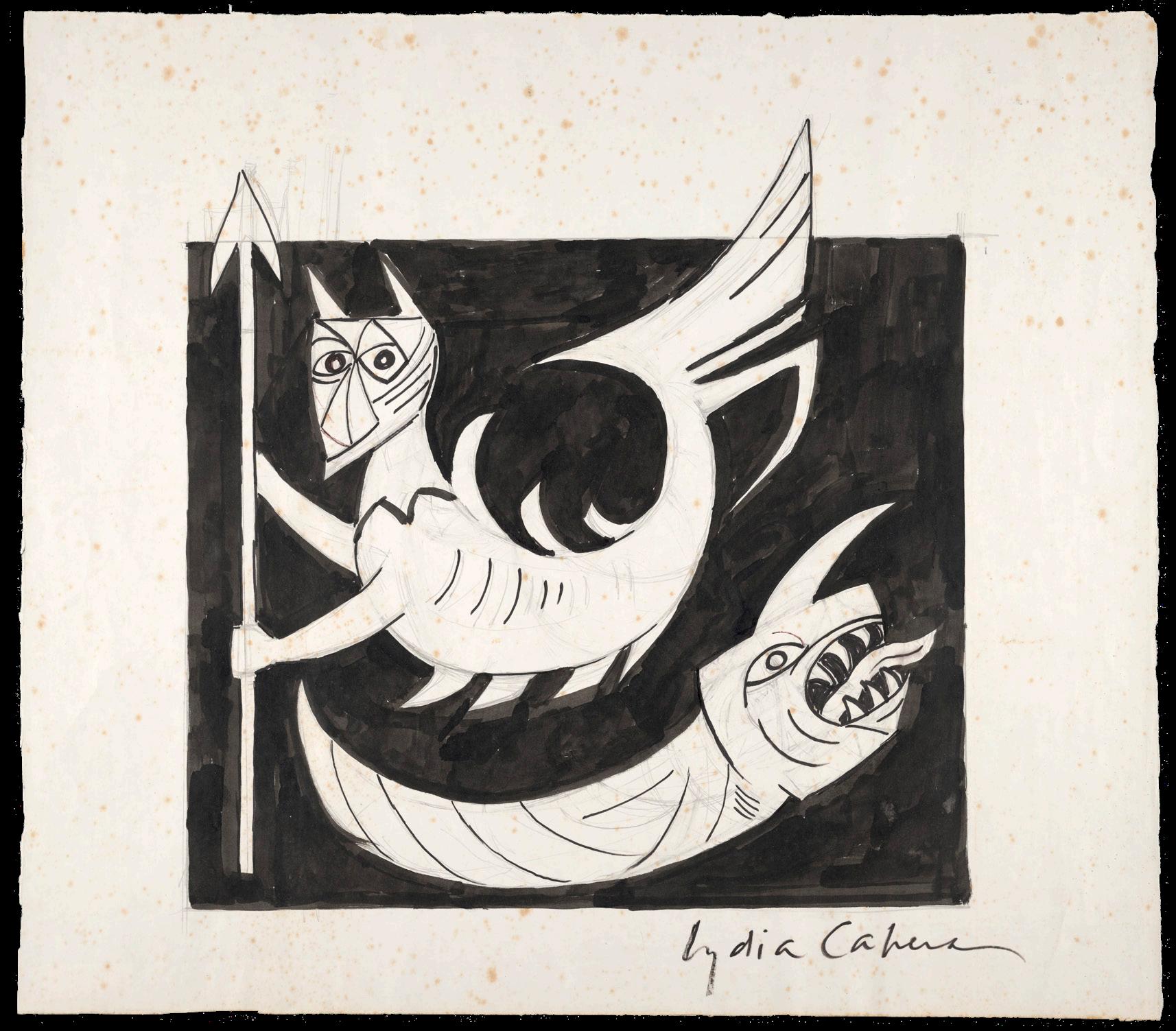
The discovery of the untitled, undated drawing on view among the treasure trove of papers, drawings, letters, notebooks, objects, and other ephemera in Cabrera’s papers, invites us to shift our attention to her visual arts production and reconsider its centrality in her work. The drawing is striking both for its content and format. Two anthropomorphic, dragon-like figures dominate the picture plane, rendered boldly in black ink and gouache. Their hybrid, fantastical nature is characteristic of other drawings Cabrera created throughout her lifetime—she often peppered her notes and marginalia with them. The work is also unique for its size, larger than her typical pieces and its composition more fully developed than other surviving works on paper. The proposition to consider the importance of the visual arts in her body of work is, of course, complicated by the welldocumented fact that Cabrera destroyed all her paintings before returning to Cuba in the late 1930s, renouncing her identity as a visual artist. However, despite this radical and definitive act, Cabrera continued to doodle, draw, and paint on paper and even on stones throughout her lifetime, thus inviting us to question the role her visual artist practice had in her oeuvre, arguably not as separate from her ethnographic work, but as integral to its articulation and expression. Engaging with Cabrera in this way highlights the methodology that drove the selection of the items for the exhibition: How does our engagement with these materials from the specific context of the archive shape and inform our understanding of Cuban cultural production and artistic practice?
THE VISUAL ARTS Artists’ Books by CINTAS Fellows
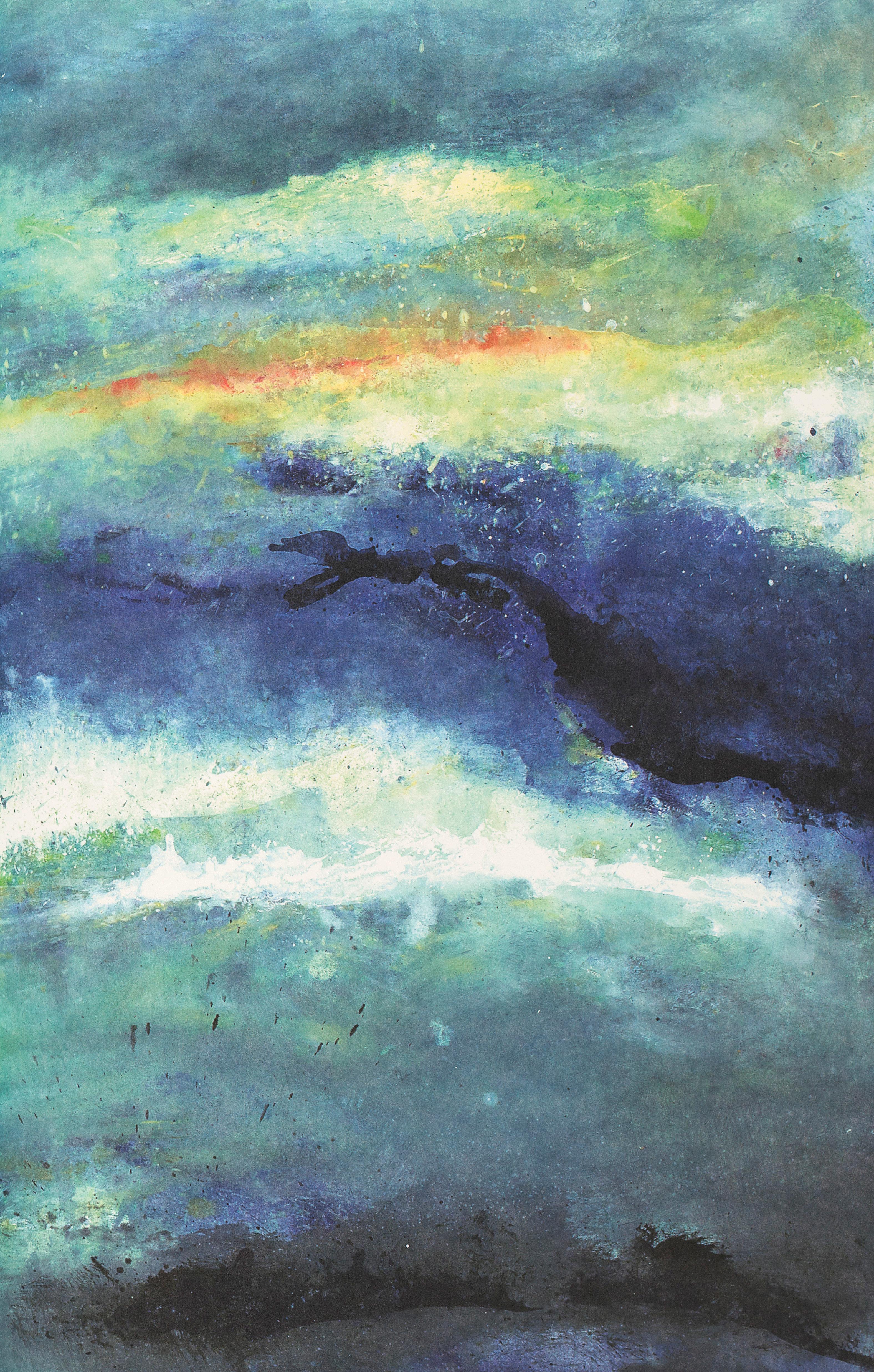
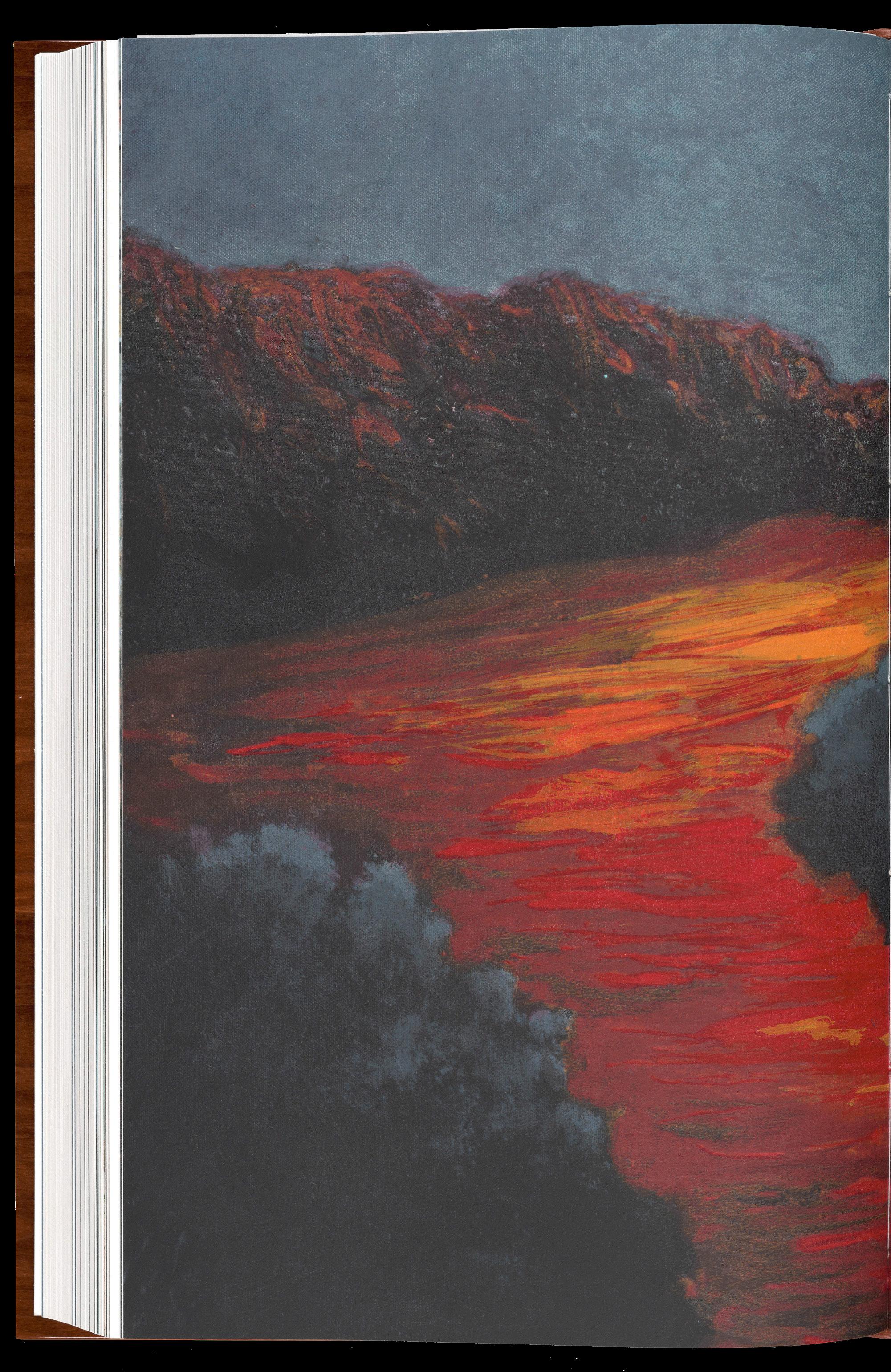
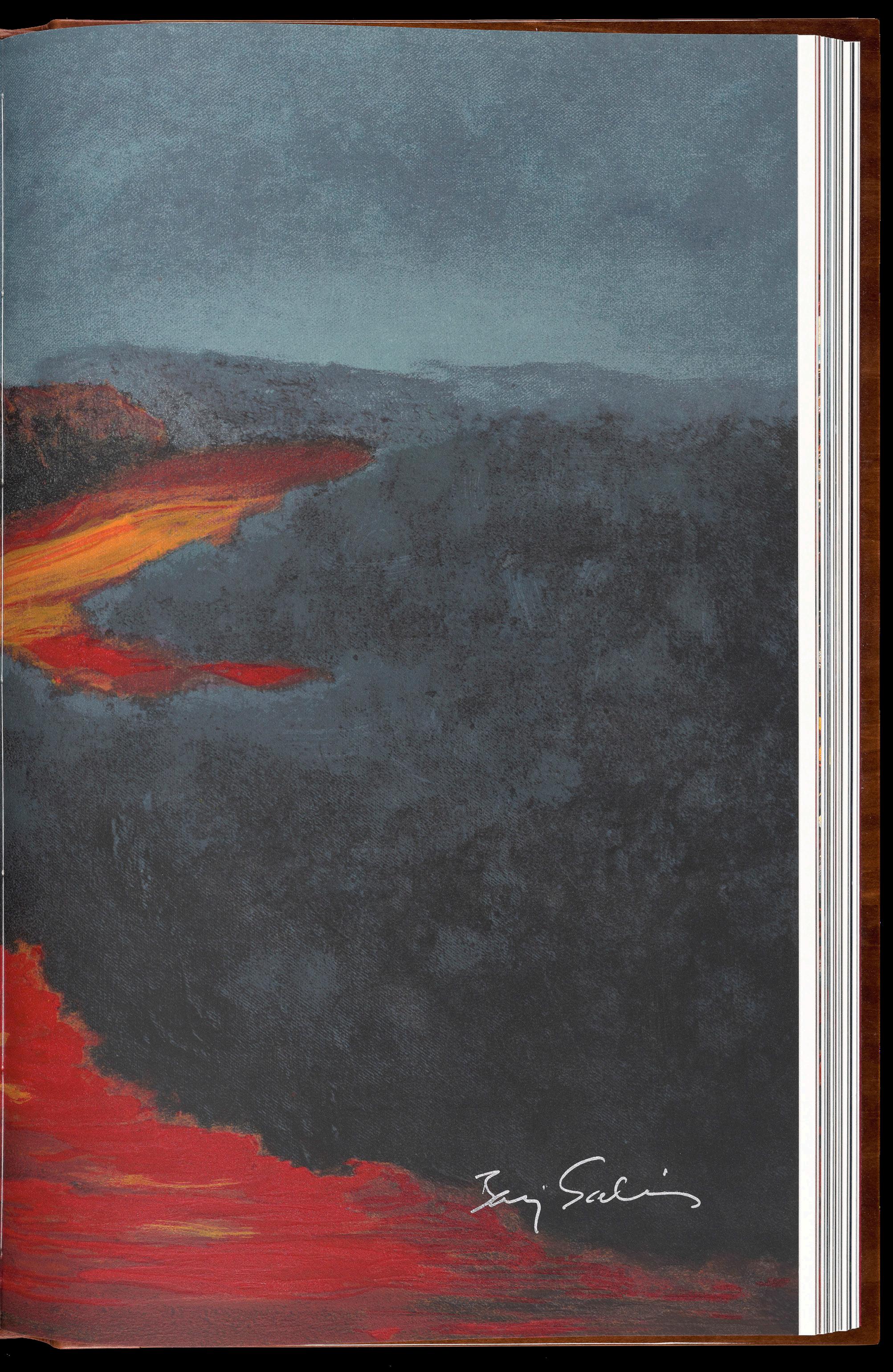
Among the Cuban Heritage Collection’s most treasured artists’ books is “The Torah Project” (2016) by Cuban American Baruj Salinas. In 2014, Salinas was commissioned to create a series of drawings interpreting the Torah’s Five Books of Moses: Genesis, Exodus, Leviticus, Numbers, and Deuteronomy. Defined as a “Chumash,” or printed edition of the Torah in the original Hebrew text, the book includes 27 lithographs printed from Salinas’ original drawings, as well as contributions by religious and cultural studies scholars in English, Spanish, Italian, and German. Printed in Urbino, Italy, the book is entirely handmade, from its paper to the binding to its impressive cover. Made from mother-of-pearl and precious wood, it is inspired by a painting by Regina Algazi de Salinas, the artist’s mother.
Like the generation of vanguard painters that came before him, Salinas traveled to Europe and became active in the Barcelona art scene, where he lived from 1974 through 1992.2 It was there that Salinas developed his own abstract visual language, characterized by an explosive energy and movement. Through his masterful merging of color and form, Salinas’ drawings powerfully convey the force described in these biblical texts about the origins of life. In addition to the book’s remarkable characteristics as
an artistic object, “The Torah Project” is representative of the rich tapestry of aesthetic, cultural, and religious narratives that make up Cuban national identity.
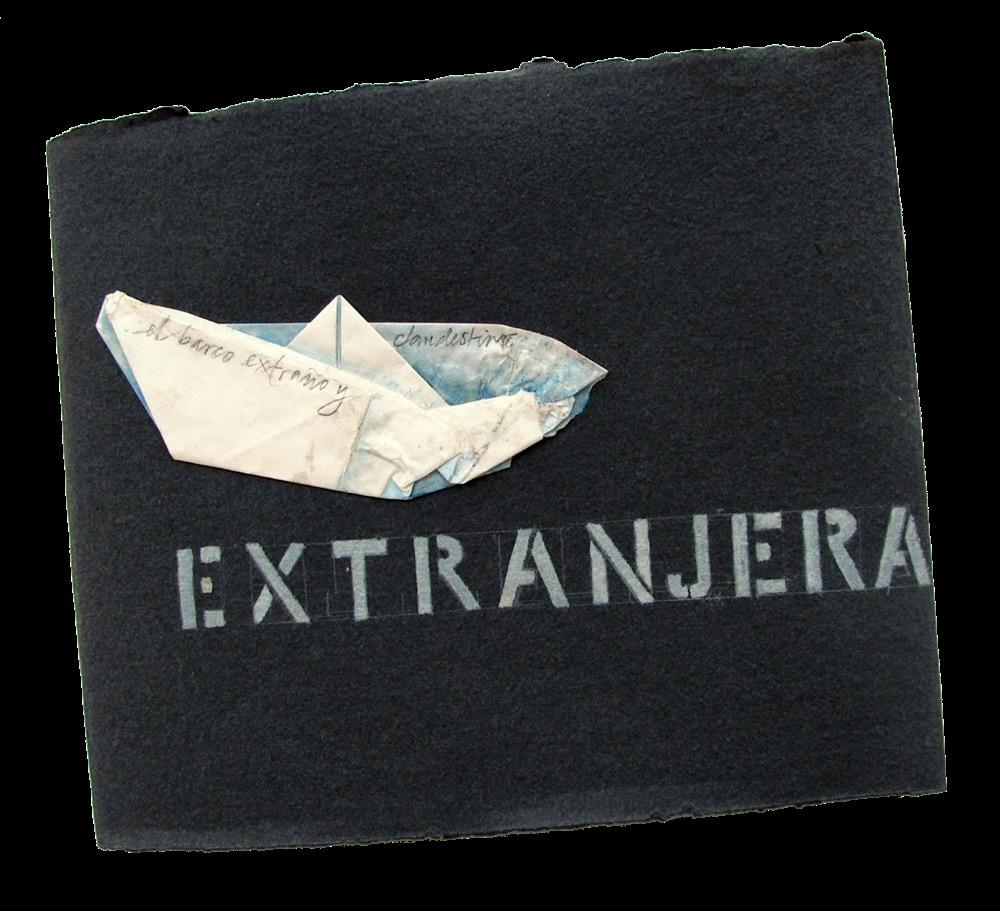
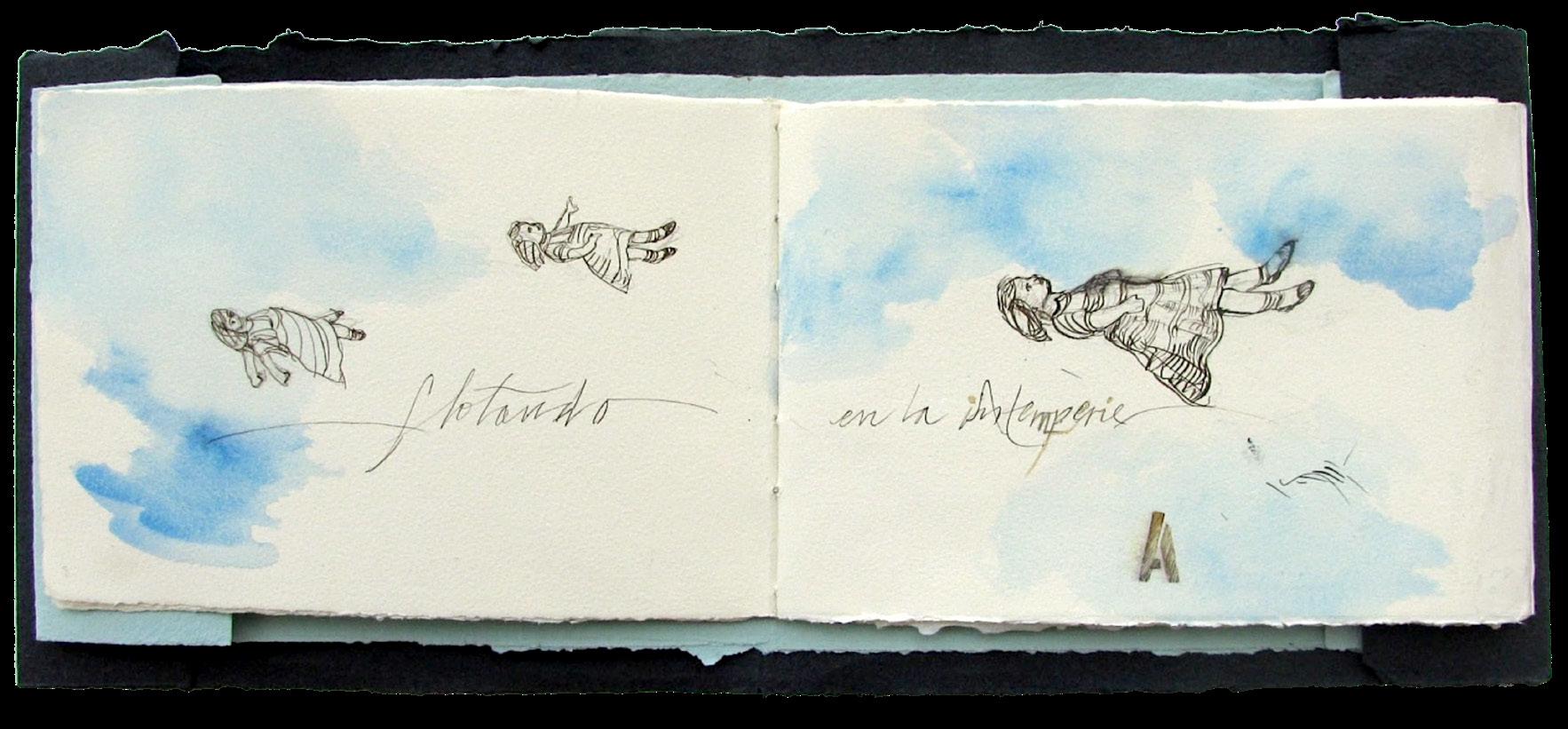
Identity is addressed from the perspectives of exile and displacement in the more personal narratives of Margarita Cano’s “Cuba: Memories and Metaphors” (2007) and Lydia Rubio’s “Extranjera” (2009), respectively. Both artists rely on the depiction of a female protagonist to tell their story. Cano’s figure is immersed in a fantastical, dream-like landscape replete with colorful visual cues from the artist’s childhood in Cuba. Inspired by the poetry of Chilean American Marjorie Agosín, Rubio’s female figure—rendered in ink and watercolor—floats untethered against the white expanse of the paper, to no particular place and as if in search of a new home to which she might belong. Both Cano’s and Rubio’s one-of-a-kind artists’ books serve as personal testimonies, transforming the pathos of migration into poetic narratives. What is imagined and dreamed about is made tangible through the materiality of the book and universal by its merging of art and words.
In contrast to the lyricism found in Cano’s and Rubio’s artists’ books, the idea of place is articulated in a more constructivist manner in Rafael Domenech’s “the elliptical hour” (2022). Made from paper, plywood, archival adhesive, laser print photographs, Plexiglas, and hanging hardware, Domenech draws our attention to the book’s materiality, prompting us to appreciate it as a constructed object. Behind the layers of materials and graphic design elements are fragments of photographic images taken by the artist that capture the architectural and vernacular elements of Miami neighborhoods. The everyday nature of these images is another way of telling a story about place and memory, different from Cano’s metaphorical approach, or Rubio’s lyrical sensibility.
WORKS ON PAPER
BY CINTAS FELLOWS
Drawings, Prints, Photography, and Ephemera
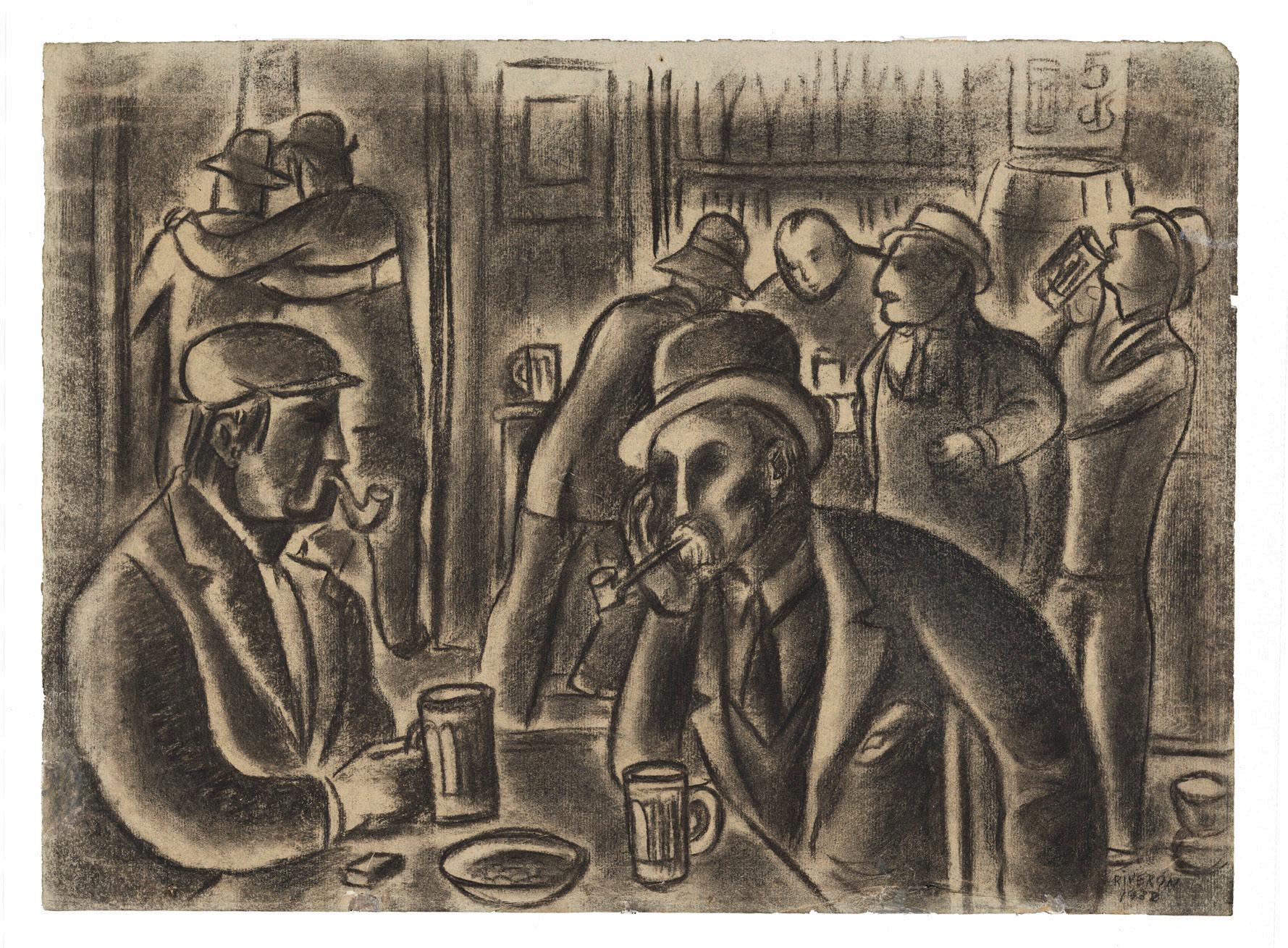
One of the earliest pieces on view is a charcoal drawing from 1932 by Enrique Riverón, an artist from the “vanguardia” generation of Cuban painters who, like Peláez and Cabrera, traveled to Europe to immerse themselves in the aesthetic language of the avant-garde of the early 20th century. The work exhibits the artist’s interest in figuration, which later gave way to experimentation with collage and abstraction following the stylistic trends that dominated postwar contemporary art. In this work, we see the influence of the Mexican mural movement in his early style of social realism.
The other item on view, a collage from the 1960s, is in dialogue with the neo-avantgarde trends of postwar American art that sought to break down the hierarchies between low and high art by using commonplace materials. Riverón’s long career also includes working as an illustrator for periodicals, which made him well-known both in Havana, Cuba, and New York City. These objects are part of a small but remarkable collection of artworks that includes illustrations, collages, and three-dimensional objects, each representative of the distinct stylistic periods that defined his work as a painter and draftsman in Cuba, Europe, and the United States.
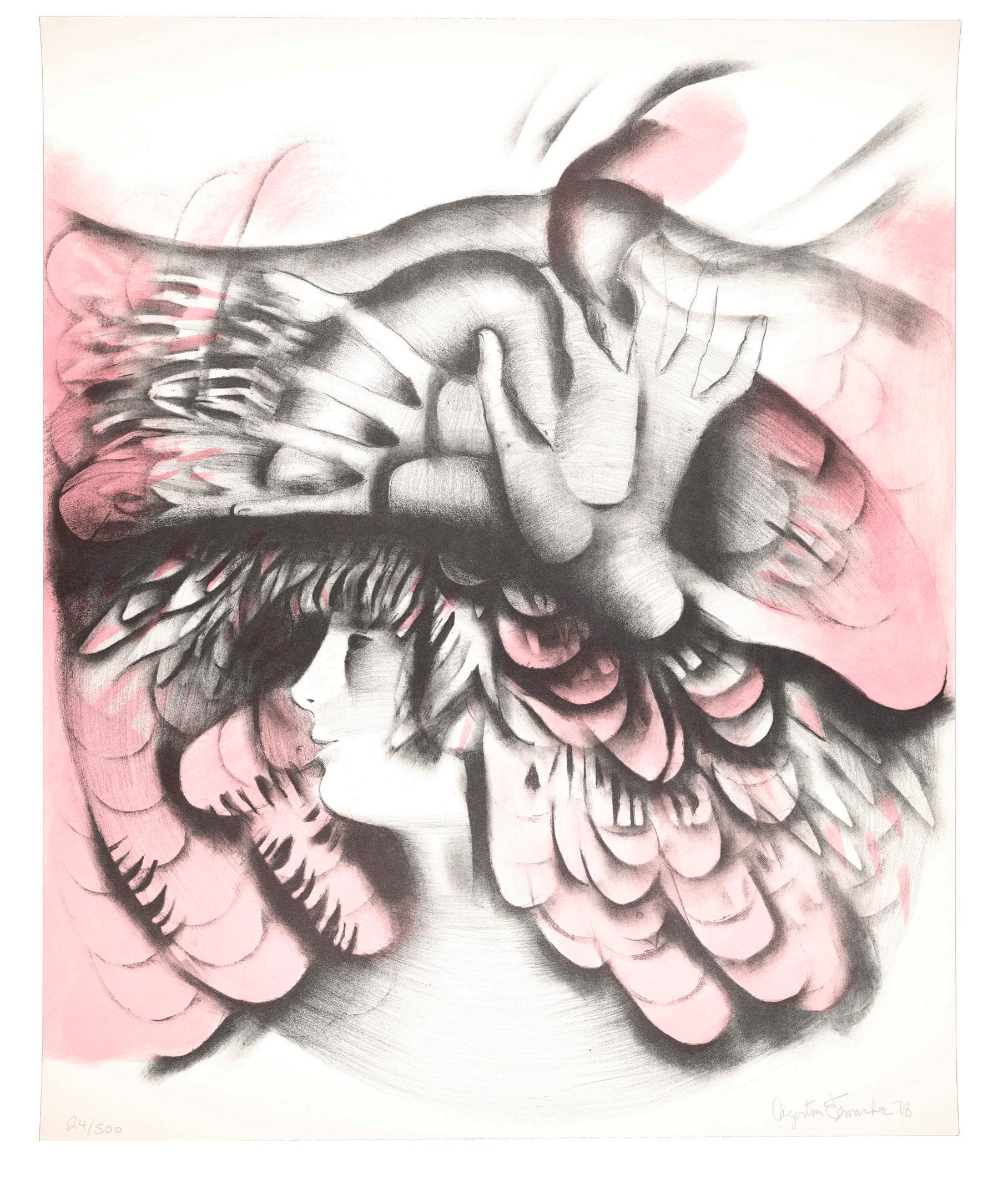
Agustín Fernández also followed in the footsteps of his predecessor and traveled to Europe to study art on a grant issued by the Cuban government. Fernández never returned to Cuba, and by the time he settled in New York in the 1970s, he had arrived at a unique artistic language, characterized by a merging of abstraction, surrealism, and amorphous figuration. These characteristics are present in the six lithographs Fernández created in 1978 for a commemorative volume titled “20th year of the Cuban Diaspora” that includes 18 poems by José Martí commissioned by the Metropolitan Museum and Art Center in Coral Gables, Florida. This portfolio of prints offers viewers a rare instance of Fernández’s artistic production in which the artist is engaging with and from his identity as a Cuban artist, albeit through a suggestive and abstract visual
language. Martí was exiled in New York City, where he wrote with both wonder and a critical eye about the Industrial Revolution’s transformation of the city into a modern metropolis. Almost a century later, Fernández deploys the language of modernity and modern art to pay homage to a historical figure with whom he shares cultural heritage and the reality of exile.
The photographs of Mario Algaze and Tony Mendoza, respectively, point to the unique and complex relationship photography holds to the archive. Historically, photographs have been understood to be veritable visual manifestations of a particular event for the medium’s capacity to render its subject with extraordinary detail. As such, in the context of the archive, they function as visual records. However, practitioners of the medium have also embraced its inherent contradiction between objectivity (or the perception of truth) and subjectivity (an image is always mediated by the photographer’s perspective). The generation of photographers that came up during the late 1960s and early 1970s reconciled these seeming oppositions by understanding the “photograph’s credibility while asserting its eternal subjectivity, as well as their own presence” (Ritchin 35). This approach has characterized Mario Algaze’s body of photographic work, including the images he captured in Cuba in 2000, when he returned to his place of birth after a 30-year absence. Stylistically, they share the same qualities as his Latin American work, as well as Algaze’s physical distance vis-à-vis the subject. As such, what do these images tell us about Algaze’s gaze specific to his identity as an exile, a Cuban American, and a photographer? What is unique about that narrative as “told” through a photographic image? Algaze traveled across the island and those experiences are fixed on gelatin silver paper in a beautiful, limited-edition portfolio of 20 photographs acquired by the Cuban Heritage Collection.
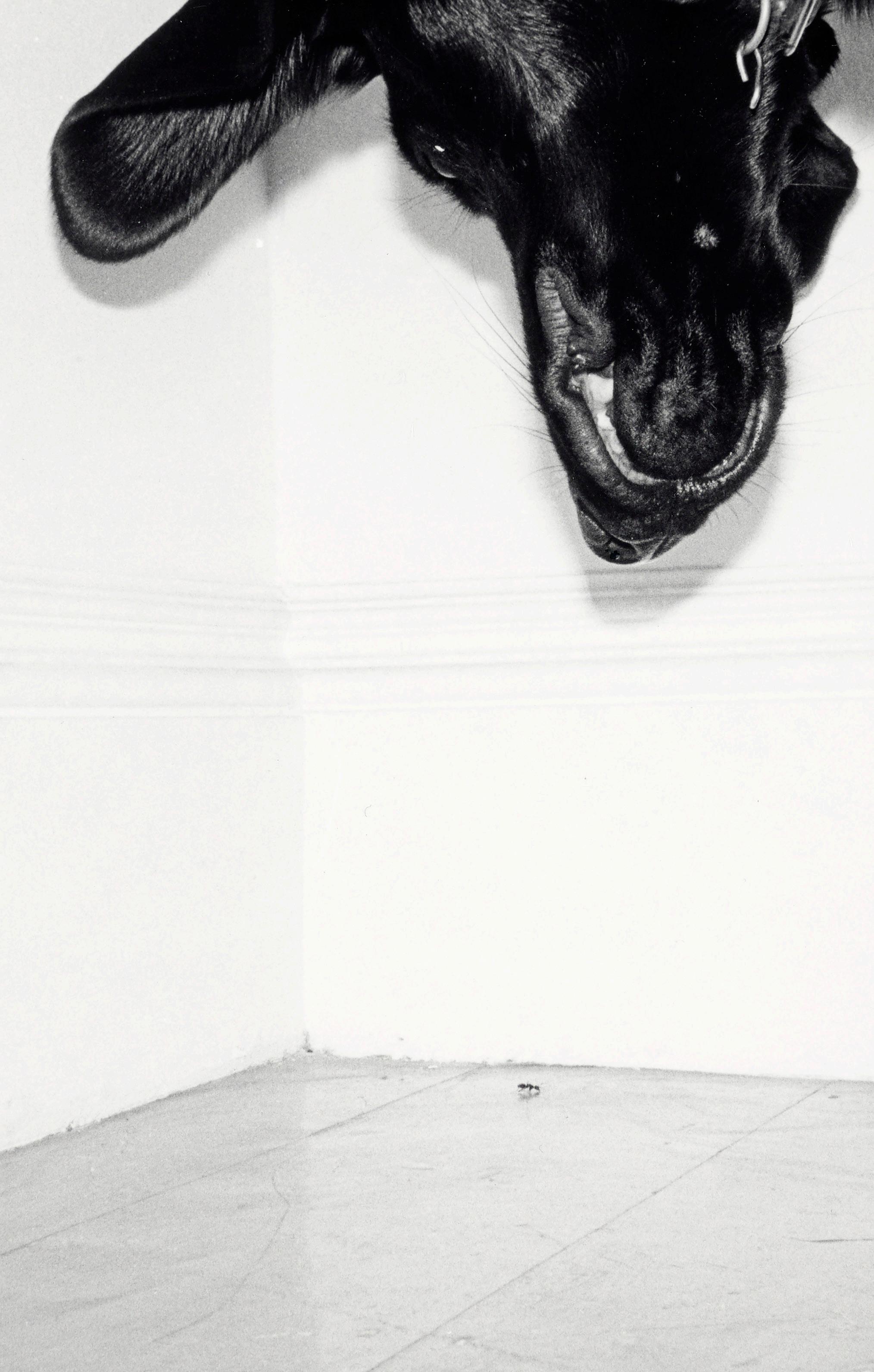
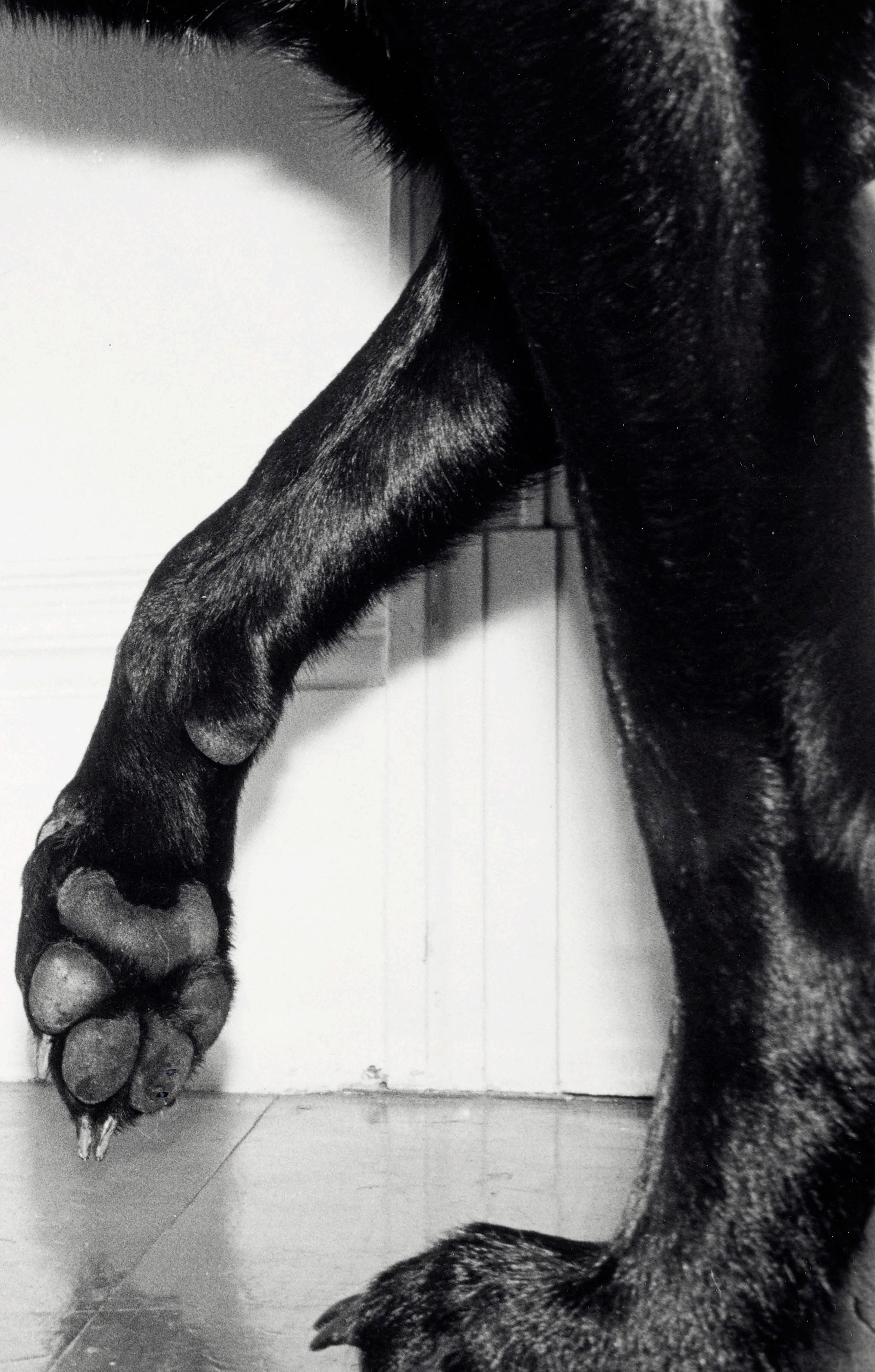
Tony Mendoza relies on photography’s narrative potential. A master storyteller, Mendoza combines image and text to chronicle stories about his family and personal life with characteristic humor and irony. Through these images we learn not only about the social life of Mendoza’s upper middle-class family, but also of the artist’s personal world. We discover that Mendoza’s girlfriend, with whom he was living in New York City in the late 1970s, had a cat and a dog who became the protagonists for a series of black-and-white photographs that would eventually earn Mendoza critical praise and set him on a path to become an art photographer.
María Martínez-Cañas shows other uses for the medium that challenge in starkly innovative ways its traditional function as a tool for documentation and reproduction. “El mantel blanco” [The White Tablecloth] is a painting by Amelia Peláez from 1935 reproduced in a series of Cuban stamps that featured key works by the vanguardia generation, including Wifredo Lam and Mario Carreño. Inspired by this collection of historical stamps from her personal archives, Martínez-Cañas recreates them in her own artistic language by constructing collages of fragments of photographic negatives from which she then creates photographs that echo the original work.
Martínez-Cañas’ experimental approach to the medium of photography signals contemporary artists’ engagement with the archive as “medium” and “form,” a longstanding topic of interest that has seen increasing critical scholarship in the field of art history since the 1990s. Artists like Martínez-Cañas, whose practice relies heavily on mining institutional archives, as well as her own, challenge traditional ways of understanding archival materials as objects with fixed meaning, exploring instead the relationships between “archive and memory, archive and public information, archive and trauma, archive and identity, archive and time” (Enwezor 22).
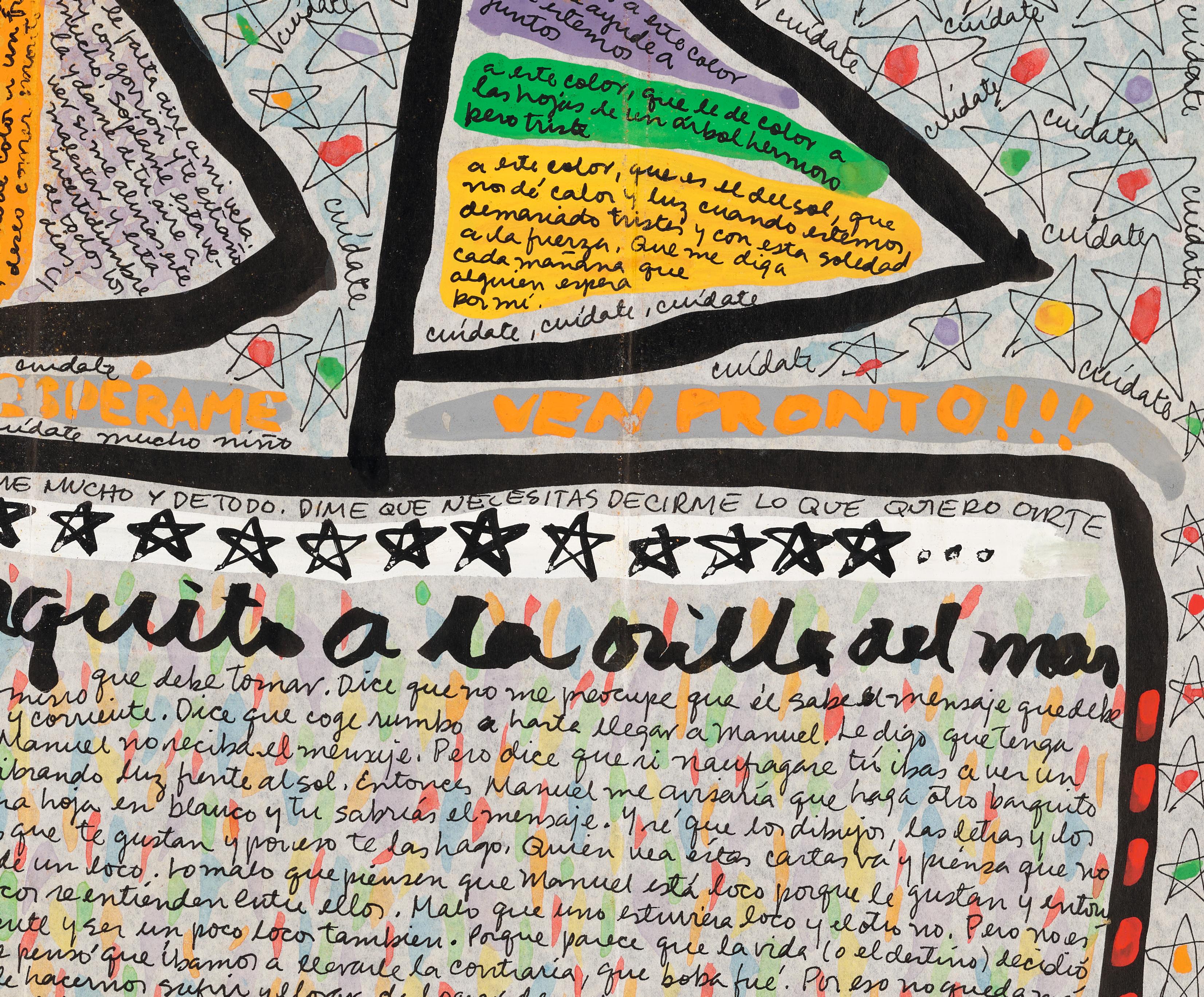
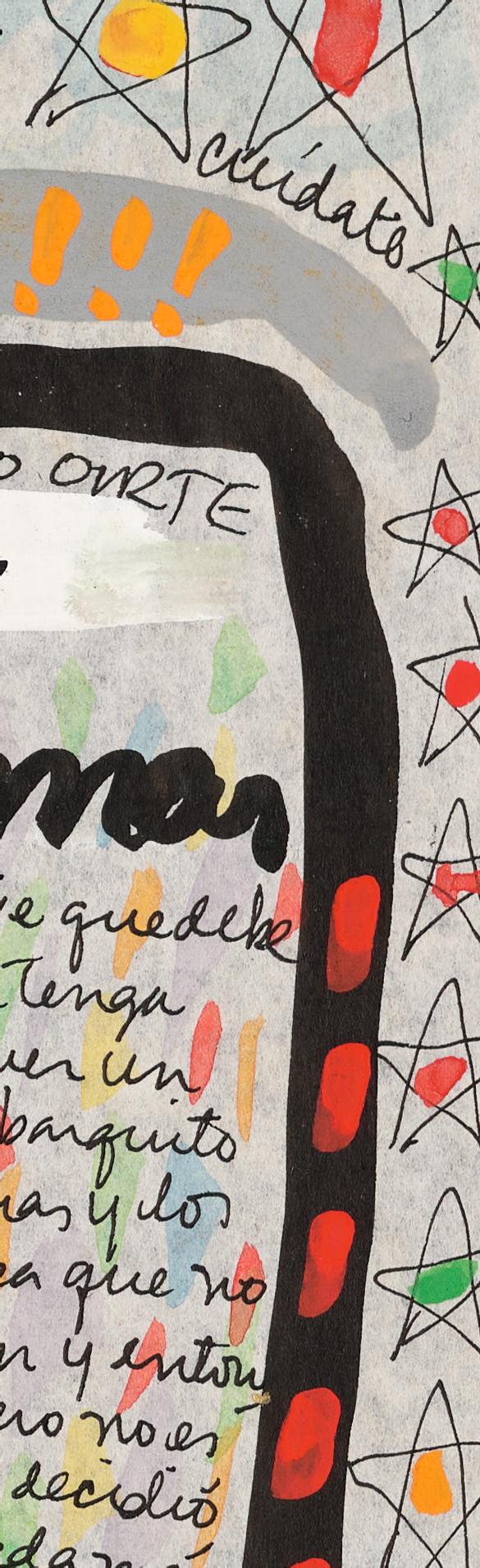
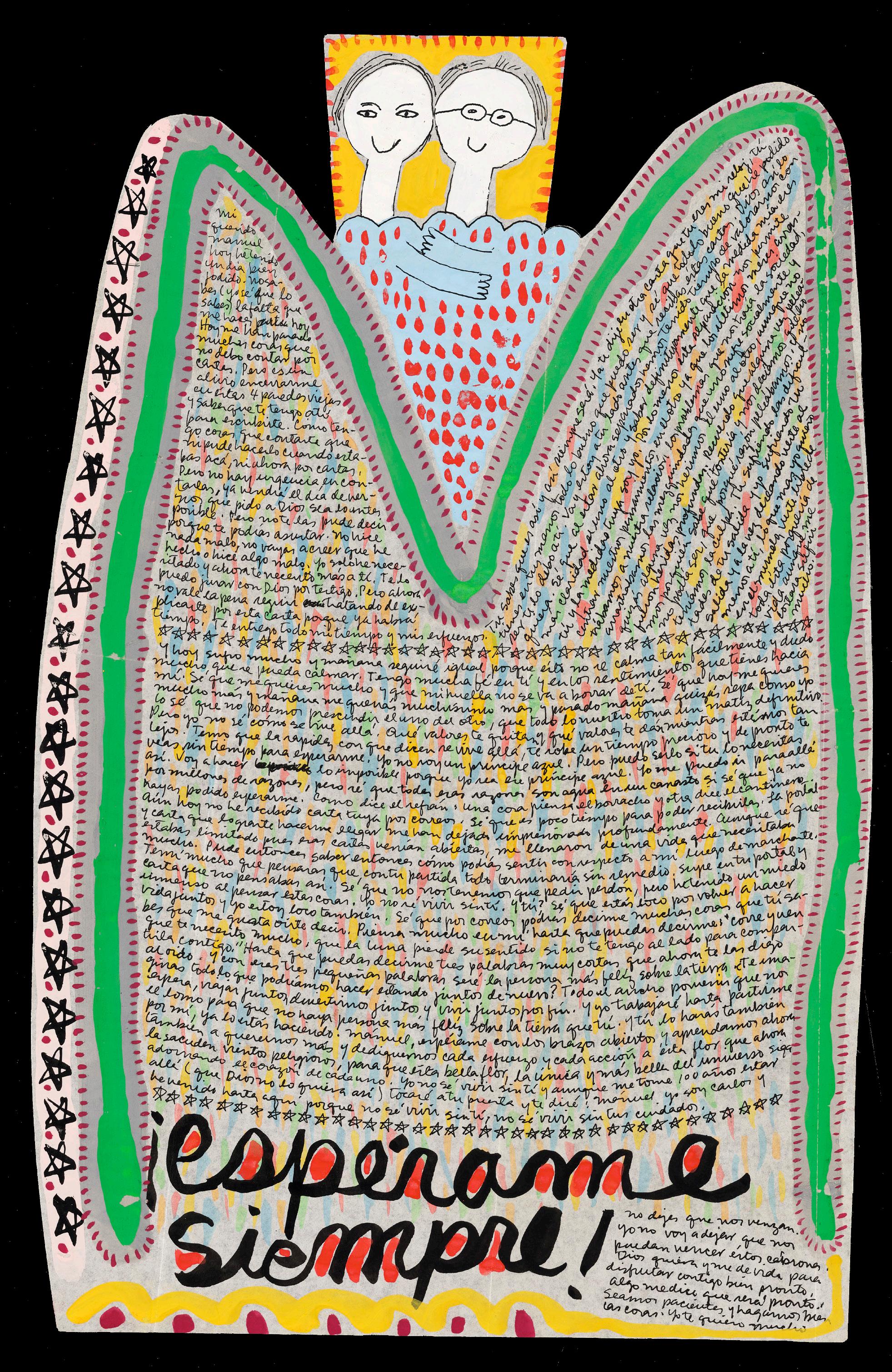
Few archival materials allow us such a privileged vantage point into the intimate spaces of its correspondents as personal letters. The cache of letters recently acquired by the Cuban Heritage Collection written by the late artist Carlos Alfonzo to his partner in Miami, Florida, Luis Manuel del Pilar, are a testament to this fact. Luis Manuel left Cuba in March of 1980 and a month later, Alfonzo left the island via the Mariel boatlift. Upon his arrival in the U.S., Alfonzo was sent to a detention center in Fort Chaffee, Arkansas. These letters document the daily correspondence by Carlos Alfonzo to Luis Manuel—written first from Cuba and then from the detention center in Fort Chaffee—until Alfonzo’s arrival in South Florida. Beautifully illustrated and written in meticulous penmanship, these letters offer an invaluable insight into Alfonzo’s early artistic formation, as well as his sexual identity. Materially, their fragility and detail offer a rich physical experience for the viewer and researcher. Finally, the circumstances that defined their romance and personal relationship intersect with broader historical moments in Cuban exile history, namely Mariel.
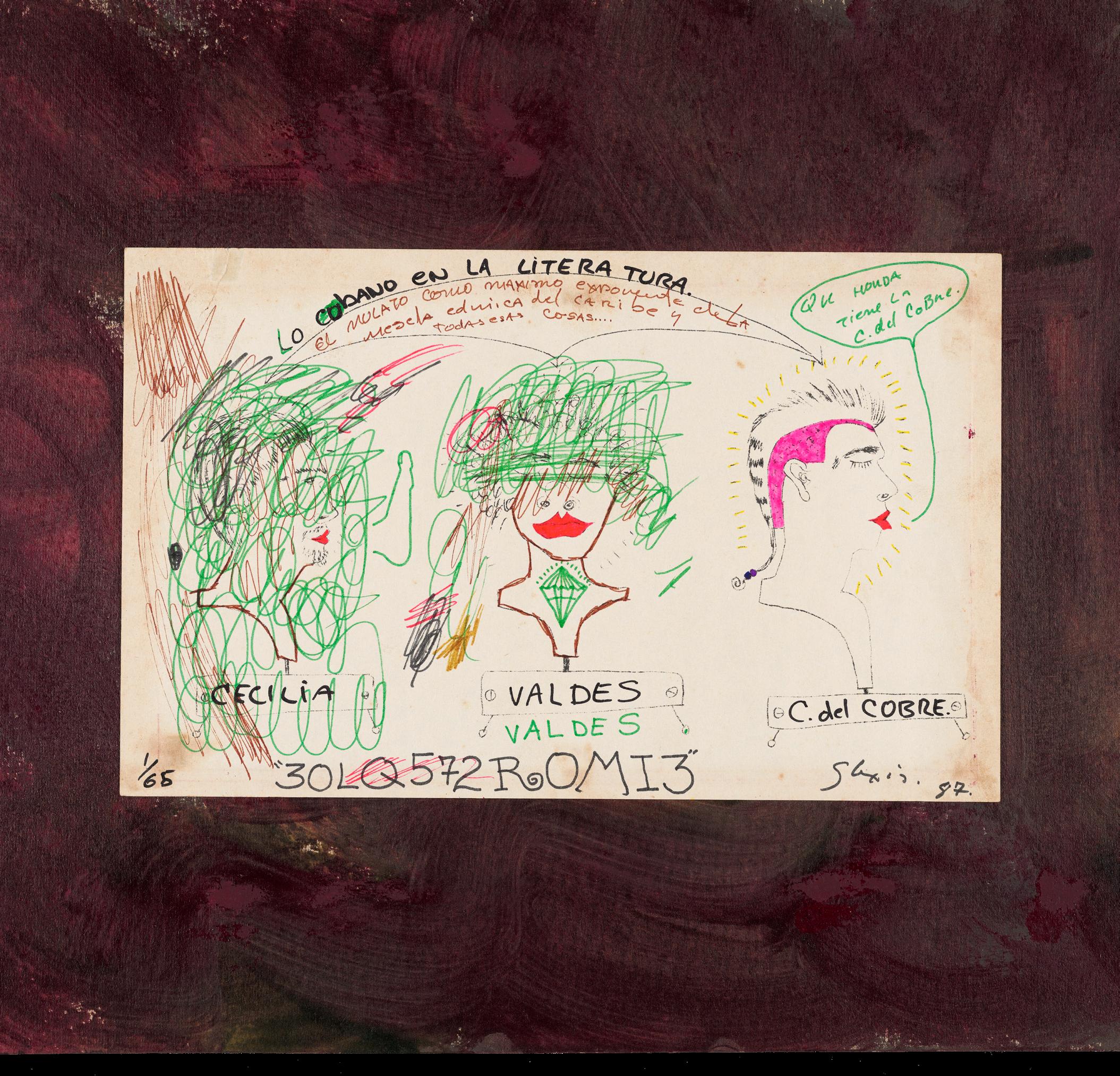
The ink and mixed-media drawings from the late 1980s by offer a similar experience for the viewer and Created in Cuba, they are rendered on sheets of poorquality paper that are precariously affixed with tiny squares of masking tape to the edges of thick board. Materially rich, these works are replete with visual references to Cuban historical and cultural figures as well as American pop culture. The works present Novoa through the framework of three different Cuban stereotypes: the “mulatto,” the “white guy,” and the “artist.” The board around which each drawing is affixed is painted with a deep red color in broad, circular strokes, adding a painterly quality to the work. This seemingly formal quality, however, should be read as an ironic act that pokes fun at what “serious” art should look like in contrast to the whimsical and seemingly haphazard nature of the drawing.
Novoa belongs to a generation of artists who emerged in Cuba in the mid-1980s known for their contestatory performances and artistic production aimed at challenging the status quo of Cuban contemporary art from that period.
In contrast and elsewhere in the exhibition, a very different type of medium—an ordinary, weathered black binder commonly used to file business cards—serves as the material support for a work by visual artist Jorge Pantoja. Instead of business cards, Pantoja filled the inserts of these plastic sheets with cutouts of random images culled from newspapers and magazines. In so doing, the artist unwittingly invites the viewer to create their own narrative connections from disjointed fragments. This untitled work belonging to an ongoing series from 2008 can also be understood as a thoughtprovoking tool for social commentary about our consumption of mass media images and their capacity for influencing our view of the world.
Cuban American artist Félix González-Torres also relied on the tenets of postmodernism to develop a highly conceptual body of work, which secured his place in the American canon for contemporary art. Unlike Novoa and Pantoja, GonzálezTorres’ references to politics and popular culture are reduced to text and couched in a minimalist aesthetic. The catalog on view titled “I always wonder if men in uniform sleep better after performing their duties” (1988) is from the artist’s first exhibition in New York City, along with the poster from the same project, held at INTAR Gallery, one of the first venues in the city solely focused on promoting the work of Latinx artists. Largely because of this fact, the exhibition and its importance for understanding González-Torres from the perspective of a Latinx artist has received little attention in the vast and growing literature on the artist; as such, the exhibition catalog and poster offer additional value to the researcher. The records that pertain to INTAR’s gallery, available at the Cuban Heritage Collection, are an invaluable repository that document the development and exhibition history of Latinx and Latin American art in the U.S. from the 1980s to the 2000s, when the venue closed.
A significant number of Cuban American artists exhibited at INTAR, including María Lino with her early feminist sculptures and installations from the 1970s and 1980s. Here, Lino is represented through a recent monotype titled “Mother of Exiles” (2017) from the series “I am an Immigrant.” Lino suspends notions of compositional logic and order, opting instead to play with scale and create an aesthetic entirely her own. In this case, the iconic Statue of Liberty is transformed into a personal memento, held in the artist’s hand and dwarfed by the exaggerated largeness of her fingers. The juxtaposition of these pictorial elements, along with an excerpt from the poem by Emma Lazarus written in the artist’s own handwriting, adds a vernacular aspect to the work reminiscent of the protest art of Latinx women of previous generations. For Lino, art is a tool for social commentary evidenced in this uncompromising piece about immigration, a topic that continues to dominate the current political discourse.
THE LITERARY ARTS AND MUSIC IN THE ARCHIVES
Papers, Manuscripts, and Scores by CINTAS Fellows
The CINTAS Fellows in the category of creative writing feature Cuban and Cuban American authors from different generations, and their literary production is representative of various genres such as fiction, memoir, and playwriting.
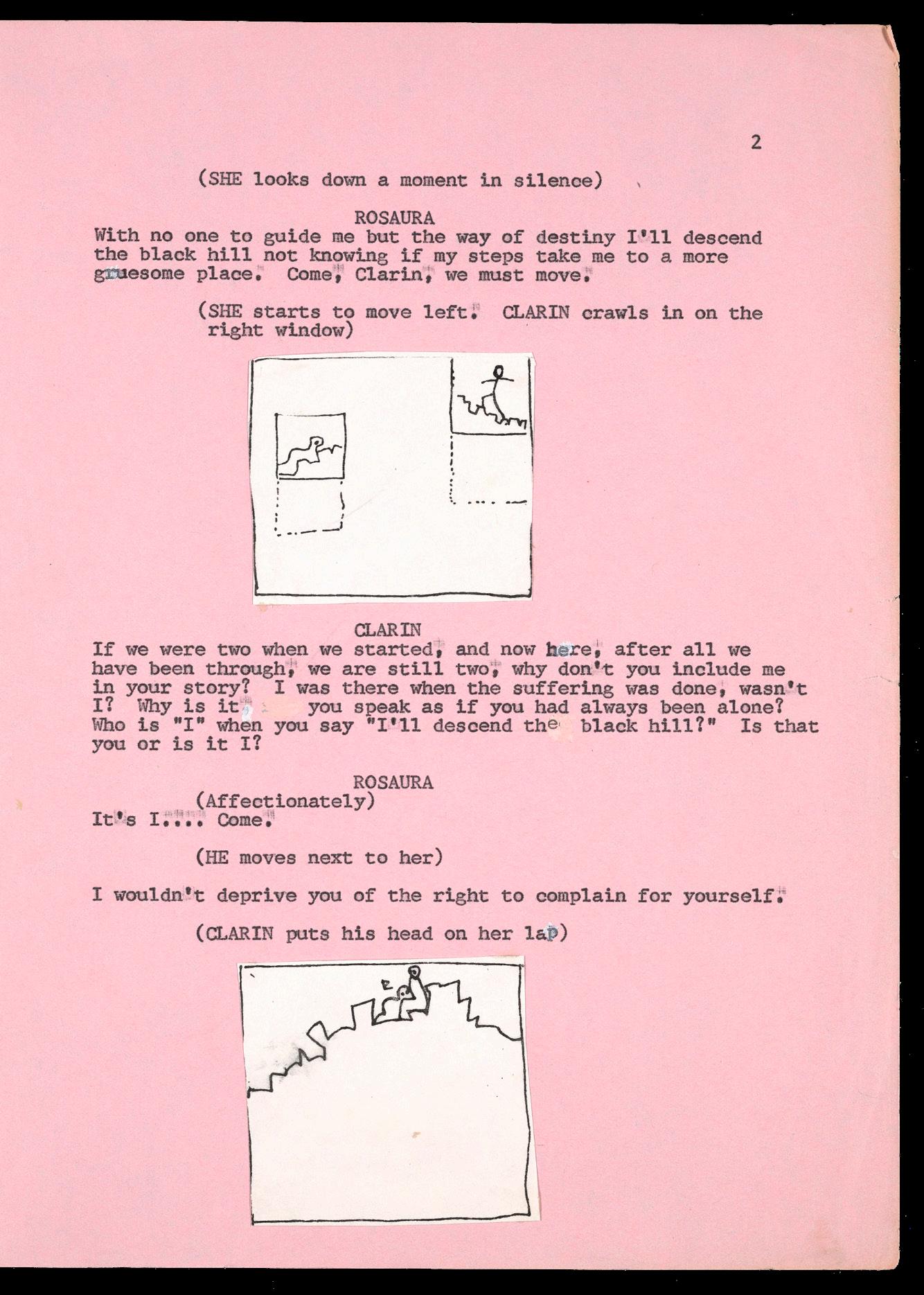
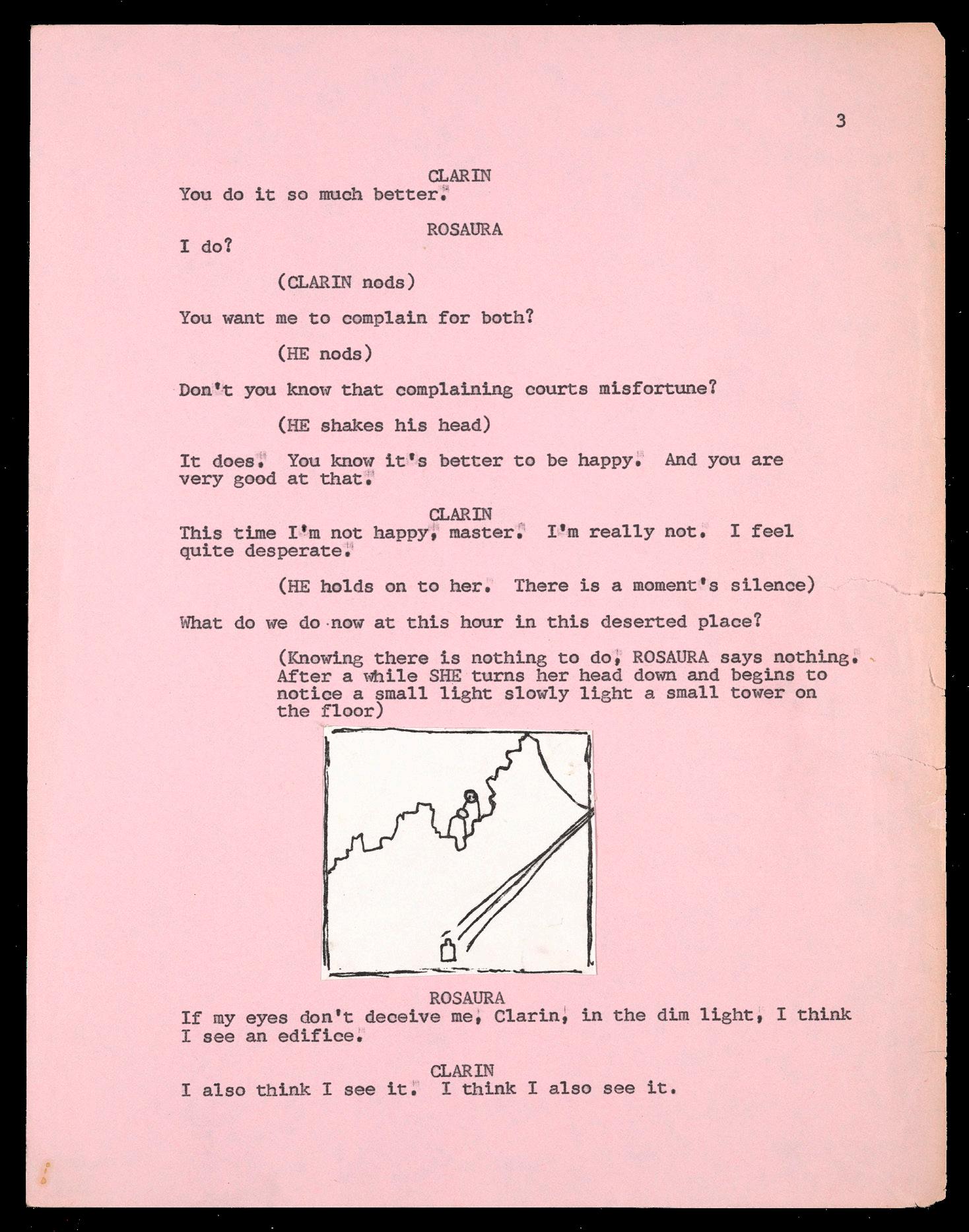
The papers of María Irene Fornés, renown iconoclastic playwright and experimental theater director, are comprised of correspondence, notes, and a rich plethora of ephemera that provide a privileged insight into her unorthodox methodologies. The examples on view include pages from a working play script from 1981 of an adaptation of the classic Spanish work by Pedro Calderón de la Barca titled “La vida es sueño” [Life is a Dream], which Fornés translated from Spanish to English. Alongside it is a review of that translation by Carmen Salazar Parr, a respected theater critic who wrote a highly negative response enumerating all the ways in wh translation fails to do proper justice to Calderón de la Barca’s Spanish, stating the language’s “bad style.” Parr misses the point here: It is precisely Fornés’ irreverent approach to the enterprise of translating a canonical text that lies at the heart of her brilliant methodology. The audacity to manipulate and intervene a classical text into a postmodern production itself becomes cunning commentary about bilingualism and identity, in Fornés’ case as both a Cuban and American artist. For researchers interested in questions of language and translation in Fornés’ extraordinary productions, these materials provide an invaluable resource.3
Similarly, researchers will delight in having access to a typescript copy of Reinaldo Arenas’ critically acclaimed autobiography, “Antes que anochezca” [Before Night Falls], one of several manuscripts of this title that the author worked on before it was posthumously published in 1992. Arenas is the most internationally recognized author from the Mariel generation, a group of artists and intellectuals that arrived to the U.S. via sea in 1980 as part of a massive exodus of Cuban refugees. The version on view belonged to Cuban poet Roberto Valero, also a CINTAS Fellow and member of the Mariel generation, who along with his wife, artist María Badias, helped to transcribe Arenas’ memoirs in 1990, not long before the author passed away from AIDS-related health complications. The manuscript’s annotations, notes, and marginalia—made by Arenas and Valero—are useful for researchers interested in comparing the various editions that have been published.
Diaries and notebooks are archival materials that, like letters, offer readers insight to the internal worlds of their authors. The “cuaderno,” or notebook, on view by Cuban Jewish poet José Kozer displays the handwritten version of a poem titled “A mis 75 años” [On my 75th Birthday] (2016) alongside the book in which it was later published. A prolific poet who for over 40 years has written one poem a day, Kozer’s poetry is representative of the neobarroco [neo-Baroque] tendency in Latin American poetry that emerged in the 1970s, characterized by its multidimensional and layered approach to language. Considered the preeminent Cuban poet of his generation and a household name among serious readers of poetry in Latin America, Kozer won the Pablo Neruda Ibero-American Poetry Award in 2013 for his “lifetime contribution to poetry.” Kozer’s journals, notebooks, correspondence, and other archival material, as well as his published works and personal library, are part of the Cuban Heritage Collection’s holdings.
Aurelio de la Vega, and Tania León, respectively, highlight important contributions made by Cuban composers to classical and modern musical styles in 20thand 21st-century music, through a variety of items that include illustrated scores, correspondence, and portraiture.
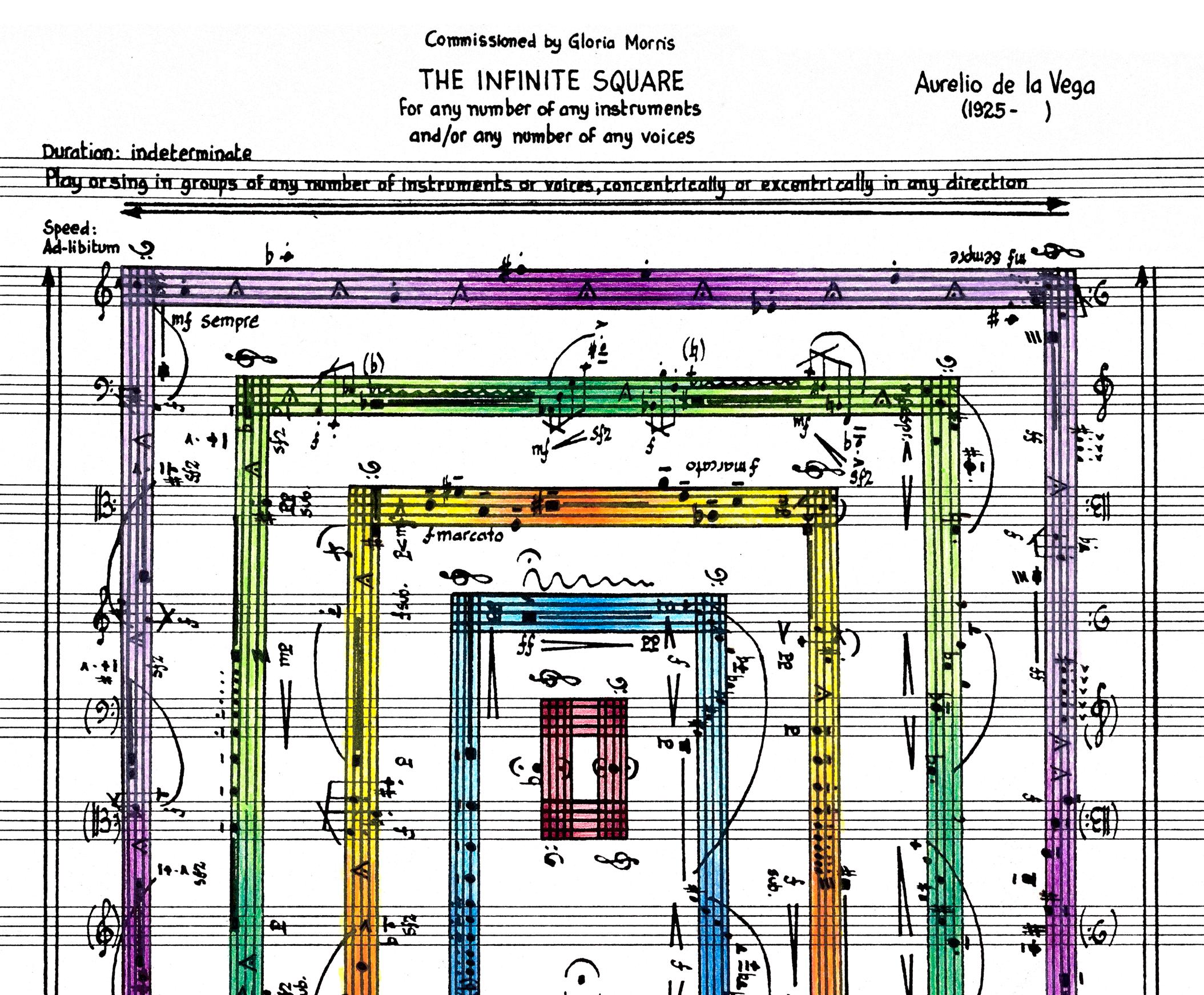
Aurelio de la Vega was a highly respected composer and beloved educator who taught composition at California State University for 34 years. His second artistic love was painting, and in the 1970s, de la Vega began to experiment with the intersection of music and visual art, creating a series of hand-colored graphic scores that were “totally conceived from a pictorial point of view.” de la Vega described the idea behind these musical sheets as consisting of “musical fragments—some totally delineated as to pitches, rhythmic configuration phrasing, and dynamics, others merely suggested as areas of improvisation, with multiple directional possibilities—creat[ing] a satisfactory pictorial image, playable, but at the same time capable of projecting its own visual architecture.” Known for his symphonic pieces; chamber music works; solo instrumental pieces; vocal works; piano, guitar, and ballet music; and electronic compositions, de la Vega was influenced by the avant-garde movements of the 20th century in which geometric abstraction dominated the visual language of the moment.4
Spanish-born Cuban composer Julián Orbón—from the same generation as Aurelio de la Vega—also left Cuba in 1960, soon after the advent of the Cuban Revolution, settling in New York where he lived the rest of his life. There he studied under Aaron Copeland, who once described Orbón as “Cuba’s most gifted composer of the new generation” (Blau). Orbón was a member of Orígenes, Havana’s circle of modernist artists and intellectuals; his works range from orchestral pieces to chamber and keyboard music, highly influenced by both the classical and folk music of Spain, Cuba, and Latin America. The handwritten letter from Orbón on display is part of a collection of correspondence written in the 1970s to Jorge Camacho, a Cuban artist living in Paris. In it, Orbón shares his ideas about a musical composition that Camacho commissioned from him in 1978. On view is a sheet from the original score he composed in the late 1970s that was inspired by the 14thcentury classic “Llibre Vermell.”
Afro-Cuban composer and conductor Tania León belongs to a younger generation, who like other Cuban musicians before her settled in New York soon after leaving Cuba in 1967. León is a towering force in the world of contemporary classical music, having received numerous prestigious awards, most notably a Pulitzer Prize in Music for her recent work “Stride,” commissioned by the New York Philharmonic in 2021. A year later, she was named a recipient of the 45th Annual Kennedy Center Honors for lifetime artistic achievements. In addition to her musical accomplishments, León is an esteemed educator and respected cultural activist, who is a founding member and first musical director of Arthur Mitchell’s Dance Theatre of Harlem, and more recently founded Composers Now with the mission to empower composers of diverse voices and bring visibility to their work.
The score on display from 1987 is an homage to the great African American baritone Paul Robeson, who was also a renowned stage and film actor, and later in his life became known for his social activism. In addition to the musical content, the fact that León pays tribute to this important American cultural figure reveals her own social preoccupations and cultural sensibilities as a pioneering black Latina artist. León’s elegance and quiet force is captured in the black-and-white portrait (1998) taken by Cuban American photographer Alexis Rodríguez-Duarte in collaboration with Tico Torres, which is also on display.
The medium of film and video, like photography, has a documentary function, and in the context of the archive, audiovisual records have historically served as important and reliable resources of information. Contemporary artists have also long exploited the moving image’s capacity to tell stories, an effective visual mechanism for creative expression and social commentary. Both films on view by Cuban Americans, Lisandro Pérez-Rey and Coco Fusco, respectively, were made in response to or inspired by political events. Each, in interwoven and parallel ways, are thought-provoking commentaries on the intersection of public sites, protest, and civil engagement (sanctioned and not) for Cubans in exile and on the island.
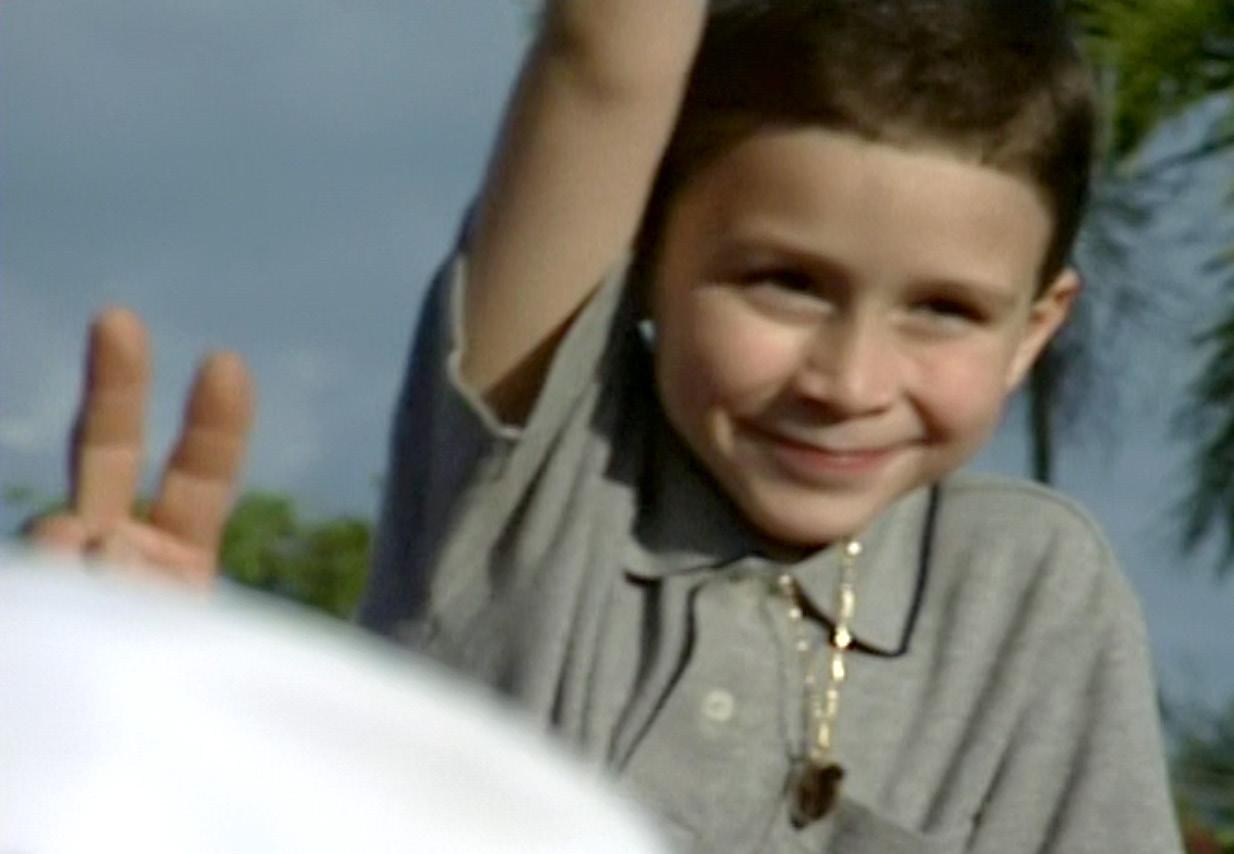
Lisandro Pérez-Rey’s short documentary was filmed outside Elián González’s family home in Miami on April 15, 2000, less than a week before Elián was taken by federal agents in a pre-dawn raid on the house. As a boy, Elián was at the center of a custody battle in 2000 that set off a crisis in Cuba-U.S. relations. The issue of whether Elián should remain in Miami with his relatives (after enduring a harrowing journey at sea with his mother and other family members who perished in the crossing), or be returned to Cuba
where his father lived, further polarized Cubans on the island and in Miami’s Cuban exile community. The case became a rallying cry that served the political agendas of these opposing groups. The street outside his home and the neighborhood at large became an impromptu site for public protest and local support of Elián and his family. The subsequent decision by the Clinton administration to return the boy to his father in Cuba prompted massive protests in Miami and served to destabilize the established perception of a monolithic Cuban community.
Coco Fusco’s “La plaza vacía” [The Empty Plaza] (2012) is a commentary about the uses of public sites that was inspired by the events that took place across the Arab world in 2011. Fusco turned her camera to Havana’s Plaza de la Revolución, a public square that the artist describes in the work as “a stark, inhospitable arena where all the major political events of the past half-century have been marked by mass choreography, militarized displays, and rhetorical flourish ... an empty stage filled with memories.” In the context of Cuba’s communist government, in which individual or mass protest is quashed by the state, the “empty plaza” stands as a poignant metaphor for the failures of revolutionary promise. The film includes archival footage of various events that have taken place at the plaza since 1959, adding to the video’s historical dimension, with voice-over narration by Yoani Sánchez, an internationally recognized journalist and dissident based in Havana.
This overview of the works in the exhibition and their relationship to the archive concludes with video highlights of the first exhibition featuring CINTAS Fellows held in 1978 at the Miami-Dade Public Library. The 1978 exhibition was curated by Margarita Cano, artist and champion of the visual arts, who is also a founding board member of the CINTAS Foundation. Cano, along with Barbara Young, created a rigorous and active arts program through the county’s public library that became paramount for local artists to showcase their work. On view is a digitized version of an interview Cano did for public television in which she gives a tour of the inaugural CINTAS Fellows exhibition highlighting various works by early recipients of the fellowship.
The year 2023 marks the 60th anniversary of the CINTAS Foundation, and this exhibition and related programming celebrate and recognize its singular contribution over the past six decades in supporting and preserving Cuban cultural patrimony around the world, a mission it shares with the Cuban Heritage Collection at the University of Miami Libraries.
Elizabeth Cerejido, Ph.D.
Curator for Cuban Collections
Cuban Heritage Collection, University Libraries
EXHIBITION CURATED BY
Elizabeth Cerejido, Ph.D. | Curator for Cuban Collections
WITH THE ASSISTANCE OF Juan Villanueva, M.S.I. | Archives Manager and Public Services Coordinator
SPECIAL THANKS TO
The Libraries’ departments of Building Services, Creative, Digital Initiatives, Preservation Strategies, and Systems for exhibition preparation, conservation, design development, and installation
We thank our sponsors for their generous contributions to “The CINTAS Foundation: An Archival Perspective.” This exhibition was made possible through the support of the CINTAS Foundation, ArtesMiami and Aida Levitan, and Rafael and Marijean Miyar. We are thankful to the individuals and institutions who loaned materials for the exhibition, including María Lino, Jorge Pantoja, the CINTAS Foundation, the Lynn and Louis Wolfson II Florida Moving Image Archives at Miami Dade College, and the Marta and Austin Weeks Music Library and Technology Center at the University of Miami. Thank you to the cultural practitioners, families, and collectors who donated materials and provided funding for the acquisition of these works so that we could grow our documentation of Cuban diasporic artistic practice at the Cuban Heritage Collection. The body of work represented in this exhibition is a testament to the creativity of the Cuban diaspora community.
LIST OF WORKS
Aguilera, Carlos A. (b. 1970, Havana). “Matadero seis.” Illustrations by Liber May. [Valencia]: Aduana Vieja, 2016.
Alfonzo, Carlos (b. 1950, Havana; d. 1991, Miami). Selection of handwritten, illustrated letters by the late Cuban American artist, written to his partner Luis Manuel del Pilar. 1980. Luis Manuel del Pilar collection on Carlos Alfonzo. This acquisition was made possible through a gift from the Kadre Family in honor of art collector and Cuban Heritage Collection patron Peter P. Menéndez. See pages 14 and 15.
Algaze, Mario. Mira quien viene, Santiago de Cuba, from the Cuba portfolio, 2000. Gelatin silver print, 9/15; Homenaje a Titón, La Habana, from the Cuba portfolio, 2000. Gelatin silver print, 9/15. Mario Algaze photograph collection.
Arenas, Reinaldo. (b. 1943, Holguín; d. 1990, New York). “Antes que anochezca (Autobiografía).” Photocopy of typescript, 1991. Cuban Historical & Literary Manuscript collection.
Boza, Juan (b. 1941, Camagüey; d. 1991, New York). Black and white photographs of artwork from the artist’s solo show titled “Juan Boza’s World” on view at Ollantay Center for the Arts, Jackson Heights, NY, 1990. Photographs by Rafael Llerena. Juan Boza papers.
Cabrera, Lydia (b. 1899, Havana; d. 1991, Miami). “Untitled,” n.d. Ink and pencil on paper. Lydia Cabrera papers. See page 6.
Calzada, Humberto (b. 1944, Havana). “Espejo de paciencia,” 2003. Acrylic on canvas. Gift of the artist.
Cano, Pablo (b. 1961, Havana). “10,865,” 1980. Sparkling paste, acrylic, and spray paint on paper. Original drawing for group exhibition poster. Pablo Cano papers. Poster designed by Pablo Cano for a group exhibition titled “10,865,” held at the Miami-Dade Public Library, Biscayne Boulevard, June 10–16, 1980.
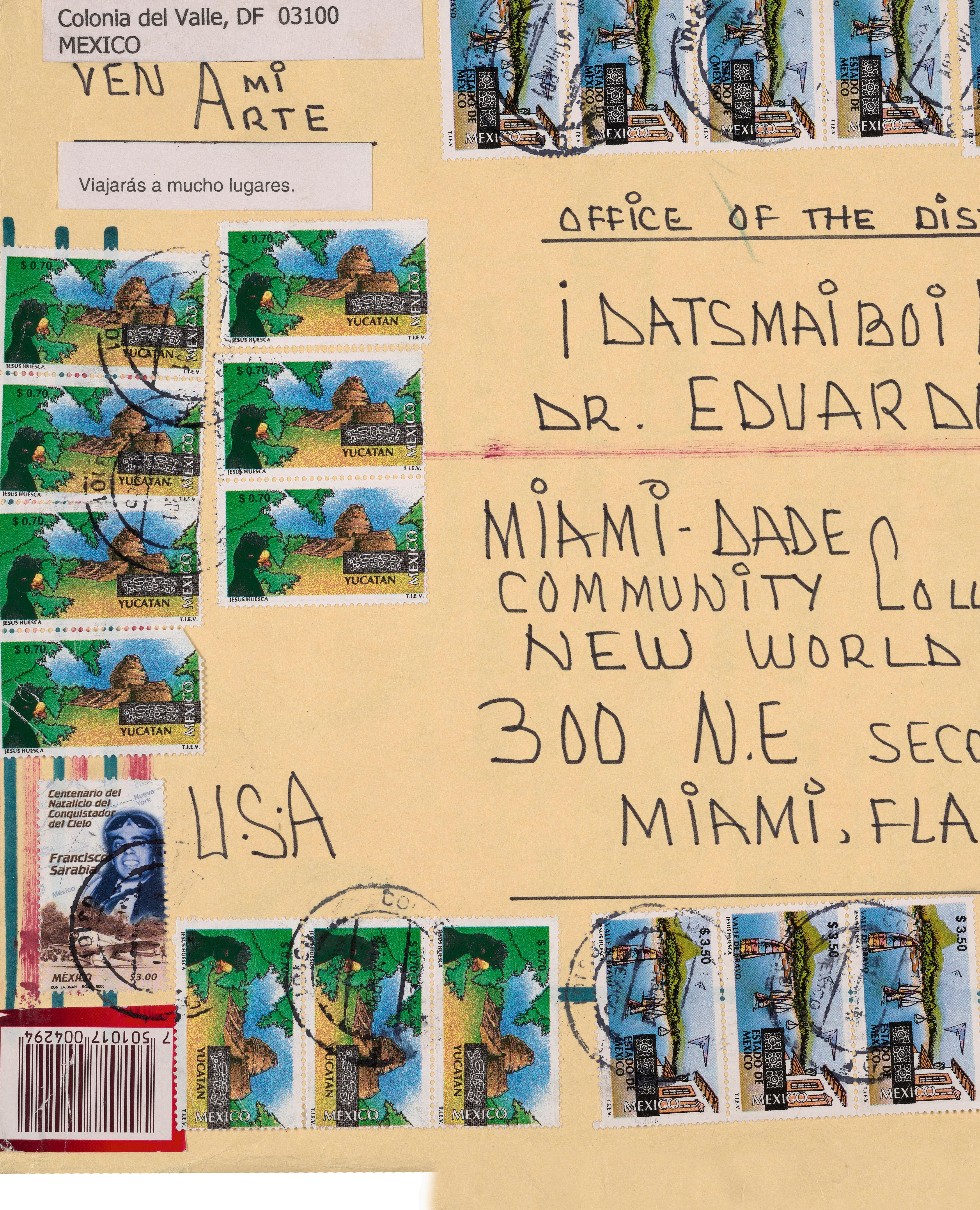
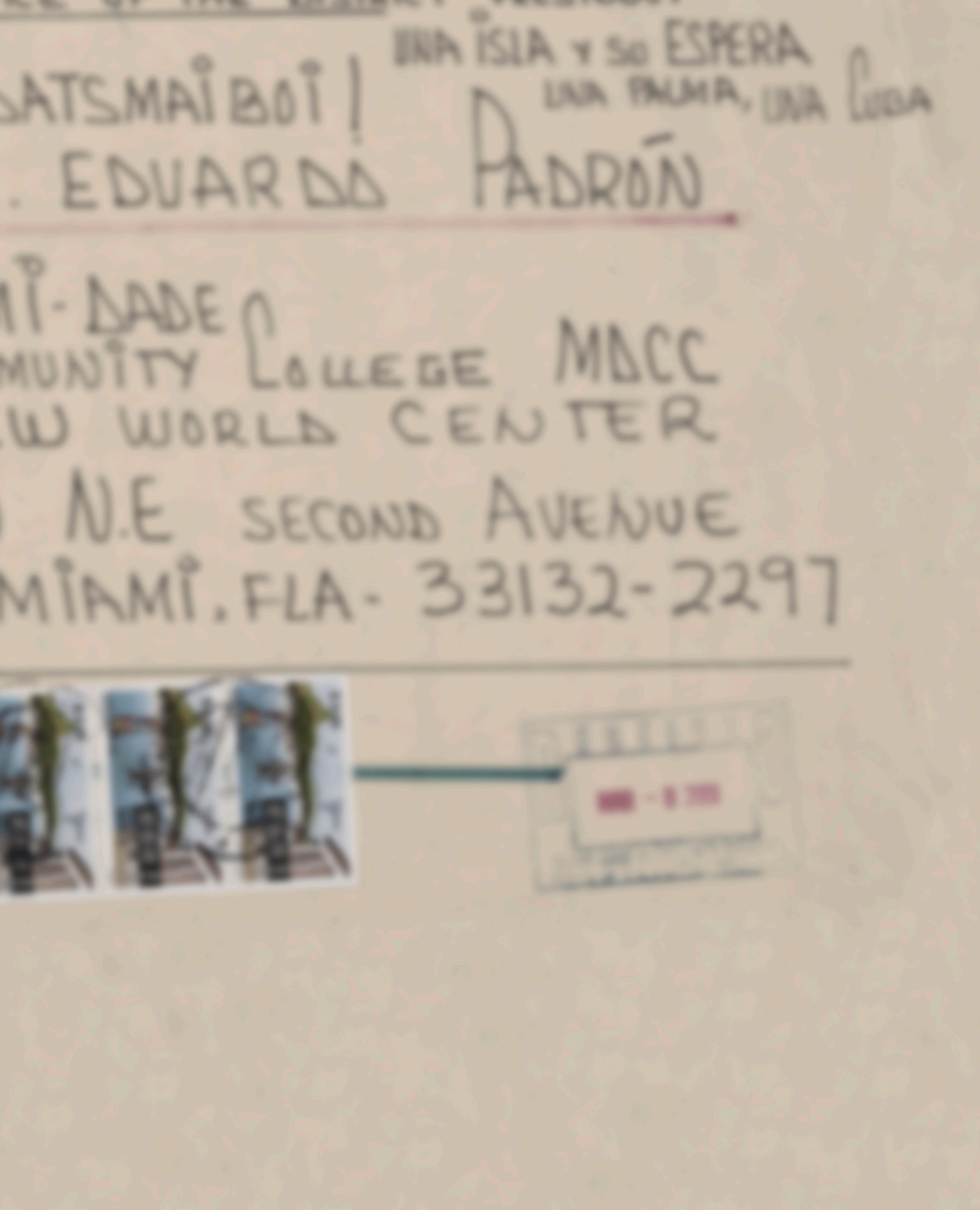
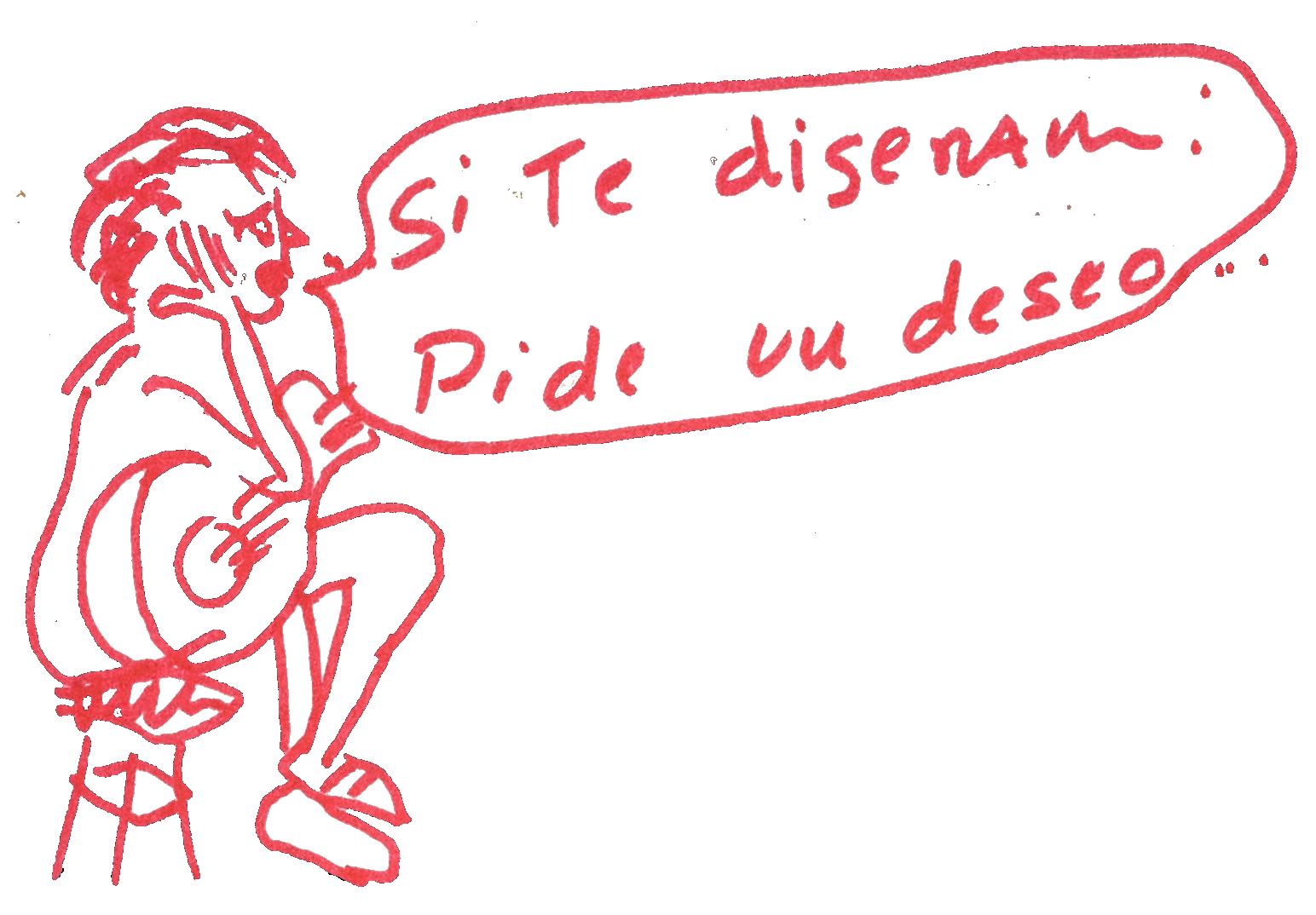
Cubiles, Miguel (b. 1937, Caibarién). Illustrated envelope used to mail his application to the CINTAS Foundation for a fellowship in the Visual Arts category. CINTAS Foundation Inc. records. See page 4.
de la Vega, Aurelio (b. 1925, Havana; d. 2022, Los Angeles). “The Magic Labyrinth,” 1974–1977; “AndamarRamadna,” 1974–1977; “The Infinite Square,” 1974–1977; and “Corde,” 1974–1977. Hand colored graphic scores. Aurelio de la Vega collection. See page 20.
Domenech, Rafael (b. 1989, Havana). From the series, “the elliptical hour,” 2022. Book painting constructed using surplus materials including paper, plywood, archival adhesive, laser print photographs, Plexiglas, and hanging hardware. Unique edition.
Fernández, Agustín (b. 1928, Havana; d. 2006, New York). From the portfolio, “20th Year of the Cuban Diaspora.” [New York]: Geo C. Miller and Son, 1978. No. 24/500. See page 12.
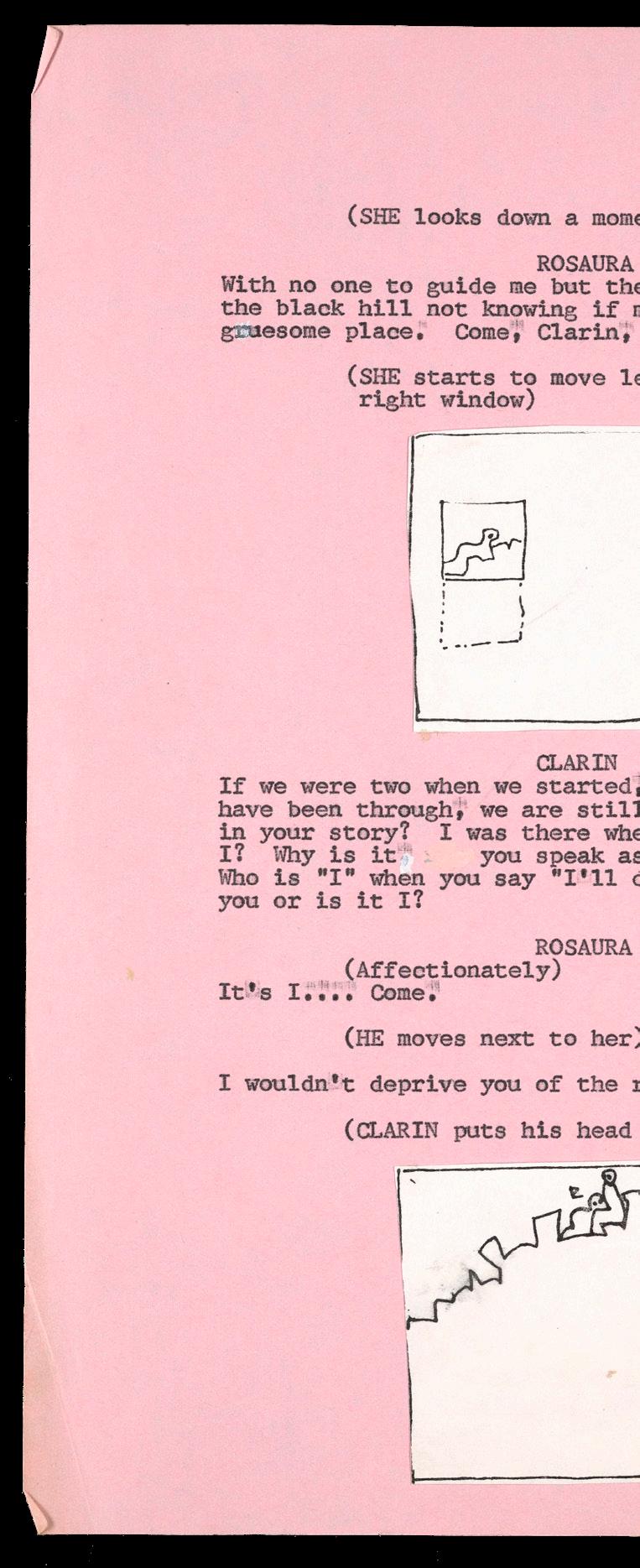
Fornés, María Irene (b. 1930, Havana; d. 2018, New York). Pages from original playscript for “La vida es sueño,” 1981; Application and review of María Irene Fornés’s “La vida es sueño” by Carmen Salazar Parr for the National Repertory Theatre Foundation National Play Award, 1981. María Irene Fornes papers. See pages 18 and 19.
Fusco, Coco (b. 1960, New York). “La plaza vacía,” 2012. Video, 11 minutes, Artist’s Proof. Courtesy of the CINTAS Foundation.
García, Cristina (b. 1958, Havana). “La caída del cielo.” Illustrations by Ivet Báez Andux. [Matanzas]: Ediciones Vigía, 2003.
González-Torres, Félix (b. 1957, Guáimaro; d. 1996, Miami). “I always wonder if men in uniform sleep better after performing their duties.” Exhibition catalog for oneperson show at INTAR Latin American Art Gallery, New York, 1988; Poster for one- person show titled “Félix GonzálezTorres: New Works,” presented at INTAR Latin American Art Gallery, New York, 1988. INTAR Theatre records.
Kozer, José (b. 1940, Havana). “JK, 75 años.” [San Juan]: Trabalis, 2016; “Cuadernos,” 2015, José Kozer papers.
León, Tania (b. 1943, Havana). “Elegía a Paul Robeson.”Score for violin, cello, and piano, 2022. Courtesy of the University of Miami Marta and Austin Weeks Music Library and Technology Center; “Portrait of Tania León” by Alexis Rodríguez-Duarte in collaboration with Tico Torres from the series “Cuba Out of Cuba 1993–2006,” 1998. Gelatin silver print. Alexis RodríguezDuarte in collaboration with Tico Torres collection.
Lino, María (b. 1951, Havana). “Mother of Exiles,” 2017. Monotype from the series “I am an Immigrant.” Courtesy of the artist.
Martínez-Cañas, María (b. 1960, Havana). Original Cuban stamps from the series “Quince sellos cubanos,” 1991–1992; “El mantel blanco: Amelia Peláez, 1991–1992.” Gelatin silver print. Gift of Alan Gordich, 2015.
Novoa, Glexis (b. 1964, Holguín). “Tres retratos,” 1987. Selections from a portfolio of 10 collage and mixed media drawings. Glexis Novoa papers. See page 16.
Orbón, Julián (b. 1926, Asturias; d. 1991, Miami Beach). “Fantasia-Tiento (sobre el tema de la ‘Danza de la Muerte’ del ‘Llibre Vermell S. XIV’) dedicado a Jorge Camacho.” Music score, [c. late 1970s]; Letter written to Jorge Camacho. New York, October 7, 1976. Jorge Camacho collection.
Pantoja, Jorge (b. 1963, Havana). “Untitled (01-28-2008, M.B., 58),” 2008. Mixed media. Courtesy of the artist.
Pérez-Rey, Lisandro (b. 1975, Baton Rouge). “Untitled,” 2000, short video filmed outside the family home of Elián González on April 15, 2000. Gift of the artist. See page 21.
Riverón, Enrique (b. 1902, Cienfuegos; d. 1998, Melbourne). “Untitled (Iberia),” 1996. Collage; “Untitled,” charcoal on paper, 1932. Enrique Riverón collection. Gift of Ruth Shack. See page 11.
Rubio, Lydia (b. 1946, Havana). “Extranjera,” 2009. Ink and watercolor on Fabriano paper. Poems by Marjorie Agosín. See page 10.
Salinas, Baruj (b. 1935, Havana). Torah Project. [Madrid]: ACC Arte Scritta, 2016. See pages 2, 8, and 9.
Sarduy, Severo. “Corona de las frutas.” Original lithographs by Ramón Alejandro. Signed, No. 82/90. [Paris]: Les Cahiers des Brisants, 1990.
Trasobares, César (b. 1949, Holguín). “Social Fabric: Old Pillows & Recent Money Works.” Signed, No. 82/100. Limited edition catalogue for exhibition at the Gallery at Green Library, Florida International University, November 13, 2002–January 31, 2003. Gift of Elizabeth Cerejido.
WPBT. Video of first exhibit of CINTAS Fellows held at Miami-Dade Public Library, Main Branch, January 29–February 13, 1977. Guided tour led by curator Margarita Cano, interviewed by Olga Palmer for WPBT. Courtesy of the Lynn and Louis Wolfson II Florida Moving Image Archives at Miami Dade College.
WORKS CITED
Blau, Eleanor. “Julian Orbon, 65; Cuban Composer, Pianist and Critic.” New York Times 23 May 1991, sec D: 21. Web.
de la Vega, Aurelio. “The Magic Lantern: Reminiscences of the Composer.” Moldenhauer Archives at the Library of Congress. Web. 2 Aug. 2023. loc.gov/collections/moldenhauer-archives/articlesand-essays/guide-to-archives/the-magic-labyrinth
Enwezor, Okwui. “Archive Fever: Uses of the Document in Contemporary Art.” New York: International Center of Photography, Göttinger: Steidl Publishers, 2008. Print.
Ritchin, Fred. “Bending the Frame: Photojournalism, Documentary, and the Citizen.” New York: Aperture, 2013. Print.
ENDNOTES
1 Work by CINTAS Fellows in this category was featured in a parallel exhibition titled “All Stars: CINTAS Foundation Fellows in Architecture & Design from 1963 to 2022” at the Coral Gables Museum from April through July 2023
2 The term “vanguardia” in Cuban art refers to two generations of visual artists who emerged in the early part of the 20th century and combined the pictorial language of modern movements, such as Surrealism, Cubism, Expressionism, and Fauvism, which they were exposed to during their travels in Europe, with typical Cuban motifs
3 I am indebted to Dr. Lillian Manzor for bringing these specific materials and their significance to my attention.
4 Quotes were taken from Aurelio de la Vega’s “The Magic Labyrinth: Reminiscences of the Composer” from the Moldenhauer Archives at the Library of Congress: lcweb2.loc.gov/music/molden/24281/2428154.pdf
The Cuban Heritage Collection at the University of Miami Libraries collects, preserves, and provides access to primary and secondary sources of enduring historical, research, and artifactual value that relate to Cuba and the Cuban diaspora from colonial times to the present. The Collection supports the teaching, learning, and research needs of the University of Miami and the broader scholarly community.
The Libraries provide faculty, students, researchers, and staff with the highest quality access to collections, information services, learning support, and digital expertise in support of the University’s mission to transform lives through education, research, innovation, and service.
Learn more about exhibitions at the University Libraries: library.miami.edu/exhibitions
Cuban Heritage Collection
Roberto C. Goizueta Pavilion
Otto G. Richter Library 1300 Memorial Drive Coral Gables, Florida 33146 library.miami.edu/chc @UMiamiLibraries | @umchc
Carlos A. Díaz • Roberto G. Fernández
Jorge Valls Arango • Alejandro R.
Humberto Chávez • Miguel Cubiles
Félix González-Torres • Doris Vila
Ismael Lorenzo • Manuel Martín • José
Harvey Ball • Juan Boza • María
Enrique Flores Galbis • José Fors Swetcharnik • José Kozer • Rolando
Rafael Catala • Miguel Correa • Ricardo
Mario Bencomo • Yvette Cabrera Vega
Alvaro García • Alejandro Hasler
Manuel Quijano • Tania León •
María E. Lino • Gay García • Pedro
Jaime Bellechasse • Elio Beltran
Manuel Alvarez • María Lino • Iraida
Eugenio Rodríguez • Roberto Valero
Camilo Franqui • Pio Galbis • Andrés
Jorge Pardo • Joseph Rodeiro • Arturo
Eduardo Sánchez • Jorge Varona
María Martínez-Cañas • Belkis Cuza
Yolanda Martín • Miguel Sales • Jaime
María Brito Avellana • Humberto
Antonio González Padura • Ileana Morgado
Susana Sori • Tony Mendoza • Miguel
Francisco Pérez Rivera • Juan José
Enrique Flores Galbis • Alvaro García
Glexis Novoa • César Trasobares •
Ivan Acosta • Lourdes Gil • Gustav Magrinat
Lilliam Becker • Humberto
Humberto Figueras • Julián Orbón • Ramon Lago • Ana María Martínez