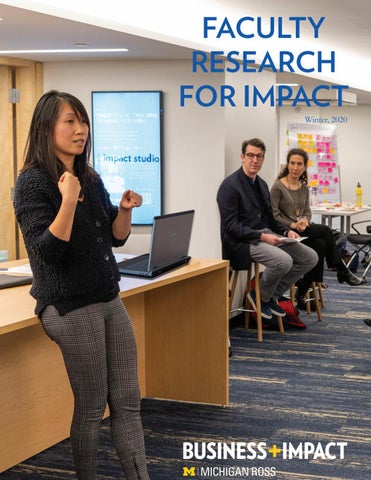
FACULTY RESEARCH FOR IMPACT Winter, 2020
FACULTY RESEARCH FOR IMPACT
2
FACULTY RESEARCH FOR IMPACT
The 17 Goals were adopted by all UN Member States in 2015, as part of the 2030 Agenda for Sustainable Development
UN SDGs: Our Basis for Determining Key Impact Areas
I
n 2015, nearly every nation on earth committed to achieving a set of 17 bold and aspirational goals by 2030: eliminating poverty and hunger, making cities more sustainable, ensuring access to education. These are the UN Sustainable Development Goals, or SDGs. We believe that the scholarly research at Ross and at other business schools can help to achieve these goals.
the powerful ideas of our faculty and the creative talents of our students to develop ideas that directly impact those goals. In addition to these articles, Business+Impact hosts interactive design activities themed around the SDGs on the campus of the University of Michigan. Faculty members have a chance to share their research in an informal setting while students from across campus gather to brainstorm possible next steps for how the research can be applied to real-world applications that make a positive impact.
The Business+Impact initiative and its Faculty Research for Impact (FR4I) series aim to harness
3
FACULTY RESEARCH FOR IMPACT
Table of Contents 9
How big data and algorithms are slashing the cost of fixing Flint’s water crisis by Eric Schwartz and Jacob Abernathy
Toward solving the broader problem, data and statistical tools can help greatly reduce risks at much lower cost, and a data-oriented understanding of the problems in Flint can guide efforts to address lead concerns in other regions as well.
14
Companies don’t need permission from the Business Roundtable to be better corporate citizens by Erik Gordon A business group that represents the CEOs of America’s most powerful companies recently issued a statement that may sound like a roar. But it’s actually more of a whimper.
4
FACULTY RESEARCH FOR IMPACT
17
‘Public goods’ made America great and can do so again by Marina Whitman
All Americans are lucky to live in a country brimming with public resources that everyone can share. Unfortunately, our stock of public goods has been declining for half a century, particularly those that require the government’s purse strings.
22
How corporate America can curb income inequality and make more money too by Wallace Hopp A standard explanation for why income inequality is increasing, to borrow a quote from Nobel-winning economist Joseph Stiglitz, is that “wealth begets power and power begets more wealth.” And there’s plenty of evidence income inequality undermines the economy.
5
FACULTY RESEARCH FOR IMPACT
Table of Contents 25
When did Che Guevara become CEO? The roots of the new corporate activism by Jerry Davis While big business hasn’t always been on the vanguard of social justice, in recent years companies like Target, Apple and even Wal-Mart have increasingly taken positions that put them squarely on the side of socially progressive activists.
30
When corporations take credit for green deeds their lobbying may tell another story by Tom Lyon
We believe the best way to expose this duplicity is by requiring corporations to disclose more details about their political actions.
6
FACULTY RESEARCH FOR IMPACT
33 When some US firms move production overseas, they also offshore their pollution by Yue Maggie Zhou, Jobs are important for both developed and developing countries. In the face of globalization, however, national leaders should focus more on jobs that are sustainable and do not come at the expense of the environment.
36
Society’s biggest problems need more than a nudge by Joe Arvai
Active decision support approaches work by breaking complex decisions into more cognitively manageable parts
7
FACULTY RESEARCH FOR IMPACT
Table of Contents 40
How to vote for a president when you don’t like the candidates by Aradhna Krishna and Tatiana Sokolova How do voters select a candidate when no one they like is on the ballot? Behavioral scientists have studied decision-making – including voting – for decades. However, researchers usually give respondents at least one appealing option to choose from.
43
Why the web has challenged scientists’ authority – and why they need to adapt by Andrew J. Hoffman In the end, the challenges that science and the scientist now face offer an opportunity to revitalize the academy by connecting it more deeply with the society and world it studies
8
FACULTY RESEARCH FOR IMPACT
How big data and alg orithms are slashing the cost of fixing Flint’s water crisis by Eric Schwartz and Jacob Abernathy, for The Conversation
A big data analysis indicates the focus on service line replacement may only go so far at fixing Flint’s water issues. George Thomas/flickr
T
he water crisis in Flint, Michigan highlights a number of serious problems: a public health outbreak, inadequate urban infrastructure, environmental injustice and political failures. But when it comes to recovery, the central challenge, and one that has received relatively little attention, is our lack of useful information and understanding.
With the support of our student team at the University of Michigan, we have aggregated a trove of available data around Flint’s water issues, including water test results, records of the service lines that deliver water to homes, information on parcels of land and water usage. Leveraging new algorithmic and statistical tools, we are able to produce a significantly more complete picture of the risks and challenges in Flint.
Who is most at risk? Where are the harmful sources of lead? Where should resources be allocated? Using modern big-data tools, we can answer these questions and help inform the response to this crisis.
These methods strongly resemble those used by Facebook, Amazon and other large tech companies who collect vast amounts of data from users. But whereas Facbeook’s algorithms 9
FACULTY RESEARCH FOR IMPACT
crunch through uploaded photographs to detect faces and Amazon’s models predict which products you’ll like, we are using these analytics tools to detect homes with high risk of lead contamination and to predict the locations of lead pipes buried underground or hidden in the homes of residents. What have we learned? Here are a few takeaways from our research. Lead contamination varies widely across homes and is highly scattered around Flint, but it is surprisingly predictable The headlines on Flint could easily lead one to believe that all homes in the city have dangerously high levels of lead. But in fact, using data from the state’s sentinel program, we found during a period in February only between 8 and 15 percent of homes had lead above the federal action level of 15 parts per billion (ppb). Based on our statistical models, we can display locations which we estimate to be at high risk of lead contamination. Credit: PhD students Guangsha Shi, Jared Webb, and others at UM.
Indeed, things have been improving from January through August 2016, according to the test data
from the sentinel program. Based on about 750 homes monitored repeatedly, fewer homes have tested above the action level over time. Almost half of all samples have virtually no detectable level (below 1 parts per billion). These low numbers provide little comfort when we don’t know which homes are at risk. Only around 30 percent of homes in Flint have had their water tested, according to government data, and these water tests do not guarantee safety; they only identify danger. Also, it is clear from the data, homes that are slower to sample their water tend to be those at much greater risk. So can we find these homes? The answer is yes, to a modest degree of accuracy. We have built statistical models that profile a home based on several attributes (year of construction, location, value, size, etc.), and provide an estimate of the risk level.
Percent of samples in the DEQ’s sentinel program that tested below the federal action level. Credit: Jonathan Stroud, Ph.D. student at UM.
10
FACULTY RESEARCH FOR IMPACT
The quality of these models is driven by the huge swaths of data from water samples submitted by residents and tested by government officials in response to the crisis. This provides us with a database of measurements that includes over 20,000 water samples covering roughly 10,000 homes in Flint since November 2015 to present. We have made our risk assessments available to government officials, and are being incorporated into an mobile application, funded by Google and built by students at UM Flint, that allows Flint residents to learn of their home’s risk level.
to be those with the lowest rates of water sampling. Additionally, while the highest readings are geographically scattered, the homes predicted to be at high risk tend to cluster in specific neighborhoods.
These statistical models not only provide predictions; they also give a better understanding of the problems. This has much broader implications, as these factors predicting lead may generalize beyond Flint.
FLINT’S LEAD Using paper records, researchers were able to PIPE RECORDS get a rough idea of what type of material – lead, copper or plastic – was used to bring water service ARE SPOTTY to home. AND NOISY, BUT STATISTICAL METHODS CAN SIGNIFICANTLY FILL THE GAP
The data suggest that lead contamination is associated with a number of factors; older homes tend to be at greater risk, for instance, as are those of lower home value. Lower-value homes also tend
Media reports and political efforts have continued to focus on the so-called “water service lines” that connect each house to the distribution system in the street. The assumption is that homes with lead service lines are most at risk for lead exposure and poisoning. As a result, much of the attention has been on locating and replacing these lines. The Michigan legislature has allocated over US$25 million toward replacing the harmful lines, beginning with a pilot phase of roughly 250 homes. This effort is being headed up by a team under National Guard Brig. Gen. Michael McDaniel.
Younger properties have lower lead levels, on average and based on the 90th percentile (blue line). There were 8 percent of tests above federal action level 15 ppb (dotted red), and still some well above 150 ppb and even 1000 ppb. The highest 0.5 percent of samples are not shown.
11
The problem, however, is not only with lines made out of lead material: Lead particulate can accumulate on the walls of corroded galvanized steel pipes. Pipes made of copper or plastic, on the other hand, are generally considered to be safe.
FACULTY RESEARCH FOR IMPACT
But there are immediate challenges with the line replacement program. And the most obvious is: Where are these dangerous pipes? The city, unfortunately, did not maintain consistent records on service line installations and materials. But city officials We can look at homes that, based on records and home inspections, appear to have copper-only service eventually found, after some lines versus those containing some lead. We plot the distribution of the lead readings for water samples from these two home categories. searching, a set of maps with handwritten annotations (last and this has guided their targeting of replacement updated in 1984), and these records were digitized resources. by a UM Flint research team lead by Professor Marty Kaufman. These appeared to identify the Our recommendations are adapting to incoming material of the service lines for most home parcels data, using techniques applied in online advertising in Flint. experiments or clinical trials, to identify the risky homes quickly and efficiently. How complete and accurate are these records? Unfortunately, not very. For over 30 percent Our machine learning techniques, which utilize of homes, either there are missing labels or the all of the available city data, parcel records and records disagree with a home inspection of a a database of over 3,000 inspection reports, are portion of the service line. able to estimate line materials with better than 80 percent accuracy. We find, for instance, that houses built in the 1920s to 1940s are many times more likely to have lead in their service line than those built after 1960. Our guesses aren’t perfect by any means, but estimates of this level can save millions Professors Schwartz (left) and Abernethy (right) at a service line replacement site in Flint, Michigan of dollars on recovery efforts. We can again fill in gaps with the help of algorithms and data. Looking for patterns in the HOME SERVICE LINES MAY NOT BE existing records, statistical tools can provide a THE LARGEST CONTRIBUTOR OF LEAD reasonable “educated guess” as to the type of Despite the huge media attention focused on the material in a home’s service line. We have been working directly with Gen. Michael McDaniel’s line service lines, one of the major takeaways from our analyses is that these service lines may not be the replacement team, providing statistical estimates major driver of the lead in Flint’s drinking water. of where lead pipes are most likely to be found,
12
FACULTY RESEARCH FOR IMPACT
Yes, it is the case that those homes with copper service lines have lower lead levels, on average, than those with lead in their service line. But when you look closely at the water testing data, the differences are much smaller than you might think.
Professor Eric Schwartz's expertise focuses on predicting customer behavior, understanding its drivers, and examining how firms actively manage their customer relationships through interactive marketing. His research in customer While it is difficult to determine Gateway to downtown Flint, Michigan. Michigan Municipal analytics stretches managerial League/US Department of Agriculture with certainty due to the spotty applications, including online records, what we have found is display advertising, email that large spikes of lead occur in marketing, video consumption, and word-of-mouth. homes with and without lead service lines. This The quantitative methods he uses are primarily Bayesian suggests a large fraction of the dangerously high statistics, machine learning, dynamic programming, and lead readings are probably not being driven by the field experiments. His current projects aim to optimize service line material but instead by other factors. firms’ A/B testing and adaptive marketing experiments Environmental engineers who study these problems using a multi-armed bandit framework. As marketers report that lead can leach from several sources, expand their ability to run tests of outbound marketing including the home’s interior plumbing, faucet activity (e.g., sending emails/direct mail, serving display fixtures and aging pipe solder. ads, customizing websites), this work guides marketers What we can conclude is that citizens as well as to be continuously “earning while learning.” While policymakers may need to widen their focus beyond interacting with students and managers, Professor the service line materials and consider alternative Schwartz works to illustrate how today's marketers efforts to address other sources of lead. Service bridge the gap between technical skills and data-driven line replacement is certainly a necessary part of the decision making. He earned his Ph.D. in Marketing from solution, but it will not be sufficient. the Wharton School and a B.A. in Mathematics and Hispanic Studies, all from the University of Pennsylvania.
Toward solving the broader problem, data and statistical tools can help greatly reduce risks at much lower cost, and a data-oriented understanding of the problems in Flint can guide efforts to address lead concerns in other regions as well.
Jacob Abernethy Assistant Professor, Georgia Institute of Technology
For more information about getting water filters and testing your water, visit michigan.gov/ flintwater/ ■
Jacob is focused on Computer Science in the College of Computing at the Georgia Institute of Technology. His research focus is Machine Learning, and discovering connections between Optimization, Statistics, and Economics. Jacob finished his PhD at UC Berkeley with Peter Bartlett in 2011, and he was a Simons postdoctoral fellow with Michael Kearns for the following two years.
Eric Schwartz Assistant Professor of Marketing, Ross School of Business, University of Michigan
13
FACULTY RESEARCH FOR IMPACT
Companies don’t need per mission from the Business Roundtable to be better corporate citizens
by Erik Gordon, for The Conversation
JPMorgan Chase CEO Jamie Dimon currently chairs the Business Roundtable. / CC BY-2.0
A
business group that represents the CEOs of America’s most powerful companies recently issued a statement that may sound like a roar.
This is a big symbolic win, but it is unlikely to change how companies – even those that signed, such as Amazon, Boeing and Pfizer – actually behave. Ultimately, only shareholders have an actual seat at the table and can vote on who runs the company.
But it’s actually more of a whimper. For decades, the Business Roundtable has maintained that the primary purpose of a corporation is to provide returns for its shareholders. The Roundtable – which represents 193 companies with over US$7 trillion in revenue and almost 15 million employees – now says that corporations “share a fundamental commitment to all of our stakeholders,” including employees, communities and suppliers.
As an adviser to corporate managers, I have spent countless hours listening to executives discussing what shareholders want. I haven’t heard more than 20 minutes of talk about what employees, communities or suppliers need or deserve. A statement from a group of CEOs, no matter how powerful, won’t fundamentally change how they operate. But there’s one thing that will. 14
FACULTY RESEARCH FOR IMPACT
Amazon’s Jeff Bezos is one of 182 Roundtable CEOs who endorsed the statement. / CC BY 2.0
• dealing fairly and ethically with their suppliers and
A SYMBOLIC CHANGE OF TUNE The idea of shareholder primacy first emerged in a 1932 Harvard Law Review article by Adolphe Berle, a Columbia University law professor who served on President Franklin Roosevelt’s “Brain Trust.” Berle said “all powers granted to a corporation or to the management of a corporation … [are] at all times exercisable only for the ratable benefit of the shareholders.”
• supporting their communities and embracing sustainable practices. The new commitments represent a symbolic victory for those who want companies to consider the interests of not just its shareholders but of other groups that are affected by corporate behavior. The statement signals this view is now Corporate America’s as well.
Until now, that was essentially the position of the Business Roundtable, which was founded in 1972. In a 1997 “Statement on Corporate Governance,” for example, the Roundtable said “the principal objective of a business enterprise is to generate economic returns to its owners.”
But in practice, the statement doesn’t really amount to much. THE PURPOSE OF A CORPORATION First of all, the Roundtable doesn’t actually have the power to define the purposes of corporations or the duties of managers who run them. Those duties are a matter of corporate law.
But on Aug. 19, the Roundtable changed its tune. The 182 CEOs who signed the statement said they are committed to not only generating long-term value for shareholders but also:
Corporate law states that the “business and affairs of every corporation … shall be managed by or under the direction of a board of directors.” And these directors in turn owe fiduciary duties of care
• delivering value to their customers • investing in their employees
15
FACULTY RESEARCH FOR IMPACT
and loyalty to the corporation and its stockholders – no one else.
But at least these companies recognize that people expect a lot more from them. That’s what is forcing change. ■
CEOs cannot alter these legal duties by signing a statement. The Roundtable is neither a state legislature nor a supreme court, so its statement doesn’t change the law.
Erik Gordon Clinical Assistant Professor, Ross School of Business, University of Michigan
NO LAW FORBIDS DOING GOOD More to the point, the law doesn’t need changing in order for companies to be able to do “good.” That is, even though the law creates a specific duty to shareholders, it doesn’t prevent companies from considering the interests of other groups.
Professor Gordon's areas of interest are entrepreneurship and technology commercialization, venture capital, private equity, mergers and acquisitions, corporate governance, the biomedical industry (pharmaceuticals, devices, healthcare big data, and biotechnology), IoT, FinTech, and digital and mobile marketing. He also served on the faculty of University of Michigan Law School. He has served on the faculty and as Associate Dean and Director of the Graduate Division of Business & Management (Carey Business School) at Johns Hopkins University, where he taught in the business and medical schools and at the University of Florida, where he also served as director of the Center for Technology & Science Commercialization Studies and as Director of MBA Programs. He has served as an adviser or co-founder to numerous companies. He is frequently quoted in The New York Times, BusinessWeek, The Wall Street Journal, Bloomberg, Reuters and other outlets, is a regular contributor to Marketplace Morning Report (in NPR's Morning Edition), Bloomberg Radio, and appears on PBS's Nightly Business Report. His degrees are in economics and law.
No law requires companies to maximize shareholder returns by paying employees the minimum necessary to keep them on the job. No law requires managers to treat suppliers unfairly, disrespect the communities in which they work or to shun sustainable practices – if doing so will yield higher returns for shareholders. The law is even more expansive than the Roundtable statement. No law forbids corporations from taking money that could have gone to shareholders and donating it to hospitals or museums. In fact, the only time companies have to exclusively focus of maximizing shareholder value is when selling the company. Otherwise, they are free to do many things that benefit people who are not shareholders. For decades the Roundtable has touted the efforts of its members in supporting the environment, their workers and their communities. It didn’t take a statement to incite those efforts. It took changes of heart – or, perhaps more often, public pressure. If you think some or most companies are behaving badly, the Business Roundtable’s statement shouldn’t lift your hopes that their behavior will get any better. Shareholders will remain primary.
16
FACULTY RESEARCH FOR IMPACT
‘Public g oods’ made America g reat and can do so again by Marina Whitman, for The Conversation
A
ll Americans are lucky to live in a country brimming with public resources that everyone can share.
Many are provided by the government and funded with our tax dollars, such as the highways that crisscross the country, the 84 million acres of national parks and the roughly 100,000 public schools that give all children access to education. Others come from nature, like mountains, lakes and rivers, which also depend on a reliable government and meaningful regulations to preserve and protect them. While the collective value of these “public goods” is probably incalculable, the economic impact of schools, clean air and vast highways has been significant. In fact, I would argue that public goods are what have made America great.
NONEXCLUDABLE AND NONRIVALROUS The formal definition of a public good is that it’s something that is nonexcludable and nonrivalrous. That’s a fancy way of saying that everyone can take advantage of it and that one person’s use doesn’t reduce its availability to others. Setting aside natural public goods, the other ones provided by the government have been on the decline. U.S. public capital investment, net of depreciation, fell to just 0.4 percent of GDP in 2014 from 1.7 percent in 2007 and about 3 percent in the 1960s. A particularly critical subset of this, research and development spending, has been the bedrock of innovation and growth in our economy. It has dropped from a high of 2.1 percent of GDP in
Unfortunately, our stock of public goods has been declining for half a century, particularly those that require the government’s purse strings. President Trump’s proposed budget would make things even worse by cutting, among many other things, funding for national parks, the cleanup of the Great Lakes and efforts to minimize climate change. So if Trump is serious about making America as great as it can be, investing in our public goods – as well as those equally vital ones we share with other nations – would be a good place to start.
President Theodore Roosevelt established many national parks. This one, located in North Dakota’s Badlands, bears his name and was set up after Roosevelt’s death. Brian Witte/AP Photo
17
FACULTY RESEARCH FOR IMPACT
1964 (during the Cold War and space race) to less than 0.8 percent in recent years. A HISTORY OF PUBLIC GOODS INVESTMENT This erosion has persisted through both Republican and Democratic administrations. But it was not always thus, as the bipartisan history of our biggest undertakings attests. The transcontinental railroads, though privately built in the mid-1800s, were heavily subsidized by generous grants of federal land under several presidents and was vital to 19th-century economic growth. President Eisenhower, right, receives recommendations for his federal-state highway program in 1955. Byron Rollins/AP Photo As one illustration, before the railroads, it took almost six months and US$1,000 Democrat, built schools, post offices, libraries and to travel from New York to California. Afterward, many other public buildings in the 1930s. And it took just a week and cost $150. Similar gains Republican Dwight D. Eisenhower created the came after 20th-century presidents invested heavily interstate highway system that bears his name in what in public works. Woodrow Wilson, a Democrat, was the biggest public works project in history. In established the National Park Service in 1916, a 1996, an estimate put its total economic benefit at well few years after Republican Theodore Roosevelt over $2 trillion, or about six times the original cost. greatly expanded their number. U.S. parks are now WHY WE STOPPED INVESTING responsible for more than $200 billion a year in economic activity. But since the 1960s, the bipartisan consensus in support of public goods has broken down, as the right’s pressure to cut taxes and the left’s efforts to expand entitlements squeezed the discretionary part of the budget – from which support for public goods comes.
Franklin Delano Roosevelt, the quintessential
Both parties have moved further from the center, where bipartisanship resides and makes large public works projects easier to build and fund. Meanwhile, a focus on reducing spending has meant that many former public goods have been fully or partially privatized. Railroad officials and employees celebrate the completion of the first railroad transcontinental link in Prementory, Utah, in 1869. Andrew Russell/AP Photo
18
Finally, research has shown that ethnic and racial heterogeneity reduces support for public
FACULTY RESEARCH FOR IMPACT
goods such as trash collection and public education because the dominant groups don’t like the idea of sharing these resources with the newcomers. In other words, racism seems to play a role. SHARING INTERNATIONALLY A bright spot for public goods has been those shared across borders, which have proliferated since World War II.
The U.N. has been an important steward of international public goods. U.N. Building via www.shutterstock.com
Perhaps the most critical global public good is peace. While there have been many regional wars, a third world conflict has been avoided, in no small measure because, in the aftermath of World War II, the United States undertook to stabilize key regions of the world through military expenditures, strategic alliances like NATO, and economic assistance. Although increasingly frayed and fragile,
The U.S. took the lead in establishing some of the key international institutions – such as the United Nations and the World Bank – that provide public goods to the world. Healthy oceans, a stable climate and cross-border money transfers require international coordination for their protection.
Imagine a country without public parks, like Millennium Park in Chicago. Some countries aren’t so lucky. Millennium Park via www.shutterstock.com
19
FACULTY RESEARCH FOR IMPACT
these arrangements, dubbed the Pax Americana, have so far held.
Marina Whitman
The broadest, if not the sturdiest, steward of public goods has been the United Nations and its associated agencies. Freedom of navigation, for example, is protected by the U.N.‘s Law of the Sea. The United States also led in the creation of the World Trade Organization, which sets the rules for international trade and the settlement of disputes.
Professor Emeritus of Business Administration and Public Policy, University of Michigan
Dr. Whitman is Professor of Business Administration and Public Policy at the University of Michigan. From 1979 until 1992 she was an officer of the General Motors Corporation, first as Vice President and Chief Economist and later as Vice President and Group Executive for Public Affairs. Prior to her appointment at GM, Professor Whitman was a member of the faculty in the Department of Economics at the University of Pittsburgh. She served as a member of the President's Council of Economic Advisers in 1972-73, while on leave from the University.
TURNING OUR BACKS? Now, not only does the Trump administration wish to significantly slash spending on already deteriorating U.S. public goods, it wants to cut funding for global institutions such as the U.N. as well. One exception is his plan to invest in infrastructure, but little of the $1 trillion total would actually come from the federal government. This is a supreme irony given the benefits our country derives from public goods, from the parks and highways to the global institutions that support trade and other international public goods.
A retired director of of Alcoa, JPMorganChase, Procter and Gamble, and Unocal, she serves or has served on numerous national boards and committees dealing with economic and governmental issues, as well as on the Boards of Harvard and Princeton Universities and of the Institute for Advanced Study in Princeton. She holds honorary degrees from more than twenty colleges and universities and is a member of a number of honorary associations, including Phi Beta Kappa and the American Academy of Arts and Sciences.
Imagine for a second what life would be like if you didn’t have the public park down the street where you can play freely with your children. Or if the rivers and lakes you swim in returned to the more polluted levels common in the past. Or if our public schools were public no longer. Put simply, investing in public goods has served America well through the years. It would be a huge mistake to turn our backs on it. ■
She is the author of many articles and several books, including New World, New Rules: The Changing Role of the American Corporation, published by the Harvard Business School Press in 1999. Her research interests center on international trade and finance and corporate governance, including global corporate social responsibility (GCSR) on the part of multinational corporations, and how the concept is expanding. Her memoir, The Martian’s Daughter, was published in 2012 by the University of Michigan Press.
20
FACULTY RESEARCH FOR IMPACT
How corporate America can curb income inequality and make more money too by Wallace Hopp for The Conversation
Share a little? Two fish via www.shutterstock.com
S
corpion met Frog on a river bank and asked him for a ride to the other side. “How do I know you won’t sting me?” asked Frog. “Because,” replied Scorpion, “if I do, I will drown.” Satisfied, Frog set out across the water with Scorpion on his back. Halfway across, Scorpion stung Frog. “Why did you do that?” gasped Frog as he started to sink. “Now we’ll both die.” “I can’t help it,” replied Scorpion. “It’s my nature.”
Nobel-winning economist Joseph Stiglitz, is that “wealth begets power and power begets more wealth.”
That is, because the rich and corporate CEOs use their influence to promote their self-interest, inequality is built into the very DNA of capitalism. And to return to our metaphor, the rich scorpions sting the rest of us – by exacerbating income This centuries-old parable, which has been inequality through pay policies, stock buybacks retold by Orson Welles (https://youtu.be/ and other actions – because it’s simply their nature. iPDgGxLb2OM) and many others and sometimes But there’s plenty of evidence income inequality refers to a turtle rather than a frog, is usually meant undermines the economy and, as a result, harms to show how a bad nature cannot be changed – companies and the wealthy too. Eventually, we all even if self-interest and preservation demand it. sink together. It’s also an apt metaphor for the growing scourge A growing body of research in the emerging area of income inequality, one of the defining issues of of “positive organizational scholarship” suggests our age. A standard explanation for why income a different lesson from the scorpion fable: inequality is increasing, to borrow a quote from 21
FACULTY RESEARCH FOR IMPACT
HOW INEQUALITY HURTS GROWTH Let us consider two important ways income inequality undermines the economy: (1) by diminishing worker motivation and (2) by reducing the velocity of money. The demotivating impact of income inequality occurs when workers see the gains of productivity going almost entirely to executives. Since 1973, productivity has increased by over 73 percent, while (inflation-adjusted) hourly worker pay has risen by only about 11 percent and CEO compensation has soared by 1,000 percent.
Source: World Bank
everyone can benefit if they work together. That is, Who can blame people for being companies can invest in their workers, help reduce reluctant to work harder when they know the income inequality and make more money, all at the proceeds will go to someone else? Extensive same time. behavioral research has shown that people will forego personal gain to prevent outcomes they But they need a new perspective to see how. perceive as unfair. In work settings, this leads to AGE OF RAGE demotivated workers working below their potential, even when it leads to smaller raises or bonuses. The The issue of income and wealth inequality has result is reduced productivity, lower quality and less received a lot of attention in recent months, creativity, all of which undermine corporate profit particularly on the campaign trail, as candidates and economic growth. have argued about whose policies would be most effective at lifting wages of the working class. Another way inequality affects the economy is by reducing the velocity of money by shifting cash to And no wonder. The percentage of total income people who spend it more slowly. Working-class received by the top 1 percent of earners in the U.S. people who are stretching to make ends meet spend has risen from under 8 percent in the 1970s to over their income quickly – usually pretty much all of it – 18 percent today. The percentage of total wealth while wealthy people whose resources exceed their held by the richest 0.01 percent (the elite 1 percent immediate needs tend to save substantial portions of the 1 percent) has soared from under 3 percent of their income. to over 11 percent over this interval. Consequently, whenever a company takes a dollar We haven’t seen extremes like these since the start of out of the hands of a worker and puts it into the the Great Depression. So the response, consisting hands of an executive or investor, the number of of speeches by political candidates, articles by times that dollar will be spent in the economy is pundits, research by academics and angry outbursts reduced. The result is less business for capitalists by the public, is hardly a surprise. and less employment for workers. 22
FACULTY RESEARCH FOR IMPACT
These two observations imply that policies that decrease income inequality also bolster the economy. Since this benefits both rich and poor, such policies offer opportunities for the rich, and the businesses they control, to be part of the solution rather than part of the problem of income inequality. FORD’S FAMOUS $5 The most straightforward opportunities are workforce investments to increase motivation and productivity of workers. A case of nature vs. self-interest? Scorpion frog via www.shutterstock.com
This is what Henry Ford did a century ago with his famous US$5 a day wage – at a time when typical manufacturing wages were about $2.25 a day – which he called “one of the finest cost-cutting moves we ever made.” In the present day, businesses ranging from tiny cleaning company Managed by Q to giant retailer Costco are using high wages as part of what Zeynep Ton of MIT calls a “good jobs strategy” to drive productivity, quality and profits. But isolated actions by individual companies are too small to have a significant impact on the velocity of money across the economy. To realize the full economic benefit of some income inequalityreducing policies, businesses need to implement them collectively. This happened to a degree with Ford’s high-wage policy. Despite the legend that he raised wages to enable his workers to buy his cars, Ford’s original goal was to improve retention and productivity. However, when other employers followed suit, their collective wage increases produced a working class that could buy more cars and more of everything else.
These are used by public companies to boost their stock prices by reducing the total number of shares, which in turn increases earnings per share. However, because this enhances stock-based executive compensation without benefiting workers, stock buybacks amplify income inequality. An alternative for boosting stock price without aggravating income inequality is investing in worker compensation as part of a productivity enhancement strategy. But, since productivity investments take time to produce results, it is likely that the buyback strategy will generate a greater increase in stock price, and executive compensation, at least in the short term. So, from a pure self-interest perspective, management has incentive to adopt the buyback strategy rather than the workforce investment strategy. The fact that stock buybacks exceeded $500 billion in 2015 suggests that many businesses made precisely this choice. STOP STINGING THE FROG
Unfortunately, because buybacks divert money away from investments in productivity without improving firm performance, they ultimately lead A contemporary example of a situation that calls to less profit, fewer jobs, lower wages and a smaller for collective action is the increasingly common overall economy. Furthermore, if other firms are using them to boost executive compensation, a practice of stock buybacks. ONE WAY COMPANIES MAKE INEQUALITY WORSE
23
FACULTY RESEARCH FOR IMPACT
company that wants to recruit and retain top managerial talent will be seriously tempted to use buybacks as well. An option for breaking this economically destructive cycle, which almost never gets considered, is for firms to lobby to take the buyback option off the table for everyone. If, for example, stock buybacks were restricted, as they were prior to 1982, management would have greater incentive to make genuine investments in their businesses, including in their workforces. In addition to producing productivity gains within businesses, the increase in worker compensation would result in a velocity-ofmoney induced stimulus to the economy as a whole. The combined effect over time could even be large enough to make both executives and workers better off than they would be under the buyback strategy. While collective lobbying for sensible regulations may sound like business heresy – in a world where corporate lobbying usually seeks narrow favors or to stymie regulations in general – it is a rational response to a situation in which legal and profitable actions by individual companies create negative consequences, or “externalities,” on the rest of the economy, and thereby wind up hurting the companies themselves. Metaphorically, such scenarios are analogous to a large number of tiny scorpions (businesses) riding across the river on a giant frog (economy). When a single scorpion stings the frog, it derives pleasure from doing what comes naturally and barely harms the mammoth frog. But when every scorpion does the same, the frog dies and so do all the scorpions. But humans aren’t scorpions, so we can choose to stop the self-destructive stinging and allow everyone to cross the river. ■
Wallace Hopp C.K. Prahalad Distinguished University Professor of Business and Engineering; Associate Dean for Part-Time MBA; Professor of Technology and Operations; Professor of Industrial and Operations Engineering
Wallace J. Hopp's research focuses on the design, control and management of operations systems, with emphasis on manufacturing and supply chain systems, innovation processes, and health care systems. He has won a number of awards, including the 1990 Scaife Award for the paper with the "greatest potential for assisting an advance of manufacturing practice"), the 1998 IIE Joint Publishers Book-of-the-Year Award (for the book Factory Physics), the 2005 IIE Technical Innovation Award, and 2006 SME Education Award, the 2010 Pierskalla Best Paper Award from the INFORMS Health Care Applications Section, the 2011 Ross School of Business Senior Research Award, and Best Paper Awards in 2016 from the M&SOM Journal and the MSOM Service Management Special Interest Group. Hopp is a Fellow of IIE, INFORMS, SME, MSOM and POMS, and is an elected member of the National Academy of Engineering. He served as President of the Production and Operations Management Society (POMS) and Editor-in-Chief of the journal Management Science, and is currently a Senior Editor of Production and Operations Management. He is an active industry consultant, whose clients have included Abbott Laboratories, Bell & Howell, Black & Decker, Boeing, Case, Dell, Ford, Eli Lilly, Eaton, Emerson Electric, General Electric, General Motors, John Deere, IBM, Intel, Motorola, Owens Corning, Schlumberger, S&C Electric, Texas Instruments, Whirlpool, Zenith, and others.
24
FACULTY RESEARCH FOR IMPACT
When did Che Guevara become CEO? The roots of the new corporate activism by Jerry Davis for The Conversation
T
arget recently staked out a position in the culture wars by announcing that it will build private bathrooms in all its locations, after earlier allowing transgender customers to use whichever room corresponds with their gender identity – both actions sparking anger from many conservatives. While big business hasn’t always When the Greensboro Four launched their sit-in protest, companies tended to stay neutral on social been on the vanguard of social issues. Cewatkin via Wikimedia Commons, CC BY-SA justice, in recent years companies scrupulously neutral on social issues. No one like Target, Apple and even Wal-Mart have doubted that corporations exercised power, but increasingly taken positions that put them squarely it was over bread-and-butter economic issues like on the side of socially progressive activists. So trade and taxes, not social issues. There seemed how did Che Guevera – the face of the Cuban little to be gained by activism on potentially Revolution – become CEO of corporate America? divisive issues, particularly for consumer brands. When I first began studying the interactions A watershed of the civil rights movement, between social movements and corporations for example, was the 1960 sit-in protest by 25 years ago, it was rare to see business take a students that began at a segregated lunch public stand on social issues. Yet today we see counter in a Woolworth store in Greensboro, organizations ranging from General Electric to North Carolina, and spread across the South. the NCAA weighing in on transgender issues, Woolworth’s corporate policy had been to “abide something that would have been hard to imagine by local custom” and keep black and white even a decade ago. patrons separated. By supporting the status quo, Woolworth and others like it stood in the way of FROM CUSTOM ABIDERS TO BULLIES progress. Traditionally, corporations aimed to be
25
FACULTY RESEARCH FOR IMPACT
But negative publicity led to substantial lost business, and Woolworth eventually relented. In July, four months after the protest started – and after the students had gone home for the summer – the manager of the Greensboro store quietly integrated his lunch counter.
governor to veto the bill. Not surprisingly, given Wal-Mart’s status in the state and the corporate backlash that accompanied a similar law in Indiana, the governor obliged and eventually signed a modified bill. That didn’t sit well with Louisiana Governor Bobby Jindal, however, who argued in The New York Times that companies in those states were joining “left-wing activists to bully elected officials into backing away from strong protections for religious liberty.” He warned companies against “bullying” Louisiana.
In general, companies were more worried about the costs of taking a more liberal stand on such issues, a point basketball legend and Nike pitchman Michael Jordan made succinctly in 1990. Asked to support Democrat Harvey Gantt’s campaign to replace segregationist incumbent Jesse Helms as a North Carolina senator, Jordan declined, reportedly saying “Republicans buy sneakers, too.”
Why have corporations shifted from “abiding local custom” around segregation and other divisive social issues to “bullying elected officials” to support LGBT rights?
And companies presumed that taking controversial positions would lead to boycotts by those on the other side. That’s what happened to Walt Disney in 1996 as a result of its early support for gay rights, such as “gay day” at its theme parks. Its stand prompted groups including America’s largest Protestant denomination, the Southern Baptists, to launch a boycott, calling Disney’s support for gay rights an “anti-Christian and anti-family direction.” The eight-year boycott, however, was notably ineffective at changing Disney policy. It turns out that too few parents had the heart to deny their children Disney products to make a boycott effective. Since then, some of the biggest U.S. companies have taken similar stands, in spite of the reaction from conservatives. For example, when the Arkansas legislature passed a bill in March 2015 that would have enabled LGBT discrimination on the grounds of “religious freedom,” the CEO of Wal-Mart urged the
CHANGING ENVIRONMENT In my view, there are two broad changes responsible for this increased corporate social activism. First, social media and the web have changed the environment for business by making it cheaper and easier for activists to join together to voice their opinions and by making corporate activities more transparent.
The Susan G. Komen Foundation faced a backlash after it said it would cut funding for Planned Parenthood. Office of Governor Dan Malloy CC BY 2.0
26
FACULTY RESEARCH FOR IMPACT
The rapid spread of the Occupy movement in the fall of 2011, from Zuccotti Park in New York to encampments across the country, illustrates how social media can enable groups with a compelling message to scale up quickly. Sometimes even onlineonly movements can be highly effective. When the Susan G. Komen Foundation cut off funds to Planned Parenthood that were aimed at supporting breast cancer screenings for lowincome women, a pop-up social Gender-neutral toilets like this one may be coming to a Target near you. Checkingfax CC BY-SA 3.0 movement arose: Facebook and Twitter exploded with millions of Companies targeting the sensibilities of the young posts and tweets voicing opposition. Within days often tout their social missions. Tom’s Shoes and the policy was walked back. Warby Parker both have “buy a pair, give a pair” Mozilla’s appointment of a new CEO who had programs. Chipotle highlights its sustainability supported a California ballot proposal banning efforts. And Starbucks has promoted fair trade same-sex marriage also generated outrage online, coffee, marriage equality and racial justice more or both inside and outside the organization. He was less successfully. In each case, transparency about gone within two weeks. corporate practices serves as a check on puffery. More recently, Mylan’s exorbitant price hikes on its EpiPen took place over several years, but an online petition fueled by social media this summer turned it into a scandal and a talking point for presidential candidates.
Social mission is even more important when it comes to recruiting. At business school recruiting events, it is almost obligatory that companies describe their LEED-certified workplaces, LGBTfriendly human resource practices and community outreach efforts.
In each case, social media allowed like-minded “clicktivists” to draw attention to an issue and demonstrate their support for change, quickly and at very little cost. It’s never been cheaper to assemble a virtual protest group, and sometimes (as in the Arab Spring) online tools enable realworld protest. As such, activism is likely to be a constant for corporations in the future.
Moreover, our employer signals something about our identity. Value alignment is part of why people stay at their job, and among many millennials, socially progressive values – particularly around LGBT issues – are almost a given. In this situation, corporate activism may be the sensible course of action, at least when it comes to LGBT issues. According to the Pew Research Center, for example, support for same-sex marriage has increased from 31 percent in 2004 to 55 percent today, and there is little reason to expect a reversal.
MILLENNIALS DON’T LIKE PUFFERY Second, as consumers and workers, millennials are highly attuned to a company’s “social value proposition.” 27
FACULTY RESEARCH FOR IMPACT
RISKS REMAIN Even as trends lead to more corporate activism, the reaction hasn’t always been as the businesses expected. Businesses on the vanguard of social issues themselves can become targets if and when they slip up. When Starbucks attempted to promote a dialogue about race after the killings of Michael Brown and Eric Garner by police in 2014, its Conservative corporate activism has also increased. Grover Norquiest speaking at a conservative rally in Minnesota method – asking baristas Fibonacci Blue, CC BY 2.0 RED AND BLUE COMPANIES? to write “race together” on cups to encourage conversations – was widely While prominent companies like Starbucks and ridiculed. Some even regarded the effort as a Target have taken stances associated with liberal misguided marketing ploy rather than a sincere causes, some businesses have gone the other effort to promote understanding. direction. In 1998, William Clay Ford Jr. became chairman of Ford Motor and aimed to turn the company green by improving fuel economy and “greening” its production processes. The company even put an energy-efficient “living” roof on a truck assembly plant. Its continued reliance on its profitable line of gas-guzzling SUVs, however, prompted some to accuse Ford of hypocrisy.
Chick-fil-A aimed to implement “biblical values” and supported anti-gay groups in the 2000s. Those groups returned the favor by encouraging like-minded people to dine there on “Chick-fil-A appreciation day.” Hobby Lobby famously sought to abstain from providing funding for birth control for employees on religious grounds. Koch Industries, overseen by the famous Koch Brothers, has long been a lightning rod for boycotts due to the rightwing proclivities of its dominant owners. And small businesses across the country are not always shy in advertising their conservative political orientations.
Starbucks’ recent effort at corporate activism was widely ridiculed. University of Denver, CC BY-NC-SA 2.0
28
FACULTY RESEARCH FOR IMPACT
As states have seemingly divided into red (for conservative) and blue (for liberal), might we expect the same thing from corporations, as consumers and employees drift toward the brands that best represent their views – red companies and blue companies?
BA 670
+Impact Studio: Translating Research into Practice
It is already easy to look up political contributions by companies and their employees. For example, Bloomberg, Alphabet and the Pritzker Group lean Democratic; Oracle, Chevron and AT&T tend Republican.
A new multidisciplinary graduate course in ethnography, ecosystem mapping, ideation, prototyping, and business model design
In the current electoral climate, it is not hard to imagine this continuing. ■
Design Thinking for Impact in Business
Jerry Davis Professor of Management and Sociology, Ross School of Business, University of Michigan
Jerry Davis is the Gilbert and Ruth Whitaker Professor of Business Administration at the Ross School of Business and Professor of Sociology, The University of Michigan. Davis received his PhD from the Graduate School of Business at Stanford University. Davis’s research is broadly concerned with corporate governance, finance and society, and new forms of organizations. Recent writings examine how ideas about corporate social responsibility have evolved to meet changes in the structures and geographic footprint of multinational corporations; whether "shareholder capitalism" is still a viable model for economic development; how income inequality in an economy is related to corporate size and structure; why theories about organizations do (or do not) progress; how architecture shapes social networks and innovation in organizations; why stock markets spread to some countries and not others; and whether there exist viable organizational alternatives to shareholder-owned corporations in the United States.
Topics include:
How might water security be improved using research and intellectual capital? How might fintech address financial inclusion and poverty alleviation, especially amongst the underserved?
www.businessimpact.umich.edu businessimpact.umich.edu
29
FACULTY RESEARCH FOR IMPACT
When corporations take credit for g reen deeds their lobbying may tell another stor y by Tom Lyon for The Conversation
Greenwashing is environmentally responsible talk without action. By Tamixes/Shutterstock.com
T
the bar for entire industries, requiring that all businesses meet minimum standards, lobbying to block sound public policies can outweigh the positive impact from internal company initiatives.
Once uncommon but now mainstream, this show of support for a greener and kinder business model might seem like a clear step forward. But many of these same companies are quietly using their political clout, often through industry trade associations, to block or reverse policies that would make the economy more sustainable. And because public policy raises
This kind of corporate hypocrisy – what we call talking green while lobbying brown – is a form of greenwashing, in which companies trumpet their good deeds while hiding their efforts to block progress. As the past and present presidents of the Alliance for Research on Corporate Sustainability, we are concerned that this greenwashing may delay by years or even decades steps that might solve sustainability problems, such as slowing the pace of climate change or ending the ocean plastic pollution crisis.
oday most large companies like Exxon Mobil, Ford and GM issue slick reports extolling their efforts to conserve resources, use renewable energy or fund clean water supplies in developing countries. This emphasis on efforts to curb environmental harm while benefiting society is called corporate sustainability.
30
SOUNDING GOOD YET LACKING IMPACT We and our colleagues in the alliance have documented many business initiatives that fall short of the impact they claim. One of the best known was the chemical industry’s "Responsible Care Program," created after an explosion at Union Carbide’s plant in Bhopal, India, killed thousands of people in 1984. Strategy professors Andy King and Mike Lenox showed that participants actually made less progress in reducing their emissions of toxic chemicals than did nonparticipants. That prompted the industry to overhaul the program. Or consider the Climate Challenge program. The Energy Department created this now-defunct partnership between business and government to encourage electric utilities to voluntarily reduce their greenhouse gas emissions. When one of us teamed up with Management Professor Maria Montes-Sancho to evaluate its track record, we found that there was no difference overall between participants and non-participants in their emissions reductions. Both of these voluntary initiatives failed to solve environmental problems, so why were they created? In the case of Responsible Care, chemical industry documents show that one of the program’s main goals was preempting tighter regulations. Likewise, public statements from the electric utility industry and the Energy Department indicate that they formed Climate Challenge to stave off new regulations. And following the Trump administration’s plan to spike the Clean Power Plan, a federal rule that would have limited air pollution from power, utilities have essentially avoided federal climate regulation to date. Even though these and other voluntary initiatives accomplish little of substance, they help call
attention to the good steps industries appear to be taking instead of the environmental damage they are causing – which is exactly how greenwashing works. TALKING GREEN WHILE LOBBYING BROWN As my colleagues and I explained in an 2018 article in the business journal California Management Review, it is easy to get away with greenwashing in part because it’s hard to detect what companies lobby for in the U.S., as there is no requirement to disclose the positions they espouse. “Despite the statements emitted from oil companies’ executive suites about taking climate change seriously and supporting a price on carbon, their lobbying presence in Congress is 100 percent opposed to any action,” Sen. Sheldon Whitehouse, a Rhode Island Democrat, lamented in Harvard Business Review. Exxon Mobil has clearly engaged in this doubletalk. The corporation declared in its 2016 Corporate Citizenship Report that “climate change risks warrant action by businesses, governments and consumers, and we support the Paris Agreement as an effective framework for addressing this global challenge.” Yet the nonprofit group InfluenceMap recently found that Exxon was one of the top three global corporations in lobbying against effective climate policy. Exxon Mobil’s hypocrisy may not be surprising given the company’s long history of funding climate deniers. However, it is far from alone in talking green while lobbying brown. Indeed, even companies with much stronger records on sustainability than Exxon do this, often through industry trade groups. For example, Ford said in its 2017 sustainability report that “we know climate change is real, and we remain committed to doing our part to address it by delivering on CO2 reductions consistent with the Paris Climate Accord.” GM’s sustainability
FACULTY RESEARCH FOR IMPACT
report stated that “General Motors is the only automaker on the 2017 Dow Jones Sustainability Index for North America, and is also on the World Index.” Yet as Alliance for Automotive Manufacturers members, Ford and GM both lobbied the Trump administration to weaken fuel economy standards – a strong tool for reducing vehicle emissions. MORE POLITICAL TRANSPARENCY NEEDED When companies hide their political opposition to sustainability policies, it deprives investors of the right to know how their funds are being used. This obfuscation also denies consumers the right to vote with their wallets for greener products. We believe the best way to expose this duplicity is by requiring corporations to disclose more details about their political actions. For instance, new laws might demand that companies, both individually and as part of industry associations, make their lobbying stances public, and reveal which politicians they have called on to take a given position. And companies could be forced to reveal what they spend on so-called “independent” political
Tom Lyon advised the US House of Representatives on climate change in February 2019. By University of Michigan CC
advertisements, also known as issue ads.
In the U.S., one good option would be to update the Lobbying Disclosure Act to require more detailed reporting, including spending on astroturf lobbying, the practice of using fake grass-roots groups to influence public opinion. The private sector can take action too. In Europe, the Vigeo Eiris rating agency has begun to assess corporate political transparency. Such evaluations would become much more powerful if required by leading investment managers. That is why we see the 2018 call by BlackRock, the world’s largest asset manager, for companies to “benefit all their stakeholders” as a step in the right direction. ■ Tom Lyon Dow Professor of Sustainable Science, Technology and Commerce; Professor of Business Economics; Public Policy Professor of Environment and Sustainability, University of Michigan
Thomas P. Lyon holds the Dow Chair of Sustainable Science, Technology and Commerce, with appointments in both the Ross School of Business and the School of Environment and Sustainability (SEAS). He is the President of the Alliance for Research on Corporate Sustainability. Professor Lyon is a leader in using economic analysis to understand corporate environmental strategy and how it is shaped by emerging government regulations, non-governmental organizations, and consumer demands. His book Corporate Environmentalism and Public Policy, published by Cambridge University Press, was the first rigorous economic analysis of this increasingly important topic. Professor Lyon earned his bachelor’s degree at Princeton University and his doctorate at Stanford University. His current research focuses on corporate environmental information disclosure, greenwash, ecolabeling, and voluntary programs for environmental improvement.
32
FACULTY RESEARCH FOR IMPACT
When some US fir ms move production overseas, they also offshore their pollution by Yue Maggie Zhou, for The Conversation
O
n April 22, as protesters swelled Earth Day rallies in U.S. cities and around the world, President Trump tweeted that he was “committed to keeping our air and water clean but always remember that economic growth enhances environmental protection. Jobs matter!” His message was eerily similar to assertions by governments in developing countries that environmental standards are less important than attracting jobs.
poor countries. CLEANER AT HOME, DIRTY ABROAD A “jobs-first” policy can add to serious environmental challenges in the host country. For example, one recent study calculates that 17 to 36 percent of four major air pollutants emitted in China come from production for export. Among these export-related emissions, about 21 percent come from the production of goods for the United States.
Indeed, over the last few decades many developing countries have adopted loose environmental standards to lure foreign firms to move production there. However, an emerging body of research shows that policies like this also bring heavy pollution to the host countries.
Studies like this suggest that trade can potentially redistribute environmental footprints. This can happen via two pathways. One is for “dirty” firms in rich countries to stay out of the entire value chain that contains the polluting activities. In this case, some rich country customers will stop consuming the “dirty” products, which is good for the global environment. Others will keep consuming “dirty” products imported from poor and less regulated countries.
In a recent study, my co-author Xiaoyang Li and I found that a significant number of U.S. firms reduce their pollution at home by offshoring production to poor and less regulated countries. The greening of U.S. manufacturing over the past several decades may be partially caused by a growing flow of “brown” imports from
Another way is for firms in rich countries to keep selling the “dirty”
33
FACULTY RESEARCH FOR IMPACT
products but redesign their production networks. They will offshore production (and jobs) in the “dirty” segment of the value chain to poor countries. They will then import the “dirty” unfinished products from poor countries for further domestic processing in the clean segment of the value chain.
pollution in the United States. Second, using this unprecedentedly detailed data, we obtained some interesting findings at the firm and plant level. We found that as U.S. firms imported more goods from low-wage countries, their plants released fewer toxic emissions on American soil. In addition, their U.S. plants shifted production to less-polluting industries, produced less waste, and spent less on pollution abatement. In sum, these firms were improving their own environmental performance by shifting to less-polluting segment of the value chain domestically and moving morepolluting activities overseas.
Unfortunately, existing studies have not been able
To our relief, we found that not all U.S. firms chose to offshore their pollution. In particular, firms that are more productive and invest more in R&D and brand equity offshore less pollution. In this May 1973 view of the Pittsburgh, Pennsylvania skyline, steel plants line both sides of the These firms may find it less Monongahela River. John Alexandrowicz, NARA/Wikipedia costly to renovate production technology domestically to comply with stringent to tease apart these two pathways. To find out if some U.S. companies were taking the second route, environmental standards. They may also find we obtained data from the U.S. Census Bureau and it more rewarding to do so because consumers the Environmental Protection Agency about trade, become more loyal to their brand for their socially production and pollution for more than 8,000 U.S. responsible behavior at home. firms with 18,000 U.S. plants. CHANGING FIRMS’ INCENTIVES We first found that of all goods imported by U.S. manufacturing firms (not wholesaler or retailers), the share produced in low-wage countries rose from 7 percent in 1992 to 23 percent in 2009. At the same time, toxic air emissions from manufacturing industries in the United States fell by more than half. Industries that experienced the greatest increase in imports from low-wage countries include printing, apparel and textile, furniture, and rubber and plastics. These industries also experienced some of the largest drops in air
U.S. companies that offshore pollution are not violating environmental laws either at home or in their host countries. Indeed, rebalancing their global production is a logical response to higher environmental compliance costs in the United States. However, to the extent that U.S. firms can choose either to purchase cheap and “dirty-to-make” goods from low-wage countries or to produce them under stringent environmental standards at
34
FACULTY RESEARCH FOR IMPACT
home, they are making a strategic decision about the private costs of production compared to the public (and international) costs of pollution. Companies that offshore pollution to less-regulated countries are taking advantage of those nations’ lower environmental and labor standards and letting the host countries bear the associated social costs. Unfortunately, it is not always A Bangladeshi worker throws a washed rawhide onto a pile inside a factory at the highly polluted Hazaribagh tannery area on the banks of the River Buriganga in Dhaka, Bangladesh, Aug. 26, 2014. easy to induce companies to Bangladesh annually exports millions of dollars of leather goods to some 70 countries, including the U.S. and Japan. AP Photo/A.M. Ahad adopt higher standards for their operations in developing countries. Jobs are important for both developed and After Nike was first reported to have unsafe and developing countries. In the face of globalization, abusive working conditions at its foreign plants, it however, national leaders should focus more on took the company almost a decade to announce jobs that are sustainable and do not come at the that it would raise wages, increase monitoring and expense of the environment. ■ adopt more stringent air quality standards in its factories overseas. Yue Maggie Zhou
Similarly, Foxconn – a key supplier to Apple – has incurred heavy criticism over its labor practices in China. The company reportedly has improved its working conditions there, but it has also diversified into other low-wage nations where regulations are more lax, including Malaysia, Mexico, Brazil, Vietnam and Indonesia.
Associate Professor of Strategy, Ross School of Business, University of Michigan
Maggie's research focuses on the theory of the firm, competitive strategy, organization structure and institutions. Her work has been published in the Strategic Management Journal, Organization Science, Journal of Corporate Finance, and Advances in Strategic Management. She is an Associate Editor of Strategic Management Journal and serves on the editorial board of Organization Science.
REWARD SOCIAL RESPONSIBILITY In a global market where companies compete fiercely across national boundaries, governments should coordinate closely to maintain a regulatory framework that incentivizes firms to undertake more socially responsible actions. Participating in trade agreements with strong environmental requirements, and in global coalitions such as those proposed at the United Nations Climate Change Conferences, is one way to coordinate. Unfortunately, some of the world’s largest economies seem to be stepping in the opposite direction.
Maggie teaches Competing in The Global Business Environment and World Economy at MBA level and a PhD seminar on Research Methods. Prior to her academic career, Maggie worked for Arthur Andersen as a financial auditor, and the International Finance Corporation of the World Bank Group as an Investment Officer on privatization transactions in Africa, Asia, and Eastern Europe.
35
FACULTY RESEARCH FOR IMPACT
Society’s big gest problems need more than a nudge by Joe Arvai for The Conversation
Is the water crisis in Flint, Michigan evidence that governments need a new way to make decisions? Public Domain
S
o-called “nudge units” are popping up in governments all around the world. The best-known examples include the U.K.’s Behavioural Insights Team, created in 2010, and the White House-based Social and Behavioral Sciences Team, introduced by the Obama administration in 2014. Their mission is to leverage findings from behavioral science so that people’s decisions can be nudged in the direction of their best intentions without curtailing their ability to make choices that don’t align with their priorities.
Yet, the same governments have done little to improve their own decision-making processes. Consider big missteps like the Flint water crisis. How could officials in Michigan decide to place an essential service – safe water – and almost 100,000 people at risk in order to save US$100 per day for three months? No defensible decision-making process should have allowed this call to be made. When it comes to many of the big decisions faced by governments – and the private sector – behavioral science has more to offer than simple nudges.
Overall, these – and other – governments have made important strides when it comes to using behavioral science to nudge their constituents into better choices.
Behavioral scientists who study decisionmaking processes could also help policy-makers understand why things went wrong in Flint, and
36
FACULTY RESEARCH FOR IMPACT
how to get their arms around a wide array of society’s biggest problems – from energy transitions to how to best approach the refugee crisis in Syria. WHEN NUDGES ARE ENOUGH The idea of nudging people in the direction of decisions that are in their own best interest has been around for a while. But it was popularized in 2008 with the publication of the bestseller “Nudge” by Richard Thaler of the University of Chicago and Cass Sunstein of Harvard.
How to decide how to help Syrian refugees? Mstyslav Chernov CC BY-SA
choice architecture into the policy mainstream. Even institutions like the World Bank and the Organization of Economic Cooperation and Development are rolling out their own nudge units. And, you shouldn’t be surprised to learn that the private sector has jumped on the increasingly crowded bandwagon of for-profit nudging.
A common nudge goes something like this: if we want to eat better but are having a hard time doing it, choice architects can reengineer the environment in which we make our food choices so that healthier options are intuitively easier to select, without making it unrealistically difficult to eat junk food if that’s what we’d rather do. So, for example, we can shelve healthy foods at eye level in supermarkets, with less-healthy options relegated to the shelves nearer to the floor.
We’ve successfully tested nudges for water conservation and sustainable food choice. Others have applied nudges to an even broader range of contexts. There’s no denying that choice architecture can work like gangbusters, which explains the widespread interest.
Likewise, if we want to encourage more people to be organ donors, choice architects can design the form we fill out at the DMV so that the choice we make without thinking is the one that may allow us to save someone’s life in the future.
SOMETIMES A NUDGE ISN’T ENOUGH Nudges work for a wide array of choices, from ones we face every day to those that we face infrequently. Likewise, nudges are particularly wellsuited to decisions that are complex with lots of different alternatives to choose from. And, they are advocated in situations where the outcomes of our decisions are delayed far enough into the future that they feel uncertain or abstract. This describes many of the big decisions policy-makers face, so it makes sense to think the solution must be more nudge units.
In my own research group, we lump these kinds of interventions under the umbrella of passive decision support because they don’t require a lot of effort on the part of a decision-maker. Indeed, these approaches are about exploiting – not correcting – the judgmental biases that people bring with them to all manner of decisions, large and small. Since the publication of “Nudge,” there has been a proliferation of interest in bringing
But herein lies the rub. For every context where a nudge seems like a realistic option, there’s at least 37
FACULTY RESEARCH FOR IMPACT
another context where the application of passive decision support would be either be impossible – or, worse, a mistake.
behavioral sciences. For example, we have a rich understanding of the decision-making shortcuts that people apply, as well as of the predictable biases that accompany them. So, we know what to be on the lookout for when we help individuals and groups make better decisions.
Take, for example, the question of energy transitions. These transitions are often characterized by the move from infrastructure based on fossil fuels to renewables to address all manner of risks, including those from climate change. These are decisions that society makes infrequently. They are complex. And, the outcomes – which are based on our ability to meet conflicting economic, social and environmental objectives – will be delayed.
When evaluating problems that unfold over long periods of time, we know that people tend not to look at cumulative effects, or consider how choices made today may restrict the choices that can be made in the future.
But, absent regulation that would place severe restrictions on the kinds of options we could choose from – and which, incidentally, would violate the freedom-of-choice tenet of choice architecture – there’s no way to put renewable infrastructure options at proverbial eye level for state or federal decision-makers, or their stakeholders.
Furthermore, we see that decision-makers struggle with questions about how to put boundaries around the problem before them. For example, who really counts as a legitimate stakeholder, and who doesn’t? Likewise, are there hard deadlines or financial ceilings that must be obeyed? Or are these really soft constraints that can be challenged if the right option can be identified?
Simply put, a nudge for a decision like this would be impossible. In these cases, decisions have to be made the old-fashioned way: with a heavy lift instead of a nudge.
We’ve also learned that decision-makers often fail to adequately account for the broad range of objectives that ought to guide their decisions, as well as the performance measures that let them know if they’ve achieved them. And, we know that the manner in which people search for alternatives is often incremental at best. People look to obvious
OFTEN, DECISIONS ARE MORE COMPLEX Complex policy decisions like this require what we call active decision support. In these cases, specialists trained in the science of decision-making must work with people both to help them to overcome predictable biases and to approach decisions in a way that is different from how they might otherwise make them instinctively. To inform and structure these kinds of decisions, we – like choice architects – also look to insights from the
Climate change is an example of a ‘wicked problem’ facing society. Steve Buissinne on Pixabay
38
FACULTY RESEARCH FOR IMPACT
and easy-to-find options, the tendency that nudges exploit, at the expense of the creativity that’s required to address the really complex challenges. Perhaps worst of all, we observe that people avoid the necessary trade-offs when a choice can’t simultaneously achieve all of the objectives that they deem to be important. It’s often the case that the objectives that push emotional hot buttons, like fear, are the ones we pay the most attention to when trade-offs are difficult or uncomfortable, even if these objectives play a relatively small role in terms of advancing our overall well-being. Active decision support helps decision-makers to overcome all of these obstacles, as well as others. Unlike nudging, the intent of active decision support isn’t to direct people toward a specific course of action. It is to structure the decisionmaking process so that resulting choices are defensible – in other words, in line with our prioritized objectives. For big policies, this includes the deliberate balancing act between social, economic and environmental well-being. The good news for policy-makers is that a wide range of tools and approaches are available which may help them make more defensible decisions. Active decision support approaches work by breaking complex decisions into more cognitively manageable parts. And they are desperately needed. The wicked problems faced by society can’t be nudged away. Emergencies like the humanitarian crisis in Syria and the slow violence of climate change cry out for active decision support. Yet, as governments amass nudge units, and as the private sector adopts a behavioral mindset in their marketing and public relations offices, the need for behavioral insights that support complex decisions goes unmet. Why? Perhaps because active decision support is often seen as something
smart, educated people in the public and private sectors should be able to do intuitively, on their own. But, the simple truth is, they can’t. And, without investing in building the internal capacity for active decision support, they won’t. ■ Joe Arvai Max McGraw Professor of Sustainable Enterprise Director, Erb Institute Ross School of Business, University of Michigan
Joe Arvai is jointly appointed between the School for Environment & Sustainability, and the Ross School of Business. Joe is an internationally recognized expert in the risk and decisions sciences; his research has two main areas of emphasis: First, Joe and his research group conduct experiments focused on advancing our understanding of how people process information and make decisions, with a specific emphasis on how people make tradeoffs. Second, Joe and his team conduct research focused on developing and testing decisionaiding tools and approaches that can be used by people to improve decision quality across a wide range of environmental, social, and economic contexts. Joe's research is applied, and accounts for decision-making by a broad spectrum of public and stakeholder groups, as well as by technical experts, business leaders, and policy makers. His work also focuses on choices made by people individually, and when working in groups. Likewise, he conducts his research across a wide range of contexts, ranging from environmental risk management, to consumer choice and policy-making. In addition to Joe's academic work, he is a member of the U.S. Environmental Protection Agency's Chartered Science Advisory Board, and is a member of the U.S. National Academy of Sciences' Board on Environmental Change and Society.
39
FACULTY RESEARCH FOR IMPACT
How to vote for a president when you don’t like the candidates by Aradhna Krishna and Tatiana Sokolova, for The Conversation
H
ow do voters select a candidate when no one they like is on the ballot? Behavioral scientists have studied decision-making – including voting – for decades. However, researchers usually give respondents at least one appealing option to choose from. This led us to wonder: What do voters do when they consider all of the options bad? Do they fall back on party affiliation, or simply toss a coin? This question is especially appropriate in the current presidential election because the two front runners have the lowest favorability ratings ever.
affect the upcoming presidential election. If people select between Clinton and Trump by using rejection rather than choice, then the information they use to make their decisions will be different.
When we did research to answer this question, we learned that in situations where all of the choices are bad, people tend to vote by rejecting the choices they didn’t like, rather than by affirmatively choosing the one they disliked least.
In some ways, it may be better. Voters using rejection are more deliberate. They are less likely to be swayed by unimportant information about a candidate that they read or hear on radio, television or Facebook. They may pay less attention to rumors. In fact, conscientious voters may be well served to actively adopt a rejection strategy for their vote in order to make a choice more deliberately.
Imagine there are two undesirable candidates named Tilly and Ron. Given this “two bad choices” option, voters will be more likely to select Tilly because they reject Ron, rather than select Tilly proactively.
CHOOSING TO REJECT In a study we ran online in April, we showed people only Hillary Clinton and Donald Trump as the two candidates for president. Those who found at least one of them attractive were more likely to select by
While the end result may be the same, the thought process that leads to this decision is quite different. As behavioral scientists who study how people make decisions, we think this distinction could 40
FACULTY RESEARCH FOR IMPACT
choice, while those who disliked both were more likely to select by rejection.
their preferences between the two programs depending on how the options are described.
Having determined that people use rejection strategies to make their voting decisions in badoption situations, we next wanted to test how rejection strategies would change the information people focus on.
People tend to select the more certain program A if it is framed as a gain. Specifically, 72 percent of respondents preferred (A) “200 people are saved out of 600” while 28 percent picked the riskier (B) “1/3 probability that 600 people are saved and 2/3 probability that no one is saved.”
In nine separate studies we conducted, some of which will be published in an upcoming Journal of Consumer Research, we found that when people use rejection strategies, they also become more deliberate in their decision-making. In other words, they pay more attention to all information they have – both good and bad – and don’t get swayed as much by one piece of information that sticks out.
That may seem rational. However, change the wording and the results also change – even though the theoretical loss of life remains the same. Program A was preferred by only 22 percent of the recipients when researchers framed the choice like this: (A) “400 people will die out of 600” versus (B) “2/3 probability that 600 people will die and a 1/3 probability that no one will die.” With this wording, 78 percent choose the riskier option. This is because people tend to focus on emotionally salient information like “save” and “die.”
In our research, we saw more deliberation in rejection decisions and less of a tendency to be swayed by emotional, in-your-face information. For example, one of these studies determined that people were less likely to vote based on party affiliation if they voted by rejection, rather than by choice. Respondents also took less time to make their decision in the choice condition versus the rejection condition.
EMOTIONAL APPEALS LESS POWERFUL Our new research revisits this classic problem to study what would happen if the respondents were choosing which program to reject instead of which one to choose. Would people be swayed less by the attention-grabbing words like “save” and “die”?
REVISITING AN OLD FAVORITE We reached these results by revisiting a classic study known as the “Asian disease problem.”
When we asked respondents which program would you reject, respondents’ selections were affected less by the use of the emotional words. Program A was selected by 48 percent in the first pair and 43 percent selected it in the second. In other words, the decision between program A and program B was similar, whether “save” or “die” was used to describe the programs.
The Asian disease problem was first proposed by the behavioral economists Daniel Kahneman and Amos Tversky in 1981. It is well-studied because of the contradictory choices people make, and is one of the many conundrums that Kahneman proposed which later won him the Nobel Prize.
The study results indicate that wild in-your-face claims made by candidates will get less weight if people use rejection strategies to vote.
In the standard formulation of the Asian disease problem, people choose between two programs to combat an unusual Asian disease: program A, which offers certainty; and program B, which involves a risk.
Princeton psychology scholar Eldar Shafir has also found that rejection makes people focus on negative attributes. Perhaps the candidates’ campaign managers know this already and that is why the
The original research showed that people change
41
FACULTY RESEARCH FOR IMPACT
negativity in this election has been so high. But, the point to remember is that this cannot be a shallow negative attribute like sounding bossy or having a spray-tanning habit. People voting by rejection will be more deliberate – and will look carefully at what makes a candidate bad. Emotional claims will not work. Voters will think carefully about why they want to reject one of the candidates. ■
associate editor for the Journal of Marketing Research and Management Science. Her work has been cited in various media such as New York Times, Chicago Tribune, Huffington Post, LA Times, NPR, Economic Times India, Globe and Mail, Telegraph UK. She has been on the Board of Directors of Northern Technology International Corporation, and is currently on an advisory panel for BAT and the advisory board of Dr. Maths. Her consulting and research relationships include Best Buy, GfK, Procter & Gamble, General Mills, Sauza, Red Scout, Kimberly Clark, The Futures Company, Ohrenstein & Brown, Reeves & Brightwell LLC, and C.S. Mott Children’s Hospital. She has also served as an expert witness for Dell and Hallmark Entertainment Inc.
Aradhna Krishna Dwight F. Benton Professor of Marketing, Ross School of Business, University of Michigan
Dr. Aradhna Krishna received her Ph.D. from New York University in 1989, her M.B.A. from the Indian Institute of Management, Ahmedabad in 1984 and her B.A. in Economics from Delhi University in 1979. Besides the Ross school, she has also spent time at Columbia University, New York University, Hong Kong University of Science and Technology and the National University of Singapore.
Additional information about Dr. Krishna can be found at aradhnakrishna.com
Tatiana Sokolova Assistant Professor Tilburg School of Economics and Management
Tatiana was a post-doctoral researcher at the Marketing department of the Ross School of Business at the University of Michigan. She got her Ph.D. from HEC Paris in June 2015.
Dr. Krishna's research focuses on how sensory inputs impact consumers' perceptions, judgements and decisions. Her work has examined the formation and impact of smell, taste, haptic, visual and auditory perceptions singly and in combination, and also sensory imagery and mental simulation. Her work on these topics has earned her recognition as the pioneer of the field of sensory marketing. She defines sensory marketing as subconscious triggers that affect how people make purchase and consumption decisions. Dr. Krishna also studies how contextual factors and design interfaces affect behavior with a focus on food and health, corporation social responsibility and donation, and voting behaviors. She has more than 60 published articles in journals like the Journal of Marketing Research, Marketing Science, Journal of Consumer Research, Journal of Consumer Psychology, Journal of Marketing, Harvard Business Review, Journal of Economic Theory, and others. She is an area editor for the Journal of Consumer Psychology, and an
She works in the area of judgment and decision-making, focusing on factors that make people change the way in which they process information. For example, she examined when people are more likely to rely on deliberative versus heuristic-based processing; or when they think about numbers in relative versus absolute terms. By uncovering factors that make consumers switch between these information processing modes, she attempts to understand when consumers are more likely to produce accurate versus biased evaluations of information.
42
FACULTY RESEARCH FOR IMPACT
Why the web has challenged scientists’ authority – and why they need to adapt by Andrew J. Hoffman, for The Conversation
Knowledge has been democratized. What does that mean for scientists? Rawpixel.com/Shutterstock.com
A
cademia is in the midst of a crisis of relevance. Many Americans are ignoring the conclusions of scientists on a variety of issues including climate change and natural selection. Some state governments are cutting funding for higher education; the federal government is threatening to cut funding for research. Resentful students face ever increasing costs for tuition.
There are multiple causes for this existential crisis, but one in particular deserves special attention. The web is fundamentally changing the channels through which science is communicated – who can create it, who can access it and ultimately what it is. Society now has instant access to more news and information than ever before; knowledge is being democratized. And as a result, the role of the scientist in society is in flux.
And distrustful segments of society fear what academia does; one survey found that 58 percent of Republicans and Republican-leaning independents say colleges and universities have a negative effect on the way things are going in the country.
But rather than facing this changing landscape head on, research shows that many in academia are resisting its inevitability. In many ways, this response has parallels to that of the Catholic Church in the wake of the invention of the printing press and its role in hastening the Protestant Reformation. I hope
43
FACULTY RESEARCH FOR IMPACT
As we all now know, it didn’t work. The world changed in ways that were unstoppable. The Catholic Church is now one of many authorities on the Bible, as there are now a variety of accepted approaches to interpreting scripture that build off of various traditions, often with interchange and collaboration among them. In the coming decades, it would be reasonable to expect the same fate for today’s notions of science. THE WEB AND ‘ALTERNATIVE SCIENCE’ The introduction of the printing press and moveable type caused a revolution in communication and challenged the Catholic Church hierarchy. Skeptacular, CC BY
The arrival of the World Wide Web has many parallels to the emergence of the printing press. this comparison offers a compelling provocation By the mid-to-late 1990s, the web had grown in for the scientific community to come to grips with distribution and come into common usage. the cataclysmic changes we are now living through One outcome of this wider usage, particularly as and ignore at our peril. we entered the 2000s, was easier access to scientific
information from a wider variety of sources. And, just as had happened to the Catholic Church, the academy and scientists are being displaced as but one arbiter of scientific knowledge among many. Though competing and questionable scientific findings are not entirely new – notably on the link between cigarettes and cancer in the 1960s – the web now makes it possible for the general public to mine the web for scientific information on a completely different scale and either draw their own conclusions or rely on other’s interpretations about what it says.
DISRUPTING THE CATHOLIC CHURCH Developed by Johannes Gutenberg in the mid-15th century, the printing press made books cheaper and easier to produce. Where a monk might be able to copy four or five pages a day, a printing press could produce as many as 3,600 a day. Fifty years later, Martin Luther leveraged the printing press to bring about the Reformation, whereas others who previously lacked the technology could not. Building on his 95 theses, hundreds of thousands of his pamphlets were printed, offering interpretations of the Bible that differed from those of the Catholic Church. Others printed their own pamphlets, offering even more interpretations (of varying quality) on what the Bible can and did say. These pamphlets were consumed by an interested public who could now access the Bible directly, since it was one of the first books printed.
Ask any doctor today what it is like to offer a diagnosis with a proposed treatment plan and have the patient offer their own web-based diagnosis. Ask a parent who chooses not to vaccinate their child for fear of autism or someone who denies the science of climate change, and they can present a string of web-based scientific studies to defend In response, the Catholic Church argued that the their position. written word was reserved for “God’s chosen There is now a proliferation of alternative science priests” and not for regular people and sought (of varying quality) through media outlets and to put the genie back in the bottle by shutting pseudo-scientific journals that leave many within down printing presses, labeling the purveyors of academia discouraged and demoralized. alternative views as heretical and publishing their own pamphlets. 44
FACULTY RESEARCH FOR IMPACT
The academy has, in effect, entered its own period of “reformation” with its authority in flux. Just as the Protestant Reformation was anchored in some very legitimate criticisms of the Catholic Church, notably indulgences, this reformation is anchored in some very legitimate criticisms of academia – rising tuition, perceptions of a liberal bias, charges that scientific research cannot be reproduced and thus verified, and questions of the social value of much academic research. But, many scientists are responding to this reformation’s challenge by trying to question the The academy and scientists are being displaced as but one arbiter of scientific information among many. Stinglehammer, CC BY-SA validity or credentials of other voices, or dismissing misinformed people. link multiple disciplines in research that reflects the complexity of real-world issues. Research shows that many scientists do not see it as their role to educate the public and can be dismissive Next, it must move toward transdisciplinary research of both those who do and the channels with which to recognize the knowledge that emerges from they do it. Surveys show that only 24 percent, for interacting with communities outside the academy example, admit to writing blogs and nearly 40 and resides in places other than academic journals, percent vow never to use Twitter or Facebook for including the web. Local communities, for example, academic purposes despite the reality that we have can be useful partners in urban research studies and a president who has shown the rising influence of business, and nonprofits can have much to offer in social media. research projects that study the market. Indeed, there are many within the public who feel a distasteful level of condescension and disdain from academic scholars who see themselves as separate and superior. In the words of one scientist, writing in the comments section of an online essay on this topic, “I would love to explain (my research to the public) but I cannot. I cannot teach my pet hamster differential equations either.”
Further, colleges and universities must accelerate teaching of how to become discerning consumers of online content, being able to distinguish rigorous and objective research from content that may have a political agenda and bias, or represents shoddy or unreliable methodology, data and review.
Next, scientists will be expected to communicate more effectively with consumers of scientific But this attitude only erodes the trust between the knowledge to explain not only what its research public and the academy. Just like the church’s failed shows, but also how it arrived at its conclusions and response to the Reformation, this resistant and the value those conclusions bring to society. This task defiant response won’t work either. will involve a new set of skills in communication, storytelling, narrative and the use of the web that TAKING TO THE WEB scientists lack today. In the face of the changes wrought by the web, the Some within the academy are beginning to adapt. academy must evolve in multiple ways. For example, Indeed, studies find that some academics use the scientific research in the 21st century should find web to boost their professional presence, post ways to break down the artificially narrow disciplinary content related to their work, discover related peers, silos that have come to dominate academic life, and
45
FACULTY RESEARCH FOR IMPACT
find recommended research articles, test new ideas and participate in discussions on researchrelated issues. One study even found that social media platforms like Twitter increase exposure for academic research within the academy.
Andrew J. Hoffman Professor of Management & Organizations, Professor for Environment and Sustainability, Holcim (US) Professor of Sustainable Enterprise, University of Michigan
Such shifts will be impossible if they are not supported by new forms of training and rewards. And some signs of change are becoming visible. The American Sociological Association published a report on how tenure and promotion committees might consider researchers’ involvement in public communication and social media.
Andy Hoffman is the Holcim (US) Professor of Sustainable Enterprise at the University of Michigan, with joint appointments in the Ross School of Business and the School for Environment and Sustainability.
The Mayo Clinic and Michigan’s Ross School of Business have gone one step further, adding social media and professional impact, respectively, to their annual review processes. New metrics, like Altmetric and Impact Story are searching for ways to quantitatively measure such practical impact. And, going to the source, Responsible Research in Business and Management is seeking to promote more toptier research that addresses problems important to business and society. These changes reflect the growing interests of a new cadre of doctoral students and junior faculty who want to have more real-world impact with their work.
Professor Hoffman has written extensively about corporate responses to climate change; how the interconnected networks of NGOs and corporations influence change processes; and the underlying cultural values that are engaged when these barriers are overcome. His research uses a sociological perspective to understand the cultural and institutional aspects of environmental issues for organizations. In particular, he focuses on the processes by which environmental issues both emerge and evolve as social, political and managerial issues. He has published fifteen books, which have been translated into six languages. His work has been covered in numerous media outlets, including the New York Times, Scientific American, Time, the Wall Street Journal and National Public Radio.
In the end, the challenges that science and the scientist now face offer an opportunity to revitalize the academy by connecting it more deeply with the society and world it studies. It also offers the opportunity to revitalize our democracy by increasing the scientific literacy of an informed electorate. Both foretell an evolving role of the scientist that is more in line with what many have long seen as its special and honored place in society, not separate or above it, but part of it. In many ways, this is the fulfillment of the social contract that many believe the scientific community has always been obligated to honor. ■
Andy has worked with organizations in both the public and private sectors. This includes projects with: Accenture LLP, Dow Chemical Co., Environmental Defense Fund, Exxon-Mobil Corp., Holcim (US) Inc., International Finance Corp., Novartis, The Conference Board, The Nature Conservancy, The Southern Company, World Business Council on Sustainable Development, and Yellowstone National Park.
46
FACULTY RESEARCH FOR IMPACT
47
FACULTY RESEARCH FOR IMPACT
UNIVERSITY OF MICHIGAN STEPHEN M. ROSS SCHOOL OF BUSINESS 700 E. UNIVERSITY AVE. KRESGE HALL, 3RD FLOOR WEST. SUITE K3510W ANN ARBOR, MI 48109-1234 EMAIL US AT BUSINESSIMPACT@UMICH.EDU CALL US AT 734.763.4214
Building a better world through business and education. 48