VOL. XXXVIII | SPRING 2025
NEWS FROM THE FRONT
Cystic Fibrosis Center
NEWS & NOTES
Pediatric Cystic Fibrosis (CF) Program Update
Inside this issue… News from the Front What's News Patient Spotlight Parent to Parent Clinician's Corner Team Updates Research Updates
1 4 6 7 8 9 10
Samya Nasr, MD, CF Center Director
significantly. After that, we wanted to see if this integration would help other CF centers around the country improve their transition process. So we asked another CF center to join us to evaluate the material. It has been very well accepted, and has been helping in increasing the use of CF R.I.S.E. by pwCF.
Our center has always been involved in projects to improve the care we provide for children and people with CF (c/ pwCF). We usually look at our CF registry data and talk to pwCF, their parents, and the CF parent advisory board to see what needs to be improved in our center. For this issue of our newsletter, I will be focusing on presenting some of our quality improvement projects. To prepare pwCF for transitioning to the adult CF program, we have been using the CF R.I.S.E. (Responsibility. Independence. Self-care. Education.) program to help assess what pwCF know about their disease and help them manage their own care. However, the CF R.I.S.E. material was not part of the electronic health record (EHR), which was a major barrier to consistent use of the program by the care team. Our pediatric program coordinator, Cathy Enochs, worked with the IT team at U-M to add the CF R.I.S.E. material to the EHR. Once that happened, the use of CF R.I.S.E. increased
Another project was to increase the rate of oral glucose tolerance testing (OGTT) in pwCF 10 years old and older to rule out CF-related diabetes. The project included dietitians looking ahead monthly and identifying pwCF that need the test, then notifying the families, ordering the OGTT ahead of the clinic visit, and placing a reminder phone call and portal message to the family
has been collaborating with us closely to follow pwCF who are diagnosed with CF-related diabetes, and joined one of our clinics every other month to make it more convenient for pwCF to be seen by both teams at the same clinic visit. We also worked to improve our CF educational material that we give to families of newly diagnosed cwCF. We started by reevaluating our current new patient educational material. Then we evaluated parental confidence and satisfaction with this material. That was accomplished by surveying the parents of cwCF who had been diagnosed at our center between January 2019 and May 2021. We developed the survey with the pulmonologists,
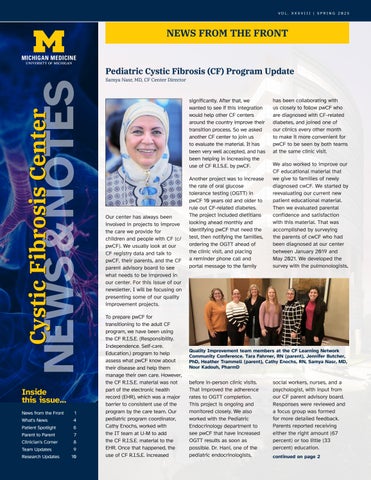
Quality Improvement team members at the CF Learning Network Community Conference. Tara Fahrner, RN (parent), Jennifer Butcher, PhD, Heather Trammell (parent), Cathy Enochs, RN, Samya Nasr, MD, Nour Kadouh, PharmD
before in-person clinic visits. That improved the adherence rates to OGTT completion. This project is ongoing and monitored closely. We also worked with the Pediatric Endocrinology department to see pwCF that have increased OGTT results as soon as possible. Dr. Hani, one of the pediatric endocrinologists,
social workers, nurses, and a psychologist, with input from our CF parent advisory board. Responses were reviewed and a focus group was formed for more detailed feedback. Parents reported receiving either the right amount (67 percent) or too little (33 percent) education. continued on page 2
CYSTIC FIBROSIS CENTER NEWS AND NOTES | VOL. XXXVIII | SPRING 2025
NEWS FROM THE FRONT
Parents categorized education material into “highly prefer,” “useful, but not first preference,” and “do not like.” Highly preferred were verbal/interactive learning (78 percent) and written and printed materials (67 percent). Digital printed materials, videos, and social media or talking to other parents of children with CF ranked lower with more parents, as second or third choice. Parents’ input showed that current printed materials are useful, as they explain CF; in addition, several new topics were added including parental mental health resources, family/sibling coping, mentoring programs, equipment tips, school prep, and tips for traveling among other topics. Now the material is placed in folders and given to parents during the first visit or two for reference at home and to be shared with their families. Positive support was given for the idea of addressing one area of the binder at each visit during the first year of life. Food insecurity screening was evaluated for pwCF and their families whether they are seen in person or virtually. We also
2
examined the current food insecurity rate at our center. We found that the response rate for food insecurity screening was lower when questionnaires were done virtually than when they were done in person. To improve the rate of screening, we have been asking parents and pwCF to complete the screening before the virtual or in-person visits with the dietitian, so she can go over it with them, and if not completed, help them with the questions. That enables us to provide the families with helpful resources that they can easily access. Globally, we have been working extensively with several children’s hospitals in Egypt since 2020 to help establish CF care centers there, and help develop national guidelines and CF registry for physicians, care teams, and pwCF in Egypt. Through our work, CF physicians’ and team members’ knowledge about CF have been improving. Also, one university has now developed a multidisciplinary team to take care of pwCF, including the pulmonary team, plus a nutritionist, gastroenterologist, physical therapist, and endocrinologist.
Back row: Dr. Marwa Hosni, Ain Sham's Physical Medicine and Rehab Specialist, Dr. Samya Nasr, U-M CF Center Director, Dr. Eman Fouda, Ain Shams Professor of Pediatrics, Dr. Terez Kamel, Professor of Pediatrics, Ain Shams Pediatric Pulmonary Director. Front: Dr. Marwa Ahmed, Ain Shams Nutritional Specialist
Most importantly, through lobbying, Vertex® included Egypt in their Trikafta® donation program and pwCF started receiving it as of early January 2025. This is very exciting news and will most likely change the nature of the disease in the nation, where most pwCF do not live to see their 10th birthday.
CYSTIC FIBROSIS CENTER NEWS AND NOTES | VOL. XXXVIII | SPRING 2025
NEWS FROM THE FRONT Cystic Fibrosis Adult Program Updates Thomas Sisson, MD, Adult CF Program Director
Happy 2025 to our patients and families! I hope everyone had a joyful holiday season and is entering the new year with excellent health. I would like to provide an update on the Adult CF program, highlighting what is happening with our clinical team, how we are doing regarding clinical outcomes, and what we anticipate for the coming year. I am very fortunate to work with such a caring, dedicated, and competent group of providers. Fortunately, our adult CF team has experienced very few changes over the past year, and I believe this speaks to how well everyone works together and how committed everyone is to caring for persons with CF. Katie Hall continues as Program Coordinator with support from Eeyeen Ong. They keep the program moving forward through their organization and novel ideas. Both Katie and Eeyeen also provide clinical support to our patients in their roles as social worker and dietitian, respectively. Mari Pitcher, one of our dedicated social workers, has reduced her clinical hours
as she enters retirement. Our program is fortunate to have her continue direct patient care as our team’s Mental Health Coordinator. To replace her social work contributions, Brynn Arnall has transitioned to the outpatient clinic full time. Many of you may know her from 6C, as she most recently provided inpatient social work services. Becca Aiello continues as our respiratory therapist, and she is spearheading our quality improvement processes. Ronnie Downer remains our primary nurse in clinic, using her extensive experience to troubleshoot outpatient illnesses, and she receives support from Joy Dettore. Finally, our team is very lucky to have the support of our two Kristens. Kristen Keith, our team physical therapist, is invaluable in helping our patients (and all of the providers) deal with musculoskeletal concerns, and Kristen Klein guides us on a daily basis with her immense expertise on medications. In addition to our outstanding care team, I work with a great group of physicians. We have also benefited from stability in our physician providers over the past several years. Both Dr. Coffey and Dr. Grum continue to care for people with CF in their clinics, having been dedicated to CF care for many decades. Drs. Huang, Jia, and Brown assist me in seeing the bulk of patients in our outpatient clinic, and Dr. Sagana leads our transplant initiatives. Their compassion, intelligence, and hard work are truly motivating and inspiring. I also want to acknowledge
the contributions of Denyse Stepka, a nurse-practitioner who came to the outpatient practice from our inpatient pulmonary service. With several providers out on leave, Denyse has been an amazing support. We additionally have two pulmonary fellows, Heather Schofield and Callie Drohan, who are working directly with our CF physicians to provide excellent patient care. Lastly, I want to mention that the CF Foundation is supporting our center (through their PACE Award Program) to incorporate a primary care physician into our practice. Dr. Dale Mazer, a primary care physician at the Michigan Medicine Briarwood Clinic, will be joining us later this spring. She is rearranging her current responsibilities, and will be seeing more of our adult patients for their primary care needs.
Dale Mazer, MD, MPH, Clinical Assistant Professor of Internal Medicine, Medical Director, Briarwood General Medicine
In this new era of CF care that includes highly effective modulators (e.g. Trikafta®, Ivacaftor, and others), our clinic continues to see improvements in health care outcomes. For example, lung function (as measured by FEV1) has steadily
improved since 2019, and the Adult CF program’s median value is now around 87 percent, which is within the normal range. With respect to lung cultures, the percent of patients chronically infected with Pseudomonas has decreased from 70 percent to 30 percent, truly an amazing outcome. Finally, nutritional status has improved as reflected in a steady increase in body mass index. These broad improvements in health tightly correlate with the FDA approval of Trikafta. We unfortunately still have patients who either do not qualify for this modulator or do not tolerate this medication. For this latter group, we are excited about the recent approval of Alyftrek™, a new once-daily, highly effective modulator. If you are looking for a way to take on a more active role within our program, we would happily welcome you to join our CF Advisory Board. The group meets once a month virtually and we depend on your voices to know what the needs of our patients are. If you are interested in joining, please send Katie Hall a portal message or email her at aultkath@med.umich.edu. To conclude, our team is excited for another year of working together to provide the best care possible for our patients. As lung function and nutrition improve, primary care will take on increased importance in our patients’ health, and we are very pleased to have Dr. Mazur joining our team. Finally, we look forward to having another highly effective modulator as an option for people with CF to consider. 3
CYSTIC FIBROSIS CENTER NEWS AND NOTES | VOL. XXXVIII | SPRING 2025
W H AT ’ S N E W S CYSTIC FIBROSIS NIGHT
Staff Introductions
Join us for another amazing night filled with conversations, connections, dinner, and cystic fibrosis education for families and friends of people with CF.
Adeeba Afrah, MD, has joined the Pediatric Pulmonology Division at C.S. Mott Children's Hospital to complete her fellowship in pulmonology. She completed her medical school from India, and her residency program at Ascension St. John in Detroit.
Thursday, May 22, 2025, 4:00-8:00 pm Kensington Hotel 3500 South State St, Ann Arbor, MI 48108 4:00 pm
Registration and Open Vendor Tables
5:30 pm
Dinner
6:00 pm
Welcome and CF Foundation Update Cystic Fibrosis Foundation
6:05 pm
Pediatric Program Update Samya Nasr, MD CF Center Director
6:25 pm
Adult Program Updates Tom Sisson, MD Adult CF Program Director
6:45 pm
CF Center Research Updates Alexandra S. Piotrowski-Daspit, PhD CF Center Research
7:05 pm
Personal Experiences with CF Katie Greve, Adult living with CF
R.S.V.P. Respond by Wednesday April 30, 2025 using the QR code to the left or email UM-Peds-CFCenter@med.umich.edu Include in RSVP: •
• •
The name of the person with CF you are connected to that is seen at our center (if applicable) Your relation to a person with CF (parent, spouse, sibling, friend, etc.) The names of each person attending (Max 6 attendees per family/friend group)
***Only 1 (one) person with cystic fibrosis may attend this event and they will be our main speakers’ family.*** This event is open to the public. U-M’s YouTube channel will post the recording in the weeks following the live event.
4
Meghna Ancha, Clinical Research Assistant, graduated from the Lyman Briggs College at Michigan State in 2023 with a degree in human biology and a minor in bioethics. She previously worked as a medical assistant for a year before joining the pediatric CF research team at Michigan Medicine. Nour Kadouh, PharmD, obtained her Doctor of Pharmacy degree from the University of Michigan in 2022 and completed two years of pharmacy residency training, specializing in pediatrics, at U-M Health. Over the past three years, she worked with patients in the pediatric cystic fibrosis clinic and joined the Pediatric Pulmonology Division as a clinical pharmacist specialist in August 2024. Brittney Rankin is an energetic and compassionate respiratory therapist with 4.5 years of ICU experience. She joined the Pediatric team in August 2024 and has quickly become a committed part of the group. Brittney holds a Bachelor of Applied Science from Siena Heights University. Additionally, Brittney serves as a Basic Life Support instructor, helping others acquire these life-saving skills. Saumini Srinivasan, MD, MS began with Fellowship training in CF at Children's Hospital Los Angeles, University of Southern California. She spent the last 17 years as an attending physician at Le Bonheur Children’s Hospital and St Jude Children’s Research Hospital affiliated with the University of Tennessee (UT), Memphis. She served as Center Director for the Pediatric CF Center of UT for the last 10 years. Dr. Srinivasan is excited to join the outstanding CF care team at U-M's CS Mott Children's Hospital.
CYSTIC FIBROSIS CENTER NE WS AND NOTES | VOL. XXXVIII | SPRING 2025
W H AT ’ S N E W S
Your Voice Matters Did you know that the CF Foundation approved a Parent Forum, initiated because of the voices of some of our advisory board members? It set the stage of community, sharing, and friendship among parents. Ask your social worker if you want to learn more!
In 2024, University Michigan investigators received a twoyear award from the Cystic Fibrosis Foundation (CFF) to start planning for a U-M Research Development Program (RDP) application. The CFF RDPs are awarded to CF centers that can bring together experts in basic science and clinical research across multiple fields to serve as research “hubs” to advance CF research locally and nationally. There are currently nine CFF RDPs across the country. The U-M RDP planning award is led by Dr. Alex Piotrowski-Daspit in Biomedical Engineering, and co-led by Dr. Lindsay Caverly in Pediatric Pulmonology. Dr. Michelle Hastings (Pharmacology) and Dr. John LiPuma (Pediatric Infectious Diseases) are also leaders in this project. Additional members of the U-M CF research team working on this project include chemical and environmental engineers, pharmacologists, pharmacists, microbiologists, cell biologists, chemists, physicianscientists, physicians, and other members of the CF care team, all of whom have combined expertise that is directly relevant to CF research and care. The topics for the U-M RDP include developing CF genetic therapies (genome editing, RNA therapeutics), drug delivery, new antibiotic development, airway infections, and tissue engineering, among others, with the overall goal of bringing bench research to patient care and helping improve CF care. Activities during this initial two-year award will include building new collaborations within U-M and beyond and developing core facilities to support CF research. Efforts to recruit new investigators to CF research are also an important part of the program, and will include both connecting with established investigators and cultivating the next generation of CF scientists through mentorship programs, handson technical training, and professional development opportunities. At the end of this two-year award, we plan to submit an application for a full CFF RDP award.
Are you interested in opportunities to advocate to state and federal lawmakers in Michigan? Contact Shelly Francis at the CF Foundation Michigan Chapter at sfrancis@cff.org for more information.
CF Peer Connect is a peer mentoring program for people with cystic fibrosis and CF family members age 16 and older. Through this program, you’ll be matched with a peer mentor who has experience with topics that are important to you. Together, you can connect over video, phone, or email. Visit: cfpeerconnect.com/about
We are excited about this new project and look forward to enriching the U-M CF research community and ultimately contributing to improvements in CF care. We will be developing a website to keep the community updated about our activities, and we will be in touch with everyone in the U-M CF community, including patients and caregivers, as opportunities to participate in these research activities arise. 5
CYSTIC FIBROSIS CENTER NEWS AND NOTES | VOL. XXXVIII | SPRING 2025
PAT I E N T S P OT L I G H T Growing with CF and its Abnormality McKenna Geiser, adult living with CF class. My presence in class was marked as bothersome, but as I continued, my absence was also seen as a problem.
Dealing with a genetic disease at a young age causes various challenges and lifealtering experiences. Specifically, when it comes to cystic fibrosis (CF), society has not yet been able to adapt to those who suffer from the illness. Since CF is still seen as a relatively unknown disease, those who deal with the effects of being different, especially in social settings, are often misunderstood and judged by their peers. As a kid who was diagnosed with CF at birth, I’ve experienced large amounts of disdain from my peers for being different. I was often avoided by those around me because of the fear of me being “contagious.” CF kids are frequently found coughing since the illness weakens their lungs. Coughing became a norm in my daily life, so much so, that I eventually developed something called a “habit cough.” The young children in my school, however, could not understand why I coughed so often. Many kids avoided me entirely, worried that I would get them sick as well. I was never able to convince them otherwise, and at the time, I couldn’t figure out how to stop my coughing from occurring so frequently. I distinctly remember holding in my cough as long as possible during our silent reading time to not disturb others. However, that only made things worse; it seemed that no matter what path I took, I would never be able to appease those in my 6
Unfortunately, having a chronic illness comes with constant absences from school. I managed to rake up numerous absences due to falling ill, hospital trips, and doctor’s appointments. While many of my teachers seemed to understand why I had to miss class, my peers did not. After so many times explaining why I was unable to come to school, the kids in my class started to label me as a liar and lazy. Yet again, I was unable to convince them otherwise. This led to a type of isolation that severely impacted both my mental health and ability to properly socialize. The isolation that comes with having CF is a difficult obstacle to overcome. This is because those who have CF are unable to converse with others who share the illness due to the risk of spreading bacteria/ infection. The probability of getting ill from shared bacteria with other CF kids is high. Therefore, in-person interaction was often not possible. As a result, I was never able to understand that others were going through the same experiences I was going through. Especially as a child, I lacked the capacity to look outside myself. I fell into fits of hopelessness and isolation. No one understood what breathing treatments meant. No one understood why I had to take pills every time I ate. It was a constant cycle of misunderstanding and loneliness—that is, until I started to find those who truly accepted me. The strangest part about growing up different was finding others who felt the same way. Much of my childhood seems bleak and bad, but it was because of those experiences that I was able to relate to and understand my friends who grew up feeling the same way. While these people didn’t have CF as I did, they understood that they should not be quick to judge, and they needed to be supportive. Being
seen as “weird” in society's eyes isn’t deplorable, it’s commendable. I’ve tried changing my lifestyle to fit in with those I deemed as “normal.” However, as I continued, I found I was slowly losing myself. By the time I was in high school, I couldn’t figure out how to be happy, normal, and myself all at the same time. So, I stopped. Once I did, that is when I truly found peace in my life. So be weird, be odd, find others who are the same or will accept you as you are. You can’t expect to live truly walking a path with those who never intend on walking beside you.
CYSTIC FIBROSIS CENTER NEWS AND NOTES | VOL. XXXVIII | SPRING 2025
PA R E N T TO PA R E N T Our CF Journey Tara Fahrner, Parent of a child with CF Every parent of a child with medical needs has a story to tell, and no two stories are the same. Just as no child with cystic fibrosis is just like another. Our CF journey started when my son, Beau, was just two weeks old. Receiving a phone call from our pediatrician stating we would need to go to a specialty hospital for further testing based on his newborn screening results was the biggest shock my husband or I could have encountered. How could our baby potentially have cystic fibrosis? We have zero family history of this disease and were in utter denial. I am a registered nurse, and what you learn from nursing school textbooks is basic and mostly outdated information. “No cure,” “progressive lung disease,” and “terminal illness” were just a few phrases that came to my mind when sitting on the patient exam table receiving Beau’s sweat chloride results at U-M hospital; they were off the charts, and it was undeniable: he had cystic fibrosis. Becoming a new parent is tough, but receiving a diagnosis like our son’s and learning our new normal was not an easy feat. Spoon feeding our newborn baby enzymes, holding a mask on his face while administering nebulized medications, and chest percussions on such a delicate little body were just a few of the things that were difficult to wrap our heads around. “Will he be okay?” our friends and family would ask daily. We weren’t quite sure how to answer such a question. We knew in our hearts we would raise this sweet boy to be resilient and he would overcome any obstacle that
might come in his way. Fast forward oneand-a-half years later, my husband and I have learned so much about this disease and have grown immensely as parents, caregivers, and individuals. When Beau was about one year old, I had the opportunity to become involved with UM’s quality improvement team as a patient family partner (PFP), as well as to attend NACFC (North American Cystic Fibrosis Conference) and join the parent advisory board within our CF program. Working closely with Beau’s care team has been so rewarding and has opened new doors for us in the realm of communication within the center. As a PFP I get to attend several meetings with the staff that are involved with Beau’s care and discuss ways of improving the care of all pediatric CF patients at U-M’s facility. This role as a PFP allows me to wear both my nurse and my parent hats at the same time and makes me feel as if I am making a difference in the future of the CF community for my son. The NACFC conference was the first event I was able to attend in my new role, and the stories I heard from other CF parents were very inspiring. I’ve never met any other parents who have a child with this disease, and it felt like I was finally
understood, and I related to these other people who fight the same fight we do every day. They understand the exhaustion that comes with the constant regimen of respiratory treatments and strict medication schedules, and the overall weight that comes along with being a parent of someone with CF. To see such a strong community come together to support one another in the fight to a cure and hear about the latest findings in research and progression of modulators makes me think that there is light at the end of all of this. The CF community is unlike any other community I have been a part of, and the passion they put toward fundraising through events with the CF Foundation and Great Strides is deeply admirable. I look forward to seeing where this journey as a PFP takes me in the next few years, and can’t wait until CF can stand for “Cure Found.”
7
CYSTIC FIBROSIS CENTER NEWS AND NOTES | VOL. XXXVIII | SPRING 2025
T E A M U P DAT E S Pediatric Family Advisory Board Update The Pediatric CF Program’s Parent Advisory Board has been busy advocating for their community. After careful discussion and prioritization of ideas, our board decided to see how they could help with durable medical equipment (DME) problems they’ve experienced and heard about in the local CF community. One of the major DME companies, Binson’s Medical Supply, graciously accepted our invitation to meet with the advisory board, and sat down to discuss ongoing equipment fulfillment problems and potential solutions. Binson’s returned with ideas for educational focus for their staff and examples to investigate for internal improvement. They heard about the burden of equipment refill problems on parents of children with CF and are devoted to
improving the services they provide this population. If you have any problems with your Binson’s equipment refills or orders, please contact the clinic and we can connect you with the appropriate person at Binson’s to help reduce the back-and-forth calls and corrections. The board is also in the process of creating a parent-led podcast that will cover all things CF. We will have guests from the community, including parents, people with CF, and providers, as well as those involved in groundbreaking research and advocacy efforts. The podcast will be widely advertised to people with CF and their families once available, so keep an eye out for this exciting new project coming in 2025!
has been working on our clinic newsletter, advising on infection control measures within the clinic, and continuing to help identify opportunities for our program to be the best it can be! Contact Katie Hall at aultkath@med.umich.edu if you have any questions!
Study Spotlight: STOP PEDS RCT We will soon be enrolling children with CF ages 6-18 for the STOP PEDS study. At enrollment, participants will be in their baseline state of health. In this study, we are going to compare two ways of treating mild respiratory illnesses in children with CF: immediate antibiotics (increase airway clearance and start oral antibiotics right away) and/or tailored therapy (increase airway clearance right away but only start oral antibiotics if symptoms worsen or do not improve). We are looking at how safe each option is and how well each one works. To do this, we will randomize study subjects (like flipping a coin) to one of these two approaches if or when you have a mild respiratory illness over the next 12 months.
8
May 4 Metro Detroit May 10 Toledo May 17 Grand Rapids May 17 Montrose
Adult Patient Advisory Board Update Did you know the Adult Pulmonary Program at Michigan Medicine has an Advisory Board? We are always seeking new members. It is a great opportunity to network with other people in the CF world. We meet monthly on Zoom and offer feedback on up-and-coming projects. Over the past few months, the Advisory Board
May 3 Ann Arbor, MI
May 18 Grand Haven CFF Great Strides! The Cystic Fibrosis Foundation Michigan Chapter holds several fundraising events including Metro Detroit’s Finest, Fall Ball, and Great Strides walks throughout Michigan and northwest Ohio. Visit greatstrides.cff.org for more details! For more information on how you can get involved and Commit to a Cure, please call the chapter office at 248-269-8759 or email us at Michigan@cff.org.
CYSTIC FIBROSIS CENTER NEWS AND NOTES | VOL. XXXVIII | SPRING 2025
R E S E A RC H U P DAT E S
Modulator Studies: 1.
1VX20-121-104: A Phase 3, Open-label Study Evaluating the Longterm Safety and Efficacy of VX-121 Combination Therapy in Subjects with Cystic Fibrosis (enrollment closed)
7.
PROMISE: evaluating the effects of CFTR modulators on airway inflammation and microbiology (enrollment closed)
8.
Mayflowers: To characterize changes in FEV1 over the course of pregnancy based on cumulative CFTR modulator use while pregnant along with defining other factors that may influence changes in pulmonary function including duration of prepregnancy modulator use, baseline FEV1, genotype, history of exacerbations, and preexisting comorbid conditions. (recruiting)
9.
yETI: Your ETI- a survey study to better understand adherence to Trikafta® (enrollment closed)
Observational Studies:
The CF Foundation’s Therapeutics Development Network (TDN) is a driving force in CF research. Michigan Medicine is a CF TDN Center, which helps us get involved in multicenter clinical research so we can contribute to making improvements in CF treatments and therapies. In addition, our center has been doing our own research as well. However, we can only accomplish that with the participation of our patients! If you have questions about our research program, you may contact Marisa Linn at mlinn@ med.umich.edu and Dawn Kruse at dmkruse@med.umich.edu. If you are interested in research participation, but not seeing something for you here, feel free to browse the CF Foundation’s Clinical Trial Finder (apps.cff. org/trials/finder). Contact Dawn or Marisa if you see something you are interested in so we can help you navigate the referral to another CF Center to participate in the study (your general CF care will continue to stay with us!).
Antibiotic/ Antimicrobial Studies: 1.
2.
3.
CMTX101-P1-CT002: A Phase 1b/2a Study to Evaluate the Safety of CMTX-101 in Combination with Inhaled Tobramycin in People with Cystic Fibrosis Chronically Infected with Pseudomonas Aeruginosa (age 18+, now enrolling) STOP360: Standardizing Treatments for Pulmonary Exacerbations in Patients Being Treated for Pulmonary Exacerbation and Pseudomonas aeruginosa (age 6+, now enrolling) STOP PEDS RCT: Streamlined Treatment of Pulmonary Exacerbations in Pediatrics Randomized Controlled Trial (age 6-18, now enrolling)
1.
REACH-OB-23: A Research Study to Advance the CF Therapeutics Pipeline for People without Modulators (age 12+, now enrolling)
2.
HOPe:CF Aim 2: Health Outcomes of Parents with Cystic Fibrosis (now enrolling adults with CF)
3.
Prospective Study of Cystic Fibrosis (CF) Patients by Lung Magnetic Resonance (MRI) Technology, CT scan of the Chest and Clinical Measures of Pulmonary Function (age 6-11 years old, enrollment closed)
4.
CHEC-OB-17: CFTR Modulated Changes in Sweat Chloride and Outcomes- for patients currently taking an FDAapproved CFTR modulator (enrollment on hold)
5.
NTM-OB-17: Evaluation of a standardized approach to diagnosis (PREDICT) and treatment (PATIENCE) of nontuberculous mycobacteria (NTM) (ages 6+, now enrolling)
6.
BEGIN: A Prospective Study to Evaluate Biological and Clinical Effects of Significantly Corrected CFTR Function in Infants and Young Children (enrollment closed)
Phage Studies: 1.
20-0001: A Phase 1b/2, Multi-Centered, Randomized, DoubleBlind, Placebo-Controlled Trial of the Safety and Microbiological Activity of a Single Dose of Bacteriophage Therapy in Cystic Fibrosis Subjects Colonized with Pseudomonas aeruginosa (recruiting)
9
CYSTIC FIBROSIS CENTER NEWS AND NOTES | VOL. XXXVIII | SPRING 2025
CLINICIAN'S CORNER Alyftrek (Vanzacaftor/Tezacaftor/Deutivacaftor, VTD): is this new CFTR modulator for me? Amy Filbrun, MD, MS, Pediatric CF Program Co-Associate Director Nour Kadouh, PharmD, Pediatric Clinical Pharmacist
10
Many of you have probably heard about Alyftrek (VTD), the new cystic fibrosis transmembrane conductance regulator (CFTR) protein modulator approved by the FDA in December 2024. Alyftrek is approved for people with cystic fibrosis (pwCF) ages six and older who have at least one F508del mutation or additional responsive mutations, including 31 rare mutations not previously approved for any other modulators.
Common Side Effects and Reactions in People with CF 12 Years and Older* Alyftrek (491 people)
Trikafta (480 people)
Cough
25%
24%
Common cold
21%
19%
Upper respiratory tract infection
21%
20%
Headache
16%
13%
Difficulty swallowing or coughing
14%
12%
What is Alyftrek and how does it is different from Trikafta?
Influenza
11%
5%
Fatigue
11%
9%
Alyftrek is the trade name for a combination of vanzacaftor/tezacaftor/ deutivacaftor (VTD). Those of you taking Trikafta may recognize some of these names. Tezacaftor is also in Trikafta. Deutivacaftor is a deuterated form of ivacaftor, which means the ivacaftor has been chemically modified to change some of the properties of the drug to increase how long the drug lasts in the body, and potentially to reduce toxicity or improve how well the drug works. Vanzacaftor is a new addition in this modulator. As a reminder, the F508del mutation causes two problems with the CFTR protein. The protein does not fold properly to be able to get to the cell surface, and the protein that does make it to the cell surface does not “turn on” or open the chloride channel at the cell service properly. Two of the medications in Alyftrek, vanzacaftor and tezacaftor, are called correctors, because they fix the protein so it can fold and reach the cell surface. Detuivacaftor is called a potentiator, because once the protein is at the surface, it helps to open the channel and allow chloride (and sodium) to flow in and out of the cell. While Trikafta requires dosing to be twice a day, due to the need to redose ivacaftor, Alyftrek is taken only once a day, as the deuterated form of ivacaftor lasts longer and does not require a second dose.
Rash
8%
4%
>3X the upper limit of normal
6%
3.1%
>5X the upper limit of normal
2.5%
1.2%
>8X the upper limit of normal
1.3%
0.1%
5%
3%
Elevated liver enzymes** Sinus congestion
*Not an all-inclusive list; adverse reactions in 6-11 year age group were generally similar to those reported in the trials with patients 12 years and older **aspartate aminotransferase (AST) or alanine aminotransferase (ALT) How was Alyftrek tested in people with CF?
What are the main side effects of Alyftrek?
Nine hundred and seventy-one pwCF 12 years and older participated in two trials comparing Alyftrek to Trikafta. The goal of these trials was to show if Alyftrek is similar to and not inferior to (worse than) Trikafta. Studies showed no difference in change in lung function between those who took Alyftrek vs. those who remained on Trikafta. There was a greater decrease in sweat chloride level noted in the group that took Alyftrek. The clinical importance of these differences in sweat chloride has not been shown in clinical trials. Seventyeight children 6-11 years old participated in a trial to assess safety and tolerability of Alyftrek. Because no one took placebo in this safety study, it is not known if changes seen in the study were due to Alyftrek, but it did appear to be safe and well tolerated.
The most common side effects of Alyftrek are cough, upper respiratory infection, headache, influenza, fatigue, rash, and sinus congestion. As with Trikafta, there have been reports of increased liver enzymes in pwCF who have taken Alyftrek. The changes in levels can range from mild elevations to cases of serious liver injury and failure, so monitoring levels when starting or switching from a different modulator is important. Cataracts have been reported in pwCF treated with medications containing ivacaftor, so as with the other modulators, baseline and annual slit lamp eye exams will be required for patients under 18 years of age taking Alyftrek. The clinical trials did not include pwCF who stopped or did not tolerate Trikafta due
CYSTIC FIBROSIS CENTER NEWS AND NOTES | VOL. XXXVIII | SPRING 2025
CLINICIAN'S CORNER
to side effects, so we do not yet know if individuals who had elevated liver enzymes, or behavior and mood related side effects on Trikafta will have similar experience on Alyftrek. What testing will I need if I switch to or start Alyftrek? Similar to Trikafta, pwCF under the age of 18 years will need a slit lamp eye exam to assess for cataracts at baseline and annually until 18 years of age. Additionally, the recommendation is for monitoring liver function monthly for the first 6 months on Alyftrek, then every 3 months for the next 12 months, and annually after that. More frequent monitoring should be considered in people with abnormal liver function at baseline. Of note, these same recommendations were also applied to pwCF newly starting Trikafta going forward. Similar to Trikafta, monitoring for Vitamin A, D, and E levels occurs every 3 months for the first year after starting the medication, and then annually thereafter. Who should switch to Alyftrek, or why would I switch if I’m doing well on Trikafta? Starting or making a change to Alyftrek is an individual decision as CF differs for every person living with it. People will have different reasons to try Alyftrek or to remain on Trikafta. The main advantage to Alyftrek is that it requires only once daily dosing compared to twice daily dosing for Trikafta. For some people, this schedule has the potential to make it easier to follow the medical regimen, and that alone is a good reason to make a switch. Please talk with your care team about the risks, benefits and potential insurance coverage issues to help you in making an informed decision.
Nour Kadouh, CF clinical pharmacist, discussing CF medications with Daphne.
11
NON-PROFIT U.S. POSTAGE PAID ANN ARBOR, MI PERMIT NO. 144
Cystic Fibrosis Center Department of Pediatrics C.S. Mott Children’s Hospital L2221 UH South 1500 E. Medical Center Dr. Ann Arbor MI 48109-5212
MICHIGAN MEDICINE CYSTIC FIBROSIS CENTER CLINICAL STAFF PEDIATRIC PERSONNEL Samya Z Nasr, MD, Director, CF Center Amy Filbrun, MD, MS, Associate Director, Pediatric CF Program Lindsay Caverly, MD, Associate Director, Pediatric CF Program Catherine Enochs, BSN, RN, CF Program Coordinator Fauziya Hassan, MD, Pediatric Pulmonology Marc Hershenson, MD, Pediatric Pulmonology Toby Lewis, MD, MPH, Pediatric Pulmonology Carey Lumeng, MD, PhD, Pediatric Pulmonology Antonia Popova, MD, Pediatric Pulmonology Ixsy Ramirez, MD, MPH, Pediatric Pulmonology Thomas Saba, MD Pediatric Pulmonology Tara Havens, MD, Pediatric Pulmonary Saly Essoh, MD Pediatric Pulmonology Fellow Emmanuel Kumar, MD, MS, Pediatric Pulmonary Fellow Adeeba Afrah, MBBS, Pediatric Pulmonary Fellow Nellie Hani, MD, Pediatric Endocrinology Jennifer Butcher, PhD, Pediatric Psychologist Morgan Benson, BSN, RN, Pediatric Pulmonary Nurse Heather Johnson, MSN, RN, FNP-BC, Pediatric Pulmonary Nurse Jourdan Stiffler, BSN, RN, AE-C, Pediatric Pulmonary Nurse Maria Nedanovski, BSN, RN, Pediatric Pulmonary Nurse Katie Wait, BSN, RN, AE-C, Pediatric Pulmonary Nurse Courtney Iwanicki, MS, RDN, CSP Outpatient Nutrition Specialist Stacey Fogarty-Brown, MA, RDN, CSP Outpatient Nutrition Specialist Julie Lehrmann, LMSW, Clinical Social Worker Gabby Quintana, LLMSW, Clinical Social Worker Annette Kortz, Patient Care Tech Associate Lisa Erpelding, Pediatric Pulmonology
Kimberly Gerbert, Pediatric Pulmonology Taylor Winn, Division Administrator, Pediatric Pulmonology Rusteena Mills, Pediatric Pulmonology Shannon Howe, Pediatric Pulmonology Jennifer Feister, Pediatric Pulmonology Devon Parker, RN, MSN, CPNP-PC, Inpatient Nursing Chris Tapley, MS, PT, Pediatric Physical Therapy Valerie Kersey, PFT Lab Lisa McGuire-Nuttle, PFT Lab Sharyn Dagher, BS, RRT, Respiratory Therapist Jodie Bowman, RRT, Respiratory Therapist Brittney Rankin, RRT, Respiratory Therapist Victoria Kiss, RRT, Respiratory Therapist Kelsey Rajala, RRT, Respiratory Therapist Breanna Bell, RRT, Respiratory Therapist Hanna Phan, PharmD, FCCP, FPPA, Clinical Pharmacist Nour Kadouh, PharmD, Clinical Pharmacist Ashley Sabourin, PharmD, CSP, Clinical Pharmacist Chrita Marshall, Pharmacy Technician Senior Adelyn Beil, MS, MPH, CGC, Pediatric Genetics Heather Trammell, Parent Partner Tara Fahrner, BSN, RN, Parent Partner ADULT PERSONNEL Thomas Sisson, MD, Director, Adult CF Program and Co-Center Director Shijing Jia, MD, Associate Director, Adult CF Program Katie Hall, LMSW, Adult CF Program Coordinator and Clinical Social Worker Sarah Brown, MD, Adult Pulmonology Michael Coffey, MD, Adult Pulmonology Cyril Grum, MD, Adult Pulmonology Yvonne Huang, MD, Adult Pulmonology Veronica Downer, RN, Adult Pulmonary Nurse Eeyeen Ong, MS, RD, Adult Outpatient Dietitian Mari Pitcher, LMSW, Mental Health Coordinator
Brynn Arnall, LMSW, Adult Social Work Becca Aiello, BAS, RRT, Outpatient Respiratory Therapy Kristin Keith, MS, PT, Adult Physical Therapy Kristin Klein, PharmD, Adult Pharmacist Joy Dettore, RN, Adult Pulmonary Nurse Callie Drohan, Pulmonary Fellow Heather Schofield, Pulmonary Fellow Rommel Sagana, MD, Adult Transplant Physician Krysta Walter, PharmD, BCTXP, Adult Pharmacist Amy VanZee, LMSW, Transplant Social Work Stephanie Zaientz, LMSW Transplant Social Work Jennifer Wyckoff, MD, Adult Endocrinology Zahrae Sandouk, MD, Adult Endocrinology Matthew DiMagno, MD, Adult Gastroenterology Please add Dale from Tom’s article Cathy Vancamp, BSN, Adult Inpatient Nurse Supervisor Vikas Sood, RN, NP, Adult Inpatient Nurse Practitioner Todd Georgia, RRT, Adult Respiratory Therapy Gomati Kanphade, PT, Adult Physical Therapy RESEARCH PERSONNEL Samya Nasr, MD, Professor Lindsay Caverly, MD, Assistant Professor Amy Filbrun, MD, MS, Associate Professor Shijing Jia, MD, Assistant Professor Alexandra Piotrowski-Daspit, PhD-BME, Assistant Professor John LiPuma, MD, Professor Carey Lumeng, MD, Professor Dawn Kruse, CCRC, Clinical Research Program Manager Candace Flaherty, Research Coordinator Marisa Linn, BGS, CCRP, Clinical Research Coordinator Jessica Carey, Clinical Research Coordinator Meghna Ancha, Clinical Subjects Associate Mary Jo LaPointe, Data Safety Monitoring Board Coordinator
The University of Michigan is an equal opportunity employer. © 2025 Regents of the University of Michigan, Ann Arbor, Michigan, 48109 Produced by Michigan Creative, a unit of the Office of the Vice President for Communications. MC 250231