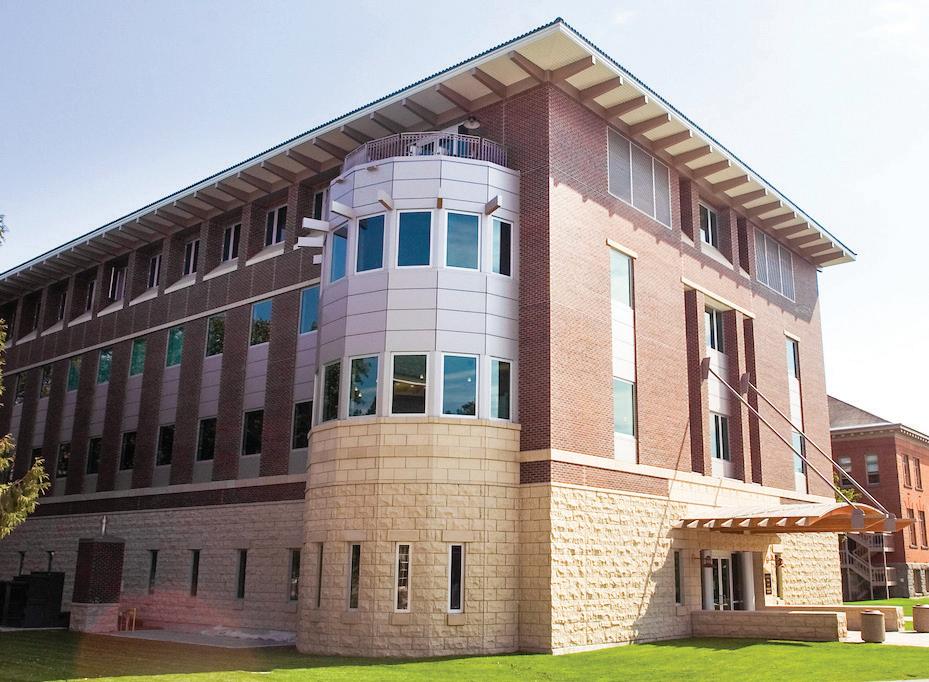
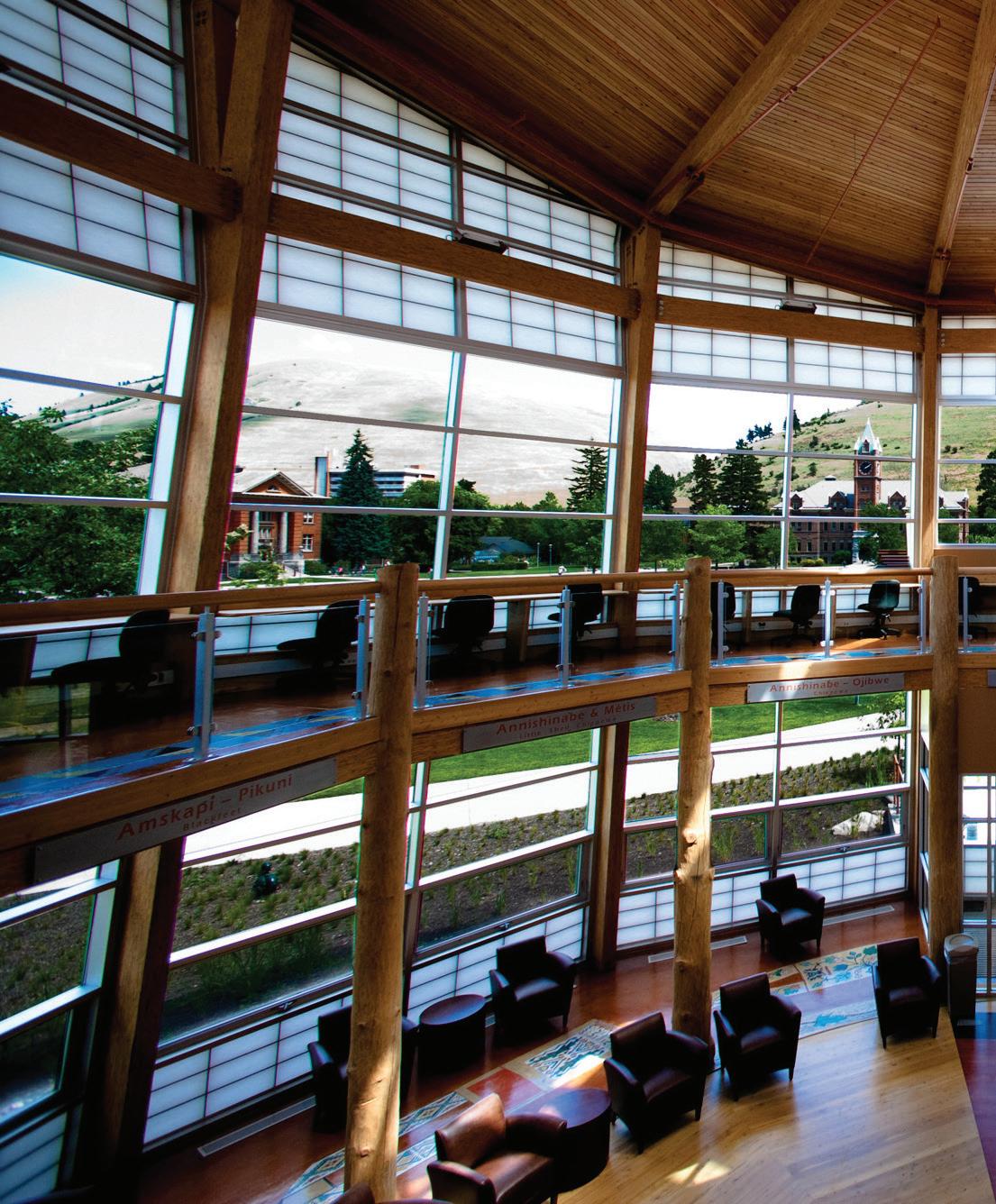
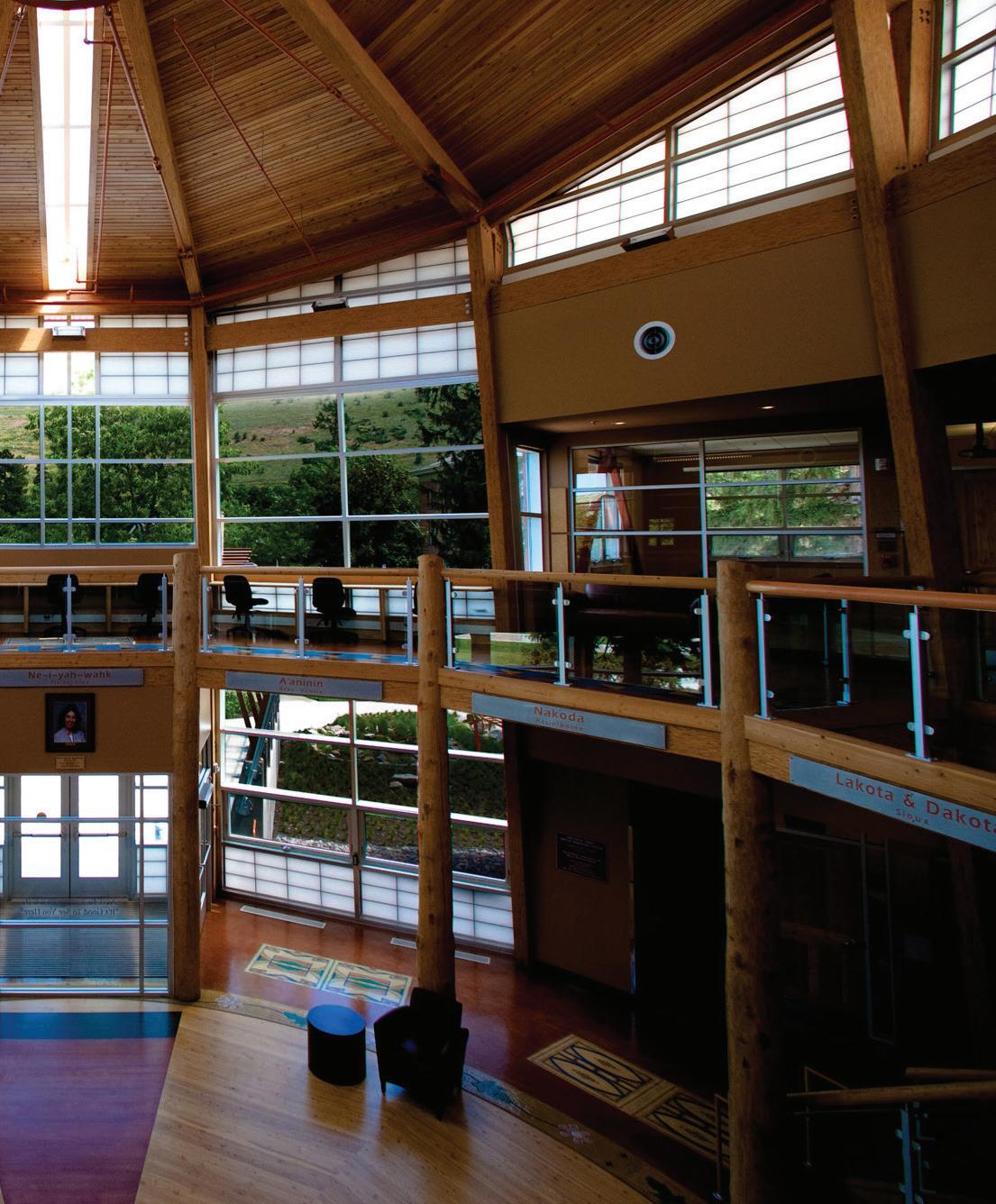
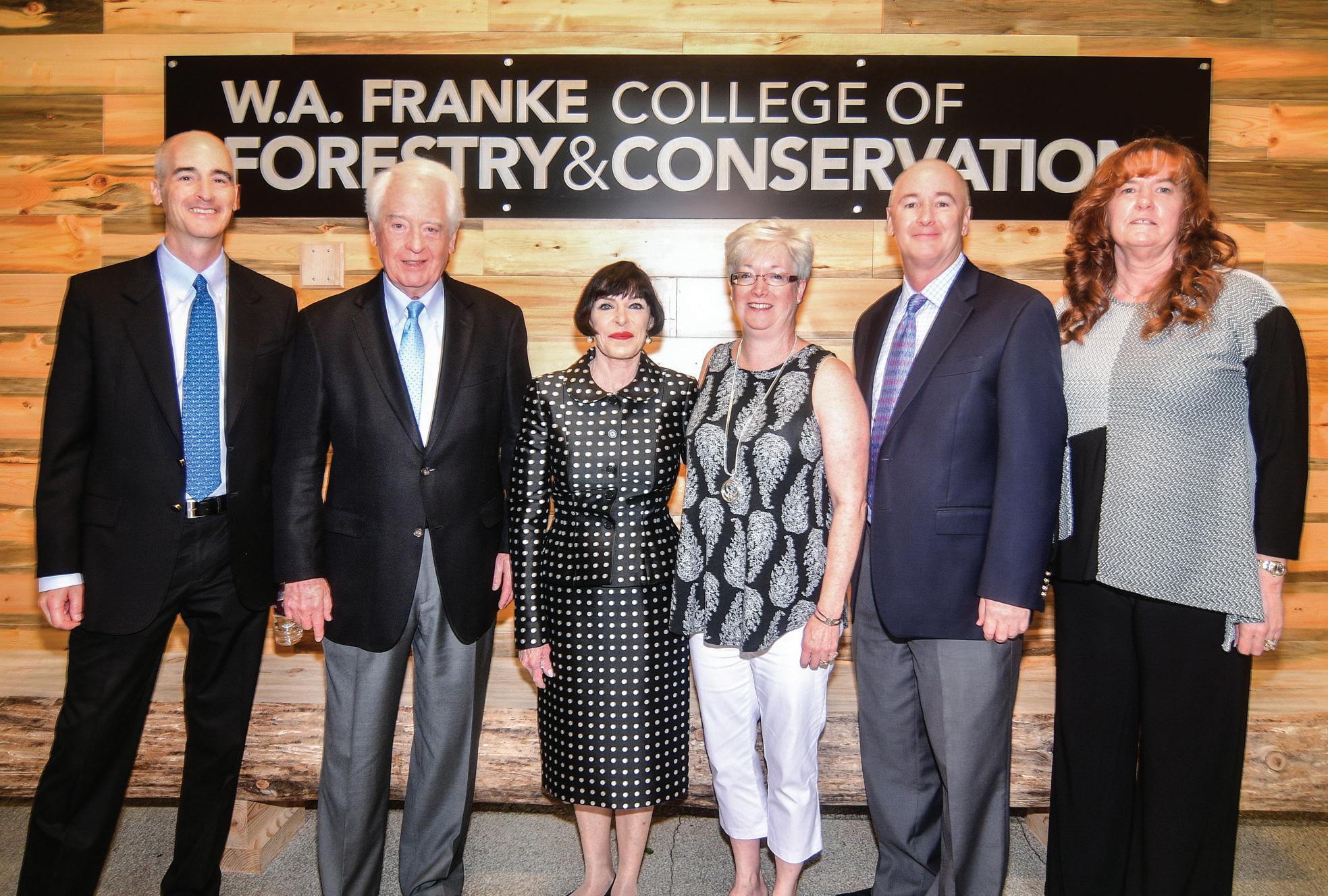
Cover photo by Ella Palulis/ University of Montana
Dear Friends,
For 75 years, dedicated donors have contributed to the excellence and growth of the University of Montana by giving to the UM Foundation.
We mark this special milestone — the UM Foundation’s 75th anniversary — with immense appreciation for the donors and volunteers whose generous spirits and vision elevate the University’s mission.
We celebrate the values that bring us together:
• belief in the power of education to transform lives,
• commitment to lifelong learning and accessibility for all,
• recognition of universities as engines of social mobility and civic engagement,
• dedication to research and creative scholarship that enriches society,
• resolve to confront global challenges through innovation and inquiry, and
• deep appreciation for the community and belonging that gives our work meaning and purpose.
For more than three-quarters of a century, our community has united around these values to help uplift countless lives and benefit our state and the world in innumerable ways.
Please join us as we honor and commemorate our community’s inspiring legacy of giving, service and impact. We hope the historical retrospectives and reflections we share within this publication deepen your connections and renew your commitment to our beloved University.
Thank you for being an integral part of our story and making the University of Montana’s critical mission a priority in your charitable giving and service. You have shaped UM’s past, present and bright future.
Together, the lives we change will change the world.
Sincerely,
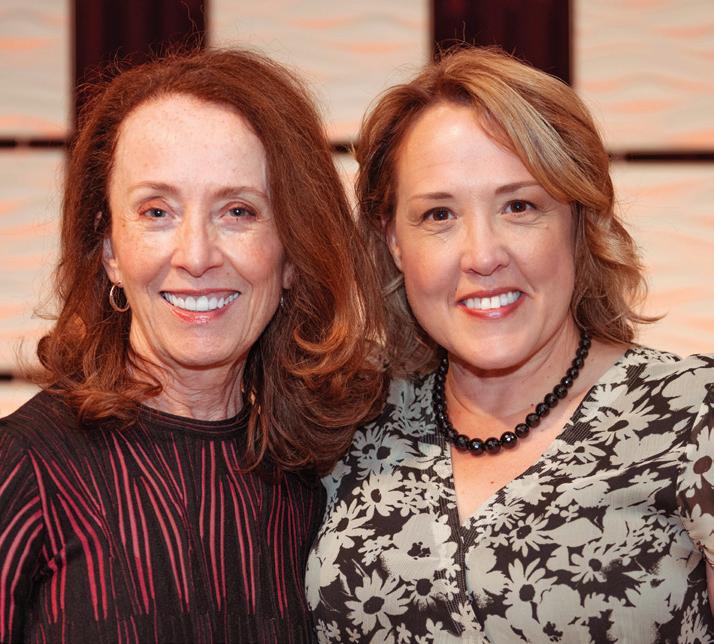
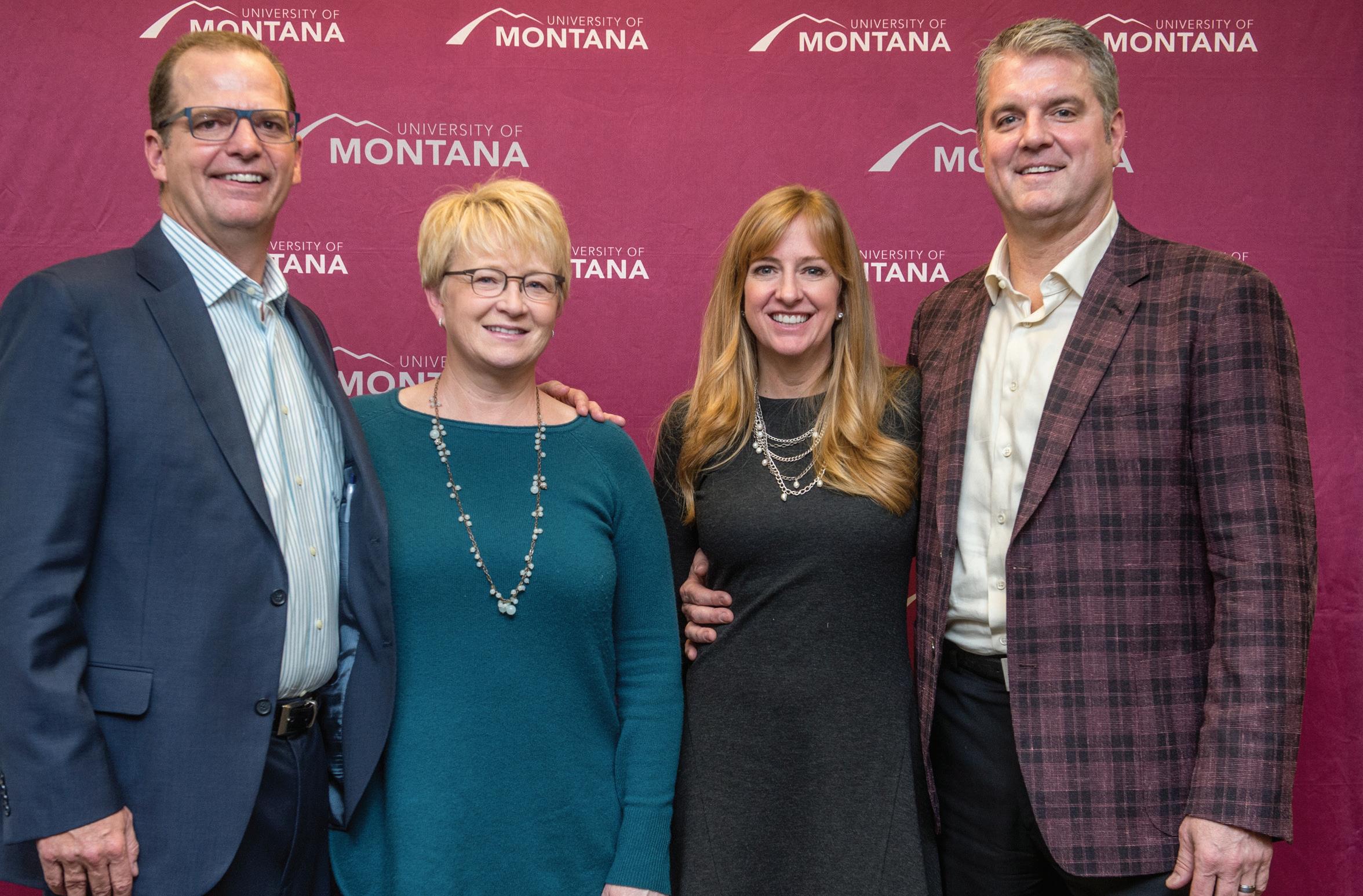
Diane Barlow ’79 and ’82 Board Chair
University of Montana Foundation
Cindy Williams President and CEO
University of Montana Foundation
The University of Montana Foundation is an independent, 501(c)(3) corporation that serves the University of Montana by managing private fundraising efforts, donations and investment of endowed gifts. Governed by a Board of Trustees, the UM Foundation operates under an agreement with UM that is reviewed and approved by the Montana University System.
A LEGACY OF GIVING AND IMPACT 1950-2025
Contributions encompass all gifts, pledge commitments, donor-advised fund grants, employer matching gifts, qualified charitable distributions, deferred gifts such as charitable remainder trusts and estate provisions, and philanthropic contributions made directly to the University.
Deep Roots, Enduring Impact
HONORING A LEGACY OF GIVING AT THE UNIVERSITY OF MONTANA
November 18, 1950, was a day of celebration at the University of Montana.
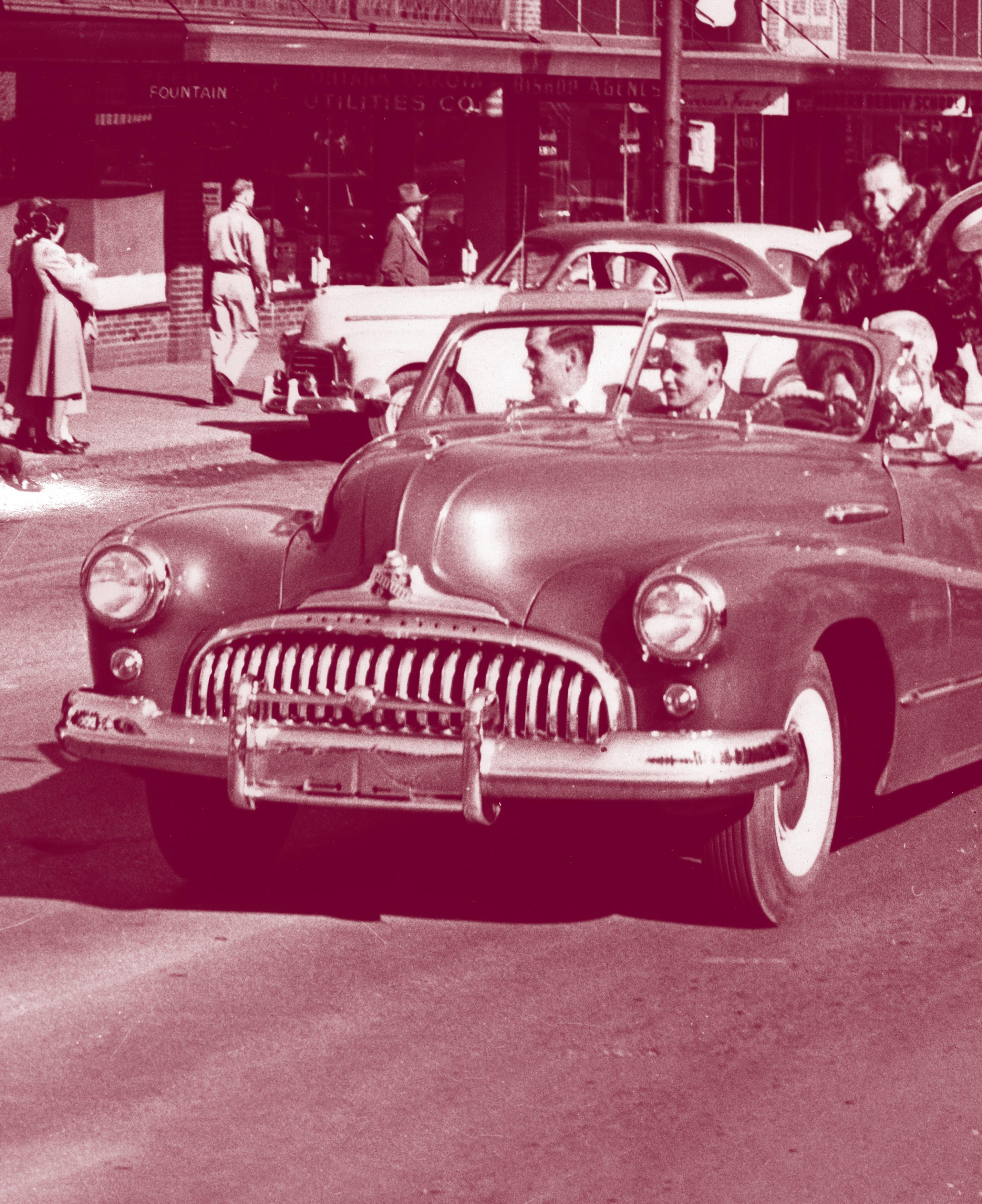
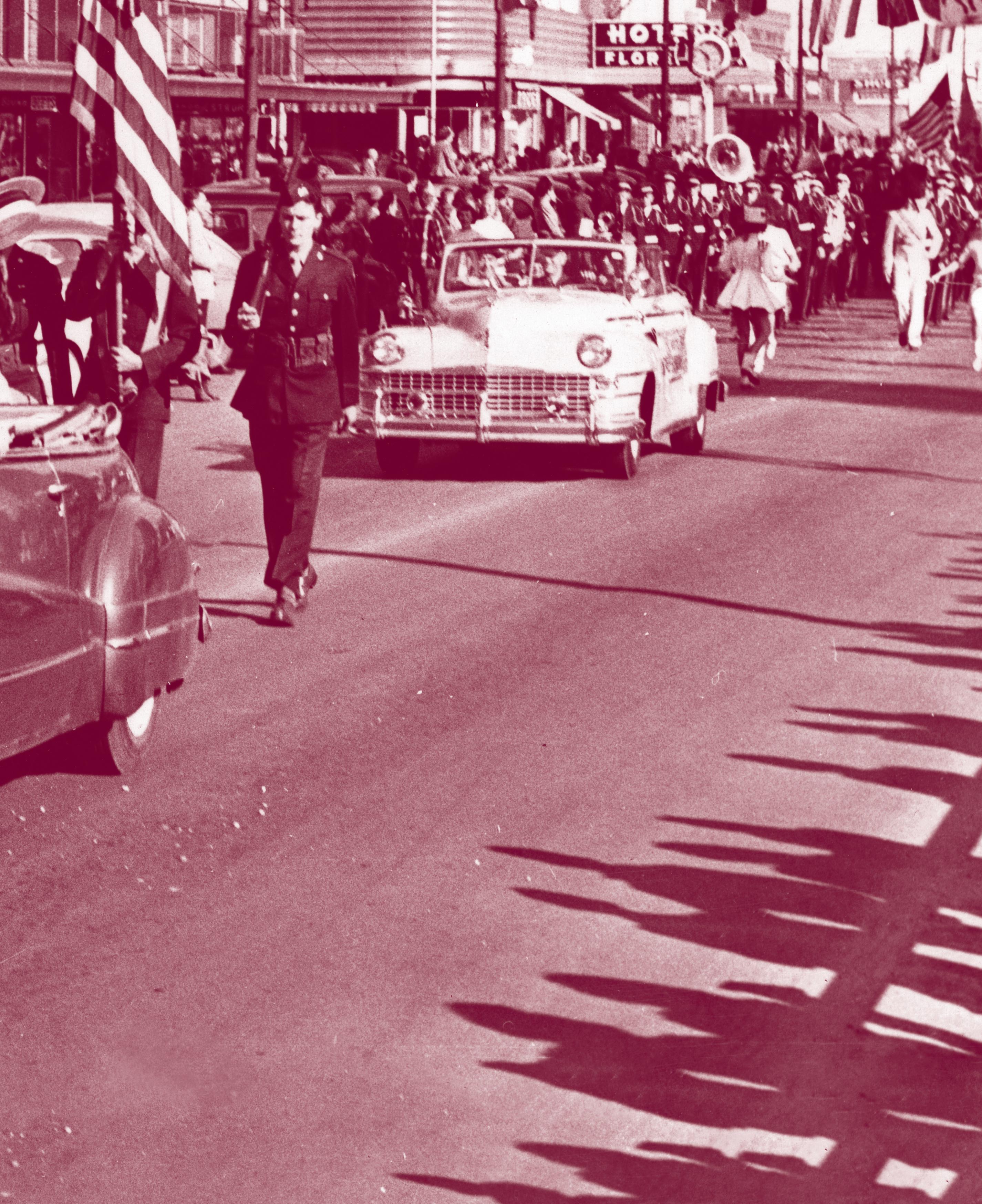
Homecoming was in full swing. Despite freezing morning temperatures, a parade marched south on Higgins Avenue through downtown, passing the lavish Christmas display windows of the Missoula Mercantile and the iconic Wilma Theater, where the marquee attraction was a film adaptation of “Hamlet” starring Lawrence Olivier.
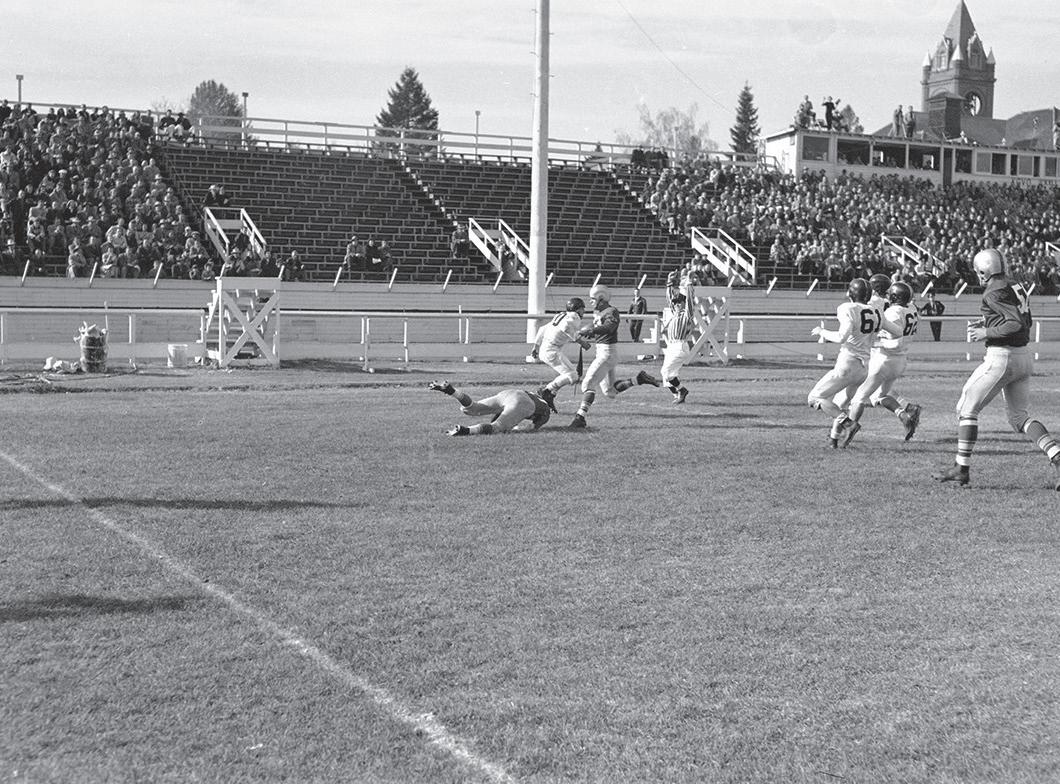
After turning east through the residential University neighborhood and arriving on the Oval, participants and spectators enjoyed a barbecue set up by students. Many local stores closed at 1 p.m., so workers could attend the Homecoming football game against Utah State Agricultural College at Dornblaser Field. (The Griz won 38-7).
Homecoming was then — as it is now — a chance to honor the University, to deepen connections with UM and to renew friendships and valued traditions.
As the crowd gathered to make merry on campus that chilly morning, a small group of enterprising community leaders and alumni worked behind the scenes with much the same goal: to give back to the school they loved.
United around the vision that ongoing financial assistance from loyal supporters would greatly benefit the University and its students, this small collection of forward-thinking Montanans filed Articles of Incorporation to establish what would become the University of Montana Foundation.
For nearly the first 14 years of its existence the organization was known simply as the Endowment Foundation. From its humble yet strong beginnings, it would spend the ensuing decades serving donors who have made a transformational impact on UM and students from Montana and around the world.
PASSION AND PURPOSE UNITE ALUMNI VOLUNTEERS
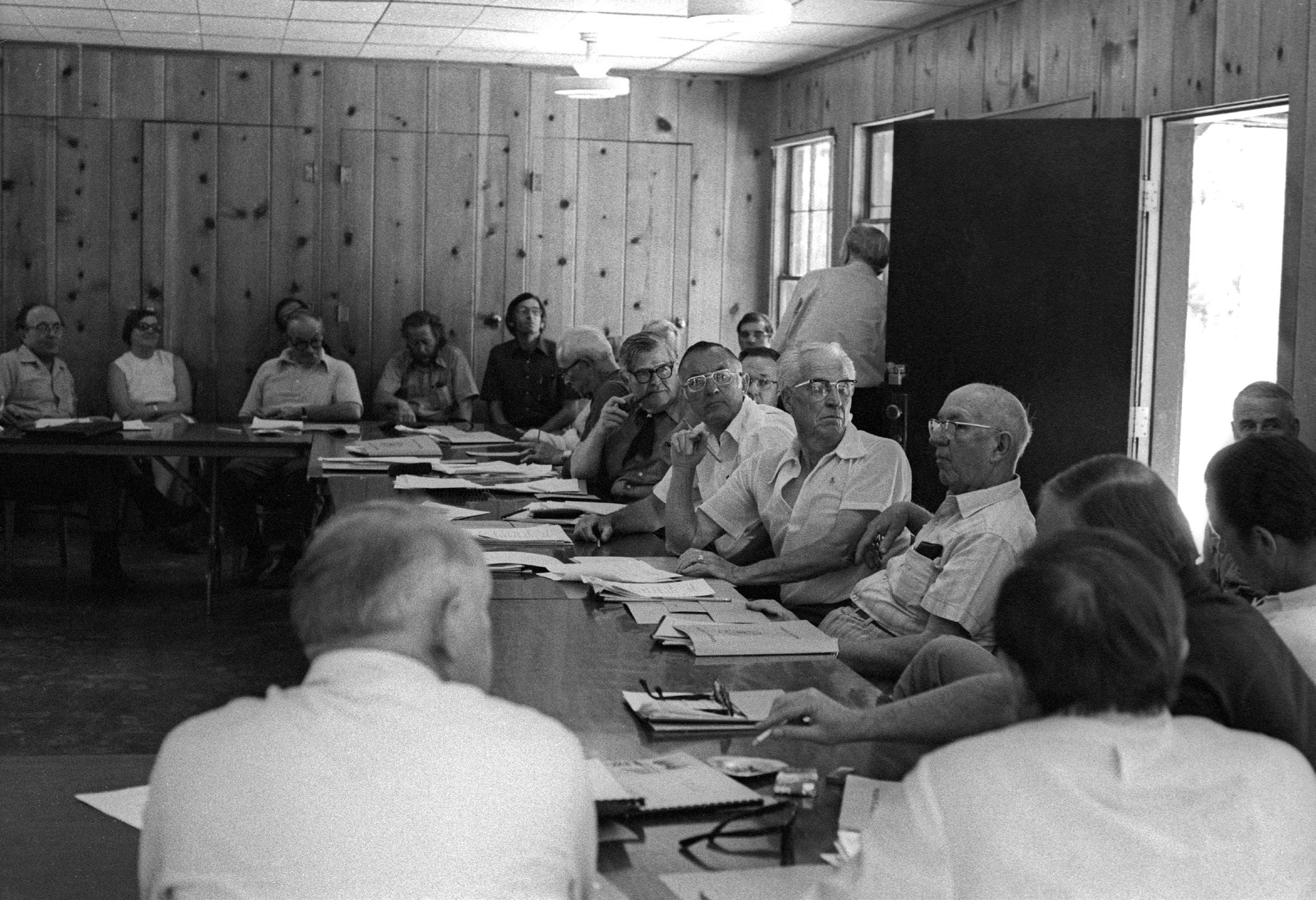
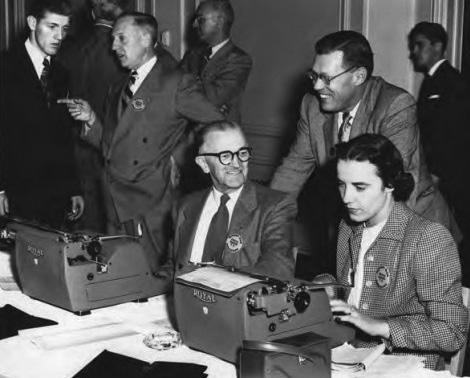
By the summer of 1951, the Endowment Foundation’s temporary Board of Trustees
gathered for its first meeting at Flathead Lake Lodge in Bigfork. Attendees nominated officers in preparation for election of the first regular Board of Trustees to be held at a meeting later that fall. These passionate volunteers were making it happen — from governance to community-building to soliciting donations. They were dedicated to modeling exemplary volunteer leadership and to involving crossindustry leaders to ensure the organization would be set up to create meaningful value for UM in perpetuity.
In those early days, the Endowment Foundation was mostly comprised of former students who connected with the mission and made modest donations to support UM. The organization’s first financial report noted funds amounting to $2,155 — about $28,000 today — given by mostly UM alumni over a period of just 30 days.
Throughout the 1950s, the organization, which was granted 501(c)(3) tax-exempt status in January 1953, remained a volunteer-led effort with a growing number of supporters contributing ongoing annual gifts.
Yet it also represented a proactive statewide eagerness to prioritize the University and its students. The Foundation’s original Board of Trustees included private citizens from towns such as Missoula, Anaconda, Billings, Butte, Glendive, Helena, Kalispell and Sidney.
Likewise, the earliest supporters hailed from communities across the state and worked across many industries. Many of them would eventually serve as Trustees in future years.
University leadership of the time recognized the potential of harnessing this wide-ranging enthusiasm to provide essential support for the University and put a great deal of trust in the Foundation’s Trustees. From the outset, University presidents and the Foundation’s Trustees were committed to maintaining alignment regarding the University’s needs and
The first University of Montana Foundation logo.
opportunities for private donations to advance the University’s mission.
Seventy-five years later, that collaboration remains just as strong.
THE EVOLUTION OF GIVING
Just as students, alumni, faculty and community members continue to gather during Homecoming to carry on the University’s proud traditions, the Foundation remains committed to inspiring philanthropic support to enhance excellence and opportunity at UM through service to donors and delivering an exceptional giving experience.
Though the Foundation’s earliest endeavors were comparatively modest to today’s, the
selfless work of those founding Trustees laid the groundwork for future success, nurturing the culture of service, through volunteerism and philanthropy, that epitomizes the UM community today.
Over the last three quarters of a century, UM has experienced remarkable growth and innovation, propelled in significant part by the ongoing philanthropic support of thousands of individuals, families, businesses and foundations.
The unwavering dedication of donors — uniting to fund crucial areas of need and opportunity for students, faculty, academic programs and facilities — has ensured that students receive a high-quality and accessible education at UM and the world can benefit from the University’s creative scholarship and research.
“It has been the Foundation’s greatest honor over the last 75 years to serve the generous donors of the University of Montana. It is with deep gratitude that this year we recognize the profound impact of their giving to UM.”
— Cindy Williams, UM Foundation President and CEO
Today, UM’s donor community continues to expand its reach and impact. In fiscal year 2024 donors made philanthropic contributions and commitments totaling $70.7 million. In that same fiscal year, the Foundation distributed a total of $28.6 million in funding to the University to support students, elevate academic programs, secure critical faculty positions to expand research and training, and enhance learning environments and facilities and more.
From the volunteer leadership of the nine pioneering members of the temporary Board of Trustees, the UM Foundation has grown to employ more than 70 professional staff today. A Board of 24 dedicated volunteer Trustees continues to govern the organization, lending their time and expertise to ensure its success. Over the years, these individuals have had the great privilege of serving UM’s loyal donors and uplifting the University’s mission.
As the need for philanthropy grows, the Foundation and its giving partners remain committed to ensuring that UM will continue to innovate and provide students with rich learning experiences and pathways to successful careers.
1950s Investing in Minds,
Enriching Futures
UM FOUNDATION TRUSTEES AND DONORS EXPANDED SCHOLARSHIPS AND CAMPUS INNOVATION DURING THE 1950s
PHOTOS PROVIDED BY ARCHIVES AND SPECIAL COLLECTIONS, MANSFIELD LIBRARY, UNIVERSITY OF MONTANA
The early 1950s were boom times in America. Montana — like much of the nation — was rapidly modernizing, buoyed by economic expansion in the wake of World War II. After experiencing the biggest enrollment drop in the University of Montana’s history during the war, student numbers at the University surged as much as 79% from 1944-46.
Yet at the time of the University of Montana Foundation’s inception on November 18, 1950, uncertainty still loomed.
The Korean War had begun five months earlier, and during the next five years, 6.8 million Americans — most of them young, college-aged adults — would serve overseas. Educational costs were rising nationwide, and as those servicemen and women began returning home, the need to secure the future of public higher education for all students became even more urgent.
In response, the Foundation’s Board of Trustees and pioneering donors, many of them former UM students themselves, moved quickly to address the challenges. They understood firsthand that an empowered student body and dedicated faculty were the lifeblood of UM. Throughout the ’50s, the Foundation’s top priority became delivering high-quality, accessible education for the nation’s “young intellects,” as it described aspiring undergraduate students at the time.
“Never in all history has such emphasis been placed upon the need to educate these students,” the Foundation wrote in an early message to donors. “Increasing costs have prevented some outstanding minds from completing their college degrees. These are
“Never in all history has such emphasis been placed upon the need to educate these students.”
—
UM Foundation message to donors
great and growing needs, and we neglect them at our own peril.”
INVESTING IN THE FUTURE: THE EARLY DAYS OF STUDENT SUPPORT
By 1952, the Foundation was facilitating gifts for at least 11 different colleges and programs. All gifts not earmarked by donors for specific purposes supported student scholarships. By 1954, initiatives like The Worthy Scholars Program were underway to help students navigate their journeys through higher education.
Financed in part through a $25,000 anonymously established endowed fund, the scholarships were awarded on a competitive basis to graduating Montana high school seniors. Students showed up by the hundreds to take special exams to qualify for them.
The Foundation referred to this initial scholarship push as its “Investment in Minds.” In 1956, donors stepped forward to provide 24 graduating high school seniors from Montana with full-tuition scholarships.
Aside from The Worthy Scholars Program, the Foundation managed around 30 additional funds and fostered several other scholarship efforts during this period — a preview of the giving community’s priority for the next decades and to today.
During this period, the organization also began to receive donor support from corporations and other business entities, as well as planned gifts in the form of bequests and life insurance benefits.
To raise additional money for athletic scholarships, the Foundation created the Century Club in 1955. By 1958, the group had 200 members, who each paid $100 per year to support Grizzly sports teams.
In addition, the early ’50s saw the formation of the President’s Fund, the forerunner to today’s Excellence Fund, used at the University president’s discretion to meet critical needs,
fund dynamic initiatives and open doors to opportunity for all UM students.
From those modest beginnings to today, the Foundation continues to work with donors and UM to provide philanthropic support for students. For example, in academic year 20232024 donor giving allowed UM to distribute $6.8 million in student support, including 3,086 donor-funded scholarship awards.
ENHANCING UM’S ICONIC AND INNOVATIVE FACILITIES
Beyond student success initiatives, the Foundation also began to help unite donors around efforts to expand and better equip UM’s campus facilities during the early 1950s.
Among those initial measures was ensuring that the clock tower at University Hall (known colloquially as Main Hall) finally got its bells.
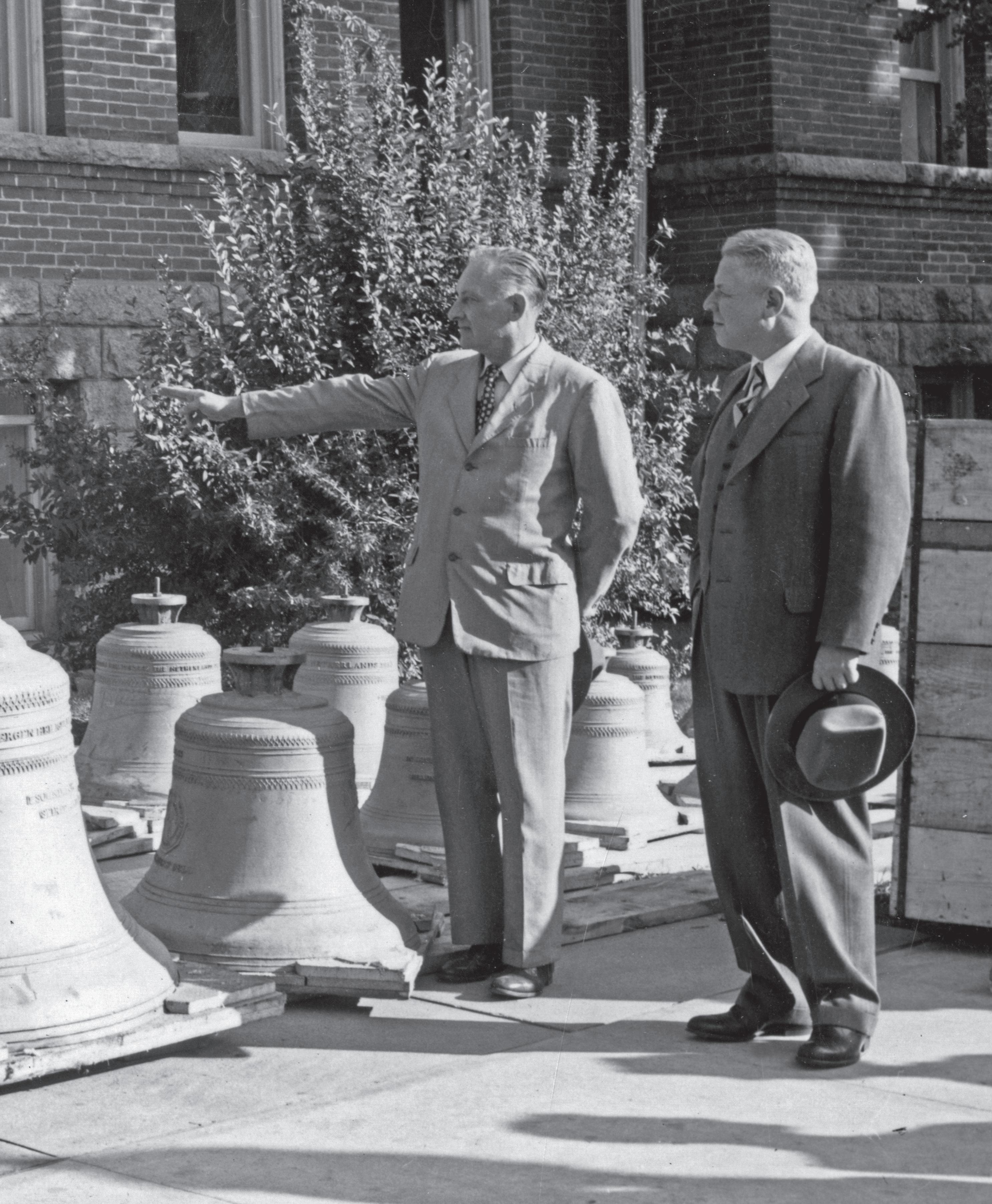
Architect A.J. Gibson specifically designed the tower to house a carillon, a large keyboard musical instrument which uses an intricate system of differently sized bells to produce melodies. But for decades after its completion in 1897-98, Main Hall only had a single bell — the comparatively small “victory bell,” which tolled the hour and rang after Grizzly athletic victories.
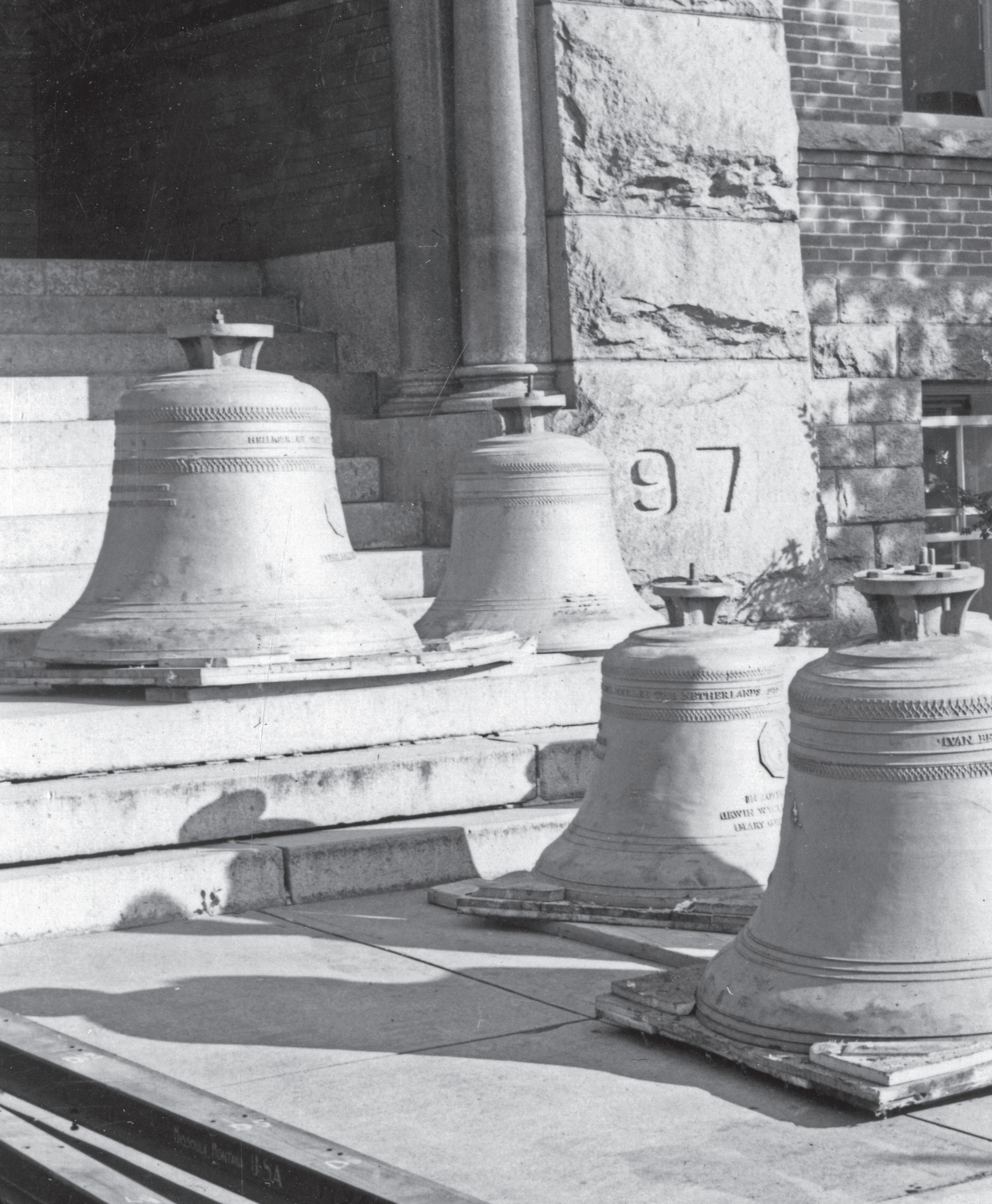
By the end of 1951, Foundation Trustees had set their sights on a 47 bronze-bell carillon cast by the renowned Royal van Bergen Bell Foundries in Holland. In just shy of two years, a coalition of individuals, families, alumni, faculty and organizations raised nearly $16,000 to buy it.
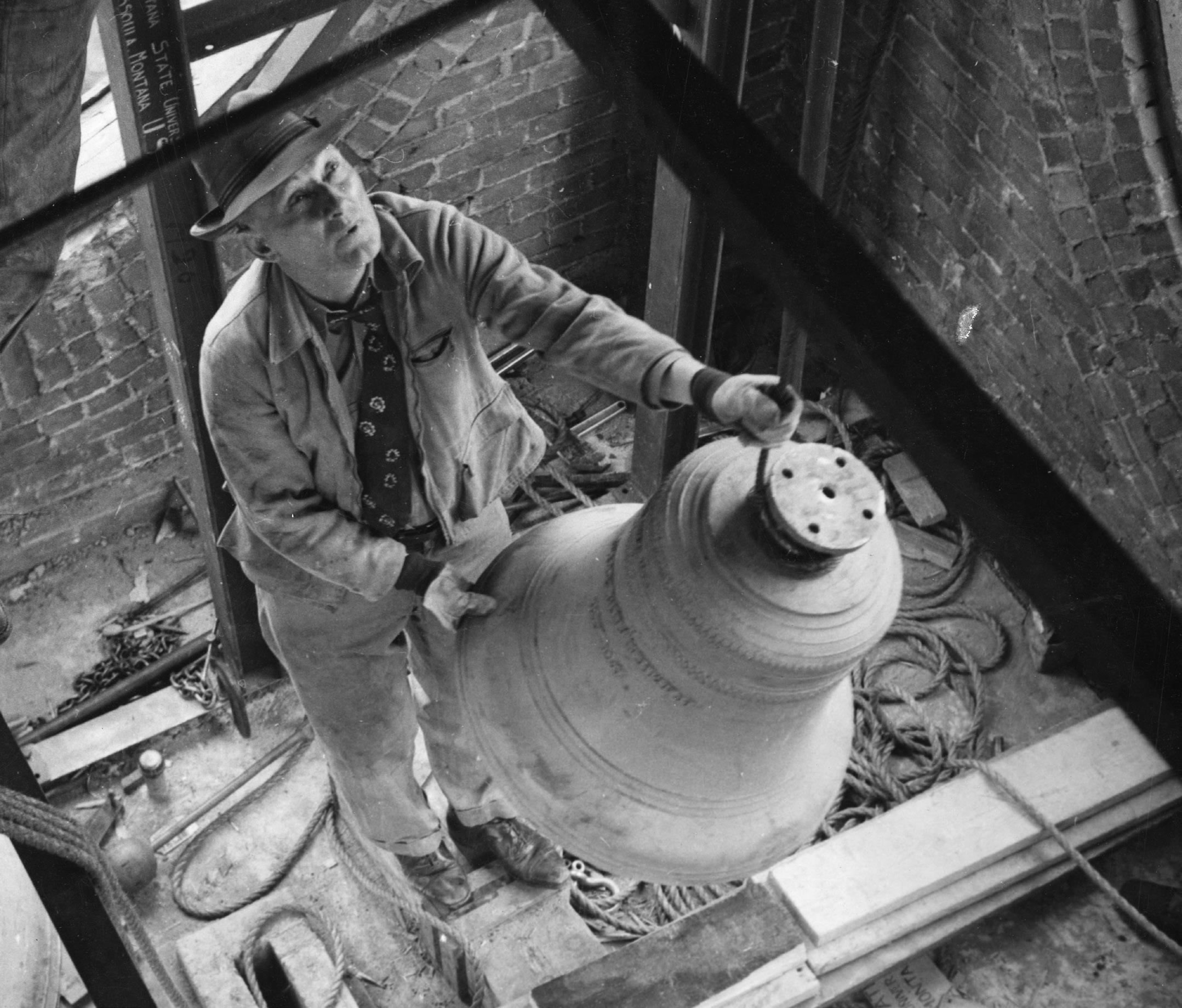
The carillon was installed in Main Hall by H.T. van Bergen himself, and was dedicated during Homecoming, on October 18, 1953.
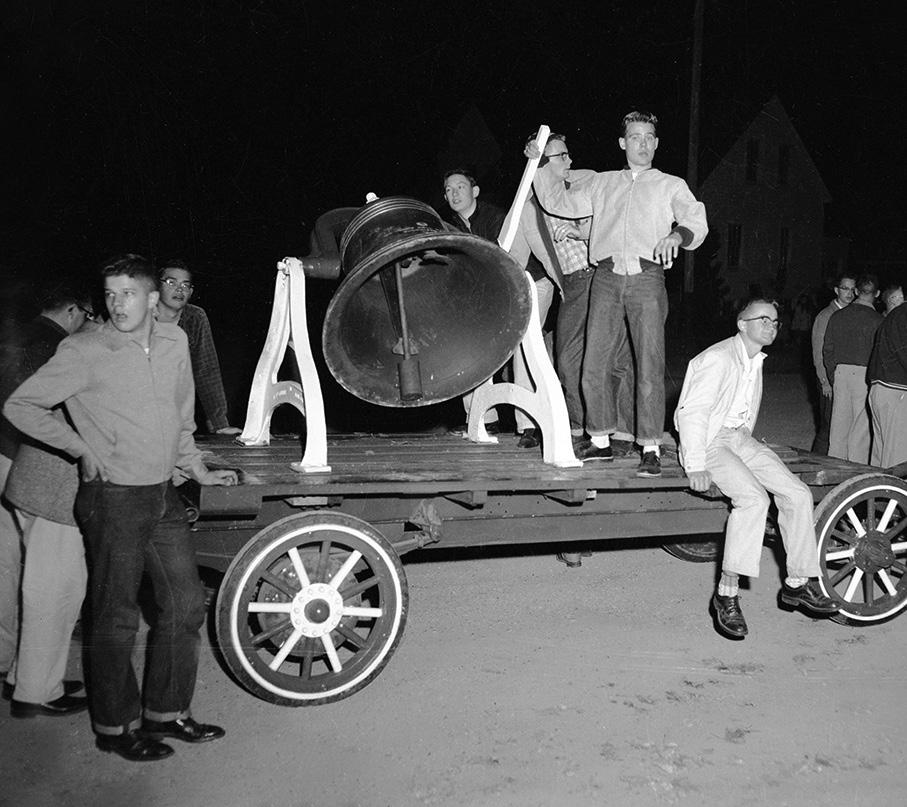
The carillon’s two biggest bells were sponsored by the UM Alumni Association and the Associated Students of UM, respectively. The original victory bell was ultimately relocated to Washington-Grizzly Stadium, where it still rings after Grizzly football team wins.
SUPPORTING STUDENTS: A TOP GIVING PRIORITY
Since its founding in 1950, the Foundation has served thousands of donors who make UM student support a top priority in their giving. In the Foundation’s earliest days, Trustees launched The Worthy Scholars Program, which provided alumni and other donors with a vehicle to pool modest gifts and open the doors of higher education to promising Montana students. By the late 1950s, this grassroots commitment had grown into a statewide movement, with donors funding dozens of student-focused initiatives. That generous spirit continues today. In academic year 2024-25, more than 20 percent of students received a privately funded scholarship and over $7.5 million in student support was awarded. Together, our UM Foundation giving community transforms lives through scholarships, graduate fellowships and more, allowing the University to provide essential support to thousands of students with financial need and to attract students who demonstrate academic merit. Donors continue to empower these students every day as they focus on their education and career goals and earn their degrees.
As of 2025, the carillon’s largest bell can be heard across campus and Missoula neighborhoods as the clock marks the hour and half hour. Its booming toll has become an iconic part of the UM campus experience.
Above: From 1951-53, a coalition of individuals, families, alumni, faculty and organizations raised nearly $16,000 to purchase a 47 bronze-bell carillon for Main Hall’s iconic clock tower. The carillon was installed in Main Hall and was dedicated during Homecoming, on October 18, 1953.
Below: The original victory bell was ultimately relocated to Washington-Grizzly Stadium, where it still rings after Grizzly football wins.
The carillon itself is still played during noontime concerts, during UM Homecoming “yell night” celebrations and at Commencement.
Each bell is dedicated in memory or in honor of a loved one, many of whom gave their lives for our country. Plaques detailing the dedications hang outside the main entrance to Main Hall.
Among the many other UM campus needs and opportunities identified as funding priorities throughout the 1950s were securing private support needed to purchase a new pipe organ for the music department as well as helping UM open the Frederick C. Scheuch Planetarium,
which operated until 1968 in the small brick building east of Craig Hall that now houses UM’s Global Engagement Office.
Many of the gifts for these upgrades came from sources who were lending support to UM for the first time. Their willingness to unite to foster community and improve campus life planted the seed from which the University’s legacy of giving would grow.
A DECADE OF VOLUNTEERISM
Records indicate that the first person to draw a paycheck from the Foundation was likely Tomme Lu Middleton, the Board’s executive secretary, who received a one-time bonus in 1957 for her work on the organization’s initial fundraising efforts.
Prior to that, however, all work done on behalf of the Foundation and its donors was carried out on a purely voluntary basis.
Initiatives of the 1950s, like The Worthy Scholars program and the Memorial Carillon, ushered in a decade of selfless volunteerism by Foundation leadership. This group of dedicated private citizens came from across Montana to contribute their time, united around a grassroots mission to fund crucial needs for UM and its students.
Their early generosity would exemplify an enterprising spirit that would carry campus through the next 75 years. Three quarters of a century later, those original values still underpin the Foundation’s work. Though today the numbers are larger and the methods more sophisticated, the Foundation and its donors continue to “invest in minds,” and to uplift “young intellects.”
That first paycheck paid to Middleton is a fun footnote in the Foundation’s history but was also a sign of its rapid evolution throughout the 1950s. It represented the desire of the Trustees to get even more work done. Skilled people were needed to expand its reach and focus on special projects.
BACKING THE GRIZ
Founded in 1955, the Century Club was established with a simple but powerful idea: annual contributions from donors could help strengthen UM’s athletics programs. By 1958, the Century Club had already surpassed 800 member-donors, and by 1980, over 1,350 contributors raised more than $300,000 in that year alone. Originally organized by the UM Foundation, management of the Century Club was assumed by the University in 1976. Today, the Century Club’s legacy lives on through the Grizzly Scholarship Association, a separate 501(c)(3) organization that supports Grizzly student-athletes, raising approximately $3 million annually for more than 330 athletic scholarships and other Grizzly Athletics initiatives.
As the decade concluded, the Foundation’s total assets had grown from $2,155 in 1951 to nearly $150,000 by 1959, a sum that equates to about $1.6 million today.
The public-private partnership between UM and its donors through the UM Foundation was already on its way to becoming a powerful force, which would impact the lives of generations of students and their communities.
Just as they did then, the University’s supporters still think big about the future, guaranteeing that UM will continue to enhance its status as a worldclass institution that boldly provides life-changing educational opportunities and cutting-edge training to the leaders of tomorrow.
OUR DEDICATED VOLUNTEERS
BOARD OF TRUSTEES
The UM Foundation is governed by an independent, volunteer Board of Trustees that brings extensive expertise and steadfast commitment to the Foundation’s mission. United by a shared commitment to enhancing excellence and broadening opportunity at the University of Montana, the Trustees provide leadership that strengthens the institution’s ability to deliver exceptional education, foster groundbreaking research and offer enriching experiences to its students and community.
With sincere gratitude for the service of our current and former Trustees, we have sought to compile a complete and accurate record of all individuals who have served on the Board; however, some unintentional errors or omissions may exist. The format of Trustee names presented here aligns with how names are listed in historic Board meeting minutes.
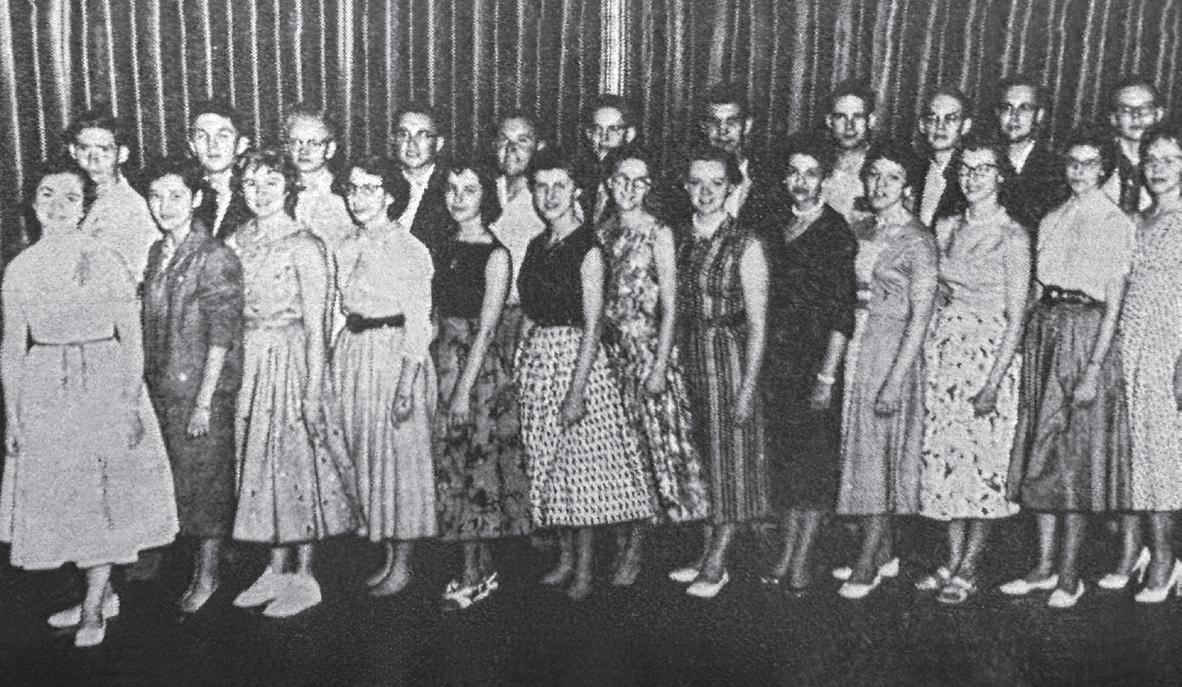
In its first year of operation, the UM Foundation was led by members of a temporary Board of Trustees, who served until the first regular Board was elected in 1951.
More than
330 VOLUNTEER TRUSTEES
have served on the UM Foundation Board since 1950.
• William Allen
• Alina Alvarez
• Zak Andersen
• William Andrews
• A.W. Aspengren
• Jim Auger
• Kirk Badgely
• Steve Bahls
• Alva Baird
• Harold Baird
• David Baker
• Jane Baldock
• Julie Baldridge
• Diane Barlow
• Phil Barney
• Marlys Barrett
• Ed Bartlett
• Robert Bates
• William Baucus
• Bill Beecher
• Douglas Beighle
• Robert Binger
• Alexander Blewett
• George H. Boldt
• Ann Boone
• Tom Boone
• Craig Bouchard
• Marcus Bourke
• George Bovington
• Bev Braig
• Bill Brenner
• Frank Brettholle
• Traci Brewster
• Dorothy Bridges
• Bill Brodsky
• Patricia Brolin-Ribi
• Bob Bronson
• Bob Brophy
• Art Brown
• Rockwood Brown
• Rosemary Brown
• Scott Brown
• Sheila Buchanan
• Chuck Bultmann
• John Burgess
• Bob Burke
• Jack Burke
• John Burke
• Marion Burke
• Fred Burnet
• Mark Burnham
• Ted Burton
• Donald Byrnes
• Alan Cain
• Paul Caine
• Sharilyn Campbell
• George Caras
• Jan Carter
• Paul Caruso
• James B. Castles
• John Castles
• Warren Caugn
• Gwen Childs
• Marva Christian
• Paul Chumrau
• Mack Clapp
• Robert Clark
• Oakley Coffee
• Maurice Colberg
• Mark Cole
• Ron Coleman
• Thomas Collins
• Bruce Cook
• J.E. Corette Jr.
• J.E. “Shaun” Corette III
• Jim Cote
• Mike Covey
• Jack Cox
• Janet Cox
• Ben Craig
• Craig Crawford
• Norm Creighton
• Bruce Crippen
• Bruce Crocker
• Suzanne Crocker
• Bobbi Dahl
• Henry Dahmer
• Dick Dailey
• Juanita Daly
• Andrew Davidson
• Ian B. Davidson
• Nancy Davidson
• Katy Delano
• Robert V. Dendon
• Art Deschamps
• Lauren Descamps
• Marilyn Dickey
• John Dietrich
• Mary Doggett
• Patricia Douglas
• Scott Dowling
• Kenneth C. Duff
• Karen Kracher Dykstra
• Kathy Eberling
• Dennis Eck
• Corey Edens
• Cliff Edwards
• Robert Ehlers
• Dave Enger
• James Finlen
• Bruce Flynn
• Sara Foland
• Dick Ford
• Donald Fordyce
• Steve Foster
• Mike Frank
• Paige Franke
• Selden Frisbee
• William J. Gallagher
• Hugh Galusha
• Jena Gardner
• Britney Gilder
• Harold Gilkey
• Priscilla Gilkey
• Lyle Glascock
• Maggie Gleason
• Gail Good
• Andrea Goudge
• Charlie Grenier
• Denise Evans Grills
• J.G. Griffith
• William A. Groff
• Paul Haack
• Kayreen Handley
• Greg Hanson
• Rob Harkins
• John Harnish
• K.H. Harstad
• Mrs. K.H. Harstad
• Crete Harvey
• Rita Hefron
• Calvin Hendon
• Robert Hendon
• A.T. Hibbard
• Theodore Hodges
• Fred Honkala
• Bill Hornsby
• Robert Huff
• Michael Hughes
• John Hursh
• Jennifer Isern
• Doug James
• William Jameson
• Bill Jardine
• Meri Jaye
• Robert Johns
• Jim Jones
• Tsukasa Karashima
• Lewis Keim
• Robert Kelly
• Stan Kimmett
• Dominic King
• Jack King
• Doug Klein
• Bill Knick
• Lyle Knight
• Linda Knoblock
• Barbara Koessler
• Clarence P. Kommers
• Merrill Kovatch
• Jonathan Krim
• Louise Krumm
• Dan Lambros
• George Lambros
• Steiner Larsen
• Glenn Larson
• Robert Lee
• Tom Lemcke
• Matt Levitan
• Harley Lewis
• Wayne Linnell
• Betty Lohn
• Sherman Lohn
• James Lucas
• Einar Lund
• John MacMillan
• Bruce Madsen
• James Mariska
• O.E. Markle
• Dale Markovich
• George Martin
• James Marvin
• Mark Matsko
• Steven Maurer
• Earl McCall
• Tony McCormick
• Mike McDonough
• Joseph McDowell
• Joseph McElwain
• Tom McElwain
• Colleen McGuire
• Tim McHugh
• Deborah Doyle McWhinney
• Peter Meloy
• Bill Mercer
• Ann Miller
• Moose Miller
• Shag Miller
• Bill Mitchell
• Peder Moe
• Leroy Moline
• Joe Monahan
• Judith Morgan
• Earl Morgenroth
• James Morrison
• Jim Mountain
• Bob Munzenrider
• Calvin Murphy
We are profoundly grateful to the hundreds of Trustee volunteers who have guided and served the UM Foundation since our founding in 1950.
• Jim Murray
• Raymond Murray
• John Myers
• Mark Nonnenmacher
• Jerry Norskog
• Nancy O’Connor
• Kathy Ogren
• Tim O’Leary
• Charlie Oliver
• Don Oliver
• John Olson
• Mary Olson
• Ivan O’Neil
• Mike O’Neill
• Don Orlich
• Ron Paige
• Philip Palm
• Bill Papesh
• Dorn Parkinson
• Bradley Parrish
• Terry Payne
• Penny Peabody
• Marilyn Peterson
• Suzanne Peterson
• William Pine
• John Poston
• Dorothy Powers
• Kent Price
• Mary Provost
• Leroy Purvis
• Colin Raff
• April Reardon
• Randy Reger
• Harry Reinsch
• Ginger Renner
• William Reynolds
• Joanne Ritvo
• Owen Robinson
• D. Gordon Rognlien
• Rich Roth
• Urban Roth
• William Roth
• Bob Rowe
• George Ruff
• John Ruffatto
• Jack Russell
• Ray Ryan
• Alex Sample
• C.T. Sanders
• George P. Sarsfield
• Jeremy Sauter
• Lloyd Schermer
• Wayne Schile
• George Schotte
• Dale Schwanke
• Kermit Schwanke
• James Scott
• Tom Scott
• Herbert Searles
• Marie Seidl
• Mick Seidl
• Bob Seim
• Garvin Shallenberger
• Ward Shanahan
• Michael Sheldon
• Guy E. Sheridan
• Robert E. Sheridan
• Deanna Sheriff
• Earl Sherron
• Jean’ne Shreeve
• Ron Simon
• Everitt Sliter
• Mickey Sogard
• Edward Stanton
• Harold Stearns
• Alex Stepanzoff
• Sid G. Steward
• John Streich
• Clarence Streit
• Jon Swan
• Douglas Swanson
• Robert Sykes
• Norman Taylor
• Joseph Thiebes
• Paul Thomas
• Alice Thorpe
• Gene Tidball
• Thea Tidyman
• Jim Todd
• Dale Tomlinson
• Mary Turmell
• Mrs. Walter Turner
• Nels Turnquist
• Kurt Ursich
• Bill VanSickle
• Warren Vaughan
• Gerhard Von der Ruhr
• Bruce Vorhauer
• Gayle Walton
• Alexander Warden
• Merritt Warden
• Phyllis J. Washington
• Leon Washut
• Fred Watson
• Sylvia Weisenburger
• Nelson Weller
• Tony Wertz
• Roger West
• Joe Whittinghill
• Warren Wilcox
• Glen Williams
• Paul Williams
• Jim Willits
• Steve Winslow
• James Wylder
• Carl Yeckel
1960s A Decade of Modernization,
Growth and Expansion
DURING THE 1960s, UM FOUNDATION DONORS FUELED STATE-OF-THE-ART RESEARCH AND HELPED TO TRANSFORM THE UNIVERSITY INTO A GLOBAL HUB OF INNOVATION AND LEADERSHIP
PHOTOS PROVIDED BY ARCHIVES AND SPECIAL COLLECTIONS, MANSFIELD LIBRARY, UNIVERSITY OF MONTANA
“Possibilities unlimited.” That’s how D. Gordon Rognlien described the burgeoning impact of philanthropy at the University of Montana while addressing students at a leadership conference at Flathead Lake Lodge in May 1960.
One of the nine original founders of the UM Foundation at its incorporation on November 18, 1950, Rognlien had witnessed firsthand the rapid evolution of the University’s giving community. By fall 1960, he’d be elected Chair of the Foundation’s Board of Trustees — and his optimism about the University’s potential for transformational growth quickly proved correct.
During the 1960s, donor support gained momentum, and the Foundation helped modernize infrastructure, fuel research and elevate UM to a position of national and global leadership in education and innovation.
ADVANCING CUTTING-EDGE RESEARCH
At a September 1960 Foundation Board meeting, UM President Henry K. Newburn outlined two immediate goals for the University: expand research capacity and raise the school’s academic profile on a global stage.
The University’s vision resonated with donors, launching a decade of support for student scholarships, faculty resources and advanced technologies.
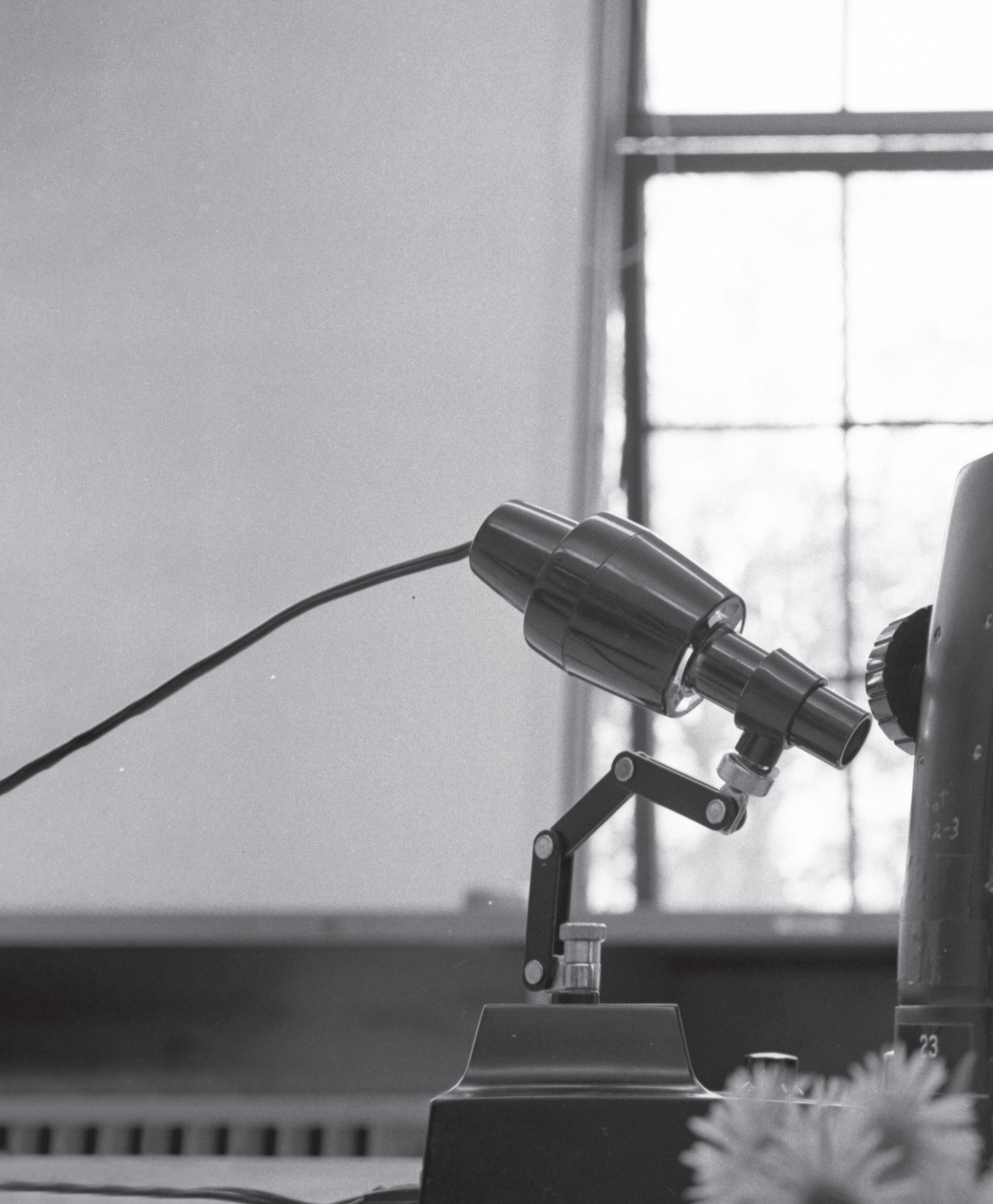
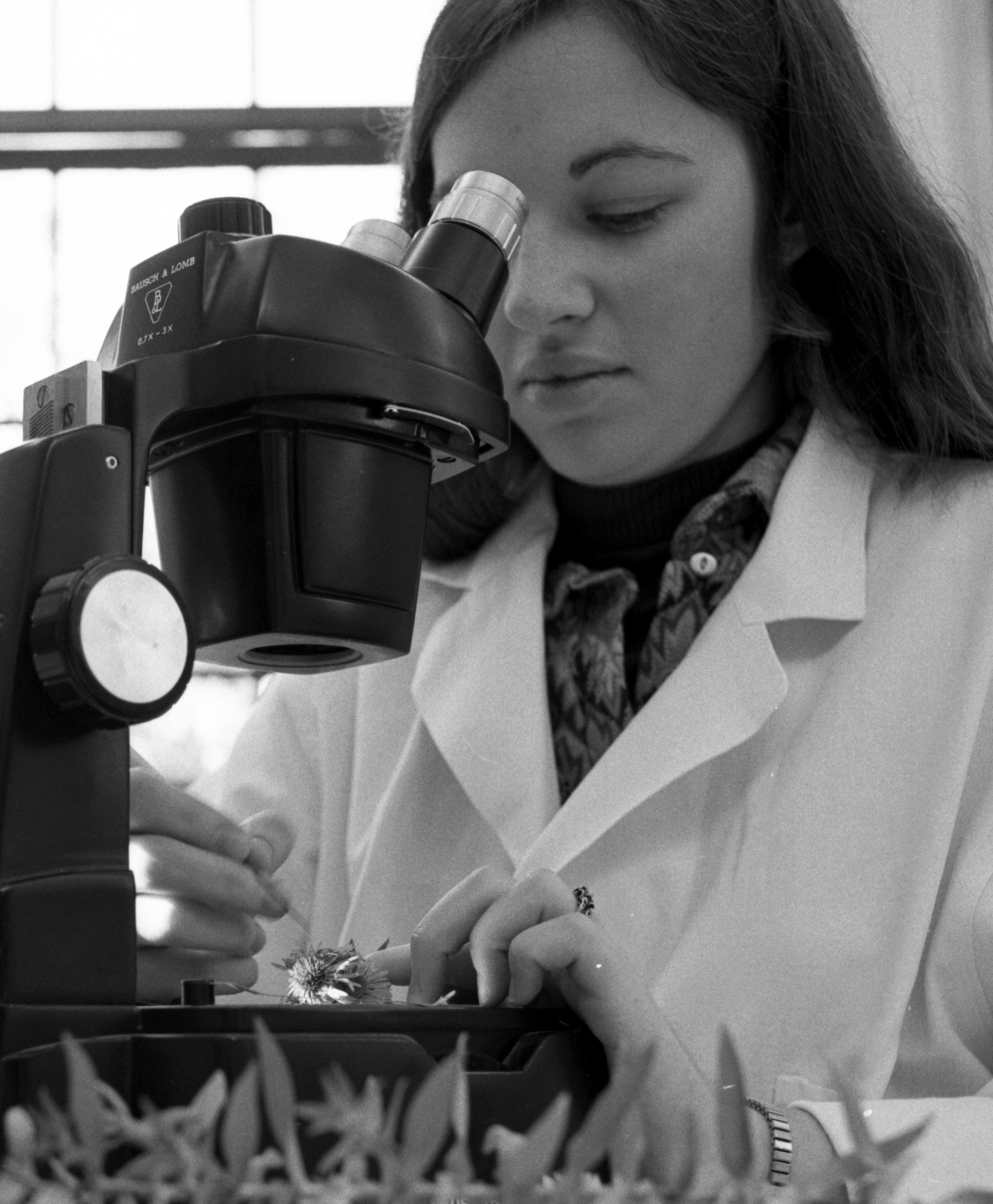
One early milestone came with the donor-funded purchase of high-resolution photomicrographic equipment, allowing researchers to capture images of organisms invisible to the naked eye, including viruses and microscopic life in remote mountain lakes and streams. The investment strengthened UM’s standing in environmental and biological sciences and opened doors for impactful student and faculty discoveries.
But perhaps the most important leap forward came a few years later, when donors rallied to support the addition of a truly state-of-the-art machine: UM’s first computer.
LEADING UM INTO THE COMPUTER AGE
As the educational and scientific needs of society evolved in the early ’60s, University and Foundation leaders considered computer technology an essential investment in UM’s future.
“The high-speed computer is a key tool in the latter half of this century ... particularly in the fields of education and research,” said Jack Corette, chair of the Foundation’s computer fundraising initiative, launched in 1962.
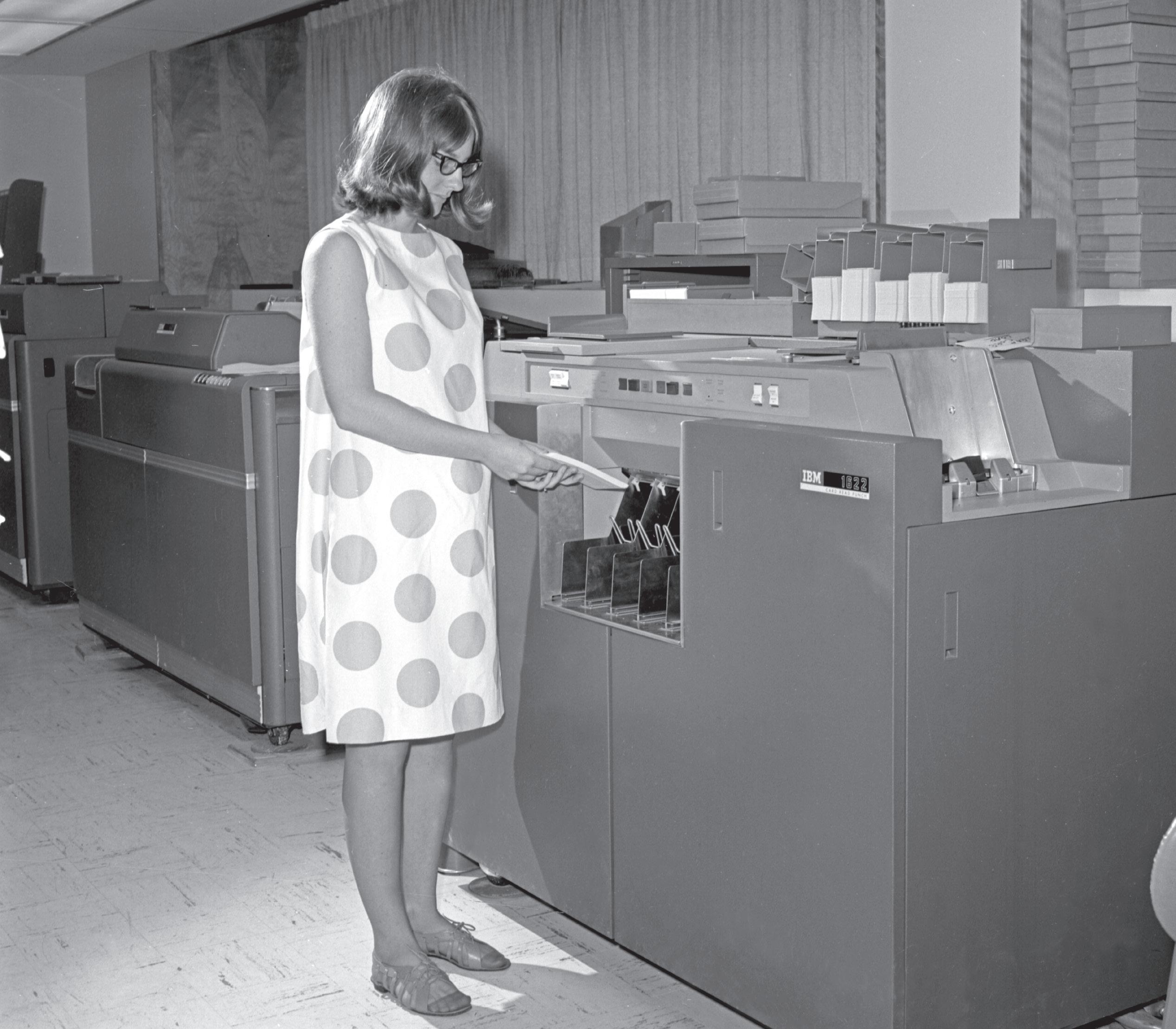
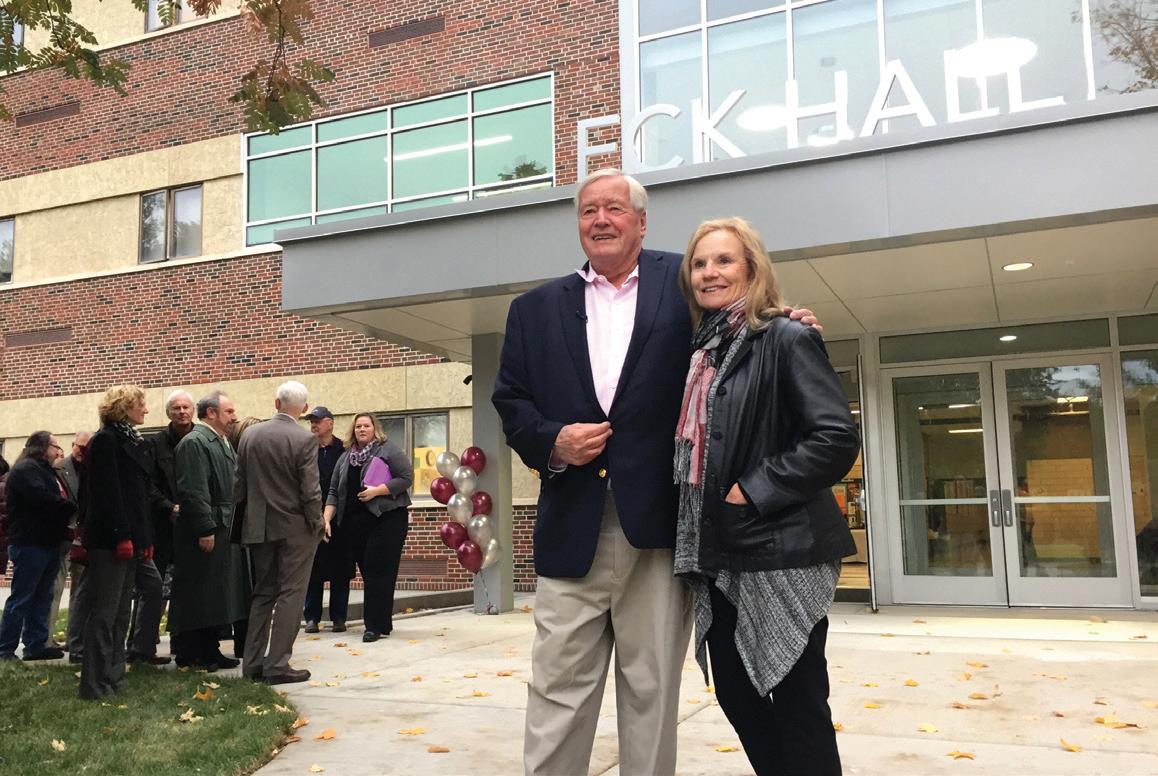
Corette said every department on campus would benefit from the purchase of a computer and, within two years, donors contributed the necessary funds. UM’s first computer center opened in the basement of what is now the Dennis and Gretchen Eck Liberal Arts Building in early 1964.
The new machine was available for any student or faculty member to aid in their research, data management or problem solving. The center also featured a mathematics lab, reference library, seminar room and staff offices. The mathematics department launched programming courses, including night classes for community leaders interested in using the computer.
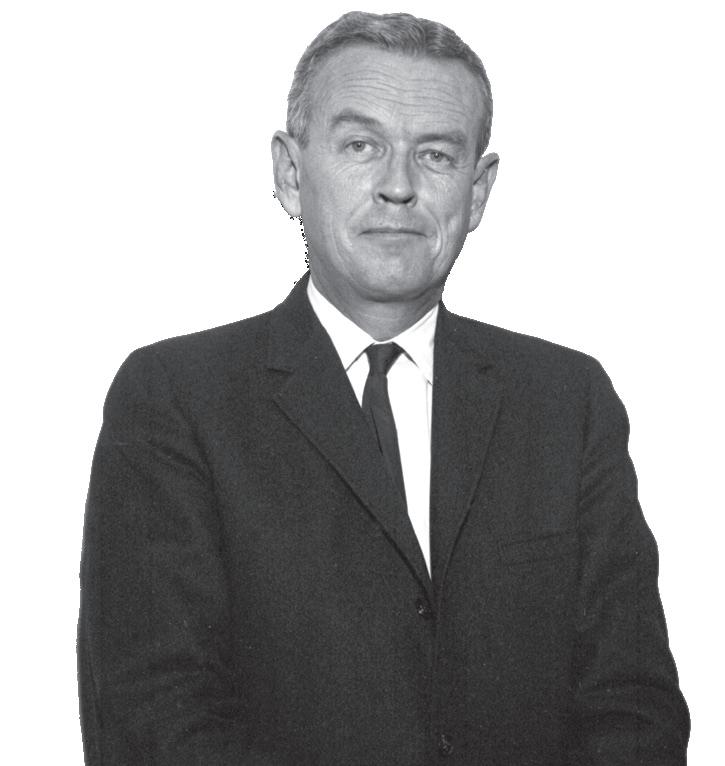
D. Gordon Rognlien (left), one of the nine original founders of the UM Foundation.
A student uses UM’s first computer center, which opened in 1964. The new computer was available for any student or faculty member to aid in their research, data management or problem solving.
A Montana Kaimin article from the time described the new eight-component IBM Processing System as: “a core storage unit, a card reproducer, card sorter, data processor and two machines that type cards.” The computer could also play tic-tac-toe and address “about 100 envelopes in five minutes.”
Donor support of UM’s technological infrastructure not only helped the University keep pace
with national trends but also laid the preliminary groundwork for the cutting-edge fields explored on campus today.
In 2025, areas of significant advancement include the emerging study of data science, cybersecurity and artificial intelligence, as UM’s many supporters continue to make good on the University’s promise to keep students at the forefront of technology and exploration.
INSPIRING WORLD-RENOWNED LEADERSHIP
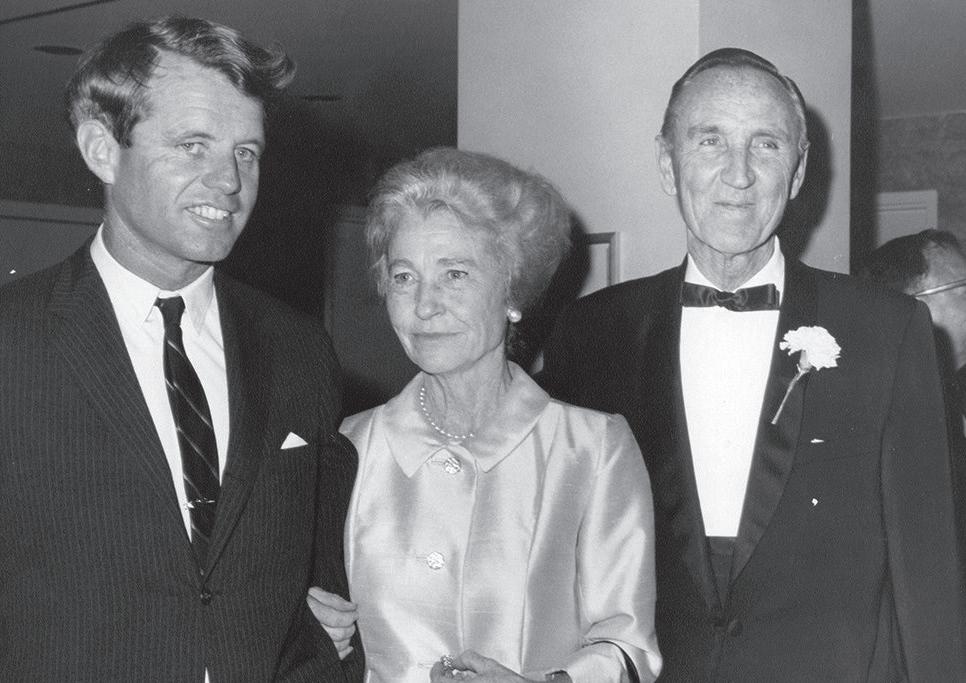
August 24, 1967, was a star-studded night in Washington, D.C., as nearly 1,000 political and cultural luminaries gathered at the Sheraton Park Hotel to honor Senate Majority Leader Mike Mansfield.
The Washington Post called the jovial, bipartisan evening a “rare and special tribute” to a man who had spent 25 years representing Montana in Congress and had become one of the most influential figures in American politics. The event — which was co-sponsored by the UM Foundation — drew cabinet members, ambassadors, military leaders, journalists and
Sen. Robert F. Kennedy, Maureen Mansfield and Sen. Mike Mansfield at the Mansfield Endowment dinner, 1967.
dignitaries, including Secretary of State Dean Rusk and Senator Robert F. Kennedy.
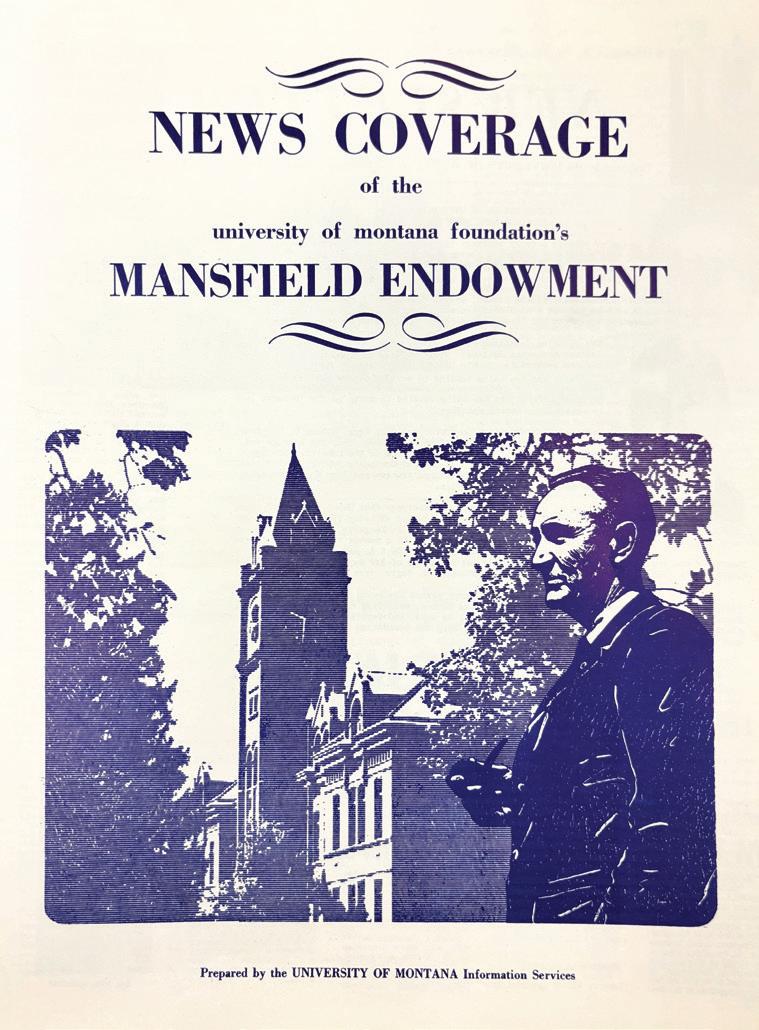
Yet the evening was more than just a celebration of Mansfield’s life in politics. It was also the launch of the Mansfield Endowment of the University of Montana Foundation, a private philanthropic effort to create an international lecture series at UM.
Led by a prestigious founding committee — including Vice President Hubert Humphrey, First Lady of the United States Lady Bird Johnson, former First Lady of the United States Jackie Kennedy, UM President Robert Pantzer and former Montana Governor Tim Babcock — the Mansfield Endowment galvanized interest and support across the political spectrum.
“I know of no more appropriate tribute to a great American. I wish the Foundation and its supporters every success in their noble endeavor.”
— Lyndon B. Johnson, President of
the
United States
Jackie and Robert F. Kennedy presented a $10,000 gift in the name of late President John F. Kennedy. President Lyndon B. Johnson sent his personal endorsement, writing, “I know of no more appropriate tribute to a great American. I wish the Foundation and its supporters every success in their noble endeavor.”
Mansfield, known as a humble, down-to-earth statesman, told the crowd he credited his wife Maureen as his “wise counselor and steadfast” partner.
“Without her, I would not be in the United States Congress,” he said.
FUELING THE FUTURE FOR FACULTY
Donor-supported faculty positions support the University’s recruitment and retention of exceptional faculty, making a lasting impact on our campus and students. These prestigious positions help UM elevate students’ academic experiences and continue to drive innovation and research.
The first gifts received by the UM Foundation to support faculty positions resulted in the appointments of Dr. Robert L. Peterson as the Hill Professor of Business History and Dr. K. Ross Toole as the Hammond Professor of Western History in the 1960s. Together, these appointments represented a milestone in UM’s academic development, placing UM at the forefront of historical research in the West.
Since these first donor-funded faculty appointments, donors have established more than 80 funds to support UM faculty and staff across many schools and colleges. Named positions continue to help UM recruit and retain top faculty and staff. Financial resources associated with named and endowed positions can supplement state salaries, provide access to research and professional development opportunities and help faculty engage students in research and other experiential learning opportunities.
Dr. K. Ross Toole
NURTURING UM IN MONTANA’S OUTDOORS
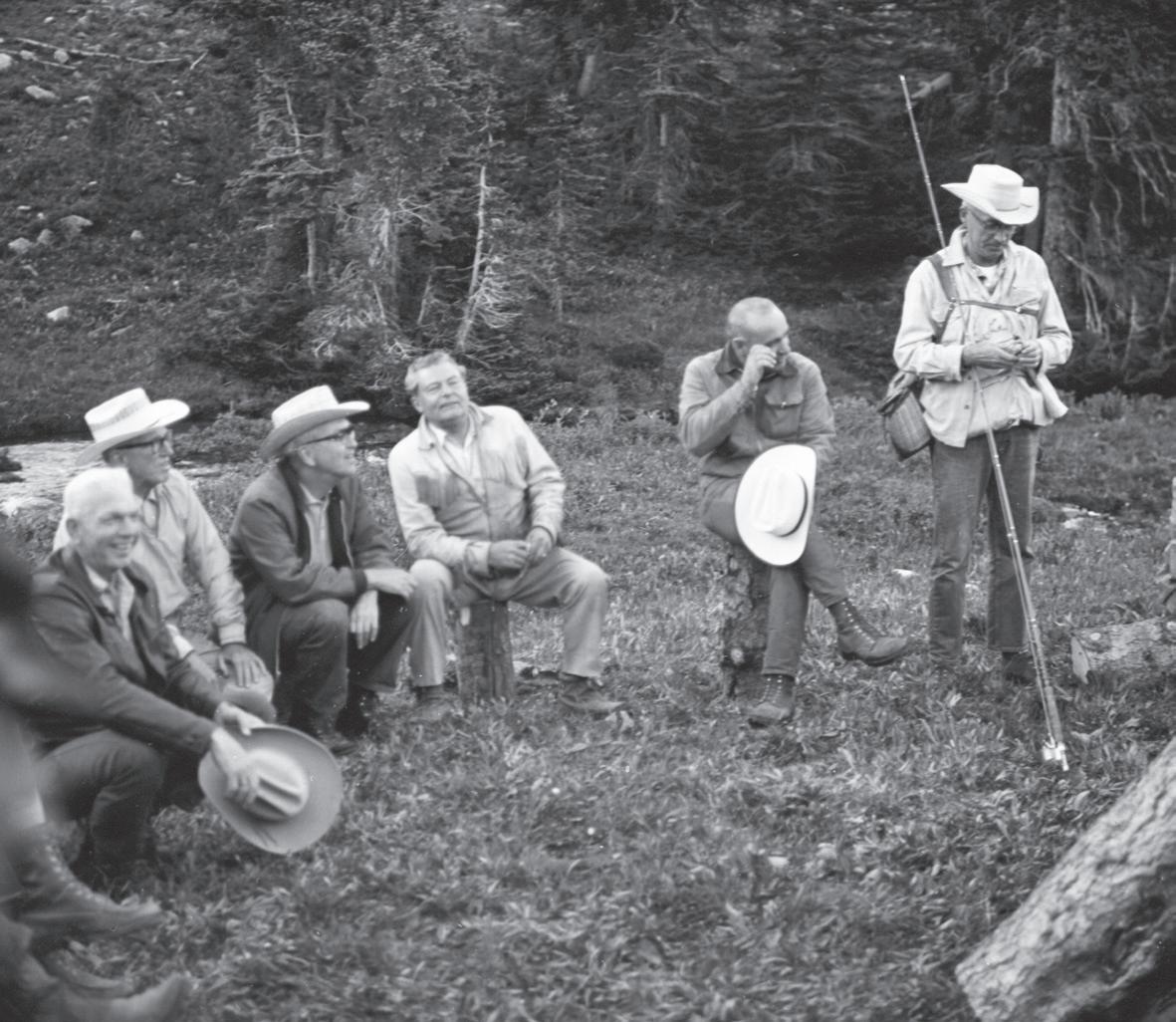
In 1966, a small group of UM supporters and volunteers trekked into the wild, spending four days in the Scapegoat Wilderness on a guided pack trip. They fished remote lakes for cutthroat trout, played music, swapped tales — and deepened their understanding and appreciation of UM under the big Montana sky. The idea for an organized annual adventure came from outfitter Smoke Elser and the UM Foundation President Tom Collins. Throughout the early decades, the Grizzly Riders aimed to raise awareness of the UM Foundation’s mission and inspire more private contributions among individuals who were passionate about UM with the unique offering of a wilderness education experience with meaningful conversation.
In 1980, Grizzly Riders International was registered with the state of Montana as a nonprofit corporation and has since been led by a governing Board of Directors. Today, 60 years after that first adventure, the “Riders” continue to enjoy their outdoor traditions and continue to generously support the Grizzly Rider Memorial Fund at the UM Foundation that supports scholarships and programs on campus.
Thanks to that visionary support and contributions to the Foundation, the Maureen and Mike Mansfield Lecture Series has become a cornerstone of excellence at UM.
Over the decades, the series has attracted leading experts in political science, international relations, the humanities and more, becoming one of the University’s best-known public features. The groundbreaking lectures continue to draw crowds in Missoula and resonate across the globe.
Recent Mansfield lecturers include Pulitzer Prize-winning bestselling author Doris Kearns Goodwin and former Secretary of State Condoleezza Rice, while earlier distinguished speakers included economist Milton Friedman and historian Barbara Tuchman, as well as New York Governor and future Vice President of the United States Nelson A. Rockefeller, and former U.S. President Jimmy Carter.
Through private and public support, the legacy of the Mansfields lives on at UM. In 1983, the Maureen and Mike Mansfield Center was founded at the University by an Act of Congress and donors continue to support its efforts to foster globally minded leaders of integrity and
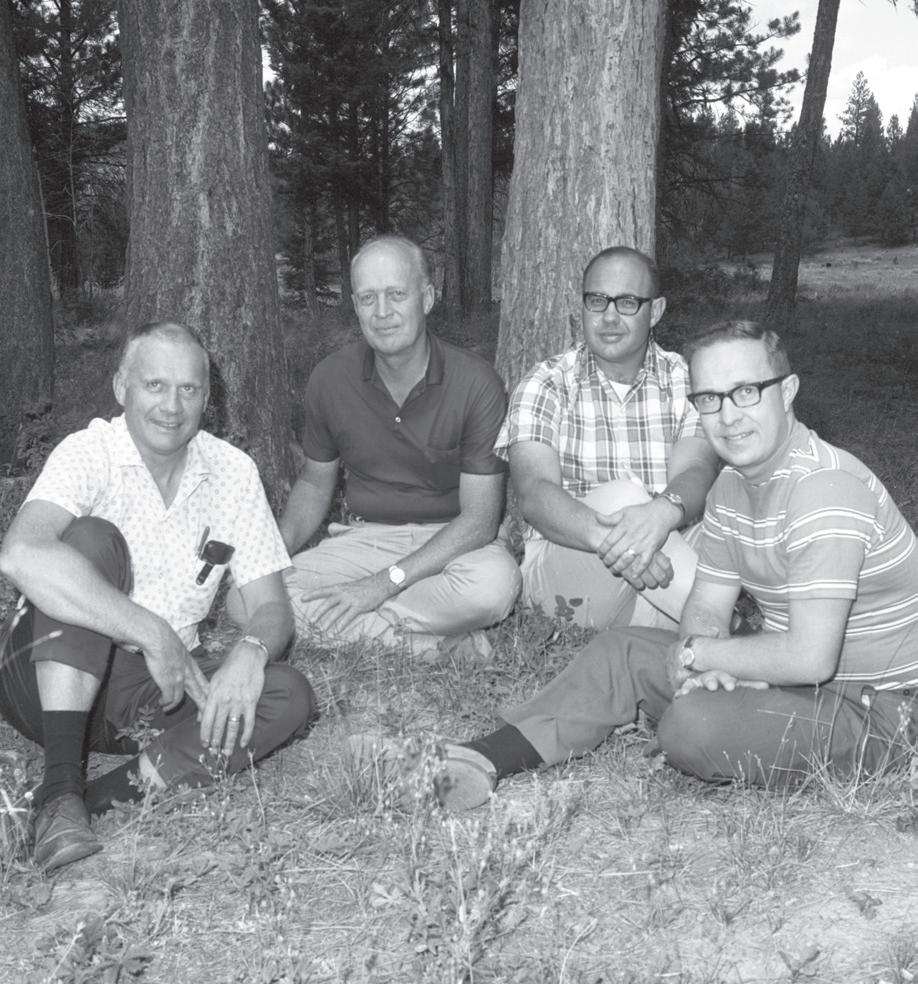
Foundation Trustees, July 1969.
distinguish the University as an international hub of leadership and dialogue.
ANNUAL GIVING TAKES ROOT
D. Gordon Rognlien’s remarks to students at the leadership conference at the Flathead Lake Lodge came just a month after the launch of UM’s first large-scale annual giving initiative — a major step toward cultivating consistent support. This drive aimed to meet the rising demands of a growing student body and ensure flexible funding for the University’s most immediate needs.
Driven by an energetic, student-led letter-writing campaign, the effort quickly gained traction. By January 1, 1961, UM administrators reported more than 1,200 donors had contributed over $13,000 to the UM Foundation — equivalent to more than $140,000 today.
“Vital work in education and research cannot be undertaken unless there is financial help from former students and friends of UM,” said UM President Robert Pantzer.
Funds raised supported student aid, library acquisitions, research, athletics, the Law School Development Fund, the President’s Fund and more.
Since the founding of the UM Foundation, the annual support and engagement of the UM community — alumni, friends, organizations and
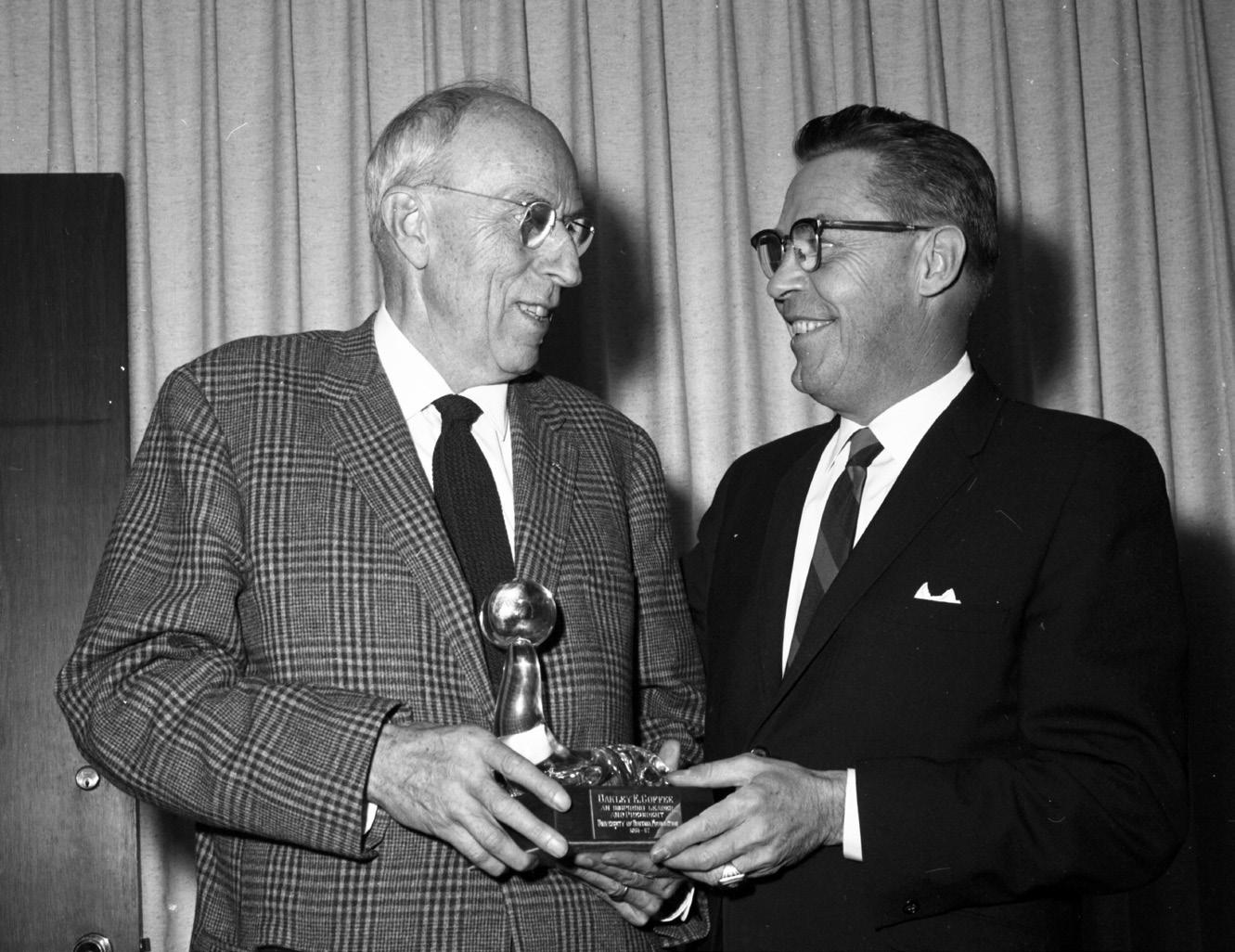
Oakley Coffee (left), one of the Foundation’s original Trustees and its first fulltime director and UM President Robert T. Pantzer in 1967.
parents — have strengthened the University and helped to propel its advancements and its accessibility for students.
Today, the Foundation’s annual giving program continues to play a pivotal role in carrying on a powerful tradition: donors stepping up each year to uplift the University’s evolving mission through continual support of crucial needs and priorities across campus.
SETTING COURSE FOR THE FUTURE
During the fall of 1967, the Foundation hired Oakley Coffee — another original Trustee — as its first full-time director. At the close of the 1960s, what had begun as a modest, volunteer-led movement in 1950 had transformed into a professional force capable of serving thousands of donors who prioritized higher education and research in Montana.
By 1969, the UM Foundation managed nearly $4 million in total assets, with an endowment exceeding more than $1 million. More than financial success, these figures reflected the strength of public-private collaboration and donor belief in the University’s mission.
Through this support, the Foundation laid out a plan for growth that continues to this day. Indeed, through the unity and vision of the University’s many donors, the possibilities had become — and remain — unlimited.
1970s
Sustained and Strengthened
AMID THE STAGNANT ECONOMIC TIMES OF THE 1970s, DONOR INVESTMENT SOLIDIFIED UM AS A GLOBAL LEADER IN CONSERVATION AND NATURAL SCIENCE
PHOTOS PROVIDED BY ARCHIVES AND SPECIAL COLLECTIONS, MANSFIELD LIBRARY, UNIVERSITY OF MONTANA
During its first two decades, the University of Montana Foundation helped the University’s giving community blossom into a powerful collective capable of inspiring enduring change and advancement.
In the 1950s and ’60s, donors seized the opportunity to transform UM into a national and global hub of education, culture and discovery.
As the 1970s dawned, however, that momentum met significant headwinds.
Growing economic stagnation and political unrest over the Vietnam War challenged universities nationwide. Educational costs rose while grants, loans and work-study programs declined.
At UM, administrators faced growing uncertainty about the future of higher education in Montana. Even as enrollment remained steady, budget shortfalls loomed.
With funding levels in flux, private philanthropy became even more essential to meeting the critical needs of the University, supporting its ability to serve students and expand its economic impact across the state. Confronted with this reality, forward-thinking donors rose to the moment, rallying to elevate research efforts and academic programs through facility improvements, faculty support and student scholarships.
By the end of the decade, UM emerged not only sustained but also strengthened as a world-class and accessible institution serving Montana and beyond — and many of the contributions and improvements launched during the ’70s still support students and faculty today.
PRESERVING MONTANA’S NATURAL RESOURCES
In January 1970, renowned scientist Dr. Wendell Mordy addressed the Foundation’s Board of Trustees with a bold prediction: “The environment will be the issue of our time.”
Donors and Trustees increasingly prioritized natural science and environmental initiatives, moving to protect Montana’s breathtaking wild spaces and leverage the University’s outdoor properties into dynamic living laboratories.
This, Mordy said, presented a unique opportunity for the University — as the state’s abundant natural resources positioned it to become the nation’s “intellectual center for conservation.”
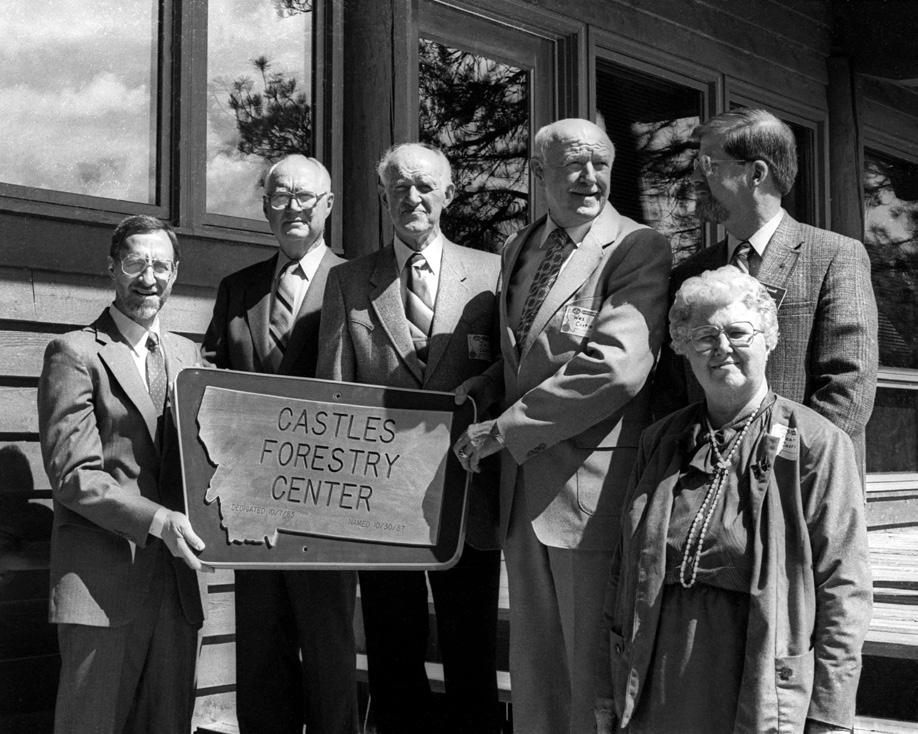
Dedication of the Castles Forestry Center (1983) designed to host gatherings, increase community outreach, and provide office, classroom and laboratory space at Lubrecht Experimental Forest.
UM Foundation Trustees meeting at Lubrecht Experimental Forest.
At the time of his remarks, Mordy, founding director of the Desert Research Institute at the University of Nevada, was consulting for UM as it sought to advance education and exploration opportunities for students and faculty around the sustainable management of forests, waterways and wildlife.
Donors and Trustees embraced Mordy’s message, and over the next decade increasingly prioritized natural science and environmental initiatives, moving to protect Montana’s breathtaking wild spaces and leverage the University’s outdoor properties into dynamic living laboratories.
Lubrecht Experimental Forest
Since 1937, Lubrecht Experimental Forest has served as an experiential classroom for students studying forestry, wildlife biology, resource conservation and other disciplines in the W.A. Franke College of Forestry and Conservation and departments across
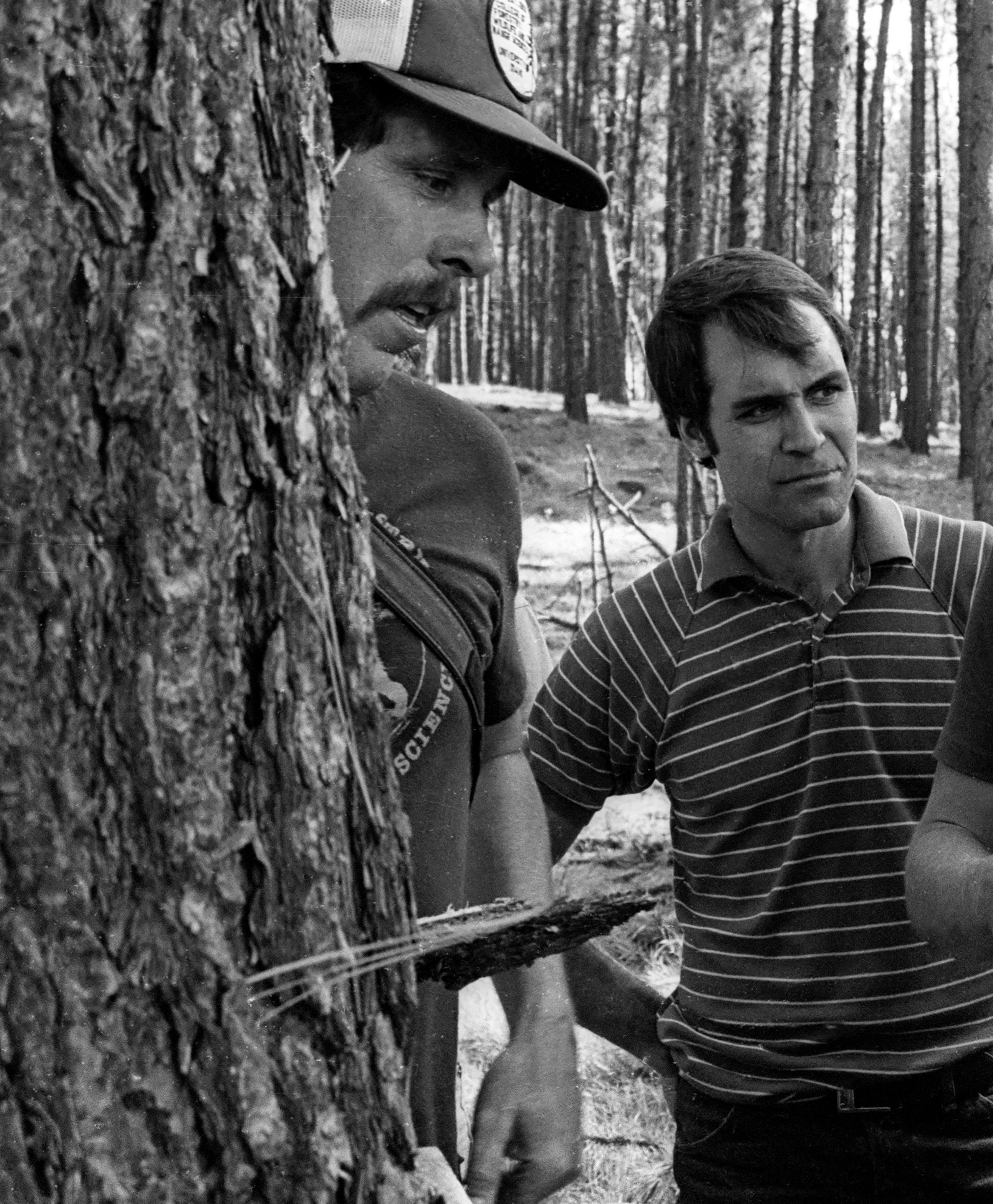
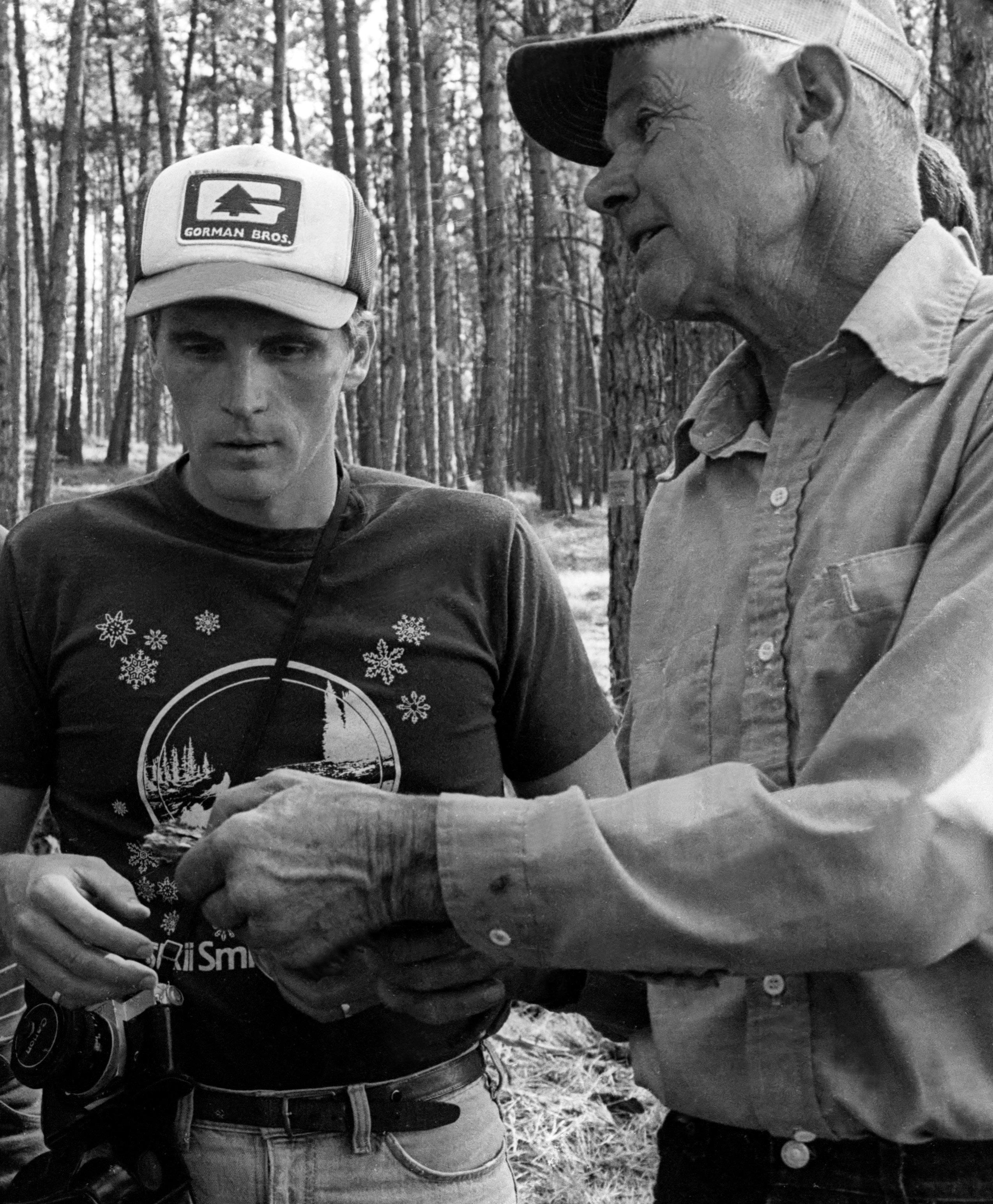
campus. Throughout the 1970s, Foundation Trustees prioritized the Lubrecht Land Acquisition Program, which sought to secure private support and public cooperation to expand the Forest’s boundaries to solidify it as a vital, contiguous center for education and public engagement.
The Foundation also launched the process of securing private funding for an on-site conference center at the Forest to host gatherings, increase community outreach and provide office, classroom and laboratory space. With a grant from the M.J. Murdock Charitable Trust and private donor support, that effort was completed in 1982 with the construction of the Castles Forestry Center. The facility was dedicated the following year.
Today, Lubrecht serves as a national center for inquiry and policy development in forestry, resource management and ecosystem science. Through immersive training and fieldwork, the
forestry and conservation leaders of tomorrow gain the skills needed to confront critical issues facing the West.
Faculty and students engage with private landowners and public agencies throughout the Blackfoot Valley to conduct influential research in areas such as forest hydrology, fire dynamics and climate resilience.
Flathead Lake Biological Station
During the 1970s, the Foundation’s donors also worked closely with the Flathead Lake Biological Station — a world-renowned aquatic research and education facility, and the second oldest such field station in North America. This work included funding key winterization projects and, in 1975, the purchase of a new research vessel.
Today, philanthropic investment continues to be a difference-maker at FLBS, supporting around 30% of the annual budget as it advances cutting-edge research, monitoring and education from its home on one of the world’s most pristine aquatic ecosystems. In 2024, FLBS celebrated its 125th year with its Anniversary Initiative, which has raised over $8.5 million in private support for research, water quality monitoring, facility maintenance and modernization, as well as student success at the college and K-12 levels.
An actively engaged donor community is also working to provide infrastructure upgrades with the construction of the Flathead Discovery Center, a new home for the future of aquatic science and education, to better accommodate ever-expanding FLBS education programs, growing staff and to support critical administration for the sustainability of its operations.
Blue Mountain Observatory
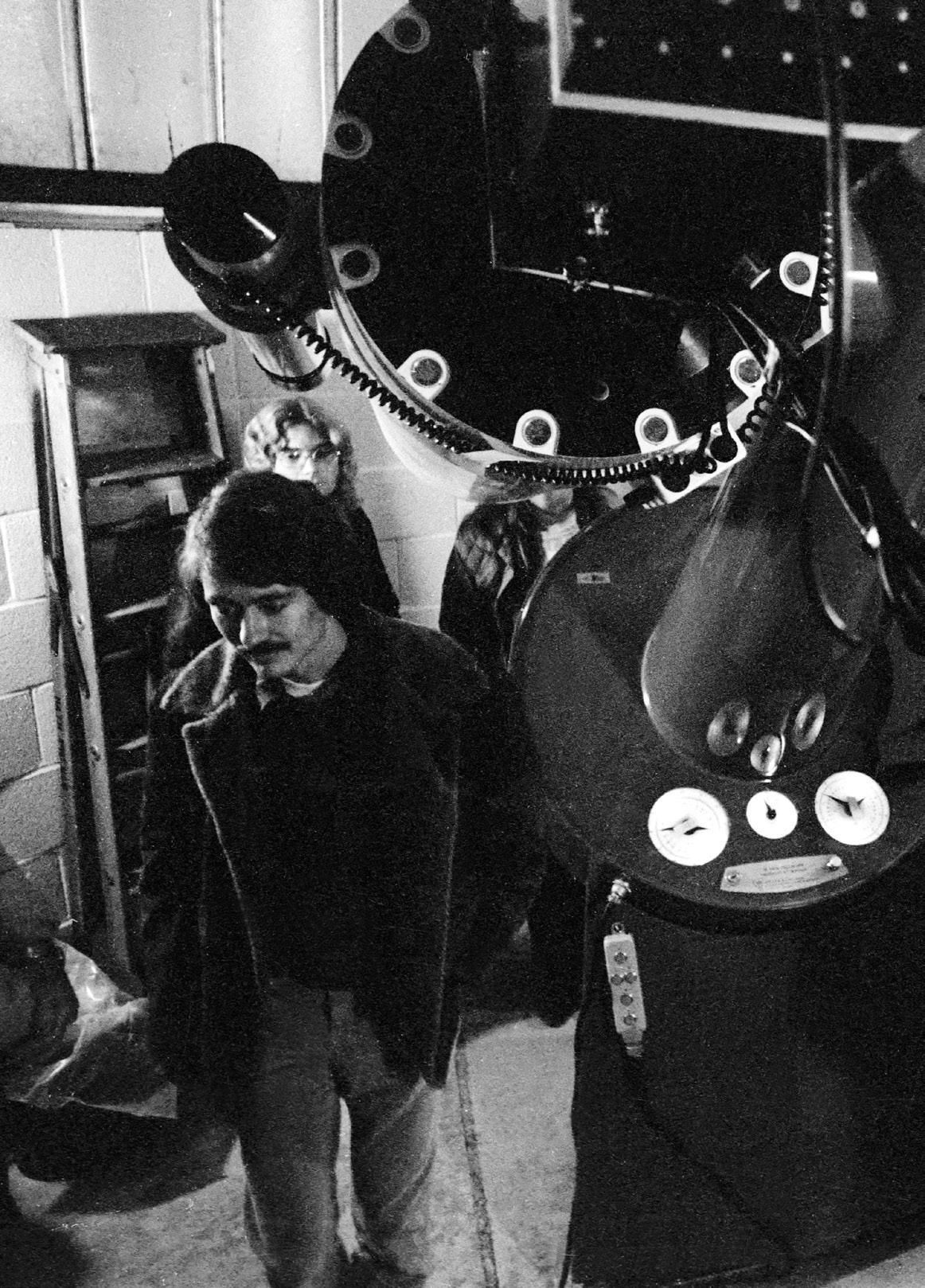
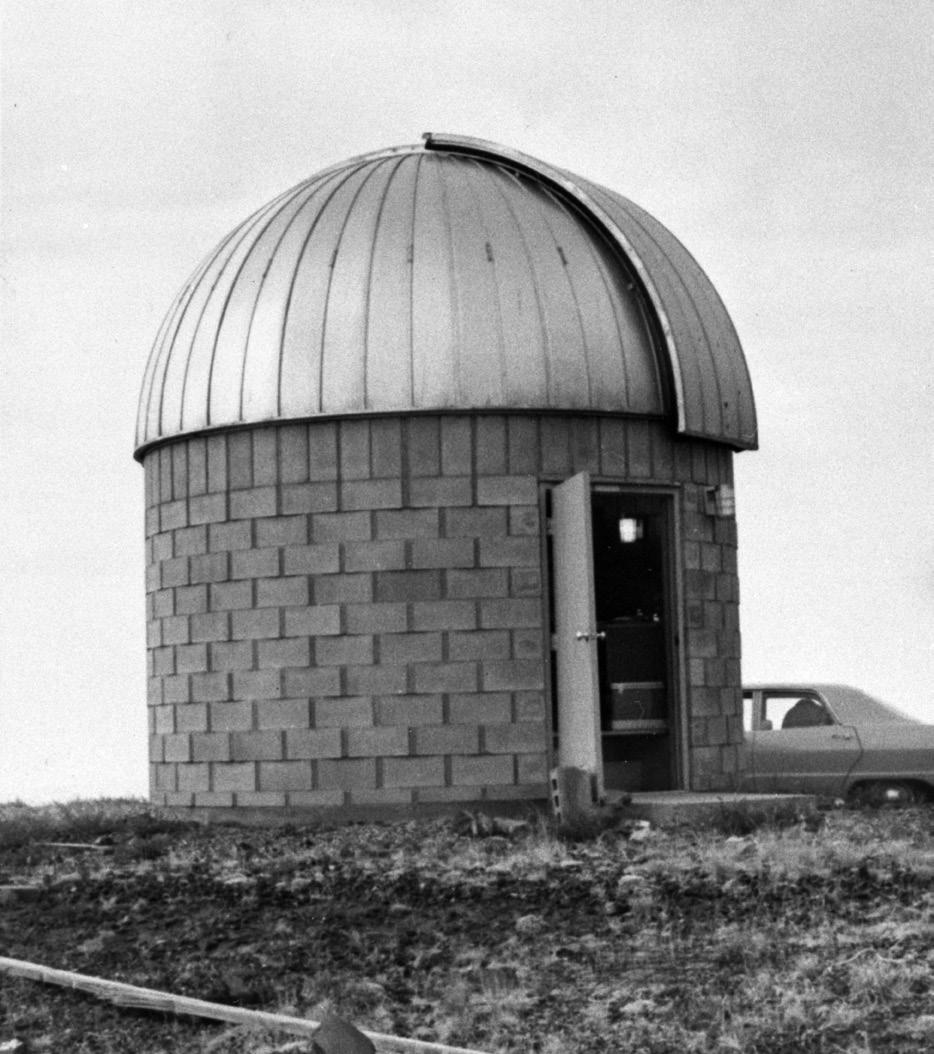
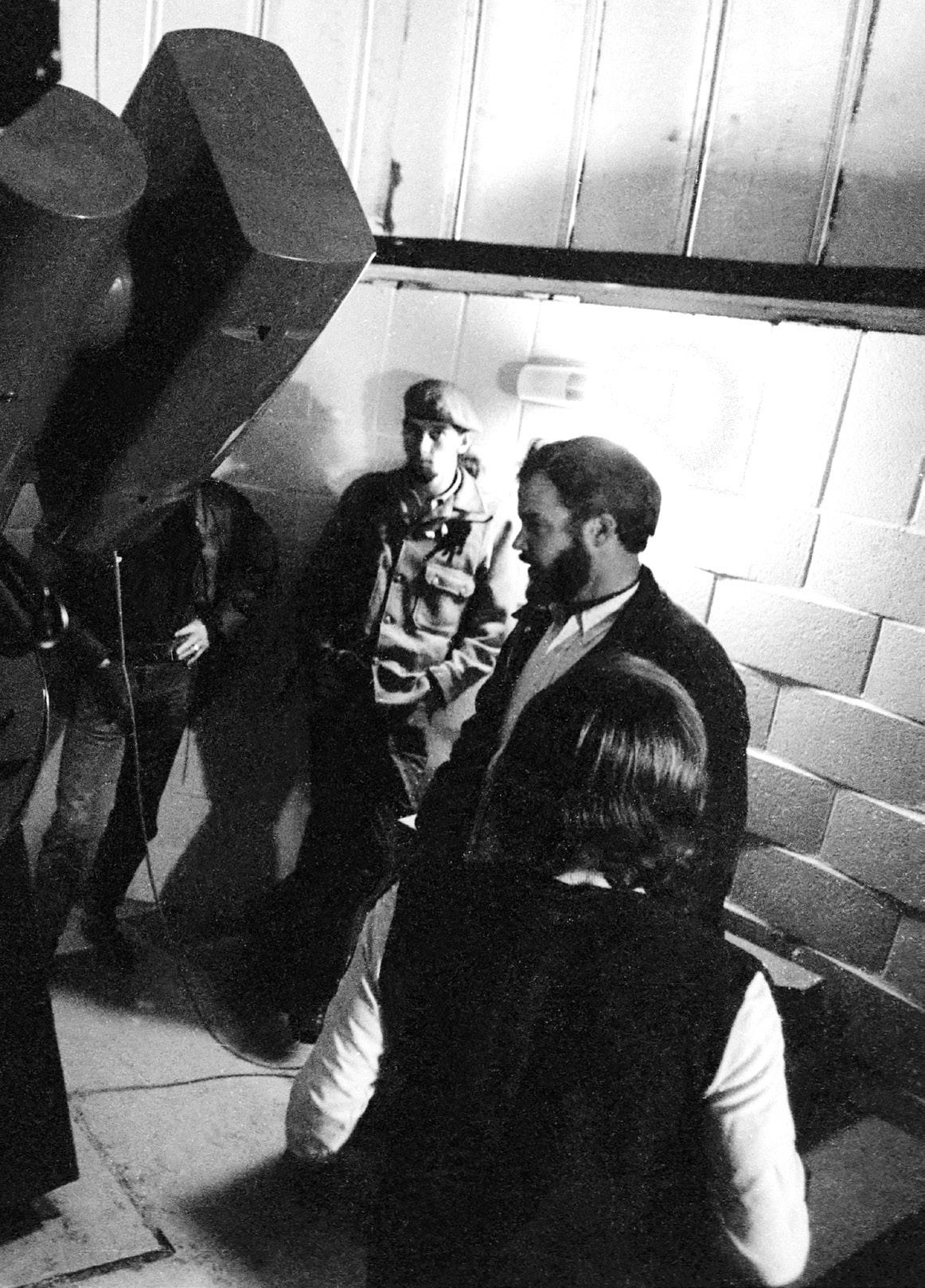
In 1971, donor support aided in opening Montana’s first astronomical research facility: the Blue Mountain Observatory. Through private gifts, along with financial support from the National Science Foundation and
Above and below: The Blue Mountain Observatory brought what was then the state’s most powerful telescope to the Missoula area.
student fees, UM installed what at the time was the state’s most powerful telescope at Blue Mountain, near Missoula.
Today, it serves as a vital training ground for students pursuing the only undergraduate astronomy program in Montana. The facility offers hands-on experience in celestial observation as well as science communication and outreach, fostering public engagement through summer open houses and stargazing nights.
LASTING LEGACIES: THE GENESIS OF PLANNED GIVING
The 1970s also saw a surge in interest in estate planning as a powerful tool for giving.
At UM, one notable example of this national trend was a gift from Mary Elrod Ferguson, who ensured that her family’s generational legacy would live on at the University before she passed away in 1975.
REMEMBERING MONTANA THROUGH PLANNED GIVING
Oscar J. Craig, the University of Montana’s first president, believed the purpose of a university was to prepare students for their environment. Within five days of arriving in Missoula in 1895, he issued a pamphlet outlining plans to position the University to achieve this goal. He famously coined what became UM’s official slogan at the time, “The University — it shall prosper.” After serving as president for 13 years, Craig retired in 1908. His accomplishments laid the foundation for the future of UM and continue to ensure the University prospers. The UM Foundation established the Oscar J. Craig Heritage Society to honor and acknowledge visionary individuals who have provided for the University of Montana in their estate plan or other planned gifts. Their support will help UM prosper for generations to come. In 2025, there are over 1,100 Heritage Society members, whose gifts are anticipated to provide over $148 million in support for UM’s future.
Planned gifts, such as those included in a will or living trust, are vital for the sustained health of the University and make an impact in a variety of ways depending on the legacy donors want to leave on campus. Donors may choose to enhance the Excellence Fund or an Impact Fund, providing campus leadership with maximum flexibility to direct resources and achieve strategic priorities. Or they may designate a specific purpose for their gift, such as a scholarship, faculty or program support, or research. Many donors choose to establish an endowed fund, in which their gift is invested in perpetuity and a percentage is made available to support the University each year. Directing a gift to an endowed fund ensures a steadfast source of support long into UM’s future and can bear a donor’s name or the name of a loved one. Each investment in the University of Montana is transformative.
A 1911 UM graduate, biology instructor and longtime dean of women, Elrod Ferguson arranged for her will to establish an endowed scholarship fund in remembrance of her father, who founded the Flathead Lake Biological Station in 1899.
According to a 1975 news release, Elrod Ferguson “virtually grew up” at the station, and the fund she established supported student scholarships there.
The Foundation received several other notable bequests during the decade that continue to provide valued support for UM students.
Bernice A. Gleed included a bequest in her estate plan to establish an endowed scholarship fund that continues to support pre-med students, while Billie Jean Bright established the George E. Bright Fellowship endowed fund for forest management graduate students.
By 1978, Trustees recognized the potentially transformative power of estate giving and began hosting public seminars on the subject. In 1979, it formally launched its Deferred Gifts Program, the precursor to today’s planned giving department.
Today, the Foundation’s Planned Giving department continues to help donors make lasting contributions that preserve access to an exceptional education at UM for future generations. The scope of the department’s work is broader than ever before, offering a wide variety of tax-advantaged and otherwise beneficial giving options, including charitable gift annuities, charitable remainder trusts, qualified charitable distributions and more.
THE RISE OF THE EXCELLENCE FUND
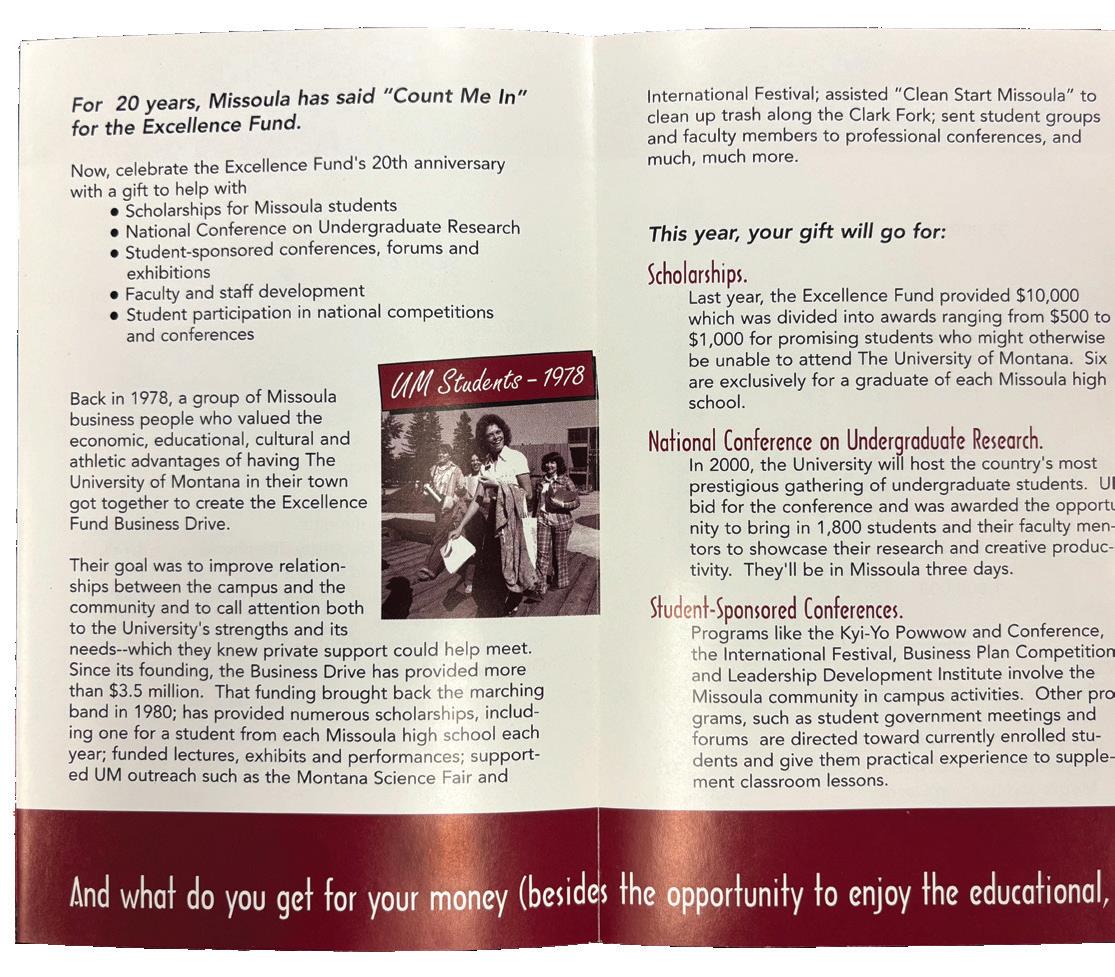
Spearheaded by a group of dedicated alumni and Missoula business leaders, fall 1978 saw the launch the University’s Excellence Fund.
Building on the success of the earlier President’s Fund — UM’s primary discretionary fund since the 1950s — the Excellence Fund is comprised of gifts given by donors to help address high-priority needs.
The results were immediate. What began as a local community effort quickly grew into a signature element of giving at UM.
By academic year 1979–80, the Excellence Fund exceeded its annual $175,000 goal by more than $5,000, supporting faculty development, library upgrades, technology improvements and alumni outreach.
Donor support for the Excellence Fund reflected the evolution of private support and the community’s continued commitment to UM. Today, donors continue to give to this cornerstone fund, empowering the University president to meet critical needs and fund dynamic initiatives as they arise.
Mary Elrod Ferguson at Flathead Lake. Date of photo unknown.
SETTING THE STAGE FOR A BIGGER, BRIGHTER FUTURE
The economic pressures of the 1970s forged the UM Foundation and its donors into a steadfast force for the University.
In 1979, the Foundation completed its first nationwide search for executive leadership, hiring Allan Vannini as director. By early 1980, Vannini reported record-breaking fundraising success, including landmark gifts from three family foundations, which totaled nearly $1 million.
One of those gifts funded the construction of a groundbreaking freshwater laboratory at the Flathead Lake Biological Station — the first of its kind in the Pacific Northwest — elevating UM’s capacity to advance freshwater science.
This and other gifts put an exclamation point on a decade where donors expanded UM’s leadership in ecological research at a defining moment in environmental history.
Throughout the 1970s, significant donor contributions helped the University’s natural science departments generate data and insights that shaped resource management practices,
TURNING IDEAS INTO ACTION: UM FOUNDATION LEADERS
Since Oakley Coffee was appointed the Foundation’s first full-time director in 1967, the following individuals have also served as Director, Executive Director or President and CEO of the UM Foundation: Laura Brehm; Thomas Collins; Shane Giese; Thomas (T.J.) Grippen; Fred Lee; Larry Morlan; Sharen Peters; Allan Vannini; Bill Zader.
Our current President and CEO Cindy Williams leads a team of more than 70 dedicated staff professionals with broad expertise and deep commitment to the mission-critical work of the Foundation. Williams has served in this role since June 2017. She joined the Foundation in 2006 as director of development for UM’s School of Business Administration, now the College of Business. She leads the overall strategic direction of the Foundation to inspire philanthropic support of the University of Montana.
informed policy decisions and supported public understanding of these pivotal issues. The decade underscored how private philanthropy could propel the University to the forefront of environmental issues — preserving Montana’s natural heritage while addressing global ecological challenges.
The vision, cohesion and perseverance of volunteers and contributors to the UM Foundation also laid the groundwork for future success, ensuring that the University could continue to serve as a beacon of innovation and opportunity.
“Success in fundraising is reached through cooperation,” Vannini wrote in his Director’s Report in July 1979. “It is because of this atmosphere of involvement that I believe UM’s most successful years are still ahead.”
After the Foundation’s first nationwide search for executive leadership, Allan Vannini became director in 1979.
CELEBRATING DONORS A LOYAL GIVING
COMMUNITY
The University of Montana has been profoundly shaped by the generosity and vision of its dedicated giving community. Year after year, donors make gifts of all sizes to the UM Foundation, sustaining the University’s legacy of excellence. Each contribution plays a vital role in UM’s continued success.
We extend our deepest gratitude to these donors whose support ensures that every student who dreams of attending UM has the opportunity to do so. Donors fuel innovation, strengthen programs and enable the University to adapt to an ever-changing landscape — including many unforeseen events over the past 75 years.
This ongoing commitment helps UM remain a world-class institution, delivering life-changing education, driving research and discovery and preparing tomorrow’s leaders to make a meaningful impact.
GIVING SOCIETIES
The University of Montana Foundation gratefully honors the generous support of all donors and recognizes participants in our three giving societies.
6,105
DONORS
have been giving to the UM Foundation for 20 YEARS or more.
The Lux et Veritas Society recognizes donors who have given more than $1 million to support the University of Montana over their lifetimes. The Foundation has recognized over 200 donors as part of the Lux et Veritas Society.
The Oscar J. Craig Heritage Society recognizes donors who have provided for the University of Montana in their estate plan. The Foundation has recognized over 1,100 donors as part of the Oscar J. Craig Heritage Society.
Each year, the UM Foundation President’s Club recognizes over 2,000 committed donors who make annual gifts of $1,000 or more to support the University of Montana. This loyal community of alumni and friends are shaping UM’s future.
41 DONORS have made gifts to the UM Foundation every single year over the past 40 YEARS
1980s
A ‘Tradition of Excellence’
FROM A NEW FINE ARTS BUILDING AND FOOTBALL STADIUM TO A RECORD-BREAKING CAMPAIGN TO MEET VITAL NEEDS, BIG IDEAS AND BOLD ACTIONS DEFINED DONOR GIVING IN THE 1980s
SELECT PHOTOS PROVIDED BY ARCHIVES AND SPECIAL COLLECTIONS, MANSFIELD LIBRARY, UNIVERSITY OF MONTANA
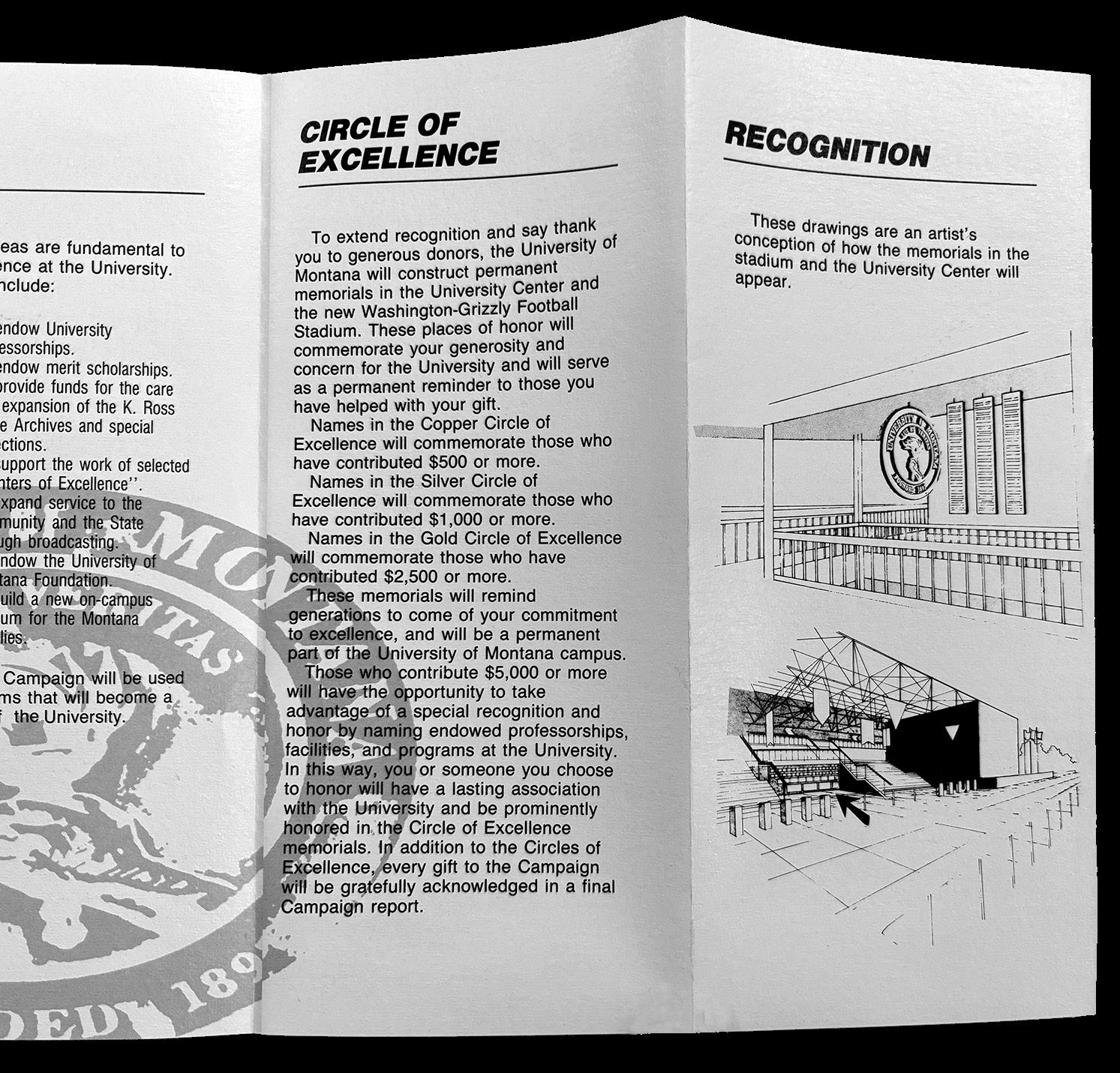
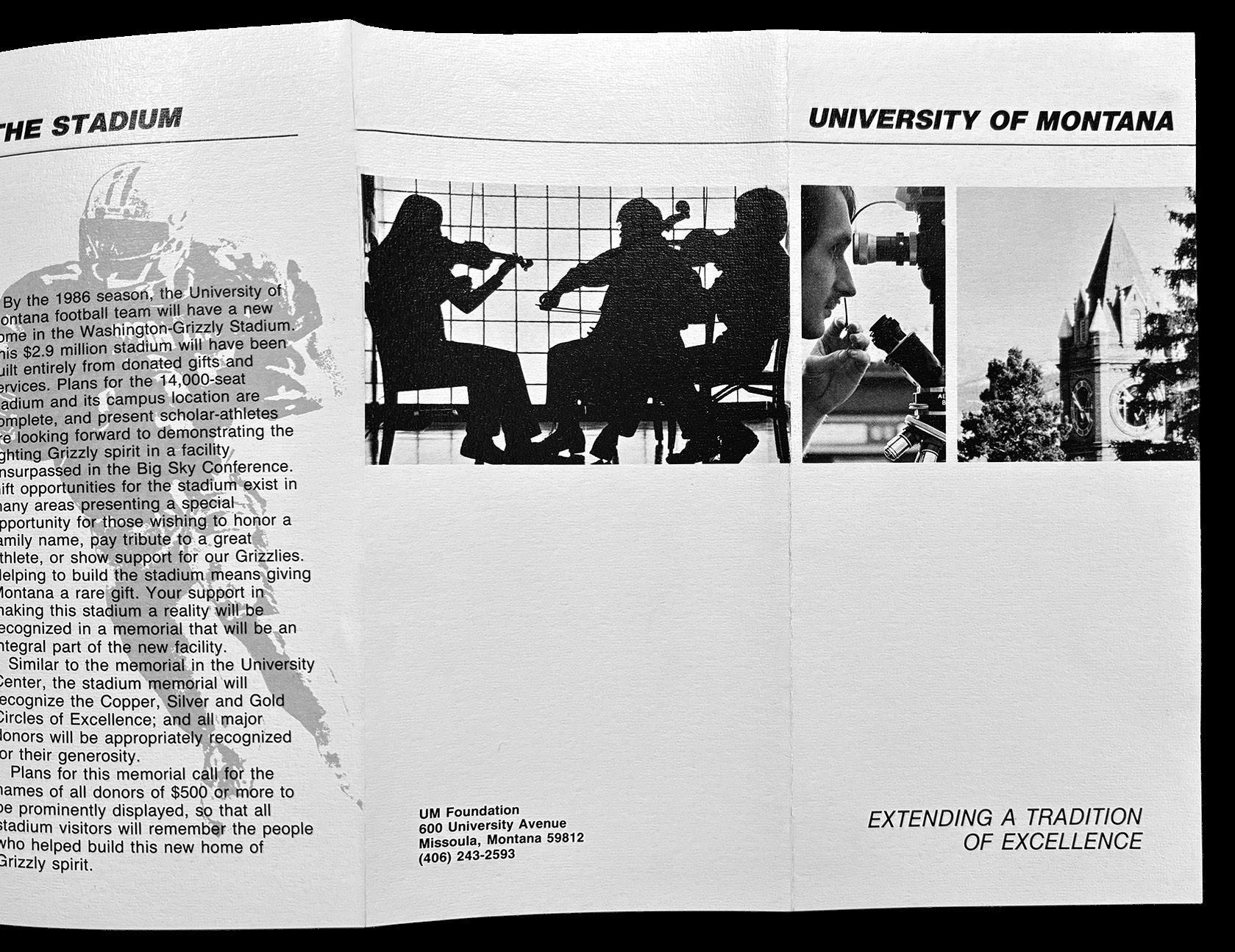
Amid the University of Montana’s Homecoming celebration in October 1984, the UM Foundation launched what was hailed in a news release as “one of the most ambitious private fundraising ventures in Montana history.”
The “Extending a Tradition of Excellence” campaign marked the Foundation’s first comprehensive, multiyear effort to generate donor support for a broad-based list of the University’s long-term institutional needs — and it signaled a new chapter of giving at UM.
The timing was critical. By the mid-1980s, the University was reprioritizing and reevaluating its funding model, and philanthropy had become key to elevating UM’s mission.
“It was apparent that a campaign would be necessary if we were to maintain our traditional margin of excellence in the years ahead,” said
The “Extending the Tradition of Excellence” campaign signaled a new chapter of giving at UM.
University President Neil S. Bucklew, in the release. “The goals of the campaign all represent significant opportunities to build on our strengths — but we’ve got to do it now.”
The “Extending a Tradition of Excellence” campaign offered donors the opportunity to become part of the UM tradition with forwardthinking gifts to the Foundation supporting many impact areas fundamental to the University’s success.
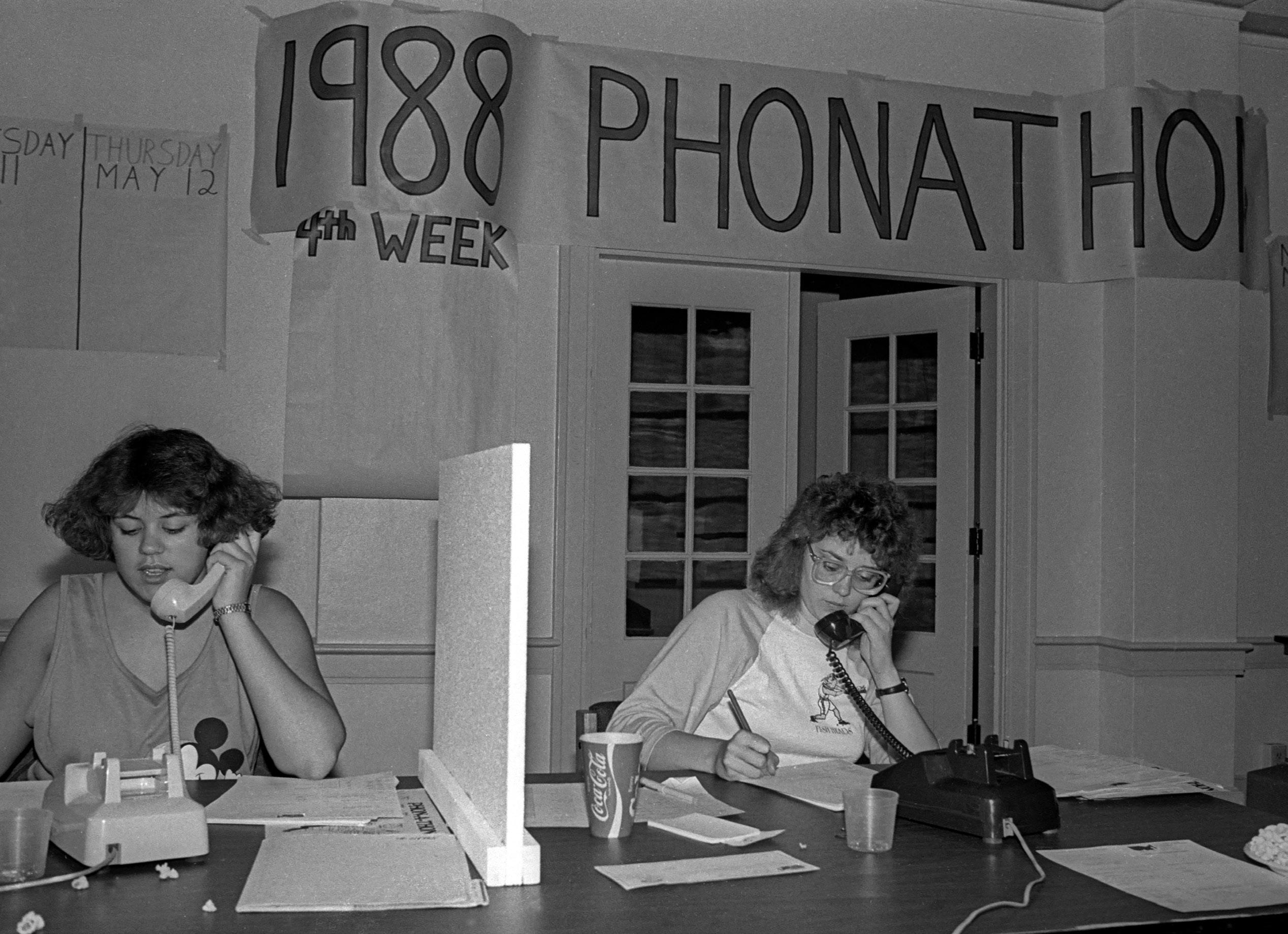
Alumni and friends responded in record numbers, inspiring sharp increases in volunteer participation and hands-on involvement from the Foundation’s Board of Trustees.
In its first four months, the campaign garnered six-figure gifts from several foundations and corporations, along with many individual and anonymous contributions.
Major campaign victories included:
• Fortifying UM’s Excellence Fund, comprised of gifts given by donors to increase the UM’s President’s ability to address high-priority needs and opportunities as they arise.
• Providing critical support for student scholarships. Donor generosity was instrumental in boosting support, including uplifting prestigious merit-based scholarships such as the Presidential Scholarship Program, as well as need-based scholarships, ensuring that UM had the resources to assist all prospective students, elevating the impact of the Foundation’s endowed scholarship funds beyond the 500 students receiving scholarship awards prior to campaign launch.
The “Extending the Tradition of Excellence” campaign inspired a sharp increase in volunteer participation.
• Strengthening what Bucklew called the University’s “Centers of Excellence,” including the Montana Repertory Theatre, Bureau of Business and Economic Research, Flathead Lake Biological Station and Lubrecht Experimental Forest.
• Administering crucial maintenance and additions to the Archives and Special Collections at the Mansfield Library.
• Inspiring support for faculty positions, including an endowed professor position in forestry.
• Solidifying programming, fellowships and academic partnerships at the newly formed Maureen and Mike Mansfield Center, which was established through an act of Congress in
1983 to further the University’s global education and public service outreach, and to honor the Mansfields’ commitment to international relations and democracy.
• Supporting Grizzly sports teams and student-athletes through contributions to scholarships, facilities and team programs. This aid prioritized academic achievement and leadership development among studentathletes, while ensuring that Grizzly Athletics remained one of UM’s most visible and powerful public-facing entities.
By the time the campaign concluded in late 1986, it had raised a reported $7.8 million, surpassing expectations across nearly every area of need.
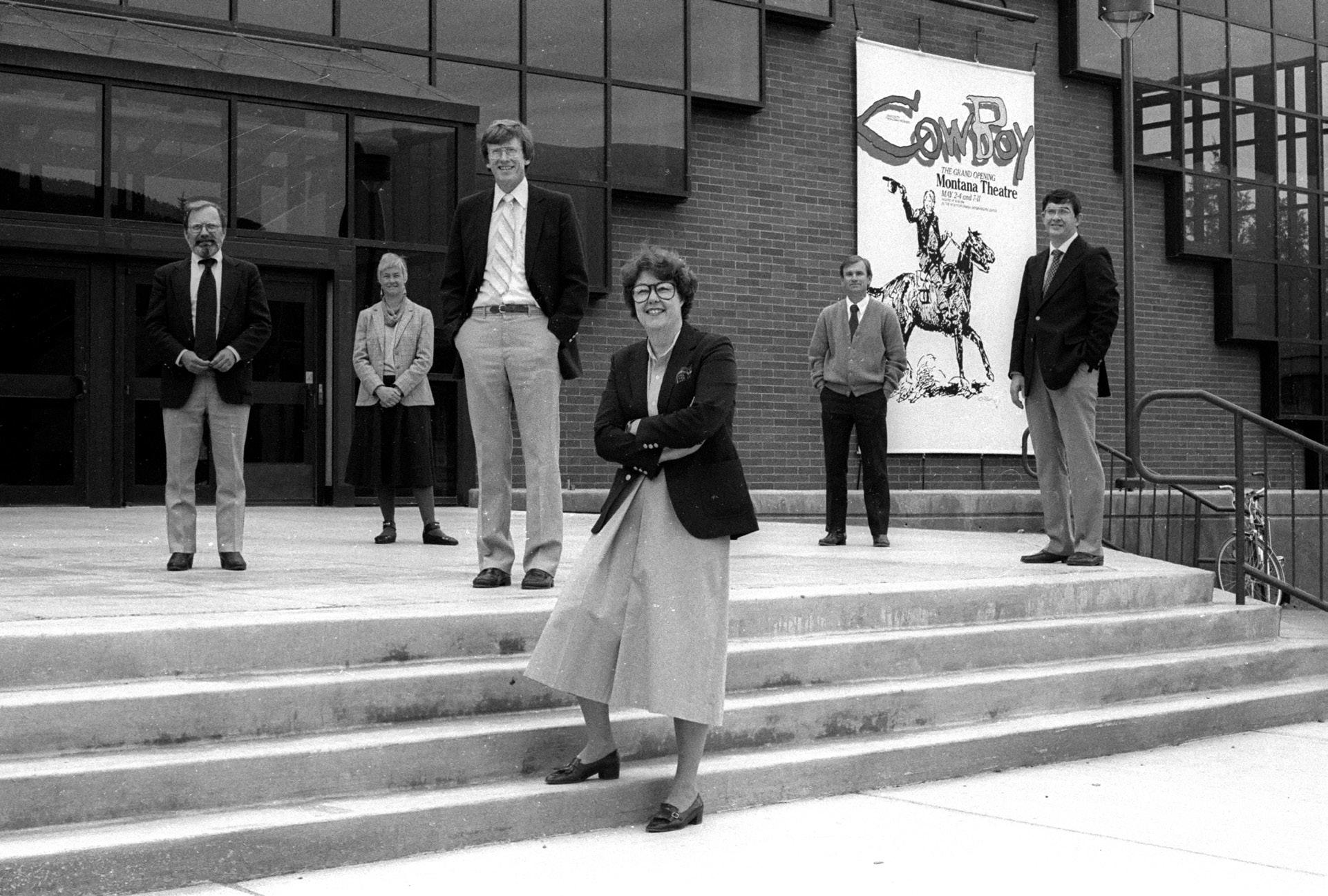
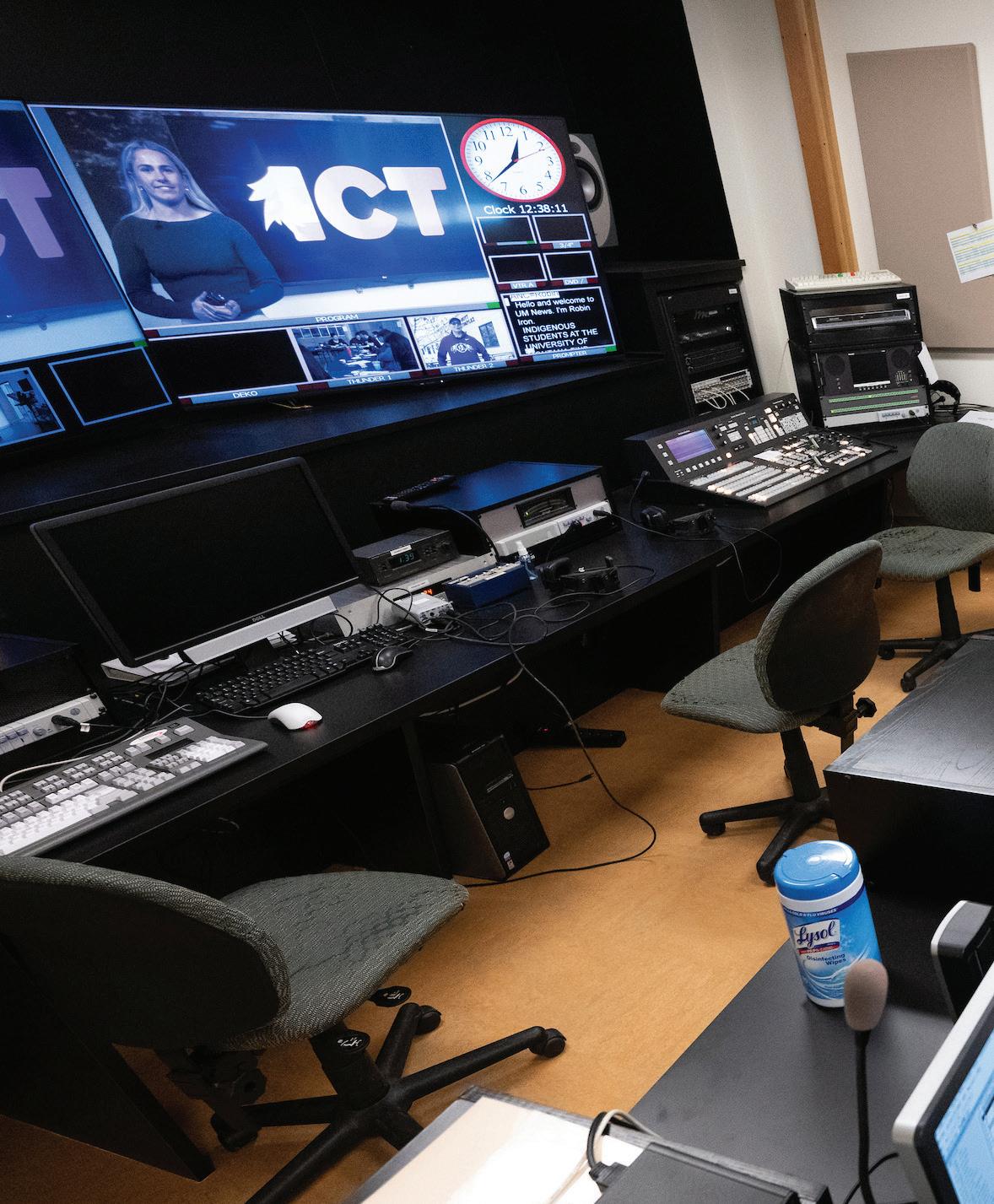
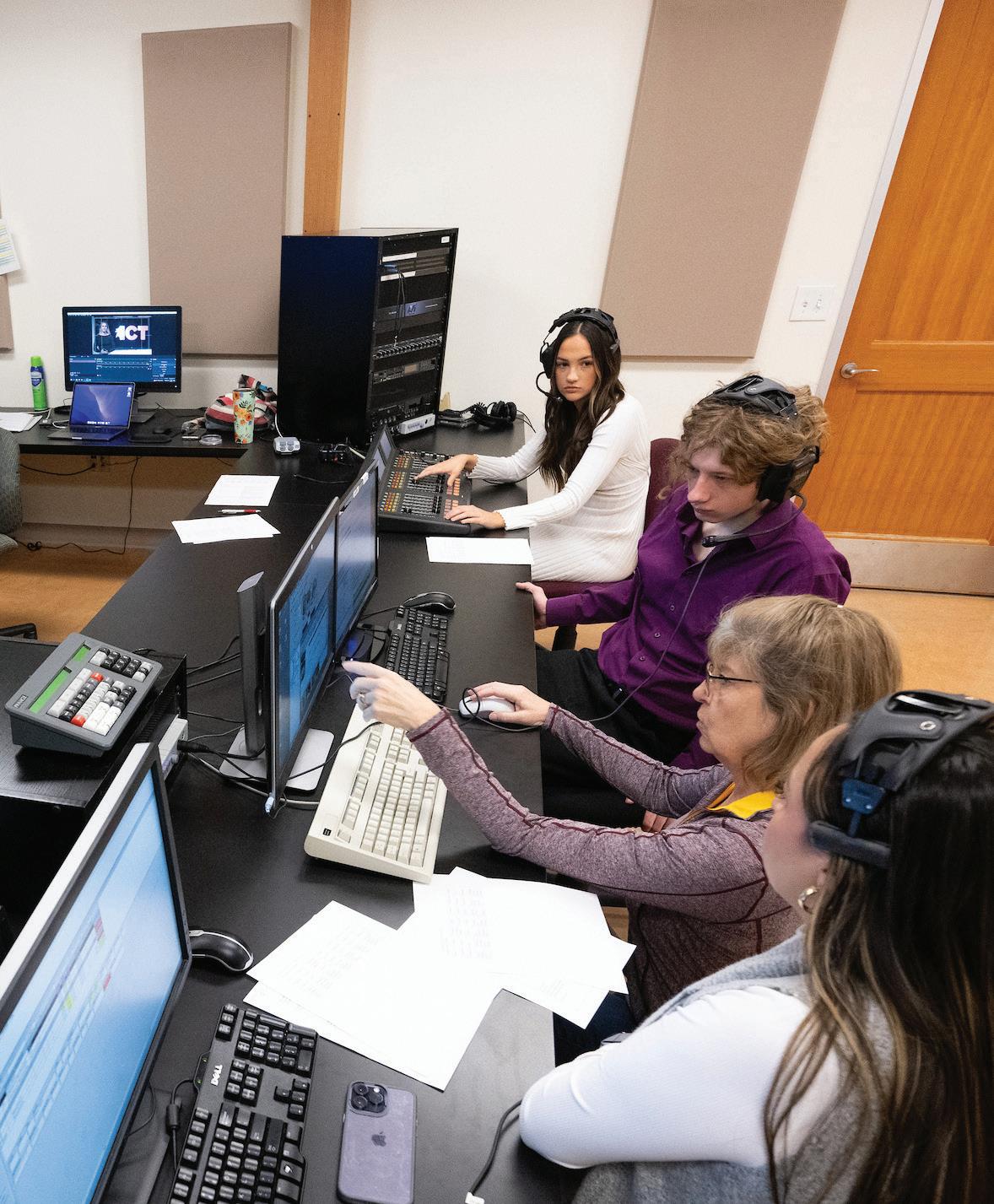
In 1981, the Foundation Board authorized an initiative to raise funds for a new building dedicated to drama, dance, television and radio broadcasting. The PAR/TV Center remains a dynamic cultural hub that serves both campus and the state.
But “Extending a Tradition of Excellence” was more than a financial and historical milestone for the Foundation and its donors — it reflected the growing spirit of collaboration at UM during the ’80s.
POWERING PROGRESS: A GIANT LEAP FOR PHILANTHROPY
Nationwide, private giving to higher education was on the rise. At the University, donors were thinking bigger than ever before about how to shape UM’s future as an innovative and accessible destination for students and faculty.
By 1983, Foundation records indicate giving to the University’s Excellence Fund had increased almost 100% and alumni participation had risen over 146% since the end of the ’70s.
That steadfast dedication would power the school through a decade of unprecedented growth, setting new standards for fulfilling student and faculty needs, while completing truly iconic facility upgrades.
Even before the official launch of “Extending a Tradition of Excellence,” in 1984, the early ’80s saw donors, Trustees and University leaders begin to revolutionize the role of philanthropy at UM.
Among the first major successes of this exciting era: A new home for the fine arts.
Acclaimed actor Carroll O’Connor (left), played a pivotal role in fundraising for the PAR/TV Center.
FINE ARTS CENTER SETS THE TONE
Foundation Trustees and donors recognized the need for a new space to nurture the University’s growing fine arts programs as early as the 1970s. However, the economic adversity of the time forced leaders to pause initial fundraising for nearly a decade.
When the effort resumed with invigorated energy and ambition in 1981, things moved at lightning speed.
That spring, the Board authorized an initiative to raise $1.1 million to supplement $7.5 million in public funding for a new building dedicated to drama, dance, television and radio broadcasting.
By August 1982, donors contributed $1.23 million. More than 150 volunteers contacted over 100 corporations and foundations in 30 cities, many within Montana. The initiative attracted 1,149 individual donors, 616 of whom were giving to UM for the first time — a testament to increasing donor engagement.
Notably, actor Carroll O’Connor and his wife Nancy, both UM alumni, played a pivotal role. They hosted fundraising events in Los Angeles and sent personalized appeals to fellow alumni using stationery featuring the name of O’Connor’s legendary television character, Archie Bunker.
The Foundation also partnered with the Alumni Association to build wide-reaching community support through a “buy a seat” campaign, selling 602 theater seats at $450 each and contributing more than $225,000 to the final total.
Construction on the Performing Arts and Radio/ Television Center began in October 1982 and the building was dedicated in October 1985.
At the time of the PAR/TV Center’s completion, Bucklew lauded the initiative’s success in galvanizing the commitment of Trustees, attracting new donors and demonstrating that Montanans and alumni across the country were eager to invest in the University’s future.
NEIL S. BUCKLEW PRESIDENTIAL SERVICE AWARD
The Neil S. Bucklew Presidential Service Award, established in 1988, honors those individuals or couples who exemplify service and commitment to the University of Montana — advancing its mission on campus and throughout the state of Montana. The annual UM Foundation award is named for former UM President Neil S. Bucklew (above), who served from 1981 through 1986.
Neil S. Bucklew Presidential Service Award Past Recipients:
1988 - Ian Davidson
1989 - Bruce Crippen
1990 - John Ruffatto
1991 - Robert Kelly
1992 - Sherman Lohn
1993 - Jack Dietrich
1994 - Kathy Ogren
1995 - Jack Burke
1996 - Tom Collins
1997 - Tom Boone
1998 - Greg Hanson
1999 - Ernie Corrick
2000 - Phyllis J. Washington
2001 - Bill Bouchee
2002 - Bill Reynolds
2003 - Ann Boone
2004 - John and Katy Delano
2005 - John and Sue Talbot
2006 - Ev and Nikki Sliter
2007 - Charlie Oliver
2008 - Terry Payne
2009 - James and Joy Mariska
2010 - Robert Burke
2011 - Ty Robinson
2012 - Cathy Capps
2013 - Rockwood Brown
2014 - John and Marilyn Olson
2015 - Deborah Doyle McWhinney
2016 - Nelson Weller
2017 - Mike McDonough
2018 - Mickey Sogard
2019 - Gretchen and Dennis Eck
2019 - Eric Sprunk
2020 - Summerfield and Julie Baldridge
2021 - Mary Olson
2022 - McCammon
Family
2023 - Suzanne Peterson
2024 - Loren and Michele Hansen
2025 - Joe Whittinghill
PRESIDENT’S CLUB GIVING SOCIETY
In 1988, the UM Foundation formed the President’s Club giving society to honor those donors who contribute annual gifts of $1,000 or more. The President’s Club started with a small group of 300 UM supporters and now includes more than 2,000 donors every year. This engaged group of committed supporters provides leadership in collective giving and powers the pivotal, lifeshaping moments that make up the UM experience. President’s Club members are invited to learn about fundraising priorities, gift announcements and UM strategic opportunities through special events and regular communications throughout the year.
He cited these and similar factors as essential to building momentum that led to the inception and ultimately the landmark success of the “Extending a Tradition of Excellence” campaign.
In 2025, the PAR/TV Center remains a dynamic cultural hub, home to academic programs, live performances and public broadcasting that serve both campus and the state.
It also stands as a triumph of public-private partnership — combining state investment with philanthropic support to achieve a shared vision for the University. Today, public dollars and private generosity continue to work together to make major improvements at UM.
PUTTING MONTANA FOOTBALL ON THE MAP
Dornblaser Field, located roughly a mile south of UM on Higgins Avenue, had served as the
Montana Grizzlies’ home turf since 1968 — but by the early ’80s, momentum was building to bring football back to campus.
In July 1983, plans to construct a new stadium at the base of Mount Sentinel were unanimously approved by the Campus Development Committee, sparking a project that would forever reimagine the scope and heart of Griz Nation.
Community and alumni enthusiasm was high, and under the umbrella of the “Extending a Tradition of Excellence” campaign, passionate donors rallied to pledge nearly $1 million by early 1985.
The stadium drive reached its defining moment on August 14, 1985, with the announcement of an additional $1 million gift from Dennis and Phyllis J. Washington and the Washington Corporation. It was the largest single corporate contribution in the UM Foundation’s history to that point and the largest gift of the decade.
During the gift announcement ceremony, Dennis Washington said he believed the University deserved a stadium that “mirrored its pride and values.”
To honor this vital support, the new facility was named Washington–Grizzly Stadium.
The stadium opened for the 1986 season and was dedicated in an on-field ceremony during an October 18 home game against Idaho State University.
A new era had begun for the Griz.
Known for its unmatched fan energy, electric atmosphere and formidable home-field advantage, Washington-Grizzly Stadium soon became one of the most respected venues in college football. By the end of the 2025 season, the Grizzlies had amassed a home record of 245-38 at the stadium.
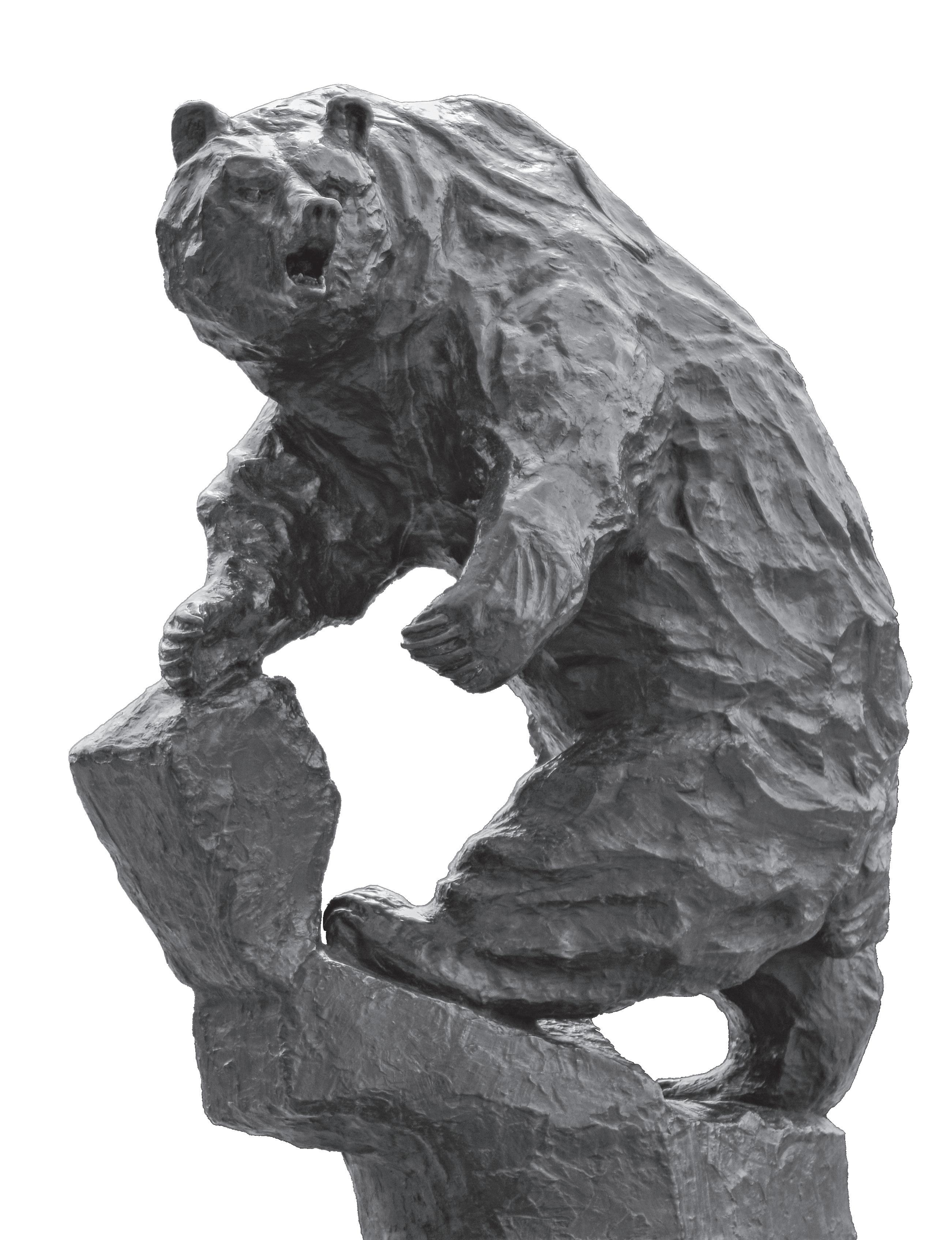
Today, after a series of expansions during the ensuing decades, the stadium seats more than 25,000 and is regarded as one of the loudest in the nation. Along with the iconic Main Hall clock tower, the Grizzly Bear statue on the Oval
Washington–Grizzly Stadium opened for the 1986 season and was dedicated in an on-field ceremony during an October 18 home game against Idaho State University.
and Mt. Sentinel’s “M,” it stands as one of the University’s signature features.
A DECADE OF TRANSFORMATIONAL GIFTS
By the end of the 1980s, the UM Foundation and its donors had made momentous progress. The decade saw a surge in major gifts from individuals, corporations and foundations. These diverse and visionary citizens, families and organizations were finding strategic ways to participate and make an impact on areas they felt passionate about.
Donors contributed a wide range of gifts during the “Extending a Tradition of Excellence” campaign. Some examples included:
• 1981: Funds from the Excellence Fund drive, including support from major newspapers across the state, provided $30,000 to the School of Journalism to purchase stateof-the-art electronic editing equipment, enhancing professional development and practical training for student journalists.
• 1981: The UM chapter of the Delta Delta Delta sorority and its alumni Theta Rho Home Association gifted $210,000 to benefit the Maureen and Mike Mansfield Library upon the chapter’s closure.
• 1983: The children of Mr. and Mrs. A.M. Mikalson established a $105,000 endowed scholarship fund in their parents’ names to provide annual awards to students majoring in forestry. These scholarships are still awarded today.
• 1988: The Stella Duncan Memorial Fund was established to assist medical research and education.
The ’80s stood as a decade that reshaped campus and expanded the possibilities of what private giving could achieve at the University of Montana.
Through capital campaigns, substantial gifts and a steadily growing base of alumni and donors, the UM Foundation helped further cultivate the University’s legacy of excellence and set the stage for a bold and inspiring future.
1990s
Soaring Momentum, Surpassing Milestones
DURING THE 1990s, DONORS POWERED MULTIPLE MAJOR INITIATIVES DURING A FAST-PACED DECADE ON CAMPUS
The 1990s were a vibrant and exciting time at the University of Montana. In 1993, the University celebrated its centennial — a milestone that coincided with a decade of climbing enrollment and increasing national recognition for both academic and athletic achievement.
Fueled by a deep belief in UM’s mission to provide world-class, accessible education, research and public service, donors helped usher in an era of rapid growth and transformative impact across campus.
Supporters, alumni and friends of the UM Foundation launched a record-breaking fundraising campaign while simultaneously making unparalleled additional investments in student and faculty success as well as aiding landmark facilities upgrades.
It was a decade of big dreams driven by an energized and empowered giving community, which rallied to set new standards of excellence at the University.
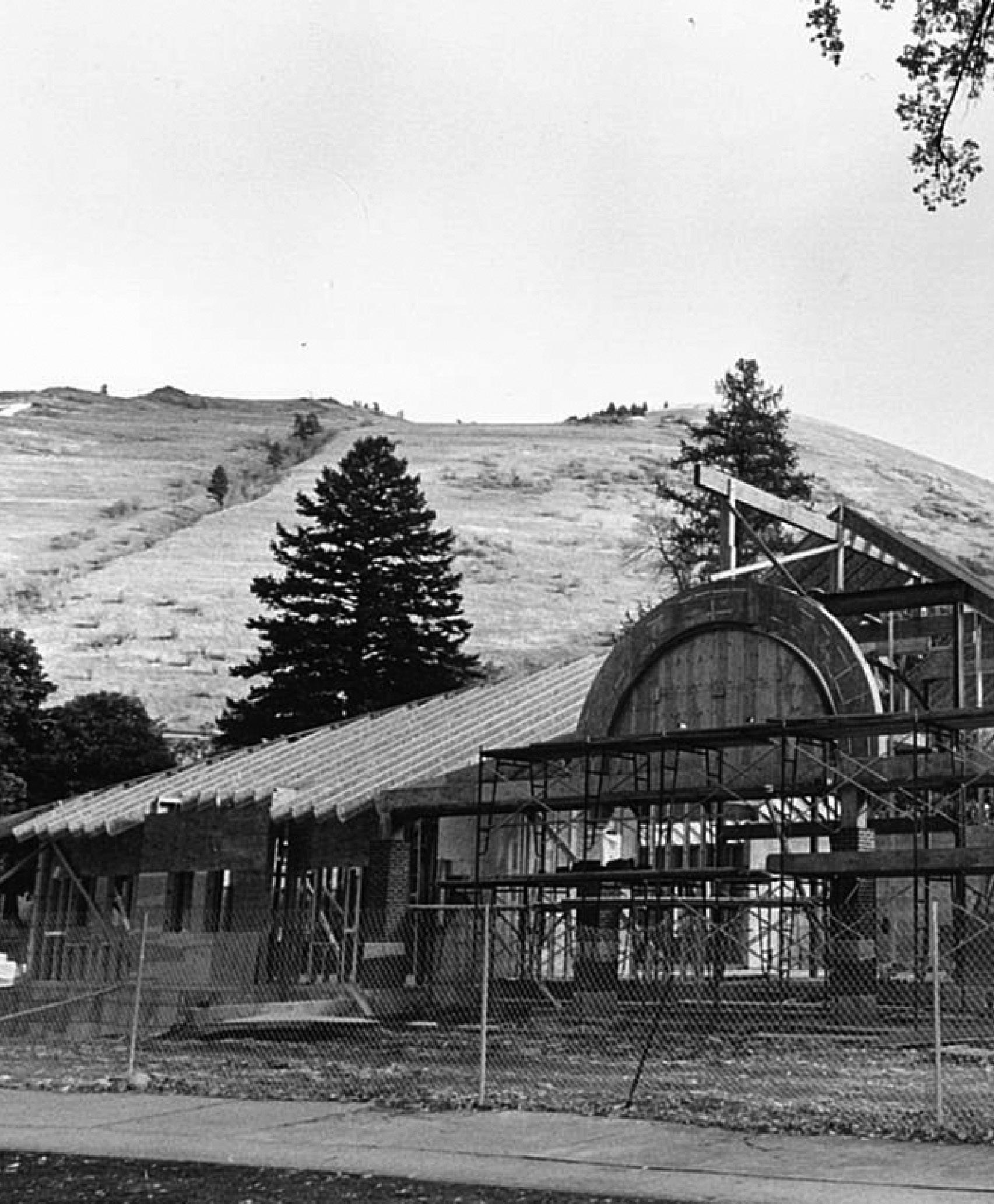
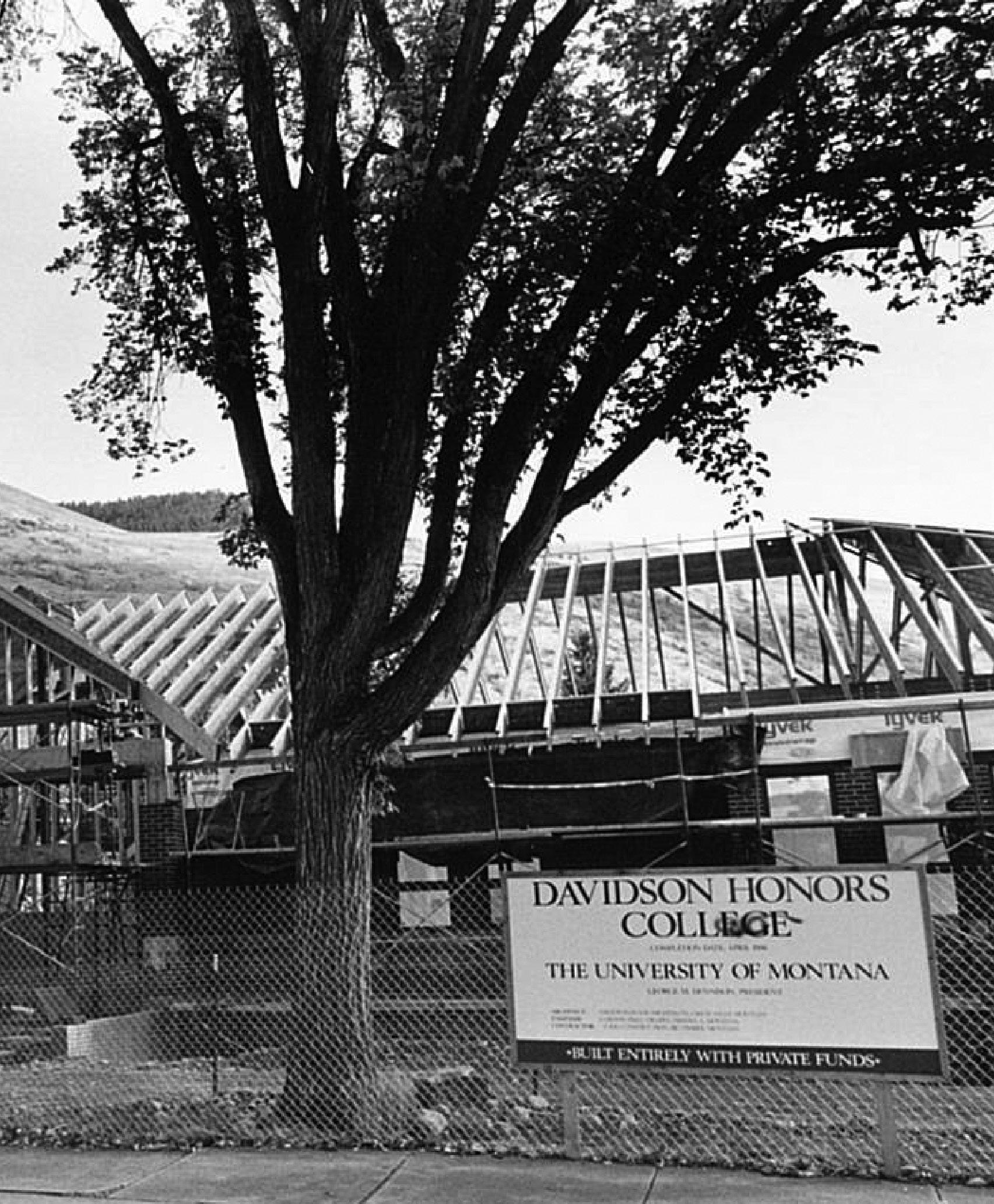
A VISION REALIZED: THE DAVIDSON HONORS COLLEGE
The ceremonial groundbreaking for the first new building of UM’s second century took place on October 29, 1993.
The Davidson Honors College, a 10,000-squarefoot facility on the south side of the Oval, would provide a long-awaited permanent academic and social home for the University’s honors student community.
Prior to the new building’s construction, UM’s Honors College was housed on the third floor of Main Hall. However, by the early ’90s, its ranks had swelled well beyond that location’s capacity, growing from just 50 students in 1980 to more than 350 by 1993.
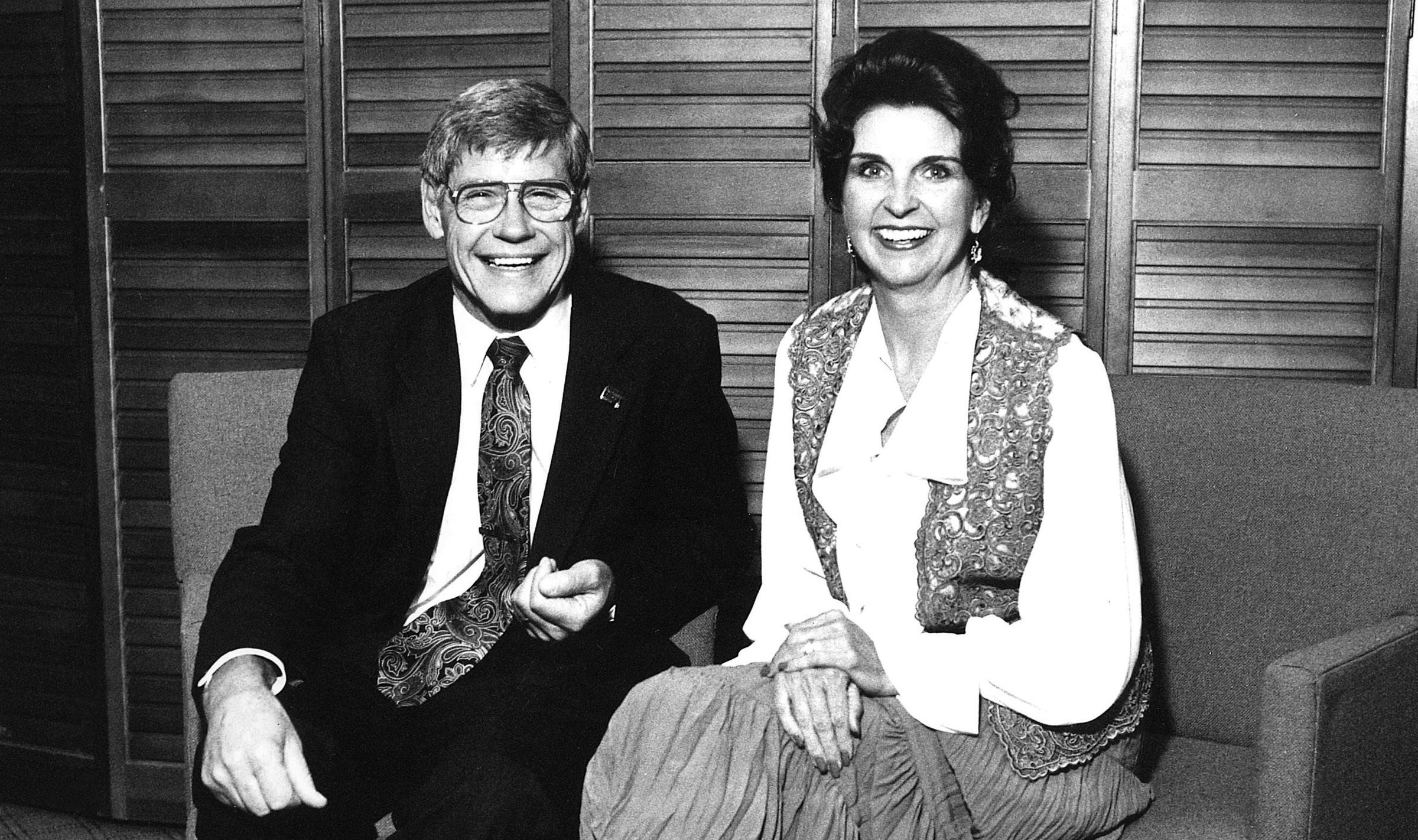
That’s when alumni Ian and Nancy Davidson stepped in.
Graduates and lifelong champions of UM, the Davidsons believed deeply in the University’s educational vision. Their $1.1 million gift helped make the new building a reality, reaffirming and expanding UM’s commitment to offering enhanced academic opportunities and support.
“Our young people are Montana’s most valuable resource. The Honors College will nurture and serve the brightest and most able of Montana’s college students.”
— Nancy Davidson
In a news release at the time, UM President George Dennison called the new Honors College, “the intellectual heart of the University.”
“Our young people are Montana’s most valuable resource,” said Nancy Davidson, also in a release. “The Honors College will nurture and serve the brightest and most able of Montana’s college students.”
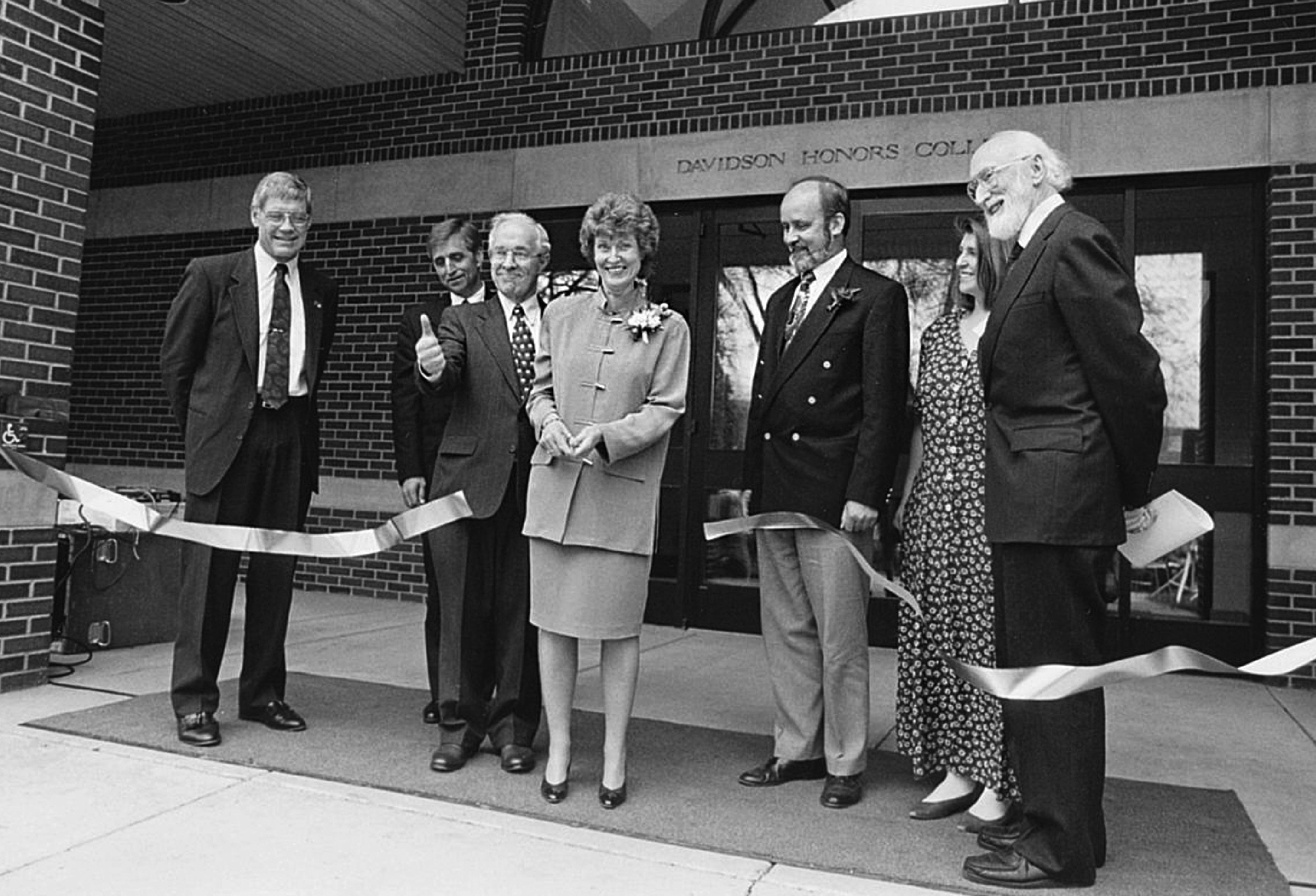
Completed in May 1996, the Davidson Honors College building provided much-needed space, accessibility upgrades and student-focused features like study rooms, a computer lab and a lounge. More than a building, it gave the Honors College a permanent identity and a dedicated space where honors students could thrive.
Today, the DHC continues to attract exceptional students from Montana and beyond, offering
Above: Completed in May 1996, the Davidson Honors College provides an academic and social home for the University’s honors student community. Alumni Ian and Nancy Davidson (center) donated $1.1 million to make the new building a reality.
a dynamic community where academic rigor, mentorship and opportunity prepare students for leadership and lifelong learning. Thanks to generous donor support, many DHC students receive privately funded scholarships, including the Presidential Leadership Scholarship (PLS), the most prestigious award for incoming students. In the 2025-26 academic year, 24 high-achieving students were selected for a PLS in recognition of their academic excellence and service to the community.
Kolter Stevenson, a Presidential Leadership Scholar from Amsterdam, Montana, recently became the 29th UM student to be awarded the Rhodes Scholarship, one of the oldest and most renowned academic fellowships in the world. Other recent prestigious awards earned by DHC students include the Udall Undergraduate Scholarship, the Barry Goldwater Scholarship and the Fulbright Scholarship.
Below: Kolter Stevenson, Presidential Leadership Scholar and Rhodes Scholar.
ENSURING EXCELLENCE:
UM’S SECOND COMPREHENSIVE GIVING CAMPAIGN BREAKS RECORDS
On the same fall morning in 1993 that the first shovelfuls of dirt were turned for the new Honors College, the UM Foundation also announced the launch of its biggest fundraising campaign to date.
The “Ensuring a Tradition of Excellence” campaign sought to inspire $40 million in giving over the next four years to support a diverse set of crucial needs at the University, including endowed funds for faculty positions; expansion of scholarship support that would directly touch thousands of students; research opportunities; academic program enhancements; and building construction, renovation and equipment.
Donors embarked on the initiative just seven years after the successful completion of the Foundation’s first major campaign, which raised $7.8 million from 1984-86.
The new campaign would be even bigger, more comprehensive and more ambitious.
Like the ’80s campaign, it would be led by passionate, driven volunteers. Campaign Chair Phyllis J. Washington, a 1964 graduate of the University, captured the spirit of “Ensuring a Tradition of Excellence,” saying in a news release, “The quality of instruction I experienced at UM must be preserved and enhanced for students in the next 100 years and beyond.”
At the time of the public announcement of the campaign in fall 1993, donors had already contributed approximately $20 million toward the goal.
The campaign exceeded its original $40 million goal, a year before its targeted completion date.
As the campaign closed the following October, the estate of Billings philanthropist Marty F. Arkwright contributed a $7.5 million gift to promote conservation and preservation of Montana’s wilderness and natural heritage.
This gift and many others helped push the campaign to a total tally of $71.4 million in giving, surpassing its original goal by more than $30 million.
UM President George Dennison and Phyllis J. Washington, “Ensuring a Tradition of Excellence” Campaign Chair.
A NEW ERA FOR BUSINESS AND HEALTH SCIENCES
William and Rosemary Gallagher Building
By the 1990s, the School of Business Administration (now called the College of Business) had long since outgrown its home at the center of campus northeast of Main Hall, where it had resided since 1950.
In 1990, University alum William Gallagher donated $1 million in seed money toward construction of a new building.
Gallagher’s donation galvanized public and private support for a project that topped the Montana Board of Regents’ long-range building program. After the Montana State Legislature approved partial funding in 1993, donors prioritized fulfilling the amount needed to complete the building, as well as purchasing new furnishings and equipment.
The result was the William and Rosemary Gallagher Building, completed in 1996. The modern facility centralized all School of Business Administration functions into one location and established a legacy of alumnidriven progress at the school.
Today, private support of the College of Business continues to reimagine and modernize the space, including features like the fully donor-funded Larry and DeeDee Gianchetta Student Success Center, which opened in 2016.
In the spring of 2025, donors also contributed to the opening of The DEN (Discover, Engage and Network), a 4,000-square-foot space that provides the next generation of student leaders with a community-focused environment to connect, collaborate and prepare for their professional lives. The DEN includes individual and group workstations, updated study rooms and space to support hybrid work such as remote interviewing and networking.
EVOLUTION OF THE EXCELLENCE FUND
Since 1978, the Excellence Fund, administered by the UM Foundation, has provided vital support to UM, allowing University leadership to fund urgent needs and strategic priorities. In 1998, the Foundation celebrated the 20th anniversary of the Excellence Fund, inspiring donors to support student scholarships, undergraduate research, student participation in conferences, faculty and staff professional development, and other investments that translate the University’s mission into action.
Throughout the decades since the fund was established, UM presidents have identified the Excellence Fund as a crucial, flexible resource that allows them to maintain the high standards of excellence and access across campus.
Through ongoing gifts to the Excellence Fund, donors make an immediate impact on many areas by helping UM leadership expand opportunities for students to thrive in their academic journeys and to innovate for dynamic programs when it matters most.
PRESCOTT HOUSE
Originally built in 1898 by Missoula merchant Clarence Prescott Sr., the Prescott House at the base of Mt. Sentinel was purchased by the University in 1955. In the 1990s, Dennis and Phyllis J. Washington funded comprehensive restoration work, which provided important upgrades to the building while preserving the historical appearance and features. The newly restored Prescott House was dedicated in 1996 and is listed on the National Register of Historic Places. Today, the UM President welcomes donors, alumni, community members and other distinguished guests to the Prescott House for special events.
“Our past is an anchor that is important in all our lives,” said Phyllis J. Washington. “We believe the Prescott House and its grounds are one of those anchors.”
The adjacent Phyllis J. Washington Park was developed by Dennis Washington and dedicated to his wife in 1997 in recognition of her lifelong commitment to the University of Montana. Its amphitheater and beautiful grounds are used for music and theatrical performances as well as outdoor receptions.
Skaggs Building
Another major leap forward for UM’s facilities came in 1998, with a $10.4 million, 70,000-square-foot expansion of the Pharmacy and Psychology Building, thanks in part to a $5.7 million contribution from the ALSAM Foundation, established by L.S. “Sam” and Aline Skaggs.
The modernized building united the School of Pharmacy and Allied Health Sciences under one roof, offering updated labs, classrooms and a 250-seat lecture hall.
Today, the Skaggs Building houses the College of Health and continues to provide vital space for education, research, clinics, collaboration and community outreach — carrying on the school’s tradition of excellence in the health sciences.
The College of Health is home to research in public health, rehabilitation and health equity, including Montana’s rural and tribal communities, and offers hands-on learning through its on-campus clinics. Through robust student services, interdisciplinary training and a strong focus on workforce development, the college prepares students to meet the health care needs of both the state and region.
PARTNERS IN PROGRESS: CORPORATE AND FOUNDATION ENGAGEMENT GAINS GROUND
Throughout the 1980s and ’90s, gifts from corporations and foundations became more integral to the UM story.
By the mid-’90s, Foundation leadership recognized the need to deepen its relationships with regional and national foundations, corporations and philanthropic organizations that aligned with UM’s mission and goals. In February 1997, the Foundation hired its first Corporation and Foundation Relations (CFR) officer.
The 1990s were a decade defined not only by extraordinary success but also by a shared belief in the University’s ability to change the lives of students from around the globe.
From securing support for professorships and faculty research and funding capital projects to advancing student programs and community initiatives, the CFR department quickly became a vital conduit for advancing the University’s core purpose and priorities. Its creation reflected UM’s ever-increasing reach — as well as the University’s evolving ability to connect with mission-driven partners ready to make meaningful contributions to education, research and the public good.
Today, the CFR department continues this legacy, engaging entities to meet their philanthropic goals while supporting the University’s mission. In 2025, private grantmakers contributed more than $15 million directly to UM in support of the Family Medicine Residency of Western Montana and other research and scholarship initiatives.
A PIVOTAL TIME AT UM
The 1990s were a decade defined not only by extraordinary success but also by a shared belief in the University’s ability to change the lives of students from around the globe. Private giving was solidified as a foundational element of providing opportunities and advancement to an expanding and diversifying campus community.
The remarkable generosity and vision of donors from this era fueled unprecedented growth — and the results continue to resonate today.
Improvements made during the decade further built on the University’s hundred-year-long tradition of innovation, accessibility and opportunity, truly setting the tone for the institution’s next century.
The Skaggs Building provides vital space for education, research, clinics, collaboration and community outreach.
INVESTING IN THE UNIVERSITY OF MONTANA
THE ENDOWMENT
The endowment plays a crucial role in providing the University of Montana with long-term financial support. The UM Foundation Board of Trustees is responsible for the investment of the endowment. These financial resources not only address immediate needs but also ensure the University’s growth and success for generations to come. We are profoundly grateful to the donors whose vision and generosity help sustain UM’s mission, benefiting countless students, faculty and staff well into the future.
Established in 1953, the endowment had an early focus on student scholarships. The Worthy Scholars Program, established in the 1950s and financed in part through an anonymous endowed gift, led the way. Over the coming decades, donors continued to generously give, growing endowed support of undergraduate scholarships and graduate fellowships.
The UM Foundation’s endowment continues to grow over time through new gifts from donors and investment market returns.
One of the earliest academic program endowed funds was established by the estate of Alice Freisheimer in 1957 to support research in chemistry and pharmacy. The endowed fund was funded by the sale of Freisheimer’s estate holdings including a lease to the Missoula Mercantile Company in a building constructed by her father, George Freisheimer, owner and proprietor of Garden City Drug between 1898-1902.
$289.6M 2024
This illustration represents the UM Foundation endowment growth from calendar year 1953 through 2024.
$791
1953
The first named faculty endowed fund, the A.B. Hammond Professorship in Western History, was established in 1968 by the estate of Edwina H. King in memory of her father. Additional faculty endowed funds were established in the 1980s and 1990s including the Karashima Endowed Professorship in Japanese Language and Culture, the Bierman Professorship of Ecology and the John Ellis Visiting Professorship. Faculty and staff endowed funds today support a range of critical needs from fully funded positions to supplementary resources for recruitment, compensation, professional development and research and creative scholarship.
Over the past 30 years, UM Foundation donors have contributed $234 million in endowed gifts, with more than $134 million distributed to support University and student needs as designated by the donors.
Donors direct endowed gifts to the area of campus they wish to benefit in perpetuity. The chart below shows an overview of how the endowment is allocated by purpose.
Scholarships, Graduate Fellowships and Other Student Support
Academic and University Support
Faculty and Staff Support
Other
2000s Unparalleled Investment, Unwavering
Generosity
DURING THE 2000s, THE UNIVERSITY’S GIVING COMMUNITY REMAINED UNITED THROUGH UNCERTAIN TIMES
SELECT PHOTOS PROVIDED BY ARCHIVES AND SPECIAL COLLECTIONS, MANSFIELD LIBRARY, UNIVERSITY OF MONTANA
As the calendar turned from the 1990s to the new millennium, the world unexpectedly found itself thrust into significant turmoil.
The 2000 stock market crash — brought on when the “dotcom bubble” burst — and the attacks of September 11, 2001, signaled the dawn of a new global landscape: one fraught with uncertainty for Americans and people worldwide. By 2008, the housing crisis had triggered the deepest economic recession since the Great Depression in the United States.
Simultaneously, innovations in technology were rapidly reshaping society and how people communicated. Flip phones became smartphones, while websites and social media began to replace traditional sources of news and information.
Confronted by the challenges of the new century, the UM Foundation and its donors responded with unwavering enthusiasm. The University’s growing community of supporters, alumni and friends seized the opportunity to help develop new pathways to prepare students for an emerging globalized economy and a working world defined by the digital revolution.
UM leadership continued to educate prospective students about the value of investing in their futures and, through purposeful contributions to the Foundation, donors united to provide students with the resources and tools needed to reach their full potential.
This included another record-breaking campaign, which set even higher standards
“It gives you goose bumps when you realize how passionate people are about wanting to do something that leaves a legacy of excellence.”
— Deborah Doyle McWhinney, “Invest in Discovery” Campaign Chair
Donors attend the “Invest in Discovery” campaign kickoff event.
of support for scholarships, faculty positions, academic programs and campus facilities.
The vision and generosity of dedicated individuals, families, foundations and corporations during this time not only preserved the University’s momentum but also broadened its reach across the state and beyond.
‘INVEST
IN DISCOVERY’: UM’S FIRST $100 MILLION CAMPAIGN
In 2002, the Foundation launched the quiet phase of “Invest in Discovery — Connecting People, Programs and Place,” a comprehensive, five-year, $100 million-goal campaign that would impact nearly every aspect of life at the University.
It was the Foundation’s third such campaign in as many decades, following two earlier efforts that each redefined expectations for what philanthropy could achieve — raising $7.8 million (from 1984 to 1986) and $71.4 million (from 1992 to 1997), respectively.
“Invest in Discovery” would be the biggest campaign yet.
Like its predecessors, the campaign would unite donors to deliver lasting assistance across a diverse range of needs. Fueled by energetic volunteers and deep personal commitment from the Foundation’s Board of Trustees, the campaign not only galvanized donor
enthusiasm, but sparked widespread community engagement around UM’s mission.
By the time of its public announcement in October 2005 — during an event at the University Center featuring renowned author and UM alum James Grady, Governor Brian Schweitzer, Campaign Chair Deborah Doyle McWhinney and University President George Dennison — “Invest in Discovery” had already inspired $72 million in giving.
The campaign invited donors to “look beyond the horizon,” pledging vital funds to keep UM students and faculty at the forefront of innovation and to prepare future professionals to launch meaningful careers and become leaders in their communities.
During its five-year run, “Invest in Discovery” inspired an unprecedented wave of private investment from every region of the country, including 16 gifts of $1 million or more. Contributions came in from all 50 states and nine of 10 Canadian provinces. Nearly 30,000 total donors contributed, including more than 17,000 alumni and almost 13,000 who were giving to UM for the first time.
When the campaign wrapped at the end of 2007, it had raised $131 million — eclipsing its original goal by $31 million.
“It gives you goose bumps when you realize how passionate people are about wanting to do something that leaves a legacy of excellence,” McWhinney said in a news release.
The “Invest in Discovery” campaign became a defining moment for private giving at UM during the 2000s. Its many successes would resonate throughout the decade.
EXTENDING A HAND: RECORD SUPPORT FOR THE NEXT GENERATION
The total of $131 million inspired by “Invest in Discovery” included $57 million to uplift academic programs and $26 million dedicated to student support.
The impact was sweeping: creating or enhancing 486 undergraduate scholarships as well as 79 graduate fellowships.
This landmark success was another powerful step in the long tradition of donors rallying to make student support a central focus of their giving. Their generosity expanded access to higher education for both undergraduate and graduate students, while also providing resources that helped sustain the University’s standing as a premier institution headed into the 21st century.
The impact of this assistance was reflected not only in record-breaking fundraising totals, but in the personal stories of students whose lives were transformed as a result.
“I am the first person in my immediate family to attain a college education,” said Emily Joy, then a senior from Whitefish studying liberal arts and Spanish, in a testimonial featured on the “Invest in Discovery” website. “I have worked full time while attending school and value the scholarship I received as an indispensable resource that allows me to balance my time between work and school. Without it, I would not be able to achieve my highest goal.”
Another $11 million provided direct faculty and staff support. Along with general faculty assistance, several professorships and faculty positions were established during the “Invest in Discovery” campaign, including:
• The John J. Craighead Endowed Chair is named for renowned scientist John Craighead, who led UM’s Cooperative Wildlife Research Unit during a 25-year career at the University. The endowed chair enables world-class experts to teach and conduct research in UM’s highly regarded wildlife biology program.
• The T. Anthony Pollner Distinguished Professorship in Journalism — named for a ‘99 journalism alumnus and former Kaimin student employee — brings renowned professional journalists with diverse backgrounds to campus to mentor and share their experiences with student journalists.
• The William Kittredge Visiting Writer, named for Montana literary legend William Kittredge, invites visiting writers from around the nation to teach environmental and nature writing to graduate students.
BUILDING A BETTER FUTURE AT UM
Don Anderson Hall
In a report to the Foundation’s Board of Trustees in March 2001, School of Journalism Dean Jerry Brown touted the program as among the nation’s best, regularly ranked alongside schools with larger enrollments and more robust funding.
UM’s journalism school was especially well known for its practical training for future professionals — and UM’s student newspaper, the Montana Kaimin, was consistently ranked as one of the Top 20 college papers in the country.
But the journalism school’s longtime home — 1930s-era Stone Hall — was overcrowded and ill-equipped to meet the technological needs of the ongoing digital media revolution. If the program was to keep up its reputation for excellence, a new building would be necessary, Brown said.
An updated journalism building became a top priority of “Invest in Discovery,” and donors stepped in to contribute 75% of its $14 million cost.
Don Anderson Hall, a five-story, 57,238-squarefoot building named for the media executive who organized Lee Enterprises’ purchase of several Montana newspapers from the Anaconda Copper Mining Company in the late 1950s, opened in May 2007.
Major donors included Anderson’s daughter Sue Anderson Talbot and son-in-law John Talbot (a former Missoulian publisher), who were also recognized for their volunteer organizational efforts. Former Lee Enterprises President Lloyd Schermer and his wife Betty gave the
Montana literary legend William Kittredge.
largest personal contribution to the building. The family of T. Anthony Pollner made a gift for a suite of offices for the Kaimin in his memory.
The new building united the journalism school’s print, photo and broadcast programs under one roof. It also introduced major technological upgrades to give students cutting-edge training in modern news gathering.
Don Anderson Hall was just one of several crucial facilities upgrades funded by $37 million raised for facilities projects during the “Invest in Discovery” campaign.
Phyllis J. Washington Education Center
The largest single gift ever given to UM at the time resulted in a new building that is the
Don Anderson Hall, home to the School of Journalism.
“inspirational heart for education in Montana.” That was according to Roberta Evans, dean of the Phyllis J. Washington College of Education. The Phyllis J. Washington Education Center opened its doors in September 2009. The $15.1 million project was 90% funded by private donors and brought the latest educational tools, high-tech classrooms and other amenities to the next generation of Montana educators.
The Center also provided a new home for the Learning and Belonging School, which has served Missoula-area children and UM students for more than 60 years, providing quality services for children and pre-service clinical experiences for future teachers. Evans saw veteran alumni educators tour the new building and come away misty-eyed. “They never thought they would see the day their alma mater was elevated to this stature,” she said. “It has generated a strong sense of professional identity for teachers across Montana.”
Other New and Renovated Facilities
Other new or renovated facilities that benefitted from private philanthropy during the decade included: The Law Building, a biomedical research facility and science learning complex addition to the Skaggs Building and the Grizzly Athletics’ Hall of Champions.
Thanks to a generous gift from the Terry and Patt Payne family, construction began on the 30,000-square-foot Payne Family Native American Center — the first-of-its-kind facility representing the 12 Native American tribes in Montana — which opened at the start of the next decade.
A DECADE DEFINED BY STEADFAST COMMITMENT
Despite the turbulence of the 2000s, UM’s philanthropic community stood strong, bonded by a shared commitment to building a brighter future for Montana and beyond.
As McWhinney put it: “Hand in hand we continue to nurture and maintain the University of Montana as a place of learning. A place of discovery. A place of influence, nationally and globally.”
GRADUATE FELLOWSHIPS –DISCOVERY NEVER ENDS
Donors rallied to support students during the “Invest in Discovery” campaign, providing gifts to establish or enhance more than 75 graduate fellowships. Many of these fellowships continue to support UM graduate students today.
Graduate students are the lifeblood of a research university like UM, playing critical roles in research, creative scholarship, teaching and outreach. They often supervise, instruct and mentor undergraduates while pursuing their own education. At UM, graduate students contribute to vital initiatives that seek solutions to many of the world’s challenges. They advance scientific research and discovery and develop advanced skills to lead innovation and solve complex societal and economic problems, while working directly with external collaborators such as federal and state agencies and industry.
Donor-funded fellowships provide the necessary financial support for graduate students to pursue advanced degrees, and allow the University to recruit the most talented students.
With the goal of increasing the number of UM graduate students and recruiting the most talented, accomplished scholars into UM graduate programs, donor support of fellowships has continued to make an impact over the decades.
They offer an important pathway for highachieving students who aim to build their knowledge, experience and networks in cooperation with UM’s distinguished faculty, and help UM attract and retain top-tier students from diverse backgrounds, enriching the academic environment and strengthening the institution’s reputation.
By investing in graduate education, donors are supporting individual scholars and fueling discoveries, leadership and solutions that benefit Montana and the world.
2010s
Griz Pride, Grit and Generosity
DURING THE 2010s, DONORS EMPOWERED STUDENTS AND FACULTY, WHILE FOSTERING A NEW ERA OF OPPORTUNITY
For Terry and Patt Payne, supporting a hub for Indigenous education, community and culture at the University of Montana was about more than driving progress through philanthropy.
It was a way to honor family connections, old and new.
Patt Payne’s grandmother had played on the Fort Shaw, Montana, Indian Boarding School girls’ basketball team, crowned world champions at the 1904 St. Louis World’s Fair. Over a century later, Terry and Patt’s son and daughter-in-law remained active with Native culture and traditions.
Most importantly, however, Terry Payne said the family was inspired to help realize a project that would attract international acclaim to UM’s Native American programs and services, encouraging more Indigenous students to attend and graduate from the University.
The Paynes lent significant support to what became the Payne Family Native American Center during the UM Foundation’s “Invest in Discovery” campaign during the 2000s. When the building opened in 2010 — on the site of a historic Salish Indian encampment at the eastern edge of the Oval — it marked the beginning of a pivotal decade for UM.
As communities nationwide recovered from the Great Recession, universities increasingly emphasized economic mobility and service to groups who faced barriers to higher education. Just as they had done for the previous 60-plus years, donors greeted the demands of these new times with passion, helping the University reaffirm and expand its role as a center for civic engagement, inquiry and leadership.
Today, the Payne Family Native American Center is the heart of Indigenous learning and community at UM. It houses the Native American Studies program and the Elouise Cobell Land and Culture Institute, supporting education on land use, culture and storytelling.
“More donors than ever before have invested in students and their success in life. Big or small, every dollar matters here.”
— Mark Burnham, “Campaign Montana” Co-Chair
The building features technology-equipped classrooms, study areas, meeting rooms and the Bonnie Heavy Runner Gathering Space. Its design includes a 12-sided rotunda, symbolizing Montana’s 12 federally recognized tribes, and a Star-Gazing Room that blends astronomy with Native sky lore through public shows and storytelling.
“We feel proud and blessed that our family was able to participate,” Terry Payne said, in the 2009 UM President’s Report. “And we weren’t alone. Many people stepped up in a big way.”
The first facility of its kind in the nation, the Center reflects the student-first, future-focused values that defined donor giving in the 2010s. Its opening reinforced UM’s commitment to world-class education for all and signaled that the University’s supporters remained rooted in honoring Montana heritage while expanding access and deepening community engagement.
This spirit, enduring generosity and leadership of UM alumni, friends, families, organizations and foundations laid the groundwork for what would come next:
The most ambitious and successful fundraising campaign in Montana history.
‘GRIZ GRIT’ IN ACTION FOR ‘CAMPAIGN MONTANA’
When describing the values of “Campaign Montana,” in the Winter 2019 issue of the Montanan Magazine, campaign co-chair Mark Burnham chose five simple words:
“Griz pride, grit and generosity.”
Launched with a quiet phase in July 2013, “Campaign Montana — Think Big. Be Bold.” once again set out to reimagine the scope of what private giving could accomplish at the University. It was a truly unprecedented effort, as each college and school, as well as programs including Grizzly Athletics, the Flathead Lake Biological Station and the Montana Museum of Art and Culture established fundraising objectives for the campaign.
With Betsy Ross Wilcox and A. Warren Wilcox serving as co-chairs during its quiet phase, “Campaign Montana” initially set out with a goal of inspiring $320 million in giving. Just as they had during comprehensive campaigns in each of the previous three decades, UM’s dedicated donors shattered expectations, surpassing goal after goal during its seven-year run.
When its public phase launched in October 2018, with Mark and Cheryl Burnham as co-chairs, the goal had already increased to $400 million. Two years later, as the campaign entered its final push, that goal rose again to $440 million.
By its conclusion in September 2020, “Campaign Montana” surpassed even that mark, raising nearly $451 million from over 34,000 donors (including more than 16,000 first-time contributors) from all 50 states.
The results were staggering, elevating every UM student, college, school and several signature UM programs, including:
• More than $126 million donated for student scholarships and other support
• More than 500 new undergraduate scholarships and graduate fellowships established
• Nearly $91 million donated for academic programs, research and innovation
• More than $50 million donated to support new or renovated facilities
• More than $45 million donated to support faculty and staff, including 16 new endowed faculty positions
• More than $110 million committed through planned gifts to provide critical support to UM in the future
The support delivered by “Campaign Montana” was essential to UM’s mission. Donor giving translated into unmatched investment in scholarships, faculty support, dynamic learning environments and academic excellence. It expanded access to higher education, enhanced career preparation and touched the lives of thousands of students for years to come.
“Campaign Montana” was a historic effort — an anchor for a decade during which UM saw unprecedented waves of giving.
COMPREHENSIVE, CAMPUSWIDE SUPPORT
In October 2016, as part of “Campaign Montana,” the UM Foundation announced the single largest gift in the 123-year history of the University.
William A. and Carolyn Franke and their family had stepped forward to provide $24 million to benefit UM’s nationally renowned College of Forestry and Conservation and the University’s Global Leadership Initiative (GLI).
Their record-breaking gift uplifted several of the campaign’s top priority areas of giving, providing $18 million for faculty, student and programmatic support to the College of Forestry and Conservation, with a focus on research and experiential learning.
The Frankes’ generosity created two endowed faculty positions at the College of Forestry and Conservation (the W.A. Franke Endowed Faculty Chair in Forest Conservation and W.A. Franke Endowed Faculty Chair in Watershed Hydrology), as well as a sustainability fellows program, and provided funds for undergraduate scholarships, graduate fellowships, internships and innovation, study abroad and service-learning projects.
An additional $6 million was directed to the GLI, which offers students unique co-curricular,
experience-based educational opportunities and professional training that positions them to serve as leaders, driving solutions for some of society’s greatest challenges.
In recognition of the gift, the College of Forestry and Conservation was renamed for William A. Franke. The Global Leadership Initiative was renamed for the Franke family.
In 2020, the Franke family funded an additional faculty endowed fund, the Professor of Forestry and Conservation, in the Franke College.
The Franke family’s landmark investment exemplified the comprehensive reach of “Campaign Montana” — bolstering faculty excellence, innovative programming and the area perhaps most deeply impacted during the campaign: a commitment to students themselves.
REVOLUTIONIZING STUDENT SUCCESS
At the heart of “Campaign Montana” was its focus on student support.
During the campaign, donors contributed over $97 million to scholarships — more than any other giving priority — providing essential financial support and access to thousands of students.
Scholarship gifts came in all sizes, including record-setting major contributions that made truly life-changing impacts.
In 2014, Tom Cotter, a UM alum and Townsend, Montana native, pledged an $11 million estate gift — the largest scholarship commitment in UM history. Today, his endowed fund annually generates key scholarship aid for students with financial need.
In 2016, William A. and Carolyn Franke (second and third from left) and their family made the single largest gift in the 123-year history of the University.
Acclaimed journalist Dorothy Rochon Powers (right) filing a story in October 1954.
In 2016, a $1.7 million estate gift from Dorothy Rochon Powers — the first female chair of the UM Foundation Board — created the Elwood and Dorothy Rochon Powers Scholarship for Montana high school students.
That spirit of generosity also appeared in unexpected ways. In 2014, a donor who wished to remain anonymous sent an unannounced $5 million check by U.S. mail to fund student scholarships.
But the effort went far beyond providing scholarships.
It also helped strengthen access to resources and programs that ensured students could thrive and persist to graduation. This included faculty mentorship, experiential learning, academic advising and career services to help students build skills, connect to their values and interests, and prepare for impactful careers and lives of purpose.
Donors supported services that aided UM’s holistic approach to empowering students, allowing them to develop the professional acumen and critical thinking skills needed to navigate an increasingly dynamic and complex world, while being immersed in a vibrant campus community that emphasized overall wellness, work, study, engagement and recreation.
Gifts made during “Campaign Montana” also helped establish the Larry and Dee Dee Gianchetta Student Success Center at the College of Business, which became a campuswide model for student support. In the College of Humanities and Social Sciences, a leadership gift from Joe Whittinghill and Blake Takamura established a Career Planning Center to help students build lives and careers of impact.
Donors also backed the W.A. Franke College of Forestry and Conservation’s Native American Natural Resource Program, which provides services and resources to help Native students have a successful academic experience.
FRANKE GLOBAL LEADERSHIP INITIATIVE
During his May 2011 inauguration, former UM President Royce Engstrom unveiled the UM Global Leadership Initiative (GLI), a program he said had the potential to create “an exhilarating campus atmosphere” while upholding the values of leadership engagement, diversity and sustainability.
In fall 2011, UM faculty selected an initial cohort of 200 freshmen as Global Leadership Fellows and the initiative became an emerging fundraising priority.
In 2016, as part of the largest single gift in UM’s history, William A. and Carolyn Franke and their family identified the GLI as a key investment in a transformative co-curricular learning experience that positioned UM students to serve as leaders, driving solutions for complex global challenges. The Franke Global Leadership Initiative, named to honor the family, received $6 million to support a fellowship fund and program fund.
“As we became familiar with the educational opportunities, research and special programs at the University of Montana, it was clear to us that the University is a hidden gem,” Bill Franke said. “We are believers that the GLI will train students to look beyond their own experiences and home geography to recognize that we live in a global economy.”
Today, the Franke GLI offers unique experiencebased educational opportunities and professional training infused with international and interdisciplinary emphasis. The structured curriculum and varied experiences through seminars, courses, study abroad programs and beyond-the-classroom and service-learning activities help students become engaged, articulate global citizens.
Each year, a cohort of approximately 150 students is admitted to the program to earn a four-year, 12-credit certificate in global leadership, complementing any bachelor’s degree on campus.
EMPOWERING ACADEMICS AND COMMUNITY OUTREACH
Generous donor contributions also expanded opportunities vital to the student experience, empowered groundbreaking, faculty-led research, fieldwork and innovation and reinforced the University’s commitment to enriching and serving communities.
The $45 million raised to support faculty and staff during “Campaign Montana” included helping establish 16 new endowed faculty positions that continue to help UM recruit and retain top faculty.
Two UM families — the Burnhams and the Sprunks — came together in 2016 to help the College of Business create UM’s first endowed dean’s position; a donor’s gift established UM’s first chair in the humanities; and additional
gifts established or endowed named chairs, professorships and faculty fellowships in a number of disciplines. A 2014 commitment by Bruce and Suzanne Crocker established a named directorship for the Montana Museum of Art and Culture.
“Campaign Montana” additionally infused necessary support into the University’s academic programs.
In 2015, Alexander and Andrea Blewett made a transformative $10 million gift to the School of Law, supporting law school students, faculty, programs and operations.
Support for health-focused programs extended the reach of UM’s Neural Injury Center in serving veterans and allowed the University to broaden neuroscience education across disciplines. Gifts also advanced the College of
In 2016, the Mark and Cheryl Burnham (left) and Eric and Blair Sprunk (right) families came together to establish UM’s first endowed dean’s position in the College of Business.
Health’s mission to train practitioners for rural Montana communities.
Donors recognized the power of the University to reach beyond the boundaries of campus, to serve the state in meaningful ways and improve the lives of its citizens.
At the Flathead Lake Biological Station, donor funding launched interdisciplinary internships, engaged K–12 students in hands-on science, and enhanced water quality monitoring and early detection of aquatic invasive species.
A gift from the Dennis and Phyllis Washington Foundation to the Montana Digital Academy launched EdReady Montana, an online program that continues to deliver improved college readiness for thousands of students statewide at no cost to the individual learner. The Dennis and Phyllis Washington Foundation provides support for the program to this day.
A gift of nearly $2 million from the estate of Richard Lee Merritt established an endowed fund for the Archives and Special Collections at the Maureen and Mike Mansfield Library, the largest ever to the library.
FORWARD-FOCUSED FACILITIES UPGRADES
“Campaign Montana” enabled the University to renovate and construct spaces that elevated learning across campus. These
Giving from Dennis and Gretchen Eck helped renovate the 1950s-era Liberal Arts Building, now renamed the Dennis and Gretchen Eck Liberal Arts Building.
investments created, updated or expanded modern, student-focused spaces that foster academic excellence, research and community engagement.
The Dennis and Phyllis Washington Foundation and the Alice Lee Lund Charitable Trust made $10 million and $5 million gifts, respectively, joining other donors to expand space for early childhood education, counseling and the Montana Digital Academy — as well as the addition of the state-of-the-art, 500-seat Ali Lund Instructional (ALI) Auditorium — in the Phyllis J. Washington College of Education.
In Grizzly Athletics, a $7 million contribution from the Dennis and Phyllis Washington Foundation on behalf of Kevin and Kyle Washington supported the creation of the Washington-Grizzly Champions Center — a premier training and locker room facility. In 2015, the Eric and Blair Sprunk Student-Athlete Academic Center opened, offering support to the school’s 300-plus student-athletes.
In 2016, the Harold and Priscilla Gilkey Building, funded through gifts from Harold and Priscilla Gilkey and more than 125 other donors, opened. Today, it provides a vibrant Welcome Center for prospective students and their families.
Giving from Dennis and Gretchen Eck helped renovate UM’s 1950s-era Liberal Arts Building, adding new infrastructure, technology and furnishings. In recognition of their nearly $11 million in support for upgrades to the most frequented building on UM’s flagship campus, the building was renamed the Dennis and Gretchen Eck Liberal Arts Building in 2022.
A DECADE OF TOGETHERNESS
During the 2010s, the generosity of thousands of donors enabled UM to deepen access, excellence, equity and service for students. From the landmark Payne Family Native American Center to the far-reaching outcomes of “Campaign Montana,” private support helped shape a more innovative and student-focused future for UM.
PHILANTHROPY AT WORK
Outstanding Learning Environments and Facilities
Since the University of Montana’s first buildings were constructed around the Oval in the 1890s, UM has become known for its iconic campus landmarks, inspirational learning environments on the Missoula and Mountain campuses, and dynamic research and field stations. Private support from generous donors has significantly shaped UM’s facilities and infrastructure. This map showcases the transformative impact donors have made — from supporting the construction of new facilities and renovation of existing buildings, to modernizing facilities with improvements in technology, safety and energy efficiency.
Facilities and learning environments that were constructed or expanded thanks to donor support.
Locations that have been renovated and modernized with donor support.
Donors have also supported facilities not listed here, including Bandy Ranch, Bitterroot College, Dornblaser Field, the Field Research Station at Fort Missoula, and Lubrecht Experimental Forest.
1. SKAGGS BUILDING
The Skaggs Building, named after L.S. and Aline Skaggs in honor of their support to renovate the building, opened in 1999. In 2007, the Skaggs and other donors provided funding for a 42,000 square foot expansion of the building.
2. DAVIDSON HONORS COLLEGE BUILDING
The Davidson Honors College Building, opened in 1996, is named in recognition of Ian ‘53 and Nancy ’59 Davidson’s generous support.
3. PAYNE FAMILY NATIVE AMERICAN CENTER
The Payne Family Native American Center, opened in 2010, was funded by donors, including the Terry ‘63 and Patt Payne family and the State of Montana, to embody UM’s strong commitment to the Indigenous peoples of our state and nation.
4. DENNIS AND GRETCHEN ECK LIBERAL ARTS BUILDING
Originally built in 1953, the Liberal Arts Building was renamed the Dennis and Gretchen Eck Liberal Arts Building in 2022 to recognize Dennis ‘67 and Gretchen Eck’s generous support to renovate and modernize the building.
5. DON ANDERSON HALL
Donors and alumni gave over $10 million to help construct Don Anderson Hall, which opened in 2007 as the home for the School of Journalism. The building is named for Montana native and newspaper mogul Don Anderson.
6. HAROLD AND PRISCILLA GILKEY BUILDING
The Harold and Priscilla Gilkey Building was constructed in 2016 and supported by Harold ‘62 and Priscilla ‘62 Gilkey along with more than 125 other donors.
7. WILLIAM AND ROSEMARY GALLAGHER BUILDING
The William and Rosemary Gallagher Building, opened in 1996, is named in honor of William Gallagher ‘25 and his wife Rosemary for their lead gift. The State of Montana and other donors also contributed to the project. 4 3 1 2 5 6
8. MUSIC BUILDING
Major renovations to the Music Building were completed in 2022 with leadership support from the McCammon, Nash and Talbot families. Efforts are underway to raise $7.25 million in matching contributions to unlock $7.25 million appropriated by the Montana State Legislature during the 2025 session for the final phase of renovations.
9. PHYLLIS J. WASHINGTON EDUCATION CENTER
The Phyllis J. Washington Education Center opened in 2009 thanks to gifts from the Dennis and Phyllis Washington Foundation and other donors. A decade later, the Dennis and Phyllis Washington Foundation, the Alice Lee Lund Charitable Trust, and other donors again provided critical support to expand facilities for the Phyllis J. Washington College of Education, and a new wing and auditorium were opened in 2019.
10. PERFORMING ARTS AND RADIO/TELEVISION CENTER
The PAR/TV building opened in 1983 after an ambitious fundraising effort chaired by UM alumnus and actor Carroll O’Connor ‘56 and his wife Nancy ‘51.
11. GRIZZLY INDOOR PRACTICE FACILITY
The Dennis and Phyllis Washington Foundation, on behalf of Kyle Washington ‘96 and Kevin Washington, along with over 170 generous donors, funded construction of the Grizzly Indoor Practice Facility which opened in 2024. It is a center of activity that serves Grizzly Athletics, UM intramural and club sports and community members.
12. MONTANA MUSEUM OF ART AND CULTURE
Opened in 2023, the Montana Museum of Art and Culture was funded by the Terry ‘63 and Patt Payne family along with other donors.
13. ERIC AND BLAIR SPRUNK STUDENT-ATHLETE ACADEMIC CENTER
The Student-Athlete Academic Center opened in 2015 with support from Eric ‘86 and Blair Sprunk and other donors. The Center offers academic support for all UM student-athletes.
14. WASHINGTON-GRIZZLY CHAMPIONS CENTER
Kyle Washington ‘96 and Kevin Washington supported the construction of the WashingtonGrizzly Champions Center, which opened in 2017, through a gift from the Dennis and Phyllis Washington Foundation.
15. WASHINGTON-GRIZZLY STADIUM
Washington-Grizzly Stadium was dedicated in 1986 to honor Dennis and Phyllis J. Washington and the Washington Corporation for their contributions toward construction of the facility. Community and alumni supporters pledged an additional $1 million to support the stadium.
NOT PICTURED
MISSOULA COLLEGE BUILDING
The Missoula College building, opened in 2017, was made possible through support from the State of Montana, along with many donors and local businesses.
THE CASTLES CONFERENCE CENTER
The Castles Conference Center at Lubrecht Experimental Forest, completed in 1982, was supported by a grant from the M.J. Murdock Charitable Trust and additional donors in honor of James B. Castles ’38.
FLATHEAD LAKE BIOLOGICAL STATION
Donors have supported a variety of infrastructure needs at the Flathead Lake Biological Station, including a research vessel and facility construction, maintenance and modernization.
GRIZZLY SOFTBALL FIELD/JACKSON CONTRACTOR GROUP INDOOR HITTING FACILITY
The Grizzly Softball Field opened in 2015 with support from donors.
2020s
Rooted in Tradition, Ready for Tomorrow
FROM 2020 TO 2025, DONORS HONORED THE SPIRIT OF UM’S PAST WHILE LOOKING AHEAD TO A BRIGHT FUTURE
When the COVID-19 pandemic arrived in America at the beginning of the 2020s, it brought challenging and unprecedented times for the entire nation — including higher education.
Confronted with tremendous challenges, the University of Montana community united to persevere, and private giving once again emerged as a vital stabilizing force.
Aligned with UM’s commitment to meet student needs through enhanced individual academic advising, wellness support, peer mentoring and a new comprehensive career readiness program, donors rallied to support the University’s continued delivery of a worldclass education to all.
In early 2020, under the umbrella of the record-breaking “Campaign Montana” fundraising initiative (2013-2020), the Foundation partnered with the UM Office for Student Success to establish the UM Emergency Student Support Fund. Nearly 700 donors contributed more than $108,000 to help students cover short-term costs related to technology, housing and medical bills, among other basic needs.
Driven by urgency and a shared sense of purpose, the early 2020s saw a rise in new, more participatory forms of philanthropy. Crowdfunding and digital giving opportunities gained momentum as communities sought ways to pool resources quickly and effectively.
A RESURGENCE OF COLLECTIVE GIVING
Since its earliest days in the 1950s, UM Foundation donors have remained grounded in volunteerism and grassroots action. Even as the size and scope of gifts and opportunities for impact have grown over the decades, the original collaborative spirit of the organization’s founding members has carried on.
Retooled for the 21st century, these collective efforts now use new technology and online
platforms to harness the generosity of UM’s expanding giving community.
The Big Give
In April 2020, the Foundation’s Annual Giving department launched The Big Give, a 24-hour online event held each spring to inspire alumni, donors, parents and friends to support UM students. Hundreds of donors — many giving for the first time — answer the call each year, raising hundreds of thousands of dollars for areas like scholarships, student success initiatives, Grizzly Athletics, academic programs and cultural resources such as the Montana Repertory Theatre.
In a testament to the unwavering spirit of generosity at UM, participants help to raise awareness and encourage others to give by serving as Big Give Advocates. Donors also double their impact through match and challenge opportunities.
“Each year, The Big Give is a powerful demonstration of the remarkable giving community that surrounds the University of Montana,” said UM Foundation President and CEO Cindy Williams in a 2025 news release. “This annual tradition directly supports students in so many meaningful ways and inspires us all to think big about UM’s bright future.”
In April 2020, the UM Foundation launched The Big Give, a 24-hour online event held each spring to inspire alumni, donors, parents and friends to support UM students.
Crowdfunding
In recent years, the Foundation’s annual fall Crowdfunding Campaign has invited campus programs and community-focused causes to raise much-needed support through online platforms, connecting alumni, parents and friends with projects that inspire them.
Through gifts of every size, donors make an immediate, tangible difference on campus and beyond. Their support has fueled critical areas including student health, leadership development, the ASUM Child Care Preschool, UM’s Military and Veterans Services Office, the Grizzly Marching Band and hands-on learning in journalism and the sciences — elevating University life while strengthening and enriching the broader Missoula community.
TRANSFORMATIVE CAPITAL PROJECTS
The early 2020s saw UM in the midst of the largest infrastructure refresh in its history. A major part of that effort involved three projects that signaled bold new eras in some of UM’s most popular areas of excellence: the arts, athletics and music.
Montana Museum of Art and Culture
After occupying temporary spaces across campus for more than 125 years, the Montana
Museum of Art and Culture (MMAC) finally found a permanent home in September 2023. Founded in 1897 and once hailed by Newsweek Magazine as “the first art museum in the Inland Northwest,” the MMAC had long lacked adequate exhibition space in which to display major portions of its 11,000-piece collection.
A group of donors — led by a $12.5 million contribution from the Terry and Patt Payne family — united to raise $15 million to construct a 17,000-square-foot, state-of-the-art facility west of the Adams Center.
The donor-funded three-level building now houses galleries, classrooms, expanded storage and advanced preservation areas. The museum stands as a beacon for Montana’s arts community and offers the region’s first Advanced Certificate in Museum Studies.
Grizzly Indoor Practice Facility
Hundreds of visitors lined up to tour the much-anticipated Grizzly Indoor Practice Facility during its grand opening in October 2024.
The donor-funded $10.2 million, 111,000-squarefoot structure, completed thanks in part to a $3 million gift from the Dennis and Phyllis Washington Foundation, offers year-round training opportunities for UM’s student-athletes while expanding recreational access for the Missoula
Left to right: Montana Museum of Art and Culture grand opening on September 28, 2023; UM jazz students practice in the renovated band rehearsal room in the Music Building, built in 1950.
community. The facility includes a 100-yard turf field, track and field event space and areas serving both athletics and community partners.
The new addition strengthens UM’s great, century-long tradition in athletics and bolsters the recruiting and retention of future Grizzlies.
Music Building renovations
Thanks to the generosity of the Don and Donna McCammon family, Richard and Diana Nash and Sue Talbot, the first phase of renovations to UM’s 1950s-era Music Building were completed in 2022.
The building’s choir and band rehearsal rooms and some individual student practice rooms underwent significant upgrades, ensuring enhanced experiences for music study and live performance.
In 2025, the Montana State Legislature appropriated $7.25 million for vital improvements to realize full renovation of the remainder of the Music Building, including the Recital Hall. With donor support, $7.25 million in philanthropic contributions will unlock the appropriation, ensuring revitalization of one of UM’s most heavily used buildings, which serves more than 750 music students each day, as well as 3,300 Montana high school and middle school students who use the building for festivals, camps and competitions each year.
“Treasure Montana” launched
In April 2024, the UM Foundation and W.A. Franke College of Forestry and Conservation launched the “Treasure Montana: Cultivating Our Tomorrow” fundraising campaign.
The ongoing campaign aims to inspire $20 million in private giving to construct a new, state-of-the-art hub for environmental and conservation research, education and collaboration with public and private partners, further enhancing a program already nationally recognized for its leadership in developing science-based solutions to emerging challenges facing the American West.
Donors’ contributions will unlock $52 million appropriated for the project by the Montana State Legislature, elevating the work of the Franke College to serve and support citizens, landowners, state partners and industry stakeholders, powering economic impact in the region while advancing cutting-edge research and innovation.
STUDENT, PROGRAM AND FACULTY SUPPORT
During the early 2020s, investing directly in student success remained a top priority for donors, as well as elevating the faculty and academic programs that help students pursue their passions and prepare for careers and lives of purpose.
The giving community united to create and develop scholarships and faculty and staff positions, and to uplift academic resources that drive discovery and innovation.
The Payne Family Impact Scholarship
With recruiting, retention and enrollment central to the University’s mission, the Terry and Patt Payne family launched the Payne Family Impact Scholarship in 2022. The scholarship fund is for Montana students who demonstrate significant financial need, particularly those who fall outside the Federal Pell Grant eligibility.
Each year, hundreds of high school graduates receive the four-year renewable award, which can be combined with other aid to cover tuition, books and living expenses.
“Our family is blessed to be able to contribute to the education and future success of Montana students,” Terry Payne said in a news release. “We wish our gift to bring hope to students who otherwise may be unable to attend the University or continue their education once enrolled.”
Siebel-Lewis Chair in Fisheries Science
During a 26-month effort culminating in July 2024, more than 50 donors — led by supporters
The Jackson Fork Ranch-University of Montana Research Project will focus on four areas, including human behavior near grizzly bears.
Ken Siebel, Huey Lewis, Gordon Moore, the Tykeson Family Foundation and the Trailsend Foundation — inspired $5 million in giving to establish an endowed chair in fisheries sciences in UM’s top-ranked wildlife biology program.
The Siebel-Lewis Chair in Fisheries Science further elevates the W.A. Franke College of Forestry and Conservation in an area where UM is already a recognized leader. It extends the University’s mission to advance education and management of fisheries in perpetuity, allowing the school to hire a world-renowned expert to meet the critical research needs of maintaining native fish populations, securing healthy waterways and sustaining recreational opportunities in Montana and beyond.
In 2025, the Franke College also appointed the first Earle and Pattie Layser Endowed Distinguished Professor in Conservation Biology and Policy. The Layser’s gift will bolster education and research supporting the protection and existence of the 34,000-square-mile Greater Yellowstone Ecosystem.
The Jackson Fork Ranch Project
A significant 2024 gift from Joe Ricketts’ Jackson Fork Ranch launched a multiyear collaboration with the Franke College to study the Greater Yellowstone Ecosystem.
Graduate student researchers, supported by fellowships, are exploring topics ranging from bison and invasive plants to migratory species and human-wildlife interactions. The project underscores UM’s commitment to conservation science to better understand and preserve Montana’s natural heritage.
James
and Lois Welch
Distinguished Native American Visiting Writer Fund
Established in 2021 by former UM Professor Lois Welch to honor her late husband, acclaimed author James Welch, and beginning in 2023, the fund brings a prominent Indigenous writer to campus each spring to teach and engage with students.
It fortifies UM’s nationally recognized creative writing program — which has produced Pulitzer Prize winners and bestselling authors — while amplifying Native voices in literature.
The position will become endowed through a future estate gift from Lois Welch.
L.S.
Skaggs Institute for Health Innovation
In 2023, The ALSAM Foundation awarded UM’s L.S. Skaggs Institute for Health Innovation (SIHI) an $8 million grant to create a statewide hub for health education, research and outreach. The ALSAM grant unlocked $2 million in matching gifts from donors and extramural grants. The grant allows SIHI to engage a wide variety of stakeholders committed to improving health outcomes of all Montanans, as well as to construct a community facing high-tech space to house SIHI programs.
As part of UM’s College of Health, SIHI works to reduce health challenges facing Montanans and improve access in rural and tribal communities through pharmacist-led, team-based care. Building on the Skaggs School of Pharmacy’s national reputation, the institute integrates research in precision medicine and pharmacogenomics while training students in emerging health technologies.
A FUTURE OF PROMISE AND PURPOSE
On October 9, 2025, supporters from across generations gathered at the University Center Ballroom for a special evening honoring 75 years of philanthropic support for the University of Montana.
The celebration capped the UM Foundation’s “75 Years of Impact” initiative, commemorating the legacy built by donors of life-changing support for students and faculty; campus expansion and renewal; state-of-the-art research and innovation; and renowned academic and athletic programs.
“We have the privilege of extending our deepest gratitude to you, our donors and volunteers,” Williams said in her remarks at the event. “Your collective commitment has created waves of lasting impact far beyond what our founders could have imagined.”
Seventy-five years after the UM Foundation’s formation, private giving remains more vital than ever to the University’s success. Thousands of alumni, families, friends and partners continue to invest their time, energy and resources helping UM and its students thrive and ensuring the University remains a key economic driver for Montana and the region.
What began as a small circle of supporters united by a belief in accessible, world-class education has grown into a vibrant, multigenerational community whose loyalty, spirit and dedication have fueled decades of impact.
Over the past 75 years, donors have contributed more than
one billion dollars for the University, touching countless lives. Their generosity has powered four recordbreaking campaigns, which helped shape nearly every corner of campus and elevated what philanthropy can achieve at UM.
As higher education continues to evolve, UM’s donor community has positioned the University to meet future opportunities and challenges from a place of strength.
To all those who have become part of the University’s story, we thank you. To those who will join us in the years ahead, your participation will help UM continue to forge the leaders and informed citizens of tomorrow, strengthening communities and expanding opportunity for all.
The next 75 years will call upon the same spirit of collaboration and generosity that brought us to this moment.
Your collective commitment will continue to ensure that the lives we change will change the world.
In fall 2025, the University celebrated its fifth consecutive year of enrollment growth, as well as the highest student retention rate in its history. Since 2022, UM has been classified as an R1 research university, placing it among the nation’s most research-intensive institutions. Its top scholars have been awarded the nation’s highest academic honors, including Rhodes Scholarships, Udall Scholarships and Goldwater Scholarships.
UM has been named the No. 1 school in the country for national and community service for three consecutive years and, in 2025, the No. 1 most military-friendly school in the nation. Among the 2024 graduates, 90% reported being employed, continuing their education, in the military or engaged in other forms of service within six months of graduation.
These achievements are made possible in part because of philanthropy. Ongoing support will ensure that UM remains not only a place of learning but a dynamic, premier destination for students that fosters connection, holistic personal and professional growth and career readiness.
ACKNOWLEDGMENTS
The UM Foundation honors and extends its deepest gratitude to the Trustees, donors, volunteers and community members who, in partnership with UM Foundation and University of Montana staff, have played an indispensable role in shaping the Foundation’s mission and advancing our collective impact over the past 75 years.
This commemorative publication is the result of the vision, expertise and commitment of many UM Foundation employees, both past and present, who devoted their time and talents to bring these inspiring and meaningful stories to life. We want to acknowledge and thank the following individuals for their service and dedication to this project:
Jackie Davis
Chad Dundas
Crystal Glueckert
Joann Hamblin
Kate Jennings
Emma Lunak
Jacob MacLean
Tammy Mickelson
Daniel Mrgan
Fleur Philips
Brad Reardon
Sebastian Rouse
Heather Rue
Leana Schelvan
Jamie Stanton
Makaya Stone
Cindy Williams
Elizabeth Willy
Chad Dundas wrote the decade feature stories published here and at SupportUM.org/UMF-75. Daniel Mrgan designed this publication.
Donna McCrea and Mark Fritch and the team at the University of Montana Mansfield Library Archives and Special Collections provided research assistance for this project.
Together, we look forward to building on this proud history and continuing to inspire opportunities for the University of Montana for generations to come.