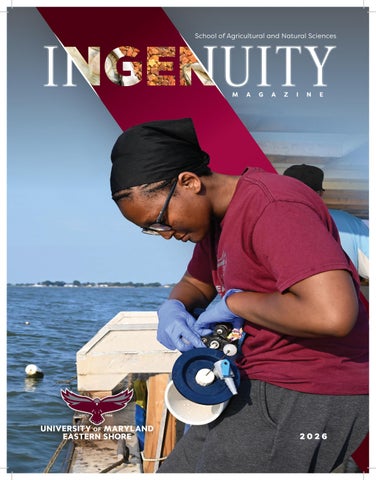
School of Agricultural and Natural Sciences
2026
RESEARCH advancing knowledge
TEACHING elevating the next generation
EXTENSION supporting farmers and families
Making a difference We make an impact thanks to the support of federal and state agencies, along with private businesses and organizations.
INGENUITY is the Research and Extension magazine of the University of Maryland Eastern Shore. It is published yearly by the School of Agricultural and Natural Sciences.
Administration
CONTENTS
2 3
Moses T. Kairo, Ph.D., DIC
Dean of the School of Agricultural and Natural Sciences
Paulinus Chigbu, Ph.D.
Associate Dean For Research, Development & Graduate Education, Professor and Director, NOAA Living Marine Resources Cooperative Science Center
E. Nelson Escobar, Ph.D.
Associate Dean and Associate Administrator for UMES Extension
Vagner A. Benedito, Ph.D.
Associate Dean for 1890 Research and Associate Director of the UMES Agricultural Experiment Station
Jonathan Cumming, Ph.D.
Professor and Chair, Department of Natural Sciences
Heidi M. Anderson and Moses T. Kairo
About the School of Agricultural and Natural Sciences Academics, Research, Extension
One Health
Heidi M. Anderson, Ph.D.
President
Letters from the President and the Dean
4 8 12 14
From seafood to pet food, scientists explore human, animal and environment ties Category: Research
Growing Farmer Profits
3 ways UMES Extension teaches value addition to family farms Category: Extension
Just What the Doctor Ordered
How nutrition education can reduce chronic diseases, boost food security Category: Extension
The Unseen World
View beyond the microscope Category: Research
Springboard to Success
20
Active research role propels student growth at UMES Category: Teaching
The Next Generation
Immersive food security experience gives advantage to future workforce Category: Teaching
Grace Namwamba, Ph.D.
22
Stephan L. Tubene, Ph.D.
24
Marine Science Scholars Gather at Forum
Laura Duck
26
She Wants to Be a Forensic Scientist
27
New Ag Building Advances Research
Professor and Chair, Department of Human Ecology Professor and Chair, Department of Agriculture, Food, and Resource Sciences Assistant to the 1890 Research Director
Category: Teaching
Category: Teaching
Tracie Bishop
CRIS Site Administrator
Tony Holden
Acting Farm Manager, Crop Research and Aquaculture
28 Editing and Production Editor-in-chief: Laura Benedict Sileo Writers: Gail Stephens and Kara Nuzback Contributing Writer: Stephan L. Tubene Proofreaders: Kamleshkumar Desai, Ayanna Zenzele-Rushing Photographer: Todd Dudek Graphic Designer: Jeremy Laney Pope Cover Photo Composite: Jeremy Laney Pope
Category: Teaching, Research
Publications Photo: Adobe Stock
p14
SCHOOL OF AGRICULTURAL AND NATURAL SCIENCES
|
INGENUITY MAGAZINE
|
2026
| 1
•••
From the President • • •
T
eaching, research and outreach remain the bedrock of our 1890 land-grant mission. Even in turbulent times, the University of Maryland Eastern Shore stands firm in its commitment to serve the Eastern Shore, Maryland and our national partners with excellence and purpose. Despite challenging financial landscapes and shifting federal priorities, UMES continues to take a forward-looking, strategic approach to ensure stability and growth. This fall, we celebrated our fifth consecutive year of enrollment gains — a powerful testament to the exceptional teaching, innovative programs and high-impact research that define our campus community. We are especially excited about the forthcoming Agricultural Research & Education Center, a transformative investment that will strengthen the School of Agricultural and Natural Sciences and expand our capacity to support Maryland’s agricultural communities. This new center will accelerate discovery, enhance experiential learning and promote research innovations that directly benefit growers, producers and families across the region. At the same time, UMES continues to advance a landmark initiative: the establishment of the first School of Veterinary Medicine in the state of Maryland. We are preparing to host the American Veterinary Medical Association’s Council on Education for a comprehensive site visit in June 2026 — an important milestone on our pathway toward accreditation and the development of a diverse, highly trained veterinary workforce for Maryland and beyond.
•••
T
From the Dean • • •
he School of Agricultural and Natural Sciences is eagerly anticipating all that is to come in 2026.
The newly constructed Agricultural Research & Education Center will soon open its doors as the iconic state-of-theart facility for the school. Equipped with technologically advanced classrooms, labs and greenhouses, it is designed to help UMES better serve Maryland agribusiness. UMES Extension, an integral part of SANS, is committed to increasing family farm profitability. Workshops, classroom series, tours and events teach farmers the latest in value addition and best practices. From information-sharing about niche market crops, to DIY medicinal and specialty herb products, to how to host on-farm educational and entertainment events, UMES champions small- to mid-sized farms in growing their business. Ongoing research activities with the potential to impact our great state and nation take place every day at UMES. In this issue, you can read about faculty and student projects on Vibrio in oysters and Salmonella in pet food, both of which can affect human health. We are charged with cultivating the next generation of agricultural leaders. As such, our underpinning mission is to provide real-world experiential learning opportunities ensuring that our students are prepared for graduate school or the workforce. These immersive experiences create a deeper understanding of agriculture and related sciences that can improve our nation’s food security.
None of this progress would be possible without the steadfast support of our many partners. We extend our profound appreciation to the Maryland General Assembly and to our federal partners — including the USDA, NOAA and NSF — as well as the private entities and stakeholders who champion our mission.
We are grateful for the support from federal and state agencies, along with the private sector for making our work possible and meaningful. Thank you for taking the time to learn about the research, teaching and extension activities we have highlighted in this issue.
UMES takes pride in accelerating student success, advancing research and deepening our community impact. With so many good things happening at UMES, I hope you find the stories in this issue of Ingenuity both inspiring and worth sharing.
Moses T. Kairo, Ph.D., DIC Professor and Dean
Heidi M. Anderson, Ph.D. President
2 | UNIVERSITY OF MARYLAND EASTERN SHORE | umes.edu / SAN S
•••
About the School of Agricultural and Natural Sciences • • •
Academics
SANS Academic Departments
The University of Maryland Eastern Shore’s School of Agricultural and Natural Sciences offers personalized student attention, authentic research opportunities, experiential learning and specialized facilities to train tomorrow’s workforce as leaders in agriculture and science. Strong research and extension programs are integrated with the school’s academic programming.
Research
Agriculture, Food and Resource Sciences:
• A gribusiness Management (BS) • U rban Forestry (BS) • G eneral Agriculture (BS) • A gricultural Education • P lant and Soil Science • A nimal and Poultry Science
•B usiness and Technology Option I
The UMES Agricultural Experiment Station within the School of Agricultural and Natural Sciences provides enhanced knowledge and technology to improve agriculture and food systems; enhance the quality of natural resources and the environment; and serve communities and families. Research is organized around: agriculture and food, natural resources and environmental sustainability, human health and development, and product development. UMES, one of the nineteen 1890 HBCUs, is one of two land-grant institutions in Maryland that provide leadership for research in agriculture, food, biomedical science and natural resource conservation and use.
• F ood and Agricultural Sciences (MS and Ph.D.) Natural Sciences:
• B iochemistry (BS) • B iology (BS) • C hemistry (BS) • E nvironmental Sciences (BS) • C hemistry (MS) •M arine, Estuarine, and Environmental Sciences (MS, PhD) • T oxicology (MS, PhD)
Human Ecology:
Extension UMES Extension uses research-backed knowledge to provide practical educational opportunities to help people, businesses and communities solve problems, develop skills and build better futures. Our programs specialize in: the Agriculture Law Education Initiative, Alternative Crops, Community and Economic Development, Family Nutrition and Health, Food Safety, Horticulture and Fruit, Small Farm, Small Ruminants, and 4-H STEM & Youth Development.
• H uman Ecology (BS) (Child Development/CHDE Online
Option, Dietetics, Nutrition, Family and Consumer Sciences, Family and Consumer Sciences Education) Fashion Merchandising and Design (BS) (Fashion Merchandising, Fashion Merchandising/FIT Option, Fashion Design) Human Ecology (MS) online (Child Development; Clinical Nutrition, Nutrition and Wellness; Family and Consumer Sciences; Fashion Merchandising) Dietetic I Internship
• • •
photo by Brian Waller/Waller Photo Services
SCHOOL OF AGRICULTURAL AND NATURAL SCIENCES
|
INGENUITY MAGAZINE
|
2026
| 3
Graduate student and NOAA Living Marine Resources Cooperative Science Center Fellow Alissa Riley, left, and Dr. Salina Parveen inspect oysters from the bottom of the Honga River in Fishing Creek, Maryland. This work is supported by: Shewanella, no. 2018-3882127759, U.S. Department of Agriculture’s National Institute of Food and Agriculture. Vibrio, no. NI251445XXXXG003 and no. 2021-38821-34583, respectively, USDA’s Evans-Allen and Capacity Building Grant. Salmonella in Commercial Pet Foods, no. MDX-AS202404, USDA.
4 | UNIVERSITY OF MARYLAND EASTERN SHORE | umes.edu / SAN S
From seafood to pet food, scientists explore human, animal and environment ties By Kara Nuzback and Gail Stephens
A
Examining seafood and swimming safety
school of thought could prevent future global illness outbreaks caused by the transfer of disease or infection from animals to humans, or zoonosis, if widely adopted. The term “One Health” was coined in the Wildlife Conservation Society’s 2004 Manhattan Principles. At the time, our increasingly global society was experiencing several outbreaks caused by zoonoses, including West Nile virus, Ebola hemorrhagic fever, SARS, mpox, mad cow disease and bird flu.
Dr. Salina Parveen, professor of food microbiology and safety, environmental microbiology, and molecular biology at UMES, studies a bacterium called Vibrio that exists naturally in seawater.
Dr. Salina Parveen
The Manhattan Principles posed: Only by breaking down the barriers among agencies, individuals, specialties and sectors can we unleash the innovation and expertise needed to meet the many serious challenges to the health of people, domestic animals, and wildlife and to the integrity of ecosystems. ... We are in an era of “One World, One Health” and we must devise adaptive, forwardlooking and multidisciplinary solutions to the challenges that undoubtedly lie ahead. Several faculty members at University of Maryland Eastern Shore are answering the call to investigate how the health of the environment, animals and marine life is central to the health of humans.
Rising water temperatures affect the concentration of Vibrio in water, and high concentrations can lead to higher levels of this bacterium in oysters, which can accumulate Vibrio during their filtration process. Since 2004, Parveen has investigated where and when Vibrio contamination occurs in oysters and coastal waters, in part because Vibrio can also affect humans who eat undercooked or raw oysters, or who go fishing or swimming in waters where the Vibrio concentration is high.
SCHOOL OF AGRICULTURAL AND NATURAL SCIENCES
|
INGENUITY MAGAZINE
|
2026
| 5
How Fido’s food affects pet owners Dr. Janak Dhakal, an assistant professor in UMES’s Department of Agriculture, Food and Resource Sciences, is studying the occurrence of Salmonella in pet food, which can infect animals, but also humans.
Scott Robinson Sr. of Madhouse Oysters pulls oysters from a floating tank on the Honga River.
“Everything is interconnected. One thing is dependent on another.” – Dr. Salina Parveen
Parveen said immunocompromised people are especially at risk of infection, and symptoms can range in severity from diarrhea from ingesting a contaminated oyster to a flesh-eating disease from a wound infection that can result in amputation or death. Parveen and her students are also studying an emerging pathogen called Shewanella that survives in fish and shellfish and can continue to survive on food processing equipment. Some strains of Shewanella can have detrimental effects on humans who are exposed, including skin infections, sepsis and gastroenteritis. These bacteria occur in the environment, but human interaction with the environment shifts their concentrations so the bacteria multiply. Then, the bacteria infect fish and humans. Through humans, the bacteria could spread to an entirely new environment, Parveen said. “The same concept applies to Salmonella in poultry and other food,” she said. “Everything is interconnected. One thing is dependent on another.”
6 | UNIVERSITY OF MARYLAND EASTERN SHORE | umes.edu / SAN S
“We hear about the Salmonella outbreaks linked to chicken, produce and vegetables, and pet foods contain a similar type of Salmonella, especially the raw ones,” Dhakal said. “When we handle and feed these feeds to our pets, we may get exposure through contaminated feed handling. Additionally, the pets then become a carrier for Salmonella and increase our risk for exposure.”
Dr. Janak Dhakal
Processed human food is treated with antimicrobials and heat, but there is no established post-processing intervention for commercial pet foods leading to potentially higher load of the bacteria. Dhakal said that since 2015, there have been at least 58 recalls due to Salmonella in pet foods in the United States, and six of those were associated with human illness and hospitalization. Richard Otwey, a Ph.D. student, works on Salmonella research in pet food in a University of Maryland Eastern Shore lab.
ZOONOTIC DISEASE TRANSMISSION ANIMAL HEALTH
HUMAN HEALTH
Infectious and Toxicologic Disease
Infectious and Toxicologic Disease Zoonotic Pathogens
Exposure Through Food Webs
Environmental Exposures
Environmental Exposures
Environmental Contaminants
Sources, Transport, Fate, Habitat, and Climate Student Allissa Riley conducts a test on Vibrio in a UMES lab.
Robyn Walker-Spencer, right, a Research Experiences for Undergraduates (REU) intern, works in a lab with her mentor, Dr. Salina Parveen.
ECOSYSTEMS CONDITIONS Diagram photos: Adobe Stock
Tackling transmission To solve the problem of Vibrio or Shewanella infection, Parveen and her team first aim to know the bacteria, inside and out.
funding, awarded through the USDA’s National Institute of Food and Agriculture, enables research to run through March 2027.
“We have to know the sources. Where is it? What can we learn about it? How do we kill or control it? Our lab is conducting research on all these approaches,” she said.
Dhakal said the grant aids UMES in becoming one of the forerunners in examining the safety of pet food. UMES looks to ultimately provide training to pet food manufacturers on applying proper safety measures.
Extensive research on ecology, antibiotic resistance, genomics, metagenomics and control of Vibrio has already helped Parveen’s lab develop methods to control its presence in oysters. She said that information can now inform aquaculturists, industry, consumers and policymakers. UMES received a U.S. Department of Agriculture grant to aid its research into how commercial pet food transmits foodborne pathogens to humans. The $600,000 in
On the frontlines of zoonoses In academia, veterinary schools are central to the One Health concept, as students learn how to practice at the intersection of animal, human and environmental wellness. In the end, veterinarians are at the frontline of zoonotic disease detection. UMES’ new School of Veterinary Medicine will be the first in Maryland.
SCHOOL OF AGRICULTURAL AND NATURAL SCIENCES
|
INGENUITY MAGAZINE
|
2026
| 7
S
mall- to mid-sized farms are steadily joining the value-added agriculture movement, and UMES Extension activities help farmers get on board.
G
R
O W
I
N
G
FARMER PROFITS By Gail Stephens
3 ways UMES Extension teaches value addition to family farms
It’s a trend aimed at strengthening rural America by creating increased economic opportunities and agribusiness development. Value-added agriculture activities enhance the worth of an agricultural commodity by creating new, locally produced agricultural products; expanding marketing reach and opportunities; and increasing producer income. UMES Extension is helping farmers explore the best fit for their business plans from alternative crops to medicinal herbs to agritourism. UMES Extension’s work is supported in part by the U.S. Department of Agriculture, National Institute of Food and Agriculture, in partnership with the Maryland legislature. Dr. Nadine Burton, UMES Extension’s alternative crop specialist, gives Small Farm Conference 2025 attendees a tour at the UMES Research, Extension and Teaching Farm.
8 | UNIVERSITY OF MARYLAND EASTERN SHORE | umes.edu / SAN S
Alternative crops form niche market Alternative crop specialist Dr. Nadine Burton is growing specialty crops and organic traditional vegetables for comparison at UMES’ Research, Extension and Teaching Farm. “An alternative crop for us is one that is grown in place of another crop. For example, kale and collards don’t grow well here on the Eastern Shore in the summer because of the heat, humidity and insect pressure, but a tropical crop like amaranth or jute leaf will,” Burton said. Better yet, they are also considered valueadded because “they can generate more money than a traditional crop,” she said. Seven years ago, Burton created a program to help small-scale farmers learn about crop options to meet consumer demand in regional niche markets based on her research. “Farmers were intrigued. They recognized the potential for increasing their farm incomes but didn’t know how to come by the specialty crops,” Burton said. “My job is to identify crops that can be grown alternatively with potential for high economic value, educate farmers on cultivating them in the region and tie them into markets.” A group of producers Burton initiated now hovers around 70 with about 25 having participated for multiple years. The extension researcher said that in fall 2025, the farmers’ alliance sold roughly 12,000 pounds of fresh produce per week to suppliers, including the Maryland Food Bank.
Dr. Nadine Burton, right, in fall 2025, used a UMES Extension hoop house with alternative crops to extend the growing season to year-round. There, she grew amaranth, hibiscus, jute leaves, Malabar spinach, waterleaf, scotch bonnet peppers, edamame, quinoa and soursop.
have access to the food they are accustomed to and desire, Burton explained. With local farmers growing these crops, she said, the product is fresh, not shipped in from overseas. It also makes an economic impact in the area. Burton and student interns research the intensity of the labor and cost of growing the crops in comparison to traditional crops. Over the past two years, Burton also has shared her findings with a select group of beginning producers through an annual Alternative Crop Class. Compared to a stand-alone workshop, the yearlong opportunity provides more classroom learning followed by practical training on their farms, Burton said.
“It demonstrates that small-scale farmers can be profitable with as little as 1-2 acres with specific value-added crops — the reason for the focus of our work,” Burton said.
“We aim to find a new crop to introduce each season. They are studied for two to three years to validate what grows well in the area because conditions like temperature and rainfall can vary each year,” she said.
Growing alternative crops addresses local food security as some consumers may not
The seeds are harvested and rooted so they can be shared to help farmers get started. SCHOOL OF AGRICULTURAL AND NATURAL SCIENCES
|
INGENUITY MAGAZINE
|
2026
| 9
Value-addition in herbs Value-added opportunities for small-scale farmers are limitless. Also on the research farm, herbalist Henriette den Ouden can be found tending rows of medicinal and specialty herbs or conducting one of her many small group workshops. Whether the clients are gardening enthusiasts, beginning farmers or professional herb growers and processers, the UMES Extension Herb Garden is a hub for information. Known throughout the ages for their culinary appeal, den Ouden emphasizes the healthful benefit that can be gained through processing the seeds, leaves or roots for use in value-added herbal teas, syrups and tinctures. Her instruction runs the gamut from herb selection, soil amendments, cultivation, harvesting and drying techniques, uses, value-added products and marketing. “Growing herbs can be satisfying and profitable, but there is more to it than most would expect,” den Ouden said. “That’s why we’re here, to help our clientele consider all that is involved before getting into a project. For instance, herb farmers in Maryland must follow strict processing regulations for food and product safety.”
Baikal skullcap is among the specialty herbs grown in UMES Extension’s Herb Garden.
10 | UNIVERSITY OF MARYLAND EASTERN SHORE | umes.edu / SAN S
Henriette den Ouden, an agent associate with UMES Extension’s Specialty Herb Program, teaches a class on how to process medicinal and specialty herbs for value-added products.
During a medicinal herbs class, fresh tulsi is chopped for making a tincture.
Flowering elderberry ripens to berries prized for their use in making syrup, jam, wine, tea and tinctures.
Agritourism entices visitors to the farm UMES Extension is encouraging farmers to consider supplementing and varying their income through agritourism. Agritourism increases revenue by offering educational and entertainment activities on a farm. It can also create marketing opportunities for farm-produced products. Sales are often made directly to consumers, making way for improved profitability by eliminating a middleman. Dr. Prem Bhandari, agritourism and valueadded agricultural marketing specialist, helps farmers find their space in the burgeoning sector. He led UMES’ inaugural 2023 Maryland Agritourism Conference and has since organized a series of traveling workshops. The on-site visits to successful agritourism operations serve as examples others may emulate or incorporate in their own agribusinesses.
Dr. Prem Bhandari, center, agritourism and valueadded agricultural marketing specialist, hosts traveling agritourism workshops like this one at Emily’s Produce in Cambridge, Maryland.
Dr. Prem Bhandari said UMES Extension can help agritourism operators navigate obstacles, and noted that studies show challenges related to time management, labor management, visitor control and liability, costing, managing insurance and taxes, direct marketing, seasonality and cash flow management, and state and county regulations. “UMES Extension has conducted four traveling workshops benefiting over 100 agritourism operators. We look forward to the next Maryland Agritourism Conference to bring agritourism stakeholders together to further the industry and farmer profitability,” he said.
According to the last U.S. Census of Agriculture in 2022, 354 farms in Maryland supplemented income through agritourism, a 20% increase in five years. The total value of sales from these operations was $14.5 million, a 47% increase from the previous census, which indicates an increasing role in Maryland’s economy. Yet there are challenges to overcome and support needed to keep farmers farming. Karen Gitau, an attendee visiting a UMES Agritourism event at Emily’s Produce, picked fresh strawberries to take home.
America lost 141,733 farms and more than 20 million acres of farmland between 2017 and 2022 according to the census. Among the reasons for small-scale farm decline, Bhandari said, are competition with larger operations, market access, labor shortages, price fluctuations and weather events. Agritourism could be an answer, Bhandari said, with the right extension support services.
“Many of these farmers start service-oriented agribusinesses without formal or informal training as they are hard to come by in the market. They may lack the necessary knowledge and skills needed for agritourism management,” said Bhandari, noting UMES Extension’s many training and networking opportunities.
SCHOOL OF AGRICULTURAL AND NATURAL SCIENCES
|
INGENUITY MAGAZINE
|
2026
| 11
Just What the Doctor Ordered How nutrition education can reduce chronic diseases, boost food security By Gail Stephens UMES Extension work, along with the EFNEP program, is supported in part by the U.S. Department of Agriculture’s National Institute of Food and Agriculture.
Photo caption required: Maios EFNEP Educator Curtis McCoy ilit, quatur ratis (not posimportance dolorun pictured) teachesesthe of tisitisque samto youth eating healthy and exercise quassiin coneture es at The Salvation Army Salisbury. molor anihiciam voluptatur.
“By offering nutrition education that helps families stretch food budgets and connects them to fresh produce, the program ensures nutritious food is attainable for all.”
E
– Dr. Virginie Zoumenou, director of UMES Extension’s Family Nutrition and Health Program
ating a diet consisting heavily of fresh, locally sourced food that is high in nutritional value isn’t just a lifestyle choice, it translates to a powerful form of food-based health care. It is proactive with the goal of helping Americans prevent, manage and even delay the onset of chronic diseases that contribute to reduced lifespan.
Katherine Lennehan, nutrition assistant educator, hosts an EFNEP session at First Baptist Church in Salisbury.
The adult obesity rate exceeds 40%, placing individuals at high risk for chronic illnesses such as heart disease, Type 2 diabetes and hypertension, according to a 2024 National Center for Health Statistics Data Brief (Emmerich et al.). For diabetes alone, a 2024 Centers for Disease Control and Prevention report states 38 million people in the U.S. are affected and nearly 100 million fall within the prediabetic range.
12 | UNIVERSITY OF MARYLAND EASTERN SHORE | umes.edu / SAN S
“These statistics underscore the urgent need for comprehensive nutrition education and outreach, all central to the mission of UMES’ Family Nutrition and Health Program,” said Dr. Virginie Zoumenou, director of the program. This UMES Extension program provides evidence-focused nutrition activities designed to teach healthy eating, meal planning, food budgeting and safe food handling practices, Zoumenou said. It serves families, youth and adults, particularly in resource-limited areas, by equipping them with practical knowledge to make informed food choices and adopt longterm, healthier lifestyles. “This group helped me compare foods nutritionally,” a program participant said. “I also learned simple ways to plan before I go to the grocery store so that I can save money.” Addressing food insecurity is a cornerstone of the program’s work, Zoumenou said. “By offering nutrition education that helps families stretch food budgets and connects them to fresh produce, the program ensures nutritious food is attainable for all,” she said. UMES Extension’s Family Nutrition and Health Program encourages farm-to-table practices by way of partnerships supporting local agriculture through community gardens, farmers markets and other cooperative projects. Adults and youth also learn how to grow their own fruit and vegetables through outreach activities led by UMES faculty and extension specialists. “One of the program’s success stories is the Well Connected Communities Initiative that created mini-orchards in three UMES neighboring towns,” Zoumenou said. “Residents of all ages work together to grow and share the harvest of fruit with guidance from town project
leaders and UMES Extension specialists. The overarching goal is to build regional food systems that promote health.” “If you cannot afford it, grow it,” said Linda Powell, the WCC community leader for the mini-orchard in Fruitland, Maryland. UMES also partners with local agencies and after-school programs to expand its reach through nutrition programs such as the Expanded Food and Nutrition Education Program, and Family and Consumer Sciences. Just one change in habit can improve health. A 44-year-old taking part in an activity highlighting sugar content in popular products realized the amount of sugar he was consuming through drinks and snacks. “Wow, this really has me thinking, because I can easily drink three or four of these in a day,” he said. Two weeks later, he reported drinking more water and a raised awareness of the nutritional value of what he was consuming. By integrating nutrition education, food access and agricultural engagement, UMES Extension’s Family Nutrition and Health Program demonstrates the importance of food-based health care in the prevention of chronic diseases, improvement in the health of Americans and creating sustainable local food systems, Zoumenou said. This work exemplifies how nutrition-centered outreach can lead to longer and healthier lives for residents across Maryland and beyond.
SCHOOL OF AGRICULTURAL AND NATURAL SCIENCES
|
INGENUITY MAGAZINE
|
2026
| 13
THE UNSEE VIEW BEYOND THE MICROSCOPE By Kara Nuzback
Two rapidly advancing fields of scientific research are transforming the way we look at the natural world. Environmental DNA, or eDNA, offers a bird’s-eye view of the variety and complexity of life on Earth. Microbial ecology sheds light on poorly understood organismal interactions. “Expertise in these fields keeps UMES on the cutting edge of research that carries profound implications for agriculture and use of living natural resources under changing ecological circumstances,” said Dr. Moses T. Kairo, dean of the UMES School of Agricultural and Natural Sciences. The University of Maryland Eastern Shore brought on Drs. Gordon Custer, a microbial ecologist, and Justine Whitaker, an eDNA expert, in 2024. “As these disciplines advance and align, they could provide solutions to many challenges in today’s rapidly changing natural world,” he said.
This work is supported by: Soil and microbes, no. 2024-67012-44745, U.S. Department of Agriculture. Switchgrass, no. NI251445XXXXG003, Evans-Allen capacity grant.
14 | UNIVERSITY OF MARYLAND EASTERN SHORE | umes.edu / SAN S
EN WORLD 15
P
30.973732
Photo Illlustration: Jeremy Laney Pope SCHOOL SCHOOL OF OF AGRICULTURAL AGRICULTURAL AND AND NATURAL NATURAL SCIENCES SCIENCES
|
INGENUITY INGENUITY MAGAZINE MAGAZINE
|
2026 2026
| 15
What eDNA can tell us about the rare Atlantic sturgeon
J
ust as modern DNA testing can help solve crimes of the past, environmental DNA, or eDNA, can shed light on species that have long been a mystery — even to scientists. Atlantic sturgeon hasn’t changed much since it swam at the feet of dinosaurs more than 120 million years ago. It is credited as the primary food source that saved the Jamestown settlers during “The Starving Time” famine in the early 1600s. It once supported a massive commercial fishery for its caviar and meat.
Rather than a traditional DNA sample, which would require catching the fish or its eggs, eDNA can be collected without disturbing what few members of the species remain. A water sample can be enough to show that Atlantic sturgeon are present.
Dr. Justine Whitaker
Today, Atlantic sturgeon is listed as endangered; its rarity and protected status makes it difficult to study, despite being the largest fish native to the Chesapeake Bay. Dr. Justine Whitaker, a UMES assistant professor of environmental science, has been testing water samples collected on the Delmarva Peninsula for eDNA, with the aim of investigating Atlantic sturgeon. She specializes in eDNA, conservation genomics, and biodiversity and genetic variation.
Young sturgeon key to recovery of species Whitaker recently joined a group of peers from the University of Maryland Center for Environmental Science (UMCES) and the Maryland Department of Natural Resources, who have studied the remaining members of the species in local waters for years. One of those peers, former UMCES associate professor Louis V. Plough, who now works for NOAA, published a 2021 article in the journal Environmental DNA that reported he had detected sturgeon in the Nanticoke River using eDNA. However, data at the time showed only adult sturgeon in the river during spawning season.
A student extracts eDNA from a local waterway sample.
16 | UNIVERSITY OF MARYLAND EASTERN SHORE | umes.edu / SAN S
Atlantic sturgeon are anadromous fish, meaning they are born in freshwater, migrate to sea at maturity and make their way back to freshwater to spawn, normally to the same river in which they hatched.
A student attempts to detect the presence of Atlantic sturgeon using eDNA in the lab in Somerset Hall on the UMES campus.
Since no juvenile sturgeon were detected, the question is now whether sturgeon are spawning in the river, Whitaker said. Since the study was published, Maryland DNR has collected samples and tagged adult sturgeon in the Nanticoke River.
Plough used a qPCR assay to detect Atlantic sturgeon in the water samples, which has been the gold standard for single species detection. With newer technology, Whitaker aims to develop an assay that is more sensitive than qPCR.
“They’ve never caught juveniles. They sampled with egg mats but didn’t find any eggs,” she said.
A targeted next-generation sequencing, or tNGS assay, takes the metabarcoding method and applies it to a single species, creating a more amplified and precise method of collecting data. The improved accuracy and increased depth of information in a tNGS assay can reveal more information about Atlantic sturgeon in the Nanticoke River, Whitaker said. A tNGS approach would also be more cost-effective than using a qPCR with sequencing, while gleaning the same information, she said.
A targeted approach Reusing water samples collected by Plough, Whitaker and intern Malachi Cox spent summer 2025 attempting a different method of eDNA collection to detect evidence of juveniles. In fall 2025, Myah Bowie, a NOAA Living Marine Resources Cooperative Science Center fellow and recent UMES graduate, joined the project. There are two main procedures, or assays, for assessing the presence, amount or activity of an entity in eDNA collection: quantitative polymerase chain reaction, or qPCR, which is sensitive but detects only one species; and metabarcoding, which can identify numerous species from a sample.
Whitaker said if she is successful in developing the new assay, it could be applied to monitoring other endangered or threatened species. For now, she hopes to find funding to grow the Atlantic sturgeon project to ensure the species is not lost. “Sturgeon are my passion,” she said.
SCHOOL OF AGRICULTURAL AND NATURAL SCIENCES
|
INGENUITY MAGAZINE
|
2026
| 17
Can bacteria, fungi mend soil health?
J
ust as humans have a skin microbiome and a stomach microbiome, plants have microbiomes in their roots, leaves and in the soil where they grow. And just as a human would take a probiotic to improve their gut health, UMES Assistant Professor of Biology Gordon Custer is researching microbial treatments to improve soil health.
While working at Penn State in 2023 and 2024, Custer sought to experiment with adding bacteria to soil that was very low in phosphorus to improve both soil health and plant performance. Phosphorus is essential to plants in the processes of photosynthesis, root development, and flower and seed production.
Custer took an interest in microbial ecology during his senior year of college while working with a professor who researched invasive plants and their effect on soil microbial communities.
Dr. Gordon Custer
“I thought it was fascinating there was this whole unseen world that you don’t ever think of,” he said. As a graduate student at the University of Wyoming, Custer worked with Drs. William Stump and Linda van Diepen, researching plant and soil microbiomes and nutrient cycling. Custer then found work as a postdoctoral fellow at Penn State, where he worked with Dr. Francisco Dini-Andreote to look more broadly at the movement of microbiomes.
Phosphorus is being depleted from soil more quickly than can be naturally replenished, leading to concerns about domestic food security and a potential reliance on imported fertilizer to meet phosphorus demand. With the help of a grant from the U.S. Department of Agriculture’s National Institute of Food and Agriculture, Custer is continuing this research at UMES.
Red spring wheat In September 2025, Custer planted hard red spring wheat in phosphorus deficient soils at the University of Maryland, College Park’s Research Greenhouse Facility. He and his research team plan to inoculate each plant with different doses and frequencies of commercially available microbial inoculants and measure plant performance and phosphorus uptake. Illustration: Adobe Stock
18 | UNIVERSITY OF MARYLAND EASTERN SHORE | umes.edu / SAN S
Custer said he hopes the bacteria and fungi unlock more phosphorus in the soil. Beyond
Photo Illustration: Adobe Stock
15
P
30.973732
“I thought it was fascinating there was this whole unseen world that you don’t ever think of.” – Dr. Gordon Custer
that, he aims to identify a dose and frequency of inoculation that results in long-term establishment in the soil microbiome — to the point that reapplication is not needed. The project, scheduled to be completed in 2028, also involves outreach with students at a local high school. The A+ Garden Centre in Salisbury, Maryland, is a student-led commercial greenhouse that offers advanced horticulture training opportunities to students in Wicomico County Public Schools. The center uses many microbial inoculants in its production facility. Since the start of his collaboration in summer 2024, Custer has lectured before nearly 30 Parkside Career & Technology Education students and plans to offer student research internships in his lab at UMES to help carry out the grant-supported research.
Switchgrass and drought A second project Custer is undertaking,
Red spring wheat and switchgrass varieties. Photo: Adobe Stock
along with Dr. Jonathan Cumming, chair of the UMES Department of Natural Sciences, investigates the effect of drought on switchgrass through the lens of soil and root microbes. Switchgrass is a biofuel stock that can grow on land that no longer supports corn or soybean growth because of salinization, drought or other environmental factors. But drought tolerance doesn’t equate to droughtproof, Custer said. Through an Evans-Allen grant, Custer and Cumming will expose switchgrass to drought conditions, measure how that impacts the chemistry of the roots and learn how those changes influence microbial decomposition. The goal of the project is to learn how drought affects plant-microbe interactions and use this information to make switchgrass more resilient to stress from extreme weather. They plan to have results by 2029. The permanent rainout shelters constructed for this project can be used to simulate drought conditions for future research projects.
SCHOOL OF AGRICULTURAL AND NATURAL SCIENCES
|
INGENUITY MAGAZINE
|
2026
| 19
Springboard to Success Active research role propels student growth at UMES By Gail Stephens
Mouhamadou Diack, an Agribusiness Management major, presents his research at the 2024 Student-led Undergraduate Research Symposium. Diack placed second in oral presentations.
Students discuss their research posters at the inaugural UMES Student-led Undergraduate Research Symposium.
L
earning by doing takes classroom and textbook knowledge and applies it to real-world situations. Experiential opportunities are the backbone of student success, helping them gain practical skills, research acumen, improved critical thinking and professional competence. The UMES School of Agricultural and Natural Sciences, or SANS, incorporates a streamlined approach to strengthen undergraduate students’ resumes, build professional networks, graduate expeditiously, be workforce-ready and enter post-graduation internships, graduate schools or gainful employment. “Our students who have completed meaningful research experiences have landed premier internships or employment in
20 | UNIVERSITY OF MARYLAND EASTERN SHORE | umes.edu / SAN S
Sophomore Sanee Crawford attends a math clinic led by Professor Mohamed Salih.
industry and government, been published in prestigious scholarly journals and have been accepted into top graduate programs across the country, including Ivy League schools,” said Moses T. Kairo, professor and SANS dean. Faculty-mentored research is an integral part of senior capstone course curriculum, along with work in labs and in the field as part of ongoing federal, state and private sector grant-funded projects, Kairo said. Students are expected to take an active role in their projects, including formally presenting their findings as a reflection of what they learned from the experience. Their investigations span a range of applied sciences and interdisciplinary research areas including:
• S oil microbes interaction • I ntegrated pest management • E nvironmental impacts on food and livestock • G enetic engineering • A pplications of artificial intelligence in agriculture • M aterial science • D rug discovery
SANS undergraduate research was highlighted at an end-of-semester symposium organized under the center, which is slated to become a school hallmark. Unlike traditional academic events, Das said, the symposium is student-led, allowing undergraduates the opportunity to organize, present and facilitate research discussions with their peers and faculty mentors.
They also explore cutting-edge topics such as space food production, precision agriculture and other emerging fields at the intersection of science, technology and innovation.
“This hands-on responsibility not only reinforces research skills but also nurtures leadership, public speaking and organizational abilities — all highly sought by employers and graduate programs,” he said.
Center for Student Excellence creates synergies In its second year, the SANS Center for Student Excellence is becoming “the hub where experiential learning and student development converge,” said Kausik Das, professor of physics and director of the center. Its mission supports recruitment, retention and matriculation goals leading to a pipeline of graduates “confident and ready to compete at the highest level,” Das said. This is accomplished through consistent information sharing, mentorship and academic support, career readiness training and leadership opportunities. Some of the tools used are: • Internship announcements • Tutoring sessions in critical academic areas such as chemistry and math • Incorporation of cutting-edge technologies in the classroom • Professional development workshops • Physical and financial support for participation in national conferences and networking opportunities
Scholarship is investment in future ag leaders The UMES Land-grant Scholarship Program has been restructured under the Center for Student Excellence. The need-based scholarship is for students with the potential for high achievement who are interested in pursuing careers in food, agriculture, natural resources and human sciences. “It can become a flagship program to attract and retain an elite group of students each academic year,” Das said. As of spring 2025, “111 students have benefited, and the first cohort experienced a 91% graduation rate within 4.5 years. Their development showcases how intentional investment in mentorship and experiential opportunities can prepare students to be leaders in these targeted fields.” The UMES scholarship is funded by USDA’s National Institute of Food and Agriculture. Applications typically open in the spring. Awardees must meet renewal conditions. Learn more at: https://wwwcp.umes.edu/sans/umes-landgrant-scholarship-program
SCHOOL OF AGRICULTURAL AND NATURAL SCIENCES
|
INGENUITY MAGAZINE
|
2026
| 21
THE
NEXT
G E N E R AT I O N Immersive food security experience gives advantage to future workforce By Dr. Stephan Tubene This work is supported by project award no. 2023-70003-38776, from the U.S. Department of Agriculture’s National Institute of Food and Agriculture.
Students learned about research and environmental education at Belize Foundation for Research and Environmental Education. Photo courtesy Stephan Tubene.
22 | UNIVERSITY OF MARYLAND EASTERN SHORE | umes.edu / SAN S
S
killed personnel, educators, practitioners and the professional workforce in today’s agriculture are required to go beyond the understanding of cross-cutting sciences of agriculture, food and environment. They must be willing to explore and develop their teaching skills and experiences based on successful practices in other countries. The Global Orientation to Agricultural Learning program is a collaborative effort to significantly change the preparation of future agricultural educators by providing immersive, high-impact experiences in global food security as a vehicle to increase teaching skills and global competency. In summer 2025, the GOALs team embarked on an international experiential learning adventure in Belize. The team included students and faculty from Penn State, the University of Idaho and the 1890 universities (i.e., Tuskegee, Alcorn and University of Maryland Eastern Shore). The weeklong learning visit to Belize was packed with activities from tropical farming systems to immersion learning about the way of life in Belize. The GOALs team participated in:
• Tropical animal education at the Belize Zoo in La Democracia.
aya civilization at Xunantunich, Cayo •M
District, and Maya experience at the Benque House of Culture, Cayo District.
• G arifuna drumming and immersion at Gulisi museum, Stann Creek District.
• Traditional Maya farm at Laguna Village, Toledo District.
• P ermaculture farming and chocolate
processing at IXCACAO, Toledo District.
Students watch a demonstration of chocolate processing. Photo courtesy Stephan Tubene.
They also visited the University of Belize, Belmopan, and learned about research and environmental education at Belize Foundation for Research and Environmental Education (BFREE), and Independence Junior College, Quebrada. For participating students, it was an eye-opener. Nathaniel Sharp, a UMES Agribusiness Management student, said he gained knowledge in global agriculture, environment and economic factors that influence agricultural systems. “Visiting local farmers and learning, for example, how chocolate is produced from the cacao bean to the finished product, provided valuable insight into farming practices and value-added production. Experiencing the food from Belize, such as fish, chicken and interacting with local farmers, broadened my knowledge of how agriculture impacts daily life and the world,” Sharp said. GOALS is led by Penn State under Dr. Daniel Foster. GOALS involves the University of Idaho under Dr. Kasee Smith and the 1890 Universities Center of Excellence for Global Food Security and Defense under Dr. Stephan Tubene. “Such experience and exposure to the global world is much needed for all students as it opens up new horizons and opportunities,” Tubene said.
SCHOOL OF AGRICULTURAL AND NATURAL SCIENCES
|
INGENUITY MAGAZINE
|
2026
| 23
MARINE SCIENCE SCHOLARS GATHER AT FORUM By Kara Nuzback This forum was supported by NOAA EPP with Minority-Serving Institutions, 2021 award no. NA21SEC4810005.
Delaware State University student and NOAA LMRCSC Fellow Aaron Pickett presents his research poster at the 11th biennial NOAA Educational Partnership Program Education and Science Forum. Photo by FotoJoe Photography.
24 | UNIVERSITY OF MARYLAND EASTERN SHORE | umes.edu / SAN S
T
he 11th biennial NOAA Educational Partnership Program (NOAA EPP) Education and Science Forum, held at the University of Maryland Eastern Shore brought together leading researchers, educators and students to advance the future of marine and atmospheric sciences. The event, hosted by the NOAA Living Marine Resources Cooperative Science Center, showcased cutting-edge research and underscored the importance of collaboration in addressing the pressing environmental challenges of our time. Over three days in March 2025, attendees participated in keynote sessions, student-led research presentations and networking opportunities. Dr. Cisco Werner, director of Scientific Programs and chief science advisor for NOAA Fisheries, who spoke virtually, emphasized the needs and opportunities that lie ahead at NOAA Fisheries. Dr. Owen Temby of The University of Texas Rio Grande Valley discussed the role and potential of social sciences in student research. Maryland Department of Natural Resources Chesapeake
UMES undergraduate and NOAA LMRCSC Fellow Myah Bowie receives an award for her research presentation. Photo by Kara Nuzback.
and Coastal Services Director Dr. Natalie Snider and University System of Maryland Senior Vice Chancellor of Academic & Student Affairs Dr. Alison Wrynn both noted the employment opportunities in state government for burgeoning scientists. “This forum reaffirmed the commitment of our scientific community to innovation and education in marine and atmospheric sciences,” said Dr. Paulinus Chigbu, director of LMRCSC. “We remain steadfast in our mission to support students and researchers who will drive the future of environmental science and stewardship, and by so doing help to improve America’s global competitiveness in STEM.” A key theme was the empowerment of the next generation of scientists. More than 100 students had the opportunity to present their research, engage with visiting academics and participate in networking events that fostered mentorship and career development.
From left, UMES students and NOAA LMRCSC fellows Cali Roberts, Ashley Duran and Nina Clovis help registrants check in. Photo by FotoJoe Photography.
Attendees left the forum with strengthened connections and a shared vision for the future of environmental research and policy.
SCHOOL OF AGRICULTURAL AND NATURAL SCIENCES
|
INGENUITY MAGAZINE
|
2026
| 25
She Wants to Be a Forensic Scientist Her time at UMES set the path. By Gail Stephens
A
lexandria Camp recalls sitting before the TV engrossed in popular dramatized crime shows as a youth. It wasn’t the charismatic or quirky main characters, or the plot twists, but the “meticulous work of the lab technicians” that caught her interest. The UMES biochemistry major, who earned her bachelor’s degree in December 2025, is now on her way to achieving her dream of a career in forensic science. “Attending UMES has supported my goals by strengthening my academic skills, connecting me with valuable mentors and resources, and providing real-world experiences that have helped shape my career path,” Camp said. The biochemistry curriculum provided the undergraduate with a strong laboratory foundation in biology, cell biology, genetics, biochemistry and microbiology, along with physics and chemistry. “These hands-on courses helped me apply scientific concepts to real experiments and strengthened my technical abilities,” she said. Camp has performed cell culture, bacterial transformation and fractionation, gram staining, PCR, DNA and RNA extraction, electrophoresis and spectrophotometry, to name a few. She expanded her analytical skills and scientific work overseas during an honors research experience in Sunyani, Ghana. There, she studied how temperature and water body type affect turbidity. Camp’s aptitude earned her a nod as UMES’ nomination for the American Chemical Society’s 2025 Outstanding Undergraduates in Biochemistry.
26 | UNIVERSITY OF MARYLAND EASTERN SHORE | umes.edu / SAN S
UMES biochemistry major Alexandra Camp performs an experiment in a chemistry lab on campus,
The native of White Plains, Maryland, attributes her success in part to the support provided as a UMES Land-grant Scholar over the course of her four-year academic career. She is also a believer in giving back. “One of her outstanding qualities is her dedication to supporting her peers. She regularly uses her free time to tutor students in Biochemistry I and Organic Chemistry, subjects she has mastered and remains current with,” said Logan Quinn, SANS coordinator for recruitment, retention and experiential learning. Camp will pursue a master’s degree in forensic science at Towson University, where she has been accepted for Fall 2026. “Science produces evidence, and evidence produces justice. This connection between scientific discovery and its impact on society is what draws me to the field of forensic science, she said.
New Ag Building Advances Research
F
inishing touches are being made to the Agricultural Research & Education Center at the University of Maryland Eastern Shore. The newly constructed building, slated to open in 2026, will provide modern research and education space, better positioning UMES for continued agriculture innovation to support agribusiness and economic development throughout Maryland and the region. At about 25,000 square feet, the center features six specialized research labs and accompanying support space, and six greenhouses of varying sizes, as well as traditional classrooms, conference rooms and office space.
SCHOOL SCHOOL OF OF AGRICULTURAL AGRICULTURAL AND AND NATURAL NATURAL SCIENCES SCIENCES
|
INGENUITY INGENUITY MAGAZINE MAGAZINE
|
2026 2026
| 27
•••
Publications • • •
The following is a selection of peer-reviewed articles published in 2025. Alkhaled AY, Çağatay Selvi K, Kabutey A, Mizera C, Hrabe P, Svobodová J, Koçak E, Herák D. Synergistic drying solutions: combining vacuum and infrared techniques for optimal persimmon preservation. J Food Sci. 2025;90(7):e70347. doi: http://doi.org/10.1111/1750-3841.70347
Flores-Iga G, Lopez-Ortiz C, Natarajan P, Nimmakayala P, Reddy UK, Balagurusamy N, Almeida A. Cucurbitacin profile and metalloid stress response in Cucurbita pepo L. upon arsenic exposure. Plant Direct 2025;9(6):e70074. doi: http://doi.org/10.1002/pld3.70074
Alkhaled AY, Townsend PA, Heberlein BC, Hills WB, Wang Y. Using hyperspectral remote sensing to develop new insights into precision nitrogen management for potato production. Smart Agri Tech. 2025;101372. doi: http://doi.org/10.1016/j.atech.2025.101372
Gao S, Mao M, Xia M. Wave dynamics in the Yellow River Estuary during cold wave and typhoon events. Ocean Modelling. 2025;102568. doi: http://doi.org/10.1016/j. ocemod.2025.102568
Almuhaideb E, Hasan NA, Grim C, Rashed SM, Parveen S. Comparative evaluation of specimen type and processing conditions for studying oyster microbiomes. Frontiers in Microbiology. 2025;15:1504487. doi: http://doi.org/10.3389/fmicb.2024.1504487 Ayayee P, Custer G, Clayton JB, Price J, RamerTait A, Larsen T. Assessing gut microbial provisioning of essential amino acids to host in a mouse model with reconstituted gut microbiomes. Communications Biology. 2025;8(1):1604. doi: http://doi.org/10.1038/ s42003-025-08966-0 Bresciani L, Custer GF, Koslicki D, DiniAndreote F. Interplay of ecological processes modulates microbial community reassembly following coalescence. The ISME Journal. 2025;19(1):wraf041. doi: http://doi.org/10.1093/ismejo/wraf041 Da Silva AV, Cunha ID, Pellegrinetti TA, Boleta EH, Zagatto LF, Zagatto SD, Nishisaka CS, Mafra TM, Patreze CM, Custer GF, Dini-Andreote F. Functional adaptations of the rhizosphere microbiome for droughttolerance promotion in common bean. Plant Stress. 2025;100860. doi: http://doi. org/10.1016/j.stress.2025.100860 Dhakal J, Bhat S, James J, Otwey RY, Chapagain S, Singh P. Highly pathogenic avian influenza (HPAI) H5N1 in raw pet foods and milk: a growing threat to both companion animals and human health, and potential raw pet food industry liability. Journal of Food Protection. 2025;100628. doi: http://doi.org/10.1016/j.jfp.2025.100628 Dhakal J, Chapagain S, Otwey RY, Timmons J, Clay A. Prevalence and antimicrobial resistance of Salmonellaisolates from backyard chicken in Maryland Lower Eastern Shore, USA. Journal of Applied Poultry Research. 2025;34(3):100572. doi: http://doi.org/10.1016/j.japr.2025.100572 Dhekney SA, Zebelo S, Sardaru P, Natarajan P, Tubene SL, Nindo C, Mukwa LF, Dida MM, Kairo MT. Addressing global food security in Africa through training of next generation of researchers in plant pest diagnostics, in vitro culture, and clean plant production. In Vitro Cellular & Developmental Biology – Plant. 2025;61:535–544. doi: http://doi.org/10.1007/s11627-024-10512-2
Gebreziher HG, Zebelo S, Gebremedhin YG, Teklu GW, Berhe YK, Berhe DH, Gerezgiher AK, Weldetnsae AK, Hailu Z, Weldeslasse GT, Gebremedhin GG. Trends of cochineal (Dactylopius coccus) infestation as affected by armed conflict, and intervention mechanisms for sustainable management in Tigray, Northern Ethiopia. Plants. 2025;14(8):1228. doi: http://doi.org/10.3390/plants14081228 Goodwyn B, Millner P, PunchihewageDon AJ, Schwarz M, Bowers J, Haymaker J, Hashem F, Kim C, Biswas D, Parveen S. Integrated crop–livestock farming systems influence the incidence of Salmonella, Listeria monocytogenes, Shiga toxinproducing Escherichia coli, and indicator bacteria on fresh produce. Microbiology Spectrum. 2025;13(10):e00862-25. doi: http://doi.org/10.1128/spectrum.00862-25 Ivović V, Bongiorno G, Volf P, Cseko YT, Shaw J, Elnaiem D, Kamhawi S, Iniguez E, Maia C, Blesić S, Siriyasatien P. Recent advances in phlebotomine sand fly research: a review based on studies presented at ISOPS XI. Parasite. 2025;32:69. doi: http://doi.org/10.1051/parasite/2025062 Ji L, Wang A, Sonthalia S, Seo Seungmae, Naiman DQ, Younes L, Colantuoni C, Geman D. CellCover defines marker gene panels capturing developmental progression in neocortical neural stem cell identity. ELife. 2025;14:e107531. doi: http://doi.org/10.7554/eLife.107531.1 Jiménez DJ, Chaparro D, Sierra F, Custer GF, Feuerriegel G, Chuvochina M, DiazGarcia L, Mendes LW, Santiago YP, RubianoLabrador C, Galan FS. Engineering the mangrove soil microbiome for selection of polyethylene terephthalate-transforming bacterial consortia. Trends in Biotechnology. 2025;43(1):162–183. doi: http://doi.org/10.1016/j.tibtech.2024.08.013 Johnson GA, Jackson CL, Timoteo A Jr, Sardaru P, Foland MH, Natarajan P, Dhekney SA. Optimizing growth regulator concentrations for Cannabis sativa L. micropropagation. Plants. 2025;14(16):2586. doi: http://doi.org/10.3390/plants14162586 Johnson TN, Richards GP, Jacobs JM, Townsend H, Almuhaideb E, Rosales D, Chigbu P, Da Silva LV, Parveen S. Prevalence and pathogenic potential of Shewanella species in oysters and seawater collected
28 | UNIVERSITY OF MARYLAND EASTERN SHORE | umes.edu / SAN S
from the Chesapeake Bay and Maryland Coastal Bays. Frontiers in Microbiology. 2025;16:1502443. doi: http://doi.org/10.3389/fmicb.2025.1502443 Johnson TN, Richards GP, Parveen S. Prevalence, antibiotic resistance, and control of pathogenic Shewanella in seafoods. Journal of Food Protection. 2025;88(8):100570. doi: http://doi.org/10.1016/j.jfp.2025.100570 Kang X, Xia M. Riverine substance transport dynamics in a semi-enclosed inland sea. Estuarine, Coastal and Shelf Science 2025;313:109074. doi: http://doi.org/10.1016/j.ecss.2024.109074 Khattri MB, Pandey R, Roy RK, Subedi M, van Teijlingen EV, Parker S, Bhandari P. Ethical dilemmas in visual anthropology and sociology in the era of artificial intelligence. Dhaulagiri Journal of Sociology and Anthropology. 2025;19(1):i–v. doi: http://doi.org/10.3126/dsaj.v19i1.80819 Klymus K, Coombs J, Ruiz-Ramos D, Maloy A, Barnhart C. The complete mitochondrial genomes of the freshwater mussel Ortmanniana ligamentina (Lamarck, 1819): male and female mitotypes. Mitochondrial DNA Part B. 2025;10(6):430–436. doi: http:// doi.org/10.1080/23802359.2025.2500528 Kulkarni KP, Callwood J, Melmaiee K, Johnson-Cicalese J, Vorsa N, Reddy UK, Natarajan P, Elavarthi S, Iorizzo M. Deciphering the genetic basis of chlorophyll fluorescence parameters and vegetation indices under heat stress in blueberry. BMC Plant Biology. 2025;25(1):1607. doi: http://doi.org/10.1186/s12870-025-07550-2 Lang C, Seo Sukyung, Liu S. Unlocking a pathway to fashion circularity: insights into fashion rental consumption and business practices. Administrative Sciences. 2025;15(8):288. doi: http://doi.org/10.3390/admsci15080288 Lawrence BL, Custer GF, Underwood RM, Dunn RR, Dini-Andreote F, López-Uribe MM. The bee bread of honey bees is characterized by a core microbiota despite the application of miticide treatments and variation across space and time. PeerJ. 2025;13:e20366. doi: http://doi.org/10.7717/peerj.20366 Lehto Brewster M. Becoming the “sorority girl”: following Southern fashion and sorority culture on #Rushtok. Fashion Theory. 2025;29(4):543–564. doi: http://doi.org/10.108 0/1362704X.2025.2477871 Mashozhera NT, Reddy CS, Ranasinghe YN, Natarajan P, Reddy UK, Hankins G. Curcumin-induced molecular mechanisms in U-87 MG glioblastoma cells: insights from global gene expression profiling. Molecules. 2025;30(10):2108. doi: http://doi.org/10.3390/molecules30102108
••• McKenzie-Reynolds P, Millner P, Hashem F, Marsh L, Smith B, Kenney A, Allen A, Parveen S, Collick AS. Survival and transfer of Escherichia coli to fresh produce from organically managed soils amended with poultry litter. Frontiers in Sustainable Food Systems. 2025;9:1502841. doi: http://doi. org/10.3389/fsufs.2025.1502841 Mosleh S, Annevelink E, Viswanathan V, Mahadevan L. Controlling moving interfaces in solid-state batteries. Proceedings of the Royal Society A. 2025;481(2315):20240785. doi: http://doi.org/10.1098/rspa.2024.0785 Mosleh S, Choi GP, Mahadevan L. Datadriven quasi-conformal morphodynamic flows. Proceedings of the Royal Society A. 2025;481(2314):20240527. doi: http://doi.org/10.1098/rspa.2024.0527 Mueller DS, Iles LC, Pilcher CL, Sisson AJ, Magarey R, Adams R, Almodovar WI, Alston D, Beauzay P, Bessin R, Bish M, Zebelo S. Integrated pest management: state infrastructure status after 50 years of federal support (1973 to 2023). Journal of Integrated Pest Management. 2025;16(1):30. doi: http://doi.org/10.1093/jipm/pmaf016 Olanrewaju O, Bamiwuye T, Omotayo AO. Impact of conflict shocks on land rental market dynamics: panel evidence from Nigeria. Land Use Policy. 2025;158:107748. doi: http://doi.org/10.1016/j. landusepol.2025.107748 Omagamre EW, Bala SZ, Zebelo SA, Pitula JS. Field-informed simulation of perfluoroalkyl substances-contaminated irrigation water alters soybean phenotype and root transcriptome. Science of the Total Environment. 2025;1001:180545. doi: http:// doi.org/10.1016/j.scitotenv.2025.180545 Omagamre EW, Custer GF. Digging deep: microbial PFAS degradation in landfill sediments. Trends in Microbiology. 2025;33(7):709–712. doi: http://doi.org/10.1016/j.tim.2025.03.004 Omotayo AO, Adeoye A, Omotoso AB, Ogunniyi AI. Impact of conflicts on agricultural crop investment in rural areas: policy insight from a nationally representative survey dataset. Land Use Policy. 2025;159:107793. doi: http://doi. org/10.1016/j.landusepol.2025.107793 Omotayo AO, Adediran SA, Omotoso AB, Olagunju KO, Omotayo OP. Artificial intelligence in agriculture: ethics, impact possibilities, and pathways for policy. Computers and Electronics in Agriculture. 2025;239:110927. doi: http://doi.org/10.1016/j.compag.2025.110927 Ono-Raphel JG, Custer GF, Arrington K, Morrison B, Kaye J, Rosskopf E, Di Gioia F, Dini-Andreote F. Effects of carbon sources on soil bacterial community dynamics during anaerobic soil disinfestation in an organic tomato production system. Agriculture, Ecosystems & Environment. 2025;381:109448. doi: http://doi.org/10.1016/j.agee.2024.109448
Publications • • •
Pandey R, Natarajan P, Reddy UK, Du W, Sirbu C, Sissoko M, Hankins GR. Deciphering the dose-dependent effects of thymoquinone on cellular proliferation and transcriptomic changes in A172 glioblastoma cells. PLoS One. 2025;20(1):e0318185. doi: http://doi. org/10.1371/journal.pone.0318185 Pennington LK, Escalona M, Toews DJ, Chumchim N, Cooper R, Fairbairn CW, Marimuthu MP, Miller C, Nguyen OH, RuizRamos D, Seligmann WE. A reference genome for Colusa grass, Neostapfia colusana, a threatened and endangered California vernal pool plant. Journal of Heredity. 2025;esaf075. doi: http://doi.org/10.1093/jhered/esaf075 Punchihewage-Don AJ, Chen Z, Meng J, Parveen S. Draft genome sequences of Salmonella recovered from organic and conventional retail chickens in Maryland, USA. Microbiology Resource Announcements. 2025;14(3):e01035-24. doi: http://doi.org/10.1128/mra.01035-24 Punchihewage-Don AJ, Chen Z, Meng J, Parveen S. Whole genome sequencing of Salmonella serovars isolated from organic and non-organic whole broiler carcasses on the Eastern Shore of Maryland, USA. Food Research International. 2025;211:116349. doi: http://doi.org/10.1016/j.foodres.2025.116349 Punchihewage-Don AJ, Hasan NA, Parveen S. 16S rRNA amplicon sequencing of organic and conventional chickens. Microbiology Resource Announcements. 2025;14(2):e0108124. doi: http://doi.org/10.1128/mra.01081-24 Punchihewage-Don AJ, Hasan NA, Parveen S. Shotgun metagenomic sequencing for detection of foodborne pathogens in retail chicken. Microbiology Resource Announcements. 2025;14(6):e00033-25. doi: http://doi.org/10.1128/mra.00033-25 Raksha K, Lila K, Bhandari P. A review analysis of heirs’ property challenges in sustainable land use. Land. 2025;14(10):2070. doi: http://doi.org/10.3390/land14102070 Reddy UK, Karnatam KS, Talavera-Caro A, Lopez-Ortiz C, Ku KM, Chinreddy SR, Ramireddy S, Natarajan P, Kumar V, Kadiyala SS, Somagattu P. Uncovering the genetic architecture of pungency, carotenoids, and flavor in Capsicum chinense via TWAS–mGWAS integration and spatial transcriptomics. Horticulture Research. 2025;uhaf243. doi: http://doi.org/10.1093/hr/uhaf243 Sahoo B, Xia M. Typhoon conduciveness of a semi-enclosed sea in the Northwest Pacific. Climate Dynamics. 2025;63(2):95. doi: http://doi.org/10.1007/s00382-024-07485-8
Sepehri M, Charles TC, Khatabi B. Metabolic insight into the role of microbial interplay in conferring drought stress tolerance in black cumin (Nigella sativa L.). Planta. 2025;262(4):83. doi: http://doi.org/10.1007/s00425-025-04801-2 Seo Sukyung, Su J, Hodges N. Measuring consumer perceived values: development and validation of a scale to investigate selfgifting and consumer satisfaction. Journal of Consumer Behaviour. 2025;24. doi: http://doi. org/10.1002/cb.70059 Sher S, Richards GP, Parveen S, Williams HN. Characterization of antibiotic resistance in Shewanella species: an emerging pathogen in clinical and environmental settings. Microorganisms. 2025;13(5):1115. doi: http:// doi.org/10.3390/microorganisms13051115 Simmons NE, Barnes DK, Scourse JD, Whitaker JM, Garza TN, Janosik AM. Quantifying microplastics concentration of invertebrates from three Antarctic fjords. Marine Pollution Bulletin. 2025;212:117503. doi: http://doi.org/10.1016/j. marpolbul.2024.117503 Su C, Sahoo B, Mao M, Xia M. Machine learning techniques for predicting typhooninduced storm surge using a hybrid wind field. Journal of Geophysical Research: Machine Learning and Computation. 2025;2(2):e2024JH000507. doi: http://doi.org/10.1029/2024JH000507 Tharp CL, Custer GF, Castrillo G, DiniAndreote F. Revisiting the cry-for-help hypothesis in plant–microbe interactions. Trends in Plant Science (in press). 2025. doi: http://doi.org/10.1016/j.tplants.2025.07.015 Toews DJ, Escalona M, Pennington LK, Chumchim N, Fairbairn CW, Marimuthu MP, Miller C, Nguyen OH, Ruiz-Ramos D, Seligmann WE, Stephens M. 2025. A genome assembly of Greene’s tuctoria, Tuctoria greenei, an amphibious endemic and endangered California vernal pool grass. Journal of Heredity. 2025;esaf084. doi: http://doi.org/10.1093/jhered/esaf084 Williams Z, Cotton C, Zebelo S, Reid M, Nance I. Managing pigweed flea beetle using insecticides and trap crop in Amaranthus viridis fields. Journal of Economic Entomology. 2025;toaf243. doi: http://doi.org/10.1093/jee/toaf243 Wilkinson SM, Whitaker JM, Janosik AM. Investigating the epigenetic effects of polystyrene nanoplastic exposure in bluegill (Lepomis macrochirus) epithelial cells using methylation-sensitive AFLPs. Microplastics. 2025;4(1):10. doi: http://doi.org/10.3390/ microplastics4010010
Salama NE, Abdelhamid MA, Mayhoub M, Alkhaled AY, Sayed HA, Younis M, Abdou SH. Synergistic enhancement of sugar beet root physico-mechanical properties using magnetically treated water and potassium nanofertilizers for sustainable farming. Cogent Food & Agriculture. 2025;11(1):2548927. doi: http://doi. org/10.1080/23311932.2025.2548927
SCHOOL OF AGRICULTURAL AND NATURAL SCIENCES
|
INGENUITY MAGAZINE
|
2026
| 29
UMES INGENUITY Magazine University of Maryland Eastern Shore School of Agricultural and Natural Sciences Richard F. Hazel Hall, Suite 3055 University Blvd. S. Princess Anne, MD 21853 410-651-6072 The opinions expressed are not necessarily shared by the University or School. Any opinions, findings, conclusions or recommendations expressed in this publication are those of the authors and should not be construed to represent any official USDA or U.S. Government determination or policy. This institution is an equal opportunity provider. If you require materials in another format, please contact ADA@umes.edu or call 410-651-6135. This work was supported in part by the Evans-Allen Program and other funding through U.S. Department of Agriculture’s National Institute of Food and Agriculture, as well as other state funding.