Maryland Fire and Rescue Institute • University of Maryland
April - June 2026 vol.56 no.2
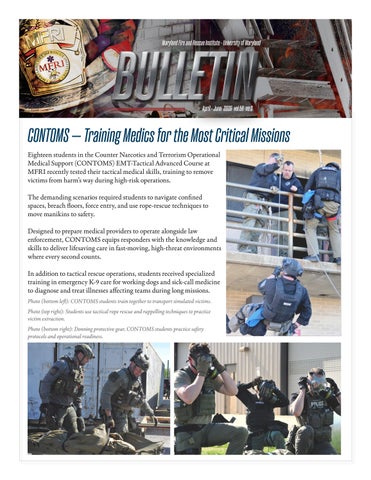
CONTOMS — Training Medics for the Most Critical Missions Eighteen students in the Counter Narcotics and Terrorism Operational Medical Support (CONTOMS) EMT-Tactical Advanced Course at MFRI recently tested their tactical medical skills, training to remove victims from harm’s way during high-risk operations. The demanding scenarios required students to navigate confined spaces, breach floors, force entry, and use rope-rescue techniques to move manikins to safety. Designed to prepare medical providers to operate alongside law enforcement, CONTOMS equips responders with the knowledge and skills to deliver lifesaving care in fast-moving, high-threat environments where every second counts. In addition to tactical rescue operations, students received specialized training in emergency K-9 care for working dogs and sick-call medicine to diagnose and treat illnesses affecting teams during long missions. Photo (bottom left): CONTOMS students train together to transport simulated victims. Photo (top right): Students use tactical rope rescue and rappelling techniques to practice victim extraction. Photo (bottom right): Donning protective gear, CONTOMS students practice safety protocols and operational readiness.
2026 April - June The Maryland Fire and Rescue Institute of the University of Maryland is the state’s comprehensive training and education system for all-hazard responses. The Institute plans, researches, develops and delivers quality programs to prepare agencies and individuals to protect life, the environment, and property. Bulletin Staff Managing Editor: Jennifer Ginn Graphics Manager: Ana Maizel Assistant Editor: Jenna Robles-Leone Contact MFRI tel: 301-226-9921 fax: 301-314-0752 www.mfri.org bulletin@mfri.org The Maryland Fire and Rescue Institute Bulletin (MFRI) University of Maryland (ISSN 1074-2298) is published quarterly by the Maryland Fire and Rescue Institute of the University of Maryland, College Park, MD 20742. Send email address changes to: bulletin@mfri.org. The MFRI Bulletin is distributed as a public service of the University of Maryland. The Bulletin is dedicated to the publication of information that will help educate its readers on the subjects of fire protection, emergency medical services, rescue, leadership, and training. This publication may contain some articles and illustrations provided by readers. MFRI does not necessarily agree with information nor endorse any products depicted in the Bulletin. The MFRI Bulletin is produced entirely in house. We extend our sincere gratitude to our contributors who make this publication possible.
Executive Director’s Message Planning for an organization’s success, especially when it spans a number of years, can be a complex undertaking. However, embarking on the process with proven strategic planning methods not only makes this exercise possible, it also helps create a roadmap to steer an organization toward meeting customers’ needs and expectations. In other words, it gives an organization a structured way to define where it wants to go, how it will get there, and how it will measure progress. It is both a decision-making framework and a communication tool that aligns people and resources around shared priorities and customer needs. On July 1, 2026, the Maryland Fire and Rescue Institute launched a new strategic plan that will guide the Institute through FY2027FY2031. This customer-centered process engaged a diverse group of students, faculty, staff, instructors, and partners through interviews, surveys, and a SWOT analysis. Their valuable feedback directly drove the development of the following strategic goals for the next five years: 1. Ensure the delivery of an effective and sustainable emergency services training system 2. Modernize and future-proof training delivery and curriculum 3. Optimize resources, logistics, and infrastructure 4. Invest in workforce development and succession planning 5. Advance student-centered and inclusive programs 6. Strengthen partnerships, advocacy, and external relations I thank all of those who contributed to this process. The time, energy, cooperation, honesty, and candor exhibited in this process reflect a shared commitment to the continued success of the Institute and to strengthening Maryland’s EMS, fire, and rescue services. Together, we have established a clear path forward that will enable MFRI to continue to provide the essential training first responders need to protect the communities they serve. Michael E. Cox Jr.
page 2
2026 April - June
First Responders from Korea Train at MFRI In June, a delegation of command-level officers, firefighters, and paramedics from Korea’s National Fire Agency traveled to MFRI headquarters to participate in a week-long Incident Command System (ICS) training program. Led by MFRI Special Programs Manager Jonathan Hart, the training was tailored to Korea’s emergency response protocols while reinforcing core incident management principles. Participants also completed two days of immersive simulation training on hazardous materials incidents, structural fires, and mass-casualty response. During their visit, the delegation also visited the College Park Volunteer Fire Department and Springdale Fire Station MFRI welcomed a delegation from Korea’s National Fire Agency to observe Maryland’s fire and rescue operations firsthand. for a week of Incident Command System training.
MFRI’s New Course Catalogs are Here! 2026 Course Catalog Whether you’re advancing your skills or planning training for your department, MFRI’s latest course catalog is now available to guide you. Explore hundreds of courses in fire, EMS, rescue, hazardous materials, leadership, and more. The catalog includes training for personnel at every stage of their careers, from foundational courses to advanced programs. With flexible scheduling and instruction from experienced professionals, MFRI offers training to help meet your organization’s evolving needs while supporting operational readiness and long-term professional development. Open the catalog here: https://www.mfri.org/coursecatalog
2026 Workplace Safety and Compliance Training Catalog MFRI’s Special Programs offers expert-led safety and emergency response training in regulatory compliance, emergency preparedness, and workplace safety. Training can be customized for private industry, corporations, and government agencies.
Special Programs trains organizations including Northrop Grumman, Johns Hopkins Applied Physics Laboratory, the U.S. Secret Service, and military bases across the country as well as first responders around the world in countries including Germany, Japan, Canada, Spain, and Italy. View the Special Programs catalog here: https://www.mfri.org/sps/coursecatalog
For more information, contact Special Programs Manager Jonathan Hart at jhart2@umd.edu. page 3
2026 April - June
Immersive Confined-Space Simulator Elevates Training at MFRI MFRI just raised the bar on training by acquiring a mobile, immersive confined-space simulator. Twenty-three feet in length, the simulator allows for vertical and horizontal entry, and features a multitude of motion-activated hazard props, sensory effects, and configurable training scenarios that replicate confined-space emergencies.
training operations in real time for enhanced instruction and post-evolution debriefings. Designed by former firefighter Chris Gantz, founder of JHB Group, the all-aluminum simulator is lightweight and can be deployed, set up, and operated by a single instructor. Solar charging, low-voltage power systems, and a dual-fuel generator allow the unit to operate virtually anywhere, making it an ideal training resource.
Advanced digital projection technology inside the simulator transforms the interior into realistic environments including a boiler room, utility vault, This state-of-the-art training prop was made possible laboratory, or aluminum construction trailer. Instructors through the Assistance for Firefighters Grants (AFG). can also simulate conditions found in manholes, grain bins, industrial confined spaces, and other challenging environments. Photo 1: MFRI’s new and mobile confined-space simulator combines Interior cameras stream live video to a large exterior monitor, enabling instructors and students to observe
motion-activated props, sensory effects, and configurable training scenarios. Photo 2: Interior cameras stream live video in real time enabling students and instructors to view training.
MFRI Introduces New Fire Dynamics and Hose Stream Training Props MFRI is enhancing firefighter education with the addition of two innovative training props designed to provide a deeper understanding of fire behavior and suppression tactics. Each of MFRI’s training centers is now equipped with
Photo: Each MFRI training center is now equipped with a Flashpoint Fire Dynamics Training Prop.
page 4
a Flashpoint Fire Dynamics Training Prop. Featuring multiple compartments with windows, doors, and roof vents, these props give firefighters a hands-on understanding of how to control fire-flow paths through realistic, scenario-based training. Firefighters can safely explore critical fire dynamics, including flow paths, basement and stairway fires, vertical ventilation, thermal ballast, the role of air in flaming combustion, and vent-point ignition. The reusable props are clean-burning alcohol-fueled scale models, that support safe indoor training. New Props continued page 11
2026 April - June
Building Rescue Readiness in Alaska This past spring, instructors from MFRI traveled thousands of miles to Fort Greely, Alaska, to deliver a physically intensive structural collapse and technical rescue training program under some of the most challenging environmental conditions imaginable. Upon arrival, lead instructor Dave Barcenas and the experienced instructional team quickly determined that students could begin training, but the instructors first had to build the training grounds. Fort Greely was heavily covered in snow and ice. Temperatures fluctuated daily, snowstorms
By MFRI Instructor Ed Rachinskas
continued for much of the first two weeks, and wind gusts regularly exceeded 50 mph. Large sections of the site had to be cleared before any practical evolutions could begin. Using excavators, bulldozers, loaders, and forklifts, instructors moved massive concrete slabs, road barriers, rubble piles, and debris materials into place to begin constructing realistic rescue environments. Additional concrete materials were recovered from surrounding landfill and rubble areas to create collapse props, breach points, confined-space lanes, and sloped floor systems.
As temperatures climbed into the 30s and 40s, thawing snow created another obstacle. Permafrost beneath the surface prevented drainage, turning the training grounds into deep mud each afternoon before refreezing overnight. Over the course of nearly two weeks of preparation, the Alaska training grounds evolved from a frozen open field into a complex, realistic, fully operational technical rescue environment capable of supporting simultaneous rescue disciplines. Despite changing conditions, instructors adapted the site daily to support rescue operations.
Photo (left and center): While teaching technical rescue and structural collapse in Alaska, the team’s training terrain changed daily with the temperatures. As the temperatures increased, permafrost prevented melting snow from draining, creating a thick covering of mud. Photo (right): Technical Rescue students were tasked with moving a 1300-pound cement slab through a complex obstacle course. Alaska continued page 8
page 5
2026 April - June
Connecting with Maryland’s Fire Service at the MSFA Convention In June, the Maryland State Firefighters Association (MSFA) held its annual convention in Ocean City, bringing together fire service professionals from across the state to conduct association business and take part in training and educational sessions while fostering collaboration and networking opportunities. As it does each year, the Maryland Fire and Rescue Institute (MFRI) staffed an exhibit booth throughout the conference, providing attendees with the opportunity to connect directly with MFRI staffers, obtain training transcripts, apply for professional certifications, and learn about upcoming courses.
According to Certification Facilitator Bob Rose, MFRI issued 330 Pro Board certifications, along with 182 concurrent International Fire Service Accreditation Congress (IFSAC) certifications. “Pro Board and IFSAC certifications verify that an individual has successfully met nationally recognized National Fire Protection Association (NFPA) standards for fire service training and testing,” said Bob. “These credentials enhance professional credibility, provide national recognition, support reciprocity and career mobility, and demonstrate a commitment to excellence in the fire service.”
Photo (top left): The MSFA Convention and Conference commenced with ceremony and tradition. Photo (top right): Certification Facilitator Bob Rose, MFRI Upper Eastern Shore Regional Training Coordinator Jack Beall, and a host of MFRI staffers prepared transcripts and certifications for convention attendees. Photo (bottom left): More than 20 educational classes and keynote presentations covered topics including the 2025 Potomac River air collision, whole blood for Maryland’s air medical response, and shipboard fires and maritime response. Photo (bottom right): A fleet of first responder vehicles welcomed firefighters from across the state.
page 6
2026 April - June
INSTRUCTOR HIGHLIGHT Recognizing excellence in fire and rescue training
RAYMOND
McRAE Battalion Chief of EMS and Training for the Annapolis Fire Department, Raymond McRae oversees EMS operations, training programs, quality improvement, recruit development, and continuing education. For more than 20 years, he has also shared his expertise as a MFRI instructor. “My passion for teaching stems from the mentors who invested in me throughout my career,” said Ray. “Fire and EMS learning heavily relies on passing knowledge between generations, and I believe it is our responsibility to prepare those who follow us. I enjoy helping students build the confidence, critical thinking, and competence necessary to safely serve their communities.”
“I am also motivated by a desire to increase diversity in the profession. Having observed a lack of representative instructors early in my career, I am committed to creating a learning environment where all students feel valued and supported,” said Ray.
“My most rewarding experiences involve seeing former students advance into leadership roles as officers, instructors, and paramedics. Knowing I played a small role in their development as they go on to mentor the next generation is incredibly fulfilling.”
Teaching management, emergency medical services, and rescue, Ray strives to create a professional, engaging, and challenging environment that emphasizes practical application and real-world problem-solving.
Valuing the opportunity to work with dedicated professionals across Maryland, Ray says that MFRI provides a unique platform for students to share experiences and learn from one another, strengthening the fire service statewide. He also appreciates the ability to engage with students from diverse backgrounds and organizations.
“My goal is to ensure students gain skills they can immediately apply in the field while maintaining high standards of personal and professional accountability.” For Ray, the greatest reward comes from watching former students grow into leaders.
When he is off the clock, Ray serves as treasurer for his homeowners’ association and enjoys traveling, experiencing different cultures, and spending time with his family.
page 7
2026 April - June
Alaska continued from page 5
One of the most innovative additions to the site was the relocation and modification of an old conex box from the firehouse. It was transformed into a realistic structural collapse prop by adding interior wall systems, truss assemblies, doorways, and window openings to simulate residential construction. Exterior reinforcement points were installed using 2x6 lumber so students could construct and secure raker shores directly against the structure during practical evolutions.
Meanwhile, the hands-on heavy lifting and moving evolutions introduced students to realistic rubble-pile operations using grip hoists, rollers, lever systems, and rigging techniques.
Students trained in: • Structural collapse operations • Shoring systems • Confined space rescue • Concrete breaching and breaking • Heavy lifting and moving operations • Search operations • Hazard recognition • Rigging and mechanical advantage systems
At the center of the evolution was a 1,300-pound concrete block that the instructors nicknamed “Big Mo.”
The breaching and breaking area became one of the centerpiece training locations. Students operated on horizontal slabs, vertical concrete walls, confined-space breach points, and angled concrete surfaces while using rotary hammer drills, concrete saws, and specialized breaking tools to create access points for simulated victim rescue.
page 8
Without access to a crane, instructors adapted by utilizing an excavator to support critical lift operations. A large rubble pile was constructed using recovered concrete slabs and debris materials to simulate collapse conditions commonly encountered during major structural failures.
Students were tasked with safely maneuvering Big Mo throughout a complex obstacle course using pipes, rollers, lever systems, grip hoists, and mechanical advantage systems. The evolution required crews to move the block under a vehicle, across trench obstacles, and through sections of the Fort Greely O-Course while maintaining load control and safe operating practices. The Big Mo evolution quickly became one of the most physically demanding and operationally realistic portions of the deployment, reinforcing the importance of teamwork, communication, planning,
and problem-solving in heavy rescue environments. The deployment coincided with a large-scale Fort Greely earthquake exercise. MFRI instructors incorporated the scenario into the training, allowing students to apply their newly developed rescue skills in a dynamic, realistic disaster environment. At the conclusion of the deployment, instructors had successfully delivered two full technical rescue programs while simultaneously overcoming extreme weather conditions, difficult terrain, logistical challenges, and an evolving training environment. What began as a snow-covered field in remote Alaska was transformed into a realistic and highly effective rescue training ground through the dedication, and adaptability, of MFRI instructional staff and students. The Alaska deployment is another example of MFRI’s commitment to delivering high-quality, hands-on rescue training—regardless of weather, or environment. Helmets off to Dave Barcenas, Ed Rachinskas, Ron Beyerlein, Rick Hartle, Robert Holmes, and Matt Brinkmann for implementing workarounds to ensure the Alaska training was successful.
2026 April - June
Matthew Briskey Earns Francis L. Brannigan Instructor of the Year Award Selected as MFRI’s 2026 Instructor of the Year, Matthew Briskey has distinguished himself in instructional delivery, program support, and service to his students and to MFRI. Since his appointment as an instructor in June of 2013, he has accumulated an exceptional total of 4,470 instructional hours across the fire, EMS, rescue, and hazardous materials disciplines. This remarkable level of service reflects not only his technical expertise but also his commitment to advancing emergency services education. Beyond the classroom, Matt serves as a mentor, instructor evaluator, Pearson VUE proctor, and hazardous materials instructor for MFRI Skills Weekends. He is widely recognized for his professionalism, dependability, and willingness to take on short-notice teaching and proctoring assignments to support program continuity and student success. Matt creates a student-centered learning environment that encourages participation, builds confidence, and promotes student success through active learning, effective questioning, and positive reinforcement. His philosophy is simple: do the work, stay engaged, absorb the knowledge, and never go through the motions. He models these principles through his preparation, professionalism, and commitment to excellence. Matt began his fire service career as an 18-year-old volunteer with the Eastern Garrett Volunteer Fire Department. He now serves with the Mount Savage Volunteer Fire Department in Allegany County. He lives in Frostburg, Maryland. Outside of the fire service, Matt enjoys motorcycling and cooking.
Seryna Weaver Selected as MFRI’s 2026 Student of the Year MFRI proudly recognized Seryna Weaver as Student of the Year at the MSFA Convention this year. Selected for her exceptional dedication and service, Seryna is a cadet with the Snow Hill Volunteer Fire Company and a stand-out student in the Worcester County Fire and EMS program. She has distinguished
herself through academic achievement, technical skills, humility, and her commitment to serving others. In every training evolution, Seryna demonstrates focused intensity and treats each exercise with the seriousness it deserves. She has transitioned into emergency services with remarkable speed, striving for mastery in both engine company operations and medical scenarios. Whether in the classroom or on the simulated fireground, she approaches every evolution as if it were a real-world incident. Her technical competence, composure under pressure, and ability to excel in leadership roles reflect the maturity and professionalism essential to success in the fire service. page 9
2026 April - June
Follow the Risk Management Policy Maryland Fire and Rescue Institute (MFRI) continues to strengthen its commitment to safety, accountability, and operational excellence through the implementation of its FY27 Risk Management Action Plan. Guided by four key objectives, the Risk Management Committee (RMC) is focused on ensuring full compliance with the MFRI Risk Management Policy while enhancing the safety and effectiveness of training programs across all six campuses and Special Programs. A critical first step in this effort is the establishment of a standardized governance structure. By September 30, 2026, the RMC will implement a unified framework that defines committee roles, responsibilities, meeting schedules, and reporting
By QA/QI Manager Michael McAdams
expectations. This structure will ensure consistency in how risks are identified, discussed, and addressed statewide, while reinforcing accountability at every level. Equally important is the development of a comprehensive risk reporting and documentation system. By March 31, 2027, MFRI will implement a standardized process that enables all campuses to capture, classify, and report risks in a consistent manner. This approach ensures that leadership has accurate and timely data to support informed decision-making and reinforces the importance of complete and reliable reporting practices. The RMC is also focused on strengthening risk oversight and corrective action management.
Through improved tracking and monitoring, the committee will emphasize timely report submission and the consistent follow-through of corrective actions within established timelines. This structured approach ensures that identified risks are not only documented but actively mitigated and resolved. Ultimately, this initiative supports MFRI’s mission by enhancing the safety of students and instructors, improving training quality, and reinforcing stakeholder confidence. By fostering a proactive, datadriven risk management culture, MFRI is positioning itself to meet the evolving needs of Maryland’s emergency services community while maintaining the highest standards of training excellence.
Training to Teach Tomorrow’s First Responders Training 20,000–30,000 first responders each year starts with exceptional instructors. During Spring Instructor Skills Weekends in April, 46 first responders gathered at MFRI headquarters to prepare for instructor roles, including 18 fire, 11 EMS, 14 rescue, and 3 hazmat candidates. Interested in becoming an MFRI instructor? Contact Todd Dyche at tdyche@mfri.org for more information. Photo (left): Fire instructor candidates practiced hose handling and ladder throws to strengthen their technical and instructional skills effectively. Photo (right): During Spring Instructor Skills Weekends, EMS instructor candidates refined their teaching skills through handson scenarios and equipment demonstrations.
page 10
2026 April - June
Employee Spotlight Stacey Gail
Stacey Gail joined MFRI as Regional Coordinator of the Northeast Regional Training Center in Edgewood. Stacey is a familiar face at MFRI, having served for many years as a Field Instructor at the Training Center in Edgewood. She brings extensive fire service experience as Assistant Chief of the Fallston Volunteer Fire and Ambulance Company and from a 33-year career with the Baltimore County Fire Department, where she joined as an EMT and retired as Captain of Station 57. Outside the fire service, Stacey is the proud parent of Seth, a science teacher, and Alex, a digital artist and content creator. A lifelong horse enthusiast, she is also dedicated to the sport of jousting and is a past Semi-Professional State and National Jousting Champion.
Michael Schaefer
Michael recently joined MFRI as Regional Coordinator for the Southern Maryland Regional Training Center in La Plata. A longtime member of the MFRI instructional team, Mike has contributed more than 1,000 hours of instruction over the past 25 years. He is also an active member of the College Park Volunteer Fire Department. Mike retired as a Supervisory Branch Chief with the Bureau of Alcohol, Tobacco, Firearms and Explosives (ATF), following a distinguished career that included service as a Senior Chief Petty Officer in the U.S. Navy and U.S. Navy Reserve. He brings extensive leadership experience, expertise in multi-agency coordination, and a strong commitment to safety, compliance, and operational excellence. New Props continued from page 4
In addition, MFRI instructor Ed Rachinskas, pictured, is building
transparent hose stream props based on designs from UL’s Fire Safety Research Institute (FSRI). The props help firefighters visualize water movement, stream deflection, and air entrainment to enhance fire suppression tactics and fireground decision-making.
of company officers. It provides a great visual aid to demonstrate how varying suppression tactics move air about a structure and how the water coats the building surfaces and burning materials,” said Keith Stakes, research engineer at UL’s FSRI.
“This innovative, hands-on training prop can be incorporated into fireground suppression training at any level—from the newest of recruits to the most experienced
Once completed, hose stream props will be available for training at MFRI headquarters and MFRI’s Southern Maryland and Northeast regional training centers. page 11
2026 April - June
Maryland Fire and Rescue Institute Presents
In Honor of the Charleston 9— A Study of Change Following Tragedy October 17, 2026 from 9:30 a.m.-1:00 p.m. DoubleTree Annapolis, 210 Holiday Court Annapolis, MD 21401 Attendance is Free for First Responders Program Details: On June 18, 2007, nine Charleston firefighters lost their lives battling a furniture warehouse fire on record as one of the deadliest firefighter tragedies in recent U.S. history.
Drawing from his firsthand experience as the operator of the first-due engine, Dr. David Griffin shares the lessons learned from that day and examines how tragedy became a catalyst for change within the Charleston Fire Department. Through his compelling first-hand account of the crisis, extensive research, and leadership insights, attendees will explore organizational culture, crisis response, resilience, and accountability. Dr. Griffin highlights the changes born from this tragedy and the lasting impact they have in shaping modern fire service operations. Dr. David Griffin recently retired as Assistant Chief of Administration in Charleston, South Carolina. He speaks internationally and annually at MFRI’s Staff and Command course. Register today: www.mfri.org/course/seminars/ SEM/160/S001/2027/
For more information on MFRI classes and events www.mfri.org