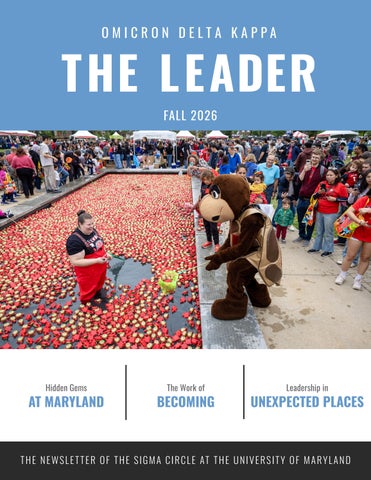
OMICRON DELTA KAPPA
T HE L E ADER FALL 2026
Hidden Gems
AT MARYLAND
The Work of
BECOMING
Leadership in
UNEXPECTED PLACES
T H E N E W S L E T T E R O F T H E S I G M A C I R C L E AT T H E U N I V E R S I T Y O F M A R Y L A N D
1 | ODK Sigma Circle THE LEADER
MESSAGE FROM THE PRESIDENT Greetings, Sigma Circle! My name is Latrell Cook, and I’m humbled to serve as the President of Omicron Delta Kappa for this year. I’m a senior pursuing a dual degree in Biological Sciences (Physiology and Neurobiology) and Psychology with a minor in Humanities, Health, and Medicine, on the MD-PhD track. Since being inducted in Fall 2024, Omicron Delta Kappa has been central to my student experience. From wading in the fountain at Maryland Day 2025 to congratulating my peers during Tapping Week to presenting awards to student leaders at the 2026 University Awards Banquet, Omicron Delta Kappa has strengthened my confidence, and I look forward to building on that growth through my commitment to our circle this year. Last year, as Digital Communications Chair, I connected with many inducted members through our media platforms and built a strong bond with other executive board members. As President, I hope to build on last year’s successes and cultivate an environment that strengthens our connectedness as an organization for years to come. Congratulations to all the students who will be nducted this fall! We are ecstatic to have you formally in the Sigma Circle, and we look forward to welcoming you into our community. 2027 marks the Sigma Circle’s centennial celebration, during which we’ll celebrate 100 years of academic achievement, student advocacy, community engagement, mentorship, and scholarship. As we continue to recognize more dedicated student leaders at the University of Maryland, it’s inspiring to see how diverse, talented, and collaborative our organization has become. Each of us embodies a unique approach to leadership that will help shape the world for the better over the next hundred years. We’re looking forward to celebrating throughout the coming year and hope many of our ODK leaders from years past will be part of it. I want to recognize my fellow executive board members and our Sigma Circle Co-Coordinators, Sarah Williamson and Dr. James McShay. We have a terrific team that makes the Sigma Circle such a strong organization, and I’m very lucky to have talented colleagues and supportive mentors. I also want to give special thanks to our Public Relations Chair, Braylen Haynes, for his remarkable work in spearheading the production of The Leader this year. Thank you all for checking out this semester’s edition of The Leader. Our accomplished members offer different perspectives on leadership-related topics. I’m always inspired by reading my peers’ submissions, and I’m sure you will be as well. We hope you learn a thing or two from our writers’ wise words. Enjoy :) Best, Latrell Cook ODK Sigma Circle President
ODK Executive Board 2026-2027 Latrell Cook President Madeline Loughlin Vice President Sarah Otwey Alumni & Member Engagement Chair Kian Mercado Philanthropy & Community Service Chair
Taryn Reinhart Events & Lectures Chair
Emma Jamka Historian
Tracy Ly Membership & Induction Chair
Dr. James McShay Circle Co-Coordinator
Leah Han
Sarah Williamson Circle Co-Coordinator
Recruitment & Community Outreach Chair
Braylen Haynes Public Relations Chair Mohe Edeen Abu Maizer Digital Communications Chair
THE LEADER ODK Sigma Circle | 2
MESSAGE FROM THE CIRCLE COORDINATORS Dearest ODK Members, Fall at the University of Maryland brings a special kind of energy to College Park. Campus is once again filled with students returning to familiar traditions, discovering new opportunities, and finding their place within the Maryland community. For the Sigma Circle, it is also the beginning of another exciting year of recognizing and celebrating leadership across our campus. This semester, nearly 200 students applied for membership in Omicron Delta Kappa, a powerful reminder of the depth of leadership, service, scholarship, and involvement among Maryland students. As our members came together to select the next class of inductees, we were reminded of the important responsibility we share in recognizing those who exemplify ODK’s values and will help carry the Sigma Circle forward. During our selections event, 73 students were chosen for membership, one of our largest induction classes in recent years. This fall, the Drury G. Bagwell Lecture Fund helped make it possible for the Sigma Circle to partner with Student Entertainment Events to bring actor and comedian Lamorne Morris to campus. The fund continues to create opportunities for ODK to support engaging programs that bring the Maryland community together and extend learning, conversation, and connection beyond the classroom. Fall also gives us an opportunity to reconnect. Whether through campus programs, circle traditions, alumni engagement, or the stories shared in The Leader, we continue to see the many ways ODK brings together generations of Terps who have made an impact at Maryland and beyond. We hope our alumni will continue to stay connected, share updates with the circle, and keep their information current through MyODK. This year carries added significance as we look toward an important milestone. In 2027, the Sigma Circle will celebrate its 100th anniversary at the University of Maryland. Nearly a century of students, faculty, staff, and alumni have shaped the history of our circle, leaving behind traditions and examples of leadership that continue to influence who we are today. As we approach our centennial year, we look forward not only to celebrating that history, but also to reconnecting with the people who have been part of it. There will be much more to share in the months ahead as we prepare to honor 100 years of leadership, fellowship, and service at Maryland. If you are interested in submitting a favorite ODK memory, tradition, story, photo, or reflection, we would love to hear from you. Your contributions will help us celebrate the people and experiences that have shaped the Sigma Circle across generations. We hope you enjoy this fall edition of The Leader and the stories that reflect the remarkable people who make up the Sigma Circle community. Thank you for continuing to be part of ODK at Maryland and for helping us carry our legacy into the next century. Warmly, James McShay & Sarah Williamson ODK Sigma Circle Co-Coordinators
MEET THE EXECUTIVE BOARD Hello everyone, my name is Latrell Cook, and I’ll be serving as President of Omicron Delta Kappa this school year! I’m a senior from Gwynn Oak, Maryland, pursuing a dual degree in Biological Sciences (Physiology and Neurobiology) and Psychology, with a minor in Humanities, Health, and Medicine, on the pre-medical (MD-PhD) track. Outside of ODK, I serve as a Student Coordinator for the CMNS Peer Mentor Office and participate in the Biology Honors Program. I also conduct research in the Araneda Lab, primarily investigating how social isolation affects neurogenesis in the olfactory bulb. I am an alum of College Park Scholars’ Civic Engagement for Social Good program, a Resident Assistant Team Lead for Johnson-Whittle Hall, a Teaching Assistant for FGSM320/ HNUH328T (Public Health Policy), and a MARC NIH Scholar. I also studied abroad in São Paulo, Brazil, and interned with the Maryland Department of Labor, Family and Medical Leave Insurance Division earlier this year. I’ve recently become passionate about public health and medicine, which has inspired me to pursue an MD-PhD. I’m very interested in studying how social factors contribute to the development of neurologic and psychiatric illnesses, and using research to inform health and social policies that improve health outcomes for medically underserved populations. Outside of academics, I love photography, concerts, visiting national parks, watching the Baltimore Ravens, and reading novels. My current read is Braiding Sweetgrass by Robin Wall Kimmerer! Favorite Place on Campus: Washington Quad Current Favorite Song: “The World Keeps Spinning” — Alemeda & Fousheé
Hi! My name is Madeline Loughlin, and I am delighted to be serving as the current Vice President of the Sigma Circle. I am a senior from Annapolis, Maryland, pursuing a degree in Biology, with minors in Vocal Performance and Health, Humanities and Medicine, on the pre-medical track. At the University of Maryland, I am passionate about
building meaningful campus connections through leadership, mentorship, and interdisciplinary learning. Through my internship at the Joint Institute of Food Safety and Applied Nutrition, I contribute to research projects at the FDA. I also serve as a CMNS Peer Mentor, where I support students navigating academic and personal transitions within the College of Computer, Mathematical and Natural Sciences. Beyond the classroom, I am the founding Vice President of Programming for Brighter Bites Champions at UMD, a member of the University Chorale, and a proud intramural athlete. In my free time, I enjoy experimenting with new recipes, running, and hosting spontaneous musical theatre karaoke sessions with my friends in ESJ lecture halls. In the future, I plan to take a gap year working in a clinical setting while applying to medical school! Favorite Place on Campus: Michelle Smith Performing Arts Library Current Favorite Song: “4Me 4Me” — Malcolm Todd Hello! My name is Sarah Otwey, and I am so delighted to be serving as this year’s Sigma Circle ODK Alumni & Member Engagement Chair! I am a senior from Hagerstown, Maryland, double majoring in Public Health Practice and Government & Politics. My time here at the University has been nothing short of amazing! As an honors student in the Gemstone Honors Program, I have been able to directly impact my campus community through a wide variety of rewarding experiences, including serving as a teaching assistant for the Gemstone Program and the Government & Politics Department. I have also guided, pun intended, fellow and prospective students through my time serving as a peer mentor with the Office of Multiethnic Student Education’s Sister2Sister program, Gemstone’s Connect Mentor and Camp programs, and as a UMD Terp Tour Guide. A major focal point woven throughout both my academics and campus activities is the importance of diversity, equity, and inclusion. This is reflected in my service on
THE LEADER ODK Sigma Circle | 3
the School of Public Health Dean’s Student Council, the Undergraduate Studies Dean’s Student Advisory Council, and as Gemstone’s Co-Director of the Diversity, Equity, and Inclusion Committee. The resources and support I have received have allowed me to further DEI efforts across the University System of Maryland as Co-Director of DEI with the USM Student Council. When I am not in meetings or in class, you can find me on the Metro to D.C., reading a good book, baking a new dessert, or visiting family and friends! After graduation, I plan to pursue a master’s degree to further my career in the field of public health. Favorite Place on Campus: McKeldin Library Current Favorite Song: “Stateside (Remix)” — PinkPantheress & Zara Larsson
Human Development.
Hi everyone! I’m Kian Mercado, and I am honored to be serving as the Philanthropy & Community Service Chair of the ODK Sigma Circle this year. I am a senior from Rockville, Maryland, pursuing dual degrees in Biochemistry and Neurobiology & Physiology, with minors in General Business and
Throughout my time at UMD, I have been fortunate to be involved in a variety of activities that engage both the community and the diverse student body on campus. As a student in the Integrated Life Sciences (ILS) Honors Program, I explored my passion for mentorship as a CoLead for the First-Year Experience Committee and as a Peer Mentor for incoming first-year students. I have also had the opportunity to serve as a CMNS Ambassador and an undergraduate teaching assistant for a molecular neuroscience course. In addition, I have been heavily involved in the pre-medical fraternity Phi Delta Epsilon, previously serving as both Recruitment Chair and Programming Chair. While my on-campus activities continue to enrich my experience in student engagement and mentorship, my activities off campus fuel my passion for medicine and patient interaction. I am grateful for the opportunity to connect with patients as a part-time medical scribe at an orthopedic clinic in Rockville. Additionally, I conduct research on traumatic brain injury and its effects on the body at the Uniformed Services University. After graduation, I plan to attend medical school and pursue a career as a physician. When I’m not in a lab,
4 | ODK Sigma Circle THE LEADER
clinic, or classroom, you can find me lifting weights at the gym or running around Lake Artemesia. When it gets late at night, one of my favorite things to do is try out new recipes. Favorite Place on Campus: First Floor, ESJ Current Favorite Song: “FE!N” — Travis Scott
Hi! I’m Taryn Reinhart, and I am honored to serve as the Events & Lectures Chair of the ODK Sigma Circle this year! I am a junior from Annapolis, Maryland, majoring in Public Policy with a minor in Disability Studies, and I’m in the Gemstone Honors Program on the pre-PhD track. So far at UMD, I have had the opportunity to participate in a range of mentoring and student support experiences in academics, including serving as a teaching assistant for the Gemstone Program and the School of Public Policy. I have also served as a tutor for first-generation, low-income students, a GEMS Connect Mentor, a Camp Leader, and a peer mentor for the Office of Undergraduate Research. Outside of academics, I prioritize advocacy, which I have pursued through serving as the Director of Academic Affairs for SGA, participating in the Undergraduate Studies DSAC and the Digital Accessibility Advisory Committee, and contributing to various University Senate committees and working groups. My passions lie in making UMD more accessible for all students to fully engage. I have also held several internships throughout my time at UMD, including my current position within the University Senate Office. When I’m not writing policy memos or working, you can most likely find me going on a run from College Park to D.C., curating playlists, cooking, or at least attempting to, for my friends, calling friends and family from home, reading all types of books, or attending UMD sporting events with my friends. Go Terps! After graduating with my B.A., I plan to stay at UMD for one more year to earn my Master’s in Public Policy, with a focus on special education policy. Favorite Place on Campus: Thurgood Marshall Hall Current Favorite Song: “All Too Well (10 Minute Version)” — Taylor Swift
Hi! My name is Tracy Ly, and I am excited to serve as the Membership & Induction Chair of the ODK Sigma Circle this year! I am a senior from Ellicott City, Maryland, majoring in Biological Sciences with a minor in Sociology, and I am on the pre-medical track. Throughout my time at UMD, I have had the opportunity to explore my interests in leadership, mentorship, and service through a variety of campus organizations. As a student in the Integrated Life Sciences Honors Program, I serve as an ILS Mentor, Academic Advisor, Teaching Assistant, and member of the Community Leadership Council. I am also a CMNS Recruitment Ambassador, Honors College Ambassador, and Student Ambassador for the Health Professions Advising Office. Beyond academics, I serve as Vice President of the Student Health Advisory Committee, where I work to represent and advocate for student health and well-being on campus. I also serve as the Social & Publicity Chair for Club Figure Skating, where I help plan social events and build community among skaters both on and off the ice. Additionally, I volunteer with the Latino Student Fund, where I mentor and tutor students from the Prince George’s County community. After graduation, I plan to attend medical school and pursue a career in medicine. In my free time, you can usually find me at the ice rink, exploring D.C., or listening to music! Favorite Place on Campus: Van Munching Hall Current Favorite Song: “Start Over” — 5 Seconds of Summer Hi! My name is Leah Han, and I am excited to serve as the ODK Sigma Circle’s Recruitment & Community Outreach Chair this year. I’m a senior from Ellicott City, Maryland, majoring in Physiology and Neurobiology with a minor in Humanities, Health, and Medicine. Many of my activities have grown from the intersection of my fascination with the brain and the sociocultural factors that shape health. As a Lead Undergraduate Research
Assistant in the Neurocognitive Development Lab, I assist with infant MRI scans involving high-risk mothers to collect developmental neuroimaging data. I also serve as President of UMD’s chapter of Hearts for the Homeless, an OMSE Peer Tutor for the College Success Scholars Program, and Education Chair of Delta Epsilon Mu. My past experiences include mentoring middle school students with Maryland Mentor Corps Higher Achievement, serving as Community Service Chair of UMD’s American Medical Women’s Association, and completing the Integrated Life Sciences Honors Program. While my academic and professional experiences continue to deepen my interest in medicine, I am also always looking for ways to explore my creative and introspective side. I love both creating and experiencing different forms of art and have been fortunate to translate this passion into leadership opportunities through The Pulse: Humanities, Health, and Medicine Journal, where I serve as Vice President, and Grey Matters Journal, where I am a member of the Production Team and contribute as an artist. Outside of school, you can usually find me on a run or fueling up on caffeine with a friend. As an aspiring physician, I hope to attend medical school and explore translational research after graduation. Favorite Place on Campus: Art-Sociology Building (studios, library, courtyard) Current Favorite Song: “Common Burn” — Mazzy Star
Hey everyone! My name is Braylen Haynes. I am your Public Relations Chair, and I am a junior from Fort Washington, Maryland, majoring in Neuroscience on the premedical track. So far, in my two years on campus, I have been very active in my Living and Learning Program, BioFire, where I have served as both a Peer Mentor and a member of the Advisory Council. I have also spent significant time conducting biomedical lab work through the program. In addition, I spent the previous summer working at the University of Maryland School of Medicine, where I focused on research related to neuroimmunology. Currently, I serve as Vice President and Secretary for the Iota Zeta Chapter of Alpha Phi Alpha Fraternity, Inc., which is based here at the University of Maryland. Our organization focuses on community service, academic
THE LEADER ODK Sigma Circle | 5
excellence, leadership development, and brotherhood. When I am not working with my fraternity, completing responsibilities for ODK, or buried in my books, I work at one of our South Campus facilities here at UMD. In the near future, I hope to perform well on the MCAT and, from there, prepare to submit medical school applications. I hope to attend either the University of Maryland School of Medicine or Howard University College of Medicine. Favorite Place on Campus: McKeldin Mall (Shoutout ODK!) Current Favorite Song: “Some of You Love” — PARTYNEXTDOOR
Hello! My name is Mohe Edeen Abu Maizer, and I am happy to be serving as ODK’s Digital Communications Chair this year! I’m a senior from Amman, Jordan, double majoring in Computer Science and Applied Mathematics with a minor in Quantum Science. Around campus, you can usually find me doing something related to technology, research, or teaching. I served as Tech Director for Bitcamp, the largest collegiate hackathon on the East Coast, and I was also involved with App Dev Club, where I worked on the Amazon Kuiper and Children’s National Hospital teams. In the past, I spent time with Do Quantum conducting machine learning and quantum computing research, and I previously worked on climate computing research at UMD. These days, you can probably find me teaching CMSC131, conducting quantum computing and biocomputing research in the Physics Department, working on Jupiterp, or spending time at Startup Shell on 3D modeling passion projects. I’m still figuring out what I want to do after graduation, whether that means entering the workforce or pursuing a master’s degree in quantum computing. If you ever want to talk about computer science, quantum computing, research, 3D modeling, or anything in between, feel free to come say hi! Favorite Place on Campus: Reading Room, McKeldin Library Current Favorite Song: “Port Antonio” — J. Cole
6 | ODK Sigma Circle THE LEADER
Hi! My name is Emma Jamka, and I’m excited to serve as the Historian of ODK this year. I’m a senior from Baltimore, Maryland, majoring in Human Development. Throughout my time at UMD, I have been involved in the Gemstone Honors Program, first as an undergraduate researcher. Since then, I have had the opportunity to support curriculum development, mentor underclassmen, and serve as a Teaching Assistant, guiding students as they navigate the team research process. I am also involved in service both on campus and in the local community. I serve as an Experience Leader for the university’s Alternative Break trip to Camp Royall, the country’s largest camp for people with autism. In this role, I oversee trip logistics and facilitate discussions that help the team critically reflect on their experiences at camp. Through Terps for Change, I have tutored local elementary school students, planted native species in campus gardens, and harvested produce at Terp Farm to help supply the UMD Campus Pantry and Dining Services. In addition to volunteering, I help train student leaders in the service office. As a campus tour guide and Honors Ambassador, I draw from my own experiences to give prospective students a glimpse into life at UMD. After graduation, I hope to attend medical school. In my free time, you can find me experimenting with a new dessert recipe, spending time with my dogs, or searching for the best spots to take a nap. Favorite Place on Campus: Second Floor of McKeldin Library Current Favorite Song: “Drop Dead” — Olivia Rodrigo
I gradually took on more responsibilities: mentoring, becoming a teaching assistant, and supporting curriculum development efforts. I did not pick the program looking to teach future students about research or support freshmen through the transition to college; I just thought it sounded interesting.
FINDING LEADERSHIP WHERE YOU LEAST EXPECT IT By Emma Jamka ‘27
Think back to when you first stepped on campus, a terrified freshman just trying to get involved. We can probably all remember the pressure to join as many clubs as possible in order to meet new people and start to make a mark on campus. With so many opportunities, it can be hard to know where to start or which ones may become the most meaningful to you. I’ve found that all you need is a small spark of interest or an impromptu commitment, and those opportunities often end up shaping you. I knew I wanted to volunteer, so as an oblivious freshman, I signed up for probably every service club. The servicelearning office turned out to be a good place to start. I began volunteering weekly with Terps for Change, tutoring elementary schoolers at the local library. As the semesters progressed, I sorted produce at the Campus Pantry, harvested crops at Terp Farm, and weeded gardens around campus. My time in the service-learning office didn’t stop there. I signed up for an Alternative Break trip to North Carolina because it looked interesting. I had no idea I would end up leading three more trips, spending my spring break with the same community partner year after year. Then there was Gemstone, my honors program. When opportunities to get more involved began to circulate freshman year, I contemplated applying. I knew I still wanted to engage with the community as I got older, and I figured that I would probably regret it if I did not apply. So,
What I didn’t realize was that showing up in these spaces as a freshman would lay the foundation for my leadership development. As I became more involved in Terps for Change, I transitioned from volunteering at sites to leading them. I learned how to build genuine, sustainable relationships with community partners and support participants in their volunteer journeys. Now, as I lead trainings for student coordinators, I get to pass on the facilitation techniques I have learned along the way. Similarly, leading a service trip has taught me the power of continuity between leaders. Returning to the same community partner year after year has shown me how valuable it can be to build relationships with the same faces; we do not need to start over each year. And through Gemstone, I have learned how to guide and foster relationships with new college students as they navigate experiences that were once also new to me. I did not join any of these organizations looking for leadership or a title. I wanted to learn, connect with fellow students, and volunteer around College Park. Looking back, these experiences have taught me that leadership is a different journey for everyone. Sometimes, it just starts with an interest that causes you to keep showing up. Now, three and a half years later, I cannot imagine what college would have looked like without these experiences. My advice is simple: choose a few opportunities because you have a genuine interest, not because you think they will sound good or lead to a leadership position. You do not have to know what type of leader you want to be. Give yourself a chance to be a participant, learn from leaders around you, and identify where your passions lie before worrying about obtaining a leadership position. You may find that the experiences you least expected are the ones that show you where you can make a difference and help shape your leadership development the most.
THE LEADER ODK Sigma Circle | 7
THE 5-9 AFTER THE 9-5 OF A LEADER: WHAT DRIVES OUR LEADERS’ AMBITION By Kian Mercado ‘27
More often than not, we all find ourselves engulfed in times, dates, deadlines, meetings, and, most notably, the colors of our Google Calendars. For leaders, this is no different. For our student leaders, on top of balancing their academics, they constantly push themselves to engage in all facets of student life. From leading organizations that serve the homeless to balancing research, teaching, and campus leadership, one has to wonder how these extraordinary college students stay motivated. To understand what keeps our leaders motivated and level-headed through it all, I spoke with ODK President Latrell Cook and Recruitment & Community Outreach Chair Leah Han and learned how they make time to recharge despite their busy schedules.
Behind the Scenes: How Our Leaders Recharge The daily lives of our student leaders are action-packed, but despite it all, they still find time to take care of themselves and enjoy activities they love that help them recharge. Here are just a few statements from our ODK Officers: ODK President Latrell Cook places emphasis on self-care and intentionally blocking off time to put himself first. He states that he viewed activities like “going to the gym and
8 | ODK Sigma Circle THE LEADER
working out” as being just as essential as getting homework done. In addition to prioritizing his health, Latrell makes sure he invests in hobbies like going to Ravens games, going to concerts and exploring Washington, D.C. with his friends as a way to de-stress outside of his duties as ODK President and a Resident Assistant. To Latrell, moments like these are essential as he “never regrets going to them but always regrets missing out.” ODK Recruitment & Community Outreach Chair Leah Han juggles everything from leading Hearts for the Homeless to serving as Education Chair for the University’s all-inclusive pre-health fraternity. However, she makes time for her friends, whether that means watching a movie or going to a café. Additionally, you can catch Leah with a book in her hand or getting her miles in running around campus. To Leah, these aren’t just fun activities; they are crucial in allowing her to come into each of her commitments with a clear mind, ready to tackle any task. As the ODK Philanthropy & Community Service Chair, I am no stranger to demands and stresses that come with being a leader across campus. However, like many of our other leaders, I cannot serve to the best of my ability without the hobbies and interests that I prioritize. When I’m not walking around a classroom as a teaching assistant or doing research, you can find me in the kitchen trying new recipes. Food is my biggest passion, and being able to do something hands-on is the perfect way to recharge my energy. You might also find me at The Anthem, Capital One Arena, or The Fillmore attending a concert late at night. On a day-to-day basis, you can find me in the gym on the treadmill or lifting weights when I’m not in class. For me, these activities are all necessary so I can give my best to the people I’m committed to serving. Recharging to Lead Ultimately, being a leader isn’t simply about showing up for the people you have committed yourself to; it is also about showing up for yourself as well. Whether it is attending a concert, working out, cooking new recipes, or exploring new places, our leaders show that our hobbies are just as important as the commitments themselves. While the “9-5” may be filled with meetings, deadlines, and other responsibilities, it is the “5-9” that gives us the opportunity to recharge, reconnect, and, more importantly, remember the passions that drive us in the first place. By prioritizing ourselves, we aren’t stepping away from leadership; we are preparing ourselves to serve with greater energy, purpose, and passion.
LEADERS IN POP CULTURE By Sarah Otwey ‘27
When you think about a leader, what’s the first image that populates your mind? Let me guess: a stuffy official who led a country during a tough time. But don’t be fooled, or limited, by this belief. Leadership and its torch-bearers go beyond the nonfiction world and can also be found within the realm of pop culture. Leaders in pop culture can range from your favorite medical drama to the Marvel universe, but they each share an important characteristic: they recognize that they are human first, meaning they will make mistakes, struggle, and sometimes bump heads with those around them, but they always learn from those experiences and use them to become better leaders in the end. With that said, let’s take a look at these leaders in pop culture! Starting off with my personal favorite, Elle Woods (Legally Blonde) Blonde, fashionable, and tenacious, Elle Woods showcases leadership, especially female leadership, in a bold and unique way. As president of the CULA’s Delta Nu chapter, she didn’t lead her sisters with an iron fist; rather, she shined through vulnerability, confidence, and a bright personality. Her leadership extended beyond her chapter house and into the courthouse. When Elle set her sights on Harvard Law School, she faced it with confidence in herself and her abilities, and, above all, she made sure to include her friends in her experience. Oftentimes, when we see leadership portrayed in the media or even in our own leadership journeys, it is easy to become accustomed to shutting people out in order to focus on that specific leadership obstacle. Rather, Elle Woods did the opposite and invited other voices to help her with her journey. In law school, she continued to grow in her leadership skills by believing in herself, taking risks, and staying true to her values, like animal advocacy. Elle Woods shows us that leaders and leadership can be relational, bubbly, and fashionable! Next up, Captain Raymond Holt (Brooklyn Nine-Nine) In contrast to Elle, Captain Holt doesn’t come off as exuding a bright, bubbly personality; rather, he showcases his personality through wry and distant interpersonal
connections. However, don’t let that write him off. To me, Captain Holt showcases how introverted people can still be strong leaders without an overtly extroverted personality. Captain Holt’s leadership is spotlighted through his empathy and closeness to his team. He demonstrates this by knowing each of their strengths and weaknesses and utilizing them to help them further their goals. Oftentimes, introverted leaders rely on observation, and Captain Holt’s leadership shows how observation can be an effective leadership tool. Captain Holt reminds us that all personality types can be leaders, but what matters is how you showcase that leadership to those around you. Ensure that you lead with true empathy and respectful consideration of the people you lead. This next captain goes out to all my Trekkies out there: Captain Jean-Luc Picard (Star Trek) Both Captain Holt and Captain Picard have some things in common beyond being influential captains. Their leadership styles emphasize empathy and its importance in how one leads. In a nonfictional sense, many traditional leaders may shy away from empathy under the impression that it makes them appear weak or permissive. Captain Picard shows why that mentality may not be as effective as one might assume. Captain Picard took the initiative to learn Tamarian, helping him to build trust and to not be seen as a threat. One factor of Picard’s leadership that is especially relevant today is the mindset of diversity in leadership. Captain Picard learned Tamarian and learned the cultural respect practices of the Klingons. If he refused to incorporate diversity into his leadership style, how far would that have gotten him? A major takeaway from Captain Picard’s leadership is for leaders to recognize that diversity and empathy are strengths, not weaknesses!
THE LEADER ODK Sigma Circle | 9
These two unlikely friends highlight the importance of never giving up, Sully and Mike (Monsters University / Monsters, Inc.) James P. “Sully” Sullivan and Mike Wazowski, better known as Mike and Sully, don’t start out as friends and, unlike Elle Woods and her friends, actually do everything in their power to stay apart and compete with one another. They eventually put aside their differences and take the Oozma Kappa Fraternity by storm. Unfortunately, this same level of determination did not help them academically, and they were expelled (that’s one thing not to take from their leadership). Yet still, they were unshaken. Recognizing that they were better together than apart, Mike and Sully worked their way up from the mailroom of Monsters, Inc. to its top scarers and eventual CEOs. Mike and Sully’s experience as leaders did not come from directly starting off in leadership roles, but rather in their unbreakable bond and belief in themselves and one another. They teach us an important lesson in leadership: never give up.
is an important characteristic to have in order to be a good leader. All these leaders share valuable leadership qualities in common, but a piece of advice often attributed to Kermit offers current, future, fictional, and nonfictional leaders a fitting reminder: “Here’s some simple advice. Always be yourself. Never take yourself too seriously. And beware of advice from experts, pigs, and members of Parliament.”
THE QUIET WORK OF BECOMING By Leah Han ‘27
“And it’s inside myself that I must create someone who will understand.” I let Clarice Lispector’s reflection marinate in my mind; as I look into myself, I determine that all of my most fulfilling experiences grew from passions and interests I delicately carried with me. I have returned to her words more than once, usually when I am trying to understand what it means to become a person rather than simply accomplish things. There is a strange ease with which ambition can convince us that our lives are measured by what we produce: the degree we earn, the organization we lead, the research we publish, the positions we hold. We become fluent in describing what we have done. We become less practiced at asking who we are becoming. When I look back at the experiences that have made me feel most like myself, many of them seem almost impractical. The first oil paintings I made in an art classroom, or the afternoons I spent experimenting with mixed media. The books I picked up simply because a sentence on the back cover made me curious, and the visual pieces I eventually created to accompany neuroscience articles. None began as an exercise in leadership, nor did they need to become anything more than an expression of curiosity.
Last but certainly not least, Kermit the Frog and the Hensons (The Muppets) UMD alums Jim and Jane Henson set creativity alight through the creation of the Muppets, gracing television with the presence of Kermit the Frog. Jim and Jane’s leadership made use of creativity and the arts through innovative puppeteering techniques and through their continued alumni efforts within UMD’s art departments. Their legacy lives on through the Muppets, where we see Kermit the Frog’s leadership shine. In my eyes, Kermit is the culmination of all these great leaders combined. As the producer of The Muppet Show, Kermit handles all the backstage chaos and obstacles that may arise with the same empathy, confidence, and tenacity, all while embracing the diverse experiences and backgrounds of the rest of the Muppet Show cast. Kermit welcomes and embraces inclusion and recognizes that it
10 | ODK Sigma Circle THE LEADER
And yet, I think these are some of the places where I have learned the most about leading. Perhaps this is because leadership begins long before anyone calls us a leader. It begins in the quieter work of becoming: learning what catches our attention, what moves us, what we create when no one asks us to, and what questions we are willing to follow simply because we do not yet know the answer. The Life Beyond the Resume There is a particular kind of restlessness that comes with ambition. When we spend our days pursuing difficult things, it can become tempting to make every part of ourselves useful. This can mean attending class to advance a career, volunteering to learn a skill, learning a hobby to gain a talent, seeking opportunities to reach new accomplishments.
I understand this impulse because I have lived it. There are seasons when my calendar feels like a carefully packed suitcase, every hour assigned somewhere. In those moments, the things I once did simply because I enjoyed them can begin to feel frivolous. Why paint when I could be studying? Why read something unrelated to my field when I could be learning something “useful”? Why spend an afternoon wandering through an idea when there is always another task waiting? But I wonder if this train of thought asks us to become too narrow a version of ourselves. If every interest must justify its existence through productivity, we risk becoming excellent at accomplishing things without ever asking whether those accomplishments are helping us become the people we want to be.
Over time, my curiosity moved beyond personal pieces. I began experimenting with mixed media and eventually found myself incorporating visual art into my interest in neuroscience. Scientific ideas that once existed as dense paragraphs could become illustrations, compositions, or visual metaphors. I realized that I was not simply interested in making things beautiful. I was interested in making things understandable. Over time, through practice and error, I came to appreciate one of the gifts of having a hobby: it teaches us things about ourselves before we even realize we are learning them. Art feeds my creative expression. It taught me patience before I ever had a reason to call myself patient. It taught me to tolerate imperfection, to experiment without knowing the outcome, and to look closely enough to notice what I had previously overlooked. Most importantly, it taught me that there is rarely only one way to look at something. Leadership, too, is a creative act. There is no universal composition for a group of people, no single brushstroke that will bring everyone into harmony. We work with different personalities, histories, expectations, and points of view. We experiment. We revise. Sometimes we begin again. The leader, like the artist, must learn to create without always knowing exactly what the finished picture will look like.
This reveals a quiet contradiction of leadership. We spend so much time learning how to guide others that we can forget that we are also responsible for guiding ourselves. Making Something Out of Nothing For me, art has always been one of the places where this internal work becomes visible: a vessel for my surges of creative expression and desire for meticulous control. With oil painting, I learned slowly how much patience a canvas demands. The final painting rarely looks like what I imagined at the beginning. Colors mix differently. An uncooperative brushstroke breaks my intentionality. A finished section looks far from it the next day. The process is an exercise in control, but also in surrender: knowing when to manipulate an image and when to let it become something different from what I intended.
The Trouble with Consuming Yet there is another tension I continue to wrestle with: the balance between creating and consuming. When I feel as though I am being chased by time, I often respond by consuming more of the world around me. I read other people’s words. I look at other people’s art. I listen to other people’s music. I scroll through the fragments of other people’s lives. It can feel comforting to absorb what others have made, as though watching enough of life might compensate for the feeling that my own is moving too quickly. Sometimes it does. But when I am most overwhelmed, I realize that creating is exactly what I need. Creation forces stillness. It asks me to stop watching and begin participating. It asks me to decide what I think, how I feel, and what I can make of the raw materials around me. James Baldwin wrote that “all art is a kind of confession, more or less oblique.” I love the idea that creating
THE LEADER ODK Sigma Circle | 11
something is, in some way, a conversation with ourselves. We reveal something before we necessarily find the words to articulate it. I think that leadership requires a similar willingness to look inward. Before we can ask others to trust our direction, we have to understand what is directing us. Prior to inviting others to contribute their ideas, we have to know whether we are genuinely curious about ideas that differ from our own. Before we can ask a community to grow, we have to remain willing to grow ourselves. Learning that My Way is Not the Way My studies in anthropology have complicated this idea of self-understanding in an important way. Learning about culture has taught me that understanding another person does not require finding a version of myself inside them. Sometimes it requires recognizing that their understanding of the world has been shaped by entirely different histories, values, traditions, and experiences. Cultural relativism asks us to resist the instinct to immediately measure another person’s way of living against our own. That lesson extends far beyond anthropology. It has changed the way I think about leadership. Authenticity does not mean insisting that everyone see the world as we do. In fact, I think the opposite may be true. We are often inspired by people who feel human enough for us to recognize ourselves in them. But meaningful leadership also requires the humility to recognize the humanity of people we do not immediately understand.
The same curiosity that makes me wonder how a painting might look in a different medium makes me wonder why someone else might approach a problem differently. The same willingness to experiment with a new artistic form can become a willingness to reconsider an assumption. The same patience required to understand a complicated scientific concept can become patience with a person whose experience is unfamiliar to me. Becoming Someone Who Understands Baldwin once wrote, “You think your pain and your heartbreak are unprecedented in the history of the world, but then you read.” I think the same might be said of curiosity. We might believe our questions belong only to us until we discover that someone else has asked them too. We believe our uncertainty is uniquely ours until we find it reflected in a poem, a painting, a novel, a conversation, or another person’s life. Art, books, science, and culture give us ways of encountering lives beyond our own. They remind us that individuality and connection are not mutually exclusive. Perhaps that is what I mean when I think about Lispector’s words now: creating someone inside myself who will understand does not mean constructing a perfectly self-contained person. It means cultivating an inner life that fuels curiosity about lives beyond my own. We often imagine leadership as an outward motion: stepping forward, speaking up, taking responsibility, guiding others toward a goal. But we should consider the equally important inward motion that precedes it. We have to learn how to lead ourselves toward curiosity over certainty, creation over constant consumption, and reflection over reaction. We must allow ourselves to remain unfinished because leadership is not the achievement of a finished self. It is the continual practice of becoming a person capable of understanding others and seeking new learning experiences.
12 | ODK Sigma Circle THE LEADER
BEYOND THE FOUNTAIN: HIDDEN GEMS EVERY ODKER SHOULD VISIT AT LEAST ONCE By Madeline Loughlin ‘27
After three years of being a Terp, I feel like I’ve come to know this campus pretty well. I’ve mastered the fastest routes between classes, which spots in McKeldin are most likely to have an open seat, and where to go when I have twenty minutes to kill between meetings. But every once in a while, I stumble across a courtyard, gallery, or tuckedaway corner that makes me realize how much of this beautiful campus I have never actually seen. Beyond the buildings we visit every day are spaces with stories, collections, and places to escape that are surprisingly easy to miss. Whether you’re still finding your way around campus or returning to a place you once called home, these are a few corners of Maryland worth discovering.
to slow down. With its labyrinth, fountains, trees, and quiet seating, the garden provides something that can be surprisingly difficult to find at a university of more than 40,000 students: a place to simply be still. Some of UMD’s best-kept secrets are tucked away inside buildings you may never have had a reason to enter. In Hornbake Library, the Katherine Anne Porter Room preserves the personal library and belongings of Pulitzer
Prize-winning author and UMD alumna, with the room arranged to evoke the parlor of her Washington, D.C., home. Across campus, hidden inside the Architecture Building, the Kibel Gallery offers another peaceful escape. The gallery features exhibitions in architecture, planning, preservation, and design, making it an easy place to spend a few minutes exploring something completely outside your normal routine. You do not need to be a literature student to appreciate the Porter Room or an architecture student to admire the Kibel Gallery. Sometimes one of the best parts of our campus is appreciating the work that has absolutely nothing to do with your academic interests.
One of the most meaningful places to visit is Lt. Richard Collins III Plaza, located near Montgomery Hall. The plaza honors 2nd Lt. Richard Collins III, a Bowie State University student who was murdered in a racially motivated attack while visiting UMD in 2017. Today, the space serves as more than a memorial. Its presence in everyday life on campus offers a lasting reminder of the importance of creating a community rooted in respect, inclusion, and belonging. Not far away, the Garden of Reflection and Remembrance, tucked behind the Memorial Chapel, offers another reason
Sometimes places don’t necessarily have a famous collection or memorial behind them; they are simply good places to disappear for a while. The Chemistry Courtyard, enclosed by academic buildings, feels strangely removed from the movement happening just beyond it. The Courtyards at the Clarice Smith Performing Arts Center offer a similar escape, with landscaped spaces tucked among the center’s interconnected amenities. These are the types of places that rarely become destinations
THE LEADER ODK Sigma Circle | 13
presenting, or making the final decision. Those are visible and easy to spot, so we can easily associate them with leadership. But is that really leadership? What about the qualities that are harder to see, the ones that truly shape whether someone is worth following? Leadership has little to do with numbers; the number of people who listen to you does not necessarily reflect the quality of your leadership. What matters more is what happens to those listeners afterward. What emotions are they feeling? Are they feeling more capable? More confident? More willing to contribute? Or do they just become better at following instructions? themselves. Instead, you discover them accidentally, return between classes or meetings, and eventually feel comfortable in them. For students balancing classes, organizations, work, and everything else that comes with life as a Terp, finding somewhere quiet on campus can offer just as much of an escape as leaving it altogether. Maybe traveling around UMD is not just about knowing the quickest way from Iribe to Stamp or which Van Munching elevator will betray you when you’re already late. It is knowing where to find a quiet courtyard, stepping into a gallery you have walked past several times, and understanding the stories behind the names and memorials scattered throughout campus. College Park is always changing, but these spaces give current students and those returning years later an opportunity to discover something they may have missed the first time around. So next time you have twenty minutes to spare, wander a little farther and explore the hidden places that truly make our university so beautiful. You may discover a side of Maryland you never knew was there.
IS THE WORD “LEADER” BEING OVERUSED? By Mohe Edeen Abu Maizer ‘27
Somewhere along the line, the word leader stopped being a description and became more of a compliment. “Leader” is a word used everywhere nowadays. Student leader. Team leader. Community leader. Future leader. At times, yes, the title is deserved. Other times, though, it just represents someone who spoke first, organized a meeting, or had the confidence to stand at the front of the room. We call people leaders so easily that the word has begun to lose the weight it once carried. That raises a question: if almost anyone can be called a leader, what does being one actually mean? Leadership has become easy to claim because we recognize its style before its substance. We look at what’s on the surface: the person giving the instructions,
14 | ODK Sigma Circle THE LEADER
There is a difference. A good leader may change the circumstances of a situation and influence emotions in the moment, but great leaders leave a lasting impact. Those who truly excel take ownership, share ideas and listen to others, and admit their mistakes with their heads held high. They challenge those around them and encourage them to challenge one another through shared thoughts or differing opinions, all toward one final goal. This type of leadership often goes unrecognized, especially when it comes from quiet leaders who do not seek an overwhelming presence. These days, leadership is often tied to presence and visibility, but the best leaders can have an impact even when they aren’t in the room. They establish a culture centered on collaboration, communication, and progress, and that environment will last. Maybe this is why leadership is so hard to define. What is tangible are the titles, positions, and awards we can point to. But the moments when leadership matters most, the “I was wrong” or “I hear you” moments, often go unnoticed and never end up on a resume. It is noticing the quietest person in the room who has been trying to speak and giving them space to do so. It is trusting others to handle responsibilities instead of holding onto control.
If you hear or see the word leader, the first thing that comes to mind shouldn’t be a person; it should be a moment, a change, a difference that shifts the way you think, not just about a given situation, but about the world as a whole.
That standard is much harder to meet, and maybe it should be. There is nothing wrong with wanting to be a leader; ambition allows people to take responsibility, speak up, and pursue opportunities when they arise. The problem comes from valuing the label more than the responsibility that comes with it. If your goal is to be called a leader, true leadership can become performative. So, is the word “leader” being overused? Probably, but not because there are too many leaders; rather, we have made the shoes of leadership far too easy to fill. Maybe, rather than using the word less, we should stop defining leadership by titles, visibility, or isolated moments. Instead, we should look at lasting impact and meaningful change; only then can we begin to understand what leadership truly looks like.
THE IMPORTANCE OF PRACTICING THE ARTS By Noah Hill ‘26
The act of involving oneself in artistic expression is an invaluable choice. Most daily activities require very little artistry, imagination, or creative intent. Menial tasks like doing the laundry, shopping, or unloading the dishwasher take almost no thinking at all. Many people have jobs that don’t require any creative work. Rather, they focus on providing a service. If art is not a main part of most people’s lives, what makes it so important? To explain its significance, it’s necessary to first describe
what artistic expression is. There is no single definition of art. Whether you are painting, creating music, performing in theater, writing poetry, creating a sculpture, or doing anything else, it is all about your interpretation and intention. A painter gets to choose how to depict the lighting and mood for their canvas; a musician gets to decide their take on a piece through phrasing, articulation, and dynamics. Practicing art allows for self-correction and improvement. An awkward phrase in one performance is interpreted differently in the next. It is through constant exposure to these differing experiences over time that mastery develops. And once mastery is reached, the ideas and expression flourish. Regular engagement in artistry builds a person’s creative ability. Over time, a person discovers what aspects of their art are most impactful, and what choices can be made to bring their ideas to life. Artistry hones one’s ability to think creatively—a creative mind, in turn, is needed to change the world. Creativity has many applications in industry and entrepreneurship. For example, the invention of the printing press revolutionized the spread of knowledge across Europe. A new idea applied to an old problem could be the foundation of a company. In a world where standardized schooling and workforce training are pervasive, creativity is often stifled. Creative thinkers will play an important role in shaping the future. The ones who find solutions to age-old problems will be the ones to bring in a new era of success and advancement. Ironically, engagement in creative endeavors is by no means emphasized as a necessity in today’s world. Art is often viewed as a “want” activity, to be pursued once all the “needs” are taken care of. Many people don’t have the time, finances, or focus for regular, extensive involvement in creative activities. The good news about art is that not everyone has to like it for it to be considered art. For example, drawing for ten minutes on a sticky note, plucking a couple of strings on a guitar, or writing poetry on a memo app are all simple, easy, and rewarding ways of pursuing art with no pressure on quality. What is key is not the form that the art takes but rather the meaning and the thought behind it. As long as it holds meaning to the one who makes it, it is art. In today’s world, there is one final factor that must be taken into account when looking at the arts, and that is artificial intelligence (AI). While AI has incredible capabilities in replicating non-artistic activities—such as coding, writing short emails, and solving math problems—the same cannot be said regarding art. As I see it, AI still struggles to replicate the originality, intention, and nuance that come from human artistic expression. It can draw on vast amounts of existing information and generate novel combinations, but questions remain about whether that is the same as creating something truly original. Even when AI-generated images or music are technically impressive, I believe they can still lack the personal intention, lived experience, and emotional nuance that shape human art. But the hyperspecific details and artistic choices that
THE LEADER ODK Sigma Circle | 15
differentiate great from genius are not so ethereal or beyond grasp. It’s only a matter of time, maybe even just a few months or years, before AI makes the jump from good to great to genius in its “creative abilities.” Even as AI-generated art becomes more sophisticated, I believe the task of true creativity and innovation still depends on people. By regularly engaging in artistry in whatever way possible, one can and should develop this incredible ability to think outside the box. And finally, it is important to always remember that a new idea, no matter how trivial others may find it to be, can, and one day might, change the world.
AN ODKER’S BUCKET LIST: THE LEGACY OF A LEADER AT UMD By Taryn Reinhart ‘27
In 1927, when ODK was founded at UMD, most things were on paper, including the M Book, a “how-to” guide for incoming freshmen. Used as a way to get around campus in your first few days, the M Book has since been repurposed into a bucket list for freshmen. On such a large campus, it can be overwhelming to know what the “must-dos” are for UMD students. Some of the common ones you’ve probably heard before: go swimming in the ODK Fountain, try a scoop of Maryland Dairy, experience a football game flag drop, or get one of President Pines’ coveted turtle pins. However, for ODK members, many of whom are seniors preparing
16 | ODK Sigma Circle THE LEADER
to graduate, there are additional boxes to check before leaving UMD. One of the aspects of ODK that draws students to it is the sense of community. That’s why, for many members, supporting their friends’ leadership endeavors is a priority. At this fall’s SEE lecture featuring Lamorne Morris, it was no surprise to see ODK members cheering on their fellow student leaders in SEE. Another valuable aspect of being in ODK is that through a variety of leadership opportunities, we develop extensive knowledge about how to make the most of our time at UMD. In typical ODK fashion, an important aspect of leadership is knowing how to pay it forward to the future leaders who will follow you. With college being a four-year journey for most, by the time senior year rolls around, many of us feel a responsibility to pass on our knowledge before we leave, and we understand the value that this knowledge holds. Because college is a marathon rather than a sprint, we, as members, do our best to “pay it forward” by using our knowledge to cultivate and educate future leaders on campus. Mentoring is an opportunity that is central to college leadership. This is why so many members of ODK find themselves in positions to act as mentors just before they graduate. From being a support system for incoming freshmen in the Honors College or Living Learning Program, providing peer mentoring in a specific academic department, or helping to train incoming officers in their respective clubs, ODK members at UMD are helping ensure that their organizations and communities continue
to thrive after they leave. Coming to the end of your time at UMD is certainly bittersweet. But it can also be a time of reflection when looking back on all of the ways you have been a leader at UMD. Being a leader is more than what you can put on your resume or in an application for a leadership award. Leadership at UMD is about giving back to the community that taught you so much about how to be an effective leader. Not a single member of the Sigma Circle was inducted on their first day of freshman year, and even our youngest members put in countless hours to position themselves for success. They did not seek roles to fill out a resume; rather, they pursued different passions and still ended up at the same finish line because, at UMD, the possibilities are endless. But having seemingly infinite choices can also feel overwhelming. That’s why, for every aspiring UMD leader, making your own “bucket list” is how to ensure you’re getting what you want out of your time here. Maybe that includes being the president of a club, captain of a club sports team, or a lead researcher in an undergraduate lab. Whatever makes up your “leadership bucket list,” there should be a healthy balance of excellence and fun on there. Don’t forget about taking a dip in the ODK Fountain (and maybe spotting your name while you’re at it!) or relishing in the traditions that make Maryland feel like home. As leaders prepare to say goodbye to their leadership opportunities, it is important to also look for the small moments of fun that come with being an undergraduate student.
LEADERSHIP AROUND THE GLOBE: EXPANDING HORIZONS BEYOND THE COMFORT ZONE By Tracy Ly ‘27
As college students, it is easy to settle into predictable routines. Yet, true leadership often begins where our comfort zone ends. For members of Omicron Delta Kappa (ODK), embracing growth means stepping into the unknown, adapting to new environments, and leading through empathy, listening, and resilience. To explore what it means to lead on a global scale, I spoke with ODK Vice President Madeline Loughlin and ODK alumnus Allen Yuan about their experiences abroad. I also reflected on my own study abroad journey in Ireland and how these experiences reshaped our perspectives on leadership, independence, and human connection. Stepping Beyond the Familiar For many students, the hardest part of studying abroad isn’t the plane ride or coursework; it is leaving behind the safety net of the familiar.
So, keep an eye out for the M Book. Try to check off as many items as you can, and maybe compare your final tally with fellow ODKers or alumni who found ways to balance both kinds of bucket lists: the traditions that make UMD memorable and the leadership experiences that make it meaningful.
Madeline (Lisbon, Portugal, Summer 2025): Balancing premed and research commitments, Madeline completed a hospital shadowing program in Lisbon.
THE LEADER ODK Sigma Circle | 17
Facing an immediate language barrier, she learned to read facial expressions, body language, and tone, discovering how much can be communicated without words.
Bringing the World Back to UMD The lessons learned thousands of miles away return home to campus, shaping how we mentor, collaborate, and lead within organizations like ODK.
Allen (New Zealand, Winter 2024): Hoping to break out of a routine of playing it safe, Allen joined a Maryland-led environmental sustainability program in New Zealand. Beyond the country’s ecological focus, his biggest hurdle was interpersonal: learning to live in close quarters with peers without overthinking how he was perceived.
Listening as a Core Tenet: Allen’s time interacting with host families at a Māori lodge emphasized manaakitanga, the concept of giving entirely of oneself without expecting anything in return, and reinforced that listening is an important gateway to inclusive leadership. Cultural Competence and Openness: My time abroad strengthened my cultural awareness and helped me become more culturally competent, eager to learn about diverse backgrounds, and excited to build genuine connections with people I have never worked with before. Building Independent Confidence: Navigating a foreign country can build the self-assurance needed for greater independence, reminding us of our own resilience and capability.
Tracy (Dublin, Ireland, Summer 2026): Drawn to a psychology course to complement my pre-med path, I chose Dublin to challenge myself. Although Ireland was not a destination I had originally envisioned, it ultimately offered a valuable chance to venture beyond familiar routines and experience a new culture. Navigating public transit alone and adjusting to a new time zone far from family taught me to become more adaptable. Finding Leadership in Discomfort Leadership does not always look like giving orders; often, it looks like humility, resilience, and a willingness to be uncomfortable. Whether it was trying traditional local foods like caracóis (snails) in Portugal, white-water rafting over New Zealand’s towering Tutea Falls, or playing in Ireland’s Gaelic games, stepping into discomfort proved transformative. “Being comfortable with being uncomfortable is inherent to being a leader. Leaders are dynamic and ambitious, never satisfied with stagnation,” reflects Allen. “Finding comfort in discomfort enables one to explore their weaknesses and give themselves the grace and patience to work on them.” For me, hearing the systemic challenges faced by the Irish Traveller and Roma communities at Pavee Point deepened my empathy and solidified my motivation to advocate for equity as a future physician. Similarly, witnessing a complex birth in a public hospital in Lisbon showed Madeline how healthcare providers can anchor a patient and communicate profound compassion across language divides.
18 | ODK Sigma Circle THE LEADER
Advice for Future Travelers For any UMD student hesitating to apply for a study abroad program, our featured leaders offer a shared piece of advice: say yes. “Do it, because if you hate it, you’ll have learned something about yourself and be glad you experienced it. And if you love it, you’ll be grateful you didn’t let fear of the unfamiliar stop you.” — Madeline “Trust yourself and your capabilities, research ahead of time so that you feel prepared, and take risks because they just might open up a plethora of incredible opportunities.” — Allen “Say yes to as many opportunities as you can! Studying abroad while in college is an experience you are never going to forget.” — Tracy Stepping outside our borders teaches us that no matter how unfamiliar a place may seem, human connection, empathy, and a willingness to listen will always bridge the gap.
STEWARD OF THE FOUNTAIN SOCIETY ODK established the Steward of the Fountain program so that ODK members and alumni can contribute to the organization and the University with a gift to support the educational and leadership programs of ODK. The generosity of the Stewards of the Fountain ensure that ODK can continue to recognize achievements of student leaders and provide them with the framework to leave a lasting legacy at the University of Maryland, and their communities. 2012-2013 ODK Executive Officers 2014-2015 ODK Executive Officers 2015-2017 ODK Executive Officers 2018-2019 ODK Executive Officers Phil Aronson Dru Bagwell Brian Bayly & Susan Bayly Katherine Pedro Beardsley Kyle Beardsley James E. Bond D. Stuart Bowers Sue Briggs Sara Brooks Kenneth Brown Caroline Carrick Pisano Adam Chepenik Zimri Diaz Devin Ellis The Honorable Gordon England Terry Flannery
William Fourney Eric S. Francis Michael Freiman Susan Wachs Goldberg & Bob Goldberg Barry Gossett Lance Governale Marc Greenberg Alden Gross Jeff Hathaway Rick Jaklitsch The Kenny Family Kelly Kish Nick Kovalakides Kevin Kruger & Lisa Hanson Phil Livingston Paul Mandell & Lisa Mandell Deven McGraw Joan Meixner Hillary Cherry Mintz & Doug Mintz Dawn Nichols James Osteen
Khalil Pettus Philip Rever James Rychner Phil Schneider & Joyce Schneider Mark Sobel Marc Solomon Bob Stumpff Brooke Lecky Supple & Matt Supple Ann Tatsios Mowrey Lee Thornton Carl Tretter Joseph Tydings Jason Ward & Joana Ward Norman M. Wereley Joel Willcher Wayne Willoughby & Gail Smelkinson Willoughby Bruce J. Winter Gabriela Winter Eric Young & Julia Young Terry Zacker & John Zacker
THE LEADER ODK Sigma Circle | 19
PLEASE CONSIDER MAKING A GIFT TO ODK Your support of Omicron Delta Kappa will not only help offset the cost of honoring the university’s best and brightest students, but will support the educational and leadership development programs that ODK sponsors, including the ODK Lecture Series, ODK Scholarships, and awards, like the annual Col. J. Logan Schutz Leader of the Year award. Click here to give to the ODK Discretionary Fund or send a check, made payable to the University of Maryland, College Park Foundation, to:
Sarah Williamson Circle Coordinator Omicron Delta Kappa Sigma Circle 7999 Regents Drive 2108 Clarence Mitchell Building College Park, MD 20742
CONSIDER SUPPORTING THE ODK SIGMA CIRCLE WITH A CORPORATE SPONSORSHIP! Sponsorship benefits include the opportunity to network with ODK members and alumni, speaking opportunities, recognition at ceremonies and receptions, tabling at signature UMD events, brand awareness in our online media, and invitations to our programs. Please contact us for more information at odk@umd.edu.
20 | ODK Sigma Circle THE LEADER
Spring 2026 Inductees Get a closer look at the Spring 2026 inductees. This class features students achieving in all five pillars. Here is a quick look at some impressive statistics:
153 Applicants 57 Selected 6 Founders of New Organizations 16 Presidents
3.890 Average GPA
35
Double Majors
16 Vice Presidents Resident Assistants
3
Fraternity & Sorority Life Members
6
Band, Orchestra or Choral Members
Teaching Assistants
28
Research Assistants
Campus Tour Guides
6
15
Intramurals or Club Sports
20
Service Volunteers
5 32
THE LEADER ODK Sigma Circle | 21
ODK’S PAST, PRESENT, AND FUTURE April 1966
As the Sigma Circle looks ahead to its 100th anniversary in 2027, glimpses into our past remind us of the generations of leaders who have shaped ODK at Maryland. This Maryland News clipping from April 21, 1966, captures a reception following the Mortar Board–Omicron Delta Kappa Convocation at the University of Maryland. Pictured are Maryland Senator Joseph Tydings ‘51, a former ODK member, speaking with then-ODK President Don Robertson ‘65 and member Larry Smith, both of Silver Spring, Maryland. Special thanks to one of our alumni for sharing this piece of Sigma Circle history with us.
MEMBER HIGHLIGHTS Gerard “Gerry” Evans ’82 was named to The Daily Record’s inaugural MD500, recognizing 500 of Maryland’s most influential and impactful leaders. Evans, President of Evans & Associates, was recognized in the Lobbyists category for his longstanding work at the intersection of law, public policy, and advocacy. A University of Maryland Public Policy alumnus, Evans also serves on the University of Maryland Board of Visitors and has taught in the School of Public Policy for more than 20 years. Michele C. Murray ’05 was appointed President of the Association of Jesuit Colleges and Universities, becoming the organization’s first lay president in June 2026. Murray brings three decades of leadership in higher education and has held senior student affairs roles at the College of the Holy Cross, Seattle University, Loyola University Maryland, and the University of Vermont.
22 | ODK Sigma Circle THE LEADER
IN MEMORIAM The Sigma Circle remembers Colman McCarthy, who passed away on February 27, 2026, at age 87. McCarthy was inducted into the Sigma Circle of Omicron Delta Kappa as a faculty member in 1987. A longtime journalist, educator, lecturer, and peace activist, McCarthy spent nearly three decades writing for The Washington Post, where his work explored politics, religion, sports, and social justice. He was also known for his dedication to teaching nonviolence and encouraging generations of students to think critically about peace, justice, and civic responsibility. The Sigma Circle remembers David Polefrone ’21, who passed away on May 2, 2026. During his time at the University of Maryland, David was active in Omicron Delta Kappa, Student Government, and parliamentary debate, graduating with honors in Economics and Chemistry. He later earned a master’s degree in Organic Chemistry from the University of Pennsylvania and had recently begun a career in data science in Washington, D.C. David is r emembered for his curiosity, intellect, and generosity of spirit, as well as the lasting impact he had on those around him.
2108 Clarence Mitchell Building 7999 Regents Drive University of Maryland College Park, Maryland 20742