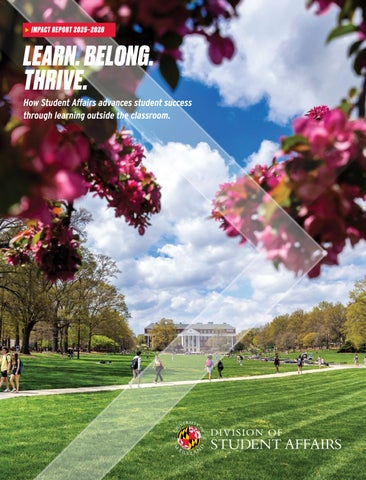
IMPACT REPORT 2025–2026
LEARN. BELONG. THRIVE. How Student Affairs advances student success through learning outside the classroom.
IMPACT REPORT 2025–2026
EVERY DAY,
across residence halls, recreation spaces, student organizations, health services, cultural centers, dining halls and countless campus experiences, Student Affairs helps Terps discover who they are, build meaningful connections and prepare for lives of purpose.
INSIDE
A Letter from Patty Perillo...........................................
3
The Division of Student Affairs.....................................
4
Student Affairs at a Glance..............................................
6
We Help Students Thrive...............................................
8
Our Strategic Plan in Action......................................... 18 We Put Students First................................................... 20 We Invest in Our People................................................. 24 We Create Caring and Inclusive Communities.......... 28 We Thrive as One Division............................................ 30 We Align Our Practices With Our Values.................. 32 We Strengthen Our Foundations..................................... 34 We Strengthen Our Foundations..................................... 34 Looking Ahead..................................................................... 37
1
IMPACT REPORT 2025–2026 A LETTER FROM PATTY PERILLO, VICE PRESIDENT FOR STUDENT AFFAIRS
Dear Terps and Friends, A college education is about much more than earning a degree. It is about becoming a thoughtful leader, a compassionate neighbor, an engaged citizen and a resilient human being. Every day, the Division of Student Affairs creates the conditions for that transformation. Our 17 departments work together to support students at every stage of their Maryland journey— from orientation through graduation and beyond. We expand opportunities for learning within and outside the classroom, strengthen our culture of care, invest in student well-being and continue investing in our strategic plan, Forward Together, with one goal in mind: ensuring that every student thrives. Whether a student finds community in a residence hall, discovers purpose through service, receives support during a difficult moment, develops leadership skills in a student organization or builds confidence through recreation, career preparation or campus employment, Student Affairs is present. This report centers on year two of our five-year strategic plan and celebrates the extraordinary work of our staff, our campus partners, our families, our alumni and most importantly, our students. Together, we are creating a university where every student can learn, belong and thrive. Thank you for believing in our students and for helping make Maryland a place where they can reach their full potential.
Patricia A. Perillo, Ph.D. Vice President for Student Affairs
2
3
THE DIVISION OF STUDENT AFFAIRS OUR VISION
OUR VALUES
OUR DEPARTMENTS
• Every student thrives
• Community • Equity and Social Justice • Learning and Growth • Inclusive Excellence • Innovation • Intergrity
• Accessibility and Disability Service • Adele H. Stamp Student Union (Stamp) • Conferences & Visitor Services • Counseling Center • Dean of Students • Development & External Relations • Dining Services • Family Engagement • Fraternity & Sorority Life (FSL) • Resident Life • Residential Facilities
OUR MISSION • We are an inclusive community of care where every student can realize their full potential. Our intentional use of resources creates environments that support and enhance student learning and growth, engagement, belonging and health and well-being.
4
• Student Conduct • Student Experience & Culture • Thrive Center for Essential Needs • University Career Center • University Health Center • University Recreation & Wellness (RecWell) MOST PROMISING PLACES TO WORK IN
STUDENT AFFAIRS
2025 The EDULedger
5
STUDENT AFFAIRS AT A GLANCE
371
17
2,475
2,700
Departments
Student Affairs Staff
Student Employees
Family Weekend attendees representing 38 states and 5 countries
14,250
153 students awarded a total of $114,000 in Economic Crisis Response Grants through the Thrive Center for Essential Needs
31,460 Campus Pantry visits 3,406 ommunity Members supported by Campus Pantry
1,531
total hours of student and community engagement and leadership development across seven areas of Leadership and Community Service Learning (LCSL) programs.
events planned by Resident Assistants in the residence halls.
8,252
70,445
total Stamp Student Union event bookings.
attendees from 15,010 unique students across 350 Stamp-sponsored events.
31,165
80 599
students registered with Accessibility and Disability Service, a 9% increase, connecting more students with resources and accommodations to support their success.
2,835 students received clinical services at the Counseling Center, constituting a 25% increase in demand for services over the last three years, with an annual average rate of increase 7%.
Residential Facilities work orders managed to support students living in the residence halls with completion rates above 93%.
conference boards, hearings and appeals were conducted by University Student Judiciary (USJ) members.
4,547
total Counseling Center clinical and outreach contacts
74,000
students completed conduct-related reflection papers, assigned by the Office of Student Conduct encouraging accountability, learning and personal growth.
6
to the Stamp Student Union.
21,559
9,779 Residence Hall Students 5,264
2,027,018 visitors
summer conference guests across 132 programs were welcomed by Conferences & Visitor Service
$836,045 invested in student success 54,639
clinical visits to the University Health Center
14,160 students and alumni connected with 1,394 employers at 30 career fairs hosted by University Career Center
616 Scholarships awarded.
service hours completed by Fraternity and Sorority Life members
students engaged in Leadership and Community Service Learning (LCSL) programs for an average of 36 hours each in prolonged development and/or community engagement.
visited the Dean of Students Office
Registered Student Organizations
4.2M
9,618
32,458
450 students
911
Dining Hall Meals Served
7,454
Recreation & Wellness (RecWell) Visits
Unity Center Reservations in inaugural year
2025–2026 HIGHLIGHTS
Terps connected through Terps After Dark Events (151 events with 17,756 total visits across 93 attendance-tracked events)
922,571
2,061
21,454
student appointments with Accessibility and Disability Service, 1,302 of which were new registration appointments
exams administered by Accessibility and Disability Service Testing Office, a 17% increase from the previous year
MORE THAN NUMBERS Behind every statistic is a student finding community and a sense of belonging, overcoming challenges, discovering purpose and preparing for what’s next.
THAT IS THE UMD STUDENT AFFAIRS DIFFERENCE 7
WE HELP STUDENTS THRIVE TERPS LEARN EVERYWHERE
Learning doesn’t stop when class ends. Student Affairs transforms everyday experiences into meaningful opportunities for growth through Terps Learn Everywhere, our co-curricular learning framework. Whether leading a student organization, participating in recreation, volunteering, working on campus or navigating life’s challenges, students build the skills and perspectives they will carry long after graduation.
TERPS LEARN TO • E ngage Inquisitively Terps engage with curiosity and innovation. Terps ask bold questions fueled by curiosity and seek insights about themselves, others and society. Terps strive for innovative solutions to the world’s grand challenges. • P ractice Compassion Terps seek first to understand, and then act with care. Terps lead with heart, listen deeply and act with empathy and kindness. Terps strengthen their decisions and actions through care for self, others and the greater good. • A ct with Courage Terps do brave things. Terps learn to step into the unknown and act boldly-to try, fail, learn and grow. Terps rise to the challenge, take responsibility to address their mistakes and practice humility when collaborating with others. • W ork for Justice Terps work toward equity for all Terps serve the community and advocate for positive change. They put values, passions and ideas into action for a more equitable, sustainable and resilient world. They consider who they are and their impact on others as they strive to address past and current injustices.
8
9
WE HELP STUDENTS THRIVE (CONT’D) STUDENTS LEARN Every experience is an opportunity to develop and grow. Leadership programs, campus employment, orientation, civic engagement, student organizations, fraternity and sorority life, career readiness initiatives, and peer education all help students develop the philosophies, knowledge and skills employers— and communities—value most. Students graduate not only with a diploma, but with confidence, purpose, and practical experience. They don’t just learn what they want to do with their life; they learn who they want to be in their life.
• Leadership & Community Service-Learning (LCSL) had 1,531 participants, leaders and interns engaged in 54,639 hours of leadership development and community engagement. They successfully generated approximately $200,000 in external funding and served as a host site for the Maryland Corps/Service Year Option (MC/SYO) Program, a signature program of the Governor.
54,639 hours
of leadership development and community engagement
• Resident Life launched Terp Tracks, a residential curriculum framework designed to create a holistic, intentional learning environment in the residence halls. Aligned with the Terps Learn Everywhere co-curricular learning domains, Terp Tracks promotes connection, collaboration and care. More than 5,000 Resident Assistant programs spanned academics, alcohol and other drugs education, professional development, inclusive communities, practical life skills and health and wellness topics. By Spring 2026, 95% of residents engaged in at least 1 Terp Talk, a one-on-one conversation with an RA about academics, social engagement and well-being.
5,000+
Resident Assistant sponsored programs
Over the course of this semester, I learned that dialogue is much less about proving a point “ and much more about understanding how people’s identities, experiences, values and fears shape the way they interpret issues. Before this dialogue class, I do not think I fully understood how deeply people’s lived experiences affect the way they understand the same issue in completely different ways. — Student participant
• The Common Ground Dialogue Program engages students on complex issues through deliberative and intergroup dialogue models and supported 355 students in dialogue sessions, including 68 students who completed CHSE228, a seven-week, one-credit course. hosted
355 students in dialogue sessions
”
• The Unity Center officially opened in August 2025 in renovated, accessible spaces in Cole Field House, fulfilling a multi-year roadmap focused on student-centered design. Featuring five lounges: The Vista, The Wave, The Braid, The Tapestry and The Mosaic, alongside a multipurpose room for social and educational programming, the space supported over 45 student organizations during the first year, hosting 371 events ranging from cultural programs to art exhibitions. 65% of students strongly agree they learned something new about a culture or community at The Unity Center.
hosted 371 events
ranging from cultural programs to art exhibitions
that civic engagement is not just voting. “TerpsVote helped me understand ” — TerpsVote Ambassador
10
11
WE HELP STUDENTS THRIVE (CONT’D) STUDENTS BELONG College is where lifelong friendships begin. Whether students find community in their residence hall, at Stamp, through student organizations, club sport teams, cultural celebrations or the Unity Center, Student Affairs creates spaces where every Terp can connect, contribute and belong. Campus traditions and everyday moments alike foster pride, connection and a shared sense of home. • Student organization participation created opportunities for students to build relationships, find community and develop a sense of belonging in the more than 900 registered groups. Student organizations hosted 5,428 events through TerpLink, while Student Entertainment Events (SEE) attracted more than 35,000 attendees across 92 events, giving students meaningful ways to connect with one another and campus life.
900+ registered groups 35,000
attendees across 92 events • STAMP programming created welcoming spaces for students to build friendships, find community and feel a sense of belonging. From the All Niter and Homecoming Terp Carnival to a reimagined New Student Welcome Program, the “Spring into Stamp’s Living Room” featuring weekly live student talent and professional performances and the Stamp Sizzlin’ Summer Series, students had opportunities to connect throughout the year. Terps After Dark extended that connection into the evening, offering 152 events attended by 30,000 Terps in the first eight weeks of the fall semester.
30,000 Terps attended 152 events in the first eight weeks of the fall semester Getting involved in Fraternity & Sorority Life has been the best and most “ unexpected part of my Maryland experience. On a campus as large as Maryland, my fraternity has given me a genuine sense of community, one that challenges me to grow as a leader and constantly reminds me that I am part of something much bigger than myself. I am proud to say that in finding my chapter, I also found my people. — Louis Mancuso, Class of 2027 12
”
13
WE HELP STUDENTS THRIVE (CONT’D) STUDENTS ARE SUPPORTED Every student deserves to know they don’t have to navigate challenges alone. Student Affairs provides coordinated care that meets students where they are—academically, emotionally, financially and personally. Whether through counseling, accessibility and disability service, case management, health promotion, emergency funding, the Campus Pantry or the Thrive Center for Essential Needs, students have a network of caring staff ready to help. Asking for help is a strength, and receiving support can change the course of a student’s journey. • The Dean of Students Office connected more than 430 students with care and resources to navigate academic, emotional, financial and personal challenges, helping them stay connected to campus during difficult times. The office also responded to nearly 300 BETA cases, coordinating support and intervention with university and community partners to ensure students had a network of care ready to help. • The Development and External Affairs team connects donor generosity with student needs through scholarships and crisis support funding. DSA scholarships provided $850,048 to 620 students, nearly 4% more funding and 5% more recipients than in FY25, helping ease financial barriers so students can focus on their education. • The Counseling Center brought mental health support closer to students through 30,165 clinical and outreach contacts and clinical services for 2,835 students, responding to a 25% increase in demand over three years. A fully staffed
Mental Health Emergency Assessment and Response Team (MHEART), added an additional transport van reducing reliance on police vehicles for mental health-related transports. Additionally, the Counseling Center launched an innovative resident life embedded services program, bringing specialized care directly into student living spaces to foster more accessiible and inclusive support communities. • Accessibility and Disability Service helped reduce barriers to participation and academic success for 4,547 registered students, a 9% increase over the previous year. Through 2,061 student appointments, including 1,302 new registration appointments, the team connected students with individualized support. The Testing Office administered 21,454 exams, a 17% increase, expanding access to accessible testing as demand grew.
4,547 registered students 2,061
student appointments • The Thrive Center for Essential Needs expanded access to personalized support, providing individual consultations to 184 students in 2025–26, a 30% increase over the previous year. These consultations offered students one-on-one guidance to navigate challenges and connect with resources tailored to their needs. • The Campus Pantry helped meet essential food needs and ease financial strain for 3,406 community members through 31,460 visits, providing a reliable source of support for those facing food insecurity.
cannot afford to send me here, even for just a semester, and I cannot be more grateful “My family for this opportunity and gift. Especially with my mother’s health currently declining, there are a lot of unknowns right now in life, and I was close to just stopping short when I’m so close to the finish line. I am unbelievably grateful and thankful for the blessing in front of me. — Taizse Johnson, recipient of the Sonali and Hari Scholarship
14
”
15
WE HELP STUDENTS THRIVE (CONT’D) STUDENT WELL-BEING Thriving students are healthy students. Well-Being extends beyond physical health. It includes emotional wellness, meaningful relationships, healthy habits, spirituality or meaning-making, resilience, and opportunities to recharge. Across fitness facilities, outdoor adventures, intramural sports, wellness coaching, recovery support, and health promotion programs, students discover ways to care for themselves while building lifelong habits for success. FEATURED PROGRAMS
• University Recreation and Wellness helped students build healthy habits, manage stress, and connect through movement, with 5,358 participants making 35,933 group fitness visits and 241 clients participating in 2,032 personal training sessions. Expanded partnerships with mental health providers helped ActiveT.E.R.P. connect 20 students with exercise support, strengthening the link between physical activity and emotional well-being.
35,933 group fitness visits
• The University Health Center supported healthier choices and emotional well-being by distributing 69,170 free wellness and harm reduction resources and expanding opportunities for mindfulness and connection. CARE empowered student leaders through advocacy, education, and outreach, delivering more than 130 prevention workshops and 48 awareness events while adding group therapy and a peerled support group. New mindfulness programming and meditation videos offered accessible ways to manage stress and build lifelong self-care habits.
130
prevention workshops • The Memorial Chapel and chaplaincies in 14 different faiths, nurtured students’ spiritual and emotional wellbeing through accessible pastoral care, counseling, and mentorship, connecting students with trusted adults. Meditation, prayer, labyrinth walks and self-care programs created opportunities to reflect, recharge and build resilience while exploring meaning, purpose and well-being.
16
17
IMPACT REPORT 2025–2026
OUR STRATEGIC PLAN IN ACTION
F ORWARD TOGETHER: YEAR TWO
Our five-year strategic plan is more than a roadmap; it’s our shared commitment to creating a campus where every student thrives. Guided by six strategic commitments, we align our work across the division to maximize impact, strengthen collaboration and deliver meaningful learning experiences beyond the classroom.
18
19
WE PUT STUDENTS FIRST
LEARNING INSIDE AND OUTSIDE THE CLASSROOM
Student Affairs continued to expand Terps Learn Everywhere, strengthening learning opportunities that help students develop leadership, creative thinking, compassion and civic responsibility.
FY26 HIGHLIGHTS • The Intern For A Day (IFAD) program facilitated 520 job shadow opportunities for students in workplace settings, increasing participants’ understanding of a career field by 97%. • Awarded 13 Terps Learn Everywhere Co-Curricular Learning Grants, funded through the Terp Family Fund, to support innovative programs and strengthen assessment across the division. • Launched a comprehensive Terps Learn Everywhere communications strategy to increase awareness of cocurricular learning opportunities. • Convened nearly 150 faculty and staff at the third annual Terps Learn Everywhere Conference to share evidence-based practices and student learning outcomes. • The Maryland Leadership Education and Development (MLEAD) Program—part of the Stamp Student Union’s Leadership & Community Service-Learning—has launched the Maryland Leadership Hub, offering flexible online modules that allow students to build skills on their own schedule.
Students are at the center of every decision we make.
• Resident Life aligned its new Terp Tracks Residential Curriculum with Terps Learn Everywhere, reinforcing community, learning and reflection throughout the residential experience based on connections, collaboration and care. • Fraternity and sorority chapter presidents co-created a new community expectations framework through the HESI 318G Policy Lab, advancing a shared vision of accountability, belonging, safety and well-being. • The TerpsVote Ambassadors peer-to-peer program, designed to enhance engagement in the democratic process, increased programming by 37%, totaling 15 classroom presentations and 45 events.
IMPACT Students experienced more intentional learning opportunities across leadership programs, residence halls, campus employment and co-curricular experiences.
DEVELOPING TOMORROW’S LEADERS
Leadership development happens in classrooms, workplaces, recreation spaces and student organizations alike.
FY26 HIGHLIGHTS
From innovative co-curricular learning experiences to expanded health and well-being resources and leadership development, we create experiences that meet students where they are and prepare them for where they’re going. Guided by Terps Learn Everywhere, we connect learning inside and outside the classroom so every experience helps students discover purpose, develop resilience and prepare for lives of leadership and service.
20
• RecWell launched its Leadership Development Program, preparing student employees through a two-semester curriculum focused on leadership, conflict management, critical thinking, inclusion and reflection. • Leadership & Community Service-Learning (LCSL) advanced the integration of the Terps Learn Everywhere learning across a year-long internship program for 20 student interns annually. Students gain one-on-one coaching, collaboration with peers and community partners, and experiential learning.
• The reimagined Peer Nutrition Coaching Program provided aspiring dietitians with hands-on coaching experience while expanding holistic wellness support for students. In collaboration with the RecWell Personal Training Program, clients were able to sign up for personal training and nutrition coaching sessions, offering a more well-rounded approach to health and wellness. • The University Health Center’s Student Healthcare Assistant Program provided pre-health students with meaningful clinical experience, with participants administering more than 2,000 vaccines and developing professional healthcare skills and training for their respective licenses as Certified Medical Assistants, Certified Nursing Assistants, or Emergency Medical Technicians. 21
WE PUT STUDENTS FIRST (CONT’D) SUPPORTING STUDENT WELL-BEING
CREATING MEANINGFUL STUDENT ENGAGEMENT
Helping students thrive means removing barriers to health, wellness and financial security.
Student-centered innovation means responding to emerging student needs with evidence-based programs and partnerships.
FY26 HIGHLIGHTS
FY26 HIGHLIGHTS • The University Health Center launched Intro to Mindfulness, using evidence-based curriculum from the Mindfulness Institute for Emerging Adults. The course teaches 10 mindfulness skills across 4 weeks. • The University Health Center expanded access to free safer sex supplies, adding the Unity Center as its 22nd distribution location and providing nearly 5,000 supplies during the year. • Through the Menstrual Health Initiative, the University Health Center partnered with the Student Government Association and Health Promotion & Wellness Services and Pharmacy to secure funding for free menstrual products, improving access to essential health resources. • CARE to Stop Violence Office launched two clinical groups for students with shared goals of reducing barriers to mental health care and supporting students in finding community and peer support. • Terps for Recovery became an officially recognized student organization, providing a welcoming community that supports students in recovery and those affected by substance use while promoting well-being and belonging. • In partnership with the Counseling Center, and through new Center-led initiatives, the University Career Center intentionally integrated resilience and wellness into career programming to support students navigating a challenging job market.
• Recognizing that students thrive when their basic needs are met, the Thrive Center for Essential Needs opened in Fall 2025 as UMD’s centralized hub for coordinated, traumainformed support, connecting students to resources that reduce barriers and promote academic success. • The Financial Wellness Hub, created through a partnership with the Thrive Center for Essential Needs, the Robert H. Smith School of Business and the University Libraries, expanded financial education and resources for students. Using the Campus Assessment Working Group (CAWG) financial preparedness survey data for first-years and juniors/seniors, and in collaboration with the FirstGeneration College Students Coordinator, a financial wellness series featuring 24 workshops was offered.
• Beginning in Fall 2025, Student Affairs departments aligned their signature welcome experiences—including Fall Welcome, Terps After Dark, First Look Fair and Find Your Squad programming—to create a more seamless transition that helped new students build connections, discover campus resources and feel a sense of belonging from day one. • Terps After Dark continued to grow as a signature late-night engagement program, fostering belonging, connection and healthy community during students’ transition to campus.
• The University Health Center unified its substance use prevention and treatment efforts, launching SMART Recovery, a new peer-supported recovery program. • The University Health Center introduced the Green Code, a campus-wide cannabis harm reduction initiative that equips students with practical information for making informed decisions for reducing the risks associated with cannabis use, while also dispelling myths about the perceived safety of using cannabis. This program was modeled after the Gold Code, a widely recognized alcohol risk-reduction campaign that has been active on campus for over a decade.
STUDENTS FIRST IN FY26 13
150
2,000+
Terps Learn Everywhere Innovation Grants awarded
faculty and staff engaged in co-curricular learning conference
vaccines administered by Student Healthcare Assistants
5,000
$5,000
safer sex supplies distributed at no cost
secured to expand menstrual equity resources Terps After Dark (TAD)
152 events and over
IMPACT Students gained easier access to financial
30,000
student encounters
LAUNCHED!
education, preventive health resources and
New Financial Wellness Hub
essential wellness services that support
Maryland Leadership Hub
academic success.
SMART Recovery introduced for students RecWell Leadership Development Program New Terp Tracks Residential Curriculum
FALL WELCOME
28
The TerpsVote Ambassadors peer-to-peer program increased programming by 37% including 15 classroom presentations and 45 events
collaborative events in four days 4,022 photo sessions in the Career Center’s professional photo booth in its first year
22
23
WE INVEST IN OUR PEOPLE Extraordinary student experiences begin with extraordinary staff.
Our staff are educators, mentors, advisors, advocates and caregivers. By investing in their well-being, leadership and professional growth, we strengthen our ability to serve students with excellence, compassion and purpose. Throughout FY26, Student Affairs expanded opportunities for staff to learn, connect and thrive, building a culture where people feel supported, valued and empowered to do their best work. SUPPORT STAFF WELL-BEING
Creating a healthy workplace enables our staff to better support students.
HIGHLIGHTS • Advanced a divisional workplace well-being framework to establish a shared vision for supporting employee wellness across Student Affairs. • Expanded staff well-being resources through funding and offering Mental Health First Aid training, Wellness at Work Resource Fairs and BeReal Pro, a mindfulness and resilience training program for staff. • Created dedicated Staff Spaces for Reflection and Response, along with Coffee & Conversations and year-round connection activities that strengthened community and encouraged open dialogue.
• Hosted the University’s inaugural World Safety at Work Conference, reinforcing a shared commitment to workplace safety and employee well-being.
IMPACT Students experienced more intentional learning opportunities across leadership programs, residence halls, campus employment and co-curricular experiences.
DEVELOPING CONFIDENT LEADERS
Strong leadership creates stronger teams and stronger support for students.
HIGHLIGHTS • 48 Student Affairs supervisors completed the University’s Excellence in Supervision program, building skills in communication, coaching, employee engagement and leadership. • Expanded restorative leadership capacity through Tier 1 and Tier 2 Restorative Practices training, strengthening staff skills in building trust, navigating conflict and fostering healthy communities. • Six senior Student Affairs leaders participated in the inaugural Courageous Leadership Lab, exploring leadership practices that promote collaboration, inclusion and organizational effectiveness. • 16 Resident Life leaders participated in an intensive 8-week restorative supervision training program.
24
25
WE INVEST IN OUR PEOPLE (CONT’D) GROWING TALENT ACROSS THE DIVISION
Professional development helps our people—and our division—continue to grow.
FY26 HIGHLIGHTS • 193 unique staff members, representing all 17 Student Affairs departments, participated in divisional professional development programs, alongside colleagues from campus partner units. More than three dozen staff members participated in two or more learning opportunities, reflecting our commitment to continuous growth and leadership development. • Continued the SoundingBoard/BTS Leadership Coaching Program, supporting 37 leaders, including both exempt and non-exempt staff across the division. • Launched a new Peer-to-Peer Coaching Program, preparing staff to build coaching skills rooted in curiosity, empathy and self-awareness. Two cohorts with 21 trained in summer of 25 and 16 participants in February 2026. • Offered Integrative iEQ9 Enneagram professional development series, engaging 51 staff from 13 departments in strengthening communication, teamwork and self-awareness. • Conducted a division-wide review of professional development opportunities to better understand and address barriers to access, particularly for non-exempt staff.
IMPACT
Professional development is creating sustained pathways for learning, leadership and career growth across Student Affairs.
INVESTING IN OUR PEOPLE IN FY26 190+
48
2
unique staff, representing
supervisors completed Excellence in Supervision
Peer Coaching cohorts launched
17 departments, participated in divisional professional development
Workplace well-being framework advanced 26
37 leaders participated in executive coaching
57 staff completed Tier 1 Restorative Practices training
51 staff particpated in Enneagram leadership development 27
WE CREATE CARING AND INCLUSIVE COMMUNITIES Every student deserves to feel seen, valued and connected. Belonging is essential to student success. Across residence halls, recreation spaces, cultural communities, leadership programs, and campus traditions, Student Affairs creates environments where students feel welcomed and empowered to contribute their unique perspectives, build meaningful relationships, engage across differences and develop a strong sense of place at Maryland.
ENHANCING SKILLS AND CREATING BELONGING
EXPANDING ACCESS AND OPPORTUNITY
Students are most successful when they feel connected to one another and to the university. Creating a welcoming community starts with equipping students and staff to engage with empathy, curiosity and respect.
Collaboration across departments—and across campus— creates opportunities that no single unit could accomplish alone.
HIGHLIGHTS • Opened the Unity Center, a welcoming hub that supports more than 47 student organizations and creates opportunities for connection, collaboration and belonging. • The annual Embrace the Heritage Showcase brought together students, staff and campus partners to celebrate the rich diversity of the Maryland community through student performances, storytelling and shared experiences. • Resident Life’s Dialogue & Community Advocate Program empowered undergraduate peer facilitators to strengthen community through: 30 educational programs 17 Heritage Month displays 18 Resident Assistant trainings focused on identity, inclusion, dialogue and community engagement. • 57 staff members from eight Student Affairs departments completed Restorative Practices Training, expanding the division’s capacity to build trust, repair harm and strengthen relationships through restorative approaches.
HIGHLIGHTS • The inaugural World Safety at Work Conference brought together staff from across Student Affairs and the campus, with intentional participation by non-exempt staff through partnerships with Dining Services and Residential Facilities. • Cross-department partnerships expanded communitybuilding initiatives, including Terp Family webinar series, Houses on the Row program, and RecWell Community Building programs that connected students, families and campus resources. • Continued advancing recommendations from the division’s Non-Exempt Task Force, strengthening access to professional development and engagement opportunities for frontline staff.
IMPACT Collaboration strengthens our capacity to serve students while creating a more connected and supportive workplace.
CARING & INCLUSIVE COMMUNITIES IN FY26 30
New faculty learning community supporting
dialogue programs hosted in residence hall communities
first-generation student success
18 Resident Assistant trainings on identity and inclusion
Expanded
57 Student Affairs staff from eight departments trained in Restorative Practices
adaptive recreation opportunities
45+ student organizations supported through the new Unity Center 1. THE BRAID. Honoring Native American and Indigenous communities.
1
4
2. THE MOSAIC. Honoring Multiracial, Multiethnic and Adoptee communities. 3. THE WAVE. Honoring Asian, Pacific Islander and Desi communities. 4. THE VISTA. Honoring Latine communities. 5. THE TAPESTRY. Honoring Disabled communities.
28
2
3
5
29
WE THRIVE AS ONE DIVISION Student success is a shared responsibility. Across Student Affairs, teams work together—and with campus partners—to share expertise, strengthen resources and create
CONNECTING OUR PEOPLE
Strong teams begin with strong relationships. Throughout FY26, Student Affairs continued building a culture where staff feel connected to one another, understand our shared mission, and see how their work contributes to student success.
HIGHLIGHTS
seamless experiences that help every Terp thrive. By embracing
• Advanced a unified Division-wide onboarding framework to create a more consistent experience for new staff while strengthening connections to our mission, values, and culture. • Continued collaboration across strategic planning committees to align onboarding, professional development, technology and workplace practices into a more seamless employee experience. • Advanced plans to revive the Faculty/Staff Financial Assistance Program, reinforcing our commitment to supporting employees during times of need.
a One DSA mindset, we are building stronger relationships among staff, breaking down silos, and creating innovative solutions that amplify our collective impact.
PARTNERING FOR GREATER IMPACT
Strong leadership creates stronger teams and stronger support for students.
HIGHLIGHTS • Through the Adaptive Recreation + Adventure Program, RecWell expanded inclusive recreation opportunities and strengthened staff capacity to support participants with diverse abilities. • The First-Generation Student Success initiative partnered with the Teaching and Learning Transformation Center to launch a semester-long Faculty Learning Community to help faculty better understand and support the experiences of first-generation students.
IMPACT Collaboration strengthens our capacity to serve students while creating a more connected and
• Student Affairs departments partnered with Family Engagement to host a coordinated webinar series, providing students and families with guidance, campus resources and timely information for a successful transition and continued success at Maryland.
IMPACT When staff begin with a shared understanding of our mission and values, students benefit from a more connected and consistent experience.
THRIVING AS ONE DIVISION IN FY26 • Unified Division-wide onboarding framework advanced • Cross-functional teams aligned staff onboarding, technology and workplace practices • World Safety at Work Conference convened campus partners • Cross-department collaborations strengthened student and staff programming • Faculty/Staff Financial Assistance Program revival advanced • Continued implementation of Non-Exempt Task Force recommendations • In partnership with 3 Student Affairs departments, Family Engagement hosted 8 webinars that prepared Terps and their families with timely information, campus resources and support throughout the student journey.
supportive workplace.
A One DSA mindset means students experience Student Affairs as one connected network of support. Whether welcoming new students, responding to challenges or creating opportunities for learning and belonging, departments work together to ensure students can easily access the people, programs and resources they need to succeed. 30
31
WE ALIGN OUR PRACTICES WITH OUR VALUES Our values are reflected not only in what we do— but in how we do it.
CREATING STRONG FRAMEWORKS
Behind every meaningful student experience is a strong operational foundation.
HIGHLIGHTS • Developed a draft Policy & Procedures Standards Guide: The Blueprint, a division-wide framework that establishes consistent standards for policy creation, governance, review, storage, accessibility, version control and continuous improvement across Student Affairs. Embedded in the Blueprint is an employee feedback process that establishes a multi-channel approach for gathering employee feedback on policies and procedures, grounded in equity, collaborative problemsolving, belonging, and community well-being. • Designed support and implementation resources, including standardized policy templates, policy review checklists and a Policy Management Maturity Model to guide departments in their efforts to improve consistency, transparency and continuous improvement.
IMPACT Shared standards help create a more consistent, equitable and student-centered experience across Student Affairs.
32
33
WE STRENGTHEN OUR FOUNDATIONS
Students thrive in spaces that are welcoming, well-maintained, and thoughtfully supported. Responsible stewardship of our facilities, finances and operations ensures that Student Affairs can continue to create exceptional experiences today while preparing for tomorrow.
Strong foundations create extraordinary student experiences.
INVESTING IN SPACES THAT SUPPORT STUDENTS
STRENGTHENING FINANCIAL STEWARDSHIP
The environments where students live, learn, work and connect matter.
Responsible stewardship allows us to invest more resources directly in students.
Throughout FY26, Student Affairs strengthened long-term planning for its facilities by bringing together departmental leaders to identify priorities, assess building conditions, and prepare for future capital investments.
HIGHLIGHTS • The Terp Family Fund awarded 55 projects, investing more than $303,000 in innovative student-centered initiatives during FY26. Since its launch, the fund has provided more than $800,000 to advance learning, belonging, well-being, and student success. • Expanded grant development support through workshops, budget consultation and proposal assistance, helping departments pursue new funding opportunities. • Strengthened partnerships between the Budget Team, Development Office, and departments to maximize the impact of foundation and endowment resources. • Improved financial transparency and operational consistency through new financial reporting tools, shared business resources, and cross-department collaboration.
HIGHLIGHTS • Established a collaborative facilities planning process that brings together leaders from Residential Facilities, Dining Services, Recreation & Wellness, Stamp Student Union and other departments to align priorities across the division. • Adopted a nationally recognized higher education Facilities Condition Assessment framework for assessing facility conditions, strengthening long-term planning and stewardship of Student Affairs spaces. • Advanced division-wide planning to prioritize capital renewal projects that enhance safety, functionality and the student experience. • Expanded the use of predictive maintenance practices to proactively identify infrastructure needs and support reliable, well-maintained facilities.
IMPACT Strategic investments and responsible stewardship expand opportunities for students while maximizing the impact of every dollar.
IMPACT Thoughtful planning today helps ensure students continue to learn, live and connect in safe, welcoming and well-maintained spaces.
34
35
WE STRENGTHEN OUR FOUNDATIONS (CONT’D)
IMPACT REPORT 2025–2026
LOOKING AHEAD
BUILDING FOR THE FUTURE
Strong operations create capacity for innovation. Student Affairs continued to improve business processes, resource sharing and operational tools to strengthen collaboration and position the division for long-term success.
As we continue implementing Forward Together, we remain focused on expanding opportunities for learning, strengthening connected communities of care, investing in student well-being and building partnerships that help every Terp thrive.
HIGHLIGHTS
The challenges facing today’s students continue to evolve and so do we.
• Developed the “Home Base: Your Finance and Administration Guide”: a new business resources and operational guide to strengthen consistency, financial literacy and continuity across departments. • Created a division-wide Finance and Business Resource Directory, expanding collaboration and shared expertise among Student Affairs business professionals. • Implemented new technology solutions that improved reservation management, financial reporting and operational efficiency.
Together with our campus partners, alumni, families, donors and friends, we will continue creating experiences that inspire students to engage inquisitively, act with courage, practice compassion, work for justice and thrive for a lifetime.
CARING & INCLUSIVE COMMUNITIES IN FY26
55
$303,000+
$800,000+
Terp Family Fund projects supported
invested in student-centered initiatives during FY26
awarded through the Terp Family Fund since its launch
Adopted a
Division-wide facilities planning
nationally recognized
Expanded
strengthened
grant development support and funding partnerships
facilities assessment framework
Improved financial reporting and operational tools across Student Affairs
LAUNCHED! New Finance & Business Resource Directory
36
37
studentaffairs.umd.edu