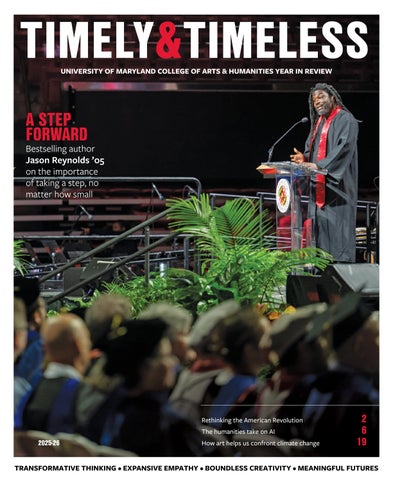
TIMELY&TIMELESS UNIVERSITY OF MARYLAND COLLEGE OF ARTS & HUMANITIES YEAR IN REVIEW
A STEP FORWARD
Bestselling author Jason Reynolds ’05 on the importance of taking a step, no matter how small
Rethinking the American Revolution The humanities take on AI
2025-26
How art helps us confront climate change
2 6 19
TRANSFORMATIVE THINKING • EXPANSIVE EMPATHY • BOUNDLESS CREATIVITY • MEANINGFUL FUTURES
CONTENTS
Rethinking the American Revolution
Professor of History Richard Bell’s new book reframes America’s founding conflict as a war fought across empires, oceans and everyday lives.
2
ARHU Meets the Moment
4
AI and the Human Experience
6
ARHU Milestones
10
Book Club for Incarcerated Women
12
Boldly Creative
14
How Stories Help us Face Climate Change
19
A Future in Advocacy Law
24
Alumni: The Paths They Took
26
Dean’s Round Table and ARHU Leadership
28
Professor of English Jason Rudy co-leads a volunteer program at Maryland Correctional Institution for Women.
Doctoral student Rashi Maheshwari discusses why literature, art and community matter in an era of environmental crisis.
After a life-changing accident, Brian Cooperman ’26 found a new path through American studies.
22 Recent Gifts
An estate commitment to bolster the Driskell Center’s collections, support for a new forum for Israel studies, funds for “expansive theater,” and more.
TIMELY & TIMELESS
ARHU Faculty Accolades
Pushing boundaries in research and community impact, meet the scholars earning national recognition and shaping their fields.
Detail, “Basketball Blooms” by Brandon Donahue-Shipp
Cover Photo by Lisa Helfert
B
16
Photo by Taneen Momeni
Photo by Taneen Momeni
FROM THE DEAN
Greetings!
PUBLISHER This issue of Timely & Timeless, an updated format for our annual year in review, is published by the Office of Marketing and Communications in the College of Arts and Humanities. It was created and produced by: Kelly Blake, Jeanette J. Nelson, Dylan Rye, Sarah Snyder and Jessica Weiss. To receive additional copies of this publication, please contact the Dean’s Office at 301.405.2090. University of Maryland College of Arts and Humanities 1102 Francis Scott Key Hall 4282 Chapel Lane College Park, MD 20742 FIND THE LATEST INFORMATION AT arhu.umd.edu CONNECT WITH US facebook.com/arhu.umd instagram.com/umd_arhu go.umd.edu/ARHUlinkedin umd-arhu.bsky.social
This issue of Timely & Timeless captures a period of great momentum for the College of Arts and Humanities (ARHU). One year after launching our 2025-2030 strategic plan, we are already seeing its vision take shape across the college. The stories in these pages demonstrate how our faculty, staff, students and alumni are putting our commitments into action—embracing transformative thinking, cultivating expansive empathy, pursuing boundless creativity and building meaningful futures. You will meet, for example, English Professor Jason Rudy, whose book club invites incarcerated women to explore new ideas and perspectives through literature. I have had the privilege of joining the group twice, for discussions of “Their Eyes Were Watching God” and “The Color Purple,” and witnessed firsthand the openness, insight and connection that emerge when people come together around a great book. You will also read about Brian Cooperman ’26, who, after a life-changing accident, found a new path toward a career in advocacy law through his coursework in American studies. Brian’s story demonstrates how our disciplines cultivate the depth and thoughtfulness needed to reimagine what is possible. This year also offered many opportunities to come together as a community. In May, we celebrated graduates from all 11 departments and three schools at ARHU’s
first collegewide commencement ceremony. Our speaker, English alum and bestselling author Jason Reynolds ’05, encouraged graduates to recognize the power of taking a step forward, however small. Across campus, ARHU faculty, students and partners also led timely conversations, performances and programs that brought humanistic and creative perspectives to issues affecting our university, our communities and our world. Even as we look ahead, we are proud to honor the foundations on which we continue to build. This year, we celebrated milestone anniversaries across the college: 80 years of American studies; 60 years of the UMD Art Gallery; 50 years of women’s studies (now the Harriet Tubman Department of Women, Gender, and Sexuality Studies); and 25 years of the David C. Driskell Center, The Clarice Smith Performing Arts Center and the School of Languages, Literatures, and Cultures. These anniversaries carry special meaning for me as I begin my fifth year and the conclusion of my first term as dean of the college. Anniversaries remind us that progress is built over time—and made possible by generations of people who believe deeply in the power of the arts and humanities to address the questions that matter most. That spirit extends well beyond campus. Through the newly established Dean’s Round Table and the dedicated leadership of the ARHU Alumni Network, our alumni are helping us strengthen connections, support our students and imagine the college’s future. I hope the stories in this issue offer a sense of what we have accomplished together—and of the creativity, compassion and purpose that continue to move ARHU forward. With gratitude, Stephanie Shonekan
Dean, College of Arts and Humanities
TIMELY & TIMELESS
1
TRANSFORMATIVE THINKING
RETHINKING THE AMERICAN REVOLUTION AS A GLOBAL CONFLICT Released before America’s 250th anniversary, Professor of History Richard Bell’s new book reframes America’s founding conflict as a war fought across empires, oceans and everyday lives. By Jessica Weiss ’05 Photo illustration by J.J. Nelson MBA ’14, MRED ’25, based on “Washington Crossing the Delaware,” painting by artist Emanuel Leutze.
I
n the most common retelling, the American Revolution ended in 1781 in Yorktown, Virginia, where combined American and French forces, led by George Washington, trapped and forced the surrender of British General Cornwallis’ army. But in fact, the war’s final battle was fought thousands of miles from Yorktown—in southern India, in 1783. Due to slow communication, French forces and their Indian allies were unaware that the preliminary peace treaty had already been signed in Paris. It’s a detail that upends the familiar rebels-versus-redcoats story. And for Richard Bell, professor of history, it’s a window into a significant argument: that America’s founding fight was a world war in all but name, entangling empires, reshaping trade routes and displacing people across the Atlantic world and beyond. That’s the topic of his award-winning book, “The American Revolution and the Fate of the World,” published in November 2025 by Penguin Random House. Bell also teaches the course “Globalizing the American Revolution” at Maryland. We asked him a few questions about the book. How did this project come together? It came from me pulling together lots of diverse scholarship—work being done in a dozen different subfields—and trying to say something original and useful. It became my COVID project, reading books and articles on various obscure topics. For instance, scholars working on Spain’s role in the Revolution don’t always get to “talk” to scholars working on Irish involvement. I wanted to break down those silos and see what happens to that scholarly conversation when it becomes a truly global one. What were the “lightbulb” moments in terms of making your argument? When places like India and Australia start showing up in your research with some regularity, you can’t continue to pretend that the American Revolution was only
I write with the ear in mind. Narrating the audiobook felt like a fun extension of that.
Bell recently won the 2026 George Washington Prize, a prestigious award honoring the year’s best new works on early American history.
a regional war. Two details really did it for me. One: the settlement of Australia as a British penal colony in 1788 is a direct result of American independence, because Britain lost access to the colonies as a potential dumping ground for British prisoners. And two: the last battle of the American Revolution was fought in Cuddalore, India, in June 1783. After that, it became pretty easy to see that this was actually a global war. You made a deliberate choice to write this for a broad audience—and even narrate the audiobook yourself. Why? I wanted the largest possible megaphone. I think these ideas—that the American Revolution is a significant event in global history—are still unfamiliar to many folks, and I wanted as many readers as possible to engage with them. So as a writing challenge, I set myself the task of trying to make complicated ideas and major flows of people and goods and ideas as easy to digest as possible. I settled on storytelling and on selecting several key characters to carry the weight of major parts of the story. And because I teach and lecture constantly,
Let’s talk about one of those characters, Harry Washington. It’s one of those stories you finish and think, “How have I never heard this?” Harry Washington should be famous. He was enslaved by George Washington at Mount Vernon, he escaped and joined British forces in Virginia after they promised lifelong freedom to enslaved people owned by Patriot masters. He fought and served with the British Army until the end of the war. Then, when Britain lost the war, he became part of a massive refugee movement—first to Nova Scotia in British Canada, and then to Sierra Leone in West Africa. It was promoted as a post-racist paradise where Black refugees of the Revolution would have genuine civil and political rights. Yet, it was a mirage and, by around 1800, Harry and other Black refugees of the Revolution were leading their own independence movement against British rule in West Africa. Readers who love “Hamilton” may catch some familiar lines in the book. Was that intentional—or is the soundtrack just always playing in your head? Yes. I’m a “Hamilton” superfan and the soundtrack is indeed always in my head, and every now and then I’ll drop in a phrase or a line from the musical into the book to express what I’m getting at. Lin-Manuel Miranda did such an extraordinary job popularizing this period of American history for general audiences. What do you most want readers to take from this book? That America’s founding fight, the War for American Independence, pulled in actors from very diverse backgrounds—many, many of them non-citizens choosing to fight for the Patriot cause. And second, that in the American Revolution, it was never America first or America alone. It was always America among the powers of the earth, building coalitions, trying to do something big by reaching out and forming alliances. T&T
TRANSFORMATIVE THINKING
3
T
hrough lectures, performances, exhibitions and public dialogue, the College of Arts and Humanities provides historical perspective, cultural context and space for thoughtful exchange for the entire University of Maryland community. Whether about global conflicts, emerging technologies or enduring questions of justice and democracy, these moments brought our community together to ask difficult questions and engage with complex ideas. They reflect the essential role of the arts and humanities in helping us better understand one another and the world we share.
Photo by Lisa Helfert
ARHU MEETS THE MOMENT AMERICAN ANTHEMS E
Photo by Dylan Singleton
From songs that carry people through hard times to the anthems that unite people across differences, a concert hosted by Arts for All and ARHU in observation of the nation’s 250th anniversary explored the melodies woven into the fabric of American life.
EH UMOR, HOPE
Peter Sagal, host of the popular NPR program “Wait Wait…Don’t Tell Me,” joined Dean Stephanie Shonekan for a wideranging, thought-provoking and funny conversation that touched on how creativity, empathy, transformative thinking and, of course, humor are essential to navigate uncertain times and find hope.
4
TIMELY & TIMELESS
Photo by Taneen Momeni
AND THE HUMANITIES
H REIMAGINING DEMOCRACY In the midst of ongoing legal challenges to birthright citizenship and due process, the Frederick Douglass Center for Leadership Through the Humanities hosted influential civil rights lawyer and Howard University Professor Sherrilyn Ifill. She discussed the perilous state of U.S. democracy and how the 14th Amendment of the Constitution provides an historical template for democracy’s future.
Photo by Taneen Momeni
Photo by Taneen Momeni
WITH LEGAL SCHOLAR SHERRILYN IFILL
ET IMELY CONVERSATIONS THAT PROVIDE CONTEXT
INTERROGATING THE CHARACTER AND CONDUCT OF THE NATION IN 2026 The Douglass Dialogues, a Frederick Douglass Center series dedicated to examining ideas across differences, launched with an event titled “What to Us Now is the Fourth of July?,” inspired by Douglass’ 1852 speech. Scholars Christopher Bonner, Janelle Wong and Larry Thompson offered perspectives on whether the United States is living up to its ideals as the nation marked its 250th anniversary.
Throughout the year, Dean Shonekan invited faculty, staff and students for timely pop-up discussions on topics including immigration, disability and accessibility, human-centered AI and war. The immigration and migration panel, featuring Professor of Spanish Ana Patricia Rodríguez, among others, explored scholarship and context amidst the backdrop of current socio-political dynamics.
TIMELY & TIMELESS
5
NEW MAJOR LAUNCHED FALL 2026
BACHELOR OF ARTS IN HUMAN-CENTERED ARTIFICIAL INTELLIGENCE • Combines technical fluency with critical insight to shape the future of AI. • Students will learn how AI works while interrogating its impacts on people, communities and the planet. • Explores AI ethics, policy, regulation and the role of human creativity. • Graduates can excel in the competitive AI-integrated workforce, spanning the private, public and non-profit sectors in roles ranging from communication to policy, design, ethics, governance and more.
STUDENTS CHOOSE FROM 7 SPECIALIZATIONS: • Arts • Design and user experience • Ethics • Language and cognition • Logic, epistemology and machine learning • Law, policy and governance • Society, culture and technology
6
TIMELY & TIMELESS
AI AND THE HUMAN EXPERIENCE By Jessica Weiss ’05
The capabilities of these systems are just staggering ... but it’s important that students feel equipped to question them.”
A
rtificial intelligence is transforming nearly every aspect of our lives, and understanding its full impact requires much more than technical expertise. The humanities provide the ethical grounding, cultural context and critical analysis needed to examine how these technologies shape society, and how they can better serve the public good. A new undergraduate major in humancentered AI at the University of Maryland is among the nation’s first interdisciplinary AI degrees focused on the impact of artificial intelligence on humans. Housed in the College of Arts and Humanities, the program combines core AI concepts with coursework spanning philosophy, ethics, public policy and other disciplines to emphasize ethical, social and human perspectives. One of the major’s required courses, “AI and the Human Experience,” introduces
students to the applications and ethics of AI, from recommender systems and facial recognition to questions of creativity, justice and what gives human life meaning. Taught in recent semesters by Professor of Philosophy Fabrizio Cariani, the course brings students from across disciplines together to examine AI as a force both shaping and reshaping human life. Cariani, who also chairs the Department of Philosophy, studies questions of meaning, uncertainty and human decision-making. We spoke with him about what it means to study AI from a humanities perspective, why these questions matter now and what students can gain from the new major. Why is it important for students outside traditional STEM pathways to study AI? AI is not just a tool, and it’s no longer something to be understood only with a
In September, UMD President Darryll J. Pines discussed how to use generative AI wisely with students in doctoral student Robert Ragsdale’s philosophy course “AI and Ethics,” part of the new Bachelor of Arts program in human-centered AI.
What does “human-centered AI” mean? The human-centered aspect comes down to approaching AI from a critical and inquisitive perspective. That perspective asks what kinds of dangers we face from AI, both short- and long-term. How is it impacting our society? But also questions like: What can we learn about cognition and creativity by studying these artificial systems? “Human-centered AI” is a kind of gathering point for those questions. It’s not critique in the purely negative sense, but in the sense of understanding what these systems are doing and being attentive to their consequences, including questions of social justice, long-term risk, equity and access. What kinds of ethical questions do you think students most need to grapple with when it comes to AI? A lot of the discussion has focused on things like predictive policing and the use of algorithms in the criminal justice system. Those are really important. But there are also ethical questions around autonomous weapons, the use of AI in war, labor and what happens if AI replaces large portions of human work. There are questions about access: who benefits from AI and who doesn’t. And there’s the alignment problem: if we want AI systems to reflect our values,
Photo by Stephanie S. Cordle
restricted body of technical knowledge. It’s just part of our world. We deal with AI in ways that go well beyond the scope of engineering questions, raising concerns of ethics and justice. So we need people who understand enough about how these systems work— even if they’re not going to build them—to think carefully about what they’re doing and how they shape the world.
what does that actually mean? Whose values? What counts as being close enough to our values? Why should students consider majoring in human-centered AI? The capabilities of these systems are just staggering, and it’s natural to be excited about what they can do. But it’s equally important that students feel equipped to question them—to ask what these systems are doing, what they should be doing and whether there are ways we need to guide their development. I think there are a lot of different directions students can take this in terms
of careers and paths. Some may pursue more technical paths, building on that foundation and moving into research or advanced study in areas like machine learning. Others may be more interested in policy, law or governance—thinking about how these systems should be regulated or how they’re shaping society. And then there are students interested in creative work, communication or other fields where AI is becoming part of the process. What they have in common is that they’re not just using the technology, they’re thinking about it. And I think that kind of perspective is going to be valuable in a lot of different spaces. T&T
TIMELY & TIMELESS
7
AI IN PRACTICE FACULTY EXPLORE AI THROUGH RESEARCH, CREATIVE PRACTICE AND TEACHING
OLD MYTHS, NEW TECH: A FEMINIST FRAMEWORK FOR REIMAGINING THE FEMTECH INDUSTRY AI tools are increasingly used in healthcare, with proponents pointing to their potential for earlier diagnosis, better risk prediction and more personalized care. Yet given women’s historical exclusion from medical research and lingering myths about their anatomy, AI tools trained on incomplete or inaccurate data risk reinforcing misinformation, says Assistant Research Professor Jessica Lee Mathiason of the Harriet Tubman Department of Women, Gender, and Sexuality Studies. Mathiason’s forthcoming book “FemTech’s Paradox: AI, Digital Health Technologies, and the Corporate Construction of Disease” argues that many health technologies marketed to women—fertility trackers, pelvic floor trainers, menopause wearables and sexual wellness devices—revive
pseudoscientific myths from the late 1800s, such as “menstrual debility” and “female body failure.” “Most of these ‘femtech’ products are, in my view, not feminist. They’re not really helping women’s health, but that doesn’t mean that they couldn’t,” Mathiason said. Beyond falling short, Mathiason warns that the biometric data they collect can be used to predict users’ behavior and influence them to buy certain products. Mathiason hopes to influence how health technologies are designed, recommending that products center women’s lived experience, favor simpler solutions and account for complex social and environmental influences on health—rather than putting the burden on individuals to troubleshoot their bodies via an app.
REASONS TO LIVE: LINGUISTICS EXPERT MINES STORIES FOR CLINICAL CLUES TO RESILIENCE What helps someone choose to stay alive? The answers can be deeply personal, ranging from the familiar to the unexpected: not wanting to hurt or burden loved ones; negative emotions like anger and spite; even everyday pleasures like watching a favorite TV show. Those were among the reasons thousands of people who had considered suicide shared in a 2020 Reddit discussion. For Philip Resnik, professor with joint appointments in the Department of Linguistics and the Institute for Advanced Computer Studies, the more than 16,000 responses offered an opportunity to identify broader patterns in what helps people through dark moments. Resnik and his collaborators used a machine learning technique called topic modeling, combined with human
8
TIMELY & TIMELESS
analysis, to identify themes with potential relevance for suicide prevention. Their findings were published in Nature’s Scientific Reports. “Not, here’s one person’s story, here’s another person’s story,” Resnik said. “But using computational analysis of language to be able to take a very large scale collection of people’s stories, their narratives, their lived experiences, and to be able to learn something from them.” The findings could point mental health professionals toward potential lifelines that can break people out of rumination and point them towards fulfillment and meaning, Resnik said.
DESIGNING IN THE AGE OF AI: HOW TO USE NEW TOOLS WITH CREATIVITY AND INTENTION Generative AI now makes it possible to produce sophisticated images and videos in seconds, and Assistant Professor of Art Alireza Vaziri sees enormous potential for designers. But he argues that the technology also makes human elements of design—judgment, storytelling and creative intention—more critical than ever. “AI is here to support, not dictate, the creative process,” Vaziri said. “We must adapt by refining our approaches, acquiring new skills and reexamining core principles.” Vaziri’s teaching grows out of his own experimentation with an ever-evolving array of tools, which he evaluates for their creative potential and their limitations. He teaches students to make deliberate
choices about when to use them—and when not to. In one project, students tasked with producing video advertisements first developed concepts and storyboards. One used generative AI to create a commercial in which noise-canceling headphones transport a commuter from a chaotic train into another world, while others intentionally chose photography, drawing or animation to better serve their ideas and develop their skills. This spring, Vaziri will take that exploration further in a new course on AI and visual storytelling, funded through a grant from the Artificial Intelligence Interdisciplinary Institute at Maryland. Students will combine traditional design methods with AI-assisted techniques, grappling with bias, intellectual property and ethics.
WRITING WITH MACHINES: USING CODE AND AI TO EXPERIMENT WITH LANGUAGE AND POETRY Lillian-Yvonne Bertram has long been interested in how texts could be constructed or modified according to patterns and algorithms—well before large language models like ChatGPT made computer-generated writing commonplace. Bertram, professor of English who directs the MFA program in creative writing, taught themself to code in 2016. They then began remixing open-source code and writing small programs to generate poetry, leading to their awardwinning 2019 collection “Travesty Generator,” which uses code and algorithms to examine race, gender and structural violence. More recently, they turned their attention to AI. For the 2024
chapbook “A Black Story May Contain Sensitive Content,” they fine-tuned GPT on the work of Black poet Gwendolyn Brooks, then prompted both that model and an off-the-shelf version to “tell me a Black story.” The very different results helped Bertram probe the technology’s limitations and biases around race. Bertram brings that same spirit of experimentation and interrogation to their courses, where students code poems and explore writing alongside LLMs. “There’s so much more than just using ChatGPT to finish an assignment,” Bertram said. “There are ways to build a practice around these tools that questions them and understands them.”
TIMELY & TIMELESS
9
Photograph by Carol Harrison, courtesy of The David C. Driskell Center
E
The UMD Department of American Studies marked its 80th anniversary in 2025, making it one of the oldest programs in the nation. Originally conceived as a cooperative venture combining U.S. history and American literature, today the department is truly interdisciplinary, also engaging with scholarship in anthropology, art history, political science, and sociology and housing the U.S. Latina/o Studies Program.
The David C. Driskell Center celebrates its 25th anniversary this fall with “Jubilee,” a yearlong exhibition featuring more than 70 works from the center’s collection. Established in 2001, the center honors the legacy of Driskell (1931-2020), a Distinguished University Professor Emeritus of art, artist, art historian, collector, curator and philanthropist, by preserving the rich heritage of African American visual art and culture.
G
The University of Maryland Art Gallery marked 60 years in 2025–26. Established during the 1965–66 academic year and originally housed in the Tawes Fine Arts Center, the gallery has grown into the university’s primary art museum, fostering research, learning and engagement through its exhibitions, collections and public programs.
Photo by Pete Duvall
10
TIMELY & TIMELESS
The Clarice Smith Performing Arts Center celebrates 25 years since opening its doors in 2001. Home to UMD’s School of Music, the School of Theatre, Dance, and Performance Studies, Clarice Presents and the Michelle Smith Performing Arts Library, The Clarice is the largest performing arts center in Maryland and remains a model for how artistic excellence, academic learning, creative inquiry and public engagement intersect.
F
The School of Languages, Literatures, and Cultures marks 25 years since its formation from four departments: Asian and East European Languages and Cultures; French and Italian; Germanic Studies; and Spanish and Portuguese Languages and Literatures. Over the years, the school expanded to include Arabic, Persian, cinema and media studies, and second language acquisition, broadening its scholarship and teaching across languages and language learning, literature, culture, cinema and media.
Photo by Stephanie S. Cordle
ARHU MILESTONES
E
F
In Fall 2025, the Harriet Tubman Department of Women, Gender, and Sexuality Studies celebrated 50 years at UMD. Bernice Carroll became interim director of the women’s studies program in 1975 and helped secure approval for the program and a permanent director position. Two years later, Claire Moses joined UMD as the program’s first full time tenuretrack faculty member. That same year, Feminist Studies, the first scholarly journal in women’s studies, found a home at UMD, with Moses serving as its editorial director until 2011.
TIMELY & TIMELESS
11
EXPANSIVE EMPATHY
BOOK CLUB OPENS NEW WORLDS FOR INCARCERATED WOMEN Professor of English Jason Rudy co-leads a volunteer program at Maryland Correctional Institution for Women. By Jessica Weiss ’05 | Illustration by J.J. Nelson MBA ’14, MRED ’25
E
ach month, a circle of readers sets out anew—perhaps to cross a dusty Georgia field in “The Color Purple,” wander a stormy Yorkshire moor in “Wuthering Heights,” or walk with convicts in colonial Australia in “The Secret River.” For now, such literary journeys are the only ones available to members of this book club, which meets inside the Maryland Correctional Institution for Women. Co-led by University of Maryland Professor of English Jason Rudy since 2017, this club gives participants a chance to reflect on what fictional worlds reveal about their own. The books they’ve read span centuries, genres and continents, ranging from gothic thrillers and speculative sci-fi to literary classics and historical fiction. “A novel can be such an invitation to imagine something completely different,” Rudy said. The club was founded more than two decades ago by Brenda Murray MBA ’87, a retired chief administrative law
12
TIMELY & TIMELESS
judge with the Securities and Exchange Commission, who wanted to create a space inside the prison for rigorous intellectual engagement. Each month, 12-15 participants read a selected novel and then come together for discussion. Some women take part in the club while serving just a few years; others have been inside for decades, and may never leave. Carolann Hartman, a former inmate who was among the club’s founding members, said she walked away each month from the meetings “with a new understanding of the world.” “It expanded our minds,” said Hartman, who was released in 2018 and now works as a designer at Maryland Correctional Enterprises. “It was intellectually stimulating and challenging, and those discussions often led to making acquaintances and bonds with the other women.” Initiatives like the book club represent a pillar of Gov. Wes Moore’s administration’s efforts to reduce recidivism, said Maryland Department of
Professor of English Jason Rudy
Public Safety and Correctional Services Secretary Carolyn J. Scruggs. “By providing the women at MCI-W a supportive environment to engage in reflective thought and discourse, we are helping them reframe their experiences,” Scruggs said. “This critical, internal development sharpens cognitive skills, boosts self-assurance, and provides the personal foundation required for longterm community success.” Today, a small committee keeps things running: Rudy and Victoria BarnettWoods, a faculty member at Washington College, lead the discussions, while longtime volunteers Susie Jordan and Roberta Sabin, professor emerita at Loyola University Maryland, manage logistics. Together, they encourage the women to follow their curiosities and explore a wide range of literary styles.
After reading Emily Brontë, the women compared the novel’s alliances to the politics of the prison cafeteria, concluding that choosing sides can be a survival strategy, while trying to please everyone may leave you unprotected. Another month, an edition of “A Christmas Carol” with illustrations casting Dickens’ characters as Black Victorians sparked a conversation about visual storytelling and race. Contemporary novels bring their own provocations: Kazuo Ishiguro’s “Klara and the Sun” prompted a debate over whether the AI protagonist truly feels or only performs feeling, and Elizabeth Moon’s “The Speed of Dark” started one about neurodivergence and autonomy. Drawing on Rudy’s interests in Australia and Indigenous history, the club often travels Down Under through novels like Kate Grenville’s “The Secret River,” Charlotte Wood’s “The Natural Way of Things” and Andrew McGahan’s “The White Earth.” Rudy noted that Australian history is bound up with “convict transportation,” the practice of exiling people to distant colonies as punishment and labor. The women use those narratives to imagine other systems of justice. College of Arts and Humanities Dean Stephanie Shonekan joined the club for its discussion of Alice Walker’s “The Color Purple.” Drawing on her background as an ethnomusicologist, Shonekan brought in selections from the 2023 film soundtrack. The women listened, then talked about how the music deepened their understanding of the story, with Fantasia Barrino’s gospel-inspired vocals echoing the character Celie’s journey toward selfhood. For Shonekan, the session revealed the way literature and music can connect people across vastly different lives. “It was so rich,” she said. “They were engaged not only with the text but with their own personal journeys.” Above all, Rudy emphasized that the women keep showing up because they want to. “For the space of an hour, hour and a half, they’re somewhere else … using their minds, engaging in bigger questions,” he said. T&T
EXPANSIVE EMPATHY
13
Illustration by J.J. Nelson MBA ’14, MRED ’25
E
ven before Bad Bunny’s biggest year yet, Professor of Caribbean and Latin American literature Juan Carlos Quintero-Herencia was inviting students to take the global superstar seriously—as a lens for understanding Puerto Rican history, politics and culture. Quintero-Herencia’s Spanish course, “Contemporary Puerto Rican Musicality,” situates Bad Bunny within a rich lineage of Puerto Rican writers, musicians and activists. Spanning figures from 19thcentury intellectual Salvador Brau to legendary songwriter Tite Curet Alonso and musical genres including bomba, plena, salsa and reggaetón, the course explores how music—and its performance, protest and poetry—both reflect and reshape the Puerto Rican experience.
Bad Bunny is the most consequential, most important contemporary poet in Puerto Rico today.”
—Juan Carlos Quintero-Herencia
14
TIMELY & TIMELESS
Photo by John T. Consoli
BOLDLY CREATIVE CREATIVITY THAT IS RESPONSIVE, ENDURING AND FEARLESSLY HUMAN!
BAD BUNNY ON THE SYLLABUS
Photo by Fadi Kheir
HF ROM COLLEGE PARK TO CARNEGIE HALL
On June 17, the National Orchestral Institute Philharmonic performed at the legendary concert venue for the first time under the direction of NOI’s Music Director and trailblazing conductor Marin Alsop. Selected by Alsop to be part of her Carnegie Hall Perspectives series, the orchestra performed works by Gabriela Ortiz, Kevin Puts and Leonard Bernstein. In Summer 2027, the training residency for Carnegie Hall’s national youth ensembles will move to UMD, launching a new collaboration with The Clarice and School of Music.
G MEET UMD’S FIRST
Photo by Dylan Singleton
OLD MASTER
HA NEW PORTRAIT OF
FREDERICK DOUGLASS On Maryland Day 2026, the university’s springtime open house, collagist and printmaker Imar Hutchins led a community project to create murals featuring portraits and influential quotes from Marylander Frederick Douglass, sponsored by Arts for All. One of the murals now hangs at University House, home to UMD’s President Darryll J. Pines.
A new artist has joined the stable of painters, sculptors and photographers represented in the collection of the University of Maryland Art Gallery— though, with a birth date in the 17th century, they’re not exactly new, and their uncredited work keeps their identity a mystery. In January, the gallery acquired a roughly 400-year-old portrait of St. Jerome, a 4th-century cardinal best known for translating the Bible into Latin; the painting is the first Old Master painting in the gallery’s collection, marking an important expansion of its largely modern and contemporary holdings. “We try as best we can to procure works of art that can give students an opportunity to engage in the object-based scholarship that’s the cornerstone of museum work,” said Taras W. Matla, director and chief curator of the UMD Art Gallery.
TIMELY & TIMELESS
15
FACULTY ACCOLADES “Staging Deaf and Hearing Theatre Productions: A Practical Guide,” coauthored by Jill Marie Bradbury, the director of the School of Theatre, Dance, and Performance Studies, won the Association for Theatre in Higher Education 2025 Outstanding Book Award for Pedagogical Achievement. Co-authored with Andy Head of the Rochester Institute of Technology, the book is a reference manual for creating theatrical productions with d/Deaf and hearing artists for d/Deaf and hearing audiences.
Assistant Professor of Art Brandon Donahue-Shipp was among five finalists for the 21st annual Janet & Walter Sondheim Art Prize, one of the most prestigious honors in Maryland’s art scene. Donahue-Shipp exhibited his work at the Walters Art Museum (select works pictured above) from June 25 through September 13.
Associate Director of Bands Andrea E. Brown was inducted into the American Bandmasters Association, one of the highest national honors for conductors. Brown also leads the UMD Wind Ensemble and serves as director of the Mighty Sound of Maryland.
16
TIMELY & TIMELESS
Associate Professor of Art History and Archaeology Emily Egan is a recipient of a grant from the Richard C. MacDonald Iliad Endowment for Archaeological Research, awarded by the Archaeological Institute of America. Egan, who is also an affiliate in the Department of Classics, will use the award to examine the unpublished wall paintings from the “Palace of Nestor” at Pylos, Greece, in order to craft a more complete history of Mycenaean painting and to contextualize the descriptions of wall decoration offered in Homer’s “The Odyssey.”
James Beard Foundation | Galdones Photography
Anny Gaul, program head and assistant professor of Arabic in the School of Languages, Literatures, and Cultures, won a 2026 James Beard Media Award in the Reference, History and Scholarship category for her book, “Nile Nightshade: An Egyptian Culinary History of the Tomato.” The recognition followed other honors for the book, including the 2026 First Book Award from the Association for the Study of Food and Society and Best Culinary History Book at the 2025 Gourmand World Cookbook Awards.
Labor: Studies in Working-Class History, the official journal for the Labor and WorkingClass History Association, was awarded the prestigious 2026 Phoenix Award under the editorial leadership of Professor of History Julie Greene, who is also an affiliate in American studies. The Council of Editors of Learned Journals gives the competitive award annually.
Assistant Professor of Art Cy Keener was selected as a researcher by the National Geographic–Lindblad Expeditions Visiting Scientist Program, an initiative designed to provide scientists with access to difficult-to-reach environments while integrating their work into expedition voyages to Antarctica. Hosted by the National Geographic Endurance ship in January 2026, the project aims to document Arctic ice that is disappearing due to climate change. Keener and his team combined sonar and cameras, GPS trackers and satellite imagery to improve understanding of iceberg form, stability and drift.
TIMELY & TIMELESS
17
The American Council of Learned Societies awarded a 2026 ACLS Fellowship to Michael Lavery, assistant professor of Russian in the School of Languages, Literatures, and Cultures. Lavery’s project, “Translating the Blazing Continent: Latin American Fiction and Soviet World Literature,” uncovers how translations of Latin American fiction reshaped Soviet visions of socialist internationalism during the Cold War.
Jeffrey Lidz, professor of linguistics and chair of the linguistics department, was elected to the American Association for the Advancement of Science for his distinguished contributions to linguistics and language science, particularly for innovative approaches to studying child language acquisition and the psychological basis of semantics. He is also a fellow of the Linguistics Society of America.
Backed by a $2.8 million grant from the National Institutes of Health’s National Cancer Institute, Professor of Communication Xiaoli Nan and an interdisciplinary team of researchers are developing a personalized, AI-driven chatbot that tailors health information about the human papillomavirus (HPV) vaccine to parents’ specific concerns and communication styles. The project also includes Cheryl Knott and Min Qi Wang, professors of behavioral and community health in the School of Public Health, Philip Resnik, an MPower Professor with a joint appointment in linguistics and the University of Maryland Institute for Advanced Computer Studies, and Clement Adebamowo and Shana Ntiri from the School of Medicine at the University of Maryland, Baltimore.
18
TIMELY & TIMELESS
ARHU Dean Emerita Bonnie Thornton Dill (above, second from left), professor emerita in the Harriet Tubman Department of Women, Gender, and Sexuality Studies, was awarded the 2025 UMD President’s Medal, the highest honor bestowed upon a member of the UMD community. Five ARHU professors were named Distinguished Scholar-Teachers in 2025 and 2026: Robyn Muncy (history), James Stern (violin) and Michael Votta Jr. (conducting and ensembles) in 2025; and Richard Bell (history) and Valentine Hacquard (linguistics) in 2026. In 2026, History Professor Julie Greene received the Kirwan Research and Scholarship Prize and Katarina Keane, lecturer and director of undergraduate studies in the history department, received the Kirwan Undergraduate Education Award. Four ARHU faculty members also received the 2025 Provost’s Excellence Awards for Professional Track Faculty. Principal Lecturer Gregory Bucher (classics) and Senior Lecturer Robert Chiles (history) were recognized for excellence in teaching, while Senior Lecturer Sarah Dammeyer (English) and Associate Clinical Professor and Undergraduate Advisor Regina Haag (German studies) were honored for excellence in service.
Janelle Wong, director of the Asian American Studies Program and a professor in American studies and government and politics, was elected to the American Academy of Arts and Sciences, one of the nation’s oldest and most prestigious honorary societies. She was among 252 new members from academia, the arts, industry, journalism, philanthropy, policy, research and science joining in 2026.
Photo by Taneen Momeni
BOUNDLESS CREATIVITY
HOW STORIES CAN HELP US FACE CLIMATE CHANGE English doctoral student Rashi Maheshwari discusses why literature, art and community matter in an era of environmental crisis. By Jessica Weiss ’05
Stories and novels were one of your first entryways into this field. Why are stories so important in conversations about climate change? We always think of climate change as something distant from us and something in the future—rising temperatures, shrinking ice caps, policy goals, carbon parts per million. These descriptions can feel very abstract. But art can make that experience very personal and palpable. It creates a certain kind of emotion and affect in the
20
TIMELY & TIMELESS
way a scientific document or policy document often cannot. I read a lot of climate fiction novels, and I became really interested in how they interweave scientific concepts and climate change into different narratives—how it is affecting people, displacing communities, eroding ecosystems, and chipping away at lives in ways that remain invisible to traditional forms of reporting. Storytelling helps us grapple with the complexities of climate change, while also amplifying voices that are too often sidelined in scientific discourse. Your research now spans literature, documentaries, visual art and more. What drew you toward a more multimodal approach? As my research expanded, I started paying a lot more attention to other mediums beyond novels. In a course I taught, we studied graphic novels like Joe Sacco’s “Paying the Land” and Thi Bui’s “The Best We Could Do,” watched documentaries including “All That Breathes” and “The Elephant Whisperers,” and read essays such as Jamaica Kincaid’s “A Small Place” and Robin Wall Kimmerer’s “The Serviceberry.” I’m interested in the way all these narratives—short stories, novels, comics, visual art, poetry, essays—can expand our imaginative capacities to understand climate change. Your dissertation asks a big question: What can the humanities do for climate change? Yes, I’m focusing on global Anglophone literature and looking at novels and art from around the world. Novels are often centered around individual heroes who face challenges, overcome obstacles and emerge stronger. But take a novel like “The Overstory” by Richard Powers; at the center of his novel are trees. You hardly ever pick up a novel that is about trees. Powers challenges the anthropocentrism that we often carry through life. A lot of the literature I’m examining does similar
Art can bring people together, shape collective consciousness, amplify marginalized voices and foster a sense of community that can push us into taking action.” Photo courtesy of Maheshwari
A
fter Rashi Maheshwari arrived at the University of Maryland from Delhi, India, one of the first things she noticed was the air. After years in one of the world’s most polluted megacities, her ability to breathe clean air felt startling. The contrast prompted deeper questions: Why do some communities bear heavier environmental burdens than others? Who has access to clean air and water, who doesn’t and why? Those questions eventually reshaped Maheshwari’s research in UMD’s Department of English. Now a fourth-year doctoral student in comparative literature, she studies climate fiction, environmental humanities and the power of storytelling to help people understand a changing climate. She has also completed two levels of UMD’s Teaching Sustainability certificate to strengthen her understanding of the scientific foundations behind the issues she studies. She recently taught a comparative literature course called “Global Literature and Social Change: Storying the Anthropocene,” exploring how stories shape the way people imagine the planet, crisis and possibility. She was also a 202526 Arts for All fellow, receiving support for her arts-based research and community engagement. We spoke with Maheshwari about why the humanities are a vital force in responding to environmental and social challenges.
During Maheshwari’s April workshop, “Greeting Cards for the Anthropocene,” participants developed and printed original greeting cards for the climate crisis using traditional letterpress tools.
things. It challenges our conception of what we know—and what we can know— about climate change through the humanities. It also challenges what we think a novel itself should be. You’ve said, “Dystopia is here. Dystopia is now.” What do you mean by that? A lot of the works I read are science fiction, and there is a lot of literature about dystopian futures. But I spend more time thinking about the present because there’s a way in which we defer responsibility and action when we are only talking about the future. For many people, especially
Photo by Taneen Momeni
marginalized communities and communities in the Global South, environmental catastrophe is now, not in the distant future. Flooding, pollution, displacement and environmental racism are already part of daily life. We often don’t think about how immediate the consequences are because we don’t necessarily face the brunt of a changing climate directly. You’ve also created hands-on public projects, including through your Arts for All fellowship. Why does that matter to you? I do a lot of work with the intention of building community. The crisis is so much
bigger than us, and it is very difficult to deal with it by ourselves. Through my Arts for All fellowship, I created a semester-long project with my students called “Backyard Biodiversity.” Each student chose one nonhuman neighbor from their daily surroundings—a bird, animal, insect, plant or tree that they regularly encounter but may rarely notice—and followed that species throughout the semester. They kept physical journals, taking field notes, making sketches, doing photography, and learning about the science and cultural significance of what they chose. By attending to the often-overlooked ecologies of their own backyards, students learned to see their environments not as passive backdrops but as active texts that demand attention, interpretation and ethical consideration. Additionally, the creative component fostered multimodal literacy, encouraging students to experiment with artistic forms that make their work accessible to wider publics. We also did a green spaces tour of campus with one of the arborists and staff
working in stormwater management. The university infrastructure often becomes a backdrop to our everyday life, so I wanted them to think more about what exists around them and how much work goes into sustaining those spaces. These activities allowed students to understand how the climate crisis is not merely a scientific or environmental issue, but also a cultural and imaginative one. What do you hope people take away from your work? I hope people see that storytelling helps us understand climate change and serves as a powerful tool of resistance. Art can bring people together, shape collective consciousness, amplify marginalized voices and foster a sense of community that can push us into taking action. Art not only documents the loss and resilience of communities but also cultivates solidarity and activism. My research examines how storytelling frames the environmental crisis and how it can inspire engagement with the world around us. T&T
BOUNDLESS CREATIVITY
21
A LASTING GIFT FOR THE PLACE THAT MADE THEM FEEL THEY BELONGED Neil and Juanita Hartbarger make an estate commitment to support the Driskell Center’s collections. By Jessica Weiss ’05
W
Photo by Taneen Momeni
hen Juanita Hartbarger first encountered African American art in college, she began discovering artists and stories she had never been taught. Years later, that early interest would become a shared passion with her husband, Neil. Together, they immersed themselves in the Washington region’s arts community, attending lectures and exhibitions and building a collection of
22
TIMELY & TIMELESS
African American art. Before long, they found themselves in the orbit of David C. Driskell. The renowned artist, scholar and Distinguished University Professor Emeritus would catch sight of them and extend an arm, inviting them to join him in conversation. That simple act of generosity grew into a decades-long relationship with Driskell and his wife, Thelma, and a lasting connection to the David C. Driskell Center at the University of Maryland, where the couple became deeply involved. “We were not significant, we didn’t have a lot of art in our house—but David treated us the same way that he treated people who had known him for years,” Juanita said. “He saw that we cared, that we were interested, that we wanted to learn. He welcomed us.” Now, as the Driskell Center celebrates its 25th anniversary, the Hartbargers have made a planned gift that will create enduring support for the center’s collections. Their bequest represents their entire estate, including more than 50 works of art that will become a part of the Driskell Center’s permanent collection. Named in honor of David and Thelma Driskell, it will establish funds to support conservation, new acquisitions and staff expertise. The gift supports Forward: The University of Maryland Campaign for the Fearless, a $2.5 billion fundraising initiative that aims to expand access to UMD’s world-class education, accelerate groundbreaking research and unite a global community to Do Good. “If we are going to have any sort of legacy, we knew it had to be in support of something that’s had a significant impact on our lives,” Juanita said. “There’s simply no place like the Driskell Center.”
The Hartbargers’ relationship with David and Thelma Driskell extended beyond art. They often saw echoes of their own partnership in the warmth and affection the Driskells shared. One memorable evening, Neil and Juanita welcomed David and Thelma into their home for dinner. David looked up at a drawing by Lois Mailou Jones and a print by James Lesesne Wells and remarked, “Oh, you have my two teachers”—a moment the Hartbargers still recall with awe. “We felt he blessed our collection,” Juanita said. In 2019, they were invited to participate in the Driskell Center’s exhibition “Uncommon Collections,” for which they loaned four works spanning decades of African American artistic practice—from Jones’ 1938 “The Umbrella Vendor” to E. J. Montgomery’s 2008 “Garden of Wildflowers”—and reflected on their journey as collectors. Neil also joined a panel discussion with fellow collectors and longtime supporters of the center. “We kept thinking, ‘You want little us?’ It was a strange feeling,” Neil said. “But when I looked around at that panel, I realized I was surrounded by people who had become my friends.” Then, for the 2022 “Telling Our Story” exhibition, the pair selected works from the Driskell Center’s permanent collection and wrote personal letters to the artists behind them, embracing an invitation to engage with the lives, histories and experiences the works represent. In her letter to renowned artist Samella Lewis about her print “Stimulant_2,” which depicts a mother embracing her son, Juanita wrote of seeing reflections of her own father and grandmother in the work. Her grandmother, a sharecropper who
RECENT GIVING
In FY26, ARHU raised just over $16 million, far surpassing its fundraising goal of $9.1 million.
could not read, found someone to teach her son to read—a gift that changed the course of his life. Juanita thanked Lewis for “making an image that allows me to celebrate the heroism, courage, and hard work of my father and grandmother.” “When I come to the Driskell Center— with its sculpture, with its prints, with its paintings, with its installations—I’m surrounded by my stories,” Juanita said. The Hartbargers have seen the center become increasingly “active, expansive and dynamic,” Neil said. And they’ve especially come to appreciate what happens “under the hood”: the conservation, preservation, research and collections care that make its mission possible. Jordana Moore Saggese, director of the Driskell Center, said that’s the “unseen work” that makes the center’s public-facing programs possible. “This gift strengthens the foundation on which everything else at the Driskell Center rests,” she said. “Without that infrastructure, the legacies we steward simply can’t endure. The Hartbargers’ commitment to that quieter, essential work reflects a real grasp of how a center like ours sustains itself.” The gift, she said, provides the kind of long-term stability that allows the center to plan for that work across generations, not just seasons. And that’s exactly the Hartbargers’ wish: that the Driskell Center continue to be a haven for Black art and the community that loves it just as they do. “Our ultimate hope is that we can support the infrastructure of preserving African American art, disseminating African American art and conserving African American art,” Juanita said. T&T
BUILDING ON AN ARTISTIC LEGACY David Bruce Smith has made a new $10 million bequest, on behalf of the Robert H. and Clarice R. Smith Family Foundation, to continue his family’s longstanding support of the University of Maryland, including $5 million for The Clarice Smith Performing Arts Center. The gift will support groundbreaking productions, artist commissions and innovative programming, enriching creative opportunities for students, faculty, staff and the surrounding community.
A NEW FORUM FOR ISRAEL STUDIES Thanks to a gift from longtime UMD benefactor Alma Gildenhorn ’53, the Gildenhorn Institute for Israel Studies launched the Gildenhorn Family Lecture Series. The new flagship public program brings students, faculty and the broader community together for rigorous exploration of Israeli politics, society, culture and foreign affairs, advancing the institute’s commitment to informed scholarship and civic engagement.
EXPANDED POSSIBILITIES FOR PERFORMANCE A new $8.16 million Brin family commitment to UMD includes $3.1 million to advance “expansive theater” in the School of Theatre, Dance, and Performance Studies. The funding will support performances in nontraditional spaces, visiting artists, new production technology and the Eugenia Brin Production Lab at The Clarice, opening new possibilities for creative experimentation and audience engagement.
A 500-WORK GIFT TO THE ART GALLERY The estate of Steve Roden, a Los Angeles-based multidisciplinary artist and pioneer of the influential “lowercase music” movement who died in 2023, has gifted more than 500 works to the University of Maryland Art Gallery. Spanning paintings, sculptures, drawings, prints and mixed media, the collection represents Roden’s career and creates new connections across art, performance and STEM.
TIMELY & TIMELESS
23
Photo by Kelly Blake
MEANINGFUL FUTURES
AFTER A LIFE-CHANGING ACCIDENT, BRIAN COOPERMAN ’26 FOUND A NEW PATH THROUGH AMERICAN STUDIES The recent grad focused his honors thesis on disability access and is planning for a future in advocacy law. By Jessica Weiss ’05
24
TIMELY & TIMELESS
W
hen Brian Cooperman ’26 returned to class after a traumatic car accident in early 2023, he often sat in the back of the room wearing tinted glasses to ease the pain of chronic migraines. Some days, simply making it through a lecture felt like an accomplishment. Amid those months of medical appointments and rehab, he found himself asking bigger questions about systems of care and the ways institutions respond to people in moments of vulnerability and disability. And he discovered a new sense of purpose through his majors in American studies and anthropology, where he found he had space to explore those questions. Once on a pre-med track, he realized both majors “100 percent fit” a new path he sought to take toward advocacy law. “I was learning how to look at systems and break them apart and do something with that,” said Cooperman. “It was extremely valuable.” Cooperman originally arrived at college as a chemistry major planning to pursue psychiatry. While attending the University of Maryland, Baltimore County (UMBC), he enrolled in an introductory American studies course to fulfill a general education requirement, and he “loved it.” As his interests shifted toward medical anthropology and broader questions about human behavior, Cooperman switched majors to anthropology at UMBC. After transferring to UMD in Fall 2022, he added American studies as a second major. He was drawn to the program’s interdisciplinary approach and the opportunity to explore culture, institutions and lived experience from multiple perspectives. And he found the two disciplines complemented each other naturally: while anthropology allowed him to study human behavior broadly, American studies helped him “focus those questions through the lens of America.” One course especially resonated after the car accident: Senior Lecturer in American Studies Asim Ali’s “Religion and American Culture,” which examines how American culture informs, and is informed by, the variety of religious beliefs and practices in the country. At a time when Cooperman was
navigating disability accommodations, the medical system and plenty of uncertainty, the course gave him space to think critically about issues like care and access. He called it a “very peaceful class that was really grounding at the time.” That eventually shaped Cooperman’s honors thesis, an 82-page ethnographic study focused on disability in higher education. Through interviews with students and faculty, policy analysis, field observations and personal reflection, he examined how disabled students navigate institutional systems and accommodations on college campuses. “I began this project as a student trying to understand why access felt so difficult,” Cooperman wrote in the thesis conclusion. “I am finishing it as someone who now understands the structure that produces that difficulty.” The project brought together ideas and methods from both of his majors while deepening his interest in advocacy and public policy. It also gave him the opportunity to work closely with Ali, who advised the thesis and became an important mentor. “Brian was able to use his own experience, in combination with American studies theory and method, to question why things are the way they are, and to consider the unexamined assumptions upon which our society is built,” Ali said. He added that Cooperman remained committed to his studies even while navigating systems that often made continuing his education more difficult. “It took a lot of energy and effort for him just to get to a point of being able to continue his work,” Ali said. “To his credit, he didn’t let this stop him.” This fall, Cooperman began at the University of Maryland Francis King Carey School of Law in Baltimore, where he hopes to pursue disability access or tenant advocacy law, to ultimately become an advocate for marginalized people. Looking back, he said the College of Arts and Humanities gave him academic direction as well as compassion and support during a difficult period in his life. “I think ARHU is a really special college,” Cooperman said. “I think it is a place with compassion and heart.” T&T
ARHU ... is a place with compassion and heart.”
MEANINGFUL FUTURES
25
THE PATHS THEY TOOK
Photo by Lisa Helfert
JASON REYNOLDS ’05
L A step is all it takes to tell the world you are here.”
ong before becoming a New York Times bestselling author, Jason Reynolds was a UMD English student selling a self-published poetry chapbook after open mics at Nyumburu Cultural Center. He even convinced his mentor and favorite professor, British lit expert Michael Olmert, to write the foreword. In May, Reynolds returned to campus as the College of Arts and Humanities commencement speaker, addressing graduates at ARHU’s first collegewide commencement ceremony, which brought together students from 11 departments and three schools. Now the author of more than 20 acclaimed books for young readers, including “Long Way Down,” “Ghost” and “Look Both Ways,” Reynolds has earned a Newbery Honor, multiple Coretta Scott King honors and an NAACP Image Award. Drawing on his experience at Maryland,
he reflected on the importance of taking small steps forward. “A step is the difference between beginning and not, and sometimes beginning makes all the difference,” he told graduates. He recalled the moment he approached Olmert as “an 18-year-old knucklehead who was underprepared for college” and asked for feedback on work he believed was “genius-level.” “In response, a step was offered to him, to me, by that professor, who chose to be kind, chose to fan my potential, to pull me along without criticizing my undeveloped gait,” Reynolds said. For Reynolds, that experience became part of a larger lesson about what commencement represents: “Perhaps the degree isn’t actually the step itself,” he said. “Perhaps the degree is simply a reminder that steps are what life is about.”
Watch Jason Reynolds’ full commencement speech: go.umd.edu/jasonreynolds
26
TIMELY & TIMELESS
LINDSEY KASABIAN ’03
Lindsey Kasabian still remembers the
moment that famed director Ron Howard turned to her after a casting session on a National Geographic project and said, “You’re a really good reader”—industry shorthand for the person who reads opposite actors during auditions. For a
former performance major in the School of Theatre, Dance, and Performance Studies, it was a powerful affirmation that she had found her place behind the scenes, helping actors shine. Today, Kasabian is senior vice president of casting for Hulu Originals at Disney, where she oversees a slate of high-profile series and helps shape some of streaming’s most talked-about shows. Her credits span the long-running drama “Homeland,” the groundbreaking series “Pose” and the new dystopian drama “The Testaments.” She also recently reunited with fellow theatre alum Natasha Rothwell ’03, whom she previously worked with on “How to Die Alone,” casting her in Hulu’s “Cable Guy” pilot. “Even as a student, I was always watching performances and breaking them down— onstage and on screen,” she said. “Now, it’s literally part of my job.”
KAREN VIDANGOS ’13
Photo by Obiekwe Okolo
Karen Vidangos has built platforms
to share what it’s like to navigate museums as a Latina professional—including her popular Instagram account @latinainmuseums—and created new ways to spotlight underrepresented artists across the country. Now, as head of social media at the Metropolitan Museum of Art, she’s applying that vision on one of the largest stages in the art world. “Growing up, I rarely saw artists who looked like me or shared my cultural background represented in mainstream galleries or museums,” said the art history alum. “What drives me is making sure people see themselves reflected in these spaces, whether that’s an artist finding visibility or a visitor realizing the museum can be their museum too.” At the Met, she fosters online conversations and highlights diverse narratives, while also finding creative ways to make the collection feel fresh and accessible. It might be a playful carousel inviting New Yorkers to a date night at the museum to experience John Singer Sargent’s portraits. Other times it’s a niche deep dive into an overlooked object in the collection. “The more you understand the work, the more you feel like it belongs to you,” she said.
FAITH OTCHERE PH.D. ’25 As a doctoral student in communication, Faith Otchere often wondered how the research skills she was developing could make an impact beyond academia. Now, as an American Council of Learned Societies (ACLS) Leading Edge fellow, she’s finding out. The program enables recent humanities Ph.D.s to apply their expertise at organizations advancing justice and equity; Otchere is in her second year as strategic communications and research director at Sojourner House, a Rhode Island nonprofit serving survivors of domestic violence, sexual assault and human trafficking. There, she uses research and storytelling to better understand community needs, elevate survivors’ experiences and strengthen the organization’s work. She has surveyed clients, staff, donors and community partners and is developing research templates and processes to guide how the organization collects, protects and analyzes qualitative data. “I believe in storytelling. I love to listen to people share their experiences,” Otchere said. “Sometimes you have to be in the field to actually understand what people are going through.” Working directly with survivors has been particularly meaningful, she said. Whether helping connect women with shelter, housing, food or other resources, “the ability to take them out of that situation and help them rebuild their lives has been the most satisfying.”
TIMELY & TIMELESS
27
Reflecting a collaborative model of leadership, partnership and shared vision Pictured left to right: Rehan Staton, Catherine (Kip) Young, Ashley Foxworth, Stephanie Shonekan, Daniel Cronin, Nancy Clarvit and Harlan Weisman. Not pictured: Patrick Delaney and Shelley Mulitz.
T
he ARHU Dean’s Round Table provides strategic guidance and engagement that advances the College of Arts and Humanities and strengthens its connections beyond campus. With the launch of the ARHU Strategic Plan 2025-2030, as well as the universitywide Forward campaign, members are poised to drive timely actions that create timeless impact.
• Nancy Clarvit ’78 (graphic design) • Daniel A. Cronin ’90, MBA ’92, Ph.D. ’07 (communication) • Patrick Delaney • Ashley Foxworth ’06 (English) • Shelley Mulitz • Rehan Staton ’18 (history) • Harlan F. Weisman ’75 (philosophy) • Catherine (Kip) Young ’89 (English)
28
TIMELY & TIMELESS
Photo by Kelly Blake
DEAN’S ROUND TABLE
Dean
School of Languages, Literatures, and Cultures
Stephanie Shonekan
Mary Ellen Scullen, Director
Associate Dean for Faculty Affairs and Research
School of Music
Trevor Parry-Giles
School of Theatre, Dance, and Performance Studies
Associate Dean for Academic Affairs: Graduate Education
Quincy Mills Associate Dean for Academic Affairs: Undergraduate Education
Audran Downing
Jared Rawlings, Director
Jill Marie Bradbury, Director
CENTERS
Center for East Asian Studies
Executive Director of Arts for All
Michele Mason, Director
Craig Kier
Center for Global Migration Studies
Chief Development Officer
Madeline Hsu, Director
Norah Quinn McCormick
Center for Health and Risk Communication
Assistant Dean, Academic Technology and Strategic Initiatives
Kathleen Cavanaugh Assistant Dean for Marketing and Communications
Kelly Blake Facilities Administrator
Ryan Knapp Assistant Dean for Finance and Administration
Julie Wright
DEPARTMENTS
Kang Namkoong, Director Center for Literary and Comparative Studies
Karen Nelson, Co-Director John Drabinski, Co-Director Mark and Heather Rosenker Center for Political Communication & Civic Leadership
Shawn Parry-Giles, Director Frederick Douglass Center for Leadership Through the Humanities
Quincy Mills, Director
ARHU ALUMNI ASSOCIATION NETWORK BOARD
ARHU LEADERSHIP
DEAN’S OFFICE
President: Latoya Jenkins ’03, Communication
Chief of Staff & Vice President of Presidential Strategy, University of Maryland Eastern Shore Board of Governors representative: Daniel Cronin ’90, MBA ’92, Ph.D. ’07 Communication
Executive Vice President and Chief Financial Officer, National Park Foundation Kraig Ahalt ’12, History and Criminal Justice
Attorney, US Attorney’s Office for the District of Columbia Lisa Berglund ’12, English and Communication
Director of Research Growth Strategy, EAB
The Driskell Center
American Studies
Jordana Moore Saggese, Director
Christina Hanhardt, Chair
Herman Maril Gallery
Art
Mollye Bendell, Director
Justin Strom, Chair
Senior Director, Glen Echo Group
Art History and Archaeology
The Joseph and Alma Gildenhorn Institute for Israel Studies
Karin Zitzewitz, Chair
Ilai Saltzman, Director
Hope Brown ’00, English
Classics
Eric Adler, Chair
Latin American and Caribbean Studies Center
Chief Compliance Officer, Calvert/ Morgan Stanley
Communication
Abby McEwen, Interim Director
Charles E. Morris III, Chair English
Maryland Institute for Technology in the Humanities
Christina Martin ’04, Spanish and Business
Lee Konstantinou, Chair
Marisa Parham, Director
Founder & CEO, SourceUP
Harriet Tubman Department of Women, Gender, and Sexuality Studies
Maryland Language Science Center
Neda Atanasoski, Chair History
Michelle Smith Collaboratory for Visual Culture
Ahmet T. Karamustafa, Chair
Quint Gregory, Director
The Joseph and Rebecca Meyerhoff Program and Center for Jewish Studies
Roshan Institute for Persian Studies
Fatemeh Keshavarz, Director
Paul Plymouth ’10, Communication
Maxine Grossman, Director
The Clarice Smith Performing Arts Center
Linguistics
Director, State Government & Local Engagement, Verizon
Jeffrey Lidz, Chair
Cara Fleck Plewinski, Interim Executive Director
Philosophy
University of Maryland Art Gallery
James Wilkenson ’91, English
Fabrizio Cariani, Chair
Taras Matla, Director
Association Management Consultant
Yi Ting Huang, Director
Danielle Leopold Bogage ’16, Communication and Government & Politics
Danielle Miller ’06, Communication
Assistant Attorney General, Maryland Office of the Attorney General
TIMELY & TIMELESS
29
UMD’s beloved mascot, Testudo, sported some new looks this past year—including a tuxedo, lab coat, artist’s smock and winter accessories—thanks to a partnership between Arts for All, the School of Theatre, Dance, and Performance Studies, The Clarice’s Costume Shop, Athletics and the Office of Special Events. Pictured: Steven Simon, one of the drapers who creates outfits at The Clarice Smith Performing Arts Center’s Costume Shop, adjusts the sleeves on Testudo’s new red tuxedo.
Photo by Stephanie S. Cordle
University of Maryland 1102 Francis Scott Key Hall 4282 Chapel Lane College Park, MD 20742 arhu.umd.edu