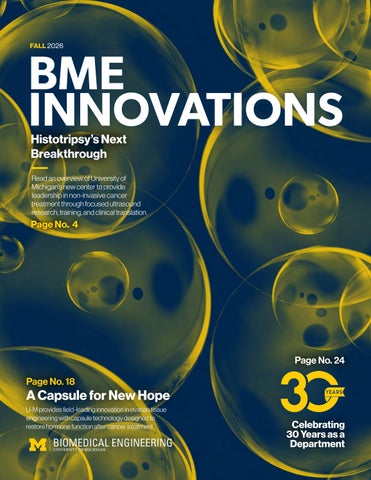
FALL 2026
BME INNOVATIONS Histotripsy’s Next Breakthrough
Read an overview of University of Michigan’s new center to provide leadership in non-invasive cancer treatment through focused ultrasound research, training, and clinical translation.
Page No. 4
Page No. 24 Page No. 18
A Capsule for New Hope U-M provides field-leading innovation in ovarian tissue engineering with capsule technology designed to restore hormone function after cancer treatment.
Celebrating 30 Years as a Department
| BME innovations
CONTENTS
FALL ‘26
2
AMPED for Medtech Careers
14
06
Preparing engineers to lead across the changing medtech landscape.
Decoding Brain Cancer Metabolism
U-M engineers and clinicians develop a wearable device to identify anaphylaxis sooner, advancing food allergy care through collaboration.
11
Detecting immune changes before symptoms and cellular damage.
Nanoparticles Against Cancer
20
Reprogramming immune cells to attack metastatic cancer.
BME Symposium
26
Celebrating research, achievement, collaboration, and community.
BME Summer Workshops @ Michigan
27
Connecting disciplines to advance cardiovascular care.
Class of 2026
32
Congratulations to our extraordinary BME graduates!
Student Organizations
36
Building skills, community, and real-world impact.
Alumni Spotlight
44
Celebrating alumni achievements, leadership, and innovation. THE REGENTS OF THE UNIVERSITY OF MICHIGAN JORDAN B. ACKER, Huntington Woods MICHAEL J. BEHM, Grand Blanc MARK J. BERNSTEIN, Ann Arbor PAUL W. BROWN, Ann Arbor SARAH HUBBARD, Okemos DENISE ILITCH, Bingham Farms CARL MEYERS, Dearborn KATHERINE E. WHITE, Ann Arbor DOMENICO GRASSO (ex officio)
BME by the Numbers
51
Quick facts about Michigan BME’s impact and excellence.
04
Advancing Histotripsy Cancer Care
U-M launches a Histotripsy Center to expand research, training, and clinical translation for tumor-destroying ultrasound technology.
LETTER FROM THE INTERIM CHAIR
Detecting Allergic Reactions Early
09
Revealing metabolic vulnerabilities in aggressive brain tumors.
Predicting Type 1 Diabetes Earlier
BME innovations
18
Restoring Ovarian Function
U-M biomedical engineers develop capsule technology to restore natural hormone production and improve life for pediatric cancer survivors.
24
Celebrating 30 Years of BME
U-M Biomedical Engineering honors decades of interdisciplinary growth, innovation, and translation from early bioengineering roots to global impact.
Honoring the Past, Celebrating the Future Dear BME Community, This fall, as we release the newest issue of BME Innovations, we find ourselves at a meaningful moment. Biomedical Engineering at the University of Michigan is celebrating 30 years as an official department — three decades of discovery, collaboration, education, and impact. Anniversaries naturally invite reflection, and we have much to celebrate. But they also invite us to look ahead. In that spirit, this issue is not only a tribute to where we have been; it is a window into where we are heading. The theme running through this issue is momentum. Michigan BME has always been defined by faculty, students, staff, alumni, clinicians, industry partners, and collaborators who see challenging problems as invitations to innovate. Starting in 1962, Michigan established a bioengineering graduate program, from which our department eventually developed. From fundamental science to translational technologies, from bench discoveries to patient impact, our department continues to lead the future of biomedical engineering. One of the most exciting examples of our commitment to innovation is our new Histotripsy Center. Histotripsy is a remarkable technology with deep roots in its discovery at the University of Michigan. Histotripsy uses focused ultrasound to mechanically disrupt targeted tissue without incisions, heat, or ionizing radiation. Its development reflects so much of what makes Michigan BME distinctive: bold engineering, close collaboration across disciplines, and a commitment to translation of innovations towards real-world use. The launch of the Histotripsy Center marks a new chapter for this field and for our department — one that unites research, clinical translation, education, and entrepreneurship in service of improving human health. This Center is more than a milestone for a single technology; it is a model for the future of innovation in BME. Today’s most urgent challenges in health and medicine demand teams that can work across boundaries — engineering and medicine, biology and computation, materials and devices, discovery and implementation. Our department is built for that kind of work. We are fortunate to be part of a university ecosystem where collaboration is not an aspiration but a daily practice, and where ideas can move from laboratories to clinics, startups, communities, and global partners. This issue of BME Innovations highlights that breadth and depth. You will see stories of discovery and translation, of students learning to think like engineers and innovators, of faculty receiving national and international recognition, and of alumni and partners extending the reach of Michigan BME far beyond Ann Arbor. Together, these stories illustrate a department that is both grounded and ambitious — grounded in scientific rigor and public purpose, ambitious in its belief that engineering can transform health–and the world. We are especially proud to recognize our award-winning faculty. Their honors reflect exceptional scholarship, mentorship, leadership, and service to the profession. But awards tell only part of the story. Each recognition represents years of curiosity, persistence, teamwork, and dedication to students and colleagues. Our faculty’s achievements elevate the entire department, and they help create an environment where the next generation of biomedical engineers can thrive. That next generation is central to our future. Michigan BME has educated students who have excelled to become leaders in academia, medicine, industry, entrepreneurship, government, and public service. Today’s students inherit that legacy, but they are also shaping it in new ways. They bring fresh perspectives, technical creativity, and a deep desire to make a difference. As biomedical engineering continues to evolve, our educational mission must evolve with it — preparing students not only to master existing tools, but to imagine and build what comes next. Looking back, we can see how far the department has come. Looking forward, we can see how much more is possible. The future of BME will be increasingly interdisciplinary, data-rich, patientcentered, and globally connected. It will require technologies that are precise and scalable, solutions that are equitable and accessible, and leaders who can bridge science, engineering, medicine, and society. Michigan BME is well positioned to lead that future. As interim chair, I am grateful for the opportunity to serve this remarkable community at such an important time. This magazine is a celebration of the people who built this department — the faculty, staff, students, alumni, and friends whose vision and hard work created the foundation we stand on today. It is also a call to keep building. The work ahead will require the same qualities that have defined us from the beginning: collaboration, creativity, excellence, and a commitment to impact. I hope this issue of BME Innovations gives you a sense of the energy and possibility that define Michigan BME today. We honor our history by using it as a launch point — not simply to remember what we have done, but to imagine what we will do next. Thank you for being part of our story, and part of our future. Go Blue,
Doug Noll, Ph.D. Interim Chair, Biomedical Engineering, Ann and Robert H. Lurie Professor, Biomedical Engineering, and Professor, Radiology University of Michigan
3
4
| BME innovations
BME innovations A U-M innovation enters its next chapter H i stot r i p sy wa s d eve l o p e d over decades at U-M through collaborations among biomedical engineers, clinicians, physicists, and entrepreneurs. The technology works by delivering highly controlled ultrasound pulses into a target region. Those pulses generate microscopic bubble clouds that rapidly expand and collapse, mechanically disrupting tissue at the cellular level. In clinical use, the approach offers an appealing possibility for patients and families: tumor destruction without an open surgery and without many of the toxicities associated with conventional cancer therapies. For families facing cancer, that distinction matters. A non-invasive option may mean less time in the hospital, fewer complications, faster recovery and the possibility of treating patients who may not be suitable candidates for surgery or other aggressive interventions. Researchers are also studying whether histotripsy can help stimulate anti-tumor immune responses by releasing tumor antigens in a way that may make cancer more visible to the immune system. But as histotripsy moves from carefully controlled research settings into broader clinical practice, new questions emerge. How can treatment be personalized for each patient? How can clinicians confirm that every part of a tumor has received adequate therapy? How can the field expand safely and effectively into additional cancers and disease sites? Those are the questions the Histotripsy Center was created to address.
U-M HISTOTRIPSY CENTER AIMS TO ACCELERATE THE FUTURE OF NONINVASIVE CANCER TREATMENT
When histotripsy received FDA clearance for the non-invasive treatment of liver tumors in October 2023, it marked a milestone more than two decades in the making for University of Michigan researchers who helped pioneer the technology. But for Zhen Xu, Li Ka Shing Endowed Professor of Biomedical Engineering, and Professor, Radiology and Neurosurgery, and a discoverer of histotripsy, FDA clearance was not the finish line. It was a new beginning. Histotripsy — a technique that uses focused ultrasound pulses to mechanically break apart targeted
tissue — has already demonstrated the potential to change the way physicians treat cancer. Unlike surgery, radiation or thermal ablation, histotripsy does not require an incision, does not rely on heat and is designed to precisely liquefy tumor tissue while sparing surrounding structures. Now, with the launch of the University of Michigan Histotripsy Center, Dr. Xu and collaborators across U-M are building the infrastructure needed to move the technology into its next era: deeper science, broader access, more rigorous training and
faster translation to patients. “The potential of histotripsy goes far beyond one disease or one device,” Dr. Xu said. “To fully realize that potential, we need the best science behind it — from understanding mechanisms, to improving monitoring and treatment delivery, to exploring new clinical applications and combinations with other therapies.” The new center is designed to do what a single research lab cannot: mobilize an entire scientific community around histotripsy.
Building a shared home for histotripsy science One challenge to histotripsy research is access to specialized equipment. Research systems are complex, expensive and often different from clinical platforms. Many investigators may have promising ideas — a new cancer model, a new treatment combination, a new imaging method — but lack the tools or expertise needed to test them. The Histotripsy Center will provide that missing infrastructure. In its first phase, the center will support research workstations,
specialized ultrasound systems, technical expertise and trained personnel so that investigators can conduct high-quality histotripsy studies using standardized, carefully controlled methods. The center’s research team is also growing. Ken Bader, Ph.D., Associate Professor, Biomedical Engineering, is joining U-M Biomedical Engineering as a faculty member in the Histotripsy Center, bringing expertise in therapeutic ultrasound, cavitation physics and translational biomedical ultrasound research. His arrival represents a significant investment in the center’s scientific future and will expand U-M’s capacity to investigate the mechanisms, monitoring methods and treatment strategies that will shape the next generation of histotripsy. D r. B a d e r i s a l s o b r i n g i n g postdoctoral researchers with him, strengthening the center’s core research team as it evolves. Along with newly recruited Ph.D. students and existing U-M histotripsy researchers, the center expects to have close to 30 core personnel by fall 2026, with additional affiliated faculty and collaborators joining as projects develop. Researchers will be able to apply to use center resources through a planned online portal. Proposed projects will be reviewed by a scientific committee, with selected investigators invited to work with center experts to design and implement studies using the equipment and workstations at the center, free of charge. The center also plans to offer seed funding for promising new ideas. For collaborators who cannot easily bring disease models to Ann Arbor, the center envisions mobile or “traveling” histotripsy systems that can be shipped to partner sites with trained personnel to support experiments remotely, also free of charge. That model, Dr. Xu said, is intended not only to expand access but also to improve rigor across the field. “There is histotripsy, and then there is histotripsy done the right way,” Dr. Xu noted. “The center provides a way to help researchers choose the right parameters, deliver treatments consistently and generate data that can move the field forward.”
From one-size-fits-all to personalized treatment A major research focus for the center will be improving how histotripsy treatments are planned, monitored and personalized. Current clinical approaches often rely on fixed treatment settings — including standard ultrasound power levels or a standard number of pulses delivered across the tumor. That can work well in many cases, but tumors and patients vary. Some tumors may be softer and require fewer ultrasound pulses; others may be tougher and need more. Treatments may also be complicated when ultrasound beams pass through ribs or other structures that can block or distort the acoustic field. Dr. Xu’s team is developing a d va n c e d a c o u s t i c fe e d b a c k methods that could allow clinicians to measure, in real time, whether cavitation — the bubble activity that drives histotripsy — is occurring and how its dynamics change throughout the full tumor volume. Instead of simply marking a planned region as treated, future systems may be able to generate a three-dimensional map showing which regions received sufficient cavitation and which may need adjustment. The goal is precision histotripsy: adapting treatment power and dose to the individual patient and tumor. That personalization may also be important for immune response. Dr. Xu’s team is studying how histotripsy dose affects the release of tumor antigens and the broader anti-tumor immune response. Undertreatment may fail to release enough tumor antigen; overtreatment may destroy cellular components that could otherwise help activate immunity. Finding the right dose could be critical for maximizing therapeutic benefit. “If we want the immune response to be maximized, we need to personalize the dose,” Dr. Xu said. “That could be very important for clinical outcomes.”
SCAN QR CODE TO LEARN MORE 5
6
| BME innovations
BME innovations
AMPED MASTER’S PROGRAM PREPARES ENGINEERS FOR A CHANGING MEDTECH LANDSCAPE STORY BY MICHELE SANTILLAN
The University of Michigan’s Advanced Medical Product Engineering and Development program (AMPED) is entering its next phase with strong momentum: a robust cohort size of 25-30 students per year, broader recruitment, growing alumni involvement and an intentional focus on how trends in artificial intelligence are reshaping medical technology and healthcare. Housed in the Department of Biomedical Engineering, AMPED is a professional Master of Engineering degree designed to prepare engineers for careers in the medical technology industry. The program combines a yearlong design-buildtest practicum with coursework in the fundamentals of medical product development, complemented by an emphasis on business decisionmaking, professional development and leadership. For Jan Stegemann, Professor, B i o m e d i ca l E n g i n e e r i n g , a n d M ac ro m o l e c u l a r S c i e n c e a n d Engineering and Director of the AMPED Program, its evolution reflects a long-standing strength in U-M BME: preparing students to translate engineering ideas into solutions that can make a difference in clinical care. Alongside the core practicum, students study quality
systems, regulatory strategy, risk management, design controls, prototyping, formative testing and proof of concept. Advanced topics have included medical device cybersecurity, creativity in design, sustainability in medtech, and case studies on recent recalls in the medical technology space. “The program has evolved from a graduate course that started 15 years ago, which then became a concentration in our master’s program,” Dr. Stegemann said. “That concentration was also popular, so we expanded it into its own Master of Engineering degree, which is the current AMPED program.” Now in its fourth cohort as a standalone degree program, AMPED was created in response to feedback from industry partners and other stakeholders who emphasized the need for graduates who understand not only engineering design, but also the regulatory, quality, risk and business contexts that shape medical product development. “It has evolved extremely well for the last four years,” Stegemann said. “We track placement data, and it has been very strong. Students are securing jobs at the types of companies they are interested in, and in the types of roles they want.”
AMPED graduates move into a variety of careers in medical technology industries, including initial roles as clinical specialists, product design engineers, R&D engineers, quality engineers and other positions associated with medical product development. Employers include some of the largest global healthcare companies, as well as midsize and smaller companies, startups and the U.S. government. A major outcome of the program, Dr. Stegemann said, is that students leave with a broader understanding of the medtech career landscape. “One thing we’ve really noticed— and in fact, one of the goals that we’ve achieved—is that students are much more aware of the breadth of job opportunities and functional roles they can fill in various organizations,” Dr. Stegemann noted. “That is helpful to them, because they have a broader spectrum of jobs they can apply for, or they may apply for roles that they were not familiar with before their AMPED experience.” At the heart of AMPED is a clinical product development experience. Each year, clinicians present current clinical problems to the student cohort. Students evaluate needs, form teams and develop devicebased solutions through a full design-
build-test sequence. Teams work with clinician consultants who provide insight into clinical practice and feedback on product concepts. “We are close to the clinic in that we receive clinical problems from practicing clinicians—not always doctors, but also nurses, EMTs, and other healthcare professionals— providing a variety of clinical experiences,” Dr. Stegemann said. Recent AMPED projects have addressed needs across cardiology, o b s t e t r i c s a n d g y n e c o l o g y, ophthalmology, orthopedic surgery, pediatrics, plastic surgery, radiology and thoracic surgery. Examples include a compression device to achieve hemostasis following catheterization, a tool for laparoscopic hysterectomies in low-income countries, a predictive monitor for diurnal enuresis in children, a portless breast tissue expander for breast reconstruction and a device to detect air leaks in the lung. The prog ram’s st r ucture is intentionally integrated. Students directly apply the concepts that they learn in classes to their team projects. Dr. Stegemann said. “It is experiential not just from the standpoint that you are physically building something, but also in that you are intellectually applying what you have learned in other courses on a complex project.”
AMPED also emphasizes the realities of maintaining a viable business model. “We are very focused on helping our students understand what medical product development looks like from the perspective of industry,” Dr. Stegemann said. “We frequently and intentionally engage industry colleagues and bring them into the program to ensure that our curriculum reflects current industry needs and practices.” That industry-informed approach is supported by a close teaching collaboration between Dr. Stegemann and Dr. Jonathan Fay, Clinical Associate Professor of Practice, Biomedical Engineering, and Associate Chair for Translational Research , wh o wor k toget h er across key elements of the AMPED curriculum. “Jonathan and I collaborate closely across the whole AMPED curriculum,” Dr. Stegemann said. “We co-teach the core design-build-test course, and we are both there to help the teams.” While the design-build-test practicum serves as the central hands-on experience for students, the broader curriculum is designed to help them understand the many dimensions of medical product d e v e l o p m e n t . D r. S t e ge m a n n teaches courses focused on quality
systems, regulatory structures, risk management and advanced medical product development topics, including AI and cybersecurity. Dr. Fay leads the program’s professional and leadership development curriculum, which helps students examine career options, better understand their own strengths and prepare to work effectively in multidisciplinary organizations. “Jonathan’s main course focuses on professional and leadership development,” Dr. Stegemann said. “Students explore different career paths, practice self-assessment to figure out what they are interested in and what they may be good at, and then look at leadership— understanding themselves, how people lead, and how they might lead or react to leaders.” The course also introduces students to business principles and decision-making processes that shape how medical technology c o m pa n i es eva l u ate p ro j e c t s , pro ducts and peopl e. Whil e entrepreneurship is included for students who are interested, the course is not centered solely on startup creation.
SCAN QR CODE TO READ FULL STORY 7
8
| BME innovations
BME innovations
EXPANDING AI ENGINEERING EDUCATION WITH NEW MASTER’S PATHWAY U-M BME is launching a new pathway for graduate learners who want to build advanced artificial intelligence skills and apply them directly to biomedical engineering. Applications are now open for the upcoming Master of Engineering (MEng) in Artificial Intelligence Engineering with a concentration in Biomedical Engineering. This degree program is designed for engineers, scientists, and technical professionals seeking rigorous, practice-oriented training at the intersection of AI, machine learning, and biomedical innovation. The program will be offered in both online and residential formats, increasing access for recent graduates and working professionals who want to continue advancing their careers without relocating or leaving the workforce. The program is designed with multiple student pathways in mind. Full-time students may be able to complete the degree in three to four academic terms, while part-time students may spread coursework over additional terms. The online format is intended to support students who need flexibility due to work, family or location constraints. A 12-credit Graduate Certificate in Artificial Intelligence Engineering will offer another entry point. The certificate is designed to be stackable toward the full MEng, giving students the option to begin with a shorter credential and continue into the master’s program later. Stackable certificates enable the student to earn credentials by completing courses that meet overlapping requirements. In this case, by completing the AI graduate certificate, the student can earn credits toward the MEng degree. This structure may be especially appealing for earlyand mid-career professionals seeking to strengthen their AI expertise, recent engineering graduates pursuing a professional master’s degree, and Sequential Undergraduate/
STORY BY MICHELE SANTILLAN
Graduate Studies students looking to continue directly into graduate education. The 30-credit degree is part of a broader Michigan Engineering initiative that unites multiple engineering disciplines around a shared goal: training engineers to develop, adapt, and apply AI-based tools within complex engineering systems. For students in the Biomedical Engineering concentration, that means learning to use AI in areas such as biomedical imaging, neural engineering, signal processing, data-driven modeling, systems biology, and biomedical decision-making. The start term for the MEng program is Fall 2027, with a stackable Graduate Certificate in Artificial Intelligence Engineering planned to begin in Winter 2027. The MEng program requires 12 course credits in AI/ML foundations, 12 credits in domain intersection in biomedicine (typically courses in BME), and 6 credits for Knowledge Extensions. The Graduate Certificate Program requires 6 credits in AI/ML Fundamentals Core Courses and 6 credit hours of Domain Intersection Courses. Individualized plans of study will be developed by students in consultation with an advisor. Refer to the Engineering Course Guide and Bulletin for course descriptions.
SCAN QR CODE TO LEARN MORE
PROGRAM TOPICS AI/ML Fundamentals Including machine learning, deep learning, optimization, reinforcement learning and matrix methods for signal and image processing.
UNLOCKING THE METABOLIC CODE OF BRAIN CANCER: U-M BME’S DEEPAK NAGRATH ON GROUNDBREAKING TUMOR NUTRITION RESEARCH
Biomedical Engineering Domain Intersections Where AI is applied to biomedical systems, data and technologies.
Knowledge Extensions and project-based learning Allowing students to broaden their expertise and apply what they learn to practical problems.
How does one of the most aggressive cancers in the human body, glioblastoma (GBM), fuel its relentless growth? A pioneering interdisciplinary study published in Nature and co-led by Deepak Nagrath, Ph.D., Professor, Biomedical Engineering and Chemical Engineering, Daniel Wahl, M.D., Ph.D., Achtenberg Family Professor of Radiation Oncology, Associate Professor of Radiation Oncology and Neurosurgery, Medical School, Wajd Al-Holou, M.D., Assistant Professor, Neurosurgery, and Costas Lyssiotis, Professor, Physiology and Medicine, is helping answer this question. Their research findings open the door to the possibility of entirely new therapeutic approaches in treating and managing brain cancer. Peering Inside Tumor Metabolism Traditionally, cancer metabolism research has required taking cells out of their natural habitat, growing them in petri dishes far removed from the biological reality of a living brain. “In vivo, or within the brain, is very difficult,” Dr. Nagrath explained. “What are the nutrients that [tumors] utilize? What are they dependent on?” To tackle this challenge, the research team infused patients with a safe, non-radioactive version of glucose—an essential sugar molecule labeled with “heavy” carbon atoms—during brain surgery for GBM. “We have infused this 13-carbon labeled glucose, and through
that, and dissecting the metabolism and quantitative models, we are able to understand how these cancer cells utilize glucose,” said Dr. Wahl. With this approach, the researchers achieved a scientific first: mapping the precise fate of glucose-derived carbon atoms in both tumor and neighboring healthy brain (cortex) tissue using advanced mass spectrometry and metabolic modeling. This allowed direct, real-time tracking of how tumors ‘choose’ to use nutrients as compared to normal brain cells. Repurposing Glucose for Growth What’s the difference between healthy brain cells and tumor cells in using food for fuel? According to Baharan Meghdadi, a co-leading author in the study, “In the human cortex, glucose carbons fuel essential physiologic processes including TCA cycle oxidation and neurotransmitter synthesis.” Healthy brain cells mostly use glucose to create energy for normal physiology— powering thoughts, movement, and repair. But brain cancers, especially GBM, have a different agenda. “Gliomas reroute these glucose carbons to produce nucleotides, which are building blocks for proliferation and can be used to resist treatment. That has been a major finding,” Andrew Scott, Ph.D., Research Fellow, Radiation Oncology, and a co-leading author of the study, noted.
In effect, these tumors hijack glucose not to help the brain work, but to build the molecular “building blocks” (nucleotides) needed for copying DNA and rapid growth—“malignant expansion” rather than normal activity. A New Frontier for Brain Cancer Therapy GBM is known for its devastating prognosis and resistance to existing treatments. “Most patients die within 1-2 years of diagnosis,” said Dr. Nagrath, pointing to the pressing need for new, personalized approaches. By directly comparing tumor and healthy brain metabolism in patients—and uncovering a metabolic “Achilles’ heel” in glucose and amino acid handling—Dr. Nagrath and his U-M colleagues are providing promising new strategies to slow or stop tumor progression. “These findings illuminate how aggressive brain tumors exploit glucose to suppress normal physiological activity in favor of malignant expansion and offer potential therapeutic strategies to enhance treatment outcomes,” the team report noted.
SCAN QR CODE TO READ FULL STORY
9
10 | BME innovations
BME innovations
RESEARCH UNVEILS MITOCHONDRIAL ROLE IN AGE-RELATED NEUROMUSCULAR JUNCTION DEGENERATION STORY BY MICHELE SANTILLAN A research team from U-M BME’s Aguilar Lab has identified a key factor in age-associated muscle decline: the loss of postsynaptic mitochondria at the neuromuscular junction (NMJ). Their findings, published in Aging Cell, provide significant insights into the mechanisms that drive sarcopenia and motor function decline with aging. Understanding Muscle Decline “As we age, one of the most critical manifestations that impinges on our health is the loss of muscle mass and muscle strength.” said Carlos Aguilar, Associate Professor, Biomedical Engineering, and senior author of the study. “We are not able to use our muscles in the same way that we did when we were young.” This functional loss is closely related to the degeneration of NMJs, which are specialized synapses allowing communication between motor neurons and muscle fibers. When this communication becomes impaired, it contributes to frailty, decreased physical activity, and the onset of age-associated diseases such as sarcopenia. Mitochondria at the Core of NMJ Stability Although NMJ degeneration in aging has been noted in both human and mouse models, the underlying cause remained unclear. Aguilar’s team focused their investigation on mitochondria, essential organelles responsible for energy production and cellular regulation within muscle fibers, particularly at the NMJ. “We were particularly interested in what happens to mitochondria at the synapse when we age,” Aguilar said. Using high-resolution imaging techniques and single-nucleus RNA sequencing before and after nerve injury in young and aged mice, the team observed a marked loss of postsynaptic mitochondria in older muscle tissue. This reduction was accompanied by increased denervation and delayed reinnervation after nerve injury.
Establishing Causality with CRISPRBased Models To determine whether mitochondrial dysfunction drives NMJ degeneration, the researchers used muscle-specific CRISPR genome editing to target two critical mitochondrial proteins: CHCHD2 and CHCHD10. These nuclear-encoded proteins localize to the mitochondrial intermembrane space and support mitochondrial integrity. “By knocking out these proteins in young mice, we were able to reproduce key aspects of the aged muscle phenotype,” said Aguilar. The CRISPR knockouts resulted in mitochondrial disorganization, reduced ATP production, NMJ fragmentation, and delayed muscle recovery after injury. Transcriptomic analysis confirmed impairments in mitochondrial remodeling programs and increased cellular stress. “Our work demonstrates that maintaining postsynaptic mitochondrial integrity is essential for NMJ stability and regenerative ability,” Aguilar stated. Implications for Therapeutic Strategies Currently, there are no approved therapeutics for sarcopenia or ageassociated muscle loss—diet and exercise remain the only physicianrecommended interventions. However, Aguilar’s research points toward the potential for targeted genetic and mitochondrial therapies.
“We are actively exploring different interventional approaches to modify gene expression in situ,” Aguilar explained. “Our findings highlight the possibility of developing novel therapies, including mitochondrial transplantation and genetic modulation, that may preserve NMJ integrity and improve outcomes after muscle injury in the aging population.” Research Collaboration and Acknowledgments Dr. Aguilar emphasized the collaborative nature of the project, noting that its success was the result of contributions from postdoctoral fellow Steve Guzman and several key collaborators, including Greg Valdez at Brown University and Joe Chakkalakal at Duke University. “This project has benefited from a wave of innovation in single-nuclei sequencing and genome editing technologies,” Aguilar noted. Support for the research came from the Hevolution Foundation and National Science Foundation CAREER award. The team’s work sets a foundation for future studies aimed at mitigating the impact of aging on muscle health and function.
SCAN QR CODE TO READ FULL STORY
NEW HOPE FOR EARLY DETECTION: U-M BME RESEARCHERS PIONEER A GAME-CHANGING APPROACH FOR PREDICTING TYPE 1 STORY BY DIABETES MICHELE SANTILLAN In a significant step toward the goal of preventing autoimmune type 1 diabetes (T1D), a team led by U-M’s Lonnie Shea, Steven A. Goldstein Collegiate Professor, Biomedical Engineering, has developed a new system that can identify—well before symptoms appear—whether an individual is on track to develop the disease. The research, published in a recent Science Advances issue, offers an actionable monitoring method that may guide the administration of current and emerging therapeutics more effectively than the current diagnostics that only assess disease risk or detect disease after destruction of insulin producing cells. The Challenge of Predicting T1D “In many instances, such as individuals with a family history of diabetes, people know that they’re at risk for developing diabetes, but there aren’t any current, reliable tests that provide actionable information,” he said. “One current test measures the presence of auto-antibodies to insulin or other islet cell components. If you test positive for one antibody, individuals develop diabetes at a rate of 14.5% in the next 10 years. For two antibodies, the rate is 65.1% and those with 3 antibodies the rate is 72.1%,” Dr. Shea explained. The numbers show that risk increases, yet the broad time frame makes it difficult to determine when an individual should act or what they should do to halt disease onset. “If someone tests positive for two antibodies,” Dr. Shea said, “a glucose
tolerance test can be administered to identify ‘dysglycemia’—longer than normal to clear glucose—that means they’re losing function of their beta cells.” At this point, the patient may receive a novel therapeutic called teplizumab that can be administered to delay the onset of diabetes. But, as Dr. Shea noted, “this drug is being delivered after you’ve already lost a significant function of your beta cells. We really wanted a system to identify the immune dysregulation that precedes beta cell destruction.” A Breakthrough System: The Immunological Niche The team’s new approach centers on a special implant called a microporous scaffold. Placed under the skin, it serves as an “immunological niche” (IN)—a safe, easily accessible site that mirrors the immune changes happening deep in the pancreas, where T1D takes hold. “We have also shown that the IN captures tissue associated phenotypes distinct from those present in circulation,” said Dr. Jessica King, the lead author on the recent publication. “This distinction is particularly useful in the case of T1D, as investigating tissue specific changes through a pancreas biopsy would destroy a piece of the tissue therapies like teplizumab aim to preserve, and blood based tests lack the time specificity we have found with the IN,” said Dr. King. Instead of waiting for glucose problems or relying only on antibody levels, researchers can analyze the genetic activity (transcriptomics)
in cells sampled from the IN, offering a much earlier window into disease progression. In their study using the NOD mouse model—where about 75% of mice develop type 1 diabetes—Dr. Shea’s team was able to identify diabetes risk early and track the immune system over time. “We sampled the implants at six weeks of age, and could distinguish those mice that were going to develop diabetes from those that were not.” This timing of analysis was “far before there are any symptoms of diabetes,” Dr. Shea noted. “There’s no indication—no dysglycemia or poor health—but we could already tell who was going to develop diabetes and who’s not.” Seeking Actionable Information for Treatment One of the most impressive aspects was the ability to monitor disease progression. For the mice at risk, “we could monitor the implant over time and develop a score based on a gene signature. From six weeks of age to about five to seven weeks before disease onset, the score remained low. Then, at five to seven weeks before onset, there was a substantial jump in that score—indicating the immune system is activating. Diabetes is coming,” he said.
SCAN QR CODE TO READ FULL STORY 11
12 | BME innovations
COULT E R UPDATES
U-M BME AWARDS $950K IN FUNDING TO NINE MULTIDISCIPLINARY TEAMS VIA THE COULTER TRANSLATIONAL RESEARCH PARTNERSHIP PROGRAM
RESEARCHERS DEVELOP AI MODEL TO TARGET SAFER, MORE EFFECTIVE DRUG COMBINATIONS FOR ANTIMICROBIAL THERAPY STORY BY MICHELE SANTILLAN
STORY BY MICHELE SANTILLAN Congratulations to the nine teams who have been selected to receive FY27 funding through U-M BME‘s Coulter Translational Research Partnership Program. Established with a $20M endowment in 2005, the U-M BME Coulter Translational Research Partnership Program supports research directed at promising technologies within research laboratories that are progressing towards commercial development and clinical practice. Outcomes of previous Coulter funding and support include the formation of 6 FDA approvals, 20 exits and well over $2B raised in angel or venture capital by startups developing Coulter funded technologies or generated through sale of companies commercializing Coulter-funded
BME innovations
technologies. “U-M BME is honored to help advance these important initiatives,” said Douglas Noll, Interim Chair and Ann and Robert H. Lurie Professor of Biomedical Engineering and Professor of Radiology. “On behalf of the Coulter Program’s Oversight Committee, I’m pleased to congratulate these engineering and clinical research teams on receiving support for their translational projects. The committee selected a strong, innovative group of teams spanning a range of biomedical engineering research areas, and we look forward to seeing the impact of their work in the year ahead.” “The U-M BME Coulter Translational Research Program supports teams from the earliest proposal stages through
Project Title
funded project development, helping guide promising laboratory discoveries toward commercial advancement and follow-on investment,” said Thomas Marten, Managing Director of the Coulter Program in Biomedical Engineering. “As part of the Coulter process, we work closely with teams and engage with an extensive network of external advisors who comprise the Coulter Advisory Board, as we evaluate projects for funding and provide guidance on milestone development. The nine projects chosen for funding this year reflect the continued strength of the program and represent a diverse set of innovative technologies with potential paths forward as therapeutics or medical devices.”
Principal Investigators
“Armaclot: A Rapid Hemostatic Agent for Uncontrollable Hemorrhage”
Nicholas Kotov, PhD, Chemical Engineering & J. Scott VanEpps, MD, PhD, FACEP, Emergency Medicine
“Vascular Integration System for Therapeutic Application (VISTA)”
Brendon Baker, PhD, Biomedical Engineering & Scott Soleimanpour, MD, Internal Medicine
“An Optimization Framework for Precision Spinal Cord Stimulation”
Scott Lempka, PhD, Biomedical Engineering & Kevin Chen, MD, FAANS, FCNS, Neurosurgery
“A Low-Profile, Expandable, and Durable Percutaneous Ventricular Assist Device (MiVAD)”
Albert Shih, PhD, Mechanical Engineering & Eric Cantey, MD, Cardiovascular Medicine
“Guided Prostate Cancer Focal Therapy with a Photoacoustic imaging needle”
Guan (Gary) Xu, PhD, Biomedical Engineering & Andrew Wood, MD, Urology
“Diagnosing Keratoconus and Ectasia by Inverting Corneal Shadowgrams”
Volker Sick, PhD, Mechanical Engineering & Angela Verkade, MD, Ophthalmology and Visual Sciences
“Development of the Systolic Target Assessment Tool (STAT)”
Kenn Oldham, PhD. Mechanical Engineering & Florian Schmitzberger, MD. Emergency Medicine
“Bridging the Gap in Spinal Cord Injury: Using Polyethylene Glycol Microporous Annealed Particle Tubes to Stimulate Neuroregeneration Through Spinal Cord Injury Sites”
Lonnie D. Shea, PhD, Biomedical Engineering & Noojan Kazemi, MD, Neurosurgery
“AI-Driven Muscle Ultrasound and Multimodal Data Fusion Device for Early Detection and Personalized Risk Stratification of Metabolic Dysfunction”
Liyue Shen, PhD, Electrical Engineering and Computer Science & Steven Soliman, DO, RMSK, FAIUM, FAOCR. Radiology and Musculoskeletal Division
Antibiotic resistance remains one of the greatest global health threats, projected to claim 10 million lives annually by 2050 unless new solutions emerge. Addressing this urgent challenge, a cross-disciplinary team at the U-M Biomedical Engineering (BME) has developed an innovative machine learning model that not only predicts which drug combinations can best combat resistant pathogens, but also flags those most likely to produce harmful side effects. T h e r e s ea r c h , l e d b y S r i ra m Chandrasekaran, Associate Professor, Biomedical Engineering, and Ph.D. student Harikat Singh Arora, pioneers a custom AI model that predicts not only the efficacy of drug combinations against key pathogens, but also their risk of toxic side effects, addressing a major obstacle in advancing new therapies. The research benefited from U-M’s drug discovery resources, the U-M Coulter Translational Research Partnership Program, and the NSF I-Corps program, which encouraged engagement with pharmaceutical industry stakeholders. “We’ve spent years developing machine learning models to find new drugs or optimal combinations for infections,” said Dr. Chandrasekaran. “But what’s unique here is the extra mile that Harikat took by engineering a model that looks at both potency and safety. It can actually rank combinations based on effectiveness and the potential for side effects, so scientists can prioritize candidates that are both safe and powerful.” The research, conducted in partnership with the Michigan Drug Discovery Core and Komodo Health, centered on two major bacterial pathogens: E. coli and M. tuberculosis. Using the Michigan Drug Discovery
Core facility and experimental assays devised by team members, Aaron Robida and Katherine Lev, they validated the AI model’s predictions in the lab. The research relied on anonymized health records from Komodo Health, which holds extensive patient data. The use of real-world evidence brought a clinical perspective to lab findings— demonstrating that drug pairing predicted by AI led to safer outcomes for patients. N o ta b l y, t h e A I f l a g ge d combinations—including one marrying
We’ve spent years developing machine learning models to find new drugs or optimal combinations for infections,” -Sriram Chandrasekaran, Associate Professor, Biomedical Engineering
the FDA-approved antibiotic vancomycin (often limited by kidney toxicity) with another agent—not only boosted effectiveness, but also reduced toxicity. “When we looked at health records for people who had received these combinations, we found that kidney side effects were significantly lower for patients taking this combination than for patients taking vancomycin alone,” Dr. Chandrasakaran said. “It was a full circle: from model, to bench, and then
to real-world patient data. It’s pretty heartwarming for us to see science translate all the way.” But the innovation doesn’t stop at prediction. Addressing long-standing criticism about “black box” AI, the team ensured their model is interpretable. “We developed new methodologies to ensure mechanistic interpretation,” Arora noted. “It shows not just which drug combinations are promising, but also which metabolic pathways or molecular mechanisms are driving potency and toxicity. That means scientists can actually see why something works or doesn’t, and engineer safer drugs based on those insights.” One recurring mechanism identified was the nucleotide pathway, crucial in both effectiveness and side effects. The team perturbed this pathway in the lab and confirmed the model’s predictions, cementing their approach as both predictive and explanatory. The project was inspired in part by the COVID-19 pandemic, which highlighted the broader threat of antibiotic resistance. “COVID claimed around 7 million lives, but if unchecked, antibiotic resistance could claim 10 million annually by 2050,” said Arora. “Pharmaceutical companies often avoid developing new antibiotics because this business model is not seen as profitable. So we thought, can academic researchers take the lead by combining existing drugs in safer, more impactful ways?”
SCAN QR CODE TO READ FULL STORY
13
14 | BME innovations CO U LT ER U P DAT E S
BME innovations
EARLY DETECTOR OF SEVERE FOOD ALLERGY REACTIONS – KNOWING WHEN TO REACH FOR AN EPI-PEN
THE STORY OF OUR COLLABORATION IS THE MOST ‘UNIVERSITY OF MICHIGAN STORY’ EVER: TWO TEAMS, ONE CAMPUS, AND A SHARED DRIVE TO SOLVE A RISING MEDICAL CRISIS. OUR STORY IS ABOUT PROXIMITY, OPPORTUNITY, AND A LOT OF ENGINEERING ELBOW GREASE.”
STORY BY MICHELE SANTILLAN “The story of our collaboration is the most ‘University of Michigan story’ ever: Two teams, one campus, and a shared drive to solve a rising medical crisis. Our story is about proximity, opportunity, and a lot of engineering elbow grease,” said Chase Schuler, MD, FAAAAI, Assistant Professor of Internal Medicine, Clinical Assistant Professor of Mary H. Weiser Food Allergy As the Coulter Translational Research Partnership Program at U-M celebrates its 20th anniversary, this story features one of the projects that embodies the collaborative ethos of Michigan BME. Xudong (Sherman) Fan, Richard A. Auhll Endowed Professor of Engineering and Professor, Biomedical Engineering, and Dr. Schuler, a faculty allergist, are spearheading the development of a wearable device designed to detect the earliest signs of anaphylaxis— potentially revolutionizing care for millions living with food allergies. Their partnership, forged through Michigan’s uniquely close clinical and engineering communities, exemplifies how proximity and teamwork can transform serendipitous discoveries into life-changing technology. A Fortunate Discovery and an Urgent Need Dr. Schuler’s research began with a fundamental clinical challenge: detecting anaphylaxis before it reaches a critical point. “There are no predictors—no monitors, no alarms,” he said. “Diagnosis is entirely clinical, and often inconsistent,” Dr. Schuler added. With food allergies affecting up to 10 percent of the U.S. population, the stakes are enormous and growing. Initially, Dr. Schuler’s team measured transepidermal water loss (TWL) using a commercial device with the aim of studying skin changes during allergy events. By chance, they discovered
a sharp and immediate spike in skin water loss during the earliest stages of anaphylaxis—a biological “fire alarm” that sounded before symptoms appeared, offering a potential window for intervention. Realizing the importance of their discovery, they published their findings, worked with Innovation Partnerships to file a patent application, and initiated a pilot trial focused on very small children— often too young to verbalize specific symptoms—making early detection especially critical. However, Dr. Schuler quickly encountered barriers with the commercial device itself. It was too bulky, expensive, and unsuited for pediatric use. The solution would require more than just clinical insight— it would need targeted engineering expertise. Where Engineering Innovation Meets Clinical Insight That’s where Dr. Fan and his team entered, approaching the problem from the engineering side. Fan’s lab, supported by NIH, had been developing technologies to measure body odor for disease diagnosis, which required accurate and affordable TWL measurement tools. The devices available on the market, he found, were cost-prohibitive, unwieldy, and far too sensitive to motion and environmental factors, such as humidity. Motivated by both necessity and scientific curiosity, Dr. Fan’s group developed their own wearable TWL monitoring device prototype using miniaturized components to enable a device small enough for on a person’s wrist. As Dr. Fan recounted, the breakthrough came when they discovered Dr. Schuler’s published study on food allergen challenges and recognized both the clinical potential
and the need for robust engineering solutions. Rather than being separated by thousands of miles or academic silos, the two teams were able to initiate collaboration minutes away from each other on the Michigan campus—an opportunity that would be much harder to realize elsewhere. “Instead of one of us being in London and the other in San Francisco, both of us were in Ann Arbor,” Dr. Schuler said. The convenience of proximity, as Dr. Fan added, also simplified administrative challenges such as IP management and accelerated iterative problem-solving. From Serendipity to Tailored Devices: The Michigan Advantage From this point, the project moved rapidly, fueled by synergy and Michigan’s collaborative environment. As Drs. Schuler and Fan began working together, they focused on refining the device to meet the unique needs of pediatric patients. Dr. Fan’s lab adjusted its prototype, making it smaller, lighter, and increasingly tailored—eventually working toward a wireless, Bluetoothenabled version. In addition to technical refinement, the team dramatically reduced costs, slashing the price from more than $500 to around $100, opening the door to future mass deployment. This engineering progress dovetailed with clinical development. As Dr. Schuler continued his pilot studies and further validated the physiological phenomena, the team also moved forward with patent applications and new grant proposals. What began as an accidental finding quickly matured into a scientifically robust, clinicallysensitive technology, ready for broader testing and commercialization. Coulter’s Strategic Boost and the Power of Guided Collaboration A crucial part of their journey was
- CHASE SCHULER, MD, FAAAAI, ASSISTANT PROFESSOR OF INTERNAL MEDICINE, CLINICAL ASSISTANT PROFESSOR OF MARY H. WEISER FOOD ALLERGY
the involvement of the U-M BME’s Coulter Translational Research Partnership Program. As Thomas Marten, Director, Coulter Program, describes, the program was designed not only to provide funding, but also to offer strategic guidance, de-risking, and essential market validation. “Coulter doesn’t give you unlimited time or funding,” Marten noted, “but we can help provide the support that teams need to reach the next stage to continue new product planning and development —whether that’s further grants, commercial partnerships in the form of licensing deals to startups or existing companies, or conducting human clinical trials while still a university project.” For Dr. Fan, this guidance was transformative. “It’s the difference between pausing a project and refining it for real-world impact.” He emphasized how the Coulter process encouraged the team to prioritize market orientation, customer validation, and usability, rather than just technical achievement. Dr. Schuler echoed this sentiment, highlighting the value of education and hands-on experience that the Coulter mentorship and proposal review process provided— practical insights that don’t come from textbooks or isolated grant writing. “Coulter’s strategic guidance and
market research were pivotal—these lessons will stick with me for the rest of my career,” said Dr. Schuler. Building Momentum and Planning for the Future As the project matured, the team began thinking beyond the immediate device. Their work with Coulter not only catalyzed technical improvements, but also built a foundation for the next steps: expanded clinical validation, commercial strategy development, and broader impact on public health. With interest from organizations such as the Keep Smiling for Abby Foundation and involvement in a nationwide food allergy consortium’s study, the team is poised for larger validation trials. Simultaneously, they are leveraging Michigan’s Accelerate Blue Foundry and programs such as Michigan Translational Research and Commercialization (MTRAC) and Advance to maximize non-dilutive funding and cultivate entrepreneurial support. Alongside potential mentor and CEO candidates, they’re seeking commercial advisors and building out an advisory board to guide future business development. Drs. Fan and Schuler are continuing their collaboration—to carry development as far as possible within Michigan’s unique ecosystem,
maximizing support and minimizing capital needs and dilution until their device is commercially ready for the market. The Michigan Difference: Collaboration and Forward Momentum Ultimately, the device’s journey from accidental observation to nearmarket readiness were made possible because of the multitude of resources at Michigan. As Marten noted, “Our structure—bringing engineering and medicine together under one umbrella with funding, commercialization and translational research support—makes it possible for teams to move quickly and learn collaboratively. Dr. Schuler summarized the transformation enabled by Coulter: “Going from a large, corded device that introduced a new measurement technique, to a small, cordless, market and clinically validated tool—that’s the process Coulter supports. And that’s exactly what we needed.” As Michigan continues to celebrate two decades of the Coulter Translational Research Partnership Program, this project stands as a testament to the power of campus proximity, interdisciplinary collaboration, and strategic support in driving medical innovation forward.
15
16 | BME innovations CO U LT ER U P DAT E S
COULT E R UPDATES
FROM CONCEPT TO CLINIC: HOW A COULTER COLLABORATION DELIVERED INNOVATION IN ADMINISTERING ANESTHESIA TO EYES
U-M BME RESEARCHERS AWARDED FRANKEL INNOVATION FUNDING FOR NEXTGENERATION DEEP BRAIN STIMULATION MAPPING
STORY BY MICHELE SANTILLAN
Tarsus Pharmaceuticals recently acquired iRenix Medical, Inc., in a business deal for $75M upfront, and up to $565M total. Few people know, though, that the origins of this innovation are rooted in BME’s Coulter Translational Research Partnership Program. Nearly 11 years ago, in the clinics of U-M’s Kellogg Eye Center, a persistent challenge inspired a team to rethink the future of eye care. Retina specialists, treating patients with sight-saving intravitreal injections for addressing conditions such as wet age-related macular degeneration (AMD), wondered if they could improve the way the doctors anesthetized the eye, making this frequent clinic procedure more comfortable for their patients. The answer would require collaboration, invention, and a journey spanning continents, specialties, and entrepreneurial opportunities. This journey has culminated in two companies, more than $50 million in capital raised, a first-in-class FDA De Novo-granted medical device, and learnings that led to the development of a new drug to replace a commonly used eye antiseptic administered before intravitreal injections that often creates problems for patients. For background, cryoanesthesia, or numbing of the eyes using precision cold temperature, can decrease the discomfort patients experience during intravitreal injections (injection of drugs directly into the eye) and eliminate the need for lidocaine anesthetic injection prior to receiving intravitreal injections of therapeutics for conditions such as wet AMD (age-related macular degeneration). Cryoanesthesia is also an alternative to lidocaine for a small group of people with lidocaine allergies.
For patients who require intravitreal injections—vision-saving treatments for conditions like wet AMD—this is a regular reality. Traditionally, doctors use anesthetic eye drops or numbing injections, which can be slow, uncomfortable, and sometimes only partly effective. But what if, instead of chemicals, cold itself could block pain? Cryoanesthesia takes advantage of
We asked ourselves if there was a faster, better way to numb the eye,” -Cagri Besirli, MD, Associate Professor, Ophthalmology
neurobiology: cold temperatures can stop nerves from sending pain signals, like when you put an ice pack on a sprained ankle or bite into ice cream and your tongue goes numb. The challenge was translating this natural phenomenon into a safe, fast, and reliable method for medical use—specifically, for safely numbing the eye. A Spark of Inspiration and the Power of Collaboration “We asked ourselves if there was a faster, better way to numb the eye,”
BME innovations
recalled Cagri Besirli, MD, Associate Professor, Ophthalmology, who first conceptualized the project with his then-resident Stephen Smith, MD, in 2014. “Traditional anesthetic drops and injections took time, sometimes didn’t fully relieve pain, and weren’t ideal for our workflow. Could cold, rather than chemicals, disrupt nerve conduction and bring relief?” The idea of cryoanesthesia developed from Dr. Besirli and Dr. Smith’s direct experience with patients and a willingness to question traditional assumptions surrounding this procedure. They noticed, anecdotally, that cold led to numbing in other situations. “We went to the literature,” Dr. Besirli said. “We examined how pain sensation works, which pain receptors exist on the surface of the eye, and how temperature changes could impact sensation.” Instead of trying yet another drug, they considered using direct cooling. T h i s c l i n i ca l i n s i g h t s pa r ke d partnership with engineers Kevin Pipe, Professor, Mechanical Engineering, Applied Physics Program, Electrical Engineering and Computer Science, and Associate Dean for Undergraduate Education, College of Engineering, and postdoctoral fellow, Gun-Ho Kim. The goal: To create a portable device that could deliver rapid, safe, localized cooling. What began as a cross-disciplinary conversation soon became a project emblematic of U-M’s collaborative spirit, drawing in the funding, support and structure of the Coulter Translational Research Partnership Program.
SCAN QR CODE TO READ FULL STORY
STORY BY MICHELE SANTILLAN Enrico Opri, Assistant Professor, Biomedical Engineering and Neurology, was recently awarded a Frankel Innovation Initiative grant for his project, “Developing Next Generation Real-Time Directional Mapping for Deep Brain Stimulation (DBS) Therapy,” which aims to revolutionize brain surgery for patients with movement disorders such as Parkinson’s disease and dystonia. Dr. Opri explained the significance of the award and the challenge his research tackles. “ The number of patients affected by movement disorders such as Parkinson’s and dystonia is increasing, and these conditions result in longterm disability and loss of quality of life,” he said. “DBS, while successful as a late-stage therapy, often requires repositioning of electrodes in an estimated 15–34 percent of cases … because the surgery relies on implanting precisely-placed electrodes to deliver targeted stimulation.” Currently, DBS procedures either keep patients awake for intraoperative mapping (“the classic way,” Dr. Opri noted, “is awake surgery, with a neurologist listening to brain activity to validate placement”), or surgery is performed while the patient is asleep based solely on imaging—limited to facilities with specialized intraoperative MRI suites. “Not many hospitals have that available, and you lose direct feedback on brain activity,” added Dr. Opri. The lack of intraoperative feedback during sleep surgeries is a barrier for expanding access to DBS therapies. With support from the Frankel Initiative, Dr. Opri and his collaborators are proposing a methodology that leverages a new biomarker, called “DBS local field potentials—evoked by stimulation—that tells us whether
DR. ENRICO OPRI we are at the optimal brain location,” Dr. Opri said. “This could allow us to provide real-time direction for electrode placement, reducing the number of surgical penetrations and making the procedure safer and more comfortable for patients.” Crucially, the team’s innovation would enable functional mapping during both awake and asleep procedures, providing neurologists and neurosurgeons with real-time, automated feedback akin
A major focus for us is how to bring our research from the bench to the bedside.” -Enrico Opri, Assistant Professor, Biomedical Engineering and Neurology to what is currently only possible with highly specialized expertise. “Our goal is to improve the patient experience during surgery, make it possible to perform sophisticated functional mapping even when the patient is asleep, and eventually develop a prototype that can be used in the clinic,” Dr. Opri added. The Frankel Innovation Initiative is a $20-million fund dedicated to supporting the research and development of life-
saving therapies and breakthrough technologies at Michigan Medicine. Thanks to the generosity of the Maxine and Stuart Frankel Foundation, this initiative offers up to $300,000 per year for promising research projects, coupled with guidance from an expert advisory committee of world-class scientists and technology developers. The program is committed to driving rapid patient impact by empowering U-M faculty at all stages of discovery. The Frankel Initiative award provides one year of funding for clinical validation and prototype development. While the project officially launched in January, Dr. Opri’s group has also established intellectual property in this space, working closely with clinical faculty and the neuromodulation group—an alliance he sees as key for translating these technologies to patient care. “My lab focuses on both exploratory neuroscience and direct clinical applications,” he said. “A major focus for us is how to bring our research from the bench to the bedside. This award is an opportunity to support our efforts towards that.” Looking to the future, Dr. Opri is optimistic about broader patient access that additional DBS might one day offer patients. “DBS as a therapy is only accessible in a small number of centers,” he said. “Many patients need to travel long distances for care. We hope our system will make DBS feasible in more hospitals and diverse care settings.”
SCAN QR CODE TO READ FULL STORY 17
18 | BME innovations
BME innovations
NEW CAPSULE TECHNOLOGY SHOWS PROMISE FOR RESTORING LOST OVARIAN FUNCTION DUE TO CANCER TREATMENTS STORY BY MICHELE SANTILLAN For thousands of young cancer survivors, life after remission can bring a new set of challenges— especially for girls and teens whose treatments damage the ovaries. Standard therapies such as
The end goal is to bring these advances to the people in the clinic.” -Ariella Shikanov, Professor, Biomedical Engineering and Obstetrics and Gynecology. chemotherapy and radiation, while life-saving, often harm thea nonrenewable reserve of ovarian follicles. These tiny structures play a key role in producing the hormones needed for puberty and health. Without them, survivors face premature ovarian insufficiency (POI), leading to not just infertility, but also a host of issues—ranging from bone fragility and heart problems to neurological and immune system complications. Until now, the only way to treat POI in adolescents has been hormone replacement therapy (HRT), which supplies only two of the ovarian hormones, estradiol
and progesterone. But there’s a major catch: HRT can’t replicate the natural ebb and flow of hormones between a healthy ovary and the rest of the body. Instead, it delivers fixed amounts of hormones, missing the complex, finely tuned feedback system that real ovaries provide. This “one-size-fits-all” approach significantly increases the risks for musculoskeletal, cardiovascular, neurological and metabolic disease, while the long-term safety remains unclear. Taking Inspiration from Nature “Currently, the only option treating these patients is an offlabel prescription of HRTn, which is not designed for the initiation of puberty,” explained Ariella Shikanov, Professor, Biomedical Engineering and Obstetrics and Gynecology. M a rga r e t B r u n e t t e, P h . D . , a former graduate student in the Shikanov lab, has pioneered a new approach for encapsulation of human ovarian tissue in a hydrogel-based immune-isolating capsule that may allow donor ovarian tissue to be transplanted, without fear of immune rejection or the need for lifelong immunosuppression. “We investigated if we could take a small piece of ovarian tissue, implant it in an organism or animal model that doesn’t have functioning ovaries, and see if this tissue can function as a healthy host ovary,” Dr. Shikanov said. H i s t o r i c a l l y, a u t o l o g o u s transplants of ovarian tissue—often from the person themselves— have helped restore fertility and normal hormone production. But for pediatric cancer survivors, this
carries risks. Cryopreserving ovarian tissue before cancer therapy isn’t common practice, and for some children (especially those with blood cancers), using their own tissue could reintroduce harmful cancer cells. Using donor tissue would be safer, but requires suppressing the immune system to avoid rejection—hardly ideal for growing kids. So, the U-M team’s innovative workaround is in the form of a hydrogel-based capsule that acts as an immune shield. This flexible, soft jello-like “bubble” allows nutrients and hormones to flow in and out, but prevents infiltration of immune cells, protecting the transplanted ovarian tissue from rejection. “What this paper is showing is that encapsulation and isolation of the tissue from blood supply and the immune system does not negatively affect its function,” said Dr. Shikanov. In other words, even though the tissue is not connected to the animal’s blood supply, it still thrives and produces hormones within the capsule similar to the non-encapsulated control tissue. Estradiol levels—a key marker for functioning ovaries—reached healthy physiological amounts. “We could restore ovarian endocrine function and reach physiological levels of circulating hormones, specifically estradiol, and it was as good as nonencapsulated tissues, confirming that the idea of encapsulation works.” Proof of Concept—Letting Ovarian Tissue Thrive In their latest study, the U-M team tested this approach in immunodeficient mice that had their ovaries removed. They encapsulated
and implanted human ovarian tissue from deceased donors over several months; they monitored the mice using hormone measurements, daily checks for estrous cycles (the mouse equivalent of menstrual cycles), and analyzed retrieved grafts. The results were remarkable: within 12 weeks, the mice began having regular estrous cycles— indicating that the implanted tissue was communicating with the brain hormone control centers, just like a natural ovary. Large follicles developed inside the capsule, producing increasing levels of estradiol (a key estrogen hormone) that reached healthy levels. In other words, the donor tissue not only survived but restored hormone function—matching nonencapsulated controls. This process echoed the natural biology of human ovarian follicles, which need several months to mature and require supporting matrices. Importantly, these hormone cycles weren’t artificially induced but emerged naturally, showing the tissue had integrated with the mouse’s own endocrine system. The study also confirmed the presence of other vital cell types needed for hormone production—meaning the whole ovarian “machinery” was running. Looking Forward—A Safer Path to
Restoring Female Health These results mark a significant step toward a safer way to help young cancer survivors regain their full spectrum of health. While the study was conducted i n i m m u n o c o m p ro m i s e d m i c e (meaning capsules didn’t have to fend off active immune systems), previous research with animal tissue suggests the capsule can protect against immune rejection. Next steps will include testing in immunecompetent models, assessing longterm outcomes, and exploring ways to fine-tune the process for real-world treatment. Though challenges remain—such as ensuring consistent follicle counts and full hormone profiles—the U-M team’s hydrogel capsule brings hope. One day, it could mean that “beating cancer” no longer comes at the cost of losing natural hormone function. By combining ingenuity and compassion, biomedical engineers are moving closer to restoring not just health, but also the future possibilities for the kids and families who need it most. Next Steps The research, now published in Science Advances, is in the process of moving to the next stage: non-human primate studies, thanks to another R01 grant from the NIH. “We travelled
to the Oregon Non-Human Primate Center, and started our first large nonhuman primate studies, where we grafted allogeneic ovarian tissue into healthy, non-immune compromised monkeys,” said Dr. Shikanov. “Right now, we are running a large nonhuman primate study. I want to acknowledge the Frankel Initiative and the NIH, for their support of our preclinical studies. We plan to submit an application to the FDA with a goal of receiving approval to start first-inhuman clinical trials.” Students in the Shikanov lab are currently working to make the capsule even better—optimizing nutrient flow, expanding to other species, and testing whether they can cryopreserve the capsule for easier shipping,longer shelf life and accessibility. Hope on the Horizon Dr. Shikanov is clear on her vision: “The end goal is to bring these advances to the people in the clinic.” For young cancer survivors and their families, this means hope for a future where “beating cancer” no longer means losing out on the chance for natural puberty and lifelong hormonal health.
19
20 | BME innovations
BME innovations
U-M BME RESEARCHERS DEVELOP NANOPARTICLE THERAPY TO BOOST THE IMMUNE SYSTEM’S ATTACK ON METASTATIC CANCER
UNLOCKING THE MYSTERIES OF AUTOIMMUNITY: U-M BME RESEARCHERS AWARDED $2.5M NIH GRANT TO TRACK IMMUNE CELL BEHAVIOR STORY BY MICHELE SANTILLAN
STORY BY MICHELE SANTILLAN
Researchers at U-M Biomedical Engineering, led by Lonnie Shea, Steven A. Goldstein Collegiate Professor, Biomedical Engineering, Ph.D. student Kate Griffin, and Jeff Ma, Ph.D., have published a study in Cell Biomaterials revealing a new approach to treating metastatic cancer using specially designed nanoparticles. This innovation could mark a major turning point in how metastatic cancers are treated in the future. How the Research Works—And Why It Matters Metastatic cancer is particularly deadly because it spreads to distant organs and establishes what scientists call “metastatic niches.” In these niches, immune cells, especially a group called myeloid cells (including monocytes and neutrophils), help the cancer settle and grow by creating a tumor-friendly microenvironment. These myeloidderived cells actively block the body’s natural tumor-fighting T cells and interfere with pathways that help the immune system identify and attack cancer. As Dr. Shea explained: “Metastatic cancer is associated with the immune system really establishing these niches within solid organs that allow for tumor cells to arrive without being destroyed by the immune system. It’s not just a one-time event— immune cells are constantly being recruited to these niches, which sustain the suppressive nature of that site and can ultimately allow tumor cells to grow in distant organs.” While previous treatments have tried to bolster the immune system or attack the cancer directly, the U-M team took a different route: rewiring the immune cells themselves. By delivering nanoparticles into the bloodstream, the
researchers were able to “reprogram” the circulating myeloid cells that travel to the metastatic niche, where they can then tip the balance in favor of the body’s natural defenses to clear metastatic cells. Nanoparticles: Small Tech, Big Changes The nanoparticles used in this study are made from poly(lactide-co-glycolide) (PLG), a material commonly used in medical applications, and formulated
If we’re able to clear tumor cells without the side effects, that becomes a major victory.” -Lonnie Shea, Steven A. Goldstein Collegiate Professor, Biomedical Engineering
with polyvinyl alcohol (PVA). When these nanoparticles are injected into the blood, they’re taken up mainly by monocytes, a type of myeloid cell. These monocytes, after internalizing the nanoparticles and traveling to the lung, transform into monocyte-derived dendritic cells (moDCs). Why does this matter? Dendritic cells are heroes in our immune system—they present pieces of the tumor to T cells, and identify the enemy, ramping up the body’s ability to fight back. The U-M study found that mice treated with these nanoparticles had more moDCs
in their lungs, where breast cancer often spreads. These moDCs boosted the activation of important helper T cell types, which play key roles in anti-tumor immunity. “We demonstrate in this paper that we can deliver particles to these circulating monocytes, and they become dendritic cells within the lung able to present antigen,” Dr. Shea said. “In the presence of T cells, we see that the tumor cells are cleared from the lung.” A Step Toward Safer, More Effective Treatments Current treatments for metastatic cancer—especially immune-based therapies—can cause serious side e f fe c t s . A s D r. S h ea ex p l a i n e d , “Immunotherapies are exciting, yet their efficacy is limited to a subset of patients, with most patients having side effects. Thus far, our nanoparticles have not had those adverse events associated with immunotherapies. If we’re able to clear tumor cells without the side effects, that becomes a major victory.” Next Steps Eventually, clinical trials in humans are anticipated. If this finding demonstrates efficacy “it becomes another tool in the arsenal to combat metastatic cancer, which is the main challenge,” Dr. Shea said. “It also presents an interesting use case,” added Ph.D. student Griffin. “Many labs are working to engineer dendritic cell therapies ex vivo (outside the body). Here, we show you can use the body’s own mechanisms to boost the dendritic cell population for therapeutic purposes. This could have a wide range of uses beyond just metastatic cancer.”
The National Institutes of Health (NIH) has awarded a five-year grant expected to total approximately $2.5 million to U-M researchers, with an aim to engineer precision biomaterials to track, recruit, and study specialized immune cells. The project is a collaborative effort featuring Aaron Morris, Assistant Professor, Biomedical Engineering, and co-investigator James Moon, the J.G. Searle Professor of Pharmaceutical Sciences in the College of Pharmacy, and Professor, Biomedical Engineering and Chemical Engineering in the College of Engineering. Funded through the National Institute of Allergy and Infectious Diseases (NIAID), these foundational tools will initially be used to monitor and evaluate treatments in multiple sclerosis (MS) models, with long-term potential to transform how clinicians track therapies for other autoimmune conditions, cancers, and vaccines. Building a Precision Window into the Immune System The project combines the expertise of the Morris lab with Dr. Moon’s extensive research at the interface of immunology, engineering, and pharmaceutics. The grant builds heavily upon previous work published by the Morris lab in the Journal of Controlled Release. In that earlier study, led by researcher Sydney Wheeler, the team successfully engineered a system to chemically attach antigens—short peptide sequences—to a synthetic polymer. This allowed them to deliver the antigens into animal models with extreme precision. In the context of the immune system, antigens act like cellular “wanted posters.” Immune cells recognize these specific sequences to target threats. While standard drug delivery
often struggles with exact dosing, the Morris lab discovered that precision is everything. “That precision loading of the antigen proved to be important,” noted Dr. Morris. “It wasn’t the case that more antigen always equaled more T cells. The response went up and then it came back down, so the ability to do that precisely was critical.” Meeting the Immune System’s Diverse Players The grant funding allows the team to
If we make tools that help us enrich B cells, the hope is we might be able to better monitor therapies like B-cell depletion,” -Aaron Morris, Assistant Professor, Biomedical Engineering
expand their material strategy. Different types of immune cells process and recognize antigens in entirely distinct ways. To create a truly comprehensive diagnostic tool, the researchers must adapt their polymers to interface with three major classes of cells: 1. Helper T Cells (CD4+) These cells coordinate the body’s immune response, essentially helping other cells mature and communicate. The lab’s initial work focused on these
cells, which are known drivers in many animal models of autoimmune disease. 2. Cytotoxic “Killer” T Cells (CD8+) These are the destructive forces of the immune system, designed to eliminate compromised targets. “If you want a T cell that recognizes and kills a cancer cell, you probably want a cytotoxic T cell,” Dr. Morris explained. “These killer T cells directly kill other cells. They are also very important in autoimmunity, vaccines, and cancer treatment.” To show antigens to these different T cells, specialized “antigen-presenting cells” act like screens displaying the protein sequences. “You can think about an antigenpresenting cell as showing a picture of what’s going on to the T cell, and the T cell recognizes that picture,” said Dr. Morris. “The different T cells view different types of screens. Helper T cells only see one type of display, and killer T cells only see another, and they can’t cross over. Because they see different kinds of material, we need to deliver different kinds of antigens to them.” 3. B Cells Unlike T cells, which only look at short, broken-down fragments of proteins (peptides), B cells recognize fully intact, three-dimensional folded proteins. B cells are responsible for generating antibodies and are major targets in modern medical treatments.
SCAN QR CODE TO READ FULL STORY
21
22 | BME innovations
BME innovations
JIAHE LI LAB EXAMINES BREAKTHROUGH IN ENGINEERING PROBIOTIC DEFENSES AGAINST EARLYONSET COLON CANCER
Microbial Risk Factors in Early-Onset Colon Cancer “Colon cancer is increasingly diagnosed in younger adults, even teenagers,” noted Dr. Li, BME Associate Professor, and the corresponding author. “If you develop colon cancer before age 50, it’s considered early onset. The rate is going up, and we’re learning that it’s not only genetic or lifestyle factors, but also environmental exposures like microplastics and, crucially, bacterial genotoxins.” One genotoxin, colibactin, is produced by certain strains of E. coli and has been linked to DNA damage in colon cells, possibly aggravated by industrial environmental changes. Dr. Li explained, “These bacteria can be transmitted both horizontally,through environment, water, or food,and vertically, from mother to child. That imprinting in the microbiome during the first 10 years of life is critical. Mutations accumulate early, and may set the stage for cancer decades later as reported by a Nature article published earlier this year.” A First-in-Class Probiotic Prevention Approach Current treatments for colon cancer prioritize intervention after diagnosis, but the Li Lab’s work charts a new course: “There are no FDA-approved
STORY BY MICHELE SANTILLAN
DR. JIAHE LI
STORY BY MICHELE SANTILLAN
A new study from U-M BME’s Jiahe Li Lab opens the door to a promising frontier in cancer prevention. Their pioneering research, published in Nature Microbiology, tackles the alarming rise of early-onset colon cancer, a trend now seen in patients under age 50. Dr. Li’s team has developed an engineered probiotic designed to neutralize genotoxic threats in the gut, shifting the focus from treatment to prevention in colon cancer research.
KENNETH BADER JOINS U-M BME IN THE HISTOTRIPSY CENTER
therapeutics targeting these genome toxins,” Dr. Li said. “We call this the first-in-class approach. The idea is to engineer commensal, or beneficial, bacteria to deliver antitoxin proteins in the gut,” said Dr. Li. “This provides protection right in the gut lumen, the inner lining of the colon, acting as a preventative shield against DNA-damaging bacteria,” he added. “Cancer prevention hasn’t been a hot research area, but it’s becoming
Eventually, we hope this technology could be deployed much like a vaccine.” -Jiahe Li, Ph.D. Associate Professor, Biomedical Engineering
increasingly important for public health. If we can prevent those early mutations, we could save millions of lives and reduce healthcare costs.” Mechanism and Promise: Two-Pronged Protection Shaobo Yang, a former Ph.D. student in the Li Lab and first author, elaborated: “The microbiota can introduce harmful gene functions that elevate cancer risk. Our engineered probiotics not only neutralize the genotoxins but also help outcompete the harmful bacteria, lowering their abundance below the
threshold required to induce DNA damage and mutation.” Zongqi Wang, a third-year Ph.D. candidate in the Li Lab said: “We first found that our engineered probiotics reduced pks+ bacteria-induced tumors in ApcMin/+ mice at Northeastern University. After relocating to University of Michigan, we repeated the experiment and confirmed the same antitumor effect across independent animal facilities. This consistency highlights the robustness and high translational potential of engineered probiotics for colorectal cancer prevention.” T h e t e a m ’s m o u s e s t u d i e s demonstrate that their approach reduces both DNA damage and the population of genotoxic E. coli, although further ecological mechanisms are still under investigation. “Eventually, we hope this technology could be deployed much like a vaccine,” Dr. Li explained. “If administered early in life, akin to the way polio or HPV vaccines are administered and work, we could reshape the microbiome and protect against cancer decades before it emerges.” Six Years of Perseverance Dr. Li reflected on the project’s long journey: “This work took six years, starting in my first year as an assistant professor. There were pauses during the pandemic, lab relocation, and challenges in perfecting the delivery mechanism for the antitoxin. The perseverance of everyone involved has been incredible.” Yang added, “I joined the lab in 2021; a number of challenges, including COVID, delayed the research, but our commitment has always been there.”
University of Michigan Department of Biomedical Engineering (U-M BME) welcomes Kenneth Bader, Ph.D., Associate Professor, Biomedical Engineering, to our faculty. His research program is rooted in physics, driven by biomedical needs, and closely aligned with one of U-M’s signature areas of innovation: histotripsy. Dr. Bader has focused his career on therapeutic ultrasound, acoustic cavitation and the development of nonand minimally invasive approaches to treating diseases that remain difficult to address with standard interventions. At U-M, he will become part of the growing Histotripsy Center, where he plans to continue advancing applications of histotripsy while asking deeper
SCAN FOR FULL STORY:
questions about the biological effects of treatment. “I’m really excited to come to U-M,” Dr. Bader said. “It’s a great environment. I’ve known the folks in the Histotripsy Center for a number of years, and they’ve been good colleagues. I’m looking forward to working with them, and the department in general seems very open, with a lot of dialogue between people.” Histotripsy is a focused ultrasound technology that uses acoustic cavitation — the formation and collapse of microscopic bubbles — to mechanically break down targeted tissue without incisions or toxic medications. Dr. Bader’s career path began with a longstanding interest in STEM and graduate research involving bubbles in a very different
I’m really excited to come to U-M,” -Kenneth Bader, Ph.D.
SCAN FOR FULL STORY:
NICOLE RAMO RETURNS TO U-M BME WITH A FOCUS ON BIOMECHANICS, DESIGN AND STUDENT-CENTERED TEACHING NICOLE RAMO PH.D.
The University of Michigan Department of Biomedical Engineering welcomes Nicole Ramo, Lecturer III, back to Ann Arbor, where she will contribute to the department’s undergraduate education mission through teaching in biomechanics and design. Ramo, who previously served as a Biomedical Engineering Postdoctoral Instructional Fellow at U-M, returns to the department with a strong background focusing on biomedical engineering education, soft tissue biomechanics, curriculum development and ABET accreditation. In her new role, she will help teach courses in the biomechanics sequence and design curriculum, including the sophomorelevel biomechanics course and junior design. “Both in the fall and long term, I’ll be helping with the biomechanics
KENNETH BADER, PH.D.
sequence as well as design classes,” Ramo said. “That’s where my background is, where my teaching interests are, and where I plan on contributing the most.” R a m o’s p a t h t o b i o m e d i c a l e n g i n e e r i n g b ega n i n M i c h i ga n . Originally from the state, she earned a B.S. in Mechanical Engineering from Kettering University in Flint, where the university’s co-op model helped spark her interest in research. “I had sort of a traditional engineering background,” Ramo said. “I’m from the state of Michigan originally and did my undergraduate work at Kettering University in Flint. Through the co-op program, I became really interested in research, specifically orthopedic biomechanics, and that motivated me to attend graduate school.” She went on to earn her Ph.D. in Bioengineering from Colorado State
STORY BY MICHELE SANTILLAN University, where her experiences as a teaching assistant helped shape her career direction. “While I was a graduate student, I served as a TA a lot, and I absolutely loved it,” Ramo said. “When I was finishing my Ph.D., I was trying to decide if I wanted to do the traditional R1 research postdoc route, but I was also looking at teachingfocused positions.” That search led her to U-M BME, where she found what she described as “the perfect blend” — a postdoctoral role focused on engineering education and international curriculum development. Ramo said one of her goals is to bring the close-knit, student-centered environment she developed in smaller undergraduate-focused programs into U-M’s larger classroom settings.
23
24 | BME innovations
BME innovations
U‑M BIOMEDICAL ENGINEERING CELEBRATES 30 YEARS AS A DEPARTMENT ON A FOUNDATION THAT BEGAN IN 1962 The University of Michigan’s Biomedical Engineering story spans more than six decades, beginning in 1962 with the launch of an interdisciplinary Bioengineering graduate program under the Rackham School of Graduate Studies. Led first by mechanical engineering professor Glenn V. Edmonson, the program reflected a bold idea for its time: that engineering, biology and medicine could be brought together to address complex health challenges. Early coursework in quantitative physiology, biomedical instrumentation, electrical biophysics and biomechanics helped establish Michigan’s foundation in a field that was still defining itself. Through the 1970s and 1980s, the program gradually evolved, sustained by dedicated faculty and a grassroots commitment to interdisciplinary education and research. By the late 1980s and early 1990s, momentum accelerated. Under late Professor Charles Cain’s leadership, the program
secured new space, national recognition and critical support from the Whitaker Foundation. In 1996, the Department of Biomedical Engineering was officially established, with Dr. Cain serving as founding chair. This milestone built on a program that had already trained generations of students and connected dozens of faculty across campus. The department grew rapidly in the following years, launching undergraduate pathways, earning ABET accreditation, expanding facilities with the Gerstacker and Lurie Biomedical Engineering buildings, and strengthening its culture of collaboration. A major turning point came in 2005, when U-M received a Coulter Translational Research Partnership Award, supporting clinician-engineer teams working to move discoveries toward clinical and commercial impact. In 2011, the program’s success led to a $10-million Coulter endowment matched by U-M Engineering and the Medical School. In
2012, BME became a joint department, formally recognizing the cross-campus partnership that had defined it from the beginning. More recent leadership has continued that trajectory. In the past decade, BME strengthened strategic hiring, research programs, student experience, advising, curriculum, community-building, national visibility and facilities. Today, Michigan BME includes dozens of core, research, affiliate and associate faculty, hundreds of students, major research expenditures, strong NIH funding and nationally ranked undergraduate and graduate programs. As U-M BME celebrates 30 years as a department, its legacy is clear: Collaboration drives innovation with a goal to improve human health for generations to come.
SCAN QR CODE TO READ FULL STORY
CELEBRATE OUR PAST. SUPPORT THE INNOVATORS OF TOMORROW. Thanks to the generosity of donors, BME is able to support support our students by funding travel to professional conferences, providing student organizations with extra programming options, and allowing us to host special networking opportunities. To help us to continue to provide these experiences, please use this link or the QR code: Link: https://donate.umich.edu/2v5Qg Gifts via check can be mailed to the following: Check payable to: “University of Michigan” Memo line: “BME IMPACT FUND” Mail to: University of Michigan College of Engineering 1221 Beal Avenue Suite G264 Ann Arbor, MI 48109
25
BME SUMMER WORKSHOPS @ MICHIGAN HIGHLIGHTS ENGINEERING IN CARDIOVASCULAR MEDICINE
26 | BME innovations
BME innovations
STORY BY MICHELE SANTILLAN
2026 BME SYMPOSIUM WITH GLENN V. EDMONSON LECTURE HIGHLIGHTS RESEARCH AND COMMUNITY ACROSS CAMPUS STORY BY MICHELE SANTILLAN About 200 attendees gathered at NCRC for a day of student research presentations, awards and the annual Glenn V. Edmonson Lecture on May 13, featuring Carnegie Mellon’s Adam Feinberg, Ph.D. Intended to build the BME community across campus, the annual symposium provides a forum for faculty and students, along with collaborators, to present current research progress and discuss future research opportunities at the interface of engineering and medicine. This year’s event featured a mix of faculty and student research talks, poster presentations, networking opportunities, and recognition of outstanding graduate student achievement. The event also included the Glenn V. Edmonson Lecture, which honors the legacy of the first graduate
chair of U-M BME’s Biomedical Engineering program. In 2026, BME marks its 30th year as an official academic department, and BME is celebrating Dr. Edmonson’s role in its creation and evolution. This year’s lecture was delivered by Adam Feinberg, Professor of Regenerative Biomaterials and Therapeutics in the Department of Biomedical Engineering and the Department of Materials Science and Engineering, with a courtesy appointment in Mechanical Engineering, at Carnegie Mellon University. Dr. Feinberg highlighted Freeform Reversible Embedding of Suspended Hydrogels (FRESH), which can 3D bioprint collagen, fibrin, decellularized ECM, growth factors, and a wide range of cell types into complex 3D architectures.
Student presentation award winners The BME symposium showcased the depth and breadth of student research through poster and oral presentations. This year’s winners were:
The Engineering in Cardiovascular Medicine Workshop, held August 6–7 in Ann Arbor, brought together researchers, clinicians, students, a n d t ra i n e e s t o ex p l o r e n e w ways engineering can advance cardiovascular care. The two-day event was part of the annual BME Summer Workshops @ Michigan series and was co-sponsored by U-M Biomedical Engineering, the U-M Frankel Cardiovascular Center, and U-M Cardiac Surgery, with additional participation and support from the NSF Engineering Research Center for Cellular Metamaterials, CELL-MET. T h e w o r ks h o p fo c u s e d o n strengthening connections across disciplines that are shaping the future of cardiovascular medicine, including cardiovascular tissue engineering, computational modeling and AI, engineering targeted therapies, and devices and translational technologies. Keynote presentations featured nationally recognized leaders Christopher Chen, M.D., Ph.D., Naomi Chesler, Ph.D., Elazer Edelman, M.D., Ph.D., and Igor Efimov, Ph.D. “The goal of this year’s event was to bring together the cardiovascular device, computational, and tissue communities to share our research and examine where we can collaborate
more,” said David Nordsletten, Professor of Biomedical Engineering and Cardiac Surgery. “This was a great forum for information sharing and networking, and a way for us to connect what we do as engineers to clinical settings where these discoveries make a difference in patients’ lives.” Across two days, speakers and participants discussed advances in engineered heart tissues, m e c h a n o b i o l o g y, p r e d i c t i v e modeling, artificial intelligence, therapeutic delivery, and nextgeneration cardiovascular devices. The workshop also provided a platform for trainee engagement, with more than 40 poster presentations from institutions across the country.
Po s t e r a w a r d s r e c o g n i z e d outstanding work in Computation/ AI and Tissue Engineering, with top honors going to Arnav Garcha of Carnegie Mellon University and Miranda Wang of Boston University. U-M trainees were also recognized, including Brandon Hardy and Nathan French. By connecting engineers, clinicians, and trainees across complementary research areas, the workshop highlighted the power of collaboration to drive translational cardiovascular innovation and improve patient care.
SCAN QR CODE TO READ FULL STORY
Poster presentation winners: -Firaol Midekssa -Michael Hu -Nicole Racca -Jyotirmoy Roy Talk presentation winners: -Emily Bence -Carlos Urrego
SCAN QR CODE TO READ FULL STORY
27
28 | BME innovations
BME innovations
That connection may look U-M BME EXPANDS PRE-HEALTH ADVISING different for each student. Some may begin with an interest in FOR ENGINEERING STUDENTS PURSUING medical device development and realize they want more direct CAREERS IN MEDICINE AND HEALTH CARE later patient interaction. Others may be STORY BY MICHELE SANTILLAN
SCAN QR CODE TO READ FULL STORY
For many engineering students interested in health care, the path to medical school or another health professional program can feel daunting. Which courses are required? Does AP credit count? When should students take standardized tests such as the MCAT, DAT or OAT? How do shadowing, clinical experience, research, service and engineering design work fit into an application? And perhaps most important: How does a student tell a compelling story about why engineering led them toward patient care? To help answer those questions and more, the University of Michigan Department of Biomedical Engineering has expanded pre-health advising for BME students and, through a College of Engineering partnership, for engineering students more broadly. The effort is being led by Frankie Quasarano, an Undergraduate and Pre-Health Advisor who serves in a hybrid role supporting both BME academic advising and prehealth advising for the College of Engineering. The position is part of a two-year pilot supported through a cost-share between BME and the College of Engineering — a structure that reflects both the high number of BME students pursuing health-related careers and the growing need for such advising across engineering. “BME has the highest percentage of engineering students who work toward a pre-health profession, so it made sense for the role to be housed here,” said Dani Koel, BME Student Services Manager. “But we also knew this need extended beyond BME. After our first year of data, about 32 percent of the students receiving pre-health advising were outside of BME,
which is very much in line with the way the pilot was designed, as 30% of the role’s financial support is from the college.” Filling a gap for engineering students Before the pilot, engineering students interested in pre-health pathways often relied on short 10 minute drop-in advising sessions through LSA, downloadable documents, internet searches, Reddit threads, classmates or informal referrals. “There was support, but it was not at the capacity students needed,” Koel said. “We knew there was a real need for more substantial, formally dedicated prehealth advising for BME and for the College of Engineering.” Quasarano saw that need firsthand while previously advising undeclared engineering students. “Students interested in prehealth did not always have a clear place to go for quality, accurate information,” Quasarano said. “Even if they found checklists online or talked with classmates, they still were not necessarily receiving the kind of pre-professional advising this complex pathway requires. It is much more detailed than asking, ‘What classes do I need to take?’” That “more” is where Quasarano sees the advising role having the greatest impact. “One of the things I love about pre-health advising is that it is as much academic coaching as it is advising,” Quasarano said. “We can absolutely talk through requirements, timelines and standardized tests, but the deeper work is helping students reflect on why they are pursuing this path, what they are learning about themselves, and how their experiences are shaping their goals.”
drawn to research, biomechanics, biomaterials, imaging, drug delivery, rehabilitation engineering or health technology design. “BME students have many opportunities to engage in research and design work that connects directly to health and medicine,” Quasarano said. “Those experiences can help students understand not only what they want to do, but why they want to do it.” New resources for students In addition to one-on-one appointments, Quasarano has developed several resources to make pre-health information more accessible. Those include: • A new pre-health Canvas resource, launched in February 2026 • Pre-health drop-in advising • An MCommunity email list for updates, events and opportunities • Collaboration with the Engineering Advising Center to reach undeclared and incoming students earlier • Outreach to students during orientation and early academic planning conversations “This is a huge life decision,” Koel said. “Students need accurate information, but they also need someone knowledgeable to talk with as they think through what this pathway means for them.” For students still deciding whether pre-health is the right path, Quasarano encourages curiosity, reflection and conversation. “You do not need to have everything figured out before meeting with an advisor,” Quasarano said. “That is what advising is for. We can talk through your interests, your questions and your next steps together.”
29
30 | BME innovations
BME innovations
FACULTY AWARDS Carlos Aguilar • AIMBE College of Fellows
Aaron Morris • National Institutes of Health (NIH) Maximizing Investigators’ Research Award (MIRA) Award • NSF CAREER Award • BMES Young Innovators Award
Sriram Chandrasekaran • BMES Young Innovators Award Cindy Chestek • Michigan Engineering’s 2026 Wise-Najafi Prize for Engineering Excellence in the Miniature World
Alex Piotrowski-Daspit • BMES Young Innovators Award Jan Stegemann • Monroe-Brown Foundation Service Excellence Award • ASEE’s Theo C. Pilkington Outstanding Educator Award
Maria Coronel • NSF CAREER Award • BMES Young Innovators Award
Alison Vander Roest • BMES Young Innovators Award
Anne Draelos • 2026 Frontiers of Science Fellow
Jim Weiland • Endowment for Basic Sciences (EBS) Teaching Award from the Medical School
Xudong (Sherman) Fan • AIMBE College of Fellows Paul Jensen • MIDAS AI in Research Symposium Empowering Research with AI Award David Kohn • Society for Biomaterials Award for Service Jiahe Li • Wu Yi-Fang Junior Faculty Award
Connie Wu • NSF CAREER Award Zhen Xu • 2026 Sony Women in Technology Award with Nature • Stephen S. Attwood Award from the College of Engineering • Time 100 Health Heroes • Crain’s Detroit Business Healthcare Heroes Award
Zhongming Liu • 2026 BME Departmental Faculty Award
BME Outstanding Core Staff Awards: Evan Murphy
Leah Alvarado • National Science Foundation Graduate Research Fellowship
Alisha Malik • Marian Sarah Parker Prize – Undergraduate
Harkirat Arora • Distinguished Leadership Award – Graduate Students • Richard F. and Eleanor A. Towner Prize For Distinguished Academic Achievement
Rebecca Pereles • Marian Sarah Parker Prize – Graduate • Rackham Predoctoral Fellowship
Angelina Burson • Distinguished Academic Achievement Undergraduate Award
Christian Reinhardt • First place poster award from the Society for Laboratory Automation & Screening (SLAS) International Conference
Collins Chimezie • Rackham International Student Fellowship
Yucheng (Jacky) Tian • Michigan Engineering Three-Minute Thesis First Place Award
Eirian Crocker • National Science Foundation Graduate Research Fellowship
Sydney Wheeler • Rackham Predoctoral Fellowship
Haniya Basmah Farooq • National Science Foundation Graduate Research Fellowship
Dana Wolfe • National Science Foundation Graduate Research Fellowship
Nathan French • 2026 Derek Tat Memorial Award
Jingyi Xia • Rackham Predoctoral Fellowship
Aditi Ganesan • National Science Foundation Graduate Research Fellowship
Owen Yuhas • National Science Foundation Graduate Research Fellowship
Nadine Grant • National Science Foundation Graduate Research Fellowship Jacob Hoenig • National Science Foundation Graduate Research Fellowship
STAFF AWARDS DeAndre Jamison
ST U D EN T AWAR DS
Jessica Polchinski
Endowment for Basic Sciences (EBS) Research Staff Award:
Catherine Liang • Tau Beta Pi Tom S. Rice Award Jingrui Liu • 2025 Derek Tat Memorial Award Sophia Lustig • Distinguished Leadership Award – Undergraduate Students
— Team or Group Awards — Team GaitWay • First place at U-M CFE’s MTank Glenn V. Edmonson Scholarship for BME Graduate Students: • Kyoungmo Koo — Exceptional Research and Leadership • Mira Mutnick — Exemplary Leadership and Research • Sriranjani Seshadri — Excellence in Research • Cole Weber — Excellence in Teaching Michigan Synthetic Biology Team : • Gold Award at 2025 International Genetically Engineered Machine (iGEM) Competition
Yike Liu
CONGRATULATIONS TO CORE FACULTY ON PROMOTIONS
31
32 | BME innovations
BME innovations Haolin Wan Ethan Wang Ariela Warticovschi Matthew John White Jr. Logan Zechariah Wilder Jack Thomas Wilkening Simeon Jerome Williams II
CONGRATULATIONS TO OUR 2026 BME GRADUATES! BACHELOR’S DEGREES Jackson David Glass Isabella Aarin Greenman Joban Singh Guron Jacob Hamaker Jacques Stuart Harris Ambrose Haskin Evan Held Aren Hite Isabella Hodder Kyra Hudson Jonah Thomas Hurley Alexandra Charis Jack Victoria Lee Jan Amin Seyedmohammad Jazaeri Yifei Jiang Avery Grace Johnson Savannah Wafiqa Jomaa Karthik Venkata Sriram Jonnalagadda Joyce Aliya Kafi Liliiwailehua Laurean Kappa Kaitlin Grace Kasza Brianna Nicole Kaunelis Daniel Thor Kelner Hallum Mariya Ayesha Khan Eeshan Kumar Khandelwal Alex M. Kim Chae Young Kim William Philip Klucevek Sonia Kore Lydia Janelle Kruis Sarah Danielle Kuepers Bhavya Kumar William Heegun Lee Chaeeun Lee Joy Li Hui Yi Lin Phyllis Lin Harika Raji Lingamarla Nicholas George Litsas Sophia Helen Lustig Amyn Macknojia Nathan Gerard Madlambayan Marisa Sophie Martinez Yousif Ayad Matti Sera Grace McCarty Samuel Brendan McDonough Charles David Mentzer II Jack Joseph Michalak Andrew William-Acierno Mojares Christopher Michael-Acierno Mojares
Haoxuan Zeng Angela Chen Zhang John Zexi Zhang Joshua William Ziegele Selma Zuhric
MASTER’S DEGREES
FA L L 2 0 2 5 -SUMME R 2026
Sanya F. Ahmed Cham Jehad Alawer Morghan L. Allen Amanda Claire Amirata Gonzalo Xavier Anyosa Galvez Nola Ruth Ashcraft Alaa Assi Benjamin Michael Aulicino Sheridan Sydney Balthazar Benjamin Max Barron Carina Bazac Shlok S. Bhattad Natalie Kristen Boesch Matthew L. Bogoski Hannah Grace Boike Pamela Bortolin Georgina Luanne Brandenburg Branch Jonathan Forgus Brandell Samantha Alexis Brozenec Evan J. Budgery Alyssa Nicole Budweg Anna Cecilia Bunge Samuel Cao Jordan Cassuto Maddison Giottonini Cayer Elizabeth Margaret Chambers Jasmine Marie Chau Beige Chen Evelyn Cho Ria Chowdhry Kyle Andrew Crockett Shannon Grace Dame Caroline Sophia Dean Abhro Debnath Emily J. Dobao Jonathan Patrick Duke Daris Durakovic Karisma Marie Edouard Haniya Farooq Jenna Taylor Ference-Salo Lauren Marie Fernando Juliana Isabella Filip Lacey Kennedy Freeman Alexandria Stacy French Breanna Nichole Gallegos Aditi Ganesan Aarushi Gangrade Esther Sirou Gao Ricardo Andres Garcia Zorba Chase Alexander Gibson
Wenlan Wu Yiwei Xia Royce R. Xu Xi Yang Terry Duke You Andrew Woonseok Yu Luxiao Yu
Alexis Kate Morrison Alec Glenn Murrell Luisa Nierhoff Ayomide Neill Olowookere Mert Hakan Oral Ian Samuel Paclik Evan A. Palumbo Sreelakshmi B. Panicker Devin Patrick Payne Kevin Daniel Pena Mikayla Michelle Petroske Naisha Nilesh Phadke Andrew Timothy Philippart Ramal S. Pillai Benjamin Michael Pomianek Ava Nicole Porter Maura Noelle Puro Abigail Grace Quint Akshaya Ragunath Allison Jane Risha Hyunsoo Ryu Salika Binte Safar Julia Rose Sarrach Jeanna Thomias Schmanski Ella Gisela Schmidt Luke Schroeder Maximus Boyd Secrest Aya Sharabi Tavish Paritesh Sharma Mia Ashley Shen Derek William Snyder Shahzad Sohail Kristina Maria Soiland Bocar Soumare Gavin James Steele Drew Micheal Stephayn Mary Katherine Sullivan Jansen Elizabeth Sullivan Jinhua Sun Jayashree Ashok Sundaram Georjeana Nicole Swartout Melissa Ayala Swiatkowski Emilia Aleksandra Swierzb Jordyn I. Tarlie Mason Laila Teachman Charlson Naoki Teo Lea Rebeca Merima Toledano Jian Lee Toy Tasuku Albert Uraguchi Ethan Joshua Wachsman
Dharshan Addla Hari Tara Vera Ahmed Joseph William Antrim Elaine Elias Azar Zachary Francis Bast Sonia Asha Bhaskaran Agniva Bhaumik Dominic Jacob Bonasse Emma Claire Camp Shrikar Sudhaman Chakravarthy Alexis Felica Chartrand Siyi Chen Jia Wei Chen Lauren Takemi Chi Lauren Faith Collins Taylor Marie Daniels Jesse Christopher Dematteo Agustina Eliane Diener Mai Huong Doan Nishant K. Domala Sarah Jocelyn Dykstra Yanbo Feng Michael Ferguson David Frey Idman Gabayre Faith Wairimu Gacheru Srihitha Reddy Gadila Hanyu Gan Elsa V. George Sasha Raquel Gonzalez Hank Magnan Greeves Satwika Gunnam Nadine Majdi Hamadeh Madalyn Eliza Higgins Theonie J. Ho Sarah Bethany Horst
Andrea Marie Jacobson Maria A. Jennings Yiou Jiang Siddharth Joshi Ninad P. Kamath Arjhun Kannappan Diana Maria Karosas Kathryn Jaein Kim Colton Reese Knowles Sonia Kore Lindsay Anne Krachon Abhiram Sai Kunamneni Shinyeong Lee Bingxu Lin Daniel Zhang Liu Jiyang Liu Jingrui Liu Mitali Mahesh Mahajan Kairav Maniar Hannah Markwell Riley McDonald Charles David Mentzer II Owen Matthew Meyer Axel Mikulan Chetan Sai Nallani Evan Andrew Nazareno Austin Kyle Newburry Danny Nguyen Jin Hao Peng Colby Thomas Peplinski Supoch Pinitchan Kayla Podlewski James Kaleb Price Rithik Chandra Puri Keturah M. Pustay Juan Pablo Raigosa Jr.
Siddhant Vishal Ranjane Mihika Rayan Anne Katherine Roesch Zoe Ann Rosenfeld Sydney M. Rowan Kate Gabrielle Rozanski Paige Elisabeth Rudy Sadman Rahman Sadid Daniela Scagnetti Clea Seman Sriranjani Seshadri Purvi Sethi Xinfei Shen Kristina Maria Soiland Eliza Kate Steinberg Shalini Suresh Babu Shi Bei Tan Sayre Alden Tillery Nidhi Gauri Tolpadi Yashasvi Vaidya Margaret Elizabeth Vander Woude Brandon Kainoa Vavul Declan Michael Vick Junhan Wang Ningjun Wang Lauren Simone Weaver Cole Orion Weber Seong-Hee Westlake Brooke Wetherill Ruoyu Wu Qihan Xu Anikaith Yerneni Yike Zhu Diksha Anoop Kumar Zutshi
PH.D. DEGREES Donia W. Ahmed Fatimah M. Alkaabi Anna E. Argento Harkirat Singh Arora Mia Bonini Meagan Kaleigh Brucker-Hahn Kathleen Mary Burkhard Yuru Chen Evan Daniel Cummings Kiera Downey Madeline Kay Eiken Guillermo Rafael Escalona Easton C. Farrell Kate Victoria Griffin
Yaocai Huang Jin Heon Jeon Maggie Elizabeth Jewett Javiera Cecilia Jilberto Vallejos Eileen Johnson Tarana Parvez Kaovasia Madison Kelberman Taeouk Kim Mahmoud Komaiha Amador Cabrera Lagunas Lauren Roberta Madden Atticus John McCoy Reliza James McGinnis Miguel Angel Ortiz-Lopez
Despina Ifigenia Pavlidis Xiaorui Peng Noah Schmid Hisham Temmar Robert Michael Theisen Thatchayut Unjitwattana Carlos A. Urrego Irene W. Zhang Ruoliu Zhang
33
34 | BME innovations
BME innovations
GO BLUE, GO GLOBAL: U-M BME STUDENTS TRANSFORM THEIR PERSPECTIVE THROUGH INTERNATIONAL PROGRAMS IN ENGINEERING
I’M LOOKING FORWARD TO MAKING MY ENGINEERING CAREER A GLOBAL EXPERIENCE!.” -ANGELINA BURSON BIOMEDICAL ENGINEERING DESTINATION: UNIVERSITY OF NEW SOUTH WALES (UNSW) IN SYDNEY, AUSTRALIA
SCAN QR CODE TO READ FULL STORY
STORY BY MICHELE SANTILLAN For Michigan Biomedical Engineering (BME) majors, global education is more than a passport stamp—it’s a challenge to their intellect, a window into new cultures, and a way to reimagine their future as engineers. Through Michigan Engineering’s International Programs in Engineering (IPE), students are part of a growing movement to combine rigorous coursework with rich cultural immersion. IPE’s Vision: Broadening Access, Expanding Perspectives M i c h i g a n E n g i n e e r i n g ’s International Programs in Engineering office has made it their mission to break down barriers for students. “Our overriding vision is to provide experiential opportunities for all engineering students,” says Diane Saran, Associate Director of IPE. “We want to meet students exactly where they are, open pathways for global engagement, and ensure everyone—regardless of major or background—has access to international programs.” Accessibility is foundational. “We’re constantly trying to expand,” added Eden Driscoll, IPE advisor. “Whether it’s helping with financial
challenges, navigating academic requirements, or just mastering the logistics of living and learning in a different country, we’re here to guide students at every turn.” For BME students in particular, careful program design means that global experiences can fit seamlessly into four-year graduation plans. “We work really closely with departments like BME,” noted Saran, “to make sure the right classes are available, the universities abroad are top tier, and credits transfer smoothly. Our office actually becomes experts in the engineering curriculum to help students identify courses and destinations that fit.” Engineering abroad isn’t just about technical know-how. Driscoll emphasizes deeper goals: “There’s not just one right way to approach engineering. When our students go abroad, they see how other cultures solve problems or address healthcare challenges. These experiences don’t just benefit the individual—they enrich Michigan Engineering as a whole.”
That breadth is intentional. “We want students to go all over the world, not just to Europe,” Saran points out. “We’re always growing our partnerships—in Asia, Australia, South America, and Africa—to reflect Michigan’s global reach.” IPE also works to dispel myths around affordability. “Cost is often a perceived barrier,” said Driscoll. “But U-M students can use their financial aid for semester programs and many summer programs. If you plan carefully, you might even find study abroad can be comparable—or cheaper—than a term in Ann Arbor.” Preparing students for professional success after study abroad is another plank in IPE’s mission. “We help students market their global experiences to employers. Those soft skills—flexibility, problemsolving, cultural agility—are top priorities for industry,” Saran explained. “We hope every student comes home able to articulate how going abroad made them a better engineer and a more global citizen.”
WHERE BME WOLVERINES GO GLOBAL Michigan BME students have recently studied and transferred credit successfully in these destinations:
Winter Semester Programs:
Spring/Summer Programs:
• •
• •
• •
• • • • • • •
Rome, Italy: Engineering in Rome (BME 331) Sorrento, Italy: Engineering in Sorrento (PHYSICS 240/241) Prague, Czech Republic: Engineering in Prague (EECS 203, MATH 214-216, STATS 412) Dublin, Ireland: Big 10 STEM and Irish Studies at UCD Summer (PHYSICS 240/241) Buenos Aires, Argentina: Engineering in Buenos Aires (PHYSICS 240/241) Hong Kong: Engineering at HKUST Summer Madrid, Spain Paris, France Shanghai, China: SJTU Global College
Summer Research Abroad: • • • •
Singapore: National University of Singapore (SERIUS) Spain: Universidad de Navarra-Tecnun, San Sebastian Germany: RWTH Aachen, Aachen UK: King’s College London (no longer offered)
• •
Madrid, Spain: Universidad Carlos III de Madrid (UC3M) Sydney, Australia: University of New South Wales (UNSW) Dublin, Ireland: University College Dublin (UCD) Hong Kong: Hong Kong University of Science & Technology (HKUST) Stockholm, Sweden: DIS Stockholm Singapore: National University of Singapore (NUS)
Advice IPE gives students who are planning a winter semester abroad: • • •
Since U-M cannot guarantee enrollment in specific classes, pick a location with plenty of back-up options that can still count towards your degree. Save your most flexible courses for your semester abroad (engineering expertise, cross-disciplinary requirements, intellectual breadth). Consult your academic advisor to ensure the courses you wish to take abroad fit with your degree requirements (especially for any courses labeled ‘departmental credit’) and degree plan.
35
36 | BME innovations
ST UD E NT ORGA NIZATIONS
BMES AT MICHIGAN: BUILDING SKILLS AND FOSTERING COMMUNITY
MEDLAUNCH: BUILDING ASSISTIVE TECHNOLOGY— AND A COMMUNITY—ONE PARTNER AT A TIME
STORY BY MICHELE SANTILLAN
STORY BY MICHELE SANTILLAN On weeknights and weekends, while much of campus powers down, MedLaunch is often just getting started. This University of Michigan student organization—now in its seventh year—brings together students who are passionate about biomedical innovation and entrepreneurship to develop assistive technologies with local community partners with health challenges. That commitment is demonstrated in the group’s schedule: MedLaunch meets twice a week on Wednesdays and Sundays, with additional work happening within each project team as deadlines and prototyping demands ramp up. “We meet twice a week,” said Hane Eun, a senior and MedLaunch’s president. “Anything else that’s needed happens team-byteam, depending on the specifics of the project.” MedLaunch operates as a collection of project teams, each assigned a community partner in the greater Ann Arbor region and guided by a yearlong design process grounded in frequent end-user feedback. Teams meet with community partners in person as often as possible, ensuring the work stays aligned with real needs, not assumptions. “We encourage teams to have as many in-person meetings as they can,” Eun said. “It keeps community partners updated on progress, and it helps teams respond quickly to changes in what the partner needs from the design.” Throughout the year, this partnercentered approach is reinforced by a deliberate engineering structure: planning, prototyping, testing—and plenty of iteration. A key milestone is MedLaunch’s design reviews, where industry professionals provide external critiques to strengthen safety, usability, and feasibility. “We invite industry professionals to critique the prototypes and designs,” Eun said. “Our goal is to get feedback
from outside sources, not just from students and peers.” The process culminates in a final showcase in April, where teams present what they built and explain the background on how it came to fruition. Six teams, six real-world problems This past year, MedLaunch fielded six project teams, each tackling a different challenge with a different mix of skills—ranging from computer science, machine learning and AI, robotics, sewing, CAD, and graphic design. The projects span both hardware and software, reflecting MedLaunch’s expansion into tools that can scale impact. Among the projects described by Caroline Dean, a senior in biomedical engineering and MedLaunch’s finance chair, are devices and applications designed to meet highly specific needs: a mouthguard-style stick to support a child with quadriplegia; an accessible shower-sitting device for people with lower-limb loss; a web application that serves as a virtual library of physical therapy exercises for clinicians and patients; a vest to support an amputee soccer goalkeeper; and a stabilization device for pots and pans for a community partner who had a stroke. The partners behind these projects come from a blend of outreach and referrals—community connections built over years of work. “We’ll have past project teams recommend us, and in the summer the executive board meets and reaches out to several groups,” Dean said. “We also use community resources, other student organizations, and word of mouth.” Engineering with a purpose For many members, the most meaningful difference between MedLaunch and other engineering experiences is the direct relationship
BME innovations
STU DEN T O R GA N I Z ATI O N S
with the person for whom they’re designing. “For me, it’s the perfect way to give back and have a direct impact on someone,” said Safir Rashid, a junior. “A lot of engineering can feel like you’re vaguely solving a problem for a broad population. In MedLaunch, you work with one person. You meet with them in person, see what they like, and if they don’t like something, you improve it. That direct interaction is the most valuable part.” Maddy Chong, a third-year student, was drawn to that same one-toone design model as her interests bridged engineering and healthcare. “MedLaunch appealed to me because you work with a single community partner, so you can tailor the project and design to one person’s needs,” Chong said. “That crossover between engineering and healthcare can be hard to find in undergrad. I also gained valuable experience learning what it’s like to work on a team and to be able directly to see the impact you can have.” That impact is often felt most strongly in the homes, practices, and athletic spaces where community partners live their daily lives. Breanna Gallegos, a senior in biomedical engineering, said joining MedLaunch was rooted in a desire to support communities that are often overlooked. “Going into BME and healthcare, it was important to me that I helped underrepresented communities,” Gallegos said. “People with disabilities are a largely underrepresented community. When I went to FestiFall to learn about student organizations, MedLaunch stood out to me for the impact it has, plus everyone was so welcoming.”
SCAN QR CODE TO READ FULL STORY
The U-M Biomedical Engineering Society (BMES) student chapter has grown into a wide-reaching hub for professional development, technical training, outreach, and social connection among BME students. “BMES is a rather large organization within U-M BME,” said Michael Fabian, who served as the chapter’s president in the 2025-2026 academic year. The chapter has about 250 registered members, with roughly 200 BME majors. Fabian estimates about 50–60 “involved members,” excluding board members, who regularly attend events, join committees, and help plan programming. That core group is busy. The chapter aims to host three events per month, organized across four programming areas—technical workshops, professional development, outreach, and social activities—each led by a chair. Technical workshops that meet students where they are BMES’s most consistently popular programming centers on hands-on skill building—workshops designed to help students add practical tools to their coursework, labs, and resumes. “In our surveys, BME students have consistently told us that the technical workshops have been the most useful,” Fabian said. This past year, the
chapter hosted sessions on pipetting, 3D printing, and MATLAB, among other topics. A key feature of these workshops is that they are scaffolded: introductory sessions invite newer students, while follow-up workshops build upon more advanced concepts. “We designed these sessions so that anyone who was
interested— whether they were learning for the first time or looking to expand their skills— could get something out of them,” Fabian said. “We did an introductorystyle session for the topic, and then the next session built off that.” This structure supports one of the chapter’s priorities: creating onramps for first-year students while addressing the professional support needs of upper-level undergraduates
and graduate students. Fabian noted that the chapter has seen different participation patterns from year to year. This year, with a younger board, the programming drew “a lot more younger students, especially in undergraduate representation,” though BMES has traditionally seen “more of an even split,” Fabian said. A variety of professional development opportunities As recruiting season ramps up, BMES shifts into career-readiness mode, with events that help students communicate their interests and navigate opportunities in industry, research, and medicine. The chapter runs resume workshops and “pitch yourself” sessions timed around career fairs, and it has partnered with campus resources for targeted training. “We worked with the Engineering Career Resource Center for a Networking 101 event,” Fabian said. BMES also hosted a BME Night that brought faculty into the conversation about real-world pathways. Faculty participated in a panel format and then broke into smaller discussions where students could ask questions aligned with their interests, including a focus on industry roles, Ph.D. training, and pre-healthcareer preparation.
SCAN QR CODE TO READ FULL STORY 37
38 | BME innovations ST UD E NT ORGANIZATIONS
BME innovations
MICHIGAN SYNTHETIC BIOLOGY TEAM EARNS GOLD AT INTERNATIONAL IGEM COMPETITION IN PARIS STORY BY MICHELE SANTILLAN
The Michigan Synthetic Biology Team (MSBT), co-sponsored by U-M Biomedical Engineering (BME), has once again raised the maize-andblue banner high, earning a Gold Medal at the 2025 International Genetically Engineered Machine (iGEM) Competition in Paris. The team’s novel bacterial cancer therapy caught the attention of judges and fellow innovators alike—using innovative synthetic biology to tackle one of medicine’s most persistent challenges: targeted ovarian cancer treatment. A Magnetizing Idea Comes to Life “We’re really excited to talk about our project,” said junior Allison Myers, the MSBT co-lead of human practices and incoming co-president. The team’s approach centered on magnetotactic bacteria, a non-model organism whose ability to migrate along magnetic fields and home in on low-oxygen environments, like those found in tumors, makes it a potent candidate for next-generation therapeutics to develop a localized bacterial-based treatment option that delivers therapeutics directly to a tumor site. “Our project uses a bacterial trifecta strategy,” explained junior Harini Ram, the MSBT incoming co-president. “First, we leverage the magnetotactic properties to guide bacteria to the tumor site. Second, these bacteria naturally move towards hypoxic regions—perfect for ovarian tumors. Third, with a two-plasmid system, we
can produce a cytotoxic protein to kill tumor cells and a tumor-specific ligand to improve localization.” The spark for this idea came from a YouTube video, Ram said, showing how magnetotactic bacteria could clean up heavy metals in oceans. “We thought, what if we used this for therapeutic purposes?” The result: a highly programmable cancer fighter, controllable through external magnetic fields, which is able to precisely deliver its toxic payload where most needed. How iGEM Judging Works: Excellence in Three Core Areas iGEM, a premier international synthetic biology competition, brings student teams together to solve real-world problems with engineered biology. “Projects are organized into ‘villages,’ and this year we were in the Oncology Village,” said Myers. The judging rubric rewards not just scientific accomplishment, but also outreach, modeling, and educational initiatives. “To earn gold, we had to achieve excellence in human practices, education, and modeling, while also meeting the bronze and silver criteria,” said Myers. “It’s a comprehensive, step-wise system—and this year, the judges didn’t have many hard-hitting questions during our interview, which showed that our wiki preparation and advance supplemental work were very thorough.” Excitement, Challenges, and Seeing
Science Come to Life With 26 teams competing in the Oncology Village, the MSBT’s unique research topic drew much interest. “Nobody had ever really heard of magnetotactic bacteria in this context,” said Myers. “It was great to share the innovation ideas and network with people from around the world.” The lab work wasn’t always smooth sailing. “Assembling our plasmid and getting our cytotoxic protein expressed was a challenge,” Ram explained. “We did a lot of troubleshooting, consulting with experts—including Dr. Jiahe Li, associate professor, BME, who advised us early on about plasmid engineering and our heat shock promoter design.” The “heat shock promoter” is an ingenious module: as the bacteria are exposed to an external magnetic field, flipping that field generates heat— activating the promoter and triggering therapeutic protein production. “This could be used for many different purposes, not just cytotoxic proteins,” Ram noted, suggesting strong future potential. Community Outreach: Changing Minds About Bacteria Education and outreach were central to MSBT’s success. “We made a podcast series—”MSB Talks,” on Spotify—connecting experts in synthetic biology, oncology, and metabolic engineering to our own educational events,” said Myers. The team actively surveyed community
perceptions about bacteria and synthetic biology, aiming to dispel negative associations. “We found that many children have a negative attitude toward bacteria,” Myers said. “So we explained how our therapy works and why bacteria can be a force for good. Input from these community discussions actually shaped our project.” Support from BME was Key Traveling to Paris, presenting at an international conference, and overseeing an innovative research project—all required substantial resources. “Funding from the BME department directly allows us to potentially send more students to represent our team at iGEM, and
helps ensure we have the resources to create the best possible product,” said Isabella Martinez, a BME sophomore. “It’s a concrete way the department and our donors make a difference in students’ lives.” With about 35 members supporting the team’s effort—including undergrads from BME, Molecular, Cellular, and Developmental Biology (MCDB), and Cellular, Molecular Biomedical Science (CMBS)—six students all together represented U-M in Paris this fall. Team roles ranged from wet lab experiment design, wiki development, outreach, and team leadership.
What is next for the MSBT? Further development and troubleshooting to perfect their magnetotactic therapy, and possibly a new project for the next competition cycle, addressing the tick-borne alpha-gal syndrome. Recruitment is underway for new team members, and MSBT is eager to continue breaking boundaries in biomedical research. For all their dedication, creativity, and collaboration across the College of Engineering, LSA, and Medical School, the MSBT continues to innovate, educate, and make a real-world impact.
Looking Forward: More Innovation Ahead
39
40 | BME innovations
BME innovations
ST UD E NT ORGA NIZATIONS
M-HEAL: A STUDENT ORGANIZATION DRIVING CONTEXT-DRIVEN HEALTH INNOVATION FOR GLOBAL IMPACT STORY BY MICHELE SANTILLAN
Major advances in global health begin with a simple principle: design solutions with the communities they are meant to serve. That philosophy drives M-HEAL — Michigan Health Engineered for All Lives — a student-led, multidisciplinary organization supported by BME and dedicated to improving healthcare in underresourced settings. Founded nearly two decades ago, M-HEAL now includes 12 active project teams and 265 members from Engineering, LSA, Public Health, Business, and beyond. Its work is guided by context-driven health innovation, or what M-HEAL President Sivani Manimaran describes as “sustainable, in-context work— solutions tailored through partnership and continuous feedback with local healthcare providers.” The organization welcomes students from all majors and experience levels. “We don’t require experience for any of the subteams,” Manimaran said. “We look for passion—it’s what sustains involvement and leadership in our
mission.” One standout project is The Initiative, co-led by Manimaran and Joanne Jung, M-HEAL’s
Vice President of External Affairs. The team partners with pediatricians Dr. Joyce Bening and Dr. Ashura Bakari at Suntreso Government Hospital in Kumasi, Ghana, to address infant hypothermia in a busy, resource-limited mother-baby unit. Based on needs assessments and clinician feedback, The Initiative is developing two prototypes: a lowcost infant incubator and a kangaroo mother care carrier. “We realized
there was great value for the infant incubator in providing warmth during transport—especially between the birthing unit and NICU, which aren’t adjacent,” Manimaran said. The designs prioritize portability, cleanability, cultural fit, and compatibility with treatments like CPAP and phototherapy. “Our materials are chosen so the incubator can withstand cleaning with bleach,” Jung noted. The KMC carrier also expands caregiving beyond mothers. “Our design allows other family members to participate, while aligning with local cultural practices,” Manimaran said. For M-HEAL students, the work is both technical and deeply human. “Every decision is made with our community partner,” Manimaran said. Jung added, “Prioritizing other people’s needs in a prototype, and seeing the impact, is a once-in-a-lifetime opportunity.”
SCAN QR CODE TO READ FULL STORY
BETA MU EPSILON FOSTERS PROFESSIONALISM, MENTORSHIP, SERVICE, AND DESIGN AMONG MICHIGAN BMES STORY BY MICHELE SANTILLAN For biomedical engineering students, the right community can shape everything from study habits to career confidence. At U-M, Beta Mu Epsilon (BME) brings together a growing network of BME students and peers in related majors through mentorship, service and hands-on engineering-focused programming. “We have approximately 90 to 100 members,” said Garima Sawhney, the organization’s president. “The goal of our organization is to promote brotherhood and friendship, and support each other in our biomedical engineering and biomedical engineering-related endeavors as students.” Mentorship at the core Beta Mu Epsilon focuses primarily on undergraduate students, with some members also in the Sequential Undergraduate/Graduate Studies (SUGS) program. Leaders emphasize that supporting students early— especially first-year students and sophomores—is central to the organization’s culture. “One of the major things is mentorship,” Sawhney said. “Especially when we have freshmen and sophomores coming in, we want to make sure they feel supported.” Each new member is paired with an older student for professional mentorship, and also matched with a “big” for additional peer guidance and community-building. Five pillars: professional development, scholarship, biomedical, service, and brotherhood Programming spans what leaders describe as major pillars of the
organization: • Professional development: events tied to career preparation, interview readiness, resume building, and graduate school awareness • Scholarship: building study habits, study groups, course planning • Biomedical: Events tied to research exploration, technical skills, activities with local schools to promote STEM and introduce younger students to biomedical engineering • Service: fundraising, volunteering, outreach, and collaborations with other student organizations and professional fraternities • Brotherhood: Community building, engaging social events Founded by BMEs, named for BME Beta Mu Epsilon was founded at U-M in 2015 by seven biomedical engineering students and has expanded steadily since. The organization’s name also reflects its roots in the discipline. “If you put ‘Beta,’ ‘Mu,’ and ‘Epsilon’ together, the first three letters of each word spell BME,” Sawhney said. While the group is not currently part of a national organization, leaders are exploring opportunities to expand Beta Mu Epsilon to other universities by building connections with BME students and alumni networks beyond Michigan. Support that carries into careers and
research Both leaders described Beta Mu Epsilon as an all-in-one support system—academic, social and professional. “I joined my first semester freshman year,” Sawhney said. “It was really nice at the beginning of freshman year to find a community and have people who I knew in my classes and with whom I could study.” She also highlighted practical career preparation—resume and LinkedIn feedback, mock interviews, interview workshops and career fair prep— supported by designated leadership focused on professional programming. “My professional mentor was super helpful in helping me polish my resume,” Sawhney said. “Going into the career fair, I was able to practice my pitch with juniors and seniors in the club and receive feedback.” Archit Vig, the organization’s executive vice president, emphasized the value of a community that spans multiple goals at once. “Having Beta Mu in my corner was very helpful because it encompassed all the different aspects of what I wanted to achieve in college—professionally and in service,” he said. “My research experiences have benefited through resume workshops and talking with people who are currently in research—doing that networking. It’s a community I cherish, because it’s helped me out, and I’m now giving back to it as well.”
SCAN QR CODE TO READ FULL STORY 41
42 | BME innovations ST UD E NT ORGANIZATIONS
STU D E N T O R GANI Z AT I O NS
BME innovations
BME GRADUATE STUDENT COUNCIL STRENGTHENS COMMUNITY THROUGH ACADEMIC, WELLNESS, AND SOCIAL PROGRAMMING STORY BY MICHELE SANTILLAN
From mentoring and qualifying exam preparation to wellness programming and signature social events, the Biomedical Engineering Graduate Student Council (GSC) plays a central role in fostering connections across the U-M BME graduate community. “ We d eve l o p a n d h o st eve n t s specifically for graduate students in the BME program, including master’s students, Ph.D. students, and postdoctoral fellows,” said GSC leader Gianna Paier. “Our programming centers on three themes—academic, wellness, and social engagement—and we also organize the annual retreat, new student orientation, and key components of the Ph.D. recruitment process.” F o r Pa i e r, t h e c o u n c i l ’s w o r k is grounded in a clear goal: helping students feel supported throughout the demands of graduate training. “A strong sense of belonging is essential for success in graduate school,” she said. “We aim to ensure students feel connected, supported by peers, and able to step outside the lab to build community.” Department partnership that enables programming
Paier emphasized that GSC’s impact i s st re n g t h e n e d by d e pa r t m e n t partnership and resourcing. “I appreciate the support the GSC receives from the department,” she said. “The monetary and administrative support makes graduate students feel recognized, and it helps us sustain community-building efforts.” She added that the council’s visibility and culture of engagement are also meaningful during prospective student recruitment. “It is one of the things we highlight most to recruits during Recruitment Weekend—that graduate students are involved and actively connect with one another,” Paier said. “That sense of community is a significant draw for many incoming students.” Signature events that bring students together GSC programming includes several traditions that have become fixtures of the graduate student experience in BME. Fall football tailgates offer an early opportunity for students to connect outside their research groups, while winter and spring events create additional touchpoints throughout the year.
“We consistently see strong participation in events that create shared experiences, particularly early in the academic year,” Paier said, pointing to tailgates as an accessible way for students to meet peers beyond their labs. GSC leader Brian Hamp noted that annual events provide continuity for returning students while also welcoming newcomers. “ We have several cornerstone events each year, including the fall football tailgates,” Hamp said. “In the winter semester, we host an ice skating event, and we are also preparing to hold the BME 5K again this spring.” This year’s calendar also included additional opportunities for crossdepartment collaboration. Hamp helped organize a student-led Bake Off in conjunction with Chemical Engineering as an example of programming that reflects the interdisciplinary nature of BME. “Collaborative events are a valuable way to connect students whose research overlaps across departments,” he said.
SCAN QR CODE TO READ FULL STORY
URBME BRINGS BIOMEDICAL ENGINEERING TO CHICAGO CLASSROOMS THROUGH ALTERNATIVE SPRING BREAK OUTREACH STORY BY MICHELE SANTILLAN During Spring Break 2026, 10 University of Michigan Engineering students traveled to Chicago to lead hands-on STEM workshops and talk with high schoolers about college pathways, engineering majors, and life as biomedical engineering students. The outreach was led in part by Underrepresented Biomedical Engineers (UrBME), in collaboration with the Society of Hispanic Professional Engineers (SHPE) and Alternative Spring Break – Chicago (ASB‑C), a College of Engineering program founded in 2011 to connect U-M students with Chicagoarea schools and community organizations. The team spent two days at Noble Street College Prep, reaching an estimated 200 students across 10 class periods. Activities included a spaghetti-and-marshmallow tower challenge simulating earthquake-
resistant design, a foil boat competition exploring buoyancy and iteration, and a robotics activity where students programmed small robots to draw geometric shapes. “We led workshops in five class periods each day, so about 10 classes total,” said UrBME President Bocar Soumare, a BME senior. “On average, every class had at least 20 or so students.” For Soumare and UrBME Vice President Morghan Allen, the trip reinforced engineering skills beyond the classroom: communication, adaptability, and engagement. “How to keep students engaged and how to communicate with them effectively and really show them what it’s like to be an engineer—that was a big learning curve for me,” Soumare said. Allen was struck by students’ enthusiasm. “Every student was very engaged,” she said. “They were asking
really good questions. It was surprising to know how much of an impact I could have on a high schooler.” For Soumare, a Chicago native, the outreach was personal. “Some communities don’t have access to the resources of knowing what it’s like to be a STEM student,” he said. “Just having us in their space…felt really great.” Looking ahead, UrBME hopes to expand outreach, technical workshops, mentorship, and collaborations. “I hope that next year, we can bring even more people and collaborate with other student organizations,” Allen said. “It reconfirmed why I chose engineering as a profession.”
SCAN QR CODE TO READ FULL STORY
43
44 | BME innovations
A LUM NI S POTL IGHT
SEAN CHAMBERS HONORED WITH 2026 U-M BME ALUMNI MERIT AWARD STORY BY MICHELE SANTILLAN
The University of Michigan Department of Biomedical Engineering is proud to announce Sean Chambers, Ph.D. ’98, as the recipient of the 2026 BME Alumni Merit Award. This honor recognizes an alumnus who has demonstrated outstanding leadership, scientific achievement, and a lifelong commitment to translating engineering innovation into clinical impact. Chambers, Director of Research & Development for the Interventional MRI division at Cook Medical, has spent nearly three decades building a career that reflects the Michigan BME spirit: collaboration across disciplines, rigorous engineering, and a focus on improving patient care. For Chambers, the recognition is both meaningful and unexpected.
“I was very humbled,” Chambers said. “When I think about the caliber of peers I know who graduated from the University of Michigan and what they’re doing in their careers, it’s very humbling to think that I would be considered for this. I’m grateful to have this honor and to be able to represent the department in this way.” Chambers’ Michigan story began before he ever arrived in Ann Arbor. His mother was born and raised in Detroit, and Chambers and his sister were born in Warren, Michigan, before the family moved to Indiana. Although he grew up outside the state, southeastern Michigan remained familiar territory — and the University of Michigan held a special place. “I’ve always been a fan of U-M,” Chambers said. “A friend of mine just sent me a picture from my senior year of high school, and I was wearing a University of Michigan sweatshirt. I remember watching the 1989 national championship basketball game with my mom. But I never thought of that being a university I could attend.” As an undergraduate studying mechanical engineering at Rose-Hulman Institute of Technology, Chambers became increasingly interested in biomedical applications. At the time, biomedical engineering was still an emerging field, and he sought guidance from mentors about where to pursue graduate training. One mentor, Sam Hulbert, then president of Rose-Hulman and a biomaterials instructor, advised him to look for universities with both a top engineering school and a top medical school — and, importantly, a place where the two truly collaborated. “University of Michigan had all that on one campus,” Chambers said. “A top-tier medical school, a top-tier engineering school, and people who actually functioned together. That was a big factor in my decision.” A visit to campus confirmed the fit.
CONNECT WITH US! Alumni who would like to share their success stories with students and our broader community are invited to contact Karen Gates, our Student Career Planning and Alumni Engagement Coordinator, at kagates@umich.edu. Karen organizes The BME Exchange and other department activities to connect students with the professional world.
Chambers recalled being struck by the depth of resources, the collaborative environment, and the people who helped him find his way into the program. He ultimately joined the lab of Dr. Robert Bartlett, the pioneering surgeon and ECMO innovator, with additional mentorship from BME alumni Scott Merz, biomedical engineering faculty Matt O’Donnell and David Kohn, and Steven Ceccio in Mechanical Engineering. “I never envisioned, as an engineer, that I would have a surgeon be my direct advisor,” Chambers said. “But that seemed valuable for where I wanted to go. Dr. Bartlett would give me these clinical challenges — things that were needed clinically — and then I had to learn how to form the right engineering approach. That training was remarkable.” Chambers arrived at Michigan during a pivotal moment for biomedical e n g i n e e r i n g . At t h e t i m e, U - M ’s bioengineering program had already built a national reputation, but the field itself was still emerging. Chambers was a student during the Whitaker Foundation process that helped transform U-M’s program into a department and expand its educational mission. “It was a very dynamic time at Michigan,” Chambers said. “The field was still forming, and I was able, as a student, to be part of the process Michigan went through to receive the funding that created the department. I remember the debates: Should we become a department? Should we offer undergraduate degrees? Would we lose what we are if we do that?” Those conversations left a lasting impression. “Michigan just provides so many experiences because of the different campuses and schools that are all there together, and they collaborate across each other,” he said. “As I look back at my career, I was able to use those experiences.”
CHECK OUR WEBSITE IN SEPTEMBER OF 2026 FOR THE FULL STORY:
ACCELERATING PHARMACEUTICAL ADVANCES WITH ORGANOID TECHNOLOGY A love of science, curiosity and plenty of football Saturdays—those are the ingredients that helped University of Michigan Biomedical Engineering alum Madeline Eiken, Ph.D., on the path to her current role as co-founder and CTO of biotech startup Intero Biosystems. It also landed her a spot on the Forbes 2026 30 Under 30 list. I n te ro i s c o m m e rc i a l i z i n g a n accurate lab-grown model of the human intestine for testing potential drug treatments. Originally developed in a U-M biomedical engineering lab, the technology is an example of an organoid—a miniaturized, lab-grown tissue that mimics the function of a human organ. Organoids could offer a better way to test new drugs, bringing more new treatments to patients in less time. They could also reduce the use of animal testing and make clinical drug trials safer for participants. The company’s organoids first entered the market in 2025; Eiken’s main task is preparing for a broader rollout. “I’m making sure that we’re getting high quality organoids and thinking about how we can scale and make really reproducible products,” she said. “So our customers can do an experiment this week and get the same results with a new batch of organoids a year from now.” As part of Intero’s staff of five, she has taken on a variety of other roles as
well, from setting up the company’s lab space, fundraising and working with customers to make sure the products meet their needs. “The business has been such a great way to sort of stretch my brain and really challenge myself to think about science in this much more expansive way,” she said. E i ke n g o t h e r f i r s t t a s t e o f entrepreneurship when, shortly after earning her undergraduate degree, she went to work for Colorado-based stem cell research startup Essent Biologics. “I was doing research I was really passionate about in the bioengineering space. And I realized that what I wanted to do with my life was my boss’s job, which was running R&D teams. And he had a PhD.” Eiken’s next stop was U-M, where she found researchers and resources that could help her toward her goal. She also got her first taste of a “big school” experience after doing her undergraduate work at a small private university. “I think I went to every single football game in the five years I was at U-M,” she said. “I definitely tried to squeeze all of the Michigan out of my Michigan experience. And I just loved getting into the Michigan spirit.” Working in the lab of Jason Spence, H. Marvin Pollard Collegiate Professor,
BME innovations
Gastroenterology, Professor, Internal Medicine, Cell & Developmental Biology, and Biomedical Engineering, Eiken teamed up with Sophia Meyer and Charlie Childs to refine an organoid technology that Spence had been working on since 2011. A series of breakthroughs that made the intestinal organoid more complex and more consistently reproducible eventually led to the founding of Intero, where all four researchers now hold research and operations roles. Spence is also a professor of cell and developmental biology at U-M Medical School. Eiken remembers working across the College of Engineering, the U-M Medical School and the Ross School of Business to build her skills as a scientist and entrepreneur. “What’s amazing about Michigan is that everything is good. You can get top-notch business education, you get a top-notch engineering education and an amazing medical school,” she said. “ I t ’s n o t a c o m p e t i t i v e P h D environment—it’s an environment where we all want each other to succeed. I made a lot of good friends, and I talked a lot of shop outside of work hours and just had great support throughout.” “Follow your passions, do what you want. It will all be useful later.”
U-M BME REMEMBERS ROBERT C. LELAND, JR. U-M BME remembers Robert C. Leland, Jr., a devoted family man, entrepreneur, veteran, and lifelong Wolverine. Mr. Leland earned degrees in Business and Industrial Engineering from U-M, where he participated in ROTC, joined Phi Delta Theta, and met his wife, Donna. He later served in the U.S. Army Ordnance Corps and cofounded Molmec, Inc., helping grow the Michigan company into a major automotive supplier. A generous supporter of U-M, he and his wife established the Leland Family Scholarship and the Robert C. Leland, Jr. and Donna D. Leland Professor of Biomedical Engineering and Cardiovascular Medicine, an endowed professorship in the department. U-M BME is deeply grateful for the Leland Family’s generosity and lasting commitment to the university, and extends heartfelt condolences to Mr. Leland’s family and friends.
45
46 | BME innovations
CO RE FACU LT Y
BME innovations
CO R E FAC U LTY
47
48 | BME innovations As of August 20, 2026
ASSOCIAT E FACU LT Y Gorav Ailawadi, M.B.A., M.D. Helen F. and Marvin M. Kirsh Professor & Chair, Cardiac Surgery Professor, Biomedical Engineering Ellen Arruda, Ph.D. Tim Manganello / BorgWarner Department Chair of Mechanical Engineering Maria Comninou Collegiate Professor, Mechanical Engineering Professor, Biomedical Engineering Daniel Beard, Ph.D. Carl J. Wiggers Legacy Professor of Cardiovascular Physiology Professor, Molecular & Integrative Physiology Professor, Internal Medicine Professor, Emergency Medicine Professor, Biomedical Engineering Omer Berenfeld, Ph.D. Professor, Internal Medicine Professor, Biomedical Engineering Paul Cederna, M.D. Robert Oneal Legacy Professor of Plastic Surgery, Department of Surgery Professor, Biomedical Engineering Luyun Chen, Ph.D. Associate Research Scientist, Obstetrics and Gynecology Associate Research Scientist, Biomedical Engineering Rhima Coleman, Ph.D. Associate Professor, Orthopaedic Surgery, Associate Professor, Biomedical Engineering Mark Draelos, M.D., Ph.D. Assistant Professor, Robotics, Assistant Professor, Ophthalmology and Visual Sciences Assistant Professor, Biomedical Engineering Mario Fabiilli, Ph.D. Associate Professor, Radiology Associate Professor, Biomedical Engineering Jeffrey Fessler, Ph.D. William L. Root Distinguished University Professor of Electrical Engineering & Computer Science Professor, Biomedical Engineering Professor, Radiology J. Brian Fowlkes, Ph.D. Professor, Radiology Professor, Biomedical Engineering Deanna Gates, Ph.D. Professor of Kinesiology Professor, Biomedical Engineering Professor, Robotics
BME innovations Karl Grosh, Ph.D. Professor, Mechanical Engineering Professor, Biomedical Engineering Vikas Gulani, M.D., Ph.D. Fred Jenner Hodges Professor and Chair, Radiology Professor, Biomedical Engineering Kurt Hankenson B.S., D.V.M, M.S., Ph.D Henry Ruppenthal Family Professor of Orthopaedic Surgery and Bioengineering Associate Chair, Orthopaedic Surgery Professor of Molecular and Integrative Physiology Professor of Orthopaedic Surgery Professor, Biomedical Engineering Luis Hernandez-Garcia, Ph.D. Research Professor, Radiology Research Professor, Biomedical Engineering Alfred Hero III, Ph.D. John H. Holland Distinguished University Professor of Electrical and Engineering and Computer Science R. Jamison and Betty Williams Professor of Engineering Professor, Biomedical Engineering Professor, Statistics Jane Huggins, Ph.D. Research Associate Professor, Physical Medicine & Rehabilitation Research Associate Professor, Biomedical Engineering Mohammed Islam, Ph.D. Professor, Electrical Engineering and Computer Science Professor, Biomedical Engineering Karl Jepsen, M.D., Ph.D. Associate Dean for Research, Professor of Orthopaedic Surgery Professor, Biomedical Engineering Jacqueline Jeruss, Ph.D., M.D. Alfred E. Chang M.D. Research Professor of Surgical Oncology Associate Dean for Regulatory Affairs Professor, Surgery Professor, Pathology Professor, Biomedical Engineering Kimberlee Kearfott, Sc.D. Professor, Nuclear Engineering and Radiological Sciences Professor, Radiology Megan Killian, Ph.D. Associate Professor of Orthopaedic Surgery Associate Professor, Molecular and Integrative Physiology Associate Professor, Biomedical Engineering Kathleen Klinich, Ph.D. Research Scientist, UMTRI Biosciences Research Scientist, Biomedical Engineering
Kenneth Kozloff, Ph.D. Steven A. Goldstein Ph.D. Legacy Professor of Orthopaedic Surgery Professor, Kinesiology Professor, Biomedical Engineering Oliver Kripfgans, Ph.D. Associate Professor, Radiology Associate Professor, Biomedical Engineering Chandramouli Krishnan, Ph.D. Professor of Physical Medicine and Rehabilitation Professor, Biomedical Engineering Professor, Physical Therapy, U of M Flint Professor, Mechanical Engineering Joerg Lahann, Ph.D. Wolfgang Pauli Collegiate Professor of Chemical Engineering, Professor, Materials Science and Engineering Professor, Biomedical Engineering Professor, Macromolecular Science and Engineering Lisa Larkin, Ph.D. Professor, Molecular and Integrative Physiology Research Professor, Institute of Gerontology Professor, Biomedical Engineering Sasha Cai Lesher-Pérez, Ph.D. Assistant Professor, Chemical Engineering Assistant Professor, Biomedical Engineering Changyang Linghu, Ph.D. Assistant Professor, Cell and Developmental Biology Assistant Professor, Biomedical Engineering Allen Liu, Ph.D. Professor, Mechanical Engineering Professor, Biomedical Engineering Professor, Biophysics Gary Luker, M.D. Reed Dunnick Research Professor of Radiology Professor, Biomedical Engineering Professor, Radiology Peter Ma, Ph.D. Richard H. Kingery Endowed Collegiate Professor, Dentistry Professor, Materials Science and Engineering, Professor, Biomedical Engineering Geeta Mehta, Ph.D. Professor, Materials Science and Engineering Professor, Macromolecular Science and Engineering Associate Professor, Biomedical Engineering James Moon, Ph.D. Chair, Pharmaceutical Sciences J. G. Searle Professor of Pharmaceutical Sciences Professor, Biomedical Engineering
Sunitha Nagrath, Ph.D. Dwight F. Benton Professor of Chemical Engineering Professor, Biomedical Engineering
Kevin R. Ward, M.D. Director, Weil Institute Professor, Emergency Medicine Professor, Biomedical Engineering
Shinichi Fukuhara, M.D. G. Michael Deeb, M.D. and Nancy Deeb Research Professor of Cardiac Surgery Clinical Associate Professor, Cardiac Surgery
Jon-Fredrik Nielsen , Ph.D. Research Associate Professor, Functional MRI Lab Research Associate Professor, Biomedical Engineering Associate Research Scientist, Electrical Engineering and Computer Science
Matthew Willsey, M.D., Ph.D. Assistant Professor, Neurosurgery Assistant Professor, Biomedical Engineering
Craig Galbán, Ph.D. Professor, Radiology Director of Preclinical Imaging & Computational Analysis, UM Rogel Cancer Center
Scott Peltier, Ph.D. Research Scientist, Radiology Professor of Internal Medicine Research Scientist, Biomedical Engineering
Euisik Yoon, Ph.D. William G. Dow Collegiate Professor of Electrical Engineering and Computer Science, Professor, Biomedical Engineering Professor, Mechanical Engineering
Indika Rajapakse, Ph.D. Professor, Computational Medicine and Bioinformatics Professor, Mathematics Professor, Biomedical Engineering Steven Schwendeman, Ph.D. Ara G. Paul Professor of Pharmaceutical Sciences Professor, Biomedical Engineering Nicole Seiberlich, Ph.D. Professor, Radiology Professor, Internal Medicine Professor, Biomedical Engineering Albert Shih, Ph.D. Yoram Koren Collegiate Professor, Mechanical Engineering Professor, Biomedical Engineering Research Professor, Institute of Gerontology Jae-Won Shin, Ph.D. Associate Professor, Dentistry Associate Professor, Biomedical Engineering
Guan (Gary) Xu, PhD. Associate Professor, Ophthalmology Associate Professor, Biomedical Engineering
AFFIL IATE FACULT Y Omar Ahmed, Ph.D. Associate Professor, Psychology Ryan Bailey, Ph.D. Robert A. Gregg Professor of Chemistry
Lana Garmire, Ph.D. Associate Professor, Computational Medicine and Bioinformatics Associate Professor, Biostatistics Robert Gregg IV, Ph.D. Professor, Mechanical Engineering Professor, Electrical Engineering and Computer Science Professor, Robotics Hitinder Gurm, M.D. Professor, Internal Medicine Chief Medical Officer, Health System Park Willis III Legacy Professor of Cardiovascular Medicine
James Balter, Ph.D. Allen S. Lichter M.D. Professor of Radiation Oncology
Jesse Hamilton, Ph.D. Assistant Professor, Radiology
Amanda Kiely Bicket, M.D., M.S.E. Assistant Professor, Ophthalmology & Visual Sciences
Diane Harper, M.D. Professor, Family Medicine Professor, Obstetrics and Gynecology Professor, LSA Women’s and Gender Studies
Marco C. Bottino, D.D.S., MSc., Ph.D. Robert W. Browne Endowed Professor of Dentistry Professor, Department of Cariology, Restorative Sciences, and Endodontics David T. Burke, Ph.D. Professor, Department of Human Genetics
Idse Heemskerk, Ph.D. Associate Professor, Cell and Developmental Biology Associate Professor, Biophysics Associate Professor, Physics Ansel Hillmer, Ph.D. Associate Professor, Radiology
Jason R. Spence, Ph.D. H. Marvin Pollard Professor of Gastroenterology Professor, Internal Medicine Professor, Cell & Developmental Biology Professor, Biomedical Engineering
Yue Cao, Ph.D. Professor, Radiation Oncology Professor, Radiology Jiande Chen, Ph.D. Professor, Internal Medicine
Todd Hollon, Ph.D. Joseph R. Novello, M.D. and Alfredo QuiñonesHinojosa, M.D., Ph.D. Research Professor of Neurosurgery Associate Professor, Neurosurgery
William Stacey, M.D., Ph.D. Professor, Neurology Professor, Biomedical Engineering
Timothy Chupp, Ph.D. Professor, Physics
Anthony Hudetz, Ph.D. Professor, Anesthesiology
Rodney C. Daniels, M.D. Clinical Associate Professor, Pediatrics
Yun Jiang, Ph.D. Assistant Professor, Radiology
Joseph Decker, Ph.D. Assistant Professor, Dentistry
Ajit Joglekar, Ph.D. Professor, Cellular and Developmental Biology Professor, Biophysics
Muneesh Tewari, Ph.D., M.D. Ray and Ruth Anderson-Laurence M Sprague Memorial Research Professor Professor, Internal Medicine Professor, Biomedical Engineering Greg Thurber, Ph.D. Professor, Chemical Engineering Professor, Biomedical Engineering Thomas Wang, M.D., Ph.D. H. Marvin Pollard Legacy Professor of Endoscopy Research Professor, Internal Medicine Professor, Biomedical Engineering
Kamran Diba, Ph.D. Professor, Anesthesiology Jianping Fu, Ph.D. Professor, Mechanical Engineering Professor, Cell & Developmental Biology
Darnell Kaigler, Jr., D.D.S., Ph.D. Major M. Ash Collegiate Professor of Periodontics and Oral Medicine Associate Professor, Dentistry
49
50 | BME innovations Kourosh Kalayeh, Ph.D. Research Investigator, Radiology Principal Investigator with the Urinary Dynamics and Ultrasound (UDUS) Research Group Research Investigator, Urology Stephen Kemp, Ph.D. Associate Professor, Plastic Surgery Jinsang Kim, Ph.D. Raoul Kopelman Collegiate Professor of Science & Engineering Professor, Materials Science and Engineering Professor, Macromolecular Science and Engineering Professor, Chemistry Steven Knutson, Ph.D. Assistant Professor, Medicinal Chemistry Nicholas Kotov, Ph.D. Irving Langmuir Distinguished University Professor of Chemical Sciences and Engineering and the Joseph B. and Florence V. Cejka Professor of Engineering Professor, Chemical Engineering Professor, Materials Science and Engineering Ronald Larson, Ph.D. George Granger Brown Professor of Chemical Engineering A.H. White Distinguished University Professor of Chemical Engineering Professor, Mechanical Engineering Professor, Macromolecular Science and Engineering Christian Lastoskie, Ph.D. Associate Professor, Civil and Environmental Engineering Daniel Leventhal, M.D., Ph.D. Clinical Associate Professor, Neurology Xiaoxia Lin, Ph.D. Professor, Chemical Engineering David Lipps, Ph.D. Associate Professor, Kinesiology Isabelle Lombaert, M.S., Ph.D. William E. Kotowicz Collegiate Professor of Dentistry Associate Professor, Biologic and Materials Sciences Pedro Lowenstein, M.D., Ph.D. Professor, Neurosurgery Richard Schneider Legacy Professor of Neurosurgery Professor, Cell and Developmental Biology Anahita Mehta, Ph.D. Assistant Professor, Otolaryngology-Head and Neck Surgery Edgar Meyhofer, Ph.D. Professor, Mechanical Engineering
Jouha Min, Ph.D. Assistant Professor, Chemical Engineering Stephanie Moon, Ph.D. Assistant Professor, Human Genetics Sungmin Nam, Ph.D. Assistant Professor, Mechanical Engineering Jacques Nor, D.D.S., M.S., Ph.D. Donald A. Kerr Collegiate Professor of Dentistry Dean, School of Dentistry Professor, Otolaryngology-Head and Neck Surgery Gabe Eston Owens, M.D., Ph.D. Clinical Professor, Pediatric Cardiology Joseph Potkay, Ph.D. Research Associate Professor, Surgery Arvind Rao, Ph.D. Professor, Computational Medicine & Bioinformatics Professor, Radiation Oncology Professor, Biostatistics William W. Roberts, M.D. Professor, Urology Gideon Rothschild, M.D. Associate Professor, Psychology Anna Schwendeman, Ph.D. Larry and Ann Hsu Professor of Pharmaceutical Sciences Chair of the Department of Pharmaceutical Sciences Professor, Pharmaceutical Sciences Chengzhi Shi, Ph.D. Associate Professor, Mechanical Engineering Kathleen Sienko, Ph.D. Arthur F. Thurnau Professor, Mechanical Engineering Tomer Stern, M.S., Ph.D. Assistant Professor, Biologic and Materials Sciences & Prosthodontics Eri Takematsu, Ph.D. Assistant Professor, Periodontics and Oral Medicine
Angela Violi, Ph.D. Arthur F. Thurnau Professor, Mechanical Engineering Dennis Assanis Collegiate Professor Professor, Chemical Engineering Professor, Electrical and Computer Engineering Zhong Wang, Ph.D. Professor, Cardiac Surgery Brendon Watson, M.D., Ph.D. Assistant Professor, Psychiatry Shane Wells, M.D. Associate Professor of Radiology and Urology, Medical School Associate Professor, Urology Pamela Wong, Ph.D. Research Associate Professor, Internal Medicine and Michigan Nanotechnology Institute Yang Xiao, Ph.D. Assistant Professor, Pathology Swathi Yadlapalli, Ph.D. Associate Professor, Cell and Developmental Biology Bo Yang, M.D., Ph.D. Frankel Research Professor of Aortic Surgery Professor, Cardiac Surgery
BME Fast Facts
#6
#6
#3
UNDERGRADUATE PROGRAM
GRADUATE PROGRAM
IN NIH FUNDING
U.S News & World Report, 2026
U.S News & World Report, 2026
Blue Ridge Institute for Medical Research, 2025
$2B
BME’S COULTER TRANSLATIONAL RESEARCH PARTNERSHIP PROGRAM in Professional Funding • • •
Established with a $20M endowment Supports research focused on promising technologies in research laboratories Advances technologies toward commercial development and clinical practice
Qiong Yang, Ph.D. Associate Professor, Biophysics Associate Professor, Physics Associate Professor, Cell and Developmental Biology Bing Ye, Ph.D. Burton L. Baker Collegiate Professor of the Life Sciences Research Professor, Life Sciences Institute Professor of Cell and Developmental Biology Ron Zernicke, D.Sc., Ph.D. Professor, Orthopaedic Surgery Professor, Kinesiology Guizhi Zhu, Ph.D. Associate Professor, Pharmacy
Peter Tessier, Ph.D. Albert M. Mattocks Professor of Pharmaceutical Sciences Professor, Chemical Engineering Dhanalakshmi (Dhanu) Thiyagarajan (Thiyag), M.D., M.P.H., FACOG Clinical Assistant Professor, Obstetrics and Gynecology J. Scott VanEpps, M.D., Ph.D. Associate Professor, Emergency Medicine Associate Professor, Macromolecular Science and Engineering
From right, Zhen Xu, the Li Ka Shing Professor of Biomedical Engineering, and Mikey Komaiha, a Ph.D. candidate in Biomedical Engineering, examine the Transcranial Histotripsy Transducer in their lab at the University of Michigan Histotripsy Center. The 360-element hemispherical transducer uses focused ultrasound to generate cavitation through the skull for precise targeting of brain tissue.
NONPROFIT ORGANIZATION U.S. POSTAGE PAID ANN ARBOR, MI PERMIT NO. 144
1125 GERSTACKER, 2200 BONISTEEL BLVD., ANN ARBOR, MI 48109
FOLLOW BME ON SOCIAL MEDIA
X (TWITTER)
BME WEBSITE
MYUMI.CH/96ZDW
MYUMI.CH/W7V1W
MYUMI.CH/W2WQN
MYUMI.CH/ZWQRP
MYUMI.CH/W5MW4
Passing through DTW? Visit Michigan Medicine’s new Michigan Answers exhibit in the McNamara Terminal. Explore 15 quick stories— including some from BME research—of discovery, innovation and healing, plus bold photos and an interactive trivia game. Snap a selfie, test your knowledge and see how Michigan Medicine is bringing answers to the world.
EDITOR: MICHELE SANTILLAN DESIGN: MASON HINAWI © 2026 REGENTS OF THE UNIVERSITY OF MICHIGAN
BME’s Alex PiotrowskiDaspit highlights a panel detailing cystic fibrosis research during her recent stop at DTW.