3 minute read
Healing at Home: The Future of Hospital Care

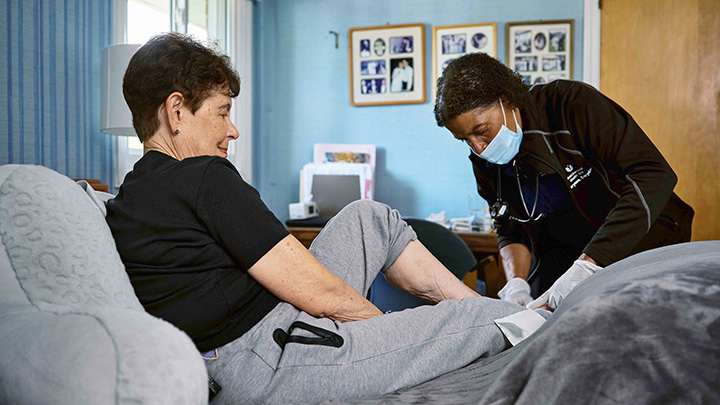
When patients need hospital-level care, they don’t expect it at home. But at UMass Memorial Health, that’s exactly where some of our sickest patients are successfully healing.
Launched in August 2021, our Hospital at Home Program —led by Constantinos “Taki” Michaelidis, MD, Medical Director of the Program, which is based at UMass Memorial Medical Center — blends advanced technology, remote monitoring and hands-on nursing and paramedicine.
Four years later — patients are experiencing faster recovery, fewer complications and what Eric Alper, MD, Senior Vice President, Chief Quality Officer and Chief Informatics Officer, UMass Memorial Health, calls “off- the-charts” patient satisfaction.
“If we can have patients recover from the comfort of their own home, then it’s a win,” said Dr. Michaelidis. “Studies show that hospital-at-home programs improve patient outcomes and increase patient satisfaction. Patients can get better sleep and experience fewer disruptions at home, which helps the healing process.”
The impact is undeniable. Today, the program is bringing hospital-level care directly into patients’ homes across Central Massachusetts. While most patients are in Worcester, the program is already reaching surrounding communities — and with further regulatory certainty from Congress — hopes to expand the program further into the community.
“Over the past four years, we’ve avoided greater than 20,000 hospital bed days,” Dr. Alper noted. “That’s like freeing up 50 beds for an entire year, beds that patients who truly need them can use.”
Patients benefit in other ways, too: they stay active, avoid hospital-acquired infections and recover more quickly.
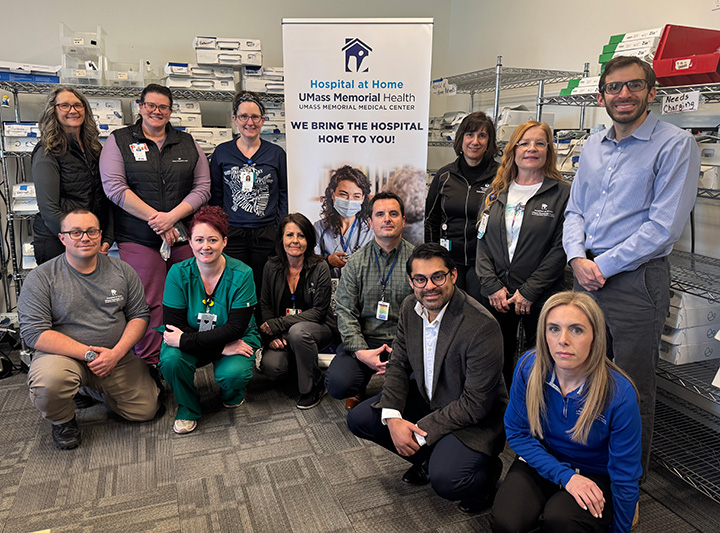
“The average age of our patients is 65,” said Dr. Michaelidis. “Facilities caring for geriatric populations might send 15 to 20% of patients to skilled nursing facilities, but we’re sending about 2%.”
The program has also reignited purpose for caregivers. “Our nurses feel like they’ve rediscovered why they went into health care.” said Dr. Alper. “They provide advanced medical care, but they’re also welcomed into homes, greeted by dogs and embraced by families. It’s deeply rewarding.”
Being in patients’ homes also reveals social realities hospitals rarely see. “Sometimes, the most powerful assessment comes from looking in the fridge,” Dr. Alper explained. “What’s there — or missing — guides us in connecting patients with food, medications and social services that reduce readmissions.”
Looking ahead, a five-year federal waiver could make hospital-at-home models more widely available. “Patients and families are increasingly demanding these programs,” said Dr. Michaelidis.
“We’ll see more health systems offering care at home, and existing programs expanding the range of services. It’s the future of care that’s personal, high-quality and digitally enabled.”
UMass Memorial’s Hospital at Home Program proves hospitals aren’t just buildings. With innovation, compassion, and technology, care can thrive anywhere — even at a patient’s kitchen table. •