3 minute read
Mobile Integrated Health: Redefining Where Care Happens

During the height of the pandemic, UMass Memorial Health patients spilled into hallways, waiting rooms and any available space. Our hospitals no longer had the brick-and-mortar capacity to keep pace, and emergency departments (EDs) ran beyond their limits. Patients experienced long waits in crowded, stressful conditions, while staff worked tirelessly to deliver care.
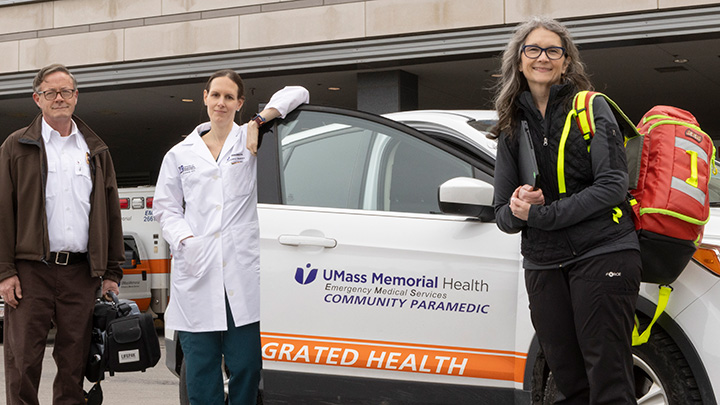
Laurel O’Connor, MD, an emergency physician and the Mobile Integrated Health (MIH) Program’s Medical Director, saw the strain firsthand. “We needed a new way to get care to people,” she said. That urgency sparked the June 2021 launch of the MIH Program, which brings acute, preventive and post-acute care directly into patients’ homes.
With MIH, trained community paramedics, supervised by physicians, deliver care once reserved for the ED. They treat infections, breathing problems, and injuries, check medications, and follow up after hospitalizations, all from the comfort of the patient’s home.
The model is working. Now, in 2025, MIH has grown to six full-time paramedics, and the team has cared for more than 2,200 patients since it started. “Ninety-four percent of our patients are treated at home and don’t use the ED within 72 hours,” said Dr. O’Connor.
Paramedics also spot issues a clinic visit might miss such as unsafe housing, missing prescriptions or food insecurity. One patient, for example, was taking three separate doses of the same medication while missing others entirely. Paramedics corrected the list, removed outdated pills and prevented dangerous errors.
In the summer of 2025, MIH received a $750,000 grant from MassHealth to expand into group homes for people with disabilities. Paramedics are receiving specialized training to provide safe, high-quality care on site. Dr. O’Connor sees this as an urgent need and a chance to build the case for sustainable funding: “If a patient living in a group home has to go to the ED, a staff member has to leave with them, she said. “By treating patients where they live, we can save resources and deliver far more patient-centered care.”
“There’s no doubt that we have the most sophisticated MIH program in the state, and probably beyond,” she added. “We do blood transfusions, administer medications, and provide mobile imaging. We also manage acute illnesses, preventive care, post-op visits — anything patients need at home.”
Looking ahead, Dr. O’Connor envisions MIH expanding into schools, clinics, and community sites, bringing vaccines, screenings, and preventive care directly to where people live and gather. The team is also developing methods to deliver high-risk leukemia and lymphoma therapies entirely at home, creating a future where hospital walls no longer define the limits of care. •