BEACONS A M AG AZ I NE FO R U M AS S BO ST O N ALUM N I AN D F RIEN DS
Summer 2 026
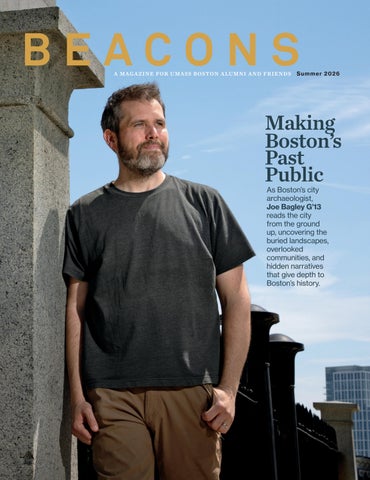
Making Boston’s Past Public As Boston’s city archaeologist, Joe Bagley G’13 reads the city from the ground up, uncovering the buried landscapes, overlooked communities, and hidden narratives that give depth to Boston’s history.
2
MAKING WAVES Assistant Professor of Biology Guilherme Longo collects macroalgae to assess the impacts of pollution in Fernando de Noronha, an archipelago off the coast of Brazil. Photographed during winter 2025, this field work is part of larger efforts by IntegraMAR, a marine biodiversity network of more than 60 researchers and academics that Longo co-leads. Through research and knowledge-sharing, the network influences conservation and management of ocean ecosystems in Brazil and beyond. “Brazilian reefs function as natural laboratories that may help us better understand the future of reef ecosystems in the Northern Hemisphere,” said Longo. “By studying Brazilian reefs and comparing them with reefs in the Caribbean and along the U.S. East Coast, we can gain important insights into the future of these ecosystems under climate change.”
Contents SUMMER 2026
FEATURES 20
Groundbreaking Work
Joe Bagley G’13 explores Boston’s layered history and brings hidden landscapes, communities, and histories to light through archaeology.
26
A Recipe for Change
28
Where Art Belongs
32
Pushing the Sport Forward
At one of the world’s most recognizable restaurant brands, Emily True ’15 is helping to turn big-picture climate commitments into practical change.
Thirty years after its founding, Arts on the Point continues to shape campus as a nexus of creativity, scholarship, and public imagination.
Remembering the legacy of Bob Hall ’74, who helped move wheelchair racing from the margins into the competitive spotlight.
DEPARTMENTS 02
Your Take
03
From the Chancellor
04
The Tea
36
Class Notes
44
Alumni Events
48
Did You Know?
ON THE COVER Boston City Archaeologist Joe Bagley G’13 at the Bunker Hill Monument, where Bagley’s team is excavating the trenches of one of the American Revolution’s first major battles. Photo by Dana Smith. See page 20
Beacons
1
Your Take
For this issue of Beacons, we asked:
What was your first job, and what did it teach you?
Newspaper boy It taught me to be on time and to commit to showing up for a job every day. —CHRIS BARTLEY ’17
Volunteer at Mt. Auburn Hospital pharmacy The experience taught me the importance of following precise directions, working as part of a team, and finding joy in helping others. —ELLIOTT BIRCKHEAD ’87
Babysitting Babysitting taught me how to work with children with different personalities, care for them responsibly, and follow directions. —NANCY BUNSON ’86
Shed delivery assistant When the work started to feel overwhelming, my boss would say, “No need to rush. Keep your eye on the prize.” It’s advice that stuck with me. Today, when I’m juggling emails, meetings, and project deadlines, I try to remember to stay focused on the ultimate goal rather than getting lost in the individual tasks. —TIMOTHY CRONIN G’23
Bookkeeping at Medford Jewels
What is your definition of success? Visit umb.edu/yourtake to submit your answer! Submissions are edited for length and clarity.
This job taught me how to work hard, take pride in what I do, and be kind and helpful to others. —KAREN HUNT ’20
Processing specialist intern at Liberty Mutual I learned the importance of professionalism, accuracy, and believing I belonged in spaces that once felt unfamiliar. —TINA SEALE ’11
2
Summer 2026
From the Chancellor
BEACONS Chancellor
Marcelo Suárez-Orozco Provost
Governor Maura Healey converses with Mayor Hidalgo and Chancellor Suárez-Orozco at a dinner prior to the commencement ceremonies.
A
Vice Chancellor for University Advancement
Adam K. Wise
T UMASS BOSTON’S 58th
Commencement Exercises in May, we were honored to hear keynote addresses by U.S. Senator Edward J. Markey and the former mayor of Paris, Anne Hidalgo. Each challenged our Beacons to trust their UMass Boston education and go on to lead lives of conviction around ideals and values that empower us to do good. Senator Markey called on Class of 2026 graduates to “be bold” and “use their talents to advance justice, equality, and opportunity around the world.” Anne Hidalgo reflected on the histories of the places we come from and how they shape the humanist values we uphold, exhorting graduates to “be daring…know where you come from and build your life as if it were a work of art.” This edition of Beacons magazine highlights some of the ways alumni have heeded the call to live the humanist ideals and values we cultivate at UMass Boston. Our cover story chronicles the journey of discovery undertaken by Joe Bagley G’13, Boston’s city archaeologist and director of archaeology. Drawn to UMass Boston for its strengths in historical, environmental, urban, and Indigenous archaeology, Joe now oversees surveys and digs around Boston that document a more inclusive public history of the city, recovering evidence of the lives of Indigenous communities, enslaved people, immigrants, laborers, women, children, and others. You will also meet Emily True ’15, director of global sustainability at Pizza Hut, who is doing her part to show that greener practices— whether eliminating unnecessary plastics,
Beacons
Joseph Berger
cutting food waste, or adopting reusable, recyclable, or compostable packaging materials— can also drive business performance. Emily’s work demonstrates how something as seemingly simple as reducing the environmental impact of a pizza order can be scaled to influence global consumer choices and address broader environmental challenges. You will read about the loving curation of UMass Boston’s extraordinary exhibition celebrating three decades of Arts on the Point, the arts initiative founded in 1997 by Professor Emeritus Paul Tucker. The exhibition has engaged scores of students, artists, donors, and faculty in showcasing the civic value and importance of public art access: that art belongs to the people, in public view, on the campus of a public university shaped by beauty, complexity, and possibility. And you will learn more about the “father of wheelchair racing,” the late Bob Hall ’74, whose pioneering work changed the sport. Fifty years ago, Bob debuted as the first-ever sanctioned wheelchair racer in the Boston Marathon. In doing so, he reimagined who can compete in races, and through a combination of will and innovation, made athletics more inclusive for everyone. I hope you enjoy reading about the good works of these exemplary Beacons. Sincerely,
MARCELO SUÁREZ-OROZCO Chancellor
Assistant Vice Chancellor for Alumni Engagement
Allison Duffy
Senior Director of Alumni Engagement
Steven Whittemore Communications Specialist
Vanessa Chatterley Art Direction
Red Ink Design Contributors
Bill Doncaster Frederic J. Frommer Madeline Kaprich Andrea Kennedy Catherine LeBlanc DeWayne Lehman G’15 Austyn Ellese Mayfield Alyssa Mazzarella G’15 Paul Nuti Crystal Valencia G’14 Photos and Illustrations
Haley Abram Sam Falconer Gillian Gordon Bartosz Kosowski Nicki Pardo Kaitlin Prince Javier Rivas Dana Smith
Beacons magazine celebrates the accomplishments and impact of the UMass Boston community and the lasting connection alumni and friends have with UMass Boston, Boston State College, and our legacy schools. We welcome your inquiries, ideas, and comments! Please share them with the UMass Boston Alumni Engagement team at 617.287.5330 or alumni@umb.edu.
3
The Tea Marketing prof. among world’s most influential researchers
Mayor Michelle Wu and Chancellor Marcelo Suárez-Orozco speak with students after announcing the new partnership to increase AI literacy in the Boston Public Schools.
New partnership boosts public ed with AI Boston will become the first major U.S. city to ensure all students graduate with AI proficiency, thanks to a new public-private partnership led by the Boston Public Schools and UMass Boston. The initiative will begin with 20 high schools and expand districtwide, with plans to support teacher ambassadors, professional development, industry-informed curricula, and student internships. The district will work with UMass Boston’s Paul English Applied Artificial Intelligence Institute—the nation’s first university-based institute dedicated to optimizing and democratizing the use of AI tools across a broad range of professions—to develop curricula, expand engagement opportunities for students, and provide resources for educators.
READ THE REPORT HERE:
The institute’s founding donor, Paul English ’87, G’89, H’19 made a $1 million contribution to BPS to support the effort. “This initiative will not only transform the educational and career opportunities for BPS students, but it will also accelerate AI adoption across all Boston businesses as they hire students with AI experience,” said English. “I’m thrilled to be working with [BPS Superintendent] Mary Skipper and her team as Boston schools lead the way in the AI era.” The partnership will “pioneer the application of AI to educational equity,” said UMass Boston Chancellor Marcelo Suárez-Orozco. “We believe that competency in applied AI can be a great equalizer and provide real economic opportunity to any student, regardless of background.”
College of Management Professor of Marketing Werner Kunz has become the first scholar in the history of UMass Boston to be named a Highly Cited Researcher by global analytics company Clarivate, recognizing him as one of the world’s most influential researchers. Researchers selected for this list have authored multiple highly cited scholarly papers that rank in the top 1 percent by citations for their field and publication year in the scientific database Web of Science Core Collection over the past 11 years. Only about 1 in 1,000 researchers worldwide receives this honor indicating exceptional influence in their disciplines. The recognition is also a key component of the prestigious Academic Ranking of World Universities. “Werner’s achievement is a milestone not only for the College of Management, but for UMass Boston,” said Dean Venky Venkatachalam. “It reflects the groundbreaking work happening across our college.” “Academia is a wonderful profession,” said Professor Kunz, who is director of the college’s Digital Media Lab and studies service technology, including service robots and human-machine collaboration. “It allows us to devote our work to the questions we’re truly passionate about. It’s even more rewarding when others read that work and find it impactful.”
“ With so many families in need of licensed childcare and early education, the state and localities must carefully consider how to best address shortfalls in those areas with the least capacity to meet current and future demand.” – Anne Douglass, professor of early childhood education policy at the College of Education & Human Development. Douglass recently coauthored a report that shows the commonwealth’s current capacity for licensed early education and childcare is uneven across the state, with extreme shortfalls in some areas.
4
Summer 2026
The Tea
Honoring a Lifelong Passion ENVIRONMENT
This spring, members of the volunteer-run organization Friends of the Boston Harbor Islands (FBHI) established the Friends of the Boston Harbor Islands Endowed Fund in Honor of Suzanne Gall Marsh ’84. The fund celebrates the life and legacy of Marsh, who co-founded FBHI in 1979, by providing perpetual support for student research at the School for the Environment. This research advances the stewardship of the Boston Harbor Islands and promotes climate resilience, ensuring that Marsh’s passion for conservation and public parks continues to inspire future generations.
EDUCATION
UMass Boston parent and grandparent Melinda R. Meister P’92, GP’23 recently endowed the Frances Goodman Rohland Scholarship, which she created in 2022 to honor the legacy of her own mother, Frances, a first-generation student who became a dedicated first-grade teacher. The fund will support generations of undergraduate students at the College for Education & Human Development, especially those who are first in their families to go to college.
MUSIC
Brothers Christopher Tawa ’76 and Nicholas Tawa ’77 recently made a gift to increase the impact of the endowed Professor Emeritus Nicolas E. Tawa and Michelina M. Tawa Music Scholarship, which they created in 2022 to provide support for undergraduates majoring in music. Their fund honors their parents, Professor Emeritus Nicholas E. Tawa, a founding member and longtime chair of the UMass Boston Music Department, and Michelina M. Tawa, who encouraged Professor Tawa to join the UMass Boston faculty and Chris and Nick to study at the university.
Beacons
Beacons Day of Giving April 8–10, 2026
20 1,086 $165,603 TEAMS
DONORS
RAISED
AVERAGE GIFT: 2024: $52 | 2025: $63 | 2026: $77
PARTICIPATION LEADERBOARD Men’s Soccer | 164 Gifts Men’s Lacrosse | 148 Gifts Women’s Soccer | 125 Gifts Men’s Hockey | 92 Gifts Women’s Basketball | 91 Gifts
IMPACTS Team travel Sports performance and sports medicine resources Equipment Student-athlete leadership development Mental health and life coaching services
5
The Tea
Other notable recent awards •
•
•
•
Associate Professor of Computer Science Xiaohui Liang was named a 2026 Fellow of the Institute of Electrical and Electronics Engineers (IEEE) for his contributions to data security in the Internet of Things. No more than 0.1 percent of IEEE’s 500,000 global members are given the status of Fellow each year, making the distinction a highly prestigious honor. On May 20, Chancellor Marcelo Suárez-Orozco received the Massachusetts Immigrant and Refugee Advocacy Coalition’s 2026 Community Champion Award. The honor places the chancellor alongside a distinguished group of previous awardees, including U.S. Senators Edward J. Markey and Elizabeth Warren, Governor Deval Patrick, and then–Attorney General Maura Healey. The UMass Boston Athletics Department received a 2025 Division III LGBTQ Institution of the Year award, recognizing the program’s commitment to inclusion, equity, and support for the LGBTQ community. The excellence of seven UMass Boston nursing faculty and students was celebrated by the Massachusetts chapter of the American Nursing Association in May. Department of Nursing Professor Laura Hayman and Associate Lecturer Eileen Stuart-Shor were both honored with the association’s Living Legends in Massachusetts Nursing award, Professor Sun Kim was recognized with the Excellence in Nursing Research Award, and students Liri Golemi ’26, Imelda Bicaku ’26, Shadi Rajeh ’26, and Alissa Gaulin ’26 all won a place among this year’s recipients of the organization’s Joyce L. Wolf Scholarship for students pursuing an accelerated bachelor’s degree in nursing.
“ Just continue to walk toward the thing that you care about. Follow it all the way to the end.” —Tony and Grammy Award-winning performer Leslie Odom Jr., offering advice to students this spring at an event organized by The Mass Media and the Student Arts and Events Council 6
Schuman Named 2026 NACDA Athletic Director of the Year UMass Boston Vice Chancellor and Director of Athletics Jacqueline Schuman was selected as a 2026 National Association of Collegiate Directors of Athletics (NACDA) Athletic Director of the Year. Schuman was one of four Division III athletic directors honored. Under her leadership, UMass Boston Athletics & Recreation has experienced historic growth and innovation, highlighted by eight Little East Conference Championships, 12 NCAA appearances, three Individual National Track and Field Championships, the highest GPA in over 10 years (3.30), and the introduction of a collaborative, sport science–driven Holistic Performance Program. “For me, this award speaks to the importance of focusing on efforts to support the ways that studentathletes, coaches, and those we lead reach their greatest potential, and how important the relationships and team around us are to help us achieve these goals,” Schuman said. Summer 2026
Student Q&A: Adele Accelus ’29 As a first-year student and member of the volleyball team, Adele Accelus has already embraced every opportunity to grow as a leader, teammate, and student at UMass Boston. Drawn to the university for its academic rigor, affordability, and strong sense of community, Accelus has managed to balance the many demands of being a student-athlete, finding support both on the court and in the classroom. We recently connected with Adele to learn more about her journey so far and what being part of the UMass Boston community means to her. Q: What made you choose to attend
moving as a cohesive unit—not just as
UMass Boston?
teammates but as friends.
A big thing for me is graduating debt free. After applying and getting into UMass
Q: How has your experience been
Boston, I was drawn to the competitive
as a student-athlete?
nature of the volleyball program. After
It has been incredibly rewarding but
recovering from a severe concussion in my
requires discipline. For me, being
senior year of high school, I wasn’t sure if
a student-athlete means that I am
volleyball was still in the picture for me, but
representing my school 24/7. It has
when I met the team and the coaches, I
taught me how to be resilient and
knew that this was something I wanted to
mindful of the fact that even if I had a
be a part of.
tough loss the night before, I still have to show up for my class the next day.
Q: How did UMass Boston play a role in where you are today?
Q: Are you involved in any other
UMass Boston has taught me how to
extracurricular activities?
balance competing priorities. Whether it’s
I am a member of the Student Athlete
managing a week’s worth of assignments
Advisory Council. It is exhilarating to be
in political science or waking up at sunrise
able to work with fellow student-athlete
for an early morning weightlifting session,
leaders that step up and want to make an
in each aspect of my life here the university
impact on campus.
has provided me with an ultimate support system that pushes me to be a leader both
Q: What are your goals after
on the court and in the classroom.
graduation? I plan to take the leadership and teamwork
Q: What has been your most
skills I developed on the volleyball court
memorable experience as a Beacon?
and apply them to a career in law.
The most memorable experience was
Beacons
when we played Plymouth State for
Q: What advice would you give a
the first time. It was a mental health
prospective student?
promotional match, and during our
I would tell them that you get what you
warmup, we all wore shirts that said, “U are
give. If you are willing to engage with
enough.” This game was so memorable
the community, join clubs, support your
to me because we weren’t sure we were
fellow Beacons, then you will find a
going to win, but the energy and aura were
second home here. Don’t be afraid to
electric. It felt like we were truly connected
lean on your professors and coaches—
that day. There’s a specific bond you form
because they truly want to see you
with your teammates when you’re all
succeed. 7
The Tea
CLAIMING CENTER STAGE This year, 13 undergraduates from UMass Boston’s Theatre Arts program, including Sam Stanley ’26 (right), traveled to Albany, New York, to participate in the American College Theatre Festival (ACTF) for the Northeast region. These students were nominated for their work in recent productions held at the University Hall Theatre: Peter and the Starcatcher (Spring ’25) and Natasha, Pierre, and the Great Comet of 1812 (Fall ’25). The festival provided an opportunity for our student artists to showcase their talents, engage in workshops, and build relationships with theater students and professionals from across the region and country. Five students who attended the festival were recognized for their work in the categories of acting, musical performance, costume design, scene design, and sound design.
8
Summer 2026
“ After 18 years of helping students prepare their ACTF presentations and scenes, I can’t help but beam with pride that we’ve always had UMass Boston students walking across the stage to accept honors.” —CARRIE ANN QUINN, ACTING AND DIRECTING PROFESSOR AND PERFORMING ARTS CHAIR
Beacons
9
The Tea
Faculty Q&A: Linda Eisenmann, EdD I started to ask people, “How do you get involved in a career in higher education?” At my first professional job, in career counseling at Georgetown University, I pulled the Harvard Graduate School of Education catalog off the shelf and started looking through it. I had no idea you could study the economics of education, the history of education, educational policy... and I got hooked. I really liked this idea of studying higher education from those perspectives.
feed each other. Every time I come up with an idea, I want to present it to my students. Or my students raise something that causes me to go investigate. Teaching inspires me to keep my research life active. Q: You recently endowed a fund at UMass Boston that’s dedicated to supporting the Junior Faculty Research Seminar, a career development program for pre-tenured faculty. What inspired you to make this investment in early-career faculty members?
Q: What brought you back to UMass Boston last year?
An accomplished higher education historian and administrator, Professor Linda Eisenmann is a founding faculty member and previous director of the Higher Education Program at UMass Boston. She has held leadership roles at John Carroll University as well as Wheaton College, where she served as provost for several years and went on to become a professor emeritus of education and history. As a scholar, Eisenmann is the author of three books and many articles focused on the history of women and gender in higher education. She returned to UMass Boston in 2025, and now teaches higher education policy and history in the doctoral program that she helped launch more than 30 years ago.
A: I had just retired from full-time teaching, but I wasn’t really ready to be finished. Later that fall, I was invited to teach a policy course part time, but also give it a historical perspective. What could be better? Coming back gave me the opportunity to do some history again, return to a program that I love and respect, and reconnect with UMass Boston. I have so enjoyed being back. There’s something special about the way UMass Boston faculty and staff reach out to one another and go the extra mile. Q: As a higher education historian and scholar, how do you view the role of institutions like UMass Boston in our culture and country? A: As a first-generation college student, I understand what schools like UMass Boston mean in their communities. My two older brothers were the first in our family to go to college. They went to Cleveland State University, which was started with a similar mission right around the same time as UMass Boston. Urban public universities begin with quality undergraduate programs, and allow you to build master’s programs and doctoral programs as strong as those at any institution. Q: What’s been the most gratifying part of your
Q: What inspired you to become a historian,
career so far?
administrator, and professor of higher
A: After I stepped down from the provost job, I decided I really want to continue teaching because it makes such a difference in my life and to my students, and it allows me to continue to be a scholar. Teaching and research
education? A: When I was a senior at Connecticut College, I was invited to be the student representative on a strategic plan. I loved this experience, so 10
A: I know UMass Boston is a place where my money can make a difference. After I returned, I noticed an email inviting early career, pre-tenured faculty to apply for the Junior Faculty Research Seminar and thought, “This! This is what’s important!” UMass is allowing these faculty to come together—they’re building a cohort and supporting not only their research and teaching, but also their career development. The program is a real match to what’s important to me. Q: What areas of research currently interest you most? A: I’m interested in exploring to what extent college is a public or private good from an economics perspective. I’ve actually had my students debate this in class. They take themselves back to the revolutionary time— they’re Jeffersonians or Hamiltonians—and they argue this: Is college a public or private good? For whom is college good? Is it equally good for everybody? Q: What hopes or advice do you have for the next generation of higher education teachers, administrators, and historians? A: I take heart in what I see in my students, all of whom are administrators or faculty. They are not giving up on the issues of access and equity. For historians, I hope we continue to ask deeper questions of stories we thought we knew around race, around gender. One we’re digging into more is, “Where were LGBTQ faculty and staff?” They were certainly there in the ’70s, the ’80s, and even earlier. We’re starting to find their histories now. Summer 2026
The Tea
Alumni and Faculty Bookshelf
In What Keeps Us, Jeanine Boulay ’00 explores New York’s hidden histories through the grounds of Green-Wood Cemetery, where the living and the dead share space across centuries. Spanning the nineteenth century to the present, these linked stories follow 10 women—school principals, wives, archivists, and more—as they navigate impossible choices in a city shaped by erasure and reinvention. Using Green-Wood as their shared anchor, Boulay uncovers the quiet resilience of those often forgotten, revealing how memory and survival entwine in the lives of these New York women.
Beacons
In Critical Perspectives on Latino
In Optional Practical Training, Shubha
In This Happened to Me: A
Education in Massachusetts, editors
Sunder, visiting professor in UMass
Reckoning, Kate Price PhD’19
and UMass Boston faculty mem-
Boston’s MFA program, follows
shares a searing memoir of trauma,
bers Lorna Rivera and Melissa
Pavitra, a young Indian woman from
memory, and survival. Raised in a
Colón bring together scholars,
Bangalore who graduates from a U.S.
small Pennsylvania mill town, Price
educators, and practitioners to
college in 2006 and begins a year of
left behind generations of poverty,
examine the experiences of Latino
work experience allowed through her
violence, addiction, and abuse to
students across the commonwealth.
student visa. Teaching math and
pursue graduate study in Cambridge,
Through essays grounded in
physics at a private high school near
Massachusetts, but long-buried pain
research, policy, and classroom
Cambridge, Pavitra quietly longs for
followed her. Through therapy
practice, the collection explores
the time and freedom to finish a novel
sessions with trauma specialist Dr.
how achievement gaps, anti-
and imagine a life beyond the
Bessel van der Kolk, Price began
immigrant policies, limits on bilingual
expectations placed on her. Told
uncovering memories of childhood
education, and broader inequities
through a series of conversations, the
abuse and searching for the truth
shape educational outcomes.
novel traces Pavitra’s encounters with
behind them. With unflinching
Together, the contributors offer a
landlords, colleagues, students,
honesty, she traces her journey from
complex portrait of Latino educa-
parents, neighbors, and family friends
survivor to advocate, building a
tion in Massachusetts while pointing
as their assumptions and projections
purpose-driven life while working to
toward more equitable classrooms,
shape her understanding of race,
protect children from the harm and
schools, and systems.
immigration, privilege, and selfhood.
silence she endured. 11
GO OUT INTO THE WORLD. FIERCELY. BOLDLY. —CHANCELLOR MARCELO SUÁREZ- OROZCO
Graduates crossed the stage to cheers on May 27 and 28 as UMass Boston celebrated its 58th commencement across two days and three ceremonies. This year, the university conferred an estimated 3,950 degrees, each representing years of rigorous study and sacrifice. As the culmination of the UMass Boston experience, the ceremonies brought together families, faculty, staff, and dignitaries to recognize the many accomplishments of the 2026 graduates and celebrate their readiness to carry the Beacon light forward into the world.
12
Summer 2026
COMMENCEMENT 2026
Beacons
13
COMMENCEMENT 2026
Stepping Boldly into the Future At UMass Boston’s 58th undergraduate commencement exercises on May 28, Senator Edward Markey told the 2,740 graduates they are entering a world shaped by rapid innovation and unprecedented technological advancement. He urged the Class of 2026 to use their talents to advance justice, equality, and opportunity around the world. “In this era of innovation, you may have jobs that have not yet been imagined in fields that have yet to be created within industries that don’t yet exist,” he said. “Be bold. You can shape the course of history…. Use your talents and your innovative tools to help all people everywhere build a more peaceful, prosperous future for them and for their families.” Chancellor Marcelo Suárez-Orozco urged graduates to use their education to confront some of the world’s most pressing challenges, including threats to democracy, climate change, and the overpromising of AI without full understanding of its threats. He spoke of how everything the Class of 2026 experienced at UMass Boston—the lively classroom discussions, the beautiful friendships, the moments of rebellion, stepping out of comfort zones—has prepared its graduates for tomorrow. “Your ‘now’ has arrived. It is your time and there is much to do. Go fix what needs fixing. Share your wisdom with your communities and the world,” he said.
Student speaker Madeeha Syeda ’26 received the 2026 JFK Award for Academic Excellence, UMass Boston’s highest undergraduate honor. Syeda moved from India to Massachusetts in 2017 to pursue a career in health care, and she reflected in her remarks on questioning why she chose such a demanding path and persisted through exhaustion and doubt. The answer, she said, was clear: her family and the generations whose sacrifices made her success possible. She also acknowledged the privilege of access to higher education. “Not everyone is given those opportunities,” she said, pointing to students in regions affected by war and instability. “Many may never get to experience a day like this…. It gives it meaning,” she said, urging graduates to use that privilege responsibly. During an internship with children with complex medical and developmental needs, Syeda saw nurses build trust with patients and families. They inspired her commitment to compassionate, relationship-centered care. Syeda encouraged her peers to hold onto their own “why” and lead with purpose and gratitude. After graduation, Syeda will join Brigham and Women’s Hospital as a registered nurse, with plans to continue her education and mentor future students. “I’m excited to get in the field,” she said. “I couldn’t see myself doing anything else.” ¡ Chancellor Marcelo Suárez-Orozco (center) presented awards to (from left) Neal Bruss for Distinguished Service, Steven Ackerman for Distinguished Teaching, and Werner Kunz and Sharon Lamb for Distinguished Scholarship, at the May 27 honoree dinner.
1 Young Alumni Council President Elizabeth West ’19 with JFK Award–winner Madeeha Syeda ’26 during the undergraduate class induction into the alumni association.
14
Summer 2026
Beacons
15
COMMENCEMENT 2026
Inventing the World to Come At Wednesday’s graduate ceremony, where 1,090 master’s degrees were conferred, the keynote address was delivered by the former mayor of Paris, the Honorable Anne Hidalgo, who received an honorary Doctor of Humane Letters. Hidalgo was the first woman elected mayor of Paris and is an internationally recognized leader in climate action and urban policy. Hidalgo urged graduates to defend freedom, justice, and democracy while confronting global challenges such as climate change, reminding them that education is a powerful tool. “You all leave here today with something extremely powerful in your hands: an education, a mind now free to imagine otherwise, and knowledge that change is possible,” Hidalgo said. “Use it to invent the world to come.” Earlier on Wednesday, 122 doctoral degrees were conferred. One, in applied physics, was awarded to Sachin Gupta G’26, who was selected as the graduate commencement speaker in recognition of his empathy, research excellence, and dedication to teaching and mentorship. He founded and since 2022 has
led the Physics Graduate Club, creating space for connection and collaboration among students. “I do not wait for the road to be laid. I make my own roads,” Gupta said. Gupta’s work in the QBism quantum research group explored quantum foundations, examining how quantum theory can function as a subjective, agent-centered framework. His work bridges physics, mathematics, and philosophy, with potential implications for the future of quantum computing. An experienced educator, Gupta taught in India before joining UMass Boston and has since led undergraduate and continuing education courses, using accessible, hands-on teaching methods. “This journey was not perfect, easy, or certain, but it was worth it,” Gupta told his fellow graduates. “That is the message I want to leave you with today: Live your life on your own terms, dream without fear, and keep walking toward what sets your soul on fire, no matter how many times life tells you ‘no.’”
Board President Philip Carver ’09, G’14 with Sachin Gupta G’26 during the graduate class induction into the alumni association.
16
Summer 2026
Honoring Vision and Service
The Commencement ceremonies featured the presentation of the Chancellor’s Medal and four honorary degrees to leaders whose work has served communities, advanced public service, and created lasting change around the world. Among this year’s honorees were former Paris Mayor Ana María “Anne” Hidalgo; entrepreneur and philanthropist Charles J. Hoff; climate leader and UMass Boston alumna Gina McCarthy ’76; constitutional law scholar Martha Minow; and U.S. Senator Edward J. Markey, recipient of the Chancellor’s Medal for Exemplary Leadership.
THE HONORABLE ANA “ANNE” MARÍA HIDALGO H’26
Honorary Doctorate of Humane Letters As the first woman elected mayor of Paris, Anne Hidalgo transformed one of the world’s most influential cities through an ambitious agenda focused on environmental sustainability, housing, inclusive public services, and quality of life. During her two terms in office, Hidalgo oversaw the addition of more than 620 miles of bike lanes, the planting of more than 155,000 trees, reductions in car traffic, and the closure of a major road along the Seine to motor vehicles. A leading proponent of the “15-minute city” urban-planning model, which puts all day-to-day amenities within a 15-minute walk or bike ride of every resident, Hidalgo helped establish Paris as a global blueprint for greener, more walkable, and more livable urban environments.
SENATOR EDWARD J. MARKEY
Chancellor’s Medal for Exemplary Leadership Senator Edward J. Markey has spent more than four decades advancing consumer protections, environmental policy, energy affordability, telecommunications reform, and nuclear nonproliferation. After serving for 37 years in the U.S. House of Representatives, Markey was elected to the U.S. Senate in 2013, building a legislative record that includes fuel economy standards, climate action, Wall Street reform, telecommunications competition, and global security.
MARTHA MINOW H’26
Honorary Doctorate of Laws A renowned scholar of constitutional law and human rights, Martha Minow has devoted her career to advancing justice, strengthening democratic institutions, and expanding access to legal protections for historically marginalized communities. A longtime Harvard Law School professor and former dean, Minow currently holds the 300th Anniversary University Professorship at Harvard University. Her work has addressed disability rights, access to justice, human rights, and legal responses to conflict in the United States and around the world.
Beacons
17
COMMENCEMENT 2026
A Lasting Connection to UMass Boston For two of this year’s honorees, the recognition carried an especially personal connection to UMass Boston. Gina McCarthy returned to her alma mater following a remarkable career in climate policy and public health. For Charles J. Hoff, the honor marked the latest chapter in a decades-long relationship with the university and its students, including hundreds whose educational journeys were made possible through his scholarship support.
GINA MCCARTHY ’76, H’26 Honorary Doctorate of Humane Letters One of the nation’s most respected voices on climate change, environmental protection, and public health, McCarthy has spent her career turning urgent environmental challenges into practical, far-reaching policy. Her work has spanned local, state, national, and international leadership, including service in the administrations of five Massachusetts governors, leadership of the Connecticut Department of Environmental Protection, and a tenure as administrator of the U.S. Environmental Protection Agency under President Barack Obama. As EPA administrator, McCarthy helped advance stronger clean air standards, clean water
protections, and the first national standards requiring reductions in greenhouse gas emissions from fossil fuel–powered energy plants. She also played a key role in international climate efforts that helped pave the way for the Paris Climate Agreement and the Kigali Amendment to the Montreal Protocol. Most recently, from January 2021 to September 2022, McCarthy served as the first White House National Climate Advisor, under President Joe Biden. Before McCarthy helped lead the nation’s climate agenda, UMass Boston helped her imagine what was possible. “UMass Boston teachers were passionate, patient, and persistent,” McCarthy said. “They opened our eyes to the pleasure of learning, writing, and reading. They built a foundation
for us—they showed us that we could build ourselves a better future—one that I had only dared to imagine.” Watching members of the Class of 2026 cross the commencement stage brought those memories rushing back. For McCarthy, the day was a reminder that UMass Boston continues to be a place where students work not only for their own futures, but for the communities and families they carry with them. “Each one of those students worked hard to ensure a brighter, more just and equitable future for their families and for all of us,” she said. “They should be so proud.”
Above, McCarthy called for optimism and action at the inaugural session of the Chancellor’s Lecture Series “From Climate Crisis to Climate Resilience” in 2023; at right, she receives her honorary degree from Provost Joseph Berger and Chancellor Suárez-Orozco.
18
Summer 2026
Hoff with Dasheka Tate ’99 and her daughter UMass Amherst alumna Jasmine Tate, who are both recipients of Charles J. Hoff Scholarships.
CHARLES J. HOFF H’26 Honorary Doctorate of Humane Letters Charles J. Hoff has spent much of his life creating opportunities for others. A successful entrepreneur, investor, and philanthropist, Hoff traces his success back to the education that first opened doors for him. Raised in a working-class family in Medford, Massachusetts, he became the first in his family to attend college, working summer jobs to help pay his way through what was then Lowell Tech, now UMass Lowell. “If I didn’t go and get my education, I would never have had the opportunity,” Hoff said. After graduating from UMass Lowell in 1966, Hoff went on to build a wide-ranging career in business and industry, beginning as an engineer and eventually rising to senior leadership roles, including senior vice president and CEO. Over the years, he became known for helping
Beacons
transform struggling companies into successful enterprises before moving into venture capital, entrepreneurship, and investment. But even as his career grew, Hoff never forgot where he started. Since the early 1990s, Hoff and his family have funded more than 3,000 scholarship awards throughout the University of Massachusetts system, including more than 500 to UMass Boston students. Along the way, he has met many scholarship recipients, heard their stories, and encouraged them to make the most of the opportunities before them. “Education is a key to upward mobility,” Hoff said. “But it also gives you a much better quality of life.” Over years of meeting UMass Boston scholarship recipients, Hoff came to see the university as a place where students from vastly different backgrounds came together to learn not only from their professors, but from one another.
“You get an education just going to class,” Hoff said. “Because one of the most important things to learn in life is about people.” Hoff’s commitment to public higher education has been recognized across the UMass system, including by the UMass Boston students who named him an honorary member of their International Honor Society. He received UMass Lowell’s Distinguished Alumni Award in 1992 and the President’s Medal, the university’s highest honor, in 2008. He has also served on the University of Massachusetts Board of Trustees, the University of Massachusetts Foundation Board of Directors, and the boards of UMass Memorial Health Care and Northeastern University. Through his philanthropy, Hoff has helped make higher education more accessible for thousands of students—and has turned his own opportunity into a lasting legacy for others.
19
G
20
Summer 2026
R U G O ND B EAK N R iG WORK AS BOSTON’S CITY ARCHAEOLOGIST, JOE BAGLEY G’13 UNCOVERS THE BURIED STORIES, OVERLOOKED COMMUNITIES, AND ANCIENT LANDSCAPES THAT REVEAL A DEEPER HISTORY OF BOSTON. BY VANES SA CHAT TERLEY
Beacons
/
PHOTOGR APHY BY DANA SMITH
21
N i
Boston, history is easy to find. It is etched into brick and steeple, marked by plaques, worn into cobblestones, and mapped onto walking tours that promise to carry visitors through entire centuries in an afternoon.
THESE TOURS OFFER a version of Boston’s past that feels orderly and easy to follow: one landmark after another, one name after the next. Here are the famous men, the famous words, the famous battles. Here are the meetinghouses and monuments. Here is the city’s layered past compressed into a 90minute story you can follow in a pair of comfortable walking shoes. Joe Bagley G’13 has built a career out of asking what is missing from that story—and who should help tell it. As Boston’s city archaeologist and director of archaeology, Bagley looks beneath the version of Boston most people are taught to recognize, recovering evidence of the lives that rarely appear in those tour scripts or textbooks: Indigenous communities, enslaved people, immigrants, laborers, women, children, and generations of families whose homes, work, and belongings tell stories the official record often missed. “There’s a lot that happened that just isn’t written about, or was written about incorrectly, or is written about in a very biased way,” Bagley said. “The written record is typically written by, for, and about adult white men—but that’s a fairly small percentage of the population.”
Below the Surface The rest of the story is where Bagley’s work begins. A single week can send him from a full day of research to a walkover survey on the Boston Harbor Islands, from coordinating 22
transportation to Thompson Island to helping decide whether construction activity in Roxbury should trigger an archaeological dig. “That’s one of the best things about the job: It is incredibly variable,” Bagley said. “It’s hard to predict, but that also makes it fun, because it’s always different, and the projects that we’re working on are always totally different topics.” Hundreds of topics, in fact. Established in 1983, Boston’s City Archaeology Program is responsible for more than one million artifacts recovered from dozens of sites across the city. Some were excavated decades ago and still require cataloging, photography, and proper storage. Others emerge through current surveys, construction reviews, public archaeology programs, and community digs designed around questions archaeology may be able to answer. Bagley describes his work as an iceberg. “The ice above the water is research, the ice below the water is analysis, and the line of the water itself is the dig,” he said. “It’s the shortest, briefest part, but it’s also the most visible.” Despite what films like the Indiana Jones or National Treasure series suggest, archaeology is rarely a rush of spectacular discoveries. Most of the work happens before and after the dig—off-site, in the methodical labor of reading old deeds, comparing maps, studying soil layers, cataloging artifacts, consulting oral histories, and asking what each object can reveal once it’s placed in context.
“What we’re doing is filling in some of the gaps that exist in the story of Boston,” Bagley said. “We don’t need people to be John Hancock and Samuel Adams to be important to the storytelling of Boston. They are. But there are a lot of other pieces that are just as interesting to this place that we can get through the archaeology.”
Finding His Way to the Field Bagley’s route into archaeology began far from Boston’s brick sidewalks and buried foundations. He grew up in rural western Maine, a first-generation college student with little sense of the careers available beyond the practical jobs he saw around him. “I didn’t have a clear sense of what I wanted to do growing up,” he said. “I didn’t even know what options were out there.” In high school, he went looking for something scientific, adventurous, and capable of taking him somewhere new. He found Boston University almost by accident, searching “Boston” and “university,” and came across archaeology in the list of programs. “This sounds amazing,” he remembered thinking. “It’s science, it’s adventure, it’s discovery.” After BU and several early career detours, UMass Boston brought archaeology back within Bagley’s reach. His wife, Jen, who earned her graduate degree in archaeology from UMass Boston in 2011, told him about a Native site in Grafton where Stephen Mrozowski, founding director of the Andrew Summer 2026
Fiske Memorial Center for Archaeological Research, was working. The project connected Bagley’s interest in Native archaeology with the university’s strengths in historical, environmental, urban, and Indigenous archaeology. He enrolled, completed field school before his first semester, and later based his award-winning thesis, “Cultural Continuity in a Nipmuc Landscape,” on the Grafton site where it all started. Not long after enrolling at UMass Boston, Bagley learned that Ellen Berkland, then Boston’s city archaeologist, was leaving the role. He knew Berkland from his senior year at BU, when he worked on her team at the City
Archaeology Lab analyzing Native American artifacts excavated from Boston Common by former City Archaeologist Steven Pendery. The position sounded like everything he wanted, but the timing felt impossible: He had only just begun graduate school and assumed he would not be qualified for at least another two years. “This is my job,” he remembered thinking. “I wanted it so badly, I can’t even explain it. It had everything: Native archaeology, historic archaeology, public engagement, excitement, discovery. It felt like exactly where I was supposed to be.” A citywide hiring freeze in the aftermath of the Great Recession slowed the search long
enough to give Bagley a chance. When the position was finally posted, a master’s degree was preferred, not required. He knew the job would draw archaeologists from across the field, so he made the case that his range of experience was the point. “My big selling point was that I can do it all,” he said. He chose references just as carefully, asking each to speak to a different element of his skillset and expertise. “I remember being so strategic about it.” Bagley started graduate school at UMass Boston in September. The city archaeologist job opened in October. He was hired for the role in November and began in December.
Left: An excavation log records the progress, depths, and observations associated with trenches at Breed's Hill in Charlestown, Massachusetts. Right: Members from the American Veterans Archaeological Recovery, a nonprofit group that trains veterans for careers in professional archaeology, carefully excavate a trench on the grounds of the Bunker Hill Monument.
Beacons
23
Making Boston’s Past Public Within a few years, his work had drawn national recognition. In 2016, Bagley received the John L. Cotter Award from the Society for Historical Archaeology, an early-career honor recognizing his construction review work, leadership of the City Archaeology Lab, public presentations, volunteer training, and creative use of social media to bring the public into active archaeological research. A decade later, his books include A History of Boston in 50 Artifacts, which uses objects from ancient spears to chinaware to tell a
From left, UMass Boston alumni Nadia Kline G’18, public archaeologist; Lauryn Sharp G’23, project archaeologist; and Joe Bagley G’13, city archaeologist, at the Bunker Hill excavation site.
24
10,000-year history of the city, and Boston’s Oldest Buildings and Where to Find Them, an award-winning guide to 50 pre-1800 structures and the preservation efforts that kept them standing. Earlier this year, he and fellow UMass Boston alumna Holly Herbster G’05 published The Historical Archaeology of Massachusetts, widening the lens to four centuries of archaeology across the commonwealth. Together, the books invite readers to look more closely at the objects, buildings, and buried evidence that expand Boston’s familiar story.
At the Speed of Trust For Bagley, though, public archaeology also carries a responsibility: to ask who gets to frame the questions, interpret the evidence, and decide what should be shared. “What an archaeologist wants to know and do is one thing,” Bagley said, “but what a community cares about and wants to know is oftentimes different.” He saw the value of that collaboration in his work on Boston Harbor’s Long Island. One archaeological interpretation suggested that color differences in stone tools might indicate a boundary between Native communities. But when Bagley discussed the evidence with Elizabeth Solomon of the Massachusett Tribe at Ponkapoag, she offered a different reading: At the scale of an island, the pattern might point to family groups using different parts of the landscape at different times of year. “There’s just different ways of looking at this that she’s bringing to the table based on her knowledge of how the Native community lived,” Bagley said. “If we put the two together, we get a much more thorough, frankly realistic interpretation.” When working with Native communities, Bagley said collaboration means allowing communities to direct the focus of the work and determine what should or should not be shared publicly. Some discoveries may be significant, but that does not automatically mean they belong in an exhibit or report. “If ‘no’ is not on the table, it’s not collaborative,” Bagley said. “Otherwise, we’re saying, ‘This is so important, and we really respect the archaeology, but we don’t respect the
Summer 2026
people who created it.’ And it just doesn’t work that way.” The work requires trust—and trust, Bagley explained, cannot be rushed. “We’re working toward the goal of community archaeology, but it really moves at the speed of trust,” Bagley said. “In some ways, they’re gifting their knowledge and experiences to these projects. That’s not something I should assume.”
A Hidden Piece of Boston’s Story One discovery Bagley wishes more Bostonians knew about is hidden 30 feet beneath Back Bay: the Boylston Street fish weirs, ancient Massachusett fishing structures that reveal a Boston far older than the city above. First uncovered in 1913, the wooden remnants were once believed to be part of a single massive weir. More recent archaeological research suggests a more layered story: smaller, seasonal structures built and rebuilt over roughly 1,500 years as the shoreline
shifted and the sea advanced. Used to harvest herring and other small fish in the tidal waters of what is now Back Bay, the weirs offer rare evidence of Indigenous engineering, adaptation, and intimate knowledge of a changing landscape. “They’re acres of structures, made by people in the ancient world, preserved beneath a major city,” Bagley said. “I just think it’s an amazing thing that the Massachusett made, and I think more people should be aware of it.”
A Race Against Time That awareness has become more urgent as climate change threatens archaeological sites across the Boston Harbor Islands, one of the most intact Native landscapes remaining in the city. Bagley has been involved in work connected to an archaeological climate action plan for the islands, where erosion, storm surge, and rising sea levels are cutting into sites that may hold thousands of years of history.
“It feels like triage,” Bagley said. “The sites are bleeding, and we need to stop the bleeding. Things are just disappearing too fast to even try to stop it.” With every foot of shoreline lost, Boston risks losing evidence from thousands of years of human history. “Boston’s history did not start in 1630,” Bagley said. “If you had a timeline of Boston that was 100 feet long, 1640 would be the last four feet. Ninety-seven percent of the history of this place happened before the arrival of John Winthrop. If you open up a book on Boston history and it starts in 1630, close the book. It missed the whole story.” For Bagley, that broader story is still underfoot—and it is exactly what makes Boston such compelling ground for archaeology. “Boston is a place where I have to do absolutely no work to convince people that what I’m doing matters,” he said. “There’s no other city like Boston in the country, and history matters here. People understand it. They get it. And I’m just trying to keep up with the demand.” •
Artifacts recovered during the Bunker Hill excavation are screened and examined as Bagley (right) confers with a member of the archaeology team.
Beacons
25
How Emily True ’15 is helping Pizza Hut turn global sustainability goals into everyday action. BY VANESSA CHATTERLEY
RECIPE for
CHANGE HE PIZZA BOX on your kitchen counter is more complex than it looks. So is the order inside it. Long before dinner arrives, a pizza has already been shaped by a chain of decisions about ingredients, packaging, energy use, regulations, suppliers, restaurants, and waste—all of which influence its environmental impact before you take your first bite. Where did the cheese come from? How much energy did the restaurant use? Can the box be recycled? What materials went into the packaging? Emily True ’15, director of global sustainability at Pizza Hut, spends her days tackling those questions—and asking the larger one behind them: What does it take for a global brand to lower the environmental impact of a pizza order without putting the onus on the customer?
26
Yum! Brands, Pizza Hut’s parent company, has committed to reducing packaging waste, eliminating unnecessary plastics, cutting food loss and waste, and moving consumer-facing plastic packaging toward reusable, recyclable, or compostable materials. True’s role—the first of its kind at Pizza Hut—is to bring those commitments out of the corporate stratosphere and into the everyday realities of restaurants, franchisees, and customers. “My job was taking Yum!’s sustainability strategy and translating it into action for Pizza Hut,” True said. “While we had a strong foundation to build from, there’s a real opportunity to define what that strategy looks like for our brand. It’s really exciting to help bring that vision to life.” Summer 2026
A Global Brand, an Everyday Impact Part of what makes the role so exciting—and so consequential—is Pizza Hut’s global scale. True had worked in corporate sustainability before joining the company, including at Conagra Brands, where she led efforts to create a set of carbon neutral products under the EVOL brand. But Pizza Hut offered a different kind of reach. “I don’t think I fully appreciated Pizza Hut’s global footprint before I joined,” she said. “With restaurants in more than 100 countries and nearly 20,000 locations, the scale was really exciting to me. That was one of the things that drew me to the role. It felt like the world was opening.” That scale is also what makes corporate sustainability so powerful, True said: the chance to work within a system so large that changes in sourcing, packaging, restaurant operations, and consumer guidance can influence not only Pizza Hut’s own environmental footprint, but also the expectations placed on suppliers, partners, and the broader industry.
Learning to See the Whole System As a student at UMass Boston, True majored in environmental science and pursued certificates in geographic information systems and clean energy, using her undergraduate years to explore different corners of a field that was still taking shape. She later earned a master’s degree in environmental management from Duke University, where a professor helped her see corporate sustainability as a path for driving change from within. “A lot of people still have a perception that companies are primarily focused on business goals and may not always prioritize environmental or social issues,” True said. “But once you’re within a company, you can often have an even bigger impact than through many of the other paths I was considering.” At UMass Boston, True said, she began developing the systems-oriented thinking she now relies on every day. Her professors helped make environmental change feel measurable and tangible, from using GIS to study changes in ecosystems to examining the relationship between farmers markets and income levels across Boston neighborhoods. She remembers reading Wicked Problems: How to Engineer a Better World by Guru Madhavan in a class with Beacons
practical example of how environmental goals and business needs can work together. “You can care about sustainability and still drive meaningful business results,” True said. “There’s a belief that sustainability always comes with a cost, or that sustainability and business performance are usually at odds. In some cases, that’s true. But increasingly, they’re intertwined.”
“ We want people to go home and have debates with their partners about whether the pizza box can be recycled.” former Professor of Hydrology Ellen Douglas, a book that helped her understand environmental challenges as interconnected problems without simple answers. “That was the first time I understood it’s not just black and white,” True said. “These environmental problems are so large, and there isn’t one solution. There are so many trade-offs, and everything is interconnected.” That lesson has followed her into her work at Pizza Hut, where even a seemingly straightforward question—how do you reduce the environmental impact of a pizza order?— quickly expands into questions about sourcing, operations, packaging, and customer behavior. “I look at what our carbon footprint is and where we can make the most change,” True said.
Where Change Takes Shape One area is a signature Pizza Hut ingredient: cheese. Through a partnership with Dairy Farmers of America, Pizza Hut has provided U.S. farmers with technology and data aimed at reducing on-farm greenhouse gas emissions. The project has decreased the emissions intensity of the milk used in Pizza Hut cheese by 10 percent among participating farmers. The company is piloting similar efforts in New Zealand and the United Kingdom. Another focus is the restaurants themselves: ovens, refrigeration, lighting, HVAC systems, exhaust hoods, and other everyday energy uses that keep a Pizza Hut running. Pizza Hut has been developing sustainability guidance designed to help restaurants conserve resources while helping franchisees save money—a
Thinking Outside the Box Part of True’s work has involved correcting a misconception as familiar as the pizza box itself. For years, many consumers have believed that greasy pizza boxes cannot be recycled. True thought the same thing growing up. But studies have shown that pizza boxes with typical levels of grease do not necessarily compromise the quality of recycled cardboard bales. So Pizza Hut is working to give customers clearer information about what to do with their boxes after the meal is over. Today, Pizza Hut boxes in the United States include a QR code directing customers to recycling information based on their location. The language, True said, is intentionally simple and consumer friendly—a way to help customers pause before tossing the box and ask, “Wait, can I recycle this?” “That’s the conversation we want,” True said. “We want people to go home and have debates with their partners about whether the pizza box can be recycled.”
Small Wins in a Big System For a global brand, those small moments matter. A clearer label, a more efficient restaurant, a better supplier partnership, a stronger internal business case—each one is part of a larger system. And for True, operating inside that system means accepting that the answers are rarely simple, the progress is often incremental, and the work requires both patience and persistence. “Be comfortable with ambiguity,” she said. “You don’t always have all the answers. Give yourself credit for the small wins.” The next time a pizza box lands on the kitchen counter, it might still look unremarkable to you. But to True, it is part of something much larger: a global system of choices, trade-offs, and steps toward a sustainable future—one slice at a time. • 27
WHERE A 30TH ANNIVERSARY GALLERY
ART
EXHIBITION CELEBRATES ARTS ON THE POINT—THE VISIONARY PUBLIC ART INITIATIVE FOUNDED BY PROFESSOR EMERITUS PAUL TUCKER— WHILE HONORING THE WORK OF STUDENTS, ARTISTS, AND ADVOCATES CARRYING ITS LEGACY FORWARD.
By Austyn Ellese Mayfield
BELONGS Beacons
29
Like many grand quests, the journey that led to the momentous and scholarly gallery exhibition celebrating three decades of Arts on the Point began with a treasure map. Or more specifically in this case: a binder. “IT HAD BEEN FLOATING AROUND the department for
years and eventually made its way to the gallery,” said Isabella Slonka ’26, the University Hall Gallery curatorial assistant who researched and curated the exhibit. Her training from her Honors College history courses had already given her a keen eye for deciphering relevance and discerning stories that had yet to be told. The binder’s colorful tabs held names of luminary artists—Oppenheim, di Suvero, Jimenez, and others—who had lent their timeless works to Arts on the Point, the arts initiative founded in 1997 by Professor Emeritus Paul Tucker that brought largescale sculpture to UMass Boston’s Columbia Point campus. “I’d heard a lot of memories and little bits and pieces about Arts on the Point, but there was very little writing on it,” Slonka recalled. “In history, you’re always looking for a gap in the literature. And this was the Grand Canyon. Nobody had touched this, and I needed to jump on it.” Drawing from her extensive research, including Tucker’s papers in the Healey Library Archives and Special Collections, Slonka began reconstructing a history that had long lived in fragments. The outcome of her curiosity and dedication was Arts on the Point: Celebrating 30 Years, a multimedia retrospective offering the most comprehensive framing of the initiative to date and the first time the gallery has mounted a student-led archive-based exhibition of its scale. The collection not only highlighted the important names and installation dates of Arts on the Point, but it also helped uncover the social texture around it: the changes on campus, the surrounding community, and the students, artists, donors, and staff who helped make the initiative possible. On April 9, 2026, more than 100 attendees gathered for the public reception. Among the celebrants who explored the sunlit gallery were returning artists Sheila Pepe (who created a new piece for the installation), Clara Wainwright, and of course, Professor Emeritus Paul Tucker, whose visionary work established the public arts initiative that made UMass Boston an important convener and steward of the arts. 30
“The arts have often traditionally been associated with a certain sector of culture and society that is not always a part of a public space, and particularly not about public educational space,” Tucker said, reflecting on his motivation for establishing the program. “But the arts are essential to all of us, and in a public space or a public university, having access and proximity to actual works only enhances the notion that we all are in this together.” For Tucker, the purpose was always clear: A public university deserves public art. The sculptures on campus were not passive objects; they were provocations that invited students, faculty, staff, and visitors to ask questions, to pause in familiar spaces, and to encounter and engage with art as part of daily life. This principle continues to guide the program’s next chapter. Sam Toabe, who serves as director of both University Hall Gallery and Arts on the Point, sees the 30th anniversary as a time to honor Tucker’s legacy and craft the expansion of the program’s impact going forward. “There is a big conversation happening right now reorienting art as a very crucial part of civic life, creative thinking, and problem solving,” said Toabe. “We want to utilize public art as a way of engaging our students and communities across all different academic fields to get them to think more critically about our past, present, and future.” That future is already unfolding, with recent and upcoming Arts on the Point projects that build on Tucker’s founding vision of monumental sculptures to include performance art, interactive experiences, and murals. Through partnerships connected to the Boston Public Art Triennial, students have participated in fabrication, programming, and workshops. Toabe also hopes to restore major works, bring new artists to campus, and continue positioning UMass Boston as a leader in public art access and discourse. The work ahead will include conservation, new commissions, and renewed philanthropic support. But the heart of the initiative will remain remarkably consistent: that art belongs to the people, in public view, on the campus of a public university shaped by beauty, complexity, and possibility. • Summer 2026
C
urated by University Hall Gallery curatorial assistant Isabella Slonka ’26 as a part of her Honors College senior thesis project, Arts on the Point: Celebrating 30 Years celebrated the revolving public art initiative that has brought major works of contemporary sculpture to UMass Boston since 1997. Through the leadership of Professor Emeritus Paul Tucker, internationally recognized artists, including Sol LeWitt, Roy Lichtenstein, Willem de Kooning, Dennis Oppenheim, Luis Jimenez, Sheila Pepe, Bill Tucker, and Mark di Suvero, lent works to the university, installed them on campus, and, in many cases, met directly with students. The program raised more than $1 million in private philanthropic support, helping make large-scale public art part of the everyday environment of a public urban university. On the walls and throughout the gallery were archival photographs, sketches, smaller-scale works, and materials from Tucker’s papers and archival collection, accompanied by Slonka’s in-depth research and interviews. Together, they told the story of an ambitious public arts initiative that transformed UMass Boston’s harbor front campus into a sculpture park and positioned Columbia Point as an important site in Boston’s public art landscape.
“ A PUBLIC UNIVERSITY DESERVES PUBLIC ART.” – Professor Emeritus Paul Tucker
¡ Isabella Slonka ’26 and gallery director Sam Toabe welcome guests and introduce the exhibit during the April 9 public reception. 1 Mark di Suvero Hieroglyph, 1976–2009 steel, stainless steel Courtesy of the artist and Paula Cooper Gallery
1 Roy Lichtenstein Folded Hat, 1968 sculpture: lithograph: folded paper print Courtesy of a private collection, New York Beacons
31
32
Summer 2026
PUSHING THE SPORT FORWARD BOB HALL ’74 HELPED TRANSFORM WHEELCHAIR
RACING FROM A NICHE PURSUIT INTO A RECOGNIZED
COMPETITIVE SPORT, OPENING THE ROAD FOR GENERATIONS OF ATHLETES TO FOLLOW. By Frederic J. Frommer
Beacons
33
N HIS WAY to becoming the
“father of wheelchair racing,” Bob Hall ’74 had a key ally from back in his days on the college track team—the legendary track coach Bill Squires. “Squires saw something that probably we didn't see: that Bobby was an athlete, even though he was in a wheelchair,” recalled Mike Duggan ’77, a teammate of Hall’s who would watch Squires and Hall practice before the rest of the team hit the track. “He worked as hard as anybody.” Hall, who died in Cambridge in April at the age of 74, became perhaps the most important figure in wheelchair racing starting in the mid-’70s, bringing both visibility and structure to the nascent sport. Training with the track team of Boston State College (which was later incorporated into UMass Boston), Hall had to tape his hands and muscle his way forward in a heavy,
hospital-style wheelchair that weighed close to 30 pounds. And there weren’t many opportunities to race; Duggan recalls Squires finding a one-mile wheelchair race for Hall to compete in. From those challenging early days, Hall became the first wheelchair champion of the Boston Marathon, in 1975; successfully lobbied marathons to create wheelchair divisions; and started his own company, Hall’s Wheels, which helped lead the way in manufacturing ultralight wheelchairs that mark the sport today. In short, he was a trailblazer in making the sport more inclusive. “In any realm of pioneering, there can only be one first, and in wheelchair road racing that remarkable distinction belongs to Bob,” says Jack Fleming, president and chief executive of the Boston Athletic Association, which hosts the Boston Marathon. “He had a vision, and he trained to be the first.”
Navigating an old campus Hall, who was born in Cambridge in 1951, contracted polio as a baby, permanently affecting his right leg. His time at Boston State College was years before passage of the 1990 Americans with Disabilities Act, so he had to navigate the campus with the aid of a crutch, Duggan recalls. “When Bobby and I went there, the halls were narrow, and I never saw him in a wheelchair around the campus,” he said. “Because it was really 22 or 23 buildings together, and he would use one crutch, and that’s how he would get along.” Duggan remembers playing on an intramural basketball team with Hall, who ditched the crutch for the games. “I mean, he couldn’t run up and down the court like everybody else was running, speed-wise, but he figured out a way to come up and down the court without falling. He was a good shooter,” Duggan said.
34
Summer 2026
Making history at the Boston Marathon
Paving the way for others
Under Coach Squire’s tutelage, Hall in 1974 won the first national wheelchair marathon in Toledo, Ohio. Then he set his sights on something bigger: the iconic Boston Marathon. In 1970, a Vietnam War veteran named Eugene Roberts had been the first wheelchair competitor in the race, but he wasn’t officially recognized. Roberts took seven hours to finish the course. The race director, Will Cloney, told Hall that to be recognized he would have to finish in under three hours. As Hall later told the Boston Globe, “Will said that if I finished the race in under three hours, he’d give me the same certificate of accomplishment that he gives every runner who breaks three hours.” Hall completed the race in two hours and fifty-eight minutes, earning the distinction of the first sanctioned wheelchair racer in the Boston Marathon. The wheelchair weighed 27 pounds, about double the weight of today’s racing wheelchairs. “If you go to a hospital today and you go into the emergency room and they put you in a wheelchair, that’s the wheelchair that he was racing in,” Duggan recalled. “It was just remarkable that somebody could do a marathon in three hours with that.” In 1977, when the Boston Marathon included seven wheelchair racers, Hall came in first place in the group, finishing in just over two hours and forty minutes. “All of us face limitations of one sort or another,” Hall reflected in a Boston Marathon documentary. “The real gauge of a man is whether or not he approaches his full potential.”
Hall’s barrier-breaking work paved the way for thousands of wheelchair racers, including nearly 2,000 competitors in the Boston Marathon alone over the years. And his impact was not limited to the racecourse. He worked with an oceanographic engineer to design and build racing wheelchairs for his company, Hall’s Wheels. A 1986 model was included in a 1989 exhibit, Designs for Independent Living, at the Museum of Modern Art in New York; it remains in the museum’s permanent collection. The museum website notes the model “features a lightweight frame of aircraft-steel tubing, a speedometer, and a tachometer.” Marcel Hug, who won his ninth Boston Marathon this year in just over one hour and sixteen minutes, raced early in his career in a wheelchair designed by Hall. “I had the honor to meet Bob Hall and speak to him,” Hug said after winning last year’s race—50 years after Hall’s historic Boston Marathon debut. “I’m very grateful and thankful for what he did. He opened the door for us so that we can participate here. To win today at the 50-year anniversary is really something special.” Bob Hall’s dedication changed the course of wheelchair racing, leaving a legacy that extends beyond records and equipment design. He reimagined who can compete in races, and through a combination of will and innovation, made athletics more inclusive for everyone. •
Frederic J. Frommer, a sports and politics historian who has written for the Washington Post, the New York Times, the Atlantic, and other national publications, is working on a book on ’70s baseball.
Beacons
35
Class notes 1960 Arthur Mabbett ’69 was inducted into the Hall of Fame at the annual Smart Business Dealmakers Conference in
GERARD BURKE ’59, a distinguished Boston
Boston in recognition of his distin-
State College graduate, was honored with
guished career in entrepreneurship,
emeritus status at Massasoit Community
leadership, and business growth.
College in recognition of his outstanding contributions to higher education and the
Paul Yovino ’68 published The Man
community. Burke taught at Boston State
from Swan Lake—Hero of the Cocoanut
College for 16 years before becoming
Grove Fire: The Clifford Johnson Story, a
Massasoit Community College’s third president,
historical fiction novel available on Amazon and Kindle. The book brings to
leading the institution through a period of
life the true story of Clifford Johnson, a
remarkable growth and national recognition.
young Coast Guardsman and survivor of Boston’s infamous 1942 Cocoanut Grove fire, whose fight for survival contributed to groundbreaking medical advances. Yovino’s novel weaves together themes of heroism, resilience, and haunting echoes of Tchaikovsky’s
1990
Ron Morin ’70 published three novels: If
in human development and the
Pain Could Make Music, A Second
socialization process, Talarico created
Innocence, and The Flowers of Trauma.
the series to help families support
Charity Collier ’97 published her debut
His fourth book, I Sing Tiffany, was
children’s character-building, confi-
novel, Making It Over the Tobin Bridge,
released in March 2026.
dence, and decision-making skills.
inspired by her college days at UMass
Russell Dupont ’71 had his poem “Do
Leo Sandy ’70 co-authored PeaceTalk:
You Remember Me?” included on Jerry
The book’s opening section unfolds on
A Compendium of Hope, a collection of
1980
Jazz Musician as part of “21 Jazz Poems
resources on peace that spotlights the
on the 21st,” an ongoing series
Kathleen Dunn ’83 was selected for
moving through the streets of Boston,
individuals, organizations, and world
showcasing outstanding jazz poetry
inclusion in the Mosesian Center for the
following Charly, a young woman
events that have advanced humanity
submitted to the online publication.
Arts exhibition Contemporary
navigating love, loss, and the “what ifs”
toward the abolition of war. His
Landscapes: From Observational to
of adulthood. A story of new beginnings,
forthcoming book, Almost Everything
Bruce Hughes ’77 reached his 300th
Symbolic, which was on display from
the novel captures the innocence of
You Wanted to Know About Parenting,
lifetime blood donation with the
January 23 through March 6. Dunn was
young love and the triumph of
has been accepted for publication by
American Red Cross on November 20,
one of 100 artists chosen for the show,
self-discovery.
Wipf & Stock.
which featured works interpreting the
Swan Lake in a moving tribute to a nearly forgotten American hero.
1970
Boston and a memorable classmate.
2025, having contributed more than 64 gallons of blood products over the years.
Tim Scannell ’75 published The
the UMass Boston campus before
contemporary landscape in a variety of
Judi Harrington ’91 received an
forms.
honorable mention in the Global Humor
Ultimate Disruptor: Generative AI’s Impact
category of the 2026 Erma Bombeck
Armand Lauzon ’79 was elected chair
on Leadership, Team Dynamics, and
of the board of Rogers Corporation.
Tom Zotter ’81 published his first
Writing Competition for her essay “Deck
Organizational Structures, a timely look
Lauzon joined the Rogers board in 2023
children’s book, The Tale of Winston: The
the Halls with Other People’s Furniture:
at how generative AI is reshaping the
and brings more than four decades of
Dog Without a Tail, available through
A Love Letter to Allston Christmas.” She
modern workplace. Drawing on insights
leadership experience in industrial and
Barnes & Noble, Amazon, and select
also served as editorial strategist for
from technology executives and industry
manufacturing enterprises. He previously
Walmart and Target stores. Inspired by
Lauran Star’s book See Dick Throw a
leaders, Scannell explores how AI is
served as CEO of C&D Technologies and
his experience as the parent of a child
Hissy Fit: The Rise and Predictable Fall of
changing decision-making, team
several Carlyle Group portfolio
with special needs, Zotter wrote the
U.S. Culture.
collaboration, organizational structures,
companies.
book to celebrate the uniqueness and
and the future of leadership.
individuality of every child. After
Kimberlee Labonte ’99 was named
decades of sharing the story with
executive director of development at
Robert Logan ’79 was elected
Janet Talarico ’79 published the third
president of the Waltham City Council.
children’s groups and refining it along
the Geisel School of Medicine at
children’s book in her Sophia Decides!
Representing Ward 9, Logan was
the way, Zotter hopes the book will help
Dartmouth, where she leads philan-
series, Sophia Decides No High Heels for
chosen by his fellow councilors to lead
children embrace what makes them
thropic strategy to advance the school’s
Her, now available on Amazon.
the council for the next term.
special.
mission in research, education, and
Grounded in her academic background
36
clinical care.
Summer 2026
U-Meleni Mhlaba-Adebo ’98 was
services, and acting director of the
Kim TallBear ’00, a citizen of the
Brendan Aikens ’14 was recognized by
selected as one of 10 artists for the
division of nursing, health and safety,
Sisseton-Wahpeton Oyate and professor
Marquis Who’s Who for his expertise in
inaugural Open Doors Residency at
and labor education.
at the University of Minnesota, was
health care and physical therapy. A
featured in the Indigenous Speakers
physical therapist at Spaulding
CROMA Space through the Artist Pathways Project, an initiative of the
Jamie Hazard G’06, G’22 was
Series at the University of Waterloo in
Rehabilitation, Aikens specializes in
Arts Action Consortium.
appointed president and chief executive
February. TallBear is renowned for her
helping patients manage chronic low
officer of NeighborHealth. A longtime
work at the intersection of Indigenous
back and neck pain. He was also named
Michael Novaria ’98, a partner at Rubin
leader in community health finance and
studies, science, and society.
Best Physical Therapist on the South
Rudman, was named a 2025 “Go To
strategy, Hazard has played a key role in
Commercial Real Estate Lawyer” by
NeighborHealth’s growth and innovation,
Massachusetts Lawyers Weekly. The
helping expand services and strengthen
honor recognizes top commercial real
community partnerships over more than
Diana Namumbejja Abwoye ’16
estate attorneys in the region for their
a decade. As CEO, he plans to advance
received the New England League for
Bridget Bearden G’18, PhD’21
expertise, accomplishments, and
innovative care models, technology, and
Nurse Educators Doctoral Degree
presented during Society for Human
creative thinking in the field.
a people-first culture rooted in
Scholarship Award in fall 2025 in
Resource Management’s Better
community connection.
recognition of her service and
Workplaces Virtual Retreat webinar,
contributions to nursing education. A
“Caregiving Support: The Hidden Driver
John P. Wilson ’90 is running for
Shore by the Patriot Ledger’s South
2010
Shore Community Choice Awards in 2024 and 2025.
Position 1 on the Benton County Board
Samantha Meier G’05, EdD’14
faculty member in Middlesex Communi-
of Workforce Well-Being.” Bearden
of Commissioners in Oregon. A retired
competed on Jeopardy!, appearing on
ty College’s nursing program, Abwoye
serves as director of member growth
social worker, Wilson has held roles in
the November 28, 2025, episode and
teaches Community Health Clinical for
and strategic partnerships at the
children’s services, disaster case
finishing in second place with $7,400.
students in the part-time option.
Employee Benefit Research Institute.
management, and emergency
Meier is an accomplished education
preparedness and response. He has
leader and current dean of students and
also served as an Adair Village councilor
student operations at Gloucester High
since 2025 and as a Benton County
School. A former U.S. Coast Guard
planning commissioner since 2023.
quartermaster, she has held teaching and leadership roles across Massachu-
2000 Bella Disu ’04, CER’04, executive vice
setts and has served as an adjunct professor at UMass Boston.
SARAH J. HOULE G’11, principal of Southbridge Middle
School, was named the 2025 Middle School Principal of the Year by the Massachusetts School Administrators’
chairman of Globacom, was conferred
Tae Hoon Nam ’05 was appointed vice
Association. Recognized by her peers for her outstanding
as a Fellow of the Chartered Institute of
chairman of Kukje Pharma, where he will
leadership, Houle has brought stability and a collaborative
Directors. Disu also serves as CEO of
help lead the company’s growth with a
spirit to Southbridge, guiding staff and students through
Cobblestone Properties & Estates
strategic focus on ophthalmology. Nam
challenging times. She has been praised for her dedication
Limited and sits on the board of Julius
represents the third generation of family leadership at Kukje Pharma and since
to fostering a supportive school culture and involving staff in
Berger Nigeria Plc. Beyond her corporate roles, she supports initiatives
joining the company in 2009, he has
in education, entrepreneurship, and
risen through the ranks to executive vice
women’s empowerment.
president, CEO, and vice chairman.
decision-making.
Under his guidance, Kukje Pharma has
Cyndy Etler ’02, G’03 narrated season two of The Sunshine Place, Robert Downey Jr.’s award-nominated podcast exploring the history of Straight Inc., the troubled teen program Etler survived.
expanded its ophthalmic drug portfolio and strengthened its production capacity, positioning the company for long-term growth.
She is also the author of the award-
Yves P. Salomon-Fernandez ’01,
winning memoirs Dead Inside and We
CER’01, president of Urban College of
Can’t Be Friends, which recount her
Boston, has overseen the college’s move
experiences of abuse and institutional-
to fully online degree and certificate
ization as a teenager.
programs, expanding access for students across Massachusetts and
Joe-Ann Fergus G’00, PhD’12 was
beyond. Under her leadership, Urban
named executive director of the
College now offers new programs in
Massachusetts Nurses Association
business, digital marketing, project
(MNA). Fergus has held multiple
management, and other fields, with
leadership roles over two decades at
courses available in multiple languages
the MNA, including associate director of
to support non-English speakers.
labor relations, director of member
Beacons
37
Class notes
Raj Bhol ’12 serves as a senior scientist
grandson serving as both inspiration and
Monica Ricci ’17 was named the new
Neha Singh G’11 is a growth-focused
at Novartis, where he conducts research
central character. She also wrote
school resource officer for the Acton
enterprise leader with experience
related to liver and kidney disease. His
Recover Me: A Poetic Journey to
Police Department, where she serves
scaling global partner ecosystems and
work on liver disease will be published in
Restoration, a poetry collection for
Acton’s elementary and collaborative
leading complex integrations. At Warner
the Journal of Hepatology, with Bhol
people in recovery from substance use
schools. In her role, Ricci focuses on
Bros. Discovery, Singh helped unify
contributing as a co-author.
disorder, drawing on her experience
promoting school safety, building strong
post-merger partner ecosystems into a
facilitating work readiness classes.
relationships with students and staff,
single global platform reaching millions
and supporting a positive learning
of customers worldwide. She continues
environment.
to guide product strategy, partnerships,
Stephen Bickerton G’12 was appointed vice president of operations
Janeal Hoyte ’12 received the 2026
at Morgan Memorial Goodwill Industries
Massachusetts Lawyers Weekly
in Boston. In this role, Bickerton
Excellence in the Law – Up & Coming
oversees facilities, security, and IT for
Lawyer Award. The award recognizes
Goodwill’s Roxbury headquarters and 14
Massachusetts attorneys who have been
additional statewide sites. A seasoned
members of the bar for 10 years or less
leader with experience in city
and have already distinguished
JUANA MATIAS ’09 was appointed secretary of the
government and facilities management,
themselves in the legal profession. Hoyte
Bickerton previously served as deputy
serves as associate general counsel and
Executive Office of Housing and Livable Communities by
commissioner of the City of Boston
intern coordinator at the Massachusetts
Parks and Recreation Department.
Office of the Inspector General.
Kirsten Christensen G’17, PhD’22 is
Laurence Louie G’11, acclaimed chef
the founder and clinical director of
and owner of Rubato in Boston, joined
advocates, and residents across Massachusetts. Matias
Upstream Mental Health, a Boston-area
the cast of Bravo’s Top Chef Season 23.
previously served as regional administrator for the U.S.
practice celebrating its third anniversary
A Boston native, Louie worked as a
Department of Housing and Urban Development, where she
in March. Founded in 2023, Upstream
community organizer in Chinatown
advanced federal housing policy across New England and
provides social justice—informed,
before training in acclaimed kitchens
identity-affirming therapy for college
including Oleana in Cambridge and
oversaw housing programs and resources throughout the
students, graduate students, and
Oklava in London. He later returned
professionals.
home to open Rubato, a Hong Kong–style café recognized on Bon Appétit’s 2023
Anna Elton ’10, G’14 published two
Best New Restaurants list. His accolades
books focused on relationships and
also include a James Beard nomination
connection in contemporary life. Her
for Best Chef: Northeast and the
first, The Formula of Desire: What Brings
StarChefs Boston Rising Star Chef
Us Together and Drives Us Apart, and
Award.
the Science of Connection, explores the science of attraction and desire in
Krunal Panchal G’15 successfully
long-term relationships, drawing on
registered the “IoT-Based Sport
research and interviews with more than
Therapy System for Injury Rehabilita-
700 couples. Her second, Couples
tion” with the Canadian Intellectual
Therapy in the Digital Age, examines
Property Office. The project integrates
how technology and digital behavior
IoT sensors and AI analytics to improve
shape intimacy, communication, and
rehabilitation outcomes for athletes, with
connection.
Panchal contributing key AI and machine learning models.
Kayci Fields ’13 returned to Massachusetts during the pandemic and enrolled in
Elena Quiroz-Livanis G’17 was named
Merrimack College’s Clinical Mental
interim secretary of the Maryland Higher
Health Counseling graduate program as
Education Commission following a
she works toward LMHC licensure. Fields
leadership transition announced by
joined Vinfen and, through the Kiva
Governor Wes Moore in March 2026.
Academy, earned certification as a
Previously deputy secretary, Quiroz-
certified peer specialist in Massachusetts.
Livanis has led statewide higher education policy efforts and helped
Natasha Goss ’16, G’21, CER’21
shape Maryland’s state plan for higher
published Ace Talks About Feelings and
education. Before joining MHEC, she
Emotions, a children’s book designed to
spent 11 years with the Massachusetts
help Black and brown boys develop
Department of Higher Education,
emotional intelligence, with her
including in senior leadership roles.
38
Governor Maura Healey. In this role, Matias helps lead the Commonwealth’s housing agenda, with a focus on increasing housing production, preserving affordability, and working in partnership with local leaders, developers,
region. She currently serves on the UMass Board of Trustees, and is a former Massachusetts state representative for the 16th Essex District.
HAYWOOD FENNELL SR. ’10, a U.S. Army veteran, founded the
Oscar Micheaux Family Theater Program Company, also known as “The Company,” to use theater as a teaching tool focused on the Harlem Renaissance and its legacy in American history. Since launching the company in 1997, Fennell has written 12 plays and produced four with the help of volunteer cast members, including both experienced performers and those new to the stage. His most recent production, The Harlem Renaissance Revisited with a Gospel Flavor, was directed by Marian Anderson Spencer and performed at the Fitzgerald Theatre at Cambridge Rindge and Latin School.
Joseph Farah ’21 was featured on the
recent graduates in the region’s
cover of Nature as first author of a
once-booming sector.
paper analyzing light emitted by a superluminous supernova more than 1
Derrick Touba ’25, a former sprinter for
and innovation across streaming
Julissa Colón CER’21, G’22 was
billion light-years from Earth. During
UMass Boston’s track and field team,
platforms, with a focus on sustainable
selected as Holyoke Community
his time at UMass Boston, Farah
competed at the Division I level as a
growth and emerging technology.
College’s first dean of student
received several prestigious honors,
graduate student at Iona University for
experience. A longtime member of the
including the Barry Goldwater
the 2025–2026 season. Specializing in
Carlos Vivar Wong ’18 serves as
HCC community, Colón has worked at
Scholarship, the NSF Graduate
short sprints, Touba represented Iona in
director of workforce development at
the college for 15 years and previously
Research Fellowship, and the APS
the MAAC Conference while pursuing
the School of Reentry, located within the
served as the inaugural director of El
LeRoy Apker Award. He will soon
graduate studies in sports media and
Boston Pre-Release Center under the
Centro, HCC’s bilingual student support
defend his PhD thesis at the University
communications.
Executive Office of Public Safety and
program. In her new role, she oversees
of California (UC) Santa Barbara, and
Security. In this role, Wong helps
new student programs, student
begin a Miller Fellowship in astrophys-
justice-involved individuals prepare for
Kimberly Marie Wells CER’22 was
engagement, wellness programs,
ics at UC Berkeley this fall.
reentry by connecting them with
named chief administrative officer for
commencement, and student conduct
education, job training, and meaningful
while continuing her commitment to
Rachael Hamilton ’21, G’23 joined
employment opportunities.
January 2026. A longtime public
strengthening HCC’s support for
Cape Cod Cooperative Extension as a
servant, Wells previously served as
students and its role as a Hispanic-
coastal resilience specialist in
2020
Somerville’s city clerk after beginning
serving institution.
partnership with Woods Hole Sea Grant.
her municipal career as assistant clerk
In this role, she supports Cape Cod
of committees in 2019. In her new role,
Tyler B. Bost ’25 recently served as a
Izabel Depina ’23, G’23 published
communities as they prepare for
Wells is part of the mayor’s executive
practice goalie for the Boston Bruins
I Overcame My Life: By the Testimony of
challenges including coastal flooding,
team, helping to carry out the
while the team’s regular goaltenders
Jesus Christ Who Rescued Me, a memoir
stronger storms, and shoreline erosion.
administration’s agenda.
were away at the Winter Olympics. A
centered on faith, healing, and personal
Hamilton previously served as a NOAA
New Jersey native, Bost transferred to
transformation. The book traces her
Coastal Management Fellow in Maine
Valerie Wright ’22, CER’22 was
UMass Boston for his senior season
journey through trauma, abuse, and
and most recently worked as a land use
awarded the CIBA Travel Fellowship
after three years at Nichols College and
spiritual searching to what she
planner for the City of Santa Fe, New
from the ACS Green Chemistry
now works as a lead goalie coach for
describes as lasting restoration
Mexico.
Institute, an honor given to only five
Stop It Goaltending. His appearance
through Jesus Christ. She is currently
with the Bruins marked a full-circle
pursuing a master’s degree in Christian
Jeremy Liew PhD’24 was quoted in an
presented her work on the application
moment for the former college
ministry at Regent University School of
MSN article examining the challenges
of high pressure in organic synthesis
goaltender, who is now being
Divinity.
facing Boston’s biotech industry.
at the 30th American Chemical Society
considered a strong local fit under the
Originally from Hong Kong, Liew shared
Green Chemistry and Engineering
NHL’s evolving emergency backup
his perspective on the shifting biotech
Conference.
goalie model.
landscape and the realities confronting
Beacons
Somerville Mayor Jake Wilson in
recipients nationwide. She recently
39
In Memoriam
In Memoriam It has saddened us to learn of the passing of the following members of the UMass Boston community since our last issue.
ALUMNI
Patricia C. Jakimczyk ’63
Lillian M. Ostopowich ’78
FRIENDS
Mary D. Anderson ’67
Paul C. Jenne ’71
John A. Panagopoulos G’90
Howard Berkowitz
Elizabeth A. Bogutt G’97
Virginia Wilkins Johnson ’63
Richard E. Paul ’66
Iris Cantor
Barbara Crowley Breen ’61
James A. Koutrouba ’74
Gail A. Provost G’01
Joe Fay
Betsy D. Buchbinder G’98
Denis G. Krasnigor ’65
Adam G. Ramusiewicz ’09
Harry Gloss
Margaret Bennett Capodanno ’83
Janice K. LaMontagne ’71
Michele A. Rogers-Goss G’00
Carol Graves
Richard J. Capra ’78
Cornel Lazea G’90
John A. Shea G’83
Nisrine Hafid
Constance Christo G’01
Walter R. Lefavor ’83
Robert Sondak ’01
Michaela M. Hughes
Mary E. Coghlan ’61
Robert J. Lenkauskas ’78
Dennis J. Teehan ’75
Robert J. Kelly
Howard S. Cooper ’67
Joseph A. Mack ’69
Edward R. Walsh ’86
Lawrence J. Lasser
William E. Cooper ’80
Marcia M. Maloney ’85
Robert E. Welch ’77
Dorothy F. Lynde
Mary A. Deissler ’78, ’81
Suzanne Gall Marsh ’84
Anne P. Whalen ’67
Frank McCaffrey
Edward A. Demille ’74
Rosemary Matanes ’69
Joao Monteiro P’29
Professor Louis Esposito
Monica Nickerson
Peter J. Metherall ’71
Professor Jacqueline Fawcett
Frances E. Olick
Alan H. Michaels ’68
Frank N. Lammerman
Margaret B. Wood
Domenic R. Guarnagia ’61
Heavenly R. Mitchell ’94
Professor Arthur J. O’Shea
Robert J. Hall ’74
Ryan C. Murphy ’12
Professor Lauren A. Sullivan
Brigette M. Henry ’82
Gertrude M. Nemeth ’51
Professor Esther Yae Iwanaga G’89
Robert M. Norton G’69
Carolyn Mastrogiovanni Donahue ’64 Robert S. Donahue ’73 Thomas M. Ferreira ’68 Judith A. Fortin ’68
40
Jacquelyn J. McCarthy FACULTY AND STAFF
Melanie L. Foskett Maxham ’13, G’13, CER’16
Summer 2026
PROFESSOR EMERITA JACQUELINE MABEL FAWCETT Professor Emerita of Nursing and an internationally renowned nurse scholar, theorist, educator, and editor, Jacqueline “Jacqui” Fawcett died March 22, 2026, in Waldoboro, Maine. Jacqui earned her bachelor’s degree from Boston University and her master’s and PhD from New York University, launching a career in nursing research and education that spanned more than 45 years. She joined UMass Boston in 1999 after distinguished service at the Universities of Pennsylvania and Connecticut, retiring in 2025. Her work helped shape modern nursing theory and continues to guide evidence-based, compassionate care worldwide. Her legacy includes Nursology.net, a widely referenced repository of global nursing knowledge that she co-founded in 2017. At UMass Boston, she held key leadership roles and was celebrated for her rigorous scholarship and generous mentorship. Remembered for her warmth and vision, she often signed her messages simply, “Onward!”
MARGARET BYERS WOOD Margaret “Peggy” Wood lived a full and vibrant life, devoted to family, learning, and service. She passed away on March 4, 2026, at age 94. Born in Milton, Massachusetts, she was the youngest of four children. She excelled at Milton Academy and spent summers in Little Compton, Rhode Island, where she developed a love of sailing and tennis. Peggy began her higher education at Radcliffe College and later earned her undergraduate degree from George Washington University and a master’s in history from Harvard. In 1952, she married Robert C. Wood, who served as the president of the UMass System from 1970 to 1977 and professor of political science at UMass Boston from 1981 to 1983. Together they built lives rooted in education and public service. A teacher and advocate, Peggy led community initiatives and taught history in Lincoln, Massachusetts, later working in teacher education at Wesleyan University and beyond. Known for her warmth, mentorship, and generosity, she welcomed many into her home. She is survived by her three children, grandchildren, and extended family.
JOSEPH ALAN MACK ’69 Joseph A. Mack of New Boston, New Hampshire, passed away on December 13, 2025, at the age of 78. Joseph grew up in Hull, Massachusetts, and earned degrees from UMass Boston and Tufts Medical School. His 50-year career in medicine spanned multiple states and specialties. He first practiced as an emergency room physician, later had his own internal medicine practice, and then, after returning to school, practiced as a radiologist into his 70s. Joseph was also a dedicated sports fan passionate about the Boston Celtics, Red Sox, Bruins, and New England Patriots. He loved boating, seafood, road trips, ice cream, and time spent with family, friends, colleagues, and patients. He was a cherished friend to many along the way.
Beacons
41
Growing Our Volunteer Community: Introducing New Board Members Over the past year, seven outstanding alumni have been appointed to the UMass Boston Alumni Association board of directors. The board guides the association’s mission to provide opportunities for alumni to stay connected, participate in mentorship and service programs, and offer philanthropic support. By building an inclusive and active alumni network, the association advises and partners in the university’s ongoing success.
CATHERINE BATES ’07, G’14,
JENNIFER FLANAGAN ’98,
KELLY MANNING ’98,
JOSÉ F. MASSÓ ’08,
Senior Academic Administration Analyst, UMass Boston
Senior Vice President, Liberty Square Group; Senior Advisor, Vicente
Executive Vice President, Manning Personnel Group
Chief of Human Services, City of Boston
Since 2022, Katie has supported academic financial operations and strategic planning for the Provost’s Office. She began her professional career at Skinner House Books, supporting editorial production, event planning, and business operations. She also previously served in various roles at UMass Boston’s Center for Collaborative Leadership and the Harvard Humanitarian Initiative, which included overseeing leadership programs, curriculum, logistics, and budgets. She earned her bachelor’s and master’s degrees in English from UMass Boston.
Jennifer provides guidance to clients on legislative processes and regulatory compliance. She began her career as chief of staff for State Representative Mary Jane Simmons as well as direct care staff at YOU, Inc. As a state representative (2005–2008) and state senator (2009–2017), she led substance use treatment and mental health legislation. She later directed cannabis regulation as a Massachusetts Cannabis Control Commissioner. She earned her bachelor’s degree in political science from UMass Boston and her master’s in mental health counseling from Fitchburg State University.
Kelly oversees client service and candidate experience for Manning Personnel Group, a boutique job placement and career advisory firm serving the Greater Boston area. A member of the firm’s senior leadership team with more than 25 years of experience, she also leads the firm’s temporary staffing division, which she launched in 2002. Kelly is passionate about mentoring team members and building lasting relationships with both job seekers and clients across a portfolio of organizations ranging from pre-IPO start-ups to Fortune 500 companies. Kelly is a summa cum laude graduate of UMass Boston, where she double-majored in psychology and sociology, and is a graduate of Notre Dame Academy in Hingham.
Since 2022, José has served as a member of Mayor Michelle Wu’s cabinet. He oversees a diverse portfolio of city departments including the Boston Public Library, Boston Centers for Youth & Families, the Age Strong Commission, Veterans Services, Office of Returning Citizens, and the Office of Youth Engagement & Advancement. A nonprofit leader, community organizer, and lifelong resident of Boston, José has over two decades of experience in building and leading large, complex missiondriven organizations, including United South End Settlements, YMCA of Greater Boston, Boston Public Health Commission, and Urban Edge. José attended Northeastern University before earning a bachelor’s in management from UMass Boston.
42
Summer 2026
credentials in design thinking and teaching with artificial intelligence, has participated in the Digital Learning Innovators Institute, and is a certified Apple Teacher. Zack holds a bachelor’s in history from UMass Boston.
ZACHARY RONALD ’10,
Manager of Emerging Technology, UMass Boston
Zack manages the IT Technovator hub, oversees MakerSpace operations, and supports HyFlex instruction and classroom capture services. He began as a classroom technologist at UMass Boston, managing classroom capture systems, videography, livestreaming, audio engineering, and distancelearning technologies. He holds
compliance, and real estate across facilities. His prior roles include senior financial consultant at Blue Cross Blue Shield, senior budget analyst at Boston Medical Center, and COO at Serenity Hill Nursing & Rehabilitation, where he serves as the licensed administrator. Matt has taught courses at Cambridge College and UMass Boston. He earned his bachelor’s in economics from UMass Boston and his master’s in health care management from Lesley University.
TANYA ZUCCONI G’07,
Founder & Principal Advisor, ZGM Advisors MATTHEW SWEENEY JR. ’91,
CEO & Partner, Long Term Centers Group, Inc.
As a managing partner at Long Term Centers Group, Matt has overseen expansion, operations,
Tanya is an experienced health care leader with a demonstrated history of success in startups, academic medical centers, private practices, and Federally Qualified Health Centers. She is
currently focused on AI governance and bridging the gap between technical architecture and frontline clinical ops. Tanya holds dual bachelor’s degrees in sociology and psychology from the University of Tulsa and a master’s in business administration from UMass Boston. She has completed MIT Sloan AI strategy coursework and is a member of CHAI's Mental Health Chatbot & Ambient AI Workgroups.
New Young Alumni Council Members
SAADIA AHMAD G’17 Conflict Resolution Consultant: Conflict Resolution, DEI, and Restorative Practices Arlington, MA
JESSICA KHOKHLAN ’14 Exercise & Health Sciences Account Executive, Broker Development at National Enrollment Partners Norton, MA
The Young Alumni Council welcomed six new members this year. The Council is a volunteer leadership organization made up of graduates from the past 15 years who are dedicated to fostering a lifelong relationship with the university and engaging young alumni through events, service, and giving.
TIMOTHY CRONIN G’23 Public Administration Associate Director of U.S. Policy & Program Strategy at Healthcare Without Harm Weymouth, MA
GIFTY MANSARAY G’24 Education 11th-/12th-Grade Inclusion English Language Arts Teacher at Boston Public Schools Malden, MA
JAMES FLEMING ’12 Political Science Senior Associate Attorney at Doherty, Cella, Keane LLP Boston, MA
PEYTON SCHIFF ’20 Sociology Talent Director at Soni South Boston, MA
Beacons
43
Alumni Events
From Boston to the West Coast and everywhere in between, we host alumni events in more than 20 cities each year. Take a look at highlights from our recent gatherings, and we hope to see you the next time we're in your area!
Join us at an upcoming event! Visit umb.edu/alumni events or scan our QR code.
Aderonke Odewale ’16, G’18, Makaela Niles ’16, G’18 | Ancient Vines: Alumni Wine Experience | Boston, MA (photo: GraphiCole)
Alumni Holiday Reception | Boston, MA (photo: GraphiCole)
Daniel Brown ’20, Jillian Brown ’22, G’22 | Scottsdale, AZ (photo: Elevation Event Photography)
44
Guest, Vasil Duka ’19, George Falardeau ’19, G’24, Nora DeBonis ’19, Sheila DeBonis ’19 | Alumni Holiday Reception | Boston, MA (photo: GraphiCole)
Ping Ting Chen G’24 and Nausheen Khan | Alumni Holiday Reception | Boston, MA (photo: GraphiCole)
Ajanee Igharo ’26, Connor Agnew ’26, Nurcin Celebi ’16, G’19, Kathryn Gillis ’19 | Ancient Vines: Alumni Wine Experience | Boston, MA (photo: GraphiCole)
Summer 2026
Ria Ferich ’05, Morgan Yarbrough, Eliza Kane G’11 | Austin, TX (photo: Saturn Photography)
Phillip Hardaway, Andrew Boland G’13 | Dallas, TX (photo: Willie and Kim Photography)
Arthur Bianchini ’78, Wally, Frederick Young | Red Sox Spring Training Game | Ft. Myers, FL (photo: Nick’s Flicks)
Carline Hjardemaal ’94, Jennifer Soberal G’06 | Tampa, FL (photo: Hunter O’Brien Photography)
Ron Zampell ’71, G’77, Ann Zampell, William Mahoney G’78, Denyce Mahoney | Naples, FL (photo: Hunter O’Brien Photography)
Mary-Ellen Gilbane, Anita Havel ’89, Gennevieve Seletsky ’62 | Fort Lauderdale, FL (photo: Hunter O’Brien Photography)
Beacons
45
Alumni Events
John Porro ’90, Ryan McDonald, Ann Pagliaro ’69, Paul Tucker, Judy DiPaolo, Adam Wise, Bernie Wang, Weiwei Gong G’11, PhD’14, Mark Governor ’78, Lily Yu, Steven Whittemore | Private Dinner with Professor Emeritus Paul Tucker | San Francisco, CA (photo: Matthew Mikaelian Photography)
Mickey Guillory, Sally Bedow ’80, Gerry Pass ’92, Amelia Joaquim ’11, G’15, Steve Rowell | Los Angeles, CA (photo: Barry Hackett Photography)
Senior Night at Castle Island Brewing Co. | Boston, MA (photo: GraphiCole)
46
Private Tour of Los Angeles County Museum of Art with Professor Emeritus Paul Tucker | Los Angeles, CA (photo: Steven Whittemore)
Arianna DaCruz, Igor DaCruz ’11, Ben Ethier G’19, Kristen Montana | San Diego, CA (photo by: Barry Hackett Photography)
Abbey Baker ’08, Danielle Lurie, Jennifer Simpson ’84, Marianne Harding ’74 | Washington, DC (photo: Chris Ferenzi Photography)
Summer 2026
Join us for an unforgettable holiday tradition! Mark your calendar for one of the year’s most anticipated alumni events, our annual Alumni Holiday Reception on Wednesday, December 9, 2026, at the iconic Fairmont Copley Plaza. Join more than 500 fellow alumni for a festive evening filled with meaningful connections, impactful networking opportunities, and holiday cheer. Hear special remarks from Chancellor Marcelo Suárez-Orozco as we gather to celebrate the strength and spirit of our alumni community.
Save the date—registration details will be announced soon!
Beacons
47
Did You Know?
media T Vol. XlI No.
t h e 28
T h e In
m a s s
depen
dent
S tu d e
nt Pa LIVTEHat per @ E UMass Bo UMas s Bos ston to
he Ro o
r& DiscoWa ntent Page 14
the style tpss tarts on age 18
r Conor Napie
This year marks the 60th anniversary of The Mass Media, UMass Boston’s independent student newspaper. Written and produced by a team of 30 student staff members, the newspaper is financially supported exclusively by students and operates independently within the Office of Student Activities & Leadership. In addition to serving as “the paper of record” for the university, The Mass Media plays an important role in covering local Boston news, providing a platform to amplify student voices, and serving as the primary opportunity for UMass Boston students to gain experience in journalism. Editor in Chief Elijah Horwath ’27 recently shared five facts you might not know about The Mass Media and described its unique role as a student newspaper at a public university.
1
The Mass Media distributes 1,500 copies of each of its 16 biweekly print editions across 12 newsstands (a total of 24,000 copies per year!). The staff collectively dedicates more
than 150 hours to writing, editing, and producing each issue. They also post breaking news and additional articles on The Mass Media website and social media between issues.
2 48
The Mass Media Student Newspaper Collection in UMass Boston’s Joseph P. Healey Library archives includes 1,212
07
Spring Co nc lowdown ert on PAGE 3
Cover by
The Mass Media
2007
n
May 16 , 20
INDEX
APRIl 30,
News . . . . .. Opinion . . . . . . 2 .. Calendar . . . . . . 7 .. Arts . . . . . . . . .12 .. Crossword. . . .14 .. Sports . . . . . . .18 . . . . .20
NEWS
CPCS Hel Page 4 ps Build Commu nity
EDUCATIo N
PHENOM Page 6 swarms State Hou se
oPINIoN
FEATURE Pinhole to the Past
UMB Res ponds to Page 7 VA Tech Tra
Page 10 gedy
today is a continuation of the work they did in 1966,” Horwath said. “It’s the same project—trying to engage in community, trying to empower students, trying to empower the freedom of speech on campus.”
3
The Mass Media charts a long history of UMass Boston student organizing and advocacy for First Amendment rights. One notable example: Special issues from May
7–25, 1970, showcase student, faculty, and staff participation in the nationwide student strikes in response to the Vietnam War, political repression, and killings of student protestors at Kent State University.
4
The paper’s staff recently received accolades from the Society of Professional Journalists, which maintains ethical standards for the field and recognizes the best
collegiate journalism through its annual Mark of Excellence Awards. Anya Tongprasith ’29 won an award for her illustration in The Mass Media’s coverage of the Natasha, Pierre, and The Great Comet of 1812 performances at the University Hall Theatre in November 2025. Photo Editor Bridget Lord ’28 and Managing Editor Joshua Levin ’28 were finalists for their photography and breaking news reporting, respectively.
5
The Mass Media invites contributions from all members of the UMass Boston community—including alumni! If you’re interested in having an article published, submit
your work for consideration through The Mass Media website.
issues of the paper, dating back to its founding in 1966. The
60th anniversary issue, distributed on January 28, 2026, featured
Visit umassmedia.com to check out the latest issue or learn
standout articles from these archival issues. “The work we’re doing
more about the newspaper.
Summer 2026
YOU ARE NEVER ALONE.
When you are at UMass Boston, you find people who match your strengths and the goals that you have and will always be there by your side to help you. I’m very grateful for the community that UMass Boston gave me. Without it, I wouldn’t be who I am today.” – AHNAF ALI ’26, Computer Science
ACCESS OPENS DOORS. COMMUNITY BUILDS BELONGING. OPPORTUNITY SHAPES FUTURES. CONFIDENCE CARRIES STUDENTS FORWARD.
Your gift to UMass Boston helps provide them all.
Make your 2026 gift today at umb.edu/beaconjourney or scan the QR code. Summer 2026
University of Massachusetts Boston Office of Alumni Engagement 100 Morrissey Boulevard Boston, MA 02125-3393
Non-Profit Organization U.S. Postage PAID Boston, MA Permit No. 52094
“ There’s no other city like Boston in the country, and history matters here.”