S U P E R M A R I O G E TS N E W J O B : D R I V I N G I N ST R U C TO R
12
W I L D A M B I T I O N S FO R A I TO H A LT A N I M A L S M U G G L I N G
30
ST U N T M A N C R A S H E S A N D B U R N S — R E P E AT E D LY
38
W I N T E R 2 0 2 6 / CO N N EC T I N G T H E U N I V E R S I T Y O F M A RY L A N D CO M M U N I T Y
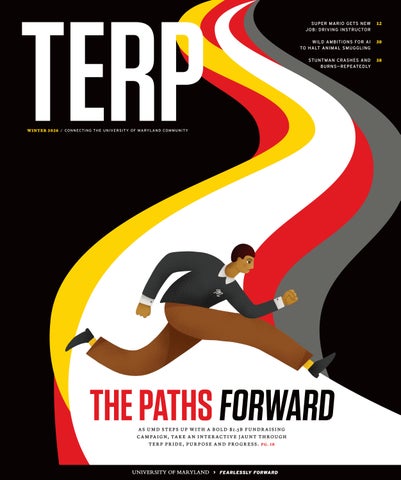
THE PATHS FORWARD A S U M D S T E P S U P W I T H A B O L D $2 .5 B F U N D R A I S I N G
C A M PA I GN , TA K E A N I N T E R AC T I V E J AU N T T H R O U GH T E R P P R I D E , P U R P O S E A N D P R O G R E S S . P G. 1 8
FEARLESSLY FORWARD
ON THE MALL
POST-GRAD
NEWS
4 5 5
Clark Foundation Invests $51.7M in Engineering UMD Virologist Makes $16M Planned Gift Sweet No. 16
CAMPUS LIFE
6 7 8 9 10 11 11
Preventing Tragedy With Ingenuity From Bee to UMD Going Green on the Greens The Art of the City Bouncing Back Mckinley’s Climb Sports Briefs
EXPLORATIONS
12 13 13 14 15 15 16 17
Super Mario Gets New Job: Driving Instructor Virtual Game, Real Learning Going Solo? Your Online Reviews Are More Trusted Just Like Cats and Dogs Don’t Wash Your Chicken (and Other Food Safety Tips) You Changed Doctors. What if Your Medical Records Didn’t? Cold Coverage Effects of a Flash
CONTENTS
POST-GRAD
36 38 39 40 41 43 44
Alumni Association Stuntman Crashes and Burns—Repeatedly Class Notes A Design Career Takes Off Chief Insector Underexposed Parting Shot
FEATURES
ONLINE AI Certificate Program Builds a Savvier Workforce More than 32,000 people have registered for a free online program launched in May by the Robert H. Smith School of Business.
—
Lifesaving Potential for Liver Cancer Patients As global deaths from liver cancer keep rising, a Maryland Robotics Center researcher is developing steerable microcatheters that can deliver chemotherapy straight to a tumor.
—
Bad Bunny Takes Stage as Academic Inspiration He’s the most popular rappersinger in the world and will be Super Bowl LX’s halftime performer. A new UMD course suggests Bad Bunny is also a poet, historian and cultural critic.
18
The Paths Forward As UMD steps up with a bold $2.5B fundraising campaign, take an interactive jaunt through Terp pride, purpose and progress. BY TERP STAFF
30
Wild Ambitions for AI An illegal trade in animals is booming worldwide. Now a UMD conservation criminologist is turning to artificial intelligence to snare smugglers and expose their networks. BY JENNIFER S. HOLLAND M .S. ’98
Get the latest on the UMD community by visiting TODAY.UMD.EDU .
B A D B U N N Y P H O T O B Y R A M O N “ T O N I T O ” Z AYA S / G F R M E D I A - G D A V I A A P I M A G E S
WINTER 2026
1
FROM THE PRESIDENT
sometimes all it takes is just a word to open a lifetime of new possibilities. That is what happened four years ago, when I saw a young girl named Zaila Avantgarde correctly spell “murraya” (a type of flowering plant) and become the first African American to win the Scripps National Spelling Bee. I reached out to her online right then and offered a scholarship if she came to the University of Maryland, with no clue what would come next. Fast forward to this fall, and Zaila—who is also a bestselling author and record-setting juggler—is now officially a Terp, studying cell biology and molecular genetics with hopes of one day working for NASA (page 7). She is the type of bright, ambitious and adventurous student who wants to be in College Park and study under our internationally renowned faculty, collaborate with groundbreaking researchers, and take advantage of opportunities and experiences only found at UMD. That’s why, to use another word, we must keep moving “forward.” Starting on page 18, this issue of Terp will take you inside our new $2.5 billion fundraising campaign, Forward: The University of Maryland Campaign for the Fearless. You will learn how we are leaping forward for tomorrow’s trailblazers, for bold and brave solutions and for stronger communities, through our commitments to scholarships, the arts, entrepreneurship, beyond-the-classroom experiences and more. We have launched this campaign because now is the time to capitalize on our momentum. From leading the way in quantum computing and artificial intelligence to increasing literacy for our state’s children, Terps have been achieving new heights in research, discovery, creativity and advancing the public good—all culminating in the historic milestone of reaching our highest-ever U.S. News and World Report rankings, coming in at No. 16 among public institutions (page 5). But for students like Zaila, and all the Terps who will come after her, we cannot be satisfied with the status quo and let this moment pass us by. Let’s show the world the power of another word—“pride”—and make this the start of something truly special. Sincerely,
Darryll J. Pines
President, University of Maryland Glenn L. Martin Professor of Aerospace Engineering
DARRYLL J. PINES President
Advisers ANNE BUCKLEY Vice President, Marketing and Communications MARGARET HALL Executive Director, Creative Strategies
Magazine Staff LAUREN BROWN University Editor JOHN T. CONSOLI ’86 Creative Director VALERIE MORGAN Art Director CHRIS CARROLL ANNIE KRAKOWER SALA LEVIN ’10 KAREN SHIH ’09 JOHN TUCKER Writers KOLIN BEHRENS LAUREN BIAGINI CHARLENE PROSSER CASTILLO Designers STEPHANIE S. CORDLE Photographer JANNA SINGER-BAEFSKY Digital Asset Manager/Archivist DYLAN SINGLETON ’13 Photography Assistant JAGU CORNISH Production Manager
EMAIL terpfeedback@umd.edu ONLINE terp.umd.edu NEWS today.umd.edu FACEBOOK.COM/ UnivofMaryland X x.co/UofMaryland THREADS.COM/ univofmaryland INSTAGRAM.COM / univofmaryland YOUTUBE.COM /UMD2101 LINKEDIN.COM /school/ university-of-maryland The University of Maryland, College Park is an equal opportunity institution with respect to both education and employment. University policies, programs and activities are in conformance with pertinent federal and state laws and regulations on nondiscrimination regarding race, color, religion, age, national origin, political affiliation, gender, sexual orientation or disability.
COVER Illustration by Valerie Morgan
2
T E R P. U M D . E D U
INTERPLAY
Targeting the World’s Most Bloodthirsty Killer
Thank you for this thrilling and exciting read. Yay for Burkino Faso! (I was there when it was the Republic of Upper Volta.) I’m so happy that the research has such heavy African scientist participation along with UMD and international funding, despite the fact that USAID no longer exists. Reading about the mathematical modeling made me cry because this was the type of thing my father used to do for the Defense Department, and it was the type of thing my husband did as a geophysicist at Northwestern University. Every single aspect of this research is impressive. —CHRISTINE SPEED, VIA TERP.UMD.EDU
Buzzwords With Buzz
The school, the state of Maryland and all the alums and friends of the University of Maryland are 100% behind you, Coach. All the best this year and the years to follow. —JOHN LANGTON ’65, SARASOTA, FLA.
Not Just a Walk in the “Park”
Reading about the parkrun brought back a lot of fond memories of College Park. I met my husband Jacob ’13 at the running club, and the rest is history. I had never run much before, but I recently completed my first 100K ultramarathon! —ANNA STRAUSS SCHIFF ‘14, LOS ANGELES
Housing, Reframed
Thank you for highlighting modular homes. Ours was built by North American Modular Homes in 1982. Quite a bit more can be said about their quality for the homeowner, but also for the working conditions of the builders who can work in a temperature-controlled warehouse with all the amenities, as well as a stable location for where to report to work. —WENDY FEAGA ‘76, ELLICOTT CITY, MD.
For Marines’ Historian, It’s Semper Fi on Corps Lore
In the Fall 2025 issue on page 41, John Hancock is credited with signing a document in 1975 commissioning Samuel Nicholas as captain of the new Continental Marines. If true, that surely is an achievement. Other than that, I am very impressed with the articles about UMD. —BARBARA SADOWSKI PH.D. ’78, NAPLES, FLA.
Editor’s Note: We took some well-deserved ribbing from readers for this typo. We meant to write “1775.”
Each year, the University of Maryland community comes together for a
WRITE TO US
We love to hear from readers. Send your feedback, insights, compliments—and, yes, complaints—to terpfeedback@umd.edu or to: Terp magazine Office of Marketing and Communications 7736 Baltimore Ave. College Park, MD 20742 Read more letters at terp.umd.edu.
one-day philanthropy marathon to raise millions for scholarships, the student experience, research and innovation, and so much more. Be a part of the Giving Day tradition on March 4. Support your favorite UMD causes. Win prizes by posting on social media.
#GIVINGDAYUMD GIVINGDAY.UMD.EDU
ON THE MALL
NEWS
Clark Foundation Invests $51.7M in Engineering Series of Commitments Adds to Legacy of Giving at UMD he university of maryland has received $51.7 million in new philanthropic investments from its most generous benefactor, the A. James & Alice B. Clark Foundation, to dramatically expand scholarships for promising engineering students and deepen academic collaborations with a network of other top engineering schools. The support is the latest example of the transformational giving of the foundation, which ceased operations in December. In total, the Clark family, Clark Enterprises and Clark Foundation have contributed over $364 million to UMD, including more than $125 million to Forward: The University of Maryland Campaign for the Fearless, the new effort to raise a record $2.5 billion. (See page 18.) “It’s impossible to imagine the University of Maryland, or the landscape of this region, without the Clarks—both the generosity of the Clark family and the Clark Foundation, and the leadership and vision of A. James Clark himself, who was truly one of the great
T
4
T E R P. U M D . E D U
builders and philanthropists of our time,” says UMD President Darryll J. Pines. “These latest investments further strengthen the foundation of educational excellence they have helped construct.” Clark credited a state scholarship with allowing him to afford his education in civil engineering at UMD. After graduating in 1950, he worked to grow Clark Construction into one of the largest firms of its kind in the nation. Remembering his roots, he made a $15 million donation to his alma mater in 1994 to support undergraduate engineering education; the A. James Clark School of Engineering was named in his honor. Following his 2015 passing, the Clark Foundation committed a historic $219.5 million to UMD through its Building Together investment, which funded a sweeping array of need-based scholarships, graduate fellowships, endowed faculty chairs and capital projects. In 2023, a new $20.6 million investment established the Clark School as the permanent home of the Clark Scholars Program Network (left), which supports talented students with financial need at 11 top engineering schools. The latest series of commitments includes $25 million for Clark Legacy Endowed Scholarships, which provide merit- and need-based scholarships for engineering undergraduates. The Clark Opportunity Transfer Scholars Program, supporting high-achieving engineering students who come to UMD from Maryland community colleges, also received supplementary funding for scholarships. Additionally, the foundation’s investment will bolster the endowment for the university’s Clark Scholars Program and create new funds supporting scholars’ professional development, providing emergency funds and launching a philanthropy challenge, where scholars will annually award a local nonprofit. Further funding will support new and existing CSPN programming. The Clark Foundation has also entrusted UMD with maintaining its legacy website and a designated space in the new Stanley R. Zupnik Hall. “We know that our partners at Maryland will use the investments to take the university to new heights of scholarship, innovation, exploration and excellence,” says Courtney Clark Pastrick, chair of the Clark Foundation’s board and the couple’s daughter.—ak
P H OTO BY S H AW N E T U R R E N T I N E , A RT T R E N DS P H OTO G RA P H Y
UMD Virologist Makes $16M Planned Gift
a $15 million planned gift to the Department of Cell Biology and Molecular Genetics to create two endowed professorships, one in virology and another in ribonucleic acid (RNA) or plant biology, and multiple postdoctoral and graduate fellowships. An additional $1 million will fund the Sondra Simon Memorial
SEVEN YEARS AGO, Professor Anne Simon
Maryland Promise Scholarship, in
(right) suddenly found herself out of funding.
honor of her mother.
After decades of published research, she was
“The University of Maryland has
between federal grants, and her lab was at risk of
been a leader in virology research
shuttering—before she could finish developing a
thanks to faculty members like
vaccine to save the world’s citrus groves from a
Anne Simon, and her generous
deadly disease.
support through this bequest will
Department support helped tide her over. But
help us immeasurably to expand
she still remembers the stress of possibly letting
our work in this vital area,” says
go of the dedicated scientists on her team.
College of Computer, Mathematical,
decimated more than 90% of oranges, grape-
“I want to pay it back and keep that from
and Natural Sciences Dean Amitabh Varshney.
fruits and other fruits in Florida since 2005
happening to others,” she says. “I want to keep
“Our research in virology and related areas is
and spread extensively in Asia, the Americas
good people here and attract good researchers,
emblematic of our drive to tackle the world’s
and Africa. While temporary fixes exist, such as
especially junior faculty, in these fields that I
most pressing grand challenges.”
injecting medical-grade antibiotics into trees,
love.”
Simon’s support stems from her company,
Simon instead vaccinates them using an RNA
That’s why the plant virologist (and longtime
Silvec Biologics, which she created with her
virus to deliver antimicrobial peptides; lab
“The X-Files” scientific
brother, Rafael Simon, in 2019 to stop citrus
testing has been effective and field testing is
adviser) this fall made
greening disease. This bacterial infection has
underway.—KS
Sweet No. 16
UMD Hits All-time High in U.S. News Rankings THE UNIVERSITY OF MARYLAND
combined 69 top-25 rankings for
achieved its highest-ever rankings
its schools, colleges, programs and
from U.S. News & World Report
specialties, according to U.S. News. News.
in the influential 2026 “Best Colleges” guide, climbing to No. 16 among public schools. It also rose to No. 42 among
The record-high rating is based on factors including improved student graduation and retention rates, increased spending on student
national universities in the new
educational experiences, higher
list—up 22 spots since 2020.
faculty salaries and rising post-
The university now has a
graduation student earnings.
T O P P H O T O : J O H N T. C O N S O L I ; LEFT: DYLAN SINGLETON
WINTER 2026
5
ON THE MALL
CAMPUS LIFE
Preventing Tragedy With Ingenuity
Student Entrepreneurs Win $250K in xFoundry Competition to Develop Tech That Detects Guns, Tracks Suspects in Schools WHEN ARNAV DADARYA ’26 was a high school senior,
as possible,” says team member Srinidhi Gubba ’26.
someone reported a shooting on campus. He followed
The contest included 89 students across more
the drill, taking cover under a desk and keeping his
than two dozen disciplines and representing each
phone in his pocket as a SWAT team rushed in. It
of UMD’s 12 schools, achieving an xFoundry goal to
turned out to be a false alarm, but the panic was real.
foster creativity and innovation through collabora-
Dadarya’s teachers “had no clue” about what was
tions across campus.
happening, he recalled. Over three semesters, Dadarya and 11 UMD
Their members belong to the first generation of Americans for whom school shootings are an
classmates developed a tool that uses artificial
unceasing threat: In the past 25 years, at least
intelligence to detect a gun carried visibly within
360,000 students have experienced gun violence
a school and track the suspect’s movements while
at school, according to Brady United, a gun control
school staff and security get automatic alerts. Soon,
organization.
they will introduce their technology to the real world as cofounders of a startup.
Open to undergraduates and graduate students, the 15-month Xperience Competition requires them
In September their group, DefenX, earned
to develop an investment-grade product along with
$250,000 from the University of Maryland College
a business plan, product strategy and a presentation
Park Foundation after winning the inaugural
for investors. An optional three-semester course
Xperience Competition, an initiative from the
provides instruction in entrepreneurial concepts like
UMD-based xFoundry that kick-starts the careers of
team building, product development and collabora-
budding entrepreneurs who develop a tech solution
tion. Competition entrants are judged by UMD experts
to a societal issue.
and interdisciplinary professionals outside of the
DefenX’s system uses video cameras, machine learning and a geographical coordinate system to identify weapons and monitor suspects. The students
university. Over the next several months, DefenX will refine its product and seek further investment before
also developed a mental health resources guide for
launching pilot programs in K-12 schools. A second
distribution following an incident.
student cohort is underway, working on technologies
“We’ve made this technology as beginning-to-end
to address the next Xperience global challenge, centered on mental health. “This program allows every student from every University of Maryland discipline to focus their passion, energy and talent on a solution that takes a major world problem off the board,” says xFoundry founder and CEO Amir Ansari, an engineer with
more than 60 patents. “They’re building real, viable products on their own, with no spoon-feeding.”–JT
Zaila Avant-garde won the 2021 Scripps National Spelling Bee after studying 13,000 words for seven hours a day, helping her master about 99% of the dictionary.
Over 18 months, students on Team DefenX designed an AI tool for active shooter situations.
6
T E R P. U M D . E D U
P H OTO CO U RT ESY O F T E A M D E F E N X
“She has an amazing attitude toward learning and work, and she’s willing to grind.” —TESSA MONTAGUE, NEUROSCIENTIST, COLUMBIA UNIVERSITY
From Bee to UMD
Spelling Champ, Basketball Record-Holder Juggles Skills or zaila avant-garde ’29, there’s more than one way to spell success. One way is M-U-R-R-A-Y-A (a kind of tropical tree), which she correctly rattled off as an eighth grader in 2021 to become the first African American to win the
F
Scripps National Spelling Bee. Now, another way is U-M-D. After her groundbreaking victory, scholarship offers poured in, including from University of Maryland President Darryll J. Pines: “We hope you’ll bring your ‘Murraya’ win to Maryland!” he wrote on social media. Four years later, she did, and now she’s a freshman studying cell biology and molecular genetics and honing her other spectacular skills: bestselling book-writing and world-record basketball-juggling. “It was a full-circle moment,” says Avant-garde, who reunited with Pines at the beginning of the academic year. “I’m really interested in coming here and taking my first true scholastic steps toward my career.” The Harvey, La., native was destined to stand out: To honor a John Coltrane
A B O V E P H O T O B Y D Y L A N S I N G L E T O N ; I N S E T : A P P H O T O /J O H N R A O U X
jazz album, her dad, Jawara Spacetime (a surname he had changed from Heard), also switched her last name to Avant-garde. In middle school, back when the Scripps bee aired on ESPN, her dad was watching the channel and jokingly quizzed his daughter with some of the competition’s nearly impossible words, like “knaidel,” the winning one from 2013. She nailed it—and nearly every other one he threw at her. That set her on her own path to the bee. And while studying 13,000 words for seven hours a day around her homeschooling, she was keeping several balls in the air— literally. Also a basketball player, she worked on hand-eye coordination from an early age at Jawara’s suggestion: “Imagine if you could dribble two basketballs really well. Doesn’t that mean you’d be better at dribbling one?” he asked her. “And then I was like, ‘Imagine if I could dribble three basketballs, or four or five!’” Avant-garde says. She’s bounced her way to four Guinness World Records, two of which she still holds: most basketballs dribbled simultaneously by one person (six) and most bounce juggles in one minute with four basketballs (255). She’s eyeing more records, and hopes UMD’s Juggling Club can help her add pins and other objects to the mix. That’s not all Avant-garde has spinning: She’s written five children’s books, with another on the way, about the magic of words and being “wonderfully weird.” She wants to one day work for NASA’s Human Research Program and help make life on Mars possible—even if that “makes me sound like an old guy sitting in the corner with a pipe talking crazy,” she says. “She has an amazing attitude toward learning and work, and she’s willing to grind,” says Columbia University neuroscientist Tessa Montague, with whom Avant-garde interned after her bee success. “Being a scientist, as with a lot of careers, requires a lot of grind.”—ak
WINTER 2026
7
ON THE MALL
CAMPUS LIFE
BIRDHOUSES
UMD’s chapter of the National Audubon Society installed six birdhouses throughout the new meadow,
Going Green on the Greens
providing habitats for native species like swallows and bluebirds. The first babies hatched in June, and Terps completed a NestWatch report for inclusion in a national dataset.
UMD’s Golf Course Doubles as Sustainable Living Classroom
TERPS TREKKING ACROSS the University
of Maryland Golf Course might not just be looking for eagles and birdies beyond the fairways, but in the treetops. The course, which hosts upward of 50,000 rounds of golf per year, also acts as a living classroom. It welcomes classes ranging from entomology to turf management, with Terps studying critters, sampling water and exploring biodiversity. “That’s what we’re continuing to focus on: having environmental, recreational and educational benefits on the golf course,” says Laura Russell, who handles
BEE BOXES
the course’s special projects. “It’s a
To boost polli-
multitasker.” After a powerful storm surged through
nation, members of UMD’s Bee Campus
College Park in July 2022, uprooting
Committee placed three
284 of the course’s trees, employees
mason bee boxes in the
turned the destruction into an opportu-
meadow last spring, with small
nity for growth. They used a university
cardboard tubes and mud for
Sustainability Fund grant to add nearly
the insects to create their new
4,000 seedlings and other plants in the
digs. They’re 95% efficient
most damaged area, between the 15th
pollinators—much better than
and 16th fairways, transforming it into a
honeybees, Russell says—and
pollinator meadow.
typically don’t sting.
Through birds, blooms and bees, it adds to the many ways the course is sustain-
NATIVE TREES
The D.C.-based environmental nonprofit Casey Trees planted 61 saplings,
ably supporting the UMD community. Tee
including holly, oak and magnolias, at
off for a tour.—AK
the course’s entrance and along the fence line in 2024. “Some of it is for safety,” says Russell, as the trunks add an extra barrier between the fairways and Adelphi Road. “Besides that, they’re great at capturing carbon.”
8
T E R P. U M D . E D U
I L L U S T R AT I O N BY K O L I N B E H R E N S ; I N S E T P H O T O S C O U R T E SY O F L A U R A R U S S E L L
OUTDOOR CLASSROOM
Educational signs and benches crafted from trees that fell during the storm make this area, surrounded by the pollinator meadow, a picture-perfect gathering space for classes.
The Art of the City Art Professor Depicts Different Sides of Baltimore in New Audiovisual Installation
It also acted as a checkpoint during the 2025 international BioBlitz
WHEN SHANNON COLLIS MOVED to Baltimore’s Locust Point neigh-
species-counting competition,
borhood 12 years ago, she was struck by the peninsula’s panorama of
where Terps placed third for the
industry: marine terminals dotting the port, freight railways circling
total number identified (353).
rowhomes and the iconic, aromatic Domino Sugar factory towering nearby. The multidisciplinary artist appreciated the contrast between her new city’s grit and the Canadian prairie town in which she grew up. That theme of juxtaposition—urban industry and natural environment— anchors the associate professor of art’s newest installation, depicting Baltimore’s heavily industrial Curtis Bay neighborhood and Masonville Cove, a bucolic wildlife refuge 2 miles away. For a year, Collis and her collaborator, Liz Donadio, captured the pulse of those areas with video cameras and sound recorders, resulting in an immersive audiovisual exhibit set to open in April at the Pikesville Amory in Baltimore County. Funded by an ArtsAMP grant from the university’s Arts for All initiative to support community-impact projects, “Resonant Site” projects moving images onto screens that will hang throughout the 30,000-square-foot space, accompanied by recordings of industrial machinery, trains, water and wind. The videos will portray the divergent landscapes in summer and winter, sometimes from a drone’s aerial view, revealing an ever-changing city. Some of that tension lies in Curtis Bay, known for a coal export terminal that has polluted the community’s air. Through it, Collis explores how industry embeds into daily life. Creating art in her adopted town brings more meaning to Collis’ work. “As you make sense of the world closer to home, you feel invested in its future,” she says.–JT
WATERSHED
The course’s creeks act as a filtration system: Runoff from Adelphi and Metzerott roads leaves the area much cleaner than when it enters. Last spring, an environmental science and technology class took water and soil samples to identify areas where this system could be bolstered, leading to successful watershed restoration near the 16th green and inspiring future projects.
P H O T O AT R I G H T C O U R T E SY O F S H A N N O N C O L L I S
WINTER 2026
9
ON THE MALL
SPORTS
He is a person who exemplifies positivity and making an impact on others.” —BUZZ WILLIAMS, MEN’S BASKETBALL HEAD COACH
that same grit as a member of new head coach Buzz Williams’ squad. Rated a top-15 prospect in his home state of Georgia, Rice committed to the Cougars and felt strong as a new arrival. When he noticed some swelling in his neck, he got tested as a precaution. But on Sept. 12, after calling his mom to wish her a happy birthday, he had to call back with a much more somber message. “Your mind starts to race. You start thinking of the worst,” Rice says of the
Bouncing Back
diagnosis. “We all leaned on each other to not only assess what the news was, but get through it.” The series of 14 chemo treatments took a toll: He lost not only his hair, but also muscle mass and slept 16 hours a day, with virtually no energy to eat or shower. Throughout the struggles, he still traveled with his team
After Conquering Cancer, Men’s Basketball Transfer Shoots for More Wins on the Court
chemo in March 2023, he also rang in a
AS POINT GUARD MYLES RICE dribbles to
deep end” to catch up with conditioning, he
whenever he could, sneaking in shots here and there. It all proved worth it: As Rice rang the treatment center’s bell after finishing major winning year. “I threw myself into the
set up plays, the ball isn’t all that’s popping
recalls, resulting in a Pac-12 Freshman of the
on the court. His fingernails flash with
Year performance just over a year after his
team colors, but he didn’t always add such
diagnosis.
panache to every pass. Rice, who transferred to Maryland last offseason, frequently had his hair styled in
done—not just athletically, but academically
different designs—until it fell out in chemo-
and in life.”
therapy. “So I was like, ‘Okay, I’m gonna find
After a year at Indiana, Rice joined UMD,
something else to express my creativity.’”
drawn by Williams’ coaching style and family-
He was diagnosed in 2022 with Hodgkin
like culture. As he helps lead his new Terp
lymphoma, a cancer that affects the immune
team, Rice’s red, white, black and gold nails
system, causing him to miss what would’ve
are a bright reminder of where he’s been.
been his redshirt freshman season at Washington State University. Through seven
10
T E R P. U M D . E D U
“It was only the beginning,” he says. “I knew there was a lot more work to be
“He is a person who exemplifies positivity and making an impact on others,” Williams
months of grueling treatments, he vowed to
says. “His story thus far in college will
return to the court, and now, he’s applying
eventually become a book.”—AK
P H O T O C O U R T E SY O F M A R Y L A N D AT H L E T I C S
SPORTS BRIEFS
Mckinley’s Climb
Olympics’ Teen Track Star Signs With UMD
Wrestler Trains With Men While Dominating Women in Independent Tournaments
2024 Olympic gold medalist and under-18 400-meter
IN THE “FIREMAN’S CARRY,” a wrestler hoists an opponent over their
says that being close to home—and his mom’s cooking—
shoulders before flipping them to the mat. It sounds like a move favored by
played a big role in his decision in November.
world record holder Quincy Wilson has signed with UMD’s track and field program. Wilson, a senior at the Bullis School in Potomac, Md.,
mountainous pros like the Rock or the Big Show, but it’s also the favorite of a
“I started my legacy in 2024 at the Summer
freckle-faced 5’5” Terp who stands among the nation’s best female collegiate
Olympic Games, and I had the whole city behind me,”
grapplers. Then-freshman Mckinley Jovanovic won last year’s National Collegiate Wrestling Association (NCWA) Mideast regional tournament in the women’s 131-pound weight class—a first for a UMD woman in any class—and finished fifth in nationals to net All-American honors. The Silver Spring, Md., native, who enrolled at UMD as the state’s top female wrestler in her weight division, has grappled with challenges off the mat, too: Women’s wrestling at the NCAA Division I level is a rarity—just six schools have teams—and Jovanovic is one of two women on UMD’s club team. After training
he says. “With 2028 coming, I want the whole city behind me. And I’m ready to do it at the University of Maryland.” Wilson adds that he looks forward to training under UMD head coach Andrew Valmon, who still owns the 4x400 world record set at the 1993 World Championships and won gold medals in the 1988 and 1992 Games. At the Summer Games in Paris, Wilson became the
with men all week, she enters independent women’s tournaments during
youngest track and field male Olympian in U.S. history
weekends, when she can find them, and pays her own travel costs. The NCWA
when he was a 16-year-old member of the 4x400 meter
oversees female competitions only during the postseason tournament.
relay pool.
Jovanovic sees parallels between her athletic pursuits and her studies as a triple major in history, education and public policy; she gravitates toward U.S. history classes that celebrate unsung women who overcame 20th century adversity.
Historic Season for Men’s Soccer
The 20-year-old hopes to finish No. 1 in her NCWA weight class this March,
After completing an undefeated regular season with a
then try out for USA Wrestling’s under-23 women’s team, the first step to qual-
No. 1 national ranking and a Big Ten title, the Maryland
ifying for the national squad that can enter the world tournament and Olympic
men’s soccer team ended the year with a run to the
trials. Despite the sport’s sometimes-bruising physicality, she says it’s the
Elite Eight in the NCAA Tournament.
mental aspect that’s bred success: “The best thing about wrestling is that you
The conference title, clinched with a 4-3 victory
can be down nine points and still come back to win if you keep persisting.”–JT
over Michigan State, was Maryland’s 50th across all sports since joining the Big Ten in 2014. Standout performances from six First Team All-Big Ten honorees, a men’s soccer program record, fueled the Terps’ success. The team suffered its first loss, 3-1, to No. 3 Washington, on Dec. 6. “They brought the Maryland style, the Maryland culture and the Maryland pride back into our program,” head coach Sasho Cirovski says of his team. “I’m so grateful for the season we’ve had.”
P H OTO BY ST E P H A N I E S. CO R D L E ; S P O R T S B R I E F S P H O T O S C O U R T E SY O F M A R Y L A N D AT H L E T I C S
WINTER 2026
11
ON THE MALL
E X P L O R AT I O N S
Super Mario Gets New Job: Driving Instructor
Engineers Use AI on Popular Video Game to Improve Autonomous Vehicles
ollowing last year’s release of Mario Kart World alongside the Nintendo Switch 2, the video game sold nearly 6 million units in two months, the franchise’s most successful launch yet. Now UMD engineering researchers are using the mustachioed cartoon plumber who races a cart around a track as a model for—wait for it—responsible driving. Funded by the U.S. Naval Air Warfare Center Aircraft Division, the researchers are using artificial intelligence (AI) to train a computer to “play” Mario Kart on its own—in this case, the inaugural 1992 Super Nintendo version—circling the track as fast as possible while hewing to actual laws of physics and, most importantly, avoiding risk. Eventually, the UMD team hopes to provide regulators with a roadmap to certify AI technologies in autonomous vehicle fleets that are increasingly popping up in cities across the U.S. and around the world. The research is led by aerospace engineering Associate Professor Mumu Xu, who studies federal safety certification for planes and cars. She recently became interested in the disconnect between long-established vehicle safety norms and the wildly complex algorithms used in autonomous cars and trucks, making it almost impossible for engineers to fully understand the systems’ driving and safety
F
12
decisions. “With AI, all the old mathematics we use to show that a system is safe no longer hold because no one knows what’s under the hood,” Xu says. So Xu and her colleagues sought out a meeting point between humans and machines that everyone could understand—and it happened to wear a bushy mustache. In a study published last spring in IEEE Xplore, they demonstrated how Mario Kart can be used to teach an autonomous simulator to avoid collisions through an AI method called deep reinforcement learning. The 33-year-old Super Mario Kart, with its pixelated landscapes and A-B-A-B button-pushing combos, pales in comparison to the lavish 3D graphics and gyroscopic controllers of today’s version, but its codes are simpler and available to the public. When Xu’s team reconfigured them so a computer could take the wheel, it added a reward system that offered points for whizzing past checkpoints and subtracted them for spinouts and slowdowns. The computer then raced Mario around the track millions of times. At first, Xu says, it “drove stupidly,” hopping up and down and bouncing into walls. But eventually it learned to zip through the course without a dent. The researchers’ next goal is to ensure that Mario’s maneuvers are mathematically feasible: Can he really carve a turn at 40 mph without running off the road, for example? Those answers will help fine-tune their algorithms in a second Navy-funded study. The research applies not just to self-driving vehicles but to any consumer product relying on algorithmic software, Xu says. “For anything that uses AI, whether it’s a medical device or a gadget like Amazon Echo, we hope that their algorithms are safe,” she says. “This is our attempt to figure that out.”—jt
Going Solo? Your Online Reviews Are More Trusted
Study: Tripadvisor Readers See Lone Consumers as Invested in Activities THE MOST TRUSTED REVIEWERS of a leisure experience—like a
Virtual Game, Real Learning VR Reading Adventure Improves Skills for Dyslexic Youth
visit to an art gallery, museum, movie theater or zoo—are people who go it alone. “People think that someone who does stuff alone must really be interested in or knowledgeable about that activity,” says Rebecca Ratner, Dean’s Professor of Marketing, who published a paper on the finding in the Journal of Marketing Research. Research. But if
DYSLEXIA ISN’T JUST FRUSTRATING for children strug-
they went with a friend, she found, it could be just because they
gling to decipher squiggles as letters. At schools that can’t
wanted to do something outside on a nice day.
support students one-on-one, it can be costly for parents who turn to private reading tutors.
Ratner for the past decade has studied people’s reluctance to do activities alone, finding that they often enjoy themselves
A new virtual reality game led by Terps offers an
more than they expected. For this latest research, she and
alternative, helping kids to learn letters, build words, and
co-author Yuechen Wu Ph.D. ’19, an assistant professor at
connect sight and sound as they race through obstacles in a
Oklahoma State, examined reviews from Tripadvisor that
fantasy world—while still in their classrooms.
revealed if consumers were alone or with others.
IRIS Reads, co-developed by education Associate
Other Tripadvisor users gave more “likes” by clicking a
Professor Donald J. Bolger, linguistics Professor Juan
thumbs-up button to reviews and recommendations from people
Uriagereka and physics Professor Drew Baden and helmed
who did something alone—results the researchers validated
by CEO Anne-Laurence Nemorin ’20, has students ages
through lab experiments.
8-13 travel to Antarctica, the Great Wall of China and the pyramids of Giza to chase time bandits who have stolen
Ratner hopes more people take a cue from other solo consumers that they can get out there sans companion: “Don’t
historic objects. Through each level, students might “grab”
let it stop you if you don’t happen to have a friend or a partner
different letters out of the air to create words or “slice and
or a child to go with you that day. Live your life and do the things
dice” words into different syllables (à la Fruit Ninja) to gain
that you think would be fun.”—CARRIE HANDWERKER
confidence in reading. Using a VR headset removes distractions, especially welcome for dyslexic kids who also struggle with attention and auditory or visual processing, says Bolger, who investigates the neurocognitive underpinnings of language development and reading. “Your whole body is engaged,” he says. “These are fundamental skills, but it’s also really fun.” The game has been tested in schools around the D.C. metro area that specialize in dyslexia. Students have demonstrated a 13-22% increase in standard reading scores after playing regularly in class. The team plans to launch it this summer for home and classroom use.—KS
I L L U S T R AT I O N AT L E F T B Y VA L E R I E M O R G A N ; I L L U S T R AT I O N AT R I G H T B Y L A U R E N B I A G I N I
WINTER 2026
13
ON THE MALL
E X P L O R AT I O N S
Just Like Cats and Dogs
Wild Predators Navigate the World Similarly to Domesticated Cousins, Study Finds THE NEXT TIME YOU WATCH your dog sniff around the same places in
invisible “highway” systems that they use to move around their home
your yard or notice your cat explore a new area every time it ventures
ranges, perhaps thanks in part to dogs’ powerful sense of smell.
outside, consider this: You might be witnessing ancient evolutionary strategies in action. A recent UMD-led study in Proceedings of the National Academy of Sciences reveals that wild canids—wolves, foxes, coyotes and others—
“Canids possess superior olfactory abilities compared to felids, potentially helping them establish and remember preferred travel routes,” Fagan says. The magnitude and consistency of differences between the
consistently create and stick to specific travel routes within their
two predator groups are striking given the large, varied
territories. But their distant carnivore cousins in the cat family—like
dataset, says senior author Justin M. Calabrese,
bobcats, lions and leopards—tend to roam more freely, relying less
head of the Earth System Science research group
strongly on favored routes.
at Center for Advanced Systems Understanding in
The study, conducted with 177 collaborators worldwide, used GPS
Germany and an adjunct professor at UMD.
collar data to track the movement of 1,239 individual carnivores from
Intriguingly, the differences between canids and
34 species across six continents over the past decade. The largest-ever
felids actually became stronger when the researchers
comparative study of carnivore movement ecology, the project was
restricted their analyses to nine shared landscapes where they could
funded by the U.S. National Science Foundation and German science
be studied together, removing the influence of variation in vegetation
agencies.
type, human “footprints” and other factors.
“We found that carnivore species use space in fundamentally
The findings have many implications for
different ways,” says lead scientist William Fagan, a Distinguished
improving wildlife conservation and manage-
University Professor of biology at UMD. “It looks like these different
ment practices, such as predicting human-wild-
navigation strategies have developed over millions of years since dogs
life encounters and organizing conservation
and cats last shared a common ancestor.”
areas to protect endangered species from
The findings challenge scientists’ traditional understanding that predators moved randomly throughout their territories, an assumption so widespread that it was baked into standard mathematical models. However, the new findings show that many carnivores create
threats including poaching, Fagan says. “The project demonstrated how modern GPS technology and sophisticated analysis methods developed by our research group can reveal fascinating hidden aspects of animal behavior that were impossible to study just a short time ago,” he says.—GEORGIA JIANG
14
T E R P. U M D . E D U
I L L U S T R AT I O N B Y VA L E R I E M O R G A N
ASK THE EXPERT A DV I C E FO R R E A L L I F E
Don’t Wash Your Chicken (and Other Food Safety Tips)
USE A FOOD THERMOMETER
“People only
pull it out for Thanksgiving, but you should use it anytime you’re cooking proteins or even heating leftovers,” Henley says. Know the safe internal minimum temperatures, especially for items like pork and poultry that must be fully cooked.
PICTURE YOUR FAVORITE MEAL. Maybe
You Changed Doctors. What if Your Medical Records Didn’t? WHETHER IT INVOLVES A STACK of
it’s your mom’s comforting congee, pot of
QUICKLY STORE AND CONSUME LEFTOVERS
paper or yet another internet portal, cue
creamy fettucine Alfredo or a platter of richly
Don’t let dishes languish more than two
the déjà vu while answering the same
spiced doro wat.
hours before getting them into the refrig-
medical history questions for seemingly
But imagine the cook forgot to rinse the
erator, because bacteria can grow rapidly. If
the hundredth time
veggies. Or came from the Metro with only a
you have a party, portion items into smaller
for a new doctor.
cursory hand wash. “Do you want to take the risk and eat it?” asks UMD Extension family and consumer
bowls and swap them out regularly. And eat or freeze leftovers within four days.—KS
Beyond the time suck, what does starting every
sciences Senior Agent Shauna Henley. She
medical relationship
works to reduce those risks across the state,
as essentially a blank
from leading a cooking club for elementary
slate to your provider
school students in Baltimore to training
mean for your health?
farmers about produce safety, to teaching
With support from a $1.4 million
canning and food preservation to consumers.
National Institutes of Health grant, Nate
Here are her tips:
Apathy, assistant professor of health policy and management at UMD, is
WASH YOUR HANDS ON REPEAT
working with A. Jay Holmgren of the
Don’t stop with one soapy
University of California, San Francisco
scrub before your meal prep,
School of Medicine to find out.
says Henley. Make sure you wash throughout. For example,
They’re using machine learning and artificial intelligence tools to examine
“we’re touching our phones, our
patients’ electronic health records and
tablets to scroll for recipes,”
determine how doctors’ decision-making
and those devices are covered
is shaped by seeing either limited data or
in germs.
“outside” data” (transferred from other medical offices), and how that affects
BUT NOT YOUR CHICKEN
Use a paper towel to get the slime off your poultry—don’t run
patients. “When health data travels seamlessly between institutions, there is immense
it under the tap. “You can get an
promise to drive down health care
aerosolized spray of bacteria” like
costs and reduce health care use and
salmonella or campylobacter, she says,
duplicative paperwork, all of which can
which can cause diarrhea and vomiting.
improve patient health and satisfaction,” Apathy says. “We hope this research and the open-source tools we will create from it will contribute to improved decisionmaking and health outcomes.” —FID THOMPSON
I L L U S T R AT I O N BY C H A R L E N E P R O S S E R C A S T I L L O
WINTER 2026
15
ON THE MALL
E X P L O R AT I O N S
FA C U LT Y Q & A S I N E A D FA R R E L L
Why does the Earth need sea ice? It regulates the global temperature and helps keep the planet cool, which is what we all need to survive. If less of the Arctic Ocean is insulated with ice, this allows more heat from the sun to be absorbed by the ocean each summer, which melts more sea ice, exposing more of the ocean and so on. It’s also important for biodiversity. The marine food web depends on it, everything from birds to seals to orca. People also use it for transportation between villages and hunting. Why do we need to know how it fluctuates? Many livelihoods depend on knowledge of conditions. Summer is the busiest time in the Arctic for tourists, wildlife and industry. For example, the Bering Sea is the crab and lobster fishery capital of the world, and the shipping trade in the polar regions is growing rapidly. How do you survey by plane? The majority of my field research has been on NASA aircraft, over places like Greenland and Alaska. I’ve also flown from southern Chile over
Cold Coverage
Antarctica and back. We use lots of instruments to take infrared, visible and radar measurements to get a much more complete picture of the total thickness of the snow and ice. From a satellite image, taken from 600 kilometers away (roughly
Scientist Examines Sea Ice Via Satellite, Plane and Snowmobile
the distance from D.C. to Boston), there’s no context: Is this long ice ridge 1 foot tall? Five feet tall? We’re using new techniques to measure the
THE BEST SNACK TO BRING on an Arctic mission, Associate Professor
ice from space to get a handle on the volume of
Sinead Farrell declares, is chocolate. A banana or sandwich will be as
ice not just the area; if you lose area but thicken
chewable as a backyard paver after a few miles on a snowmobile. That bar,
the ice so it’s more dense, that could be harder to
however, will melt right in your mouth, even if it’s 5 degrees Fahrenheit outside.
melt. But if there’s less area and it’s thinner, it will
That’s the kind of surprising tidbit Farrell has learned over nearly a dozen trips to the North and South poles for research on sea ice. A faculty member in the departments of Geographical
melt quicker. Over the 14-hour flight, we crossed multiple
Sciences and Atmospheric and Oceanic Science, she has used remote sensing to determine
time zones, so the sun set again and again as we
long-term changes and year-over-year fluctuations in ice cover for nearly two decades. To
crossed time zones. It was really fascinating!
validate satellite data, her team takes measurements from aircraft and on the ground. In December, she authored part of the annual Arctic Report Card, which found that sea ice cover in March 2025 was the smallest winter maximum recorded in 47 years, 8% lower than the long-term average. She explains why sea ice is so important, how she once saw five sunsets in one day and why she only uses mechanical pencils in the field.—KS
16
T E R P. U M D . E D U
What is it like to step onto the ice? It’s truly magical, so stark, blue and white. It’s a completely quiet environment—so quiet it allows you to hear the ice cracking beneath your feet. It’s sensory deprivation, almost.
P H O T O S : T O P L E F T : N A S A / R O S E D O M I N G U E Z ; B O T T O M R I G H T, J A C Q U E L I N E R I C H T E R - M E N G E , C R R E L
The conditions are quite hazardous, even in the summer. The cold weather wreaks havoc with our normal experimental approach, from instruments not working because batteries are dead to your pen freezing, so I bring mechanical
Effects of a Flash
Study: Lightning Creates, and Eliminates, Pollution
pencils. “ALL-NATURAL” IS OFTEN used as a synonym
Why work with Indigenous communities? At Maryland, we’re trying to improve the collaboration with local communities, because they’re the most knowledgeable about the ice, the current conditions and placing that in the context of the past. And a lot of the work we do directly impacts their livelihood, so we want to connect our measurements with the need on the ground. The very first time I ever went out on sea ice, near Utqiagvik, Alaska, I was only there for five minutes before a polar bear was sighted. We always travel with a bear guard because they’re dangerous animals and very inquisitive—they often cross paths with our field campaigns and sometimes even take the instruments apart. While driving the snow machine, our Indigenous guide saw the bear, a quarter of a mile away, without using binoculars.
for “pure,” but nature’s fury can get pretty dirty— dirty —think volcanoes. Recent UMD research shows how even lightning can release the same pollution— pollution —nitrogen oxide— oxide—as your car when it’s idling in traffic. For the first time, scientists from the University of Maryland were able to detect lightning’s impact on air quality using high-frequency satellite observations that revealed how storms produce both pollution and other critical chemicals that help cleanse Earth’s atmosphere. Over the course of a few days last summer, atmospheric and oceanic science Research Professor Kenneth Pickering and Associate Research Scientist Dale Allen used data from NASA’s orbiting TEMPO instrument to monitor the evolution of Eastern U.S. thunderstorms, with readings taken at 10-minute intervals. A lightning flash’s extremely hot temperatures break apart nitrogen and oxygen molecules, resulting in up to 15% of all nitrogen oxides released into the atmosphere, contributing to ozone pollution that can trigger asthma and other respiratory conditions. “Human pollution is much greater, but what’s important to consider is that lightning releases nitrogen oxides at much higher altitudes, where it can be more efficient at catalyzing the production of ozone,” Pickering says. Luckily, lightning doesn’t just create pollution— it also triggers the formation of hydroxyl radicals, important molecules that help clean Earth’s atmosphere by breaking down gases like methane, an important contributor to global warming and ozone pollution.
At left, the frozen Arctic Ocean, captured via aircraft, shows newer ice up top and older sea ice, topped with snow, at the bottom. Above, Farrell measures the depth of meltwater accumulating on top of the sea ice in Utqiagvik, Alaska.
I L L U S T R AT I O N B Y VA L E R I E M O R G A N
WINTER 2026
17
THE
PATHS As UMD steps up with a bold $2.5B fundraising campaign, take an interactive jaunt through Terp pride, purpose and progress. BY T E R P S TA F F
FORW
WARD TERPS SOMETIMES LIKE TO SAY that terrapins can
only move in one direction: forward.
Determined. Dauntless. Driven. But what if they
strapped on rocket packs?
That’s how it feels at the University of Maryland,
Now we’re launching Forward: The University of
Maryland Campaign for the Fearless, Fearless, an audacious bid to raise a record $2.5 billion.
We’re in pursuit of unprecedented trans-
formation to advance new discoveries and
where we’re increasing our momentum like never
knowledge, and to change life and
before. In the past year, we’ve achieved our best-ever
lives—on this campus and throughout
U.S. News & World Report rankings. Notched a new
the state, nation and world.
high in research and development spending. Racked
On the following pages, come along on a
up the largest number of freshmen applications and
journey that’s both local and global, soaring with
the most competitive class of incoming students.
ambition and down to earth, and see how this
We’ve never been afraid to think big. Never shied
campaign’s 12 universitywide fundraising priorities
away from big moves, powerful actions or doing
will prepare a new generation of Terps to tackle the
what’s right rather than what’s easy.
challenges that face us all.
I L L U S T R AT I O N S B Y VA L E R I E M O R G A N
WINTER 2026
19
FORWARD FOR TOMORROW’S TRAILBLAZERS UMD is expanding access to a world-class education, enhancing Terps’ academic and personal growth, and preparing them for careers in a quickly evolving job market.
FUNDRAISING PRIORITY ONE
Scholarships and Graduate Fellowships To become a top 10 public university, UMD needs to recruit and enroll the nation’s best applicants. Donor-funded scholarships and graduate fellowships not only make Maryland more appealing than ever, they also swing open the doors to a Maryland education for students with financial need.
The Mighty Sound of Support // If Ken Isman ’86 was using one part of his
his gratitude for that scholarship, though: He and his wife, Joan, have established an
in fire protection engineering. “I want to see that industry succeed, so we
endowment to support Maryland bands—whose
need to get more people into the program, and
purchases have included new tubas—and
hopefully scholarships are a major encourage-
created need-based scholarships for students
ment,” he says.
brain while at UMD to learn about suppressing or controlling fires, the other was to get Terps fired up.
HOW IT STARTED:
HOW IT’S GOING:
The fire protection engineering major happily spent his free time on campus playing the tuba in the marching and pep bands, along with the jazz band. But a doubling of his expenses senior year threatened to silence Isman’s twin interests. No longer able to get by on his $500-persemester band scholarship, Isman applied for, but didn’t receive, the few need-based engineering scholarships available back then. He was bracing to drop out so he could earn enough money to finish his degree later. That’s when then-Director of Bands John Wakefield learned of Isman’s plight and doubled his music scholarship. “It made the difference in my ability to stay in school,” Isman says. “I owe everything in my career to that degree.” Isman worked for the National Fire Sprinkler Association for 28 years, then returned to the A. James Clark School of Engineering as a clinical professor for a decade. He never forgot
20
T E R P. U M D . E D U
Isman performs with the Mighty Sound of Maryland in 1981 (left), and with its Alumni Band at Homecoming 2025.
L E F T P H OTO CO U RT ESY O F K E N I S M A N ; R I G H T P H O T O B Y J O H N T. C O N S O L I
FUNDRAISING PRIORITY TWO
Beyond-the-Classroom Experiences Our students aren’t just joining a hypercompetitive workforce. They’re defining it. Terps should have the opportunity to level up their learning through actionoriented experiences to make an impact as interns, advocates and researchers now.
A Commanders Performance // Instead of sitting in a cubicle or making coffee runs, Vinay Kumar ’26 got to call Northwest Stadium his office last fall. As an intern for the Washington Commanders, he enjoyed the full behind-the-scenes gameday experience, assisting with fan traffic flow, answering questions from season ticket holders and even scoring some swag. He’s a member of the second cohort of the Stephen M. Schanwald Sports Management Program, endowed as part of an $18 million gift from the 1977 graduate and trailblazing marketing executive. “It’s really given me that foot in the door in sports,” Kumar says. Follow Kumar on a day in the life, gameday edition, by scanning the QR code at right.
FUNDRAISING PRIORITY THREE
Leadership Programs To prepare Terps to step up and stand out, we’re reimagining how we educate and inspire across every discipline. Teaching and learning in leadership programs cultivate the next generation of changemakers by encouraging critical thinking and creative problem-solving.
P H O T O B Y J O H N T. C O N S O L I
What’s the best leadership advice you’ve received in your career? Tell us about it at terpfeedback@umd.edu, and we’ll publish a selection of responses in Maryland Today near Commencement to inspire our newest graduates.
FORWARD FOR TOMORROW’S TRAILBLAZERS
FUNDRAISING PRIORITY FOUR
The Entrepreneurship Ecosystem Through classes, programs, clubs, consulting groups, makerspaces, hackathons, accelerators, internships, mentors, pitch competitions and more (whew!), UMD supercharges student startups, equipping Terps with skills, resources and expert mentors on the road to success.
Terps created some of the brands you use every day, whether you’re going online or going to lunch: // Axios // Beyond Meat // Cava // Epic Games // Google (that’s a given!) // Sirius XM // SquareSpace // Under Armour
A lot of professors here at the Smith School have made themselves available because they really, truly believe in entrepreneurs. Streetwear Savvy —MILAN CHAUDHARY ’26
// One of the hottest tickets during the 2025 men’s basketball team’s NCAA tournament run was a tee, and it was designed by a Terp. Marketing major Milan Chaudhary ’26, founder and CEO of Brown Boy Nation, produced the wildly popular “Crab 5” shirt celebrating the starting lineup. Now he’s inking deals with stars on the court, the big screen and beyond. His custom streetwear company has signed nearly 100 clients across the U.S. since 2023; legendary actor Robert De Niro, basketball great LeBron James’ son Bryce and renowned stylist Zerina Akers have appeared in his apparel. Last fall, Chaudhary became licensed
with Maryland Athletics to support Terp teams’ name, image and likeness deals. He credits UMD experts with offering guidance to help his young business grow. “A lot of professors here at the Smith School have made themselves available because they really, truly believe in entrepreneurs,” he says. “Without them, I don’t think I would be as successful.” Scan the QR code to read more about Chaudhary and see some of his top tees.
// UMD was ranked No. 7 among all U.S. universities for undergraduate entrepreneurship studies by The Princeton Review and Entrepreneur magazine for 2026—Maryland’s 11th straight year in the top 10. The university also ranked No. 15 overall for graduate studies in entrepreneurship.
22
T E R P. U M D . E D U
FORWARD FOR BOLD AND BRAVE SOLUTIONS UMD is making real progress for real people by pushing frontiers in emerging fields, making groundbreaking discoveries and spinning out innovations that tackle our world’s most pressing problems.
FUNDRAISING PRIORITY FIVE
Artificial Intelligence UMD is harnessing artificial intelligence (AI) to boost human potential, promoting its trustworthy and responsible use throughout society. We’re preparing students from all majors to thrive in an AI-integrated workforce. The university’s hub for AI collaboration is the Artificial Intelligence Interdisciplinary Institute at Maryland (AIM). With donor support, AIM can continue to develop new AI majors, minors, certificates and graduate degrees and expand a research seed award program to steer this revolutionary field for the benefit of all.
AI as a Lifeline // In a natural disaster or a terrorist attack, human rescuers might be unable to promptly reach the trapped and injured. Maryland robotics and AI experts are developing airborne drones and ground-based bots like RoboScout that could locate and even provide aid to a victim. RoboScout can measure vitals, provide an audio link to a human rescuer and converse directly using a non-scripted speech system based on generative AI. Such robots working the wreckage could boost the capabilities
// Top 10 public university in AI programs U.S. News & World Report // Top 5 Ph.D. producer of AI degrees National Bureau of Economic Research
of first responders, helping them provide speedy critical care to those who need it most. To see the RoboScout in action, scan the QR code at above left.
// No. 3 producer of AI publications csrankings.org
WINTER 2026
23
FORWARD FOR BOLD AND BRAVE SOLUTIONS FUNDRAISING PRIORITY SIX
The Capital of Quantum Long a leader in quantum science, UMD is accelerating a statewide effort to amp up discovery and economic growth in a field that holds the potential to revolutionize education, health care and commerce. The beating heart of the Capital of Quantum is the research underway in campus landmarks like the Physical Sciences Complex, the IDEA Factory and the Brendan Iribe Center for Computer Science and Engineering. Here, our faculty and students continually lay the groundwork for a growing ecosystem of quantum startups and innovation that extend from UMD’s Discovery District to the entire region. Follow the QR code to learn more about UMD’s quantum facilities with an interactive version of this map.
PHYSICAL SCIENCES COMPLEX
ATLANTIC BUILDING
JOHN S. TOLL PHYSICS BUILDING
JEONG H. KIM ENGINEERING BUILDING
E.A. FERNANDEZ IDEA FACTORY
APPLIED RESEARCH LABORATORY FOR INTELLIGENCE AND SECURITY
24
T E R P. U M D . E D U
M A P BY C H A R L E N E P ROSS E R CAST I L LO
FUNDRAISING PRIORITY SEVEN
FUNDRAISING PRIORITY EIGHT
Literacy
Grand Challenges Grants
Frederick Douglass wrote back in 1845, “Once you learn to read, you’ll be forever free.” That rings true today: Children who reach adulthood without knowing how to read or write are at risk of being unable to find a job, access health care or even vote. Through the Maryland Initiative for Literacy and Equity (MILE), UMD faculty have partnered with school districts across the state to create research-based teacher training and instructional strategies, professional development opportunities, and new tools to engage families and communities with the goal of boosting students’ reading scores. One example is researchers’ work with nonprofits including Open Source Phonics and Reading University, which offer free materials and activities for the classroom and home. Novice readers must learn 29 high-frequency words by heart that don’t follow traditional phonics rules and have unique, irregular spelling and pronunciations. Think what, said and you. Can you find the “heart words” in this quiz, adapted from the organizations’ websites?
1 APPLE AFTER ATTIC AGAIN
Creative solutions to the state’s and world’s most vexing problems require unconventional approaches. That’s the impetus for UMD’s Grand Challenges Grants program, an unprecedented $30 million investment in 50 projects that emphasizes cross-campus collaborations. Initiatives funded in its 2023 launch have made important strides to protect our planet, build healthier communities, strengthen data security and online privacy and much more. Financial support can keep their work going and fuel additional funding.
BY THE NUMBERS
450 PARTNERSHIPS
2 CAKE CAR CARRY CAT
3 FISH FUN FAST FROM
4 TALL TODAY TAKE TIME
Keep going! Find the answer key and more questions online by scanning the QR code.
5 WAS WAGON WALL WANT
55M
$
IN ADDITIONAL EXTERNAL FUNDING SECURED
100% MARYLAND COUNTIES BENEFITED
6,500 STUDENTS INVOLVED
63K
STAKEHOLDERS ENGAGED
WINTER 2026
25
FORWARD FOR STRONGER COMMUNITIES Terps coming together ignite powerful reactions, whether deepening connections, amplifying excellence or uniting to do good on our campus and around the globe.
FUNDRAISING PRIORITY NINE
Do Good Campus As the nation’s first Do Good campus, UMD catalyzes a culture of social innovation and philanthropy. We’re growing our lineup of courses and adding more training and unique experiences that propel chance takers and difference makers to change the world now. The Do Good Rings outside Thurgood Marshall Hall feature recordings of powerful quotes from Terps W E ’ R E B U IL D I N G S C H O O L S A . N OW C ROS S R who’ve turned ideas E IS SH A R OND D into impact: UN U
WI
TE
D
W
NG
RI
P E
R VE
DO
S FO U
E AT V
Y H A RV E ST
RP THON
14, HUNGR
S H ’ 24 , T E
U TZ ’
N K AT E
N D AT I O N
D
LNES
UE
WEL
SHW
ESC
ER
—SA
AN L —EV
“WE HA VE R
I ST
ISE
OLL
L .”
RA
SH
TO E .”
’VE
Y
L
ST
“WE
ANC E RV
E’V
NS
NA
ME
“W
CO
H
JA
AT IO
RAS
W
DU
NE
ON
HE
RE
RT
GH
AT T
TU NA
PA
M
PIN
TA R
G
EL
IN
SH
ER
18,
“ BY
TT
NT
KE
DE
ES
. P.
HE
“W
,M
TU
IL
I TA
G
’ 24
,S
HL
SP
OIN
KA
HO
ION
MG
—M
WA
7
LL MI
PO
O F FO O D F R O UNDS
O
R’
L
’S N
S .”
IN
TE
MI
REN
AL
AT
LIS
$6
N LIO
FO R
AT I E N T S AT C H I L THE P D
IDU
—A VA M
,T
ED
DIV
ALL Y.” —
S .”
’15
D VI
RE
C YC
M LED
T I O N TO OV E R 6 0 0 , 0 0 0 EDICA IN
NNU
RA
OL
RO
ME
I TER
W ES,
I L L I O N G A L L O N S O F WA TER VE 7 M A S A E
What small action could you take today for a better tomorrow?
’ 25
CE
F
How can you use your skills to do good?
PM
H IT
. D.C
SE
What’s your wildest dream for a thriving world?
P
TH
G
L RI
LE
DC
E HE
QUESTIONS TO GET YOU MOVING
FUNDRAISING PRIORITY TEN
Civic Engagement UMD’s initiatives in K-12 classrooms, across higher education and beyond prepare the next generation of voters to participate in the democratic process and create a more just society for all.
Sleuths for Truths // The flood of information coming from your phone and laptop can be relentless—and it’s hard to parse what’s real and what’s not as you scroll through attention-grabbing headlines and flashy graphics. Now imagine being 13 and trying to navigate this chronic chaos. “Students aren’t very good at evaluating information online … but that’s where they are turning for news,” says Associate Professor Sarah McGrew, a misinformation expert. That’s why she works with social studies teachers in middle and high schools. “If we teach strategies explicitly to help students find credible information and identify misinformation, we help them make better decisions.” Her work is part of a broader push across UMD to promote civic education and engagement through the Maryland Democracy Initiative, which has been supported by more than $6 million in gifts from Marsha ’64 and Henry Laufer. Does the made-up social media graphic at right seem credible? Follow the QR code to get McGrew’s tips on how to pick out what’s real and what’s not.
Why do images of U.S. astronauts cavorting on the moon look like they were shot on a Hollywood soundstage? Where are the stars in the background? What’s with the unnatural lighting and shadows? I’m a professional scientist who’s done the research, and I’m here to teach you why everything you know about the moon landings are wrong. I’ll explain why the videos are part of a half-century cover-up, reaching the highest levels of government— and why they’ve been perpetuated for decades. Follow the link in my bio for more.
FUNDRAISING PRIORITY ELEVEN
Arts for All Our ambitious campuswide initiative bridges the arts, tech and sciences to spark important conversations, expand understanding and kick-start action. Immersive programs, pop-up performances and other arts explorations fire our imagination and reveal our shared humanity.
A Tuxedo for Testudo
him off-the-shelf items like a yellow rain jacket and pink blazer. More attire is coming, including a lab coat designed by
// Testudo brings the hype to every
Katie Glenn M.F.A. ’27, a painter’s smock
Terps game, tailgate or campus event.
and giant pom-poms.
Now, he’s ready to bring high style. In the fall, he debuted a tuxedo,
The project was funded by Arts for All, led by Professor Craig Kier. “By
complete with a plush red jacket, subtle
elevating the arts
diamond-patterned lining and Maryland
in a really visible
flag pocket square, designed by Bailey
way, people can
Hammett-Colwell M.F.A. ’25 and created
understand how
by Costume Shop staffers at The Clarice.
it creates joy, or
It’s the first outfit custom-made for Testudo, though Athletics has bought
helps us consider really complicated topics.”
Flip to the inside back cover for a Testudo paper doll and three of his outfits.
TOP PHOTO VIA WIKIMEDIA COMMONS; T E S T U D O P H O T O B Y J O H N T. C O N S O L I
27
FORWARD FOR STRONGER COMMUNITIES
4
FUNDRAISING PRIORITY TWELVE
Which team did Kristi Toliver force overtime
Terrapin Pride
against here by making “The Shot,” leading to Maryland women’s basketball’s 2006 national
We rev up Terrapin pride by supporting student-athletes in the game and in the classroom and by rallying alums through the Alumni Association’s donor-funded programs that merge passion and purpose. The Forward campaign will elevate UMD’s championship culture and empower young people to realize their full potential by supporting scholarships and career development programs and allowing Maryland Athletics to thrive in the revenue-sharing era. From NCAA championships to field-storming, feel-good wins, Terp teams have delivered plenty of moments that make Maryland spirit soar. Think you can identify some of the most special ones from just a snapshot? Find the answers on the right side of the page.
1
championship win? A. Duke B. Stanford C. UConn
5
Who’s this sporting the net around his neck after leading Maryland men’s basketball to the 2002 national championship over Indiana? A. Juan Dixon B. Steve Blake C. Lonny Baxter
making a confetti angel in 2021? Who is the Maryland women’s lacrosse team celebrating beating to finish a perfect 23-0 season for the 2017 national championship? A. Boston College B. Northwestern C. Duke
A. The Terps won the national title. B. She earned her UMD-best 600th win. C. The Terps won the Big Ten Tournament.
Bonus
Who’s this reacting during this fall’s unveiling of the Barry P. Gossett Basketball Performance Center, the
3
sleek new men’s and What is men’s lacrosse defender
women’s training facility
Brett Makar so emotional about?
named for the longtime
A. Finishing the 2022 season undefeated
Terps benefactor?
B. Winning the 2022 national
A. Kaylene Smikle
championship over Cornell
B. Oluchi Okananwa
C. Both A and B
The Next Steps
C. Saylor Poffenbarger
Want to be part of the journey Forward at Maryland? Just scan this QR code.
P H OTOS CO U RT ESY O F M A R Y L A N D AT H L E T I C S
ANSWERS: 1: A; 2: A; 3: C; 4: A; 5: B; BONUS: B
2
Why is field hockey head coach Missy Meharg
for the fearless. At the University of Maryland, our momentum is undeniable. We’re accelerating the future of AI. Building the Capital of Quantum. And inspiring a new generation of Terps to unite for good—to change life and lives. Join the movement, and help build a better future for all.
forward.umd.edu
30
T E R P. U M D . E D U
WILD AMBITIONS FOR AI An illegal trade in animals is booming worldwide. Now, a UMD conservation criminologist is turning to artificial intelligence to snare smugglers and expose their networks. BY J E N N I F E R S . H O L L A N D M . S . ’ 9 8
P O R T R A I T B Y J O H N T. C O N S O L I
WINTER 2026
31
EREDITH GORE was eight-and-a-half months pregnant when a federal agent called with an unexpected request: Could she take in 900 other babies—the kind with shells? Customs agents at the Canada-Michigan border had just caught a man with “irregularly shaped bulges” in his sweatpants trying to smuggle what would amount to a small fortune in young terrapins to sell as illegal pets. Most were stuffed in cereal boxes in his luggage, but some were taped to his legs and groin. “Just no. I’m a social scientist. I’m a dog person. I wouldn’t know what to do with 900 turtles,” Gore told the U.S. Fish and Wildlife Service agent. But she had cared for confiscated reptiles at the authorities’ request before, so the then-Michigan State professor and expert on the illegal wildlife trade finally agreed to foster a solitary African spur tortoise that would serve as evidence to finally convict the smuggler. The incident represented just one thread pulled out of the vast fabric of the global illegal wildlife trade, with an estimated annual U.S. value exceeding $1 billion; the worldwide total is anyone’s guess, Gore says. For every obvious criminal like the man with turtles in his pants, perhaps 100 more-creative ones slip through—hummingbirds nestled inside wigs, scorpions labeled as chocolates, seahorses buried in boxes of chili peppers, even iguanas stuffed into a prosthetic leg. “We do a terrible job reducing the scope and scale of the illegal trade with seizures,” says Gore, today a human-focused geographer at the University of Maryland. One hurdle is the ceaseless demand for animals in traditional medicines and dishes in various cultures and their diaspora communities. Others are inconsistent data collection and reporting, and the herculean nature of organizing international law enforcement operations.
32
T E R P. U M D . E D U
The environmental and social costs of this illicit trafficking are extreme: habitat destruction, loss of species, damage to human communities reliant on healthy ecosystems, even the potential spread of diseases and pandemics. “This is a massive driver of accelerating biodiversity loss on our planet—one that’s basically hidden,” Gore says. But the environmental law enforcement challenges that seemed nearly insurmountable before look less so today, as artificial intelligence (AI) continues to grow in sophistication. The advanced computing methods can sift through vast piles of information, quickly find subtle connections that human researchers might be slow to spot—or never see—and suggest new approaches to solving some of the world’s greatest challenges. Gore is collaborating with computer science experts at the University of Southern California (USC) to use machine learning and AI to leverage the “big data” available from airport crime and travel records. While the information can be gap-toothed, the team sees potential and has begun to demonstrate how the system could identify hotspots or smuggling routes, giving traffickers a run for their illegally gotten money in a kind of futuristic “CSI: Wildlife.”
GORE GREW UP chasing snakes and finding injured birds to nurse in the Central Massachusetts woods with her dog, Abby, at her heels. She became a scientist to help solve problems for wildlife, but today it’s the motivations of people that move her the most. As a student intern tasked with filing at the nonprofit Defenders of Wildlife, she discovered studies on human behaviors relating to wildlife conservation and wondered, “Why aren’t decision makers using the social science data in these studies? I wanted to change that,” she recalls. Later, while studying human-black bear interactions for her doctorate, she became frustrated by people’s continual feeding
of the animals despite clear evidence—and laws—against it. She began seeing how criminology could be the teeth of her wildlife work. “In a way, I’m an ‘anti-disciplinary’ scientist, meaning I’m not one thing or the other,” she says. “I work in the spaces in between.” Helping to develop and then run the Conservation Criminology program at Michigan State solidified Gore’s devotion to that in-between. Then, after more than a decade building a scientific understanding of wildlife crime, she brought her layered expertise to UMD’s geographical sciences department, where she continues to lead multidisciplinary projects studying the social drivers of global environmental change and seeking solutions. Gore is no deskbound scientist: She’ll sit on a wooden crate under a tree in Cameroon with villagers as they draw maps showing where scaly anteaters called pangolins are poached, or squat on a dock in Mexico talking to fishermen about incentives to protect sea cucumbers from illegal fishing. She’s interviewed rhino guards about their perceptions of crime prevention from the Gore interviews residents of Andasibe, Madagascar, about perceptions of environmental crime like lemur poaching and illegal mining, both rampant in the region.
This is a massive driver of accelerating biodiversity loss on our planet—one that’s basically hidden.” —MEREDITH GORE, ASSOCIATE PROFESSOR OF GEOGRAPHICAL SCIENCES
back of a pickup truck in Zambia and led focus groups about local poaching methods with park managers in fire towers overlooking vast forests in Vietnam. Her students are similarly hands-on, whether researching wildlife poaching in Namibia, tiger trafficking in Indonesia, illegal logging in Madagascar or overfishing in Brazil’s Pantanal wetland. Time and again, she’s seen the “why” of illegal wildlife trade. It often starts with rural people trying to provide for their families through activities like hunting and trapping, similar to those their forebears engaged in legally, she says. “What a terrible calculus to have to choose to break the law to get food or medication for your child.” On the demand side, buyers are looking to cure illness or boost sexual prowess with folk medicine, or to impress peers with luxury foods or exotic pets, never comprehending the ecological harm they contribute to. With so many stakeholders and facets to the problem, a single knockout blow to broadly solve wildlife smuggling is an unrealistic goal. “The aim is disruption at as many points as possible,” Gore says. “So we are tackling the problem with evidence from different angles and all along the chain.” Gore’s ability to embrace complexity—the way wildlife crime often nests with drug smuggling or human trafficking, for example, or the need to unite different academic disciplines to comprehend the challenge—is one of her superpowers, colleagues say. “She knows how to collaborate, how to talk to all sorts of stakeholders, and how to tackle things across different dimensions,” says research collaborator Bistra Dilkina, a USC professor of computer science.
P H OTOS CO U RT ESY O F M E R E D I T H G O R E
Baby sea turtles will soon be released in a reintroduction program at Indonesia’s Way Kambas National Park. Illegal fishing to support the unlawful trade of sea turtle products slashed local populations.
REDUCING THE ILLEGAL TRADE requires focus on another “in between,” Gore realized: It’s not just about the buyers or sellers themselves, but how they connect. After all, if you can’t get the dried seahorses from the boat dock to the curio shop two continents away, the trade withers and dies. Finding those paths and links essentially meant making the invisible visible, and that’s where the AI-based methods used by Dilkina and her Ph.D. student, Hannah Murray, became central. They teamed up with Gore to identify the global flight networks smugglers prefer, using AI to build models and find patterns that might predict trading hubs not yet on officials’ radar. “We wanted to know, why do traffickers select the airports they do—what are the drivers? And where are the undetected hotspots of trafficking activity?” says Murray. “Which routes are they most likely to use?” The lack of standardized reporting means airport trafficking data is inconsistent and sorely incomplete, creating an obvious bias toward detected incidents. But AI and
other computational strategies can suggest answers to these questions by parsing out the hidden interactions in data. For a study published last year in Nature Communications Earth & Environment, the team used AI to create a model that considered reams of historical trafficking data from some 2,000 airports worldwide: arrest locations, what was snatched, and smugglers’ origins and destinations. It also assessed 1,300 airport features influencing their airport choice, from size and proximity to natural resources to whether it’s located in a country that has joined the Convention in International Trade in Endangered Species of Wild Fauna and Flora (CITES). “Why would a smuggler choose Rome instead of Milan, Denver over Detroit?” asks Gore. “By looking at the feature analysis, we can understand better what influences the social network.” The model used machine learning to obtain an unprecedented kind of tipoff: It offered the best predictors of an airport’s likely involvement in wildlife crimes, a list
WINTER 2026
33
topped by centrality in the global airline network, history of unlawful plant trafficking (which often goes hand in hand with animal smuggling) and level of anti-trafficking measures at each location. Then the model highlighted 307 airports as potential “hidden” trade hubs (where illegal wildlife commerce hadn’t yet been detected), circling 11 of those as likely hotspots. Those included Dallas Fort Worth International and Denver International, not previously flagged in global trafficking databases based on seizures. The list also points out airports in Indonesia, the Philippines, China, Mexico and Italy, suggesting they’re worth watching more closely. “The technology isn’t just predictive; it can also help in decision making and resource allocation,” Dilkina says. The model’s revelations of the negatives—places smuggling would be expected but hasn’t been recorded—suggest where to boost anti-interventions such as putting more law enforcement personnel at airports, providing more training for workers and posting signs in bathrooms asking travelers to report suspicious behavior.
FOR ANIMALS CAUGHT up in the trafficking
world, AI is proving the master of “speed data-ing.” Case in point: pangolins, the world’s most trafficked mammal. The nocturnal cat-size animals, native to parts of Asia and Africa, have long been poached for their meat and scales, the latter of which is used mostly in traditional Asian medicine. As a result, CITES has listed all eight pangolin species as being threatened with extinction and banned commercial trade in the animals and their parts. Gore and Dilkina joined conservation ecologist Matt Shirley of Florida International University (FIU) for Operation Pangolin (OP), a multidisciplinary effort using AI to analyze information combined from wildlife crime, wildlife population monitoring and socio-ecological systems in
34
T E R P. U M D . E D U
Clockwise from above: Mexican authorities intercepted juvenile parrots; illegally traded young primates intended for pet markets are housed as evidence in Indonesia; a leopard skin is offered for sale in the Republic of the Congo; pangolins are the world’s most frequently trafficked animal.
areas pangolins live. One aim, says Shirley, OP’s lead researcher, is to predict where crimes will occur—like where animals are likely to be captured, slaughtered or sold to a smuggler— and shape effective responses and policy recommendations to prevent them from happening in the first place. (In Gore’s past projects, prevention has ranged from involving local law enforcement to working with churches or community organizers. Arresting people is not always the aim, she says.) Pairing AI with other technologies using a range of sensors and tracking systems is central to OP’s work. “For example, imagine the time needed to look through 100,000 images or videos trying to pick out the pangolins, then having to answer, black-bellied or white-bellied?” Gore says. “AI can do this kind of work for us at speed and scale.” Now the OP team is setting up machine learning systems to automatically process data as soon as it arrives, Shirley says. “So, now, if a field biologist finds a trapped animal we can get a text with an instant ID, and we know right away if a sound he or she reports hearing was a tree fall or a gunshot, which has real-time implications for how we respond.” Land animals aren’t the only ones swept up for illegal sale. Sharks are hot commodities globally as food; currently CITES lists 149 threatened species. Gore’s shark work has focused in part on understanding public
perception of the animals; their sinister image can be an obstacle to protecting them from illegal fishing and trade. Her FIU collaborator, Diego Cardeñosa, uses molecular and forensic tools to fight shark fin trafficking. He developed an inexpensive DNA test that takes just two hours to identify the species in a sample taken from a suspicious seafood shipment, instead of the months that sorting out DNA can normally take. “Often if you don’t provide evidence that a shipment of shark fins is illegal within the first 24 hours, you have to let the container go, and illegal behavior goes unpunished,” he says. The team’s goal is to generate an increasing flow of data on where containers are coming from, where they’re going, which species are being traded and who is involved, and use AI to categorize the seemingly chaotic permutations arising from all vessels,
P H OTO S CO U RT E SY O F M E R E D I T H G O R E ; PA N G O L I N P H OTO V I A I STO C K
Imagine the time needed to look through 100,000 images or videos trying to pick out the pangolins. AI can do this kind of work for us at speed and scale.” —MEREDITH GORE, ASSOCIATE PROFESSOR OF GEOGRAPHICAL SCIENCES
routes and species entangled in the global illicit trade. It’s a powerful way to funnel information into CITES and other authorities to trigger investigations, enforcement and punishment.
A SUCCESSFUL DAY in the field for Gore looks something like one that took place in August 2024 in a vast transnational “peace park” spanning South Africa, Mozambique and Zimbabwe. She and her team were seeking links between elephant Skulls from poached rhinos are racked outside the ranger station at South Africa’s Hluhluwe-Imfolozi Park. Unbridled poaching for rhino horns resulted in a dramatic spike in crime within the park and created more dangerous conditions for rangers charged with safeguarding the animals.
poaching, poisoning of vultures to prevent them from leading law enforcement to crime scenes, trade in vulture parts for traditional use, and disease transmission risks from elephants to vultures to people. Operating from an empty classroom in a school in a remote Mozambican village, she met with a succession of local people, including elders, teenagers, and working men and women, all willing to help with “participatory mapping” of, literally, where the wild things are, and where they’re being killed. Once the team explained the disease linkages—and residents got past their surprise that an institution like UMD would send people thousands of miles just to learn what they had to say—the interviews provided a torrent of valuable information. “The local people have so much knowledge and understand the trade perfectly,” she says. “They are the best teachers.” “Successful” doesn’t always mean easy: Gore and her team faced the logistics of tagging vultures with ethical and safe “backpacks,” moving a team of 15 from camp several hours away to the village via frontwheel-drive trucks on dirt roads and buying and preparing chickens or a goat to feed everyone. The demands of feeding a voracious AI algorithm are even greater, however, and the interviews required voluminous and precise data gathering that left the team “cognitively exhausted,” she says.
Maybe they wouldn’t need AI if the depth of cooperation they found in this village existed everywhere, or they’d had permission to work on the project in Zimbabwe—or if her U.S. Defense Threat Reduction Agency grant hadn’t fallen victim to and sweeping cuts to federally funded science, keeping her and her team out of South Africa. The result is “data deserts” that exist in parts of the park, or even whole countries, inaccessible for political, logistical or funding reasons. “The AI helps us stitch all these things together, giving us the ability to extrapolate data in a rigorous, replicable way that previously was not possible,” she says. Dilkina notes that while continuing to improve the airport model, “we want to apply this method to other transportation modes, as a lot of illegal wildlife trade is happening by maritime transport.” Across the projects, Gore says, AI and machine learning aren’t just a kind of super calculator; they give her and her collaborators a chance to leapfrog barriers to knowledge with a tool that combines human intuition and cutting-edge computing. With AI, they’re slicing through the mystery around a trade its practitioners are working furiously to hide. “With so many people in different disciplines working to reduce illegal trade, if there were an easy solution—or even a moderately hard solution—we would have found it already,” Gore says. “These computational approaches are the force multiplier for data integration that conservation has been waiting for.” terp
UMD RESEARCH CHANGES LIVES University of Maryland scientists and scholars come together to spark new ideas, pursue important discoveries and tackle humanity’s grand challenges— improving lives in our communities and around the globe. See more examples at today.umd.edu/topic/research-impact.
WINTER 2026
35
POST-GRAD
A L U M N I A S S O C I AT I O N
Letter From the Senior Executive Director THIS PAST JULY marked my first full year
as the leader of your Alumni Association, and what an incredible year it was. I’m grateful for the many Terps I met at events across the country— each one eager to stay connected, share their pride and celebrate how Maryland continues to move Forward. UMD has been transformational for all of us. Maybe it inspired you to take a new career path. Maybe a fellow student, professor or class changed your perspective. Or maybe you—like me!—met your Terp love on campus. As you hear about all of the grand challenges the university is stepping up to address, I encourage you to think about your own challenges and triumphs, and how being a Terp set the stage for who you are today. I want to make sure that you feel included in UMD’s Forward momentum. In the coming months we’ll be bringing events to you, so you can hear directly about emerging topics and how they affect you. In the fall, we hosted a virtual town hall with President Darryll J. Pines to help alums know their voices are heard and valued. And more than 150 alums attended an event in Arlington, Va.,
Ways to Stay Connected as Maryland Moves Forward Alums Play Crucial Role in Accelerating UMD’s Momentum There’s never been a better time to be a Terp. UMD is ranking higher than ever, innovating at the forefront of global issues and making a difference in communities worldwide. A large part of that success comes from a network of more than 431,000 alums—Terps connected by pride and the power of a Maryland education. As an alum, here’s how you can help the university soar as it begins a $2.5 billion fundraising effort, Forward: The University of Maryland Campaign for the Fearless.
for those managing career transitions to share the important message that you are never alone—the Terp community is behind you. Our Terrapins Connect platform also continues to thrive, engaging nearly 22,000 alums and students in volunteer mentorship opportunities. Across the country, our regional alumni networks host game watches, crab feasts, trivia nights and more, bringing a piece of Maryland wherever life takes you. To our 24,000+ members, thank you—you’re the heart of Terp pride. Membership fuels student and alumni programming, helping connect Terps across generations. When you give back through mentorship, membership or support of a program that’s close to your heart, you’re helping ensure that future Terps have life-changing experiences, too. Go Terps!
Jessica K. Roberts ’02 Senior Executive Director University of Maryland Alumni Association
36
T E R P. U M D . E D U
P H O T O C O U R T E SY O F U M D A L U M N I A S S O C I AT I O N
1
VOLUNTEER WITH TERPS IN YOUR COMMUNITY. Join a regional alumni network to plan events and bring alums together in your area. Or find an affinity network to engage with Terps who share your interests and affiliations. You can also volunteer with your company or at service events across the nation during Do Good Service Month in April. alumni.umd.edu/volunteer
“I have learned so much through every position I’ve held on the board, from creating memorable events and working with different types of people from all walks of life, to meeting and building relationships with alums of all ages.” —AURELIA MICHAEL-HOLMGREN ’08
Michael-Holmgren, second from left, with fellow Los Angeles Terps Alumni Network board members at the Coffee With Terps event on Sept. 27.
2
GIVE BACK TO SUPPORT ALL TERPS.
Your alma mater helped shape who you are today. Pay it forward to touch the lives of current and future generations of Terps. Become a member of your Alumni Association to fuel programs for alums and student scholarships. Shop for Terp gear at the Alumni Store, where every purchase gives back. Show your support on Giving Day, March 4, for a campus unit that means the most to you. Every gift counts! alumni.umd.edu
Blackman with Testudo at the Maryland Day breakfast for Alumni Association members on April 25.
“From having a daughter attend Maryland, to conducting mock interviews with business students, mentoring and co-leading seminars, to serving on the Smith Alumni Board, my connection [with Maryland] has only grown. How could I not be a lifetime member—with my name on the wall?” —RICHARD BLACKMAN ’73
3
ATTEND AN EVENT. Your Alumni Association hosts events for every Terp: social gatherings and game watches, lifelong-learning opportunities, networking gatherings, events headlined by celebrity Terp speakers and so much more. You can also travel the world with Terps, reunite with friends at a tailgate or shop Terp-owned at a Maryland-made market. We can’t wait to see you! alumni.umd.edu/events
SAVE THE DATE
MARYLAND MINDS: SHAPING THE FUTURE WITH AI THE CLARICE // FEB. 17
Learn how the university is solidifying its role as a global leader in emerging technologies at this TED Talk-style event. Join us to celebrate the pioneering work of our faculty, staff and students and highlight how UMD is making real progress for real people.
I L L U S T R AT I O N S V I A I S T O C K ; P H O T O S C O U R T E SY O F U M D A L U M N I A S S O C I AT I O N
4
JOIN THE CONVERSATION ON SOCIAL MEDIA. The best way to stay informed about all things Maryland is to follow us on social media for event announcements, giveaways, Terp nostalgia and more. You can inform us, too! We love seeing your comments, from photos with the iconic Jim Henson statue to your favorite places to eat in College Park. Terps together, Stay Fearless forever.
FIND US ON: INSTAGRAM: @MARYLAND_ALUMNI FACEBOOK: @TERPALUMNI LINKEDIN: UNIVERSITY OF MARYLAND ALUMNI ASSOCIATION
WINTER 2026
37
POST-GRAD
PROFILES
Stuntman Crashes and Burns— Repeatedly Alum Flips, Fights, Tumbles Across New York Sets printing throUgh the streets of New York with cops in pursuit, then getting hit by a yellow cab and shot in the leg was one of the best days of Warren Hull’s life: The brutal 2014 chase scene for the TV series “Person of Interest” jump-started his career as a stuntman. “It cemented exactly that this was what I wanted to do,” says Hull ’11. Since then, he’s done everything from mauling humans as a zombie in “Fallout” to rappelling from the ceiling to arrest Rachel Brosnahan on “Saturday Night Live” and diving across a football field as a Pop-Tart for NFL commercials. He credits Gymkana in part for putting him on the path. Tumbling for a Washington Wizards halftime show led to an invitation to join a stunt dunking troupe, which he balanced with a full-time job at an engineering firm after graduation. But he never considered leaving his 9-5 until 2014, when his dunk team signed on for a bit part in the Amy Schumer movie “Trainwreck.” The two weeks on set changed his life. He qualified to join the Screen Actors Guild, which opened the door to more jobs. But finding them wasn’t easy—especially because all the websites Hull scoured were grossly out of date and hard to navigate. He put his tool-designing skills to use, co-creating with Derric Stotts ’09 StuntListing.com, a database featuring photos, wardrobe details, reels and more. Now it’s the biggest stunt casting website in the world. Since it was launched in 2017—shortly after he finally quit his day job—it’s helped New York-based Hull make copious industry connections. Staying flexible is key;
S
38
T E R P. U M D . E D U
WA R R E N H U L L ’ 1 1
he’s often being contacted on Monday to ask if he’s free on Thursday—or even the same day. “They’ll say, ‘Start driving to Brooklyn and your contract will be on your phone by the time you get there.’” Flip through some of his projects:
CLASS NOTES SILLIEST
“Queens of the Dead,” a campy
zombie movie. Hull was covered head to
Crime drama “Godfather of
SARAH LEE ‘18 , known professionally
Harlem.” Hull set his fellow stuntman
as Rei Ami, provided the singing voice for Zoey in Netflix’s animated “KPop
HOTTEST
toe in green glitter as he threatened to
ablaze while his buddy was tied to a
eat people before finally getting a drill
chair—one of about 200 he’s started over
Demon Hunters,” the streaming service’s
to the head by Margaret Cho. “It was so
the years. Hull’s also been on fire a few
most-watched film of all time. The song
funny, but that glitter didn’t come out
times himself; it takes flame-resistant
“Golden” clinched the No. 1 spot on
for weeks.”
clothing, protective gel and training
Billboard’s Hot 100 and was nominated for
to hold your breath while squirming
a Golden Globe and Grammy.
SCARIEST
Playing a Speedo-clad corpse
floating off the coast of Fire Island
convincingly and keeping the heat out of
in 50-degree water for the indie film
sensitive areas like armpits.—KS
A year after winning gold in the triple jump at the 2024 Paris Olympics, THEA
“Instagays.” “It’s probably one of the most dangerous stunts I’ve done, for
LAFOND-GADSON ’14 took silver at the
hypothermia reasons,” he says. When
2025 World Championships in Tokyo with
they hauled him out after four minutes,
a mark of 14.89 meters.
he couldn’t stand or dress on his own, and was so cold his body didn’t even
DIJON DUENAS ’14 , a singer, songwriter
start shivering for another 15.
and producer who goes by his first name,
MOST FAMOUS STAR HE’S BEEN A DOUBLE
earned two Grammy nominations—for
Ice-T on the latest season of “Law
producer of the year (non-classical) and
& Order: SVU.” Hull not only doubled for
album of the year—for his work on Justin
the actor in a scene where the character
Bieber’s “SWAG.” He was “Saturday Night
gets beat up, but helped develop the
Live’s” musical guest on Dec. 6.
FOR
fight and even taught the “SVU” veteran a few moves. “You’re trying to save the
ELIZABETH ATWOOD PH.D. ’94 wrote
bodies of the actors,” he says.
the new book “Deadline: 200 Years of Violence Against Journalists in the United States.” The former longtime reporter and editor at The Baltimore Sun was inspired to write this book by the 2018 murder of a colleague in The (Annapolis) Capital shootings. Atwood is now an associate professor of journalism at Hood College in Frederick, Md. BOB BECKER ’70 , at age 80, broke the
record in July as the oldest finisher of the Badwater Ultramarathon, a 135-mile race through Death Valley, Calif., called the “toughest footrace in the world” by National Geographic magazine. The course includes 14,000 feet of elevation gain. He completed it in 45 hours. Clockwise from top: Hull (right) doubles for “SVU” star Ice-T; plays a Pop-Tart in a series of NFL commercials; is dressed as a ghoul (right) for the TV series “Fallout.”
P H O T O AT L E F T BY S T E P H A N I E S . C O R D L E ; A B O V E P H O T O S C O U R T E SY O F WA R R E N H U L L ; I L L U S T R AT I O N S BY C H A R L E N E P R O S S E R C A S T I L L O
Submit your class notes and read many more at terp.umd.edu.
WINTER 2026
39
POST-GRAD
PROFILES
A Design Career Takes Off
Architect Wants Your Next Airport Experience to Feel Less Terminal n airport’s moving walkway offers a window into the spectrum of human emotion in motion: the exhaustion of a mother placating her toddler with M&Ms; the
A
C H A R I S H M A H U N JA N ’ 1 3, M . A R C H . / M R E D ’ 1 5
collective fury over a canceled flight; the apathy brewing in a stagnant queue at Starbucks. But when architect Charishma Hunjan ’13, M.Arch./MRED ’15 was designing a new terminal for Pittsburgh International Airport, her team drew inspiration from another shared sentiment—the joy of reunion. In Pittsburgh, it’s personified by the city’s “meeter-greeter” culture: throngs of people with homemade signs waiting in baggage claim. “We wanted to take that little nugget, which is such an important experience for this community, and create something amazing,” she says. An architect for the past decade with the global design firm Gensler’s aviation practice, Hunjan has spent a lot of time in airports. Her teams were behind Toronto Pearson International Airport’s Terminal 1
expansion, the upgrade at Syracuse, N.Y.’s international airport and the new terminal in Pittsburgh. Her latest project, the glassy, butterfly-shaped Terminal 1 at New York’s JFK Airport, is slated to welcome flyers this summer. “Airport architect” is not the career most students dream of, but Hunjan had a clear runway: Her thesis at Maryland was a new scheme for Seattle’s SeaTac International Airport, a slow-burn idea lit her senior year after a dismal trek to her gate for an education abroad trip. “It was this long, unending hallway and really miserable,” she recalls. “I kept thinking, ‘Am I going the right way? Why are there no windows? Is that the same Cinnabon?’” Hunjan had picked architecture as a major for its power to impact people; she’d design an airport for its ability to bring them together. “I wanted to create a place that offered these shared experiences for people, regardless of where they’re from,” she says. “And I thought, what is that? Well, an airport.” Hunjan flexed her newly acquired real estate development skills to navigate what’s akin to building a small city. But when she realized she was in over her head, a former classmate connected her with Ty Osbaugh, a principal at Gensler who oversees its aviation practice. “She just blew me away with the amount of rigor she put into it, and she continues to put so much thought into her work,” says Osbaugh. “I’ve told her this point blank: She’s the future of Gensler aviation.” The complexity of designing Charishma Hunjan designed the upgraded terminal at Pittsburgh International Airport with a goal of making travelers’ experience there comfortable, and even enjoyable.
40
T E R P. U M D . E D U
L E F T P H OTO BY E M A P E T E R, B OT H P H OTOS CO U RT ESY O F C H A R S H I M A H U N JA N
M A X F E R L A U T O P H . D . ’ 24
“It’s about creating space to enjoy the moment. And why can’t that happen at an airport?” —CHARISHMA HUNJAN ’13, M.ARCH./MRED ’15
airports isn’t juggling the traffic patterns of large, steel birds or the myriad technical aspects, he says; it’s the thousands of stakeholders with no shortage of opinions. Hunjan, he says, is adept at working with the developers, investors, airport authorities, vendors and others with a quiet confidence. “It’s a building type that challenges everyone, and every day is a little bit of a fight,” he says. “I thrive on her calmness.” Tranquility isn’t an emotion easily channeled into the travel experience, but Hunjan says certain design elements can soothe and provide predictability. Simple, linear movement from security to the gate helps the hurried traveler, while abundant windows, calming natural light and clear signage help the harried one. Once travelers off-ramp, they’ll find opportunities for different types of experiences in Hunjan’s designs, from welcoming corners to gather gate-side, to a trafficstopper piece of art in the arrivals area. In October, an open house gave the Pittsburgh community its first glimpse of the airport’s new meeter-greeter hall, its expansive reception area capped with a vaulted wood ceiling inspired by Western Pennsylvania’s forests and hoisted by sleek steel “branches.” It’s a far cry from the terminal’s nondescript concrete lobby that previously welcomed weary travelers. “When I think about the places I’ve been, I think of moments—it’s not always about the whole building,” says Hunjan. “It’s about creating space to enjoy the moment. And why can’t that happen at an airport?”—maggie haslam
P H O T O B Y J O H N T. C O N S O L I
Chief Insector
Alum Serves, Protects State’s Threatened Bug Community THE BALTIMORE CHECKERSPOT, the state butterfly, owes its name to a wing pattern resembling
the checkered quadrants of Maryland’s beloved flag. But the orange-and-black beauties lately have struggled to survive. “If populations keep dwindling, it will be hard to keep calling them the state butterfly,” says Max Ferlauto Ph.D. ’24, who as Maryland’s state entomologist is tasked with conserving all manner of bugs, beetles and butterflies, with particular TLC given to the rarest and most vulnerable insecta. Employed by the Wildlife and Heritage Service, the binocular-carrying Ferlauto travels from Appalachia to the Eastern Shore, quantifying his tiny charges in hopes of preserving them. The plight of the checkerspot is largely due to deer feasting on its host plant, the white turtlehead flower, leaving the hungry butterflies nowhere to prosper but farther north, where deer populations are less dense. To protect the insect, Ferlauto must first protect the flower. So he consults a database of Western Marylanders whose wetland properties could grow turtleheads, then calls them, asking to survey and eventually place fencing around the plants in their backyards. “Usually they say, ’Sure, come on by,’” Ferlauto says. On other days Ferlauto might putter a boat across the Chesapeake Bay to a ribbon of sand that is home to threatened Puritan tiger beetles, which breed on the clay cliffs above. He and a colleague trek across miles of coastline, tallying the bugs one by one. On a given visit, the team might observe up to 200; if the count is too low, it returns with herbicide-spraying drones to clear the cliffs of invasive vegetation. The diversity of insect species far surpasses mammals’, and for Ferlauto, each one—including native critters like the Sedge leafhopper and Edwards’ hairstreak—plays a vital ecosystem role: Bees pollinate flowers. Flies decompose compost into garden soil. Wasps prey on caterpillars destroying your backyard forsythia. The entomologist, who is building a habitat on his own property to attract wildlife including reptiles and bats, even defends the muchmaligned mosquito, history’s most bloodthirsty killer. “They’re food for dragonflies, which we do like,” he says. –JT
Ferlauto explains to The New York Times why you should leave the leaves in your yard. Read the article at go.umd.edu/LeavingLeaves.
WINTER 2026
41
We’ve saved a space for you.
Leave your mark on campus with a personalized brick or paver at the Samuel Riggs IV Alumni Center, just steps from SECU Stadium. All-new granite pavers in the Reeve Reading Garden and bricks along Testudo Row offer lasting ways to celebrate your Maryland pride—or honor someone who shares it.
Every brick and paver has a story. Write yours today at alumni.umd.edu/Bricks
¬ GO.UMD.EDU/BRICKS
Brick and paver purchases are considered a donation to the University of Maryland Alumni Association and are 100% tax-deductible.
UNDEREXPOSED
Snow Day? Terps Dig It
After a 1983 blizzard dumped 21 inches on campus and canceled classes, students stepped up to shovel the area across from Cambridge Hall. Do you know any of these Terps, like the one tackling the frosty task in shorts or the man with a “Magnum P.I.” mustache looking on? And why were they clearing the campus lot themselves? Share your memories with us at terpfeedback@umd.edu, and check out the responses in the next issue alongside another snapshot of UMD history.
FROM THE LAST ISSUE(S)…
Both Caryl Hall ’97, whose roommate played field hockey, and Brian Layman ’97, a former Terp wrestler, recognized goalie Erin Flanagan pulling along teammates Jen Pratt ’97,
Lynsey McVicker ’98 and Emily Ward ’00 in the 1998 picture featured in the Fall 2025 issue. “This photo brought back so many memories of the fun we all had in College Park!” Hall
wrote. The responses kept rolling in: Jay Samuels ’02 spotted himself at the bottom right of the human pyramid from 1988, shown in the Spring 2025 issue.
P H OTOS CO U RT ESY O F D I A M O N D BAC K P H OTO CO L L ECT I O N , U N I V E R S I T Y A RC H I V ES
WINTER 2026
43
PA R T I N G S H O T
TWIN PINKS
The giant window in the E.A. Fernandez IDEA Factory’s facade casts the interior in an otherworldly light as Andrew Schafer ’26 relaxes on the third floor. The dichroic glass, which changes color based on lighting conditions and angle of view, is the signature design element of the building. P H OTO BY DY L A N S I N G L E TO N
FORWARD FOR STRONGER COMMUNITIES
Testudo, Meet Tuxedo
You don’t have to wait until the next basketball game or Maryland Day to see Testudo in his new outfits. Cut out our paper-doll version of UMD’s friendly mascot and dress him in some of his favorite looks.
P H OTOS BY J O H N T. C O N S O L I
NONPROFIT ORG. U.S. POSTAGE
PAID
TERP MAGAZINE OFFICE OF MARKETING AND COMMUNICATIONS COLLEGE PARK, MD 20742–8724 Change service requested
UNIV. OF MARYLAND