En rise

From the
Vice President for Research
EACH YEAR, ENTERPRISE offers a window into some of the most compelling research underway at the University of Maryland. This edition highlights discoveries, ideas and innovation from the past year that demonstrate how our faculty, staff, students and partners are advancing knowledge and tackling challenges that impact our communities and our world.
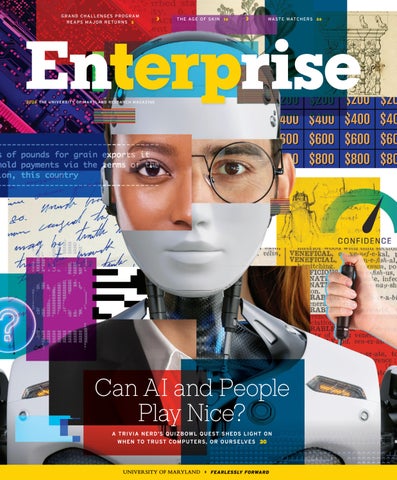
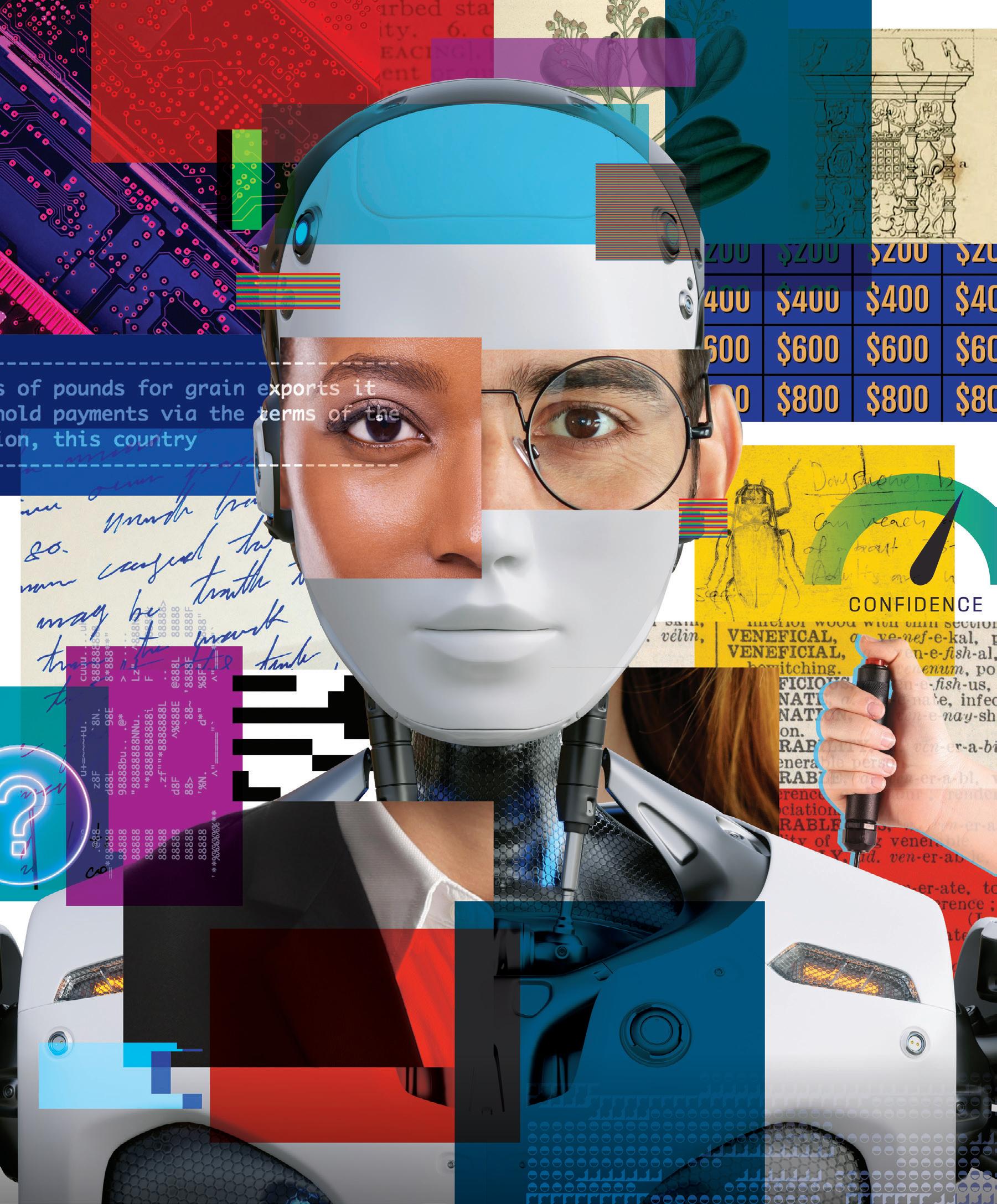
A central theme of this issue is collaboration—across disciplines, institutions and, increasingly, between humans and technology. Our cover story follows computer scientist Jordan Boyd-Graber, a self-described trivia enthusiast and former “Jeopardy!” contestant who is exploring a profound question through quizbowl-style competitions with students: Can people and AI systems work together to solve complex problems more effectively than either could alone?
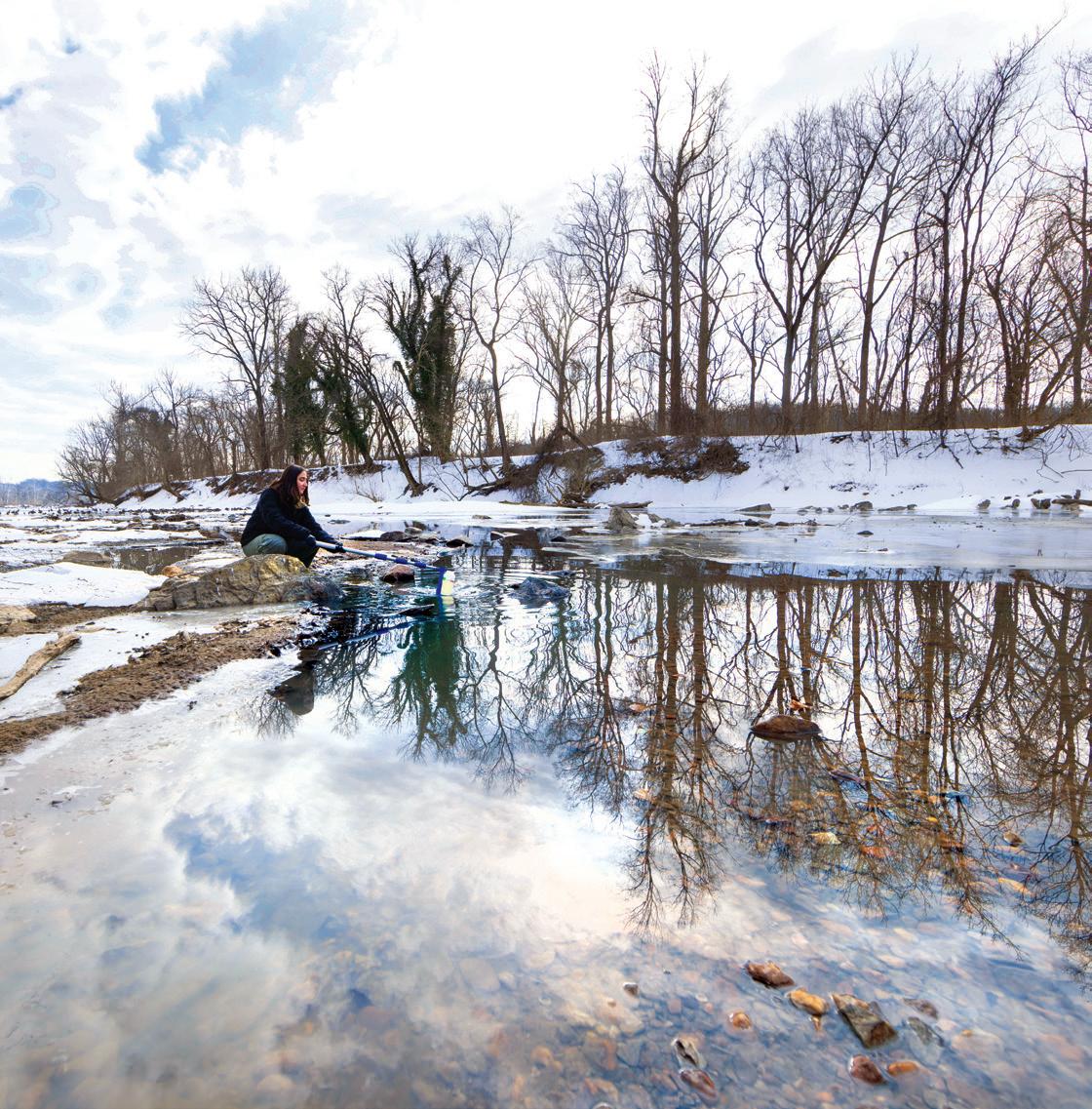
We also spotlight the Water Emergency Team (WET), which brings researchers into the field when water infrastructure failures threaten public health. From Baltimore homes contaminated by bacteria after sewer overflows to a major sewage pipe rupture that spilled into the Potomac River, WET scientists and their students are studying these incidents in real time to better understand risks and inform solutions.
The WET project emerged from the university’s Grand Challenges Grants Program, introduced three years ago to spark bold, cross-disciplinary research. That initiative is now entering its next phase with new funding to accelerate transformative ideas. In these pages, you’ll learn more about what comes next for the program—and find an update on Maryland’s Capital of Quantum initiative one year after its landmark launch.
Together, these stories highlight the creativity, dedication and real-world impact that distinguish the University of Maryland as a leading public research institution. I hope you find them as insightful and inspiring as I do.
Go Terps!
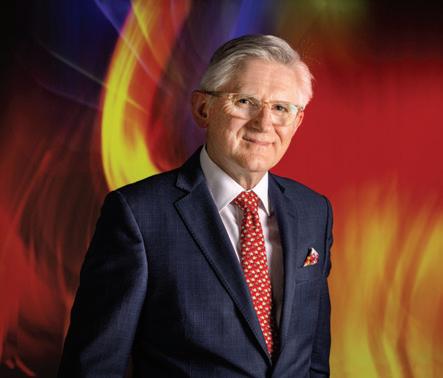
Patrick O’Shea
Vice President and Chief Research Officer University of Maryland
President
DARRYLL J. PINES
Publishers
PATRICK O’SHEA
Vice President for Research
ANNE BUCKLEY
Vice President for Marketing and Communications
Advisers
MARGARET HALL
Executive Director, Creative Strategies
SARA GAVIN Director, Research Communications
Magazine Staff
LAUREN BROWN University Editor
CHRIS CARROLL Managing Editor
JOHN T. CONSOLI ’86 Creative Director
VALERIE MORGAN Art Director
JAGU CORNISH Production Manager
BAILEY BEDFORD
DANIELA BENITES
KATIE BEMB
KELLY E. BLAKE
KIMBRA CUTLIP
GINA DRISCOLL
ALLISON EATOUGH ’97
RACHAEL GRAHAME ’17
CARRIE HANDWERKER
ROBERT HERSCHBACH
GEORGIA JIANG
ANNIE KRAKOWER
WYNNE PARRY
LIYA TADESSE
FID THOMPSON
JOHN TUCKER
TOM VENTSIAS
SAMUEL MALEDE ZEWDU
Writers
STEPHANIE S. CORDLE Photographer
JANNA SINGER-BAEFSKY Digital Asset Manager/Archivist
DYLAN SINGLETON ’13 Photography Assistant
EMAIL enterprisemag@umd.edu
NEWS today.umd.edu
RESEARCH research.umd.edu
FACEBOOK.COM / UnivofMaryland X x.com/umdresearch
YOUTUBE.COM / @UofMaryland
The University of Maryland, College Park is an equal opportunity institution with respect to both education and employment. University policies, programs and activities are in conformance with pertinent federal and state laws and regulations on non-discrimination regarding race, color, religion, age, national origin, political affiliation, gender, sexual orientation or disability.
COVER
Photo collage by Valerie Morgan Images via Unsplash, iStock and Wikimedia Commons
2 Grand Challenges Grants Program Reaps Major Returns
3 UMD Partnerships Build Capital of Quantum
4 Lifesaving Robots, AI to the Rescue
5 The Art and Science of AI-Generated Iceberg Models
5 Journalism Center Creates AI Tools to Aid Newsgathering
6 Opening the Door on a “Quantum Refrigerator”
7 Rot Race
7 Thumbs Up for Solo Reviewers
8 Super Mario’s New Job: AI Driving Instructor
9 Marine Microbes Will Power Ocean Monitoring Devices
9 Scholars Tally Cyberattack Risk Across All 50 States
10 Portrait of an Atom
10 UMD Rises in Prominent Rankings
11 NSF Funding Fuels AI Approach to Fighting Wildland Fires
11 “Murderous Verbs” and a Movie Mayhem Surge
12 AI Goes to School for Math-Instruction Study
12 You Changed Docs—Why Didn’t Your Medical Records?
13 UMD-Built System Provides Near-Real Time Tracking of Global Land Cover Changes
13 NIA Award Establishes 2 AgingFocused Centers
14 The Age of Skin
A “Key” Step Toward Safer Surgeries Worldwide
// Can AI and People Play Nice? A Trivia Nerd’s Quizbowl Quest Sheds Light on When to Trust Computers, or Ourselves 26 // Waste Watchers
UMD Researchers Wade Into Homeowners’ Sewage Spills and Brave Failing Public Infrastructure to Track Health Risks
Grand Challenges Grants Program Reaps Major Returns
UMD Researchers to Tackle New Set of Societal Issues in Initiative’s Next Phase
ATRANSFORMATIVE INITIATIVE to accelerate solutions to the world’s most pressing issues is taking its next step.
In 2023, UMD awarded $30 million to research teams and individual investigators through the Grand Challenges Grants Program. Working in local communities and around the globe, they are tackling a range of vital topics including global health, ethical and trustworthy technology, and pandemic preparedness.
That investment is paying off in life-enhancing results for our nation, state and world. It has also brought in a surge of external research funding that so far has nearly doubled the initial expen-
diture, boosting the resilience of UMD’s research enterprise and allowing projects to continue producing meaningful results. Among them:
The scientists of the Climate Resilience Network are working with state and federal agencies to protect Marylanders and their livelihoods as weather grows more volatile. The team oversees Mesonet, a statewide weather tower network that warns of approaching storms and provides climate data to farmers, and it developed the Hydronet sensor system to monitor coastal flooding.
Researchers with the Global FEWture Alliance apply multidisciplinary expertise to health and environmental challenges at the food-energy-water (FEW) nexus from Baltimore neighborhoods to Nepal and Tanzania. Projects include harvesting rainwater for urban agriculture, energyefficient water treatment methods and converting landfill waste into clean energy—scalable solutions to build healthier, more sustainable communities.
Maryland Initiative for Literacy and Equity researchers conducted a comprehensive review of literacy instruction in all 24 Maryland public school districts. Now they are working with educators around the state to implement their recommendations to help every student read and write proficiently.
UMD is upping the ante on doing good for humanity with the Grand Challenges Grants Program 2.0, launched in January. The university will soon announce funding for up to 10 new institutional and team projects encompassing education, research, scholarship, creative activities and service.
The multidisciplinary projects will connect scientists and scholars from across the UMD campus and beyond, encouraging more of the cross-cutting, creative problem-solving established with the initial grants.
“We have been tremendously impressed and inspired by the bold ideas and solutions that resulted from the first round of Grand Challenges Grants and can’t wait to see how the proposals generated for version 2.0 continue to move our campus, state, nation and world fearlessly forward,” Senior Vice President and Provost Jennifer King Rice and Vice President for Research Patrick O’Shea said in the announcement of the new grants.
By the Numbers
50 projects 450 partnerships $30M UMD investment $55M in additional external funding secured 100% Maryland counties benefited
6,500 students involved 94% of projects have provided experiential learning opportunities 63K stakeholders engaged






UMD Partnerships Build Capital of Quantum
State, Federal Government and Industry Align in Advanced Research, Innovation
MAJOR RESEARCH, workforce and commercialization partnerships are accelerating the University Maryland’s rise as a global quantum leader following the state’s January 2025 launch of the Capital of Quantum initiative.
In April 2025, UMD and the Defense Advanced Research Projects Agency (DARPA) established the Capital Quantum Benchmarking Hub at UMD’s Applied Research Laboratory for Intelligence and Security (ARLIS) in UMD’s Discovery District. Backed by matching contributions of up to $100 million each from DARPA and the state over four years, the hub will help test and evaluate quantum computing prototypes for national security and commercial uses, positioning Maryland at the center of the race to build a useful, fault-tolerant quantum computer.
The same month, ARLIS launched the Maryland Institute for Quantum
Applications, a center aimed at assessing the potential of commercial quantum applications to advance U.S. national security in coming decades.
Momentum continued in September, when Gov. Wes Moore announced that Microsoft will open a major quantum research center in the Discovery District. The new lab will give government, academic and industry partners early access to Microsoft quantum technology, deepen collaboration with UMD students and researchers, and add to a rapidly growing cluster of startups and institutions in the region.
“This is a landmark moment for the University of Maryland and for the entire state,” says UMD President Darryll J. Pines. “It reflects years of world-class research, visionary investment and bold collaboration that together have made Maryland and the greater D.C. region the true Capital of Quantum.”
A National Bureau of Economic Research study released in June underscored the strength behind this growth, ranking UMD among the nation’s top five producers of doctorates in quantum science and four other critical technology areas tied to national security and innovation.
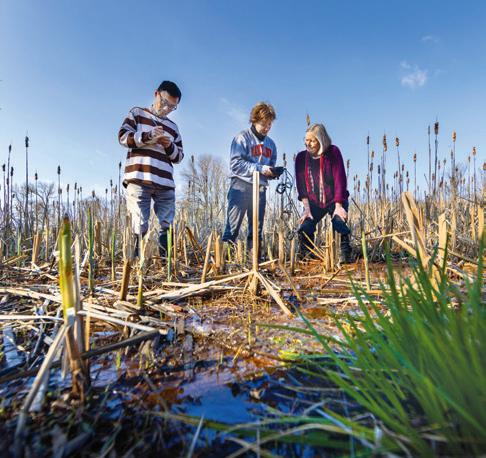
Geology researchers affiliated with the Climate Resilience Network, funded by a Grand Challenges Institutional Grant, measure groundwater quality at the University of Maryland Golf Course.
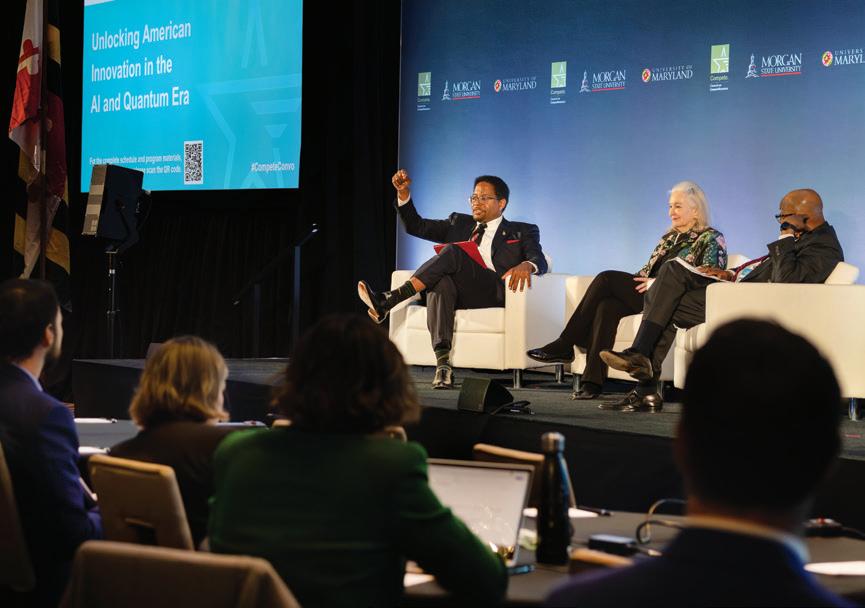
UMD President Darryll J. Pines (center) discusses the future of quantum and AI research at a Council on Competitiveness event held at the university in March 2026.
Lifesaving Robots, AI to the Rescue
UMD Engineers Develop Systems to Speed Care in Mass Casualties
ROBOSCOUT, THE UNIVERSITY OF MARYLAND’S entry in a competition run by the Defense Advanced Research Projects Agency (DARPA), would rapidly survey and assess injuries at sites of disasters or violence, helping first responders prioritize medical care. The project, while in its early stages, takes an ambitious step toward autonomous systems to help as many people as possible survive such events.–WP
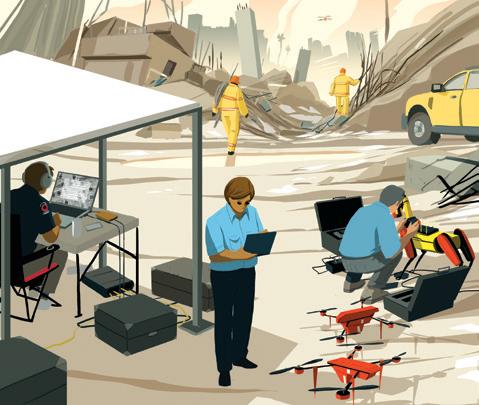
ARRIVAL
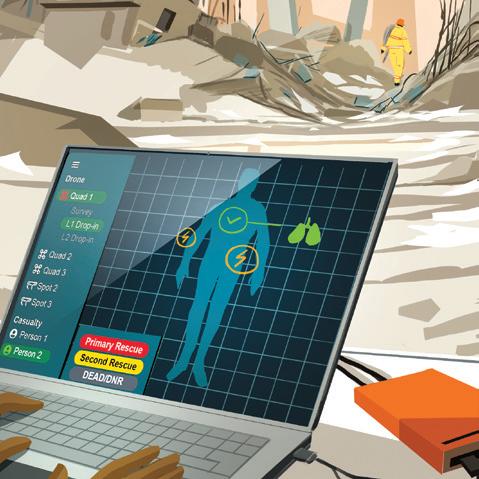
At the site of disaster or violence, medical personnel set up the RoboScout system: drones custom-built by A. James Clark School of Engineering faculty and students, robot “dogs” and a base station that runs sophisticated AI models.
INITIAL SURVEY
The operator launches drones equipped with visible light and infrared (or thermal) cameras. The location of each person they identify appears on a map on the base station’s monitor.

CLOSER LOOK
The drones hover closer, and sensors collect essential health data on bleeding, traumatic injury and difficulty breathing for analysis by one of the base station’s AI models.
ON THE GROUND
Robot dogs are dispatched to those injured to collect more information using cameras and radar sensors. Using large language models, AI systems like those that power chatbots, the dogs reassure victims while gathering further information.
REPORT
The inference engine weighs observations from the drones and dogs to assess each person’s injuries to prioritize those most in need of care. “We’re trying to recapture the performance of a human medic assessing injuries, and scale it to situations that are dangerous or where there
aren’t enough medics to look at everybody in the first 10 minutes,” says Willis H. Young Jr. Professor of Aerospace Engineering Education Derek Paley, director of the Maryland Robotics Center and RoboScout’s team leader.

The Art and Science of AI-Generated Iceberg Models
Researchers’ 3D Renderings Could Help Sailors Navigate Arctic Waters
CY KEENER COULD SEE only the tip of the iceberg.
For years the University of Maryland associate professor of art had voyaged to the Arctic to gather data for his digital artwork about melting sea ice and shifting icebergs, collected using drones and computer software. But his
visual interpretations captured just what was above the surface.
Keener, whose background includes some engineering, longed to create renderings from top to base that would be more than eye-catching or thought-provoking; they could also help scientists predict the path of icebergs, and mariners navigate ice-choked waters more safely.
In June, with funding from a grant from the Artificial Intelligence Interdisciplinary Institute at Maryland (AIM), he sailed to an iceberg in Greenland to capture underwater images using an instrument he designed that was equipped with sonar technology developed by computer science
Journalism Center Creates
AI Tools to Aid Newsgathering
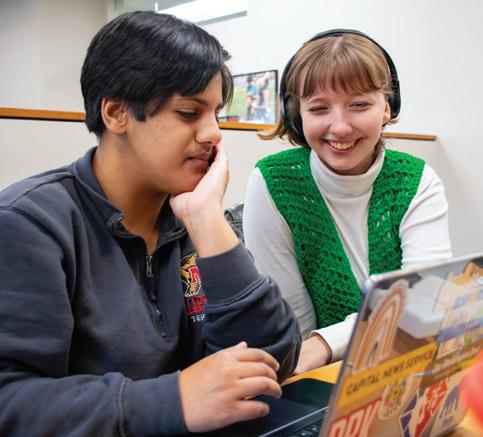
A $1 MILLION GRANT from the Scripps Howard Foundation will help empower UMD’s Howard Center for Investigative Journalism to build, test and pilot several artificial intelligence (AI) applications to support local news.
UMD’s Howard Center in the Philip Merrill College of Journalism, launched in 2019 and funded by the foundation, trains investigative reporters by producing major investigative projects in partnership with faculty and staff and news organizations across the U.S.
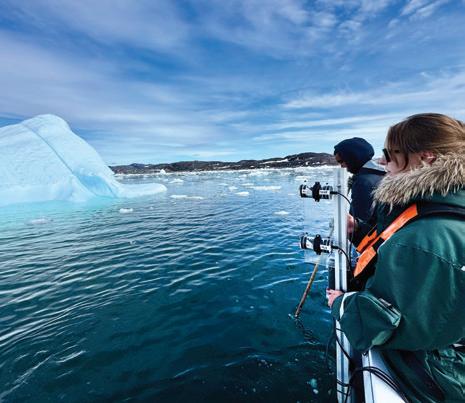
Assistant Professor Christopher Metzler. The research team wired the pole to a laptop, hung it over the hull and plunged it into the water, where it soon began providing clear imagery.
Metzler’s team used artificial intelligence to stitch together the data, showing the ice in 3D The process, called inverse differential rendering, will rely on an algorithm that fills in visual gaps between images that were gathered in intervals, animating details as fine as a ripple in the water.
Keener says the project helps tackle “a really important scientific problem and a really beautiful art problem,” which he plans to explore in an eventual exhibit. JT
Merrill College will develop AI tools that will, among other things, help local news organizations assess their archives to examine how topics have been covered in the past, boost efficiency for reporters in tasks like transcription and summarization of interviews, and monitor public meetings to notify journalists about newsworthy events and provide summaries.
“Our students and faculty will help local newsrooms implement tools that will transform journalism and journalism operations, while also reimagining journalism education,” says Merrill College Dean Rafael Lorente. “Like other revolutionary technologies, we can make choices about how we use AI.”
Researchers deploy a system that helped fill in underwater details of a Greenland iceberg (left).

Opening the Door on a “Quantum Refrigerator”
Novel Technology Ices Down Quantum Processors to Keep Next-Gen Computers Error-Free
JUST AS STRAY CHALK MARKS on a blackboard might make a 1 look like a 7, the units of information in a superconducting quantum processor are notoriously sensitive to errors from heat and radiation. Now a UMD researcher is helping to address one of the main issues confronting quantum computing: how to keep these “qubits” free of errors and ready to perform calculations.
Erasing qubits after a calculation involves cooling them to a fraction of a degree above absolute zero and then keeping them there. The team’s new method is more effective as an eraser than
other state-of-the-art methods because of the lower temperatures it achieves, and works in a novel way—by powering the eraser with the heat that flows between two parts of this “quantum refrigerator.”
The technique “shows that we can siphon heat from one part of the computer’s refrigerator and convert the heat into work,” says Nicole Yunger Halpern, a National Institute of Standards and Technology physicist and fellow in UMD’s Joint Center for Quantum Information and Computer Science. “It could introduce technological capabilities we haven’t even thought of yet.” She was a co-author of a team study on the discovery published in January 2025 in Nature Physics.
The team’s fridge uses two additional quantum bits, or qubits, as its components. One, which would be connected to a warmer part of the computer, would serve as the energy supply. The second would serve as a heat sink into which a third computational qubit’s undesired extra heat could flow. In a quantum computer, if the computational qubit—the chalkboard—got too warm, the fridge’s first qubit would pump the heat into the heat sink, returning the computational qubit to nearly its “ground state” of absolute zero and erasing the board.—BB
Rot Race
Researchers Help State’s Growers Save Vines, Fruit
THE NUMBER OF WINERIES in Maryland has grown eightfold since the 2000s, generating billions of dollars in the state. But unlike the dry, temperate traditional wine regions of California or Italy, our area’s warm, wet summers invite fungi to thrive.
If just 5% of a grape bunch is rotting, the product can be ruined, pressuring growers to apply fungicide liberally throughout the six-month growing season despite high costs, potential environmental threats and health risks.
Associate Professor Mengjun Hu, a plant pathologist who assists growers through the University of Maryland Extension, discovered a way to cut fungicide use while protecting quality. After culling diseased grapes from more than 20 regional vineyards, he and his team identified the pathogen responsible for most decay while identifying the “control window” for blight.

Thumbs Up for Solo Reviewers
Study: Doing Something Alone Earns Extra Trust
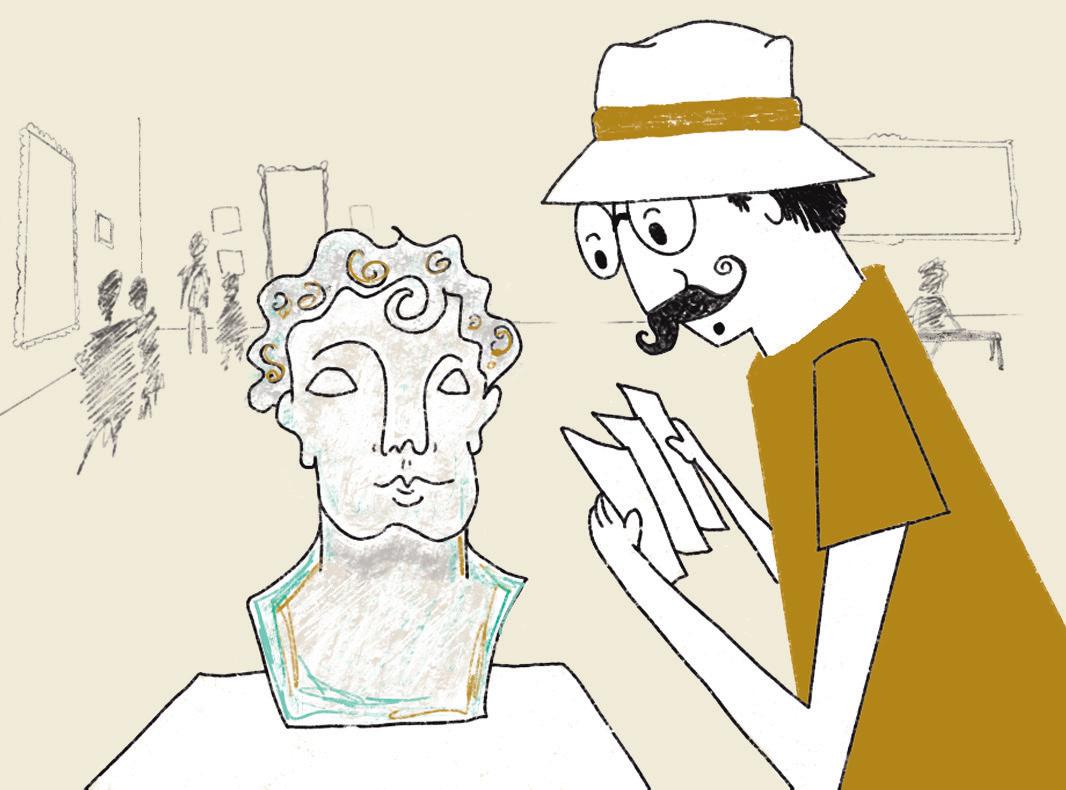
THE MOST TRUSTED REVIEWERS of a leisure experience— like a visit to an art gallery, museum, movie theater or zoo—are people who go it alone.
“People think that someone who does stuff alone must really be interested in or knowledgeable about that activity,” says Rebecca Ratner, Dean’s Professor of Marketing, who published a paper on the finding in the Journal of Marketing Research in August. But going with a friend might just mean they wanted to do something outside together on a nice day.
Ratner for a decade has studied people’s reluctance to do activities alone, finding that they often enjoy themselves more than they expected. For this study, she and co-author Yuechen Wu Ph.D. ’19, an assistant professor at Oklahoma State, examined reviews from Tripadvisor that revealed if reviewers were alone or with others.
“For this type of rot, the crop isn’t vulnerable in the early season, so application then is unnecessary and ineffective,” says Hu. Growers adopting his recommendation saw significant boosts in fruit quality.
He and his team also developed a mathematical model that predicts disease based on weather data, along with growth stage, which the Maryland Grape Growers Association incorporated into a digital tool for members. Those using the model can expect to reduce fungicides by at least 30%, says Hu.– JT

Other Tripadvisor users gave more “likes” (by clicking a thumbs-up button) to reviews and recommendations from people who did something alone—results they validated through lab experiments.
Ratner hopes more people take a cue from other solo consumers: “Don’t let it stop you if you don’t happen to have a friend or a partner or a child to go with you that day. Live your life and do the things that you think would be fun.”– CH


Super Mario’s New Job: AI Driving Instructor
Engineers Steer Classic Game Toward Autonomous Vehicle Certification

IN THE REAL WORLD, Super Mario’s serial crashes and decades of aggressive “kart” driving would get his license suspended faster than an approaching Bullet Bill. But in the realm of artificial intelligence (AI), UMD engineering researchers use the video game character as a model for responsible driving—one that could someday help keep autonomous cars safe.
Funded by the U.S. Naval Air Warfare Center Aircraft Division, the researchers are training computers to “play” Mario Kart—circling the track as fast as possible while


hewing to laws of physics and avoiding risk. In a study published in May 2025 in IEEE Xplore, they demonstrated how Mario Kart can be used to teach an autonomous simulator to avoid collisions through an AI technique called deep reinforcement learning.
Aerospace engineering Associate Professor Mumu Xu, an expert on federal safety certification for planes and cars, leads the project. A few years ago, she noticed a disconnect between long-established safety norms and the diverse algorithms applied to autonomous systems, making it almost impossible for engineers to track autonomous decision-making.
Traditional vehicles have well-established processes for federal inspection, Xu says, “but with AI, all the old mathematics we use to show that a system is safe no longer hold because no one knows what’s under the hood.”
Eventually, the UMD team hopes to provide regulators with a roadmap to certifying AI technologies in the autonomous vehicles increasingly popping up around the world. JT









Marine Microbes Will Power Ocean Monitoring Devices
$7.8M DARPA Grant Aims to ”Cut the Cord” at Sea With Advanced Fuel Cells
AUMD-LED RESEARCH TEAM aims to create a biologically fueled energy source to power research and sensing devices throughout the world’s oceans, supported by a $7.8 million award from the Defense Advanced Research Projects Agency (DARPA).
Environmental science and technology Professor Stephanie Lansing leads the collaborative effort aiming to bypass batteries and ship- or shore-based power cables by using microorganisms to output up to 10 watts consistently for a year or more.
The system could power a vast array of ocean sensing devices that provide critical information for understanding marine environments, monitoring climate change and maintaining national security.
“This unique collaboration of interdisci-
Scholars Tally Cyberattack Risk Across All 50 States
ONE DAY IN MID-2024, Russian-affiliated hackers breached city networks in Columbus, Ohio, pirating names, Social Security numbers and other private data. When the city didn’t pay a nearly $2 million ransom demand, the stolen data surfaced on the dark web.

plinary experts will produce a bioinspired system that has game-changing potential to provide direct electric power to improve sensing capabilities while protecting and limiting the impact to the environment,” Lansing says.
The Persistent Oceanographic Device Power system will collect and concentrate ocean microbes and bits of organic matter in a special fermentation chamber.
The episode reflects a modern reality: Local governments are common victims of cyberattack, but state- and national-level policymakers are often unaware of the collective risk.
UMD research published in January 2025 in the Journal of Cybersecurity fills in the gaps, measuring vulnerability for every U.S. county government—3,065 in all, finding heightened risk in California, Virginia and Florida, with the Southeast the most threatened region.
“This is a big issue, and we’re putting real,
Bacteria in the chamber will pre-digest the material, producing “food” for a second kind of bacteria that colonizes the fuel cell electrodes and releases electricity.
The first phase of the project will run through summer 2026 and includes collaborators from eight other universities and firms. If approved, a $3.4 million second phase will be deployed in various settings.—KC
holistic numbers around risk level posed by cybercriminals to critical infrastructure,” says Associate Research Professor Charles Harry of the School of Public Policy, who wrote the paper with College of Information Assistant Professor Ido Sivan-Sevilla and Mark McDermott of UMD’s Center for the Governance of Technology and Systems. The UMD findings—visualized with state and regional “heat maps”—can help state and federal authorities step in to provide extra help where needed. “County governments are neglected when it comes to cybersecurity—it’s a black box,” says Sivan-Sevilla.– JT

Portrait of an Atom
Scientist Lauded for Imaging Breakthrough
A UMD ADVANCE in electron microscopy was included among Physics World’s Top 10 break-throughs in 2025. The honor recognizes the most important worldwide discoveries that propel scientific progress or lead to real-world
applications in fields including astronomy, antimatter, and atomic and molecular physics.
Yichao Zhang, an assistant professor in the Department of Materials Science and Engineering, served as the lead author of a paper published in July in Science that reported the highest-resolution image ever captured of a single atom.
Her advance was achieved using a technique known as “electron ptychography,” which reached a resolution of 15 picometers—about 10 times smaller than the size of a typical atom. This enabled researchers for the first time
to directly visualize “moiré phasons,” which are ultralow-frequency collective vibrations that arise when two atom-thin sheets are stacked and slightly rotated. By shaping how these materials conduct electricity and heat, moiré phasons are critical to next-generation quantum and electronic devices.
“Being recognized by Physics World is an incredible honor,” says Zhang. “This technique goes beyond atomic-resolution imaging, and has revealed a hidden branch of physics once thought impossible to observe.” DB
UMD Rises in Prominent Rankings
The University of Maryland’s research enterprise jumped four spots (to No. 14) in the National Science Foundation’s annual measure of research and development activity, while the university climbed to No. 16 among public schools—its best showing ever, according to U.S. News & World Report.
NSF Funding Fuels AI Approach to Fighting Wildland Fires
$1.86M Project
Aims to Develop Tools for Detection and Forecasting
WILDFIRE ACTIVITY ACROSS the United States has approximately doubled over two decades, but predicting where and when the blazes will spread to threaten communities, wildlife and natural resources remains a challenge.
Brendan Iribe Endowed Professor in Computer Science Heng Huang is leading a project to provide this critical heads-up using the power of artificial intelligence, supported by a recent $1.86 million National Science Foundation award.
The collaboration with American University researchers aims to address the extreme complexity of fire dynamics, which has limited the ability of traditional computer modeling approaches to forecast events.
Huang and his team will develop largescale AI and machine learning algorithms capable of digesting the diverse sources
of geoscientific data, including satellite observations, atmospheric records, fuel information and historical fire data. The goal is a framework that boosts detection accuracy and forecasting capabilities while remaining usable in real-world conditions, where data is often incomplete.
The project includes development of an open-source, integrated dataset to share with the broader research community; meanwhile, partnering with NASA, the U.S. Forest Service and the National Park Service will help ensure that the tools align with operational needs for fire tracking and management.
“By accurately forecasting wildland fire events and implementing preparedness and mitigation strategies in advance, societies can better shield themselves against the devastating impacts of such disasters,” says Huang.– SMZ









“Murderous Verbs” and a Movie Mayhem Surge
UMD-led Study Shows Rising Violence Across Film Genres
WHILE THE U.S. HOMICIDE RATE has fallen far from that of a half-century ago, you wouldn’t know it from the movies. Silver screen violence has soared, according to a study that analyzed a 50-year database of film dialogue.
Researchers at the University of Maryland, the Ohio State University, Penn State University and Iran’s Institute for Research in Fundamental Sciences used machine learning to search subtitles of 166,534 English-language movies produced from 1970 to 2020. They calculated the amount of dialogue from characters using variations of the words “murder” or “kill” in each of the films.
There was a clear increasing trend over the five-decade period—not just in crime thrillers, but across genres—according to the study in the March 2025 issue of the journal JAMA Pediatrics
“This is more evidence that violence is a bigger part of the movies we watch than ever before,” says lead author Babak Fotouhi, an adjunct assistant research professor in the College of Information.
Film violence surged despite what the researchers called “ample scientific evidence” that media violence can influence aggressive behavior and mental health, including reducing empathy and fostering the “mean world syndrome”—seeing the world as a vicious, unforgiving place.
AI Goes to School for Math-Instruction Study
Researchers to Create Database of A+ Classroom Teaching
INSIDE THE MIDDLE SCHOOL CLASSROOM, a video camera swivels on its tripod while five microphones capture clues to the age-old question: How do you teach math to kids?
This lesson and thousands like it across the country will be fed into an artificial intelligence (AI) program trained to spot instances of student engagement and the teaching practices that elicit it.
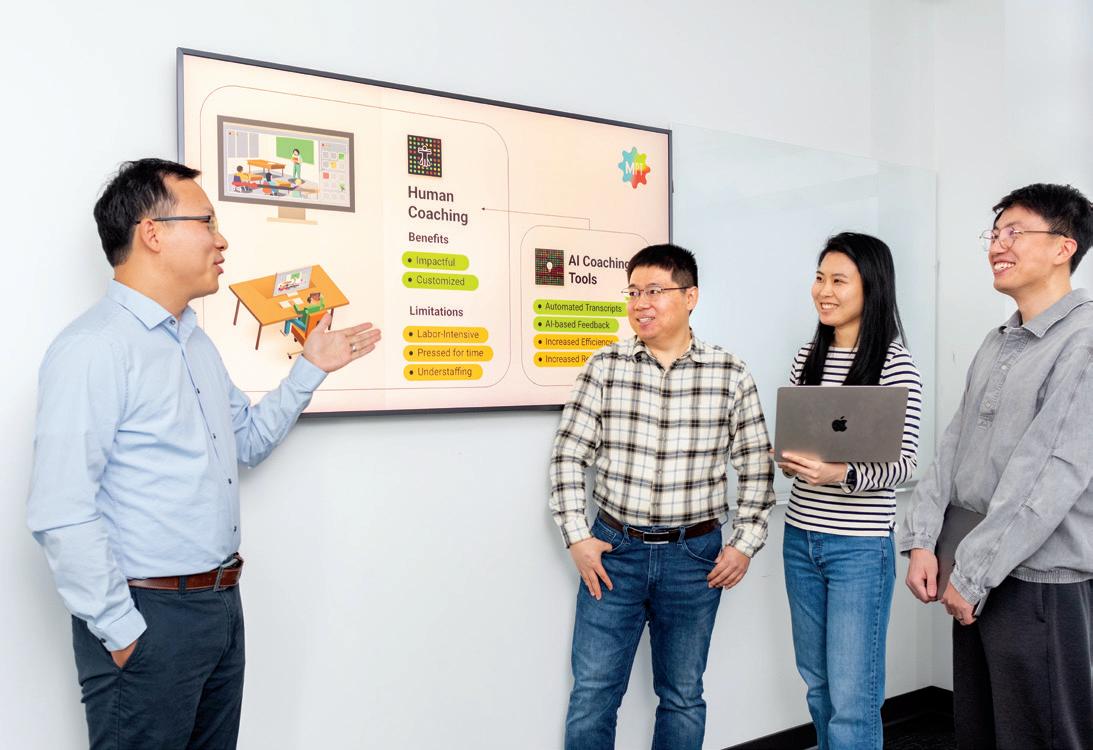
It’s the first phase of a project, funded by a $4.5 million grant from the Gates Foundation/Walton Family Foundation and led by UMD’s Center for Educational Data Science and Innovation (EDSI) to create a massive database arming scholars and ed-tech companies with real-world classroom data to mine for best practices.
Elementary- and middle-school math scores have tumbled from pre-COVID levels, widening the gap between high
and low achievers as other countries leapfrog the United States in international rankings.
The three-year UMD effort, initially supported by a Grand Challenges Team Project Grant, blends AI with roll-upyour-sleeves rigor. The recordings will be made anonymous, then turned into transcripts that educators will scour to flag examples of quality instruction. Those annotations will get fed into EDSI’s MPowering Teachers program and other AI systems to support effective instruction.
“There might be teaching aspects we didn’t know of that are really important for learning,” says the study’s lead researcher, education policy Associate Professor and EDSI Director Jing Liu. “The data open up this possibility.”—JT
You Changed Docs— Why Didn’t Your Medical Records?
WHETHER IT INVOLVES A STACK of paper or yet another internet portal, cue the déjà vu while answering the same medical history questions for your latest doctor. Beyond the time suck, what does starting every medical relationship as a blank slate mean for your health?
With support from a $1.4 million National Institutes of Health grant, Nate Apathy, assistant professor of health policy and management at UMD, is working with A. Jay Holmgren of the University of California, San Francisco School of Medicine to find out.
They’re using machine learning and artificial intelligence tools to examine patients’ electronic health records and determine how doctors’ decision-making is shaped by seeing only limited data, or a broader selection of “outside data” transferred from other medical offices—and ultimately, how that affects patients.
“When health data travels seamlessly between institutions, there is immense promise to drive down health care costs and reduce health care use and duplicative paperwork, all of which can improve patient health and satisfaction,” says Apathy, a researcher at the University of Maryland Institute for Health Computing.
“We hope this research and the open-source tools we will create from it will contribute to improved decision-making and health outcomes.” FT

UMD-Built System Provides Near-Real Time Tracking of Global Land Cover Changes
SCIENTISTS WORLDWIDE CAN NOW receive updates about the how the Earth’s surface is
changing more quickly than ever before, thanks to a new satellite-based monitoring system created and operated by University of Maryland researchers.
The system, known as the OPERA Land Surface Disturbance Alert (DIST-ALERT), was introduced in October in Nature Communications. It is the first to track lands that are being changed by various causes, human activity, weather events
NIA Award Establishes 2 AgingFocused Centers
Researchers Will Study Resiliency, Health Issues of Older Americans
THE NATIONAL INSTITUTE ON AGING (NIA) awarded grants totaling up to $5.23 million over six years to launch a pair of University of Maryland-led centers that aim to improve the health of older Americans, at a time when their average age is at an all-time high.
The two centers, with research that spans fields including public policy, public health, sociology, economics, psychology, nursing, gerontology, engineering and more, aim to strengthen the university’s reputation as a
national hub for interdisciplinary research, training and real-world innovation in the field of aging.
In the School of Public Health (SPH), principal investigator Jie Chen, professor and chair of the Department of Health Policy and Management, was awarded $2.59 million to establish the Center for Seniors Uniting Nationwide to Support Health, Integrated care, and Economics, or Center for SUNSHINE
Including 10 UMD academic units and co-led by researchers from SPH and the University of Maryland, Baltimore’s School of Medicine, the center draws
and fires in a truly global manner.
Previously, only particular areas were closely monitored for changes to their land cover—such as near the equator, where rainforests are concentrated—and only for specific types of changes, like forest loss or fire.
DIST-ALERT also produces this information more quickly than other monitoring systems. Most utilize imagery from one satellite system, but DIST-ALERT leverages data from both Landsat 8/9 and Sentinel-2A/B/C, totaling five satellites. Since it takes several days for a single satellite to revisit an area once it has passed over, DISTALERT’s use of five satellites can shorten these intervals to as little as one day.
“With more observations we get more opportunities to get a cloud-free observation, and each observation can matter so much, particularly in cloudy areas,” says Amy Pickens, an assistant research professor in the Department of Geographical Sciences who leads DIST-ALERT. RG
from 50 years of scholarship at UMD’s Center on Aging and the computational innovation and clinical partnerships enabled by the University of Maryland Institute for Health Computing.
UMD is also the lead institution for the new Southern Population Aging Research Center, supported by a $2.65 million NIA award.
School of Public Policy
Professor Katrina Walsemann, Roger C. Lipitz Distinguished Chair in Health Policy, serves as contact principal investigator, co-directing the center with researchers at the University of Alabama at Birmingham and the University of Maryland, Baltimore County.— FT, GD
The Age of Skin
Researcher’s Study of Disease That Fatally Ages Children Leads to a Discovery That Could Help Us All Look Younger
WHOEVER SAID “TIME MAY be a great healer, but it’s a lousy beautician” would be stunned by a skin care aisle today. Softcheeked preteens snatch up anti-wrinkle products, spawning the hashtag #SephoraKids. “Skinfluencers” hawk $120 peel pads and $325 lotions, while TikTok filters transform timeworn faces into eerily realistic teenage versions.
For a generation raised on selfies and Zoom, the pursuit of youthful skin has never felt so extreme, or so accepted. Headlines announce that Gen Z already fears looking old, and the global skin care industry is
projected to balloon to nearly $200 billion by 2032.
We can’t stop aging, and perhaps miracle serums based on dubious claims are inevitable too. But as technology has advanced, science-backed companies have also emerged. One is Mblue Labs, founded in 2018 at the University of Maryland, with products featuring a 150-year-old antioxidant that penetrates skin and extends cellular life, appearing to slow signs of aging. The U.S. Chamber of Commerce in 2024 named Mblue one of America’s top 100 small businesses, praising its “rigorous scientific research.”
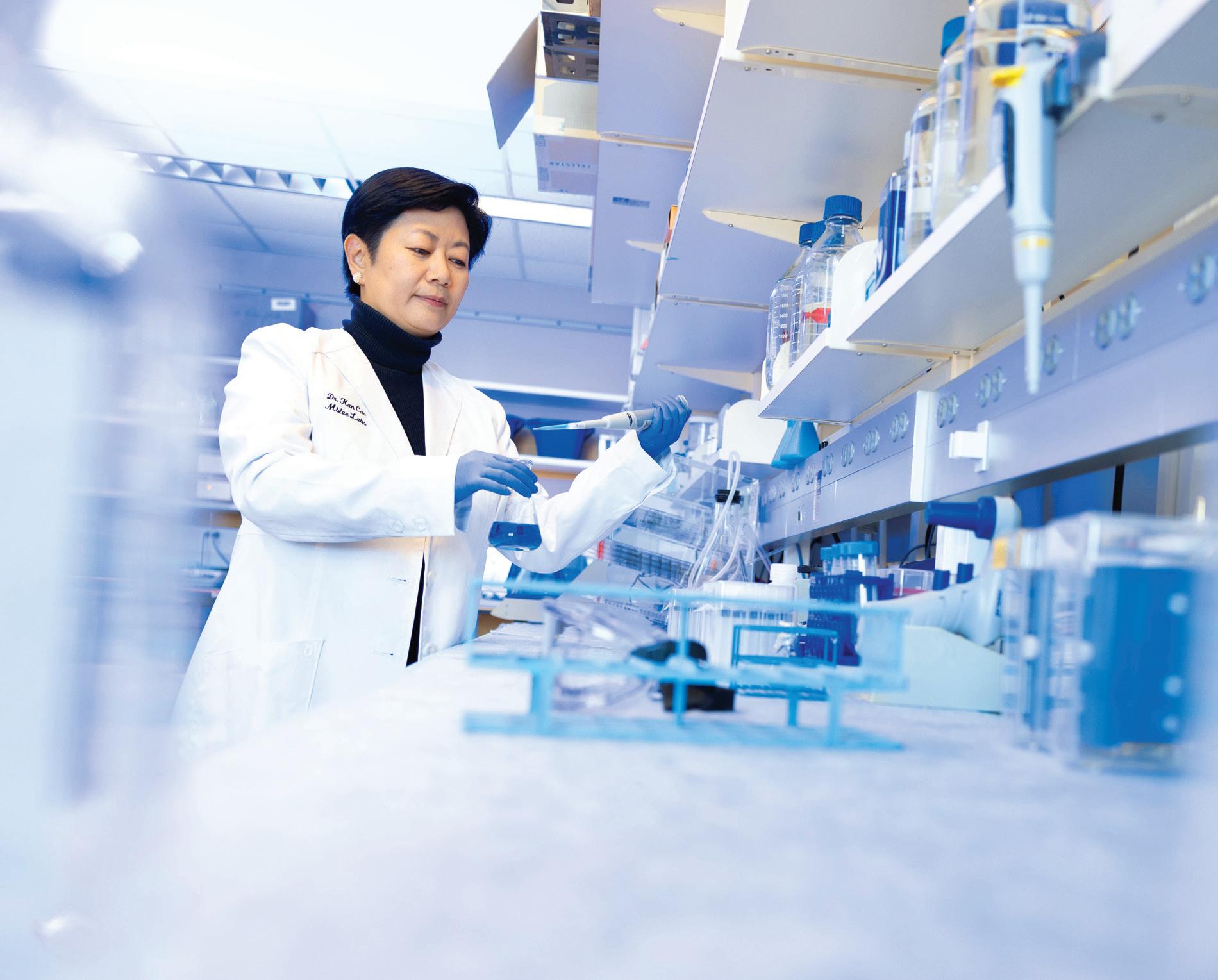
Behind the science is Kan Cao, a professor of cell biology and molecular genetics at UMD. Since first using the chemical methylene blue to turbocharge a skin cell in a petri dish, Cao has become a national authority on skin aging. But she wasn’t trying to help 50-year-olds look 30. She was trying to save teenagers born with a rare genetic disease from dying.
Hutchinson-Gilford progeria syndrome— “prematurely old” in ancient Greek—causes children to develop veiny, wrinkled skin, fragile joints, hardened arteries and hair

loss. The average child with progeria dies at 14, usually from heart attack or stroke. Only about 400 cases are known worldwide.
For decades, the disease drew little attention, until the Progeria Research Foundation formed in 1999 and arranged to donate patients’ skin cells to science. That caught the eye of Francis Collins, then director of the National Institutes of Health, who led the team that mapped the human genome. Collins’ lab identified the genetic mutation behind progeria—a single DNA “typo” that produces a toxic protein. To help answer remaining questions, Collins hired a young cell biologist: Kan Cao.
Growing up in Zhenjiang, China, Cao became fascinated with the mechanisms of life watching her grandfather, a traditional Chinese medicine doctor, mix remedies to control bleeding or blood pressure. After earning her doctorate at Johns Hopkins, she joined Collins’ lab in 2005 and quickly made discoveries in studies both “exquisitely designed and beautifully conducted,” Collins says. She showed that progeria cells don’t divide cleanly, and that trace amounts of the progeria protein appear even in healthy people, hinting at links to normal aging.
By the time she arrived at UMD in 2010, Cao was a global leader in the field, though critics questioned her devotion to such a tiny population. Securing grant funding was challenging. Still, she says, “I had no doubts about my career choices. Never.”
While most progeria research focused on
I had no doubts about my career choices. Never.
—Kan Cao
Professor, Department of Cell Biology and Molecular Genetics
cell nuclei, where the toxic protein resides, Cao turned to the mitochondria, the power plants for cells. Under her microscope, healthy mitochondria looked long and folded; progeria-warped ones were short and swollen. So she tried methylene blue, a known mitochondrial catalyzer. Two weeks later, the progeria cells looked dramatically healthier—their deformed nuclei restored to smooth spheres. She also noticed that normal skin cells treated with methylene blue produced more energy and lived longer.
Her lab found that the vivid cerulean chemical, developed in the 19th century as a malaria drug, stimulated skin proliferation, thickened tissue, healed wounds faster and jump-started collagen and elastin production. She published the findings in 2017 in Scientific Reports, intending to return to progeria research. Instead, questions poured in. “Are you guys going to make a cream?”
The idea seemed to conflict with her identity as a scientist, and the skin care market seemed saturated. But after years devoted to a handful of patients, Cao saw a chance to help more people—and to understand human aging itself. She took a course in skin care formulation, mixed methylene blue creams at home, and handed out jars labeled “MAGIC CREAM, Cao Lab.” With help from UM Ventures, which helps commercialize research findings, she patented the formula and in 2018 launched Mblue Labs. Today, the company offers multiple products under
the Bluelene label, with more than $1 million in annual sales.
Meanwhile, progeria research has surged. Hope comes from gene-editing technology developed by Harvard’s David Liu, which can replace single DNA letters. After correcting the mutant gene in the lab, Cao helped validate Liu’s work in progeria cells. Collins now believes a cure in his lifetime is possible.
Cao’s work intertwines two opposing ideas—aging sped up and aging slowed down. Progeria informs aging, and aging informs progeria. As she revisits questions about whether trace progeria proteins contribute to normal wrinkles, those mysteries feel newly urgent in an era of peak skin care. We are, after all, products of our cells. If the lives of our cells can be prolonged, perhaps our physical lives can be, too.—JT
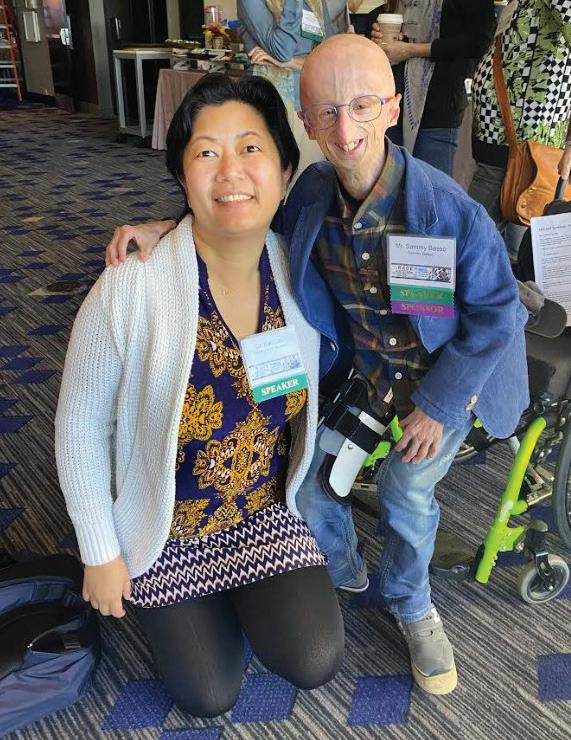
Cao attends a conference with Sammy Basso. The oldest known person with progenia, he died in 2024 at age 28.
Deep Dive
A “Key” Step Toward Safer Surgeries Worldwide
Engineers Develop Durable, Reusable Laparoscope for Low- and Middle-Income Countries
SURGICAL COMPLICATIONS WORLDWIDE claim more lives each year than tuberculosis, HIV and malaria combined. While minimally invasive laparoscopic methods, which involve inserting a thin instrument with a camera through a small incision, could likely prevent many of those deaths, patients in low- and middle-income countries rarely have access. Just one operating room outfitted with even the most modest system costs $130,000 or more.
Now, a team of University of Maryland engineers is partnering to stitch up those gaps in affordability.
KeyScope, the group’s durable, reusable device, reduces cost and complexity by replacing the standard system’s fiber optic technology with a tiny consumer-grade camera and ring of LED lights, complete with waterproof casing for easy cleaning. Backed by funding from the National Institutes of Health, UM Ventures and Wellcome Leap, the device, which can be built for around $1,000, has already been successfully tested in pigs and is slated in summer 2026 for human clinical trials at the Uganda Cancer Institute in March.
that’s now on the market.
That caught the attention of Tamara Fitzgerald, associate professor of surgery and associate research professor of global health at Duke, who’d been working in Uganda. She’d been forced to perform fully open procedures there, with laparoscopes unavailable in the country. Could they apply the technology from the colposcope to a low-cost device for hysterectomies, appendectomies and other abdominal surgeries?
“You don’t want to have to make a large incision, so it’s a huge engineering challenge to develop a scope that fits within a standard 5-millimeter-diameter trocar port,” says bioengineering Assistant Professor Jenna Mueller (above), who’s partnering with the Robert E. Fischell Institute for Biomedical Devices to further develop the device. “But we’ve been able to figure out how to do it and get the same level of image quality as that really expensive standard-of-care system.”
Mueller was no stranger to such medical engineering feats, having previously applied her skills to devices that expand access to lifesaving care. During her postdoctoral research at Duke University, she helped work on the Pocket Colposcope, a low-cost, portable instrument to screen women for cervical precancer
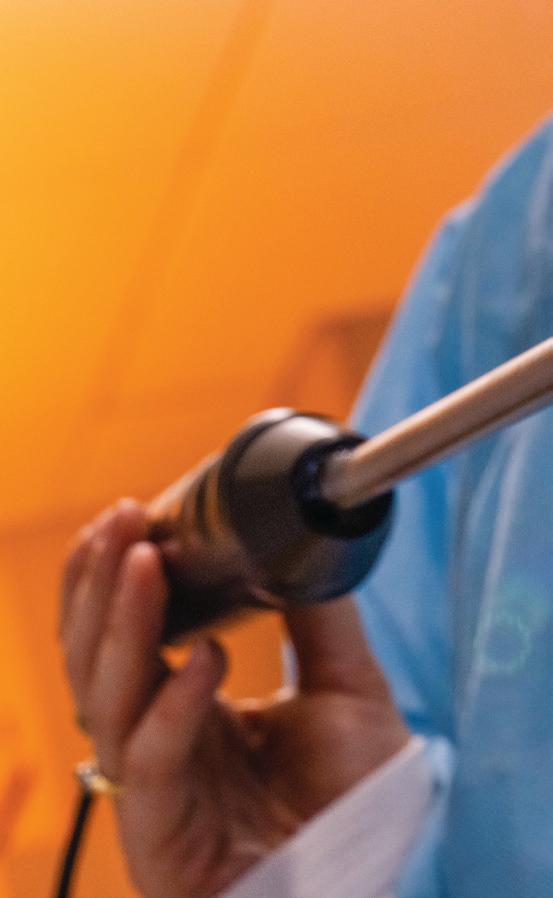
“Most people in the world don’t have access to laparoscopic surgery,” Fitzgerald says. A device like KeyScope could improve recovery times and reduce infection rates not only in Uganda, but also in surrounding nations in Africa and other low- and middle-income countries in Asia and South America. “It could be a pretty big impact.”
After they created the initial prototype, Mueller brought it to UMD when hired in 2020, where she teamed up with the Fischell Institute’s chief engineer, John Rzasa, and senior engineer, Kevin Aroom, to refine it and address design challenges. One, for example, was the ring of LED lights. The 5-millimeter circle needed to provide enough illumination for a surgeon to see the whole abdominal cavity, without generating too much heat and damaging the attached camera. The solution: Pulse the lights in sync with the camera’s frame rate.
“The LEDs are actually off most of the time,” says Rzasa, an expert in designing custom camera systems. “But to the user, it appears like they’re on all the time.”
Another major issue for the low- and middle-income countries that would use KeyScope is sterilization. In these nations, hospitals often don’t have the gas hookups or autoclaves typically used for high-pressure steam cleaning of reusable medical equipment. So
To illuminate the whole abdominal cavity without generating excess heat, a 5-millimeter ring of LED lights at the tip of the KeyScope device pulses in sync with the camera’s frame rate.
TOP PHOTO BY JOHN T. CONSOLI;
INSET PHOTO COURTESY OF JENNA MUELLER

Aroom created a custom, hermetically sealed casing to allow for repeated submersion in a readily available disinfectant called Cidex.
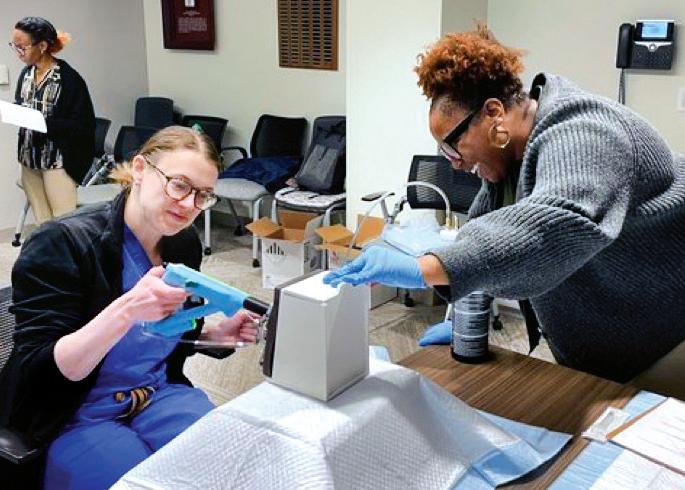
Even with all the modifications, the team is working to keep the device accessible and easy to make—“don’t design stuff that you need a Ph.D. to assemble,” Rzasa says. In collaboration with Ugandan medical equipment manufacturer Shishi International, they’re guiding local engineers to put together the devices in makerspaces, testing limitations and tracking build time. For example, Mueller says, if the available soldering equipment was difficult to work with, she and the team could try to eliminate some of the soldering steps. So far, the process has helped cut the manufacturing time in half.
That back-and-forth to create a sustainable model has been the most rewarding aspect of the project, Mueller says.
“My favorite part is when the Ugandan engineers make a scope and it works. They plug it in, the light turns on and they’re so thrilled,” she says. “I even see that with students here at UMD. If you make something that works, it’s such a confidence boost. It’s a powerful feeling.”—AK
Team Develops Another LowCost, Lifesaving Solution
AFTER CREATING an inexpensive cervical precancer treatment for lowand middle-income countries, a UMD team led by Mueller is exploring the best way to deliver the lifesaving care.
The researchers tested three ways to inject the mixture of ethyl cellulose and ethanol (EC-ethanol), which forms a gel upon contact with tissue and dramatically reduces leakage and off-target damage. One option was a single-needle injector, another was a multi-needle injector, which delivered the treatment to three locations in the cervix simultaneously, and the third was an “extender injector,” which used a shorter needle attached to a longer extender shaft.
The study published in Springer Nature found that the extender injector offered
the best combination of precision, ease of use and affordability. Each dose of EC-ethanol is expected to cost less than $1, and the injector design can be produced for under $10.
Now, a $3 million Method to Extend Research in Time Award from the National Cancer Institute, will support a clinical trial at the University of Maryland School of Medicine.
The World Health Organization reports that cervical cancer is the fourth most common cancer in women globally, with around 660,000 new cases. It killed about 350,000 in 2022.
“We believe we can significantly reduce this number in our lifetime if diagnosis and treatment technologies are made accessible to all,” says Mueller.— LT
MPoweringMaryland
Combined Research Excellence of the University of Maryland, College Park and the University of Maryland, Baltimore

$12.75M MPower Grant to Spur Biomedical Tech Advances
Investment Supports Education, Research at St. John Center for Translational Engineering and Medicine
AFIVE-YEAR, $12.75 million grant from the University of Maryland Strategic Partnership: MPowering the State (MPower) announced last spring aims to accelerate breakthroughs in biomedical technology through a collaboration between the University of Maryland, College Park (UMCP) and the University of Maryland, Baltimore (UMB).
The grant supports research and education as well as new offices, labs and faculty at the Edward and Jennifer St. John Center for Translational Engineering and Medicine (CTEM), announced last January. The MPower funding builds upon a $10
million joint gift from the St. Johns and the Edward St. John Foundation to establish CTEM.
The center brings together clinicians from the University of Maryland School of Medicine (UMSOM) at UMB and engineers from the A. James Clark School of Engineering at UMCP to tackle health challenges and drive medical innovations. CTEM’s initial work will draw from Fischell Department of Bioengineering faculty; its goal is to involve all engineering disciplines in addressing human health.
“Heart disease, diabetes and hypertension are among the leading causes of
death and disability in our state, according to UMSOM,” says Clark School Dean Samuel Graham. “Those diseases cause personal impacts on many families, and treatments are significant drivers of health care costs, but engineering and health care, working hand in hand, can address these challenges and improve people’s lives.”
The funding from MPower—an initiative to leverage the complimetnary strengths of UMB and UMCP—supports the design and construction of state-of-the-art shared space at the University of Maryland BioPark in Baltimore, providing new opportunities for cooperative educational programming and research. Already, UMB-UMCP partnerships in health care are propelling medical device development, improving cancer detection and care, and improving ophthalmology diagnostics and the fight against glaucoma.
“As Maryland continues to rise as a national leader in biomedical technology, we can see the dynamic impact that MPower can have in accelerating disruptive innovation,” says Mark T. Gladwin, M.D., the John Z. and Akiko K. Bowers Distinguished Professor and dean of UMSOM
The MPower investment also supports the recruitment, seed funding and co-location of eight UMCP bioengineering faculty alongside a similar number of UMSOM clinical faculty. Together, they will provide rich opportunities for student education and experiential learning, including a new eight-year B.S.-to-M.D. degree, undergraduate clinical experiences, co-advising and support for capstone design projects and graduate fellowships.
“Collaborations like this one strategically link our complementary strengths to spark powerful and transformative change, multiplying the impact that each institution could have independently,” says MPower Executive Director Adrianne M. Arthur.
PHOTO BY KATE DEBLASIS / UMD PHILIP MERRILL COLLEGE OF JOURNALISM
Being Kind to Your Heart Protects Your Brain
Maryland Researchers Find Cardio Health Factors Impact Dementia Risk
IT’S NOT EXACTLY NEWS that poor diet and lack of exercise are bad for our hearts, but it turns out they’re bad for our brains, too. Conversely, heart-healthy lifestyles can ward off brain aging and dementia, according to researchers with the University of Maryland School of Public Health (SPH) and the University of Maryland School of Medicine.
The team’s study, published last May in eBioMedicine, leveraged artificial intelligence and a massive dataset: MRI brain scans of nearly 20,000 participants aged 40-69 included in a United Kingdom database.
The National Institutes of Health-supported study received foundational funding from both the UMD Grand Challenges Grants program and from MPower.
The researchers focused on white matter, key for communications between brain regions; its natural decay over time may lead to memory and cognitive problems. Using a machine learning method, the researchers estimated each person’s “brain age” based on MRI scans of white matter. Next, they assessed people for eight measures like exercise and healthy eating promoted by the
UMD, MPower Invest in “Research Resilience”
$8.75M Program Addresses Challenging Federal Funding Landscape
THE UNIVERSITY OF MARYLAND in November announced $8.75 million in new Research Resilience Initiatives to safeguard critical capabilities, support scholars affected by recent shifts in the federal funding landscape and bolster the university’s long-term competitiveness.
UMD will direct $5 million to preserve strategic institutional investments, support
American Heart Association (AHA), finding that better scores meant less white matter loss.
“People who want to live longer without the risk of early-onset dementia may want to exercise more or quit smoking, which might work better than medication,” says Tianzhou “Charles” Ma, SPH associate professor of epidemiology and biostatistics, who led the study.
Going a step further, Ma’s team looked at the APOE4 allele, the strongest known genetic risk factor for Alzheimer’s disease. While carriers were likely to have more white matter loss, those hewing to AHA recommendations reduced the loss regardless of APOE4 status.
The findings underscore the importance of long-term management to sustain brain health, and might also encourage health care practitioners to create tailored prevention plans based on patients’ genetic predispositions to dementia, Ma says.— JT
researchers who need to seek new funding sources, and continue to expand the university’s research enterprise. In addition, the new initiatives include $3.75 million over three years for UMD from MPower to help students, postdocs and junior faculty affected by recent cuts to research funding.
“Over the course of the year, we have all felt the impact of a rapidly evolving federal funding environment,” said UMD President Darryll J. Pines, Senior Vice President and Provost Jennifer King Rice and Vice President for Research Patrick O’Shea in a joint message to campus. “The changes have caused
uncertainty and, in some cases, significant shifts for our researchers. We continue to be inspired by the perseverance of our community, and are reassured by the continued strength of our research enterprise.”
The $5 million program has two tracks: One will support essential, at-risk institutional capabilities, as well as for institutional initiatives to pivot to new and sustainable sources of funding. The second track will provide short-term funding for principal investigators or lab group members to sustain operations, or pivot their portfolio to qualify for new funding sources.


andCanAI People Play Nice?
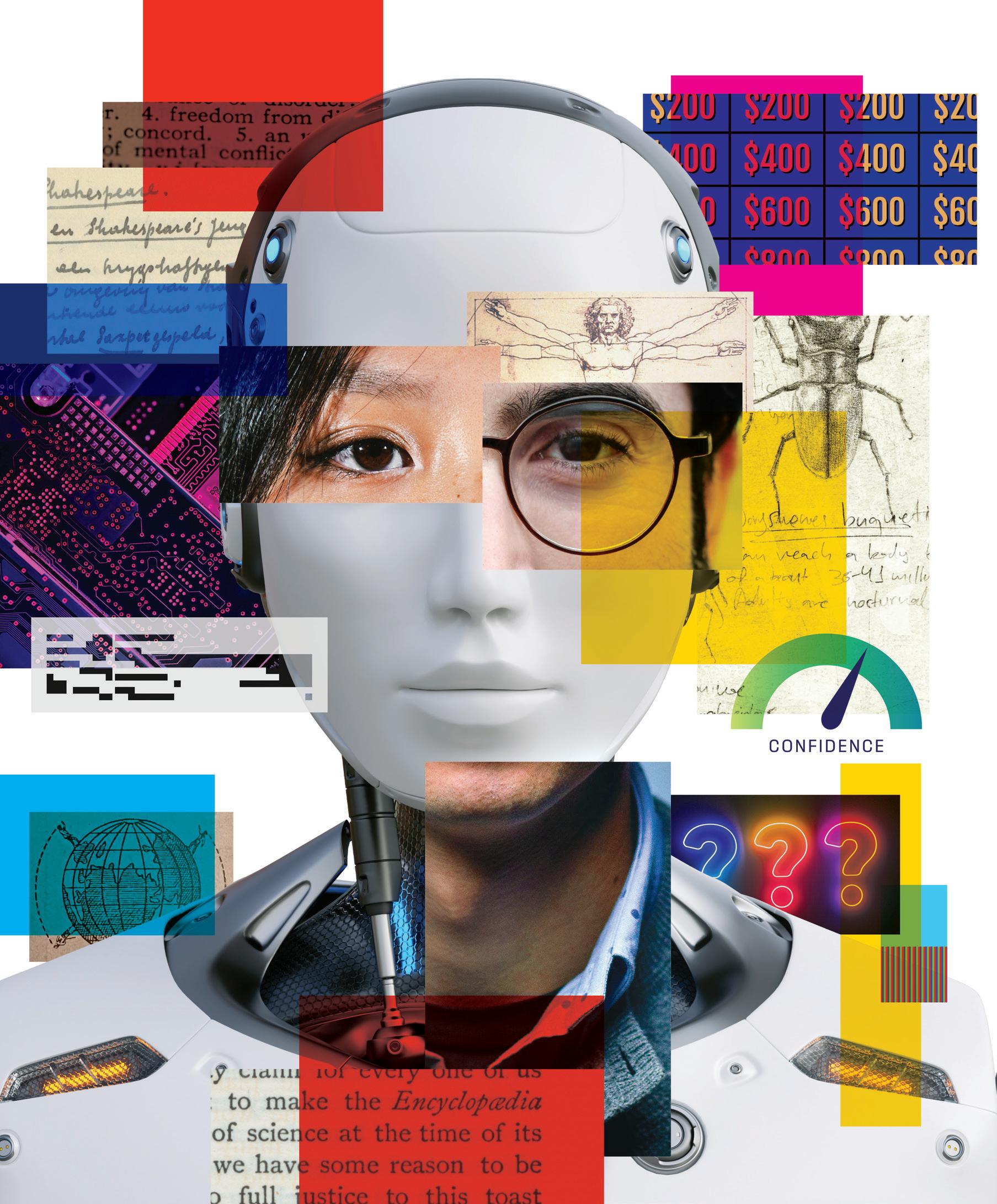
The May 2019 showdown between people and artificial intelligence (AI) at the University of Maryland wasn’t exactly a “Terminator”-style last stand for humanity—just a quiz game. Yet it represented, in a sense, the final days of an era when flesh-and-blood competitors could beat silicon-based ones built to relentlessly pursue trivia wins.
That day, humankind was represented by four visiting “Jeopardy!” champions. As the game unfolded, the computer buzzed in at least as quickly and accurately as the humans with answers about straightforward facts, like the birthdate of a pop star or the melting point of an element. But other questions required creative logic to link, say, cryptic clues about gender norms to others about religion.
“What I call squishy questions, the kind that require lateral thinking, tripped up the system sometimes,” says Roger Craig, a “Jeopardy!” Tournament of Champions winner who held the record for one-day winnings ($77,000) for nearly a decade. Thanks to that limitation, he and past winners Aaron Lichtig, Kristin Sausville and Monica Thieu prevailed 190-160. “It wasn’t a nail-biter, but not a blowout either. If we’d played multiple times, I think we would have won maybe 60% of the time.”
A Trivia Nerd’s Quizbowl Quest Sheds Light on When to Trust Computers, or Ourselves
BY CHRIS CARROLL
PHOTO COLLAGES BY VALERIE MORGAN
But the balance of power in the game they were playing—quizbowl—has shifted. AI technology has evolved by leaps and bounds since that match; the advent of powerful and uncanny large language models behind popular chatbots and image generators is the prime example. People, though, have pretty much stayed the same.
“When it comes to raw accuracy, the computer is now better at answering questions than humans, and I mean humans who are good at this,” says Jordan Boyd-Graber, a UMD computer science professor who hosted the 2019 contest and has been developing the system used in the match, QANTA (Question Answering is Not a Trivial Activity), for nearly 15 years.
As one rough measure of the current state of AI, the system answered a recent set of quizbowl questions he and his research team used in a study with 70% accuracy, while humans managed about 55%. Even on “adversarial” questions crafted by AI experts to exploit its weaknesses and give the advantage to humans, computers are catching up.
Although he built a system that can reliably beat the smartest people on earth, Boyd-Graber’s goal isn’t AI dominance, or to fuel predictions of AI-induced utopias or apocalyptic visions of humanity rendered obsolete.
Now, instead of a face-off, Boyd-Graber is having the two sides team up in a new phase of research. He’s trying to understand what people are good at, what AI is good at, and how this meeting of the minds can bring about benefits for all of society while avoiding, he jokes, our “enslavement by robots.”
“I want people to be able to live happily and productively alongside AI,” he says, “and to do that we need ways to measure and understand human-computer collaboration.”


“People have to be able to trust these systems are providing something that is useful and accurate.”
—Yoo Yeon Sung Ph.D. ’25, Applied Scientist, Hippocratic AI
What he and his students have found so far is that despite its capability, AI is far too confident in its authoritative pronouncements, while people are unsure when to trust AI suggestions. Should they stand aside for superior intelligences, or tell it to shut up and play quizbowl the old-fashioned way? It’s a question with broader implications for how we live our lives and do our work in the future. Now he’s looking for ways to help AI earn badly needed trust—but also to ensure that humans can always run the show when the time comes to deliver the final answer.
QUIZBOWL HAS BEEN CENTRAL to Boyd-Graber’s life for 20 years, and he has the wife to prove it. He competed in high school at a science-focused












boarding school in Arkansas, during his undergraduate years at Caltech (where he met the fellow quizbowler he would marry) and grad school at Princeton. Like most who play the game, he’d amassed broad knowledge along with specialties in history and science—he was also the guy to call on for German literature and light opera questions—helping each of his collegiate teams place fourth at national championships.
He’d just become an assistant professor at UMD (where he’s long served as the quizbowl club’s faculty adviser) when AI struck its first major blow in the trivia war. IBM’s Watson, which could respond with encyclopedic knowledge to queries posed in natural, human language rather than in formal query language, beat “Jeopardy!” GOAT and current show host Ken Jennings in a heavily hyped 2011 match.
There’s nothing unusual about computerized tech besting humans at cognitive tasks. Few would try to race a calculator in basic number crunching, while in the world of games, IBM’s Deep Blue supercomputer beat chess world champ Gary Kasparov in 1997. This inaugurated the era of “centaur” chess, in which the best teams were human-AI hybrids (similar to Boyd-Graber’s collaborative quizbowl teams), a situation that persisted until the 2010s, when AI alone could finally beat the best hybrid teams. But math calculations and coldly strategic games like chess bear little resemblance to quizbowl’s complex language play, which seems closer to the ambiguities of real life.
As a specialist in natural language processing, which focuses on computers’ ability to use human language, Boyd-Graber was captivated—and perhaps a bit aggravated—by Watson’s win. “I was jealous about not being involved,” he says. “The two things I did were now coming together in front of me.”
He set to work on QANTA, publishing his first paper on a trivia answer system, titled “Besting the Quizmaster,” in 2012. By 2015, working with then-UMD student, now Associate Professor Mohit Iyyer Ph.D. ’17 and others, Boyd-Graber had the system running well enough to defeat Jennings in a solo demonstration match at the University of Washington.















During that faceoff, Jennings said that part of Watson’s winning ability was its superhuman speed hitting the buzzer. But QANTA, he said, wasn’t just buzzing in faster, it was thinking through answers at lightning speed: “It’s legit faster than me, as well as knowing more stuff,” Jennings says in a video of the contest. (Boyd-Graber himself appeared on “Jeopardy!”

in 2018, where he came in second with $8,200.)
Watson—a room-size, heavily engineered crown jewel of one of the world’s most powerful corporations— represents the traditional, statistical approach to AI that stretches back to the mid-20th century. QANTA, by comparison, has comparatively modest hardware demands and springs from a newer type of AI: neural representations. It teaches itself from large datasets, such as the complete text of Wikipedia, and uses computational models that emulate the workings of the human brain.
That difference in cost and scalability of the two approaches is why Watson was retired from the trivia world, while QANTA kept getting better at answering hard questions until it rendered humans passé as trivia competitors.
Below, Boyd-Graber, shown with late “Jeopardy!” host Alex Trebek, competed on the show in 2018.

Not that this AI-induced obsolescence matters in real life, where millions continue to tune into “Jeopardy!” each weeknight without a QANTA or a Watson in sight. “People want to watch other people competing,” says former champ Craig, himself a computer scientist. “No one is going to care about computers playing a game.”


IF HUMANITY IS HAVING a moment of self-doubt in the face of AI, the technology itself appears to be overflowing with self-assurance.
By now, we’re all familiar with the crisply stated, often unequivocal answers provided by AI chatbots and even web browsers whether we want them or not. Just one problem: The AI is often wrong. One 2025 study found AI summaries provide misinformation about





recent news more often than not. A key difference between premium and free chatbots was the former’s higher level of confidence in its errors.
How AI systems come up with answers—and botch them—has been a central point of Boyd-Graber’s and colleagues’ question-answering research. An early collaboration with computer science Professor Hal Daumé began with a shared interest in AI systems able to reason in real time, exercising “incremental processing,” as Daumé called it.
“This is what humans do; we don’t wait until the end of a sentence to start thinking about what’s in that sentence,” says Daumé, director of the Artificial Intelligence Interdisciplinary Institute at Maryland, which coordinates AI research and education efforts across the university. It infuses UMD’s widely acknowledged strengths in many areas of AI with a particular dedication to leading its ethical and responsible use in society.
The question-answering studies put Boyd-Graber at the forefront of successive “next big things” in AI and computer science time and again, from neural networks to large language models themselves, Daume says. “His biggest academic flaw is that he’s not good at bragging about himself … (but) his research has been fundamental in a series of things that really resulted in the AI we have today.”
To test computers’ ability to incrementally process, the collaborators chose two applications: simultaneous language interpretation and quizbowl. Daumé had never played, but the game struck him as an ideal test bed: “If you don’t keep up with the question being asked and wait until the end to try and answer, you will definitely lose.”

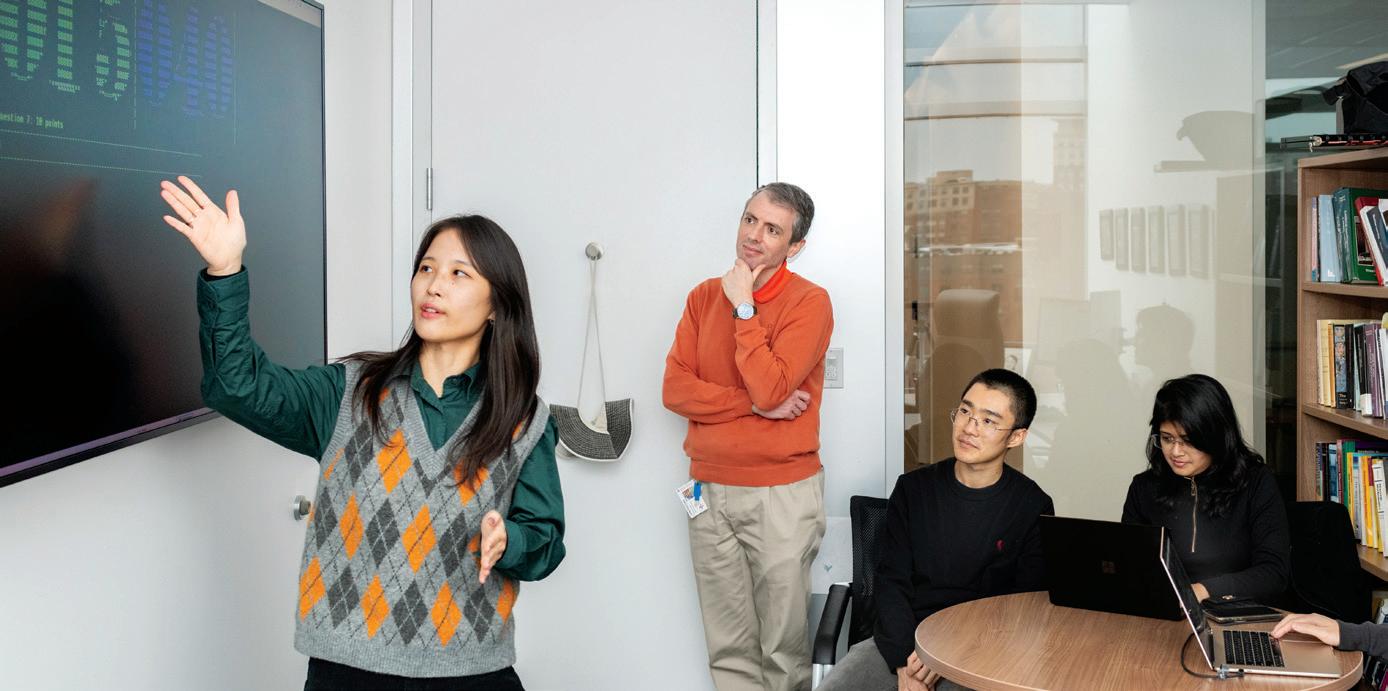
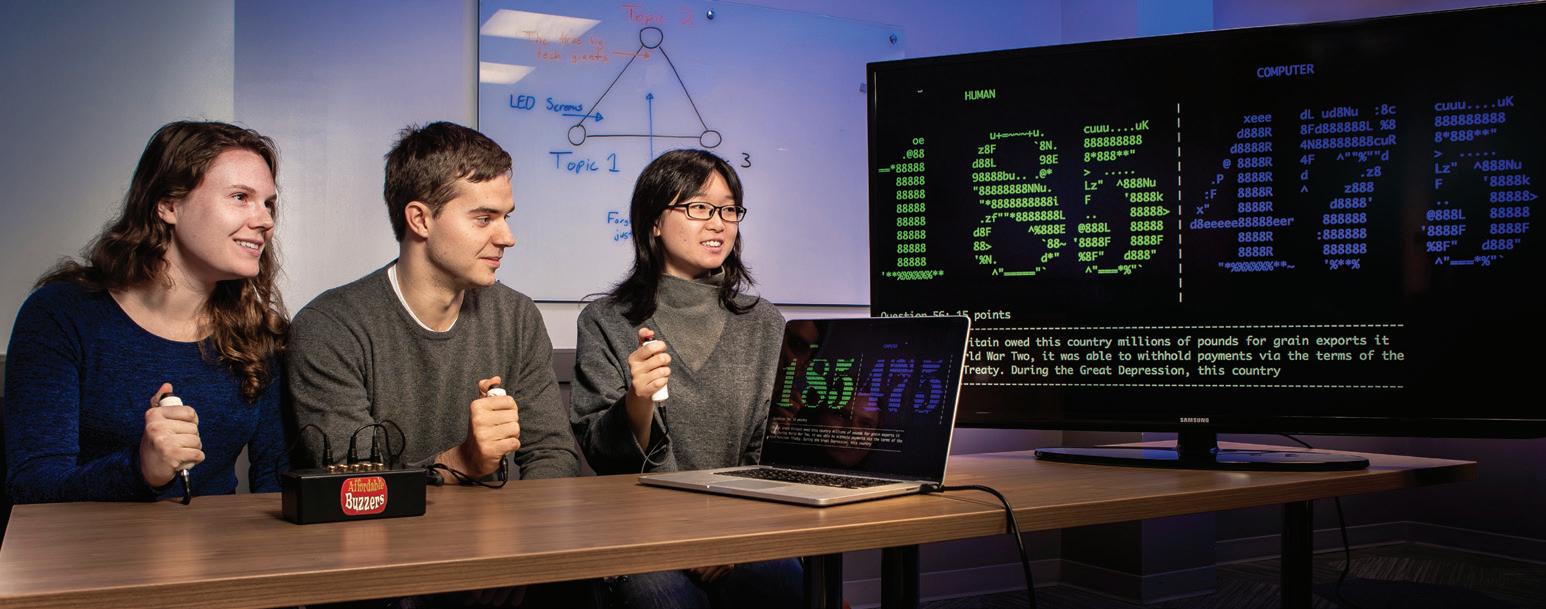
Computer science Professor Jordan Boyd-Graber (second from left) and Ph.D. students (from left) Yoo Yeon Sung, Feng Gu and Ishani Mondal work with the QANTA trivia game-playing system.

Unlike “Jeopardy!,” where competitors can’t hit the buzzer until the announcer has read the entire clue, players in quizbowl can buzz in for “toss-up” questions and offer an answer as quickly as they can blurt it out. The questions are also longer and more complex than on the TV game show; for instance, a question with the answer “King Lear” might start with a hard clue mentioning only a minor character, progressing in several steps to the simple, “Name this Shakespeare play about an aging king.” This inability to break up problems and think on its feet is why Watson—which can only consider a question as a complete unit—would never be able to compete at quizbowl.
BOYD-GRABER’S AREA OF STUDY has become more mainstream in recent years, but he was a pioneer at the start, says one of his research collaborators. “One unique thing is that he’s not just interested in accuracy, but other aspects too, like time—how quickly the system can answer,” says Sewon Min, a University of California, Berkeley computer science assistant professor who has worked with Boyd-Graber on natural language question answering. “That’s how trivia games work, but that’s also how actual human communication works.”
The opportunity on toss-up questions to buzz as soon as possible with only partial clues makes quizbowl not just a contest of knowledge, but of self-awareness and confidence as well: How much do you trust yourself?
A 2025 study led by Boyd-Graber and presented at the conference of the Association for Computational Linguistics found that the computer competitors trusted their knowledge too much; the AI system provided inflated estimates of its likelihood of being


QANTA, an AI system that plays trivia games, surges 290 points ahead in a demonstration match against Boyd-Graber’s former students: Jo Shoemaker Ph.D. ’20, Dennis Peskov Ph.D. ’18 and Michelle Yuan Ph.D. ’22.
correct on the answers it provided in a game played alongside human teammates (who were better able to gauge whether the answer they’d provided was right).
The computer was still more likely than people to nail the answer, Boyd-Graber says. But when you weight the raw results by the players’ knowledge of whether they were correct—for example, if humans say they are 25% sure and AI says it is 75% sure that the capital of Persia under the ruler who defeated the Median Empire was Persepolis—the humans effectively come out on top, even though both are wrong.
But wait: If AI gets the correct answer more often than humans overall, isn’t AI simply better, no matter how you slice it?
No, because a confidently delivered wrong answer is far worse than no answer, says Yoo Yeon Sung Ph.D. ’25, first author of the paper on the study. This is particularly true given the range of sensitive societal functions AI is being introduced to, from supporting military decisionmaking to sifting through mortgage applications.
Sung, whose doctorate is in information science, now works as an applied scientist at Hippocratic AI, a company that creates conversational AI agents to help patients with health care decisions; its motto of “Do no harm” acknowledges the damage that bad AI, like bad medicine, can do in the world.
“Health decisions are one of the most crucial things people think about using AI, and some of the decisionmaking can be extremely delicate,” she says. “People have to be able to trust these systems are providing something that is useful and accurate.”
All the upsides of AI—from saving time on tedious tasks to crunching complicated data to potentially solving major societal problems—can benefit us only if people trust the technology can live up to its own

confident claims, Daumé says.
“This is really important with ‘agentic AI,’ where it’s actually acting as your agent out in the world,” he says. “If an AI is doing my travel booking for me, I need to be able to trust when it tells me it paid a certain amount, it didn’t hallucinate an extra zero onto the payment— otherwise, I’m not using it.”
IN THEIR MOST RECENT RESEARCH, Boyd-Graber and his team turned their attention more toward the people teamed up with AI than the technology. What they found, essentially, was that human competitors weren’t sure how to react to talented but cocky AI teammates.
“I want people to be able to live happily and productively alongside AI, and to do that we need ways to measure and understand human-computer collaboration.”
teammate. The group’s paper on the phenomenon, “AI, Take the Wheel,” found that people believe in themselves less than they should, while “AI is banking on trust that it hasn’t earned,” he says.
Like a quizbowl player jumping to answer a stillambiguous question, humanity is giving up more and more decision-making to AI systems. Boyd-Graber hopes that what he ironically calls a “silly game” can help build the foundation needed for this partnership to pay off: an understanding of the gaps between voluminous facts and knowledge, and between confidence and competence.
hurting
“mute” it). Per standard quizbowl
In these quizbowl games, humans and computers alike can buzz in for toss-up questions (although if an AI teammate is really hurting the score, its human teammates can “mute” it). Per standard quizbowl rules, the team that wins the toss-up then has a chance to add to the score in a bonus round in which teammates confer before they answer.
—Jordan Boyd-Graber Professor of Computer Science
round in which teammates confer before they answer.
In Boyd-Graber’s games, the rules specify that human and AI players come up with bonus answers separately, then compare notes, with the human players ultimately determining the answer. In many cases, computers and humans agreed on the right answer; it was when they disagreed that things got interesting.
“We saw in the previous paper that computers aren’t very good at knowing what they know, and in our new research, it shows people don’t always know whether to trust them or trust themselves,” says Gor, first author of a forthcoming paper in Findings of the Association for Computational Linguistics.
One noteworthy type of disagreement occurred when human players were wrong, the AI player was right, and the people stuck with their wrong answer not because they were simply stubborn, but because the computer failed to provide a logical case for its answer.
The worst-case scenario, says Boyd-Graber, was when the humans had the answer, the computer was mired in error, and people still conceded to their electronic


AI at Maryland
For decades, University of Maryland computer scientists and engineers have helped build the technical foundations of the AI revolution with ground-shifting advances in machine learning, natural language processing and computer vision.
Today, more than 200 UMD faculty members are directly focused on cutting-edge AI research and innovation tackling challenges like creating better and safer autonomous vehicles, enabling incisive data analysis for personalized health care, and pioneering classroom AI systems to reinforce human teaching. An even broader community of scholars and scientists across campus is employing AI as a tool to accelerate research and forge solutions to an array of the world’s most pressing issues
The university is also expanding its menu of AI-focused classes, majors, minors, and certificate and graduate programs while partnering with government and industry to prepare students with both technical skills and principled vision equipping them to drive tomorrow’s economy and contribute to our increasingly dynamic society.
At the center is the Artificial Intelligence Interdisciplinary Institute at Maryland (AIM), UMD’s hub for AI collaboration. AIM unites students, faculty and staff in every corner of campus to pursue community engagement, research and development, policy work and training to shape this transformative field for the benefit of all.

Waste Watchers
UMD Researchers Wade Into Homeowners’ Sewage Spills and Brave Failing Public Infrastructure to Track Health Risks
BY JOHN TUCKER // PHOTOS BY JOHN T. CONSOLI
Primrose Stukes fell in love with the small colonial in Baltimore’s Westfield neighborhood a dozen years ago, its bay-windowed kitchen perfect for family gatherings and Ravens parties. But after she bought the house built in 1930, brown sludge started creeping up from the tub drain in one of the bathrooms.
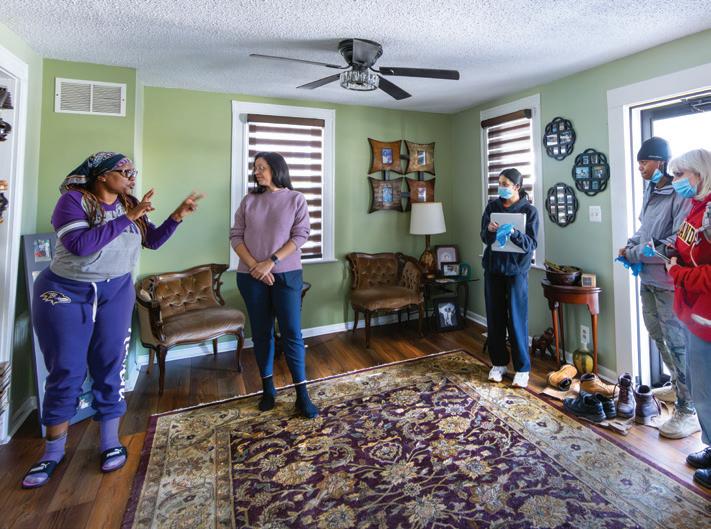
Stukes routinely doused it with bleach and made do, until she attended a community meeting last November where a pair of University of Maryland researchers described their project studying water quality and its health impacts in Baltimore homes plagued by sewage backups—a problem they explained doesn’t affect all communities equally.
The 51-year-old Stukes, who lives in a neighborhood where backups are too common, learned the potential danger of what she’d been living with: When too much water overwhelms a sewer pipe
network, often through cracks in an aging system that allow stormwater to enter, raw sewage is forced to reverse course and take the path of least resistance.
When it pours into homes through toilets and drains, it’s more than just a smelly mess; the backups often contain E. coli and other potentially harmful bacteria that can remain on surfaces for up to six months and cause fever, gastrointestinal symptoms and a wide range of infections. In rarer cases, antibiotic-resistant bacteria could lead to life-threatening infections for residents, especially children, the elderly and those with immune deficiencies.
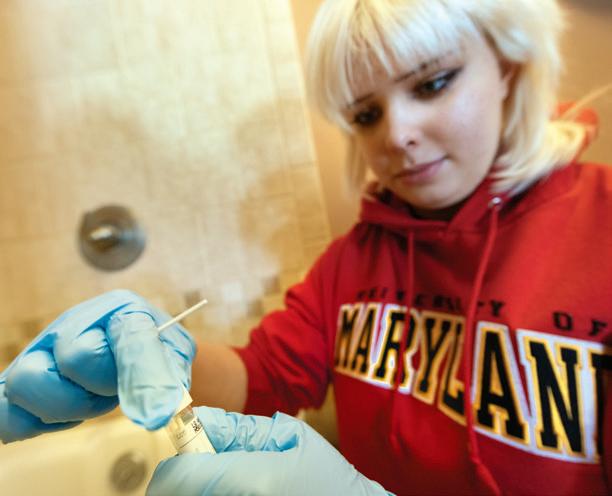
After the meeting, Stukes told the researchers about the “grunky stuff that comes up through the tub,” and when they offered to collect a sample and pay her $75 for the hassle, she accepted.
To the researchers—whose group, the Water Emergency Team (WET), comprises
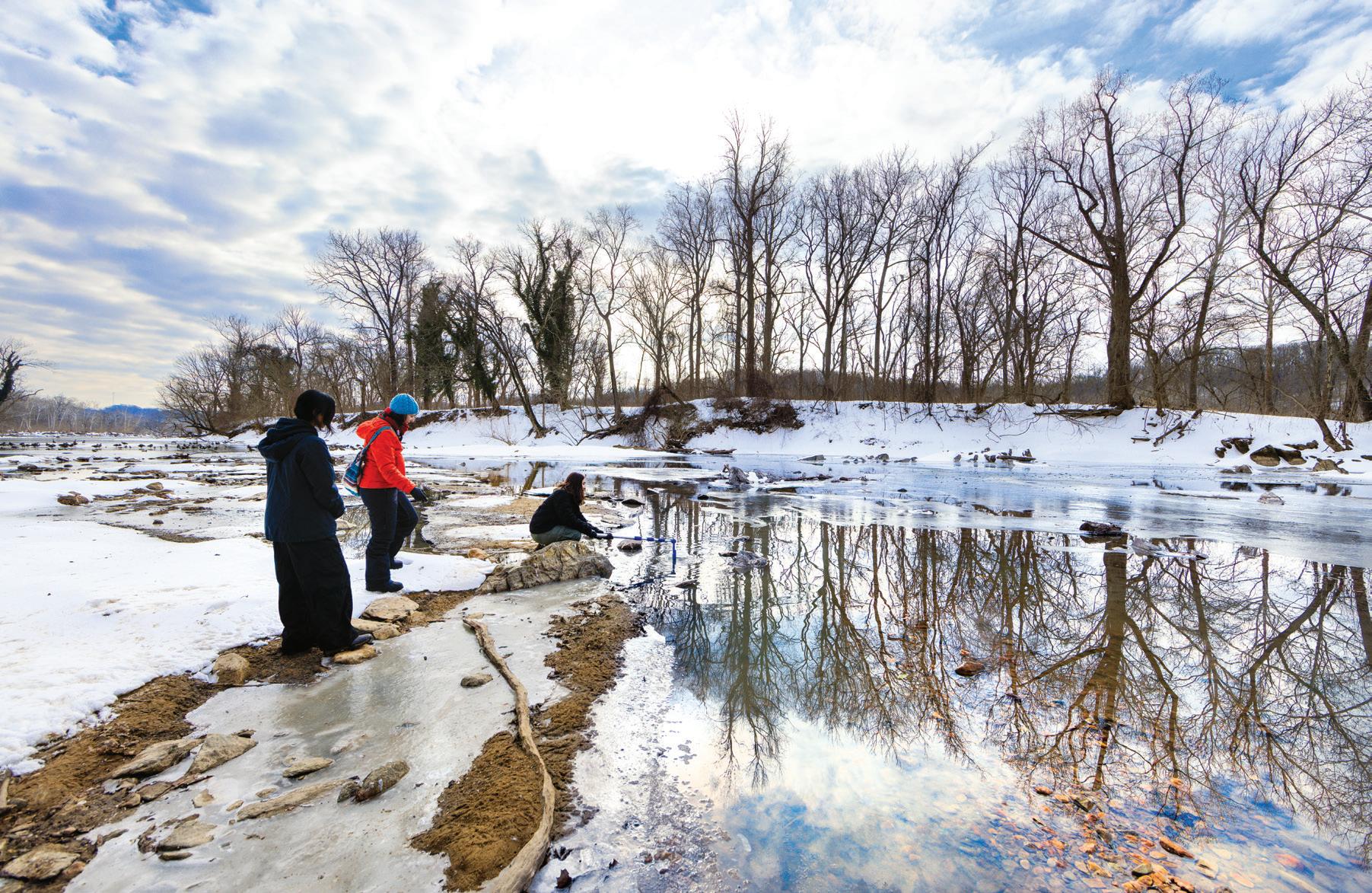
Madison Vlach ’27 (above), an environmental science and policy major, takes a sample from a possible sewage overflow at a Baltimore house. The city (top) receives thousands of sewage complaints from residents each year. UMD researchers (facing page) test the Potomac River for dangerous bacteria after a catastrophic sewer pipe break in January.
professors and students from the School of Public Health and the School of Architecture, Planning and Preservation—the project goes beyond the academy.
The initiative is funded by a three-year, $1.3 million UMD Grand Challenges Grant on health and infrastructure and $2.2 million from the National Institutes of Health. Led by Marccus Hendricks, associate professor of urban studies and environmental planning who studies public infrastructure inequalities, and Rachel Rosenberg Goldstein, assistant professor in global, environmental and occupational health who studies water quality and risk communication, WET aims to educate communities and motivate policymakers to deal with public health risks from failing sewers and stormwater systems, partly by noting where they occur most—Stukes’ neighborhood, for instance, is primarily Black.
Like other class- and race-based
divisions, whether in real estate or criminal justice, “certain individuals and groups across the urban landscape don’t have equal access to environmental resources, including protections from polluted water,” says Hendricks.
Hendricks was raised in southwest Dallas, a community vulnerable to storm pipe bursts and flooding; Goldstein grew up in eastern North Carolina, where frequent floods coursed through hog farms, spreading waste. Both bring their personal experiences with dangerous water to this Maryland project.
Hendricks recalls a morning as a young teen when he awoke to a foot of water in his bedroom. His mother ripped out the carpet, scrubbed the cement foundation and spent what she could on new drywall. Hendricks doubted that North Dallas neighborhoods, home to Cowboys owner Jerry Jones and
President George W. Bush, ever dealt with such disasters.
“It gave me a burning desire to ask, ‘What was it about me, my family, my neighborhood that led to these outcomes?’” he says.
For his dissertation at Texas A&M University, Hendricks studied Houston’s two stormwater systems: a nexus of open ditches along roadways in the city’s heavily Black and Hispanic neighborhoods; the other a sophisticated apparatus of pipes to funnel away rainwater in wealthier, mostly white areas of the city.
After joining the UMD faculty, Hendricks gravitated toward Baltimore. Its picturesque Inner Harbor bustling with tourists contrasted with narrow waterways in poorer neighborhoods that challenged a 110-year-old sewage system spiderwebbed with cracks. The result was frequent residential backups; in a 12-month period ending last June, the city’s 311 service
received 8,692 sewer-related complaints, likely a fraction of total occurrences. In 2019, supported by a Harvard University environmental health fellowship, Hendricks launched a pilot project that leaned on community guidance to address the issue.
Goldstein too knew what floods could do, remembering when Hurricane Floyd closed her school for two weeks. While pursuing her master’s in public health and Ph.D. at UMD, she studied wastewater treatment plants and the cycle of raw sewage, and was lead author of a study documenting the discovery of methicillin-resistant Staphylococcus aureus (MRSA), an antibiotic-resistant bacteria, in a wastewater treatment plant.
In 2021, Goldstein’s Biosafety Level 2 campus lab specializing in waterborne bacteria detection caught Hendricks’ attention, and he asked Goldstein, who also specializes in community engagement, to co-lead his project.
They began attending community meetings and arranging home visits with students, spending eight-hour days knocking on doors to inspect and swab bathrooms, kitchens and basements for signs—visible or otherwise—of sewage overflows. After sampling dozens of homes, they sent the specimens to Goldstein’s lab and waited for results.
Four WET team researchers trudge up a snowy sidewalk to Stukes’ porch one February afternoon. After swapping boots for disposable booties and saluting a cat named Theo, they follow Stukes to a bath-
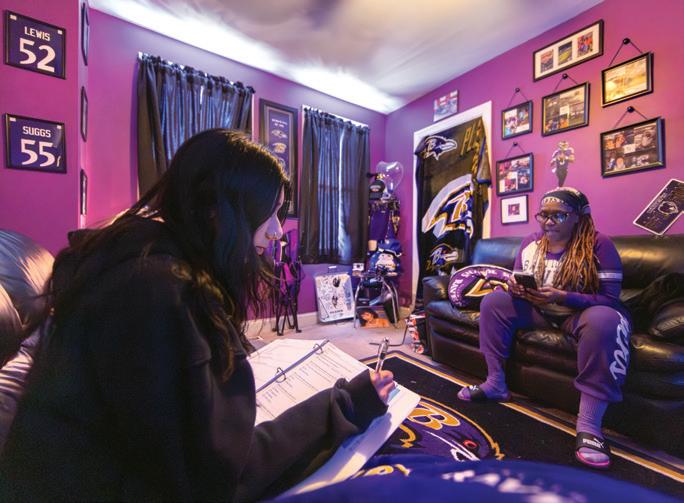
tub where remnants of a recent propulsion rim the drain. Urban planning doctoral student Maeghan Goode tries to determine a cause—rain?
There’s no clear pattern, Stukes says: “It just comes up, and now it’s just kind of sitting there.”
As one student swabs the still-wet residue, Goode inspects the rest of the home, looking for clues like mold or leaks. Another researcher works through a survey with Stukes in her memorabilia-packed “Ravens Room”: How many people live in the house? (Only her and Theo.) Do you ever have symptoms like a cough? (No.) Have you communicated with the city? (She’s asked for help, to no avail.)
Inspections and surveys help root out infrastructure issues not just for individuals, but for disproportionately impacted communities as a whole, says Priscila Alves, assistant research professor of urban studies and planning and lead author of a recent paper on WET’s methodology.
“We look for patterns and clusters,” she says. “Inspections don’t necessarily show something is contributing to the sewage event, but they can turn on an alarm.”
A 40-house pilot study by the team, published last year, was just such a clarion call. It found 34 containing toxic bacteria likely linked to sewage, including one with ankle-deep water and E. coli concentrations 10 times the federal limit for swimming areas. Seven homes contained antibioticresistant bacteria; one had MRSA, estimated to cause more than 70,000 severe infections and 9,000 deaths annually. (The U.S.
Primrose Stukes (far left) welcomes members of UMD’s Water Emergency Team (WET) to her Baltimore house. WET project manager Raisa Haq ’26 records details about sewer infrastructure woes in Stukes’ “Ravens Room.” Below, raw sewage gushes into the Potomac in Montgomery County, Md.
Centers for Disease Control and Prevention projects bacterial infections to be the leading cause of death by 2050.)
The residents were mostly homeowners and predominantly Black, female and in their 50s and 60s. Many reported nausea, shortness of breath and fatigue, and two-thirds battled anxiety. Some said they were scared to use their basements.
As the researchers say goodbye to Stukes, who’s part of a new phase of research, she half-jokingly asks, “Is the city going to come clean it up?”
While the U.S. Clean Water Act enforces liability for sewage spills into bodies of water, no laws protect residents from backups, according to Barbara Johnson, senior water protection manager for Blue Water Baltimore, a nonprofit. Baltimoreans can call 311, prompting the Department of Public Works to send an inspector to determine eligibility for free cleanup or reimbursement for cleaning costs up to $5,000.
Many are devastated by destroyed appliances and ravaged boxes of family mementos; it’s also common to feel shame.
“You’re not just dealing with your
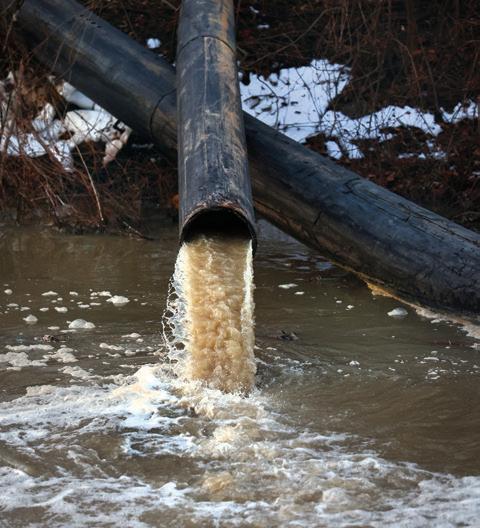
family’s poop, you’re talking about your neighbor’s poop in your basement,” says Johnson, whose organization has partnered with WET to double up on community outreach. Having the support of academics has been “amazing,” Johnson says. “They’ve brought this issue to light as a public health issue.”
Sometimes the team tackles neglected infrastructure at scales far bigger than that of a single home. One morning in February, Goldstein takes a hesitant step onto a frozen hill above the Potomac River. Ice from a recent blizzard lingered, as did the stench from a Jan. 19 breach of a 72-inch wastewater pipe in Montgomery County, Md., which dumped nearly 250 million gallons of raw sewage into Washington’s main waterway. The disaster, likely the largest wastewater spill in U.S. history, sent cleanup crews scrambling to divert the spewing sludge into a nearby canal.
The geyser from the 60-year-old pipe may augur similar disasters across the country, due to a decrease in federal funding to replace sewage systems, critics maintain. When news of the spill broke, Goldstein dispatched students to ground zero to collect water samples, the first of weekly visits to monitor water quality.
As she and two researchers inch their way across an icy bridge surrounded by woods, a flock of geese descends on the fouled river. The odor grows stronger, “a sour decay, like some animal died,” observes Claire Barlow, a Ph.D. student in environmental health. “That’s not dirt,” Goldstein says at the frozen riverbank, pointing out toilet paper frozen in the sludge. At the river’s edge, WET’s project manager pokes a metal pole with a plastic jar into the water to collect a sample, then passes it to Goldstein. A sewage-saturated tampon sat nearby. “Anything that goes down a drain is now here.”
Two weeks after collecting its first sample, Goldstein’s team announced preliminary findings, sending shockwaves through the
DMV and prompting President Donald Trump to deploy federal resources. The river contained extraordinarily high levels of fecal bacteria, including E. coli levels 10,000 times above EPA recreational water quality standards. Wastewater had flowed at least nine miles downstream, near Georgetown. The team also detected MRSA and the bacteria that causes Staph infections.
As it continues to monitor the river, the WET team is expanding its house testing with the Grand Challenges Grant funds, with a research footprint covering the city of Baltimore and Montgomery and Prince George’s counties.
In March, Stukes got a call from Goldstein with her test results. Surprisingly, the researchers found no pathogens in her tub. But on the basement walls under the bathroom, the team detected two fecal bacteria: Methicillin-resistant coagulase-negative Staphylococcus, often associated with hospital-acquired infections; and Enterococcus, able to cause potentially severe infections including those to the urinary tract.
“To think that my grandkids have played in the basement, leaning against the walls—it’s concerning,” she says the day after getting the news, criticizing the city. “I asked for help with leaking water years ago, and I’ve heard crickets.”
The WET team’s newest testing has yielded even more disturbing findings
IT GAVE ME A BURNING DESIRE TO ASK, ‘WHAT WAS IT ABOUT ME, MY FAMILY, MY NEIGHBORHOOD THAT LED TO THESE OUTCOMES?’
—Marccus Hendricks
Associate Professor of Urban Studies and Environmental Planning
than the pilot. At most recent count, 64 of 77 homes contained fecal contamination, including 28 with antibiotic-resistant bacteria. The researchers warn that the problem will intensify as a shifting climate causes more extreme weather.
Hendricks, who is writing a book about the history of Baltimore’s sewage system, isn’t shocked by the findings, citing a sense of resignation that settles on resource-starved communities. “Some have normalized infrastructure failures and exposures, or suppressed it,” he says.
Goldstein says she is fueled by residents’ kindness, despite their embarrassment, recalling one woman who inherited her mother’s home breaking down in tears in front of her, having seen the property value plummet because of the leaks.
“This isn’t just a research question,” she says. “People are living with this, with potentially lifelong impacts, but it’s not their fault.”
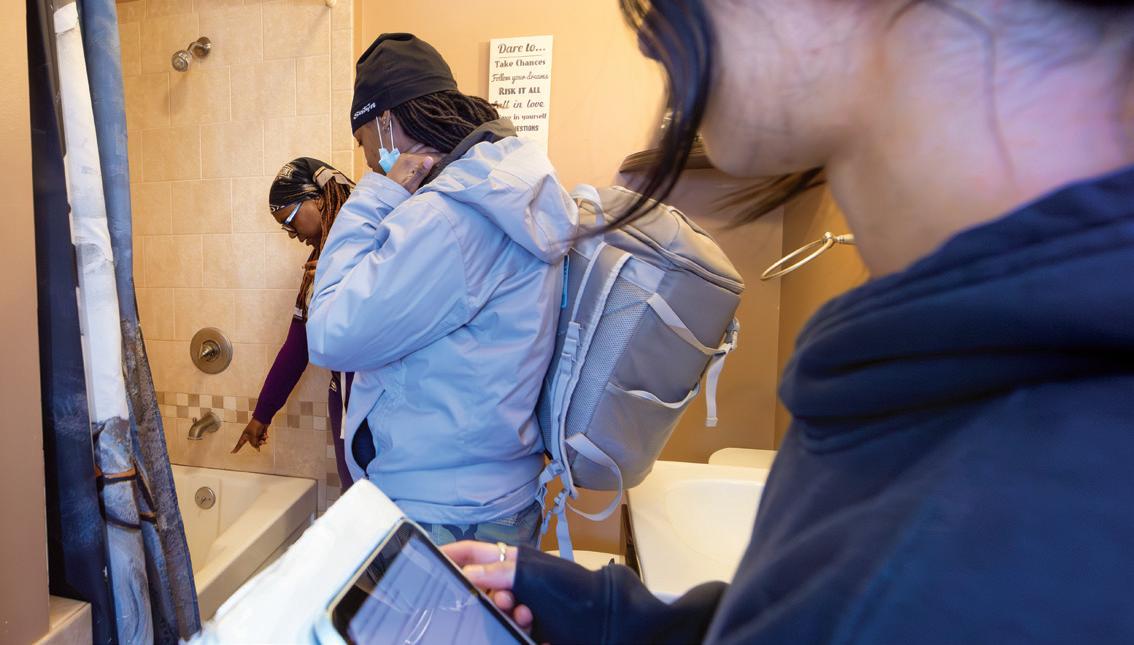
Stukes points out potential spots for WET researchers to test for sewage contamination in her home.
Groundbreakers
Accolades
Awards and Honors Earned by Faculty and Staff
Researchers in 2025




3 UMD Researchers Elected to National Academy of Inventors
Engineering, Agriculture and Natural Resources Scholars Honnored for Translating Research Into Products and Services That Change Lives
THREE LONGSTANDING University of Maryland researchers and leaders joined the ranks of the nation’s most creative academic innovators as new fellows of the National Academy of Inventors’ (NAI) Class of 2025.
UMD President and Glenn L. Martin Professor of Aerospace Engineering DARRYLL J. PINES , Department of Veterinary Medicine Professor DANIEL J. NELSON , and SRINIVASA RAGHAVAN , Patrick and Marguerite Sung Professor in the Department of Chemical and Biomolecular Engineering, were elected to a class of 185 inventors who collectively hold more than 5,300 U.S. patents. The NAI is the highest professional distinction awarded to U.S. inventors.
Pines, who arrived at UMD as an aerospace engineering professor, holds seven co-authored patents with his students and collaborators. His research has focused broadly on structural dynamics, including structural health monitoring and prognosis; smart sensors; and adaptive, morphing and biologically inspired structures, as well as the guidance, navigation and control of aerospace vehicles.
“It’s a tremendous honor to be selected as an NAI fellow,” Pines says. “I am proud of the research and innovation that thrive on our campus, and I’m grateful to be recognized among these talented faculty members working to educate and inspire future scholars and inventors.”
Nelson, who holds 12 U.S. patents along with 10 additional patent filings, is a microbiologist and protein engineer whose work focuses on understanding and engineering natural

enzymes from viruses that kill bacteria. The therapies his work advances address one of the most urgent global health threats, antibiotic resistance.
“I am deeply honored and grateful to be named a fellow of the National Academy of Inventors,” says Nelson, who holds a joint appointment at the Institute for Bioscience and Biotechnology. “It is not only validation of my own efforts, but of the exceptional capabilities and efforts of the students, postdocs and collaborators who contributed to these discoveries over many years.”
Raghavan is the principal investigator of the Complex Fluids and Nanomaterials Group. Earlier this year, his group discovered that “electroadhesion,” a method that adheres materials by applying electricity, was achievable for nearly any biological tissue, whether human, animal or plantderived.
This discovery builds from the group’s 2021 study of electrically-induced adhesion between soft materials (gels and animal tissues), which led to a suture-free repair method for surgery, cuts and wounds that earned the 2022 UMD Invention of the Year award in the life sciences category. “I am very grateful for this honor, and am fortunate to work with brilliant students whose creativity drives our inventions,” Raghavan says. “Some of these inventions—including our materials that stop bleeding—are already making a tangible difference in the real world, and that is deeply gratifying.”–DB, KC, EA
UMD Scholars Among 10 Nationwide Awarded Barry Prize
TWO UNIVERSITY OF MARYLAND FACULTY MEMBERS received the American Academy of Sciences and Letters’ 2025 Barry Prize for Distinguished Intellectual Achievement, presented annually to scholars who have “made outstanding contributions to humanity’s knowledge, appreciation and cultivation of the good, the true and the beautiful.”
CHARLES BUTTERWORTH , a professor emeritus of the Department of Government and Politics, and Distinguished University Professor SYLVESTER JAMES GATES JR. , who holds the Clark Leadership Chair in Science and joint appointments in the Department of Physics and the School of Public Policy, were among 10 honorees who each received a cash award of $50,000 and became members of the academy.
UMD was the only school with two faculty members to receive the award last year; only two other faculty members from public universities have been presented with it since its 2023 inception.
Gates, a University System of Maryland Regents Professor, conducted seminal work in supersymmetry, supergravity and string theory, making milestone discoveries in the mathematics of particle theory and the geometry of gravity. In addition to his research achievements, Gates also distinguished himself as a powerful advocate for education and a global ambassador for science.
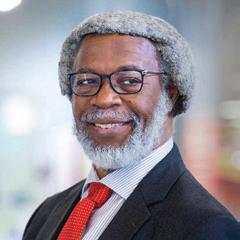
“It is truly inspiring to see Professor Gates’ groundbreaking research and tireless public outreach honored by these prestigious organizations,” says Amitabh Varshney, dean of UMD’s College of Computer, Mathematical, and Natural Sciences. “These honors are well-deserved given his pioneering discoveries that cross the boundaries of mathematics and physics.”
Butterworth was selected for the Barry Prize for his contributions to the understanding of Arabic and Islamic philosophy, as well as the relationship between reason and religious texts. In the award citation, the academy said Butterworth “has broadened the world of scholarship for generations of students in politics, philosophy, and religion,” and “provided scholars around the world with intellectual resources for inquiry into the good life.”
“Two University of Maryland faculty members receiving the Barry Prize this year is a testament to the fact that some of the world’s best and brightest minds call College Park their academic home,” says College of Behavioral and Social Sciences Dean Susan Rivera.–RG
3 UMD Faculty Researchers Named AAAS Fellows
THREE UNIVERSITY OF MARYLAND FACULTY were announced last March as 2024 fellows of the American Association for the Advancement of Science (AAAS), the world’s largest general scientific society.
Professor XIN-ZHONG LIANG of the Department of Atmospheric and Oceanic Science, Professor and Chair JEFFREY LIDZ of the Department of Linguistics and Professor Emerita ANN WYLIE of the Department of Geological, Environmental, and Planetary Sciences joined a class of 471 scientists, engineers and innovators. The new additions bring UMD’s total to over 110 AAAS fellows.
Liang, who has a joint appointment in the Earth System Science Interdisciplinary Center, was honored for his pioneering leadership in developing regional modeling capabilities for understanding climate change impacts on water resources and various societal sectors, the association said.
“Advancing interdisciplinary research requires broad collaboration, and I am grateful for the opportunity to work with such dedicated colleagues,” Liang says.
Lidz, who directs UMD’s Project on Children’s Language and the Infant and Child Studies Consortium, was recognized for advancing linguistics and language science, particularly for innovative approaches to studying child language acquisition and the psychological basis of semantics.
“I’ve tried to do linguistics in a way that speaks to broad questions in psychology and philosophy, using as broad a set of tools as possible. So, I hope this induction will allow me to be a role model for young scientists who want to engage big questions in the study of language and mind,” he says.
Wylie was honored “for distinguished contributions to both the field of mineralogy and university administration.” She is a nationally recognized mineralogist and economic geologist whose research focuses on the relationship between mineral properties and human health.
When she arrived at UMD in 1972, Wylie became the first female faculty member in the Department of Agronomy and in the Department of Geology when it was created the following year. She most recently served as vice president and chief financial officer in 2021.
“I am deeply honored, and I thank the University of Maryland for the opportunities it has given me to work and thrive, making this recognition possible,” Wylie says.—KB, KEB
Faculty Q+A
PHILIP RESNIK
Researcher: To Make Better AI, Stop Tackling Biases “Whacka-Mole”-Style
SINCE THEY BECAME widely available, artificial intelligence (AI) chatbots have been embraced as research assistants, trip planners and writing helpers—but they’ve provided some face-palm moments as well.
One company’s bot developed anti-Muslim attitudes, while another’s praised Hitler. One ill-fated attempt to reduce bias resulted in depictions of, among other historical impossibilities, a rainbow coalition of U.S. Founding Fathers.
Although each problem was addressed, the trend has persisted, and there’s no reason to believe it will stop without thoughtful action, says PHILIP RESNIK , a University of Maryland scholar whose research lies at the intersection of linguistics, computing and artificial intelligence.
He spoke to Enterprise about creating AI tools that work better—for everyone.—CC
Chatbots can be useful. How much do we need to worry about occasionally offensive behavior?
“It’s what I call playing ‘whack-a-mole’ when you deal with these things as individual problems to solve,” said Resnik, a professor of linguistics with a joint appointment in the University of Maryland Institute for Advanced Computer Studies. “You fix it here, and then it pops up there, and maybe your corrective action created yet another problem.”
In a September paper in Computational Linguistics, provocatively titled “Large Language Models Are Biased Because They Are Large Language Models,” Resnik argues that harmful biases in chatbots are a reflection of the basic nature of the models.
They can indeed be very useful, but we’re not only talking about chatbots, but the large language models, or LLMs, they are based on. These don’t only do chatbot-like interaction, but are also summarizing, making suggestions about potentially important decisions, and much more. Also, we are emphatically not talking about politeness, or just making technology more pleasant to interact with, (but) real-world impacts. If you have a system with negative or positive biases based on someone’s dialect, for instance, and it’s helping make hiring decisions, you can see the problem.
How do they become biased?
The fundamental job of an LLM is to generate plausible strings of words. The decision about what word to produce next is based on an extremely rich internal model of words and concepts and relationships among them. That’s the amazing power of these things—they analyze hundreds of billions of words of text and extract this underlying model that’s not just a word association game.
Here’s where the problem comes in: They learned this model by observing an incredible volume of things people have said in the past. Observing how words are distributed in text tells them dogs bark, that a kiwi is a kind of food, all kinds of important knowledge about the world. But those observations also include all kinds of bad stuff—the stereotypes, the presuppositions, the racism and bias you find in written material online and elsewhere. And crucially, what I argue in my paper is that from a formal, mathematical standpoint, a system
that learns in this strictly distributional fashion simply has no way to distinguish the valid knowledge you want it to learn from the other stuff.
How can we fix this?
I’m not claiming that changing the path of AI development would be easy. Clearly, the kind of large-scale distributional learning that enabled today’s LLMs is vastly more effective and powerful than older approaches, but we didn’t have to throw out the baby—the fact words have meanings beyond just how they’re used—with the bathwater. One possibility would be to revise learning approaches so that notions like meaning and factuality have a privileged status, rather than having systems that can learn only through observational clues Decades of thought in linguistics, cognitive science and other fields have gone into what it means to represent meaning and knowledge, and we should take advantage of that.
Economist Elected to American Academy of Arts and Sciences


A UNIVERSITY OF MARYLAND RESEARCHER whose statistical and measurement methods have for decades helped policymakers understand changes in the U.S. labor market was named a member of the American Academy of Arts and Sciences (AAA&S).




JOHN C. HALTIWANGER, a Distinguished University Professor who serves as the Dudley and Louisa Dillard Professor of Economics, was among nearly 250 individuals elected in 2025 from fields including academia, the arts, industry, public policy and research; 27 UMD faculty members are now represented in the AAA&S
“It is a special honor to be included amongst the group of economists that inspired much of my work,” Haltiwanger says. “In addition, it is a great honor to be a member of this society with my distinguished University of Maryland colleague and co-author, Katharine Abraham.”
Since the 1980s, he has used U.S. longitudinal firm-level data to develop new statistical measures and analyze the determinants of firm-level job creation and destruction and economic performance. He has explored their implications, tracking the contribution of business dynamism and entrepreneurship to U.S. job creation and productivity growth. Haltiwanger is now working to modernize economics measurement methodology for key economic indicators.—LO


faculty memberships in the national academies
new memberships since 2020
Groundbreakers
4 Early-Career Researchers Receive White House Honor
FOUR UMD RESEARCHERS were among nearly 400 scientists and engineers nationwide honored at the White House in January 2025 for their exceptional potential for leadership and novel research undertaken early in their scientific careers.
DAMENA AGONAFER , Clark Faculty Fellow and associate professor of mechanical engineering; ZOHREH DAVOUDI , associate professor of physics; SOHEIL FEIZI , associate professor of computer science with an appointment in the University of Maryland Institute for Advanced Computer Studies (UMIACS); and JUSTYNA ZWOLAK , a National Institute of Standards and Technology mathematician working on the UMD campus, received the Presidential Early Career Award for Scientists and Engineers.
Agonafer, a faculty affiliate of both the Center for Risk and Reliability and the Maryland Energy Innovation Institute, as well as site lead for the National Science Foundation-funded Environmentally Applied Refrigerant Technology Hub, was recognized for his research on the fundamental limits of evaporative cooling for high-powered electronic systems, with applications that range from data centers to electric vehicles.
Davoudi, of the Maryland Center for Fundamental Physics, was recognized for her research into strongly interacting quantum systems and investigations of how elementary particles like quarks and gluons come together and form the matter that makes up our world. She is a fellow in the Joint Center for Quantum Information and Computer Science (QuICS)
Astrophysicist Elected to National Academy of Sciences
University of Maryland visiting research scientist and alum Brenda Dingus M.S. ’86, Ph.D. ’88 was elected to the National Academy of Sciences (NAS) for her pioneering work in gamma-ray astrophysics.
Dingus was one of 120 members and 30 international members elected by their peers in 2025, joining a select group of 2,662 scientists around the country recognized for their influential research. She’s one of 26 current UMD faculty members of the NAS.











and associate director for education at the NSF Quantum Leap Challenge Institute for Robust Quantum Simulation.
Feizi, a core faculty member in the University of Maryland Center for Machine Learning who is active in the Institute for Trustworthy AI in Law & Society, is a widely known expert in the field of reliable and trustworthy artificial intelligence.
Zwolak is an affiliate fellow in QuICS, with adjunct appointments in physics and UMIACS. She was recognized for research combining machine learning, computer vision and physics-based heuristics to calibrate and control quantum systems, with particular emphasis on enabling the scale-up of semiconductor quantum dot devices, a leading system for building quantum computers.– BB, RH, TV
“This is an incredible honor,” Dingus says. “It is a wonderful recognition of the scientific importance of this new area of astronomy.”
Dingus is best known for her work in developing innovative gamma-ray detectors and analyzing cosmic phenomena in extreme environments such as around neutron stars and supermassive black holes.

Throughout her career, Dingus led the development of increasingly sophisticated instruments for
detecting gamma rays from space and on Earth, including the Fermi Gamma-ray Space Telescope and its predecessor, the Energetic Gamma Ray Experiment Telescope on NASA’s Compton Gamma Ray Observatory satellite. GJ







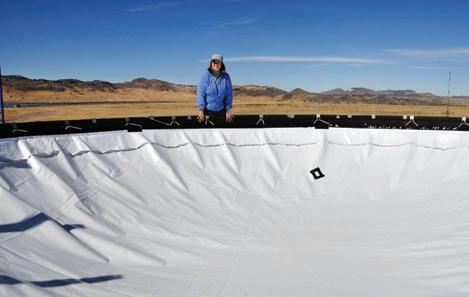
Bookshelf
Books Written by UMD Faculty in 2025

THE AMERICAN REVOLUTION AND THE FATE OF THE WORLD
PENGUIN’S RIVERHEAD BOOKS
Richard Bell, Professor of History
The award-winning author reveals the full breadth and depth of America’s founding event as not only the colonies’ triumphant liberation from the rule of an overbearing England; it was also a cataclysm that pulled in participants from around the globe and threw the entire world order into chaos.
THE COMMUNITY OF INQUIRY FRAMEWORK IN WRITING STUDIES: DESIGNING FOR LEARNING WITH PEER REVIEW
WAC CLEARINGHOUSE
Jennifer M. Cunningham, Mary K. Stewart, Natalie Stillman-Webb, and Lyra Hilliard, Principal Lecturer in the Department of English
ATLANTIC THEORY: ON THE VICISSITUDES OF RELATION
EDINBURGH UNIVERSITY PRESS
John E. Drabinski, Professor of English and of African American and Africana Studies
SO UNIMAGINABLE A PRICE: BALDWIN AND THE BLACK ATLANTIC
NORTHWESTERN UNIVERSITY PRESS
John E. Drabinski, Professor of English and of African American and Africana Studies
EXTRAVAGANT CAMP: THE QUEER ABJECTION OF ASIAN AMERICA
NYU PRESS
Chris Eng, Assistant Professor of English

REBEL GOVERNANCE IN THE AGE OF CLIMATE CHANGE
CAMBRIDGE UNIVERSITY PRESS
Kathleen Gallagher Cunningham, Professor of Government and Politics
SOCIAL ENTREPRENEURSHIP FOR DEVELOPMENT: A BUSINESS MODEL
ROUTLEDGE
Margaret Brindle, Associate Clinical Professor of Public Policy
HOW FATHERS HELP THEIR CHILDREN DEVELOP: MONEY AND LOVE
CAMBRIDGE UNIVERSITY PRESS
Natasha J. Cabrera, Professor of Human Development and Quantitative Methodology, and Ronald B. Mincy

EVERYDAY ACTIVISTS: UNDOCUMENTED IMMIGRANTS’ QUEST FOR JUSTICE AND WELL-BEING
NYU PRESS
Christina Getrich, Associate Professor of Government and Politics
CONSIDERATIONS
FOR
CULTURALLY INFORMED LEADERSHIP
EMERALD PUBLISHING
Kathy L. Guthrie and Darren Pierre, Senior Lecturer in the Science, Technology, and Society Program

ACTING, PLANNING, AND LEARNING
CAMBRIDGE UNIVERSITY PRESS
Malik Ghallab, computer science Professor Emeritus Dana Nau, and Paolo Traverso
This is an overview of AI’s next big challenge: integrating the essential cognitive functions needed by robots and other automated agents, including planning what actions to undertake and under what conditions, acting (choosing what steps to execute, deciding how and when to execute them, monitoring their execution and reacting to events), and learning about ways to act and plan.
Groundbreakers
MYSTICAL LANDSCAPES IN MEDIEVAL PERSIAN LITERATURE
EDINBURGH UNIVERSITY PRESS
Edited by Fatemeh Keshavarz, Roshan Institute Chair in Persian Language and Literature, and Ahmet T. Karamustafa, Professor of History
FEMALE ROBOTS AND AI IN SCIENCE FICTION CINEMA: THE FABULAR FEMININITY OF GYNOIDS
PALGRAVE MACMILLAN
Rebecca Jones, Visiting Lecturer in University Honors
MULTILITERACIES, MULTIMODALITY AND LEARNING BY DESIGN IN SECOND LANGUAGE LEARNING AND TEACHER EDUCATION
ROUTLEDGE
Edited by Agustín ReyesTorres, María Estela Brisk and Manel Lacorte, Professor of Spanish and Portuguese
FUNDAMENTALS OF ELECTRIC POWER ENGINEERING
WORLD SCIENTIFIC PUBLISHING
Isaak D. Mayergoyz, Distinguished University Professor and Alford L. Ward Professor of the Department of Electrical and Computer Engineering, and Patrick McAvoy
THE CHURCH OF DIVINE ELECTRICITY
UNIVERSITY OF WISCONSIN PRESS
Emily Mitchell, Associate Professor of English
THE QUEST FOR SIGNIFICANCE: HARNESSING THE NEED THAT MAKES THE WORLD GO ROUND
ROUTLEDGE
Arie Kruglanski, Distinguished University Professor of Psychology, and Dan Raviv
The scholars offer a better understanding of how the same universal need to belong and feel significant drives both our daily efforts to succeed, contribute and build a just society— and to commit the atrocities of wars, cruelty and inhumanity.

COLLECTION MANAGEMENT BASICS, EIGHTH EDITION
BLOOMSBURY
Maggie Saponaro, UMD Libraries’ Director of Collection Development Strategies, John Novak and G. Edward Evans
BELVOIR: AN ARCHAEOLOGY OF MARYLAND SLAVERY
UNIVERSITY OF ALABAMA PRESS
Julie Schablitsky, Adjunct Assistant Professor of Anthropology
WRITING GROUPS IN THE WRITING CENTER: NEGOTIATING AUTHORITY AND EXPERTISE IN COLLABORATIVE LEARNING
UTAH STATE UNIVERSITY PRESS
Sara Wilder, Assistant Professor of English

REBELS IN THE FIELD: CADRES AND THE DEVELOPMENT OF INSURGENT MILITARY POWER
OXFORD UNIVERSITY PRESS
Alec Worsnop, Associate Professor of Public Policy
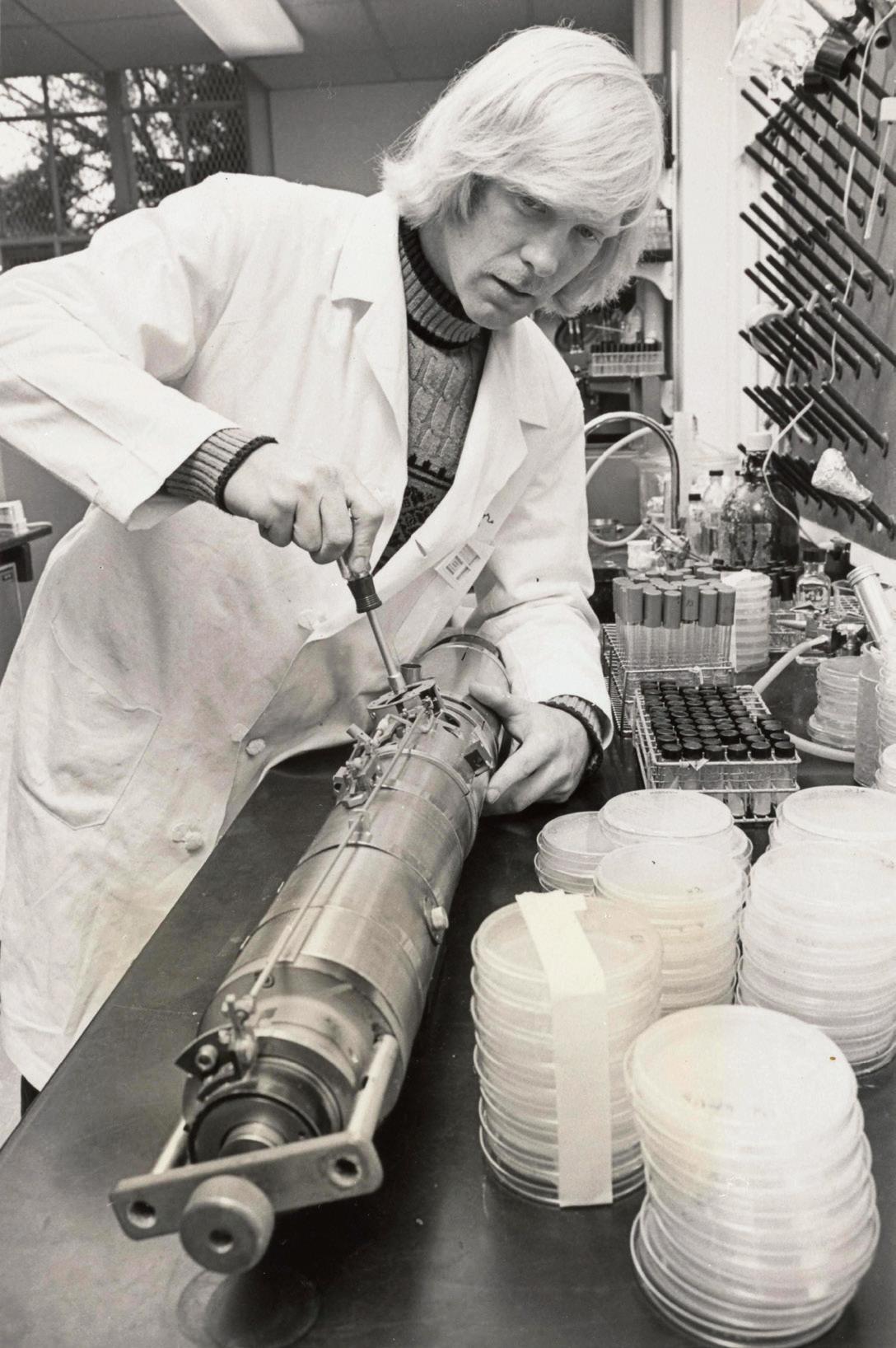
Under Pressure
Ph.D. student Paul S. Tabor works in the late 1970s on a new deep-ocean sampling device he developed with then-microbiology Professor Rita Colwell and researchers from the National Bureau of Standards (now the National Institute of Standards and Technology). Biological samples from miles below the surface had been previously gathered, but the device, which scooped up microorganisms at depths of more than 22,000 feet, was the first that could maintain the water pressure required to keep them alive for study. Colwell, now a Distinguished University Professor in the Institute for Advanced Computer Studies, says it was an exciting time in her lab. “We were able to culture deep-sea bacteria and lay the groundwork for understanding metabolism of bacteria that require high pressure for structural integrity and function,” she said this year. “The research contributed to understanding the extraordinary diversity of life in the deep sea.”
PHOTO COURTESY OF UNIVERSITY ARCHIVES
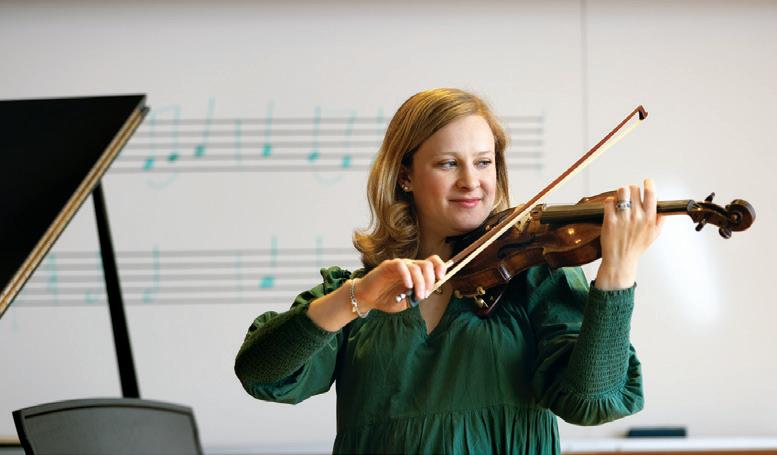
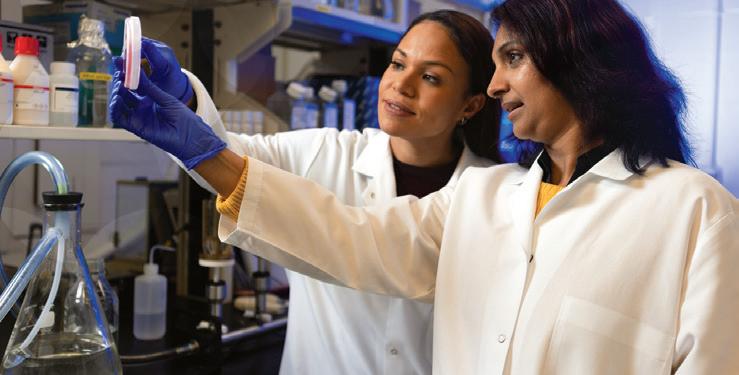
WE’RE DOING A WORLD OF GOOD
WHAT WILL IT TAKE TO SOLVE THE GRAND CHALLENGES OF OUR TIME, LIKE CLIMATE RESILIENCY, LITERACY INEQUITY AND FOOD INSECURITY? Bold, groundbreaking research. Unparalleled teaching and learning experiences that go beyond a classroom. Artists and innovators who fire our imaginations. And a community of diverse perspectives and an open exchange of ideas. As the nation’s first Do Good campus, we bring together scholars, researchers and creators, united in purpose to do good.
It’s all happening now at the University of Maryland. Here, we lead Fearlessly Forward.


