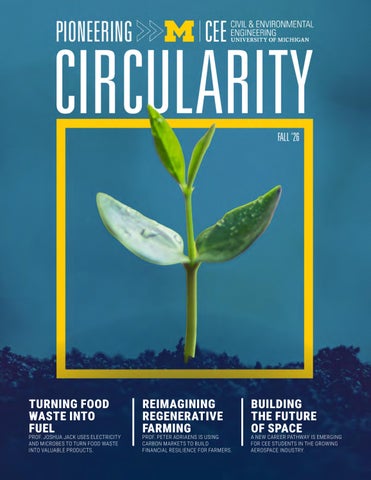
TURNING FOOD WASTE INTO FUEL
PROF. JOSHUA JACK USES ELECTRICITY AND MICROBES TO TURN FOOD WASTE INTO VALUABLE PRODUCTS.
REIMAGINING REGENERATIVE FARMING
PROF. PETER ADRIAENS IS USING CARBON MARKETS TO BUILD FINANCIAL RESILIENCE FOR FARMERS.
BUILDING THE FUTURE OF SPACE
A NEW CAREER PATHWAY IS EMERGING FOR CEE STUDENTS IN THE GROWING AEROSPACE INDUSTRY.
CONTENTS
FALL 2026
2 | PIONEERING CIRCULARITY
CEE Fast Facts
04
Research Articles
06
Faculty Awards
28
Staff News
30
Recent Grads
32
Student Awards
34
Student Organizations
36
Alumni News
38
Retirements
41
In Memoriam
42
Discover our department at a glance, by the numbers.
Explore the groundbreaking research happening in U-M CEE.
Celebrate this year’s awards and honors.
Welcome new staff and recognize award recipients.
Celebrate the Class of 2026 and their achievements.
Recognizing students who earned this year’s top honors.
Catch up on the latest activities from our student groups.
See what our alumni have accomplished this year.
Honoring the faculty who are concluding their careers with CEE.
Remembering alumni & faculty who have passed away this year.
THE REGENTS OF THE UNIVERSITY OF MICHIGAN JORDAN B. ACKER, Huntington Woods MICHAEL J. BEHM, Grand Blanc MARK J. BERNSTEIN, Ann Arbor PAUL W. BROWN, Ann Arbor SARAH HUBBARD, Okemos DENISE ILITCH, Bingham Farms CARL MEYERS, Dearborn KATHERINE E. WHITE, Ann Arbor DOMENICO GRASSO (ex officio)
22
Start a CEE career out of this world
14
Turning regenerative farming into financial resilience
6
U-M CEE explores what circularity means
PIONEERING CIRCULARITY
LETTER FROM THE CHAIR
20
Modeling particles reveals soil density impact on surface fault ruptures
The University of Michigan Department of Civil & Environmental Engineering has reached important milestones this year in research and education. Automation, resilience, and circularity (ARC) are three interconnected themes that reflect our strengths and help guide our future direction as we address evolving societal and technological challenges. Following last year’s edition on resilience, I am pleased to introduce this year’s focus on circularity. Circularity invites us to rethink how we use resources, extend their useful life, and recover value from materials that might otherwise become waste. As demand grows, these approaches can help us use scarce resources more efficiently, reduce costs, and create new economic opportunities. Our faculty and students are advancing this work by finding value in waste and developing systems that keep resources in use. Converting food waste to biofuel, closing carbon loops in construction, and managing water systems more holistically are among the ways they are helping conserve resources and create economic value. Alongside these efforts, CEE continues to advance resilience and automation through new approaches to risk management and applications of artificial intelligence. We are also expanding our educational offerings to prepare students for emerging career opportunities. Our new Minor in AI and Smart Cities, with classes beginning in winter 2027, will help undergraduates understand and apply AI to the infrastructure systems that support daily life. Open to undergraduates across U-M, the minor brings together perspectives from multiple disciplines to prepare students for careers at the intersection of technology, infrastructure, and urban systems. At the graduate level, Michigan Engineering is developing a Master of Engineering in AI+ Engineering, with an anticipated launch in fall 2027. A graduate certificate in AI is being made available as early as Fall 2026. The degree and graduate certificate will combine foundational training in AI with a concentration in an engineering discipline. The CEE concentration will prepare students to apply these tools to the design, operation, and management of infrastructure and environmental systems. These additions build on our longstanding commitment to educating engineers who lead and serve society. As we approach our 190th anniversary in 2027, we take pride in alumni who helped engineer landmarks such as the Flatiron Building and the Ambassador Bridge, and faculty who consulted on projects such as the Mackinac and Golden Gate Bridges. Our alumni continue to distinguish themselves in academia, industry, and public service. This year, department alumnus Domenico Grasso was named the university’s 16th president, continuing this tradition of leadership. We look forward to celebrating our 190th anniversary in 2027 with a symposium and special commemorative materials. I hope you will join us next fall to honor this history and look ahead to the department’s future. Our alumni and friends remain essential to this work. This past fiscal year brought the highest level of donor engagement in three years, reflecting continued support for our mission to educate engineers whose work serves society and the public good. CEE is proud to contribute to the university’s Look to Michigan campaign, launched in October 2024 with a $7 billion fundraising goal to advance education, research, and public service. We are especially grateful for the extraordinary generosity of Paul and Dorothy Ganzenhuber. Their gift of approximately $8 million will support CEE students and faculty for decades to come, helping future engineers address pressing infrastructure and environmental challenges. Their legacy will continue through the students they support and the discoveries their generosity make possible. To propel their vision forward, Krista Wigginton has been named the Paul G. and Dorothy A. Ganzenhuber Professor of Civil and Environmental Engineering in recognition of her outstanding contributions to environmental research and service. This newly established professorship honors the Ganzenhubers’ legacy while supporting work that advances our department’s mission. This year we also have another faculty member receving a Collegiate Professorship. Carol Menassa was named the Robert I. Carr Collegiate Professor of Civil and Environmental Engineering in recognition of her contributions to construction management. We also remember Jim Wight, a respected leader in structural engineering and a dedicated teacher and mentor. His contributions to the Structural Engineering Laboratory and his commitment to students have left a lasting mark on our department and the profession. We will miss him deeply and honor his legacy through our continued dedication to education and service. This spirit of dedication, innovation, and service continues to shape CEE. Through the work of our faculty, students, and alumni, we are rethinking resource use, preparing future engineers, and developing solutions to the challenges facing our communities. I warmly invite you to read on and learn more about the people and ideas advancing this work.
Yafeng Yin, Ph.D. Donald Cleveland Collegiate Professor of Engineering Donald Malloure Department Chair of Civil and Environmental Engineering University of Michigan, Ann Arbor
3
4 | PIONEERING CIRCULARITY
CEE Fast Facts 249 Undergraduate Students 63 Master’s Students 85 PhD Students
41
9:1
189
Faculty Members
Student to Faculty Ratio
Years as a Department
PIONEERING CIRCULARITY
NATIONAL RANKINGS - U.S. NEWS & WORLD REPORT
$14.8M Annual Research Expenditures
#2
Graduate Environmental Engineering Program
#4
Graduate Civil Engineering Program
#3
Undergraduate Environmental Engineering Program
#6
Undergraduate Civil Engineering Program 5
6 | PIONEERING CIRCULARITY
WHAT IS CIRCULARITY?
Story by: Andrew Housman & Mason Hinawi
In a world of finite resources and growing waste, circularity offers an alternative to the traditional “take, make, dispose” model. Circular systems keep water, materials, and nutrients in use by recovering and transforming them rather than treating them as waste. But circularity involves more than recycling. It requires engineers to consider the full life cycle of resources and design interconnected systems that conserve energy, prevent pollution, and create value. Across construction, water, and food systems, University of Michigan Civil and Environmental Engineering faculty are demonstrating what becomes possible when engineering looks beyond disposal and toward recovery.
A Carbon-Neutral Future for Cement Concrete is the world’s second-most-consumed substance after water, and cement production accounts for approximately 7% to 8% of global carbon dioxide emissions. Assistant Professor Jiaqi Li wants to transform cement from a carbonemitting commodity into a carbon-negative one. Producing cement traditionally requires heating limestone and clay to about 1,450 degrees Celsius. Burning fossil fuels to reach that temperature generates emissions, while limestone itself releases stored carbon dioxide as it breaks down. Li is developing an electrochemical process that operates at room temperature. Using electricity, the process produces acids that can extract calcium and other metals from natural rock or construction waste. It also produces bases that capture carbon dioxide from industrial flue gas and cement manufacturing. The recovered calcium and captured carbon dioxide then react to form calcium carbonate—the material conventionally supplied by limestone. According to Li, this approach could
eliminate approximately 60% of cement manufacturing emissions without requiring major changes to the rest of the production process. It may also recover metals used in batteries and semiconductors. “We can produce exactly the same materials, but with significantly lower carbon emissions and the possibility of creating other valuable elements,” Li said.
Turning Trash into Treasure An estimated 30% to 40% of the U.S. food supply goes uneaten. Much of it enters landfills, where it decomposes and generates methane, a potent greenhouse gas. Assistant Professor Joshua Jack is investigating how that waste could instead produce valuable materials. Jack and his team use bioreactors to study the electrochemical stimulation of microbes. These microorganisms can transform food waste into products such as jet-fuel components and pharmaceutical precursors. The technology could eventually recover products from liquid and gaseous waste streams as well. “We hope to inspire people to see waste as a resource, which can be transformed back into something valuable and useful. Perhaps, something even more valuable than the product it came from,” Jack said. As urbanization concentrates people—and their waste— recovering value locally could reduce disposal costs and create revenue for communities. “Nobody wants to spend more money to manage waste,” Jack said. “Politically, socially, and economically, circularity makes a lot of sense.”
PIONEERING CIRCULARITY
Closing the Loop in Wastewater Potable reuse can make water systems more circular by turning treated wastewater into a drinking-water source. Assistant Professor Aleksandra Szczuka is examining how to make that process safer and more effective. Water reuse facilities commonly use reverse osmosis, which forces water through a fine membrane to remove salts, pathogens, and other contaminants. Yet some pollutants— including likely carcinogens such as 1,4-dioxane and haloacetonitriles—can remain after treatment. Szczuka studies non-thermal plasma, an electricity-driven technology that creates highly reactive chemicals capable of breaking down pollutants. Her research revealed an important distinction: A contaminant’s disappearance from water does not necessarily mean it has been destroyed. In some experiments, haloacetonitriles moved from the water into the surrounding air. “A successful system has to consider where pollutants go, whether they are truly destroyed, and how much energy the process requires,” Szczuka said. Her work provides a more rigorous way to evaluate emerging treatment technologies—one that follows contaminants through the entire system rather than measuring only their removal from water.
“We hope to inspire people to see waste as a resource, which can be transformed back into something valuable and useful. Perhaps, something even more valuable than the product it came from.” - Assistant Professor Joshua Jack, U-M CEE
Designing Beyond Disposal For civil and environmental engineers, circularity means challenging the assumption that waste is the inevitable endpoint of a resource’s useful life. It means designing around entire material cycles to recover water, nutrients, energy, and other valuable products while protecting people and the environment. From carbon-negative cement to resource-producing water systems, CEE researchers are building infrastructure that is more efficient, adaptable, and responsive to communities. As resources become more constrained and waste streams grow, circularity offers a path toward a future in which what was once discarded becomes part of the solution.
A Different Kind of Fertilizer Stream Professor Nancy Love is reframing wastewater as a resource, beginning with human urine. Urine contains roughly 80% to 85% of the nitrogen and 60% to 65% of the phosphorus and potassium excreted by humans. Conventional systems dilute those nutrients with potable flush water and mix them with other wastes, creating an energy-intensive treatment burden. “If we think about urine as a nutrient stream instead of a waste stream, we can reduce the energy and cost of treatment while creating products that have value locally,” Love said. Her work explores source separation: collecting nutrients before they become contaminants, processing them locally, and reusing them regionally. At U-M, Love is investigating a “campus as lab” model in which urine collected from a portion of campus users could help fertilize university grounds, athletic fields, and golf courses. Such a system could conserve water, reduce nutrient pollution, and lessen reliance on volatile global fertilizer supply chains. It could also encourage updates to aging plumbing infrastructure, including the installation of urine-separating fixtures.
Nancy Love and her team showcase a new urine sourceseparating toilet at G.G. Brown, designed to separate urine from solid waste for nutrient recovery and fertilizer production.
7
8 | PIONEERING CIRCULARITY
The U-M Campus Farm has become a testing ground for developing technology that could turn food waste into a valuable fuel source. U-M CEE Assistant Professor Joshua Jack and his team are utilizing U-M’s Campus Farm as a Living Learning Laboratory (LLL) to develop novel methods of using excess food waste, crop residues, and agricultural clippings as a sustainable energy source. In 2024, America generated approximately 60 million tons of food waste out of a total of 240 million tons of food, according to the waste management organization ReFed. Additionally, the USDA estimates that approximately 30 to 40% of the country’s total food supply is sent to landfills, where decomposition produces greenhouse gases. To combat this environmental toll, Jack and his team are using a bioreactor located on the Campus Farm to test the efficacy of using electricity to stimulate microbes and convert food waste into valuable fuels and chemicals. The project, which is in collaboration with Matthaei Botanical Gardens and Nichols Arboretum, will also serve to educate local community members about innovations in reducing food waste. The project is part of an interdisciplinary initiative launched by U-M’s Institute for Energy Solutions, which aims to provide faculty, students, and community members with opportunities to participate in research projects with the long-term goal of developing sustainable alternatives to carbon-intensive energy. Electro-fermentation is a novel process in which electrical currents direct microbial fermentation pathways, steering their metabolism toward the production of the most valuable bioproducts with greater selectivity. This method avoids emitting methane, a potent and low-value greenhouse gas that is a common byproduct of anaerobic digestion, a more widespread waste-to-fuel energy source. Instead, electro-fermentation produces caproic acid, an important commodity chemical used as a precursor for sustainable aviation fuels and in pharmaceutical production. Jack explained that the world’s growing population and increasing supply chain entanglements mean that more food winds up in these landfills. Electrofermentation, however, is a potentially viable solution for ameliorating the environmental and economic impacts of food waste. “This is a key step in reducing food waste and fossil fuel use,” he said. The real-world setting will allow the team to explore the still relatively misunderstood process of electro-fermentation. “We’re trying to understand the biomolecular mechanism of how the enzymes or (Continues on page 10)
PIONEERING CIRCULARITY
From Field to Fuel: Giving Food Waste a Power-Up Story by: Andrew Housman
Professor Joshua Jack works at the U-M Campus Farm, where researchers are exploring electro-fermentation as a way to transform food waste into valuable chemicals. The project uses microbial communities and renewable electricity to investigate more sustainable alternatives to conventional chemical production.
9
10 | PIONEERING CIRCULARITY
At the U-M Campus Farm, Jeremy Moghtader works among crops that help support research into food waste and sustainable resource recovery. The project connects agricultural systems with laboratory research to better understand how discarded organic material can become a useful feedstock.
microbes are uptaking electrons, or how they behave in response to the electricity input,” explained Jisu Yang, a U-M CEE PhD student working on this project. She added that, at the same time, the team is exploring how these discoveries can pave the way for real-world use. “We’re also focusing on applicational purposes. We’re trying to see how the microbes are really breaking down the food waste and then how they can synthesize a more valuable product in their cell bodies.” In a previous research project, Yang converted synthetic food waste that mimicked the makeup of urban food waste into caproic acid at high rates. Inspired and informed by this study published in ACS EST Engineering, Yang is moving on to testing the use of organic food waste as substrates for microbes in the fermentation process by introducing lettuce to the bioreactor testbed, with rainbow chard and napa cabbage next on the way. “We are going to compare the performance in terms of product concentration for each crop to understand how these different types of food waste can affect caproic acid production,” said Yang.
In collaboration with Professor Benjamin Goldstein from SEAS and Jeremy Moghtader, program manager at the Matthaei Botanical Gardens and Nichols Arboretum, the team of researchers is currently analyzing the environmental and economic impacts of the project. According to the UNEP Food Waste Index Report from 2024, the total cost of food waste for the global economy is $1 trillion
Jisu Yang prepares samples at the U-M Campus Farm as part of research connecting food waste, microbial communities and electro-fermentation. The team combines field and laboratory work to better understand how biological processes can support more circular approaches to resource recovery.
PIONEERING CIRCULARITY
Haley Kerner collects produce at the U-M Campus Farm, where food waste provides material for experiments in electrofermentation. Researchers are studying how differences in organic waste can affect microbial activity and the production of valuable chemicals such as caproic acid.
A laboratory electro-fermentation system helps the research team study how microbial communities respond to food waste and electrical currents. By monitoring these processes, researchers can evaluate conditions that encourage microbes to convert organic material into higher-value chemical products.
(USD). Jack and his team are thus helping to valorize available resources in order to create a circular economy and give an incentive to produce revenue. “The goal is to bridge the gap between experimenting with using food waste as biofuel and commercialization,” said Jack. “Food waste isn’t free to treat, but we can hopefully offset these costs with high-value products while also giving back value to the community.” Meanwhile, Jack and his team are using the LLL as an opportunity to engage with students and community members through interactive educational programming. Through Campus Farm visits and outreach events, the team is working to publicly
communicate their work. “One of the beauties of this project is that we actually get to have an on-site reactor where people that are visiting the campus farms or the Matthaei Botanical Gardens might be able to actually go and see our reactor in operation,” said Keoni Young, a U-M CEE PhD student who is helping with the public outreach component of the project. “Electrochemistry is not something that I would say is super well-understood by the public, and so it helps to just share how cool it is
that there are bacteria that live in these electrochemically modified environments. It helps to show them what kind of technologies are being developed and studied at the University of Michigan, and what kind of things they can look forward to.” 11
12 | PIONEERING CIRCULARITY
CEE Engineers Advancing New Safety Systems in Automated Vehicles Story by: Andrew Housman
Professors Menassa and Kamat are developing research on self-driving systems to prevent car accidents. CEE Professors Carol C. Menassa and Vineet R. Kamat are working to make automated driving safer, smarter, and more reliable by developing system models that continuously monitor and react to human driver behavior. As self-driving cars become more commonplace, automated driving systems still face roadblocks. Sensors in these cars can indicate when their drivers have taken their eyes off the road, but there is a range of other behaviors to account for in emergencies. As a result, car accidents occur when automated systems fail to detect the precise moments when the driver must take control of the vehicle, and the driver is consequently found unprepared to do so when called upon. “What AV manufacturers therefore currently enforce is something similar to a ‘dead man’s switch,’ and this has currently put a ceiling on what fully autonomous driving can be. For technological and compliance reasons, these cars are thus fighting against themselves,” said Kamat. “If we want true automated driving where drivers can meaningfully engage in secondary tasks, we have to continuously monitor human driver activity passively and not interrupt them frequently to confirm their engagement in the driving task.” Menassa and Kamat, both of whom work in the robotics field, recognize that AI systems must take into account the vast number of variables that make up real-world scenarios. They hope to apply this mindset to their research on automated driving, which must account for a myriad of human psychological and physiological conditions. Kamat refers to “takeover readiness” as the ability of drivers to regain full manual control of their vehicle from an automated driving system when called upon. He explains that car crashes occur in automated-driving incidents because of a discrepancy in the time it takes to notify drivers after the system senses they are distracted. Drivers can thus drift too far from the focus before they are
PIONEERING CIRCULARITY alert enough to take back command of the vehicle in an emergency that requires immediate attention. “There is no way to passively monitor takeover readiness properly if drivers are to be allowed to engage in secondary tasks, meaning drivers can find themselves anything but ready to take over when such situations arise,” he explained. Menassa explains that her and Kamat’s system can monitor drivers’ physical conditions, such as brain activity, heart rate, and skin conductance, to measure specific levels of alertness and distraction in real time. That way, cars can ease their drivers into an appropriate level of takeover readiness, rather than catapulting them into a situation where they cannot react in time. “This data would tell us the level of distraction that the human is at, and we always want to keep them at an acceptable level of distraction during secondary tasks,” she explained. “We’re looking at this data to determine what the correct time is to issue an alert and what level of alert we should issue, so that in case an accident is on the horizon, the driver is always ready and able to take control effectively. This real-time monitoring and assessment will allow us to provide personalized alerts depending on driver characteristics, level of engagement with secondary tasks, and driving scenarios encountered.” Menassa and Kamat hope their research will help usher assisted-driving systems into the next - Professor Vineet R. Kamat, U-M CEE stage of self-driving vehicle automation.
“There is no way to passively monitor takeover readiness properly if drivers are to be allowed to engage in secondary tasks, meaning drivers can find themselves anything but ready to take over when such situations arise.”
13
14 | PIONEERING CIRCULARITY
TURNING REGENERATIVE FARMING INTO FINANCIAL RESILIENCE Story by: Andrew Housman
CEE Professor Peter Adriaens and his research team are developing novel financial instruments that leverage carbon markets in the agricultural sector, granting farmers greater autonomy, incentivizing sustainable farming practices, enabling participation in farm credit, and building both financial and ecological resilience. Farmers typically depend on specialized loans and credits from agricultural banks, alongside federal subsidies established in the U.S. farm bill, to cover operational costs. “Farmers count on having these subsidies to make their business model work,” explained Adriaens. “They apply for operational loans every year, and then they grow and rotate their crops to sell it into the market, where hopefully it makes enough money to both pay back all the loans and also generate them a profit.” The Farm Bill, which Congress negotiates once every five years, includes both general subsidies meant to stabilize the agricultural market and conservation subsidies meant to incentivize using less fertilizer that causes algal blooms in local waterways and the Great Lakes. Adriaens explained that these subsidized loans help regulate prices when consumers shop at their local supermarkets. “We would be paying way more for our lettuce, carrots, and avocados at market pricing. So this is all subsidized pricing,” he said. These Farm Bill subsidies, however, are sensitive to market fluctuations due to trade disputes, supply chain disruptions, and political realignments. Adriaens hopes to both stabilize the agricultural market and improve environmental conditions by incentivizing regenerative agriculture using the financial markets, rather than relying on fickle national agricultural policies alone. Current sustainable farming practices are often financially undervalued, but Adriaens and his team are researching ways to create stronger incentives for adopting these methods. They have engaged partners along the agricultural and financial value chain to make
this work. “When you have a regenerative practice, how does that strengthen the asset base that you will be clarifying to the bank to get a loan at a lower interest rate?” asked CEE PhD student Lis Huang, who works with Adriaens in the Center for Digital Asset Finance. The solution is to show that land can be appraised at a higher value. “We’re hoping to build that kind of support to show the farm credit lender that services these farmers that there is long-term value for both the banks and for the farmers when they’re less susceptible to drought and other natural disasters that cause a dip in profit,” she explained. Traditionally, production is what gives agricultural land value, but Adriaens and his team are researching how to increase and monetize the carbon within the farmers’ soil as an alternative source of land value. “We’re trying to
PIONEERING CIRCULARITY figure out how to put carbon on the balance sheet,” said Huang. The idea is that farmers are guaranteed the right to the stored carbon, or to hold it and increase the value of the land and the crop. The guarantee is established through a carbon warrant between the lender and the farmer, allowing them to sell the carbon and use it as collateral to secure a lower interest rate. “At the point you sign the loan, you also receive a discount as part of the underwriting process because you’re sharing the warrant with the bank, guaranteeing both value in the long term for both parties,” Huang explained. Carbon warrants are a novel financial structure that Adriaens and his team codeveloped with Triangle Digital, a project partner. It won the top digital financial innovation prize at COP30 from the Brazilian Central Bank
in 2025. These agreements support the implementation of regenerative practices and provide contractual options for farmers’ loans. “Farmers get rewarded by changing to a different – carbon integrated – management practice,” Adriaens said. They also ensure that farmers have room to negotiate carbon fees with buyers, which often operate on take-or-pay models. “When a General Mills goes to a farmer and offers two bucks per acre for the carbon on the farm, the farmer has no counter-argument in these pricing negotiations,” Adriaens explained. “So there’s power asymmetry and information asymmetry that we’re resolving.” Instead, the carbon warrant model aims to give farmers as many options for as many benefits as possible, granting them financial autonomy. This strategy also redirects the carbon equivalents associated with fertilizer that flows into the Great Lakes from agricultural runoff back into farmers’ pockets, mitigating an ecological issue with a financial investment. “There is roughly about a billion tons of carbon that drains into the Great Lakes. There’s money left on the table here,” said Adriaens. “We try to essentially take that billion tons of carbon that’s flowing into the Great Lakes, which is up to $60 billion in market value, and we bring it back to the land, to reward the farmers and lenders for adoption of sustainable practices.” Adriaens’ team is collecting data from farm credit services, crop buyers, LimnoTech’s hydrological modeling, and farmers themselves to develop the financial models underpinning these warrants and provide assurances within their framework. The goal is to use sustainable agriculture to help farmers weather economic shocks and gain greater stability. “Implementing a regenerative practice to replace the traditional practice is essentially an additional revenue option. That’s what we call income resiliency,” said Adriaens. “That’s a financial resiliency story for farmers as well as for the lenders to farmers. We’re trying to essentially hedge against climate risk and against policy uncertainties.” The ultimate goal is to ensure that farmers have financial resilience while maintaining the ecological integrity of their land. “Building farmers’ financial resilience means they can continue doing what they do in a more sustainable way, which then translates to the longterm resiliency of the land that they steward rather than just maximizing production and yield as their key metric of success,” explained Huang. “If you’re not focusing on how to build resilient land to be resilient to climate change, then from a long-term planning strategy, the farm is going to suffer, and farmers will be economically harmed.”
15
16 | PIONEERING CIRCULARITY
A FAST METHOD FOR MEASURING HOW WELL AIR DISINFECTION WORKS: SEE HOW IT GLOWS Story by: Jim Lynch
The effectiveness of air disinfection devices may now be measured in minutes, rather than hours, with a new technique from University of Michigan Engineering. This is important for researchers developing better antiviral air purifiers, helping to mitigate outbreaks of viral respiratory diseases and prepare for the next pandemic. The new method harnesses a property known as UV fluorescence, or how molecules absorb UV light, followed shortly thereafter by emission of energy at another wavelength. It turns out viral aerosols shine brighter before disinfection treatment than after. This finding offers the potential to indirectly but rapidly track the performance of air disinfection technologies and more. “Our findings suggest that it may be possible to detect changes in aerosol infectivity in a rapid, realtime manner without tedious laboratory procedures,” said Zhenyu Ma, a U-M postdoctoral research fellow, and first author of the study in Plasma Chemistry and Plasma Processing. “As the field of application for this technology becomes clearer, we could use it to better understand the behavior of pathogenic aerosols and their infectivity, thereby providing essential information for public health guidelines.” The speed of the new approach, developed in the lab of Herek Clack, a U-M associate professor of civil and environmental engineering, is key. The standard method of evaluating an air disinfection process requires
collecting pathogen samples from air before and after treatment. For viruses, it involves exposing host cells to the pathogen sample so that the viruses have something to infect. Then, technicians look for signs of infection through a microscope, a labor-intensive process that yields just a single measurement of air disinfection performance. In contrast, U-M’s approach yields results after several minutes of sampling a small portion of the air stream entering, and then exiting, an air disinfection device or chamber. The sampled air streams flow separately into a device that measures the size of each particle, exposes it to UV light, and measures the intensity of its glow. With
The research team uses specialized equipment to expose aerosolized samples to disinfection treatments and measure changes in their fluorescence. These measurements can be compared with traditional infectivity tests, helping establish whether fluorescence can provide a faster proxy for viral inactivation.
thousands of these measurements taken over a couple of minutes of sampling, naturally occurring particleto-particle variations cause the fluorescence intensity measurements to take the shape of a bell curve. This bell curve shifts to lower intensities as the fraction of viral aerosols inactivated by the disinfection process increases. As a result, researchers can measure the fluorescence intensity of the air sample before and after the disinfection process and compare them to figure out how well disinfection worked. Once the expected shift in the bell curve is known for a particular pathogen, between treated and untreated viruses, the effectiveness determination takes just a few minutes. For researchers like Clack, who develop disinfection processes, this means faster prototyping and testing at different air flow rates, air temperatures, humidity levels and more. “Even as the paradigm has shifted regarding the significance of airborne disease transmission, air disinfection technologies that do not rely on filtering air suffer slow development cycles because of how tedious it traditionally has been to prove how well the pathogens have been inactivated. Having an indirect indicator, properly calibrated, for pathogen infectivity could speed up that development process tremendously,” said Clack. Fluorescence monitoring could also be effective for disinfection tools such as ozone and chlorine, the researchers suggest. But for techniques that disrupt the virus’ genome, such as ultraviolet light, fluorescence will not work. The genome is too deep inside the virus to be reached by these fluorescence detection methods, so their fluorescence signatures don’t change in the same way. Clack’s group studies interactions between aerosols and strong electric fields. These fields produce nonthermal plasmas, or regions containing charged molecular fragments, which damage viruses and render them harmless. Their group has demonstrated that nonthermal plasmas are capable of reducing the number of infectious viruses in flowing air by 99.9% in lab testing as well as at enclosed livestock operations. Clack’s startup, Taza Aya, has prototyped plasma-based respiratory protective gear, currently being tested in a Michigan turkey processing plant.
PIONEERING CIRCULARITY
Justin French and Emily Hong prepare samples in the laboratory while studying how air-disinfection treatments affect viral aerosols. Their work uses fluorescence measurements to provide a faster indication of pathogen inactivation and help researchers evaluate emerging disinfection technologies.
Laboratory equipment records signals produced during fluorescence testing, allowing researchers to quantify how aerosol samples change after disinfection. By collecting rapid measurements across different treatment conditions, the team aims to make testing new air-disinfection technologies faster and more efficient.
17
18 | PIONEERING CIRCULARITY
U-M CEE CO-SPONSORS 2026 BORCHARDT CONFERENCE TO SHOWCASE ADVANCEMENTS IN WASTEWATER TECHNOLOGY Story by: Andrew Housman On May 5 and 6, 2026, the four th floor of the Rackham Building was host to a gathering of the nation’s leading scientists, practitioners, and students in the field of wastewater engineering. U-M CEE brought together representatives from universities, consulting firms, and municipalities to solve pressing challenges and plan for the future of water management. Since its inception in 1983, the event has honored the legacy of Dr. Jack A. Borchardt, P.E., founder of the Sanitary Engineering curriculum at the University of Michigan, and Professor Eugene A. Glysson, who advanced and built par tnerships in wastewater engineering for over for ty years at U-M CEE. Every three years, the event honors their legacies with the Borchardt-Glysson Water Treatment Innovation Prize. The recipient of this year’s award, Zhiyong Jason Ren, whose work in redirecting carbon flows in wastewater management has helped shift the field’s focus to resource recovery, commented on carrying on the work of these innovators. “We’re all reminded of
Attendees gather for a technical session at the 2026 Borchardt Conference, where speakers presented research and emerging approaches to wastewater treatment and resource recovery. The conference combines presentations, poster sessions and discussion to strengthen connections between academic research and industry practice.
Jisu Yang with her award-winning poster, which displays her project on using electro-fermentation to convert food waste into caproic acid resources.
U-M Environmental Engineering undergraduate student Ian Fiero displays his project with Borchardt and Glysson Collegiate Professor Nancy Love on recovering nutrients from recycled urine.
the legacy of Professors Borchardt and Glysson, who taught us that we can make our research more impactful by making a connection with industry. That’s where you put your paper into practice,” he said. The conference also featured a poster competition from student researchers from universities across the country, including U-M students. CEE Ph.D. student Jisu Yang won the third-place prize on Day 2 for her project on recovering valuable byproducts from food waste with bioreactor technology. “The Borchardt Conference is a really nice oppor tunity to meet other colleagues in our field,” she said about discussing her work with conference attendees. “Listening to research talks about environmental engineering topics made me feel honored to be here.” Poster sessions held intermittently between talks helped these students network with exper ts. “I think there’s a lot of really cool projects that are going on here, and it’s just been really fun to walk around and see what everybody’s doing and talk to everybody,” said Environmental Engineering undergraduate student Ian Fiero, who works with Nancy Love on a project collecting nitrogen and phosphorus from urine waste for fer tilizer. “I think everybody’s passionate about this field, so I think it’s just a great experience,” he said.
PIONEERING CIRCULARITY
Other students, like Ph.D. candidate Ruchi Korde from the U-M Depar tment of Microbiology and Immunology, felt excited about the oppor tunity to cross-collaborate with leaders in other disciplines, such as CEE Professor Krista Wigginton, on her project about next-generation sequencing to detect the influence of viruses in water. “I find it really interesting to do this multidisciplinary research that has implications for microbiology, infectious disease, public health,
In addition, AEESP Distinguished Lecturer Dr. David Sedlak, the Plato Malozemoff Distinguished Professor of CEE at UC-Berkeley and Director of the Berkeley Water Center, spoke to the audience about developments in small-scale water treatment systems that could benefit countries with limited financial resources. A host of U-M CEE depar tment members played central roles in hosting and moderating the event. Assistant Professor Alex Szczuka, Assistant
We’re all reminded of the legacy of Professors Borchardt and Glysson, who taught us that we can make our research more impactful by making a connection with industry. That’s where you put your paper into practice. - Zhiyong Jason Ren, 2026 Borchardt-Glysson Water Treatment Innovation Prize recipient CEE Department Chair Yafeng Yin presents the 2026 Borchardt-Glysson Water Treatment Innovation Prize to Zhiyong Jason Ren.
and environmental engineering,” she said. The event’s keynote speakers, Megan Plumlee and Dr. Belinda Sturm, presented on their interrelated work on water treatment and resource recovery. Plumlee, who is Research Director of the Orange County Water District, discussed her agency’s work in treating groundwater PFAs for potable reuse. Dr. Sturm, who serves as the Ross McKinney Endowed Professor in the Depar tment of Civil, Environmental & Architectural Engineering at the University of Kansas, as well as Director of the Kansas National Science Foundation’s EPSCoR program, talked about her research in developing low dissolved oxygen biological nutrient removal to reduce the energy use and operating costs of wastewater treatment plants.
Professor Joshua Jack, and Professor Krista Wigginton served as U-M Representatives on the Borchardt Committee to present the event’s lectures and panels, while staff member Joyce Kennedy served on the Borchardt organizing committee. Lutgarde Raskin, Co-Chair of the U-M Borchardt Committee Representatives board, could be heard ringing a bell at the end of each poster session to signal attendees to return to the auditorium for continuing lectures. At the end of the conference, Raskin handed down her role as Co-Chair and passed her signature bell to Professor Szczuka, whose closing remarks announced her return at the next Borchardt Conference.
19
20 | PIONEERING CIRCULARITY
MODELING PARTICLES REVEALS SOIL DENSITY IMPACT ON SURFACE FAULT RUPTURES Story by: Patricia Delacey
The discrete element method models tens of millions of distinct particles to help understand this rare earthquake hazard and inform resilient civil engineering design. Earthquakes can visibly and permanently crack the ground apart in dramatic and unpredictable surface fault ruptures, but new research led by University of Michigan Engineering revealed that soil density strongly influences how and where they occur. The research team, which includes collaborators at the U.S. Geological Survey (USGS), modeled soil as millions of particles interacting in order to represent the soil above a fault. The first live video of surface fault rupture was captured in Myanmar in March 2025. Because of the absence of other realtime surface fault rupture videos, researchers rely on physical and virtual models to understand this rare hazard. But virtual models have been limited in the degree to which they reflect the behavior of physical sandbox models used in geology laboratory studies. To address that gap, the researchers leveraged the discrete element method, treating soil as a collection of distinct particles that interact more like real soil grains. “Our goal is to quantify and anticipate how surface fault rupture will develop at the ground surface so we can
accommodate the associated ground deformations in civil engineering design or retrofit whenever we cannot outright avoid the hazard,” said Estéfan Garcia, an assistant professor of civil and environmental engineering at U-M and corresponding author of the study published in the Journal of Geotechnical and Geoenvironmental Engineering.
How the discrete element method works Up to this point, most virtual models of surface fault rupture relied on the finite element method. This technique requires the researcher to encode strength and stiffness, and it treats soil as a continuous mesh. The discrete element method instead models soil closer to its true nature as a collection of distinct particles. The discrete element method allows properties like strength and stiffness to emerge naturally from how particles interact based on Hooke’s Law and Newton’s Second Law. Together, these laws describe how forces result from particle contacts
PIONEERING CIRCULARITY and lead to particle motions. This approach makes the virtual models more like virtual experiments for observing complex soil behavior from its fundamental origins in particle-to-particle interactions. “The foundation is basic physics,” said Garcia. “I like that while the numerical integration and simulation programming are more complex, the underlying physics is based on principles taught to first- and second-year undergraduate students.” Each virtual particle is a simplified shape made of three spheres, called elements, clumped together to ensure it cannot roll continuously like a ball or a cylinder. These simplified shapes represent key features of soil: soil grains are threedimensional and non-spherical, and soil is a discontinuous collection of distinct particles. Using the Frontera supercomputer at the Texas Advanced Computing Center, the researchers modeled soil as a collection of 1 million elements, 8 to 10 million elements, and 70 to 85 million elements to analyze the tradeoff between simulation detail and computational demand. The simulations with 85 million elements are the largest geotechnical simulations to date in terms of particle quantity.
The foundation is basic physics. - Assistant Professor F. Estéfan T. Garcia, U-M CEE
Simulations match real-world events The researchers confirmed the realism offered by the discrete element method by showing how the simulation results matched previous physical model experiments. Taking it a step further, they compared their simulations with surface fault ruptures from two real earthquakes— the 2010 Darfield earthquake in New Zealand and the 2019 Ridgecrest earthquake in California. The simulation results were consistent with the real-world occurrences. Broader zones of deformation with multiple distinct ruptures occurred in New Zealand, an area with coarsergrained soils. More localized damage occurred in finer-grained soil in California. As a next step, the research team would like to add more complexity to simulations to more closely represent nature. Currently, the simulation focuses on frictional interactions between particles, but does not include bonding and cementation that could be present in rocky, clayey and much older soil deposits.
Soil density impacts surface fault rupture Simulations represented the physical models that use sand or clay in a box with a movable base to visualize tectonic deformations on a manageable scale. The researchers subjected virtual soils with loose, medium-dense, and dense packing densities to bedrock strike-slip displacements, where tectonic plates move horizontally past one another. “Surface fault rupture during earthquakes can threaten communities and infrastructure, but the physics that control how shallow shear zones form and evolve remain poorly understood. These simulations give us a controlled yet realistic environment where we can directly explore how the physical properties of soils and sediments near a fault influence how rupture develops at the ground surface,” said Curtis Baden, a research geophysicist at the USGS Earthquake Science Center and contributing author of the study. The researchers found that looser soil, which contracts during shearing, confines deformation to a narrower area that propagates vertically above the bedrock fault. Denser soil expands during shearing and produces more widespread deformation with multiple separate ruptures propagating in different directions. The packing density of the soil was the only difference between simulations that exhibited these different soil behaviors. The simulations further showed how very complex soil behaviors and rupture patterns can emerge from simple physics. “We thought that our observations of complex surface fault rupture patterns in nature must result from very complex soil profiles and geologic histories. But we observed such complex patterns even with very simple homogeneous soil profiles and simple displacement boundary conditions. These simulations demonstrate that much of the rupture complexity in nature actually comes from the principles of contraction and dilation in soil mechanics and geotechnical engineering,” said Garcia.
Surface rupture from the 2019 Ridgecrest earthquake sequence in California provides a real-world comparison for the research team’s simulations. The region’s contractive soils produced more concentrated deformation, helping researchers examine how soil density influences the way earthquake ruptures reach the surface.
21
22 | PIONEERING CIRCULARITY
START A CEE CAREER OUT OF THIS WORLD Story by: Mason Hinawi
From spaceports and launch facilities to habitats on Mars, new career opportunities are emerging for civil and environmental engineering students. When students consider studying civil and environmental engineering, they may picture bridges, buildings, transportation systems, clean water, and resilient communities. They might not immediately picture a career in the aerospace industry. But rockets need launch pads. Spacecraft need specialized processing facilities. Spaceports require roads, foundations, power, water, and carefully planned safety zones. Future settlements beyond Earth will need resilient structures and closed-loop environmental systems capable of sustaining life where resources are scarce. For Michigan CEE students, this means that some of the field’s most exciting career opportunities may extend far beyond the infrastructure we see every day, and perhaps beyond Earth itself. “People think of SpaceX as a rocket company,” said Kiko Dontchev, a University of Michigan aerospace engineering alumnus and vice president of launch at SpaceX. “It’s really an infrastructure company.” Although Dontchev trained as an aerospace engineer, much of his work involves infrastructure, including launch pads, large structures and vehicle-processing facilities. These projects also depend on transportation, energy, water, and environmental systems,
and on engineers who can bring those pieces together. “I think civil and structural engineering is going to be one of the hottest and most indemand areas over the next five to 10 years,” he said. “It is by far one of the most challenging areas in which to find talent right now.” Consider the challenge of developing a spaceport. Like an airport, it requires careful land-use and transportation planning. Unlike a conventional airport, it also must accommodate the extreme heat, vibration, acoustics, and safety requirements of rocket launches. “How do you build a spaceport?” Dontchev asked. “How do you do the land development and then the actual civil and structural design? I don’t think many students have that on their radar.” Civil engineers must determine where to place launch pads, vehicle-processing facilities, and utilities. They must design foundations and structures for unusual loads while accounting for drainage, coastal hazards, severe weather, and long-term resilience. Construction engineers must then turn those plans into reality safely and efficiently. Environmental engineers are equally important. Aerospace infrastructure must be
designed with nearby communities, wildlife, and natural resources in mind. “There’s a huge environmental piece,” Dontchev said. “There are acoustics and noise. There is wildlife mitigation when you’re developing less-developed areas. And there is the question of how to make these facilities as environmentally low-impact as possible.” The role of environmental engineering becomes even more critical when a mission moves beyond Earth. Reaching the Moon or Mars is only the beginning; sustaining people there will require systems that continually recover limited resources, maintain clean air and water, support food production, and manage waste and contaminants. “Environmental engineering maps to space applications more closely than we might expect: in space, we will need closed-loop life support, which includes resource recovery, air purification, agricultural contamination control, amongst many others,” said Alex Szczuka, assistant professor of environmental engineering in Michigan CEE. “These are all challenges that environmental engineers tackle on Earth, and our solutions will translate well to extraterrestrial exploration.” A habitat on another world cannot rely on conventional systems in which resources are used once and discarded. It must function
PIONEERING CIRCULARITY
If I could talk to all the freshmen and they said, ‘I want to work at SpaceX,’ I would tell them to go get a civil degree. —Kiko Dontchev, vice president of launch at SpaceX
more like a closed ecosystem, recovering water, nutrients, and other materials and returning them to productive use. Environmental engineers can design those processes, monitor risks to human health and help ensure essential systems remain reliable. The benefits can flow in both directions. Technologies developed for resourceconstrained space missions could contribute to more efficient water treatment, resource recovery, and food production on Earth. At the same time, the solutions environmental engineers are already developing for communities here could provide the foundation for sustaining life elsewhere. Michigan Engineering students will explore these connections in an Engineering 100 course on extraterrestrial habitation taught by Jeff Scruggs, professor and associate department chair of graduate programs in Michigan CEE. Scruggs studies intelligent, self-powered infrastructure that can sense changing conditions, respond to disruptions and, in some cases, harvest energy from its surroundings. His research encompasses structural control during earthquakes and high winds, oceanwave energy, wave-powered desalination, and intelligent water systems. “An extraterrestrial habitat cannot be treated as a passive structure,” Scruggs said. “It must monitor its condition, respond intelligently to uncertain events and manage
limited energy and resources with very little outside support. In many respects, it represents the ultimate challenge in resilient, autonomous infrastructure.” His Engineering 100 course will invite students to approach extraterrestrial habitation as an integrated civil and environmental engineering problem. Structures, water, energy, environmental controls, sensing, and human safety must function together, often with little opportunity for outside maintenance or repair. “Extraterrestrial habitation does not fit neatly within one engineering discipline,” Scruggs said. “Students have to connect structural engineering, environmental systems, controls, energy and risk—and understand how every design decision affects the resilience of the whole system.” While the course looks beyond Earth, its lessons are relevant to infrastructure closer to home. Communities also need buildings and water systems that can withstand uncertain hazards, operate with limited resources and recover from disruptions. Designing for the extreme conditions of space can help engineers rethink how infrastructure performs on Earth. For Michigan CEE students fascinated by space, Dontchev offered direct advice: They do not need to switch to aerospace. Civil and environmental engineering may provide precisely the expertise that aerospace
employers need. “If I could talk to all the freshmen and they said, ‘I want to work at SpaceX,’ I would tell them to go get a civil degree,” he said. Dontchev also encouraged students to pursue hands-on experiences such as the Michigan Steel Bridge Team, where they can apply engineering fundamentals, build alongside their peers and demonstrate what they can accomplish. “I want to see that someone did the hardcore engineering and technical work,” he said. “You don’t have to have all the skill sets to walk in the door at SpaceX. We get to teach you a lot, but you have to have the right attitude.” Civil and environmental engineering has always enabled human possibility by creating safe structures, clean water, reliable transportation and resilient communities. Today, that mission is expanding to include spaceports, intelligent infrastructure, and extraterrestrial habitats. “You are the future,” Dontchev told Michigan students. “Work hard to be the best you can be, because if you do that, your opportunities will be endless.” Whether that future begins in a Michigan CEE classroom, at a launch site, or someday on another world, civil and environmental engineers will help build the systems that make it possible.
23
24 | PIONEERING CIRCULARITY
HONORING THE LEGACY OF PAUL & DOROTHY GANZENHUBER Story by: Mason Hinawi
U-M Alumni donate a transformational gift of approximately $8 million to U-M Department of Civil & Environmental Engineering. U-M CEE is honored to celebrate the legacy of Paul and Dorothy Ganzenhuber whose lives were marked by love, creativity and a deep commitment to service. Their remarkable generosity to CEE marks a defining moment in the department’s history, empowering innovation, expanding opportunities and elevating our mission for generations to come. Paul and Dorothy first met as students at the University of Michigan. Paul was pursuing civil engineering and Dorothy was flourishing in the arts. A chance meeting on campus blossomed into a partnership that spanned more than sixty years. Their
relationship was rooted in mutual respect, shared pursuits, and a passion for making a difference. Dorothy went on to become a remarkable artist, capturing vivid landscapes and delicate florals in her paintings. Paul devoted his professional life to public service as a civil engineer, working steadily to improve infrastructure and champion sustainable solutions, especially for safe and clean water. Their journey together was defined not only by personal achievement, but by acts of kindness and generosity that enriched the lives of friends, family, and their communities. Though they did not have children, Paul and Dorothy extended warmth and compassion far beyond traditional boundaries, shaping countless relationships, and making positive contributions wherever they went. Paul maintained a strong connection to his alma mater and firmly believed in the power of education to solve society’s most urgent challenges. Together, he and Dorothy envisioned a future in which new generations of engineers would be empowered to lead by developing resilient infrastructure and promoting environmental stewardship for the greater good.
The Ganzenhubers’ extraordinary multi-million-dollar gift to the Department of Civil & Environmental Engineering will have a lasting and far-reaching impact. Their support enables the department to embark on transformative new initiatives, from expanding student scholarships and advancing groundbreaking research to attracting outstanding faculty who will guide the next generation of Michigan engineers. The proceeds from the Paul G. Ganzenhuber Trust have been carefully allocated to support three distinct and impactful initiatives: •
$5,000,000 will establish the Paul G. and Dorothy A. Ganzenhuber Professorship Fund, supporting faculty professorships in civil and environmental engineering. This fund will empower two faculty positions, each carrying the Ganzenhuber name, allowing the department flexibility to meet evolving educational and research needs.
•
$2,000,000 will create the Paul G. and Dorothy A. Ganzenhuber Fellowship Fund, enabling financial support for graduate students pursuing a PhD in civil engineering. Student recipients of these fellowships will be recognized as Ganzenhuber Fellows, advancing cutting-edge research and leadership within the field.
PIONEERING CIRCULARITY •
Approximately $1,000,000 will go toward the Paul G. and Dorothy A. Ganzenhuber Endowed CEE Department Chair’s Discretionary Fund, providing resources for the department chair to address immediate priorities and emerging opportunities in support of the department’s strategic mission.
Reflecting on this remarkable gift, Dr. Yafeng Yin, Donald Malloure Department Chair of Civil & Environmental Engineering, shared: “The extraordinary generosity demonstrated by Paul and Dorothy Ganzenhuber is deeply inspiring and will have a lasting impact on our department. Their vision and commitment empower us to advance research, inspire innovation, and support future generations of students and faculty. We are profoundly grateful for this gift, which will ensure that U-M CEE engineers are equipped to solve society’s most pressing challenges for decades to come.” In honoring Paul and Dorothy and their legacy, we recognize not only their profound generosity but also their unwavering belief in the importance of community and the transformative power of education. Their story and their example will continue to guide and inspire the department and all who are committed to building a better, more sustainable future.
Their vision and commitment empower us to advance research, inspire innovation and support future generations of students and faculty.
Krista Wigginton Receives Newly Established Paul G. and Dorothy A. Ganzenhuber Professorship
U-M CEE is proud to announce that Professor Krista Rule Wigginton has been approved by the Board of Regents as the Paul G. and Dorothy A. Ganzenhuber Professor of Civil and Environmental Engineering, effective March 1, 2026. The title acknowledges and celebrates Wigginton’s outstanding contributions to research on pathogenic viruses and water contaminants. Her work has helped to advance the detection and understanding of these viruses in natural and engineered environments to reduce their spread, as well as to modify wastewater treatment processes to remove chemical and biological contaminants. She has supplied her research to a wide range of interdisciplinary applications, including water reuse, public health surveillance, and environmental virology.
Read more:
- Dr. Yafeng Yin, Donald Malloure Department Chair of CEE
Paul and Dorothy Ganzenhuber on their wedding day
25
26 | PIONEERING CIRCULARITY
NEW
AI & SMART CITIES MINOR PREPARES U-M STUDENTS FOR EMERGING CAREERS IN INFRASTRUCTURE, TECHNOLOGY, AND URBAN SYSTEMS CEE is offering the program to give students across U-M an interdisciplinary pathway into the growing intersection of AI, infrastructure, and urban systems. U-M CEE is excited to offer a Minor in AI and Smart Cities. The minor gives students a pathway to explore how artificial intelligence, data, sensing, and infrastructure are reshaping the cities and systems people rely on every day. Although the program is offered through the Civil & Environmental Engineering department, it is intentionally interdisciplinary and designed for students across the U-M campus. Though open to all U-M undergraduates, the program is designed to supplement specific majors such as engineering, computer science, public policy, and urban planning. This aims to provide these students with the additional expertise needed to enter an increasingly competitive job market. AI and Smart Cities will provide students with an overview of how artificial intelligence can be applied to urban infrastructure systems through sensing, smart infrastructure, and machine learning. Applications include power grids, water distribution, transportation, and other shared urban systems. CEE Associate Professor Seymour Spence, who is spearheading the program, said the minor was developed to help undergraduates explore career pathways that are already emerging across infrastructure, technology, mobility, utilities, consulting, digital services, and related sectors. “There are a lot of examples of our PhD students and master’s students going into diverse sectors like transportation companies, technology, and the digital services sector,” said CEE Associate Professor Seymour Spence. “We want to make sure that students can begin gaining that coursework and that perspective, at the undergraduate level, and explore these opportunities earlier, without having to get a PhD.” Spence explained that the program’s interdisciplinary nature will expose students from diverse academic backgrounds to shared questions at the intersection of AI, infrastructure, and urban systems. “Anybody coming from outside of engineering is going to be exposed to infrastructure-related ways of thinking, but they’re going to learn about them within a more general space, and within this rapidly evolving domain,” he said. “We’re beginning to see the possibility of training students for roles that work at the intersection of AI and civil infrastructure.” Students pursuing the minor will complete three core courses: Sensing and Data Acquisition, Introduction to Smart Infrastructure Systems, and Machine Learning for Infrastructure Systems. Together, these courses introduce students to how infrastructure data is collected, how smart systems are designed and evaluated, and how machine learning can be applied to infrastructurerelated challenges. Students will also complete at least six elective credits, allowing them to tailor the minor to their interests. Spence noted that AI and Smart Cities offers students an exciting opportunity to get involved in a rapidly evolving, increasingly important field. “We want Michigan to be at the forefront of this transformation in engineering and infrastructure education, and that’s not just in civil engineering, it’s in all engineering. And we are very well positioned for that, because our faculty and university community bring strength across multiple disciplines connected to this space, so we are in a very strong position.” Students will be able to take classes for the minor starting Winter 2027.
PIONEERING CIRCULARITY
AI + ENGINEERING:
BUILDING AI SKILLS FOR THE ENGINEERING WORKFORCE As artificial intelligence reshapes engineering practice, Michigan Engineering is launching new AI+ Engineering graduate programs that pair AI fundamentals with discipline-specific expertise. The program will prepare civil and environmental engineers to develop and deploy AI-driven solutions for the planning, design, operation, and management of resilient, sustainable, and intelligent infrastructure systems. Designed for both recent graduates and working professionals, the programs offer flexible oncampus and online options across seven engineering concentrations, including civil and environmental engineering. CEE launched the AI+ graduate certificate in fall 2026, with additional certificate programs rolling out in other engineering departments through 2027. The 30-credit Master of Engineering curriculum has three parts: Fundamentals in AI and Machine Learning (12 credit hours), Applying AI in Discipline (12 credit hours), and a group of electives called Knowledge Extensions (6 credit hours). The program is designed to help engineers apply AI to real-world
systems and physical environments, but students will also benefit from interdisciplinary studies in computer science, robotics, data science, and sustainability, among other areas, based on their individual interests. Transcripts and diplomas will list the degree as Master of Engineering in Artificial Intelligence Engineering, along with the name of the engineering discipline concentration the student chooses. For working professionals seeking a shorter pathway, the 12-credit AI+ graduate certificate provides focused training in AI fundamentals and their application to a specific engineering field. The certificate is also “stackable,” as all 12 credits can count toward the corresponding M.Eng., allowing students to build their credentials toward a future master’s degree. The AI+ program aims to help increase AI competency and workplace readiness for students from all walks of life, preparing engineers for emerging technologies and their applications within complex frameworks and systems.
27
28 | PIONEERING CIRCULARITY
Faculty Honors Jeremy Bricker
Joshua Jack American Academy of Environmental Engineers and Scientists 40 Under 40 Recognition (2026)
CEE Rising Star Award
Seth Guikema National Academies of Sciences, Engineering, and Medicine Committee Appointment
Roman Hryciw
Valeriy Ivanov CEE Outstanding Achievement Award
ASCE Geo Institute President’s Award
Vineet Kamat Vice President for Publications, International Association for Automation and Robotics in Construction (IAARC)
Branko Kerkez
Christian Lastoskie
2026 Provost’s Teaching Innovation Prize
Rackham Master’s Mentoring Award
PIONEERING CIRCULARITY
Nancy Love Distinguished Faculty Achievement Award
Jason McCormick
Carol Menassa
Staff Faculty Partnership Award
Robert I. Carr Collegiate Professorship
Herbert Kopf Service Excellence Award
ASCE Construction Management Award
Rachel O’Brien CEE Departmental Faculty Award
Jeremy Semrau
Henry Liu
CEE Outstanding Achievement
Fellow, Institute of Electrical and Electronics Engineers (IEEE)
Seymour Spence Featured Paper Award, Engineering Structures
Siqian Shen
Max Li
Fellow, Institute of Industrial and Systems Engineers (IISE)
NSF CAREER Award
Senior Member, Institute of Electrical and Electronics Engineers (IEEE) Focused Issue Editor, IISE Transactions
Yafeng Yin ASCE Frank M. Masters Transportation Engineering Award (2026) Co-Editor-in-Chief, Artificial Intelligence for Transportation, Elsevier
Aleksandra Szczuka
Steve Skerlos
CEE Rising Star Award
JEE Wickenden Award (2025)
29
30 | PIONEERING CIRCULARITY
STAFF AWARDS
2025 CEE Living Our Values Award
2026 CEE Staff Excellence Award U-M CEE is proud to announce that Amy Shepherd, Senior Administrative Assistant and Assistant to the Department Chair, has received the 2026 CEE Staff Excellence Award for her outstanding work in providing administrative support to the Department Chair, as well as her years-long service on the CEE Alumni Engagement and Partnerships Committee. Since joining CEE in 2017, Amy has been crucial to running the department’s daily operations in her role managing the Chair’s calendar, taking minutes at faculty meetings, organizing departmental events, supporting the Honors and Awards Committee, assisting with promotion and tenure materials, processing donor thank-you letters, reconciling P-Cards, and processing reimbursements. In addition, Amy’s role on the Alumni Engagement and Partnerships Committee in developing and implementing initiatives to enhance alumni engagement has provided pivotal support for the CEE Department’s alumni relations. Congratulations to Amy on receiving this award for her outstanding achievements, excellence, and demonstration of Michigan Engineering values.
U-M CEE is proud to announce a slate of award nominations for department members that best embody the College of Engineering values in their work ethic. Congratulations to Marketing Specialist Mason Hinawi, Engineering Technician Tobias Pace, and Senior Undergraduate Coordinator Lynn Shock for receiving the 2025 CEE Living Our Values Award. Mason Hinawi, who joined CEE in February 2020, has demonstrated immense creativity in his marketing strategies. He has challenged the status quo and helped design essential marketing products, such as podcasts, TikTok-style short videos, and research spotlights, that promote diversity of community viewpoints and innovation. Mason also collaborates across multiple teams to foster inclusivity and engage in open professional dialogue that cultivates trust among team members. Tobias Pace has embodied the college’s values since enthusiastically taking on the role of Engineering Technician in 2024. Tobias has built trust and collaboration with students, faculty, staff, and external groups through his caring and encouraging demeanor. Notably, he has trained the Concrete Canoe and Timber Strong teams in the use of power tools, paving the way for Timber Strong’s victory. Lynn Shock exemplified leadership in her nearly 30 years of work at U-M by organizing course registration and academic onboarding initiatives, including orientation and recruitment. Her unwavering dedication to the student body has ensured that all students have equitable access to resources that help them seamlessly navigate their academic careers. Congratulations to Mason, Tobias, and Lynn for their outstanding achievements and excellence.
PIONEERING CIRCULARITY
NEW STAFF Shari Emhoff
Karen Klingensmith Unit Administrator
Student Services Assistant
Karen Klingensmith serves as the Unit Administrator for CEE, overseeing the department’s administrative, financial, and human resources operations and supporting faculty, staff, and students. She earned her Master of Business Administration (MBA) from Madonna University and enjoys applying her leadership and organizational skills to help the department achieve its goals. Outside of work, Karen has a passion for travel and loves exploring new destinations, experiencing different cultures, and creating lasting memories with family and friends.
Shari Emhoff serves as a welcoming and reliable resource for students, faculty, and visitors. She is dedicated to creating meaningful connections while providing support throughout the student experience. Shari enjoys finding ways to foster a positive community that helps students feel supported as they navigate their academic journey with confidence. She enjoys spending time with her husband and three children, especially outdoors, and reading good books.
Holly Holland Student Services Assistant Holly Holland supports undergraduate and graduate programs at CEE, with a particular focus on graduate student services. She earned her Master of Public Policy (MPP) from the University of Michigan and brings extensive experience in service-oriented roles. Holly is excited to contribute to a positive student experience at CEE. In her free time, she enjoys Irish dancing, reading, and baking.
Brandon Ferro
Albert Richlie
Research Lab Specialist Associate
Research Lab Specialist
Brandon Ferro is a Research Lab Specialist Associate in the Wigginton/Eisenberg lab, where he works in wastewater-based epidemiology. His background in research has focused on wastewater surveillance, environmental microbiology, and public health. He graduated with a BS in Environmental Science from Eastern Michigan University in 2022 and an MS in Environmental Biology from SUNY College of Environmental Science and Forestry in 2024. In his free time, he enjoys spending time with friends and family and exploring new restaurants.
Albert Richlie is a Research Lab Specialist technician in the Wigginton Lab, working on biosensor validation and transcription efficiency. He graduated from CU Boulder with a BS in Biochemistry and Neuroscience. He previously worked with the United States Geological Survey and wrote his honors thesis on biofilm EPS quantification. His favorite hobbies are running marathons, cooking, and playing guitar.
31
32 | PIONEERING CIRCULARITY
RECENT FALL 2025 - WINTER 2026
GRADUATES
UNDERGRADUATE DEGREES Kareen Alvarez — Civil Engineering BSE Kaitlyn Aprill — Civil Engineering BSE Noah Arsulowicz — Civil Engineering BSE Ayeyi Asamoah Manu — Civil Engineering BSE Elizabeth Borg — Civil Engineering BSE Neil Broide Befeler — Civil Engineering BSE Guillermo Corral Tobio — Civil Engineering BSE Spence Cottrell — Civil Engineering BSE Samantha Doerr — Civil Engineering BSE Jacob Droski — Civil Engineering BSE Jack Easterday — Environmental Engineering BSE Avery Fields — Environmental Engineering BSE Ian Fiero — Environmental Engineering BSE Tyler Fong — Civil Engineering BSE Lucia Font — Civil Engineering BSE Caleb French — Civil Engineering BSE Meredith Gallagher — Environmental Engineering BSE Quincy Garrow — Environmental Engineering BSE Natalie Garvey — Civil Engineering BSE Lizbeth Gonzalez — Civil Engineering BSE Manush Gopal — Environmental Engineering BSE Megan Gutierrez — Civil Engineering BSE Mary Hallal — Environmental Engineering BSE Daniel Haskell II — Environmental Engineering BSE Ethan Johnson — Civil Engineering BSE Tushaar Kapoor — Environmental Engineering BSE Amy Karlsen — Civil Engineering BSE Eathan Klar — Civil Engineering BSE Tyler Klinkman — Civil Engineering BSE Cara Kolwich — Environmental Engineering BSE Gregory Koontz — Environmental Engineering BSE Desirae Krzeczkowski — Environmental Engineering BSE Hannah Kueffner — Environmental Engineering BSE Kristen Kwan — Civil Engineering BSE Eric Li — Civil Engineering Minor Clara Liao — Environmental Engineering BSE Hailey Luke — Environmental Engineering BSE Jacob Lyons — Civil Engineering BSE Alexa Martell — Civil Engineering BSE
Elizabeth Meilinger — Civil Engineering BSE Zenab Memon — Environmental Engineering BSE Joshua Mock — Civil Engineering BSE Adna Mohamed Saed — Civil Engineering BSE Zayd Mohamud — Civil Engineering BSE Esther Murray — Civil Engineering BSE Ella Palmer — Civil Engineering BSE Isabella Paparella — Environmental Engineering BSE Kaeya Patel — Civil Engineering BSE Patrick Periard — Environmental Engineering BSE Yocelyn Perez — Civil Engineering BSE Emily Pytell — Environmental Engineering BSE James Ransler — Civil Engineering Minor Kensington Richards — Civil Engineering BSE Emma Robledo — Civil Engineering BSE David Roshu — Environmental Engineering BSE Prudence Russell — Environmental Engineering BSE Avery Sanchez — Environmental Engineering BSE Weston Schroeder — Environmental Engineering BSE Delaney Schultheiss — Environmental Engineering BSE Owen Schwartz — Civil Engineering BSE Nickolas Skiver — Civil Engineering BSE Sara Soluk — Environmental Engineering BSE Nathaniel Steever — Civil Engineering BSE Cali Streeter — Civil Engineering BSE Lee Sun — Civil Engineering BSE Olivia Sweik — Environmental Engineering BSE Anna Sychta — Environmental Engineering Minor Liliana Szalai — Environmental Engineering BSE Joshua Tracy — Environmental Engineering BSE Sabrina Van Putten — Environmental Engineering BSE Briana VanderVelde — Environmental Engineering BSE Calvin Veith — Environmental Engineering BSE Katrina Walbridge — Civil Engineering BSE John Watha — Civil Engineering Minor Ayanna Wu — Environmental Engineering BSE Jesse Yang — Environmental Engineering BSE Jack Zubalik — Civil Engineering BSE
PIONEERING CIRCULARITY
GRADUATE DEGREES Muhammad Siddiq Abdulloh — Civil Engineering MSE Khikmatullokh Akhmedov — Civil Engineering MSE Eva Albalghiti — Environmental Engineering PhD Nuha Alfahham — Environmental Engineering PhD Garrett Alston — Environmental Engineering MSE Pavani Anand — Civil Engineering MSE Kera Baad — Environmental Engineering MSE Irtaza Badar — Civil Engineering MSE Daniel Bagryantsev — Construction Eng & Mgt MSE Owen Baldwin — Environmental Engineering MSE Diana Barriga — Civil Engineering MSE Anuradha Bezwada — Environmental Engineering MSE Kendall Biggs — Structural Engineering MEng Alana Boelter — Environmental Engineering MSE Mekhi Adisa Boulware — Environmental Engineering MSE Yi Cao — Environmental Engineering PhD Nicholas Carlson — Smart Infrastructure Finance MEng Mira Chaplin — Environmental Engineering PhD Pranav Chaudhari — Civil Engineering MSE Yuzhou Chen — Civil Engineering MSE Dharm Desai — Civil Engineering MSE Mariana Isabel Fernandez Correa — Environmental Engineering MSE Jackson Frankel — Environmental Engineering MSE Mohammed Gealani — Construction Eng & Mgt MSE Andrew Hardy — Civil Engineering MSE Charles He — Civil Engineering MSE Luke Herberger — Civil Engineering MSE Samuel Hillenmeyer — Structural Engineering MEng Yixin Hong — Construction Eng & Mgt MSE Weichen Huang — Environmental Engineering PhD Gauri Jere — Environmental Engineering MSE Zachary Jerome — Civil Engineering PhD Brianna Jimenez — Environmental Engineering MSE Changyoon Jun — Environmental Engineering PhD Jai Kedia — Civil Engineering MSE Saumya Khanal — Civil Engineering MSE Taeksang Kim — Civil Engineering PhD Yeon Sam Kim — Civil Engineering PhD Yeaseul Kim — Environmental Engineering MSE Jenna Kutscher — Environmental Engineering MSE Kristen Kwan — Civil Engineering MSE Ruo Lan — Civil Engineering MSE Jordan Landis — Environmental Engineering MSE
Kaming Leung — Civil Engineering MSE Runfeng Lin — Construction Eng & Mgt MSE Shyh-Jiun Lin — Civil Engineering MSE Kuang Chieh Lin — Smart Infrastructure Finance MEng Jingqing Liu — Structural Engineering MEng Tianming Liu — Civil Engineering PhD Qiyan Liu — Environmental Engineering PhD Hailey Luke — Environmental Engineering MSE Ainundhiya Nabilla Maharani — Smart Infrastructure Finance MEng Huda Mannath — Civil Engineering MSE Daniela Martinez — Environmental Engineering MSE Madylin McLean — Civil Engineering MSE Wanxuan Ming — Environmental Engineering MSE Abigail Grace Monahan — Environmental Engineering MSE Raili Nelson — Civil Engineering MSE Adam Nix — Environmental Engineering MSE Emma Noraian — Civil Engineering MSE Kieran Parikh — Civil Engineering MSE Ayesha Patel — Construction Eng & Mgt MSE Ayush Sandipbhai Patel — Construction Eng & Mgt MSE Kathan Patel — Construction Eng & Mgt MSE Ved Dipal Patwa — Construction Eng & Mgt MSE Lily Pegg — Environmental Engineering MSE Patrick Periard — Environmental Engineering MSE Weijie Qin — Civil Engineering MSE Mark Remell — Civil Engineering MSE Jose Sapriza Melgarejo — Civil Engineering MSE Olivia Sherman — Environmental Engineering MSE Charles Luther Smith — Environmental Engineering MSE Mahanthesh Sreekantamurthy — Construction Eng & Mgt MSE Marta Nguyen Struve — Environmental Engineering MSE Aaron Sugarman — Civil Engineering MSE Yiming Tan — Environmental Engineering MSE Xiaojun Tang — Environmental Engineering MSE Olivia Therese Teodoro — Environmental Engineering MSE Binyu Wang — Civil Engineering MSE Andrew Wohlford — Civil Engineering MSE Liuyun Xu — Civil Engineering PhD Yifan Xu — Civil Engineering PhD Shuxuan Yuan — Civil Engineering MSE Evan Zalek — Environmental Engineering MSE Xiaoshan Zhou — Civil Engineering PhD James Zittel — Construction Eng & Mgt MSE
33
34 | PIONEERING CIRCULARITY
STUDENT
AWARDS
Zachary Chaussee •
George M. Landes Prize for Technical Communication
Natalie Garvey
ASCE Student Teams • • •
•
Timber Strong: 1st Place Steel Bridge: 3rd Place Concrete Frisbee: 1st Place
Distinguished Academic Achievement (Undergraduate)
Min-Chun Han • •
Barbour Scholarship Rackham International Student Fellowship
Mary Hallal •
Layla Ibrahim
Student Paper: 2nd Place
•
Distinguished Academic Achievement (Undergraduate)
•
James F. Lu World Fellowship
Taeho Kim •
Rackham Predoctoral Fellowship
Sharon Kim •
Jai Kedia
Rackham Merit Fellowship
Abel Melese •
Bridge to PhD
PIONEERING CIRCULARITY
Renisha Karki •
Barbour Scholarship
•
Tishman Master’s Fellowship
Joseph Lybik •
Towner Prize for Distinguished Academic Achievement
Rackham International Student Fellowship Winner
•
Walker Fellowship
Distinguished Leadership Award Graduate
•
Pelham Fellowship
•
Walker Fellowship
•
Cooley Writing Contest Essay
•
Rackham Predoctoral Fellowship
•
Walker Fellowship
Pelham Fellowship
Wayne Tu •
Rackham International Student Fellowship Winner
Gunwoo Yong
Nathaniel Steever •
CEE Master’s Fellowship
Meredith Gallagher
Yifan Xu
Ian Henke •
Towner Prize for Distinguished Academic Achievement
Oliver Kayi
Adalia Schafrath-Craig
Adna Mohamed Saed
Emma Robledo •
•
Margaret Miles
Alex Song •
Tianming Liu
Spence Cottrell
•
Rackham Predoctoral Fellowship
Congratulations to our 2026 Undergraduate Scholarship Award Recipients Bartus Scholarship: Jack Easterday, Avery Fields, Ian Fiero, Natalie Garvey, Weston Schroeder, Liliana Szalai, Briana VanderVelde, Eleanora Andre, Brock Beemer, Ryan Buchanan, Kian Catabian, Kaelyn Halverson, Suhas Karri, Vincent Machado, Apoorva Narahari, Keagen Papke, Diya Patel, Kyle Schlaff, Kevin Lema, Ella Stangl, Spencer Austin, Charles Taylor, Yafate Desta, Isabel Gee, Marina Campoy-Lovasco, Chloe Cash, Marina Klemm, Colin Madden, James Vancamp, Rawan Fakih, Aaron Teal and Kay Youmans Beavers Heavy Construction Scholarship: Ethan Zupancich Construction Management and Sustainability Scholarship: Brayden Morioka, Bronson Morioka, Felicia Ambrogi, Max Vollmert and William Bushey Edward V. Schulhauser Scholarship: Felicia Ambrogi Frank J. Lemper Scholarship: Michael Fox, Willow Hwang, Amanda Bryant, Mia Grabke, Ally Knice and Kori Schaaf Lori Ann Lloyd Fellowship: Maya Jaafar
Roy D. Chapin Scholarship Fund: Kristie Trinh, Sinead Molony, Devin Saxon and Alexandria Morales Starr D. Kohn PhD PE Memorial Scholarship: Bronson Morioka and Kristie Trinh Other Non-CEE Scholarship: Josie Mutschler, Kelly Sun, Alicia Xie and Beatrice Faber Robert I. Mordis Endowed Scholarship Fund: Brayden Morioka John Sacher Scholarship in Civil and Environmental: Davis O’Donnell, Layla Ibrahim and Adalia Schafrath-Craig Dominic J. Rossi & K. Evelyn Healy Scholarship Fund: Calvin Cater Paul A. Nordgren Scholarship in Civil Engineering: Chloe Nielsen Osborn Engineering Co./Robert M. Namen Scholarship: Nicole Giang Gary R. Elling Endowed Scholarship Fund: Joseph Zetouna Gary W. Peterson Memorial Scholarship in Civil Engineering: Bryan Humbert
35
36 | PIONEERING CIRCULARITY
Student Organizations
l, cial, professiona great mix of so a ith w es ar ni ye pa le m 16 co d an incredib abundant, with ent Chapter ha rtunities were po fall career fair r op The ASCE Stud ou ng g ki in or nd w y more atte events. Net r an m ee d nt lu an a variety of s vo p, rie d an me worksho y speaker se kl su re ee a w r arch. ed ou st at ho RC. We presenting annual trip in M iTSO and the EC returned to Chicago for our M er by nn d di ce t du ue co-pro a banq ar, and ty, and enjoyed l roughout the ye explored the ci our time at loca social events th s, d ce re offi ee nt m lu fir vo ed e e ur w , to ar e In . ye w , e hout th n and CEE th In Chicago l alumni. Throug our organizatio g g ca in in lo en ot ith th w om ng t pr re ec , st to conn anning by ganizations pl or t r en he ot ev r of ee ty nt rie volu CEE parks and a va to expand our zations and the year, we hope student organi t member EE C en r ist he ns ot co coming school ith g boration w d increasin lla an , co en d m an ss s la ip rc partnersh ging unde tentionally enga department, in participation.
ASCE What a ye ar it was fo Transport r ation Stud ent Organ the Michigan MiTSO rais ization (M ed $16,00 iTSO)! 0+ this ye Transport ar for our atio annual Washingto n Research Board conferenc n D.C.! Fu e in rthermore were able , our mem to go on e bers including xciting tec MCity here hn Southeast in Ann Arb ical tours, Michigan o r and to th Transport e Mic Center in ation Ope higan Transpo Downtow rations n Detroit. our weekly S t We contin u dent Organiza rtation speaker se ued ries, where tion speakers we hosted sectors, su from both public a nd private ch of Transpo as the Michigan De partment rtation (M engineeri DOT), OH ng M Adviso Arbor, and and planning firm, rs the City o the F f Ann (FHWA) w ederal Highway Ad m here our st day in the udents lea inistration life from p rn ed abo lunch and rofessiona ls while en ut a networkin g joying . Next year, build the communit MiTSO pla y, ns to u p grade our presence, social me and conti dia nue many of the acti vities listed abo ve! ,a Tiffany reated sswork c m a e anoe t ny’s gla t crete c omfort Tiffa competed a n o c e C h t e e is r r, u W e a o . e t L w e by f Ar This y eum o early April. W risbee spired s in u e M o F can the U-M mposium in e Concrete Hallal h sy play at on dis CE student 1st place in t anager Mary ion. the AS take home team Risk M er Competit to to ap e ue proud etition, whil Symposia P hard year d im Comp place in the has been a . We carry h to nd s, it son took 2 our succes Lucas Matt ve been able . e e a im t it h h a p t t s m o u e n o D r team we would te with s of ou compe the los r hearts, and in ou
MiTSO
During the 20252026 school year, the Chi Epsilon Honor Society Chapter at the University of Michigan continued to exemplify its four pillars of scholarship, character, practicality, and sociability. Ambitious and aspiring CEE students got the chance to learn from our esteemed faculty about cutting-edge solutions to some of civil and environmental engineering’s biggest challenges, from wastewater treatment to deployable structures to programming robots in construction projects. Our students also had the chance to give back to the community by volunteering to clean up and beautify Gallup Park. Our Chi Epsilon chapter plans to keep our students engaged, motivate them by introducing them to interesting CEE topics, and set a good example so that CEE students can continue to be the “leaders and best” at U of M.
Chi Epsi
lon
e
no a C e t e r Conc
ing s work ubteam on for our s e e r ad th y arati cessfull ar, we h in prep This ye ent projects tor team suc rbor and r A ra on diffe . Our incine type in Ann airflow ip to e o tr s r a il p z e r a d Bra inc lar team d teste way to built an ented a new ntion. Our so cale -s implem oved heat rete n about small a manual g r o p ti in a d il. aniz buil for im the org n and started ooting in Braz es t h g u ta in h o s b ti r a le ll tu b r sta ou solar in to use for tr esigned wate ortable ls d a p c m g a lo in r r te e l fo o rs, pow w hydr r in rura Our ne to rain gutte g extra powe these h e to attac s and providin lan to improv ater testing! p ie w r e e to w tt in ar, ba expand Next ye areas. and possibly s design
Steel Bridge
ips h s r e n t r a nal P
Panta
In 2025-26 school year Advisory Com , the Gradua Graduate C mitee (GSAC) engag te Student om ed the CEE munity and over 47 even CEE Ice Skating ts, ranging from Free Department in at Yost to Alu B ag el Fridays to Run by nine mni Dinne programs involunteer student leadr to Headshots. er En s vi in ronmental En graduate Engineering ginee sense of bel, this dedicated team ai ring and Civil onging and ms to create support d a studie organizatio s. With the departmen uring graduate n has provid t’s support, within the C the ed the mos t en EE g before. GSA raduate student bodygagement than ever this commun C hopes to contin ue ity impact repor over the summer by cultivating cr disc golf, an t, having summer so eating an year right by d starting off the upco cials such as ming school bringing tog ethe together in r the department a welcome event.
PIONEERING CIRCULARITY
Graduate Stude n
l ol year, the Stee 25–2026 scho d ha an ig During the 20 ich of M the University Bridge Team at l year marked by sfu es cc su d an y an exciting welcomed man evement. We hi ac d an d th an grow the team who energized new members lture. Members cu e tiv ra bo colla enhanced our ross all stages ac e nc n experie gained hands-o ing technical us ication, from br fa d an n sig of de d Solidworks to as SAP2000 an software such ng in the Wilson ting, and weldi as bl nd e sa , ng milli d a strong sens am also fostere ilt bu d an Center. The te ts en ev through social ents. At of community networking ev at ns tio ec nn id off as pa k industry co or w ason, our hard se e th to of d cit en the we’re ex ed r nationals, and d! ea ah we qualified fo ar ye e omentum in th build on this m
t Advisory Com
mitee (GSAC)
During th Timber Stro e 2025-2026 acade m n computer m g Design Build Team ic year, the c reated a 3D o d e l an d built a tw structure to o-s c symposium ompete in the annual tory wooden AS at Yo a year of har ungstown State Un CE student ive d work and learning, th rsity. After of Michigan te am won first pla e University Building In ce fo and the ove rmation Modeling (B in both the IM) catego rall compe ry titi group of st udents retu on. With a dedicated rning from Timber Stro la st better struc ng team hopes to bu year, the ild tu competitio re and continue their an even the team an n. They hope to conti success at nu d want stud ents to kno e growing w that al welcome to l are join!
Sierra Club cational nts, volunteer events, and edu ed This year we held social eve aniz org re, futu ate clim Michigan’s events. We held a panel on ty, in which year cultivated in Planet Par campus clean ups, and the ations, aniz org nity mu com ent and we hosted 36 different stud marched and as ll we as art, nity mu com listened to live music, did Data center construction. heard guest speakers about nities re camping trips and opportu mo n Next year, we hope to pla ll we as , ure nat with ting connec to get students outdoors and state rk through lobbying with the as continue our advocacy wo tes. oca adv nity mu com with ting chapter in Lansing and connec
Timber Strong
GreenPEAS
GreenPEAS continued to support community building and student engagement within CEE during the 2025 - 2026 school year. In summer 2025, we organized the CEE 5K, an outdoor running event that brought students together outside the classroom. During the Fall 2025 semester, we held a kickoff and recruitment meeting to welcome new members. In Winter 2026, GreenPEAS also helped prepare coffee and drinks for the CEE 880 seminar series.
37
38 | PIONEERING CIRCULARITY
CEEFA PRESIDENT’S LETTER 2026
BY PAT WINGATE Dear CEE Alumni, Students, and Friends, In a time of continuous change and global challenges, opportunities abound for Wolverines and CEE alumni. Many of today’s most pressing issues involve the physical world, the built environment, and our infrastructure systems. These are areas where we, as engineers and professionals, can continue to make meaningful contributions to society. There is also much for us to celebrate. UM CEE will mark its 190th anniversary in 2027, a remarkable milestone reflecting nearly two centuries of innovation, leadership, and impact. The Department remains vibrant and dynamic, supported by student organizations who are active
with projects, competitions, seminars, service activities, and educational travel experiences. As we witness leadership transitions throughout our country and institutions, we are especially excited to welcome new leadership to the University of Michigan. Please join me in welcoming President C. Cybele Raver as she begins leading Michigan into its next chapter of excellence and innovation. Our alumni community continues to be deeply involved with both the University and the CEE department. And, of course, it has been exciting to celebrate another Michigan championship, this time led by our men’s basketball team! The CEE depar tment remains exceptionally strong and is welcoming a record number of undergraduate students. The program continues to earn top national rankings while leading groundbreaking research across a wide range of disciplines. CEE faculty and students are also at the forefront of advancing artificial intelligence applications in engineering, thoughtfully addressing the legal, ethical, and societal implications that accompany these emerging technologies. The CEEFA Board enters the coming year with continuity and momentum, as all current directors will continue serving their terms. The Board remains focused
on engaging with CEE and two key subcommittees. The Alumni Connections Subcommittee continues its efforts to strengthen alumni engagement and partnerships. We are also expanding and updating our alumni database to improve communication and ensure that CEE alumni remain informed about department news and opportunities. We look forward to creating additional ways for alumni to connect, engage, and celebrate the accomplishments of our students, faculty, and fellow graduates. The Educational Mission Subcommittee remains focused on enhancing opportunities for students. This includes strengthening connections with the CEE 402 Capstone Design Course, supporting industry engagement both on and off campus, and fostering meaningful interactions between students and alumni professionals. As we prepare for a new academic year and the arrival of the fall season, my hope for all CEE alumni is that you find opportunities for enjoyment, enrichment, engagement, and relaxation. And, of course, I wish you an exciting season of Michigan football! Go Blue!! Pat Wingate, PE Vice President, OHM Advisors
PIONEERING CIRCULARITY
TAROLYN BUCKLES RECEIVES U-M CEE 2026 ALUMNI MERIT AWARD
STORY BY ANDREW HOUSMAN U-M CEE is proud to present the 2026 Alumni Merit Award to Tarolyn Buckles, whose career in founding and leading a civil infrastructure engineering firm has made an immense positive impact on her community. The award recognizes alumni who have embodied the department’s leadership ideals in their commitment to bettering the lives of their communities and the world. As Founder, President, and CEO of the certified woman and minority-owned engineering firm Onyx Enterprise, Inc. (OEI), Buckles has led a host of high-profile projects that have improved the functionality of Southeast Michigan’s transportation, water/ wastewater, and energy infrastructure. Among her 38 years of industry experience in community-driven development, she has led projects such as the Detroit Water and Sewerage Construction Engineering Inspection of watermain and lead service line replacement projects, including emergency sinkhole repairs; billion-dollar renovations and new Detroit Public Schools projects as Owner’s Representative for demolition, utilities and permitting; HVAC general contracting at the recently opened Wayne County Criminal Justice Center; and multi-year design and construction projects, including the Dingell Tunnel, taxiway and runway projects at Detroit Metropolitan Airport.
Along with her two other firms, A/E Collaborative (AEC) and Green Energy Innovations (GEE), Buckles has committed her career to planning and building civil engineering projects that uplift communities and create sustainable and resilient pathways. Her work and dedication has earned her prestigious accolades such as a place on Crain’s Detroit Business Notable Women in STEM and as a Finalist for the EY Entrepreneur of the Year. In addition, the U.S. Department of Commerce granted Onyx Enterprise the Minority Construction Firm of the Year award in 2022. Buckles developed a close relationship with Detroit Water and Sewage during her previous roles at engineering firms Arcadis US and Metco, and DWSD Board Technical Advisor, continuing to work with the water department to this day. “I work together now on many projects through client relationships I made while in those positions,” she said. She also explained how her experiences in these firms and being mentored by other engineering firms gave her valuable insight into starting and running her own company. Buckles knew she wanted to be an architectural engineer since she was ten years old, but credits her present-day success to the breadth of engineering programs like DAPCEP (Detroit Area PreCollege Engineering Program), Engineering/ Architecture Explores program (Smith Group High School program), and for Michigan Department of Transportation for coming to her High School (Murray Wright) to introduce her to Civil Engineering, all of which transformed her life and created a successful career path in Civil Engineering and owning multiple firms. “Make sure that you are exposed to different areas of engineering and engineering internships,” she said. “Stay involved in STEM classes, because that’s where you’re going to learn.” Buckles advises current U-M students to find mentors to help guide them toward their goals and to stay in touch as they build their careers. “My first mentor was a civil engineer working in the same department as me. “To this day, I still consider her a mentor. I learned so much simply by watching her journey—seeing what she had to overcome to start, build, and grow her own business. Her perseverance showed me what was possible and transformed the way I saw my own future. I remember thinking, ‘Wow, if she can do it, I can do it too.’ That realization gave me the confidence to believe in myself, take a leap of faith, and pursue entrepreneurship. When I reached out to her, she generously shared genuine, sound advice that helped shape my path. Her example didn’t just inspire
me—it changed the trajectory of my life and helped me become the businesswoman and entrepreneur I am today.” Buckles also encouraged students to embrace engineering both inside and outside the classroom and to build community through shared educational passions and career pursuits.“Get involved in all the different engineering extracurricular organizations, as well,” she said. “They were so helpful for me. The National Society of Black Engineers (NSBE) where she was Regional and Detroit Chapter Chair, the American Society of Civil Engineers (ASCE), and the Society of Women Engineers (SWE) all really helped me from both a technical standpoint and on a networking level. I’m still friends with many members of those organizations to this day.” As a professional, Buckles remains a vital part of engineering organizations that serve as platforms for developing and communicating projects to the public. Buckles established, as a co-founder, the National Association of Minority Consulting Engineers in Detroit advocating for small businesses, and the Michigan Minority Supplier Development Council Board Director. Buckles also served on the College’s Multicultural Engineering Program Office (MEPO) Advisory Board as well as the Civil and Environmental Engineering Friends Association (CEEFA) Board. Notably, she was President of the CEEFA board and served in various roles for eight years, applying her professional and industry expertise to creating student and alumni collaborations. “It was a blessing to serve on the CEEFA board and bring the perspective of both an entrepreneur and a civil engineer with 38 years of industry experience. I was especially grateful recently for the opportunity to share my knowledge of Artificial Intelligence and its emerging role in civil engineering to prospective U-M students, as well as to contribute to important conversations about what I see as the Civil Engineering Revolution—the transformation of our profession through AI, technology, innovation, sustainability, renewable energy, and new approaches to designing and delivering infrastructure. Hearing the perspectives of other board members and exchanging ideas about industry innovation and the future of the CEE curriculum was transformative for me. It reinforced the importance of preparing the next generation of civil engineers not only for the profession as it exists today, but for the rapidly evolving profession they will lead tomorrow,” she said of her experience on the board. Congratulations to Tarolyn Buckles on this outstanding achievement.
39
40 | PIONEERING CIRCULARITY
ALUMNI SPOTLIGHT
Larry Brinker Jr.
Restoring Michigan Central and many other high-profile Detroit landmarks: Larry Brinker Jr. Story By: Marcin Szczepanski Larry Brinker Jr. is president and CEO of BRINKER Group, the nation’s largest Black-owned construction contractor, launched by his father in 1989 as a small Pontiac-based firm. BRINKER co-led Michigan Central Station’s $1B renovation, which involved pumping 2.5 million gallons of water from the basement, and 3D-printing historic stone details. BRINKER’s portfolio of Detroit redevelopment projects includes major landmarks Ford Field, Book Tower, Comerica Park, Little Caesars Arena, and The Motown Museum expansion.
Read More Read More
Keeping Michigan’s waterfronts working from Grand Haven: Elizabeth Wilkinson Story By: Marcin Szczepanski Elizabeth Wilkinson is operations manager in the U.S. Army Corps of Engineers’ Grand Haven office, where she oversees maintenance of 18 harbors on Michigan’s west coast from St. James on Beaver Island all the way south to St. Joseph. Not only does her work keep Lake Michigan harbors safe for recreational boating, it protects critical transportation routes that annually move hundreds of millions of dollars in commodities that support the state’s economy, including coal that fuels northern Michigan power plants.
ALUMNI SPOTLIGHT
Elizabeth Wilkinson
PIONEERING CIRCULARITY FACULTY RETIREMENT:
GLEN DAIGGER Professor of Engineering Practice Glen Daigger will officially retire from the Department of Civil and Environmental Engineering this year, concluding eleven years of teaching, research, and service at U-M. His departure from CEE will see him continuing a highly distinguished career in wastewater engineering in a water management consulting role. Daigger received his education at Purdue University, where he earned his B.S., M.S., and Ph.D in environmental engineering in 1973, 1975, and 1979, respectively. From 1979 to 2014, he had a highly successful career working for the prestigious global engineering firm CH2M Hill, which was the country’s largest environmental engineering firm at the time of his tenure. He also started his own consulting practice One Water Solutions, LLC, acting as President and Founder in 2014 and continuing after his retirement from CEE. Bringing his expertise to U-M when he began teaching in 2015, Daigger applied professional knowledge to the Environmental Biotechnology group to help develop research
FACULTY RETIREMENT:
RADOSLAW MICHALOWSKI Professor Radoslaw Michalowski will officially retire from the Department of Civil and Environmental Engineering on December 31, 2026, after four decades of contributing advancements to the field of geomechanics and educating students in geotechnical engineering. Prof. Michalowski graduated with an M.S. in civil engineering in 1974 from the Poznań University of Technology (PUT) in Poland, where he also earned his PhD in civil engineering in 1980 through a joint doctoral program with the Institute of Fundamental Technological Research of the Polish Academy of Sciences in Warsaw. This was a chaotic time in Poland’s history. The Soviet Union was to implode in the next decade and the Berlin Wall was to fall, but in 1980 political upheaval had just started in Poland. As an Assistant Professor at PUT, Prof. Michalowski joined a small group of faculty members at his university to organize a chapter of ‘Solidarity,’ the first independent trade union organization with a strong political arm. Prof. Michalowski became the university’s delegate to the regional congress of Solidarity, while continuing as a member of the organization’s governing body at the university; in that environment, he continued his academic career. At that time, he received news from the American Embassy in Warsaw that he was granted a Fulbright Fellowship. It was less than
in water resource technology. His research on advanced filtration systems has demonstrated the efficacy of wastewater nutrient recovery in creating environmental solutions and economic opportunities in wastewater management. Daigger is a co-author of textbooks that have become keystone materials for environmental engineering curricula, as well as technical manuals that have become industry standards. His contributions have been widely recognized across the environmental engineering profession, earning him prestigious industry accolades. In 2015, the publication Water and Wastewater International named him the Most Influential Individual in Water, and the American Academy of Environmental Engineers and Scientists gave him the Gordon Maskew Fair Award in 2022. Daigger has also worked to mitigate stormwater flooding in Southeast Michigan as principal investigator on an independent panel that examined Metro Detroit’s widespread historic flooding in June 2021. Collaborating with both the Great Lakes Water Authority (GLWA) and the engineering firm AECOM, Daigger offered recommendations to improve the area’s resilience to flooding. His work in this space led him to a collaboration with the National Fish and Wildlife Foundation to develop solutions that combine built infrastructure, natural flood buffers, and community-based planning strategies to protect local ecosystems
while supporting residents. Combining academia with professional practice has been one of Daigger’s core approaches during his time at U-M CEE. “I came to U-M as a professor of practice who settles into academia, but also preserves their professional practice. I had that combination here,” he said. “They’re different environments, but you can achieve the same goals in either setting. Too often, people believe they’ve reached a crossroads where choosing one path means giving up the other. But that’s absolutely not true.” Daigger will, in fact, continue to act as the principal consultant for One Water Solutions, providing water management professional services to utilities, consulting providers, and technology providers. This mentality has helped Daigger cement CEE’s leadership in water and wastewater engineering and management, while exemplifying the department’s commitment to creative and innovative solutions for pressing societal challenges. As a valued mentor to 11 PhD students, Daigger encourages future engineers at CEE to embrace their personal passions when shaping their careers. “Success in the real world is not about doing what people tell you you need to do,” he said. “It’s about finding your own North Star and figuring out how to pursue it.”
three months after he started his fellowship at the University of Minnesota in the fall of 1981 that martial law was declared in Poland with many Solidarity activists imprisoned. Unable to return to Poland as planned, he was granted an extension of his fellowship by the International Council for Exchange of Scholars, an organization founded in 1947 to help administer the Fulbright Program for the U.S. Department of State. Prof. Michalowski met with Sen. J. William Fulbright in 1982 during a symposium held in Washington, D.C., and had an opportunity to learn about how the political landscape after World War II shaped the efforts for international exchange of scholars at the outset of the Cold War (the Fulbright Act was signed into law by President Truman in 1946). Fast forward, after returning to his position at PUT in 1984, Prof. Michalowski accepted a research faculty position at the University of Minnesota in 1986, and was later recruited by the Johns Hopkins University, where he joined the faculty in 1990. He joined the CEE faculty at the University of Michigan in 1999 as professor. Prof. Michalowski established himself as an international scholar advancing the field of geomechanics, a discipline essential to understanding rock and soil systems upon which we depend for mining and for supporting our built environment. His primary contributions have been in extending the theory of plasticity to soils and developing new methods for analyzing plastic flow and stability of earth structures. These and his former contributions in the area of modeling the freeze-thaw cycle in frost-susceptible soils are now standard references in the literature world-wide. His studies have garnered renewed interest due to the inevitable expansion of human habitat in the Arctic now possible due to climate change. Prof. Michalowski’s more recent contributions to micromechanics of granular geomaterials have also opened new paths
to the field’s understanding of the origins of time-dependent behavior of granular materials, including both rate effects and ageing. From his first days at Michigan, Prof. Michalowski was an outstanding educator and mentor to our students and younger faculty. In 2003 he received the James M. Robbins Excellence in Teaching Award for the Great Lakes District of Chi Epsilon, the Civil Engineering honor society. In 2004 he was also the recipient of the Teacher of the Year award voted by the students in the Department of Civil and Environmental Engineering. In 2005, he received the Monroe-Brown Foundation Education Excellence Award from the U-M College of Engineering. Starting in 2005, Prof. Michalowski became Program Director of the Anatole S. and Pamela D. Dekaban Fund, a CoE international exchange program focusing on sponsorship of fellowships for junior faculty members from the Warsaw University of Technology (WUT) visiting the U-M College of Engineering. Thanks to his leadership, more than 40 fellows from WUT have been hosted across nine departments in the College of Engineering. For these activities, as well as his research, Prof. Michalowski received awards in both countries, including the American Polish Engineering Association’s Tribute Award, and in 2009 the president of the Republic of Poland bestowed upon him the life title of Professor. In 2022, Prof. Michalowski was elected member of Poland’s Academy of Engineering. CEE reflects back on Professor Michalowski’s enduring career that embodies the department’s dedication to innovation and service to society. His years of dedication to excellence and resilient design principles created a legacy with a lasting impact.
41
42 | PIONEERING CIRCULARITY
In Memoriam: Professor James K. Wight
U-M CEE is saddened to announce the passing of Professor Emeritus James K. Wight on Monday, June 8, 2026. Professor Wight made important and crucial contributions to reinforced concrete construction and was a dedicated and highly valued educator to his students at U-M CEE. Professor Wight began as an Assistant Professor of structural engineering at U-M CEE in September 1973. As a specialist in reinforced concrete structures, Wight made important contributions to earthquake-resistant design research that continue to impact the field to this day. When the Civil Engineering Department relocated to the G.G. Brown Building on North Campus in the fall of 1985, Wight played a central role in constructing the new Structural Engineering Laboratory. As the structural
designer for the lab’s strong floor, strong walls, and overhead crane system, Wight helped create a smaller version of the large reaction wall testing facilities in Japan and broke new ground in simulated earthquake testing in the United States. His work on the strength and inelastic behavior of composite structure connections made of reinforced concrete and steel earned him numerous accolades from the American Concrete Institute (ACI), under which he served a six-year term as Chairman of the Building Code Committee starting in 1991. After he retired from teaching in 2019, the ACI awarded him the title of Honorary Member for his extraordinary service and work. Wight was also an internationally recognized figure in post-earthquake damage studies. His assessments of impacts in Mexico, Chile, Armenia, Egypt, California, Japan, and India demonstrated his commitment as an engineer in service to society. Among his contributions are the construction and simulation testing of a full-scale reinforced concrete building in Japan from 1980 to 1981, as well as his induction into the Mexican Academy of Engineers as a Corresponding Member in October 2008. Besides his innovative work in concrete engineering, Wight was also a dedicated educator who made a positive impact on his students. His undergraduate and graduate curricula earned him nine ASCE Teacher of the Year awards, as well as the Great Lakes District of Chi Epsilon Excellence in Teaching Award in April 1989, the Teaching Excellence Award from the College of Engineering in December 1989,
and the State of Michigan Teaching Award in April 1990. Numerous colleagues benefited from Professor Wight’s leadership, mentorship, and presence within the department over the decades. “Professor Wight exemplified what it means to an educator, scholar, and researcher. His research advanced reinforced concrete design nationally and internationally, while his mentorship of students and younger faculty positively impacted the department for decades. Those of us who had the opportunity to work alongside him will remember not only his accomplishments, but also his generosity, professionalism, and unwavering dedication to the civil and structural engineering community,” said Jason McCormick, Arthur F. Thurnau Professor and Associate Department Chair of Undergraduate Programs. Professor Wight left an enduring legacy in structural engineering at the University of Michigan and a lasting impact on his colleagues, students, friends, and family. He will be remembered, honored, and missed dearly. “Professor Wight’s contributions to engineering, education, and the University of Michigan have left a lasting mark on our department and the broader profession. We are grateful for the foundation he helped build and the example he set through a lifetime of scholarship, service, and dedication to students,” said Yafeng Yin, Donald Malloure Department Chair of the Department of Civil and Environmental Engineering.
PIONEERING CIRCULARITY
IN MEMORIAM In order by year of graduation Robert L. Mitchell B.S.E. 1944 12/04/2025
Ronald J. Betten B.S.E. 1962, M.S.E. 1963 04/23/2026
David L. Bennett B.S.E. 1973 10/25/2025
John S. Sorice B.S.E. 1946 12/05/2025
Robert A. Mahoney B.S.E. 1964, M.S.E. 1965 01/28/2025
James A. Kanemoto B.S.E. 1950 01/08/2024
William D. Johnson B.S.E. 1964, M.S.E. 1965 06/15/2026
Josue Njock-Libii B.S.E. 1973, M.S.E. 1975 Ph.D. 1980 10/02/2025
Richard W. McGaw B.S.E. 1952 05/05/2025
Mark Z. Hanlon M.S.E. 1964 09/23/2025
Charles G. Salmon B.S.E. 1952, M.S.E. 1954 04/28/2014
William W. Wood B.S.E. 1965 08/20/2024
Robert T. Beattie B.S.E. 1953 02/19/2021
George E. Weatherford B.S.E. 1965 04/21/2026
Howard D. Linders B.S.E. 1956 04/02/2026
John R. Phillips B.S.E. 1966, M.S.E. 1967 04/02/2026
Jack J. Sawinski B.S.E. 1958 01/01/2026
Glenn I. Klopfer B.S.E. 1967 02/15/2026
E. James Ebert B.S.E. 1959 05/30/2025
Robert D. MacLean B.S.E. 1967, M.S.E. 1971 02/08/2026
Leo J. Helms B.S.E. 1960 01/09/2026
James R. Cooper B.S.E. 1967 09/11/2025
Bruce G. Visser B.S.E. 1960 02/12/2026
Richard A. Chudd M.S.E. 1968 07/30/2026
Clifford G. Osborne B.S.E. 1960 04/21/2026
Richard W. Anderschat B.S.E. 1971, M.S.E. 1971 04/11/2026
Nicholas A. Liakonis B.S.E. 1961 02/04/2026
William J. Kotowski B.S.E. 1972, M.S.E. 1973 08/14/2025
Jeffrey J. Mundth B.S.E. 1974, M.S.E. 1975 05/18/2026 Michael F. Kelly B.S.E. 1975, M.S.E. 1976 06/16/2025 Terrence G. Stefan B.S.E. 1976 08/20/2025 Mithkal R. Asfour B.S.E. 1977, M.S.E. 1978 12/08/2025 Laurence S. Gregory B.S.E. 1978 11/29/ 2025 Richard K. Joyner B.S.E. 1982 12/30/2025 Yasmin S. Khan Byron B.S.E. 1982 01/16/2023 Robert P. Irwin B.S.E. 1983 09/19/2025 Laura L. Niemann B.S.E. 1986, M.S.E. 1987 06/07/2026 Jeffrey C. Bryant B.S.E. 1993 08/24/2025
43
NONPROFIT ORGANIZATION U.S. POSTAGE PAID ANN ARBOR, MI PERMIT NO. 144
2350 HAYWARD STREET, 2105 GG BROWN BUILDING ANN ARBOR, MI 48109-2125
®
MIX Paper from responsible sources
www.fsc.org
FSC® C188255
HOW ALUMNI CAN STAY INVOLVED IN CEE Your connection to CEE continues long after graduation. Share your expertise by mentoring current students, speaking to classes or groups or joining panels and recruitment events. Your real-world insights help shape the next generation of engineers and foster a strong learning community beyond the classroom. Support CEE’s mission by directing your philanthropy to advance education and research, while helping to develop skilled engineers who make a positive impact. Every contribution—whether your time, knowledge or financial support—strengthens our department’s excellence. Stay informed by subscribing to our quarterly alumni newsletter. Receive updates on department news, upcoming events and new opportunities to get involved so you can stay connected to CEE’s progress.
Did You Know? One of the University of Michigan’s most recognizable landmarks owes its design to a graduate of its Civil and Environmental Engineering program. Bernard Green (Eng. 1891), president of the Osborn Engineering Company, worked closely with legendary athletic director Fielding Yost to design Michigan Stadium, which opened in 1927. As Yost championed construction of a new football stadium, Green helped refine the engineering plans, advocating for a bowl-style design that would maximize seating capacity while minimizing construction costs. Together, they developed a stadium built largely below grade, with foundations strong enough to support future expansion beyond 100,000 seats—a remarkably forward-thinking decision that allowed the Big House to grow into the nation’s largest college football stadium. Beyond Michigan, Green’s firm designed Yankee Stadium and numerous other iconic athletic venues across the country, cementing his reputation as one of the foremost stadium engineers of his era.
Michigan Stadium, University of Michigan
Ready to take the next step? Visit our alumni page at https://cee.engin.umich. edu/alumni/ or email cee-alumni@ umich.edu to learn more and join us today.
AI Disclaimer: Artificial Intelligence (AI) tools were used to enhance images, written stories and to assist with proofreading. All content was reviewed and approved by human editors and faculty members. Lead Editor & Designer: Mason Hinawi Assistant Editor & Writer: Andrew Housman Assistant Designer: Serina Zou
© 2026 Regents of the University of Michigan