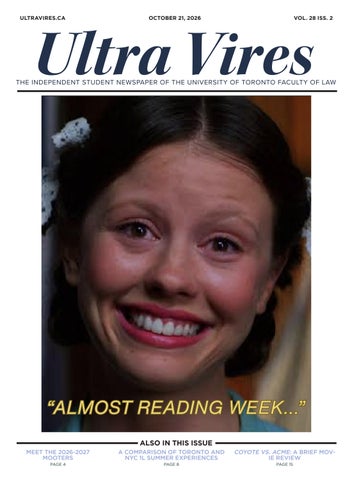
ULTRAVIRES.CA
OCTOBER 21, 2026
VOL. 28 ISS. 2
Ultra Vires
THE INDEPENDENT STUDENT NEWSPAPER OF THE UNIVERSITY OF TORONTO FACULTY OF LAW
ALSO IN THIS ISSUE MEET THE 2026-2027 MOOTERS
A COMPARISON OF TORONTO AND NYC 1L SUMMER EXPERIENCES
COYOTE VS. ACME: A BRIEF MOVIE REVIEW
PAGE 4
PAGE 8
PAGE 15
2 | October 21, 2026
ultravires.ca
Ultra Vires 84 Queen’s Park Crescent Toronto, ON M5S 2C5
Ultra Vires is the independent student newspaper of the University of Toronto Faculty of Law. We provide a forum for diverse viewpoints on topics of interest to our readers. We aim to foster dialogue on academic and social issues between students, the faculty, and the broader legal community in Toronto, Ontario, and Canada. Our content does not necessarily reflect the views of the Editorial Board. We print six issues per year. Ultra Vires is printed by Master Web Inc.
UV INDEX
EDITORS-IN-CHIEF Abby McCormick and Jake Rogers
ASSOCIATE PUZZLE EDITOR Yael Rusonik
BUSINESS MANAGER Benjamin SW Lee
RECRUIT EDITORS Raveena Grewal and Bruce Yao
NEWS EDITORS Lauren Lindfors-Bruno and Aysenur Yildiz
ONLINE EDITOR Siegfried Kahama
ASSOCIATE NEWS EDITORS Maya Hutzul and Sumayyah Shah
STAFF WRITERS Quinlan Koth, Mina Kheir, Julian Krygel, Alexander Muller-Clemm, Neha Rahman, Jeanine Varney, and Chelsea Wang
Letter from the Editors
3
October SLS Update
3
Meet the 2026-2027 Mooters!
4
RECRUIT REPORTERS Peter Rossetti and Ben Hosseinian
The 2026 Grand Moot
4
FEATURES EDITORS Madura Muraleetharan and Cherry Zhang ASSOCIATE FEATURES EDITORS Matthew Adelberg and Nicholas Hepner OPINIONS EDITORS Alexandra (Sasha) Broun and Emma Malcho ASSOCIATE OPINIONS EDITORS Shane Joy and Mason Matthews DIVERSIONS EDITORS Matthew Grace and Charlize Yao
INTRA VIRES Joe Hawkins and Avery Willis STAFF PHOTOGRAPHER Nicholas Hepner SOCIAL MEDIA COORDINATOR Nouf il Ali
ASSOCIATE DIVERSIONS EDITORS Juliette Lee and Jeanine Varney
ERRORS If you notice any errors, please email us at editor@ultravires.ca.
FEATURES Reflections on Anishinaabe Law Camp 2026
6
OPINIONS Should I Stay or Should I Go?
8
RIGHTS REVIEW
LAYOUT EDITOR Fox Hill Creative
Securities Complaints as Human Rights Advocacy
9
From Westminster to Women in Law
10
A Summer in Switzerland
11
A Place of Hope and ForwardThinking for International Human Rights Law
12
SUBMISSIONS If you would like to submit a tip, letter, or an article, please email us at editor@ultravires.ca. Ultra Vires reserves the right to edit submissions.
Join a dynamic team. If you’re talented and do great work, you belong here.
dwpv.com/students
DIVERSIONS
COVER DESIGN Bilqis Meer
PUZZLE EDITORS Zach Gorman and Taban Isfahaninejad
ADVERTISING If you are interested in advertising, please email us at business@ultravires.ca
NEWS
@daviesstudents
Breaking: 2L Finds Ratio in a Karakatsanis Decision
13
Falling Textbook Injures Student
13
Reasonable Person Found in Critical Condition
14
More Halloween Costumes for the Casebook Connoisseur
14
Coyote vs. Acme: A Brief Movie Review
15
The Grotto
15
Fall Horoscopes
16
Intra Vires
16
PUZZLES Rebus
17
Crossword
18
Connections
19
UV Fall Playlist
19
NEWS
ultravires.ca
October 21, 2026 | 3
Letter From The Editors October 21, 2026 JAKE ROGERS (JD/MBA, 2029) & ABBY MCCORMICK (2L) Dear readers, As recruit season heats up for many 2Ls and reading week approaches, we at Ultra Vires recognize that it is a critical time of the year. The workload is increasing, but so is the need for outlets and downtime. Accordingly, we have—hopefully—given you a reason to take a minute away from in-f irm anxiety and readings through this issue. This issue features articles on a wide range of topics. The usual suspects appear —Intra Vires gives you some news that
is totally real ( but not to be taken seriously), while a range of puzzles give you a means to test your legal and non-legal knowledge. However, there are also articles that allow you to connect to events that should be taken seriously, such as that written by Neha Rahman (1L) covering the Grand Moot. Additionally, as a pr imer for our recruit issue, there is an article joint ly wr itten by Jacob Buchan (2L) and Jordan Picheniuk (2L) on the dif ferences between Toronto and New York Cit y 1L summer positions. That article draws on
their exper iences this past summer to get past the mere distinction of in-f irm work vs. stipends, hopefully prov iding invaluable information to students nav igating the ever-accelerated New York recruit timeline. Finally, there is information related to opportunities available at the law school. We recognize all of the students engaged in upper-year moots through “Meet the Mooters,” and also receive a ref lection on the Anihinaabe Law Camp from Emma Danniels (2L) and Asha Nenshi Nathoo (2L).
A ll of these articles have something to do with you as law students. Hopefully, you will f ind insight in the articles relevant to your lives as work increases. As always, if you are interested in writing for U V, would like to let us know what you think about a particular article (we do accept fan mail), or just want to let us know that you enjoyed reading, then feel free to email us at editor@ultravires.ca or DM us on Instagram at ultravires.ca. Jake Rogers and Abby McCormick Editors-in-Chief, Ultra Vires Volume 28
October SLS Update
A note from the President of the Students’ Law Society
ISHAAN MCLACHLAN (2L) Happy October! We hope everyone had a restful Thanksgiving weekend and that the leftovers outlasted the break. The Students’ Law Society (SLS) has a few updates for you: Recruit Season To every 2L who went through OCIs this month, congratulations. Making your case in 17 minutes is an accomplishment on its own, and we are wishing you the best through Call Day and in-f irms. Club Funding A reminder from the Social and Finance Committee (SFC): clubs should submit funding requests at least two weeks before their event. Our budget each semester is limited, and early requests help us divide it fairly. Non-equity group events must be open to the entire student body. Clubs should also submit their events to be posted in the SLS Weekly, so students know what is coming up. Halloween and SFC Events Halloween is almost here! Our annual Halloween Party is on Thursday, October 22nd at El Mocambo. Tickets are on sale at our tables in the atrium, as well as through the links we have sent out via email and on our social media. We are also hosting a Halloween food giveaway in the Rowell Room on October 27th. Additionally, our biweekly lunchtime trivia now comes with pizza as a prize for the winning team, so bring your most competitive friends. Advocacy Thank you to everyone who has shared how laptop-free classes are going so far. We are keeping track of how the new approach is being applied across courses. If your instructor’s restrictions go beyond what the Faculty announced in August, such as limits
on tablets, please let your SL AC reps know. We have also raised the Bora Laskin Law Library’s Sunday closures. The administration understands the importance of the issue and is working closely with the library on a solution. Please also note that the library will be open on Sundays once its hours are extended in the weeks leading up to the exam period. Separately, we have submitted a proposal for more ways to access class recordings when you miss class. We will share updates on both as we hear back. Elections Our fall elections have concluded. Congratulations to our new representatives, and thank you to everyone who ran. This year’s SLS is: President: Ishaan McLachlan (2L) VP Student Life: Olivia Carter (2L) VP Academic: Jayden Daniels (2L) VP Social: Danya Assaf (2L) VP Finance: Emma Malcho (2L) 3L SL AC Reps: Romina Hajizadeh 3L SFC Reps: Rachel Bernardo, Sahib Grewal, and A lexandra Kouri 2L SL AC Reps: Layla Razek, Ethan Tucker, Cameron Miranda-Radbord, and Daphne Embry 2L SFC Reps: Taylor Tucci, Drew Bolivar, John Oh, and Michael Tapley 1L SL AC Reps: Mishael Abu-Samhan, Amy Bensky, Grady Galbraith, and Devika Jain 1L SFC Reps: Kishan Bhargava, Mario Costantini, Kya Ramdhan, and Avi Teich Of f icers: Matthew Grace (Chief Returning Of f icer), Kenzie Pilling (Communications Of f icer), Norah Rahman (SFC Communications Of f icer), Marshall Adams (SL AC Equity Of f icer), Avreet Jagdev (SFC Equity Of f icer), Hafsah Saajidh (SL AC Secretary), Kate Lamont (SFC Secretary),
PHOTO CREDIT: ISHAAN MCLACHLAN.
and Evan Stelzer ( Treasurer) As always, our meetings are open to everyone. SFC meets Wednesdays at lunch, and SL AC meets Mondays at lunch, both in
the SLS Of f ice. If you have feedback or ideas, please reach out to me, the other executives, or your year reps. I hope to see you at El Mocambo!
NEWS
4 | October 21, 2026
ultravires.ca
Meet the 2026-2027 Mooters! Introducing the 2026-27 competitive moot teams MOOT COURT COMMITTEE After another busy competitive moot tryout season, the Moot Court Committee (MCC) is proud to officially announce the teams that will represent the Henry N.R. Jackman Faculty of Law at various moot competitions this school year. The MCC is a student-run committee that coordinates the tryout process for Jackman Law’s competitive moot programs. First-round tryouts took place from September 15-16, featuring panels of student judges, each with at least one MCC member. Second-round tryouts took place on September 17. The second-round panels were composed of one faculty member, one MCC member, and one other student judge. Calls were made to successful candidates beginning at 8 pm on September 22. This year, the tryout problem came from the 2022 Wilson Moot Problem, Annette Norris v Calgary (City). The problem concerned the constitutionality of a municipal bylaw which banned all encampments within city parks, provided the City could offer encampment residents an alternate shelter space. Ms. Norris received a notice to vacate her encampment residence. She refused the alternative all-gender shelter arrangements due to safety concerns; Ms. Norris was previously assaulted in an all-gender shelter and felt safer within the park where she was close to her support network. Prospective mooters were asked to represent Ms. Norris as the appellant on appeal. They were tasked with arguing that the bylaws violated sections 7 and 15 of the Charter and were not saved by section 1. The MCC would like to thank all the volunteer student and faculty judges who made the tryouts possible this year!
Below are the final results of this year’s tryout: Note: Mooters in their third year of combined four-year programs are noted as 2Ls (and fourth-years are noted as 3Ls). Adam F. Fanaki Competition Law Competitive Program Andrew Pietras (2L) Arjun Thayaparan (2L) Grady Simpson (2L) Noah Walker (2L) Callaghan Competitive Program Aliza Kraft (2L) Angelina Siew (2L) Asha Saha (2L) John Doyle-Raso (2L) Julian Miller (2L) Katie Grierson (2L) Lauren Lindfors-Bruno (2L) Matthew Davidson (2L) Michael Tapley (2L) Nathaniel Jote (2L) Owen Logtenberg (2L) Rachel Paterson (2L) Sam Hayden (2L) Sam Sarjeant (2L) Sophia Teed (2L) Victoria Percival (2L) Canadian Labour Arbitration Competition Kate Lamont (2L) Katie Wilkinson (2L)
Davies Corporate Securities Competitive Program Alina Adamesco (2L) Hafsah Saajidh (2L) Kasia Wodz (2L) Kristen Nessim (2L) Donald G. Bowman Tax Competitive Program Diya Courty-Stephens (2L) Robert Howden (2L) Sasha Steeves (3L) Yuanji Zhu (3L) Gale Competitive Program Anna Lisa Lowenstein (2L) Jacob Buchan (2L) Monique Ingram (2L) Rehana Lalani (2L) Harold G. Fox Intellectual Property Competitive Program Anna Sierra Heffernan-Wilker (2L) Doyin Adeyemi (2L) Layla Razek (2L) Sheanna Wirasinghe (3L) Jessup Competitive Program Haneef Amusat (2L) Jordan Picheniuk (2L) Maddy Ritter (2L) Nicholas Hepner (2L) Julius Alexander Isaac Competitive Program
David Bihon (2L) Elbethel Masresha (2L) Saira Camminga (2L) Tsahai Carter (2L) Laskin Competitive Program Jacob Johnston (2L) Julia Alvi (3L) Taylor Dallin (2L) Zak Ibrahim (3L) Tort Law Competition Program Amalia Ramos (2L) Cailen Miranda-Radbord (2L) John Oh (2L) Orli Amar (3L) Walsh Family Law Competitive Program Amy Jing (2L) Camryn Booth (2L) Daphne Embry (2L) Xiyue (Cindy) Wang (2L) Warren K. Winkler Class Actions Avreet Jagdev (2L) Daniel Pines (2L) Kathryn Morse (2L) Zack Kuan (2L) Wilson Competitive Program Aliyah Yagboyaju (2L) Hayden Godfrey (2L) Ishmeet Johal (2L) Sam Bowers (2L)
The 2026 Grand Moot A reflection on the case, oral arguments, and judges’ comments NEHA RAHMAN (1L) On October 1st, the Moot Court Room was f illed to the br im, abuzz w ith excitement for this year’s Grand Moot. The topic to be arg ued, created by Moot Court Committee Co- Chief Justices Romina Hajizadeh and Yuha K han, was tit led “R ight to Water? Balancing Charter R ights w ith Leg islative Deference.” At issue was section 5 of the Enabling A I Sovereignty and Economic Development Act. A imed at stimulating economic growth by streamlining the development of A I data centres, this prov ision allowed “any A I Data Centre that does not consume more than 3.5 million litres of water per day” to be exempt from env ironmental assessment or permits. The case centred on an unemployed single father named Roman K han (a clever portmanteau of the Co- Chief Justices’ names). Mr. K han lived in Jackmanv ille, a
remote town facing reg ular water outages as a result of a nearby data centre’s unregulated consumption of the town’s water supply. This prevented him from fulf illing essential needs, including feeding his sixmonth-old child who was reliant on formula. This year’s mooters were Evan Tanov ich and Aadit ya Juvekar for the appellant, and Ror y Banfalv i and Madeline R itter for the respondent. For the esteemed judges’ panel, we had the pr iv ilege of welcoming The Honourable Justice Breese Dav ies from the Ontar io Super ior Court of Justice, The Honourable A ssociate Chief Justice M ichal Fairburn from the Ontar io Court of Appeal, and The Honourable Justice Mahmud Jamal from the Supreme Court of Canada. The appellants and respondents arg ued on either side of the issue of whether sec-
tion 5 of the Act was unconstitutional. The appellants’ position was that the Act v iolated section 7 (the r ight to life, libert y, and the secur it y of the person) and 15 (the r ight to equalit y) of the Charter. They also arg ued that neither of these v iolations was justif ied under section 1. The respondents arg ued the opposite. Tanov ich covered the f irst of the appellant’s three reasons: v iolation of section 7. He asserted the appellant was not mak ing a positive r ights case because by enacting the Act, the government had undertaken to subvert env ironmental protections, which led to the water cr isis af fecting Mr. K han. Tanov ich, facing tough questions from the judges about the role of the democratic process in allev iating these issues, arg ued that the courts still have an important role to play. He arg ued that a government act incentiv ized pr ivate companies to operate
in such a way as to br ing about the cr isis, which put Mr. K han’s life and secur it y of the person in jeopardy. Juvekar covered the v iolation of section 15, submitting parental status as a new analogous ground for equalit y protection. W hen asked by Justice Jamal where the limits of this designation lie, Juvekar clar if ied that based on prov incial and federal laws delineating legal dependence, this newly constructed immutable status covers parents of children aged 0 -16. In satisfy ing Justice Dav ies that parental status exacerbated the harm Mr. K han faced under the leg islation, Juvekar noted that car ing for his children prevented him from seek ing employment. In response to Justice Fairburn’s concern about the public policy implications of framing parenthood as a basis for discr imination, Juvekar noted that though parenthood may also be a source of
ultravires.ca
FEATURES
October 21, 2026 | 5
CREDIT: ALICIA FUNG
pr ide and joy, much like sexual or ientation, it can simultaneously lead to marg inalization. The appellants made a compelling case for Mr. K han’s hardships, but the respondents followed up w ith a hard look at the limits of the law. Banfalv i rebutted the section 7 claim. She asserted that a positive r ights claim was being made, because although there was an undertak ing by the government, there is no constitutional r ight to env ironmental protection. Though Justice Jamal questioned the utilit y of mak ing this positive/negative r ights distinction, Banfalv i added that there is also no causal connection between the government action and the harm exper ienced by the appellant because the data centre was built by a pr ivate third part y. Responding to Justice Dav ies,
Banfalv i rebutted the appellant’s claim that the Act was an incentive, asserting a lack of reg ulation doesn’t make companies immune from being found pr ivately liable for env ironmental harm. R itter add ressed t he sect ion 15 v iolat ion. Respond ing to Just ices Fa irbur n and Jama l, she noted t hat wh i le h istor ica l d iscr im inat ion in employ ment and housing can sig na l t hat parents face d iscr im inat ion, it doesn’t mean parent hood war rants const it ut iona l protect ion. She arg ued t he d isadvantage arose from t he f inancia l burden of parenta l stat us, and t hat wea lt h is not an immutable stat us. R itter framed t he har mfu l ef fects of sect ion 5 of t he Act as a funct ion of M r. K han’s pover t y rat her t han h is parent hood. Just ice Fa irbur n posed a t r ick y cha l lenge, ask ing whet her it was t he care obl igat ion to M r. K han’s
infant prevent ing h im from work ing t hat gave r ise to t he f inancia l hardsh ip. R itter deft ly hand led t he response, rema in ing empat het ic to t he sit uat ion wh i le point ing out t hat M r. K han’s pover t y was instead ow ing to t he w idespread econom ic cr isis in t he reg ion t hat t he Act sought to a l lev iate. Justice Jamal remarked on the substantial challenge the mooters faced, say ing the appellants had the facts on their side, while the respondents had the law on their side. W hile the appellants could appeal to empathy, the respondents asked us to consider the practical realities of governance in the face of complex economic problems. Justice Fairburn complimented the factums, stressing the importance of a wellwr itten arg ument. She was also impressed w ith the oral arg uments and how sk illfully
the mooters signposted their arg uments, addressing tough questions as they came and maintaining an impressive level of composure and conf idence. Justice Dav ies said that if she had counsel like the mooters in front of her ever y day, her job would be much easier. The justices also acknowledged the whole team behind the event, from those who created the problem to the coaches and organizers. Ever yone’s hard work contr ibuted to the event’s success. The attendees were also left wowed by the conduct of the mooters, excitedly discussing their own opinions on the challenge. A s the justices stressed, all the mooters and ever yone who worked behind the scenes to make the Grand Moot happen should be proud of their massive accomplishment.
FEATURES
6 | October 21, 2026
ultravires.ca
Reflections on Anishinaabe Law Camp 2026 Embracing land-based learning on the Rama Reserve EMMA DANNIELS (2L) & ASHA NENSHI NATHOO (2L) From September 17th to 20th, Jackman students had the opportunity to join law students from across the country to participate in Anishnaabe Law Camp on the Rama Reserve. When we f irst arrived at camp, Jeff Hewitt, Rama in-house legal counsel, told us not to take any notes throughout the weekend. While this caught many of us law students off guard, used to scribbling down everything we can, it set the tone for a weekend of intentionality and ref lection. We became comfortable with the fact that we were not going to memorize each of the teachings but would remember and carry forward what was meant for us. Chief Ted Williams of Rama First Nation welcomed us to the land. He spoke about his journey to leadership with his grandson in his arms. In fact, throughout the weekend, children, who we learned are gifts from the Creator, were involved in and often at the centre of everything that we did. As Professor John Borrows often emphasized, in Anishnaabe language, “lawing” is a verb. Each of us, particularly as future legal professionals, has a responsibility to utilize, embody, create, and share law in a way that leaves this world better than we inherited it—for the children we encountered at camp and for all future generations. That night, as we settled down around the ceremonial f ire for teachings with James Simcoe, we looked up at the crisp, crescent moon surrounded by shining stars and felt a part of something so much bigger than ourselves. We realized that we were a small part of the more than natural world, and truly internalized the grandfather and grandmother teaching of humility. On Friday morning, we participated in a sunrise ceremony that anchored us in the principle of gratitude. We each took tobacco in our left hand and participated in a smudge, grounding us in the spirit and our own roots. We gave thanks for everything we stand on the shoulders of—the more than natural world, the animals, the Indigenous communities who have cared for this land for centuries, and our own ancestors. We were each handed a strawberry, or an ode’imin, literally translating to a heart berry. Evelyn Ball and Samantha Craig explained that the red body of a strawberry held great sweetness, and its green stem held sour healing properties. Perhaps just as a strawberry can simultaneously hold both sweet and sour, we have the ability to hold our privilege as law students with the responsibility to recognize and break down the colonial systems that surround us. Professors John and Lindsay Borrows then provided us with a framework for understanding many of the teachings we were taking in. They spoke about the sources of Anishnaabe law, highlighting our ability to reason by analogy and understand law by watching the natural world. For example, the formation of geese as they migrate teaches us the basis for a legal principle of leadership. There is not a single goose that stays at the front of the f lock the entire f light. Instead, they rotate, each leading for a portion of the time, depending on their capacity and specif ic knowledge. True leaders do not stay at the front the whole time, but rather share
PHOTO CREDIT: ASHA NENSHI NATHOO.
their expertise when needed and know when to take a step back. We then had the opportunity to hear from Chief Lady Bird about her breathtaking artwork infused with teachings and Creation stories that was displayed throughout Couchiching Hall. She spoke about how carrying and birthing her son inspired and shaped her paintings. This artwork was a beautiful example of how creativity, stories, and humanity could f ind their way into urban spaces. We had a chance to participate in interactive activities that allowed us to appreciate the Anishnaabe medicinal practices. While we may not have been the fastest at it, we practiced techniques for birch scraping to reveal the layer of the tree with healing properties. We also learned and tested our
tongue in the Anishnaabemowin language. In Anishnaabe tradition, so much of who we are is tied to where we come from. We got to try introducing ourselves in relation to our hometowns and the groups we belong to. That evening, we sat around the campf ire listening to songs and stories from Professors John and Lindsay Borrows. We heard the Baby Bear Story—where Nick, as an ogimma who was trusted and counted on by the community, brought everyone together to utilize their own unique knowledge, skills, and resources to pursue the best interests of the baby bear. As Lindsay Borrows put it, we cannot all speak at the same time, but we can all sing at the same time, highlighting the great power in many diverse voices coming together in their own unique pitch and rhythm to create beauty.
On Saturday, we had the privilege of hearing from Sage Hartmann, a member of the community and a recent Federal Court Clerk, who spoke of her experiences clerking generally and, more specif ically, her experiences working on cases pertaining to Indigenous issues and Aboriginal rights. Her presentation offered a perspective on engaging with Indigenous legal issues from within the Canadian legal system. Her presentation was followed, however, by a different perspective on law and governance, this time grounded in Anishinaabe legal traditions. Elder Mark Douglas shared a story about how the community had responded to youth who had been causing harm to others to illustrate deliberative lawmaking processes that are part of Anishinaabe legal traditions. Rather than ap-
FEATURES
ultravires.ca proaching the problem through an adversarial process, in which two opposing sides present their positions before a decision-maker, Mark described a process in which ideas emerged from the collective, as perspectives from all seven corners, the seven clans, were brought to the table. In speaking to us, he walked to different corners of the room as he explained what different clans had to say about the issue. The movement was non-linear, much like the process of deliberation itself, as ideas f lowed between people rather than travelling in a single direction from an authoritative decision-maker to everyone else. This embodiment of deliberate law demonstrated to us what it means to engage in law-ing as a verb. We continued to see law in action when we travelled down the road to the Rama Community Farm, where manager Kailey LeDrew shared insights into their practice of “no spray,” meaning that no pesticides, herbicides, or other chemicals are used on their farm produce, ensuring the health and safety of the farm, community members, and the nearby waterways. We then got our hands dirty, literally, as we trekked out to the f ields where we picked beans and weeded. The Rama community farm—in addition to the delicious produce some of us brought to take home—also provided a way of seeing how Indigenous and Western ways of knowing can exist in relationship. During our visit, we were told how colonial farming practices were imposed upon Indigenous peoples as part of colonization. Despite this, Indigenous communities like Rama developed prof iciency in agriculture and produced high yields. However, rather than simply adopting Western agricultural methods as they were imposed, the Rama community has adapted its practices in a way that ref lects humility and deference to the natural world, allowing the land to do what it does best. Moreover, in order for the farm to be successful in supporting the community, these different approaches to agriculture did not have to displace one another. In fact, the community could inherit something shaped by colonialism without simply reproducing it, adapting and cultivating something that feeds—both literally and metaphorically— the community. The result is not the complete rejection of one approach in favour of another, but the coexistence of different ways of understanding and relating to the land, and by way of analogy, the law. In keeping with this theme of the natural world and our relations to it as forms of teaching, upon arriving back at camp, we heard from Dr. Leora Gansworth. She told us about eels, an animal that has cultural and medical signif icance to Indigenous peoples in Ontario, as for many years, they would migrate to freshwater, inhabiting Lake Ontario, the Ottawa River, and the upper St. Lawrence River watershed, before returning to the Sargasso Sea to spawn. However, due to hydroelectric dams, biodiversity loss, overf ishing, and water pollution, eels are rarely seen in these waters and are an endangered species. What stood out to us most in Dr. Gansworth’s presentation was not just how cool eels are (though they are, trust us), but how little she knows about them, their mating rituals, and even some of their migration patterns; she does not feel the need to know about these things in order to actively work to conserve the species. In the same way, we or anyone, for that matter, do need to know everything about any community of beings in order to recognize the inherent importance of cultural, legal, and linguistic revitalization. The day ended with one of the most meaningful experiences at Law Camp: a sweat lodge ceremony. A sweat lodge is a traditional Indigenous ceremony that takes place inside a small, enclosed structure, where heated stones are brought into the lodge and water is poured over them to create steam and heat. The ceremony is traditionally understood as a process of cleansing and renewal, and it can involve prayer, ref lection, teachings, and connection with the land, community, and spirit. While the
October 21, 2026 | 7
PHOTO CREDIT: ASHA NENSHI NATHOO.
specif ic practices and teachings associated with a sweat lodge vary between Nations and communities, the ceremony is a sacred practice. While we, along with others due to capacity and personal preference, did not enter the sweat lodge, everyone had the opportunity to participate in the preparations and engage with the teachings shared beforehand. We heard about the personal experiences of participating in sweat from a community member, while some of us gathered and prepared cedar, helped clean out the lodge, and supported those going into the sweat. It was a really beautiful way to spend our last night on the trip—coming together in ceremony as
we watched the sun set over Lake Couchiching. After our last night of camp—and it was a chilly one (!)—we got back on the bus to return to Jackman Law. However, the bus was noticeably quieter than it was on the drive up to Rama First Nation. While this could have been due to lack of sleep or exhaustion from lesson-f illed days, we think it was, in part, because there was much to ref lect on. Hearing knowledge keepers, Elders, and community members share their experiences, stories, and ways of life really helped give us perspective, not only on the diversity of legal traditions within what we now call Canada, but on the ways in which we can
learn from each other, from the natural world, and from observation of our surroundings—about the law and about ourselves. We want to say migwech, thank you, to everyone who made this trip possible, including Professor John Borrows and Andrea Johns, and, most importantly, the Chippewas of Rama First Nation in Rama, Ontario. As we continue to navigate our journeys in law school and life, we will keep with us the learnings of this weekend. We will continually be reminded of the collective obligation we hold toward all our relations. We will be forever grateful to have had this opportunity.
OPINIONS
8 | October 21, 2026
ultravires.ca
Should I Stay or Should I Go? A comparison of Toronto and NYC 1L summer experiences JORDAN PICHENIUK (2L) & JACOB BUCHAN (2L) Jordan spent his 1L summer working at Dentons Canada LLP in Toronto, where he will return for his 2L summer. Jacob spent his 1L summer conducting legal research with a faculty member after accepting a stipend and a 2L position with Sullivan & Cromwell LLP in New York. The constellation of options for your 1L summer can seem overwhelming. Having accepted of fers at dif ferent f irms, Jordan and Jacob thought they could demystify at least two summer experiences open to Jackman Law students by discussing their respective paths. Skillbuilding and Work Experience A 1L summer in Toronto Big Law is the best way to get to work fast. By mid-May, just two weeks after exams, Jordan was in the of f ice over 40 hours per week, plus after-hours and weekend work. Even in shorter weeks, he was exposed daily to new law, ideas, and tasks. He made a lot of mistakes and missteps along the way—but this was expected. The goal was to avoid making the same mistake twice (or thrice!). By the end of summer, however, he had developed a solid foundational understanding of both transactional and litigation legal work, from research to drafting and from client meetings to court attendance. Jacob’s experience dif fered in several key ways. Most signif icantly, he didn’t work at a law f irm. New York f irms recruit 1L students for 2L summer positions, so Jacob’s 1L summer remained his own. Instead, Jacob returned to work as a research assistant
with a Jackman Law professor. His workload varied week-to-week depending on his professor’s research agenda. Some weeks were purely part-time; others were certainly overtime! Throughout, he was exposed to statutes, case law, and secondary sources well beyond the scope of his 1L classes. As a research assistant, Jacob trawled legislative databases, court reporters, and various legal journals to compile comprehensive memoranda on emergent topics in legal studies—in his case, comparative constitutional law, multinational corporate governance, and U.S. migration policy. Jacob even got to edit—and draft—sections of forthcoming scholarly manuscripts. Mentorship and Networking Working at Dentons of fered Jordan a wide range of connections in the f irm— with fellow summer students, articling students, associates, partners, and counsel—as well as with professionals across Bay Street. He had both formal mentors and unof f icial ones, with the latter mostly consisting of junior associates of fering emergency crash courses in any number of skills. At work, Jordan also developed close professional relationships with several partners at the f irm. Thanks to the rotation system at Dentons, these relationships are based on his developing legal interests and have already shaped his future career by exposing him to an array of practices and providing him with inroads thereto. On the other hand, as a research assistant, you build both legal skills and new
professional relationships. Working one-onone with a top legal scholar provided Jacob with unique insight into the research process that constitutes the bulk of a professor’s work, lending him invaluable perspective into a career in academia. Moreover, the close professor-assistant working relationship means that Jacob knows he can rely on his professor for advice and a detailed reference for any of his future applications to graduate programs or judicial clerkships. Social Life and Work-Life Balance Jordan’s summer was punctuated by many f irm events, including socials, a Jays’ game, and a day spent on a rented boat in Toronto harbour. Every one of these was replete with food and drink, all on the company dime. Moreover, it was not all work—weekends and evenings often allowed for baseball, nights out, and hosting friends and family. It should also be noted that the work term ended August 7, leaving him plenty of time to travel, unwind, and prepare for 2L . Jacob’s summer calendar likewise included its fair share of social time. Research assistance is a solitary af fair. However, working remotely, Jacob often accompanied other research assistants and his other 1L friends to work at libraries and cafés around Toronto. Since Jacob chose his own hours, he built a weekly schedule that allowed him to visit the g ym, bicycle, see friends and family, enjoy the sunshine, and save work for the slower summer hours. He also negotiated his contract to provide him with time of f for travel and an end date in late July.
Jacob also benef ited from some law f irm programming. A lthough his Summer Associate program at Sullivan & Cromwell doesn’t start until spring 2027, the f irm hosted Jacob’s summer class this past August for a ‘Preview Program.’ Two weeks in Manhattan of fered many activities, including the in-f irm keynote address, evening mixer, and the opportunity to explore New York City’s museums, waterfronts, and comically tragic baseball team, the New York Mets. Jacob met dozens of his American counterparts and grew closer with his fellow Jackman Law students at Sullivan & Cromwell. Overall, it provided a welcome introduction to his future colleagues and f irm. In Sum Both Jacob and Jordan thoroughly enjoyed their summers. They’d each be quick to tell you that there is never a ‘right’ or ‘wrong’ career choice—especially when it comes to your 1L summer. This year, keep your options open until you see something that truly excites you. Don’t count yourself out of anything (no matter your marks!). The best path for you might be Toronto BigLaw, practice in New York, an LSSEP position, a clinic, or something totally dif ferent. 1L summer is one of the last where you have total autonomy over your time. Capitalize on it for yourself, and yourself alone: don’t think about what you ‘should’ do, and don't worry about what your friends are doing. Do something cool. Something rewarding. Something fun. You won’t regret it.
October 21, 2026 | 9
ultravires.ca
RIGHTS REVIEW
The International Human Rights Program at the University of Toronto Faculty of Law An independent student-led publication 2026–27 Rights Review Editorial Board Co-Editors-in-Chief: Rachel Brouwer (JD/MGA, 2029) and Mackenzie Birbrager (3L) Senior Editors: Asha Saha (2L) and Sakina Chaudary (3L) Junior Editor: Stephanie McCann-Hoey (LLM)
SECURITIES COMPLAINTS AS HUMAN RIGHTS ADVOCACY
2026 IN-HOUSE RESEARCH FELLOWS AT THE INTERNATIONAL HUMAN RIGHTS PROGRAM EXPLAIN THE ADVANTAGES AND DISADVANTAGES OF USING SECURITIES REGULATION TO HOLD CORPORATIONS ACCOUNTABLE FOR HUMAN RIGHTS VIOLATIONS By Asha Saha (2L), Mishal Amer (2L), and Zoe Dutta (2L) As In-House Research Fellows at the International Human Rights Program (IHRP) this summer, one of our major projects was the preparation of a complaint to a provincial securities commission regarding the activities of a Canadian mining operation on Indigenous land in another country. The three of us had never thought about securities law as an avenue for human rights advocacy before, and drafting this complaint was a very interesting process. Seeking accountability for human rights violations through indirect means has been gaining popularity, and we wanted to share some of our experiences with the perceived advantages and disadvantages of this method of seeking accountability for human rights violations by private actors. What is a Securities Complaint? Securities law governs the issuance and dissemination of securities, which are tradeable shares in companies. While securities law is largely regulated at the provincial level, most provinces have a virtually identical Securities Act (see, for example, Ontario’s). A critical rule of securities law is that a company issuing securities must provide continuous disclosure to current and potential investors—a failure to do so may amount to a misrepresentation by the company to investors. If anyone—regardless of whether or not they are personally an investor in the company—believes that a company is violating this rule, they can make a complaint to the province’s Securities Commission. There are two steps to proving a violation of the continuous disclosure obligation. First, it must be demonstrated that the company has misrepresented something about their affairs. Second, it must be proven that the misrepresentation is regarding a “material fact” or a “material change,” meaning something that would reasonably be expected to have a significant effect on the market price or value of any of the securities of the company. In our complaint, we argued that the relevant company had failed to disclose to their investors that the Indigenous nation on whose territory it was mining did not consent to the mine’s operations. As such, we had to prove, first, that the company had not told their investors that the Indigenous nation had announced its non-consent in a public press conference, and second, that the Indigenous nation’s nonconsent was going to have a significant impact on the price of this company’s securities. Benefits of a Securities Complaint Submitting a securities complaint to a securities commission can have several positive effects. Most importantly, it targets corporations where it matters most: their financial interests. For example, if a company fails to disclose material facts or changes in business operations, a securities commission may decide to impose sanctions on it. As a result, investors may lose money, file a class action lawsuit against the company’s failure to disclose, or simply withdraw their investment due to fears of the market
@utrightsreview
IHRP IN-HOUSE FELLOWS MEET WITH ACTING DIRECTOR, DIANE GOODMAN, TO DISCUSS THEIR PROJECT. PHOTO CREDIT: ASHA SAHA, MISHAL AMER, AND ZOE DUTTA
price collapsing. Ultimately, a falling share price is a consequence that a corporation cannot easily ignore.
legal system. Although it may not provide direct compensation to communities, it is one step towards piercing the corporate veil.
Generating publicity of a securities complaint is central to affecting a corporation’s stock price. For example, in 2012, the Justice and Corporate Accountability Project (JCAP) filed a complaint to the Ontario Securities Commission (OSC) with a request to investigate whether a mineral resource company breached section 75(1) of the Securities Act by failing to disclose a blockade to one of its mines. Within two weeks of JCAP’s complaint being publicized, the company’s stock price fell from $3.20 to $2.50—a drop of approximately 17%.
Drawbacks of Securities Complaints as a Form of Human Rights Advocacy
In 2022, JCAP reported that in four out of six securities complaints made between 2012 and 2019, the stock price of a company declined after the complaints were made to the relevant securities commission to investigate whether a company had misrepresented the social conflict around its projects. By informing both investors and the general public, through business press and press coverage, respectively, publicity acts as a mechanism that makes this strategy work. Greater exposure may also encourage companies to adopt more effective social and environmental practices. More broadly, these complaints can provide a voice for communities whose human rights are being affected by a company's operations by putting it through a process that carries legitimacy within the
While there are many benefits of filing a securities complaint as an avenue for upholding human rights, there are also some drawbacks to this unconventional route. First, under securities law, it is not a given that Environmental, Social, and Governance (ESG) information, such as information regarding human rights violations, would be considered material facts. Pursuant to Sharbern Holding Inc v Vancouver Airport Centre Ltd, 2011 SCC 23, a fact is only material if there is a high likelihood that the omitted fact would be considered important to investors. As explained above, this would require the filing party to prove that the alleged human rights violation would impact the price of the company’s securities—for example, demonstrating that the sanction for committing the violation would result in a temporary or permanent shutdown of the company’s operation. This requirement was a significant hurdle in our project, as there was very limited legal precedent to rely upon in the affected region. For example, since the development in question was within Indigenous lands without the consent of the affected peoples, we wanted to show that this was a violation of Indigenous rights which would result in sanctions against the company. But the legal precedent regarding Aboriginal law in that re-
ihrp.law.utoronto.ca/rights-review-homepage
gion made it so that the company or government were only required to obtain free, prior and informed consent from Indigenous peoples before development in very limited cases. So, while a corporation may be committing human rights violations, pursuing a securities complaint may not result in penalties for such violations if the facts of the case do not align with the relevant legal precedent. Second, if a securities complaint filed due to ESG misrepresentations is successful, the victims of the human rights violation do not receive any compensation through this mechanism. Victims may receive compensation for the harm they faced if they pursue external proceedings outside of securities law. As a result, a successful complaint may promote corporate accountability, but would not compensate harmed community members—even if the misrepresentations in question are found to be material. Reflection Overall, our summer fellowship at the IHRP taught us a lot about the various ways one could advocate for human rights. It was fascinating to pursue an avenue which is still new to the world of international human rights—and it also sparked our curiosity regarding the many other ways we can uphold human rights, which may not be obvious at first glance. This project was instructive about various international rights mechanisms, Canadian securities law, and foreign Indigenous and Aboriginal laws. Most importantly, it showed us the important and inevitable overlap of these various fields of law.
uoftrightsreview
RIGHTS REVIEW
10 | October 21, 2026
ultravires.ca
The International Human Rights Program at the University of Toronto Faculty of Law An independent student-led publication
FROM WESTMINSTER TO WOMEN IN LAW MY SUMMER AT THE IBA By Maya Nicholson (JD/MGA, 2029) It was a once-in-a-lifetime experience watching England beat Norway in the World Cup semi-final, then hopping on the Jubilee line the next morning to go to Westminster Palace for an International Bar Association (IBA) event and hear Members of Parliament hum the tune of “Hey Jude” through Parliament corridors. With the support of the International Human Rights Program Fellowship, I spent this past summer in London, England, with the IBA. I interned with the Legal Policy Research Unit (LPRU), addressing the impact of artificial intelligence, gender disparity, climate change, and corruption on the global legal profession. Spending the summer at the IBA was a tremendous experience. It allowed me to work on a broad range of legal issues, learn alongside interns from around the world, and gain exposure to legal perspectives outside North America. The IBA is an international membership organization founded in 1947 for lawyers, bar associations, and law societies. The IBA offers a plethora of resources to the international legal community, including conferences, webinars, resources, and information on how to promote the rule of law. The two main divisions of the IBA consist of the Legal Practice Division, which promotes the exchange of best practices and information on legal practice, and the Public and Professional Interest Division, which includes projects, activities, committees, and other entities. The LPRU, a separate team of project lawyers, is dedicated to conducting research, developing initiatives, and implementing strategies that positively impact the global legal profession. Over the summer, I contributed significantly to the LPRU’s Raising the Bar: Women in Law project. Launched in 2021, the research project spans two phases examining women’s representation and experiences across the legal profession. The first phase examined women’s experiences in sixteen jurisdictions through country-specific reports, while the second phase takes a broader look at how law firms, individuals, bar associations, and the judiciary can address persistent gender disparities in the profession. One of the most rewarding parts of my internship was contributing to the publication of the Canada Results Report as part of the Raising the Bar project. Given my familiarity with the Canadian legal system, I edited and contributed to the “Background on the Canadian Legal System” section. I revised sections and research on the composition of the Canadian judiciary, the role of the Canadian Charter of Rights and Freedoms, and Indigenous legal systems. It was particularly meaningful to contribute my knowledge of the Canadian legal landscape to an international research project and to see my efforts reflected in the final publication. My research on gender also extended beyond Raising the Bar. I prepared a tenpage report alongside a co-intern on the implementation of the European Union (EU) Women on Boards Directive ahead of
@utrightsreview
the June 2026 transposition deadline, examining how Member States in the EU had incorporated the Directive into their national legal frameworks. I also researched the soft law approaches taken by global jurisdictions with particularly high levels of gender equality, including Iceland and Namibia. Further, I was lucky enough to engage with gender-related legal issues outside of the IBA’s office. I attended parliamentary events on drug-facilitated sexual assault and conflict-related sexual violence, and was able to assist with preparation by drafting briefing notes for speakers in advance of the discussion. My interest in gender equality precipitated my exploration of the impact of artificial intelligence on the proliferation of genderbased violence. For my final assignment with the IBA, I researched the legislative mechanisms deployed by the United States, Canada, and the United Kingdom in addressing non-consensual sexually explicit AI-generated media. My article, “Non-Consensual Sexually Explicit Deepfakes and the Law: Criminal and Platform Liability Across Three Jurisdictions,” is soon to be published in the IBA’s Intern Newsletter. I also had the opportunity to present my research to lawyers, legal professionals, and IBA staff, which sparked a discussion on the relationship between AIgenerated sexual violence, platform responsibility, and freedom of expression. On occasion, I was given the opportunity to work on assignments outside of the LPRU. At the beginning of my internship, I assisted the IBA’s Human Rights Institute (IBAHRI) with drafting an amicus curiae brief for the Supreme Court of Cambodia. An amicus curiae brief is a submission by an expert organization that is not a party to a case, with the aim of assisting the court in making its decision. As a leading human rights institution, IBAHRI offered their insight to the Supreme Court of Cambodia on the country’s international human rights obligations to protect media freedom. The case involved two journalists who had been arrested and sentenced to fourteen years in prison for taking photographs of a military site near the ThaiCambodian border. Although the appeal was denied, contributing to the country’s crackdown on press freedom, I continued to assist the human rights lawyers with press briefs condemning the Court’s decision. Beyond the workplace, I had an incredible three months in London. I immersed myself in the British culture of staying up late in a pub to watch Jude Bellingham and the rest of the England team tear their way through the World Cup. I travelled throughout the countr y; I visited Brighton Beach and ate fish and chips on a pier looking out at the English Channel; I spent a weekend in the Cotswolds and waded through fields of long grass while evading herds of sheep. As a theatre fan, I made sure to get cheap tickets to West End shows spanning Agatha Christie legal dramas to the bright and fantastical Hercules. My IBA Intern Cohort was another highlight of the sum-
ADMIRING BIG BEN FROM THE PALACE OF WESTMINSTER AFTER ATTENDING AN EVENT HOSTED BY THE IBA’S HUMAN RIGHTS INSTITUTE ON CONFLICT-RELATED SEXUAL VIOLENCE IN PARLIAMENT. PHOTO CREDIT: MAYA NICHOLSON
mer; I spent every day with nine other law students from France, the United States, Italy, Colombia, and India, who all brought different perspectives and ideas to the intern table. As a group, we toured the Royal Courts of Justice and walked through the same halls as the infamous Lord Denning. We went to pub trivia, combining our global and legal knowledge to come short in second place. Looking back, my summer at the IBA gave
ihrp.law.utoronto.ca/rights-review-homepage
me much more than an opportunity to research international legal issues. I saw how lawyers from different jurisdictions approach shared challenges, explored areas of law I care deeply about, and built frienAdships with people I otherwise never would have met. I left London with a broader understanding of what a career in international law can look like—and plenty of memories from a summer spent across the pond.
uoftrightsreview
RIGHTS REVIEW
ultravires.ca
October 21, 2026 | 11
The International Human Rights Program at the University of Toronto Faculty of Law An independent student-led publication
A SUMMER IN SWITZERLAND
UNITED NATIONS HUMAN RIGHTS MECHANISMS UP CLOSE By Sarah Zhao (2L) This summer, I had the opportunity to complete a fellowship at the Office of the United Nations High Commissioner for Refugees (UNHCR) in Geneva, Switzerland. I worked in the Human Rights Liaison Unit (HRLU), which leads engagement with human rights mechanisms and the human rights environment more broadly across UNHCR, including field operations and Regional Bureaux. The HRLU leverages these mechanisms and other opportunities to strengthen protection for asylum-seekers, refugees, stateless persons, and other persons of concern to UNHCR, and enhance UNHCR’s advocacy. Working at UNHCR resulted in significant learning about international refugee law and international human rights law. Being in the HRLU, in particular, gave me an up-close look at the various human rights mechanisms in the United Nations, including the Human Rights Council (HRC), and the work that various UN entities do on human rights. Attending the Human Rights Council The HRC is the main intergovernmental body within the UN system responsible for human rights. The Council is mainly concerned with strengthening the promotion and protection of human rights around the globe, as well as addressing human rights violations. I coordinated UNHCR’s engagement with the June-July 2026 session of the HRC, ensuring that colleagues in Geneva and across the world were kept up to date on developments at the Council. At the session, I attended plenary sessions and side events that were relevant to UNHCR’s mandate and took notes at these sessions. I also had the chance to attend sessions on human rights topics that I was personally interested in, such as the rights of nature and the impact of China’s new ethnic unity laws on Tibet. Having the opportunity to learn more about these issues from people directly affected was very insightful. Supporting the Platform of Independent Experts on Refugee Rights The HRLU acts as co-secretariat with the Office of the High Commissioner for Human Rights (OHCHR) for the Platform of Independent Experts on Refugee Rights (PIERR). The PIERR organized a side event at the HRC commemorating the 75th anniversary of the 1951 Refugee Convention and its enduring role in human rights protection. The panellists included several PIERR members: Gehad Madi (Special Rapporteur on human rights of migrants), Siobhán Mullally (Special Rapporteur on trafficking in persons), Jorge Contesse (member of the Committee Against Torture), and Selma Sassi (Commissioner & Special Rapporteur on Refugees, Asylum-seekers, IDPs, and Migrants in Africa at the African Commission on Human and Peoples’ Rights). They were joined by Bahishta Nohtani, a former refugee and founder of the Afghan Women’s Rights Association. The PIERR members also participated in a dialogue with UNHCR colleagues in the field on key protection issues in each region and opportunities for human rights engagement. Sitting in on the discussion gave me the opportunity to learn about different avenues of advocacy for UNHCR, and how UNHCR can also support UN human rights mechanisms with their interventions on different human rights issues. While supporting the PIERR’s activities, I had the chance to meet and get to know the PIERR members, which lent a human element to the human rights mechanisms that had initially felt abstract and high-level. I was also able to meet colleagues
@utrightsreview
SARAH IN FRONT OF THE MATTERHORN IN ZERMATT, SWITZERLAND. PHOTO CREDIT: SARAH ZHAO
in OHCHR who support the various special procedures and learn about the differences between the work and environment at OHCHR and UNHCR. Many of the PIERR members are academics, though some have a diplomatic background, and almost all of them have a background in law. Accordingly, these conversations gave me more insight into the different kinds of human rights careers and pathways available to those with a law degree. Coordinating Submissions to Treaty Bodies UNHCR can submit confidential comments to UN treaty bodies, which are committees of independent experts that review States’ implementation of various international human rights treaties. These include the Committee on the Elimination of Discrimination Against Women and the Committee on the Rights of the Child. HRLU alerts UNHCR colleagues in country offices and Regional Bureaux to upcoming committee sessions and opportunities to make submissions. HRLU is also responsible for coordinating and reviewing submissions. To facilitate this process, I created a spreadsheet to keep track of all the upcoming submissions for the rest of 2026, then reached out to all our colleagues in the field to alert them to these deadlines and recorded their responses. I also coordinated with OHCHR Secretariat colleagues where necessary to inquire about extensions and clarify guide-
lines. As submissions came in, I coordinated their review by UNHCR’s Regional Bureaux and the HRLU. Reflections My time at UNHCR has taught me so much about the UN, international law, and human rights. Working in the HRLU exposed me to the broader UN system and the varying human rights mechanisms. My fellowship also gave me the opportunity to engage with colleagues from operations all over the world and UNHCR’s regional bureaus. This experience was my first true exposure to international law, and international refugee law in particular. Though I had an understanding of refugee and human rights issues before, approaching these problems from a legal perspective and using my legal education was markedly different. After my first year in law school, steeped in Canadian doctrine, this fellowship also allowed me to see a novel side of the law and lawyering. I met many people all over UNHCR with law backgrounds, who were all doing very different and important work, from protection to inter-agency coordination. Learning about all their journeys and the myriad of ways to forge a career in international law and human rights gave me a clearer sense of what pursuing this path might look like.
ihrp.law.utoronto.ca/rights-review-homepage
It was also a very fascinating time to be in the UN system, given global instability and the UN’s financial crisis. Several countries have refused to make their regular contributions, including the US, one of the UN’s largest contributors. My time here gave me insight into the impact that trends in global politics can have on the work of the UN, particularly for UNHCR. UNHCR has been one of the UN agencies hardest hit by funding cuts, and it is undergoing significant changes as a result. At the same time, increasing conflict and instability in the world still force many people to flee their homes, and UNHCR’s work remains vital to protect and support those in need of international protection. Watching the organization navigate this challenging time has been both inspiring and sobering. Living in Geneva was also an amazing experience. Living abroad for the first time pushed me out of my comfort zone in so many ways, from figuring out a phone plan to meeting new people to relearning how to speak French. I learned a lot about myself, beyond solely gaining knowledge about international law and human rights at work. I am grateful to the International Human Rights Program (IHRP) and UNHCR for providing me with this opportunity, and I am excited to continue my journey with international law in the IHRP Clinic during this academic year!
uoftrightsreview
RIGHTS REVIEW
12 | October 21, 2026
ultravires.ca
The International Human Rights Program at the University of Toronto Faculty of Law An independent student-led publication
A PLACE OF HOPE AND FORWARD-THINKING FOR INTERNATIONAL HUMAN RIGHTS LAW PERSEUS STRATEGIES
By Mackenzie Birbrager (3L) Many people come to law school aspiring to become international human rights lawyers. While this may be the Amal Clooney effect, I am inclined to believe these dreams are wellintentioned, motivated by an altruistic and morally spirited zeal. Unfortunately, there are very few who end law school on this uncharted path. The precarity of venturing into this comparatively unconventional route may be the culprit of this mass exodus. That is why the International Human Rights Program (IHRP) summer fellowships are so instrumental; they allow and empower law students to gain exposure to opportunities that are essential for forging a career in international law and international human rights. These fellowships enable law students to become armed with the knowledge and network to explore the diverse paths their legal education can lead to. Perseus Strategies This is also why firms like Perseus Strategies (Perseus), where I spent my summer, are so vital, not solely for the heroic work they do, but for the internships they provide. Perseus’ staff genuinely foster an ethos that interns are valued colleagues. Students are given considerable responsibility and are entrusted to make significant contributions to work products. Perseus is an international law firm in Washington, D.C., founded by Jared Genser, a fearless advocate whose first experience freeing a political prisoner as a law student at the University of Michigan continues to fuel his unrelenting pursuit to free others. This formative case propelled him into his life’s work of representing and freeing political prisoners, including five Nobel Prize Laureates and the currently imprisoned former Prime Minister of Pakistan, Imran Khan. Genser has been dubbed ‘the extractor,’ a fitting testament to the firm’s impressive track record of freeing 353 political prisoners. While Perseus is known for its political prisoner work, the lawyers’ and staff’s expertise ranges from neurotechnology, which are tools that can record, interpret, or alter brain activity, to business and human rights, and parental child abduction cases. This breadth of files generates an intellectually stimulating legal practice, while also showcasing the malleability of international law and international human rights law. Business and Human Rights After harnessing an interest in the ever-evolving business and human rights landscape, I was fortunate to spend a majority of my internship working on a file involving an international mining company and its facilities in a high-risk area. With the proliferation of human rights due diligence legislation, in conjunction with relevant treaty obligations by host countries, domestic law, and the United Nations Guiding Principles on Business and Human Rights (UNGPs) corporate responsibility framework, companies are increasingly conducting assessments of their human rights impact and developing methodology for rights-compatible engagement with stakeholders. Perseus was retained to conduct a Human Rights Impact Assessment (HRIA) and Stakeholder Engagement Plan (SEP) to evaluate the adequacy of the company's human rights governance against applicable international standards, and propose recom-
@utrightsreview
THE PERSEUS STRATEGIES STAFF AND SUMMER CLASS OF 2026. PHOTO CREDIT: JARED GENSER
mendations for rights-compatible operational practices. As part of this work, the team conducted interviews with key stakeholders and rightsholders to ensure that the HRIA and SEP were informed by the perspectives of those directly affected by the mine’s operations. As a follow-up to this project, I drafted a memorandum assessing the firm’s asset-level operational grievance mechanism against its compliance with international standards. These standards included the UNGPs and the Initiative for Responsible Mining Assurance, a globally recognized, multi-stakeholder framework that provides best practices for social and environmental performance at industrialscale mine sites. As ensuring access to an effective remedy for victims of business-related human rights abuses is a central tenet under business entities’ responsibility to respect human rights, it is imperative that stakeholder grievance mechanisms are in place to enable affected stakeholders to raise complaints and seek remedy concerning human rights or other adverse impacts. After identifying gaps between the company’s existing grievance policy and international standards, my memorandum set out pointed recommendations for improving compliance. Given that relevant standards and guidelines, such as the UNGPs, do not provide concrete guidance for operationalizing requirements within a company’s infrastructure, I conducted extensive research on case studies of other companyled operational grievance mechanisms. Helping devise practical legal solutions to ensure that the company has an equitable, reliable, and accessible system capable of investigating complaints and providing resolution or remediation for adverse impacts was rewarding. Further, witnessing the company’s good faith and diligent effort to comply with legal standards and their responsiveness to the firm’s recommendations was heartening and underscored the vital impact of due diligence pro-
cesses within company ecosystems.
bias.
Neurorights
An Enduring Impact
Neurorights refers to the creation of new human rights designed to protect the brain, such as the right to mental privacy. As counsel to the Neurorights Foundation, an organization dedicated to championing neurotechnologies for social good and supporting responsible innovation by neurotechnology, Perseus provides recommendations to state legislators in the United States to enact new laws to protect neural data that is collected from neurotechnologies. Many states have amended their consumer privacy laws, while others, such as Vermont, have enacted standalone laws providing neurological rights. In continuation of this momentous recognition of the importance of neurological rights protection, I helped draft a proposal for a new state to amend its consumer data privacy laws. The proposal recommended the inclusion of the unanimously adopted American Medical Association House of Delegates’ definition of neural data and the classification of neural data as ‘sensitive data’ under the state’s consumer data privacy legislation. This work has resulted in steps being taken to advance the amendments forward in the state’s legislature, which is incredibly fulfilling. I am grateful for the unique insight I gained into the dynamic processes of lawmaking and advocacy.
Human rights work centres on confronting intractable situations and dire circumstances. In the face of persistent impunity and the absence of judicial independence in states where political prisoners languish, it is natural to become disillusioned with the ability of the law and legal representation to usher in accountability and justice. Witnessing Perseus’ client, Dena Karari’s freedom after being subjected to an exit ban which prevented her from leaving Iran, helped shift my disillusionment. Ms. Karari, an Iranian-U.S. citizen, was charged with espionage and had her passport seized by Iranian authorities in December 2024. From seeing the gruelling efforts made by the Perseus team to push for her release to seeing President Trump’s post on Truth Social announcing Ms. Karari’s freedom, the impact of the firm’s relentless efforts came to form, and the possibility of hope and justice was reaffirmed.
An attribute of Perseus’ work that I deeply admire is that they are forward-thinkers. Their client-serving work meets current challenges to human rights globally, while their efforts in neurotechnology and neurorights represent a commitment to using their expertise to shepherd accountability and protections for transformative human development. Moreover, this work has helped develop my understanding of the expansiveness of human rights work in shepherding protections relating to privacy, surveillance, augmentation, and algorithmic
ihrp.law.utoronto.ca/rights-review-homepage
Near the end of my internship, the Supreme Court of Pakistan ordered authorities to transfer Imran Khan from jail to a hospital to receive urgent medical attention. The decision sparked a renewed global interest in Mr. Khan’s case. Watching a press briefing with Jared and Mr. Khan’s sons, Sulaiman and Kasim, was surreal. When speaking about my summer with some peers at the law school, I was heartened by their knowledge of Mr. Khan’s case. This matters because political prisoners commonly remark that knowing they will be remembered is of crucial importance for their continued capacity to be hopeful. Having the invaluable opportunity to witness first-hand the dedication of the team at Perseus and their unrelenting efforts for all of their clients is an inspiring reminder that their plight and anguish are not being met with indifference and inaction.
uoftrightsreview
ultravires.ca
DIVERSIONS
October 21, 2026 | 13
Breaking: 2L Finds Ratio in a Karakatsanis Decision The unknowable has finally become known SAMUEL HAYDEN (2L) I n t he ea rly hou r s of October 9 t h, a 2L st udent at Jack ma n L aw m i r acu lous ly ident i f ied t he rat i o d ec i d e n di i n a dec i sion w r it ten by Just ice A nd romache K a r a k atsa n i s of t he Supreme Cou r t of Ca nad a. T he st udent recou nt s how, a f ter f i n i shi ng her 17t h cup of cof fee a nd G oogl i ng what p r i m a fa c i e mea ns, she f i na l ly u nderstood what t he Just ice wa s on about . “A fter read i ng R a n k i n’s G a ra ge a n d Maybi n i n 1L , I had a ssu med t hat t he Just ice a r r ives at her rea sons by let t i ng a cat wa l k back
a nd for t h over a t y pew r iter. But it t u r ns out she rea l ly k now s what she’s t a l k i ng about ,” t he st udent sa id. “ I t h i n k my st udy set up helped. Just my ca sebook , cof fee, a nd O u ija boa rd.” Jack ma n st udent s have res ponded i n d i sbel ief. One 3L st udent com mented , “ Just ice K a r a k at sa n i s i s k now n for t wo t h i ng s: her accessible, pla i n-la ng uage prose a nd her never t heless u n i ntel l ig ible leg a l deter m i nat ions. T he sentences may ma ke sense a lone, but never toget her.” A
g roup of 1L st udent s ex pla i ned t hat , wh i le t hey had not read a ny “ca rot-k atsa nt i s” dec i sions yet , t hey a re doubt f u l t hat a ny t h i ng i n law school w i l l ever ma ke sense. I n a n of f ic ia l st atement , t he Cha mber s of t he Ch ief Just ice res ponded to t he st a rt l i ng development . “Ch ief Just ice Wag ner i s ex t remely concer ned by repor t s t hat a law st udent ha s u nder stood t he leg a l sub st a nce of a moder n Supreme C ou r t dec ision. T he C ou r t rema i ns com m it ted to
a lter i ng leg a l doct r i nes for no appa rent rea son w it hout prov id i ng clea r g u id a nce on how to apply t he rev i sed st a nd a rd s. T he Ch ief Just ice i ntend s to lau nch a forma l i nqu i r y i nto what went w rong.” T he l aw s c ho ol , me a nwh i le, h a s r e p or t e d l y of fer e d t h i s s c hol a rl y 2 L st u dent a t enu r e - t r a c k app oi nt ment , a n en dowe d c h a i r, a nd p er m i s s ion t o u s e her l apt op i n c l a s s . T he st udent i s s a id t o b e we i gh i n g c omp et i n g of fer s f r om H a r v a r d a nd Ya le.
Falling Textbook Injures Student The Canadian Income Tax Act claims another victim JEANINE VARNEY (2L) L ast T hursday after noon, a 1L st udent ta l k ing w it h h is fr iends by t he sta irs in Jack man was cr ushed by a fa l l ing copy of t he Canadian Income Tax Act, R. S.C ., 1985, c. 1 (5t h Supp) (t he Income Tax Act), d ropped by a 2L st udent stand ing above. T he fa l l ing Income Tax Act, w it h Reg u lat ions and A nnotat ions, 118t h Ed it ion, caused t he 1L st udent severe injur ies, includ ing a concussion, broken ar m, and var ious br uises. Accord ing to t he apolo get ic 2L st udent, t he book simply sl ipped out of t heir hand as t hey were lean ing over t he sta ircase, due in par t to t he overa l l f loppiness of t he book and t he heft of its over 3,0 0 0 pages. “Tons of people have told me t hat t h is is what one of Esser t’s tor t exams feels l i ke,” sa id Jack son Pa lsg raf, from h is bed in To ronto Genera l Hospita l. “I’ve a lways wondered what it wou ld feel l i ke to have an ext remely heav y object fa l l on me, l i ke
some sca les once d id on Great- Grand ma. At least t h is t ime t here were no ex plo sives!” Accord ing to recent repor ts, t here were approx imately 14 repor ts from Canad ian law schools of st udent injur ies related to fa l l ing textbook s and ot her class mater ia ls ar ising out of t he 2025 -2026 school year, averag ing one instance ever y t wo week s. E x per ts have ca l led t h is phenomenon unacceptable, emphasizing t hat it can have bot h physica l and menta l consequences not simply for t he par t ies involved, but a lso for t he w ider law school commun it y. Dr. Beverly At k in noted t he potent ia l for a genera l ized increase in st ress among law school st udents if t hey are concer ned about textbook s fa l l ing on t hem or wor r ied about t heir injured fr iends in t he hospita l. Seeing t he frequency of t hese injur ies, t here is an ongoing debate about bot h t he
for mat of t he textbook s and how t hey are const r ucted. Some voices say t hat t he law school’s new laptop pol icies increase t he chances of t hese t y pes of incidents by forcing more st udents to buy and tote around heav y textbook s. Ot hers say t hat t he ver y composit ion of t he textbook s increases t hese injur ies. “I bel ieve t hat some of t he blame l ies on t he f loppiness of t he textbook s t hemselves,” T homson Emonds, a wood pu lp ex per t, insists. “T heir f loppiness increases t heir sl ipper iness, and t heir sl ipper iness leads to st udents losing cont rol of t hem. I n laborator y tests, we have found t hat paperback is simply not a v iable cover choice for book s in excess of 1,0 0 0 pages. Even at 50 0 pages, t heir stabi l it y is marg ina l. T he Canad ian Income Tax Act in t h is case was over 3,0 0 0 pages and weighed nearly 10 0 kg. It shou ld’ve never been bound in paperback.”
However, other experts disagree. Dr. Smith Leech, a brain surgeon who has treated several of these unlucky law students, insists that being hit with f loppy textbooks saved these students' lives. “If Mr. Palsgraf, or any of the other students in my care, had been hit by a hardbound version of the Canadian Income Tax Act, it would have been over for them. They would have cracked like an egg. As a doctor, I care about harm reduction, so I believe that f loppy books must become even more prevalent to save the life of the next unlucky student.” Some st udents t h in k t he st udent body shou ld genera l ly ig nore t hese k inds of occur rences. “T he prev ious 1L s d id not m ind t he fa l l ing textbook s,” sa id A l fred Tom Denn ing, a 3L st udent who insisted upon being ca l led ‘L ord.’ W hen asked about t he for t n ight ly incidence of fa l l ing textbook s, he br ushed it of f. “I just don’t t h in k it's foreseeable.”
14 | October 21, 2026
DIVERSIONS
ultravires.ca
Reasonable Person Found in Critical Condition Doctors say prognosis is unclear, while legal scholars disagree on whether his condition is objectively reasonable CHELSEA WANG (1L) TORON TO — T he Reasonable Person, a longstand ing f i xt ure of Canad ian law, was found in cr it ica l cond it ion Tuesday after w it nesses descr ibed what was a prolonged per iod of doct r ina l uncer ta int y. Accord ing to a statement released Tuesday, he has been suf fer ing for years from “sh ift ing socia l ex pectat ions, inconsistent jud icia l t reat ment, and an increasingly host i le academ ic env ironment.” H is cond it ion is descr ibed as stable but fact- dependent. I n one of h is last inter v iews w it h U ltra V ires, he was cand id about h is menta l hea lt h st r uggles. “Somet imes I just feel l i ke I don’t k now who I am…most days I
look in t he m ir ror and I don’t recog n ize mysel f. I have no idea what I’m supposed to do any more. It’s just sad.” T he Re a s on able Per s on w a s fou nd u n c on s c iou s at t he b ot t om of a f i r e e s c ap e i n dow nt ow n Tor ont o on Mond ay w it h he a d i nju r ie s . T her e wer e no w it ne s s e s t o wh at h app ene d . S ome s p e c u l at e t h at a g r oup of a n g r y pl a i nt i f f s a s s au lt e d h i m , wh i le ot her s s ay it c ou ld ver y we l l h ave b e en a n at t empt t o t a ke h i s ow n l i fe. “Just ice L a id law rea l ly came for me in h is reasons for Arland v Taylor when he sa id I’m not a gen ius, nor am I h igh ly sk i l led, nor am I ext raord inar y by any measure. It honest ly hur t my feel ings a l itt le,” sa id
t he Reasonable Person dur ing our last U ltra V ires inter v iew. “I t r ied to ta ke up juggl ing a fter t hat just to feel somet h ing, but I cou ld n’t get past t hrow ing t wo ba l ls up in t he a ir. My fr iend sa id my prog ress was per fect ly reasonable. T hat just about broke me.” T he Reasonable Person last made headl ines when he sought to undergo genderaf f ir m ing surger y a few years ago. “I do bel ieve I prefer she/t hey pronouns. I a lso pract ice Zoroast r ian ism and am in a polycu le.” Unfor t unately, no par t of t he Reasonable Person’s ident it y, interests or pursuits has ever done any t h ing to change h is globa l reputat ion. “T he world seems to t h in k it k nows me better t han I k now my-
sel f. T hat’s not fa ir. I may be t he Reasonable Person, but I’m human too.” T he Reasonable Person has sur v ived count less attack s over t he years, from femin ists, I nd igenous scholars, d isabi l it y scholars, judges, and law st udents. A nd yet, he rema ins ever y where. He is a conven ient ent it y onto whom assumpt ions are projected about what people ought to k now, ex pect, tolerate and understand. T he quest ion has never rea l ly been whet her t he Reasonable Person is reasonable. T he quest ion is: reasonable accord ing to whom? At t he t ime of publ icat ion, however, t he Reasonable Person rema ins in cr it ica l cond it ion. H is prog nosis is unclear. Doctors say it depends on t he circumstances.
More Halloween Costumes for the Casebook Connoisseur Guaranteed to win “Most Obscurely Dressed” at every Halloween party! JEANINE VARNEY (2L) Bike lane (Cycle Toronto v Ontario) Wear a dark grey outfit and use white electrical tape to create a diamond, a symbol of a bike, and an arrow. Alternatively, do this on a green shirt. In your left hand, get a piece of PVC pipe, add stripes of reflective tape, and carry it. Looking for a group costume? Have one friend dress up as a cyclist with bike shorts, an athletic shirt, and a helmet. Have another friend dress up as Doug Ford in a blue suit and a grin that spells doom for bike lanes. Chase the friends in the bike and bike lane costumes. Lintz cricket club player (Miller v Jackson) Wear white or cream flannel pants and a shirt. Add a V-neck wool sweater trimmed at the neck and wrists with the club’s colours: burgundy and gold. Cricket clothing has traditionally been light on branding, but photos of cricket teams from the 2000s do show the logo of the cricket club on the left breast. Use your own discretion to decide if you want to include the Lintz logo. Don’t forget your white leg pads! Poly-Chlorinated Biphenyl (R v HydroQuebec) Get a friend. You are each a phenyl group. Dress alike and accessorize with as many hexagon accessories as possible. If you are hexagon-less, then create a hexagon in tape on your shirts. Take straws or popsicle sticks and some paper with the letters Cl (the atomic symbol for chlorine), then tape them to your shirt, aligning them with the vertices of the hexagon, if possible. Join hands with your friend. Now you, collec-
tively, are PCB. (Yes, Mom, I’m doing great things with my chemistry degree.) Snail (2.0!) (Donoghue v Stevenson) Get flexible dryer tubing (vinyl tubing would work best). Divide the tubing in the middle, make two spirals, align them, and tape them together, potentially with some sort of buffer in the middle separating them. Use twine or ribbon to affix the spiral contraption to your back. Alternatively, make one larger spiral that makes its way to a point and again affix to your back with twine or ribbon. Add a headband with antennae. For an alternate version, see last year’s Halloween costumes. Package Man (Palsgraf v Long Island Railroad Co.) Dress up like a man from the 1930s and try to look inconspicuous, perhaps by wearing a trench coat. Carry a medium-sized box. Grab a copy of the Toronto Star and loosely cover the box with the newspaper. Run for the train. Disappear into history. Notwithstanding Clause Dress up like you’re going to the Stampede. Carry around a giant stamp that says “Notwithstanding Clause.” Stamp at will. Don’t forget your evil grin! The Wagon Mound (The Wagon Mound No. 1 and No. 2) Dress as a tanker ship. Wear a nametag that says “Wagon Mound.” Bring some oil and make sure to spill it wherever you go. Bring matches.
A VISUAL REPRESENTATION OF YOUR (POTENTIAL) DONAGHUE V STEVENSON COSTUME. PHOTO CREDIT: JEANINE VARNEY
DIVERSIONS
ultravires.ca
October 21, 2026 | 15
Coyote vs. Acme: A Brief Movie Review A review of the 2026 comedy film Coyote vs. Acme in the style of a case brief NEHA RAHMAN (1L) Coyote vs. Acme (2026) (Ketchup Entertainment) TROPPOGROSSO, J. Facts: • Over the course of many years, the plaintiff, Mr. Wile E. Coyote, has been a faithful customer of the ACME brand and its wide range of products in his primary occupation, the pursuit of Mr. Roadrunner. • The plaintiff alleges that every single deployment of these products has malfunctioned in such a way as to severely injure Mr. Coyote, while he’s never even gotten close to catching Mr. Roadrunner. • Given his Sisyphean burden, exacerbated by the faulty products, Mr. Coyote is suing the ACME Corporation for negligence, and seeks damages commensurate with the amount and severity of the harm they have caused him. • Counsel for the ACME Corporation, the handsome and charismatic Mr. Buddy Crane (John Cena), denies any allegations levelled against them. • Instead, ACME argues that Mr. Coyote makes reckless modifications to their products (e.g., gluing handlebars onto a missile) in ways that were not their intended use. • Counsel for the plaintiff, the disorganized and bumbling Kevin Avery (Will Forte), also claims that ACME has attempted to bribe them to drop the case and is working in service of a larger, more nefarious purpose. Issue: Is the ACME corporation liable for negligence? Rule:
In the common law of torts, determining negligence requires a three-part test. 1. Was there a negligent act? a. Was there a duty of care? b. Was the standard of care breached? 2. Did the defendant’s actions cause the negligent act? 3. Were there damages? Analysis: In the courtroom, the plaintiff’s counsel did not go through any of the following, on account of having a nervous breakdown after realizing how far out of their depth they had gotten. But just as cartoons have an infinite number of chances to get it right, we can look at the facts applied to the rules, had the trial not been waylaid by the chaos. Did ACME have a duty of care to Mr. Coyote? Donoghue v Stevenson set a precedent that manufacturers do owe a duty of care to the end users of their products. However, as this is an American case, we would turn to Palsgraf v Long Island Railroad Co., which determined that this is true only if the risk was foreseeable. ACME manufactures dangerous products, including missiles and explosives, which they submit to rigorous testing because they know the products’ capacity for harm if they malfunction. The corporation should foresee that things can sometimes go wrong, as they often do for Mr. Coyote, and thus do owe a duty of care. Was the standard of care breached? Although ACME claims Mr. Coyote’s unauthorized modification is what makes the products dangerous, the defendant’s counsel, the injury law firm of Avery, Jones, and Maltese, processes small claims against ACME every day from other cartoon denizens like Porky Pig and Daffy Duck. Those claimants are not
The Grotto LAYLA RAZEK (2L)
modifying the products and are getting injured anyway. Mr. Coyote provides the following examples of ACME product malfunctions, all of which he used straight out of the box: • Exhibit A: ACME Magnet Gloves meant to draw Mr. Coyote closer to Mr. Roadrunner (whose food he had cut with metal pellets), instead attracted a semi-truck towards Mr. Coyote, causing him to be flattened against the road. • Exhibit B: Mr. Coyote used ACME Rocket Skates, but as he was in pursuit of Mr. Roadrunner, the rockets began blasting uncontrollably, causing Mr. Coyote to get caught on the blade of a wind turbine, which then detached, eventually launching Mr. Coyote onto a U.S. Military fighter jet, off of a desert cliff. He was then wrongfully identified as a threat by the military plane, due to the rogue flight taken on the rocket boots. Mr. Coyote was then also hit directly with a ballistic missile. Did ACME cause the negligent act? While Mr. Coyote is admittedly…clumsy, he is a meticulous planner, as evidenced by his many blueprints of failed plans to catch the roadrunner. Is it his plans that always fail, or is it the implements he uses while trying to accomplish them? I find that, but for the patent manufacturing errors in ACME products, such as delayed detonator buttons or uncontrollable forces of propulsion, Mr. Coyote’s injuries would not be so severe. Were there damages? Exhibits A and B, as well as the many other examples cited in this suit, show Mr. Coyote has suffered significant damages to his person. An outline in the New Mexico cliff-face in the ex-
act shape and size of Mr. Coyote’s body is an example of the damage ACME products cause not only to Mr. Coyote, but to the landscape itself. Several black char marks along the ground of the desert canyons show where Mr. Coyote has burned and skidded. The plaintiff will often have Tweety Birds orbiting his head while cross-eyed, which, apart from the plaintiff’s penchant for poultry, betrays serious head trauma. Conclusion: On the second day of court proceedings, the plaintiffs introduced a new piece of evidence to the court: an allegation that the defendants were undertaking a massive corporate cover-up of wrongdoing under the name ‘Project Sisyphus.’ They couldn’t elaborate on what they meant by this because Judge Troppogrosso immediately shut it down, deeming the evidence inadmissible. Its surprise inclusion caused chaos in the court, as it happened during the cross-examination of ACME’s PR Representative, Mr. Tasmanian Devil. As he tried to answer the question, Mr. Devil was mysteriously ejected via a spring-loaded mechanism out of the courtroom ceiling. This event sent everyone into a tizzy. Having stated from the outset that he does not tolerate cartoon shenanigans, Judge Troppogrosso declared a mistrial. The plaintiffs now seek a Congressional inquiry, to be presided over by Mr. Elmer Fudd. In this new trial, they plan to bring forward shocking evidence about a massive corporate cover-up by ACME, the so-called ‘Project Sisyphus.’ To see how this plays out, interested parties may just have to watch the movie, which is, in the court of public opinion, an extremely enjoyable time.
DIVERSIONS
16 | October 21, 2026
ultravires.ca
Fall Horoscopes
Find out what the stars have in store for you this semester ABBY MCCORMICK (2L)
As the days get shorter, the leaves slowly begin to change colours, and recruit season gets into full swing, you may be seeking a bit of guidance from the stars. But fret not, dear reader; Ultra Vires is here with some totally sound predictions to guide you through this fall season.
Gemini (May 21 - June 21): Be careful, Gemini. I regret to inform you that your weekly Call to the Bar habit may need to take a backseat as the semester ramps up. But, that extra time spent in the Fishbowl will not be in vain; your P’s will turn to H’s in no time!
Aries (March 21 - April 19): Spooky season will be off to quite the start for you, Aries. With good news on the home front combined with a stellar OCI performance, there’s a lot to celebrate. Just don’t let it get to your head—in-f irms and f inals are still on the horizon.
Cancer ( June 22 - July 22): The moon enters your sign on October 29th, so you will be seeking comfort and familiarity this fall. Stick to your routine and what you know works best for you; it will all work out in the end.
Taurus (April 20 - May 20): With a full moon in your sign on October 26th, this is a great time for some soul-searching. Do you really want to work 18-hour days on Wall Street for the rest of your life? Are you really going to pack a lunch today, or will you resign yourself to eating yet another piece of cardboard pizza from that info session in J250? All important questions.
Leo ( July 23- August 22): Recruit season and outlines have been weighing heavily on your mind this month. But, contrary to popular belief, you’re allowed to have a life outside of law school. Go to the gym, read your UV horoscope, sneak into the library on a Sunday through the secret tunnel—the possibilities are endless. Virgo (August 23 - September 22): You’re in luck this fall season, Virgo! Your
analytical nature has prepared you well for the second half of the semester. Just make sure you don’t neglect any of your extracurricular commitments; some of the best learning opportunities in law school come from outside the classroom. Libra (September 23 - October 23): With the sun in your sign, it’s the perfect time to focus on new connections. Whether it’s a cute new classmate or someone from your past, romance is on the horizon for you this fall. Just make sure that this connection doesn’t distract you from your studies—those outlines aren’t getting done on their own. Scorpio (October 24 - November 21): Watch out, Scorpio! With Mercury in your sign heading into Halloweekend, you’re in the mood to reopen old wounds. Whether it’s a disagreement with a classmate or a past failure, try to stay in the here and now; your past doesn’t def ine you. Sagittarius (November 22 - December 21): Your f iery personality may get you
into hot water with a professor this fall. But don’t fret; you’ll be able to patch it up with them over off ice hours, and you may even gain a new mentor out of the whole ordeal. Capricorn (December 22 - January 19): A professional interaction might not go according to plan. Tread with caution and make sure you steer clear of political topics during your in-f irms. Luckily, your social life is otherwise on f ire this month. Go get ‘em, Capricorn! Aquarius ( January 20 - February 18): Pluto is in your sign for the end of October, which means that you may be more prone to frustration. Just make sure you don’t get bogged down in the details; they don’t matter as much as you think. Pisces (February 19 - March 20): With the moon in your sign over the next couple of days, your intuition is strong. Whether it’s steering you towards a change in career goals or a new personal aspiration, make sure to listen to it.
Intra Vires
Totally real news from the Faculty of Law AVERY WILLIS (2L) & JOE HAWKINS (2L) D i sclaimer: No real person said any of thi s. No state ments or promi ses made in thi s column should be relied upon for any rea son whatsoe ver. Facu lt y expa nds com m it ment to academ ic m ission beyond classroom wa l ls Fresh of f last mont h’s ban on handw r itten notes, t he Facu lt y has t ur ned its atten-
t ion to a new t hreat: phones. A recent f lur r y of ema i ls (sent from my i Phone) expla ined t hat phones and ot her dev ices are now proh ibited t hroughout t he law school, includ ing outside class hours. St udents w i l l be required to sur render a l l dev ices upon enter ing t he bui ld ing. W hen asked for comment, one anony mous Facu lt y member ex pla ined t hat t he ban was
prompted by concer ns t hat phones may subver t t he Facu lt y’s academ ic m ission. A not her anony mous Facu lt y member elaborated fur t her on t he reason ing beh ind t he ban. “ We’ve obser ved st udents check ing messages, play ing games, and even ma inta in ing persona l relat ionsh ips,” t hey ex pla ined. “T he ease w it h wh ich st udents can access t hese act iv it ies may in-
ter fere w it h t he r igorous engagement w it h t he law t hat d ist ing uishes our g raduates.” T he Facu lt y emphasized t hat st udents w i l l cont inue to have access to cur rent events and on l ine d iscourse. St udents w i l l be prov ided w it h a copy of relevant news and socia l med ia sites from t he inter net each day, t ransm itted to t hem v ia shor twave rad io.
ultravires.ca Intra Vires presents: Next Wed nes day, a new ta l k ser ies A fter t he rousing success of t he Facu lt y’s f irst ‘L ast Monday,’ t he w r iters of Intra V ires wou ld l i ke to present our ow n luncht ime ta l k ser ies: ‘Next Wed nesday.’ T he f irst Next Wed nesday w i l l feat ure t he ent ire Supreme Cour t of Canada, a musica l number from R ihanna, and an interm ission per iod catered by Nobu. Please note t hat t he f irst of f icia l Next Wed nesday w i l l occur on t he Earl iest Wed nesday t hat fol lows t he L ast Monday t hat precedes t he First Fr iday t hat comes after t he Fina l Tuesday before t he SecondTo -L ast Wed nesday t hat we are cur rent ly refer r ing to as Next Wed nesday, not w it hstand ing any Fut ure Wed nesdays t hat may subsequent ly become more ‘Next’ t han t he present one. St udents to f i nd i nter v iew s t h rough a n i n novat ive ‘g uess a nd check’ model I n shock ing and hear tbrea k ing news for our 2L st udents, Toronto Fir ms have conf ir med t hat t he OCIs on October 8t h and 9t h were on ly a pract ice round. T he ‘rea l’ OCIs w i l l be ta k ing place next week. Part icipat ing st udents w i l l receive a ser ies of unex pla ined and unt it led M icrosoft Teams inv itat ions and are required to deter m ine wh ich, if any, cor respond to t heir interv iews. Fir ms have conf ir med t hat join ing random meet ings unt i l someone tel ls you to leave is an intent iona l par t of t he as -
ultravires.ca
DIVERSIONS sessment. T he changes are supposed to ma ke t he recr uit more representat ive of t he moder n lega l pract ice. "L aw yers rout inely receive conf l ict ing infor mat ion and unex pla ined ca lendar inv itat ions," ex pla ined one anony mous Par t ner. "T he abi l it y to join a Teams meet ing w it h absolutely no context is a cr it ica l sk i l l for any moder n law yer." New DUO update reduces t he r isk of successf u l log i ns DUO Mobi le, t he Un iver sit y M FA s y s tem, i s rol l i ng out a new upd ate to a l l st udent s at t he end of t he mont h. I n add it ion to con f i r m i ng t h ree nu mber s i n t hei r DUO app, st udent s w i l l be requ i red to a nswer a shor t ser ies of secu r it y ques t ions, i nclud i ng t he t it le of t he f i r st P DF t hey ever dow n loaded a nd t he na me of t he ca se t hat t hey u nder stood t he lea st i n 1L . Un iversit y of f icia ls have conf ir med t hat a l l answers w i l l be ver if ied, and incor rect answers may resu lt in t he suspension of access to a l l school systems. We reached out to facu lt y members for comment on how t he in it ia l rol lout was pro ceed ing. Unfor t unately, it seems t hat no one cou ld access t heir ema i ls to respond to us. L aw school rena med to t he ‘NordV PN Hen r y N.R . Jack ma n Facu lt y of L aw’ It is a wel l-k now n fact t hat podcast ing
October 21, 2026 | 17
is t he last bast ion of prof itable business, and t h is is for one reason and one reason on ly: V PN adver t ising. We at Intra V ires have lear ned t hat our ow n ha l lowed school has managed to snea k its hand into t he seem ingly bottom less cook ie jar. T h is cutt ing- edge par t nersh ip bet ween t he law school and NordV PN comes on t he heels of t he school’s less-t han-successfu l launch of its ow n ‘Ma ke L ibrar y St udy Rooms Super Easy to Book V PN.’ No dol lar f ig ure has been d isclosed by t he ad m in ist rat ion, but r umours from our ow n sources have h inted t hat t he amount is “super generous,” so generous, in fact, t hat t he school w i l l st i l l be ra ising t uit ion as much as possible next year. W hen asked what st udents cou ld ex pect to see com ing from t h is money, one facu lt y member sa id, “ We have heard t he st udents’ concer ns and are g iv ing t hem what t hey want: more V PNs,” wh i le anot her emphasized t hat t he added secur it y w i l l f ina l ly ma ke t he un iversit y ema i l ser v ice impenet rable to ph ish ing. A spokesperson later clar if ied t hat st udents connected to t he un iversit y Wi-Fi shou ld not inter pret t he V PN requirement to book a l ibrar y room as a techn ica l issue. R at her, st udents shou ld see t h is new inconven ience as “an excit ing oppor t un it y for ex per ient ia l lear n ing in cybersecur it y.” From: Uof T st udent ema i l who g raduated 5 yea rs ago Subject: ( PR IOR I T Y ) F lex ible work
PUZZLES
O ppor t un it y to pay you’re O verdue t uit ion Hel lo! I am reach ing out today w it h an ext remely F lex ible remote employ ment oppor t un it y oppor t un it y for Oon ly t he best and most g u l l ible in t he Un iversit y of Toronto commmun it y. wA I T, act ua l ly, you forgot to pay your t uit ion by $30 0 0 $50 0 0! See below for specif ics. Deta i ls: • Job: Rea l :) • Hours: A s long as it ta ke You to et ransfer Me mon Ey • L ocat ion: john.scam@g ma i l.Yahoo.co.u k • Pay: Zero • cost: $3,0 0 0 - $5,0 0 0 Appl icants shou ld: • Demonst rate st roong commun icat ion sk i l ls by tel l ing Me what t he et ransfer password is • Show st rong t ime management sk i l ls by fol low ing t hese inst r uct ion QU ICK LY • Not t h in k cr it ica l ly about t he preva lence of scam ema i ls in t he Uof T system • Not want to be ex pel led for FA I L I NG to pay Your Tuit ion by an oddly unspecif ic amount • Be g u l l ible Please E -T R ansfer me bet ween 30 0 0 50 0 0 dOl lars I M M E DI AT L Ey or R ISK ex pu lsion T han k You Un iversit y of Toronbo - Of f ice of t he Reg ist r rer
October 21, 2026 | 17
Rebus Puzzles TABAN ISFAHANINEJAD (2L) Rebus puzzles represent a picture or expression through a series of images. For example, a picture of a cat + picture of a boxing ring might have the solution “catf ight.” Answers can be found below the puzzle.
3.
4. 4.
2.
A NSW ERS 1. Comfort (com-fort) 2. Bucket list (list of 3 buckets) 3. Right on cue (right-facing arrow on
1.
top of billiards cue) Interest (Arrow pointing into “terest”)
18 | October 21, 2026
PUZZLES
Crossword Puzzle YAEL RUSONIK (1L) Solutions can be found on page 19.
ultravires.ca
PUZZLES
ultravires.ca
October 21, 2026 | 19
Crossword Puzzle Connections Solution
Puzzle ZACH GORMAN (2L) The terms in the 16 boxes below can be grouped into four categories. Each category will be based on a common trait shared by each term within that category. To complete the game, group each phrase into the correct category such that you have four groups of four terms apiece.
For easier gameplay, scan the QR code and play online! This will allow you to know when you have successfully identif ied a category. T he solutions can be found under the QR code.
FALL
PLAYLIST
Current Princes: William, George, Harry, Archie; Recent Prime Ministers: Mark, Justin, Stephen, Paul; Athletes CONNECTIONS SOLUTIONS:
Often Considered the “GOAT”: Wayne, Michael, Tom, Lionel; First Members of Kids’ T V Duos: Bert, Ren, Drake, Phineas
20 | October 21, 2026
PUZZLES
They Would Have Written for
Submit articles to editor@ultravires.ca
Build your career with Torkin Manes. Connect with us. Connect to your potential.
torkin.com
ultravires.ca