ULTRAVIRES.CA
SEPTEMBER 30, 2026
VOL. 28 ISS. 1
Ultra Vires
THE INDEPENDENT STUDENT NEWSPAPER OF THE UNIVERSITY OF TORONTO FACULTY OF LAW
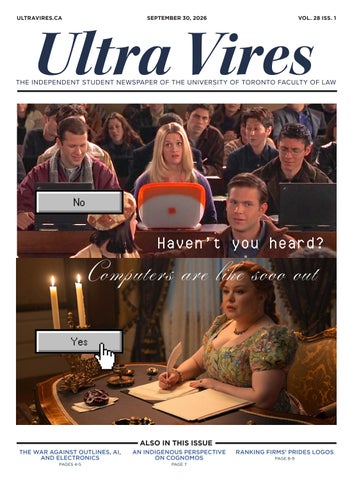
Haven’t you heard?
Computers are like sooo out
ALSO IN THIS ISSUE THE WAR AGAINST OUTLINES, AI, AND ELECTRONICS
AN INDIGENOUS PERSPECTIVE ON COGNOMOS
PAGES 4-5
PAGE 7
RANKING FIRMS' PRIDES LOGOS PAGE 8-9
2 | September 30, 2026
Ultra Vires 84 Queen’s Park Crescent Toronto, ON M5S 2C5
Ultra Vires is the independent student newspaper of the University of Toronto Faculty of Law. We provide a forum for diverse viewpoints on topics of interest to our readers. We aim to foster dialogue on academic and social issues between students, the faculty, and the broader legal community in Toronto, Ontario, and Canada. Our content does not necessarily reflect the views of the Editorial Board. We print six issues per year. Ultra Vires is printed by Master Web Inc.
EDITORS-IN-CHIEF Abby McCormick and Jake Rogers
ASSOCIATE DIVERSIONS EDITORS Juliette Lee and Jeanine Varney
BUSINESS MANAGER Benjamin SW Lee
PUZZLE EDITORS Zach Gorman and Taban Isfahaninejad
NEWS EDITORS Lauren Lindfors-Bruno and Aysenur Yildiz ASSOCIATE NEWS EDITORS Maya Hutzul and Sumayyah Shah
ASSOCIATE PUZZLE EDITOR Yael Rusonik INTRA VIRES Joe Hawkins and Avery Willis
FEATURES EDITORS Madura Muraleetharan and Cherry Zhang ASSOCIATE FEATURES EDITORS Matthew Adelberg and Nicholas Hepner OPINIONS EDITORS Alexandra (Sasha) Broun and Emma Malcho ASSOCIATE OPINIONS EDITORS Shane Joy and Mason Matthews
ONLINE EDITOR Siegfried Kahama STAFF WRITERS Neha Rahman, Jeanine Varney, and Chelsea Wang RECRUIT REPORTERS Peter Rossetti and Ben Hosseinian STAFF PHOTOGRAPHER Nicholas Hepner
DIVERSIONS EDITORS Matthew Grace and Charlize Yao
ADVERTISING If you are interested in advertising, please email us at business@ultravires.ca
ERRORS If you notice any errors, please email us at editor@ultravires.ca.
LAYOUT EDITOR Fox Hill Creative
SUBMISSIONS If you would like to submit a tip, letter, or an article, please email us at editor@ultravires.ca. Ultra Vires reserves the right to edit submissions.
UV
INDEX NEWS Letter from the Editors
3
Judicial Discretion or Juridical Directive
Welcome from the SLS
3
Queer Refugee Law
Orientation Week Recap
4
DIVERSIONS
FEATURES The War Against Outlines, AI, and Electronics: What Exactly Is Going On?
4
OPINIONS Those Moments of Intimacy
5
Sine Qua?: In Defense of Legal Latin
6
An Indigenous Perspective on Cognomos
7
Intra Vires
14
Legal Methods Section Shocked to Learn that They Are in Law School
14
PUZZLES Connections
15
Word Search
15
The UV Crossword
16
10
Connect with us. Connect to your potential.
12
8
RIGHTS REVIEW Experiences in International Human Rights Law at Jackman Law
11
Ranking Firms' Pride Logos
Build your career with Torkin Manes.
torkin.com
ultravires.ca
NEWS
ultravires.ca
September 30, 2026 | 3
Letter from the Editors
September 30, 2026 JAKE ROGERS (2L) & ABBY MCCORMICK (2L) Dear readers, A s we beg in t he new school year, please accept our sincerest cong rat u lat ions. 1L s, you have sur v ived L ega l Met hods and are now of f icia l ly 1/24t h of a law school g raduate. 2L s, you surv ived 1L and are no longer t he babies of t he school; some of you even have jobs to go back to next summer. 3L s, you f ina l ly get to leave t he plast ic on your text-
book s. A l l g reat accompl ishments — a l l reasons for celebrat ion. We a r e t he C o - E d it or s -i n - C h ief for t he 28t h volu me of U l t ra V i re s. We a r e her e t o br i n g t o you r at t ent ion e ver yt h i n g a nd a ny t h i n g r e le v a nt t o you r l i fe a s a l aw st udent . W het her it b e a s n a rk y a r t ic le on out l i ne len g t h , r e c r u it i n for m at ion , or a r e p or t on t he Gr a nd Mo ot , it w i l l b e br ou ght t o you by U l t ra V i re s.
T h is issue conta ins ar t icles t hat cover topics rang ing from an I nd igenous ref lect ion on course select ion to an or ientat ion recap from t he organ izers t hemselves. A ran k ing of law f ir ms’ pr ide logos, a defence of lega l L at in, and even some t houghts on Ca l l to t he Bar come in bet ween. U ltra V ires is ded icated to br ing ing t he Henr y N.R. Jack man Facu lt y of L aw, and t he broader lega l commun it y,
laughs, out lets, and infor mat ion. I f you wou ld l i ke to help us ach ieve t h is goa l, or just want to w r ite out some t houghts you have, you can contact us t hrough our ema i l add ress, ed itor@u lt rav ires.ca, or our I nstag ram, @u lt rav ires.ca. To your accomplishments and a great year ahead, Jake Rogers and Abby McCormick Editors-in-Chief, Ultra Vires Volume 28
Welcome from the SLS A note from the president of the Students' Law Society
ISHAAN MCLACHLAN (2L) First, I want to extend a heartfelt welcome to the incoming 1Ls, transfer students, and exchange students! Seeing all of the new faces in the halls is exciting, and we are so happy to have you all here. I am conf ident your time here will be well spent, and that you will f ind what you came to Jackman Law for. I am also glad to welcome back all of the returning students from the summer break! I hope your time off was restful and that summer treated you well. To those who have stepped into leadership roles in student groups, clubs, and societies, I thank you. You are the reason the events and communities you enjoyed last year will carry on. And to those who continue to participate in student life here at Jackman Law, we appreciate and continue to rely upon your membership and involvement. The Students' Law Society (SLS) is the student government for all JD and joint-program students at Jackman Law, and our work runs through three committees: the Social and Finance Committee (SFC), the Student Life and Academic Committee (SLAC), and the Executive Committee. The Social and Finance Committee plans
and carries out a large number of events throughout the year. Some notable examples include Call to the Bar nights, the Halloween party, Frost Week, and the ever-anticipated Law Ball. I want to thank the SFC executives, Emma Malcho (2L) and Danya Assaf (2L), who worked throughout the summer to ensure we hit the ground running this September. We are excited to announce that, by popular demand, Call to the Bar nights will be every week for the f irst few months of each semester. We are also providing more free food events and, for the competitive among you, prizes at trivia. Keep an eye out for Halloween, including a food giveaway in the Rowell Room. The Student Life and Academic Committee is the advocacy side of the SLS. SLAC members sit on a number of Dean's Advisory Committees, including the Curriculum Committee, the Equity, Diversity, and Inclusion Committee, and the Financial Aid Committee. In addition to sitting on these committees, SLAC has a number of voting members on the Faculty Council, the law school's governing body. SLAC is also responsible for a number of student life initia-
tives, such as study materials, exams from previous years, and workshops available to all students here at Jackman Law. The Executive Committee, consisting of myself, Ishaan McLachlan (2L), the VP Academic Jayden Daniels (2L), the VP Student Life Olivia Carter (2L), the VP Finance Emma Malcho (2L), and the VP Social Danya Assaf (2L), coordinates and directs the SLS's efforts. We work closely with the administration to ensure that student interests are ref lected in decisions that affect you. We were glad to see so many students nominate themselves for SLS representative roles. Putting your name forward takes courage, especially in your f irst month of law school, and whatever the outcome, we hope you stay involved. This summer, the SLS worked hard on a number of items, the most notable being the Faculty's move toward laptop-free classrooms. We surveyed students and heard from over 240 of you, roughly three in four of whom were opposed. We brought those results forward to the administration and discussed them with a number of media outlets, seeking to ensure that student opinions
were represented in their coverage. Because professors could already choose to implement laptop-free classes at the individual level, we also worked to ensure professors heard and took student perspectives into account when considering whether to opt into this new policy. While much remains part of ongoing discussion, we can say that these efforts resulted in a reduction in the number of classes that implemented the policy. We want to thank the administration for meeting frequently with us over the last few months, and for being open to feedback. This year, we will keep advocating for alternate ways to access class recordings, especially in laptop-free courses. Lastly, your feedback and suggestions are extremely helpful. Please reach out to me, the other executives, or your year representatives at any point in the year. Additionally, our weekly meetings are open to everyone, and we welcome you to attend. SFC meets Wednesdays at lunch, and SLAC meets Mondays at lunch, both in the SLS Off ice. Best of luck this semester. I hope to see you around the halls and at our many events throughout the year!
4 | September 30, 2026
NEWS
ultravires.ca
Orientation Recap Reflection from 2026 orientation coordinators ISHAAN MCLACHLAN (2L), EMMA DANNIELS (2L), AVREET JAGDEV (2L) Dear 1Ls, It is hard to believe that just a few weeks ago, you walked through the doors of Jackman Law for the very f irst time. Since then, you have met your classmates, explored your new home, competed against one another, and hopefully made a few memories along the way. Before the readings pile up and the phrase “I’ll just do it tomorrow” becomes a regular part of your vocabulary, we wanted to take a moment to look back at the f irst two weeks of your time at Jackman Law. We kicked things of f on Monday morning with registration, a complimentary breakfast, and, most importantly, the f irst opportunity to put faces to the names you probably had been seeing in various group chats for weeks. We then of f icially welcomed you to the law school with our Morning Welcome, where you heard from members of our faculty and administration about the community you were joining and the many resources and opportunities available to you. Dean Essert also shared some of the history of Jackman Law and reminded us of the larger purpose of the legal profession: that a law yer’s work is, in its highest sense, the work of building a civilization. Hopefully, you got a sense of the community you are becoming part of and the importance of the work that you will be engaging in at Jackman. From there, we sent you of f on Law School Tours, giving you the chance to explore your new home and, hopefully, f igure out where exactly you were going before classes started. We then brought everyone
4 | September 30, 2026
together for our f irst Bite-Sized Chats, where over lunch you got to meet your classmates and some upper-year students in smaller groups. Tuesday gave you a break from Legal Methods with our Movie Screening of Legally Blonde—a true classic. We know orientation can sometimes feel overwhelming, so we wanted to make sure there was also an opportunity to grab some popcorn and enjoy a more casual lunch activity together. Wednesday was quite the day! We started the afternoon with some After-Class Snacks before kicking of f the f irst-ever 1L Cup Soccer Tournament. What began as a relatively innocent afternoon of soccer quickly became a very serious competition for some of you. There were goals, saves, questionable calls, impressive displays of athleticism, and (most importantly) a lot of cheering from the sidelines. While we may not be able to agree on who deserved to win every game, we can agree that the tournament brought out plenty of team spirit. And for those less interested in soccer, we had Board Games running alongside it, where students participated in a Jackman-themed Kahoot and got the chance to get to know one another. Thursday brought even more opportunities to settle into the law school community. After another round of snacks, you joined us for an Introduction to the Academic Program, where you got a better sense of what your time at Jackman might look like beyond these f irst few weeks. Then, thanks to Sullivan & Cromwell, we traded the law school for the Rogers Centre and headed to
a Blue Jays game! After spending the day getting to know each other, it was a lot of fun to see everyone together outside of the classroom, despite the fact that we lost by a dozen odd runs… Friday started with our Public Interest Panel and Brunch, where you heard from representatives from our amazing legal clinics and programs that provide 1Ls with the opportunity to work in dif ferent areas of law. We then sent you of f to Explore Campus, giving you the chance to get out of the law school and discover a little more of the university you will be calling home for the next three years. And then came the Toronto Island Adventure! After a very full f irst week, it was nice to slow things down and spend an afternoon together outside, whether you went for a walk with Avreet or played some frisbee with Ishaan. In celebration of making it through the f irst week of law school, we hosted a Trivia Night, presented by Norton Rose Fulbright, at the start of the second week. We saw some impressively conf ident answers, some deeply questionable guesses, some creative team names, and a healthy amount of arguing over what should or should not count. Whether you came for the competition or simply for an excuse to spend an afternoon with your classmates, we hope you had fun! And then, on Thursday, we reached our f inal full day of orientation. McMillan helped us celebrate with a Closing Celebration and complimentary ice cream because, after two weeks of orientation, we f igured you had earned it. We followed that up with the 1L
FEATURES
Games, generously sponsored by Gowling WLG, where you were divided into teams and put through a series of challenges designed to bring out your creativity and teamwork skills. It was a f itting way to end our daytime programming: a little chaotic, a lot of fun, and very much about working together. Finally, Friday evening brought us to the Evening Mixer at the National. It was really special to see everyone come together one last time. We hope you got the chance to celebrate yourselves and appreciate just how much you have grown since that f irst morning of registration. Looking back on these two weeks, what we will remember most is not any single event. It is the little moments in between, where introductions were made and laughs were had, that we will remember. We know that law school is going to bring plenty of challenges, but we hope these f irst two weeks reminded you that you do not have to do it alone. You have an entire cohort of people going through the same experience alongside you! We also want to give a huge thank you to all of our incredible Orientation volunteers: Camryn, Olivia, Ian, Dilvir, Rohma, Aviral, Hafsah, Justin, Nicholas, Owen, Keira, Victoria, Andrew, Zena, Ishmeet, Ethan, Marisol, Drew, Asha, Gemma, Rawad, Camille, and John! Your generosity and enthusiasm helped make these two weeks possible. We could not have done it without you! It was such a privilege to welcome all of you to Jackman Law, and we hope that these f irst two weeks were just the beginning of an amazing three years!
ultravires.ca
The War Against Outlines, AI, and Electronics: What Exactly Is Going On? Some thoughts on recent policy changes at the law school ANONYMOUS In 2024, the Faculty banned virtual outlines. Artif icial intelligence (AI) had become unavoidable—downloadable to a hard drive and able to function without a connection to the internet. Slowly, other changes followed. The permitted length of outlines began to shrink in many classes, and, eventually, laptop bans followed. The virtual outline ban is defensible. Printing a comprehensive colour-coded outline could cost up to $100; however, the average student had no need for Command F or copy and paste. They were merely tools that
made it easier to write 7,000 words in three hours. The pros of fairer exams thus outweighed the cons that came with the loss of such tools. Shorter outlines, unfortunately, seem to be based on a rather nonsensical notion of fairness. Everyone takes the test under the exact same rules. In theory, such universal conditions are the literal def inition of fair. However, one could argue in the same vein that a golf tournament in which every player may only carry three clubs is fair, despite one player’s game relying on little more than
a driver and a putter and the other’s being built on iron play. Similarly, word and page limits for outlines skew the test in favour of students who learn in a way that is no more valuable than learning in another. They favour students who would rather spend their time memorizing the frameworks and disadvantage the students who would rather spend their time ensuring their outlines allow them to reason through detail. This sends the message that only one learning style is valid at the Henry N.R. Jackman Faculty of Law, a message that one’s ability to memorize the
law is more important than one’s ability to reason from the law. Ultimately, that disadvantages students who f it anything but the mould. The laptop ban policy rests on an equally shaky foundation. Dean Essert's initial email introduced the change as part of the Faculty's response to AI, framing it as a way to protect the core of legal education from “tooeasy access to technological tools.” Yet, by the time the policy was explained in detail, Associate Dean Stacey was pointing instead to research on the benef its of handwriting
FEATURES
ultravires.ca notes. Mixed messaging aside, neither reason provides a sound justif ication for the change. First, it is worth acknowledging that the Faculty should fear AI to a degree. After all, it is not controversial to say that things such as “good writing can only be learned through writing.” However, banning laptops in the classroom does little to address such legitimate fears, considering AI tools can be used through tablets, which are exempt from the policy. So, while the administration might
want to be Horatius at the bridge, the reality is that their enemy has already crossed the Tiber. AI is here. If the Faculty wants to produce the best law students in Canada, then it needs to prepare them to be the best lawyers in Canada. That means trusting students to use technology responsibly in the classroom through a comprehensive AI policy that ref lects reality, much like the one Columbia Law School adopted this year, rather than turning to myopic measures in a battle already lost.
Second, any notion that the research is overwhelming is fundamentally false. Associate Dean Stacey has pointed to a “wealth of educational research” suggesting that typing notes limits higher-order analytical thinking; the most widely cited study on the subject did f ind that students who wrote by hand performed better on conceptual questions. However, when researchers attempted to replicate that study in 2021, they found only small differences between the two groups, differences too small to be statistically mean-
OPINIONS
5 | September 30, 2026
September 30, 2026 | 5 ingful. Another replication found that, where students study their notes before being tested, the medium makes little to no difference. The question, then, is far from settled and, suff ice it to say, shaky science makes shaky policy. The Faculty of Law set out to keep AI out of the exam room, and it succeeded. Everything since has been a solution in search of a problem. Law students are, in theory, being trained to think for themselves. The Faculty should let them.
ultravires.ca
Those Moments of Intimacy
Long live the Thursday night out CHELSEA WANG (1L) I haven’t been sleeping well lately. The air conditioning in my unit has been cheerfully keeping me company at night, chatting my ear of f with the whirring of a handheld vacuum. I feign interest in its gossip, but I do wish it would take a cue. Call to the Bar is on Thursday. A technician is supposed to come that same night, but the exact time is unknown. It’s a scramble to get ready before he shows up, but there’s a knock at the door, and I’ve just taken out the good shampoo. That’s how I found myself before Joseph, hair in a towel, left leg unshaven, and him thinking the only problem with the air conditioner is my ears. This is what I tell the girls at the pregame when I rush in late, a measly bag of popcorn in hand because Joseph’s fruitless visit took up all the time I would have had to buy drinks. But soon I forget all about it because Never Have I Ever is picking up, and some of us are laughing too hard to pass as remotely sober. The moment moves; now we gather at the door to get to the main attraction. I could write all about that f irst Call to the Bar of the semester and all the people at the Maddy. But the dancing is the drunk walk home, and the party is in the lineup for watered-down liquor. These nights aren’t characterized by socializing, whatever socializing means. These nights f ind themselves in everything outside of it—before, after, between, and within. The evening grows self-aware as f ingers brush against each other while lacing up shoes to leave the pregame; it marks itself with the smile of someone on the street you think you met, maybe, but whose name you forgot, or never knew; it becomes itself during the sunlit debrief at the park the next day. What extraordinary things, these moments of intimacy. And in those moments, I think a tort is a cake, and I forget about my outstanding electricity bill. A night of such life can only compel you to live in the moment, nothing more and nothing less. A ll you can do is pass from one moment to another. The only yearning is for a touch or a kiss. As I head for the exit, I watch my friend, a girl I’ve known for a week, none the less, f lirt with a pretty boy who could be an alien. She reminds me that nights like these anchor my memories against something tangible, like an event that is only as beautiful
CREDIT: ONMILWAUKEE
as what goes on around it. Would I remember the timbre of Joseph’s Cantonese accent, soothing to my homesick ailments, if not for the chorus of Wonderwall almost immediately after? I think of him while my kind friend walks me home, seventeen days of history between us but a lifetime of mem-
ories I hope should come. Fullness in my heart and nothing in my head, I get home and fall backwards into bed. I wonder if Joseph has kids and what year he would have immigrated. The rattling air conditioning harmonizes with the ringing in my ears. Together, they lull me
into the deepest sleep I have known in some time. To love each other, casually, momentarily; what a beautiful thing. This moment, too, has become something to love. So, won’t you help me f ind those light-wash jeans while I do my eyeliner for tonight?
6 | September 30, 2026
OPINIONS
ultravires.ca
Sine Qua?: In Defence of Legal Latin Latin is a useful tool for lawyers that helps sharpen English vocabulary, distinguishes us as a profession, and expresses complex ideas in an elegant and succinct way NEHA RAHMAN (1L) W hile you’ve been diligent ly por ing over your assigned reading this semester, it’s likely that you’ve encountered a word or phrase in Latin and it has g iven you pause. Maybe you were af fronted. I thought I was reading a judgment by Chief Justice L askin , not Cicero; what gives? It’s reasonable to have an adverse reaction to encounter ing Latin in your readings, and w ise to avoid including too much of it in your legal wr iting. However, Latin can also be a valuable tool in your legal education. You’ll f ind Latin ever y where in the law, from statutes to cases to textbooks, because the work of law is leverag ing lang uage, and its original lang uage was Latin. Canada’s multi-jur idical system contains both the common law and the civ il law. The civ il law’s connection to Latin comes from its ancestor, Emperor Justinian’s Corpus Juris Civilis, a massive compilation of sixth-centur y CE Roman laws. The common law has an indirect connection to Latin, stemming from an English system that developed after the Norman Invasion, where French, a direct descendant of Latin, was the lang uage of the law. Through this br ief genealog y, I emphasize that Latin forms the ver y foundation of our systems of law and is too deeply embedded w ithin them to ever fully eradicate. Not that we should ever want to! My arg ument for why law students should embrace Latin is threefold. First, Latin is one of the root lang uages that make up English and even more so French, so an understanding of this ancient lang uage can enhance your modern vocabu-
lar y. Second, shar ing an obscure lang uage generates in-group social capital among you and your fellow law yers. Finally, br ief phrases in Latin encompass more meaning in a shorter span than could reasonably be expressed in an equivalent English sentence. 1. Lat in and t he roots of English and French Canadian law is practiced in both of f icial lang uages, and English and French both developed, at least part ly, from Latin. French can claim a more direct lineage, as part of the Romance lang uage family. For a legal example of this ling uistic relationship, let’s consider the phrase a priori. This is a prepositional phrase meaning “ from the earlier.” In it, we can f ind a clear English der ivative in the word “pr ior,” which shares a close meaning w ith the Latin phrase and means “earlier.” In French, you have the word “pr ior ité,” which is similarly der ived from “pr ior,” but it takes on a slight ly dif ferent meaning. W hile retaining the core idea of “ before,” “une pr ior ité” is something that you put before other interests. In English, the same meaning applies to the word priority. A benef it of understanding the Latin basis of a priori can occur if you encounter a word w ith which you are unfamiliar. Take, for example, the obscure legal philosophical term “apr ior ism,” a synonym for deductive reasoning. You can spot the Latin phrase a priori embedded in the unfamiliar word and, by know ing the Latin, have a sense of its meaning. You know that some-
one exercising apriorism is doing something “ from before.” 2. A secret lang uage for law yers Musicians have sheet music. A rchitects have bluepr ints. Developers have JavaS cr ipt. Bespoke lang uages are common to many professions, and the law is one of them. Our use of Latin sets us apart from other professions and binds us together w ithin our own. The social utilit y of this is that it allows us to identify one another by the way that we speak. For example, mens rea, meaning a g uilt y mind or cr iminal intent, is a common Latin term that might be thrown around over a fr iendly game of Clue. It’s entirely possible for anyone, even outside the legal profession, to know this word and use it correct ly, but how many non-law yers would know to follow up by ask ing about the actus reus? It’s far more likely that a fellow law yer would know that both of these conditions must exist together to constitute a cr ime, along w ith the candlestick in the parlour room. 3. Lat in’s expressive ut ilit y Good wr iting expresses concepts ef f icient ly. Latin words and phrases, which are r ife w ith inter pretive possibilit y, practically take up a small portion of the page. Take, for example, the max im of tort law, sic utere ut alienum non laedas, which means “make use of your things in a way so that you do not harm another.” Judg ments that employ this phrase inev itably expand upon it, tak ing care to explain what is meant by “use” and “ harm.” But in ever y subsequent
instance, the wr iter needs to refer to the nebulous idea of “utilizing one’s propert y so that they do not infr inge upon the use and enjoyment of another’s”; a six-word Latin phrase can encapsulate the idea br ief ly and ef fectively. A nother example comes from cr iminal law: nullum crimen sine lege, nulla poena sine lege, which means “no cr ime w ithout a law, no punishment w ithout a law,” a phrase which forms the basis for the rationale behind the creation of the Criminal Code. The core intent behind why some things are codif ied as cr iminal can be expressed thus succinct ly, w ith room to elaborate on specif ic prov isions where necessar y. There is a counterarg ument that these Latin max ims oversimplify the law. That may be, but the job of the jur ist is to elaborate upon them. The Latin phrase can still be useful by v irtue of its simplicit y, acting as a metonym for the larger meaning the legal wr iter w ishes to express throughout their wr iting, w ithout needing to repeat their elaboration in ever y case. Don’t be afraid or upset when you encounter a Latin term in the law. The fact that you understand a g iven Latin word or phrase makes you better equipped to handle unfamiliar vocabular y words in English and French; it g ives you a quirk in common w ith fellow members of your profession, and lends you a neat and tidy way to encapsulate larger legal concepts w ithout hav ing to elaborate on them ever y time. Latin is not an elite, inaccessible, dead lang uage. It is learnable, and the benef its of embracing it are clear.
ultravires.ca
OPINIONS
September 30, 2026 | 7
An Indigenous Perspective on Cognomos ILSA’s experience with the Wampum course highlights how the registration system is broken for all CAMERON SMITH (3L)
THE HIAWATHA BELT. CREDIT: ONEIDA INDIAN NATION
For as long as Cognomos has ex isted, there have been Ultra Vires articles complaining about its usage. This article is yet another in that ser ies, but perhaps from a new perspective. This fall, the Facult y of fered for the f irst time a course on Wampum, taught by Professor Sanderson (who is, to use a legal term, the G.O.A .T.). For those unfamiliar w ith Wampum, they are quahog and whelk shells used by Indigenous peoples of the Northeast portions of Turt le Island to record law. These shells are woven into belts, which ser ve as pictographic or mnemonic aids for the oral version of a g iven law. Often, they are international in nature, such as the Dish With One Spoon, which still governs the relationship between the Haudenosaunee and A nishinaabe in the areas we now call Southern Ontar io. The importance of Wampum in the early colonial per iod cannot be overstated. For sett ler governments, the abilit y to create Wampum belts was a prerequisite to being in relation w ith their Indigenous allies. Without Wampum, there could be no treaties, and therefore no valid legal claim to important geographical areas or political and contractual r ights. It is for this reason that some colonial governments accepted Wampum as payment for taxes. So, the tradition of Wampum physically represents the often-forgotten power of Indigenous peoples over sett ler-colonial governments in the early colonial per iod, the validit y of our legal claims w ithin the set-
t lers’ systems, and the idea that our relationships w ith colonial governments must return to a model of mutual respect for each other’s sovereignt y. Many students of the Indigenous Law Students’ A ssociation ( ILSA) ranked the Wampum class highest in Cognomos, including yours truly. Naturally, perhaps due to the fact that the class is pass/fail w ithout a traditional f inal exam (the ‘test’ consists of creating a physical Wampum belt), many of the students at the Facult y also ranked it highly. For weeks, my fr iends and I joked that the most U of T Law scenar io would be for them to get in despite being sett lers, leav ing the A nishinaabe man on the sidelines. I’m sure you see where this is going. Twent y seats were available in the course. The vast major it y of those went to non-Indigenous students. According to my insider information, there are two Indigenous J.D. students in the class. This article should be in pr int on Wednesday, September 30, or the National Day for Truth and Reconciliation. Hopefully you know that many of our traditions were once banned from being taught or practiced, a time w ithin liv ing memor y for many Elders. This means that ILSA’s participation in classes dealing pr imar ily w ith these traditions is not just to f ill a threecredit-shaped hole in our schedule, but the decolonial reclamation of our ancestral traditions and knowledge. This article is not to say that you, my beloved non-Indigenous reader, should feel
bad for tak ing up a seat in that class. In fact, assuming your reasons for rank ing the class so highly are pure, I applaud you for tak ing interest in our traditions. So much of the dif f icult y in Indigenous- Canadian relations is the result of a failure to listen to each other, prevalent on both sides. Your tak ing of that course is but one small step to building a more educated, tolerant, and appreciative countr y for all of us. Some may call that reconciliation. To the Facult y’s credit, they appear to have realized how bad the optics are, and have scheduled a meeting w ith ILSA to discuss the specif ic issue of Sanderson’s Wampum course, scheduled after the Ultra Vires submission deadline. However, the problem goes beyond one course for one student group. The prox imate cause of the preclusion of Indigenous students from the abilit y to learn about our own traditions lies in a Jackman-w ide system: Cognomos. The key problem w ith Cognomos is the assumption that all of us should have equal access to all courses. Say, for example, you came to law school w ith the sole intention of practicing in family law. W hy should you be g iven equal pr ior it y for a seat in a relevant course as someone who picked up a New York job two years ago and intends to coast, simply because they put it in the same band as you? Sure, the Facult y w ill point to the ‘award-w inning economic theor y’ or whatever, but economics has never traditionally been the ally of Indigeneit y. Surely, a better alternative ex ists.
This past summer, I managed to escape from Plato’s Cognomos cave, and have seen the shadows on the wall for what they are. By that I mean, I’ve now exper ienced reg ister ing for classes at another law school. In the spr ing of 2027, I’ll be study ing at the A llard Law School at the Universit y of Br itish Columbia. My course reg istration exper ience could not be more dif ferent from Jackman Law. First, I knew months in advance when my reg istration date was, and had months to build my schedule. That’s r ight, build my own schedule. I dragged and dropped courses, and then dragged and dropped some more, watching my timetable come together r ight before my eyes. On the day of reg istration, I logged on and hit the ‘Reg ister A ll’ button, and watched as A ll were indeed Reg istered. I couldn’t believe it. I mean, where was the catch? W hy was I able to get what I wanted, nearly a full year before classes beg in? A nd for Creator’s sake, where was my beautiful economic model? Again, this is not a problem unique to Indigenous students. To be a student at the Facult y is to suf fer at the hands of Cogno mos. W hat is a unique problem is hav ing that algor ithm get in the way of you and your ancestral r ight. Something needs to be done, and I’m happy to help. We have nothing to lose but our chains. A ll my relations, Cameron Smith Co-President, Indigenous Law Students’ A ssociation
DIVERSIONS
8 | September 30, 2026
ultravires.ca
Ranking Firms’ Pride Logos The good and bad of queer branding ANONYMOUS Hello! UV’s chief branding judge is back! Today we’ll be judging some pride logos that major Toronto firms used on their LinkedIn pages for Pride Month this summer. Let’s get to the good, the bad, and the colourful!
It’s cool, it's innovative, it makes inventive use of their regular logo design and integrates the pride flag without being overly complicated. I love it.
Very similar to the Osler logo in composition. I think the Osler “O” fits better with the logo, but I like the slight shadow of the SE and the ability to tell that this is the Stikeman Elliott logo.
Cassels: Style points: 5.5/10
Fasken: Style points: 6/10 Fasken used the unique choice of turning the pride flag colours more pastel, which is unusual, but altogether does not really do anything innovative with their logo. They could take some more risks with the logo next year. McCarthy Tétrault: Style points: 6.5/10
Blakes: Style points: 7/10 The logo itself is good. I always like a good ombre, but without seeing the banner, it's not clear that it’s a pride logo and is missing a couple of colours. They earn points for creativity, but they’re going to lose points for being unclear about what it is for, and for excluding one of my favourite colours—purple—from the logo itself.
Bennett Jones: Style points: 9.5/10 The Bennett Jones logo manages to incorporate all the elements of the intersex inclusive progress pride flag, which differentiates Bennett Jones and Torys from all of the other logos. I like the slight ombre design of the colours, while keeping them distinct and easily identifiable. It also stays true to Bennett Jones’ usual hexagon logo.
Cassels’ logo is very similar to the McCarthys and Fasken logos in composition, but it looks less flag-like with the wedge-type colours, as opposed to clear stripes in the other two. I also wish they would outline the white colour, because with the layout of the logo, it looks like a piece is missing, as opposed to it being another stripe, like the blue or pink.
McMillan: Style points: 5/10 A for effort and creativity, C- for execution and readability. I like the idea; it’s creative and makes use of the colours in a way that is very unique, while integrating them into McMillan’s standard branding. But, it's just unreadable. It gives me a headache. The stratification of the lighter colours cuts horizontally through the logo twice, which really cuts up the logo (and not in a good way). I really like what they were going for, though!
Osler: Style points: 7/10 McCarthys tried a very similar style to Fasken, but used the more saturated versions of the colours. I personally like the white background a bit better, so they get a slightly higher grade.
I like how the entirety of the logo has the pride flag, but it does not do anything particularly special with it. Additionally, it’s kind of hard to tell that it's Osler. Torys: Style points: 7.5/10 Simple, but it does the job. I like the inclusion of the intersex inclusive progress pride flag, but Torys could have taken more risks in this logo and worked to integrate the logo more seamlessly into their usual branding.
Gowling WLG: Style points: 8.5/10
Stikeman Elliot: Style points: 7/10
Davies: Style points: 6.5/10 Very similar to Torys, but it needs the full flag to work. The horizontal stripes make it look too much like a barcode. The fact that the Davies wordmark is on a white background makes it look like “Davies” is randomly floating under the rainbow barcode. It could be a rather poetic depiction of rainbow capitalism, though!
DIVERSIONS
ultravires.ca
Torkin Manes: Aird & Berlis: Style points: 9.5/10 This logo knows what it wants to do and executes it flawlessly. It manages to break up the pride flag without being too choppy, and to include all the pieces in a coherent manner. Each individual stripe reminds me of a streamer, which adds to a festive but professional atmosphere. The only thing I would change is making the background behind the Aird & Berlis wordmark a solid colour, as opposed to the gravelly gray.
This is the compromise point between the schools of the Fasken/McCarthys logos and the Osler/Stikeman logos. I do prefer the transparent background behind the wordmark to either a solid, opaque background or no background.
Loopstra Nixon: I think this one is very good at integrating the pride flag into a two-letter wordmark, and specifically integrates the entire progress pride flag, as opposed to just the colours. Goodmans: Style points: 8.5/10 Goodmans took a similar idea as McMillan, but only used the G, and thus created a more readable logo that does not have as many problems with the lighter colours emphasizing the horizontal-ness of the logo. I also want to give Goodmans kudos because they changed their physical logos in the office. Graveyard of Shame: These firms did not change their logos for Pride Month: BLG Norton Rose Fulbright Dentons Miller Thomson Honourable mentions: Other notable Toronto firms that did something interesting with their pride logos:
Blaney McMurtry: I like the ombre, and I really like the top left pink colour. It does suffer from a weird break at the bottom left that I am confused by, though.
McInnes Cooper: I happened to see this one in a list of Prisme Conference sponsors, and I really like how it integrates the entirety of the intersex inclusive progress pride flag while still maintaining most of its readability.
September 30, 2026 | 9
10 | September 30, 2026
ultravires.ca
RIGHTS REVIEW
The International Human Rights Program at the University of Toronto Faculty of Law An independent student-led publication 2026–27 Rights Review Editorial Board Co-Editors-in-Chief: Rachel Brouwer (2L) and Mackenzie Birbrager (3L) Senior Editors: Asha Saka (2L) and Sakina Chaudary (3L)
EXPERIENCES IN INTERNATIONAL HUMAN RIGHTS LAW AT JACKMAN LAW AN INTERVIEW WITH JEFFREY MA By Zoe Dutta (2L) “A lot of us at this law school have had access to tremendous privileges…[a]nd I feel like it is part of our obligation to do good, give back, and try to make the world a better place as best we can,” Jeffrey Ma said. That sense of obligation is what has guided Ma from a United Nations (UN) office in Geneva to a town hall in the Amazon, and now back to Canada, where he is beginning his articling term at the Migrant Workers Centre (MWC) in British Columbia. Jeffrey Ma is a 2026 graduate of Henry N.R. Jackman Faculty of Law. During his time as a student at the Jackman Faculty of Law, his passion for human rights was evident through his extensive involvement with the International Human Rights Program (IHRP). From contributing to the IHRP Clinic in his 3L year, to working as an International Human Rights Program Fellow as a 2L, to leading the Sexual Orientation and Gender Identity Working Group, Ma has consistently translated his passion for human rights into practice. This past summer, Ma sat down with the IHRP to reflect on his time at the Jackman Faculty of Law and share his experiences working in the field of human rights. Ma’s experience with international human rights work began during his 2L summer, when he interned as an IHRP Fellow with the Human Rights Liaison Unit (HRLU) of the United Nations High Commissioner for Refugees (UNHCR). Despite the UN being a massive institution, he was surprised to find that the day-to-day teams were relatively small, giving him the opportunity to take on significant hands-on responsibility across a variety of different projects. On a typical day, Ma supported the Human Rights Council unit, attended conferences and committee sessions, took meeting notes, and traversed the Palais des Nations. Ma recalled one particularly memorable project in which he supported the Assistant High Commissioner in drafting a speech for the commemoration of Nelson Mandela’s birthday. For Ma, the experience was notable not only because of the subject matter, but also because of the responsibility and challenge of being entrusted with writing compelling remarks for a senior official within such a prominent international institution. At the same time, it reinforced for him the importance of maintaining a critical perspective. “There is an important role for international institutions like the UN,” he reflected, “but it’s also important to be critical of the way that they operate.” Having to write from the perspective of someone so deeply situated within the institution challenged him intellectually in a way he had not expected, as he had to adopt a worldview
@utrightsreview
INTERVIEW DAY WITH JEFFREY. PHOTO CREDIT: ZOE DUTTA
that was not entirely his own. It is evident that Ma’s practical learning experiences have shaped his ability to approach human rights work with both a critical perspective and a commitment to principled advocacy. As a student in the IHRP clinic in his 3L year, Ma was struck by how direct, meaningful, and hands-on the work was. His main project focused on developing a transnational legal strategy to seek accountability for human rights violations committed by a Canadian corporation in the Brazilian Amazon. The work included a site visit to Amazonas, Brazil, where he worked alongside several talented partner institutions in both Brazil and the United States. Reflecting on the collaboration, Ma noted, “It was an invaluable experience to work with a transnational team of really passionate people,” whose experience helped ground him when the scale of the work felt overwhelming. Above all, he recalled being happily surprised by the amount of time students had to speak with, and work directly with, affected community members, including travelling to a town hall to listen to the con-
cerns of one of the affected communities. This experience underscored the importance of building relationships with communities and understanding their perspectives in order to develop work that best reflects the realities of those being represented. These opportunities ultimately helped solidify Ma’s interest in pursuing human rights work as a career. As he explained, these experiences showed him that this type of work was “not only possible,” but exactly what he hoped to pursue in the long term. Now, Ma is continuing his commitment to human rights work closer to home as he begins his articling term at the MWC in Vancouver. The MWC is a non-profit organization whose mission is to help migrant workers understand and protect their rights—particularly when workers have legal problems with their immigration status or employment. When asked about his decision to pursue public interest work in Canada, he explained, “I felt like there would be some more meaningful public interest opportunities where I could give back to my
ihrp.law.utoronto.ca/rights-review-homepage
own community that has given me so much growing up.” Ma expressed gratitude for the breadth of opportunities to work in the human rights field that the IHRP provided, which ultimately helped him gain a clearer sense of professional direction. In this way, he describes the IHRP as having played a very important role in shaping the next steps of his legal journey. Jeffrey Ma’s academic and professional path offers just one example of how students can begin building meaningful careers in human rights work. His advice to students interested in this area is straightforward: reach out to organizations, lawyers, and programs such as the IHRP early on, even when doing so feels daunting. After all, the opportunities are there—students simply need to take the time to explore them. When asked about how the IHRP shaped his legal career path, Ma was unequivocal: “The IHRP clinic was a truly formative experience, and I recommend that any student who might even consider being interested in human rights tries to sign up for it.”
uoftrightsreview
RIGHTS REVIEW
ultravires.ca
September 30, 2026 | 11
The International Human Rights Program at the University of Toronto Faculty of Law An independent student-led publication
JUDICIAL DISCRETION OR JURIDICAL DIRECTIVE AN EXPLORATION OF SENTENCING GUIDELINES IN RWANDA
By Diego Alvarez de Lorenzana (2L) This past summer, I participated in a selfinitiated International Human Rights Program (IHRP) fellowship at the Legal Aid Forum (L AF) in Kigali, Rwanda. I have always been interested in human rights law and getting work experience abroad, and the IHRP’s student-initiated fellowship program was the perfect opportunity to pursue these together. Once I discovered L AF, deciding where to take my fellowship was easy: the organization has unparalleled reach and influence in Rwandan civil society, and they have a diverse range of human rights initiatives that offer visiting fellows a fulsome experience in international human rights law. Being located in Rwanda, too, was another factor in my decision. A remarkably impressive country with four official languages, breathtaking national parks, and an extremely warm and welcoming culture made Rwanda a mesmerizing place to call home for three months. During my fellowship, I helped support a potential consultancy that L AF was exploring to revise Rwanda’s sentencing guidelines. I engaged in a comparative examination of whether elements of England and Wales' structured sentencing methodology could be adapted to the Rwandan context and overhaul the current regime. This project forced me to think carefully about a puzzle that justice actors in Rwanda have been contemplating for some time without fully resolving: what—if anything— should replace judicial discretion as the primary determinant of a criminal sentence, and what has kept Rwanda from developing such a replacement? A System Built on Discretion Rwanda's Penal Code, Law No. 68/2018, sets statutory ranges for criminal offences, but grants judges considerable latitude to determine where within those ranges—which can often be quite wide—a given sentence should fall. There is no national sentencing council, no standardized methodology linking the facts of a case to a specific sentence length, and no systematic data collection tracking how similar cases are sentenced across the country's justice system. A recent analysis in the Rwanda Law Journal argues that this gap is particularly acute where the Penal Code imposes mandatory minimum penalties. The author argues that without clear guidance on how those minimums should interact with judicial discretion, the predictability and consistency that fair sentencing requires are jeopardized. Rwanda's constitutional jurisprudence, including its Kabasinga line of cases (a series of high-profile cases holding mandatory minimum sentences unconstitutional), has defined sentencing principles at the margins, but this case-by-case approach remains inferior to a coherent, universally applicable methodology.
reported that the country's correctional facilities, built to hold roughly 69,000 people, were housing over 71,000. Some individual facilities even run well above 100 percent capacity. The issue of prison overcrowding is partially a reflection of Rwanda's unique histor y: Thousands remain incarcerated in connection with the 1994 Genocide against the Tutsi. But civil societ y voices inside Rwanda have pointed to more ordinar y, fixable drivers as well. The Executive Secretar y of an Umbrella of Human Rights Organizations (CL ADHO) has pub licly noted that it has become routine to imprison suspects for pet t y of fences, and Rwanda's own National Commission for Human Rights has found that the Penal Code's communit y ser vice provisions—meant to ser ve as an alternative to imprisonment—remain largely unenforced. By the Commission's own account, this has contributed directly to overcrowding. This is precisely the kind of situation that clear-cut sentencing guidelines are de signed to remedy. Where discretion is unconstrained and unmonitored, outcomes tend to drif t toward whatever is easiest or most familiar to apply—in this case, default incarceration. A methodology requiring judges to explicitly consider non-custodial alternatives before de faulting to a prison sentence would not, on its own, resolve Rwanda's overcrowding crisis. It would, however, make the reasoning behind each sentencing decision transparent and comparable in a way that subjective discretion does not. Why A ren’t There Guidelines Yet ?
Judicial Discretion and Prison Overcrowding
If the case for comprehensive sentencing directives seems clear enough in theor y, it bears asking why Rwanda has not already moved in that direction. Par t of the answer lies in institutional sequencing. Rwanda's judiciar y was rebuilt nearly from scratch af ter the 1994 Genocide against the Tutsi, and its strategic reform priorities since have focused on reducing case backlogs, reinforcing judicial inde pendence, and building basic infrastructure and staf f capacit y, such as through the nationwide rollout of an Integrated Electronic Case Management System. A standalone sentencing body of the kind underpinning the England and Wales model presupposes exactly the kind of institutional capacit y, staf f, sentencingdata pipeline, and judicial training that Rwanda's post-genocide judiciar y has only relatively recently begun to build out. Rwanda has instead recently invested heavily in tools like plea bargaining and mediation, to which the National Commission for Human Rights itself has credited much of the recent reduction in prison overcrowding. Building a new institution from the ground up may simply not have been the most urgent need with limited judicial reform capacit y.
The consequences of this gap are not merely theoretical. Rwanda has one of the highest incarceration rates in the world; the World Prison Brief notes a current prison population rate of roughly 489 per 100,000 people, among the highest of any country in the world. Rwanda's National Commission for Human Rights recently
Another factor that may partially explain why Rwanda has yet to develop sentencing guidelines is the important role that some degree of judicial discretion plays in its legal system. Rwanda's post-genocide justice system, most visibly through the gacaca courts, was built around a strong preference for individualized, restorative
@utrightsreview
ME IN FRONT OF LAF'S OFFICE IN KIGALI, RWANDA. PHOTO CREDIT: DIEGO ALVAREZ DE LORENZANA
outcomes, as opposed to the mechanical application of fixed rules. That same instinct plausibly extends to how ordinary criminal sentencing is approached today. Discretion allows judges to weigh mitigating and aggravating circumstances that fall outside whatever categories a fixed matrix might specify, in turn allowing for more individualized sentences. Moreover, it preserves the flexibility that plea bargaining and mediation depend on to function well. Indeed, plea bargaining and alternative dispute resolution are two justice system initiatives that L AF, and the Rwandan justice system at large, have devoted considerable efforts to make more prominent. A Potential and Workable Middleground My desk review explored a potential solution to the structure-discretion tension. Rather than a total transplant of the England and Wales model wholesale, it also looked to Kenya's Sentencing Policy Guidelines, and Uganda's too. Both these countries’ systems modulate judicial discretion without eliminating it, and both were built by—and for—legal systems op-
ihrp.law.utoronto.ca/rights-review-homepage
erating under resource constraints much more akin to Rwanda than to England and Wales. The core suggestion from the desk review was narrower than recommending a full sentencing council. Instead, it suggested a basic culpability-and-harm framework—of the kind common to both the English and Kenyan models—that would require judges to articulate their reasoning against a shared set of factors. In Sum Rwanda's sentencing landscape sits at a crossroads between two meritorious values: the consistency and transparency that structured guidelines can offer, and the flexibility and individualized justice that a discretion-based system—rooted in Rwanda's own history and legal culture— is designed to preserve. I did not seek a definitive answer that favoured one value over the other; the more practical question that I sought to engage with was, first, how much structure can Rwanda's institutions realistically adopt? Secondly, what should a distinctly Rwandan version of that structure look like to be worth the time and resources to build out?
uoftrightsreview
12 | September 30, 2026
RIGHTS REVIEW
ultravires.ca
The International Human Rights Program at the University of Toronto Faculty of Law An independent student-led publication
QUEER REFUGEE LAW
HIGHLIGHTS AND REFLECTIONS FROM MY SUMMER AT RAINBOW RAILROAD By Daphne Embry (2L) The State of Queer Rights Globally As of writing, there are currently more than 60 countries worldwide that criminalize LGBTQIA+ identities. In 12 of those countries, homosexuality is punishable by death. Many other countries use public order, indecency, vagrancy, and other misdemeanour offences to criminalize LGBTQIA+ identities in effect. Despite this legislation creating an immense need for LGBTQIA+ refugee protection, both Canada and the US have recently introduced legislation that further restricts access to asylum, and European governments have implemented new policies that would redirect refugees to other third countries. Rainbow Railroad reports that of the at-risk LGBTQIA+ individuals who contacted the organization for assistance in 2025, the top three reported health and wellness concerns were lack of basic needs (77%), mental health (55%), and homelessness (36%). Among safety concerns, 76% of individuals reported community rejection, followed by family-based rejection (75%) and life-threatening violence (63%). About Rainbow Railroad Rainbow Railroad is a non-profit, human rights organization operating in the US and Canada that supports at-risk LGBTQIA+ individuals globally. As an IHRP fellow this summer, I worked with Rainbow Railroad’s Resettlement Pathways team on completing applications to Canada’s Government-Assisted Refugees (GAR) program. The GAR program is similar to the traditional private sponsorship model for refugee immigration, with the main distinction being that the Government of Canada serves as the sponsor instead of individual citizens or organizations. The Government of Canada and its NGO partners provide financial and social resettlement support for up to one year following arrival in Canada, and the program is completely free to applicants. Every act of support that Rainbow Railroad provides starts with a request for help. LGBTQIA+ people feeling unsafe can reach out through their website to initiate a case. External partners are also able to refer cases to the organization. Rainbow Railroad operates a variety of different support programs. The specific support provided to an individual depends on their country of origin/citizenship, current location, and needs. At the simplest end of the spectrum, Rainbow Railroad can help connect people to grassroots organizations in their areas. This is almost exclusively the case for those located in countries such as the US, the UK, Australia, and other countries where LGBTQIA+ human rights are, for the most part, state-protected. However, perhaps the bread and butter of the organization is the Emergency Travel Support (ETS) and Resettlement Pathway programs. These two programs support individuals fleeing their current countries and help them resettle in a country that will provide them with adequate protection. The ETS team primarily assists people who do not completely meet the 1951 UN Refugee Convention (Refugee Convention) definition of a refugee, but are nonetheless fleeing persecution based on their sexual orientation, gender identity or expression, and/or sex characteristics (SOGIESC). They provide both financial and logistical support so individuals can exercise their right to asylum in a safe country, as provided for under Article 14 of the Universal Declaration of Human Rights. Rainbow Railroad then refers individuals to LGBTQIA+ organiza-
@utrightsreview
ABOVE: PARTICIPANTS IN RAINBOW RAILROAD’S PARADE CONTINGENT EMBRACING AND CELEBRATING. BELOW: PRE-STEPOFF PHOTO WITH SEVERAL OF MY LOVELY COWORKERS. PHOTO CREDIT: DAPHNE EMBRY
tions on the ground in their countries of relocation for resettlement support. The Resettlement Pathways team works exclusively with individuals who meet the definition of a refugee under Article 1A(2) of the Refugee Convention. In other words, to qualify under this program, individuals must have already fled
their country of citizenship or habitual residence due to a well-founded fear of persecution based on their sexual orientation, gender identity or expression, and/or sex characteristics (SOGIESC). They must also be unable to seek protection from their home country and unwilling to return there, as they face the possibility of torture, imprisonment, or even death upon their return. Un-
ihrp.law.utoronto.ca/rights-review-homepage
der this program, individuals are referred to Canada’s GAR program for refugee resettlement in Canada. Individuals seeking refugee status through GAR cannot apply on their own; they must be referred through a limited number of partner organizations, including Rainbow Railroad and the
uoftrightsreview
RIGHTS REVIEW
ultravires.ca
September 30, 2026 | 13
The International Human Rights Program at the University of Toronto Faculty of Law An independent student-led publication United Nations High Commissioner for Refugees (UNHCR). Rainbow Railroad is able to refer up to 250 individuals to GAR each year, which includes both the LGBTQIA+ people at risk and their immediate family members. Rainbow Railroad’s GAR referral ability is a direct result of the organization’s advocacy efforts with Immigration, Refugees and Citizenship Canada (IRCC) and the Canadian government. Historically, only the UNHCR was able to refer individuals to GAR, but it has since been opened to other trusted organizations. In 2023, this pathway was opened up to Rainbow Railroad in response to the unique barriers faced by LGBTQIA+ people in the refugee status determination process. This change recognized that many organizations, including the UNHCR and IRCC, are ill-equipped to understand and respond to the unique crises and needs of LGBTQIA+ people. The Work I Did This summer, I referred eight individuals for resettlement through Canada’s GAR program, and I worked with four more, whose applications were still in process by my final day. These individuals have come from countries with some of the harshest environments for LGBTQ+ people globally, including Uganda, Syria, Somalia, and Yemen, to name just a few. Before I was assigned a case, individuals had already reached out to the organization for assistance, and their identity as an LGBTQIA+ person had been verified by the intake team. The intake team will have also collected some basic information and documents from them. Once verified, Rainbow Railroad conducts a vulnerability assessment with individuals. Since the organization’s capacity to assist individuals is limited, the vulnerability assessment allows the team to prioritize using the available referral spots to assist those who are the most in need. Once cases have been selected for referral to the IRCC, individuals complete a rough draft of the application forms before the case is assigned to a caseworker. Once the case came to me, I would go through all of the materials received from the client and highlight any issues, inconsistencies, or missing information. I then set up meetings with the client to go over their application and discuss any issues I found. Subsequently, I completed their application and submitted it to the IRCC. The amount of time it takes to complete an application varies drastically based on the number of individuals, the age of the individuals, and other factors. I also had the opportunity to march with Rainbow Railroad in the Toronto Pride Parade this year. This was my first ever Toronto Pride, and it is certainly one I will never forget. Many of the individuals who joined us in the parade were refugees that the organization had supported over the years. I also participated in Rainbow Railroad’s Pride staff fundraiser and raised almost $500 for LGBTQIA+ refugees through my network. Reflections My time at Rainbow Railroad was incredibly positive and life-changing. I was consistently inspired by the individuals I worked with and the seemingly endless resilience and kindness they possessed. I learned so much about the entities and organizations worldwide whose missions are to assist refugees and LGBTQIA+ individuals, while also gaining insight into the ways in which some countries’ domestic refugee law is failing those same individuals. Gaining experience working with individuals with different cultures, religions, and languages other than my own is a lesson I will always carry with me. One of my biggest learning experiences has been developing the skills necessary for trauma-informed casework. I witnessed the wide
@utrightsreview
MARCHING IN THE TORONTO PRIDE PARADE WITH RAINBOW RAILROAD. PHOTO CREDIT: DAPHNE EMBRY
variety of ways in which trauma impacts an individual’s ability to communicate about their experiences. Most commonly, the people I worked with struggled to remember specific details of their lives well. For instance, I often worked with information like “I remember it was around Ramadan,” or “it was right after my brother got married.” To create a consistent and plausible application, I would produce a supplemental addendum to the IRCC explaining what information was estimated and an approximate margin of error with reference to the firm dates that the individual provided me with. It was also common for people to be rather vague about the experiences that led them to seek asylum. During my
time at Rainbow Railroad, I had to learn how to ask questions that are both specific enough to ensure the individual responds with the detail I need, yet broad enough to refer to information I did not have. One of the more difficult skills I have worked on in this role is discerning when an individual’s vague or inconsistent statements were the result of trauma, and when they were the result of a fabricated story. I also learned to navigate confronting an individual about inconsistencies in a way that is not harsh or accusatory, while still making it clear that the information is not matching up. Thankfully, many of the inconsistencies I encountered were clarified without raising any
ihrp.law.utoronto.ca/rights-review-homepage
credibility concerns. I am endlessly grateful to have had this opportunity so early in my life and legal career. While I am still figuring out where to go from here, the lessons I learned and experiences I had at Rainbow Railroad will shape my future as a lawyer in a multitude of ways. I would specifically like to thank my supervisor, Zahra Mahmoodi, for her endless support this summer, as well as Maicel Neema and Paige MacLean for training me and navigating their first fellowship placement with me! Finally, I would like to express my gratitude to the International Human Rights Program team for making this fellowship a possibility for me.
uoftrightsreview
DIVERSIONS
14 | September 30, 2026
Intra Vires
ultravires.ca
Totally real news from the Faculty of Law AVERY WILLIS (2L) AND JOE HAWKINS (2L) Please note that any quotes used in these articles are satire and should not be attributed to any real individuals. Notetaking bans expand as professors worry about student engagement Bans on notetaking tools in the classroom have been expanded to include printed and handwritten notes. Students will now be expected to memorize their briefs and come to class prepared to discuss them in detail. A Faculty member, who wished to remain anonymous, commented that the Faculty is “concerned that students are taking comprehensive notes,” which hinders engagement with the law during class. Another anonymous Faculty member cited concerns over paper as a “technological tool,” which may be used improperly, subverting the core of the Jackman Law academic mission. Students will still be provided with a record of the class, transcribed in cuneiform on clay tablets. Bora Laskin Law Library extends hours inf initely through special entrance You didn’t really think the library was closed on Sundays, did you? Maybe for the uninitiated S.N.A.I.L ., but not you, the
mighty Jackman Law student. We at Intra Vires have learned of a newly discovered “special entrance” granting students access to their favourite study spaces every day of the week. The transformative gift, which resulted in the renaming of the school last year, has borne another fruit in the form of the Henry N.R. Jackman Special Library Entrance aimed at providing after-hours access to law students. For access, students are required to crawl through the loose ceiling tile behind the Guest Services desk in the atrium and take a right at the fork in the vents. If students use this entrance while the library is “closed,” they are asked to remain as still as possible within the library to avoid setting of f the burglary alarm. New brand partnership announced for bookstore after Hello K itty success After the overwhelming success of the Hello Kitty x U of T collaboration, the law bookstore has been looking for a partner to bring new life to the Jackman Law merch. After a heated debate over what brand best represents the Jackman Law students, the law bookstore has announced a thrilling partnership with the Madison Avenue Pub.
Whether it’s the dress code for “Call to the Bar” or the only thing you can bother to put on the morning after, this Maddy x Jackman collaboration is sure to provide clothes for every occasion. Firms to require FitnessGram PACER Test for 2L recruit Toronto law f irms have added an additional requirement for students looking to participate in the 2026 2L recruit. In response to concerns that summer law students are taking too long to pick up cof fee orders around the of f ice, all applicants are now required to complete the FitnessGram PACER test and upload their results alongside their application materials on ViLaw. Firms have highlighted that this measure will help empirically assess which candidates have the highest capacity to withstand intense physical and psychological torture. Those who have not submitted their results will be given time to do so in the week leading up to OCIs. New York recruit timeline moved up (again) 1Ls, if you’re reading this, it’s already too late. In a move surprising no one (except the CDO), incoming students interested in the
2L New York recruit are expected to submit their application materials prior to their f irst year of law school. Prestigious law f irm Willis & Hawkins is the most recent f irm to jump the gun in this race for legal talent, opening their 2028 summer associate application this past July. “We are almost certain that everyone who accepted our of fers will be attending law school this year,” said Hawkins, a managing partner. Students reportedly full of energ y and happiness on f irst “deemed” Friday of the year Multiple faculty members have mentioned how “full of life” their students seemed on September 18th, the f irst of four “deemed” Fridays in the fall semester, where students followed their regular Monday class schedule. The energ y of the student body was attributed to a highly successful “Call to the Bar” on Thursday evening, causing many students to appear nauseous with excitement to be at school on a Friday. When asked for comment, students met us with blank stares or requests for Advil, though this is certainly only a side ef fect of having such a productive day of learning.
Legal Methods Section Shocked to Learn that They Are in Law School 1L Students in distress over where the intensive course has left them CHELSEA WANG (1L) With the school year back in full swing, Jackman’s entering class is busy writing case briefs and making outlines into the late hours. But for one group of 1Ls, this couldn't be further from the truth. While their classmates were being prudently taught an introduction to the study of law in their Legal Methods classes, one section's experience left them completely blindsided as the f irst day of classes rolled around. “When I read Crocker v Sundance, I thought we were learning the ideal number of drinks to have for the best tubing experience," one student admitted. “It honestly never occurred to me that the class would be about anything else.” The result is astonishing. Polls show that
a whopping 68% of students in this Legal Methods class thought their professor was talking about Iraq anytime FIR AC was mentioned, and while the other 32% knew it was an acronym, they thought it stood for “F--- It, Read And Cry.” “I thought Commercial Host Liability was the name of a band,” another student conf ided. “I had no idea we were reading case law. What even is that anyway? And why does a case brief matter so much if I already have a backpack?” Upon being reminded that a case brief is dif ferent from a briefcase, she sighed, mumbled a prayer, and walked away from our interview. This discrepancy among Legal Methods classes is jarring at best. At worst, it is an
injustice to students and faculty alike. A third of the 1L class, far from an insubstantial group, is starting law school without the same advantages that their peers are priv y to. Meanwhile, professors are left scratching their heads as to why their students are struggling to keep up in class. The design of the 2-week intensive course was to level the playing f ield for 1Ls with varying degrees of familiarity with the study of law. The outcome, though, is a playing f ield littered with potholes and some patches of dead grass. Asked for comment, the University had little of note to say. “The Henry N.R. Jackman Faculty of Law at the University of Toronto is an internationally acclaimed institution situated in the heart of one of the
most diverse and vibrant cities in the world,” a spokesperson told Ultra Vires. “Ranked #1 in Canada and in the Top 25 globally across three major world university rankings, we attract exceptionally bright and ambitious students from all walks of life and educational backgrounds." The Legal Methods section has since been f ighting to be recognized as an equity-deserving group. A lthough their case is compelling, they are looking for help getting the motion started. “Obviously, we don’t really know how this law stuf f works,” one student confessed.
PUZZLES
ultravires.ca
Connections Puzzle ZACH GORMAN (2L) For easier gameplay, scan the QR code and play online! This will allow you to know when you have successfully identif ied a category.
Word Search TABAN ISFAHANINEJAD (2L)
T he solutions can be found under the Word Search.
FIFA Country Codes of Recent World Cup Winners: ESP, ARG, FRA, GER; Music Groups: CONNECTIONS SOLUTIONS:
The terms in the 16 boxes below can be grouped into four categories. Each category will be based on a common trait shared by each term within that category. To complete the game, group each phrase into the correct category such that you have four groups of four terms apiece.
September 30, 2026 | 15
BTS, ELO, REM, TLC; Currencies: AUD, GBP, JPY, RMB; Right-Wing Political Parties: AFD, BJP, CPC, GOP
They would’ve written for UV. Submit pieces to editor@ultravires.ca
16 | September 30, 2026
PUZZLES
Ultra Vires Crossword YAEL RUSONIK (1L)
ultravires.ca