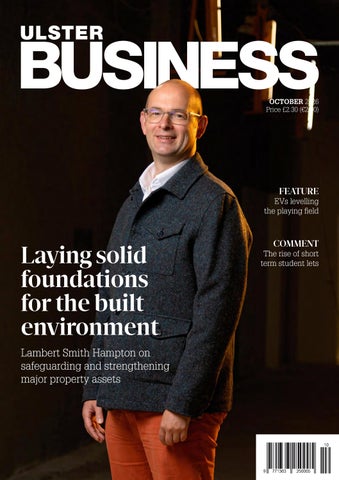
OCTOBER 2026 Price £2.30 (€2.60)
FEATURE
EVs levelling the playing field
Laying solid foundations for the built environment Lambert Smith Hampton on safeguarding and strengthening major property assets
COMMENT
The rise of short term student lets
06
27
18
84
58
82
Contents 06 News The latest news and exclusives from across Northern Ireland business and beyond
18 Cover story Lambert Smith Hampton on laying the foundations for a solid property investment
43 Commercial property & construction Those behind our most interesting buildings
53 Office environment & fit-out
66 Top 100 launch A look back at the official launch of this year’s Ulster Business Top 100
70 Lifestyle
What’s next for the wider office market in NI
John Mulgrew pays a visit to Lunn’s Jewellers to try the latest references from Patek Philippe
27 Renewable energy
58 Analysis
77 Motoring
Italian firm ERG brings the experts together to look at the future of green power here
Beyond 10,000 hotel rooms: a new chapter but student rooms changing market
Toyota’s workhouse gets an upgrade and Hyundai releases a smaller Ioniq
35 Energy
61 Hospitality, food & drink
94 Technology
John Mulgrew looks at the rise of EVs and why they are becoming the obvious choice
The businesses and operators making waves here in Northern Ireland
Solana coders take the Slane stage in twoweek crypto castle takeover
Ulster Business is a part of the Independent Press Standards Organisation (IPSO). If you believe you have been unfairly treated, you can contact IPSO in writing via its website for guidance on what to do. The service is free. IPSO can then advise on whether it’s likely you have grounds for a complaint and what to do about it. The normal procedure is for the complainant to then contact the publication’s editor directly. If no agreement is reached, the complainant can go back to IPSO to look for an adjudication, or for it to take over the complaint. Full details are available at www.ipso.co.uk. Alternatively, email complaints@ipso.co.uk, or inquiries@ipso.co.uk, or telephone 0300 123 2220, or the out-of-hours emergency number: 07659 152 656. Or write to: IPSO, c/o Halton House, 20-23 Holborn, London EC1N 2JD
OCTOBER 2026
3
EDITOR’S COMMENTS
The worrying rise of the online mentor
T
hose operating businesses work considerably hard to build and develop their firms and organisations.
Take hospitality, for example. Some of the better restaurants have failed, commercially at least, due to the nature of that sector, the margins, and sometimes because the skill and passion don’t always translate to good business practice. Setting out to go it alone and set up a business of any kind, right across the sectors, is both an ambitious and commendable task. It’s fraught with challenges throughout the journey, from the initial investment right through to being able to sustain it, paying a growing workforce, dealing with changing markets,
and ever-increasing input costs. It’s not something I imagine many take lightly. You’ll also be acutely aware of people who position themselves as having the ability to make you a millionaire. The ability to turn a scrappy start-up into a conglomerate. All it takes is signing up to this course, and they’ll teach you the tricks of the trade. There are of course business experts and mentors out there with lengthy CVs who assist firms and entrepreneurs along on their career path. But that’s not what I’m talking about. We’ve all seen them on our social media feeds. While I’m sure they existed long before Instagram and TikTok came along, the evolution of social media means that
Publisher Ulster Business c/o Mediahuis UK Ltd Belfast Telegraph House, 33 Clarendon Road, Clarendon Dock, Belfast BT1 3BG Printer W&G Baird Greystone Press, Caulside Drive, Antrim BT41 2RS www.wgbaird.com
www.ulsterbusiness.com
this particular type of individual now has a free platform from which to shout. And they do – a lot. For many, it’s the ‘fake it until you make it’ ideology. Flash cars, watches, and crass designer T-shirts with a logo so large you could see it from space. I’d like to hope that people can separate the wheat from the chaff. Established businesses and entrepreneurs most likely can. But there’s still an undercurrent of people who just want to make it work, and become comfortably well-off, or independently wealthy, and will try anything – even if it costs them a fortune in the process. ■ John Mulgrew
Editor John Mulgrew, john.mulgrew@mediahuis.co.uk Advertising Louise Henderson, louise.henderson@mediahuis.co.uk Charlotte Prentice, charlotte.prentice@mediahuis.co.uk Graphic design Susan McClean, Mediahuis Ireland Design Studio Cover photo Richard Trainor
@ulsterbusiness
Ulster Business Magazine
Mediahuis UK Ltd © 2026. All rights reserved. No part of this publication may be reproduced, stored in a retrieval system, or transmitted in any form, or by any means, electronic, mechanical, photocopying, recording, or otherwise without the prior permission of Mediahuis.
OCTOBER 2026
5
NEWS
A month in numbers
10k
The number of hotel bedrooms available across Northern Ireland in 2026.
John Mulgrew
T
12.3
The percentage increase in the cost of groceries in NI, yearon-year.
2.3
The percentage increase in economic output here over the last year.
£1m
The total investment by Bullhouse Brewing Company in its new east Belfast production site.
Student scheme shortterm lets ‘approaching same level as hotel rooms’
Janice Gault
he boom in student accommodation being used for short-term let will now see almost 5,000 additional rooms on the market in Belfast and risks “creating competitive imbalance”, it’s been claimed. There will be almost as many student accommodation rooms available to rent as hotel rooms available in Belfast city centre, fresh figures show. That includes several major schemes which have recently been given the green light to be allowed to rent out rooms to non students during July and August. That includes developments owned by Queen’s University, such as the city centre Elms developments, as well as 123 York Street, the Biscuit Factory, and around 450 rooms for another student scheme on Corporation Street. The hotels and hospitality sector has opposed many of the change of uses and says while it’s “not about restricting competition or consumer choice…it is about ensuring that everyone operating within the visitor accommodation market does so within a clear, consistent and equitable regulatory
framework.” “During summer 2026, around 5,000 student rooms in Belfast were certified for use as visitor accommodation, adding significant seasonal capacity and creating a new dynamic within the market,” Janice Gault, chief executive of the Northern Ireland Hotels Federations (NIHF), told Ulster Business. “Allowing other providers to enter primarily during peak trading periods without necessarily carrying the same year-round cost base risks creating a competitive imbalance. “This is not about restricting competition or consumer choice. It is about ensuring that everyone operating within the visitor accommodation market does so within a clear, consistent and equitable regulatory framework.” “The growth of purpose-built student accommodation (PBSA) is also changing the shape of the visitor accommodation market.” Northern Ireland’s hotel sector has growth significantly since the turn of the century. As the new millennium dawned, there were 139 hotels offering 5,013 bedrooms, with the three-star sector dominating the market at 37pc. Since 2000, the number of hotel bedrooms has more than doubled, with the average property growing from 38 bedrooms to around 70 today. More than 60pc of hotels are now affiliated with a local or international brand, reflecting a significant shift in the profile of the sector. Today, there are 145 hotels comprising 10,107 bedrooms, with the four and five-star sectors now dominating the market. “Development has taken many forms, from larger, internationally branded, bedroom-led hotels to smaller independent and boutique properties offering a more individual guest experience,” Ms Gault said. “The emergence of the aparthotel has added another dimension, responding to changing visitor needs and demand for greater flexibility, particularly for longer stays.” Read the full article on page 58-59
6
NEWS
NI beer maker investing £1m in new brewery
Willy Mayne pictured at Bullhouse’s current brewery
John Mulgrew
A
Northern Ireland beer maker is building a major new brewery in Belfast as part of a £1m investment, Ulster Business can reveal. Bullhouse Brewing Company says it is taking a new site at Millmount in Dundonald to meet growing demand and significantly expand production. It currently brews on the Boucher Road and operates its successful bar, Bullhouse East, on the Newtownards Road in east Belfast. Founder Willy Mayne says it also hopes to do beer and brewery tours at its new base, as well as offering corporate experiences. He says it also wants to “open more venues if we can” in future. “It’s trying to save community assets and find the right opportunity to take a venue and turn it around.” Mr Mayne says the first year would see the brewery expanding to
OCTOBER 2026
5,000 hectolitres, but that the new site will have the capacity to produce 12,000 hectolitres at full capacity. “We’re just at Millmount which is only a mile away from where the brewery started,” he says. “The other benefit is moving from the hands-on brewhouse we currently have. From a consistency point of view, we really have to be on it. It’s a testament to the work we do. It’s as much art as it is science. “This new brewery will be semi-automated. Adding a brewing kettle will allow us to add more hops [during the brew] and it will help us develop certain styles. We will also have a pilot kit for research and development.” Read the full story on page 60
7
NEWS
Administrators appointed to Glens of Antrim Potatoes
A
dministrators have been appointed to Northern Ireland business Glens of Antrim Potatoes. Established in 1972 by the McKillops, a third-generation Co Antrim farming family, Glens of Antrim Potatoes began growing and packing potatoes for supermarkets and grocery chains across the island. It now also produces a range of handcooked potato crisps under the Glens of Antrim Crisps brand and makes own-label crisps for Tesco in the Republic under its Finest range. In 2022, the brand secured a new contract to supply its full range of hand-cooked crisps to 35 Tesco stores across Northern Ireland. Glens’ branded crisps are also exported to key markets including Dubai, Singapore, Malaysia and South Korea. The firm had expanded over the last 10 years, including investing £900,000 in a new plant in 2015. The business operates from sites in Cushendall and Ballymena and employs 95 staff, most of whom have lost their jobs. Administrators Stuart Irwin, Ian Leonard and Robin Coughlin from Interpath were recently appointed due to “significant challenges” in the agri-food sector, a statement from Interpath said. Businesses up and down the supply chain are being heavily impacted by rising input costs, they added.
Quotes of the month
8
Michael McKillop of Glens of Antrim
“For Glens of Antrim, these pressures had a significant and detrimental impact on cashflow. In response, the directors explored a range of options, including refinancing and investment, but sadly, with no solvent options available, they had to take the very difficult decision to request the appointment of the joint administrators.” The statement continued: “Following the appointment, the Company has ceased to trade. As a result, and with deep regret, all of the company’s employees, with the exception of a small skeleton staff retained to
support the administrators, have been made redundant. “The joint administrators and their specialist employment team will be providing any and all support to those impacted.” Stuart Irwin, managing director at Interpath and joint administrator, said: “Glens of Antrim has been growing and supplying potatoes across Ireland for over 50 years, so this is a tremendously sad outcome for the business, its dedicated team, the agri-food sector in Northern Ireland, and the wider community in Ballymena and Cushendall.”
“Allowing other providers to enter primarily during peak trading periods without necessarily carrying the same year-round cost base risks creating a competitive imbalance.”
“It’s hoped that the momentum from new buyers will continue over the coming months. But any solutions to the housing supply issues in the short term are hard to see.”
Janice Gault on the increase in student rooms available for short-term let.
Samuel Dickey on Northern Ireland’s residential housing market.
“The story we’re seeing from our GenAI Workforce survey is that Northern Ireland employees are relatively well informed about generative AI tools.” Deloitte’s Marie Doyle speaking about its latest survey looking at the use of AI in the workplace.
NEWS
‘Innovation’ can help plug NI’s low productivity
N
orthern Ireland’s low productivity is a sign we “need to encourage more innovation” in our businesses, the head of Invest NI has said. Writing in this edition of Ulster Business, Invest NI chief Kieran Donoghue says “recent data shows our productivity remains 12-13pc lower than the UK average, even after some pandemic-era improvements”. “Productivity measures how efficiently a business turns time and resources into value. “Northern Ireland’s productivity gap can be explained, in part, by our SME economy, but it is also a sign that we need to encourage more innovation in our businesses. By investing in R&D and innovation, SMEs can become more efficient and find advanced ways to operate. “Low productivity can constrain growth
OCTOBER 2026
and negatively impact the competitiveness of businesses. “Invest NI is supporting businesses to invest in the drivers of productivity, such as machinery and equipment, technology, digitalization, and skills, so they can become more innovative and competitive.” And on innovation, he said the “UK Innovation Survey shows that only one-third of NI businesses are ‘innovation active’… slightly below the UK-wide average”. “This innovation gap partly reflects our industrial structure: smaller firms typically invest less in Research & Development (R&D) and have less capacity to absorb new technologies. “Encouraging more businesses to innovate can future proof key sectors, boost productivity
Kieran Donoghue
and stimulate wage growth and business profitability, while generating knowledge spillovers and diffusing innovation. “At Invest NI, we are actively looking at ways to increase the number of clients that are undertaking product, process, supply chain and organisational innovation to drive growth and competitiveness.” Read the full article on page 32-33
9
NEWS
‘Thousands every week’ being lost by south Belfast business due to road closure Abdullah Sabri
R
oadworks on a busy south Belfast route are affecting trade for local businesses — some of whom report they are losing out on a fortune. Newton Park, a key carriageway for Co Down commuters from the countryside, has seen its city-bound route disrupted since July. A Department for Infrastructure (DfI) spokesperson said the works are being taken out by contractors at the adjoining roundabout hired by a developer as part of a new housing scheme for the area. Newton Park’s closure is due to end on October 2, with wider works being completed by late December. Christine McCarrigle, who has managed the store for over 20 years, said sales began to dip after the work began. “We were actually having a good summer because the weather was good — the sales were quite good — and then it dropped off,” she explained. “And usually summer would be the quietest part of the year for us, and then with back to school we’d get busy again, and from then on it’s the rush to Christmas. Our sales are now down from the summer, I don’t think it’s ever happened before.” The work has cut off some customers picking up items on their morning commute, with Ms McCarrigle surmising those returning are unsure if disruptions exist on the return journey. “They’re not able to come down Newton Park, so there are not many people about,” she said. “And then we kind of expected a bit of a rush
The closure sits on a busy roundabout in the Four Winds area
10
The works are expected to be completed in December
in the evenings, but we’re not really getting that either”. “I think there’s a lot of confusion as to what direction the road is open or closed, so people just don’t bother trying.” Joanne Dugan manages The Little Laundry Co in the same parade of shops as the Mace. The manager of four years said that the disruptions have been an “absolute nightmare.” “A lot of customers are complaining,” Ms Dugan said. “Even getting to work is a complete nightmare. You have to go right round the ring road and it’s an extra 20 minutes on your journey.” “We don’t have as many walk-ins as we usually do — it’s definitely having a knock-on effect. “Something needs to be done because it’s just taking far too long. And then with the schools starting too, the traffic’s horrendous.” Four Winds Pharmacy manager Adrian Cassidy took over the chemist eight months ago and also noted that “sales are down.” While the store hasn’t been hit as hard as others in the area, Mr Cassidy said the number of drop-in customers has fallen. “We’re not getting as much passing trade,” he explained. “It just cuts us off from anyone living above the roundabout. It’s probably more than half of our customer base.” All three businesses reported that they did not receive any official correspondence notifying them of the works. A DfI spokesperson said: “In agreement with the department, contractors acting for the developer notified residents and affected businesses in close proximity of the work, while all other road users, residents and businesses have been notified through advance notification signage.”
NEWS
Grocery price inflation reaches 12.3pc in NI Margaret Canning
P
ressure on Northern Ireland shoppers is growing, a report has said, with grocery inflation now hitting 12.3pc. Data organisation Worldpanel by Numerator said the increase in the price of groceries was up 0.54pc on figures from August, hit 12.33pc year-on-year. Its data also revealed that take-home grocery sales in Northern Ireland increased by 2pc in the year to September 6. The end of summer activities saw shoppers going to stores less often, with trips down 5.5pc on last year, and volumes continuing to decline, down 8.7pc year-on-year. But prices are continuing to rise steadily,
OCTOBER 2026
with no end in sight, according to business development director Emer Healy: “The outlook remains precarious, and there are signs of further pressures in the months ahead for shoppers.” She said shoppers relied on promotional offers to offset high prices where they could, as children began heading back to school. Promotions accounted for 34pc of value spend, the highest share reached to date, with more than £1.5bn now spent on promoted products in-store each year. Branded ranges continue to hold majority value share in Northern Irish baskets, at 57.1pc, growing by 6.2pc and contributing an additional £151m in value sales compared to last year. Premium own-label ranges also continued
to show strong value growth, up 13pc and adding £20.6m in value sales to take-home grocery. Ms Healy said: “The return to school has brought shoppers back into their everyday routines, with this reflected in growth across key categories. “Over the 12 weeks to September, bakery pastries grew by 3.2pc, savoury snacks by 13.3pc, yoghurt by 14.9pc, biscuits by 7.7pc and coffee by 2.5pc, as shoppers returned to their familiar breakfast, lunchbox and snacking occasions. “We also saw total toiletries grow by £7.8m, as households replenished their essentials following the summer holiday period.” Tesco leads in value share, at 39.3pc, as the number-one take-home grocer in Northern Ireland. Sainsbury’s held its market share at 17.3pc, while Asda sat at 14.1pc value share, declining by 7pc. Lidl, meanwhile, claimed a value share of 9.9pc, up 8.5pc in value growth.
11
MOTORING
Tesla is planning to build a major electric vehicle charging hub in Londonderry
Tesla building Northern Ireland city’s largest electric car charging hub John Mulgrew
T
esla is planning to build a major electric vehicle charging hub in Londonderry, it can be revealed. Fresh plans are underway which could see the development of eight electric charging bays at Lisnagelvin Retail Park in the Waterside area of the city. It would be the largest rapid charging system in the city, which currently has very few when compared to Belfast and other major road routes. The development would include eight supercharger bays, with Tesla branding, along with power cabinet equipment, and the installation of a substation. Tesla operates some 16 similar rapid charging stations across the island, the majority of which are based in the Republic. The plans, which have been submitted by McArdle Doyle, say the primary reasons for the new charging stations include its links with
12
major roads, the “limited electric vehicle rapid charging infrastructure available in Northern Ireland” and need for a “much needed rapid charging hub serving the west Ulster region”. “The site is highly suitable, serviced and available, and the proposed development can be delivered and contributing to the national electric vehicle charging network without delay,” supporting documents say. Elsewhere, retail giant Amazon is building new electricity infrastructure at its Belfast base to support its growth of the use of zero-emission electric vehicles here, it can be revealed. Amazon operates its main major delivery base from the Titanic Quarter at Belfast Harbour. And it’s now developing new infrastructure to assist in electric vehicle chargers demands, in a bid to support its fleet electrification. “The proposed substations will support charging stations for electric vehicles and
complement the operation of the Amazon warehouse,” plans say. “The proposed facilities will be located on small patches of brownfield land located adjacent to the existing Amazon Belfast depot.” Partner EO Charging is behind the new development, and has helped roll out some 800 EV chargers for the digital retailer over the last few years. A number of firms are continuing to invest in public charging infrastructure here, including Weev, with faster points for EV users across Northern Ireland. And the latest figures show Northern Ireland had the largest percentage increase in 50kW and above devices at 70.5%, corresponding to an increase of 55 devices rated 50kW and above. EV charging platform business Virta said while the figures were bad news for drivers in Northern Ireland, they also represented a real opportunity for businesses. ■
Benedicts in Belfast has been sold
NEWS
Prominent Belfast hotel is sold after almost 30 years of family ownership Simpsons hand Benedicts over to ‘highly capable and safe hands’ of Johnston duo, writes John Mulgrew
A
prominent, family-owned Belfast hotel has been sold after almost 30 years of ownership, it can be revealed. Benedicts of Belfast on Bradbury Place, formerly in the hands of owners Paddy and Edmund Simpson, has been bought by hospitality operators Colin and Louise Johnston. Mr Johnston said that while there is “no intention of changing what people know and love about it, we have some exciting plans in store for 2027 and look forward to working with the impressive and loyal team that Paddy and Edmund have built up over the years”. The hotel, which was first opened in 1998 and was built at a cost of around £4m, is one of the most prominent hospitality venues in the
OCTOBER 2026
area once referred to as the ‘Golden Mile’. A final sale price of the property and hospitality venue has not been revealed. Benedicts of Belfast will continue to trade under its existing name, with the current team remaining in place. “We are extremely proud of what Benedicts has become over the years and are grateful to our staff and loyal customers who have been such an important part of the business,” outgoing owners Paddy and Edmund Simpson said. “We are delighted to be handing Benedicts over to Colin and Louise and wish them and the entire team every success for the future. We know we have left it in highly capable and safe hands.”
Paddy and Edmund Simpson own and operate a number of developments, including several in Londonderry, such as the Brunswick Moviebowl in the city. Business will continue to trade as normal following the change of ownership, and all bookings and events will proceed as planned. “Benedicts is a Belfast institution and has an incredibly loyal customer base,” Colin Johnston said. “Our intention is to build on what Paddy and Edmund and the team have created, while investing in the business for the future.” “The character of Benedicts is a huge part of its success and we have no intention of changing what people know and love about it. We have some exciting plans in store for 2027 and look forward to working with the impressive and loyal team that Paddy and Edmund have built up over the years.” ■
13
NEWS
The Blacks Gate development, which sits on the former Visteon site off Blacks Road, Dunmurry Brown O’Connor
£30m Belfast housing scheme finished after site lay vacant for almost a decade Olivia McAteer
A
landmark west Belfast housing development has been completed as a result of a £30m regeneration project. Around half of the investment for the project was provided by the Department for Communities. Radius Housing’s Blacks Gate development is located just off the Blacks Road in Dunmurry. The site has been transformed from a longderelict former industrial site into a community that is said to have the potential for almost 1,000 people. Once a major manufacturing facility, the site had remained vacant for more than a decade and presented substantial challenges, including the need for remediation, demolition and environmental works, including the removal of asbestos The first homes were handed over in summer 2021, with the final works, landscaping, and shared spaces now complete. The development comprises of 195 social homes and 48 affordable homes for sale, alongside landscaped public open space, community infrastructure, a play park, and sustainable transport initiatives.
14
The complex includes a variation of family homes, apartments, and specialist wheelchairaccessible accommodation. The development has transformed the former Visteon car manufacturing site, a 21.5-acre brownfield site which had remained vacant since 2009, into a new neighbourhood designed to respond directly to local housing need. Anita Conway, director of development at Radius Housing, said: “Blacks Gate is a powerful example of what can be achieved when we are prepared to take on difficult sites, think long-term, and remain committed to a vision through periods of uncertainty and change. “What was once a vacant and challenging former industrial site has been transformed into a thriving community, providing muchneeded homes for almost 1,000 people. “We were grateful to the local community for their forbearance throughout the development of this signature project, which has transformed this gateway into west Belfast. “This was not a straightforward project. It involved extensive remediation and demolition, planning and consultation, construction challenges, the impact of the Covid-19 pandemic, inflationary pressures, and wider
economic and political uncertainty. “At every stage, however, the objective remained the same: to regenerate this site and deliver high-quality homes and a community that people could be proud to call home. “Blacks Gate demonstrates the important role housing associations can play in unlocking complex sites that may otherwise remain undeveloped. “It also shows the value of partnership, with the support of the local community, elected representatives, government, contractors, consultants, and many others being critical to bringing the project forward. “Most importantly, the success of Blacks Gate can be seen in the community that has emerged. “Families are settled into their homes, children are playing in the park, and a site that was once associated with dereliction has become a place where people can live, grow, and build their futures. “Blacks Gate shows that difficult does not mean impossible. “It is a development that demonstrates what can happen when we are prepared to take calculated risks, overcome obstacles, and remain committed to delivering for communities.” ■
RECRUITMENT
Don’t Look Back in Anger: how recruitment has changed since 1996 Mark Wade, Hays
N
ostalgia for the 1990s has been big business in recent years, with pop groups and bands from the era reforming to cash in, movie franchises being rebooted and retro technology making an unexpected comeback. In 1996, when Hays established our Northern Ireland office, the Spice Girls topped the charts with Wannabe, Britpop peaked with Oasis playing sold out gigs to hundreds of thousands at Knebworth, and Baddiel & Skinner told us football was “coming home” as England hosted Euro 1996 (spoiler: it didn’t). At the box office, people went to the cinema to see blockbusters Independence Day, Twister and The Rock, indie hits like Trainspotting and the first instalments of Toy Story, Mission Impossible and Scream, which spawned many sequels. Dolly the sheep became the world’s first cloned animal, Bill Clinton was re-elected US president and Microsoft launched Hotmail to encourage us all to use email. In the recruitment world, we were still in an age of printed hard copy CVs, desktop computers and files stored on 3.5-inch floppy disks that held 1.44MB of data. There was no such thing as remote working. Tom Cruise may still be making Mission Impossible films, but a lot has changed in the world of work in 30 years, both for Hays and in the Northern Ireland economy. But it’s also possible to draw a through line back to when we first opened our doors. Hays Specialist Recruitment, as we were back then, was part of a wider business services group and focused on providing permanent, temporary and contract staffing across professional sectors, including many which continue to form the backbone of our business today: accountancy and finance, manufacturing and engineering, construction, IT, financial services and office support and administration. While you might think the most in-demand
OCTOBER 2026
skills back in that first era of Hays were very different to today, there are interesting parallels to the current revolution being driven by the introduction of agentic AI. In 1996, the UK was in the middle of a shift from traditional industry to an economy more reliant on services and technology, fuelled by the early expansion of the internet and growth in professional services. Rapid advances in technology in offices across the UK meant employers were reporting a widening gap between the digital skills they needed and the skills of their existing workforce. Sound familiar? Back then, employers were crying out for people with basic literacy in emerging office software like Microsoft Office 95, while software engineers, network specialists and database administrators were in high demand as organisations introduced email, intranets and panicked about Y2K (those under 40, look it up). As manufacturing jobs declined, the UK’s financial and corporate services sectors were expanding and we started to see a rise in the importance of communication skills and demand for people who were problem solvers, had the ability to analyse, make decisions autonomously and influence colleagues.
By 1996 the concept of a job for life was disappearing, replaced by demand for flexible workers, people who were keen to take on continuous training and capable of adapting and learning new skills. Again, not so different. Today, Hays continues to provide specialist recruitment and workforce solutions to clients. We’re harnessing the unrivalled experience and expertise of our consultants, using AI to improve our services and pioneering specialist, tailored solutions that help them shape and run their entire recruitment processes. We’re more than just a recruitment company. We provide clients with market insights, salary and remuneration benchmarking, retention review and consultation, brand evaluation and digital and creative marketing solutions, as well as to end to end statement of works delivery through our project services team. Our directors and sector leads are trusted experts in their fields and have built reputations as reliable advisers. Clients know they will get strategic input from us, not just a traditional recruitment placement service. As we enter this new era of Hays in Northern Ireland, I’m excited by what the next 30 years have in store for the business – and intrigued to see what number Mission Impossible film Tom Cruise is on to by 2056. ■
15
NEWS
Peter McAuley and his team opening Nomadic Watches’ first store in Belfast
NI watch brand opening first store in Republic John Mulgrew
A
Northern Ireland watch brand is opening its second standalone store and its first in the Republic, it can be revealed. Nomadic Watches, which launched its first bricks-and-mortar shop in the heart of Belfast last year, is now launching a new venture in Dublin city centre. The new store will be based at Castle Market Street in the city, in partnership with Weir and Sons. It will be a full, single-brand store for Nomadic Watches. Founder Peter McAuley has grown his company from a spare room to a microbrand, with sales of more than £2m and a strong export market. Earlier this year, Nomadic opened its inaugural store at Donegall Square East in Belfast city centre. It then started selling its watches at Weir and Sons in Dublin. Speaking to Ulster Business earlier this year, Mr McAuley said he was eyeing a base in the Republic.
16
“Do we look at that now, based on the success of this store?” he said. “The more places where we can blend e-commerce with the physical retail touchpoints, we will do as well. Speaking about selling his watches at Weir and Sons’ Grafton Street store, he said: “As an Irish watch brand, standing on Grafton Street is something I never take for granted. “Seeing Nomadic alongside some of the world’s greatest watch brands is a deeply proud moment for me personally. To be part of Weir and Sons, a name that has represented craftsmanship and trust in Ireland for generations, makes this milestone even more special. “It’s a powerful moment in our journey and a reminder of why we started Nomadic in the first place.” Nomadic produces a range of automatic, mechanical watches, most with a local slant or connection — from its introduction into the sector with a 40mm diver, to its Cior 928 integrated sports watch and Cead 126 chronograph — with racing styling and
connections, linking back to Northern Ireland’s road racing heritage and ambassador Glenn Irwin. “With each and every one of our watches, as we develop the range, we’re developing our own language continuously,” Peter previously told Ulster Business. “Every piece usually has an Irish name, and that links into a story from home, or from here. “We want to be able to link people back to their roots and their history. And that’s kind of why people buy a Nomadic watch — it means something to them. On the expansion and future of Nomadic, he said: “We see the brand expanded across Northern Ireland, across the South and across the US in particular. “Those are the areas where you see the biggest amount of growth. We think that we can get to a £50m-£100m business in the next decade. “That’s kind of the where we want to go. We want to build an enduring brand that becomes part of the fabric of this city and makes a mark.” ■
Jonathan Tate, associate director, Niki Alderdice, director and head of project and building consultancy and David Horisk, director
COVER STORY
Lambert Smith Hampton: laying the foundations for a solid property investment As a leading commercial property consultancy in Northern Ireland, Lambert Smith Hampton has worked on some of the region’s largest transactions. Beyond the headline grabbing deals, LSH has an expert team providing advice and insight across the built environment. Ulster Business speaks to Niki Alderdice, head of project and building consultancy to examine what buyers and developers need to consider when investing in commercial property
P
roperty is often an organisation’s largest asset, so understanding its condition, risks and development potential is essential. Lambert Smith Hampton’s (LSH) Project and Building consultancy team works across the commercial, retail, office, industrial and heritage sectors, providing independent, expert advice that helps clients make informed decisions, avoid costly mistakes and maximise long-term value. Niki Alderdice heads up the team of expert surveyors including director David Horisk and associate director Jonathan Tate, as the management team of a larger cohort of surveyors. “Building surveyors are the unseen problemsolvers of the property world,” Niki says. “While architects, developers and contractors may take centre stage, building consultants play a critical role in protecting investments,
18
managing risk, improving sustainability and ensuring buildings remain fit for purpose throughout their lifecycle. LSH is quite unique in that we have a full team of surveyors working across the public and private sectors – the largest in-house team in Northern Ireland.” The role of the building surveyor starts early, from initial feasibility and design through to occupation, maintenance, refurbishment and eventual redevelopment. “We are involved at every stage of a building’s lifecycle. That breadth of involvement and consistency means we can achieve quality, compliance and value for money while effectively managing risk,” Niki says. Keeping costs sustainable As costs continue to rise in the construction industry, LSH’s clients are concerned with keeping costs sustainable. “We’re in the best position to control costs
if we’re involved early in projects. Through feasibility studies, condition assessments and strategic planning we help identify risks before they become expensive problems,” he says. “It’s about looking at the assets longterm. Sometimes the cheapest solution today becomes the most expensive solution in five years’ time.” Small issues can create expensive problems Property investment is an expensive business, and looking behind the curtain to ensure that investors are protected can save a lot of time and money, especially when it comes to significant defects that could be invisible to the untrained eye. “We regularly identify roof defects, water ingress, structural movement, façade deterioration and building envelope failures that may not be visible to occupiers but have
COVER STORY
the potential to cause substantial damage over time,” Niki says. “A building can appear perfectly sound on the surface while concealing issues that could lead to major expenditure if left unaddressed.” Even small issues that may seem harmless in isolation can compound over time, becoming very expensive to fix. “Small issues rarely remain small. A minor roof leak can result in extensive damage through timber decay of structural elements, or a small crack may indicate wider structural movement” says Niki. “We’ve seen many examples where prompt investigation and targeted repairs have saved clients substantial sums compared with the cost of delaying maintenance.” Working across large-scale projects, the firm recently completed an estate-wide contract for Ulster University, providing maintenance advice and projected financial liabilities across 52
OCTOBER 2026
buildings and more than 160,000 sq m of floor space, led by Jonathan Tate. “The project at Ulster University has helped to safeguard the buildings across the estate for the future and ensure that necessary maintenance is carried out well before it becomes a problem,” Niki says. Refurbishing, retrofitting and ESG With costs high on the agenda, LSH has seen clients adapt their strategies and portfolios in the current economic climate. “Many retail clients are focusing on refurbishment and retrofit rather than wholesale fit out, and utilising previous fit outs where possible,” Niki says. “There is a growing recognition that existing buildings often hold considerable value and can be adapted to meet modern requirements more efficiently and cost effectively than rebuilding from scratch.”
“In many cases, improving existing stock provides a more sustainable solution than demolition and redevelopment, and therefore retrofit projects are now accounting for a significant part of the market across many sectors.” Niki says that sustainability requirements have moved from being a desirable addition to a core business consideration. “Investors, occupiers and regulators increasingly expect buildings to demonstrate strong sustainability credentials, which is further driven by mainstream finance placing ESG performance as a key lending criteria,” he says. “Many organisations have established sustainability targets, carbon reduction commitments and reporting requirements within their own business that are directly influencing property decisions,” he says. “This is driving investment in energy-efficient upgrades, renewable technologies, building
19
COVER STORY
performance monitoring and wider net-zero initiatives.” With clients in multiple commercial sectors, LSH is taking an active role in sustainability projects. “We help clients assess their existing assets, identify improvement opportunities, develop realistic strategies and implement projects that achieve measurable sustainability outcomes. That can range from condition surveys and energy improvement programmes through to major refurbishment and retrofit schemes,” Niki says.“ For instance, we are currently managing a multi year solar panel installation project for the landlord of Victoria Square, which will eventually create 100kW of clean energy.” Changing office demands It is no secret the office environment has had its challenges over the past number of years, but the requirements for office fitouts have also adjusted for a new world of work. “The workplace has changed dramatically over the last five years,” Niki says. “Hybrid working has shifted the emphasis from installing as many desks as possible towards collaboration, flexibility and employee experience. Clients are looking for spaces that encourage interaction, creativity and wellbeing.” Niki says that technology integration, adaptable layouts, sustainable design and high-
20
quality amenities have become increasingly important for clients. “Office environments are no longer simply places to work, they are destinations designed to attract and retain talent. David Horisk project managed the fit out of IT firm Rapid 7’s city centre offices on Chichester Street, extending to around 5,000 sq m. The requirements included a mix of desk space and break out collaborative and social spaces to create one of the most engaging workplaces in the NI market.” Preserving heritage Ireland has some incredible heritage sites, which have the potential to fall into disrepair if not taken care of properly. “Heritage projects require a careful balance between preservation and modern functionality,” Niki says. “Historic buildings often present complex technical challenges, and interventions must respect the character and significance of the asset while ensuring it remains safe, accessible and fit for contemporary use.” LSH has undertaken heritage projects on iconic buildings across the island. “We carried out a major instruction at Trinity College Dublin, which involved an estate wide condition assessment and maintenance plans covering 162 buildings and 327,581 sq m of floor space, and technical due diligence surveys
of Shannon Heritage properties for Clare County Council, surveying four castles including the world famous Bunratty castle,” Niki says. “These projects are particularly rewarding because they involve safeguarding culturally important assets, and demand specialist expertise and a deep understanding of traditional construction methods to ensure that we’re protecting the buildings for future generations.” The future of the built environment The trends in commercial property are ever changing, but ensuring that buildings are safe, sustainable and structurally sound is a constant. In the future, Niki says the profession will evolve, becoming increasingly shaped by sustainability, digitalisation and data-driven decision-making. “I believe we will see greater use of smart building technologies, more sophisticated asset management tools and increased focus on carbon performance and monitoring across the built environment,” he says. “Most exciting of all is the opportunity to help shape a more sustainable built environment across Ireland. “Building surveyors will continue to play a central role in that transformation, combining traditional professional expertise with emerging technologies to solve increasingly complex challenges.” ■
CONSTRUCTION & OFFICE
Keeping control of margins in construction
I
t can be difficult to get a clear view of where each job stands when several construction projects are live at the same time. Costs can change as work progresses, while finance teams may still be pulling figures together from spreadsheets or different systems. By the time everything is brought together, the position on a job may already have changed. Finance and commercial teams need to understand what is happening before the end of the month. Job costs and work in progress form part of that picture, but they also need to know what those figures mean for the margin on a live project. If an overrun only becomes clear later, there is less time to find out what caused it and decide what needs to be done. Construction businesses can also face different tax and compliance requirements depending on where they operate. This can include CIS for UK construction work or RCT for relevant contracts in the Republic of Ireland, alongside the normal work involved in keeping project information accurate and up to date.
OCTOBER 2026
Sage Intacct Construction gives finance teams a way to bring more of this information into the finance system. Job costing and WIP reporting sit alongside dashboards that show how projects are performing and at the same time costs can be tracked at job level and broken down further by phase or cost code where required. Innov8 has added further CIS and RCT functionality around Sage Intacct for these construction-specific requirements. This includes its recently released RCT module for the Republic of Ireland, alongside CIS processing for UK construction work. It allows more of this to sit alongside the wider finance system rather than being managed through separate manual processes. For businesses with more than one company or division, financial information can also be consolidated across the organisation. This reduces some of the manual work involved in bringing reports together and gives management a more current view of the business. If costs begin to move against budget while a project is still live, having that
information earlier gives teams more time to understand why and respond. Finance teams can also spend less time establishing the position before they start looking at what the figures are actually telling them. That matters when several projects are running at once and the information is coming from more than one place. Innov8 has experience working with construction businesses using Sage Intacct Construction and understands the finance and project requirements that come with the sector. For businesses reviewing their current finance setup, it comes down to how easily they can see what is happening across live projects. If getting that view still relies heavily on spreadsheets or information from separate systems, or only becomes clear at the end of the month, it may be worth asking whether the current setup is still giving the business what it needs. ■ See Sage Intacct Construction in action with a Coffee Break Demo at innov8.co.uk/ulster-oct26
21
INTERVIEW
Meet the woman who has big plans for Belfast boutique hotel Alice Stewart and partner Chris McClurg are putting their experience, ambition and savings behind a 10-year commitment at Regency House, writes Claire Craig
F
or Alice Stewart, becoming a hotelier was never part of the plan. Yet, at 31, she finds herself at the helm of one of Belfast’s most distinctive hospitality businesses, having taken on Regency House with her partner, chef Chris McClurg. The couple took over the boutique hotel in June of this year, putting their savings, experience and reputations on the line to turn the distinctive property into a sustainable, owner-operated hospitality business. There is no outside investment and, by Alice’s own admission, little room for error. What they do have is more than a decade of experience working at the highest levels of hospitality and a determination to prove that their ambitious vision can work. “It’s in equal measure the most exciting and petrifying thing we’ve ever done,” says Alice. Her career path into the industry has been less than conventional. Born in Sussex before moving to Cornwall as a teenager, university was never the expected route. Her family was creative — her brother works in music, and her mother is an artist — while she describes herself as the “odd one out”, unsure initially where her talents might take her. She started working in a surf shop at 14 and remained there until she was 20, eventually becoming assistant manager. Alongside that, she worked in hospitality and, at one stage, held three jobs. “I loved the engagement. I was always hungry to work,” she recalls. A chance comment from a customer in the shop one day proved significant. “He turned around to me and was like, ‘What are you doing here? You could be doing more than this’. And that was the first time I think
22
anyone outside of my family had made me go, ‘Oh, maybe I am capable of something more’.” That throwaway comment was enough to make Alice start fine-tuning future ambitions. With a natural love of cooking and looking after people, she decided she wanted to open a café of her own and trained as a chef, specialising initially in pastry. The course changed her life’s direction and she went on to work at the five-star Hotel Endsleigh in Dartmoor before being invited to interview for a role with the acclaimed chef Paul Ainsworth in 2019. Remembering that moment she says: “I was like, ‘I can’t work in a Michelin-star restaurant. Who am I?’” But she did, and under the direction of Ainsworth’s team, Alice’s career progressed rapidly, starting first as a commis chef, before becoming head pastry chef within a year and then sous chef six months later. A restaurant director position became available at Paul Ainsworth at No. 6, and Alice decided to go for it. This was where she met Chris, when he interviewed her for the role. “I don’t think I’ve ever met anyone as naturally gifted as Chris. From our first meeting, I could tell how passionate he was about the industry and I just thought ‘I’ve got to work with this guy’.” After years of building their careers in Cornwall, the couple had reached a point where they wanted to take everything they had learned and put it into a business of their own. Ready for a new challenge, the pair decided to move to Chris’ native Northern Ireland, where the appeal of having family close by and the chance to start a new chapter proved too
strong to resist. They spent several months exploring opportunities in Belfast, and when their original property deal fell through, an unexpected introduction opened another door. Their lawyer was also acting for Anthony and Andrea Kieran, who had transformed Regency House and its surrounding properties as part of an ambitious restoration project. After investing heavily in bringing the historic buildings back to life, the Kierans found themselves running a hospitality operation almost by accident. Alice and Chris initially came on board as consultants, bringing their industry experience to help shape the business and navigate the practical realities of running a hotel and restaurant and the relationship developed from there. “We’re heart and soul people, but we’re also very commercially minded. This has to work as a business,” she says. Given that the couple are operating in a challenging environment of rising costs, high overheads and recruitment pressures, pragmatism is crucial, and the small details matter. Regency House’s restaurant seats 46, with a private dining room for eight to 16 guests. Rather than positioning it as an intimidating fine-dining destination, the couple want it to feel accessible. That philosophy extends to the food, with a menu that uses Irish ingredients and producers and draws on the couple’s travels and experiences. “It’s food with a story and a bit of soul,” Alice explains. Building relationships with local suppliers has been central to that approach. The couple
INTERVIEW
Alice Stewart and Chris McClurg
have sought out producers across the island, including Seaview Farm, whose chickens are delivered directly to the restaurant. The emphasis is on quality, provenance and familiarity rather than food designed to intimidate, and brunch has become an important part of that strategy, offering a more accessible entry point for customers who may not yet know what Regency House is about. For a business still in its infancy, authenticity is important, and Alice is the first to acknowledge that Regency House is still finding its feet. The team is growing, processes are evolving and, as owner-operators, she and Chris are learning something new every day. “We’re trying to add realness to it. This is
OCTOBER 2026
a polished building, and we’ve worked in polished environments for so long, but it’s people who make a business work, and that takes time. We’re getting there.” For Alice, the leap from working multiple jobs and being unsure where her career might take her to running a hotel and restaurant of her own still feels slightly surreal, but she believes it’s a lesson in how far hard work can take you. “As a young woman who never went to university and kind of always felt on the back foot compared to my peers, the fact that we’re here seems unbelievable. We’ve done this ourselves, and we’re super proud of that, but it takes unbelievable hard work.” Despite being naturally drawn to hospitality
and instinctively focused on making other people feel at ease, Alice admits she is less comfortable when the attention turns towards her, joking she’d normally “push Chris out on a cart” to do interviews instead. Even now, as the face of a growing business, Alice is much more interested in what Regency House can become rather than in taking any credit for what she has already achieved. Alice and Chris’ immediate ambition is to establish Regency House, build the team and create a sustainable business. Beyond that, they hope to develop further hospitality projects across Northern Ireland, with the long-term vision of having a presence across coast, country and city. ■
23
NEWS
Co Down steak house to close after 20 years and property ‘sale agreed’ Margaret Canning
A
landmark steak house in Co Down has announced its closure as its owners of 20 years sell up. The Bronte Steak House & Grill in Banbridge, owned by Ian Clyde and family, first went on the market in early 2024. In a Facebook post recently, the family said the property is now “sale agreed” but that they would not be “commenting on any future plans for the property”. The restaurant is located on Ballynafoy Road, six miles from Banbridge and 11 miles from Newry. The social post said: “After nearly 20 wonderful and unforgettable years, we’ve made the incredibly difficult decision to close the doors of Bronte Steakhouse for the final time on Sunday, November 22.” “[It is] hard to put into words what Bronte has meant to our family. “When we first took over, our son was just a toddler, running around the restaurant, and he has grown up alongside it. So many special family memories are tied to this place.
26
“After years of working weekends, holidays and countless long hours, we feel now is the right time to close this chapter and begin something new. “We’re also pleased to confirm that the property is now sale agreed. “At this stage, we won’t be commenting on any future plans for the property, but we wanted to share this update as we move forward with the next chapter for our family. “Although this decision is difficult, we’re also looking forward to a little more normality, some weekends back with our family and a fresh adventure for us all. “We’re incredibly proud of what we’ve built at the Bronte, and none of it would have been possible without our wonderful customers and team. “Thank you for every visit, booking, celebration and special occasion, and for allowing us to be part of so many of your memories. “We’re also deeply grateful to every member of our team, past and present, for their hard work, loyalty and support over the years.” But it said bookings beyond this date would
not be accepted. The post concluded: “The coming months will be emotional, but we hope to welcome plenty of familiar faces before we say our final goodbyes. “Thank you for almost 20 amazing years of memories, support, friendship and loyalty. Bronte has given our family so much and we will always be incredibly grateful.” The steak house went on the market as a going concern for an undisclosed sum through Osborne King in 2024, though no deal was announced recently. The family said at that time that it would be business as usual until a buyer is found: “Should that be in six months’ or in a few years’ time, we will not be closing the doors on the Bronte. “We remain committed to running our thriving restaurant and we look forward to welcoming you to the Bronte Steak House & Grill.” The name of the business pays homage to the area’s links to the Bronte family as the homeland of Patrick Brunty, the father of Charlotte, Anne and Emily Bronte. ■
RENEWABLE ENERGY
RENEWABLE ENERGY
How to grow and power Northern Ireland’s renewable future Italian renewables firm ERG has invested close to £200m in Northern Ireland through renewable energy schemes, including the Corlacky Wind Firm. It recently brought together a host of industry experts and stakeholders to discuss our clean energy future, the need for greater grid capacity, and a focus on longterm planning as Northern Ireland works to expand renewable generation and decarbonise power GUESTS ■ Renato Sturani, chief operating officer, ERG S.p.A ■ Alan Campbell, chief executive, SONI ■ Luca Fratini, Consul General of Italy for Scotland and Northern Ireland ■ Rachel Sankannawar, project director, energy group, Department for the Economy ■ John Mulgrew, editor, Ulster Business
ERG’s Renato Sturani speaking during the discussion around renewable energy and wind power
28
John Mulgrew: Renato, ERG is a company developing renewable energy projects across Europe, and the US, as well as assets here in Northern Ireland. Tell me a little about the work you’re doing, the presence of ERG in NI and particularly, the Corlacky Wind farm. Renato Sturani: ERG has come from an oil background, but has made the transition to
renewables. It’s a family-owned company, and is publicly listed. The company operates 4,000MW across Europe and the US. We started our first project in the UK in 2016, and have invested around £550 million with 412MW here. In Northern Ireland we’ve invested just under £200m, and have now 118 megawatts operating. It’s been actually a very successful journey. We’ve found working here to be a very productive environment – so it’s been very good. John Mulgrew: You are committed to continue investing in Northern Ireland, but what are some of the challenges for further investment in renewables here? Renato Sturani: The biggest challenge we have is one we are facing across Europe, and that is the penetration of renewables growth in the grid. Grids are often not ready and are delayed in their upgrades to allow the flexibility required to have this renewable generation coming in, and this has been an issue. It is a growing issue in many of our geographies, and in Northern Ireland, the curtailments that we are facing are just at a different level. This year, for example, the equivalent generation of one out of four turbines has been cut and not able to export the power to the grid. When you make an investment decision, you need a certain confidence in what your revenue streams will be. Such high uncertainty will not allow further investment decisions.
Speakers and guests during the discussion, which was held at Roe Valley Resort outside Limavady
RENEWABLE ENERGY
Luca Fratini addresses guests at the renewable energy discussion
Rachel Sankannawar during the renewable energy fireside chat
John Mulgrew: Alan, our electricity system, and consumer and business demands, are changing. Tell me a bit about where we are today, the work SONI is doing, and what needs to be done to ensure we have a secure, stable energy system in the years and decades ahead. Alan Campbell: SONI is the electricity system operator for Northern Ireland, and we also operate the single electricity market across the island of Ireland… we have to maintain the grid on a 24/7 basis to make sure the lights stay on, first and foremost. Then we need to make sure we get as much affordable and low-cost energy on the system, and renewables play a huge part in that. We also have to deal with the way the market operates in terms of how we bring in
OCTOBER 2026
power for Scotland, as an example, across the Moyle Interconnector. That [can be] cheaper… and as Renato has discussed, that it can sometimes displace locally-generated energy. Fifty percent of Northern’s energy consumption was from renewables in the past year, and that’s up 44% from the previous year. That’s a good news story, but clearly there is more to do and we certainly see the challenges that the current the way the grid is operated has on developers. We have a roadmap in terms of how we can ultimately get to decarbonised power grid… we’ve recently reduced the number of traditional thermal power stations [down to two]… that’s meant we’ve been able to create extra headroom for renewable generation onto the grid here.
We’ve also recently procured low-carbon inertia services –basically large inertia machines that will provide inertia stability on the system. Another really important part of SONI’s role is to plan the future of the natural grid itself. John Mulgrew: Northern Ireland and Italy have business and industry connections across different sectors. Why is this sort of investment important for that relationship between the two regions, and what can we do to help that grow and evolve? Luca Fratini: John, I feel that the first part of the answer is investment turns a relationship into something tangible, and it creates lasting links besides creating projects, jobs, expertise, supply chains, and long-term partnerships… in addition, it’s also a way to show the people in Northern Ireland and the broader public that Italy is not only about agrifood and fashion, but we produce and export a lot of [goods >
29
RENEWABLE ENERGY
Alan Campbell of SONI speaking during the renewable energy discussion
and services] in so many different sectors – and ERG is one of them. They are an Italian industrial champion in renewable energy with a very established international presence. The investments we are witnessing demonstrate confidence in a market such as Northern Ireland, which is developing rapidly and which has an ambitious target. It’s also recognising the critical role that the Italian community plays here – those residing in Northern Ireland. I met with some representatives of that Italian community last night in Belfast, and I’m impressed with the variety and the quality of their stories and their expertise. John Mulgrew: The Department for the Economy is at the heart of policy development and reform in relation to renewable energy, and the new Renewable Electricity Generation Bill has been introduced. Tell me about the role the department is playing, and the ‘Path to Net Zero Energy’. Rachel Sankannawar: When we talk about the energy transition, we talk about the technologies, the wind turbines, the solar panels, the grids, the electricity network, and the infrastructure that must be built. But I think this is ultimately about something that’s so much bigger. It’s about building a
30
Northern Ireland that is more secure, more resilient, and more prosperous. Over the last two decades, we’ve seen how that investment in renewable electricity has transformed Northern Ireland’s electricity market. We now have over 1,000 onshore wind installations and 32,000 solar installations. In fact, we have reached a record high of 53% renewable electricity generation. Moreover, Northern Ireland has grown a low carbon and renewable economy that today generates around £1.5bn in turnover and supports over 7,000 jobs. [Corlacky] isn’t just a wind farm. It’s a practical example of how renewable resources can contribute to affordability, to energy security, and to economic growth as well. We [at the Department] are developing a pathway for our power system. That’s the roadmap for delivering the Executive’s energy strategy, while balancing our wider responsibilities around security of supply, affordability, and meeting our climate obligations as well. And at the heart of this pathway, it recognises a simple reality that the next phase is not only about new renewable generation. It is about building the ecosystem that allows renewable generation to thrive. It requires co-ordination across the whole ecosystem. Everybody’s got a role to play, and it starts with
making better use of the renewable electricity that we’ve already got. Next, it’s about creating the conditions for future growth. And then, enabling the next wave of renewable generation, storage, and flexibility. John Mulgrew: There’s obviously a lot of positivity here, as well as some barriers. Renato, looking ahead, what are the conditions needed by developers, especially those working to grow our renewables industry, to continue investing? Renato Sturani: Typically, you want to have the security of a long-term investment. Volatility is the issue, and how things change over the years. One way is with long-term government backed CfDs (contract for difference), or it can be long-term PPAs (power purchase agreement) with consumers. However the first issue is how do we get a system which is able to absorb more renewables. What we need is an adequate and flexible grid system with enough storage to timely exploit the increasing volumes of renewable energy. The way to lower, stabler electricity bills, and avoiding to having to import expensive oil or gas, as well as decarbonising our consumption, is renewable energy. ■
COMMENT
How can we drive economic development in Northern Ireland? Kieran Donoghue, chief executive of Invest Northern Ireland, looks at the areas which Northern Ireland can leverage to expand economically as well as closing the productivity gap
I
nvest Northern Ireland is constantly assessing the opportunities and challenges facing business in Northern Ireland so we can deliver against the Economy Minister’s Economic Vision of increased productivity, good jobs, a low carbon economy, and regional balance. In this context and with a challenging global economic environment, what are some of the current and future priorities for economic development?
Growing our SME economy Small and medium-sized enterprises (SMEs) are the backbone of Northern Ireland’s economy. SMEs bring agility and innovation but often have limited resources capacity to grow and invest. This means many SMEs reach a point where growth plateaus, leaving Northern Ireland with a so called ‘missing middle’ in terms of its industrial structure. Only 2pc of Northern Ireland’s business base is comprised of medium-sized businesses. Invest NI wants to help more businesses to scale and access new markets to increase productivity and drive economic growth. By nurturing our small firms to become the scaling successes of tomorrow, we will strengthen the private sector’s contribution to sectoral and regional growth. Closing the productivity gap Productivity measures how efficiently a
32
undertaking product, process, supply chain and organisational innovation to drive growth and competitiveness.
business turns time and resources into value. Recent data shows our productivity remains 12-13pc lower than the UK average, even after some pandemic-era improvements. Northern Ireland’s productivity gap can be explained, in part, by our SME economy, but it is also a sign that we need to encourage more innovation in our businesses. By investing in R&D and innovation, SMEs can become more efficient and find advanced ways to operate. Low productivity can constrain growth and negatively impact the competitiveness of businesses. Invest NI is supporting businesses to invest in the drivers of productivity, such as machinery and equipment, technology, digitalization, and skills, so they can become more innovative and competitive.
New technologies and skills Invest NI clients often cite skills shortages as a barrier to growth. Businesses have responded to this challenge by increasing levels of capital investment, particularly in automation, by upskilling their staff, rediscovering the importance of apprenticeships, and building relationships with universities and colleges. Artificial intelligence (AI) has brought this issue into even sharper focus. Used effectively, AI can help businesses to improve efficiency and boost productivity. For example, we recently supported Kainos to expand its AI capabilities in response to customer demand and this investment will create up to 340 new jobs. Northern Ireland can develop significant capability in this space if we support businesses to adopt AI and technologies that support upskilling and re-skilling of our workforce.
Innovating for the future The UK Innovation Survey shows that only one-third of NI businesses are “innovation active”, slightly below the UK-wide average. This innovation gap partly reflects our industrial structure: smaller firms typically invest less in research and development (R&D) and have less capacity to absorb new technologies. Encouraging more businesses to innovate can future proof key sectors, boost productivity and stimulate wage growth and business profitability, while generating knowledge spillovers and diffusing innovation. At Invest NI, we are actively looking at ways to increase the number of clients that are
External orientation As a small, advanced economy, Northern Ireland depends on external sales and exporting to grow. Exporting businesses tend to be more productive and innovative. There is much untapped potential for SMEs in overseas markets, and Invest NI is actively helping clients to find opportunities in external markets and to export for the first time. Northern Ireland’s unique role as a platform to access both the UK and EU markets presents a strategic opportunity for trade and investment growth. In a recent report, 61pc of SMEs expected overseas sales to increase in the coming year.
COMMENT
Kieran Donoghue
This is higher than the national average, and reflects that, despite global uncertainty, NI businesses remain engaged internationally. Overseas direct investment and internationalisation Overseas direct investment (ODI) is when a business expands its operations, sales, or production beyond its home country, often through acquisition or joint ventures. Internationalising gives businesses more commercial experience and insight, access to markets, new skills, and more sources of revenue. Northern Ireland firms such as Almac, Randox and Mallaghan Engineering have successfully scaled and are now internationalised companies. If we encourage more Northern Ireland companies to internationalise while retaining headquarters, key decision-making, and other functions at home, it can create more export channels for businesses and help access new customers and resources, while increasing overall competitiveness.
OCTOBER 2026
Encouraging entrepreneurship and increasing new business formation Entrepreneurship stimulates competition in the marketplace, contributes to job creation, and fuels innovation. Between 2022 and 2024, Northern Ireland’s entrepreneurial activity rate between was lower than the UK average. Starting a new business can be challenging, and entrepreneurs encounter significant barriers. We are finalising a new strategy to reinvigorate our approach to supporting entrepreneurs. We know that financial support is important, but so too is non-financial support such as mentoring and peer connection. Studies have shown that promoting local entrepreneurial role models and providing access to entrepreneurial skills can help encourage more people to start their own business. Enabling infrastructure Lack of infrastructure capacity, especially industrial land, water and wastewater, energy grid connectivity and housing, is imposing limits on future growth in Northern Ireland.
Addressing infrastructure challenges will be essential if we are to deliver sustainable economic growth, create high-quality jobs and support investment across all parts of Northern Ireland. That is why Invest NI continues to collaborate with clients, government, utility providers, and local partners to prioritise infrastructure needs as part of Northern Ireland’s long-term economic development. Looking ahead Around the world, businesses are dealing with geopolitical uncertainty and other challenges. The good news is that Northern Ireland has significant strengths to build upon. By continuing to work together, across government, industry, and academia, we can face our challenges and capitalise on opportunities. Invest NI is in the final year of our strategy, and we are optimistic about achieving our targets and creating a foundation for further development of business enterprises across Northern Ireland’s economy. ■
33
The current Capital House building
NEWS
Belfast city centre office block goes on market amid ‘redevelopment’ plans John Mulgrew
A
major city centre office building has gone on the market after receiving the planning go-ahead for redevelopment. Capital House is location at Wellington Place and Upper Queen Street in Belfast city centre. Developer Melcorpo Commercial Properties lodged plans for revamping the building last year, and was recently awarded planning permission. It’s now being actively marketed by TDK Property. It’s understood the property is commanding offers of between £8m and £10m. “Capital House is set to become a landmark of sustainable transformation in the heart of Belfast City Centre. Capital House is located in the heart of Belfast’s central business district, one block from Belfast City Hall,” it says. “The redevelopment has full planning permission and an experienced project team in place to redevelop the building to provide much needed… ‘Breeam excellent’, grade
34
A office space. A purchaser or JV partner can avail of the work already carried out to hit the ground running, and provide the next generation of grade A space in Belfast city, taking advantage of the dearth of new development in the city centre core.” The recently-approved plans involve adding a two-storey extension, which would bring the building to eight storeys. The developer is also planning to add front and back extensions, and to replace the front of the building with full-height glazing. The main entrance to the building would be relocated to Wellington Place from Upper Queen Street as part of the plans. When complete, the scheme would bring around 97,400 sq ft of lettable office space, with spaces ranging from around 10,970 to 12,875 sq ft. A spokesperson for agents TDK Property at the time, which advised on the planning application and is marketing the building for sale, said that when complete “Capital House will deliver an exceptional grade A office building in the heart of Belfast’s most sought-
A CGI of how the building could look on completion
after business district”. Stephen Deyermond, partner at TDK Property, said: “We are delighted to obtain planning permission so quickly, and credit is due to the project team and the Belfast City Council planning team. “Capital House occupies a strategic corner, one block from Belfast City Hall, in the heart of Belfast’s most sought-after office district.” He said the redevelopment would bring a grade A office building to the market at a time when little new high-quality space was available or proposed. ■
ENERGY
Bringing democratisation to motoring Sponsored by
ENERGY The new Renault 5 has shown that electric cars can both be fun and practical
Electric cars have changed the motoring marketplace, and continue to eat more sales here while continuing to evolve. John Mulgrew looks at the rise of EVs and why, with considerably more options now, they are becoming the obvious choice for an increasing number of drivers
T
here’s a gradual, changing shift happening in the motor market here. While traditional internal combustion engine (ICE) vehicles will be with us longer than previously expected or planned, there’s something of a democratisation coming forth in the wider motoring industry. When I first tentatively drove a first generation Nissan Leaf during a joint Stormont
36
department-led event more than 13 years ago, it was both something of a novelty, and a niche, as the first major mass-produced fullyelectric vehicle to hit these shores. It was also very expensive. Taking inflation into account, it would have come in well over £40,000, when comparable ICE hatchbacks were considerably less. The range was another thing which was a barrier for many – getting about 70-80 miles on a full charge. And
speaking of charging, that was slow, too. But it started the ball rolling. You’ll see the odd first generation Nissan Leaf out on the roads today. Cut to 2026, and while the EV market continues to grow across the UK and Ireland, pricing and range were arguably the two barriers to entry for many. But that’s gradually changing, especially when turning to pricing. Most new EVs, like most ICE vehicles, are purchased on a form of personal contract purchase (PCP). This essentially means, normally, something upfront, then a monthly payment spread over around three years, with an option to buy the car outright for a final payment at the end. Looking at some of the pricing and offers available in 2026, and there isn’t a big
ENERGY
John Mulgrew’s Volkswagen ID.3
difference in many of those options when comparing traditional fuel vehicles and EVs. Take the influx of Chinese brands into the market and you’ll find many are actually cheaper. But the last few years of a plethora of new models and marques on the market, including many with significantly extended ranges, means there’s now a burgeoning used market – making EVs available to a considerably wider demographic. Take comparable small and compact cars, for example, and compare their performance. Stellantis Group vehicles, like the Vauxhall Corsa and Peugeot 208, come in all sorts of forms. There’s the traditional petrol models, hybrid offerings, and full EVs. But while prices, certainly on the used market, remain similar, the performance and experience when driving are different.
OCTOBER 2026
A base model comes with a small petrol engine, and 75hp (the next one up cracks that 100 mark), for example, along with a traditional manual gearbox, and 118nm of torque. The electric version has considerably more grunt – the base 208 has 136hp and one from that provides 156hp and 260nm of torque, as well as having the usual fixed-gear automatic electric gearbox. The driving experiences are very similar across the electric vehicles I’ve driven thus far. By that I mean smooth, and seamless. There’s still the room for the lust and excitement brought about by clean and quick gear changes, using a manual box, but in the grand scheme of things, this is about the only real boon I can see in driving an underpowered ICE vehicle. Of course, something with a bit more grunt will be more fun with that turbo-charged petrol engine under the bonnet. But we’re talking about cars which also demand a significant premium. What EVs do is level the playing field – bringing a great driving experience, even at the lower end of the market. Up front, new electric vehicles have been more expensive than their petrol counterparts. Whether it was the cost of the batteries, the numbers being produced, a pseudo premium being attached to them as an emerging technology, or the upfront cost of getting a home charger installed. However, most of us are acutely aware of
how cheap they are to run. You can get an off-peak tariff for around 16p per KwH. That means you’ll be able to get more than 200 miles for as little as nine or 10 quid, depending on the vehicle. There’s also an innate freedom in largely powering your vehicle at home, and not relying on petrol stations and fill-ups. Electric cars have largely removed a lot of the mechanical components in a traditional ICE vehicle. For car fans, range concerns aside, this is probably the main reason they are opposed to going electric. And I get it. There’s no rumble, there are no revs, there’s no dropping down to a lower gear for an overtake and hearing the engine push itself. But that also means, there are fewer moving parts, and thus, fewer things to go wrong. Electric cars are essentially computers and large batteries, limiting most of the mechanics to just the motor and wheels. They have their own issues, too, of course. They are software-driven, and the operating system and sensors are their own complex components. But that’s also the way most petrol cars are going to. Aside from the political nationalism and chaos happening across the Atlantic Ocean, it’s evident if the US opened up its motor market to Chinese vehicles, the American industry would be decimated. I’m sure it’s something the big brands and the administration are both acutely aware of. Currently, there’s a 100% levy on Chinese >
37
ENERGY
Weev recenrtly installed the first cross-paving EV charging point solution in Northern Ireland as part of a Stormont trial
vehicles, effectively making them uncompetitive in that marketplace. While there’s some levy in the UK and Irish markets, the influx of a swathe of brands – many of which have already been well established in their native market – are certainly making the big European manufacturers sit up and pay attention. It started with BYD, which has been selling vehicles here for a number of years. Now, there are brands like Geely, Changan, and Jaecoo – the latter’s hybrid model already one of the UK’s best-selling cars. Much of the technology featured in electric cars, whether they’ve been developed by a European or US marque, either come from, or the technology has stemmed from Chinese makers. China is the industry leader in the technology, and already has a well-established market, along with the required charging infrastructure. Almost two thirds of all new cars sold in China are now electric. Anyone who has driven one will know they punch considerably above their weight. Pound for pound, many boast better quality, fit
38
and finish than their already well-established European rivals. But European brands are of course fighting back and entering both the (relatively) cheaper end of the market with superb little cars like the reimagined Renault 5 (possibly the coolest car on the road at the moment, while Dacia and Leapmotor are bringing forth cars well under £20,000 new. And with battery efficiency and technology expanding and growing with each generation of vehicle, there are now lots of affordable, new, small electric cars, which will satisfy most needs. There are new EVs available for well under £200 a month on a PCP deal, and these will be considerably cheaper again in a handful of years when used models appear on the market. Of course, range has been the big stickler for many people. But for many who criticise, it’s often framed with hypothetical scenarios. ‘What if you had to drive to Cork?’. The answer is you’d use one of the many rapid chargers along your journey. You’ll have to stop for fuel, regardless. But ask yourself, when did I last drive to
Cork? If your EV does 99% of your journeys without even considering range, then that’s the key. EVs with bigger range often come with price and specification. But you can pick up used EVs with relatively low mileage, still protected under warranty, like a Hyundai Kona, for £12,000, and with a range of around 250 miles. EVs also have eight-year warranties on the battery. For those with deeper pockets, the BMW Ix3 boasts an industry-leading 500 mile range, with real world in excess of 400 miles. We’re well into traditional combustion territory here. In Northern Ireland, while companies like Weev, Ionity and Tesla, have made waves in bringing in rapid chargers across the region, the primary range considerations really should be about the Republic. Luckily, the network is more mature, especially along key routes and motorways. Most of the modern EVs can top up enough charge to complete a long journey in under half an hour. The newest models can be considerably faster, depending on the state of charge and the rapid charger output. ■
NEWS
Staff at Powerscreen in Co Tyrone mark 60 years of the business, now part of Terex Corporation
Co Tyrone manufacturing firm celebrates 60th anniversary
C
o Tyrone manufacturing brand Powerscreen has marked its 60th anniversary. Powerscreen has been part of US giant Terex Corporation since 1999, while retaining its manufacturing roots in Dungannon. Founded in 1966 as Ulster Plant Ltd, it pioneered the concept of mobile screening, an innovation that transformed how aggregates are processed around the world. It also established Northern Ireland as a centre of engineering excellence in the global materials processing industry. Now, machines designed and manufactured in Mid Ulster operate across Europe, the Americas, Africa, Asia and Australia. And the Powerscreen name remains one of the most recognised brands in the crushing and screening sector worldwide. Terex Corporation marked the anniversary through PowerFest, a weekend of events to celebrate those who contributed to the company’s success. Sean Loughran, business line director of Powerscreen, said: “While Powerscreen is recognised globally for the machines we build, our success has always been driven by people. “As we celebrate our 60th anniversary, it is important to recognise the generations of
OCTOBER 2026
employees, families and communities whose contribution helped create a world-leading manufacturing business from right here in Co Tyrone.” The company said that Powerscreen had become the incubator for the successful careers of many workers and future entrepreneurs. The firm said: “Generations of apprentices, engineers, tradespeople and business leaders began their careers with the business, while many former employees went on to establish successful dealerships, manufacturing businesses and engineering companies around the world. “For many in Mid Ulster, Powerscreen was known as a place to learn a trade, develop skills and build a career in manufacturing.” Mr Loughran said: “People often referred to this place as the University of Powerscreen. For decades, local people came here to learn a trade, gain experience and build careers. “Those opportunities created a ripple effect that extended far beyond our own workforce. “Many former employees went on to establish successful businesses of their own – all over the world, while others spent their entire careers with Powerscreen. “Together, they helped create a
manufacturing ecosystem that has contributed significantly to Mid Ulster’s reputation as one of Europe’s leading manufacturing regions.” Over the past six decades, suppliers, engineering firms and specialist manufacturers across Northern Ireland have grown alongside Powerscreen, helping strengthen the region’s industrial base and export capability. Since its takeover by Terex Corporation, the business has seen the opening of new global offices in Dungannon and investment in advanced manufacturing technologies, automation, robotics, skills development and workforce training. Mr Loughran said: “Manufacturing today looks very different from when Powerscreen was founded in 1966. “Advanced engineering, automation, digital technologies and AI are transforming the industry, but one thing remains constant: success depends on talented people. “For 60 years, Powerscreen has shown that a business founded in Co Tyrone can compete successfully on the global stage. “As we look to the future, our focus remains on continuing to innovate, investing in our people and ensuring that future generations have the same opportunities to build rewarding careers in manufacturing.” ■
39
ENERGY
Share Energy: helping challenge the way Northern Ireland thinks about power Share Energy now boasts 41,500 customers, two years after launching in 2024. Chief executive Damian Wilson says transparency, profit-sharing and a fundamental rethink of Northern Ireland’s energy system are at the heart of its challenge to the established market, and looks to the future and the firm’s expansion
T
wo years ago, Share Energy entered a market dominated by established suppliers and where consumers have become accustomed to navigating tariffs, introductory offers and changing rates. Now the Northern Ireland energy provider has more than 41,500 customers. Its chief executive, Damian Wilson, describes that growth as “phenomenal” and ahead of the company’s expectations. The numbers are only part of the story. Share Energy was established with an ambition to do things differently, particularly when it comes to pricing and how customers understand what they are paying for. “We are delighted and have exceeded our expectations for planning,” he says. “People are starting to buy into our approach. We are trying to be different in the market. We question everything.” That philosophy is reflected in Share’s approach to tariffs. Rather than using discounts or short-term incentives to attract customers before moving them on to a higher rate, the company operates a single tariff structure. “There are no discounts or gimmicks like offering a low tariff, and then moving up to a huge tariff. Whether you’re with us today, or you’ve been with us for two years, everyone pays the same price. That simplicity comes through.” The company also wants consumers to look beyond the headline unit rate when comparing
40
suppliers. An electricity bill is shaped by wholesale energy costs, network and system charges, standing charges and unit rates, and Damian believes customers should understand how those elements affect the final price. That transparency has become particularly important as wholesale energy markets have again come under pressure. Share recently had to increase its prices after absorbing higher gas-related costs for several months. “It’s a price increase, and I hate doing it, but we have been absorbing gas prices for the last six months,” Damian says. The wider market remains heavily influenced by international events. Russia’s invasion of Ukraine triggered a major shock to European energy markets, while instability in the Middle East continues to contribute to uncertainty around global energy supplies and prices. For Northern Ireland, Damian argues, that exposure highlights a more fundamental problem: the region’s continued reliance on gas-fired generation. “Twenty-five years ago, people thought gas was the way to go,” he says. “But gas is becoming so expensive and geopolitics plays into it.” He highlights Northern Ireland’s limited gas storage infrastructure and the lack of major new power station development in recent decades as factors that leave consumers exposed to international prices. Damian sees smart technology, solar and wind power, batteries and electric vehicles
as part of that alternative. Consumers could increasingly become their own small-scale power generators and storage providers, he says. “People want to become their own power stations,” he says. “With bidirectional charging, EVs could feed stored electricity back into the grid, or homeowners could use that energy themselves during peak periods.” The issue, he believes, is not simply how much renewable energy Northern Ireland produces, but how effectively it uses it. “Renewables are great, and we have an abundance, but are we using them efficiently?” he says. “We need to push on. It’s not the future, it’s the now.” For Share Energy, the debate therefore extends beyond the price on an electricity bill. Damian wants consumers to think about where their electricity comes from, how the system is structured and what changes could make Northern Ireland more resilient. The company is also positioning itself around a different idea of value. A central part of its proposition is a commitment to share half of its profits with customers, with the profitsharing element due to come into effect from July 2028. “We didn’t want to be just another supplier,” Damian says. “We wanted to give back to the customer.” In the meantime, Share Energy has sought to establish its credentials in the community through sponsorship and grassroots support. It currently has more than 50 sponsorships,
ENERGY
Damian Wilson of Share Energy
supporting sports clubs, teams, community groups and local hubs. Despite the growth in competition, Damian believes there remains a misconception that switching is complicated or could somehow affect the physical electricity supply to a home or business. “It’s a myth that it’s too much hassle,” he says. “It takes four or five minutes to sign up, or you can speak to a member of our team and they will talk you through the process. Two weeks later, you switch over seamlessly.” He would like that process to be faster. “In the Republic of Ireland, consumers will soon be able to switch supplier in a day, while Northern Ireland currently operates on a longer timescale.
OCTOBER 2026
“I would like to see consumers becoming more aware of the competition and what’s out there,” he says. “It would make the switching decision easier.” Share Energy is now looking beyond its existing Northern Ireland customer base. The company has applied for a licence to operate in the Republic of Ireland and hopes to become operational there next year. Its ambition at home remains clear – to continue growing and become an electricity provider of choice in Northern Ireland. “We haven’t set targets as such, because we don’t want to limit ourselves,” Damian says. “We want to give customers every reason to make the switch. We are proud to offer best in class service and a share of
our profits.” Ultimately, though, the bigger question sits beyond any individual supplier. Northern Ireland is facing a choice about how its electricity system should evolve, from investment in interconnection and infrastructure to the role of renewables, storage, smart technology and consumers themselves. Investment by NIE and SONI is welcome, Damian says, but he believes Northern Ireland should have been moving sooner and should not stop with existing projects such as the North-South Interconnector. “There are considerable resources that need to be shared across the island,” he says. “If we can provide this service and deliver, then why wouldn’t we?” ■
41
NEWS
Public sector pay bill per head for services in NI ‘up to 45pc higher’ than England Margaret Canning
T
he public sector pay bill for services in Northern Ireland per head of population could be up to 45pc higher than in England, a report has claimed. Public sector pay is the largest component of day-to-day spending funded by the Executive, with pressure to maintain pay parity with England. The NI Fiscal Council report said the higher cost per head was partly down to more people being employed in the public sector here. It said funding per head in Northern Ireland is only around 24pc higher than England — but the public sector pay bill worked out even higher. That meant a “structural tension” between the cost of maintaining the workforce and the funding available to do so. The report said: “Recent experience suggests that the cost of maintaining public sector pay in Northern Ireland at the relative levels desired by the Executive has risen more quickly than the funding generated through the Barnett formula when pay awards are made in England. “As a result, ministers face difficult choices between agreeing less generous pay settlements, reducing workforce numbers, cutting spending elsewhere, raising additional revenue or overspending their budgets.” The report said the choice of maintaining pay parity with England was one for the Executive to make. But it said it was interested in the budgetary consequences of the choice, given the relatively high number of public sector workers here. It said public sector employment per head of population in Northern Ireland is around 140pc of that in England. Higher workforce numbers meant it was more expensive to maintain pay parity. The Executive is also using part of the Block Grant on pay for workers delivering public services delivered by local authorities or the
42
private sector in England. That included water, transport, housing and parts of social care. “Our initial assessment is that these structural differences also represent a significant contributor to the affordability challenge faced by the Executive,” the report said. The council said its analysis suggests that the public sector pay bill for services here comparable with those funded in England may be around 35 to 45pc higher per head of population in Northern Ireland. Overall, the council said that maintaining public sector pay settlements here is becoming increasingly difficult within existing funding arrangements. It said public sector pay accounted for a large proportion of public spending in Northern Ireland and had been a recurring source of budgetary pressure. Sir Robert Chote, chair of the NI Fiscal Council, said: “This discussion paper examines
why the cost of maintaining public sector pay in NI appears to be rising faster than the funding generated through existing arrangements. “We are not taking a view on whether pay parity with England is desirable. Our role is to examine the fiscal implications of policy choices and to assess what they mean for the sustainability of the Executive’s finances. “Our initial analysis suggests that the challenge is not primarily about public sector workers in NI being paid more than their counterparts elsewhere. “Rather, the evidence points towards the size and structure of the workforce and the way public services are organised and funded. “When funding generated by pay awards in England is insufficient to cover the cost of matching those awards in NI, the Executive faces difficult choices. “We view this report as the start of a conversation rather than its conclusion.” ■
CONSTRUCTION & COMMERCIAL PROPERTY
Foundations of the future
CONSTRUCTION & COMMERCIAL PROPERTY
Northern Ireland construction, fit-out, and architecture firms are responsible for building and designing some of the most interesting buildings on these isles. Could a revival of public design competitions encourage even more, asks Pavel Barter
T
he professional body for chartered architects in Northern Ireland has called on the public sector to create more design competitions to encourage creativity. Ciarán Fox, director of the Royal Society Of Ulster Architects (RSUA) cited the Lyric and MAC theatres in Belfast, and the Giant’s Causeway Visitors Centre in Bushmills, as examples of projects that were delivered through design competitions: “The appointment of architects in those cases was based on design, innovation and understanding of site and context. Public open competitions have become few and far between.” Andrew Murray, director at Todd Architects, is in agreement.
44
“Design competitions are an important way of giving commissions to practices and they allow for emerging practices to win work,” he says. “They foster a culture of collaboration.” Encouraging NI’s indigenous architectural practices was part of the thinking behind the 2026 RSUA’s Architecture Awards where Monaghan Peace Campus, designed by Hall Black Douglas Architects, won Ulster’s Building of the Year. For the first time, the society opened its awards to projects by architects from across all nine Ulster counties and included an Ireland and Great Britain Awards, showcasing the work of local architects outside their locale. The shortlist for this award included projects in Dublin, Galway, London and Woking. “On
current evidence,” according to Ciarán, “this category is set to continue to grow over the next few years as our local architects are increasingly winning projects away from home.” Todd Architects – which recently celebrated 50 years in business and operate offices in Belfast, Dublin and London – was among those shortlisted for the Ireland and GB category. Its entry City Square House in Leeds is a landmark 12-storey building beside Leeds railway station. Some medium-to-large practices in NI do a lot of work beyond the six counties. Belfast-based White Ink, for example, created the original concept design for a £146m residential development in Islington, London, and is currently working on a £150m redevelopment project at Southbank Place in London. Kennedy Fitzgerald Architects from Belfast are winning school and hospital work in Ireland (Scoil Chormaic Community National School in Ballybriggan; The Village, St Mary’s Hospital, Drogheda). Ciarán Fox cites local practices doing
CONSTRUCTION & COMMERCIAL PROPERTY
Digital drawings of how Belfast Stories building will look
Inside Titanic Belfast
“fantastic work” in the Republic. “Some practices deliver almost no work in Northern Ireland because it’s such a hard trading environment in terms of fee levels. Designers are winning work outside Northern Ireland and clients are coming back for more.” Northern Irish architects are thought to excel in health care design. “For many years our health buildings have won awards across Europe for their design and innovations. Whenever we show our healthcare buildings to architects from other parts of the world, they are impressed.” Some local firms are known for their masterplanning skills. Todd Architects is lining up Belfast Stories – a £100m visitor destination close to Belfast’s Cathedral Quarter – in alliance with Snøhetta, a Norwegian practice. Belfast Stories will be the first of its kind for the region: a build-to-rent (BTR) housing scheme comprising 778 apartments specifically designed, built, and professionally managed for the rental market rather than for individual sale.
OCTOBER 2026
Student Hub, Queen’s Business School
“You have your apartment but also on site there will be a range of co-located, private amenity spaces: gyms, cinema, private dining, etc. We are creating a community,” says Andrew Murray. Masterplanning is not the only trend changing the ballpark. Designers are striving to make buildings more inclusive – and not just for people with physical disabilities. “The focus of a lot of our clients has been on wellbeing, collaboration, community and inclusion,” says Andrew. This might include accommodating neurodivergent employees in a workplace: “a range of spaces: some that are quieter or less bright. One size doesn’t fit all.”
A building’s environmental footprint is central to every designer’s strategy in 2026. Ciarán Fox cites the popularity of the passive house (Passivhaus) approach, which prioritises ultra-low energy structures, including “a major focus on air tightness of the building fabric to result in low carbon emissions once a building is in use.” NI architects are renowned for their regeneration and conservation work. Todd’s work on the Royal Irish Academy of Music (RIAM) in Dublin, for example, “brought the existing terrace building up to modern standards but kept original features and >
45
CONSTRUCTION & COMMERCIAL PROPERTY
Omagh Hospital and Primary Care Complex
sensitively worked that into a series of new spaces.” Todd won the Regeneration Award at this year’s RSUA’s Architecture Awards for their work on Custom House Belfast. McConnell’s Distillery, designed by Like Architects, won the Conservation Award. Incentives in NI are in favour of new developments, believes Ciarán. “The economic and regulatory system encourages people to demolish and build new. There are few grants available to support people in bringing buildings back into use. Sometimes, unless the building is protected, the easiest thing is to demolish… but with that you lose character.” Local architects and their clients face rising cost challenges in 2026. “The commercial reality of a lot of work carried out in Northern Ireland is that people are doing things on very tight budgets,” says Ciarán. There is also a “growing frustration” over the absence of city architects in NI unlike most cities across GB and Europe. “There are really good examples in the Republic of Ireland where the architect has been able pull together the economic, tourism, environmental, social and cultural benefits of the built environment.” NI’s indigenous architectural and design community is ready for the challenge, states the RSUA director. “From one-off houses in the countryside to big buildings that do a lot of the lifting for the public: hospitals, etc., there are lots of different sectors in which local architecture is thriving and delivering real quality.” ■
46
Designs for life Andrew Murray, director at Todd Architects, selects three of the firm’s greatest hits. TITANIC BUILDING (2012) The centrepiece of the £97m Titanic Quarter regeneration project is located on the slipway where RMS Titanic was built and has become an iconic Belfast landmark. The building - which Todd delivered in collaboration with CivicArts, a London-based firm – features four steel-plated wings but its popularity has yet to fly away. The venue has almost a million visitors a year, which the Todd director describes as staggering. “The initial business plan and brief was for significantly smaller numbers, but it has really picked up.” STUDENT HUB, QUEEN’S BUSINESS SCHOOL (2023) Located within the Riddel Hall campus of Queen’s in south Belfast, the Student Hub was designed with teaching, study and social spaces in mind. “The site and the setting were critical: mature woodland alongside existing buildings. The building
nestles down below the tree canopy. It’s a people-focused design: lecture theatres, seminar rooms, study spaces, labs, a whole range of different spaces, some formal, some informal. There are triple-height spaces, double-height spaces. As well as distinct spaces for learning, there are spaces where people can have chance encounters, allowing an overlap of people who come here.” OMAGH HOSPITAL AND PRIMARY CARE COMPLEX (2017) NI architects are renowned for their work in healthcare and Omagh hospital is a case in point. Todd designed the £75m complex in collaboration with Hall Black Douglas, creating acute, primary and community care under one roof. The facility has been commended at the European Healthcare Design Awards, which Andrew describes as “amazing.”
NEWS
Dead Rabbit founder hosting university food event T he Belfast man behind one of the world’s top rated bars will return to his native city as part of a new hospitality event at Ulster University. Ulster University will welcome awardwinning Belfast-born hospitality entrepreneur Jack McGarry, owner of the award-winning New York bar and hospitality brand The Dead Rabbit, back to the city for a special dining and learning experience designed to inspire the next generation of hospitality professionals. Hosted at The Academy Restaurant at Ulster University Belfast, the collaboration will see Jack host the latest Culinary Salon Dinner on October 22, joined by The Dead Rabbit’s director of operations, Laura Torres, and director of marketing, Grainne O’Neill, working with students on the BSc Culinary Arts Management and BSc International Hospitality Management programmes. “We’re absolutely delighted to be working alongside Ulster University and to have the opportunity to showcase what we do to the next generation of hospitality leaders coming through their incredible Academy,” Jack McGarry said. “I take the responsibility of passing the baton very seriously. Our industry only moves forward if those of us fortunate enough to have built careers in it share what we’ve learned from both our successes and our failures, open doors, and give the next generation the tools, confidence, and opportunities to take hospitality somewhere even better than we could.” Robert McKenna, head of department, hospitality and tourism management, Ulster University said: “We are thrilled to welcome Jack back to Belfast as part of our Culinary Salon series. His journey from North Belfast to co-founding one of the world’s most celebrated bars is an inspiring example for our students and the wider hospitality community. “Events like this give our students the
52
Jack McGarry
opportunity to learn directly from industry leaders while experiencing the creativity, innovation and excellence that define worldclass hospitality. The Academy is where the future of hospitality is being shaped, and Culinary Salon events give our students and guests the opportunity to experience that journey together. We’re proud to collaborate with Jack and The Dead Rabbit to create a
unique learning experience that connects future talent with global expertise.” Since its launch, the Culinary Salon series has welcomed leading figures from across the food and hospitality sectors, including Ken Hom, Andi Oliver and Chris McClurg, offering students unique opportunities to engage with internationally recognised chefs, restaurateurs and entrepreneurs. ■
OFFICE ENVIRONMENT & FIT-OUT
A-grade expectations
OFFICE ENVIRONMENT & FIT-OUT
Inside One Bankmore on the Dublin Road in Belfast city centre
The cranes have been going up for several years, but most of the major office schemes in Belfast and beyond are either completed or full of tenants. Pavel Barter examines what’s next for development and wider office market in NI
B
elfast city centre has less than 250,000 sq ft of grade A office space remaining. That’s the takeaway message from CBRE NI’s latest Belfast Office Market Report. The commercial property consultants found that new schemes are performing “exceptionally well” in finding tenants. City Quays 3, an office space on Belfast’s waterfront, is now fully let. The Ewart, a scheme on Bedford Street, was over 97% let with only half a floor remaining at the time of the report’s release in August. Of the 250,000 sq ft of prime space available, a large portion of that is tied up in legal negotiation or is under offer. According to CBRE NI, there was a take-up of 132,456 sq ft in the first half of 2026: a decrease of 11% from the second half of 2025. The grade A space simply isn’t there anymore. “With a lack of new development
54
in the pipeline, the market will be dependent on office refurbishments for the foreseeable future,” CBRE NI director David Wright wrote in the report. But is there the appetite – or the capital – to make this happen? The office rental market is in flux at the moment, Brian Lavery, managing director of CBRE NI, tells Ulster Business. This is due to the costs of construction impeding Northern Ireland’s famously affordable rental market. “We were always well below what offices [elsewhere in the UK] were charging,” he says. The highest rentals at the moment are priced at approximately £24 per sq ft but in order to be sustainable the market needs to raise prices to around £40, he adds. “We need [tenants] prepared to pay that sort of a level.” Summer 2026 marked the year’s three biggest deals for grade A space. Fieldfisher, a European law firm, relocated to 20,000 sq ft
across the ground and first floors of Adelaide Exchange. Bank of America, meanwhile, struck two deals at City Quays. Future developments include approved plans for a company connected with Translink to develop an eightstorey office building at the Lanyon Place Station. The brightest short term light in new prime office development is the opening of One Bankmore by Kainos in 2027. The location, on Belfast’s Dublin Road, will consist of 75,000 sq ft of grade A office accommodation, alongside café and restaurant space. It will become the new global headquarters of Kainos, a digital technology company. Laura McCarthy, global head of property
OFFICE ENVIRONMENT & FIT-OUT
Inside One Bankmore on the Dublin Road in Belfast city centre
– Central Services at Kainos, told Ulster Business: “Kainos plans to occupy 6.5 floors, representing around 45,000 sq ft, with the remaining accommodation available to other businesses and organisations, supporting the wider ambition to create a new technology and business hub in the heart of Belfast. Facilities for all occupiers will include a ground floor reception coffee bar with associated conversation pit and a separate restaurant, mezzanine library, gym and studio, roof terraces and secure cycle storage with showers and changing facilities.” One Bankmore has been designed with the needs of the modern workforce in mind, with an emphasis on sustainability. Laura says
OCTOBER 2026
the project is the first of its kind in Northern Ireland to target BREEAM certification for sustainable buildings, which is awarded to less than 1% of new non-domestic buildings in the UK. But One Bankmore is an exception. CBRE NI’s Belfast Office Market Report finds the half yearly investment spend for 2026 totalled £123m – 18% lower than the £150m invested over the same period during 2025. “There are a number of factors behind this,” says Brian Lavery. “Construction costs have rocketed. Geopolitical forces have made everything more expensive. Steel, energy and concrete have got more expensive over the last five-year period and it’s still going up. Labour costs have also increased dramatically.” Hybrid
and remote working has created uncertainties for corporate businesses that are recruiting and figuring out how much office space they need to utilise. CBRE NI’s report states: “Anecdotally we have seen more people return to the office although this very much depends on the sector, with technology firms and the public sector slowest to return.” There is a handful of grade A space available. Olympic House in Belfast’s Titanic Quarter, for example, has 146,746 sq ft of premium space across two, six and seven storey blocks. However, the building remains vacant since its opening in 2022 because – according to the developers – of a stipulation that requires 80% of the floor space to be >
55
OFFICE ENVIRONMENT & FIT-OUT Belfast City has less than 250,000 sq ft of prime grade A office space remaining
used for research and development. The Belfast market, according to its report, continues to experience a “flight to quality” where newer developments with ESG (environmental, social and governance) credentials, sustainability features, and efficient energy performance are outperforming older buildings. “This trend is driven by companies prioritising energy efficiency and sustainability, particularly given the recent energy cost crisis.” Larger companies want grade B buildings or above – and bonuses such as Energy Performance Certificate (EPC) ratings. “This trend is expected to continue, with companies seeking modern, sustainable offices to attract and retain talent.” But here lies the problem. “Much of Belfast’s existing office stock falls short of this standard, making it challenging for landlords to attract and retain tenants,” reports CBRI NI. “To remain competitive, landlords of secondary buildings will need to invest in upgrades to meet the growing demand for high-quality office space.” Corporates want best in class but there is little of that space remaining in Belfast due
56
to falling rates of development. “Now there is a pent-up demand where we have a lot of corporates sitting in relatively outdated spaces,” remarks Brian Lavery. All of which impacts rental costs. Grade C space is diminishing in value because nobody wants to take it, and as the supply of quality space runs out, grade A rents are likely to increase. It’s a Catch-22. Build it and they will come; don’t build it and they won’t. But can developers afford to spend huge amounts of capital on new grade A developments without guaranteed returns? Brian Lavery believes the region requires capital help. He uses the Greater Manchester Good Growth Fund as an example of a model of economic growth that works. The GM Good Growth Fund is an unprecedented project of urban renewal, delivering in its first phase 2 million sq ft of new employment space alongside 3,000 new homes. Brian describes the project as “a great blueprint for growing a city in terms of the office space and the grants and money available to build space there through different channels. They solidified that by also
making a lot of capital available for housing and high-rise residential development. If you’re increasing your workforce, you’re also generating office demand.” The commercial property consultant is encouraged by Bank of America’s commitment to Belfast. A decade or more ago, a number of major international law firms decided to bring their businesses to the city partially because of the large quantity of legal graduates emerging from the region. Herbert Smith Freehills Kramer LLP and Baker McKenzie Belfast (the first tenant at City Quays) provided a template for others to emulate. Will Bank of America encourage other American banks and institutions to follow in their footsteps to Belfast? “We need a steep change,” says Brian. “We need occupiers such as Bank of America and other major corporates to come here. If they’re prepared to pay [higher] rentals that would flick a switch and then development would start again, attracting further investment from office occupiers, and then development can ripple out to the regions.” ■
NEWS
Angela Craigan, Barry O’Donnell and Jane Fyffe of HM Chartered Accountants launching the new event
Northern Ireland charities urged to strengthen fraud defences
C
harity leaders and trustees from across Northern Ireland are being invited to put their fraud defences to the test at a new event designed to expose just how easily organisations can become vulnerable to fraud, governance failures and cybercrime. Protecting Every Pound, hosted by HM Chartered Accountants in partnership with the Fraud Advisory Panel, will take place at The Mac Belfast on Friday, October 16. Rather than a traditional conference, the event will put delegates directly into realistic situations where they will have to make decisions, identify warning signs and consider how their own organisation would respond when something goes wrong. The morning will include an interactive forensic investigation led by Barry O’Donnell of HM Chartered Accountants. ‘The Board Meeting: Could It Happen Here?’ will place attendees in the trustee’s seat as they follow a developing fraud scenario and see how
OCTOBER 2026
apparently reasonable decisions can contribute to serious financial and governance failures. The PSNI Cyber Crime Team will also bring its Cyber Escape Room to the event, challenging teams to work against the clock to identify threats, recognise scams and experience some of the techniques criminals use to target organisations. Real-world insight will come from Catherine Gleeson, head of internal audit and investigations at Concern Worldwide, and Daniela Rea, internal audit manager, who will share lessons learned from their work in internal audit and investigations within the charity sector. Angela Craigan and Jane Fyffe of HM Chartered Accountants will then focus on what organisations can do differently, examining the questions trustees should be asking, the warning signs boards should not ignore and practical governance measures that can help protect charitable funds. “Every pound entrusted to a charity matters,
and protecting those funds is ultimately about more than having the right policies sitting on a shelf,” Barry O’Donnell, associate partner, HM Chartered Accountants, said. Fraud, cybercrime and governance failures can develop in ways that are surprisingly difficult to spot until an organisation is already dealing with the consequences. “We wanted Protecting Every Pound to be different. Rather than simply telling trustees and charity leaders what the risks are, we are going to put them into situations where they must spot the warning signs, make decisions and ask themselves a very important question: could this happen in our organisation? “Our aim is that everyone leaves with practical questions and actions they can take straight back to their next board meeting.” The event will conclude with The Trustee Takeaway, giving attendees a practical set of questions and actions to take back to their organisations. ■
57
ANALYSIS
Beyond 10,000 hotel rooms: a new chapter but student rooms changing market shape
Janice Gault
Northern Ireland has more than doubled hotel room numbers since the start of the millennium. But the pandemic stalled that growth, and while the next target is being eyed, the raft of student rooms coming onto the market is having an impact, writes Janice Gault, chief executive of the Northern Ireland Hotels Federation (NIHF)
T
he hotel industry in Northern Ireland has undergone seismic change since the turn of the century. As the new millennium dawned, there were 139 hotels offering 5,013 bedrooms, with the threestar sector dominating the market at 37pc. Since 2000, the number of hotel bedrooms has more than doubled, with the average property growing from 38 bedrooms to around 70 today. More than 60pc of hotels are now affiliated with a local or international brand, reflecting a significant shift in the profile of the sector. Development has taken many forms, from larger, internationally branded, bedroom-led
58
hotels to smaller independent and boutique properties offering a more individual guest experience. The emergence of the aparthotel has added another dimension, responding to changing visitor needs and demand for greater flexibility, particularly for longer stays. Today, there are 145 hotels comprising 10,107 bedrooms, with the four and five-star sectors now dominating the market. It has been an interesting journey, characterised by significant investment and expansion, but punctuated by global crises, a pandemic and increasingly challenging fiscal conditions. Despite these pressures, the sector has continued to evolve and grow.
Back in 2016, Northern Ireland was in the midst of a hotel building boom. The impact of the financial crisis had eased, confidence had returned and the prediction was that the market would break through the 10,000-bedroom mark by 2020, with total investment approaching £2bn. For a while, everything was progressing to plan. Between 2016 and 2019, more than 1,000 new rooms came on stream. Then the pandemic struck. Tourism stopped, construction stalled and the trajectory changed. Breaking through the 10,000-bedroom barrier has therefore been a long time coming.
ANALYSIS
Six years later than anticipated, Northern Ireland has finally reached a milestone that says much about the resilience and evolution of its hotel market. At the end of 2025, Northern Ireland had 9,768 hotel bedrooms. Today, that figure stands at over 10,100. Growing supply inevitably has implications for performance. Average occupancy stood at 71.9pc in 2025 and is expected to be around 70pc in 2026. However, occupancy tells only part of the story. With a larger room base, Northern Ireland’s hotels are selling approximately 1,000 additional bedrooms every week, despite the slightly lower occupancy level. And there is considerably more growth to come. Around 600 additional bedrooms are currently under construction and expected to open by the end of 2027. Premier Inn at Belfast International Airport is next in line, with Adagio, Staycity and Yotel among the larger schemes to follow. Belfast is once again at the centre of hotel development, experiencing another growth spurt after a prolonged period of limited growth. The north coast and DerryLondonderry have also seen considerable expansion, driven initially by The Open in 2019 and subsequently by preparations for its return in 2025. More than 700 bedrooms came on stream across the region during this period, increasing capacity and strengthening the tourism offering. Looking ahead, projects in the pipeline through to 2028 could take the market closer to 11,000 bedrooms. Other schemes are also being explored by operators, developers and investors, although not all are yet in the public domain. While some may not progress or ultimately trade as hotels, the level of activity points to continued appetite for investment in Northern Ireland’s accommodation sector. Growth, however, brings challenges. Events are increasingly important in generating the demand required to support a larger accommodation base, and gaps in the summer events calendar have caused concern. Adding rooms is only sustainable if Northern
OCTOBER 2026
The Grand Central Hotel on Bedford Street is one of the largest hotels built in Belfast over the last few years
Ireland can grow demand and attract visitors throughout the year. There is also a need to review and tighten the regulatory framework around visitor accommodation, providing greater clarity and consistency. Uncertified properties continue to be available across a range of booking platforms, highlighting the challenges around monitoring and enforcement. The growth of purpose-built student accommodation (PBSA) is also changing the shape of the visitor accommodation market. During summer 2026, around 5,000 student rooms in Belfast were certified for use as visitor accommodation, adding significant seasonal capacity and creating a new dynamic within the market. Hotels are year-round businesses, carrying substantial staffing, regulatory and operating costs throughout the calendar year. Allowing other providers to enter primarily during peak trading periods without necessarily carrying the same year-round cost base risks creating a competitive imbalance. This is not about restricting competition or consumer choice. It is about ensuring that everyone operating within the visitor
accommodation market does so within a clear, consistent and equitable regulatory framework. New development is only part of the investment picture. More than 10% of Northern Ireland’s hotel bedroom stock, representing over 1,000 rooms, is currently for sale. This has the potential to significantly alter the ownership structure of a market traditionally dominated by owner-operated hotels, with funds and other investors increasingly recognising hotels as an attractive asset class. But 10,000 is not the finishing line. It marks the beginning of the next chapter, and the opportunities and challenges that come with it will be at the heart of the discussion at Hospitality Exchange 2026 – which takes place on October 13-14 at the Crowne Plaza, Belfast – as the industry comes together to consider what that next chapter should look like. By the end of 2027, investment in the hotel sector since the turn of the century should exceed £2bn, visitor spend will have quadrupled and the appetite for further growth is evident. The challenge now is to ensure that demand keeps pace with that ambition. ■
59
HOSPITALITY, FOOD & DRINK
Willy Mayne
Northern Ireland beer maker launching major new brewery in £1m investment John Mulgrew
A
top Northern Ireland beer maker is launching a major new brewery in Belfast as part of a £1m investment, it can be revealed. Bullhouse Brewing Company is taking a new site at Millmount in Dundonald to meet growing demand and significantly expand production. It currently brews on the Boucher Road and operates its successful bar, Bullhouse East, on the Newtownards Road in east Belfast. Founder Willy Mayne says it also hopes to do beer and brewery tours at its new base, as well as offering corporate experiences. And he says it also wants to “open more venues if we can” in future. “It’s trying to save community assets and find the right opportunity to take a venue and turn it around.” “[The new brewery] will be double the size of the current site, which is capped at 3,500 hectolitres [around 600,000 pints] a year.” Willy says the first year would see the
60
brewery expanding to 5,000 hectolitres, but that the new site will have the capacity to produce 12,000 hectolitres at full capacity. “We’re just at Millmount which is only a mile away from where the brewery started,” he says. “The other benefit is moving from the hands-on brewhouse we currently have. From a consistency point of view, we really have to be on it. It’s a testament to the work we do. It’s as much art as it is science. “This new brewery will be semi-automated. Adding a brewing kettle will allow us to add more hops [during the brew] and it will help us develop certain styles. We will also have a pilot kit for research and development “It allows us to add more bitterness and it will be better for more traditional styles, as well being more energy efficient.” Like most commercial and residential developments, water connectivity remains a challenge. “[We will have] a water treatment plant for discharge. Securing a site, water was one of the main factors.
“The new site ticked all the boxes, and we are going into a clean slate, a new build, built to our specifications.” Willy says there will be concurrent production between the old brewery and new development, the former aiming to be closed by March next year. The new brewery will boast 10 fermentation tanks, allowing a significantly greater output. “The idea is to produce a wider variety of styles. For example, we don’t produce a lot of lager as it takes time. We can expand into that style and look at new product development, including non-alcoholic production.” The company is also receiving funding from Invest NI. “We will have to hire more people… [and hope to have] a visitor centre on site for tours, and hopefully the opportunity for corporate experiences.” Bullhouse has been producing beer for the last decade. But it expanded with its own large bar and coffee shop, announcing Bullhouse East in 2020. ■
Hospitality, food & drink
HOSPITALITY, FOOD & DRINK
The Olive Tree Deli owners Cliodhna Mailey and Kostas Kitilis
‘It’s not the most popular cuisine here... but the food’s incredible’ Olive Tree promises authentic flavours from homeland of owner Kostas, who’s found love in Belfast with partner Cliodhna, writes Niall McGreevy
T
his is the couple bringing a taste of Greece to Glengormley. Kostas Kitilis (34) and Cliodhna Mailey (37) met five years ago while working in the Lansdowne Hotel, and soon set their sights on opening their own deli. After a place became available, they acted quickly to make that dream come true. The pair are “extremely excited” about the Olive Tree Deli, due to open in a couple of weeks. Kostas, who is from the port city of Volos in Thessaly, said: “I came to Belfast on my own without any family after the pandemic. “A friend of mine was working here and invited me over until I settled and found a job. “I was looking for job opportunities as I was keen to travel, but never planned to permanently stay here until I met Cliodhna. “My family has always been into hospitality themselves. They owned a restaurant back
62
home, so it’s a setting that I’ve always grown up with and have wanted to build on and make into my own. “So, having a place like this has been on my mind for a long time, and after I met Cliodhna we decided to give it a go.” Cliodhna added: “It’s been a bit of a worklove story. “We knew we worked well together after meeting in the Lansdowne and decided from then on that we really wanted a place of our own.” Kostas is keen to bring some authentic Mediterranean food to Belfast. He said: “It’s not the most popular thing over here, so we want to introduce people to some of the softer flavours first, as it might involve tastes that people aren’t used to.” Cliodhna fell in love with Greek cuisine after meeting Kostas and visiting his home city in the years since.
She said: “The food there is incredible. In the café, we’ll have traditional Greek pies, which are made with phyllo pastry, and will have things like spinach, feta cheese and chicken in them.” “They’ll be the main connection the café has to Greece, as they are very popular back home. “But we want to make this place also feel homely for the people who come in, so there’ll be something for everyone.” The Olive Tree is located at the bottom of the Collinbridge Road. Kistas said: “Because of where we are in Glengormley, we’re hoping that the bistro will feel more personal. “We had thought about somewhere like the city centre, but with how fast-paced it can be there, you can’t get to know anybody, and that’s really important to us. We want to add to the community that’s here, and to build friendships with people who come back.” ■
HOSPITALITY, FOOD & DRINK
‘People say hotel food’s just OK... we’re not going to be just OK’
B
elfast chef and ex-owner of The Barking Dog restaurant is hoping to bring back the flavours of his old BT9 restaurant while reviving a hotel eatery in the heart of south Belfast. Michael O’Connor, originally from west Belfast, is relaunching The Avenue Brasserie, a restaurant located within The Malone on Eglantine Avenue. Michael says that his goal is to revive and rebrand the existing hotel restaurant, while bringing back some staple dishes from his former business. “I’m bringing back some of The Barking Dog favourites, like our fish pie, our scampi and our pork belly,” he said. The chef is keen to change the “mediocre” reputation he believes hotel restaurants have through attention to detail and an emphasis on local produce. “There’s a stereotype around hotel food, people say: ‘Oh, hotel food’s just OK’. We’re not going to be just OK — we’re going to set a standard,” he said. “We want to elevate the food and use local produce as best we can, and champion that produce — we want to let the produce do the work. “We’re really trying to bring it back to what this hotel was a few years ago.” He ran The Barking Dog for 15 years on the Malone Road. That restaurant, which closed in 2023, was built on gastropub-style dining. It attracted high-profile guests, including Hillary Clinton, Shania Twain and the Game Of Thrones cast. Mr O’Connor said a combination of soaring costs, the pandemic and a lack of staff had made it “impossible” to keep going. He said: “Covid kicked in, killed us, and then Brexit kicked in and everything went crazy. “A beef tomato was working out at 28p a slice — a burger bun’s not even 28p” When asked if The Avenue Brasserie was somewhat of a continuation of The Barking Dog, Michael said he feels this might be the case “to a certain extent”. “It’s not a Barking Dog rebrand, but it’s just
OCTOBER 2026
The Barking Dog ran for 15 years before its closure in 2023
Chef Michael O’Connor speaks to Olivia McAteer about his return to BT9 to relaunch The Avenue Brasserie within The Malone on Eglantine Avenue bringing those classic dishes and comfort dishes that people knew from there.” He has been inundated with messages following the announcement of the new venture, with many old clientele from The Barking Dog asking if he would be bringing back some popular dishes. “My phone was going off the hook from the moment the press release was put out,” he said. Born and bred in west Belfast, he “sort of fell into BT9” through reconnecting with old friend Sam Spain from London, who was running a burger joint in The Barking Dog building at the time. The pair then decided to partner up, shut down the burger restaurant, which was struggling at the time, and launch The Barking Dog together. “I met Sam for dinner on the Friday night, and then on the Monday we walked in and shut the Gourmet Burger Bank, and reopened as The Barking Dog two weeks later,” he said. “It’s taken me just over three-and-a-half years to sort of find my home, and I think BT9 is where I’ve sort of made my mark in Belfast. “The ‘Westies’ are very supportive, and
obviously when they see one of the ‘Westies’ doing well, they all support that.” He believes Belfast has made great strides when it comes to dining experiences, but is concerned at the increase of fast food joints in the city. “We’re getting lots of different types of cooking, which is great — we have some Somalian restaurants opening up,” he added. “I do fear that Belfast is becoming a bit of a junk food haven. I don’t know if I can see another chicken wing or kebab shop open up. “At the same time, there is a place for that, we are a very student-based city.” He also reflected upon the increase in tourism in Belfast. He said: “Ten years ago... tourism was very low. It’s really over the last 10 to 15 years we’ve just blossomed, and the hotels have all blossomed. “So, bringing my flavour to a hotel in south Belfast, there aren’t really any hotels in the area that will have anything like it.” Details on the opening of The Avenue Brasserie will be posted on its website in the coming weeks. ■
63
HOSPITALITY, FOOD & DRINK
John Kelly, chief executive of McConnell’s Irish Whisky
NI distillers ‘delighted’ with Trump’s pledge to scrap US tariffs on Irish whiskey
I
rish whiskey producers here have said they are “delighted” that US tariffs are set to be removed. Distillers including McConnell’s Irish Whisky, Shortcross Gin and Hinch have all welcomed the news. While tariffs on UK-produced whiskeys were lifted earlier this year, Northern Irish producers were still hit by import taxes if their products were deemed to include elements produced in the Republic. During his visit to Ireland this summer, US President Donald Trump announced at the Irish Open prize-giving ceremony that he would lift all US tariffs on Irish whiskey. John Kelly, chief executive of Belfastbased McConnell’s Irish Whiskey, said: “It does simplify things because there was some confusion earlier this year whenever the UK tariffs were removed. “That meant that Scotch whisky, for example, and also some whiskies from Northern Ireland, were exempt from tariffs, but there’s quite a complicated production process. “If any stages are happening in the south of
64
Ireland, which often is the case because we’re an all-island industry, then it meant that you were defaulting to being an EU-sourced brand. That created some complications for the last number of months. “We at McConnell’s are delighted that the tariffs have been removed, and we can get on with doing business in the US, which is the number one market for Irish whiskey.” Whether a particular Northern Irish whiskey was deemed to have been partly produced in the Republic was at the discretion of the American authorities, who assessed each import. Mr Kelly said this added an element of the “unknown” into doing business, where the ability to operate without tariffs was “out of your hands”. He said the removal of tariffs will allow McConnell’s to be “more competitive with other whiskies”. “Scotch has benefited from no tariff since July of this year. That means they have been able to set their prices slightly differently. “This will allow Irish whiskey to be more
competitive on the shelves in the US, because we’re not fearful of the tariffs and the implication of the tariffs on price “It’s a very positive thing for business generally across the island of Ireland.” David Boyd Armstrong, co-founder and head distiller at Shortcross Gin, is among those in the Irish Whiskey Association who “championed for zero tariffs”. He hailed the new announcement as “a great step forward”. “Of course, it all comes down to how quickly he writes that change of law into the statute book and gets moving on it. “I think it’s great news, especially when we’re all facing such difficult times amid the cost-of-living crisis. It’s nice to get a little bit of a positive story.” Mr Armstrong also said that the unpredictable nature of Trump’s decisionmaking has hurt business. “There were no signs that this was going to be announced at the weekend. “What you’ve got to understand is that the current American administration’s way of doing business is to rely on chaos and uncertainty.” ■
Some of the firms on this year’s Lidl Kickstart campaign
HOSPITALITY, FOOD & DRINK
Famous Co Down ice cream family bringing brand to Lidl
T
he name Nugent has been closely associated with ice cream in the Co Down seaside resort of Newcastle for almost a century. And now the entire island of Ireland will know it. The famous Nugelato brand of ice cream and gelato is being stocked by Lidl here and in the Republic as part of the supermarket’s Kickstart programme. The Kickstart class of 2026, includes 30 new products from more than 16 local producers hits the shelves of Lidl stores. What started out as a small family-run ice cream shop in the heart of Newcastle in 1930 has expanded to 13 stores across the region after fourth-generation gelatiere Michael Nugent rebranded his family’s ice cream business from The Strand to ‘Nugelato’ in 2015. “It really began with my great-grandfather Jack Nugent, who was born in Newcastle in 1900,” he explained. “He travelled to America looking for work, but in 1928 received a letter from his mother asking him to come home and start a business. “Jack had developed a real interest in ice
OCTOBER 2026
cream and spent around a year perfecting his recipe before returning home. “In 1930 Jack and his family opened The Strand Ice Cream Parlour and Home Bakery in Newcastle. “At the time he was the first non-Italian in Ireland to perfect the art of ice cream-making. “The Strand became part of Newcastle life and the ice cream-making tradition was passed down through the generations of our family. “For me growing up in Newcastle, ice cream was always part of family life. “My dad introduced me to the business from a young age and I made ice cream at weekends and while I was at university. “I always wanted to carry on that family tradition, but at the same time create something new.” This eventually led to Michael and wife Catriona opening the first Nugelato Ice Cream Boutique in the town in May 2015. From here, they made a name for the brand with the famous ‘Nuggy Pot’. “We have always been very proud that the roots of the business remain here,” he said. “I think what makes Nugelato stand out is that combination of heritage and innovation.
“We can genuinely trace our ice creammaking history back to 1930, but Nugelato was never intended simply to recreate what had gone before, we wanted to take that experience and create something fun, modern and distinctive.” Lidl’s involvement “feels like another chapter in the same story.” “Nearly a century after Jack started making ice cream in Newcastle, products made by our family business are now sitting in Lidl stores across Ireland,” he said. “The Lidl Kickstart programme has been a wonderful opportunity for us, not only to expand our reach, introduce Nugelato to new customers and bring a little happiness into homes across the island, but also to learn and grow as a business. “Over the last seven months we have gained so much experience and, importantly, the confidence that our team and our products can compete alongside major international brands within an international supermarket chain. “To see a product made in our factory in Newcastle making its way into Lidl stores across Ireland is something we are incredibly proud of.” ■
65
TOP 100
Rory Grant, Elaine Osini, Ryan, Ulster Business editor John Mulgrew, Michael Heinicke, Eugene O’Neill, and Colm Cavanagh, Ryan
Business chiefs turn out to mark Top 100 launch
B
usiness and industry chiefs have turned out to mark the official launch of this year’s Ulster Business Top 100. The Ulster Business Top 100 Northern Ireland Companies 2026, in association with Ryan, remains the flagship in the Ulster Business calendar – and has done so for almost 40 years. It charts the performance of our largest firms, ranked by turnover. The event, which was held at the private events space at the new Bedford Hotel, welcomed many of those firms involved in the edition, including some of those companies making the list. The launch heard from Ulster Business editor John Mulgrew, and Ryan’s Michael Heinicke. Ryan is one of the world’s largest tax specialists, and is now growing its presence here in Northern Ireland.
66
“This year’s numbers tell a slightly different story to previous years,” John Mulgrew said. “For only the second time since the list began, sales were essentially flat across the Top 100. “And pre-tax profits actually fell by 17.5% – dropping £315.7m to £1.48bn. “But while it may largely look like performance is down, some 53 firms improved their profitability during the year – including 13 which did so while sales fell. “This year’s figure appears to show a tightening of margins among some companies here. “And it may highlight the impact of macroeconomic factors – and global headwinds – on some bottom lines. “But – this still reflects a wider, long-term positive story for Northern Ireland, and some of those firms which are performing strongly are in the room tonight. “I’d like to pay special thanks to our new
Suzanne Wylie and Dr Theresa Donaldson
sponsor this year – Ryan, including the local team, including Michael Heinicke, Eugene O’Neill, and Colm Cavanagh, as well as Elaine Osini. ■ The full Ulster Business Top 100 list and analysis is available at ulsterbusiness.com
TOP 100
Ryan’s Michael Heinicke and John Mulgrew
Dermot Hanna, Shane O’Neill and Keith Anderson
Maeve Fisher and Nichola Daly
Noel Brady, Arlene O’Connor and Chris Brown
OCTOBER 2026
Chris McCracken, Glyn Roberts, and Mark Spence
Nicola Mulligan and Jackie Logan
67
COMMENT
Stormont should be doing more with Financial Transactions Capital People are familiar with the use of resource funds for day-to-day expenditure, but so much more can be done to improve Northern Ireland, writes Paul Gosling
I
t has just been announced that Derry’s Inner City Trust has purchased the former Danske Bank building in the city centre. It is to be an economic hub, bringing life back into a landmark historic building. The acquisition has been financed through a £1.4m loan from the Department for Communities’ (DfC) North West Regeneration Fund. A further £10m is available from the fund over the next five years for other heritage building acquisitions and renovations. This funding comes through DfC’s use of Financial Transactions Capital (FTC). While people are familiar with the use of resource funds for day-to-day expenditure and capital funding for building construction and asset purchases, there is much less knowledge and understanding of FTCs. FTCs are provided by the UK government for use either to lend to non-public bodies, including charities and businesses, or to provide equity in private sector projects. In principle, the FTC must be repaid and should generate a financial return. This provides a free gift to Stormont. They were introduced from the 2012/13 year by David Cameron’s Conservative government, with the objective of encouraging government — including the devolved governments — to engage more closely with non-public sector bodies in capital projects, while doing so in ways that did not increase the Public Sector
68
Net Borrowing figure. It also sought to stimulate the construction sector and build new infrastructure. Examples of the use of FTCs in Wales have included funding for Cardiff Airport; help to buy housing; land for housing; town centre regeneration; and green infrastructure. Scotland has used most of its FTC spend on housing and rural lending projects. Northern Ireland’s use has included allocations to Invest NI for its Growth Fund, Agri-Food Loan Scheme and Small Business Loan Fund, with other funding for the Northern Ireland Science Park, Co-ownership Housing and to Ulster University for its Belfast campus. Ulster University vice-chancellor Paul Bartholomew has pointed out that FTCs are not a suitable financial resource to assist with its current challenges at Derry’s Magee campus and elsewhere as an FTC loan needs to generate a financial return in order to fund the repayment. What is truly astonishing, though, is that while Northern Ireland is desperately short of capital funding for core infrastructure, it has been consistently unable to spend large amounts of its FTC allocations. In most recent years, Stormont’s Executive has spent less than half of its allocated FTCs — in some years a third. In 2024/5, it has £90.5m of available spend, but only £32.3m was spent. In 2021/22, £124.7m was available, and only £42m spent. And in 2022/23, £304.3m was
allocated, of which only £84.5m was spent. Over a five-year period, the unused FTC allocations totalled a staggering £390m — representing lost investment in Northern Ireland infrastructure. It is true that structuring departmental priority projects to be eligible for FTCs can be difficult. And this is the point that Northern Ireland’s Department of Finance stresses. Its spokeswoman explains: “Financial Transactions Capital (FTC) can only be used to provide loans to or equity investment in the private sector. This funding is ring-fenced for this purpose and cannot be used for anything else. “The FTC Capital underspend reflects the ongoing challenge for departments in identifying suitable projects which can avail of this form of finance, as FTC can only be used for loans to or equity investments in the private sector. “The Finance Minister continues to encourage all departments to continue seeking opportunities to utilise this form of finance where appropriate.” A Northern Ireland Assembly briefing paper added that “only a few Northern Ireland departments use FTC. That in part arises from the fact that some departments do not currently have the statutory capability to make loans of certain types or for certain purposes, including FTC. “Where that is the case, and the lead
COMMENT
Pictured outside the former Danske Bank building in Londonderry are Shona Campbell and Damian McAteer, Inner City Trust, Communities Minister Gordon Lyons MLA, and Vicki Hassan, operations director at Danske Bank
department wishes to make an FTC loan, the money is channelled through The Executive Office (TEO) to the Strategic Investment Board (SIB), as SIB is empowered with a general capability to make loans or take equity investments of this type.” To put it another way, using an FTC is administratively complex and off-putting. Other issues raised in the briefing paper are that FTC allocations vary year-by-year making planning for their use difficult and causing problems for financial management; there has been Stormont instability, with the Executive and Assembly not functioning for periods; and
OCTOBER 2026
some potential partners do not want to engage in the funding stream. There are, though, two key reasons for their lack of use — there is no dedicated Executive strategy for using FTCs, and there is a shortage of the necessary expertise to recognise their potential use; assess the related risks; and to project manage. It is easy enough to think of bodies outside the public sector that might be suitable candidates for the use of FTCs. In the past they have been used for lending to GPs to finance upgrades to primary care facilities. The construction of the new Casement Park
stadium has been mentioned as potentially suitable. Had Northern Ireland Water been mutualised to take it out of the public sector — while still keeping it out of the dividendreleasing private sector — it, too, might have been eligible. FTC expenditure is clearly a difficult resource to use effectively and to manage. But the role of government’s officials and ministers is to manage difficult challenges and deliver results. What a waste. ■ Paul Gosling is a commentator based in the north west
69
The Patek Philippe 7118/1A-001
LIFESTYLE
Patek Philippe: a new grey dial for a modern classic and a grand complication
W
John Mulgrew gets hands on with some of the new Patek Philippe watches for 2026 during a visit to Lunn’s Jewellers, as well as some classic models and references with considerable wrist presence
hen Patek Philippe launched its in-line perpetual calendar a few years back, while I appreciated the pared back aesthetic, from photographs, it didn’t scream at me that this was something special. But all you need to do is get it on wrist and it becomes apparently clear that this watch is both an incredibly impressive piece of microengineering, but also a beautifully striking piece, without being overbearing. Initially launched with a deep, blue dial, followed by a salmon variant – both stunning – it has now added a silver-grey reference, the 5236P-011. The in-line was a first for Patek, with the day, date and month displayed in three clean and clear windows below the brand, with second below and a moonphase, housed in a
70
platinum case. There are an 118 additional parts just to create this new in-line display, and the new dial shimmers and plays with the light – going from a silver tone to something a little darker around the edges. At just over 41mm it wears very well on a medium-sized wrist, but hits a sweet spot for smaller wrists, as well as those preferring something chunkier. It’s one of the new releases for 2026. Patek is also pushing on with its somewhat divisive Cubitus, this time introducing a skeletonised version with a perpetual calendar. Presented in a chunky 45mm case there’s impressive visual openwork, with the reference coming on a blue composite strap with fabric pattern. As for grand complications, among those unveiled this year was the 6105G-001 –
Celestial. According to Patek Philippe this took some five years to develop, and includes six patents. Cased in white gold and with a striking and complex dial, depicting the sky as seen from Geneva. Equipped with mechanisms for displaying sunrise and sunset times as well as summer time to winter time correction. Then there’s the 5322G Calatrava, offering a chiming mechanical alarm as part of its grand complication. While the larger Nautilus gets all the press and attention on the secondary market, Patek also makes a small iteration. Aimed at women, it’s actually something that wears on larger wrists. It’s just a little over 35.2mm, but wears a touch bigger, as well as sporting some strong presence, given that classic case shape and mixture of polishing and
LIFESTYLE
Patek’s 5236P-011
Patek’s 7968/300R
Patek Philippe 5160/500R
brushing on the bracelet. This 7118/1A-001 steel model features a blue opaline dial with fine luminescent hourmarkers and hands. There’s the blue opaline wave pattern, white gold applied numerals and hour markers with white luminescent coating, and white gold alpha-style hands with white luminescent coating. If the subtly of the new in-line 2026 perpetual calendar reference isn’t making enough of a statement on the wrist, then then a rose gold Aquanaut chronograph – complete with white mother-of-pearl, engraved with
OCTOBER 2026
Aquanaut pattern, baguette multi-coloured sapphire hour markers and gold applied numerals – should do it. On wrist this is a sizeable piece, wearing a little larger than its almost 40mm case dimension. The dial is one which certainly draws the eye, thanks to the shimmer and reflective nature of that punchy mother-ofpearl. It’s the brand’s answer to something like the Rolex Daytona Rainbow – a watch which has been spotted on the wrists of the rich and famous over the years, as well as finding its way into the homes of serious collectors.
There’s a punch of colour from the red strap, which keeps things at least a little more pared back when there’s so much going For those after something a little smaller, with more classic styling, as well as the complexity of a perpetual calendar, then there’s the 5160/500R-001. This rosegold-cased watch features a retrograde date hand, day, month and leap year in apertures, moonphase, and sweep seconds. There’s a striking silvery opaline dial, hand-engraved centre, blackened white gold applied Breguet numerals. And what makes this piece stand out from the crowd is the precise hand-engraving across the case, and caseback. At 38mm, it wears well on a medium-sized wrist, the protruding lugs adding a little more size and presence. ■
71
The finished and sliced hanger steak
FOOD & DRINK
The hanger steak wrapped in muslin
C Curing beef the easy way – this quick recipe will impress on the cheeseboard John Mulgrew takes a look at a cured hanger steak recipe sure to impress guests at the next dinner party 72
uring meat isn’t an exact science, especially if you’re doing it at home, you’re not in a controlled environment, and you’re fairly new to it. I’ve looked at recipes from some of our culinary greats: how to make coppa, or bresaola. But the challenges and issues involve how long they take to mature, the cost of the meat itself, and the risk of the wrong mould forming and the cut going rancid. There’s a recipe in one of Fergus Henderson’s books which warns just of that. It’s definitely the sort of thing to put-off a keen cook, lacking the professional nous and experience to pull it off. This is where my beloved hanger steak comes into play. The butcher’s favourite, there are two muscles on the animal, like small fillets, but with considerably larger muscle fibres, while not as tender as that prized cut. It’s affordable and also deeply flavoured. This recipe will work with most cuts of fairly lean beef, fillet for example. But you’ll end up spending three to four times the cash on it. If
FOOD & DRINK
you can, get a big piece of flat iron, that will work too, or even rump. The advantage here is this is a quick cure and it doesn’t rely on pink curing salt. You don’t need much in the pantry to make it happen. This brings out a rich minerality from the beef, and while not innately ‘funky’ you’ll get a little of that character similar to dry-aged beef (which is essentially similar to this process, aside from the speeding up of moisture extraction using sodium). Start by making your curing mixture. Combine around 100g of Maldon sea salt with 30g of sugar. Add some very roughly ground black pepper (it can take a lot). Now it’s time for the aromatics. These will come across fairly prominently with the finished beef, so choose wisely. I’ve gone for lots of fresh thyme and lemon thyme. Other hardy herbs will work or you could also use juniper berries for some additional spice and depth. Combine well and get your whole hanger steak muscle. Dry the exterior with kitchen roll and sprinkle roughly half your curing mixture on the bottom of a container. Then, top off the
OCTOBER 2026
beef with the rest, working it in loosely to all sides and any crevices. Now, cover the dish with cling film and place in the fridge. This first stage normally takes around 48 hours. After the first 12–24 hours, you should see lots of moisture having emerged from the beef. Drain this off and return to the fridge. Ensuring your hands are clean is important when dealing with the hanger when you’re touching it, to avoid unwanted bacteria ruining your meat. After a couple of days, it should be considerably stiffer than before. Remove and dry well with kitchen roll. I also wipe the exterior with some distilled white vinegar, just to knock back the growth of anything you don’t want, and remove any of the aromatics still clinging on. Now, you’ll need some food-safe muslin. Ensure you’ve plenty of material, and enough at both ends so you can tie and hang it. Wrap well in a couple of layers, and then twist at both ends. You can secure this using some string or twist ties. The muslin will keep as much of the bad stuff away from your
protein, but allow airflow, which will continue to cure and dry your meat out. Now, hang it somewhere in your fridge. Most of us will have shelves, which make it tricky without taking a couple out to make way, but I find lifting up one of the higher drawers on the right and then putting the end of your muslin in the gap, before reinserting the drawer, will lock your meat into place, and hang down. Just make sure there’s nothing else touching it. This will take anywhere between 10 and 14 days to get some depth of flavour and dry out more. When you’re happy with it, unwrap the muslin and remove, and clean off any of the remaining herbs or pepper. Because this is hanger, you want to cut against the grain. Get a sharp one, and slice into very thin slices when you’re ready to serve. You’ll likely have some oxidisation on the outside of your slice, but it’s just more noticeable as it’s a thin piece of meat. This works as a snack, on a cheese board, or served up alongside some punchy pickles. It’ll last a few days in the fridge. ■
73
FOOD & DRINK
Rare breed pork belly, ribeye galbi, and chicken thigh dakgalbi at Gogi Belfast
From charcoal grills to pineapple kimchi: how Korean barbecue is winning over Belfast John Mulgrew pays a visit to Banana Block in east Belfast for a fresh Korean barbecue experience
A
s the breadth of Northern Ireland’s diversity grows, in spite of recent ugly pockets of racist repulsiveness, so does the food. We now have access to Brazilian, Eritrean and Ethiopian cuisine, among other nations across Asia, Europe, Africa and South America. It’s a melting pot from which we can certainly benefit. Looking at the last census in 2021, there were just over 70 people living here in Northern Ireland with a Korean passport. Just a short time ago, there was a small, long-running Korean café on Botanic Avenue, which has now shuttered. But Korean food, part in thanks to pop
74
culture and a growing global penchant for some of the East Asian nation’s fast foods, such as fried chicken, is undergoing something of a boom, in Belfast at least. Jae Shon and her husband recently opened Seoul Food & Studio, bringing a taste of the breadth of food from across the country, as well as hosting events, and acting as something of a cultural hub for the south Belfast area and beyond. But an Ormeau Road man, who was first exposed to Korean food while teaching there, is also helping shine a light on some of the region’s culinary chops. A teacher by day, Sean Armstrong’s side project is Gogi Belfast. It’s responsible for a
range of different Korean food-focused events, including regular Korean barbecue at the Banana Block in east Belfast, giving guests the experience of cooking their own meat and vegetables on a hot charcoal grill, tableside. “Korean barbecue is a very social event… it’s a very Irish thing,” he says. “I thought it’s something which would be well received in Belfast. Korea was my first big trip on my own, away from home, and that definitely had a factor in how I’ve embraced it. “My first teaching job was in Korea, many years ago. I had Korean friends who owned a bar and restaurant and I started helping them at weekends, learning about the food and flavours.” It took Sean a decade after his time in Korea before he took the plunge and began catering and hosting his Gogi Belfast events.
FOOD & DRINK
Pork belly and beef cooking over charcoal at Gogi Belfast
Sean Armstrong
“I’d worked in hospitality before, but this was never an intention,” he says. “It’s a bit of an escape.” The food itself is both celebratory and engaging. Seated in a half-circle at Banana Block at Portview Trade Centre in the east of the city, we’re first presented with a wide range of banchan. These are traditional cold accompaniments, served alongside a variety of Korean dishes, including different types of kimchi (not all is of the popular cabbage variety), pickles and other vegetables, white rice, lettuce leaves and a disarmingly large bowl
OCTOBER 2026
of spiky whole red chillies. To the left of our table is a scorching charcoal grill. This is where the work happens to turn your marinated meats into something wellrendered, crisp and juicy. The ribeye galbi gets seared hot and fast in the centre, allowing the fat to render down enough, while keeping things medium-rare inside. It’s deep and rich, with plenty of umami and sodium to back things up. “I’m still in contact with a lot of Korean friends,” Sean says. “For example, the steak is one of my friend’s granny’s recipes, normally
made with shortrib.” Cooking the pork belly takes a little more effort. First, slightly off to the side to avoid flare-up from the high fat content, and also allowing a slower rendering, while starting to get a little colour. Then, it’s time for the scissors to chop it up into more manageable pieces to help it get up to temperature quicker, while avoiding a charred piece of protein. The chicken is also packed with many of those hefty savoury notes, and benefits from a little time off to the side of the grill. A standout among the banchan is the pineapple kimchi. Sean says it’s an example of how varied the dish can be, with origins from the Korean immigrants who moved to Hawaii, utilising a fruit which was available and plentiful. “When you first visit Korea, you start with a Western palate,” he says. “There was a variety of spice, flavours and textures. With kimchi, there are hundreds of varieties, dependent on what’s available to people, and where they are, such as carrot kimchi, for example. “For me, it’s using local produce, but remaining authentic.” Sean says the feedback from Koreans who have paid Gogi Belfast a visit has been “very positive”. ■
75
NEWS
The Lanyon Building at Queen’s University
Belfast hotel’s warning against Queen’s accommodation plan
A
Belfast hotel is opposing Queen’s University’s plans to allow visitors to stay in one of its student accommodation schemes during the summer, it can be revealed. The Elms building on McClintock Street currently houses hundreds of students attending the university. But it’s now seeking to allow short-term accommodation within the scheme during July and August. Similar-sized schemes from other developers have also applied for permission to allow short-term stays, with some already having received planning permission. Queen’s has also applied for similar permission at its larger College Avenue student development. The latest plans for Elms proposes allowing some 245 rooms to be used outside of term time. However, The Foundry hotel in the Cathedral Quarter is warning that the increased range of short-list accommodation “risks a negative long-term impact on Belfast’s hospitality and tourism industry”. It opened its doors in the heart of Belfast’s busy pub and restaurant heartland in 2024, with 20 bedrooms, bar and restaurant. “They would introduce additional tourist accommodation into an already competitive
76
city-centre market, without the regulatory standards, taxation, or financial obligations that are placed on established hospitality providers,” a spokesperson for RBH, which operates the Foundry, said. An objection letter on behalf of the hotel has been submitted to planning, which claims the “application gives a competitive advantage to accommodation not bound by the same regulations, inspections and standards”. “The introduction of an additional unregulated supply of short-term let accommodation will result in displacing potential customers from established tourism accommodation providers. “Such displacement will in turn have significant financial impacts with the potential for reduction of operations leading to reduced accommodation offering, job loss and potential closures to established and regulated tourism accommodation providers. The letter says the addition of more shortterm rooms into the sector here could lead to the “potential for Belfast’s hospitality and tourism sector to shrink, rather than grow”. “The application for this development would set a precedence to allow other student accommodation from also having a change of use and so potentially flood the visitor market with short term let accommodation,
having a major impact on existing hotels and accommodation providers.” In a supporting statement on behalf of Queen’s University, it says it is “implementing organisational change to improve our effectiveness and resilience, with operating, financial, and budgetary processes redesigned to further enable and support delivery of our strategic priorities. “To maintain financial sustainably we need to strengthen our financial position through income growth and diversification, with a renewed focus on maximising returns from our asset base which include the subject properties. “ It says “seeking short-term lets outside of term time allows Queen’s University Belfast to make efficient, year-round use of its purposebuilt student accommodation, which would otherwise remain largely vacant over the summer period”. “This approach supports the sustainable management of existing assets by generating additional income to help offset operational and maintenance costs. “Short-term occupation can also meet seasonal demand in Belfast from visitors, conference delegates, visiting academics and summer programmes, contributing positively to the local economy.” Queen’s did not wish to comment. ■
Motoring Pat Burns
Sponsored by
MOTORING
Toyota’s top workhorse gets an upgrade
T
oyota’s top selling workhorse, the Hilux, has been revamped with an upgraded diesel version alongside an all-electric model. This ninth generation Hilux now features electric power steering for easier manoeuvring on and off-road and less risk of kick-back when driving over rough surfaces. It is tuned for light steering feel for agile manoeuvring at low speeds with increased weighting for stable and less fatiguing performance at high speeds. The Hilux has a double cab body style and all-wheel drive across the board – 4WD for the diesel and permanent all-wheel drive for the EV. While retaining similar packaging and dimensions to its predecessor, it has been restyled on the outside while the all-new cabin sees an upgrade in quality, comfort and equipment specifications beyond anything previously offered in a Hilux. There is a focus on practicality, too, with 4WD controls – including on specific grades new MultiTerrain Select (MTS) and Multi-Terrain Monitor (MTM) – centrally grouped to be easily accessible when driving off-road.
78
The diesel 48V line-up comprises four equipment grades: Active, Icon, Invincible and the range-topping Invincible X. For the Hilux EV the choices are Icon and Invincible. The EV range is 159 miles. The diesel 48V’s performance parameters are largely unchanged, delivering better fuel economy and lower emissions compared to the previous model. Fuel economy is 29.1mpg and CO2 emissions are rated at 254-258g/km. The 2.8 16-valve diesel engine generates a maximum 201bhp at 3,400rpm and produces 500Nm of torque between 1,600 and 2,800rpm. Payload is up to 1,065kg and the towing capacity for braked trailers is 3,500kg. The engine uses a mild hybrid system that combines the diesel engine with an electric motor-generator, a 48V lithium-ion battery (housed beneath the rear seats) and a DC-DC power converter. The hybrid components are located so they do not affect Hilux’s off-road performance. For example, the motor generator is positioned high on the engine, so a 700mm wading capability is maintained. Likewise, the motor-generator’s drive belt
has a fabric layer that absorbs water and maintains consistent tension, even when wet. The compact electric motor-generator is driven by the engine and charges the 48V battery. Its benefits include a regenerative braking function recovering energy when the driver comes off the accelerator pedal. The Hilux also benefits from a wider range of advanced safety and driving assistance features than ever before, including the introduction of third-generation Toyota Safety Sense. Lane tracing assist (LTA) is featured for the first time on Hilux, thanks to the adoption of an electric power steering (EPS) system. This provides steering assistance to keep the vehicle centred in its traffic lane; it can also recognise when an off-set driving path is appropriate, for example when passing vehicles parked at the side of the road. The operating scope of the pre-collision system (PCS) is enhanced with the ability to detect motorcycles as well as vehicles, pedestrians, cyclists and oncoming vehicles. Its intersection collision avoidance support also provides greater support with detection of crossing vehicles at junctions. Toyota has confirmed that the range will be extended with a hydrogen fuel cell model, which is expected to be launched in 2028. Prices start from £42,845. ■
MOTORING
Hyundai launches new smaller Ioniq
H
yundai has just launched the Ioniq 3, a compact electric aero hatchback. It has been developed for drivers seeking an affordable, efficient and practical compact electric car. Built on a 400-volt electrical system, the Ioniq 3 aims to combine everyday usability, fast DC charging, AC charging up to 11 kW and two battery options, with an expected driving range of up to 308 miles. The Ioniq 3 is the first European Hyundai model to feature Pleos Connect, Hyundai’s infotainment system based on Android Automotive OS. The system is available with a 12.9-inch or 14.6-inch display and gives access to vehicle functions, navigation and connectivity. Other key technologies include Hyundai Digital Key 2, plug and charge, an integrated EV route planner, interior and exterior vehicle-to-load functionality and memory reverse assist, which can memorise the last 50 metres of driving inputs to assist with subsequent manoeuvres such as reversing out of tight parking spaces. Although Ioniq 3 has a B-segment footprint, its interior has been designed to deliver space and storage typically associated with larger
OCTOBER 2026
vehicles. Practical features include an open bridge floating centre console, adjustable cup holders for large drinks bottles, Megabox underfloor storage and total boot capacity of 441 litres. The entry level Advance model is available from £22,245 and includes 16-inch alloy wheels, LED front headlamps and rear lamps, front and rear parking sensors, a 12.9-inch infotainment screen with wireless Android Auto and Apple CarPlay, dual-zone automatic climate control, rear view monitor, smart key with push-button start, smart cruise control with stop-and-go and an electronic parking brake. The Advance is available with a 42kWh 147PS powertrain with an expected 213 miles of range, or a 61kWh 135PS powertrain with an expected 308 miles of range from £25,745. The Ioniq 3 Premium, priced from £27,445 adds 17-inch alloy wheels, privacy glass, battery heating and pre-conditioning, a 9.9-inch digital information cluster, rain-sensing windscreen wipers, electrically folding door mirrors, wireless smartphone charger, seat back pockets, solar windscreen and passenger seat height adjustment. Premium options include the EV pack with heat pump and vehicle-to-load
functions. All Premium models use the 61kWh 135PS powertrain and offer an expected range of up to 303 miles. Next up is the Ultimate which features 18inch alloy wheels, navigation for the 12.9-inch infotainment system, matrix LED headlamps with dynamic welcome function, heated front seats, heated steering wheel, rear seat armrest, front seat lumbar support, rear air vents, reclining rear seats, cabin ambient lighting and highway drive assist with hands-on detection and navigation-based smart cruise control. All Ultimate models use the 61kWh 135PS powertrain and offer an expected range of up to 300 miles. The N Line Evo, priced from £31,945 is the range-topping trim and adds N Line exterior design, 19-inch N Line alloy wheels, a 14.6inch infotainment display with navigation and wireless Android Auto and Apple CarPlay, suede and cloth N Line seats, surround view monitor, blind spot view monitor, parking collision avoidance assist, 360-degree parking sensors, remote smart parking assist and memory reverse assist. All N Line Evo models use the 61kWh 135PS powertrain and offer an expected range of up to 265 miles. ■
79
MOTORING
Taycan The original all-electric Porsche continues to exceed expectations on all fronts, including power, range and acceleration, with adaptive air suspension as standard. A range of up to 434 miles is complemented by rapid charging that will take you from 10 to 80% in just 18 minutes.
Porsche – electrified Discover the E-Performance range by Porsche – now available at Porsche Centre Belfast
F
or decades, Porsche has been defined by sports cars that combine everyday usability with exceptional performance. The all-electric Taycan, Macan and Cayenne continue that tradition, bringing unmistakable Porsche DNA to the road with a driving experience that is as exciting as it is practical. Whether you are navigating the working week or setting off for a family weekend away, each model is designed to fit effortlessly into modern life, all whilst maintain the driving dynamics that define Porsche. With a spacious and luxury cabin environment, generous luggage capacity and among the fastest charging speeds on the market, Porsche innovation speaks for itself. Macan Electric With five distinct variants to choose from, the Macan Electric range offers a Porsche for every driving style. It begins with the Macan Electric, balancing everyday usability with exhilarating performance, before progressing through increasingly powerful models to the driver-
80
focused Macan Electric GTS. At the pinnacle sits the breathtaking Macan Electric Turbo, delivering up to 639 PS and accelerating from 0–62 mph in as little as 3.3 seconds. Whichever model you choose, every Macan Electric delivers precise handling, instant responsiveness and unmistakable driving engagement expected of a Porsche. Cayenne Electric Available as an SUV or Coupé, the Cayenne Electric has an all-new level of interior luxury, along with the largest display console in a Porsche with an all new ‘flow’ design, interactive mood modes and a new generation of seats. This latest addition to the Cayenne family charges to 80% in just 16 minutes and delivers up to 415 miles of range. Plus, it will be the first model to offer Porsche Wireless Charging. Performance is even more impressive. The Cayenne Electric Turbo is the most powerful production Porsche on the market generating 1,500 Nm of torque that will propel you to 62 mph in a supercar-rivalling 2.5 seconds.
Built for business With an ever-growing range of stunning Porsche electric vehicles, supported by a sophisticated charging infrastructure, now is the perfect time to explore the mobility of the future. Offering significant tax relief and company car savings to employees, the financial logic of introducing the Porsche electric range to your business is as compelling as the drive itself. Qualifying businesses can benefit from a 100% first-year allowance, while company car users can enjoy a 4% Benefit-in-Kind rate. Combined with reduced servicing requirements, zero tailpipe emissions and ULEZ exemption, the Porsche Electric range offers financial advantages to match its everyday versatility. The E-Performance range by Porsche proves that choosing an electric company car no longer means compromising on performance, practicality or desirability. Instead, it combines the qualities expected of a Porsche with the efficiencies of modern electric mobility, making it an exceptional choice for business and family life alike. Local expertise... business focus Whether you are running a growing business or managing an established fleet, the experienced team at Porsche Centre Belfast has extensive experience supporting SMEs, and understands the financial, operational and tax considerations that matter most. Should you wish to explore salary sacrifice, company vehicles or your first Porsche Electric vehicle, we are on hand to help you find the right solution for your business. Start your Porsche E-Performance journey. ■ To arrange a consultation for yourself or your business, contact the team at Porsche Centre Belfast. 90 Sydenham Road, Belfast, BT3 9DJ 02890 389 999 www.porschebelfast.co.uk info@porschebelfast.co.uk
APPOINTMENTS
Donite Plastics, an industry leader in plastics manufacturing and thermoforming, has appointed Des Hassett as general manager at its Saintfield base as the company continues to grow and invest in its manufacturing operations. Advice NI has appointed Fiona Magee as its new chief executive. She previously served as deputy chief executive before taking up the role of interim chief executive in 2025. Egis UK & Ireland has announced the appointment of Helen Bray as finance director of the company’s operations and maintenance division.
Stephen McNally has been appointed to the board of McKeever Hotels. As founding director and deputy chief executive of the Dalata Hotel Group, he was responsible for shaping, driving and scaling the business. Ian Aldous has joined AtkinsRealis’ Manchester office covering the north of England, Scotland and Northern Ireland, having joined from Mace Consult where he helped double the size of the firm’s northern business. Liberty IT managing director Tony Marron has been appointed global engineering capability lead of parent company, Liberty Mutual Insurance, expanding his leadership remit across the Fortune 100 insurer’s global technology organisation.
Lisa Littlefair has been appointed a director of AtkinsRealis. Based in Leeds, she will cover the north of England, bringing more than a decade of experience working across public and private sectors, including eight years at Mott MacDonald. Jonny Weir has been appointed senior account Manager at b4b Group, bringing extensive experience across the managed services provider (MSP) sector to the role. Arthur Rafferty has been appointed head of IT at b4b Group, bringing extensive experience across the managed services provider (MSP) sector, having progressed from level one support roles through to senior engineering positions.
82
1 PHOTOCALL
1. Pictured are representatives from organisations that received funding through the first round of the Community Awards 2026 with Jenni Barkley, communications and community engagement manager at Belfast Harbour.
2
4
2. Pictured at ICC Belfast as the Big Marketing Meet-Up prepares for its fifth edition are BMMU founder Treena Clarke and members of the marketing community, Tina Calder and Ruth Young.
84
3
5
3. Millisle-based skincare startup ElastiK Skin, founded by entrepreneur and health and lifestyle creator Marc McKee, has been named a finalist in Best New Indie Brand at the Pure Beauty Awards 2026.
4. Action Cancer’s Paint the Town Pink fundraising campaign has launched with an evening of music and song in the surroundings of Stormont’s Great Hall. Pictured is Donna Kelly, lead advanced practice radiographer at Action Cancer.
5. Launching their partnership is Neil McShane, managing director, Lambert Smith Hampton, Richard Spratt, chief executive, Cancer Focus NI, and Darren Fitzsimons, director, Lambert Smith Hampton.
6 PHOTOCALL
6. Allstate Northern Ireland is celebrating 25 years in the north west, marking a milestone that reflects a quarter century of investment, innovation and opportunity in the region.
7
8
9
7. The Northern Ireland Hotels Federation (NIHF) has unveiled the programme for Hospitality Exchange 2026, taking place at the Crowne Plaza Belfast on October 13-14. Pictured is NIHF president Vicky Green.
OCTOBER 2026
8. Chadwicks Group has marked a major expansion in Northern Ireland as The Panelling Centre and Sitetech opens its doors for the first time in Belfast. The new branch, located in Ravenhill Business Park, has created eight new jobs.
9. NI Chamber has hosted a Grow with Danske Bank event at McConnell’s Distillery in Belfast. Pictured are Chris Morrow, NI Chamber, Fiona King, Danske Bank, and Nick Coburn CBE, Ulster Carpets.
10
10. Ards and North Down Borough Council has launched its latest Leid and Lairn programme. Pictured are Dr Dayna Jost from the Ulster-Scots Community Network, with deputy mayor of Ards and North Down, James Cochrane.
85
11 PHOTOCALL
11. Some of the best locallymade artisanal produce has been handpicked by Lidl Northern Ireland to feature in the retailer’s Kickstart Supplier Development Programme.
12
14
12. Pictured at ICC Belfast ahead of Allied Group’s Beyond Borders Summit are Stephen McAneney, managing director of Allied Group, Jim Fitzpatrick, journalist and speaker, and Ciaran May, founder of Natural Resilience.
86
13
15
13. Mayor of Derry and Strabane, Grace Uí Niallais launches a new round of Go Succeed grants with Jonny Campbell, founder of Dukes Ultra Premium Ice Cream, a previous recipient of funds from the scheme.
14. Dickson Group has unveiled a major growth strategy to double its gross written premium by 2030, underpinned by three senior appointments, a new Belfast office and the consolidation of its regional network. Pictured are Ruth and Ashley Dickson.
15. Ricardo Holland from Melitta Professional Coffee Solutions with Mark Stewart Maunder, commercial and development director at Henderson Foodservice, and the latest Barista Bar coffeeto-go system offering iced drinks, matcha and chai alongside a range of traditional hot drinks.
16 PHOTOCALL
16. DWF in Belfast has welcomed its largest trainee cohort, with seven new trainees joining the office, alongside a record six solicitor qualifications across a range of practice areas.
17
18
19
17. Radius Housing is pleased to announce the appointment of Kelly Looker as its new director of HR and corporate services.
OCTOBER 2026
18. Toland House Properties has handed over the keys to the first completed home at Drew’s Glen, with support from Danske Bank. Pictured are Neal Toland, Brian Shane, Sarah Toland, and Alan Wilson.
19. A new report published by Ifac finds that while Irish food and agribusiness leaders remain committed to growth, optimism has declined and cost pressures have reached their highest level in nine years.
20
20. Dr David Jordan, lecturer in Economics at Queen’s University Belfast, Lynsey Mallon, president of Belfast Chamber, and Emer Hinphey, partner at AAB, launch Belfast Chamber’s annual Productivity Summit.
87
21 PHOTOCALL
21. Agriculture Minister Andrew Muir with members of the Land Use Working Group (LUWG) following completion of the report ‘Land of Plenty?’.
22
24
22. Finch’s Spar Millburn in Cookstown has celebrated 15 years as a Spar store. Pictured are store owners, Michelle and Jonathan Finch with Henderson’s business development manager, Ciaran Breen.
88
23
25
23. Farrans has opened applications for its 2027 graduate, placement and apprenticeship positions, offering 60 aspiring construction professionals the opportunity to take the next step in their careers.
24. Mills Selig has announced the appointment of partner Glenn Watterson as head of corporate, recognising his outstanding contribution to the firm and his role in the continued growth of its corporate team. He’s pictured with Chris Guy, managing partner.
25. Olympians Rhys McClenaghan and Kerry O’Flaherty are inviting secondary schools across Northern Ireland to apply for Lidl Northern Ireland’s 2026/27 Sport for Good programme.
26 PHOTOCALL
26. Slim’s Healthy Kitchen will provide high-protein meals and sides to Ulster Rugby Academy players during their pre-season programme.
27
28
29
27. Business chiefs John McGrillen and Stephen Kelly have spoken candidly about how cardiovascular disease has severely impacted their busy careers. They are pictured with the British Heart Foundation’s Fearghal McKinney.
OCTOBER 2026
28. Members of SJH Fulfilment’s leadership team pictured at the company’s new greater Belfast facility. Stephen Henderson, founder and chief, Elizabeth McConville, head of customer success, Stephen Laird, chief operating officer, and Kathryn Henderson, head of finance.
29. Agriculture Minister Andrew Muir has launched a public consultation on a draft strategy to help protect human health and the environment by improving air quality in Northern Ireland.
30
30. Henderson Group marketing director, Desi Derby, announces an investment of £8m in shopper savings in the lead up to Christmas at Spar, Eurospar and Vivo stores, including the new 40 Big Deals of Christmas, which features comedian and musician, Emer Maguire.
89
31 PHOTOCALL
31. More than 1,200 businesspeople have attended the NI Chamber’s Festival of Business, which has returned to St George’s Market in Belfast.
32
34
32. The Ulster Orchestra has performed at Grand Central Station in Belfast as part of ‘Sounds at Saltwater’, bringing live music into the heart of the station, in partnership with Translink.
90
33
35
33. Construction leaders, educators, policymakers and industry representatives gathered at St Clare’s Hall in Manorhamilton for the first event in a new Grasp Masterclass series focused on the future of construction.
34. Armagh-based corporate gifting firm, Needi, has announced it has secured a £1m follow-on investment from the Investment Fund for Northern Ireland (IFNI). Pictured are Claudine Owens, Clarendon Fund Managers, and Louise Doyle, Needi.
35. Pictured at the launch of the Home Heating Oil Support Scheme in Belfast are Raymond Gormley, Consumer Council for Northern Ireland, Fiona Magee, Advice NI, Communities Minister Gordon Lyons, Nicole Lappin, NI Housing Executive, and David Blevings, Northern Ireland Oil Federation.
36 PHOTOCALL
36. Mayor of Antrim and Newtownabbey Henry Cushinan welcomes guests to the launch of the new Film Club in the Old Courthouse in Antrim, with councillor Billy Webb, councillor Rosie Kinnear, councillor Lucille O’Hagan, councillor Stephen Cosgrove and councillor Anne Marie Logue.
37
38
39
37. Shannon Airport has welcomed the USA Walker Cup Team, arriving on a United Airlines flight from Newark ahead of the tournament at Lahinch Golf Club.
OCTOBER 2026
38. Attending the launch of the Short Courses Programme are Professor Gillian Armstrong, Pro Vice Chancellor and Executive Dean, Ulster University Business School, Terence McLaughlin, Economy Minister Dr Caoimhe Archibald, Alison Craig and Sean Carey.
39. Health Minister Robbie Butler joins Aidan Jennings, chief Fire and Rescue officer and Paula White, director of finance and support services, to welcome a £16m investment in new NIFRS appliances and equipment.
40
40. Suzanne Wylie, chief executive, NI Chamber and Andrew Sands, head of sales at WRB Group, are pictured on the championship course at Galgorm for its annual golf day.
91
TRAVEL
Grant Ghent and little Lokeren make for the Supreme summer festival sojourn Patrick Lawlor returned to a Flemish fete to catch Diana Ross, a rainy Irish hooley and some new-wave legends, but this time glorious Ghent also impressed
I
t was a slow, teasing build for the adoring fans gathered. After an emotional montage of her life shown on the big screen, the moment we had all been waiting for arrived. “I’m… coming... out” rang out as the Queen of Motown’s ensemble, all in white, arrived on the main stage and encouraged the ecstatic crowd to sing along. It took a little longer than expected for our hero to actually “come out” to her adoring fans… but then, you can’t hurry love. When she finally did sashay on stage, her trademark sequinned red dress glistening and big bouffant hair bobbing, tears flowed among her greatest admirers as the rapture of Diana Ross, still performing at 82, began. What followed on that special evening was a hits-filled set. A medley of Supremes classics, a few dress changes and some very happy faces. But how is it that a small city like Lokeren,
92
with a population of just over 50,000 people, is able to draw such big acts each year? This year was Lokeren Festival’s 52nd edition and the key to its success is a combination of hard work from its dedicated local volunteer organisers and a clever set-up. It started small in 1975, but has now grown into a 10-day festival, with themed days of music that attract some of the biggest names. This was my second year in a row. Three days interested me. The opening night had Diana headlining; then there was day three – essentially a ‘new wave’ celebration with the likes of Soft Cell, Cabaret Voltaire and our own Gavin Friday. I christened the Monday “Irish day”. As would be expected, the rain arrived for the Irish, but with barnstorming hooleys from names like The Mary Wallopers, Madra Salach and The Scratch, spirits were far from dampened. Indeed, as a guest of the festival
on “Irish day”, I was treated to the VIP ticket experience, complete with free drink, a sheltered view of the stage from the indoor stands and fine dining. What makes Lokeren Festival special is its perfect formula of great music, super value and comfort. You can buy a 10-day ticket for just under €300, and while you might not go to all 10 days, even if you choose just three, that’s still a steal. In terms of comfort, there’s ease of access and plenty of food options on-site. We stayed in Ghent and got the train in each day. It’s roughly 20 minutes per journey and around €8 a ticket. Ghent was our base for five days and we did our own version of RTÉ’s High Road, Low Road, opting for a mix of accommodation. Getting the “Low Road” bit out of the way first, we checked in to Uppalink Hostel for a night. A private three-bed bunk room for two cost just over €100 and it was clean, comfortable but a little stuffy in the heat. The staff were very helpful and the location was ideal. Central, beside St Michael’s Bridge, it’s also a meeting place for tours and newbie
TRAVEL
kayakers wanting to flex the muscles on the River Leie. Nights two and three were spent in the three-star Aparthotel Castelnou in the Kasteellaan residential neighbourhood. Think of it as a Flemish Stoneybatter but with slightly bigger red-brick houses and where people set up tables and eat with their families on the street. On the final two nights, we went for a pool option and while it felt a little odd to be planted in a Costa-type beach setting in the heart of a medieval city, Novotel Gent Centrum was well worth paying a little extra for (around €360 for two nights including breakfast). It offers impressive views of the city, with Ghent’s famous Belfry right next door. The historic St Bavo’s Cathedral is also just around the corner. Alongside these two stunning landmarks sits St Nicholas’ Church. Together, the towering trio form a magical medieval skyline. The Belfry is tough going on a hot day, but it’s worth the climb for stunning views of the city. The medieval centre is also dominated by the
OCTOBER 2026
gargantuan Gravensteen, an almost absurdly well-preserved medieval fortress looming over the heart of the city. At night, the city is lit up like a scene from a fairytale. We did Legends Tours’ free “Dark Side of Ghent” walk with a witty and informed local guide, Isabelle, who took us through the shadowy streets of Ghent’s past, where we learnt all about the “stinking rich” buried beneath the city; the “Devil’s Tower”; and the array of torture implements the city’s medieval ancestors used. A great bit of fun, and don’t forget to tip your ghoulish guide... or you could be cursed. Almost one-third of Ghent’s population is made up of students, so there are plenty of inexpensive food options. For traditional fare, try the Gentse stoverij, a rich beef stew cooked with Belgian beer. We had ours with frites and salad after a starter of shrimp in a creamy and lightly spiced diabolique sauce. Accompanied by a Trappist Westmalle beer and a coffee, all for just €50, our lunch at De Kuip van Gent set us up for day two. Restaurant de Graslei, along the famous Graslei waterfront, was another great-value spot with tasty local cuisine. However, the best place we found for food, drink and a relaxed atmosphere was Mosquito Coast bar – which had plenty of space, bouji Middle Eastern and Asian decor, and a funky rooftop terrace.
But it wouldn’t be a trip to Belgium without sampling the chocolates. Check out Deduytschaever, Flanders’ 2026 Chocolatier of the Year. While Ghent is famous fstory, you won’t find many bars that do live music, sadly. We were advised by a local to check out blues bar Missy Sippy, and while the vibe was nice, we were disappointed not to find live music on a weekend night. The same went for the Hot Club “jazz bar”, tucked down a blink-andyou’ll-miss-it lane. Both did charm nonetheless. But like Lokeren, Ghent punches above its weight when it comes to festivals — and July is the time to visit. Late in the third week of the month, Gentse Feesten transforms the city into one enormous cultural celebration, with stages and eclectic performances spread across the centre. Families and party animals flock from all over Belgium to be there, and tourists are cottoning on to its brilliance. It runs for 10 days and into the wee hours each day, and you’ll even get to sample a medieval breakfast. In early July, there is the more sedate Ghent Jazz Festival. And one to look forward to for anyone visiting in September is the Flanders Festival, for fans of classical and world music. It spans three weeks and features over 1,500 artists. And so ends this musical tale of two cities... just 20 minutes apart. ■
93
TECHNOLOGY
Solana coders take the Slane stage in two-week crypto castle takeover Marquesses and meme coins collide as 80 coders occupy the storied 1,500acre Slane Castle estate, writes Adrian Weckler
I
n the velvet-couched main sitting room of Slane Castle, a young man in a hoodie sits slumped in a chair, a MacBook Pro glowing against his face. Above him, a portrait of Countess Mount Charles, the first wife of the late Henry Mount Charles, the eighth Marquess Conyngham, hangs serenely. As he scrolls through white code on the laptop’s black screen, a black and white portrait photo of the new countess (Carina, wife of Henry’s son, Alex, who is the ninth marquess) peeks at him demurely from the side-table next to him. He looks tired. He’s been up for hours, trying to solve a crypto coding issue for an app he’s building. It’s a race against time. He and the other 79 crypto and financial technology startup coders have until Friday. Then it’s “demo day”, where they’ll show off the projects to each other and to the visiting junior finance minister Robert Troy. Luckily, when the young man crashes that night, he won’t have far to stumble. Alex Conyngham has given over his 1,500-acre estate and castle to the crypto coders for two weeks. The programmer in the hoodie has bagged a room on the second floor, just below
94
Vibhu Norby of Solana Foundation
where Alex and his family sleep. Visible outside the 12-foot sash window to his right, a coder kid from Dubai walks on the metal balcony, which looks out onto two kilometres of Slane’s private stretch of the river Boyne. This is all part of what has been dubbed CastleDao, a two-week intensive hackathon for dozens of finance-industry crypto developers in Slane Castle. Those present have the run of the house and the demesne. It’s an idyllic, if unlikely, setting for almost 100 hackers, geeks and coders to speed-build apps for Solana, the finance and meme coin crypto network. Then again, Slane’s giant gothic revival homestead has long been a relatively accessible place for movers and shakers, from U2
temporarily moving in there to record their 1984 album The Unforgettable Fire to The Traitors Ireland using it as a filming venue, two years running. “Alex [Conyngham] has been really cool about it,” says Alejandro Gutierrez, one of the organisers of the fortnight and the lead for SuperTeam Ireland, a group set up to support the development of services built for the crypto network. “They are pretty happy to have us here.” Alexander Burton Henry Vivien Pierpont Conyngham, whose title puts him above all other British royalty save for dukes or princes, has been hanging around the coders all day, but pulls out of the driveway just as I arrive, leaving his electric charger free,
TECHNOLOGY
Simon Stern of SuperTeam Canada, Vibhu Norby and Jacob Creech of Solana, Josh Winer of Solana and Alejandro Gutierrez of SuperTeam Ireland
which I promptly take advantage of with my Volkswagen. The room I’ve been allocated is directly next to where the Conynghams themselves sleep, on the third floor. I have a bathroom the size of a small flat, a carpet that’s two inches deep, a view out onto the Boyne and no TV. Downstairs, adjacent to the gold-tassled living room, two large reception rooms are lined with black desks and large, humming monitors. They’re mostly all occupied, with T-shirted and sweatshirted young men staring, tapping, snoozing and talking into their devices. Vibhu Norby, the Solana Foundation’s chief product officer, walks in. He’s there because Solana is what almost everyone at the CastleDao hackathon is basing their start-up products and services on. It has been a roundabout journey for Norby, a Texas-based entrepreneur, into Solana and crypto. He has been around large swathes of the tech and crypto industries, from earlycareer stints in Roblox and MySpace to selling his own start-up (Origami Labs) and then becoming a lead engineer at Nest and Google. Over the last decade, he has mostly focused on his own companies, from a tech-demo retail space firm to a crypto-collectible start-
OCTOBER 2026
up that was acquired last year. Now he has become what the Switzerland-based Solana Foundation describes as its chief product officer, evangelising online and checking in on what companies are doing with it. To the uninitiated, Solana is a blockchain network, intended as a foolproof, tamperproof “ledger” on which other services or assets can reliably be based. Like Ethereum (the largest blockchain by value, but not by userbase), one of its basic ideas is to help speed up transactions, as well as lowering their cost, by letting the network process lots of crypto transactions at the same time. In the short term, much of this depends on banks and big institutions signing up to this way of doing things. You can’t buy a house if the legal and financial establishment
Crypto networks are like viruses. And we can’t go back in time to when they don’t exist
doesn’t recognise, let alone defend, a ledger transaction. For the last five years, blockchain evangelists have claimed that big banks and mainstream finance are on the cusp of joining the crypto revolution. Now, Norby says, it really is happening. “There’s an unstoppable flywheel happening in crypto,” he says. “The more liquidity that comes onto blockchains and leaves the traditional system, the more the issuers have to be there. “It’s a network effect. People will want access to the money that’s coming on chain. The reason there’s a network effect is because it’s software and it’s global. It is impossible to stop now.” As evidence for all of this liquidity and network effect, Norby reels off a list of metrics: $500m of equities, which could be linked to ordinary shares such as Apple, “tokenised” on Solana; stablecoins on Solana that are linked to real currencies such as the dollar, now worth $16bn and so-called “real world assets” (excluding stablecoins) valued at over $4bn on Solana. And that’s just Solana, he says. There are over $300bn worth of stablecoins now across crypto in general. >
95
TECHNOLOGY
The crypto programmers in Slane Castle
Norby claims that the real world assets tokenised on Solana are up 1,000pc annually. He credits last year’s US Genius Act, which introduced a regulatory framework for stablecoins, as the driver for all of this, because it “made all the issuers who were scared of blockchains feel more comfortable”. Now, he claims, it’s a flood. “Crypto networks are like viruses, basically,” he says. “They spread on the internet. And we can’t go back in time to a place where they don’t exist, because those networks are maintained by so many people around the globe. They’re not state-owned or owned by any single entity.” It’s one thing to look at ETFs, tokenised assets, stablecoins and major banks coming “on chain” to support a wider use of contracts. But when Fartcoin, Bonk or Official Trump are also part of your legacy branding, it’s a hard thing to completely ignore. Does that get thrown back at people like Norby when they’re talking to stiff establishment figures from the financial industry? “Honestly, not really,” he says. “You could argue that things like Bitcoin are very sophisticated meme coins, given that they don’t have some underlying thing that they’re tracking, they just exist virtually.
96
“Solana is just a piece of tech. People can use it for lots of things. If anything, I think meme coins have brought a lot of users to the table. People hold them for an average of 45 seconds or something like that. “I think they’re quite fun, and it’s why they’ve proven to be part of crypto for a really long time. It’s really not that harmful. It’s mostly very small amounts of money. People are enjoying themselves. But I can understand your position. I think it’s a very European mindset.” “Everything. I mean, a lot of it is meme coins, but they’re also trading equities, stablecoins, other crypto tokens. But meme coins are, like, the thing that tested the infrastructure and have proven that these things can scale.” With the infrastructure thus tested, Norby is betting that things are in motion – and we will
You could argue that things like Bitcoin are very sophisticated meme coins
soon see a new era of people getting to own things by buying pieces of just about anything. “I’m a free-market libertarian, so I would say that we should let markets run wild,” he says. “But that’s a more extreme view than most people would have. “I think the world that we’re entering now is one where every coffee shop, every start-up, every thing that could become an asset will become an asset that people can invest in and own. I think that will be a wonderful thing for the world. “It’s been a real shame what’s happened in the last decade, where the most valuable companies on the planet are exclusively owned by a handful of private investors, and so all the gains of that equity have been privatised.” Solana, he thinks, is a key part of what will transform this into something more democratic. With that, Norby goes back upstairs to the 25-foot-ceiling reception rooms hosting banks of monitors with black screens and white code scrolling down them. Someone has suggested an impromptu photo-shoot with swords and helmets in front of the painted portrait of Countess Mount Charles. “Don’t cancel me over the meme coins,” he jokes as a parting shot. ■
NEWS
£20m redevelopment of shopping centre moves a step closer as tenant confirmed
The Flagship Centre in Bangor
Kyle Frazer
A
formal planning application has been submitted to Ards and North Down Borough Council which seeks to transform the former Flagship Shopping Centre in Bangor. The proposals will see approximately £20m invested in bringing the existing centre back into use, creating a new mixed-use destination incorporating retail, food and beverage and leisure facilities. The plans have been presented by developers Marina Village Assets. Rodeo Donuts has been confirmed as the first tenant with discussions ongoing with other prospective tenants. It’s understood that the developers are in negotiations with popular high street chicken shop Nando’s, that’s despite a new Nando’s currently under construction at the nearby Lesley Bloomfield complex.
OCTOBER 2026
The plans also list that a gym and a 10-pin bowling alley could be amongst the new traders. National bowling alley chain Hollywood Bowl is about to open their latest venture at the Boulevard in Banbridge, indicating that they are keen to grow in the Northern Ireland market. While this has yet to be confirmed, a spokesperson for the developers said that negotiations with prospective tenants are “developing at pace”. Alistair Smith said: “The scheme has the potential to support around 150 jobs once operational, as well as generating employment and economic activity during the construction and refurbishment programme. “The aim is to create a diverse mix of occupiers which will give people more reasons to visit and spend time in Bangor, while establishing Marina Village as a destination serving both the local community and visitors to the city.
“The submission of the planning application represents a significant step towards bringing the former Flagship Centre back to life and delivering a long-term future for this important site.” Mr Smith said he was “delighted” to submit the application and said that approval could signal a “huge boost to the north Down economy.” “I know the community have not seen a lot of activity on the site, but behind the scenes, the team have been working really hard on the pre-development phase and it’s a great relief to submit this application. “We are now progressing to the next phase, including securing operators; we have some really good interest and we look forward to sharing the details soon.” The developers reopened the multi-storey car park earlier this year to provide more free parking for the city centre, whilst they awaited the arrival of payment terminals, in a move that was welcomed by the community. ■
97
my day
UNCOVERING THE 9-5
Mark Collins Managing director, Collins Rolston Architects 8am My alarm goes off at 8am and, with sevenyear-old twin girls and a nine-year-old boy, there’s not much chance of a leisurely start. I help with the school drop-off and, a couple of times a week, walk the three miles into work. It’s brilliant for my mental health and gives me time to think through the day ahead. I’ll take a few calls, but I value having time with my own thoughts. I don’t do social media, so there’s no morning doomscrolling. 9am I’m usually in the office by 9am and go straight for coffee. I’ll walk around and check in with everyone, like what are they working on, what deadlines are coming up and are they OK? Communication is a huge part of how we work. Designs and visuals regularly go up on the walls and tables so everyone can contribute. We leave our egos at the door. It doesn’t matter whether you’re the most junior person or the MD; the question is always: can we make it better? We work across a varied mix of projects, from schools and community buildings to residential schemes, so every day brings a different problem to solve. 11am Our 11am tea break has basically become another staff meeting, although probably a livelier one. We’re entirely office based and I like that. There’s a constant revolving door and plenty of chat. I spend time with junior staff helping them work through planning, site defects or contractual issues. I’m a big believer in learning by doing. I’m also quite old-school about some things: everyone should be able to hand sketch and pick up the phone. Technology is important, but buildings are ultimately created by people, so relationships matter.
98
There’s a similar balance in conservation. You need to understand traditional buildings, materials and techniques, but also how they can remain relevant and useful. It’s not about freezing a building in time, it’s about respecting what makes it significant while giving it a future. 1pm Lunch varies, but once or twice a week we’ll eat together as a team. By this point, I could be meeting a client, visiting a site, working on a project or tendering for new business. I’m often on the road around Northern Ireland and further afield, including Galway. New tenders excite me. We’ve continued to grow year-on-year and conservation architecture is an area I’m increasingly drawn to, particularly the challenge of working with buildings that already have a story and making sure they can work for another generation. 2pm Afternoons are often about clients, relationships and keeping projects moving. I
think best on my feet, so I’ll often walk while making calls. One of the most rewarding things about architecture is seeing the impact a project can have beyond the building itself. We’re currently working on the NI Community Training Centre in Belfast, which will create new spaces for training, education and employment opportunities for young people. Projects like that are a reminder that architecture can help strengthen communities and create opportunities. 6pm I normally leave around 6pm. We don’t work from home, so when I leave, work is parked. I like that separation. I’ll get home for dinner and the bedtime routine. At the minute there’s plenty of Minecraft and Scooby-Doo. Then I’ll walk the dogs. Between walking to work, moving around the office and walking the dog, I usually clock up 12,000 to 16,000 steps a day. It’s a good chance to switch off and reset before it all starts again. ■
TITLE
100