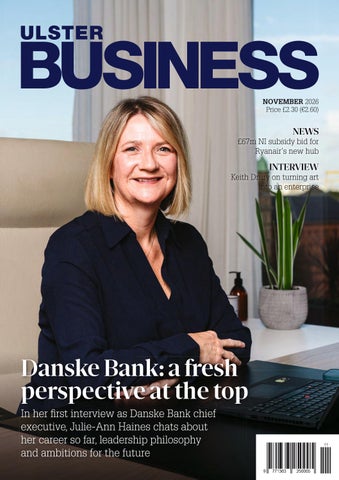
NOVEMBER 2026 Price £2.30 (€2.60)
NEWS
£67m NI subsidy bid for Ryanair’s new hub
INTERVIEW
Keith Drury on turning art into an enterprise
Danske Bank: a fresh perspective at the top In her first interview as Danske Bank chief executive, Julie-Ann Haines chats about her career so far, leadership philosophy and ambitions for the future
08
22
18
84
32
82
Contents 08 News
35 Exports
77 Motoring
The latest news and exclusives from across Northern Ireland business and beyond
Pavel Barter looks at how local firms export to markets thousands of miles away
Pat Burns takes a look at Jaguar’s long-awaited new electric entrant into the motoring market
18 Cover story
43 Corporate law
84 Photocall
Ulster Business speaks to Danske Bank’s newlyappointed chief executive Julie-Ann Haines
Angela Brady on how AI is helping law firms work but why human input is essential
A look at what’s been happening across Northern Ireland over the last few weeks
22 In Focus
53 Staff & workplace
92 Review
John Mulgrew sits down with Bank of America boss Brian Moynihan about its expansion here
Is the four-day week a viable option for businesses in Northern Ireland?
John Mulgrew gets hands on with two very different titanium Tag Heuers
32 Interview
61 Christmas planner
96 Technology
Keith Drury speaks to John Mulgrew about turning art into a successful enterprise
Lottery winner submits plans for new Belfast Christmas market this year
Apple Watch Series 12 takes on rivals with better sensors and advanced health scores
Ulster Business is a part of the Independent Press Standards Organisation (IPSO). If you believe you have been unfairly treated, you can contact IPSO in writing via its website for guidance on what to do. The service is free. IPSO can then advise on whether it’s likely you have grounds for a complaint and what to do about it. The normal procedure is for the complainant to then contact the publication’s editor directly. If no agreement is reached, the complainant can go back to IPSO to look for an adjudication, or for it to take over the complaint. Full details are available at www.ipso.co.uk. Alternatively, email complaints@ipso.co.uk, or inquiries@ipso.co.uk, or telephone 0300 123 2220, or the out-of-hours emergency number: 07659 152 656. Or write to: IPSO, c/o Halton House, 20-23 Holborn, London EC1N 2JD
NOVEMBER 2026
5
EDITOR’S COMMENTS
£67m subsidy bid is one of our largest
I
t’s been a while since we’ve seen Northern Ireland in the running for a significant airline investment.
And with that comes one of the largest proposed public subsidies here in many years. Invest NI will submit a letter of offer to Ryanair, alongside a £67m proposed subsidy, in a bid to attract the low-cost airline to these shores, for the second of its maintenance hubs, which will be used to service its fleet of Boeing 737s. According to economist Dr Esmond Birnie, it’s one of, if not the largest of its kind in recent years. He points out that while Northern Ireland has been successful in winning service sector projects in recent
years, it’s been less successful in heavier industries. However, one of the largest came in assisting Bombardier in the building of part of its former C-Series aircraft here. The proposed funding for this potential £400m Ryanair scheme will come from the NI Enhanced Investment Zone (EIZ), along with additional support from Invest NI, primarily around subsidising job creation. There’s talk of as many as 600 jobs being created if Northern Ireland is successful. In arguing the case of the subsidy, it’s been claimed it would be the minimum required to help us land the deal, but would not entirely offset the potential cost difference with other competing regions. When I wrote the story in October, I knew there’d be significant public interest.
Publisher Ulster Business c/o Mediahuis UK Ltd Belfast Telegraph House, 33 Clarendon Road, Clarendon Dock, Belfast BT1 3BG Printer W&G Baird Greystone Press, Caulside Drive, Antrim BT41 2RS www.wgbaird.com
www.ulsterbusiness.com
It’s potentially a very positive move in the right direction for us, with more employment and additional income. But the decision now rests with Michael O’Leary and co, and whether that subsidy will be enough to put us out in front. Of course, a successful bid is only the beginning. Once the funding is in place, the next phase is the lengthy and tempermental planning process. It’s scuppered development here in the past. Let’s hope if we’re successful that the process will be as smooth as possible, and considering both the positives and any negatives which may come to fruitition. ■ John Mulgrew
Editor John Mulgrew, john.mulgrew@mediahuis.co.uk Advertising Louise Henderson, louise.henderson@mediahuis.co.uk Charlotte Prentice, charlotte.prentice@mediahuis.co.uk Graphic design Susan McClean, Mediahuis Ireland Design Studio Cover photo Elaine Hill
@ulsterbusiness
Ulster Business Magazine
Mediahuis UK Ltd © 2026. All rights reserved. No part of this publication may be reproduced, stored in a retrieval system, or transmitted in any form, or by any means, electronic, mechanical, photocopying, recording, or otherwise without the prior permission of Mediahuis.
NOVEMBER 2026
7
NEWS
A month in numbers
£67m
A proposed public subsidy to help NI’s bid to host Ryanair’s new £400m maintenance hub.
110
The number of jobs at risk at financial services firm FinTrU.
£840
The average weekly public sector wage in NI, which is around 19% higher than average private sector wages.
25
The number of rooms at a proposed hotel in the Cathedral Quarter area of Belfast.
8
£7m Lidl store ‘to create 35 new jobs’ A round 35 new jobs could be created as part of a £7m investment in a new Lidl store in Co Down. The supermarket chain has submitted plans which could see a new shop built outside Donaghadee. It’s now submitted full plans for the store, which could be located at a site at High Bangor Road, on the outskirts of the town. “The proposal involves significant economic benefits – it will create 35 new jobs and the construction and fit out of the store will be an investment of £7m,” plans say. “The proposed store would be operated by Lidl, a well-established discount retailer with over 13,000 stores across Europe and the USA including 44 in Northern Ireland. “Lidl has a reputation for high-quality, lowprice groceries and is becoming increasingly popular with NI shoppers, with market share recently climbing to 9.9%... it is the highest paying supermarket retailer in the region. “The proposal would be a quality shopping facility that would provide additional choice and competition and meet the need for a large food store in Donaghadee. “It will be a significant investment of £7m and will provide 35 new jobs. “The pre-application community consultation shows that there is considerable local support for the proposal. It is a sustainable development that complies with planning policy and we commend it to the
council.” Elsewhere, Lidl is also pushing plans forward to build a new store in Co Antrim. It’s eyeing a new supermarket in Ballycastle, amid fresh plans. The chain wants to build the new unit off the Leyland Road, at a former Original Factory Shop premises. Lidl has also completed the building of new pub and off-licence in Co Down. The company said the Dundonald opening was bringing its wines, beers and spirits to shoppers and residents of the area for the first time. Lidl Northern Ireland’s bid to open a pub had been approved by the High Court under the surrender principle, in which a new operator acquires an existing licence. The 900 sq ft pub sits next to its existing Dundonald supermarket, with work being carried out by building firm MMG Contracts. Meanwhile, Lidl Northern Ireland hit out at rival supermarket Tesco for opposing the granting of planning permission for new premises in Londonderry. It has claimed Tesco has written to the Department for Infrastructure (DfI) requesting that planning permission for the new Lidl at Crescent Link is quashed. It said Tesco would be bringing judicial review proceedings to challenge the decision. Tesco declined to comment when asked about the challenge by the Belfast Telegraph.
NEWS
£400m Ryanair hub ‘won’t be built in NI without subsidy’ John Mulgrew
R
yanair’s new £400m hub ‘will not be built in Northern Ireland’ without a £67m proposed subsidy, it’s been claimed. An official bid alongside £67m of public money will be offered up to Ryanair as Northern Ireland fights off competition to host the low-cost airline’s £400m hub and 600 new jobs. The Department for the Economy stress-tested the business case for the new engine maintenance, repair and overhaul (MRO) facility. Invest NI is expected to submit a formal letter of offer to Ryanair before the end of October for its major new base. That follows an evaluation from the UK’s Competition and Markets Authority (CMA). In an assessment submitted to the CMA, it says that without the subsidy, “the MRO facility will not be built in Northern Ireland, but would go ahead in another location”.
NOVEMBER 2026
Ryanair chief exeutive Michael O’Leary
Northern Ireland is up against at least two other nations, and is bidding for the second MRO. Ryanair is planning to develop two separate facilities to service many of the airline’s aircraft and engines, supporting its Boeing 737 fleet. Invest NI is proposing £67m of support in order to help attract Ryanair to Northern Ireland. Some £7m of that would be an employment grant, drawn down as roles are created. Read the full story on page 28-29
9
NEWS
Invest NI opening new north west hub at Derry’s Ebrington Plaza
I
nvest NI will locate its new north west office at Ebrington Plaza in Londonderry. The grade A office will “serve as a hub for driving economic development in the north west”, it says. Invest NI has had a base in Derry at Timber Quay since 2006. Following the purchase of Timber Quay by Ulster University, the agency has been looking for a new office location. The new office at Ebrington Plaza is a 10-year lease. “Strengthening Invest NI’s regional network is an important element of my Sub Regional Economic Plan,” Economy Minister, Dr Caoimhe Archibald, said. “With Invest NI recently appointing Aeidin McCarter to lead the north west region. I’m now delighted to announce that the new regional office will be located in Derry’s Ebrington Plaza. This prestigious new office will ensure that Invest NI is more visible, accessible, and embedded in the local community. “I look forward to the office officially opening in the New Year and to using the office as a base to meet both local businesses and inward investors.” Kieran Donoghue, chief executive, Invest NI said: “Stimulating further economic development in the North West and across Northern Ireland is a key priority for Invest NI. We are working to deliver more investment and more high-quality projects and jobs.
Quotes of the month
10
Invest NI chief executive Kieran Donoghue, Economy Minister Dr Caoimhe Archibald and Aeidin McCarter, head of regional business for the north west at Invest NI
“We are monitoring our progress on this carefully across several KPIs including the volume of investment, value of investment and the jobs we are supporting outside the Belfast Metropolitan Area (BMA). Last year we supported 263 projects in the north west that will result in over £80m of investment and create over 400 new jobs. “Locating in Ebrington Plaza ensures that our new office is close to some of our most significant clients in the region, while also giving us direct access to the entire city. The office will provide a welcoming and accessible space for businesses to meet with our teams. The office will also create a very positive first impression for new international investors when we bring them to the area to consider the north west for potential investment.
“It is my hope that the office will be viewed as a representation of our commitment to regional balance.” Aeidin McCarter, head of regional business for the north west, Invest NI said: “The new office will be a modern, progressive and welcoming space for our clients, entrepreneurs, partner organisations and potential investors. “As well as providing workspace for Invest NI staff to support economic development right across the north west, the office will offer businesses a place to meet with our specialist teams, access support and advice, and connect with partners to explore opportunities to start, grow, innovate and export. Clients, potential investors and local stakeholders visiting us will be able to use the informal areas for impromptu meetings and calls.”
“Rental demand remains exceptionally high, though it has gradually cooled from the peaks of a couple of years ago.”
“Companies across Northern Ireland are dealing with higher energy costs, higher transport costs and cautious customers spending less.”
Jordan Buchanan of PropertyPal speaking about the current NI rental property market.
Brian Donaldson, chair, CBI Northern Ireland, speaking at the organisation’s recent business breakfast.
“Another headwind for firms remains the inflation picture as higher energy and fuel costs in particular push up prices for firms and have the potential to restrict demand.” Sebastian Burnside of Ulster Bank speaking in its latest growth tracker survey.
NEWS
Applegreen announces new M&S partnership at petrol station
S
ervice station giant Applegreen has announced the launch of an M&S food shop at a site in Co Down. The facility on the A1 outside Hillsborough will now stock over 400 M&S Food items and meal deals, and treats like Colin the Caterpillar cakes, Percy Pigs sweets and M&S cookies. A spokesperson for Applegreen said: “Situated on Dromore Road, the site will bring together M&S quality food, a Braeburn Coffee cart, Greggs and an Applegreen convenience store, providing motorists and the local community with a convenient destination for food, coffee, convenience and everyday essentials on the go. “The opening marks another milestone in Applegreen’s commitment to expanding its food and retail offering across the island of Ireland, delivering exceptional service and quality to motorists and local communities.” The site will be the fifth M&S Food at an Applegreen in Northern Ireland. An Ireland-wide partnership between M&S and Applegreen started in late 2022, and now has around 40 locations across the island. There are
NOVEMBER 2026
Applegreen in Hillsborough, Co Down, has launched a new M&S Food Shop on the premises
plans to increase numbers to more than 60. M&S has also expanded its food outlet at Aldergrove close to Belfast International Airport. M&S has announced that its Aldergrove store will reopen on October 8, with the addition of 25 new roles. The store, located close to Belfast International Airport, expanded in size by 50pc, after extending into the neighbouring service station unit.
11
NEWS
Around 110 jobs at risk at ‘success story’ NI fintech firm Margaret Canning
O
ver 110 jobs are at risk at a Northern Ireland fintech company, it has emerged. It’s understood FinTrU is seeking to make 95 roles redundant in Belfast, and 19 at its operation in Londonderry. The firm, which is led by chief executive and founder Darragh McCarthy, also has a base in Portrugal. Its headquarters are at the Gasworks in south Belfast. A spokesperson for the company confirmed there was a “proposed restructuring” affecting some roles. Trade union the Financial Services Union (FSU) said it was supporting affected members. But it said it was concerned about the fairness of the process through which roles are being selected for redundancy. And it claimed employees were being offered only statutory redundancy, which is capped at £751 a week. The firm provides compliance, regulatory and risk management services to global financial institutions. The business has been regarded as a fintech success story in Northern Ireland, growing to workforce of around 1,360. Craig Arden, industrial relations organiser with the FSU, said: “The company has proposed 19 redundancies in Derry and a further 95 redundancies in Belfast. “Workers have also been advised that, if selected for redundancy, they may receive only statutory redundancy payments despite enhanced redundancy terms having reportedly been applied in previous restructuring exercises. “These proposed redundancies will have a significant impact on workers and their families in both Belfast and Derry. “Our members are deeply concerned not only about the prospect of losing their jobs, but also about the fairness of the process being followed.” He said the trade union had written to the
12
FinTrU founder Darragh McCarthy
company expressing “significant concerns” about the procedural fairness of the redundancy process. He said: “We call on the company to restart the consultation process to ensure all affected employees receive fair and consistent treatment, to apply enhanced redundancy payments to support workers during the ongoing cost-of-living crisis, and to engage directly with the union throughout the process. “FinTrU has been widely recognised as one of Northern Ireland’s economic success stories. “We believe workers who have contributed to that success deserve to be treated fairly, consulted meaningfully and provided with appropriate support if redundancies cannot be avoided.” The union said it was continuing to support workers and said it wanted the firm to engage with it directly so that workers concerns could be heard.
The company spokesperson said: “FinTrU has initiated a proposed restructuring affecting a number of roles. “This follows a wider strategic review and forms part of an organisational realignment to support the company’s long-term growth and ensure it remains aligned with evolving operational needs.” “Our people have been central to FinTrU’s success, and we are committed to supporting employees affected by these proposals throughout the consultation process. “FinTrU is committed to conducting a fair, transparent and meaningful consultation process with colleagues who may be impacted by the current proposals. “Out of respect for our employees and the ongoing consultation, we will not be providing further comment at this time.” There was no comment on the number of roles affected.
NEWS
Belfast-based chain announces opening in time for Christmas
B
elfast-based juice business Juice Jar has announced a new opening in Co Armagh. The company, led by founder Sam Shephard, is to open a kiosk in time for Christmas at Rushmere Shopping Centre in Craigavon. Juice Jar’s existing nine locations include stores in Belfast, two in Dublin and one Bristol. Its ninth opening was at Queen’s University’s Physical Education Centre (PEC) in south Belfast last month. Juice Jar’s menu includes its signature açaí bowls, smoothies, shakes and juices, alongside speciality coffee, breakfast items and melts. Mr Shephard said Rushmere had become a
retail “powerhouse” following its acquisition in 2023 by a team of investors including Stuart Draffin and Ian McMahon. Writing on LinkedIn, he said: “Juice Jar venue number 10 is on the way. “And we’re doing it differently, our first-ever kiosk. “We’re bringing Juice Jar to Rushmere Shopping Centre in Craigavon, opening in time for the Christmas chaos.” Mr Draffin said the business would be a welcome addition to its line-up. “We are all delighted Juice Jar is coming to Rushmere, and we are very much looking forward to them opening.”
Juice Jar boss Sam Shephard in the company’s store on Belfast’s Ormeau Road
Juice Jar’s Belfast locations include Ormeau Road, Botanic Avenue, Lisburn Road and the city centre. The first branch opened in Belfast city centre’s Wellington Place in 2019. Last year Mr Shephard won the top prize of €150,000 in the first North/South Business Co-Operation Awards, established by easyJet founder Stelios Haji-Ioannou. The awards are delivered in partnership with Co-operation Ireland.
Deloitte senior partner among Telegraph Accountancy Awards
T
he first Belfast Telegraph Accountancy Awards have taken place in partnership with Hire IQ, with firms and individuals honoured at a glittering ceremony. The prestigious awards event, which honoured winners in 16 categories, was held at the Culloden Resort and Spa outside Belfast, with Finance Minister John O’Dowd a special guest. It’s the first time the Belfast Telegraph has staged an awards programme and ceremony to honour the profession, joining forces with specialist accountancy and finance recruitment firm Hire IQ. Jackie Henry MBE, a partner at accountancy firm Deloitte in Northern Ireland, was honoured for her stellar 37-year career in accountancy with a Special Recognition award, the first accolade of the night to be presented. Mrs Henry’s high-profile roles at the firm have included five years as managing partner UK Deloitte People and Purpose, and 12 years as Deloitte Northern Ireland office senior
NOVEMBER 2026
Special Recognition winner Jackie Henry (second left) with business editor Margaret Canning, Finance Minister John O’Dowd (centre) and Shaun Hawkins and Jack Buddy from Hire IQ
partner. And John Hannaway, the founder of HCA Chartered Accountants, was recognised for his successful career — including 25 years at PwC before he then set up his own firm — with the Lifetime Achievement Award. Other individuals to be honoured on the
night were Andrea Herron of P McVey Building Systems, who triumphed in the category of Finance Manager/Controller of the Year. And Kirsten McGarrity of Lowe Rental Corporation was the winner of Accountant of the Year, with the business also named Overall Company or Team of the Year.
13
NEWS
Royal County Down planning ‘significant’ course upgrade amid speculation on bid to host The Open
Royal County Down Golf Club
R
oyal County Down Golf Club is planning a major and significant upgrade to its world-famous course. Plans cited as a “major application” and a “significant upgrade” to the Royal County Down Golf Club in Newcastle, Co Down, have been submitted, amid reports it could see the famous links host The Open. The scheme, currently with planning officers at Newry, Mourne and Down District Council, includes a “major application for full permission to develop land”. The plans are for adjustments to several of the holes, which could be a precursor to the Newcastle course joining Royal Portrush in hosting the oldest men’s golfing major. The club is working with Mackenzie and Ebert, the same course designers that worked to improve Royal Portrush ahead of The Open returning there for the first time in 68 years in 2019. Specifically, works are proposed on the 1st,
14
3rd, 5th, 11th, 12th holes as well as the 15th, 16th, 17th and 18th holes of the chamionship links and to the 1st and 2nd holes on the Annesley links. Royal County Down Golf Club is a private members club which hosts over 10,000 visitors annually, including a large number of US tourists. Its championship course again ranked number one in the world by Golf Digest. The new planning application describes the site as “a hugely significant golf tourism asset in Northern Ireland [which] forms a key destination in attracting high spending international golfing visitors to Northern Ireland”. In a statement as part of the plans, the proposed development is summarised as “changes to the existing golf links and comprises new and revised teeing areas, revisions to greens and new bunkers.” The plans also include the “reconfiguration of fairways and an element of modest dune land re-profiling as well as utilisation of existing
parts of the course as borrow areas to source sand to balance the mix of cut and fill material that is proposed across the Championship and Annesley courses”. The golf club sits south of popular National Trust site Murlough Beach and north of Newcastle town centre, facing out to Irish Sea, with a backdrop of The Mournes. “The aim is to significantly upgrade the course to reflect Royal County Down’s status as one of the very best golf courses in the world and one of the most significant golf tourism assets in Northern Ireland,” according to planning documents. The last professional tour event held at Royal County Down was the 2024 Irish Open. It also hosted the event in 2015, and the men’s Senior Open for three consecutive years from 2001 to 2003. Royal County Down was approached for comment, as well as Mackenzie and Ebert, the architects behind the plans. ■
RECRUITMENT
High recruitment demand in engineering sector driven by skills gaps in key areas Mark Wade, Hays
W
hile nobody could argue that these are not uncertain economic times, I continue to be encouraged by sectors of the economy which are thriving in the face of local and global headwinds. One industry which is booming – or trying to – is the engineering sector. Northern Ireland has a proud tradition in manufacturing and engineering, and at Hays we have client relationships and candidate networks spanning agri-food, heavy steel engineering, aerospace and more, providing candidates to fill roles right across any production facility. When I said above that engineering is “trying” to grow, I was reflecting the feedback we are getting from employers who are facing an acute shortage of skilled technical staff at all levels, particularly in areas such as electrical work, design and operations. Our teams are reporting that companies which previously relied on temporary-to-permanent staffing arrangements and generalist agencies are now coming to us because they need permanent, skilled employees who require minimal training. Eamonn McCance and Lisa McCord lead Hays’ business in the industry and are well known in the sector. The team’s expertise spans decades of combined experience within the Northern Ireland market, giving them deep knowledge of industry requirements and the ability to match candidates with roles that suit their career trajectories. “The market has fundamentally shifted from a situation where companies could hire less experienced workers and invest time in their development,” Eamonn says. “Now, given the pressures to fulfil orders and maintain growth, businesses cannot afford the cost and time investment of training. “This shortage has given skilled technical workers significant bargaining power, creating what is genuinely a candidate’s market where companies must actively sell their value propositions. That means emphasising their culture, wellbeing, and growth opportunities, rather than simply expecting candidates to compete for positions based on salary and holiday entitlement. “People aren’t willing to move now for temporary roles, they don’t need to because it’s a candidate-led market with a range of options. It has made it hard for companies to hire at every level, from a good, skilled production operative at the lower end, right through to more senior roles like operations managers.” Working right across the supply chain, Hays takes a specialised approach to filling positions, with its teams operating in what we call “career silos,” meaning our people become experts in specific areas such as electrical and mechanical design, quality and manufacturing,
NOVEMBER 2026
maintenance, and operations. This specialisation allows us to serve clients across the entire employment spectrum, from skilled operatives and entry-level positions up to senior management roles including operations managers, general managers, and managing directors. “In the current Northern Ireland engineering market, success depends on moving rapidly when good candidates emerge, being realistic about true job requirements, and recognising that employers must now actively attract and retain talent rather than simply selecting from a pool of applicants,” says Lisa, who specialises in quality and manufacturing. “A huge amount of our recent placements have come from our access to passive candidates – with approximately 85 to 90pc of our monthly placements coming from people who were not actively job hunting. These are people who our team has nurtured through ongoing relationships and conversations. By understanding candidates’ social and economic needs, we can alert them when appropriate opportunities arise.” “The other side of that is that we’re doing a lot of work with employers to refine unrealistic job specifications, removing unnecessary requirements such as degrees when the actual role and existing team dynamics don’t justify them,” Eamonn says. “This collaborative approach, combined with our specialized knowledge and speed to market, positions us to connect quality candidates with employers quickly.” With the largest engineering recruitment team in Northern Ireland comprised of genuine experts, we are confident that the sector is set for a period of significant growth, but work is still needed across the industry to ensure employers’ aspirations are not thwarted by the lack of availability of skilled technical staff. ■
15
NEWS
New apartments and shops planned for Co Down quayside John Mulgrew
A
major new apartment, retail and office development could be built in the heart of Newry. Plans are underway to build the new scheme at Merchants Quay in the city centre. That could include a total of 74 apartments across the development, as well as three shops, and a small office. A previous scheme has already been approved for the site, while the new application moves it forward and removes a larger office element of the scheme. The new application has been submitted by Parkgate Property Developments Ltd. Part of the plans include knocking down a former car sales showroom, as well as encompassing a grade B2 listed building. It was constructed in the mid 18th century and suffered “significant fire damage”, resulting in the collapse of a section of the rear of the building. “Strategically, the site is located within Newry city centre and in close proximity to Newry Canal,” plans say. “The surrounding context is mixed use, characteristic of the site’s urban location. To the north, Merchants Quay contains a strong commercial frontage comprising retail, service and commercial premises together with traditional mixed-use buildings. “Beyond this area are the primary retail and commercial areas of the city centre., bin and cycle stores and associated site works.” It says the “development comprises the demolition of the existing building and clearance of the site to facilitate the erection of a highquality mixed-use development”. “The scheme has been designed to create a strong frontage on to Merchants Quay. “The building returns into the site, extending towards the site’s
16
Artist’s visuals of the new proposed scheme in Newry
western boundary. “Retail units are proposed to occupy the ground floor space along the Merchants Quay frontage with residential units above. “The principal communal access to the apartments is proposed to be taken from Merchants Quay with access to a lift and stair core to access the upper floors. “The apartments within the Merchants Quay frontage are orientated to provide aspect towards Merchants Quay, while the units proposed within the site are designed to have aspect towards the communal amenity space.” Meanwhile, Newry’s long-awaited public park plans were recently given the green light. The Albert Basin 15 acre site is set to be transformed into a major destination for play, sport and leisure with the £18.6m project. The council’s Outline Business Case for the park was approved by the Department for Communities (DfC), with up to £16.2m available from the Executive’s Complementary Fund for phase one of the development. The local authority is also investing £2.4m of funding. In March 2026, the council launched the procurement process to select a contractor for construction. According to the council website, the park is due to be completed by 2028. The city centre area will be transformed into a new, inclusive green space where people can relax, enjoy nature and take part in community events. It is due to have everything from waterside walks and natural play areas to urban sports areas and flexible event spaces with links to the Carlingford Lough Greenway. ■
COVER STORY
From Cardiff to Belfast: Danske Bank’s chief executive on bringing decades of experience to her new role Julie-Ann Haines is Danske Bank’s new UK chief executive, having spent two decades building her career in the financial sector in Wales. Her new role brings her to Northern Ireland, from where she will now lead the bank’s continued growth plans, alongside continuing to position it as a customer centric organisation with a strong workplace culture 18
COVER STORY
Julie-Ann Haines
F
or Julie-Ann Haines, taking the helm of Danske Bank has brought more than a new job. Born in Scotland to a Northern Irish mother, over the years Julie-Ann has made many journeys travelling back and forth to Northern Ireland, where her family roots run deep. Her parents both retired here and she never thought she would get the “great privilege” of being able to work in Northern Ireland and see them more often. “It’s a real opportunity – a great role with a great organisation,” she says. After a career that took her from Scotland into England and Wales – and ultimately to the chief executive’s office at Wales’s Principality Building Society – the move to Northern Ireland represents both a professional challenge and a personal milestone.
NOVEMBER 2026
Julie-Ann took up her new role in July, joining Danske at a pivotal point in her career. She spent five years as chief executive at Principality, having risen through a variety of roles including IT, strategy and customer leadership. Her 20-year career with the Cardiff-based building society gave her a deep understanding of running a strong, regionally focused financial institution. In her early years, she studied accountancy in Glasgow before deciding against becoming an accountant, then completed a master’s in international marketing at Strathclyde Business School. Before entering financial services, JulieAnn had built a career across marketing, sales, strategy, technology and innovation, working for major organisations including WPP subsidiary Millward Brown, Sainsbury’s and Reckitt Benckiser. Her first financial services role came with Halifax Bank of Scotland in the years just before the global financial crisis. “I learned a lot in that organisation,” she says. “I learned what banking was about.” “I also saw some sides of banking that didn’t sit well with me, and a culture that has thankfully changed over the years,” she says. Joining Principality Building Society, the biggest financial services organisation in Wales, Julie-Ann quickly moved up the ranks, running its IT function before moving into strategy and customer roles and becoming the organisation’s first female board director in a customer director position. She ultimately became chief executive in 2020, leading the society through the challenges of the pandemic and beyond. Among the most visible achievements of her tenure was sealing the deal which saw Cardiff’s Millennium Stadium renamed the Principality Stadium. For Julie-Ann, the naming rights were about more than putting a company logo on a national landmark. “It was looking at elevating it from being a Welsh-focused brand and organisation to one
with aspirations to grow on a national level,” she said. The strategy worked, she says, helping take the organisation from a distinctly Welsh identity towards a broader UK positioning. Julie-Ann also served on former Prime Minister Rishi Sunak’s UK Business Council. “That offered a great opportunity to sit around the table with chief executives from global organisations and help put Wales on the map,” she says. “It was about focusing on and helping guide what was required to try and stimulate economic growth right across the UK.” That ability to protect a strong regional identity while also looking beyond its traditional heartland is one of the parallels Julie-Ann sees between her former employer and Danske Bank UK. Her first months have been focused around listening – having held sessions with hundreds of colleagues across the business, as well as visiting branches and meeting customers. For Julie-Ann, the exercise is about more than just gathering ideas, but rather it is a responsibility to understand what already works before deciding what needs to change. “In any chief executive role, there’s such a responsibility to make sure that you really protect and nurture the existing strengths of the organisation,” she says. She recalls a visit to the bank’s Enniskillen branch where she heard how colleagues were collaborating around customers whose financial lives span private banking, personal and business relationships. “That’s just wonderful to see that in practice, rather than just hear about it,” she says. “I’m really impressed by the culture of the organisation,” Julie-Ann says. “There’s a really great level of collaboration, of honest conversations, support and friendship.” The next stage is about making it easier for that culture and capability to translate into performance. >
19
COVER STORY
Julie-Ann Haines
Her leadership style is collaborative, and she is focused on listening, clarity, simplification and empowerment – giving people a clear sense of where the organisation is heading and then removing obstacles in their way. “I’m very much about painting a picture for the organisation and for our stakeholders, and then ensuring that as leaders, we clear the path and empower colleagues to do the things that are in the best interests of our customers and the bank,” she says. Of course, geopolitical uncertainty and a changing economic landscape are continuing to have an impact on customers right across Northern Ireland. Despite this, Julie-Ann says businesses remain resilient but are thinking hard about where to invest. Against that backdrop, she is clear about the priorities for Danske Bank. “It’s making sure that we continue to operate really successfully here in Northern Ireland and put our customers
20
first,” she says. The bank also wants to improve its customer propositions, making it easier for customers to bank with Danske and receive the support they need. Technology will continue to play a central role in improving customer experience. JulieAnn sees opportunities in data and artificial intelligence (AI) but insists that investment must serve a practical purpose. “It’s about ensuring that investment in data and AI is making our customers’ lives easier and is complementing the work of our fantastic people who customers tell us are so important to their overall experience.” she says. Beyond Northern Ireland, there is an ambition to continue developing Danske’s presence in the rest of the UK, particularly in areas where the bank can offer something distinctive. Julie-Ann highlights strong growth
in mortgages, housing association lending and syndicated lending over recent years as foundations for further expansion. Her career has taken her through global consumer businesses, the pre-crash banking world, a Welsh financial institution and the corridors of government and industry policy. And she is bringing those experiences together at Danske Bank. “Having spent a long time at Principality, I was very thoughtful about what would come next,” she says. “It’s special to have the opportunity to take up such a chief executive position, based in Northern Ireland, with a growing UK focus, and as part of a large European banking group.” The next chapter of the Danske Bank UK growth story is being written, with Julie-Ann at the helm – putting its customers to the fore and ensuring it plays its part in helping the economy grow. ■
NEWS
Belfast City Hall
Council rejects plans for four short-term holiday lets in space of month while three withdrawn John Mulgrew
P
ermission for four short-term and holiday lettings in Belfast have been turned down and a further three withdrawn in just one month. City council planners have rejected plans for four homes to be used as short-term accommodation, often found on platforms such as Airbnb. The properties were located in the city centre and south Belfast. A further three applications for a change of use to short-term accommodation were also withdrawn. However, three applications, including one on the Malone Road and two at University Street, were given the go-ahead. Many of the concerns surround policies around short-term lets taking the place of full-time housing stock, and a demonstrated demand or need for such properties in particular areas.
NOVEMBER 2026
And another area, which has been criticised by one short-term let property manager who is responsible for around 60 houses and apartments, is that part of the property is retained as permanent residential housing. Many cities are cracking down on Airbnbstyle short-term holiday properties, with Barcelona in Spain pledging an outright ban on short-term rentals, while other areas are imposing restrictions. Applications are now being submitted to planners which retain one bedroom for longterm residential use. Earlier this year, permission for more than half a dozen short-term and holiday properties in Belfast was also refused in the space of just a few weeks. City council planners rejected plans for seven houses and flats to be used as short-term accommodation, often found on platforms such as Airbnb.
Some of those properties which were turned down for permission in Belfast earlier this year were located in areas including University Avenue (off Botanic Avenue), Brookland Street, the city centre, Windsor Road, Lisburn Road, and Thorndale Avenue. At the time, one short-term let property manager said: “For many cases, a common thread throughout is the fact that part of the property has to remain open for permanent housing. If it fails, it’s always going to fail on that part.” He says that policy is “short-sighted” and doesn’t actually protect the housing stock in the area. “On that basis, people won’t know who the person is. Do they have friends round? Do they make noise? From the housing perspective, I don’t believe it makes any sense. Does it really retain housing stock? Would someone want to live in just one bedroom?” ■
21
IN FOCUS
Donald Trump has not hampered recruitment of 1,000 Bank of America staff for Belfast John Mulgrew sits down with Bank of America chief executive, Brian Moynihan, to discuss the firm’s creation of 1,000 jobs here over the next two years, the state of the economy in the US, and how it came to chose Northern Ireland for its new base
T
he head of Bank of America says it could hire all of its new 1,000 Belfast staff in the next two years but that the US’s global reputation and Trump administration has not hampered recruitment. In an interview at its City Quays offices, Brian Moynihan also says it could take until 2028 until interest rates rises in the US tackle inflation there. Mr Moynihan himself has connections to Northern Ireland, with family now living in Co Down, and says he first came here “a long time ago” to play rugby. Bank of America has already recruited some 350 staff here. “I’d say over the next two years we’ll finish it up [the total recruitment],” the chief executive said. Mr Moynihan says it was a conversation with a company already based here which helped the firm chose Belfast as the new base for its major operations centre. “I came here because I heard other people had a good experience,” he says. “I listened to people in sessions and said ‘this is interesting’, as I knew we had to talk
22
about capacity. “It’s a city which keeps developing post [Good Friday Agreement]… young people who left the country in the 1980s, 1990s and 2000s, because the jobs were elsewhere, would rather stay. “We believe that is a great backdrop to hiring people. Secondly, the talent and good education. As we mature, we will do more secondary school work. Right now, we are hiring experienced people. “And our commitment to the UK. We have 6,000 plus people in the UK and another big operations centre in Chester. [Belfast] is a good city, growing into 2020s’ self, a lot of fun, and affordable for the teammates who are working. Then it will mature into being a different thing over the next 20 years.” “[The Belfast jobs] are highly skilled operational roles around customer information requirements and things like that, and some technology roles. “… it’ll keep expanding, and so I expect we’ll add some technology here. We’ll add more technology and things because there’s
talent [in Northern Ireland]. On the US economy, Mr Moynihan says with the US growing at around 2.3% he sees the “US consumer is continuing to spend money and continuing to participate fully”. “The unemployment rate is very low… the affordability question on gas prices, home prices, and mortgage rates is absolutely a concern.” Mr Moynihan says investment is continuing while small and medium-sized businesses in the US “are in great credit shape”. “They have great access to lines of credit, their borrowing is very rational compared to their capacity,” he says. “Businesses are doing fine… the business earnings growth in US companies is pretty strong.” On interest rates in the US, which have
IN FOCUS
Bank of America chief executive Brian Moynihan
recently been hiked to 3.75%-4% following a unanimous decision by the Federal Reserve, Mr Moynihan says he believes it will take until 2028 to get inflation “back to the target”. “We were always saying that they needed to raise rates faster than the market was saying… we think [there will be] two more rates rises this year, and more next year.” Asked about whether the current Trump administration and the US’s resulting global reputation is having a negative impact on recruitment for new roles here, he says: “No. We hired 1,800 in September, worldwide… so there’s nothing. The talent is coming. All of the things that could go wrong in the world this month, could go wrong last month, or the one before.” Asked which particular global macroeconomic conditions are the most
NOVEMBER 2026
considered, Mr Moynihan says “all of them”. “Cyber-security and the new models, the need to do the patching works,” he says. “It’s not a new issue, or a different issue, it’s another generation. We have to worry about all the issues. “On the other end, we have to drive growth. This is a country where we serve larger companies and cash management… those companies need our help now.” On whether the administration has hindered or helped the firm, Mr Moynihan says: “Our company has been around for 246 years. So every president of the United States has been in office while we’ve been a company. “Sometimes the policies are more favourable to business, sometimes not. The idea is that we have to run this company, drive growth and drive success, irrespective of who is the PM
[leader] of the country.” Bank of America has utilised artificial intelligence (AI) for the last eight years, Mr Moynihan says. “Our strong belief is that AI will help our teammates to be able to do their job better… we have a human in the loop requirement, because we make decisions about things, that if you don’t get them right, it’s not a good thing. We have to be perfectly right.” Asked about any concerns over our current political crisis here in Northern Ireland, with the stand-off on the Garvaghy Road fuelling concerns over the collapse of the Executive, he says: “No. The amount of work that went to get all that done [The Peace Process]… was an amazing amount of work by a lot of people. “I think people realise the value of that.” ■
23
THE MIGHTY MIDDLE
The Mighty Middle: big challenges… bigger ambitions From rising costs and recruitment pressures to infrastructure and investment, NI’s mid-sized businesses are navigating an increasingly complex landscape. But despite the challenges, their ambition to grow remains, writes Ian Smyth of Ulster University Business School, in partnership with Harbinson Mulholland
N
orthern Ireland’s mid-sized businesses are a vital part of the economy. They provide employment, invest in people, support local communities and have the potential to drive significant growth. Yet they occupy a challenging position. Too large to benefit from some support designed for smaller enterprises, but without the resources and influence of major corporations, they can often feel overlooked. At the latest Mighty Middle roundtable, business leaders and economic experts explored the issues shaping their experiences. While the challenges were familiar, what emerged was also a strong sense of ambition, with businesses investing in people, exploring opportunities and finding new ways to improve performance. Setting the scene was my colleague Karen Bonner, principal economist at Ulster University’s Economic Policy Centre, who highlighted the contrast between Northern Ireland’s encouraging economic performance during the first half of 2026 and the increasing pressures facing businesses. She also identified a longer-term concern: demographic change. With the younger population projected to shrink significantly by 2040, attracting and retaining talent could become even more challenging.
1
Rising costs, shrinking certainty Energy, labour, insurance, transport and raw material costs continue to put pressure on profitability. Research from InterTradeIreland’s All-Island Business Monitor, presented by Bonner, revealed: • 50% of businesses identified energy costs as
24
their biggest challenge. • Around one third were absorbing increased costs rather than passing them on. • Almost half were uncertain about their own profit margins. For mid-sized businesses carrying substantial overheads, fluctuating costs make forecasting and investment decisions difficult. The challenge is not simply managing today’s costs, but planning confidently when the financial picture keeps changing.
2
Finding people is hard. Keeping them is harder. Recruitment and retention emerged as persistent challenges, with competition for skilled employees, increasing wage expectations and changing attitudes towards work. Three issues stood out: • Recruitment: finding people with the right skills and attitude. • Retention: keeping valued employees in a competitive labour market. • Development: encouraging employees to acquire new skills and responsibilities. But businesses are adapting rather than simply accepting these challenges. As one participant put it, the priority is to “train and coach and develop the people that we have and get them to stay.” Employers are placing greater emphasis on attitude and potential, investing in coaching and creating clearer career pathways. There was also recognition that completing a training programme does not necessarily translate into improved performance. Businesses are looking more closely at how employees apply what they learn. And not every employee wants promotion.
For some, stability, flexibility and job satisfaction matter more than additional responsibility. With fewer young people expected to enter the workforce, developing existing talent will become increasingly important.
3
Culture could be a competitive advantage While larger organisations may have greater financial resources, mid-sized businesses often have something equally valuable: a strong workplace culture. Closer relationships, accessible leadership and a sense of belonging can distinguish them in a competitive employment market. As one participant observed, “you can only market it so much.” The real value of workplace culture is often appreciated through experience, sometimes becoming clearer when employees move elsewhere. The discussion highlighted the importance of: • Listening to employees and acting on feedback. • Creating clear development opportunities. • Recognising different motivations and ambitions. • Delivering on promises made during recruitment. For businesses unable to compete on salary alone, culture can be a powerful retention tool.
4
Growth: ambition in action Despite economic uncertainty, ambition remains firmly on the agenda for Northern Ireland’s mid-sized businesses. The discussion revealed organisations actively exploring expansion, investing in
THE MIGHTY MIDDLE
opportunity, although challenges remain: • Repetitive documentation and lengthy tender processes. • Limited resources for preparing bids. • Uncertainty around contract evaluation. • Social value requirements that risk becoming tick-box exercises. Greater transparency and accessibility could help mid-sized businesses compete more effectively for public sector contracts.
7 Ian Smyth
employee development, improving technology and rethinking established ways of working. As another participant put it, success depends on “my ability to adapt, find out and fix faster”. That willingness to respond rather than simply accept challenges is a significant strength of the Mighty Middle. Examples of ambition discussed included: • Developing talent: Building the skills and leadership capability needed for future growth. • Improving productivity: Reviewing operations and introducing more efficient ways of working. • Investing in technology: Using better systems and information to support decisions. • Exploring expansion: Considering new opportunities while managing financial risk. These ambitions are not without challenges. Investment requires resources, confidence and some certainty about future costs. But growth is not always measured by additional premises or increased turnover. Strengthening profitability, improving capability and creating a sustainable business are equally important indicators of progress. What emerged was not a lack of ambition, but a determination to make growth sustainable.
5
AI: from conversation to implementation Artificial intelligence and digital transformation offer opportunities to improve productivity,
NOVEMBER 2026
reduce administration and support better decisions. But implementation is not always straightforward. Mid-sized businesses may lack dedicated technology teams, substantial budgets or integrated systems. Priorities discussed included: • Improving operational efficiency. • Connecting financial and performance information. • Reducing administrative demands. • Understanding customers and business performance. The discussion highlighted investment in better systems and growing interest in how AI could help organisations make more effective use of information. For the Mighty Middle, successful adoption is less about following trends and more about achieving measurable results.
6
Barriers beyond business control Not every obstacle to growth can be addressed within individual businesses. Infrastructure constraints, including electricity capacity, wastewater provision and planning delays, continue to influence investment decisions. Northern Ireland’s trading position offers opportunities, particularly in manufacturing and logistics, but these cannot be fully realised without adequate infrastructure and skilled workers. Public procurement presents another
Giving the Mighty Middle a stronger voice With economic uncertainty and political change on the horizon, businesses need confidence in the environment in which they operate. The discussion reinforced several priorities: • Greater recognition of the mid-market’s contribution. • Long-term certainty around infrastructure and investment. • Better alignment between education and workforce needs. • Practical support for technology and productivity. • Improved access to public sector opportunities. These are established businesses with the experience, capability and ambition to grow, but without unlimited resources to absorb uncertainty. Bigger ambitions for the Mighty Middle Resilience is frequently used to describe Northern Ireland’s business community. But the Mighty Middle is demonstrating something beyond resilience: a willingness to adapt, invest and create opportunities. Across the discussion, there were examples of businesses actively developing their people, embracing technology, strengthening operations and exploring future growth. The challenge now is ensuring that the wider economic environment supports that potential. Because the Mighty Middle isn’t simply keeping Northern Ireland’s economy moving. It has the ambition to help take it further. ■
25
FAMILY BUSINESS
Steensons Jewellers marks 50 years as a family business with new collections
A
family-run jewellery firm is celebrating 50 years in business and launching five new collections to mark the occasion. Steensons Jewellers is marking 50 years of creating distinctive handcrafted jewellery, marking five decades of design and craftsmanship. The business was founded by Bill and Christina Steenson in 1976, starting off as a small, two-person craft workshop in the coastal village of Glenarm in Co Antrim. Today, it has grown into an established independent jewellery business with a team of 16, a workshop and showroom in Glenarm, and a flagship store on Bedford Street in Belfast. To mark the anniversary, Brona Steenson, daughter of the founders, has created a special exhibition comprising five collections, each featuring five one-off pieces. The work celebrates the distinctive design language that has developed throughout Steensons’ history, bringing together ideas and forms that have shaped the studio’s creative journey while offering a fresh expression for the future. Rather than looking back through a retrospective of past designs, the exhibition reflects the continuing evolution of Steensons: a business rooted in traditional craftsmanship, with a curiosity for new ideas and a commitment to making jewellery that is meaningful, individual and made to last. “I think one of the things we’re most proud
26
of is that what started as a small, two-person craft business has grown into an established company with a team of 16 people,” Brona says. “This exhibition is a celebration of that team and everything we have built together. Everyone has played a part in bringing it to life, and it has been a real collective effort to showcase the very best of Steensons’ design and craftsmanship. “Reaching 50 years while staying true to the values my parents began with is a huge achievement, and one that belongs to everyone who has been part of the journey.” The team remains at the heart of Steensons, with skilled makers, colleagues, suppliers and collaborators all contributing to the business over the years. Their shared knowledge and dedication have helped preserve traditional
jewellery-making skills while allowing the company to embrace contemporary design methods and technology. “Customer relationships have also been central to the story,” the firm says. “From bespoke commissions to pieces marking engagements, anniversaries and other important life moments, Steensons has built its reputation on a personal approach to jewellery and the understanding that each piece can carry its own meaning. “As the business enters its next chapter, the focus remains on bespoke design, considered craftsmanship and sustainability, ensuring that traditional skills continue to thrive alongside innovation.” The public will have a chance to see the anniversary exhibition between October 16 and November 7. ■
PROFILE
John McGuinness
Progressive brings back the personal touch to business savings
J
ohn McGuinness is Progressive Building Society’s first business relationship manager, a role created to make business savings simpler, faster and more personal for organisations across Northern Ireland. Progressive offers business savings accounts to a broad mix of organisations across Northern Ireland, including local SMEs, solicitors, credit unions, churches and other community groups. The range caters for short and longer-term business savings needs, with John giving customers a direct, local point of contact throughout the process. Credit unions in the UK and solicitors in Northern Ireland can apply for a new account online directly. Other organisations can apply in branch or by post with John available to assist with any enquiries. “Not everyone has time to go to their branch or to fill in applications, so I’m that liaison between the Society and businesses based locally,” he said. Since taking up the role in September 2024, John has helped many business customers understand their options and guided them through the application process. He can visit a customer’s premises, help verify identity
NOVEMBER 2026
documents where required and support getting an account through to activation. “As a dedicated business relationship manager, I visit businesses, explain the online process, help them with application forms, verify identity documents if required and get their business savings accounts activated,” he said. That hands-on service stands out at a time when much of banking has become increasingly remote. “It’s that personal touch we’re offering almost like a door-to-door service,” he said. For customers, the appeal is clear: competitive savings options and a service built around busy schedules. Business accounts can be opened with anything from £1 up to £5m. “Our range of business accounts offer competitive rates of interest, but businesses often don’t have the time to complete forms and verify documents,” John said. “This is where I add real value to the process. “That matters, particularly when some organisations feel overlooked elsewhere. “A solicitor recently told me they’d been downgraded from having a relationship manager at another financial institution because their turnover wasn’t high enough.
“By comparison, I deal with any account from £1 right up to £5m.” That approach reflects Progressive’s wider ethos as Northern Ireland’s only local building society. As a mutual, it has no shareholders, so funds are reinvested in the Society and its services. With 17 years’ experience in financial services and investment, John believes business relationships will continue to matter more as Northern Ireland’s business sector grows. While many banks are retreating from the high street, Progressive is investing in a multi-millionpound refurbishment programme across its 11 branches. For John, that signals a commitment to local businesses and communities. “My job is to make it as easy as possible,” he said. “For online and branch-based accounts, I’ll help with the documentation, verify IDs and, where necessary, bring everything along to a branch. All customers have to do is fund the account.” ■ Business product information, including available accounts and how to apply, can be viewed on Progressive’s website at theprogressive.com
27
NEWS
£67m public subsidy bid to be submitted as NI fights rivals for £400m Ryanair hub with 600 new jobs John Mulgrew reveals Invest NI is poised to submit a letter of offer to Ryanair in a bid to host the low-cost airline’s maintenance, repair and overhaul hub
A
n official bid alongside £67m of public money will be offered up to Ryanair as Northern Ireland fights off competition to host the low-cost airline’s £400m hub and 600 new jobs, it can be revealed. It’s understood Invest NI is expected to submit a formal letter of offer to Ryanair before the end of October for its major new base. That follows an evaluation from the UK’s Competition and Markets Authority (CMA).
Ryanair chief executive Michael O’Leary
28
It’s understood the Department for the Economy stress-tested the business case for the new engine maintenance, repair and overhaul (MRO) facility, which could create up to 600 new jobs, this summer. It’s understood a preferred option could be based in the Greater Belfast area. Northern Ireland is up against at least two other nations, and is bidding for the second MRO. Ryanair is planning to develop two separate facilities to service many of the
airline’s aircraft and engines, supporting its Boeing 737 fleet. Invest NI is proposing £67m of support in order to help attract Ryanair to Northern Ireland. Some £7m of that would be an employment grant, drawn down as roles are created. The £67m represents around 15-25pc of Ryanair’s proposed investment. The funding could come from a range of sources, including Invest NI, along with a substantial chunk from Enhanced Investment Zone money. An assessment states that without the subsidy, “the MRO facility will not be built in Northern Ireland, but would go ahead in another location”. It’s thought that a decision on the first MRO could soon be announced, with the second — which Northern Ireland is bidding for — later this year, or early 2027. It’s claimed the salary benefit to Northern Ireland could be worth more than £20m a year. Invest NI’s proposed subsidy is believed to be “the minimum required to give Northern Ireland an opportunity to secure the project”. That’s according to a report from the CMA’s
NEWS
One of Ryanair’s Boeing 737s, which could be serviced in Northern Ireland if its bid is successful
Subsidy Advice Unit, referring to Invest NI’s assessment of the support. It says the “assessment states that, without the subsidy, Northern Ireland will be significantly less competitive than alternative locations due to its higher construction, labour and energy costs”. “The supporting evidence notes that, while Northern Ireland has strengths in skills availability and site characteristics, these nonfinancial advantages are insufficient to offset the cost gap that disfavours Northern Ireland,” the reports states. The proposed subsidy will be issued over a seven-year period with capital grant drawdown expected over years one to four, and employment grant drawdown expected “over years three to seven”. It says all funds are expected to be drawn down by 2035/36. The assessment says it relies on a “Ryanair cost model” which identified a cost gap “between Northern Ireland and the most likely alternative location, reflecting higher construction, employment and energy and transportation costs in Northern Ireland”. In its report, the CMA’s Subsidy Advice
NOVEMBER 2026
Unit says: “Invest NI has considered other ways of achieving its policy objective and clearly explains why a subsidy was the most appropriate option.” However, it adds: “Assessment could better evidence why these [other] options would not be commercially attractive to Ryanair.” A Ryanair spokesperson said: “Ryanair is in continuing discussions with a number of European governments and state agencies over the location of its first two engine MRO facilities. “Ryanair has no comment to make until these negotiations are concluded, and the final two sites are announced.” A spokesperson from Invest NI said: “Ryanair has publicly stated that it is considering Northern Ireland as a location for a new engine maintenance, repair and overhaul (MRO) facility. “Invest NI is currently in discussions with the company about this investment. We are competing for this investment against other international locations. Negotiations are of a highly commercial nature and we are not in a position to comment further.” Invest NI carried out an Economic Efficiency
Test, saying that the construction of the MRO will result in a “positive benefit cost ratio with a net benefit to Northern Ireland’s economy of [£10m-20m] over the first 10 years of operation... In addition, it will create an increase in productivity at a Belfast, Northern Ireland engineering and Northern Ireland economy level.” In February, Ryanair chief Michael O’Leary revealed that Northern Ireland was a potential location for the major operation, alongside Spain, the Baltic states, Portugal and Italy. Minutes from a Department for the Economy board meeting in January also revealed that “there is a proposal from Ryanair for the establishment of a major maintenance, repair and overhaul facility in NI, which could produce 600 high-quality jobs”. Mr O’Leary also told the Irish Independent that Londonderry was in the running. “The Northern Ireland authorities are very keen to be selected,” he said. “They are much more active. It’s certainly not going to be the first one chosen. It would be running well behind. We’re in active negotiations with six sites and it’s probably running at number four or five.” ■
29
NEWS
Battle of the supermarkets as Tesco seeks to quash plans for new Lidl Derry store
L
idl Northern Ireland has hit out at rival supermarket Tesco for opposing the granting of planning permission for new premises in Londonderry. Discount supermarket Lidl, the fourthbiggest grocer in Northern Ireland, claimed Tesco has written to the Department for Infrastructure (DfI) requesting that planning permission for the new Lidl at Crescent Link is quashed. It said Tesco would be bringing judicial review proceedings to challenge the decision. It’s understood Tesco’s letter communicates its intention to start judicial review proceedings. Lidl Northern Ireland said it had “serious concerns” about Tesco’s intervention, claiming it jeopardised 30 new jobs and a £10m investment in the area. In June, Infrastructure Minister Liz Kimmins said she was in favour of granting permission to Lidl Northern Ireland’s proposal for the store. The proposal was “called-in” to be considered by the department after a six-year planning wrangle. Lidl claimed that independent research by Customer Perceptions showed that “93pc of shoppers in Derry agree that the city should have more than one Lidl store”. A spokesperson for DfI said: “The department is in receipt of pre-action correspondence challenging the decision; it is not appropriate to say anything further at this time.” Tesco declined to comment when asked about the challenge. It’s understood the supermarket maintains it only challenges planning decisions on the basis of planning considerations, and not on grounds of loss of trade, or to delay a competitor. It’s the latest supermarket dispute in the area, after Tesco also objected to a new Sainsbury’s premises at Crescent Link.
30
Gordon Cruikshanks, regional managing director for Lidl Northern Ireland
Lidl Northern Ireland already has one store in Derry, based on Buncrana Road. Gordon Cruikshanks, regional managing director for Lidl Northern Ireland, claimed there is strong demand for a second store in the city. “Derry-Londonderry is one of Lidl‘s strongest-performing locations in Northern Ireland, with our existing store in the city at Buncrana Road/Springtown Road consistently recording the highest footfall of our entire store network in the region. Lidl Buncrana/ Springtown Road is also among our bestperforming stores across the wider island of Ireland. “Underpinned by this demand, in December 2025 Lidl Northern Ireland announced its ambition to invest £31m in the Derry City and Strabane District Council area over the next five years, including a £10m investment in its new Crescent Link store. “The investment will see the retailer expand its footprint in the region by a further three stores, creating more than new 100 jobs in-store and sustaining more than 500 jobs throughout the construction phases.
“We are extremely concerned to learn of Tesco’s plans to attempt to hinder Lidl‘s expansions in Derry-Londonderry through a judicial review process, just as we set to commence construction of the long-awaited new store at Crescent Link. “Our plans for Crescent Link received an incredible amount of support from the local community, and we know that many people will share our disappointment with these latest developments. “Lidl exists to provide households with access to good-quality food at bestvalue prices, and it is regrettable that a large business such as Tesco is weaponising the planning system in this way to try to block the new store, which ultimately deprives local customers of choice and value.” “Tesco will claim that their objections are based on material planning considerations. However, should their request to quash the planning permission be successful, it will benefit no one else but Tesco — and certainly not households and families in the northwest.” ■
MARKETING
The next chapter of rapid growth As Belfast-based creative agency Rapid approaches a decade in business, founder James Scullion reflects on its journey from a kitchen-table startup to an awardwinning agency working with some of Northern Ireland’s most recognisable organisations, and why creativity remains central to its ambitions
R
apid is approaching its 10th year in business. How would you describe where the agency is today? It’s remarkable to look back. Rapid began at a kitchen table with an ambition to build something different, and almost 10 years later, we’ve grown into a team of around 20 talented people working across brand, web and marketing. Over the last 12 months, we’ve seen a shift in the scale of organisations we’re working with and the complexity of projects we’re delivering. I’m proud we’ve built a genuinely multidisciplinary agency in Belfast, with the talent and expertise to compete for significant contracts against much larger businesses. We’re now thinking less about how big Rapid can become and more about how good we can become. That’s what excites me. What’s been driving that growth? A big part has been our willingness to evolve and challenge ourselves. We’ve always believed creativity should be at the heart of what we do, underpinned by strong strategy and an understanding of our clients’ commercial objectives. We’ve invested heavily in brand strategy, creative, web development and digital marketing, allowing us to approach clients’ businesses holistically rather than through isolated projects. We’ve also attracted incredibly talented people who’ve helped shape the agency. Ultimately, clients want agencies that understand their business, challenge their thinking and deliver meaningful work. That’s the reputation we’re building. You’ve recently secured some significant new contracts. What do those wins mean for Rapid? Securing contracts with the Northern Ireland Assembly, PSNI, Devenish Nutrition and Ulster University has been a significant milestone. Our three year creative services contract with Ulster University is particularly exciting, and we’re incredibly proud to deliver creative work for one of Northern Ireland’s most important institutions. These wins demonstrate that an independent Belfast agency can compete successfully for major contracts. They also give our people opportunities to work on ambitious projects, develop their skills and push themselves creatively. That’s hugely rewarding. The bigger the opportunities we secure, the bigger the opportunities we create for our team. With the rise of AI, how do you see the creative industry changing? AI is fundamentally changing how agencies operate, creating opportunities to improve efficiency, support research and streamline
NOVEMBER 2026
James Scullion, founder and owner of Rapid Agency
creative processes. We’re embracing it where it adds genuine value. But it also presents a challenge. Content is easier than ever to produce, making it easier for brands to blend in. When everyone has access to the same tools, original thinking becomes the real competitive advantage. Technology can accelerate production, but it can’t automatically provide compelling brand strategy, distinctive ideas or an understanding of human connection. The agencies that thrive will embrace technology without losing the human creativity that makes their work valuable. That’s a real opportunity for Rapid. Finally, what’s next for Rapid? Approaching 10 years is significant, but I genuinely feel we’re only getting started. We’re focused on raising our creative standards, investing in people and building relationships with ambitious organisations across Northern Ireland, the Republic of Ireland and the wider UK. I’m also focused on developing our next generation of leaders and building a business that can evolve beyond any one individual. We’ve achieved a lot, but you can’t become too comfortable in this industry. We want to keep challenging ourselves, taking creative risks and building an agency our people are proud of and clients are excited to work with. The ambition isn’t simply to become a bigger agency. It’s to become a better one. ■ To find out more about Rapid, visit www.rapidmarketing.co.uk
31
INTERVIEW
Keith Drury at his Belfast studio and gallery
From the church to corporate commerce: Keith Drury on turning art into a successful enterprise John Mulgrew sits down with artist Keith Drury to discuss his journey from an accountancy student, to becoming a Presbyterian minister for almost 20 years, an autism diagnosis in his 50s, and expanding his business into the wider world of Northern Ireland’s private sector
S
ome six million people are likely spot artist Keith Drury’s work as they pass through Belfast International Airport each year. And while the south Belfast man has had a lengthy and varied CV over the last few decades, from accountancy, to Presbyterian minister for almost 20 years, the last 13 years
32
has seen him growing his business from a twoperson operation – alongside his wife Deborah – into a thriving operation, and one which is now firmly aiming its sights at the corporate market. “I kind of roamed around different professions, like many people,” Keith told Ulster Business.
While he’s been an artist for many years, working in oils, the former minister took a different path when developing his current style. Keith creates entire landscapes and scenes using 3D modelling software – the same kind used by visual effects artists on some of the world’s biggest animated feature films.
INTERVIEW
Keith Drury with his work at Belfast International Airport
“I initially started doing accountancy at Queen’s University, and didn’t really like it. I then switched to purely business and economics.” He worked for the former Shorts business for a time, before entering the Presbyterian church. His role within the church and his time as a minister would represent almost two decades of his life, before his interest in art really took hold. Each original piece of work can take around six months to complete. But the flexibility of creating a piece of art digitally allows Keith to amend and transform works, customising for customers and businesses. “Every building has to be made, every footpath, each piece of grass, and every tree,” Keith says. “The arrangement is difficult because you have all your models, and you’ve got to make it look like a picture that someone can hang on their wall. So then it’s the composition stage –
NOVEMBER 2026
the lighting, the texture, the colour, everything has to be done. “It’s intuitive to me, but it’s still a long process because you have to drag every light in place, and lights affect other lights. Every light bounces 10 times before it degrades.” The pair’s business has now worked with the great and good of the Northern Ireland private sector, including customised commissions for firms such as pharma giant Almac, Danske Bank, and construction firm Henry Bros. “At the very start, we weren’t thinking of that at all, and then I think somebody asked me: ‘could I change something? And I thought, yeah I can.” That corporate end is now just under a third of the business’s sales. “It’s an important part of our business model,” Keith says. That customisation can include adding in new elements, such as a company work van, signage, or an individual into the work. “We did a series for a dentist… they had
one car with a big tooth strapped to it, and another car with a toothbrush. “We can customize things according to whatever they want. “It’s the idea that you can actually use art to celebrate an anniversary. A lot of companies, for example, Almac, are buying art for people retiring, or company directors.” One of Keith’s larger corporate commissions also offered up serious exposure and visibility for the artist, and his work. SSP, which runs the main hospitality offering at Belfast International Airport, contacted Keith about working with him to create something for the hub. Keith was also diagnosed with autism as an adult. His wife and business partner, Dr Deborah Drury, has previously been immersed in that world, professionally – her doctoral research at Queen’s University was in autism and virtual reality. He now serves as a patron for the National Autistic Society in Northern Ireland and an ambassador for Tribe Autism Support. ■
33
PHARMA
Millicent Pharma’s Larne expansion signals confidence in NI’s life sciences future
M
illicent Pharma has announced a multimillion-pound investment in its Larne manufacturing facility and the creation of more than 20 new high-quality jobs. It’s a move that underscores the specialty pharmaceutical company’s focus on women’s health, growing commitment to Northern Ireland as a long-term manufacturing and innovation base. The investment will support automation and productivity improvements at the Larne site, strengthening manufacturing capabilities and helping the business respond to accelerating demand. The expansion will grow the Larne workforce, with recruitment spanning technicians, engineers, managers and quality assurance specialist roles already being actively filled following job postings published in early October. Established in 2018 with backing from the Carlyle Group, Millicent Pharma operates two manufacturing sites, Larne and Puerto Rico, alongside corporate offices in Dundalk, Ireland and New Jersey, US. The Larne facility is distinctive within that footprint: it functions
34
not just as a production base but as a dedicated R&D Centre of Excellence, giving the site an outsized role in the company’s wider innovation pipeline. Invest Northern Ireland has previously supported the company’s growth in the region, a partnership that has helped underpin seven years of continuous operation in Larne. “We are delighted to announce our expansion plans in Larne,” said Ryan Loughlin, senior vice-president of Millicent Pharma. “Having been part of the local economy for seven years, this announcement is a tangible demonstration of our commitment to investing in both our production capabilities and job creation, collectively delivering a meaningful contribution to the region’s prosperity.” That commitment extends beyond the factory floor. Millicent Pharma is a supporter of the Larne Community Wealth Building Partnership, a LEDCOM-led programme aimed at unlocking economic potential and regenerating the wider area. “Our future and Larne’s future are closely linked,” Ryan said. “Supporting the Community Wealth Building Partnership is about ensuring that,
Ryan Loughlin, senior vice-president of Millicent Pharma, Christopher Brady, director of technical operations, Willis Millar, director of production and Gillian Megaw, site quality head
as Millicent Pharma grows, the benefits; skills, jobs, and opportunities are shared across the whole locality.” The expansion also reflects the strength of the environment Millicent Pharma operates within. Northern Ireland’s pharmaceutical and life sciences sector generates over £2.4bn in wider economic output and supports more than 15,000 jobs, with firms collectively investing tens of millions annually in R&D. A skilled talent pipeline from Queen’s University Belfast and Ulster University, combined with dual market access to both the UK and EU, gives companies like Millicent Pharma practical advantages few other locations can match. Ken Nelson, chief executive of LEDCOM and chairman of the Larne Community Wealth Building Partnership, welcomed the announcement. “As a vital part of the Larne life and health sciences sector, it’s exciting to witness Millicent Pharma’s growth plans as it progresses towards being a global centre of excellence within its target markets,” he said. With capital investment already underway and set to continue over the coming years, Millicent Pharma’s Larne expansion stands as a clear signal of the company’s trajectory and of Northern Ireland’s growing pull as a base for global pharmaceutical manufacturing and R&D. ■
EXPORTS
A long distance relationship
EXPORTS
Pavel Barter looks at how local firms export to markets thousands of miles away alongside the cultural, physical challenges, and language barriers in doing business on the other site of the world
I
nternational sales of goods and services from Northern Ireland amount to £5.5bn a year, according to NI Economic Trade Statistics, but what challenges does a business face when dealing with customers 3,000 miles away? How do local firms manage cultural differences, languages, time zones? How can they navigate the mysteries of foreign payment terms, taxes and logistics? The logical answer, reckons Stephen Kelly, chief executive of Manufacturing NI, is to jump on a plane and
36
see these markets for themselves. “There are people with Northern Irish accents in Brazil selling machinery to people in the materials and minerals industries. Local manufacturers sell products directly to customers, pick up orders, come back to Northern Ireland, and then work out logistics and tariff implications. They deal with lawyers in that particular country to secure contracts and work with their banks in terms of how money is transferred economically between partners.”
Manufacturing NI members export to South America, the Middle East, Australasia and beyond. “They may be thousands of miles away, but business is largely the same,” says Stephen. “There are different legal structures and financial structures, but it’s still the same. You secure an order, agree a contract, fulfil the order and you get paid.” Universal realities of trade make it no less intimidating for a company dipping its toe into these waters for the first time. Edge Innovate – which manufactures quarrying, mining, material handling and recycling equipment – began exporting in the wake of the financial crash in 2008. “It was daunting at the start,” says Darragh Cullen, Edge Innovate’s managing director.
EXPORTS
“I can remember making the first machine that we dispatched to America and it was a big day in our company.” Over time, Edge Innovate employed a salesperson in America, built relationships with customers, and established their brand overseas. Today the NI firm exports to over 70 countries and has fulltime employees in Australia and the US. Technology helps, says Darragh. “It’s certainly easier than it was for businesses that started selling equipment out of Northern Ireland 50 years ago when there was no internet, computers or mobile phones. AI can translate foreign languages in seconds. We used to employ a translation service but we don’t do that anymore because we can do it all ourselves.”
NOVEMBER 2026
Darragh Cullen, Edge Innovate
Edge Innovate sell high-value capital equipment that requires service, backup and spare parts. This requires distribution partners – dealer networks – in the territories they operate in. Working with overseas middlemen can be cost efficient – it means a local business does not need to establish their own warehousing, networks, or logistics contracts.
A local agent may also be a legal requirement. “Through a country’s domestic law,” notes Stephen Kelly, “there usually needs to a locally registered customer or supplier [in order to sell a product].” How does an NI business find the right partner in a foreign jurisdiction? Declan Barry who leads Export Explore, a Belfast>
37
EXPORTS
based international trade and economic development consultancy, tells a cautionary tale about an NI group “who sent £120,000 worth of equipment and it disappeared on a dock in New York”. On another occasion, the consultancy received a call from an exporter whose product was about to be seized by customs in the US. “They told us, ‘the paperwork wasn’t right and the people we dealt with aren’t answering their phone. They’ve taken $20,000 worth of consultancy fees from us.’” Global trade shows and exhibitions are a good conduit to meeting distribution partners. Invest NI provides trade support through its Business Information Centre and its nibusinessinfo.co.uk resource website. Invest NI’s trade missions, exhibitions and international trade advisors “provide insights into markets to help companies understand local conditions and market dynamics so they can prepare export strategies,” a spokesperson told Ulster Business. Commercial agencies in NI also provide assistance. Explore Export primarily caters for SMEs and first-time exporters: “businesses that want to operate internationally but haven’t reached the stage where they’re able to have an international sales manager or afford a bigger consultancy firm,” says Declan. Explore Export’s partner network encompasses around 25 different countries across Europe, Asia, Southeast Asia, and Central and South America. “We deal with all sorts of weird and wonderful things in any one day. I could be dealing with someone whose product is in a port somewhere and it’s about to be destroyed. Or it could be someone who’s trying to work out regulatory issues to sell materials for the space industry.” Declan’s advice for SMEs exploring overseas exports is to proceed with caution. An overseas agent handles your reputation as well as your business. “It’s a wild world out there and you have to be careful. The overarching rule is to do this properly. Learn your lessons. Maybe sacrifice some of your profitability or margin to make sure that you export safely and responsibly. “Around 80% of Explore Export’s work is in North America. The consultancy is an authorised trade representative for various US states: Pennsylvania, Virginia, Delaware, Colorado and California. It recently hosted a delegation
38
Stephen Kelly
of engineering companies from Switzerland to Northern Ireland. “That creates economic growth on both sides. Export is rarely a onesided win. Usually both sides do well out of it.” Export Explore often hears the same story from local SMEs, says Declan. “‘We have a phenomenal deal on the table. A company wants to buy 15,000 units [of our product]. How do we export to them? How do we get it on a boat? How do we get it on a container? What do we need to do?’” His advice is usually the same: hit the brakes. “’Have you run a background check on the [overseas] company? Have you checked your credit terms? We would have a local partner on the ground in the jurisdiction who can localise background checks and advise on the best quality advisory firms, accountants, lawyers, etc.” Northern Ireland firms have the advantage of speaking English, an internationally recognised language, but in order to create long-term relationships and impressions, customers naturally prefer to be greeted in their own language. Stephen Kelly recalls assisting an embassy in London that was sending representatives to NI from a Saharan country in Africa. “I brought them to a
business in Cooksown where they were greeted by a fluent Arabic speaker in a senior position. That’s the level of attention some local businesses pay to their exports and international business - they’re employing people with language and cultural skills.” Whatever assurances a firm might put in place, the whim of geopolitics is beyond their control. Edge Innovate once distributed widely within the Middle East and Russia. Nowadays, “there’s virtually no business going on in the Middle East now and we don’t sell anything to Russia,” says Darragh Cullen. It has not dented his enthusiasm for exports. “ If you’re making a product or planning a service and you have the opportunity to go international, you’re increasing your business potential a thousand fold than if you never exported,” he says. Stephen Kelly of Manufacturing NI is “fascinated” by local businesses that manufacture products in NI and ship them past every competitor into far flung markets like New Zealand. When he asks companies why their customers are choosing firms from NI, he usually gets the same response. “’Because we’re the best at what we do, and they want to buy the best’.” ■
Brendan Boyd Founder of Air Core and Hopp Belfast How did you start your business? I started Air Core in 2010 when renewable energy was still a relatively new and emerging sector in Northern Ireland. I took a loan from my father to get started and used my experience in property to identify suitable sites for wind turbines across Northern Ireland. I moved into areas including electric vehicle charging and energy storage, and that eventually led me towards sustainable transport. The idea for Hopp Belfast came from spending time in London and regularly using shared e-bikes. I could see how convenient they were for short journeys and kept thinking that Belfast needed something similar. Since launching in July 2026, the response has reinforced that belief. In the first two months, more than 12,000 journeys were made on our e-bikes, totalling almost 185,000 minutes of travel. What have you found most challenging during your years in business? Probably resistance to change. When you work in sectors such as renewable energy and sustainable transport, you are often introducing something new or asking people to think differently about how they do things. Change can make people cautious, particularly when they are comfortable with what they already know. I saw that in renewables and I see it again with Hopp. Sometimes you must be prepared to back an idea before everyone else can see its potential. How would you describe your management style? I believe in investing in good people and giving them the space to do their jobs. Once I understand someone’s strengths and know what they are capable of, I don’t believe in constantly looking over their shoulder. You don’t have to be the best person in the room at everything. You need to know when to let other people lead.
NOVEMBER 2026
Entrepreneur OF THE Month What would you change if you could go back and do it all again? There honestly isn’t a huge amount I would change. There have obviously been difficult decisions that haven’t always worked out exactly as planned, but that is part of being in business. If anything, experience has reinforced the importance of trusting your judgement and being prepared to take a calculated risk when you see a good opportunity. Have you done it all on your own? Definitely not. I have been fortunate to have good advice, strong support from my family and some excellent employees who have played a major part in developing the businesses. My dad has been a huge influence on me. He helped me get started, but more importantly, he gave me guidance and taught me a lot about business, people and trusting
my own judgement. Those lessons have stayed with me throughout my career and always will. How would you like your business to be remembered? As a business that championed renewables and sustainability from the beginning, not because they became fashionable or because everyone suddenly started talking about net zero, but because we genuinely believed there was a better way of doing things. What piece of advice would you give to your 20-year-old self? Trust your gut. You can research an opportunity, take advice and analyse the numbers, and all those things are important. But there are times in business when you simply have a strong instinct that something is going to work. ■
39
EXPORTS
The Old Bushmills whiskey distillery in Bushmills is the oldest working distillery in the world
Historic Bushmills distillery holds £218m in maturing whiskey stock worth four times its annual turnover James McNaney
B
ushmills Distillery grew its profits before tax to just under £10m last year despite a drop in sales. Even as it dealt with an American tariff on Irish whiskey through much of 2025, the firm’s underlying sales and incomings remained above £50m. The historic Co Antrim distillery holds over £200m worth of still-maturing whiskey, a sum that is worth almost four times as much as its annual turnover. While whiskeys made in the United Kingdom and Ireland have had US tariffs reversed in recent months, both were subject to tariffs through parts of 2025.
40
President Trump reversed the UK’s whiskey tariffs after a meeting with King Charles earlier in 2026 After this, as an Irish whiskey distilled in Northern Ireland, Bushmills would have to prove no part of its production was done in the Republic of Ireland in order to avoid tariffs on Irish whiskeys. Trump later also pledged to remove the tariffs on whiskeys from the Republic following his attendance at the Irish Open in Doonbeg. Bushmills is headquartered on Distillery Road in the eponymous Co Antrim town. It is one of the world’s oldest distilleries and the oldest working distillery on the island of Ireland. In 2015, it was purchased by Mexican spirit giant Becle Group
The directors of Bushmills said: “The principal activities of the company are distilling, maturation, blending, packaging and distribution of Irish Whiskey throughout the world to fellow group undertakings and third parties.” Assessing the company’s performance in the year up to December 31, 2025, the directors said: “Bushmills is one of the leaders in the Irish Whiskey category and demonstrated a good level of performance in its major markets. “It is the directors’ intention to continue to develop the present activities of the company through the continued expansion into new markets and growth of the brand.” Turnover at Bushmills dropped slightly between 2024 and 2025, falling from £54m to £52.2m over the 12 months. The accounts do not specify what geographical areas accounted for different percentages of the company’s turnover, although Irish whiskey distilleries often sell a lot of their product into North America.
EXPORTS
Bushmills’ distillery saw profits improve despite falling sales in 2025
Performance at the company was aided by a fall in cost of sales, which dropped from £42m to £40m in the same time period. There was a slight increase in administrative expenses, which rose £300,000 to £3.9m. Other operating income stayed static at just under £2m over the two years, while interest receivable and similar income rose from £958,000 to £1.2m. Interest payable stayed largely consistent at £1.8m. Dispute the slight drop in turnover, Bushmills was able to grow profits before tax from £9.6m to £9.8m between 2024 and 2025. One stand-out feature of the firm’s balance sheet is the value of stock held by the company which increased from £206m in 2024 to £218m in 2025. Most of this stock is whiskey waiting to mature: it holds £29m worth due to mature within a year and £182m maturing in more than one year. The company’s parent firm Becle Group has been leaning into long-matured whiskey
NOVEMBER 2026
as part of Bushmills’ offering, launching the “Bushmills 46: Secrets of the River Bush” line, which it claims is “the world’s oldest Irish single malt” and a “rare expression celebrating the distillery’s centuries-old heritage”. Elsewhere on the balance sheet, the firm is owed £9.3m by debtors, and grew the amount of cash at bank and in hand it holds Bushmills’ directors said the “principal risks and uncertainties facing the company” are “generally the same as those facing” the businesses’ owners, the Becle Group. The Becle Group’s accounts for 2025 list a range of risks facing the group, which include tariffs, adding: “Tariffs on spirits can increase costs and reduce competitiveness in key export markets, potentially impacting sales and profitability.” To mitigate the risks of the tariffs, Becle Group said it has taken a range of measures including increased “intercompany shipments before tariff implementation”, “strategic
pricing and product mix” and “cost efficiency and productivity”. Becle’s accounts also note that “100pc of the electricity used at Bushmills was backed by renewable origin certification”, meaning that all the energy expended at the distillery came from renewable sources. In March of this year, the company announced plans to launch a £70m expansion to its sites in Bushmills. It plans to add 26 warehouses and a new bottling facility, partly in order to accommodate its maturing stocks of whiskey. These warehouses will have no industrial processes taking place on site, and will be used only for maturation. Bushmills estimates that the sevenyear construction project will support 340 construction jobs here, and said it will provide £42.8m of additional GVA to the economy of Northern Ireland. Based on the Haw Road, the project will support 25 jobs once it is completed. ■
41
NEWS
Losses grow at Dermot Desmond-owned firm behind Titanic Quarter development Margaret Canning
L
osses have increased at the firm behind Belfast’s Titanic Quarter co-owned by Celtic FC shareholder Dermot Desmond. According to 2025 accounts for Titanic Property Development Ltd, losses before tax at the business rose from £2.1m in 2024 to £2.75m in 2025. It comes as work is finished on the site’s landmark build-to-rent development, the £190m Loftlines. According to a strategic report filed with the accounts, the directors did not recommend a dividend. Turnover was steady at £4.84m, up slightly from £4.8m a year earlier, with its land valued at £22.3m, up very slightly on the year before. It described turnover as generated from “property rental and proceeds from sale of properties”. The cost of sales climbed by more than £27,000 to £628,915, with administrative expenses climbing slightly from £4m to £4.1m. Operating profit increased by around 44pc from £232,727 to £334,650, but the loss before taxation climbed 31pc from £2.1m to £2.75m. There were 16 employees, down from 17 a year earlier, and a pay bill of £1.2m. Titanic Property Development is responsible for the development of the Titanic Quarter on land totalling 161.5 acres, ultimately owned by Belfast Harbour. Titanic Quarter is home to over 100 companies with around 20,000 people living and working in the area. Around one million are said to visit every year. The company’s report said that planning approval was in place for three million square feet, with half of that amount delivered to date. And £800m had been invested in projects at the site. Offices include Citi Group’s Gateway office, the headquarters of the Public Record Office of Northern Ireland (PRONI), Catalyst Inc and
42
Loftlines in Belfast’s Titanic Quarter pictured under construction
Olympic House. Commercial tenants include Premier Inn Hotel, Audi, Porsche, and Amazon, which has a large logistics unit and van park. Residential developments baed at Titanic Quarter include the ARC apartment blocks, Loftlines and Dargan House. It’s the location of visitor centre Titanic Belfast and sister attraction the SS Nomadic, along with film facilities at Titanic Studios. The company is controlled by Celtic FC shareholder Dermot Desmond and Co Donegal businessman Pat Doherty and family. In a strategic report filed with the accounts, the company said: “TPDL has been focused throughout 2025 on the planning and implementation of development activity associated with the land available for sale and development. “This activity has yielded further results in terms of progression of the sale of sites at Titanic Quarter for development by third parties and the negotiation of agreements that will result in further development during 2026 and beyond.” Commenting on the future, it said the company stakeholders, funders and
shareholders remained committed to progressing further development “in the near term”. As well as highlighting the opening of the Marriott hotel and Loftlines this year, it said planning permission had also been granted for 1,007 managed student accommodation units. It said: “These proposed developments are key elements in the ongoing realisation of the Titanic Quarter Master Plan. “TPDL is well positioned to actively pursue its development objectives and to maximise the commercial opportunities presented to it under the TQMP, with the continued support of its shareholders and working collaboratively with its stakeholders, most importantly Belfast Harbour.” It referred to the pre-tax loss and a next current liabilities position of £6.4m, compared to £39,774 the year before. But it said banking facilities had been renewed for another three years on December 22, 2025. Senior debt facilities had been provided by Danske Bank, with subordinated debt provided by Realview Limited, an entity “ultimately beneficially owned by Mr D Desmond”. ■
CORPORATE LAW
AI’s court of appeal
CORPORATE LAW
Angela Brady of the Law Society of Northern Ireland tells Pavel Barter how artificial intelligence (AI) is helping law firms work efficiently but why human input remains essential
A
I has become an integral tool for most legal practices, helping with analysis, contracting, forecasting and decision-making. A report published earlier this year which surveyed over 500 legal professionals and 500 members of the public across the UK and Ireland, found that 89% of legal professionals now use AI in some capacity. This statistic chimes with the experience of Angela Brady, chair of the Law Tech Group at the Law Society of Northern Ireland. “The vast majority of solicitors use it in some form or another,” she says, “for arranging notes, drafting, rephrasing certain types of emails, client communication, simplifying legal concepts, summarising cases and documents, and transcribing meetings.” The report from Clio, an AI consultancy firm, found that 77% of solicitors thought the tech improves the quality of their legal output. 81% said it helps them respond faster to clients and 78% reported the ability to handle a higher volume of work through use of the tool. “It can be used to get through process-driven work more quickly,” says Angela. “It will lead to better outcomes for clients if they’re getting their matter dealt with a more quickly.”
44
71% of respondents claimed that AI reduces cost. Angela Brady thinks the jury is out on this matter. “In terms of reducing costs, we have to see how that goes because any AI output has to be checked by the solicitor. You have to make sure it’s correct. So it isn’t just a case of pressing a button and getting an output and fees are reduced.” Large practices – those with upwards of 15 partners might afford in-house IT departments – but smaller firms (sole practitioners, for example) need to balance cost savings against
the price of a bespoke AI service. “There may be cost savings further down the line for clients, but we need to see how that works.” Perhaps the most concerning statistic within Clio’s report was that 17% of law firms have no formal AI policy in place, “despite allowing and even encouraging AI use”. In response to the grey areas around the use of AI in law firms, the Law Society of Northern Ireland earlier this year launched guidance on “the responsible use” of Artificial Intelligence. The Society’s members fear
CORPORATE LAW
the fact AI is not entirely trustworthy. It can invent cases, citations, legal reasoning, and create fake quotations while using persuasive reasoning. Human verification, according to the guidelines, is non-negotiable. “I can’t emphasise enough how important it is to verify the output [of AI-produced content],” says Angela.”We have heard stories about AI hallucinations in lots of different contexts. We’ve certainly heard about court cases around the world, including in the UK, in which lawyers refer to cases that have been
NOVEMBER 2026
hallucinated by AI.” Furthermore, an AI tool may not be aware of the nuances of the law in Northern Ireland. “Not all laws apply the same way in Northern Ireland as they would, for example, in England and Wales. AI tools don’t necessarily make that distinction and they’re not necessarily aware of case law here in the same way as they might be in England and Wales. Lawyers have to be very careful about any answer provided by an AI tool because it may not be correct.” The ramifications of submitting inaccurate
AI-generated content in a court are serious. The guidelines highlight possible regulatory referral, disciplinary action, costs consequences, contempt proceedings, and perhaps police involvement. “A solicitor could be personally disciplined,” continues Angela. “There may be ramifications and costs, even a referral to the prosecution service”: even if the solicitor was unaware of the inaccuracy. “The intent is irrelevant. If inaccurate or wrong material is used in a court, the solicitor is responsible.” >
45
CORPORATE LAW
Use of public or unsecure AI tools risks confidentiality breaches. “The solicitor needs to keep any information within a closed system. A solicitor’s duty with regard to their client’s confidential information is paramount.” Public AI tools often retain material in the US, for example – this would amount to a legal breach in NI. If privileged documents (materials between clients and their lawyers that are not submitted to court) were waived in this manner, they could jeopardise a client’s case and cause a solicitor to be sued for negligence. The guidelines highlight the risk of a client using AI and uploading confidential information to a public-facing AI tool. “They will potentially lose confidentiality and privilege around their own documents, which will huge problems for a solicitor when presenting a case,” says Angela. “During the course of a case it is normal for a client to be kept informed of documents from the other party. If the client uploads that party’s confidential information to a public facing tool, they could
46
be breaching the other side’s confidentiality.” While AI can help make smaller firms more profitable, Angela doubts the technology will replace solicitors or be a substitute for sound legal advice. “Even if a client were to use AI to answer a legal query, all it can do is produce reams of information. It cannot advise the client. If a client asks an AI to make a claim for a court, the AI might produce a ridiculously long document of 50 pages, but the AI isn’t able to advise whether that claim is good or bad, or what strategy or tactics should be employed in the terms of the management of that litigation. When people come to see lawyers, it’s usually because something awful has happened. An AI tool cannot provide the empathy a solicitor can. An AI tool is trained to be sycophantic and is not necessarily going to deliver bad news the way a solicitor can.” Clio’s survey suggests legal clients want full disclosure when it comes to the use of AI in law firms. It found that 79% of the public believe lawyers should always disclose when
they use AI; yet only 7% of clients recalled their client telling them AI had been used in their matter. The Law Society guidelines call for firm-level governance: AI-use policies, staff training, due diligence, data-protection assessments, supervision, incident reporting and audit records. This process should begin, argues Angela, with training. “It’s important that firms provide training to all staff, whether that’s solicitors, secretaries, paralegals or admin staff.” While AI might be streamlining processes, it should never be used as an authority, a decision-maker, or to transfer responsibility away from the solicitor. Angela Brady urges lawyers to “double and triple check that any AI output is accurate as regards the facts of the case – and as regards as the law as it applies in Northern Ireland. The solicitor’s duty is to ensure that anything put before the court is correct and accurate. AI is a tool but the buck stops with the solicitor so the solicitor always has to check that the outcome is true.” ■
NEWS
NI firm gets £3m funding to expand operations
Niall Moen and Richard Irwin, Freight Island, Jamie Cairnduff, Whiterock, Jon Drape, Daniel Morris and Gareth Cooper, Freight Island, with Paul Millar, Whiterock
T
wo Northern Ireland entrepreneurs have landed £3m of funding to expand operations across the UK and Ireland. The injection is from the Investment Fund for Northern Ireland, managed by Whiterock. Northern Irish entrepreneurs Richard Irwin and Stephen Symington have joined forces with Jon Drape and Gareth Cooper, co-founders of entertainment venues such as Broadwick Live, Warehouse Project and Parklife, to expand the Freight Island concept across the UK and Ireland. Freight Island now boasts three of the UK’s leading social dining and music spaces, offering a unique ‘incubator model’ for up-and-coming food and drink entrepreneurs to grow their products from idea stage to becoming wellknown brands. The company currently operates dance, dine and drinks venues in Manchester, Leeds and Brixton in London, as well as its newest venue in Newcastle. The team have ambitious expansion plans for Freight Island, with a second phase of Freight Island Leeds set to open in 2027 and more venues across the UK and Ireland to follow.
NOVEMBER 2026
Headquartered in Belfast, the group showcases Northern Ireland musical talent and produce at each of its venues, including Titanic Distillers. The £3m investment from Whiterock has supported Freight Island’s latest venue development in Newcastle, which opened in June. “Our mission is to create one of the most exciting hospitality and entertainment spaces in the country,” Dan Morris, managing director at Freight Island, said. “The scale and flexibility of the venue allows us to host everything from relaxed daytime dining to major live events and late-night programming within a single destination. “The Freight Island team has worked closely with Whiterock to secure this investment, which has been invaluable as we transformed our venue in Newcastle from a derelict department store into a unique neighbourhood enabling us to support emerging talent, welcome touring acts, and collaborating with brands and organisations. Freight Island Newcastle will create 300 jobs, nurture creative careers and deliver long term value.”
Jamie Cairnduff, head of portfolio at Whiterock, said: “This is an exciting investment for Whiterock and reflects our continued commitment to helping Northern Ireland founders scale ambitious businesses and become leaders in their industries. Freight Island has established a bold and innovative concept, bringing together the very best of live entertainment, music and hospitality.” And Sue Barnard, senior investment manager, UK and regional funds at British Business Bank, said: “This is the largest debt investment made through the Investment Fund for Northern Ireland, and it reflects the scale of ambition behind Freight Island’s growth. Freight Island has grown into one of the UK’s leading social dining and entertainment brands, with venues now spanning Manchester, Leeds, Brixton and Newcastle. “Supporting businesses at this stage of expansion is exactly why the fund was established. We’re proud to see Freight Island carrying Northern Ireland’s exceptional musical talent and world-class produce onto bigger stages, and we look forward to following the next phase of its growth.” ■
47
INTERVIEW
Emerald Airlines boss: ‘We’ll tender for Dublin-Derry route when we get the opportunity’ Emerald Airlines chief executive Keith Butler speaks to Margaret Canning about bidding for an air route from Derry to Dublin
T
he boss of Emerald Airlines has said it will bid to provide the public service obligation (PSO) air route from Derry to Dublin when the tender process begins. Emerald Airlines flies to nine routes in Great Britain from Belfast City Airport, operating a franchise deal with Aer Lingus Regional. In the Republic, it operates routes including the Irish government-funded Dublin to Donegal service on behalf of Aer Lingus Regional. A Dublin to Derry route was withdrawn in 2011 but is to be restored under the Republic’s Shared Island initiative, with €2m in funding for the route provided by the Irish government. However, an October target for relaunching the route has been missed. Speaking to the Belfast Telegraph, Emerald Airlines chief executive Keith Butler said it would look to fill the Dublin to Derry route: “We will tender for the PSO route from Dublin to Derry, and we currently operate a Dublin to Donegal route on PSO. “So we think we’re in a very good position to be able to apply when the route is tendered.” Economy Minister Caoimhe Archibald recently condemned a UK government decision not to exempt the Dublin-Derry route from air passenger duty (APD).
48
Keith Butler, chief executive of Emerald Airlines
While APD has been abolished in the Republic, it is still applied in the UK at £9 on domestic flights and £15 on flights to the EU. The Economy Minister accused the UK government of “imposing a tax which potentially undermines the viability of the route”. Emerald Airlines was established in 2020 by industry veteran Conor McCarthy to bid for the Aer Lingus Regional contract in the Republic following the collapse of Stobart Air. The first flight under the franchise agreement was Donegal to Derry in 2022.
Last year accounts for Emerald Airlines showed that its revenue jumped to €201m in 2024 from €166.7m in 2023. It posted an operating profit of €9.6m for 2024 compared to a €7.6m operating loss the year before. Mr Butler told Belfast Telegraph that the airline now has a significant operation in Northern Ireland. “We have 20 aircraft overall, with 13 in Dublin and seven in Belfast, and about 160 staff in Belfast operating nine routes. “We connect Belfast with major Great Britain destinations all the way from Edinburgh
INTERVIEW
City of Derry Airport
and Scotland down to Southampton in the centre of England. “At the moment, those nine are meeting the needs of the market as it is, but we’re constantly looking at new opportunities. “Our priority has been to make sure we’re hitting all the key cities and markets, and we’ve been focusing on putting the right frequency into those, because a lot of these destinations need multiple flights a day to give customers what they actually need. “But we’re constantly looking at opportunities for growth and assessing the routes.” Edinburgh, Manchester and Birmingham are among its most popular routes — but customers don’t see Emerald Airlines livery on the planes. “We have full commercial and operational responsibility for the routes under the franchise agreement,” Mr Butler said. “We essentially have an agreement with Aer
NOVEMBER 2026
Lingus to use their brand and to use their sales and booking channels. “So that meant that we could be set up quickly and have quick access to markets, and you have the benefits of travelling under the Aer Lingus brand and using their frequent flyer program as well.” Mr Butler said he supported the Economy Minister’s stance on APD being charged on the Dublin to Derry route. The matter has been discussed at the general assembly of the European Regions Airline Association (ERAA) earlier this month. “The Minister restated her position that she’s against APD taxes overall, not just on the PSO route. She recognises the importance of connectivity, particularly to the Northern Ireland market. “In terms of driving the economic role, driving tourism, and also driving social connections, I think APD on an overall basis
suppresses the connectivity demand which is so critical to Northern Ireland. “And we certainly support the view that APD overall should be abolished, not just for this impending PSO route, but all routes.” The Republic’s Department of Transport told BBC last month that it expects to publish a request for tenders “very shortly”. Emerald Airlines has been a key sponsor of the Sunday Life Spirit of Northern Ireland Awards, which took place at the Culloden Resort and Spa last month. Mr Butler said sponsorship and community support was crucial to the airline. “We’re the only commercial airline which has its UK headquarters in Northern Ireland, since setting up here in 2022. “So I feel proud of the community connections that we’ve established in a very short period of time, and sponsoring awards is very important.” ■
49
ECONOMY
Northern Ireland public sector pay still higher than private sector Fresh figures show private sector wages, although at a record level, still lag behind the public sector, writes Margaret Canning
P
rivate sector wages in Northern Ireland are still lagging behind the public sector even as wages hit a record high, a report has said. Earnings in the economy as a whole were at a record level in April after climbing for the sixth year in a row, with workers in the private sector having the bigger increase, the Annual Survey of Hours and Earnings (ASHE) 2026 said. But earnings for workers in the public sector here are still higher than their counterparts in the private sector, at £840 a week compared to £708 — a gap of 18.6pc. However, the gap between male and female earnings was narrowing, the ASHE said. The report from the Northern Ireland Statistics and Research Agency (Nisra) provides provisional estimates for 2026 and final revised estimates for 2025. The data said that median gross weekly earnings for all full-time employees in Northern
50
Ireland were £754 in April 2026, up £44 (6.1pc) from £711 in 2025. That was the sixth consecutive annual increase, ASHE said — and a stronger rate of increase than the 5.8pc growth for workers in the UK as a whole. But there remained a gap of nearly 8pc between wages here and those in the UK, with median gross weekly earnings for full-time workers of £811 in the UK. The ASHE said that weekly earnings increased across all 12 UK regions in 2026, but added that “Northern Ireland remained around the middle of the regional earnings rankings, with median weekly earnings 7pc below the UK median”. Wages growth in Northern Ireland had also picked up in recent years, ASHE said, with average annual growth since 2021 of 6.1pc, compared to 2.2pc between 2006 and 2020. ASHE said the trend “broadly reflects the strong earnings growth observed across the UK
in recent years”. Real weekly earnings, adjusted for inflation, in Northern Ireland increased by 3.1pc in 2026, following rises of 2.8pc in 2025 and 0.9pc in 2024. That had followed two years of decline of 0.7pc in 2023 and 3.7pc in 2022. Real earnings are now at their highest level in the 20-year series, the ASHE said, standing 7.1pc above their pre-pandemic level in 2019. For the UK as a whole, real weekly earnings increased by 2.8pc over the year. Over the past year, private sector weekly earnings in NI increased by 6.8pc, compared with a 5pc increase in the public sector. It followed particularly strong growth of 9.3pc in public sector earnings in 2025, which ASHE said partly reflected the implementation
ECONOMY
Even though pay is going up in Northern Ireland, there is still a gap between wages in the public sector and in the private sector
of backdated multi-year pay settlements. Despite slower growth in 2026, public sector weekly earnings (£840) remained higher than private sector earnings (£708). Real earnings in the private sector increased by 3.7pc in the year to 2026, outpacing the 1.9pc increase recorded in the public sector. Compared with pre-pandemic levels in 2019, private sector real earnings have increased by 12.3pc, while public sector real earnings have grown by 2pc. Private sector real earnings have reached their highest level on record. According to the ASHE, low-paid jobs accounted for 4pc of employee jobs in 2026, up 0.5 percentage points from the record low of 3.5pc in 2025. Despite remaining significantly below the
NOVEMBER 2026
26pc recorded in 2016, when the National Living Wage was introduced, Northern Ireland had the highest proportion of low-paid jobs of the 12 UK regions. The proportion of eligible employee jobs paid below the applicable National Living Wage (NLW) or National Minimum Wage (NMW) was estimated at 1pc in 2026. This was similar to the revised 2025 estimate (0.9pc) and below the 2024 rate (1.6pc). It also remained close to the pre-Covid level in 2019 (1.1pc) and significantly below the peaks recorded in 2020 (11.2pc) and 2021 (5.8pc), when earnings were affected by furlough. In 2026, the gender pay gap here stood at 7.1pc in favour of men when considering
all employees, regardless of working pattern, meaning that for every £1 earned by men, women earned approximately 93p. This gap narrowed slightly from 7.4pc in 2025. In comparison, females in the UK earned 12.3pc less than males on average in 2026, down from 12.9pc in 2025. The gender pay gap has narrowed considerably in both regions over the last two decades, falling from 14pc to 7.1pc in NI and from 22.2pc to 12.3pc in the UK since 2006. Median annual earnings for full-time employees in NI were £38,200 in 2026, approximately £2,700 lower than the UK median of £40,900. The highest 10pc of full-time earners in NI earned at least £68,400, the ASHE said. ■
51
NEWS
OpenAI to create extra 200 Irish jobs as AI boom accelerates in Ireland Adrian Weckler
Sarah Friar, chief financial officer of OpenAI, who is from Co Tyrone
O
penAI has announced 200 new jobs in Ireland, growing its EU headquarters in Dublin to at least 570 people. It is the second hiring spree from the AI giant here in three months, having announced 250 new roles in July. Prior to both announcements, OpenAI employed 120 people in Dublin. Its main AI rival, Anthropic, is currently expanding its Dublin European headquarters to employ 300 people. Some of the new jobs will be for what the company calls a new “applied AI lab” at its Dublin headquarters. OpenAI currently employs more than 120 people in Ireland. The new recruits will be based at the company’s new EU headquarters at the Tropical Fruit Warehouse, located close to Google around Dublin’s Grand Canal Dock. OpenAI established its European headquarters in Dublin in 2023. Since then, the company says that one million Irish people use ChatGPT. “Since we opened our EU headquarters in Dublin three years ago, Ireland has been critical to our success in Europe,” said Sarah Friar, chief financial officer of OpenAI, who is originally from Co Tyrone. “I’m delighted we’re deepening our investment here, creating 200 more jobs and helping turn advances in frontier AI into local opportunity. “Through our new applied AI lab, expansion of our partnership with Dogpatch Labs and wider roll-out of the SME Academy, we want to help Irish businesses grow, support founders in turning ideas into thriving companies and equip more people across the country to benefit from AI.” The new jobs will include engineering roles focused on privacy, “solutions” and those who
52
work directly with OpenAI customers to build and deploy AI applications. Other new OpenAI jobs will include sales and user operations. OpenAI also says that it will extend its “OpenAI for Ireland” programme for start-ups, SMEs and “builders”. It is to support a new ‘Founder Cafe’ initiative alongside Dogpatch Labs to encourage 150 “high-potential founders” from across Ireland to get AI skills training in ChatGPT, Codex and APIs. OpenAI also says that it will carry on its SME Academy events across Ireland, starting in Cork in November, in addition to its ongoing
support of the Patch programme, which is aimed at young tech coders between the ages of 16 and 21. “As Ireland hosts the International AI Summit... as a flagship initiative of our EU presidency, this further investment by OpenAI is a vote of confidence in the strength of our people, economy and ecosystem, which sets Ireland apart,” said Taoiseach Micheál Martin. “These factors combine to make Ireland a leading destination for applied AI research, innovation and commercialisation, and this is a position the Government will build upon in the years ahead.” ■
STAFF & WORKPLACE
The four-day week
STAFF & WORKPLACE
Talk of bringing in a four-day week for some companies was given a kickstart amid the prevalence and necessity of remote-working amid the Covid-19 pandemic. But is it still a workable option for some companies, and what’s the appetite among employers? Ulster Business takes a closer look
T
he idea of a four-day working week was something which piggy-backed on remote-working amid the fall-out of the Covid-19 pandemic. And while the concept wasn’t anything new, campaigns pushing for the four-day week began to take the labour market by storm during 2022 and 2023. But as companies have gradually – and often quietly – returned workers to the office, either dropping remote-working or going to a fulltime office environment, is it something which is still being actively considered, and how would it work for a range of different sectors? According to recruitment firm Hays, Google searches for ‘four-day week’ skyrocketed at the beginning of 2022, as the 4 Day Week Foundation, 4 Day Week Global and Autonomy began recruiting organisations for a large-scale trial of this working style. “Interest peaked again in February 2023 following the widely publicised positive feedback from the majority of organisations that took part in the trial,” it says. “Yet, at the time of this second interest peak, only 5% of organisations in the UK had implemented or were trialling a four-day work week. So, more than two years on, are we any closer to the four-day week becoming a reality for the masses – or was it just a fleeting workplace trend that fizzled out quicker than it started?” Nichola Daly, founder of Daly Recruitment – which specialises in luxury hospitality recruitment – says the sector, like others, cannot ignore what job seekers want in 2026. “That’s about a better work-life balance and more predictable time off,” she says. “Some businesses are already offering a four-day week – four days on, three days off and, when designed around the needs of the
54
business, it can make a real difference. “It gives people more time to recharge and helps employers stand out in a competitive market, attracting talent who might otherwise overlook hospitality roles. “A well-planned approach can support operational needs while offering the work-life balance that matters more than ever in today’s employment market.” In 2023, almost three quarters of staff said they would prefer a four-day working week in the office over five days on a hybrid basis. And some 43% of employers would be more likely to consider offering a four-day working week if all days were spent in the workplace by staff, according to Hays. It says 71% of NI workers would rather work a four-day week, with all four days spent in the office, over a five-day hybrid working pattern. The survey also shows that 70% of workers would be tempted to move to an organisation if they were offering a four-day week – up from 62% in 2022. Research conducted by Hays found that 43% of employers in NI would be more likely to consider offering a four-day working week if all days were spent in the workplace by staff, a figure that was higher than the overall UK figure (34%). The 4-Day Week Campaign’s pilot has been supported by NI social enterprise Timely Careers. It aims to help women back into the workforce after time away. Partly inspired by the changes forced by the Covid-19 lockdowns, many more people work, at least partly, from home. More radically, there are also proposals to remove entire days, or hour requirements, from the working week entirely. The 4-Day Week Campaign advocates for
Conversations around a four-day working week became more common following the pandemic
a four-day, 32-hour working week to become the new norm. Its director, Joe Ryle, said the world of work has “transformed” in the years since the 40hour week became standard. “We’re still working a relatively similar amount of hours as we were decades ago,” he said. “If you think about all the technological productivity gains we’ve had over the last few decades, none of that’s really been passed back
STAFF & WORKPLACE
to workers in terms of more leisure time. “So we think a four-day working week, along with reduced hours, is a change which is long overdue. “Hundreds, if not thousands, of organisations have successfully implemented this across the world in the last couple of years.” The adoption of the four-day week had been quietly gaining ground. “Back in 2023, just 5% of UK organisations
NOVEMBER 2026
had introduced or were trialling the model,” according to Hays. “That figure has climbed to 9%, according to responses from professionals in our 2025 Salary & Recruiting Trends Guide. The biggest challenge for many employers is those requiring face-to-face interaction, and the need to provide services throughout the week. That includes health, retail and the hospitality sector. The UK Chartered Institute of Personnel and Development (CIPD) found that 26% of
organisations that had reduced working hours identified the requirement for someone to be present as a challenge. “[From an employer perspective] the CIPD research showed while a third (34%) of employers think the four-day week will become a reality in the UK for most workers within the next 10 years, very few organisations have already introduced the four-day week or are planning to do so,” the CIPD said. “Looking back, one in 10 (10%) >
55
STAFF & WORKPLACE
Nichola Daly of Daly Recruitment
organisations report they have reduced working hours without reducing pay for the whole or a significant part of their workforce over the last five years and of these, four in 10 did so as a result of the furlough scheme.” The move by many firms to bring workers back into the office is something which could likely be expedited if a four-day work week was being considered. “An increasing number of employers are closing the lid on hybrid working and requesting their employees head back into the office more frequently,” according to Hays. “For the 8% of employers who are planning on implementing a return-to-office (RTO) in the next six months, according to our 2025 Employment Trends – Spring Update Survey, they should be considering how these policy
56
changes could have implications on employee attraction and retention. One solution could be to explore how offering alternative flexible working arrangements could mitigate this.” According to Hays, opinions remain mixed
A well-planned approach can support operational needs while offering the work-life balance that matters more than ever in today’s employment market
on whether or not the four-day work week will become a reality for the masses. “Insights from our 2025 Salary & Recruiting Trends Guide show a divide in outlook: 39% believe widespread adoption will happen within one to five years, while 24% anticipate a longer timeline of five to 10 years. Meanwhile, 37% don’t expect it to ever become a reality. “While the long-term fate of the four-day working week is still uncertain, one thing is clear – it’s sparked a larger conversation about how and where we work best. “As organisations navigate economic shifts, employee expectations and the changing nature of productivity, flexible working models will remain front and centre as a means to attract and retain staff.” ■
NEWS
A Bob and Berts coffee shop
Coffee shop chain Bob and Berts reports more than £24m in sales James McNaney
B
ob and Berts has reported record revenues of more than £24m for the financial year ending June 2026. The coffee shop chain, which is headquartered in Duke Street, Ballymena, said that unaudited management accounts show a 73pc rise in trading earnings between 2025 and 2026. The announcement comes after a year when the business did not open new locations, with the owners describing this as a “conscious decision” driven by a desire to improve its current coffee shops. Bob and Berts opened its first store in Portstewart in 2013, with the group company being founded in July 2017. Today it operates across Northern Ireland, Scotland and England with “plans to further expand its presence across the UK”. Companies House does not yet have the firm’s statutory accounts for the previous financial year, which ended June 2025. However, the firm says these “show revenues of £22.5m and trading EBITDA [earnings before interest, taxes, depreciation and amortisation] of £1.59m”, with profits
NOVEMBER 2026
before tax of £21,000. Accounts for the most recent financial year show revenues at the chain going up 8.3pc to £24.3m, while profits before tax jumped by over £1m to £1.32m. In a statement, the company said: “The improved results follow a deliberate decision by the business to pause its store opening programme during the financial year ended June 2025, to allow it to focus on strengthening its existing stores and investing in the systems, technology and customer offering needed to support future growth.” David Ferguson, co-owner of Bob & Berts, said: “FY25 was an important year for us. We made a conscious decision to pause opening new stores and concentrate on improving the performance of the business we already had. “A big part of that was investing in technology and changing how we operate. We’ve introduced new digital ordering options, improved our systems and made changes that allow our teams to spend more time looking after customers. “We’re now seeing the benefits of those decisions. Sales have continued to grow, but what’s particularly pleasing is the improvement in profitability.
“We’ve increased our underlying trading earnings by almost 73pc in the space of a year, which shows just how much progress the business has made. “We’ve now got a much stronger platform to build on and we’re excited about the opportunities ahead.” And Colin McClean, founder of Bob & Berts, added: “While we’ve been making changes behind the scenes, we’ve also been working hard on the things our customers see every day. “We’ve continued to develop our food and drink offering, bringing in new products, refreshing our menus and making sure we’re giving customers plenty of reasons to keep coming back. “Our loyalty programme has also been an important part of that. It’s helping us build stronger relationships with our customers, understand what they enjoy and make their experience even better. “We’ve always believed that good food, great coffee and a friendly atmosphere are what make Bob & Berts special. That hasn’t changed, but we’re constantly looking at how we can improve and bring something new to our customers.” ■
57
INTERVIEW
From Hollywood farm to AI startup: Wicklow engineer aims to transform construction industry After working on major engineering projects in Ireland and the UK, John Lawlor has developed a platform that uses artificial intelligence to identify design gaps, reduce uncertainty and improve cost planning, writes Eoin Mac Raghnaill
A
Wicklow engineer is aiming to change industry attitudes and cut construction costs for homeowners and contractors with a new AI-powered platform designed to identify what is defined in a construction project, what is missing and where commercial risks may emerge. Developed by John Lawlor, EchoByld targets a problem the Hollywood, Co Wicklow native encountered repeatedly during his career: projects reaching the costing stage with gaps in their design and scope, leaving teams to work out what was missed and exposing them to further costs and inefficiencies. Drawing on a decade of experience and input from a startup team, John launched his solution: software that analyses project drawings and specifications, identifies missing scope, information gaps, interfaces and assumptions, and helps turn them into
58
something measurable and costable before construction. “Essentially, if a user hasn’t already defined it, EchoByld will tell them things like how many cranes they should have on the project, how many deliveries per day, how many operatives on the ground – essentially absorbing information and context on the project to produce sharp insights,” John said. The insight behind that solution is rooted in John’s fascination with engineering and construction, interests that took hold during his early years on the family farm near Hollywood village. Studying engineering at Trinity College, joining Techrete, and undertaking a seven-hour exam to become chartered with the Institution of Structural Engineers, John then moved on to work on “clever engineering solutions” on high-impact projects for the Robert Bird Group in London, including one which involved
suspending a tower crane in mid-air over Liverpool Street. Years later, after taking a break with his partner to explore the globe, a project manager role at Sisk brought John closer to the stage at which incomplete design information had to be translated into real decisions, and helped crystallise a problem he had seen from different perspectives throughout his career. “I’d always see senior managers wondering: Where are we getting stung on this project? What is not being costed? They’re bracing for having to figure out where the surprises in the project will come from, and where they are going to lose money and efficiency,” John said. “That was something I had seen, in retrospect, in every single position I’d been
INTERVIEW
EchoByld founder John Lawlor
in as a professional, across different areas of construction and design.” Across engineering, main contracting and specialist contracting, he saw projects begin while elements of the design and scope were still developing, leaving contractors and specialist teams to inherit gaps, interfaces and omissions in the information available to them. The result, he said, was that teams often entered projects knowing changes and unforeseen costs would emerge, with the real uncertainty being where those costs would land, how significant they would be and who would ultimately carry them. After working through the lifetime of the Sisk project, John returned to Techrete in a more executive role, where he continued
NOVEMBER 2026
exploring how technology could help make the pre-construction process more predictable and easier to manage. Drawing on what he had seen across different parts of the industry, he began looking at ways of automating or accelerating that work, particularly at public works level, but found much of the available technology fragmented or built around proprietary systems bolted together. After establishing EchoByld and beginning development of the prototype, John entered the National AI Challenge in August/September 2025, where he met Ali Shah and Eduardo Navarro. They subsequently joined him in developing and testing the prototype further and helping turn it into the product.
Eager to test the technology on standalone projects they knew they could comfortably deliver, the EchoByld team focused on residential builds, something John described as a “great testing ground”, particularly because homeowners and smaller builders often have little in the way of digital tools or established systems, with John estimating that more than 90pc have no digital tools at all. “We’ve had some good testimonials from customers in the residential space because homeowners, and people outside the industry, don’t know what they don’t know. Lots of people don’t even realise that you need to figure out what things should cost or that it might be worth having an independent cost assessment,” John said. >
59
INTERVIEW
John said the impact varies by project, but in some analyses EchoByld has identified approximately five to 15pc of project cost tied to scope issues or other costs that were likely to emerge later, with resolving those issues before construction potentially avoiding further inefficiency costs. Central to that analysis is a combination of AI-driven drawing and text recognition, engineering design codes and regulatory checks built into the platform that identify unresolved information before it becomes a problem and, crucially, recognise not only what appears on project drawings, but what is missing from them. “Essentially, we have a mix of AI and powerful Large Language Models (LLMs), which, if we feed them the right context, can almost act as a digital builder. So, it’s how we put all this together that is the high-value piece,” John said. “On one live project evaluation, we identified approximately €220,000 of commercial scope variance. That doesn’t mean the entire €220,000 disappears, because that cost was likely to emerge anyway.” With the project scope already defined through EchoByld, John and his team have also identified an opportunity to develop
60
a marketplace through which builders can connect with vendors and subcontractors suited to the work, while separate design gaps identified during that process can generate engineering work for the company itself. “Really, what we’re here to do is provide not only the definition of the work scope but also provide connections to our growing network of vendors and subcontractors,” he said. Having initially tested the model with homeowners and small builders, EchoByld now has paying customers and has applied the platform across residential, commercial and infrastructure projects, while moving into enterprise setups with organisations in Ireland and the UK. “We’ve had about 35 customers so far, and now we’re talking to larger enterprise contractors. Ultimately, we want to keep climbing that chain up to public projects and put ourselves in a position to affect how the industry performs,” John said. “Once you move up the chain of construction projects, there is a bit more of a sophisticated usage requirement, as we have to build our systems to fit in with theirs to let information flow into their steps and close the gaps that exist. “At scale, that becomes even more
impactful, and right now, we need to go up the food chain in terms of complexity and scale. “However, there’s a lot of rejection out there when you have a young product, particularly in an industry like this, and there are a lot of gateways we want to get through to earn our way to those big projects.” For John, the signs that EchoByld is beginning to make progress through those gateways are coming from outside the company as well as from customers. Alongside Enterprise Ireland backing, EchoByld was named one of three Dublin B2B regional finalists in the 2026 InterTradeIreland Seedcorn Investor Readiness Competition, with the Dublin Regional Final taking place on October 20. The All-Island Final will take place on November 12 if EchoByld progresses. “We’d love to push on and get to the All-Island Final, but as one of three Dublin B2B regional finalists, it’s a brilliant piece of validation, win or lose,” John said. “It’s great that we are getting external validation though, through testimonials and the nomination for the Seedcorn award, and now we’ve got the backing of Enterprise Ireland; I think we’re on the right path to affecting change in the industry.” ■
CHRISTMAS PLANNER
‘We’re hoping to be a wee bit different’
CHRISTMAS PLANNER
‘We’re hoping to be a wee bit different’: Lottery winner submits plans for new Belfast Christmas market this year Lottery winner and whiskey producer Peter Lavery has submitted plans for a new Christmas market for Belfast, writes Abdullah Sabri
A
planning application made by a Northern Irish lottery winner is in the works to turn part of Belfast city centre into a ‘Christmas village’. It is being proposed to take place at Custom House Square for over a month between November 19 and January 1. Belfast Events Ltd, owned by multi-million lottery winner Peter Lavery, has applied for permission for the festive event from Belfast City Council (BCC). Mr Lavery hit the jackpot in 1996 after walking away with £10.2m and is now aiming to bring some festive cheer to the city. Speaking to the Belfast Telegraph, he said the original Christmas market at Belfast City Hall is at full capacity and believes there’s “room for expansion”, with hopes to make the event an annual feature for the city. “We know exactly what to do, so we’re just hoping to be a wee bit different,” he said. “It’s been a tough turnaround, but I think we’ve made it, It’s been challenging, but I think it’ll be good for the city, and it’ll be hopefully good for Belfast.” The festive plans include “36 chalets” that will facilitate local food, drink and crafts, according to a flyer issued to local residents and businesses. The event will include “world-class musical acts” in a spiegletent as well as a bar and marquee. The overall maximum capacity for the Christmas village will be 2,000 people. Opening times will range from 11am to 9pm from Monday to Wednesday and 10am to 11pm between Thursday and Saturday.
62
Peter Lavery at Titanic Distillers
It will be open from 10am to 10pm on Sunday. One of the highlights outlined within the event details is a New Year’s Eve celebration. Belfast has not had a public New Year’s Eve event in almost two decade, which was traditionally held at Albert Clock. Mr Lavery hopes permission for fireworks for the ticketed event and bring the celebrations back to the area. The last civic celebration organised by BCC was in 2008 and remains one of the few capital cities that does not officially mark the occasion. An attempt was made in 2019 to revive the event but the council did not fund it. Subsequently, Belfast relies on private events run by nightclubs and local hotels. A report from city hall officials published last year revealed that a civic celebration would cost taxpayers “north of £400,000.”
BCC’s city growth and regeneration committee, looking into the potential for an annual New Year’s Eve party, as proposed by the DUP, has concluded that the “cost to council is very significant.” The report stated: “The Millennium Celebrations was a significant celebration across the globe and was celebrated in Belfast with an event outside City Hall. It was felt at the time that there was some merit in continuing to provide an event in subsequent years; this included two years of a Radio One Dance Party and a small concert at City Hall. It added: “Costs a decade ago were circa £250,000 for an audience of 3,000 to 4000, and with event delivery costs rising significantly post-pandemic, the cost of a New Year’s Eve event could be north of £400,000. The opportunity cost to council is very significant.” ■
CHRISTMAS PLANNER
The Christmas Market at Belfast City Hall
Talks under way for return of Christmas market to partially closed Derry street
P
lans for a Christmas market on Derry’s Pump Street are being explored in a bid to bring footfall back to the area after last year’s festive market was cancelled. Councillors have backed efforts to work with local businessman Justin McNicholl on proposals for a market, with officials expected to meet those involved to discuss planning, licensing and other requirements. The issue was raised at Derry City and Strabane District Council’s business and culture committee by the SDLP’s Rory Farrell, who said businesses in the area had endured a difficult period since Pump Street was partially closed following storm damage in October 2025. “There’s been a lack of footfall, there’s been a lack of vibrancy in that particular area of the city,” Mr Farrell said. “I’ve spoken to Justin... I said I would raise
NOVEMBER 2026
it at council and ask officers to convene a meeting to discuss what support, what guidance and what assistance we could provide in making sure the market happens and making sure it’s a success.” He said representatives from a number of council departments would be required because of issues including events, licensing and the continuing situation on Pump Street. “Traders around that area could do with support. “I don’t know if there’s light at the end of the tunnel in terms of having that street back fully functioning, but I’m making the proposal that we engage with Justin McNicholl. The proposal was seconded by the SDLP’s Lilian Seenoi-Barr. Sinn Féin’s Aisling Hutton said she and party colleague Sandra Duffy had met Mr McNicholl and discussed how the proposed
market would operate, including cabins, traders and potential dates. She said there had previously been success with a market on a smaller scale and stressed council involvement would need to move quickly if this year’s plans are to proceed. Ms Hutton added work could also be carried out to improve the appearance of the barriers and containers currently associated with the Pump Street closure so they would better blend in with the Christmas cabins. “We need to see Pump Street alive and bright and footfall this Christmas,” she said. “The traders, in my opinion, have been very patient. They’ve been very respectful, and we should do everything in our power to help them get this done this year.” Pump Street has remained partially closed amid concerns over the condition of the former Convent of Mercy building, with the disruption affecting access and businesses. ■
63
NEWS
New hotel and bar set for Cathedral Quarter after planning approval granted James McNaney
A
new 25-room boutique hotel and bar in the heart of the Cathedral Quarter has received planning approval from Belfast City Council. The proposed hotel at 27-31 Donegall Street and 3-5 Commercial Court has received the go-ahead from the council. Headed by the Fullan Family, the development will have an entrance on both roads and a ground-floor bar. Commercial Court is one of Belfast’s busiest streets for pub trade, with the well-known Duke of York trading there, and the colourful umbrella display a popular spot for tourists to take pictures. The proposal calls for “refurbishment, alterations to façades for new window, door
64
and fixture arrangements and change of use from existing office block to new 25 bedroom boutique hotel with associated ground floor bar, restaurant and auxiliary spaces” along with the installation of PV panels to the roof.” The first and second floors will each have 11 bedrooms, with the remaining three on the third floor. A restaurant and a bar will take up the ground floor, with material submitted with the application saying it will “create an attractive and sustainable place to stay and socialise” that will “further enhance the 24-hour economy of Belfast city centre.” Converted into one building by a previous owner, 27 and 29-31 Donegall Street are currently in use as offices, number Commercial Court is a vacant office space. The application noted that the proposed
hotel is in the “commercial heart of Belfast’s city centre”, and close to four other hotels. While work will be carried out to convert the interior of the building, the application says that the “height, scale, massing, proportion, plot width, building lines, rhythm and roofscape remain as per the existing building.” It adds: “The proposed amendments provide a palette of materials and finishes in keeping with, and reflective of, those found in the surrounding area. There will be no impact upon built or natural heritage as a result.” The hotel will be moving into a part of the city that has recently been recognised nationally as a great place to work, live and socialise. Time Out named it the second “coolest neighbourhood to live in the UK”, only being beaten by Govanhill in Glasgow. ■
NEWS
Pictured at the Ulster Tatler Awards 2026 in Belfast City Hall are Jonathan Rea (Lifetime Achievement winner) with Chris Sherry, Ulster Tatler managing director and compere, Pamela Ballantine
Ulster Tatler ‘sold to major media company’ to bring an end to 60 years of family ownership
O
ne of Northern Ireland’s bestknown magazines has been sold to a major media company, according to reports. According to the Irish News, the Ulster Tatler has been sold to Media Concierge, the group that owns the News Letter. The sale brings to an end six decades of ownership of the magazine by the Sherry family, with the late Richard Sherry having founded the publication in the 1960s. Purchased for an undisclosed sum, the Tatler will become part of a media group that owns a number of local newspapers on the island of Ireland, as well as long-running British local titles such as The Scotsman and The Yorkshire Post. The deal reportedly also includes the sale of
NOVEMBER 2026
Ulster Tatler Interiors, the awards events the Ulster Tatler Awards and the Influential Women awards as well as “a range of publishing contracts”. Earlier this year, Media Concierge’s subsidiary, the Iconic Media Group, purchased the Alpha Media Group, taking ownership of 13 titles including the Ulster Gazette in Armagh, Tyrone Courier and Ballymena Guardian. A Media Concierge spokesperson told the Irish News: “It’s our first acquisition in Northern Ireland outside news media, and it adds premium lifestyle publishing and live events to our portfolio.” Malcolm Denmark, chief executive of Media Concierge, said: “This shows we intend to be part of every side of community life here, not just the headlines.
“Our job is to protect what makes the Tatler special and give it the investment and reach to grow in print, digital and events.” The Ulster Tatler was launched in 1966, and today describes itself as “Northern Ireland’s largest and most widely read monthly magazine”. It covers social events in Northern Ireland, as well as beauty, local fashion, healthcare, weddings, interior design and other topics. Ulster Journals, Limited, the business that operates the Ulster Tatler, employed 19 people according to its most recently published accounts. The company reported having around £100,000 of cash in bank and at hand in the year ending September 30, 2025, and total shareholders’ funds of over £201,000. ■
65
RETAIL
Managers Keith Irvine and Jonathan Sloan of Wardens Newtownards
NI department store crowned best in the UK after beating John Lewis and Harrods Wardens of Newtownards has been in business for nearly 150 years and has now won a top national award, writes Kyle Frazer
T
he manager of a renowned Northern Ireland department store has said it was a “great privilege” to be selected for an industry award. Keith Irvine from Wardens of Newtownards in Co Down was celebrating after the win for his team at the Excellence in Housewares Awards 2026. The store was named the Best Independent Department Store, beating off some household names. “It was an excellent award for us to receive and it’s full credit to the team and all of their work,” Mr Irvine said.
66
“We were nominated for this award by our suppliers and that’s how we were shortlisted, never mind making it to the final. “We were up against some very big players in the UK market, the likes of John Lewis and Harrods. “When you’re shortlisted and especially when you see who you’re up against, you’re thinking ‘we have no chance’ — but here we are, we won it and it’s just great.” Wardens will celebrate 150 years in business in spring 2027. Mr Irvine said the award is a great way to start those celebrations.
“We wouldn’t be here without our customers and we have a great loyal band of customers who support us locally, but increasingly we are seeing more customers coming in from further afield.” Jonathan Sloan is the manager of the cookware department and oversees the merchandising and sales of household brands like Ninja and Le Creuset — the latter supplier nominated Wardens for the award. Mr Sloan said: “We were nominated by Le Creuset for Best Independent Retailer at the Homeware Awards in London. “We are one of the first businesses from Northern Ireland to have won this award, so we are really chuffed with that. Even just to be nominated was a privilege, but to have won was truly just amazing.
RETAIL
Wardens Newtownards
“It felt really good to be there and not just for us, but to come back with this for the team was great, because this was for them. “This award was independently judged and there were several factors taken into consideration, such as the presentation of the window displays, so for us and everyone in the cookware displays, it was our job to ensure everything was tip-top. “Especially for Le Creuset with all of the colours. We keep all the top brands here and that’s good because people trust those brands, but they also trust us for the service we provide.” Mr Sloan agreed with his colleague that the award symbolises something bigger for the business as they approach 150 years in trade, with both saying they hope the community will continue to shop local. “The response from the community has been fantastic and even before you came here a woman approached me this morning with her well wishes for the award. “Everybody is really proud because this is so good for not just us but the whole Newtownards community.” A spokesperson for Newtownards Chamber
NOVEMBER 2026
of Commerce said the award was “a fantastic achievement” and “a tremendous testament to the quality, dedication and resilience of the team.” “Wardens is one of a number of family businesses in Newtownards that have been trading for more than 100 years, and that heritage is part of what makes the town such a unique and special shopping destination. “This award demonstrates that our independent businesses can compete and succeed at the very highest level, while retaining the personal service and connection to the community that customers value. Jim Shannon is the local MP for the area and said the award was “a magnificent milestone” for the business and for Newtownards. “This accolade belongs entirely to the wonderful, close-knit staff. The loyalty and dedication of the team at Wardens is legendary, with many staff members serving the store for decades. “It is their personal, warm customer service that keeps generations of families coming back. “Walking past the storefront, anyone can see why they have won. Their great window displays truly harken back to the best days of
the traditional high street—drawing people in with a sense of pride, community, and classic showmanship. “Furthermore, the generosity of the store and its staff through consistent charity fundraising and community events shows the enormous heart behind the business.” Local councillor for Newtownards town, Naomi Armstrong-Cotter said she has fond memories of looking at the Warden’s window as a child, something she still enjoys today with her own children. “As a grown woman with my own little girls, we still go for a walk to the warden’s window to admire the display and then go in for a wee shop. “I remember when I got married 16 years ago, I had my wedding list and am still using my toaster and bin amongst other items. The high quality of the products matches the high quality of the staff who are so helpful and kind. “I am so proud of Warden’s on receiving this recognition and the honour that comes with being the UK’s Best Independent Department Store and this display window is one so many people from Newtownards will take such pride in.” ■
67
INTERVIEW
‘I’m not afraid to say yes to challenges... and I’ll be getting mentoring from Eva Longoria’ Margaret Canning speaks to Geri Martin, owner of The Chocolate Manor, about growing her craft cocoa company, mentoring from Eva Longoria, and the rising cost of doing business 68
INTERVIEW
Geri Martin of The Chocolate Manor
I
t’s been a whirlwind time for businesswoman Geri Martin, owner of The Chocolate Manor in Co Londonderry. With the core of the business making personalised chocolate products for corporate clients, she’s been battling rising costs of key supplies like cocoa. So Geri is now focusing on growing her ‘chocolate experiences’ for groups at her premises in Castlerock. The 47-year-old is also among three UK winners of a global competition run by laptop giant Lenovo this year, with prizes such as kit and business support from Lenovo, including in
NOVEMBER 2026
the use of AI, and mentoring from actress and entrepreneur Eva Longoria. While she first became known as an actress through starring in the TV drama Desperate Housewives, Longoria has now emerged as a shrewd investor with interests including TV and film production, food businesses and football clubs. Geri says she entered Lenovo’s Backing Every Business competition with low expectations. “I was really struggling with my laptop at the time and I thought there might be a runner-up prize of a laptop. “It was a long process with questions back and forth after I entered in March. We did a Zoom call with the team in the UK who were managing it for Lenovo. “In May things started to ramp up and in early June I was told that I had won. The mentoring is one small element of the overall prize for the competition. There are 12 global winners, three from the UK, three from Mexico, three from the United States and three from Japan. All 12 of us will be getting an online mentoring session with Eva... “It’s a very exciting element of the prize to be able to have the opportunity to speak to someone on that level. I want to hear about how you manage so many different things as a solo entrepreneur. I struggle with being the one person running the business. “When you look at her portfolio, she does so, so much, so asking how she does it is top of my priority list for whenever I get the chance to speak to her.” The win has come at a good time, as she says business has been “really challenging”. “Cocoa prices have been a difficult issue for us really since 2024. And that was one of the reasons that this competition could not have come at a better time. “Cocoa prices went way, way up, dropped slightly, but are now back up again so we’ve really had to change our model and our
approach with the business. “There’s not the same margin that there used to be for me to sell our product wholesale to stockists, and then for them to put it on the shelf and make their margin. “Chocolate hasn’t had the same educational journey that coffee has, for example, so people will pay for good coffee but chocolate hasn’t hit that level. As a rule, people wouldn’t necessarily see the value and why our chocolate bars are nearly £4 now but would have been £2.75 18 months or two years ago.” She has also downsized the Chocolate Manor’s flavoured chocolate bars from 60g to 50g “because the price of that 10g actually is very close to what our own profit is”. “People probably don’t believe that, but that is the reality.... The price of everything has gone up from the price of the box to the delivery costs from our suppliers and I think sometimes people don’t see all of that. So we’ve had a really challenging couple of years. “We’ve seen a number of chocolatiers not survive this crisis, and we’ve had to very much adapt and we’re very lucky to have the experiences side of the business which does have more capacity. “We’re trying to work very hard to promote that, not only locally but right across the world. Tourism Northern Ireland and Tourism Ireland have been fantastic and given us opportunities to showcase the experiences, so this year alone I’ve been out at trade events in Milan, Paris, Madrid and Berlin to try and bring as many people as we can to Castlerock to do the experiences.” At present, 70pc of the business is focused on product, and the remainder on experience. “We need to make the experiences bigger and grow the revenue from them, or simply because of the cost of sales, if you want to put it that way. “In order to put a chocolate bar on the >
69
INTERVIEW
Geri supervises a group taking part in a chocolate experience at The Chocolate Manor
shelf, I have staff to pay, the packing to pay, the rent, all the insurance. It’s a lot more to put a chocolate bar on the shelf and there’s such a small margin in comparison.” Chocolate Manor products are still sold through some stockists, such as specialist gift and food shops like Indie Fude in Belfast and The Designerie in Bushmills. Old Bushmills Distillery is a major corporate client, with The Chocolate Manor making goods like branded chocolate discs and truffles. “We’re in the middle of a 26,000-piece order for Bushmills, which is going to be going across the water as a promotional gift to be handed out. “We work with Cobbs Cakes in Scotland, making discs for the branded cupcakes they sell to customers. And we have a special range we created for Dunluce Lodge. That sort of work is really important for us and keeps us busy.” The Hastings Hotels group has been a major corporate client, with The Chocolate Manor continuing to work with Marine & Lawn, the new owner of the Slieve Donard in Newcastle, and with its second Northern Ireland property, The Adelphi in Portrush. And in 2022, she won a royal seal of approval when her truffles were presented to Queen Camilla and King Charles on their first Northern Ireland visit post-coronation. She employs six staff at the minute, though
70
the permanent team is Geri and three core staff. She says she never imagined the company would have grown to become a profitable business with a turnover of around £150,000 — though it has dropped from around £200,000 in the last few years. Setting up a chocolate business was not something she set out to do after completing a degree in media studies at the University of Ulster. “I’ve always been a chocoholic and I actually was working in PR and events for North West Regional College. “Back in 2012, I had my second child and I was on maternity leave with him, and I decided to go and do the 10-week chocolate skills course in the college. I took myself off to, kind of, get a bit of space from being at home with two small kids. And I just fell in love with it. “I had my home and kitchen approved by environmental health that November, 14 years ago now. I was really afraid to say it was a business because when you say ‘I’m starting a business’ and then it doesn’t work, you feel like you failed. “I had a kind of inkling in the back of my mind that it might be something I might want to build up, but probably never in a million years, back 14 years ago, would I have thought I would have my own premises, or that I would employ staff or make chocolates for King Charles and Queen Camilla.” She has travelled to a Downing Street reception for International Women’s Day, and
flew to Seattle over the summer with the other Lenovo competition winners to watch the US play Australia during the World Cup. “I was doing something with North West Regional College and chatting to my old boss yesterday reflecting back to think, if I’d stayed in my job, I would never have had these opportunities. “People always want to know, ‘how do you become a chocolatier’, and part of the answer is, I’m not afraid to say yes to challenges. I’m not afraid to put myself out there.” After working in further education and undertaking a vocational course which changed the course of her life, she says she is disappointed at the prospect of cuts to further education budgets here. Recently, it emerged that Belfast Met would be cutting thousands of student places in order to make ends meet. “When I started to work in further education, I was blown away by the people who were teaching in it and by the students who come out of it. As a country, we need to recognise and value what the further education colleges bring to our economy because small businesses are driven by the skills that are taught in further education colleges — think about every hairdresser that you’ve ever gone to, anybody who has ever cooked your food. The number of businesses that contribute to our economy that start with someone deciding to learn a practical skill is incredible.” ■
Word Wise FROM THE
The column with an ear for experience... How did you start out in your business? My dad owned a commercial vehicle dealership and I suspect he would have liked me to go into that industry, but I knew from a very early stage I wanted to study law, much to his disappointment. I joined Tughans as a trainee in the insurance litigation team when I qualified and worked my way up to Partner. I then moved to global firm Herbert Smith Freehills, which exposed me to the London litigation market, and I had responsibility for a team in South Africa, which got me out of the “Belfast bubble”. Joining Fieldfisher in Dublin gave me the opportunity to see another legal jurisdiction. However, the draw of working with people from home drew me back to Belfast, and to my current role in Wilson Nesbitt.
Neil Cahill Partner and head of dispute resolution, Wilson Nesbitt to hear fresh ideas and to help keep up to speed and evolve in a modern world.
What have you found most challenging about your years in business so far? The most challenging part is trying to generate new business. Litigation is a crisis service and it’s not something that people actively want to seek out. They are also usually coming to me at a difficult point in their journey. However, the rewards are building relationships with clients, guiding them through stressful situations, earning their trust and helping them reach a satisfactory conclusion.
What would you change if you could go back and do it all again? Looking back, I wish I had taken some more time to enjoy life before settling in to work. I went straight from university to my training contract, so I was definitely a bit green. While the experience was invaluable, I could have benefited from seeing a bit more of the world and gaining some life experience outside of university. If I were to do it all again, I’d take a year or two out to travel and explore different opportunities before settling into the next 40 years of work.
How would you describe your management style? I would say I’m relatively relaxed: I like my team to have ownership of their work and time, and I want them to feel empowered to express their opinions – after all, as lawyers that’s what we are paid for. The team should enjoy coming into work, as I still feel the office environment is the best place to learn, collaborate and secure the best results for clients.
Have you done it all on your own? I don’t think anyone has. My family instilled a strong work ethic in me from a young age, and I worked in my father’s business from the age of 15. I learned a lot from working there, particularly the importance of strong communication skills. I’m still learning from colleagues every day, and I’ve been lucky to work alongside some of the best. I find as I get older, it’s particularly important to listen to more junior colleagues
What piece of advice would you give a 20-year-old you? Law graduates leave university with a good understanding of the law, but that’s only part of the picture. If I could give my younger self one piece of advice, it would be to focus earlier on understanding the business of law and the commercial environment in which clients operate. Being able to provide advice in that wider context is what will set you apart out in the real world. ■
How would you like your business to be remembered? Of course every lawyer wants to be seen as a trusted advisor. However, ultimately, we want Wilson Nesbitt to be known for our solutions-based approach. Clients often come to us with complex problems, and we aim to find practical, commercially focused solutions that help them achieve the best possible outcome.
COMMENT
Assessing Sinn Féin’s record on the economy: growth is different from government success There is little evidence that the Executive has done anything since devolution’s restoration to change NI’s economic trajectory, writes Colin Lewis
A
s an Assembly election approaches — assuming devolution remains intact — the temptation for any government is clear: if the economy is growing, particularly faster than the UK economy, ministers will present the figures as evidence that their policies are working. But an economy growing while a government is in office is not necessarily growing because of that government. This distinction is crucial when assessing Sinn Féin’s record in leading the economy portfolio, and the Executive’s wider performance since
72
devolution was restored. Northern Ireland’s economy is undoubtedly growing. Recent figures show economic activity increased by 1pc in the second quarter of 2026, compared with 0.4pc across the UK. Output was 2.3pc higher than a year earlier and 12.7pc above its pre-pandemic level. These are positive figures, but they do not, by themselves, demonstrate the success of a Northern Ireland economic strategy. The critical question is causation: how much of this performance can be attributed to Executive decisions rather than wider economic
forces and policies determined elsewhere? Many of the most powerful economic levers remain outside Stormont. The UK Government controls most taxation policy, the Bank of England sets monetary policy, and Northern Ireland’s public finances depend heavily on its funding settlement with Westminster. The Executive’s ability to invest in infrastructure and public services is also substantially shaped by decisions taken at UK level. The restoration of devolution in 2024 illustrates this dependence. The UK Government’s settlement was worth more than
Aisling Reilly, Sinn Fein Junior Minister in the Executive Office, Minister for Infrastructure Liz Kimmins, Paul Boggs MLA, First Minister Michelle O’Neill, Minister of Finance John O’Dowd, and Minister for the Economy Dr Caoimhe Archibald speaking to the media in the Great Hall at Parliament
£3.3bn, including a 24pc needs-based factor in the Barnett formula, more than £1bn to stabilise public finances and increased capital borrowing capacity. Subsequent fiscal arrangements reinforced the needs-based element and enhanced borrowing powers. This does not mean Stormont is powerless. It means ministers must distinguish between favourable economic conditions and the demonstrable effects of their own policies. The Department for the Economy (DfE) has four principal ambitions: more good jobs, higher productivity, decarbonisation, and greater regional balance. These are perfectly sensible objectives, but are measurable outcomes delivering transformation?
NOVEMBER 2026
Consider good jobs, a central departmental priority. In 2025, 69pc of Northern Ireland jobs met the department’s definition of a good job, up from 66.9pc in 2021 but below the 70.9pc peak recorded in 2022. Although the figure recovered from 67.4pc in 2024, the latest increase was not statistically significant. This is neither a disaster nor a revolution. It illustrates why economic outcomes deserve closer scrutiny than ministerial announcements. Productivity presents a similar challenge. Northern Ireland’s weakness in this area is structural and long-standing; it cannot fairly be blamed on one minister or resolved in a single mandate. Equally, ministers cannot claim every favourable economic movement as proof that their policies have transformed productivity. The real test is whether a strategy changes the trajectory. Have policies generated additional investment, helped indigenous companies grow, improved productivity, increased well-paid employment or narrowed regional disparities? These questions matter far more than whether the economy grew. There has been some policy activity, including skills action plans and initiatives to improve productivity and exports. Northern Ireland also has a potentially valuable advantage through access to both UK and EU goods markets. Manufacturing, services, and closer economic integration with the Republic of Ireland have all featured in analysis of the region’s performance. But activity is not impact. Northern Ireland’s outperformance of the UK economy long predates the Executive’s restoration. Between 2015 and 2023, economic output increased by around 16.5pc, compared with 11pc across the UK. Longer-term postconflict recovery and growing cross-border economic links help explain this performance. It is therefore difficult to attribute the current trajectory primarily to the present Executive’s policies. Nor can the Windsor Framework explain the entire story, although its dualmarket arrangements may be benefiting manufacturing and other internationally exposed businesses. The precise effect remains difficult to isolate. Infrastructure is another essential test. Water capacity, transport links, housing,
COMMENT
digital connectivity, and skills underpin private investment. Businesses cannot expand efficiently without reliable infrastructure, suitable premises, and workers with the right skills. Publishing strategies will not overcome these constraints without sustained investment. The political test is straightforward: did economic progress happen while Sinn Féin held the economy portfolio, or because of decisions taken while it held it? There is little evidence that the Executive has done anything since devolution’s restoration to change Northern Ireland’s economic trajectory. Chronic underfunding of further and higher education exposes a glaring lack of economic vision. Undermining skills, innovation, and future prosperity is economic self-sabotage. The failure to deliver a multi-year budget, crippling long-term planning, is equally damning. Together, these failures expose chronic political incompetence and a fundamental absence of leadership. The stronger explanation for recent growth lies in longer-term structural trends, including expansion in production and services, deeper cross-border integration and potentially the opportunities offered by Northern Ireland’s post-Brexit trading position. Economic growth is welcome, but it is not proof of ministerial success. Demonstrating that government policy has changed Northern Ireland’s economic trajectory requires evidence of additional investment, higher productivity, more good jobs, and improved living standards that can reasonably be linked to those policies. That is the standard against which the next mandate must be judged. Given the political toxicity, chronic governance failures, relentless infighting, and inability to make difficult choices, there is little reason to expect the next Executive to deliver the economic transformation Northern Ireland desperately needs. This latest incarnation of devolution has delivered precious little locally-influenced economic progress. A persistent refusal to say “no”, prioritise or take a long-term view leaves Northern Ireland condemned to continued drift, sustained by UK policy and the block grant. Ultimately, we get the governance we tolerate — and the economic stagnation that comes with it. ■
73
FOOD & DRINK
Why cooking with your children is important for their development ... and a key skill later in life John Mulgrew has gained a helper in the kitchen and looks at why teaching children about food and cooking is a key strand in their development
‘C
an I help you cook, daddy?’ That’s the sort of thing that a keen home cook and part-time food writer wants to hear. Now, not necessarily at 6am on a Monday when it’s either sticking a round of bread in the toaster, or throwing some cereal into a plastic Spiderman bowl. But I appreciate the enthusiasm. Finding the time to cook with your children is certainly part of this journey. But there are, and will be, many overcast days ahead as the nights are fair drawing in. The open farm may be closed for the season, or the weather dictates a visit unwise, and you cannot face the soft play on a Saturday afternoon – resembling somewhere between the pit at a Slayer gig and the opening scene from Saving Private Ryan. So far, a few things have worked. There’s the old staple of rice crispy buns. It works, and it allows them to get their hands in there, with little room (mess aside) for any major screw-ups. Baking is a good start. It’s not an area I particular excel at, but something like cooking little madeleines is relatively cheap and involves some simple mixing. Getting our eldest to crack the eggs, then beat them into the caster sugar, before mixing in the flour and melted butter is a solid way to
74
The finished madeleines
pass an hour. He genuinely becomes a helpful assistant, while you can grease and flour the silicon moulds and get the oven on. You can also get children-safe plastic knives. Cutting up things like strawberries or cucumber is a great way to help them understand the process, as well as improving motor skills. It will get messy, though, I should add. I remember the baby steps we took at school with home economics. I presume they had to start at the very bottom, but Cup a Soup and a powdered milkshake felt like something of slap in the face. I’d hope things have improved in the years
since. We did eventually move on to cooking actual food, but at the same time, the best way to learn is at home. While I didn’t make anything complex or lavish in my earliest years, cooking simple dishes with my mum or grandmother certainly helped pique my interest in food. It’s important to see both how food is made, and create an interest early in life. People are picky eaters for all sorts of reasons as they get older, in some cases despite the often meticulous efforts of parents. But there’s definitely a through line for many. If food isn’t part and parcel of growing up, you’re likely to go one of two ways when
FOOD & DRINK
John Mulgrew cooking madeleines with his son
reaching adulthood. If helping out and understanding what goes into food is front and centre, it’s likely that will carry with you as you get older. At the same time, I know people for whom cooking and food wasn’t a big part of their childhood, but as they began travelling and exploring, they developed their own culinary journey. Being able to cook – even something as simple as a tomato sauce or white risotto – should be seen as an important life skill. The ‘I haven’t a clue how to cook thing’ edict really isn’t something you should have in your lexicon as an adult. Occasionally, I’ll see people paying a visit to
NOVEMBER 2026
some of the most food-centric cities in Europe and beyond, but not spending any real time to take in what that place does best. I have no idea what a city break to somewhere like Milan, Paris, London, or Bruges would look like if food and drink wasn’t at least a key element, let alone the raison d’etre. There are obviously genuine conditions and neurological reasons which dictate why some children won’t try different foods, or grow up with a particular aversion to many types of ingredients or cuisines. But where possible, letting them access different flavours and textures at an early age in life is one way to attempt to foster both
a healthy relationship with food in later life, as well as the ability to appreciate the sheer breadth and diversity of dishes, many to be had here on this island, as well as discovered on their travels as young adults. Start small and when time permits. Any parent will be acutely aware that, sometimes, trying to fill a weekend with sufficient dopamine drivers for small people can be tough – especially amid competing personalities, sleep routines, and inclement weather. But maybe leave the lièvre à la royale until they’ve at least learned how to tie their shoelaces. ■
75
NEWS
Whiterock hits £70m milestone in Northern Ireland business investment
A
Northern Ireland firm is launching a new fund to support businesses seeking growth as it hits its latest milestone of £70m of investment here. Whiterock has invested £70m in local SMEs across the Growth Capital Fund and Investment Fund for Northern Ireland both backed by the British Business Bank. Now, it’s looking towards establishing a new fund, which it says will “seek to continue to support UK based SMEs with strong management teams looking to accelerate the growth of their business and we would hope to be able to bring a larger fund to the market”. Whiterock has invested £40m into 15 companies across Northern Ireland, including Drinksology, Mantis and Around Noon, through its £75m equity fund and a further £30m invested into 60 companies through its £60m IFNI debt fund, supporting local SMEs such as Neighbourhood Café, Nomadic Watches, Axial 3D and Blk Box. It’s been operating in Northern Ireland for more than 14 years, managing more than £255m across five funds. To date, the company has deployed in excess of £190m, which has leveraged over £150m of further funding from other funders, and supporting the creation of over 3,000 jobs. “Whiterock has been supporting local SMEs’ growth for over 14 years, and our strong, dedicated team has spotted investment opportunities across multiple sectors from advanced manufacturing to tech to consumer products,” Paul Millar, chief executive of Whiterock, said. “We are an NI-based funder with local knowledge, and we find that local businesses really value the insights and partnership that we bring to the table. We are proud of the resounding success of our equity and debt funds since they launched in early 2024 and
76
Neil McCabe, Rhona Barbour, Paul Millar, and David McCurley, Whiterock
we hope to continue working as the go-to strategic partner for local companies to achieve their growth ambitions.” Speaking about the recent investment, and plans for a new fund, David McCurley, partner at Whiterock, said: “We have been delighted with the quality and quantity of opportunities which our inaugural equity fund has seen which has contributed to the £40m deployed to date. To capitalise on the momentum of the fund and the pipeline of deals (both near and mid-term) we have already started to shape and contextualise what fund II would look like. “The fund will seek to continue to support UK based SMEs with strong management teams looking to accelerate the growth of their business and we would hope to be able to bring a larger fund to the market.”
Among some of the fund’s recent investments include Neighbourhood Café at Donegall Street in Belfast city centre. Since opening its new site in February 2025 with loan support has delivered strong growth and is on track to more than double its revenue… its first full year of trading from the expanded premises. The business now serves an average of 11,000 guests each month across its café operations. Sue Barnard, senior investment manager at the British Business Bank said: “Reaching £70m of investment in Northern Ireland businesses is an important milestone and demonstrates the impact that public and private finance can have in supporting ambitious smaller businesses to grow.” ■
Motoring Pat Burns
MOTORING
Mini Countryman E now offers extended range
M
ini first introduced the Countryman E in 2023, but this new third-generation Countryman receives a range of technological refinements to enable a single-charge range of over 300 miles. The improved Countryman E now boasts a range of up to 307 miles, offering customers more versatility than ever before, while the Countryman SE ALL4 (four wheel drive) is capable of up to 287 miles. These improved figures are thanks to a number of innovative technical updates. Most importantly is a new silicon carbide inverter, which guarantees highly efficient energy conversion while minimising power loss. This is complemented by an increased net high-voltage battery capacity of 65.2 kWh, providing more usable energy. Meanwhile the addition of friction-reduced wheel bearings on
78
the front axle helps to reduce rolling resistance – each playing a part to optimise range. Countryman Electric customers can now take advantage of the full £3,750 discount as part of the government’s ECG scheme. The all-electric Countryman blends the versatility of a compact crossover with Mini’s driving experience and iconic proportions: short overhangs, a short bonnet and a contrasting long wheelbase. Despite its size, it still feels as light and nippy as any other Mini and still retains the fun persona that all Minis possess. EV models are heavier than their petrol and diesel counterparts, but the electric Countryman feels like a small, sporty car on the road. Thanks to generous interior dimensions and a boot space of up to 1,450 litres, the Countryman offers enough space for the entire family. Meanwhile, larger wheels, wider
wheel arches and the removal of chrome details add to the vehicle’s road presence. Available in nine exterior paint colours and with nine alloy designs to choose from, there is endless possibility for customisation. Moving inside, the interior of the vehicle echoes the minimalist design of the classic Mini, using just the round instrument cluster in the centre and the infamous toggle bar below. In the Countryman, it is precisely these two elements, in combination with the steering wheel, that are the focus of the interior cabin. At the heart of the interior design is a central 24cm circular OLED display, which enables intuitive operation of the entire infotainment system. Advanced driver assistance systems enable up to level two autonomous driving capabilities while ensuring comprehensive safety and maximum comfort. The Countryman E range starts from £33,005. ■
MOTORING
Jaguar enters its new luxury electric era
J
aguar claims that its Type 01 is the first of a new era, a luxury four-door GT that looks and drives like no other electric car. Low, with a long bonnet, sleek silhouette and dramatic presence, it aims to combine the best of Jaguar’s past, distilled into a luxury electric GT of the future. The Type 01 is the start of a new era for Jaguar. Designed, developed and built in the UK, Type 01 is the first production Jaguar created on Jaguar Electric Architecture (JEA), a dedicated platform enabling an entirely new approach to design, proportions and occupant experience. A luxury four-door GT, Type 01 embodies Jaguar’s renewed vision of modern luxury, combining dramatic design, craftsmanship and innovation to create an unmistakable presence and emotional connection. It is the first of a new generation of Jaguars. Its name references both Jaguar’s legendary lineage and its all-electric future: ‘Type’ nods to
NOVEMBER 2026
iconic predecessors, ‘0’ signifies zero tailpipe emissions and ‘1’ marks the first of a new generation. Achieving Jaguar’s vision for a modern electric GT with four doors, more than 1,000PS and signature Jaguar driving character demanded a new body architecture. The result is the most technically advanced Jaguar to date, with more than 360 patent applications. The most powerful Jaguar road car ever created shrinks around the driver with 50:50 weight distribution. Tri-motor technology with Intelligent Torque Vectoring puts the power precisely where it’s needed, with up to 1,030PS and 1,365Nm of torque, achieving 0-62mph from 3.2 seconds. More than just pure acceleration, Type 01 delivers a sense of always having power in reserve. Its rate of rolling acceleration demonstrates this, going from 62mph to 112mph in 4.0 seconds. Know-how from the double world championship-winning Jaguar TCS Racing Formula E team helped finesse its
unique character. A 118kWh battery and 850-volt delivery means clients an anticipated EPA range of up to 400 miles (up to 450 miles of WLTP range) and the ability to add up to 200 miles of range in as little as 13 minutes using 350kW rapid DC charging. Inside, a central spine runs the length of the cabin to create individual spaces for each occupant. It is mirrored on each side by brass-inspired elements that run from front to back. The interactive driver display – a 24-inch single glass OLED screen – sits directly ahead of the driver, while an additional smartphone-style seven-inch display between the driver and front passenger places the most common key controls within easy reach. Immersive audio creates a wall of sound using a full-width, full-range, automotive-first panoramic soundbar with sensory audio seats. Orders are expected to open in early 2027, with first client deliveries anticipated in the second half of the year. ■
79
MOTORING
Vauxhall returns to combustion with new Frontera offering
V
auxhall is offering customers greater choice while offering a new access point to the Frontera range with the introduction of a new 1.2-litre petrol powertrain, complete with a six-speed manual transmission. The efficient turbocharged 1.2-litre, threecylinder petrol engine produces 100PS and 205Nm of torque and returns an economical 47.1mpg (WLTP combined). The Frontera petrol accelerates from 0-62mph in 12.4 seconds in five-seat form, extending to 13.3 seconds in seven-seat form. The rugged family SUV, which is already available in electric and 48V hybrid versions, now comes with a petrol powertrain offering a new, even lower, entry point to the Frontera range, with prices starting from just £22,820. Across all powertrains, the Vauxhall Frontera
80
has been engineered to deliver a comfortable ride and a well-equipped driver and passenger experience. The space and versatility on offer are reflected by the fact that the Frontera comes with the option of a third row of seats on GS and Ultimate versions, costing £550, giving capacity for seven occupants and, in doing so, making it the most compact sevenseater on the market. The Frontera range comes with an easy-tonavigate trim line-up that has been designed to simplify the customer buying experience. With three specification levels – Design, GS, and Ultimate – Frontera petrol customers have greater choice and flexibility across all trims. Starting at £22,820, the new entry point to the Frontera range is the Design specification that comes with 17-inch alloy wheels, a 10inch touchscreen with wireless Apple CarPlay/
Android Auto, electronic climate control, Intelli-LED headlights, and driver aids such as a rear-view camera, cruise control, and speed sign recognition. At £25,220, moving up a grade to the GS model includes a gloss black roof and matching gloss black wing mirrors, the ergonomically designed Intelli-Seats for the driver and front passenger, satellite navigation, a wireless phone charger, and added driver aids such as blind spot alert. For £26,020, the top-spec Ultimate versions enhance the car even further, offering a heated windscreen, heated steering wheel, and heated front seats are included, along with high-gloss black roof rails and LED front fog lamps. The Frontera Electric, with the Electric Car Grant applied, is only £475 more than the petrol entry version. ■
MOTORING
Mid-life upgrades for the new gen Astra
T
he Vauxhall Astra is one of the UK’s top-selling cars and comes with a success story that stretches back more than 45 years. Since it first appeared in 1980, more than three million have been sold. The current eighth generation model has now received some upgrades and a facelift. The upgraded exterior design of the new Astra is also reflected in the interior. A redesigned cabin introduces a new scratchresistant satin grey finish across hard surfaces, physical buttons for key functions such as radio, climate control, and drive modes, and an improved seven-colour ambient lighting system. For added refinement, the Astra features acoustic glass and additional door and boot seals to reduce interior noise levels. Practicality and versatility form a key part of the Astra ownership experience. In-cabin storage is impressive, with the centre armrest offering 6.2 litres of volume and the front door pockets 2.6 litres each. Depending on the version, up to 1,339 litres of luggage can fit into the rear compartment of the hatchback with the seats folded down. The Astra Sports Tourer offers a load volume
NOVEMBER 2026
of up to 1,634 litres. In addition, the rear seat backrest in the compact-class estate can be flexibly folded down in a 40:20:40 ratio. All models feature the Pure Panel Pro, which combines the 10-inch digital instrument cluster and 10-inch touchscreen with satellite navigation and Over-the-Air updates into a single edge-to-edge glass display The Astra Electric is updated with a new 58kWh battery and a 156hp electric motor, plus energy-saving technology such as battery pre-conditioning and a standard-fit heat pump to increase range and driving efficiency. The Astra Electric accelerates from 0-62mph in 9.3 seconds, with the Sports Tourer taking 9.5 seconds; both models have a top speed of 105mph and produce 270Nm of torque. An additional 22 miles has been gained to offer up to 281 miles of range for the hatchback, or 275 miles for the Sports Tourer (WLTP). Three levels of regenerative braking, adjusted via paddles on the steering wheel, assist in energy recovery to help extend range during driving. Plug-in hybrid models pair a 1.6-litre petrol engine with a 17.2kWh battery to produce a total output of 195hp and 360Nm of torque,
enabling 0-62mph in 7.6 seconds and a 140mph top speed. Driving on electric power alone, the Astra Plug-in Hybrid offers a range of up to 52 miles (WLTP combined). The e-Save function for Plug-in Hybrid models allows drivers to specify a level of battery capacity to be preserved while driving, to ensure it can complete a later part of its journey – for instance through a low emissions zone or urban area – using purely electric power. The 48V Hybrid powertrain uses a 136hp turbocharged petrol engine that works in combination with an electrified six-speed dualclutch transmission and a 21hp electric motor for total system output of 145hp. 0-62mph takes 9.0 seconds and top speed is 130mph. Vauxhall has also added a 1.2-litre petrol powertrain to the line-up, mated to either an eight-speed automatic or six-speed manual transmission. The automatic uses a 1.2-litre turbocharged three-cylinder engine to deliver 130PS and 230Nm of torque, which enables acceleration from 0–62mph in 9.7 seconds and a top speed of 130mph, while achieving fuel economy of up to 48.7mpg. Prices start from £27,495. ■
81
APPOINTMENTS
Jonny Bailie is now general manager, Dunadry Hotel and Gardens in Antrim. He has overall responsibility for the running, management and oversight of the hotel including maintaining its four-star standard and award-winning customer experience. Kris Cunningham is general manager, Corrs Corner Hotel, Newtownabbey. He is responsible for the overall operation, performance and success of the hotel, including overseeing the daily running of the business, managing budgets and leading staff. Scott Smyth is general manager, Dunsilly Hotel in Antrim. Mr Smyth is responsible for the overall leadership and operation of the hotel. He has more 23 years’ hospitality experience and moves to the Dunsilly from The Lodge Hotel in Coleraine.
First Minister Michelle O’Neill and deputy First Minister Emma Little-Pengelly have announced the appointment of Rachel Langdale KC as chair of the Truth Recovery Public Inquiry into Mother and Baby Institutions, Magdalene Laundries and Workhouses. SJH Fulfilment has appointed Stephen Laird as chief operating officer, strengthening its senior leadership team as the business accelerates its next phase of growth across its Kilkeel and Belfast sites. Stephen Laird has been appointed as chief operating officer at SJH Fulfilment, strengthening its senior leadership team as the business accelerates its next phase of growth across its Kilkeel and Belfast sites.
Belfast-headquartered Openfolde has appointed George Wallis as group commercial director. Mr Wallis will report to the managing director of the Openfolde Group and will lead the group’s commercial divisions across the UK, Ireland and internationally. P McVey Building Systems has appointed James Scullion as commercial and finance director, to help drive its next stage of expansion amid surging demand for offsite construction across the UK and Ireland. Re-Gen has appointed experienced operations leader, Kieran McPolin, as its first municipal solid waste (MSW) general manager. He will oversee ReGen’s MSW operation, with his primary focus on operational efficiency, health and safety, productivity, compliance, people development and continuous improvement.
82
1 PHOTOCALL
1. Eastside Awards sponsors launching the Eastside Awards, which will recognise the best in east Belfast at Titanic Belfast in January.
2
4
2. Hopp Belfast marked Global Car Free Day with an official launch event in Belfast, bringing together local businesses and stakeholders to hear more about the e-bike service and its plans for the city.
84
3
5
3. Young Enterprise Northern Ireland chief executive Carol Fitzsimons MBE joins Dr Ryan Feeney, vice-president and registrar at Queen’s University Belfast, as the organisation launches its new vision to deliver 500,000 learning experiences for young people by 2030.
4. Daly Recruitment, a specialist in luxury hospitality executive and management search, is supporting the next generation of industry talent during Hospitality and Tourism Week 2026. Pictured are Amy Boylan, student, with Nichola Daly.
5. NI Chamber’s 2026 Future Workforce Summit has taken place at Clandeboye Lodge, Bangor. Pictured are Margaret McCabe, Tara Craig, Helen Sullivan, John Burns, Suzanne Wylie and Richard Kirk.
6 PHOTOCALL
6. Belfast City Airport is taking the 37th Cinemagic International Film Festival for Young People to new heights as its main sponsor.
7
8
9
7. Bank of Ireland is encouraging parents to have an important conversation with their children about the dangers of money mule scams and the serious consequences they can have. Pictured is Allison Ewing.
NOVEMBER 2026
8. HR Leave Hub has been shortlisted in the HR Leadership and Management Awards 2026. Pictured at its Ebrington Square base are HR Leave Hub founders, Ian Cullen, Breda Cullen, Martina McAuley and Denis Finnegan.
9. Wilson Nesbitt has announced 10 promotions across its Belfast and Bangor offices. Pictured are Marie Wilson, Sarah-Louise Quinn, Bethan Ratcliffe, Ruby Keenan, Gareth Morgan, April Rea, Chi Ting Yip, Alison Taylor, Robyn Cupples and Scott Smid.
10
10. The Republic of Ireland’s Minister for Further and Higher Education, Research, Innovation and Science, James Lawless TD, has announced new research from Skillnet Ireland which reveals that over three-quarters of business leaders view upskilling as a strategic priority.
85
11 PHOTOCALL
11. More than 300 grocery industry colleagues have raised a record-breaking £47,891 towards GroceryAid, the charity that supports financial, emotional and practical support to grocery and retail workers in Northern Ireland.
12
13
14
12. Enterprise Ireland has launched the High Potential StartUp Founder of the Year Award for 2026. This year, 38 high potential start-ups were eligible for the award.
86
15
13. The Waterfoot Hotel in Londonderry has been acquired by a partnership led by hotelier Ciaran O’Neill, marking a new chapter for one of the city’s established hotels. Pictured are Michael O’Neill, deputy general manager and Laura Davies, general manager.
14. NJM Accountancy has announced the opening of a new office on High Street in Bangor, creating four new jobs as part of a £300,000 investment following a sustained period of growth across its accountancy and payroll services.
15. South West College has hosted the Grasp Building Net Zero symposium, bringing together representatives from education and industry to examine the future of sustainable construction and workforce development. Pictured are David McKelvey, Matthew Bridgestock, Barry McCarron and Gary Kelly.
16 PHOTOCALL
16. Henry Brothers has won the ‘Overall Award’ for the Advanced Manufacturing and Innovation Centre (AMIC), Newtownabbey at the 2026 NI Construction Awards.
17
18
19
17. Nelipak is investing £480,000 in the skills of its workforce to boost manufacturing productivity. Pictured are Niall Casey, director of skills and competitiveness, Invest NI and Simon Adcock, plant manager, Nelipak.
NOVEMBER 2026
18. Irish beef has been served in Vietnam for the first time, marking a significant milestone for Ireland’s beef sector. Vietnam was identified by Ireland as a priority growth market in 2017.
19. Phoenix Energy is celebrating 30 years since it first introduced gas to Northern Ireland, marking three decades of investment that has transformed energy choice for homes and businesses.
20
20. Belfast aesthetics business Face Therapy NI has celebrated its 10th anniversary with a major expansion. Pictured are Dr Patrick Campbell, Lisa and Geri Duffy Waring and Dr Mehdi Sadeghnejad.
87
21 PHOTOCALL
21. Grace Uí Niallais, Mayor of Derry City and Strabane District Council, Steven Lindsay, Derry Chamber president and Anna Doherty, Derry Chamber chief executive, pictured at the annual dinner.
22
24
22. Northern Ireland’s further education students have delivered a world-class performance on the global stage, bringing home a gold medal, bronze medal and five medals for excellence from WorldSkills in Shanghai.
88
23
25
23. Ireland’s credit union sector is entering a new era of change, with artificial intelligence, digital banking, operational resilience, regulation and mergers among the key issues, cuEngage Live 2026 has heard.
24. Actor Ian McElhinney is supporting Age NI and Lidl Northern Ireland’s campaign to draw attention to the hidden loneliness experienced by older people across Northern Ireland.
25. Semichem colleagues and customers across Northern Ireland have played their part in a recordbreaking year of fundraising for Alzheimer charities, contributing to an overall £474,474 raised across the wider Scotmid Co-op family.
26 PHOTOCALL
26. Tourism Northern Ireland has launched 10 new music experiences for visitors aimed at further enhancing the region’s reputation as a destination for vibrant culture and rich heritage.
27
28
29
27. Lidl Northern Ireland has announced that it has spent a record £624m in procuring goods and services from local suppliers across the region in the last year. Pictured are Lidl’s Robert Ryan and Gordon Cruikshanks.
NOVEMBER 2026
28. A&L Goodbody (ALG) has welcomed nine newly-qualified solicitors to its Northern Ireland practice. Pictured are Connor Thompson, Declan Gorman, Rachel Horner, Jenna Blaney, Patrick Murray, Kevin Murphy, Jasmine Bird, David Anderson and Victoria Boyd.
29. Northern Ireland’s screen industry will take the stage as NI Screen offers a behind-the-scenes look at the sustainability initiatives helping productions across the industry go green, on November 15. Pictured are Chris McCracken, Heather Henry-Wilson, and Gavin Kelly.
30
30. More than 250 leaders, employers and inclusion practitioners have gathered at Titanic Belfast for the Diversity Mark Summit. Pictured are Christine White, Ben Hurst, and Stephen McKeown.
89
31 PHOTOCALL
31. Hundreds of Year 8 girls from across Northern Ireland will gather at ICC Belfast next year for the fourth annual Empower Girls event, jointly delivered by Aflac Northern Ireland and TechFirst, the UK Government’s technology skills programme.
32
34
32. Communities Minister Gordon Lyons has hailed the completion of one of the largest social housing projects delivered in Northern Ireland in recent years, the Blacks Gate Development in Dunmurry.
90
33
35
33. Andy McNeill, general manager of the Europa Hotel, and James McGinn, managing director of Hastings Hotels, are pictured as the hotel completes a £550,000 investment, transforming the former Piano Restaurant into The Parlour and revitalising its Piano Lounge.
34. ARC Regulatory has secured an additional £3.7m in major pharma projects as the laboratory business expands. Pictured are Dr David Ribeiro, with Bethany Montgomery, ARC Regulatory.
35. Directors Mike McVey, James Scullion and Adrian McVey inside P McVey Building Systems’ manufacturing facility in Toome. The appointment of Mr Scullion as commercial and finance director comes as the firm expands capacity to meet growing crossborder demand.
36 PHOTOCALL
36. A £11.7m investment to accelerate pharmaceutical innovation and help businesses bring new products to market has been announced by Economy Minister Dr Caoimhe Archibald.
38
37
39
37. One Personal Wellness has entered a new phase of growth following an investment in a new private members’ club in Belfast city centre. Pictured are Jonathan Doherty and Tracey Eisen of One Personal Wellness inside the new May Street location.
NOVEMBER 2026
38. Connections between rural communities in Mid and East Antrim Borough Council and Leitrim County Council and Sligo County Council are being strengthened by a £2.12m investment from Peaceplus.
39. Le Lapérouse’s third visit of 2026 to Warrenpoint brought the curtain down on a successful cruise season which welcomed more than 1,000 passengers to the town.
40
40. Protecting Shared Waters, a major cross-border initiative to enhance water quality in two vital drinking water catchment areas, has been officially launched at the foothills of the Sperrin Mountains in An Creagán, Omagh.
91
REVIEW
Tag Heuer: two very different references using steel’s tougher little brother Titanium is finding its way into more watchmaking, due to its robustness and hardness, as well as its often tool-like aesthetic. John Mulgrew spends a week with one of the brand’s classic divers during a visit to the Tag Heuer boutique in Belfast, and gets hands on with something a little more complicated
The Monaco Evergraph
92
REVIEW
Tag Heuer’s solar Aquaracer in titanium
T
itanium seems to be having something of an annus mirabilis. Watchmakers have long-used this lighter and tougher metal in horology. But of late, many brands are turning their attention to it for cases, bracelets, and internal components. I’ve been a fan of it for years. The first time I tried on a Tudor Pelagos there was the initial hurdle of getting over that significant weight loss, and an almost jangly-feeling bracelet when taken off the wrist. But that’s simply due to the fact that it is considerably lighter. There’s something ostensibly tool-like and functional about titanium which makes it perfect for watchmaking, certainly from a wearer’s perspective (it’s traditionally harder to work with given its toughness), especially when it comes to divers and pilot watches. On wrist, it disappears in all the right ways. You don’t quite realise how much heft a large steel watch and accompanying bracelet has until you swap it out for a lighter material. Tag Heuer has long used titanium in its
NOVEMBER 2026
watches, and has seen the benefit of its use in recent years with its popular Aquaracer series. It’s now turned its attention to its iconic Monaco range – releasing three new models cased in titanium. But Tag Heuer has also just unveiled a handful of higher-end models, also utilising the metal, as well as pushing technological and design-language barriers. The Monaco Evergraph sits within the brand’s Avant-Garde Horlogerie moniker – showcasing some of Tag’s exceptional timepieces. It’s a sizeable piece on wrist, the 40mm proportions belie its presence, given its squarecase shape and chronograph. Openwork and skeletonised watches divide opinions, but on something modern and chunky like this, especially one showcasing interesting complications and utilising clever design cues, it works. Alongside the use of titanium in the watch, the brand has its Calibre TH80-00 beating inside. This is a high-beat automatic
chronograph, operating at 36,000 vibrations an hour. And with that carbon composite hairspring comes an innovation in the actual chronograph functionality. The start and stop of the chronograph is built with flexible components which minimise friction. You can actually see the subtle bending of the small piece of metal which activates the complication, and there’s a slightly different feel when clicking the pusher than a standard mechanical chrono. There is serious presence on wrist – with a slightly different and larger case shape from the standard Monaco. There’s a textile patten on the deep blue rubber strap, framed with clean white stitching. The Monaco has continued to have more than a nod to its motorsport pedigree, often found on leather racing straps, and although there are bracelet options across some models, it’s a piece which I think works best forgoing that addition metal and heft. For those looking for something a little more wallet-friendly, Tag has also released a version of its titanium Aquaracer. It’s released a line of references featuring a mixture of fine brushed and polished titanium – the latter not utilised as often. These bring more wrist presence and boldness to the wrist when compared to the slightly pared-back sandblasted variant. But that more utilitarian model really is something which could be a ‘one watch and done’ collection. Using its solar movement, a version of the technological incarnation which came from Japanese watch giant Citizen, makes this essentially a tool to forget about, given its huge light-charged battery (up to 10 months when fully-charged). It’s a handsome piece, but remains functional and clean, with that dull sandblasted finish across the case, bezel, crown and bracelet, and just a little pop of colour from the light blue seconds hand, inner markers, and Solargraph branding. ■
93
TRAVEL
It’s four quid for a glass of cava... winter-sun Malaga is a no-brainer This prime jumping-off point for tourist hotspots like Marbella and Torremolinos is deserving of our full attention, writes Paul Whitington
A
bout 10pm on our first night in Malaga, we’re just winding down over a glass of tinto when my mobile erupts with a fearful shriek. On the hotel floors below and above us, the siren call echoes: out in the street, people standing, anxious faces lit by phones: something is definitely up. “Alerta de Protección Civil,” the message on my screen says, before launching into an essay in Spanish visibly teeming with terror. Using a cunning mix of French and Latin, I decipher: an extreme weather event is likely, no unnecessary travel, avoid flooded areas, be prudent at all times, call the following numbers if affected. Accumulations of 120mm of rain are expected. Basically, we should all be hiding under our beds. As it transpires, we get a little bit of thunder, a few showers – the kind of squall a Mayo man would laugh at. And, next day, the Andalucian press is full of recriminations. It was all the fault of Madrile o fusspots, apparently. But spare a thought for those harried Castilian officials, because all of this needs to be viewed in the context of Valencia. In late October 2024, a dreadful storm swept in off the Mediterranean, burst the banks of the River Turia and devastated large parts of the Valencian hinterland. At least 230 people died, many homes were destroyed and, afterwards,
94
the regional government was heavily criticised for downplaying weather alerts and mishandling relief efforts. No wonder Spanish civil servants are so trigger happy. And that, as it turns out, is the only moment of potential peril we experience on our six-day winter visit to Malaga – a jewel of a city, so often bypassed, overlooked. Sitting bang in the middle of the Costa del Sol, backed by the snow-capped Sierra Nevada and facing the sparkling Alboran Sea, Malaga abuts some of the most famous (and infamous) holiday resorts in all of Spain. Torremolinos, Benalmadena, Fuengirola and Marbella are all within easy striking distance of Malaga airport and, as a result, most tourists bypass the city entirely en route to sangriafuelled bacchanals. More fool them, because Malaga is a delightful and endlessly explorable town. We’re staying in the NH Malaga, a wellrun modern hotel right on the edge of the historic centre. The rooms are comfortable, the immediate neighbourhood quiet and, as for the breakfasts, well they merit their own separate paragraph (with you shortly). Founded almost 3,000 years ago, Malaga has had many owners. The Phoenicians were first, Carthage after, then, inevitably, Rome. In the eighth century, the Moors came – sophisticated Middle Eastern raiders who quickly overran
all of Spain. Andalucia (Al-Andalus) was their heartland. In Malaga, they left an enduring symbol: Gibralfaro, a vast stone fortress on a hill overlooking the city and connected by a narrow pathway to Alcazaba, the former royal residence. Built in the 11th century, and afterwards expanded, Gibralfaro dissuaded invading pirates, but became an oppressive symbol of Islamic rule. Ferdinand and Isabella laid siege to it in 1487, starving its inhabitants into surrender. Ferdinand and Isabella’s siege was, of course, part of a wider campaign by the Catholic monarchs to free their land from the Muslim yoke and make Spain great again, as it were. Down in the old city is a symbol of their success: the colossal Santa Iglesia cathedral. In the narrow streets all around Santa Iglesia are rows of jostling restaurants, the best of them specialising in fish dishes and tapas. It is always said that there are two tapas capitals in Spain: Seville in the south and San Sebastian in the north. But Malaga must come in a close third.
TRAVEL
The coastal city of Malaga
But the best place we found was Casa Lola on the Calle Granada, a no-nonsense taberna renowned for its anchovies, fried octopus, patatas bravas and cojonuda (quail’s egg with black pudding). Long queues outside every lunchtime speak to the quality of Casa Lola’s menu, and the service is performatively brisk. If you want an authentic taste of Andalucia, this is it. Less than 500 metres away, at Illari, things are quieter, a little more relaxed, but the tapas are also excellent – particularly the boquerones, anchovies marinated in vinegar to create a taste so sharp it will loosen your fillings. It’s €2 for a glass of beer, €3 for a glass of rosé, €4 for a glass of cava. It cost us no more than €40 for lunch for three in these restaurants. By Irish standards, Malaga is cheap. The train journey out the coast towards Benalmadena is not uplifting. In Torremolinos, great tower block hotels obscure the ocean view, and a concrete maze has crept up the hillside. In Benalmadena, I counted at least 10 Irish bars. Malaga has had numerous famous residents,
NOVEMBER 2026
but one name outshines them all. Pablo Ruiz Picasso was born in the heart of the old city, in the Plaza de la Merced, on October 25, 1881. His family’s second floor apartment is now a museum. All around Malaga are plaques denoting points of interest in the great artist’s formation. There’s also the Museo Picasso, which houses almost 300 works donated by the painter’s extended family. Built in association with Centre Pompidou in Paris, the Malaga gallery displays works from that museum’s vast collection of modern art. A visit is highly recommended. The Spanish take New Year’s Eve seriously and, at midnight (when we are safe in our beds), a barrage of explosions across the city makes me wonder if Ferdinand and Isabella are back. At breakfast the following morning, we see many subdued revellers, though some have opted to keep the party going, mixing cava with their cornflakes. I noticed one bullish tourist with a worryingly high colour who started each day with a monster fry and a glass or two of red wine. After that, the only way is down.
The breakfast at NH Malaga is renowned on the tourist sites, and with good reason. The buffet display is breathtaking. Fries, omelettes, yoghurts, cheeses, smoothies, milkshakes, freshly-made cakes and pastries, every kind of fruit… It is probably the most impressive hotel breakfast I’ve come across. That afternoon, our last in the city, we wander along the Palmeral de las Sorpresas, a cleverly renovated covered walk in the port, which is a popular venue for la caminata, the traditional evening stroll during which locals get a good long look at each other. There are lots of fur coats, shades and small pampered dogs, some wheeled along in tiny buggies, which seems to me a sign of mental breakdown. One thing, though, cannot be denied: the people of Malaga know how to live. With lots of direct flights from Dublin, the Malaga-Costa del Sol airport is undoubtedly a great launching pad for holidays along the coast and for more adventurous journeys to Cordoba, Granada and Seville. But tourists who avoid Malaga are really missing a trick. ■
95
TECHNOLOGY
Review: Apple Watch Series 12 takes on rivals with better sensors and advanced health scores A new ‘readiness score’ is the main attraction of Apple’s latest Watch upgrade, with no improved battery life but also no price hikes, writes Adrian Weckler
A
pple’s new Watch Series 12 isn’t about a bigger screen, new buttons or extended battery life (with one small exception). Instead, the hardware upgrades have taken a backseat to the Series 12’s expanded sensors, better chip and enhanced health and wellness features, including a new Whoop-like health ‘readiness score’ that turns otherwise arcane data into something more understandable to ordinary people. Having tested the new ‘dark bronze’ aluminium 46mm model (£369) for almost two weeks, the thing I’ve noticed most is that deeper, more accessible sense of my health and wellness ‘score’. I get up in the morning and it now gives me a score out of 10, based on how it assesses my physical readiness for the day ahead. Those scores are couched in soft advisory language, too – ‘recover’ (0-1), ‘pace yourself’ (2-4), ‘ready’ (5-7) or an enthusiastic ‘go for it’ (810). And there’s typically a further bit of advice (or admonishment) around what I should (or shouldn’t) do that day, based on my readiness measurement. Unsurprisingly, when I get more sleep, my score is higher. But that isn’t the only metric
96
Apple Watch Series 12
that counts. The Series 12 now measures my recovery heart rate variability (HRV) every five seconds, compared to previous Apple Watches only being able to do it once every five minutes. It also takes into account recent activity, particularly how much strain or exertion I’ve been subject to. And if I’ve had a low readiness score early in the day (which will sometimes be inevitable),
taking a nap or even a mindful rest can improve it. In some ways, this is telling me what I already know; if I get four hours of sleep, of course I’m likely to be a bit wrecked for the next day (or even two days). But it’s handy to have a little more science behind it. The Series 12 fulfills this task courtesy of what it says are enhanced optical sensors on the underside of
TECHNOLOGY
the Watch with redesigned photodiodes, an increased surface area of ECG readings and larger green LEDs for more accurate heart rate measurements. Otherwise, aside from some new colours (and the return of a pricier ceramic model for extra toughness), the Series 12 looks and feels almost identical to the Series 11 model that went before it. That means you get a Watch that’s the same size, has the same display, the same outwardly physical design (with the crown and action button on one side) and, crucially, mostly the same battery life. Under the hood, however, there’s a beefedup S11 chip (the same as in the new Watch Ultra 4) that gives the Series 12 the ability to do the aforementioned enhanced health and wellness tasks, none of which are available on previous Watches, even last year’s Watch Ultra Series 3. Apple now claims to have the most accurate heart rate measurement among its major fitness wearable rivals, including Garmin, Google Pixel, Samsung, Huawei, Oura and Whoop. While battery life hasn’t generally been extended on the Watch Series 12 (still at around a full day, or a little more, of normal usage) there are some minor enhancements. First, you now get up to around a quarter more longevity (up to 10 hours) from a workout compared to the Series 11 model. And it charges faster, too, with around 12 hours use added in 15 minutes and around 80pc in 30 minutes. It’s worth adding a note here on the colours
NOVEMBER 2026
and finishes in the range. My test model was the new matte ‘dark bronze’ colour in the base aluminium finish. It’s arguably the nicest of the four colours in the aluminium cast, with the new black colour the next most attractive (to me). The new ‘light gold’ colour might appeal to some, while the traditional space grey remains an option, too. These are all matte finishes, unlike the gloss of the ‘space black’ aluminium Series 11 Watch last year. If you want gloss in this year’s range, you’ll have to move up to either the titanium or ceramic finishes. Neither of these pricier materials gives you any technical upgrade over the base aluminium model, but they’re more durable (titanium and then ceramic, in that order) and they also come with tougher Watch glass – what Apple calls sapphire front crystal. Apple claims that this has is its top level of scratch resistance. It also adds, however, that the aluminium models’ ‘Ceramic Shield 2’ is still 60pc tougher than the Ion-X glass on last year’s Series 11 models. So either way, you’re getting a durability upgrade. Nevertheless, so far as looks go, I’d strongly advise going into a shop to see the finishes in person before buying, as it’s hard to tell the colours and matte-versus-gloss preference from websites and online videos. As for pricing, thankfully, the Apple Watch has not followed the trend of MacBooks, iPhones and other Apple gadgets surging upwards in price because of the AI memory demand crunch. All of the configurations come with your choice of either a rubber or textile watch strap. A stainless steel option, which is the one I
REVIEWED: Apple Watch Series 12 (aluminum, 46mm) PRICE: from £369 to £899 PROS: new ‘readiness’ health and wellness score; more powerful; new colours; extra tough ceramic option; no price hike CONS: missing key AI functions because of EU standoff; still has limited battery life think looks best and which I have found stands up completely fine up to perspirant-inducing sports activities such as running, tennis and other (non-saltwater) exercise, is extra. Overall, though, the core reasons for considering the Watch Series 12 are similar to previous iterations of the device. It is, by far, the most useful and complete smartwatch for anyone with an iPhone. No other wearable comes close to its utility as an accessory that can pay for things, add security and allow you to control things like Siri, music playback and calls, in anything like the same simple way. It’s also a completely competent health, fitness and sports watch that can record and track almost any physical exercise or activity. But if it’s a choice between this and, say, a discounted Series 11 Watch or a refurbished Series 10 model, the main reason you’d consider this one is the more powerful sensors and engine that combine to give you more health data in a much more accessible way. So for those who might have been eyeing a Whoop band (for example) for the admirably plain-English way that it communicates what it has learned about your health and wellness from its sensors, this Apple Watch Series 12 makes a decent case for having caught up quite a bit. ■
97
my day
UNCOVERING THE 9-5
Jamie Stinson Head of brand and marketing, Catalyst 7am I’m not naturally a morning person. No 5am cold plunges or motivational affirmations here. Instead, I’ve built an AI agent that reviews my diary, inbox and priorities to get me organised. Coffee remains non-negotiable; ‘pre-caffeinated’ isn’t a good look on me. Then it’s getting my eleven-year-old daughter ready for school, where no matter how well prepared we are, we’re late, and it’s always my fault. 8.30am I’ve spent seven years at Catalyst, leading our brand and marketing function. It’s a varied role spanning strategy, creative direction, entrepreneurship and corporate communications. I work closely with our executive team, helping shape organisational strategy, positioning and how we engage with stakeholders. The challenge is balancing long-term ambitions with leading a small team across a complex organisation. 9am The morning starts with the team. We support everything from entrepreneurship programmes and commercial property to open innovation and corporate reputation. There’s a constant balancing act between strategic priorities, creative ambition and delivery. I enjoy challenging ideas, developing people and pushing the standard of what we produce. 10.30am This is where things get interesting. I might be coaching a startup founder on their go-tomarket strategy, helping them understand customers and find product-market fit, navigating a sensitive PR or public affairs issue, or building something new. I’m fascinated by what AI makes possible. Despite not being a developer, I’m creating tools and systems that change how we work. One example is Athena, an internal platform I’ve built bringing together our brand guidelines, creative resources and
98
AI-powered tools. I love making complicated problems simpler, although that occasionally means inventing another project for myself. 12.30pm Lunch is usually functional, but the conversations aren’t. One minute it’s a campaign, the next it’s a technology I’ve never heard of. Curiosity is a professional advantage in an innovation community. 2pm Afternoons might involve shaping our brand, directing creative work or developing strategic initiatives. I also lecture on brand and marketing strategy and occasionally speak at events. I particularly enjoy connecting entrepreneurial thinking with practical
commercial challenges, helping people turn ambitious ideas into viable businesses. 5.30pm I review tomorrow’s priorities and attempt to switch off. My brain rarely gets the memo. 6.30pm I enjoy doing hard things, whether that’s functional training, Pilates or Brazilian jiu-jitsu, where my meditation is essentially trying not to die. At home, it’s time with my daughter, often playing co-op games (currently Split Fiction) or watching films. I’m a lifelong film lover, avid reader and aspiring writer. I usually wind down with an audiobook or chess puzzles, hoping to quieten a brain that’s somehow thinking about 99 different things at once. ■