A Tale of Two Truths:
A Science without Society and a Society without Science
Ashey Freedman-Lawson
Foreword
Separated only by the Berkeley bridge, the two great city -states of Fallowfield and Grazia could not have been more different. This has not always been the case. Many years ago, the two nations were one. Fallowfield was run by Raimund Sesame, who was seen by many as a just, if inflexible, ruler. Sesame prioritized, above all else, the avoidance of laws and rules based on principles he deemed illogical or meaningless. Sesame hated all that could not be proven false.
All decisions in Fallowfield were sent to a board of scientists who Sesame placed in charge of finding knowledge, and making policy based on this knowledge. These scientists met yearly, discussed policy and rules, as well as advancements in science. Each y ear, these scientists selected by appointment of the chief scientist, who at this time was the aforementioned Raimund Sesame, would meet in the nation's capital and have raucous debates where they would set the agenda for Fallowfield in the coming years. A s scientists were the most powerful group in Fallowfield, the group responsible for determining the veracity of claims and for creating policy based on those claims, it was only natural that the most ambitious young Fallowfieldians would aspire to attain positions as scientists.
Each year, Sesame appointed one member to the board, and one fateful day he met the man who would one day attempt to overthrow everything he stood for, Saul Watermark. Watermark was a young up-and- coming scientist who had spent his youth idolizing Sesame and hoping to one day attain a position on his Board of Knowledge. Saul studied physics at the great Fallowfield University, and after receiving his doctorate and working under another acclaimed scientist, he began a letter-writing campaign to Sesame. Thes e letters varied wildly in their
nature, sometimes being questions/concerns with regards to the laws passed by that year's board of scientists, sometimes questions for Sesame himself about the conflicting nature of his rigid rules of science and the nature of past scientific discovery, an d sometimes unabashed solicitations to Sesame for a position on his board.
An assistant of Sesame’s brought Watermark’s letters to his attention, and the two began a correspondence. Sesame was thoroughly impressed by the young Watermark’s understanding of Sesame’s most valued principle, that of falsification, as well as his knowl edge of the most recent developments in physics. He also noticed a contrarian strain in Watermark’s thinking, but enjoyed their conversations enough to put up with his sometimes eccentric opinions. Watermark was thrilled just to have the chance to interact with the most powerful man in all of Fallowfield, though privately his doubts surrounding Sesame’s technocratic rule began to grow. The two exchanged letters for the better part of a year, and over this time, Watermark endeared himself to Sesame, sometimes visiting his home.
When the time came for the honourable Dr. Raimund Sesame to make his yearly appointment to the Board of Knowledge, he was excited to present his new protege to the board. He appointed the still relatively unknown Watermark, taken in by his rhetorical prowe ss. The board would meet the following day, and Watermark, being its newest member, would get the chance to speak first after Sesame’s annual address. The scientists piled into the meeting room one by one and greeted each other cordially. Sesame began his opening remarks,
“Good evening my fellow scientists, truth-seekers, and knowledge holders. Today, we will review a number of new potential policies for our great nation. I am privileged to share the pursuit of falsifiable truth with all of you, and I am grateful to live in a society which recognizes the importance of scientific knowledge...”
Sesame went on to list the issues at hand for the day, including a new drug treatment proposed by one of the board's most senior scientists, whether the government should be involved in the funding of religious institutions, whether the board should hold e lections or continue its appointment system, along with a myriad of other more administrative and bureaucratic issues. As the other members of the board listened to him, they began to formulate responses and opinions on the issues, and readied themselves f or a day of lively, scientific debate. What came next would be the catalyst for the separation referenced in the beginning of this work. As Sesame wrapped up his summary of the day's agenda, he shot a quick smile at his protege and continued,
“As the Chief Scientist of this great and storied Board of Knowledge, I am honoured to introduce our newest member. His ideas on quantum physics have influenced my own conception of the world, and I can only assume, or better, hope, that my knowledge has influenced him. Please give a warm welcome to the newest member of our society, Saul Watermark.”
Saul made his way to the stage quickly, with a nervous, almost manic way about him, his pupils full of energy, though the dark circles under his eyes and the unkempt nature of his hair showed the tiredness behind this passion. He came to the front of the r oom and began his introductory address, an address which had been a tradition of the board since its inception, and which had typically been made up of countless thank yous to members of the board, or, in the case of a particularly brash scientist, the suggestion of one or two policies or theories.
“Honourable members of the Board of Knowledge, I thank you for receiving me, and I thank most of all the Honourable Dr. Raimund Sesame, a man who I have come to know quite well over the past year. I’ve spent the past weeks racking my brain for the right wa y to phrase my
thoughts and hopes for my appointment to this board. In this consideration, I came to a conclusion which I hope the knowledgeable members of this establishment will understand. Before all else, I must tell you that I cannot accept this appointment.”
There were audible gasps heard from all around the room, and Sesame stood up, in order to interrupt Watermark and ask what he could possibly mean, but before he had the chance, Saul went on,
“I apologize for any perceived or genuine disrespect to Dr. Sesame, a man whose mind I admire greatly, and who has given me an opportunity that most Fallowfieldians could only dream of, in the form of the chance to play a role in the shaping of our societa l truth. I do not recognize the authority of this Board of Knowledge. I condemn the fact that we have consolidated the pursuit of knowledge, and the public policy shaped by this knowledge, into a meeting of select few members of the scientific elite. I remember a time when a church stood on every corner, when scientists had to work to convince politicians of their merit, when science was submissive to knowledge rather than knowledge submissive to science. I stand before a power whose authority I do not recognize, because, though I don’t recognize its power, this initial address may be the only way to share the contempt that I, and a considerable number of Fallowfieldians, share for this supposed Board of Knowledge. The very fact that the only way to share kn owledge with my compatriots is through this scientific authority shows the flaws apparent in technocratic rule.”
Watermark went on and on about the many spiritual and epistemological failings of the Board of Knowledge. The room had grown completely silent, and as Saul’s speech drew to a close he concluded that,
“I intend to find a way to a new form of knowledge, which is far more flexible and deft, and in which the thoughts and opinions of all are considered, regardless of their falsifiability. The rigidity of this board and the nepotistic nature of its appointments, myself included, are no way to the truth, wherever it may lie.”
With this, he walked out of the room, leaving no time for debate or questioning. Saul addressed reporters waiting outside the convention, and he reiterated his remarks from the meeting, with the important addendum that anyone who agrees with him should hel p him in the founding of a new state, free of the oppressive “truth” of the Board of Knowledge. As Watermark’s interviews aired all over Fallowfield, support for his message began to grow, until he had formed a rather impressive following, which demanded a hearing from the Board of Knowledge in order to allow for the creation of a new state, with democratically elected decision makers and without the monopoly of scientists on truth
After weeks of protest and with a growing pro - Watermark sentiment beginning to spread through Fallowfield, Raimund, sensing the vulnerability of his state and wanting to avoid violence, made a rare press appearance in which he announced the formation of a new autonomous region, under the leadership of Watermark, which would not be beholden to his board of knowledge. This shocked many onlookers who anticipated either a crackdown on Watermark’s ideas or a violent confrontation between the opposing factions. Raimund, however, anticipated that Watermark’s state would fail almost immediately, and concluded his remarks to the press outlining the borders of the new state separate from his own by saying,
“I wish the best for the inhabitants of this new state, and I retain an undying faith in science as the best means of finding truth. I sincerely hope that Saul Watermark does not forget
all that I have taught him, and that he does not forsake the findings of science in order to promote an unjustified freedom.”
Fallowfield
Twenty years after these events, I find myself wandering through modern -day Fallowfield. I was raised in the formerly united Fallowfield, but my parents, who were scientists living in what became Grazian territory, moved me to Austria when I was twelve due to the lack of opportunities for them in Grazia and Fallowfield. I’m struck by the rows of tall buildings, with their grey concrete exteriors and their large glass windows, resembling something between a Soviet housing bloc and the Killam library, growing taller and more monolithic as I reach the downtown core. People walk the streets, busy, always busy, carrying their state -issued backpacks, which have been designed for maximum ergonomic efficiency, but look rather dull.
Fallowfield has served as a model for countries and cities across the modern world, with many states attempting to emulate its board of knowledge, which has been responsible for a number of medical and technological advancements, and for disproving many fr inge theories through its rigid testing and insistence on finding holes wherever they may lie within theories. In many senses, Fallowfield is the envy of the technological world.
Across the street from me is a man, sitting under the awning of the mental hospital, smoking a cigarette, a rare sight in Fallowfield, as cigarettes have been made prohibitively expensive to curb their use, and it is uncommon to see someone sitting in fron t of a building, doing nothing, due to the non-stop nature of the duties of Fallowfieldians. I slow my walk, in order to better observe him. There is something about this man that feels deeply off -putting. His face looks young and full of spirit, without a single wrinkle, but his hair is grey and thinning. He
has the newest state issued runwear on his feet, but he walks as though his shoes are far too big for him, wobbling and sliding around. Just as I’m noticing his yellowed fingernails, he yells out at me, “HEY! WHAT THE FUCK ARE YOU STARING AT!” I start to w alk away more quickly, but he crosses the street, not waiting for a signal or an appropriate light, and calls out to me once again, “Don’t ignore me.” Though this time his voice was only just above sp eaking level, and his tone was very different. Scared, but feeling the human obligation to acknowledge someone speaking to you, I slowly turn around to face him. As soon as I turned though, he was gone.
Deeply shaken and wondering if I’ve gone insane, I continue walking through the downtown core of Fallowfield. How did he disappear? Why was he so bothered by me? Was he a patient at the hospital? I try to convince myself that none of these questions really matter, or that there is some rational explanation for what just unfolded, or that perhaps I was just lightheaded from all of the hustle and bustle around me. None of these explanations feel satisfying, but it would be silly to linger all day on unanswerable questions. I resolve to get myself some food, and maybe a cold beer, hoping nourishment will distract me from my increasingly untraceable mish-mash of thoughts.
As I walk, I remember my favourite restaurant, a little Italian place called Marianna’s, which, if my memory serves me correctly, should be close to the bridge, the bridge I would cross often as a child, which now serves as a border between Grazia and Fall owfield. I wonder if it's still open, all these years later, and make my way towards the street corner it once sat on. I know Marianna and Joe are probably gone, given they were already quite old when I left, and it is now 20 years later, but I hope that p erhaps one of their children might have kept it open. I hit the corner and see that the restaurant was likely torn down long ago, and in its place sits the Fallowfield embassy of the United States. I’m slightly disheartened, but it makes sense.
Fallowfield has grown rapidly, and a mom-and-pop restaurant couldn’t possibly keep up with the rent or the tastes of modern-day Fallowfield. I see the Springly, the famous Fallowfieldian salad bowl chain, with its minimalist salad bowl logo and its aggress ive, bright, white lights. I feel disgusted by it, though I can’t quite explain why. Still hungry and disillusioned with the lifelessness of (at least half of) the city I once loved, I cross the bridge.
Grazia
As I walk into Grazia, I’m immediately struck by the contrast between the well -ordered monotony of Fallowfield and what I see before me. I walk down the street, and I feel overwhelmed, but not in the spirit-sucking, corporate way that Fallowfield drained me. The street is alive, loud, and smells of sweat and marijuana. Up the street, I see a crazed - looking Middle Eastern man blasting the backtrack to Hotel California out of a speaker, and singing along, or rather yelling along to it, without a hint of pitch or rhythm. In front of him sits a guitar case (though I saw no guitar), presumably for tips, and to my surprise, there are more than a few coins in it. Feeling annoyed by the lack of skill in his performance, but rather impressed by the generosity of the Grazians who took pity on this loud, unfortunate man, I walked on. Just a couple steps beyond the street crooner, I saw an old man playing a violin, perhaps beautifully, but I could not hear him over the sounds of The Eagles. His case was empty.
Remembering my hunger, I wander further, and I see a pub. Just what I was looking for! I walk into the pub and am immediately hit with the stench of cigarette smoke, and I see the bar is filled with old men, smoking, singing, and drinking. Smoking inside! It had been many years since I’d been in a place like this, and as my boots squelched along the floor, I felt a strange mix of nostalgia and despair. I went to the barkeep and asked for a menu, and she seemed somewhat confused by my request and had to search for at least 30 seconds (though it felt longer) in order
to find one. I was amazed by the length of the menu and by the limitless food and drink options. Steak tartare! Hamburgers! Sushi! Eggs! Anything a hungry man could dream of. I ordered the mussels and a bottle of Pinot Grigio, thinking that I deserved some thing nice after such a long and confusing day, and remembering my earlier Italian cravings.
After a wait of about an hour, the bartender brought out my mussels and a bottle of Chianti. I knew I had ordered white, and I would’ve appreciated a spoon to make eating the mussels and their broth easier, but at this point I was too hungry and too in nee d of a drink to care. I grabbed the first mussel and memories flooded my taste buds. It was almost (almost!) as good as the mussels at Marianna’s, and with this bite, a newfound appreciation for Grazia grew in me. I poured myself a glass of wine, and while a more cultured person might’ve been annoyed by the pairing of seafood and red wine, or the beer stein I’d been given to pour my wine into, I am not such a person. A couple of the mussels had sand in them, but this was not enough to dampen my nostalgic appreciation of my former home. I cursed the technocracy of Fallowfield and was grateful for the wisdom of the late Saul Watermark.
I still had six hours before my flight back to Switzerland, and filled with a newfound hope, I embarked outwards to find my old home. I still remembered where it was, and I knew it was only a 30-minute walk. As I walked the streets of Grazia, I noticed how many more homeless people I saw here than in the city across the river. My stomach felt increasingly off, and I started to feel a little light-headed, but I was almost at my old street. The only way I recognized the street was the name, which was still Veritas Lane. Everything else was unrecognizable. At the start of the street, I saw my childhood best friend Mark’s house had been replaced by a brothel. I felt still woozier, and from the start of the street I could see a big blue building on the corner where my house, along with four or five others previously sat. It was
empty, and the lights were off, but as I approached I read the big gold letters adorning the clean blue front, “Church of Scientology.” I threw up on the steps and sat down for a minute to collect myself. So much for the beautiful freedom of Watermark’s philosophy!
I decided to start making my way to the Fallowfield airport, as this day had done nothing but dishearten me, and my flight could not be so long now, and anyway, it would be nice to sit in the airport for a moment, away from all this strangeness. My head fe lt cloudy and slow, but paradoxically also far too fast. My palms were sweating and my heart was going a million miles a minute. My thoughts raced, trying to make sense of the day's happenings, and trying to understand what exactly had made me so miserabl e, so lifeless, so unknowing.
I arrived at the bridge and jumped off, to my death.
An Analysis of Inoculation During the Smallpox Outbreaks in Nova Scotia from 1754 -1776
Kate Winterton
Analysis
Smallpox is a devastating disease that has claimed the lives of many individuals and is one of the only diseases that has been declared completely eradicated world -wide by WHO. This eradication is due to the groundbreaking work done by Edward Jenner in 179 8 on the creation of the smallpox vaccine. Jenner’s work was inspired by Mary Wortley Montagu, who used a process called variolation to vaccinate her children. The variolation process involved taking scrapings from the smallpox spores of an infected indiv idual and transferring them into a healthy individual. The idea is that you provide the immune system with a small amount of the disease so their body mounts an immune response. This is the exact premise that Jenner used when he inoculated an eight year old farm boy and, when that same boy was later exposed to smallpox, did not catch it. However, instead of using smallpox, because it is ver y virulent, he used cowpox, which is of the same family, so it would provide immunity, but is much less virulent (WHO 2025). Smallpox did not only affect Europe; Halifax, and the surrounding areas were also hit hard by the virus because it was a port town with a lot of ships coming from Europe. Halifax experienced three outbreaks of smallpox from 1754 - 1776 (Marble 1988). At the time the public health procedures we know today had not been created so the people of Halifax had to figure out how to deal with these outbreaks that caused awful effects. However, this was before Jenner’s vaccination was distributed worldwide, so the people of Nova Scotia had to use inoculation. Inoculation was then marketed towards the city and surrounding towns in an effort to mitigate the spread. I am going to argue that smallpox inoculation was not marketed toward the general
public but was marketed specifically towards the poor of Halifax and the surrounding towns because they were particularly vulnerable.
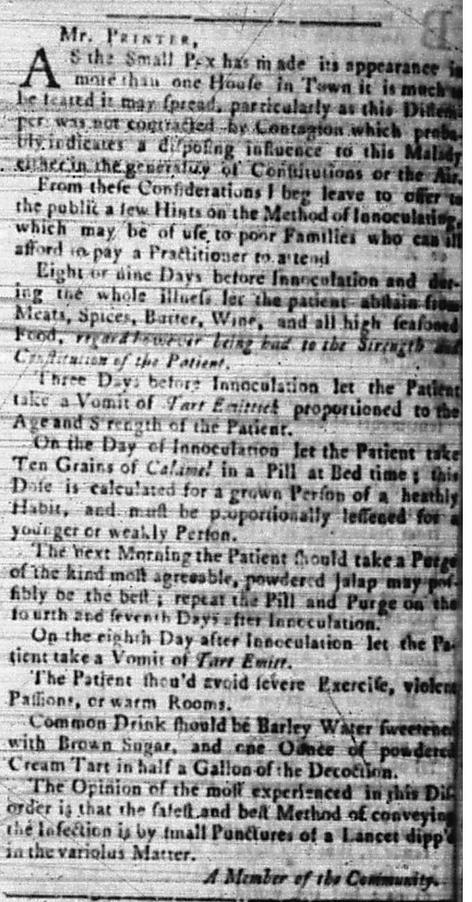
On July 4, 1775, an alert was published in the Nova Scotia Gazette that implored the people of Halifax and the surrounding towns to get the smallpox inoculation because of how rapidly the virus was spreading and how devastating the disease was. The passage describes what a patient should do eight days before inoculation, three days before inoculation, the day of inoculation and the morning after inoculation (Nova Scotia Gazette 1775). It also describes what a patient should eat and drink pre- and post-inoculation, and also what they should avoid, such as severe exercise. This passage describes three different ways of how the smallpox inoculation was marketed toward the poor of Halifax and the surrounding areas. The first is how the “…distemper was not contr acted by [a] contagion…” but was rather spread by bad air. This meant that in close quarters, such as in homes of poor individuals, smallpox would spread much quicker (Nova Scotia Gazette 1775). The second is that, if the rich contracted smallpox they could afford to have a medical practitioner come to their home to treat them. However, a poor person would not be able to afford to have a medical practitioner come to their home, and so if they got smallpox they would just have to treat themselves in their ow n home. The third, which connects to the second, is that this alert provides medical information to the poor person receiving the inoculation. So if a poor person receives the smallpox inoculation, they can turn to their article for how to treat the inoculation acquired smallpox as opposed to paying to see a medical practitioner. This passage provides many reasons as to why the smallpox inoculation was marketed towards the poor population of Halifax and the surrounding towns.
On July 23, 1775, the first death attributed to smallpox was buried at St. Paul’s Church in Halifax, and since that death, the number of people dying of smallpox continued to rise rapidly
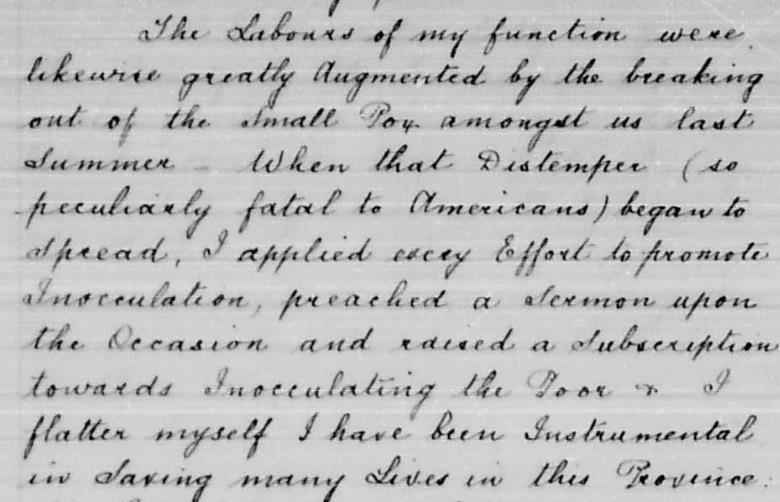
(Marble 1988). Reverend John Breyton, of St. Paul’s church wrote the second primary source passage. He served there during the smallpox outbreak (Marble 1988), and stated that, “… the labours of [his] function were likewise greatly augmented by the breaking out of the Small Pox…last Summer…” (Breyton 1776). He noted that the number of deaths kept rising quickly and he was imploring everyone to get the inoculation. He said that he, “…preached a sermon upon the occasion and raised a subscription towards inoculating the poor…”(Breyton 1776). He saw so many lives taken by smallpox and believed that inoculating the poor was a way to limit the spread.
Due to the rapid rise of smallpox cases in Halifax and the surrounding towns, the House of Assembly accepted a bill on November 17, 1775, that dealt with quarantine procedures for infected individuals and inoculation policies and procedures (Marble 1988). In the section that deals with quarantine procedures it states that if an individual has contracted smallpox, they must remove themselves from their home, so they do not spread the virus to others. The act also states that a “Justice and Overseers of the Poor” who have taken, “…the testimony [of a] physician, surgeon, or apothecary…” (An Act to Prevent the Spreading of Contagious Distempers , 1775) has the right to remove the individual from the home and place them in a separate facility. If the individual cannot afford the facility though, the cost would be placed on the town that they reside in. The second part deals with inoculation and states that if a person wishes to be inoculated, they may do so as they see fit, they just have to place a flag outside of their home if their house is not, “… at least one hundred and sixty rods distance from any other house or dwelling…” ( An Act to Prevent the Spreading of Contagious Distempers , 1775). Both of these items make it much easier for the poor to both be treated because the cost barriers are removed and provides the poor individual an opportunity to be safely treated and inoculat ed. The law about the quarantine
procedures provides “public health” officials an opportunity to intervene where a poor person would not go for treatment because they cannot afford it. If an individual wishes to be inoculated they have been provided opportunities to which they can do so without the financial barrier and with only physical signs on their home th at the inoculation procedure has taken place on an individual in that dwelling. Also, by laying out supervision, community fundings, and procedures towards inoculation, the government is treating quarantine and inoculation as being essential for mitigating the spread of smallpox and ensuring that the poor can be inoculated.
Although smallpox has devastated so many communities worldwide, including Nova Scotia, inoculation was used as an effective treatment method. Therefore, through the outbreaks of smallpox in Halifax and the surrounding towns from 1754 to 1776, the inoculation was marketed towards the poor population, as opposed to the rich.
Primary Sources Textual Excerpts
July 4, 1775, Nova Scotia Gazette and Weekly Chronicle
Passage:
“As the smallpox has made its appearance in more than one House in Town it is much to be feared it may spread, particularly as the Distemper was not contracted by contagion which probably indicated a disposing influence to this malady either in the generality of constitutions or the Air.
From these considerations I beg leave to offer to the public a few Hints on the method of Inoculating, which may be of use to poor Families who can ill afford to pay a Practitioner to attend. Eight or nine days before Innoculation and during the whole illness, let the patient abstain from meats, spices, butter, wine, and all high seasoned Food, regard however be had to the strength and constitution of the patient.
Three days before Inoculation let the patient take ten grains of Calomel in a Pill at Bed Time, this Dose is calculated for a grown person of a healthy Habit and must be proportionally lessened for a younger or weakly person.”
The next morning the patient should take a purge of the kind most agreeable, powdered jelap may possibly be the best, repeat the Pill and Purge on the fourth and seventh Days after
Inoculation. On the eighth Day after Inoculation let the Patient taken Vomit of Tar Emitt. The patient shou’d avoid severe Exercise, violent passions, and warm Rooms.
Common Drink should be Barley Water Sweetened with Brown sugar, and one ounce of powdered Cream Tart in half a Gallon of the Decoction.
The opinion of the most experienced is this Disorder is that the safest and best method of conveying the Infection is by small punctures of a Lancet dipp’d in variolus matter”
Significance: This is a passage from the Nova Scotia Gazette and Weekly Chronicle July 4, 1775, and it was published as an alert to persuade individuals who were poor to get a smallpox inoculation. The rich could afford to have a doctor come to their home to treat them with medicines if they got smallpox, however, the poor did not have enough money to do this. The smallpox inoculation was marketed toward the poor because it was a way for them to prevent themselves from getting smallpox in a way they would not have had a ccess to before. The passage also provides information on what to avoid since inoculation often resulted in minor smallpox infection.
Nova Scotia Gazette and Weekly Chronicle, 4 July 1775.
Reverand Breyton Letter
Passage: “ The labors of my function were likewise greatly augmented by the breaking out of the small Pox amongst us last summer. When that Distempers (so peculiarly fatal to Americans) began to spread, I applied every effort to promote Inoculation, preached a ser mon upon the occasion and raised a subscription towards inoculating the Poor. I flatter myself I have been
Instrumental in saving many lives in this Province…”
Significance: This is a passage from a letter written by Reverand Breyton who worked at St. Paul’s church in Halifax, Nova Scotia. This was the record he wrote f or all those who died of smallpox buried at his church. He highlights how inoculation could have saved all those lives from the dreadful “Distemper” (smallpox)
Rev. Breyton to S.P.G., Letter No. 202, 2 Jan. 1776 PANS Micro: Miscellaneous “S”, “Society for the Propagation of the Gospel in Foreign Parts, Peel 73, p. 597.
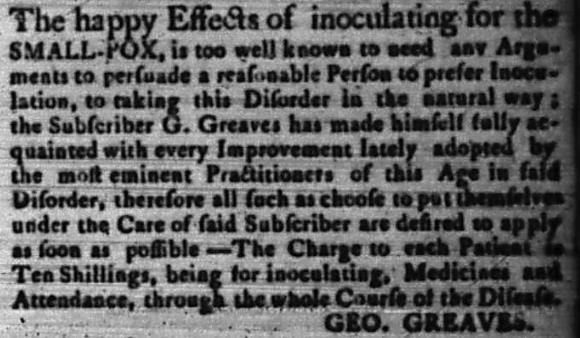
Dr. George Graves Ad in a Paper
Passage: “The happy Effects of inoculating for the Small Pox is too well known to need any arguments to persuade a reasonable Person to prefer Inoculation, to taking this Disorder in the natural way. The Subscriber G. Greaves has made himself fully acquainted with every Improvement late ly adopted by the most eminent Practitioners of this Age in said Disorder, therefore all such as choose to put themselves under the care of said Subscriber are desired to apply as soon as possible – The Charge to each patient is Ten Shillings, being for inoculating, medicines, and Attendance, through the whole course of the Disease.”
Significance: Dr. George Greaves was a physician that operated a hospital that specialized in smallpox inoculation in the North Suburbs of Halifax. Smallpox inoculation was actually so important and necessary that this was the first private hospital that was operated in Nova Scotia (Marble 1988, 49).
Nova Scotia Gazette and Weekly Chronicle, 1 August 1775.
Primary Source Text - Secondary
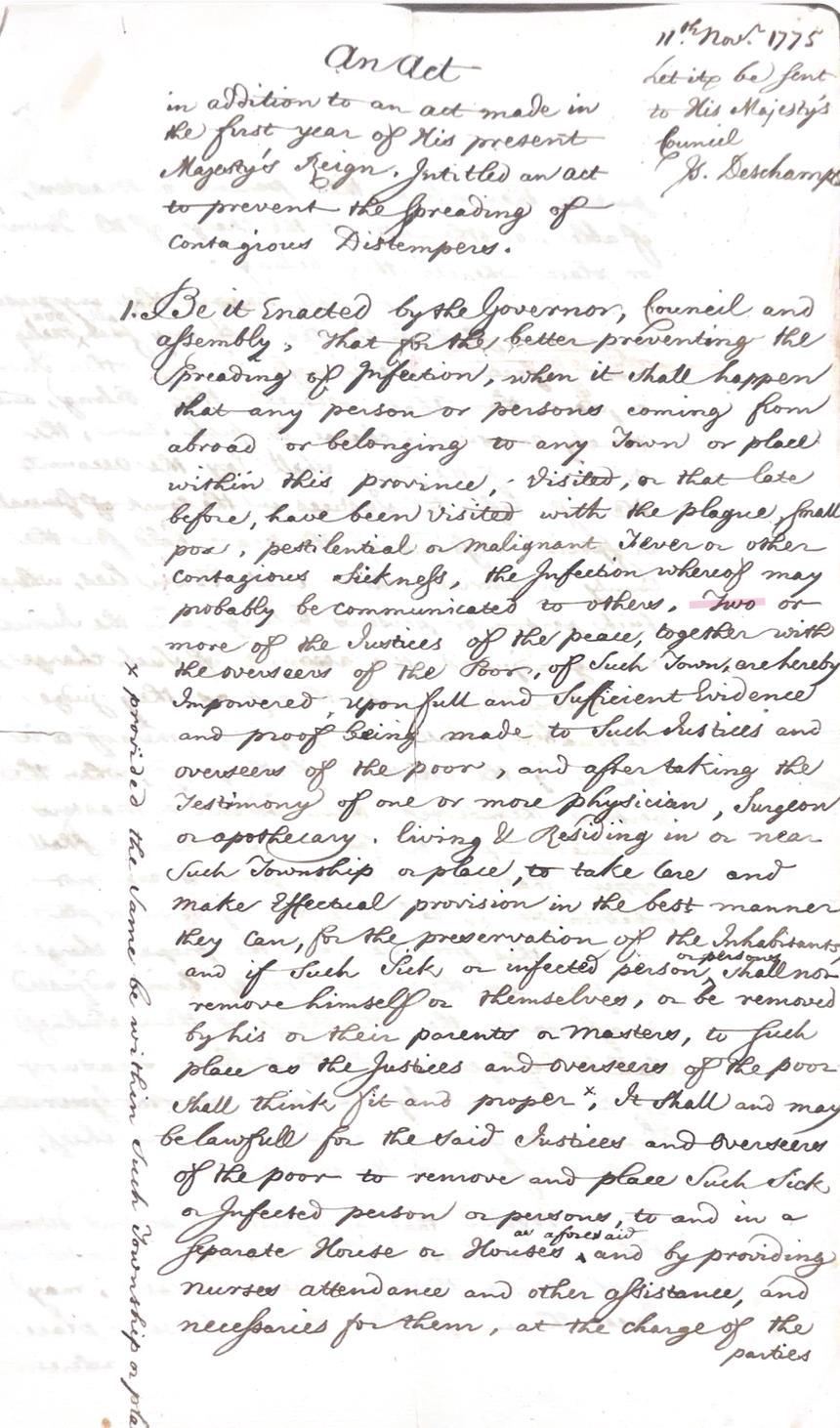
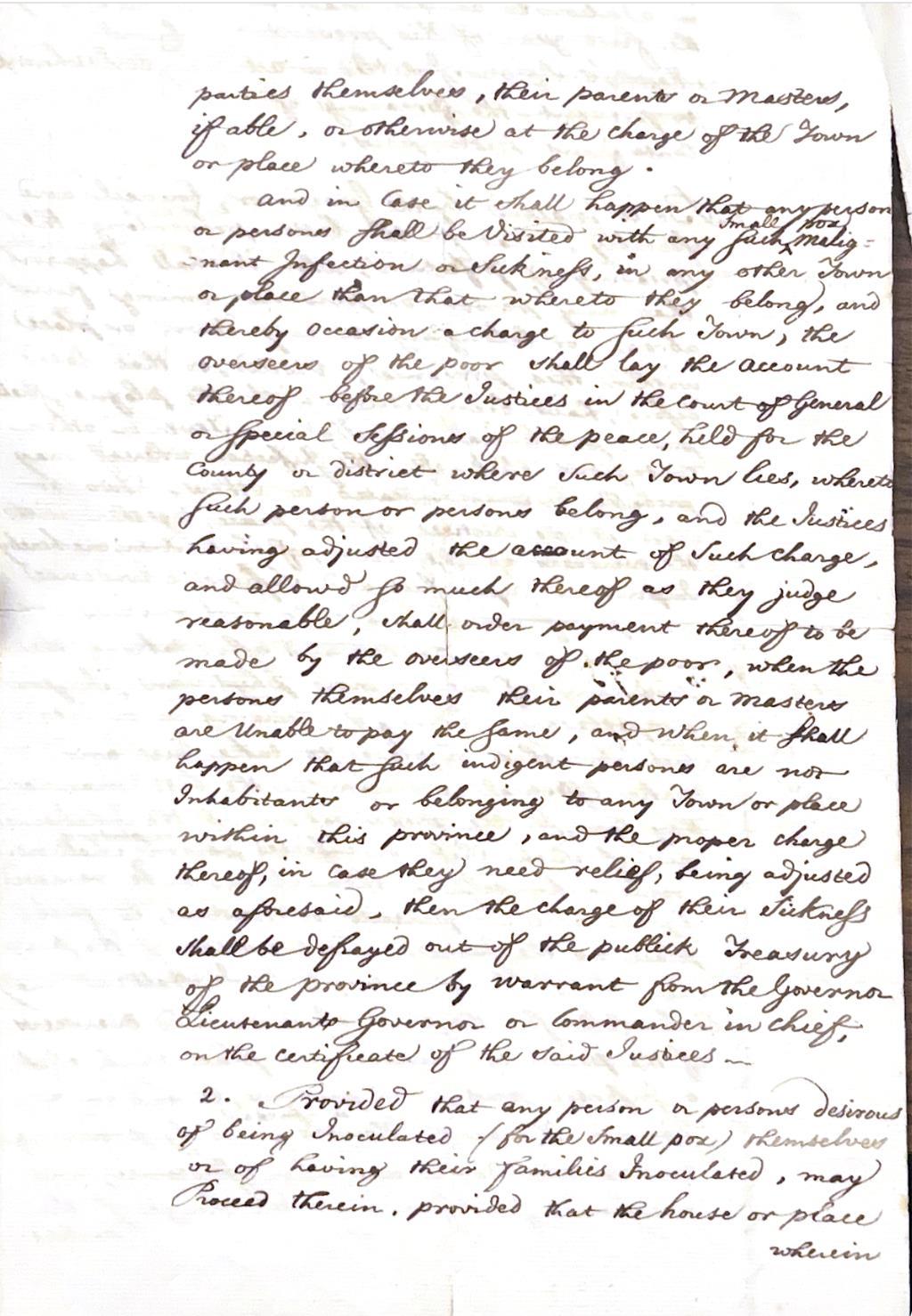
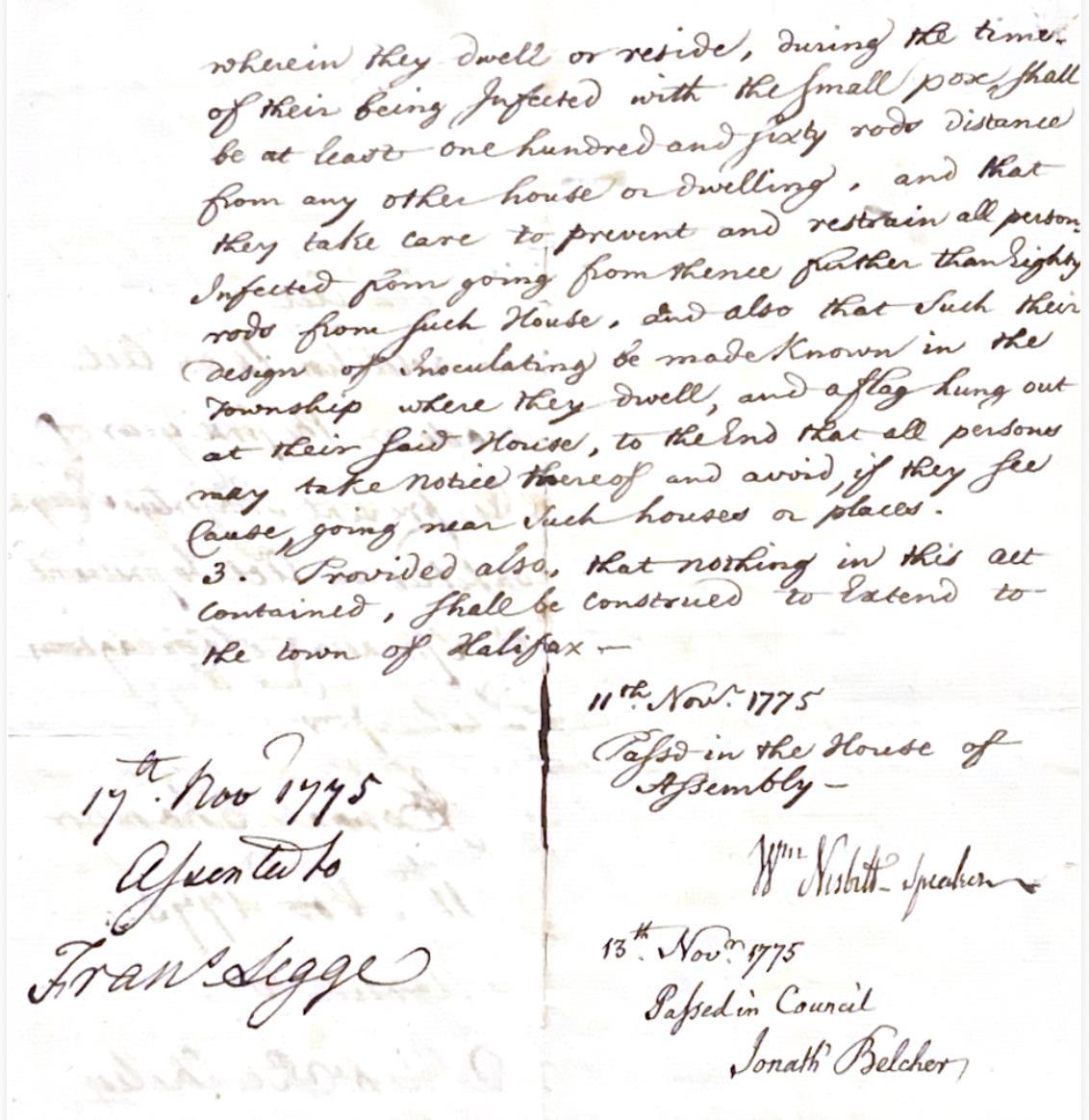
1775 Legislature, … “act to prevent the spreading of contagious Distempers”
Passage: “Two or more of the Justices of the Peace, together with the Overseers of the Poor, of such Town, are hereby impowered, upon full and sufficient evidence and proof being made to such Justices and Overseers of the Poor, and after taking the Testimony of one or more physician,
surgeon, or apothecary, living and Residing in or near such Township or place, to take care and make Effectual provision in the best manner they can, for the preservation of the Inhabitant, and if such sick or infected person, or persons, shall not remove himself or themselves, or be removed by his or their parents or Masters to such place as the Justices and Overseers of the Poor shall think fit and proper provided the same be within such Townships or place. It shall and may be lawful for the said Justices and Overseers of the Poor to remove and place such sick or infected person or persons, to and in a separate House or Houses and by providing nurses attendance and other assistance, and necessaries for them, at the charge of the parties themselves, their parents or masters, if able, or otherwise at the charge of the Town or place whereto they belong…Provided that any person or persons desirous of being Inoculated (for the Small pox) themselves or of having their families Inoculated, may Proceed therein, pro vided that the house or place wherein they dwell or reside, during the time of their being infected with Small pox shall be at least one hundred sixty rods distance from any other house or dwelling…A flag hung out at their said House, to the End that all p ersons may take notice thereof and avoid, if they see cause, going near such houses or places.”
Significance: This Legislation was passed in November 1775 in Nova Scotia in response to the outbreak of Smallpox cases. The act applied to individuals located in villages and towns within Nova Scotia but outside of Halifax (Marble, 1988). The first part deals with what an individual should do when they have contracted Smallpox, which involves quarantine procedures and what should occur if someone receives a Smallpox inoculation.
Citation
An Act in Addition to an Act, made in the First Year of his present Majesty’s Reign, entitled, An Act to Prevent the Spreading of Contagious Distempers (NS 1775), 15 George III c. 2.
Secondary Textual Source
1988 Dr. Allan Marble, Epidemics and Mortality in Nova Scotia”
Passage 1
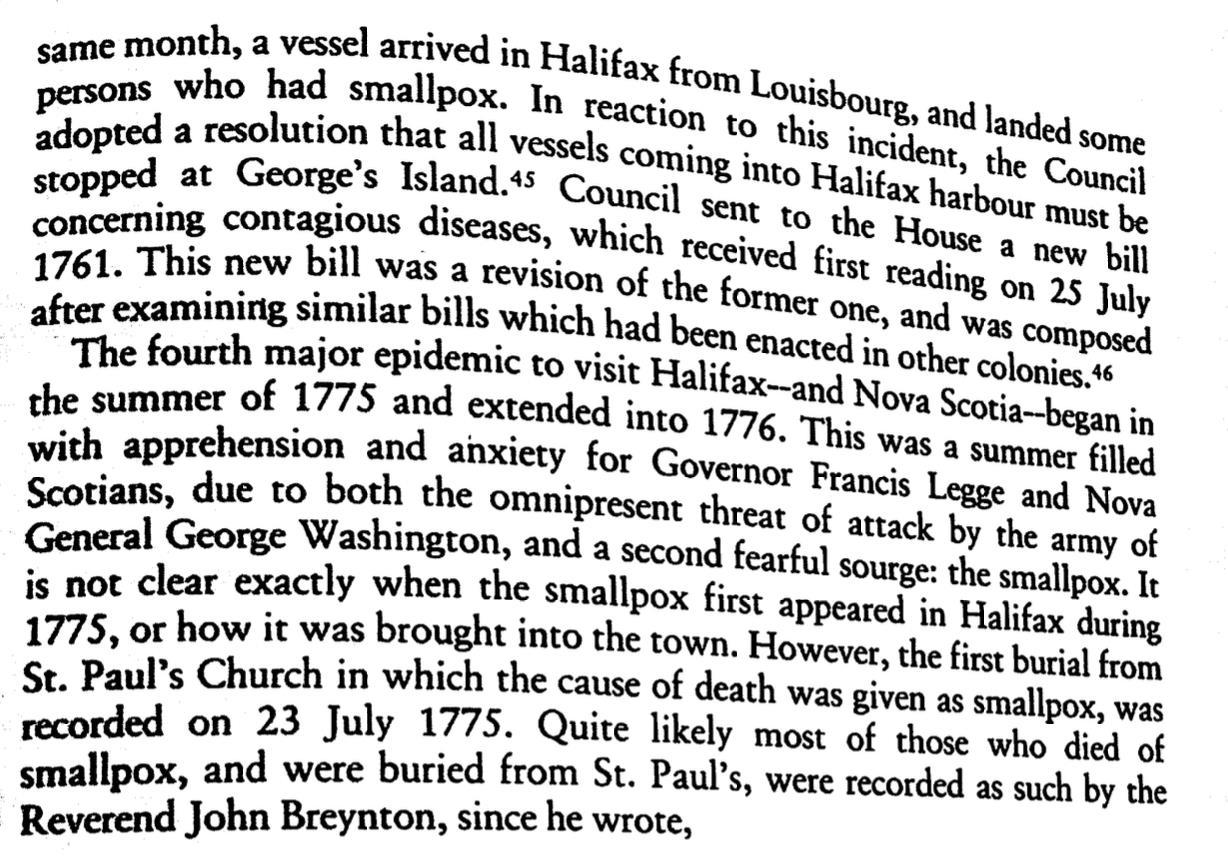
“As was the case in the autumn of 1755, the epidemic brought by the fleet in 1757 spread to the civilian population. The number of deaths occurring in Halifax during the autumn of 1757 increased rapidly over previous months, as shown in Figure 3. It is cle ar that the smallpox represented a very serious epidemic i n Halifax during October, November and December of that year and i n early 1758. In December 1759 the Council prepared a bill entitled "An Act to Prevent the spreading of Contagious Distempers," which they submitted for consideration by the House of Assembly. Surprisingly, as reported by Jonathan Belcher, President of th e Council, to the Lords of Trade on 24 December 1760, the House of Assembly rejected the bill. During the same month, a vessel arrived in Halifax from Louisburg and landed some adopted a r esolution that all vessels coming into Halifax harbour must be persons who had smallpox. In reaction to this incident, the Council concerning contagious diseases, which received first reading on 2 5 July stopped at George's Island. Council sent to the Hous e a new bill 1761. This new bill was a revision of the former one and was composed after examining similar bills which had been enacted in other colonies. The fourth major epidemic to visit Halifax -and Nova Scotia-began in the summer of 1775 and extended into 1776. This was a summer filled with apprehension and anxiety for Governor Francis Legge and Nova Scotians, due to both the omnipresent threat of attack by the army of General George Washington, and a second fearful sourge: the smallpox. It is not clear exactly when the smallpox first appeared in Halifax during 1775, or how i t was brought into the town. However, the first burial from St. Paul's Church in which the cause of death was given as smallpox, was recorded on 23 July 1775.”
Passage 2:
Passage:
“In 1798, the English physician, Edward Jenner, published his discovery that immunity to smallpox could be achieved by the introduction of the virus of vaccinia, or cowpox, through an abrasion in the skin. Inoculation of a person with the virus of vaccinia (i.e., vaccination) induces a mild attack of the disease but renders the person immune to subsequent attacks of similar virulent organisms for at least five years. Whereas during the eighteenth century in Nova Scotia, inoculation for smallpox was viewed w ith a great deal of scepticism because of the chequered history of its success, the general public soon recognized that vaccination was very effective in preventing smallpox. This development was undoubtedly one of the most important discoveries in the history of mankind and improved dramatically the quality of life and life expectancy of people. Smallpox and typhus were the main epidemics which plagued Nova Scotians during the eighteenth century. Although it is frequently difficult to identify the specific 'fevers' which permeate the records of eighteenth-century Nova Scotia, it would be expected that most were either the smallpox virus or typhus, the microorganism of the latter being spread primarily by lice and enhanced by unsanitary living conditions. Th is article provides an account of the degree to which these two diseases influenced the life of Nova Scotians during the second half of the eighteenth century. It will be shown that these diseases were significant factors in deterring both the French and the Americans from attacking, and probably capturing, Halifax during the period. The diseases were also partly responsible for limiting the life expectancy of adults to forty -nine years of age, and for causing a very high level of infant and child mortality. This is probably also the first attempt to quantify the death rate and life expectancy of Nova Scotians during the first fifty years of British settlement.
Significance: This was the passage I read that inspired the theme of my analysis as it describes a general impact of inoculation on Halifax and the Nova Scotia area. It also provides a general description of the outbreaks of both smallpox and typhus going on at the tim e, even though I only focused on smallpox. It provides background on Edward Jenner’s vaccine, as well as the process of inoculation.
Citation Marble, Allan E. “Epidemics and Mortality in Nova Scotia.” Nova Scotia Historical Review , volume 8, number 2 (1988), 72-93.
Reflection Questions
1) Can you identify similarities between how they handled inoculation during this time period and how we handle inoculation in the present day?
2) What ethical dilemmas arise when analyzing historical health interventions with contemporary bioethical frameworks?
3) Which voices dominate the surviving records (e.g., government officials, military officers, clergy, physicians)? Whose perspectives are missing or marginalized?
4) How might modern assumptions about public health influence your interpretation of 18th-century actions?
5) How does studying this period reshape your understanding of risk, trust, and public health communication?
Bibliography
An Act in Addition to an Act, made in the First Year of his present Majesty’s Reign, entitled, An Act to Prevent the Spreading of Contagious Distempers (NS 1775), 15 George III c. 2.
“History of the Smallpox Vaccine.” World Health Organization, 2025. https://www.who.int/news-room/spotlight/history-of- vaccination/history-of-smallpoxvaccination.
Marble, Allan E. “Epidemics and Mortality in Nova Scotia.” Nova Scotia Historical Review , volume 8, number 2 (1988), 72-93.
Nova Scotia Gazette and Weekly Chronicle, 4 July 1775.
Nova Scotia Gazette and Weekly Chronicle, 1 August 1775.
Rev. Breynton to S.P.G., Letter No. 202, 2 Jan. 1776 PANS Micro: Miscellaneous “S”, “Society for the Propagation of the Gospel in Foreign Parts, Peel 73, p. 597.
Alexis Carrel: The Surgeon Who Revolutionized The Treatment of Infected Wounds of Soldiers in WW1
Isabelle Borden
Infections were a very serious problem on the front lines during the First World War. Many soldiers wounds developed infections. If these infections were left untreated, they could end up causing severe deformities, amputations of limbs, or in extreme cas es, death. New methods of dealing with infections and curing them were needed to prevent soldier deaths and mass amounts of amputation. Alexis Carrel, a French American scientist, developed infection treatment techniques and a wound treatment process durin g WW1 in a field hospital not far from the front lines. This scientist played a key role in the war by helping treat soldiers’ infections pertaining to combat injuries. He treated these infected wounds with his sterilization techniques that he developed due to his research done at the front where he, along with other scientists, worked on a treatment method. This paper delves into the reasons that infections were such a problem on the front, what research Alexis Carrel conducted and how, what method he developed for treating infections, the pushback and reaction to his methods, and his work’s legacy. Why were infections such a struggle for soldiers and medical staff to treat?
Infections were a cause of great concern and worry for medical staff during the war; once a wound became infected it was extremely difficult to treat. The reason infections were so problematic is that injuries from machine guns, artillery or shrapnel would cut deep into the skin, allowing for bacteria of all sorts to enter the wounds and establish themselves deep within the wounded tissue (Mayo-Robson 1918). There was a lot of bacteria on the Western Front. The primary reason for this large amount of bacteria is that the land where the Western Front was situated was previously farmland that was treated with manure; which meant the soil was filled
with fecal bacteria (Mayo-Robson 1918). When bombs, artillery and machine gun fire disrupted the ground, this bacteria would come back up to the surface, making it even easier for the soldiers to come into contact with it it was on their clothes, their equipment, in puddles, etc. (Barr et al. 2019). When the soldiers trenched into the ground, they would dig into ba cteria rich soil which made preventing infections more difficult (Hawk 2019). The bacteria entered these wounds in many ways it was on the shrapnel, or the soldier’s clothing was unclean, then entered the wound during injury (Walker 2002). The problem is once the bacteria enter the deep tissue it is hard to remove. When the bacteria enter a new area, it is able to take over, reproduce and spread, which then creates the infection (Mayo - Robson 1918). Once the infection starts to spread it becomes even more difficult to treat and would likely result in amputation of the infected limb, and if left untreated it could lead to systemic infection and death (Mayo -Robson 1918). Amputations as a result of infections were such a large problem during the war that seventy to eighty percent of amputations of British soldiers were due to infections (Selcer 2008). There were a multitude of infections that soldiers suffered from on the Western Front, one common condition caused by combat wound infections was gas gangrene whic h was caused by many gas producing species of bacteria. Gas gangrene could necessitate limb amputations due to the spread into the muscles causing a lot of pain (Gas Gangrene 1943). It could also lead to toxemia which would stop the heart or cause issues i n the lungs resulting in death (Gas Gangrene 1943). It could cause extreme cases of sepsis.
How then were these infections to be treated when they were deep within the tissue of the soldiers’ combat wound? Alexis Carrel invented a delivery method to help keep wounds sanitized and aseptic (Selcer 2008). Carrel exclusively used the Dakin solution c reated by Henry Dakin, a British scientist, upon Carrel’s request to create a solution to treat infected battle wounds
(Ambrose 2021). The Carrel-Dakin method was finalized in May 1915 (Selcer 2008). His solution was a hypochlorite that was able to kill all germs and did little to no damage to the tissue except for potentially causing slight tissue and skin irritation (Walker 2002). The Dakin solution then needed to be delivered to the wound, this is where Carrel developed a delivery method to solve this problem. His method started with the clearing of the wound. The priority of treating war wounds and preventing bacterial infections was to clear out the wound as soon as possible. It is essential to remove all foreign objects from the body, such as bullets, scrap metal, dirty clothes, etc. and any dead tissue (Benveniste 2013). The removal of these materials would help prevent foreign bacteria from taking advantage and spreading within the body which can lead to severe infections and various health issues including sepsis, nerve, joint and muscle damage. It was commonly agreed upon that clearing of wounds from foreign materials was the key component in preventing infection (Barr et al. 2019). Once the wound was cleared of foreign materials, the next step was to use small tubes with holes to let the solution flow into the wound (Walker 2002). The wound would either be continuously or intermittently supplied with solution (Walker 2002). Doing this would prevent the infection from spreading and the rotting of the limb which would require amputation. The death rate at Carrel’s war hospital had decreased as had the rate of amputations brought about by infections (Walker 2002). The next step was to examine the smear of the wound to make sure there was only one microbe that would appear in five or six slides for a few days of testing; once achieved, the use of Dakin solution was over, and the wound would be closed by a surgeon (Selcer 2008). The planimeter was put into use by Du Nouy, he developed a mathematical equatio n to determine once the wound was able to be considered no longer infected; once the smear showed only one microbe per five to six slides (Selcer 2008). The use of the planimeter sped up the process and was much more accurate as it
would indicate if the wound was septic or not. Carrel’s newly developed method was considered to be easy, cheap and effective however, it could be time consuming due to the need to check the smear, and to make sure adequate fluid was reaching the patient (Walker 2002).
During a time of war, research was not an easy task especially when very close to the front. Alexis Carrel was funded by the Rockefeller Institute which paid for his field hospital in Compiegne which was known as Hôpital complémentaire 21 (Selcer 2008). The hospital also had the advantage of having a laboratory on site, allowing for proper research (Selcer 2008). This laboratory allowed Dakin to test over 200 different liquids to determine which was the best for sterilizing the wounds w ithout damaging the tissue (Walker 2002). However, Dakin did claim that it was very difficult to conduct research during war time and gather data because the research lacked proper controls and it was full of variables (Ambrose 2021). The wounds were never exactly the same so there was no way to test the varying solutions against one another.
Another problem caused by conducting research on war patients was the proximity of the hospital to the battlefield. Having a hospital this close was quite risky especially considering the hospital was bombed and destroyed before the end of the war (Walker 2002). One feature of his hospital was that Carrel was selective about the number of patients he would allow in his field hospital (Selcer 2008). He would only accept soldiers with wounds that were similar in shape to one another to create a control in his experiment (Selcer 2008). He was more focused on the aspect of research then accepting all types of injury into his hospital. The limited number of patients kept the hospital from being overcrowded and allowed for more time and effort to be spent on research and proper note taking to ensure the development of a method for treating the patients. He had proper documentation of the wounds and patients he treated which was not a common occurrence with other doctors doing research near the front lines (Selcer 2008).
There were mixed reactions to Carrel’s method when it was established. There were some who thought it was a good method and useful in the treatment of combat wound infections, others believed the method was not efficient or practical enough. There were some issues with the method such as the fact that it was extremely diffic ult to move the patient while there were tubes delivering the solution to the patient (Mayo -Robson 1918). Another issue with the method was that it required the surgeons’ attention and needing to check up on patients along with the nurses needing to make sure the solution was flowing and irrigating in the wounds (Carrel-Dakin Treatment of Wounds 1917). These tasks would take more time than other methods which could be difficult when the hospital staff was already stretched thin by the large number of patien ts they had (Barr et al. 2019). Another issue with his method is that some people would claim it did not work but the counter argument was that they did not execute the method properly, they omitted steps or used a different solution which Carrel advised a gainst (Selcer 2008). Some would not properly perform his method, which was a key component of the success of the method he created. His method was dismissed by different people for various reasons regardless of the fact his method obtained good results. Carrel and his method were dismissed by quite a few prominent French and British medical professionals, they would dismiss it as American nonsense (Walker 2002). Some scientists thought that it was not possible to invent a method like this, they believed that Carrel’s research for a method was a pointless endeavour and that a treatment for infections and germs could not be done (Ambrose 2021). Amongst the scientists who believed this were notable doctors from Edinburgh, they did not believe in the pathogenic ity of germs (Ambrose 2021). At the start of the war this concept was still debated amongst medical professionals. Carrel and other scientists ignored the naysayers and continued their research to
develop a method to treat combat wound infections. There were also those who believed Carrel’s method to be very simple and that the method was not as innovative as Carrel and others were making it seem (Walker 2002). The method faced a wide array of reactions from those who thought it was a great and innovative m ethod to those who thought it was pure nonsense. The effectiveness of Carrel’s method compared to others is debatable, and difficult to compare due to the difference in data and record keeping. However, his method was successful in treating wound infections and it reduced the need for amputations because of infections by half when performed at Hôpital 21 and also sped up the healing process (Ambrose 2021). One issue however is that his method was not easy to practice elsewhere besides his research hospital. One of the reasons for this is the Dakin solution was not easy to prepare and a chemist is needed to make it (Mayo-Robson 1918). If the method did not work or medical professionals were not obtaining good results Carrel would blame these struggles on the other scientist for not following the method properly (Ambrose 2021). Other medical profes sionals would change part of his method, but Carrel was specific that the method needed to be followed, and nothing should be changed. It is a whole process, and no component should be omitted from the Carrel -Dakin method. If certain components were omitted, then it was no longer technically his method being used. There were other solutions that were also used with Carrel’s tube system instead of the Dakin solution such as flavine and eusol, two other types of antiseptic fluids (Mayo -Robson 1918). Although these other fluids were also antiseptics, flavine was a poor bactericide and did not properly sanitize the wound (Mayo-Robson 1918). Whereas eusol is an efficient bactericide similar to Dakin’s solution and is easier to obtain (Mayo -Robson 2018). Carrel would appear to have the best results because his records of his research were well kept. If Carrel’s method was properly performed it was quite effective and obtained good results, an infection was able to be
considered clinically sterile (Carrel-Dakin Trea tment of Wounds 1917). One of the benefits of his method is that the soldiers were generally free from pain with this method, aside from some potential irritation of the skin around the wound which is treatable with Vaseline (Carrel -Dakin Treatment of Wounds 1917). The method itself had good results it would prevent nerve damage, blood vessel damage, issues with bones and joint, and the need for amputations (Walker 2002). Nonetheless, there was lack of accessibility of the use of this method, often times ch anges were needed, and the method was not properly executed meaning in practice the method was not the best even if scientifically it had good results. After the war his method became less common and fell out of practice because new drugs and better method s were developed. The main method of treatment for infection is now antibiotics (Ambrose 2021). The Dakin solution was still used after the war and is still sometimes used to this day as an antiseptic fluid (Walker 2002).
In conclusion, during a time where infections were causing much damage to soldiers by infecting their wounds due to the bacteria-rich soil on the Western Front, Alexis Carrel was able to develop a method to help deal with this issue. He developed a way of making wounds antiseptic which would greatly reduce the rate of infection and all the issues that would follow if the wounds would get infected. He was able to conduct his research near the front during a difficult time because he acknowledged the importance of record keeping and proper research. When his method was created it received an array of reactions, it was praised while others viewed it as nonsense, it did however, have good results and reduce infections. In the end his method fell out of practice and was no longer as useful as it once was because new methods were developed.
References
Ambrose, Charles T. “A Letter from Alexis Carrel Concerning the Preantibiotic Treatment of War Wounds: The Carrel–Dakin Solution. Updated 2021. ” Journal of Medical Biography 29, no. 1 (November 2018): 3–9. https://doi.org/10.1177/0967772018808366.
Barr, Justin, Leopoldo C. Cancio, David J. Smith, Matthew J. Bradley, and Eric A. Elster. 2019. “From Trench to Bedside: Military Surgery During World War I Upon Its Centennial.” Military Medicine 184, no. 11–12 (June): 214–20. https://doi.org/10.1093/milmed/usz130
Benveniste, Glen L. “Alexis Carrel: The Good, the Bad, the Ugly.” 2013. ANZ Journal of Surgery 83, no. 9 (April): 609–11. https://doi.org/10.1111/ans.12167
“Carrel-Dakin Treatment Of Wounds.” 1917. British Medical Journal 2, no. 2966: 597–99. https://doi-org.ezproxy.library.dal.ca/10.1136/bmj.2.2966.597
“Gas-Gangrene.” 1943. British Medical Journal 2, no. 4304: 15–15 https://doi.org/10.1136/bmj.2.4304.15.
Hawk, Alan J. “ArtiFacts: Fighting Wartime Wound Infections with the Carrel-Dakin Method.” 2019. Clinical Orthopaedics and Related Research 477, no. 12 (December): 2651–52. https://doi.org/10.1097/CORR.0000000000001010.
Mayo-Robson, A. W. “Some Surgical Developments in Wound Treatment During the War.” 1918. British Medical Journal 1, no. 2975 (January): 1–4. https://doi.org/10.1136/bmj.1.2975.1.
Selcer, Perrin. “Standardizing Wounds: Alexis Carrel and the Scientific Management of Life in the First World War.” 2008. The British Journal for the History of Science 41, no. 1 (March): 73–107. https://doi.org/10.1017/S0007087407000295.
Walker, L.G. “Carrel’s War Research Hospital at Compiegne: Prototype of a Research Facility at the Front.” 2002. Journal of the American College of Surgeons 195, no. 6 (December): 870–76. https://doi.org/10.1016/S1072-7515(02)01290-5
Holy Holy: Human exceptionalism, unitarianist Christianity and concepts of worship in Thoreau’s Walden and Lyell’s Geological Evidence for the Antiquity of Man
Kay A. Nelson
1. Rediscovery
Time and time again, humanity has rediscovered religion.
I use the term rediscovered because of the deep roots many religious beliefs tend to have in common with one another. In America and England, one needs only look at any of the great Awakenings to see how Christianity has changed over time, but, looking eve n further back, one can see how monotheism spread throughout the Middle East as traditions either moved, or were forced, away from animism. Looking more recently at the history of Abrahamic religions, earth or nature worship and spiritual practices like wiccan and witchcraft personalized religion have been popularized by a predominantly white, Western, middle -class crowd.1
This popularization of individualized spiritual experiences is proof enough that the search for a singular ‘higher power’ that fulfills every individual is a near impossible task.
Transcendentalism as a philosophy and religion for it is indeed a spiritual practice revolves around ideas of individualism and connection to the natural world. Ralph Waldo Emerson, Henry David Thoreau, and their analysts have explored these ideas extens ively.
Transcendentalism being one of many interpretations of Unitarianism that came about during the era of the Second Great Awakening, is itself a rejection in some capacity of Christianity. While defining the specifics of this era of religious discovery is difficult, one constant in the various articles regarding the Second Great Awakening is the rejection of
1 Zwissler, New Age, Wicca, and Paganism, 1.
Calvinism2 - essentially absolutism regarding the state of God. Nancy F Cott argues that this is due in part to a movement away from religious piety to political survival in the wake of the American Revolution 3. Preachers and priests evangelized more fiercely than they had in the past as a matter of survival, leading to a wave of revival in religious thought in the United States and Canada. Due to this period coinciding with the end of the American Enlightenment , many philosophers also pushed back against the evangelical ideals the church preached, leading to various new interpretations of spirituality, including Transcendentalism, which emerged as a challenge to Unitarianist Christianity at the time 4 . Walden was written in the period following the Second Great Awakening by Transcendentalist Henry David Thoreau. A common interpretation of this text is as a beautiful, but secular piece of literature 5. A far less popular interpretation of Walden is as a religious text in and of itself - a guidebook for living, a list of commands absent of a commander. Much of the book has an emphasis on the aforementioned importance of nature, the proper way to live a life. “Simplify, Simplify.” 6 as is so often cried by followers of Thoreau and Transcendentalism as a whole.
This essay will focus on these aspects of the text - the importance of the commands stated in the book regarding self-reliance, isolation, and connection to nature, as well as the connection Walden has to the sacred, allowing one to define for themselves what a spiritual life is. We will be unpacking these Transcendentalist spiritual beliefs as they relate to Walden as a text and 2Mathews,The Second Great Awakening as an Organizing Process, 1780 -1830: An Hypothesis., 23.
3 Cott, Young Women in the Second Great Awakening in New England., 15.
4 Stievermann, Emersonian Transcendentalism and the Invention of Religion(s) in the Nineteenth Century., 538
5 Hatcher, RELIGIOUS IRONY, RENUNCIATION, AND ENVIRONMENTALISM IN ‘WALDEN., 125
6 Thoreau, Walden, or, Life in the Woods ; and Civil Disobedience., 81
comparing them to the Unitarianist philosophies of geologist Charles Lyell surrounding humannature dualism. Using these differences as a case study, proof can be found that Transcendentalism as a religion is so successful in proving that the human -nature dualism is merely a social construct because of the innate understanding of the Calvinist and Unitarian roots from which it sprang.
2. Is Walden even religious?
Walden is an innately religious text, a transcendentalist bible of sorts, one that leads to a non-hierarchical connection with Nature that aims to separate itself from the idea of human exceptionalism. Harding writes in The Massachusetts Review on five distinct readings of Walden, 3 of which it can be argued contribute to the view of Walden as a religious book.
The five manners of interpreting Walden are as follows: as an experiment and experience in Natural History 7, as a Guidebook to living a simple life 8, as a Satirical Criticism of ‘modern life’ 9, purely as an Aesthetically pleasing text 10, or, lastly, as a Religious endeavour 11 .
The first and fourth readings provide little in the way of religious interpretation, however, they are also short-sighted enough that it would be a benefit to ignore them entirely.
Firstly, while Thoreau has an appreciation of the natural sciences, he is by no means a scientist. Harding makes note of the manner in which Thoreau speaks about a loon upon the pond as a way of pushing back against this reading, ending this section with “ But so much for Thoreau as a nature writer.” 12
The fourth way of reading the text is simply as a piece of literature that is aesthetically beautiful, and to ignore its contents as a whole. Using this reading within a bubble not only contradicts the other four possible interpretations of the text, but ignores any deeper meaning that
7 Harding, Five Ways of Looking at Walden., 149
8 Harding, Five Ways of Looking at Walden., 151
9 Harding, Five Ways of Looking at Walden., 154
10 Harding, Five Ways of Looking at Walden., 156
11 Harding, Five Ways of Looking at Walden., 160
12 Harding, Five Ways of Looking at Walden., 151
Walden’s many biblical parallels or references to other religious texts such as the Bhagavad Gita might suggest 13. Only by looking at all of these readings together can a full view be formed.
The readings as a Satirical Criticism, a Guidebook and Religious endeavor all lend credence to the idea that Walden is inherently religious.
Hatcher’s “Religious Irony, Renunciation, And Environmentalism in Walden”, attempts to prove the deeply entrenched religion in Walden. It begins by challenging one of the other possible readings of Walden that of Thoreau’s role as a naturalist not by claiming he did not have or embody this role, but by pointing out the consistency of transcendentalist philosophical themes in his later work, works that are more aligned with the natural sciences 14. Hatcher then attempts to interpret Walden as a religious text through the lens of religious satire, through the third lens of Satirical Commentary.
Early on in Walden, Thoreau posits the idea that “Christianity had been adopted as an improved form of agriculture” 15. What does Thoreau mean by an improved form of agriculture? The context surrounding this statement is important, as it describes Thoreau’s belief that tools have been the driver, the wedge that separates man from nature. “ -men have become tools of their tools. The man who independently plucked fruits when he was hungry is become a farmer;” directly precedes Thoreau’s statement on Christianity 16 .
13 Thoreau, Walden, or, Life in the Woods ; and Civil Disobedience., 264
14 Hatcher, RELIGIOUS IRONY, RENUNCIATION, AND ENVIRONMENTALISM IN ‘WALDEN., 126
15 Thoreau, Walden, or, Life in the Woods ; and Civil Disobedience., 33
16 Thoreau, Walden, or, Life in the Woods ; and Civil Disobedience., 33
Hatcher interprets this statement as a mocking one-liner, while also questioning how one’s agriculture can implicate them in a religion 17. “The Bean Field”, a chapter in which Thoreau describes his experience farming, goes over just how religious such an experience in farming can be - especially one not rooted in a specific output. Thoreau referred to in Hatcher’s article simply as “the farmer expresses a deep faith in how the natural world instructs him on farming. The article goes over how Thoreau is dedicated to his crop for reasons that are decidedly unrelated to profit - that he has sought to know his crop deeply. Beyond that “The Be an Field” has quite a few other experiences that are deeply religious. Thoreau speaks of placing his “entire faith” regarding his agricultural timings in the cries of a bird 18. This action has zero scientific or economic basis. It is an act of faith.
Hatcher’s choice of words with regards to Thoreau’s realization that his relationship to repetitive action has transcended the material is particularly poignant. Thoreau states “it was no longer beans that I hoed, nor I that hoed beans” 19, and Hatcher notes that what the farmer Thoreau has cultivated is not his beans, but rather an individual relationship with nature 20 .
To return to Hatcher’s original point of contention with reading Walden as a Satirical Commentary, how can the reader take any of these points seriously given the depth and sheer number of jokes, puns, and playful language present in Walden? Despite the many references to Christianity, if they are done mockingly, how is a reader meant to believe that Thoreau himself could ever be truly religious? Whisnant argues in tune with Hatcher, that “Underneath Thoreau’s
17 Hatcher, RELIGIOUS IRONY, RENUNCIATION, AND ENVIRONMENTALISM IN ‘WALDEN., 127
18 Thoreau, Walden, or, Life in the Woods ; and Civil Disobedience., 141
19 Thoreau, Walden, or, Life in the Woods ; and Civil Disobedience., 141
20 Hatcher, RELIGIOUS IRONY, RENUNCIATION, AND ENVIRONMENTALISM IN ‘WALDEN., 130
blustery rejection of the contemporary religious establishment is an ironic and paradoxical, but nonetheless profound, religious sensibility” 21 .
Whisnant speaks deeply of the differences between the “religious man”, and the “nonreligious man”, specifically how each makes their way through the world.
The unreligious man finds that he can exist in the world in the same way, at all times because the world is simply the world. The religious man however, as Whisnant argues Thoreau is, will argue that some if not all aspects of the world require a difference of being through them22. Through repetitive action, the religious man attempts to incorporate the aspects of those religious or spiritual portions of space and time into every moment.
One repetitive action we see within Walden is the toiling over the field, the same beanfield that Hatcher has already insisted is religious. Another is the bathing in the titular pond, a daily experience Thoreau directly refers to as a religious endeavor. “I got up early and bathed in the pond; that was a religious exercise,” 23 .
This reverence can offer a glimpse into how Thoreau experienced and, more importantly, practiced Transcendentalism. While he states very clearly that Walden is not a guide for how to live one's own life, it should serve as inspiration for how to learn to live one's own life, as Transcendentalism stands for. These religious practices bathing within Walden Pond, 24 toiling over the beanfield at the cry of a brown thrasher 25 have a deep religious meaning for Thoreau,
21 Whisnant, THE SACRED AND THE PROFANE IN ‘WALDEN.’, 267
22 Whisnant, THE SACRED AND THE PROFANE IN ‘WALDEN.’, 269
23 Thoreau, Walden, or, Life in the Woods ; and Civil Disobedience., 79
24 Thoreau, Walden, or, Life in the Woods ; and Civil Disobedience., 79
25 Thoreau, Walden, or, Life in the Woods ; and Civil Disobedience., 141
but may not for you or I. The individualism that Transcendentalism elevates argues that via isolation and connection to nature, we can find those religious practices.
3. Human Exceptionalism
Thoreau’s own thoughts on human exceptionalism are strange. Within Walden, he actively states that he observes no separation - rather, he sees that humans are fundamentally tied to nature.
“Every child begins the world again, to some extent, and loves to stay out doors, even in wet and cold. It plays house, as well as horse, having an instinct for it.” 26
This is a theme that is expanded on throughout Walden. In fact, the connection between humanity specifically children and the natural world is emphasized to the point of being comedic within the text. Thoreau even describes the sounds made by the cows and compares it to the choral voices he hears from the church boys. “I do not mean to be satirical, but to express my appreciation of those youths’ singing, when I state that I perceived clearly that it was akin to the music of the cow, and they were at length one articulation of Nature” 27. Yet, he himself still refers to hierarchical religion consistently.
In "Solitude”, he speaks of foxes, skunks and rabbits as the “wildest animals” 28 indicating some form of hierarchy even within the animal kingdom. In “Higher Laws”, often quoted as one of the more philosophical chapters of Walden 29, he refers to this separation more starkly than it appears elsewhere.
The chapter begins with Thoreau seeing a woodchuck cross his path, and was seemingly compelled to “seize and devour it raw” 30. While this statement, on its own, could easily be a
26 Thoreau, Walden, or, Life in the Woods ; and Civil Disobedience., 25
27 Thoreau, Walden, or, Life in the Woods ; and Civil Disobedience., 110
28 Thoreau, Walden, or, Life in the Woods ; and Civil Disobedience., 115
29 Harding, Five Ways of Looking at Walden., 150
30 Thoreau, Walden, or, Life in the Woods ; and Civil Disobedience., 187
reference to humanity’s connection to the natural what could be more “natural” than the desire to hunt – Thoreau’s follow-up leaves some doubt towards that interpretation. Thoreau states “Not that I was hungry then, except for that wilderness that he so r epresented.” 31. The woodchuck, the act of hunting, the desire to exist in a more animalistic mindset - this is the true essence of the natural.
“Higher Laws” as a chapter describes Nature more personally, personifying ‘her’ more consistently than has been done in other chapters. In doing so, whether intentionally or not, Thoreau has either created or accepted a strange separation between Nature an d that which is outside of her - resigning himself to the very idea that man could exist outside of the natural. The view Thoreau has of Nature in this chapter is indeed hierarchical, as he cleanly calls the savage lower, and the spiritual higher, while acknowledging them both
32 .
It is important to add that this relationship with nature is one seen also in Christianity, indicating that perhaps Thoreau, or rather Transcendentalism as it is drawn from Walden, is not as separate from its Christian upbringing as originally thought. While it is unlikely that Thoreau had deeply held Christian beliefs, given that he pokes fun at the religion throughout this book, it would be unreasonable for any reader to interpre t Walden or Thoreau without examining JudeoChristian values in society as a whole. America following the Second Great Awakening in the late 1840s was not some place of post-Christian acceptance; it remained a Christian state, which affected social change and scientific development for years to come. Thoreau could not escape Christianity in the western society it had built.
31 Thoreau, Walden, or, Life in the Woods ; and Civil Disobedience., 187
32 Thoreau, Walden, or, Life in the Woods ; and Civil Disobedience., 187
To summarize, the interpretation of Transcendentalist philosophy within Walden and how it applies to human exceptionalism, humans are, in essence, a part of Nature and have been separated from Her by technology - by their tools.
4. Naturalists and Unitarian Christianity
This aforementioned separation from nature is not only present in Thoreau’s works, but is in fact a well-recorded Christian religious belief. The Great Chain of Being (GCB) is a system that organizes existence into a hierarchical system that begins with Go d, followed by Man, Animals, Plants, Metals, and Rocks 33. A clear line can be drawn not only in the hierarchy itself, but also within the language that is used - God being separate from man and man being separate from animal. This system of belief can be seen in Christian beliefs codified in Medieval Christianity around the 1800s, and has had a maintained presence in society to this day.
Charles Lyell, famed naturalist and Christian provides an interesting case study on how belief in hierarchical religion influences belief in human -nature dualism. Lyell has often been called anti-christian in Christian circles 34 for his work developing the theory of uniformitarianism, the idea that geological processes today were most likely the same thousands of years ago. This went against the more popular theory of catastrophism that supported that the Earth had been formed by various disasters - such as the biblical Great Flood. While much of Lyell’s work focused on geology, he published a book in which he remarked on humanity’s place in society entitled Geological Evidence for the Antiquity of Man soon after Darwin had published his book, On the Origin of Species.
Lyell’s religious qualms regarding the theory of evolution are most evident in the final chapter of this book, in which he attempts to argue why humans ought to have a separate classification from animals. Lyell begins this final chapter in an attempt to d etermine “Whether
33 Bryant and Farrell, The Influence of the Nature-Culture Dualism on Morality., 268
34 Parker, Science of the Physical Creation in Christian Perspective., 268
Man can be regarded as an Exception to the rule if [Evolution] be embraced for the rest of the Animal Kingdom” 35
Despite every chapter prior going over geological evidence for the theory of evolution - a theory that directly connected all living things, thereby removing the line between Man and Animal in the GCB, Lyell’s religious beliefs stood in the way of his acce pting this truth.
For Lyell, the theory of evolution which proved an objective, factual link between man and nature could not overcome his religious ideology, preventing him from viewing the human-nature dualism as a now unpacked social construct.
Christianity, and other religions that indicate a hierarchy of some kind exacerbate this problem, indicated by the fact that the GCB originated with religions that included multiple deities, yet remaining under God, allowing for a hierarchy to still exist.
Lyell strongly believed that human exceptionalism must exist. Klaver writes in Geology and Religious Sentiment that Lyell’s thoughts on belief in creation remained “strongly anthropocentric throughout his life” and that Lyell remained “convinced of man’s ‘ divine’ dignity” until he died 36. The word divine is not used lightly here, as Lyell’s inspirations were most certainly religious.
While Lyell is purely a singular case-study on how these beliefs affect thought on human exceptionalism, Bryant and Farrell have illustrated a short history on how this social construct has changed. They analyse three systems of thinking with regards to Na ture, that of the Ancient Greek, that of Medieval Christianity, and that of the Modern Day. They distinctly point out the
35 Lyell, The Geological Evidences of the Antiquity of Man., 471
36 Klaver, Geology and Religious Sentiment : The Effect of Geological Discoveries on English Society and Literature between 1829 and 1859., 17
dualistic nature of the Christian framework 37, and illustrate the development of society itself as a contrasting factor leading to the split between Nature and Culture - something Thoreau has already remarked upon.
To summarize once again, Lyell’s staunch Christian beliefs stop him from accepting that the human-nature dualism which his own investigations revealed to not be rooted in science is a societal construct. Inversely, while transcendentalism has the same ro ots as Lyell’s Christian beliefs Unitarian Christianity Thoreau easily denies the human-nature dualism, and in moments where he pushes back against this, such as “Higher Laws”, his awareness of christianity allows him to recognize the harm the dualism can cause.
37 Bryant and Farrell, The Influence of the Nature-Culture Dualism on Morality., 274
5. Conclusion
Thoreau’s Walden and Transcendentalism as a whole succeeds in dismantling the split between nature and society in two ways. The first being that Transcendentalism is fundamentally tied to Christianity - due to its split from the rigid logic of Unitarianism, it is better able to push back against the hierarchical ideas found within it. Secondly, also due to its separation from Unitarianism, Transcendentalism grounds itself in the emotional and spiritual, rather than remaining grounded in logical goals, while remaining a faith that does not steer away from scientific investigation.
“Beyond the Nature-Culture Dualism” goes into detail regarding the paralyzing effect this dualism has on environmental action 38. Haila also notes that removing this dualism from modern society might be impossible 39. “A standard environmentalist answer is that[…]views of nature must be developed that are not tied to the dualism. The problem with this argument is,[...i ]f a “new” view of nature is defined entirely in opposition to an “old” one, either a new dualism is created or the assumed new is actually within the old.” 40 .
Such a claim could similarly be made about Transcendentalism - it sprang from hierarchy, and thus would always have some semblance of that hierarchy within it. There is even evidence for this, as mentioned prior, Thoreau speaks of separation and dualism qu ite frequently in “Higher Laws”. Going further, it could even be suggested that this dualism could benefit the natural world, if humans were to interpret their role as a protector, rather than a conqueror. Might the best option be to simply accept this dua lism, and attempt to use it for good?
38 Haila, Beyond the Nature-Culture Dualism., 169
39 Haila, Beyond the Nature-Culture Dualism., 169
40 Haila, Beyond the Nature-Culture Dualism., 169
Examining one chapter in Walden, Sounds, there is a passage that is unique in its meaning.
“Sometimes, on Sundays, I heard the bells, the Lincoln, Acton, Bedford, or Concord bell, when the wind was favorable, a faint, sweet, and, as it were, natural melody, worth importing into the wilderness. At a sufficient distance over the woods this sound a cquires a certain vibratory hum, as if the pine needles in the horizon were the strings of a harp which it swept. All sound heard at the greatest possible distance produces one and the same effect, a vibration of the universal lyre, just as the intervening atmosphere makes a distant ridge of earth interesting to our eyes by the azure tint it imparts to it. There came to me in this case a melody which the air had strained, and which had conversed with every leaf and needle of the wood, that portion of the so und which the elements had taken up and modulated and echoed from vale to vale. The echo is, to some extent, an original sound, and therein is the magic and charm of it. It is not merely a repetition of what was worth repeating in the bell, but partly the voice of the wood; the same trivial words and notes sung by a wood-nymph.”
41
Thoreau writes of the church bells he hears echoing throughout the forest he finds himself in, a forest that is distinctly a part of the natural if his religious writing is to be believed. As this sound reverberates through the natural, it becomes somethin g altogether original, something “magical”. He ends with the statement, “[The sound is] the same trivial words and notes sung by a wood-nymph.”42
41 Thoreau, Walden, or, Life in the Woods ; and Civil Disobedience., 109 -110
42 Thoreau, Walden, or, Life in the Woods ; and Civil Disobedience., 110
Christianity as a tool has its benefits, and Thoreau does not argue that tools are awful, merely that humans have become far too reliant upon them. Thoreau even compares in his typical, mocking manner
Christianity to a candle, a source of light in darkness.43
The singing of the wood-nymphs would not exist had they not heard the lyrics of the church bells - similarly, Transcendentalism would not have come into being without the existence of the Unitarian church. While the bells might have originally produced the sound of merely bells, the sound of Christianity, the sound of hierarchical religion, at a further distance that sound becomes incorporated into every other sound in existence.
Thoreau describes the warping of this sound not as something that is wrong, or unnatural, but as a conversation. Once the sound has reached an understanding of everything it has gone through to reach the ears of Man, it arrives more in tune with the sound of everything itself, with the sound of the universe.
By beginning from a point of hierarchy, and transmuting, or as was so often put by more scientific naturalists, evolving to a point of equality, Transcendentalism has an understanding of the importance that is within all things. Lyell’s theories of uniform itarianism hold true even with regards to individuals, to species.
In an anthropocentric framework, humans are the most important species on the planet.
The sound Thoreau hears allows for an understanding that the same must be said for everything else.
43 Thoreau, Walden, or, Life in the Woods ; and Civil Disobedience., 116
References
Bryant, Jesse C., and Justin Farrell. 2010. “The Influence of the Nature -Culture Dualism on Morality.” In Handbook of the Sociology of Morality. N.p.: Springer. https://doi.org/10.1007/978-3-031-32022-4_18
Cott, Nancy F. “Young Women in the Second Great Awakening in New England.” Feminist Studies 3, no. 1/2 (1975): 15–29. https://doi.org/10.2307/3518952.
Haila, Yrjö. 2014. “Beyond the Nature-Culture Dualism.” Biology and Philosophy 15 (March): 155–175. https://link.springer.com/article/10.1023/A:1006625830102#citeas.
Harding, Walter. “Five Ways of Looking at Walden.” The Massachusetts Review 4, no. 1 (1962): 149–62. http://www.jstor.org/stable/25086959.
Hatcher, Andrew S. “RELIGIOUS IRONY, RENUNCIATION, AND ENVIRONMENTALISM IN ‘WALDEN.’” Soundings: An Interdisciplinary Journal 94, no. 1/2 (2011): 125–49. http://www.jstor.org/stable/41200945.
Klaver, J. M. I. Geology and Religious Sentiment : The Effect of Geological Discoveries on English Society and Literature between 1829 and 1859 . Brill, 1997.125–49.
Lyell, Charles. The Geological Evidences of the Antiquity of Man . G. W. Childs, 1863.
Mathews, Donald G. “The Second Great Awakening as an Organizing Process, 17801830: An Hypothesis.” American Quarterly 21, no. 1 (1969): 23–43. https://doi.org/10.2307/2710771.
Ng, Shu Tian, and Kimin Eom. “Religious Stewardship and Pro -Environmental Action: The Mediating Roles of Environmental Guilt and Anger.” Psychology of Religion and Spirituality (Washington) 16, no. 3 (2024): 263–71. https://doi.org/10.1037/rel0000499.
Parker, Gregory. Science of the Physical Creation in Christian Perspective. A Beka Book Publishers, 1999.
Stievermann, Jan. "Emersonian Transcendentalism and the Invention of Religion(s) in the Nineteenth Century." ESQ: A Journal of Nineteenth - Century American Literature and Culture 67, no. 3 (2021): 533-570. https://dx.doi.org/10.1353/esq.2021.0019.
Thoreau, Henry David. Walden, or, Life in the Woods ; and Civil Disobedience. Vintage Books, a Division of Random House LLC, 2014.
Whisnant, David E. “THE SACRED AND THE PROFANE IN ‘WALDEN.’” The Centennial Review 14, no. 3 (1970): 267–83. http://www.jstor.org/stable/23737727.
Zwissler, Laurel. 2018. “New Age, Wicca, and Paganism.” International Encyclopedia of Anthropology, 1-11.
Structuring Invisibility: Women, Expertise and the ENIAC
Sarah Campbell
Historians of science have demonstrated that women were consistently present in American scientific and technical work throughout the nineteenth and twentieth centuries, yet their contributions were routinely placed in the background rather than the foregr ound of innovation (Oreskes 1996, 87). The ENIAC women exemplify this broader pattern: highly skilled, quantitatively rigorous labor performed by women that was essential to scientific progress yet rendered historically marginal.
The early history of electronic computing has frequently minimized or erased the contributions of women, despite their central role in shaping the field. A particularly striking example is the case of the ENIAC programmers. The Electronic Numerical Integrator and Computer (ENIAC) is widely recognized as one of the first general-purpose electronic computers and the designers, John Mauchly and Presper Eckert, were celebrated repeatedly (Fritz 1996, 13).
Yet the six women who programmed it Kathleen McNulty, Frances Bilas, Betty Jean Jennings Bartik, Elizabeth Snyder, Ruth Lichterman, and Marlyn Wescoff (Fritz 1996, 13) were largely excluded from early historical accounts and public recognition.
This research focuses on why the ENIAC’s original programmers were omitted from media coverage and early computing histories despite their indispensable technical contributions. More broadly, it investigates how institutional practices, gendered labor classifications, and postwar cultural assumptions shaped both the conditions under which these women worked and the ways their labor was documented, credited, and remembered
During World War II, these women began their careers as “human computers”, performing complex ballistic calculations by hand or with mechanical aids. As the ENIAC
transitioned from an experimental machine to an operational system, they became its first programmers, developing procedures, configuring hardware, debugging errors, and training others to use the machine without manuals, formal instruction , or established programming conventions (Meter 2023, 1). In doing so, they acted as essential intermediaries between the engineers who built the ENIAC and the scientists who depended on it for advanced computation. Nevertheless, their work was consistently disregarded in records of the ENIAC.
Although later narratives sometimes suggest that women were subsequently pushed out of programming by men, such claims obscure the fact that sex segregation ensured women and men were assigned fundamentally different kinds of work . The question of whether men would have received more recognition misses the structural conditions that shaped who performed which labor in the first place (Oreskes 1996, 93 -94; Misa 2021, 77).
The marginalization of the ENIAC women must be understood within the broader gendered labor dynamics of the 1940s. While World War II expanded opportunities for women in technical and scientific roles, these positions were widely portrayed as temporary wartime necessities. After the war, government and military institutions made efforts to restore traditional gender norms which contributed to the systematic suppression of women’s technical achievements in public narratives and institutional memory ( Light 1999, 456; 480). As a result, press releases, photographs, and official histories of the ENIAC foregrounded male engineers and administrators while rendering female programmers invisible or anonymous (Light 1999, 459; 473-475). This erasure also shaped later misconceptions about women’s participation in computing, fostering the false impression that women enter ed the field only decades later (Misa 2021, 2; 7-8).
Because technicians rarely authored the publications, manuals , or institutional records that formed the historical archive, they were systematically denied authorship and recognition (Light 1999, 459). By examining the ENIAC women’s technical labor alongside the media practices and institutional decisions that obscur ed it, this project argues that their absence from early computing histories was not accidental but structural. Recovering their contributions not only reshapes our understanding of the ENIAC itself but also reveals how gender shaped the production, valuation, and historical memory of technological innovation.
What is the ENIAC?
The Electronic Numerical Integrator and Computer (ENIAC) emerged from an urgent wartime demand for faster and more reliable ballistic trajectory calculations. As the Moore School of Electrical Engineering at the University of Pennsylvania reorganized its faculty to support military research, the ENIAC proposal was driven largely by the growing backlog of trajectory computations required by the U.S. Army, calculations that existing mechanical methods could not complete efficiently (Haigh 2016, 44 -47). In early 1943, physicist John Mauchly and engineer J. Presper Eckert drafted the initial proposal, which received official approval in April of that year (Haigh 2016, 44-47). Although the project was governmentsponsored, the ENIAC was patented in the names of its co -inventors, Mauchly and Eckert (Bartik 2013, 50-65).
During its construction, the ENIAC was housed in the basement of the Moore School of Electrical Engineering in Philadelphia, where much of the wartime research , development, and calculations took place (Bartik 2013, 50-65). Construction was well underway by 1945, and despite frequent technical setbacks and the pressures of wartime urgency, the machine was completed in 1946 (Levy 2001, 1; Haigh 2016, 90-93). Following its completion, the ENIAC
was transferred to a government facility at the Aberdeen Proving Ground in Maryland, where it continued to be used for military calculations (Bartik 2013, 50 -65).
The ENIAC was immense : it weighed approximately thirty tons, filled an entire room, and consisted of forty separate units arranged in a large U-shape to allow access from both the front and back (Levy 2001, 1; Kleiman 2022, 141). Standing eight feet tall and stretching nearly eight feet in length, the machine embodied the unprecedented scale of early electronic computing. The project’s final cost far exceeded initial estimates, but continued funding was justified by the persistent need for rapid computation, even after the end of World War II (Haigh 2016, 97-100). Prior to the ENIAC, a single ballistic trajectory could take thirty to forty hours to compute by hand, underscoring the military significance of automation (Kleiman 2022, 23).
Figure 1. The ENIAC. A US corporal is at the function table. We can barely see Ruth Lichterman Teitlbaum (front) and Jean Jennings Bartik (back) on the right. U.S. Army Photo (Public Domain), from: Historic Computer Images (Accessed April 10, 2026).
What made the ENIAC both powerful and exceptionally complex was its design as a parallel machine, capable of executing multiple operations simultaneously (Bartik 2013, 82). This architectural complexity required not only innovative engineering but also highly skilled human intervention to configure, coordinate, and operate the machine, making programming a critical and intellectually demanding task. Programming the ENIAC demanded an intimate understanding of a system containing approximately 18,000 vacuum tubes, 3,000 switches, and
extensive cabling, whose construction had taken over 200,000 hours (Kleiman 2022, 2; Levy 2001, 1).
Who Were the ENIAC Girls?
The success of the ENIAC depended not only on its unprecedented hardware but also on the expertise of trained human operators capable of translating mathematical problems into executable machine processes. Without a skilled programming and operating team, the Ballistic Research Laboratory (BRL) the U.S. Army research center at Aberdeen Proving Ground that contracted the ENIAC’s development would have been unable to make practical use of the completed system (Haigh 2016, 97-100).
During World War II, much of the Army’s large-scale computation was performed by “human computers”, a workforce composed primarily of women. With relatively few men available for civilian mathematical work due to military service, the Army turned to women with college-level training to fill these roles. Recruitment advertisements made explicit that these positions were emergency war service appointments, expected to terminate with the end of hostilities, reinforcing the temporary and gendered nature of women’s technical employment (Abbate 2012, 33). The BRL collaborated with the Moore School of Electrical Engineering at the University of Pennsylvania to recruit and train women to carry out ballistic calculations, marking the first time the Moore School formally opened its doors to female technical sta ff (Kleiman 2022, 20).
Initially, recruiters sought women with mathematics degrees, but because relatively few women majored in mathematics at the time, the criteria broadened to include women with any
substantive mathematical background. These women were then trained by Aberdeen in the specialized mathematics required for ballistic computation.
The group that would later be known as the “ENIAC girls” consisted of six women: Kathleen McNulty, Frances Bilas, Betty Jean Jennings Bartik, Elizabeth Snyder, Ruth Lichterman, and Marlyn Wescoff. All six held university degrees, a distinction that set the m apart from many other computers of the era and reflected their relatively advanced formal preparation (Haigh 2016, 97-100). Among the original ENIAC programmers, McNulty, Bilas, and Bartik were mathematics majors; the others possessed relevant mathematical training and received additional instruction through the Army’s computing programs (Bartik 2013, 8). They were selected from an existing pool of human computers working at the Moore School, often based on recommendations from their immediate supervisors, who recognized their accuracy, persistence, and mathematical skill (Haigh 2016, 97-100).
Many of these women began their work as calculators performing repetitive numerical tasks but some, particularly McNulty and Bilas, soon took on more complex responsibilities. This progression reflects a broader pattern in which women routinely engaged in highly quantitative analytical work; labor often portrayed as emblematic of scientific objectivity and yet were denied professional recognition for it (Oreskes 1996, 89). They were assigned to work with a differential analyzer, a massive, room-sized machine used to compute trajectories, and eventually became supervisors within that project (Kleiman 2022, 63 -65). This experience with large-scale computational machinery would later prove critical in preparing them for the challenges of programming the ENIAC.
The ENIAC Women’s Role in its Development
Before being introduced to the ENIAC itself, the women underwent months of preparatory training. During the summer of 1945, they were trained extensively on IBM punched-card equipment, including card readers, punches, sorters, and tabulators, all technolog ies essential for feeding data into and extracting results from the ENIAC (Kleiman 2022, 111-117). Following the end of the war, while many women computers were released from their assignments, the ENIAC women were instructed to remain on standby, signalin g the Army’s continued investment in the project and its recognition of their specialized expertise (Kleiman 2022, 122).
After completing preparatory training at Aberdeen Proving Ground, the six women returned to Philadelphia in July 1945 without manuals, instructors, or direct access to the machine itself. Due to security restrictions, they relied on circuit diagrams and th eoretical reasoning to understand a machine of unprecedented complexity, without having seen it in operation (Bartik 2013, 74; Fritz 1996, 27)
Together, these six women would become the first programmers and operators of the ENIAC. Their prior experience as human computers, supervisors, and machine operators positioned them uniquely to undertake the intellectually demanding work of configuring an d programming one of the world’s first electronic digital computers, a contribution that would lay the foundational groundwork for modern computing.
The work performed by the six ENIAC women extended far beyond the boundaries implied by the job titles “operator” or “programmer”. In practice, they were responsible for every stage of preparing and running a computation, including configuring the machine’s physical
setup, routing data through its functional units, operating punched - card readers and punches, and detecting and correcting errors during execution (Haigh 2016, 97 -100). Their labor effectively transformed the ENIAC from an assemblage of electronic components into a functioning computational system. Programming the ENIAC was not only intellectually demanding, but also physically strenuous, requiring the lifting of fifty-pound digit trays, crouching among towering units, and manually rewiring the machine for each new problem (Kleiman 2022, 166).
The ENIAC project drew a sharp gendered distinction between hardware and software: designing hardware was understood as authoritative, masculine work, while programming was constructed as secondary and clerical, and therefore suitable for women (Light 1999, 469).
Although engineers initially conceived programming as routine setup, it rapidly proved to require deep mathematical insight and experimental reasoning (Light 1999, 470). When the women later testified to clarify their professional status, they articulated a clear distinction between the physical act of operating the machine and the intellectual labor of numerical analysis and program design, underscoring the sophistication of their work (Abbate 2012, 31).
When the memo circulated to invite computers to interview to work on a new machine, supervisors were asked to recommend candidates from their teams, candidates who notably were all women (Kleiman 2022, 107). Five women were initially selected, along with two alternatives; when two primary candidates could not meet the requirements , Bartik, one of the alternates was offered the position (Kleiman 2022, 104). Bilas was added to the group later, after completing her prior assignment, bringing the team to six (Kleiman 2022, 108, 130).
In August 1945, the women were finally informed of the nature of their work: they would be responsible for running ballistic trajectory calculations on the ENIAC at unprecedented speeds, fulfilling the promise made to the Ballistic Research Laboratory at A berdeen Proving
Ground (Kleiman 2022, 124). Although World War II had ended, the BRL remained committed to maintaining computational readiness in anticipation of future conflicts, and the ENIAC was central to that mission (Kleiman 2022, 125). By this point, the women collectively possessed years of experience in numerical analysis and trajectory computation, making them subjectmatter experts rather than novices (Kleiman 2022, 125).
To begin understanding how the ENIAC worked, the women adopted a collaborative strategy: they divided into pairs, with each pair responsible for mastering specific functional units of the ENIAC, then reconvened to share their findings (Kleiman 2022, 131 -133).
Remarkably, much of this work was done before they were permitted to see the machine itself. Because the ENIAC was still under construction or being used for classified tests, the women often programmed it without direct access, relying instead on schemat ics and theoretical reasoning (Kleiman 2022, 139, 155). Snyder and Bartik even developed their own notation system to track mathematical and logistical steps, an early form of programming documentation, further underscoring the originality of their work (Kleiman 2022, 148).
Security restrictions also meant that the ENIAC team, both men and women, often did not know the specific purposes of the calculations they were running, sometimes for years (Kleiman 2022, 146). Nevertheless, by December 1945, the women were granted full access to the ENIAC room, and by February 1946, they were operating the machine independently (Kleiman 2022, 157).
The results of their work were extraordinary. Trajectory calculations that had previously required thirty to forty hours of manual computation could now be completed in approximately twenty seconds (Kleiman 2022, 172). As the women’s familiarity with the E NIAC deepened, engineers increasingly relied on them to diagnose hardware failures, including identifying
malfunctioning vacuum tubes, a task that required both technical insight and experimental knowledge of the machine’s behavior (Kleiman 2022, 170). Their ability to run complex programs error-free and to pinpoint sources of malfunction earned them the respe ct of their engineering colleagues, who came to recognize the women as indispensable technical authorities rather than auxiliary labor (Kleiman 2022, 170).
Through their self-directed learning, collaborative problem solving, and technical innovation, the ENIAC women played a central role in making the world’s first large -scale electronic digital computer operational. Their work not only enabled the ENIAC to fulfill its military purposes but also helped define what programming itself would become.
Erased from the Record: Media, Memory, and Marginalization
Despite their essential role, the contributions of the six programmers went largely unrecognized in contemporary accounts . Even after they were granted the title of “programmer”, they continued to be classified and compensated as clerical staff, shap ing how their labor was valued and remembered (Meter 2023, 1).
Press materials prepared for the ENIAC’s public unveiling featured extensive biographies of male engineers while omitting the women entirely. This absence reflects more than simple oversight, it reveals how gendered assumptions about technical labor shaped who was recognized as an innovator. Because programming was framed as routine or clerical work, rather than as a site of intellectual contribution, the women who performed it were positioned as “invisible technicians” whose expertise did not warrant public acknowledgement. At the same time, this devaluation was inseparable from gender, as such work was considered appropriate for women and therefore less worthy of recognition. As a r esult, the programmers were neither
interviewed nor included in shaping the ENIAC’s public narrative, cementing an all -male account of its development (Light 1999, 473).
Photographs from the unveiling reinforced this dynamic. As historians have noted, the press coverage rendered invisible both the skilled labor required to stage the demonstration and the gender of the workers who performed it (Light 1999, 474; Abbate 2012, 37). Oreskes describes this pattern as characteristic of heroic scientific narratives that emphasize traits culturally coded as masculine, relegating the women’s contributions to the realm of the inconsequential regardless of its importance (Oreskes 1996, 111). The ENIAC’s 1946 demonstration thus functioned not only as a technological debut but as a kind of vanishing act for its female participants.
This pattern is evident in the official press material themselves . In January 1946, plans were finalized to reveal the existence of the ENIAC to the public through a series of invited tours and press demonstrations. Extensive informational materials were prepared for the press, including detailed descriptions of the machine, its development history, and its anticipated future applications. A press release titled “Profiles of Personnel Who Developed ENIAC” featured lengthy biographies of senior male figures such as Colon el Paul Gillon, Herman Goldestine, John Mauchly, and J. Presper Eckert, along with brief mentions of select engineers and administrators. Notably absent were the six female programmers: McNulty, Bilas, Bartik, Snyder, Lichterman, and Wescoff. Their names appeared nowhere in the documentation distributed to reporters, all of whom received identical press packets (Kleiman 2022, 159 -161).
For more than fifty years, this selective representation shaped public memory, with anniversary celebrations continuing to frame the ENIAC as an overwhelmingly male achievement (Bartik 2013, 179).
Photographs taken for the press further reinforced this exclusion. While images of the ENIAC often showed women positioned near the machine alongside male engineers, captions either omitted names entirely or identified only the men present. As a result, the women appeared as anonymous figures in the background of the visual record, their presence detached from any recognition of expertise or authorship (Kleiman 2022, 182-184).
Figure 2. Advertisement from p. 212 of the October 1946 issue of Popular Science. The female programmers have been cropped out of the image. The ad makes clear that the army “needs men with aptitude for scientific work”. Those who enlist are promised that “an Army career pays off” (https://archive.org/details/1945-to-1949-popular-science/1946-10 Popular Science, Accessed April 10, 2026).
The marginalization of the ENIAC women was even more explicit during the public demonstration on February 15, 1946. Although the women had written and debugged the programs being run, the demonstration itself was conducted by engineer Arthur Burks, and the women were instructed to serve as hostesses rather than programmers (Kleiman 2022, 162 -176).
McNulty and Bartik were asked to serve coffee to reporters following the demonstration and were never formally introduced as the individuals responsible for the machine’s operation. As a result, attendees congratulated the engineers but not the programmers, largely because no one present knew the women’s role. Thousands of hours of technical labor went unacknowledged in a moment designed to cement the ENIAC’s place in history (Kleiman 2022, 178).
That evening, a celebratory dinner was held in honor of the ENIAC’s completion.
Although the women were aware of the event, they were not invited. Initially, the male engineers were also excluded, but Mauchly and Eckert objected, arguing that any celebrati on of the ENIAC must include those who built it. No comparable effort was made on behalf of the female programmers, not by administrators, supervisors, or colleagues. Bartik later recalled that this omission was deeply hurtful, underscoring how thoroughly their contributions had been taken for granted (Kleiman 2022, 181).
Institutional erasure continued even after Mauchly and Eckert resigned under pressure to relinquish their patents. The women who remained employed and were granted full access to the
ENIAC as the BRL sought to explore the machine’s full capabilities. Ironically, as the men most publicly associated with the ENIAC departed, the women who best understood the machine were tasked with demonstrating what it could do (Kleiman 2022, 188). Yet this expertise did not translate into professional recognition. Lectures at the Moore School on the ENIAC’s creation routinely featured male engineers and administrators, while the women were neither invited to speak nor permitted to attend. Snyder and Bartik reportedly listened from an adjacent classroom , excluded from discussions about a machine they had helped bring to life (Kleiman 2022, 196).
The women’s marginalization must also be understood within the broader postwar context. As men returned from military service in late 1945, government campaigns encouraged women to leave wartime jobs to make room for returning soldiers. While some women welcomed the transition, others were displaced reluctantly (Kleiman 2022, 136). The ENIAC women were an exception: their specialized knowledge made them irreplaceable, and no returning soldiers could immediately assume their roles (Kleiman 2022, 136). Even so, their continued employment did not shield them from exclusion in public memory.
Taken together, these patterns reveal that the ENIAC women were not forgotten by accident. Their absence from media coverage, official histories, and institutional recognition reflects broader assumptions about gender, authority, and technical labor in the mid-twentiethcentury science and engineering. Although their work was indispensable to the ENIAC’s success, it remained largely invisible, shaping the historical record in ways that would take decades to correct.
After the ENIAC: Professional Recognition & Dispersal
Following the ENIAC’s relocation to Aberdeen Proving Ground, some of the women began to receive limited institutional recognition. McNulty and Snyder were reclassified as professional staff, belatedly acknowledging the intellectual sophistication of their work (Abbate 2012, 31). Others departed from their roles once married, reflecting the social norms of the time, and turned their attention to family life (Fritz 1996, 27).
The subsequent dispersal of the ENIAC women reflects a broader historical pattern in which women’s scientific careers fragmented not due to declining competence but because institutional structures offered limited paths for advancement and recognition (Ore skes 1996, 95). Although programming offered greater opportunity for continued employment than many wartime technical roles, due in part to the absence of an entrenched male workforce, the women’s foundational contributions remained largely absent from the historical record (Abbate 2012, 33).
Although the ENIAC’s relocation to the Aberdeen Proving Ground marked a new phase in its operation, it brought only limited recognition for some of the women who had been instrumental in making the machine operational. McNulty and Snyder saw their civilian classifications upgraded from sub-professional status to the professional rank of P2, allowing them to continue their work at Aberdeen in officially recognized technical roles (Kleiman 2022, 202). While this reclassification marked a significant change in title, it came only after years of highly specialized labor and did not erase the earlier marginalization of their contributions.
Not all the ENIAC women remained with the project. In December 1946, Wescoff left her position after moving away with her husband, ending her formal association with the ENIAC
and the BRL (Kleiman 2022, 205). As the ENIAC project reached completion and its contractual obligations were fulfilled, the group of women who had pioneered its programming gradually dispersed. Some left technical work to raise families, while others purs ued new projects and professional opportunities elsewhere (Kleiman 2022, 218).
These divergent paths should not be read as reflections of ability or commitment, but rather as outcomes shaped by postwar labor conditions and limited institutional support for women in technical fields. Even for those who remained, professional recognition arrived late and unevenly, often failing to reflect the foundational nature of their work. The fragmentation of the ENIAC women’s careers, and the sparse documentation of their subsequent contributions, mirror the broader pattern of historical neglect that characterized their treatment during the project itself.
The erasure of the ENIAC programmers stemmed from a broader devaluing of women’s labor in American society and from assumptions about computing that privilege d machines over the humans directing them (Abbate 2012, 38). By classifying programming as clerical, excluding women from authorship and media narratives, and emphasizing heroic masculine intervention, institutions produced a distorted history of technological development.
Recovering the contributions of the ENIAC women not only reshapes our understanding of one machine but also exposes how gender structured the production, valuation, and historical memory of technological innovation. Their absence from early computing histories was not accidental but a structural and predictable outcome, deeply embedded in the culture of the midtwentieth-century science and engineering.
References
Abbate, J. 2012. Recoding Gender: Women’s Changing Participation in Computing (1st ed.).
MIT Press.
Bartik, J. 2013. Pioneer Programmer : Jean Jennings Bartik and the Computer that Changed the
World (J. T. Rickman & K. D. Todd, Eds.). Truman State University Press.
Fritz, W. B. 1996. The Women of ENIAC. IEEE Annals of the History of Computing , 18(3), 13–
28. https://doi.org/10.1109/85.511940
Haigh, Thomas, Mark Priestley, and Crispin Rope. ENIAC in Action: Making and Remaking the
Modern Computer. 1st ed. Cambridge, Mass: MIT Press, 2016.
https://doi.org/10.7551/mitpress/10131.001.0001.
Kleiman, K. 2022. Proving Ground : The Untold Story of the Six Women Who Programmed the World’s First Modern Computer Grand Central Publishing, Hachette Book Group.
Levy, C. 2001. Betty Holberton Dies; Helped U.S. Develop Computer Languages:
The Washington Post December 11, 2001.
Light, J. S. 1999. When Computers Were Women. Technology and Culture, 40(3), 455–483.
https://doi.org/10.1353/tech.1999.0128
Meter, R. V. 2023. Editorial Scaling Up Quantum Systems: Engineers Wanted. IEEE
Transactions on Quantum Engineering , 4, 1–2. https://doi.org/10.1109/tqe.2023.3347068
Misa, T. J. 2021. Dynamics of Gender Bias in Computing. Communications of the ACM, 64(6), 76–83. https://doi.org/10.1145/3417517
Muuss, Mike. “Historic Computer Images” https://ftp.arl.army.mil/ftp/historiccomputers/ (Accessed April 4, 2026).
Oreskes, N. 1996. Objectivity or Heroism? On the Invisibility of Women in Science. Osiris , 11, 87–113. https://doi.org/10.1086/368756
Numb
Lauren Konok
To Free a Mind
Lauren Konok
If one were to travel thousands of years into the future, one might be surprised at what humanity has considered progress. One might be mildly horrified seeing the vast, glowing spheres orbiting around the sun,1 each of which contains a small subset of humanity. Shuttles2 race back and forth between these winged spheres 3 like bees to the hive, undergoing journeys that millennia ago would have taken years, and now take hours. However, we are not concerned with the anthophilic4 shuttles, nor with the glowing lanterns spilling their energy into the cosmos. No, we are concerned with a mere corner of one sphere in particular - a tiny, glowing green pinprick in the sea of white light. Just outside of this green fleck is a corridor, with one side open to the vastness of space, the other side enclosed in solid metal - two very different types of prisons. Standing5 in this corridor is a woman. In this moment she is pausing, staring out into the stars, taking a moment to centre herself as she always did this time of day.
1 Bernal notes the difficulties of being confined to the earth (Bernal 20), before stating that “When the technicalities of space navigation are fully understood there will, from desire or necessity, come the idea of building a permanent home for men in space.” (Bernal 23). Bernal also notes that these space homes would orbit the sun (Bernal 1929, 30), and be built to maximize the energy they derive from it (Bernal 1929, 27).
2 Bernal describes the need for shuttles, stating that “Interplanetary vessels would insure the transport of men and materials” (Bernal 1929, 30).
3 Bernal describes his vision of these future space stations, describing them as a “spherical shell ten miles or so in diameter, made of the lightest materials and mostly hollow. [...] The outer shell would be hard, transparent and thin [...] the globe would almost certainly be supplied with vast, tenuous, membranous wings” (Bernal 24-27). I chose to remain faithful to his description, setting my story into what I would consider to be a Bernal Sphere.
4 This is admittedly a word I coined myself, from the scientific name of the clade of bees; anthophila (Henríquez-Piskulich et al 2024).
5 Bernal is writing with the belief that humanity will eventually learn to live without gravity (Bernal 1929, 29), but due to the data on prolonged weightlessness that has been gathered since then, I decided that my Bernal spheres would take advantage of gravity (American Heart Association 2021).
The woman is young, although her sharp eyes and icy mannerisms would have one believe otherwise. Her blonde hair is pulled back into a tight, neat braid, although a few wisps are already beginning to escape, and she impatiently pushes them back behind her ears. She is restless, eager to put her hands and mind to work, if only to distract herself from the repercussions of the unsettling dream she has found herself falling into every night. As she stands silently beneath the watchful stars, she traces her fin gertips over the characters inked into the fibre of the soft skin of her wrist. X -Æ-A-10. These few letters heralded her life of anomaly- originally, her identification was to be X - Æ-A-12, in keeping with the predetermined naming pattern. However, upon entering the code into the mainframe, it was discovered that several millennia ago, another child bore the same identification code 6. He was apparently the son of a latter-day Pharaoh7, a man of unspeakable wealth, renowned for his cruelty and foolishness. If the computer known as the Mind was capable of displeasure, it certainly would have pursed its lips and narrowed its eyes at the disruption to the otherwise harmonious mathematical matrix. X was secretly glad of her name, the two Xs were a hidden joke with herself. Her hands brushed over her breasts as a smile ghosted across her lips.
Another anomaly. Traditionally, the Caretakers were one of each: male and female. The Mind did not understand gender, it was an outdated and archaic construct. It did, however, understand binaries. Ones and zeros. Objective and subjective. Male and female 8. And so it was, until that day years ago when X was born flat where she should have been rounded, and curved where she should have been a barren plain, with an X where there should have been a
6 (Petter 2023).
7 (Miller 1955, 348)
8 Keller writes that popular mythology “casts objectivity, reason, and mind as male, and subjectivity, feeling, and nature as female” (Keller 1985, 7). I reference this illusory binary several times throughout my story, namely to highlight how this common binary and the rigid gender binary are intertwined with one another, and how ultimately it is not a useful distinction to make in regard to the human experience. Both X and Y traverse, transgress and ultimately transcend this opposition, which is a common th read throughout Keller’s work.
Y9. She could be called many things- an accident, a mistake, a transgression. She simply preferred X.
It was time. X walked up to a set of pressure sealed doors, and scanned her wrist under a sensor. There was a chime and the doors slid open before her. As she stepped inside the vestibule, she focused her attention on a small screen, upon which were a few short lines of text left to her by the other Caretaker. X let out a long slow breath, nodding to herself as she tallied her mental list of tasks for the day. Humming quietly, she dressed herself in a freshly laundered uniform and adjusted the bindings over her chest before she clasped her tool belt around her hips. Scanning her wrist again, she entered the Core.
There was always a quiet hum in the Core, a subtle pulsing of energy, and the tang of metal and disinfectant greeted X every time she entered. The Core was constructed to maximize efficiency, layered like an ancient coliseum. Its glowing green heart was the Vat; a misnomer as it was not singular, but rather thousands of crystal cylinders 10 packed tightly together, bound to each other by miles of twisting wires and cables. Inside each glass cocoon was suspended a human brain, cushioned in green biofluid 11. Above the Vat was a circular skylight, through which countless stars were visible. Ringing around the Vat was the catwalk,
9 Keller notes “masculine and feminine are categories defined by a culture, not by biological necessity.” (Keller 1985, 4). In this instance, masculine and feminine are leftover cultural relics from the people that created the Mind, and that the Mind understands them in mathematical rather than cultural terms. Furthermore, this point is accentuated by the fact that there are two biologically female Caretakers who are able to care for the Vat very effectively, highlighting the fact that having a male and a female Caretaker is not crucial to the roles that they were created to fulfill.
10 I took some liberties with Bernal’s jar, my jars are cylinder shaped and full of fluid to support the brain (Bernal 1929, 47), but instead of making it from a rigid, opaque material such as metal or a synthetic substance (Bernal 1929, 47), I chose to make mine from glass due to wanting the brains to be visible to my characters, and my own experiences with glass and crystal being the superior choices for lab work. Although my story may be taking place in the unbelievably distant future and humanity will have doubtlessly invented new and better materials, I wanted a few elements to remain relatable to the experiences of current individuals, including the use of some very common and readily understandable materials, such as glass.
11 “The first step will be the development of new materials and new processes in which physics, chemistry and mechanics will be inextricably fused.” (Bernal 1929, 17). Bernal’s view on synthetic materials inspired my understanding of the biofluid, as well as other seemingly futuristic materials. He continues on to say in regards to organic substances that “the complexities are greater but the results will be more far-reaching.” (Bernal 1929, 18). I read this as a natural extension of Bernal’s interest in the overcoming of nature (Bernal 1929, 16). He later states his belief that a world will come about which “will imitate the balanced perfection of the living body” (Bernal 1929, 18), such as the life-supporting biofluid in my short story.
bordered on one side by a metal railing to oversee the contents below, and on the other side by a panel displaying endless lights, dials, and switches - this was the lifeline of the Core; an endlessly changing display that represented each minute shift in t emperature12, each pressure change, each animation13 of one of the brains below. Built like the Panopticons of old, one could see each light, each meter, each line of code from any position. The catwalk was dimly lit, in order to better see the flashing vital signs of the trillions of neurons the Core faith fully observed. Sometimes, X would lay a hand on the railing and follow the catwalk, around and around, hypnotizing herself with the endless blinking lights and shifting dial needles. Above the panel was a screen w hich provided a live feed to each individual jar; should a Caretaker need to provide a specific brain with extra monitoring or care14. When a jar needed repairs or a fluid level adjustment; the Caretaker would take one of the dozen moving platforms to the floor, where they could walk underneath the Vat. There, thousands of cables hung from above, each attached to a remote control panel. The Caretaker merely had to reach up through the forest of wires, and pull down on the desired remote to access an individ ual jar.
This was what X both hated and relished the most. Seeing an individual brain floating passively in biofluid, vulnerable away from the Collective to which it was only strenuously attached by means of a few taut wires, was unsettling. It was these moments when she felt an
12 Bernal notes the importance of maintaining a consistent temperature, he writes that the fluid the brain rests in should be “kept circulating over it at a uniform temperature” (Bernal 1929, 47)
13 While Bernal imagines that the separated brain should have a new, mechanical body (Bernal 1929, 45 -46), I translated this into having the brains provide feedback on their existence and sensations directly to the display in the Core, as I imagined them as having transcended the need or desire for physically embodied existences, especially if they can share all of their experiences, and receive all of the lived experiences with the rest of the Collective. Bernal also notes this potential for cooperative sharing of information, writing that if connecting a brain to a machine is possible, then “the way is open for connecting it with a brain -cell of another person.” (Bernal 1929, 52). I chose to extend this connection to thousa nds of brains, operating as one massive, cooperative neural circuit. Further in the text, Bernal also notes that artificial bodies may potentially become irrelevant, and that the brains would instead “become more and more separated into different groups of cells or individual cells with complicated connections, and probably occupying considerable space.” (Bernal 1929, 56). Given Bernal’s resistance to the concept of loss of individuality (Bernal 1929, 52) and the lengths he goes to to imagine the aforementioned construction of mechanical bodies, as well as the fact that he sees this collectivization as potentially predating the extinction of the human race (Bernal 1929, 57), I am inclined to believe that he believes this to be a less desirable outcome.
14 Bernal believes that “Serious derangements, such as those involving loss of consciousness, would still, or course, call for outside assistance” (Bernal 1929, 50), which is why being able to access individual jars and having a Caretaker constantly on duty would be of the utmost importance.
odd pity for the brains, then an intoxicating recognition of her own power. Sometimes, she felt the desire to destroy the jar surging through her 15 , a craving to permanently darken just a few of those lights on the panel upstairs. She always stopped short of this though, both frightened and giddy from the emotions pounding through her. To harm a mind was to harm a human. To harm a human as a Caretaker, to violate that most sacred of duties physically encoded into her DNA - that was unconscionable.
Upon the deterioration of the body,16citizens of the Sphere would undergo the Separation, when the brain was separated from the decaying body 17 and plugged into the Collective18 ; the mass of humanity that X now tended. Caretakers were not afforded such a luxury19- they were artificially engineered20 to fulfill a specific purpose: to nurture and care for the brains of their respective Vat. The citizens had determined21 that machines could not
15 Keller argues that “the specific kinds of aggression expressed in scientific discourse reflect not only the absence of a felt connection to the objects one studies but also the subjective feelings many children (and some adults) experience in attempting to secure a sense of self as separate from the more immediate objects of their emotional world.” (Keller 1985, 124). In this instance, X is an individual whose entire life has been dedicated to caring for the brains, and she has no sense of self external to the Vat. Her struggles with fleeting thoughts of aggression and a lack of identity beyond her genetic code are something that I wrote to try and present Keller’s argument with a specific and visible example. Until later in the story, X feels rather apathetic towards the brains. However, as she gradually develops a sense of self and a recognition of her own humanity, she begins to connect with her work on a deeper level; able to feel empathy, disappointment, sympathy, and jealousy for the brains in the Vat. In this way, she mirrors Keller’s ideal progression of science from the aggression that stems from pure externality to a more embodied understanding born out of dynamic objectivity (Keller 1985, 117).
16 Bernal writes, “This was sufficient to revolutionize the whole of human life and to turn the balance definitely for man against the gross natural forces (Bernal 1929, 16). Being able to assure a form of immortality by keeping the brain alive indefinitely appears to me to be the ultimate form of being able to dominate nature.
17 This concept came directly from Bernal, he writes “He will then be forced to abandon his body or his life.” (Bernal 1929, 43), and that with enough time and improved technological sophistication, “become the regular culmination to ordinary life” (Bernal 1929, 44), such is the case for my citizens of the Sphere.
18 Bernal notes that “only a Brahmin philosopher would care to exist as an isolated brain” (Bernal 1929, 43), hence why the brains are connected to one another in a way that allows inter -neural communication. Bernal describes this process as stemming from properly rewiring and connecting the nerves (Bernal 1929, 43 -44).
19 Bernal also places a caveat here, musing “Whether this should ever be so for the whole of the population we will discuss later” (Bernal 1929, 45), providing justification for why the Caretakers do not undergo this process.
20 Bernal is a firm believer in the altering of the human body in order to improve the species (Bernal 38), and he describes the necessity of making these improvements artificially, stating “To do this we must alter either the germ plasm or the living structure of the body, or both together.” (Bernal 1929, 38).
21 Keller quotes Kuhn’s theory that paradigms are not always chosen purely for their rational or empirical value , and that other factors play a role in which are adopted and which are discarded (Keller 1985, 5). In this instance, a form of preemptive nostalgia for the future loss of their bodies encouraged the citizens to adopt the paradigm of manufacturing individuals specifically to fulfil the role of the Caretakers. It is also irrational to believe that simply because a human is created instead of naturally born that they are no longer a human being, particularly since their humanity and empathy are the key traits that make them so effective at their designated job.
adequately care for the suspended brains 22, that they required a gentle, organic touch; a connection to their now lost bodies. And so, the Mind manufactured the Caretakers from flesh, blood, and empathy23 ; human in all ways but purpose24. Sometimes, X would closely examine her fingers, imagining that she could see traces of the machine encoded DNA unravelling and blooming visibly on her skin. Upon the first signs of deterioration of a Caretaker, a successor was created25 and trained. The elder Caretaker would then ceremonially relinquish the care of their Vat to the apprentice, before undergoing the Undoing ceremony. The body of the elder Caretaker would be dismantled into its most formative components: vitamins, minerals, and proteins, and fed into the Vat 26 they had so lovingly tended. There was no need to preserve the mind of a Caretaker, as they were not human. Instead, they underwent a beautiful process of the ultimate sacrifice, the highest fulfillment of
22 “Essentially it succeeded in substituting mechanisms for some of the simpler mechanical movements of the human body, with steam and later electrical power in the place of muscle energy.” (Bernal 1929, 16) In this instance, it is not due to lack of technological sophistication, but rather a sense of human connection that makes this task the exception to the mechanised rule described by Bernal.
23 Bernal mentions that the “aristocrats” differ only superficially from the “many” (Bernal 1929, 87), in much the same way as the Caretakers differ only superficially from full citizens of the sphere. The “aristocrats are superior due to their scientific intelligence (Bernal 1929, 87), in the same way that the citizens and the Mind manufacture the Caretakers. I agree with Bernal when he writes that “A happy prosperous humanity [...] may be well content to leave the machine, by which their desires are satisfied, in other and more efficient hands.” (Bernal 1929, 88-89). In this instance, they are leaving the machine in the hands of their creation, the Caretakers.
24 Bernal is quite clear that “In a civilized worker the limbs are mere parasites” (Bernal 1929, 41), and seeing as the Caretakers in my story are some of the only people to do manual labour, it stands to reason that they would be seen as inferior.
25 In the manner of Keller, one thing I attempted to play with in this story was to imagine how gender roles that would be supposedly outdated several thousand years into the future still retain some influence. In her essay “The Historical Couplings on Mind and Nature”, Keller returns to the 17th century to demonstrate how the gendered language commonly used in relation to science evolved. She references the Paracelsus to highlight how women’s reproductive abilities were a sign of “Divine benediction” (Keller 1985, 53). Conversely, when she travels through time to the Victorian era, she emphasizes that the feminine ideal has become a “chaste, desexualized, and harmless dependent whose only function was to uphold the values of the new age” (Keller 1985, 62). In this respect, since the Caretakers are created, they have lost access to their reproductive abilities, and likewise exist only to serve the greater good. While I extend thi s reasoning to the Caretakers as a whole, both biological male and female, I found this description of the shift in perspective of women’s bodies fascinating. This was what also inspired me to implement a harsh punishment system for the caretakers who failed in their duties- women throughout history have suffered for their alleged transgressions from their nature (Keller 1985, 57, 59, 62), and Caretakers who fail in their duty to care for and uphold the social order are guilty of the same crimes.
26 Bernal states that “a brain suffused by fresh and correctly prescribed blood is to be alive-to think.” (Bernal 1929, 43). This is what gave me the idea to have the biofluid in the jars be partially composed from human remains.
their purpose: their body would be used to fuel the Vat for millennia27. They would finally become whole. Should a Caretaker harm a mind, either accidentally or purposefully, they were deemed unworthy of this process, for they had defied and perverted their very purpose, their very DNA. As a symbol of their ingratitude, and the resources they wasted, they would be publicly destroyed in a process referred to only in hushed tones as the Annihilation. X had only heard of one Annihilation taking place, told to her by her Master Caretaker before his Undoing. X had never seen his arthritic hands tremble as they did when he recalled the screams of agony as the fallen Caretaker was systematically dismantled in front of a silent audience of thousands. She had watched with shock as he shed a tear. Tears were precious in her world, a reminder of the luxury of existing. And so, remembering her Master Caretaker’s quivering hands and wasted tears, X would gently guide the jar back up to rest within the Collective once more.
X’s shift remained uneventful. She recalibrated several jars28, caught and remediated a slight pressure change in another, and made endless, silent rounds of the catwalk. When she heard the chime, she turned to face the door as the other Caretaker, Y, entered. She was slightly taller than X, and her muscular figure showcased her strong cons titution; which belied her long, delicate fingers that were so adept at tracing the fine wiring of the jars, sensitively seeking and correcting any minute imperfection. As Y ascended to the platform, X
27 Bernal believes that the brains in jars could survive for at least three hundred years and maybe up to a thousand (Bernal 1929, 53), however I believe that a few hundred years would be the maximum, as it would be almost impossible, even in the future, to prevent any type of degradation of the brain tissue. The nutrients from the dismantled human body, however, I believe could be recycled almost indefinitely.
28 This aspect of X’s interaction with technology is in line with Rosser’s assertion that “with women concentrated in the lowest-paid positions, closest to the most tedious, hands -on making of the products and furthest from the creative design of technology” (Rosser 2005, 2). As a Caretaker, X has little to no control over the technology she works with, she is merely expected to fulfill her assigned tasks within the confines of what she has been given. It is at this moment worthwhile to note that the Caretake rs in my story have a very complex relationship with gender and gender binaries: while both biological males and females act as Caretakers, the role itself serves as an analogy to many of the gendered issues discussed by Keller. As neither X nor Y themselves neatly fit the rigid gender binaries that are in place, they can be suitably seen as placeholders for anyone who is struggling with or questioning the role of gender in science or society.
raised a hand to her. Y nodded in acknowledgment turning away, X silently passing by29. As X exited the Core, she swiped her wrist under the scanner to time out, before spending a few seconds at the screen in the vestibule adding several brief lines regarding problems that had arisen, what had been solved, what was ongoing 30. And then, she left.
Thus, X’s life continued in this unshakeable rhythm of waking, working, and resting.
An endless rotation of a white and gold planet around a vivid green sun. Endlessly circling the catwalk, waiting and walking. Waiting for what, X didn’t know.
This cycle was only interrupted by the dark eclipses of her dreams.
It was dark in the dream world, with just enough flickering orange light for X to instinctively realize with a sort of primal awareness that she was in a cave. Then, slowly, an image began to materialise in front of her, like those ancient photographs on acetate film. As she instinctively reached towards the figure, her gesture was halted by heavy shackles enclosed around her wrists. X began to struggle, feeling her skin chafe against the cold metal.
Just as she felt her blood beginning to trickle down her forearms, she was abruptly pulled into the harsh fluorescent light of her room and she bolted upright, gasping for air. Every night she entered that cave, felt the damp, oppressive heat that seemed to radiate from its walls, felt with keen certainty that if she didn’t reach that shadow she would die- before returning back to the cold, white dryness of the real world.
29 The relative isolation of the Caretakers is a reference to Keller’s observation that science is a social activity (Keller 1985, 7). X & Y live relatively isolated lives, working on their own shifts with minimal communication with each other, using logs to share their observations with each other. Further on in the story, they engage with each other collaboratively, and find it not only more efficient, but also a much more enjoyable and enriching experience.
30 Keller references Boyle’s Law in regards to the value judgements on data made by scientists, noting that judgements on what phenomena are worth studying, what counts as statistically significant data, and which descriptions of those phenomena are the most reliable “depend critically on the social, linguistic, and scientific practices of those making the judgements in question” (Keller 1985, 11). In this instance, one of the Caretakers’ daily tasks is to make value judgements based on their observations, whi ch highlights the role of logic and scientific reasoning in their day to day lives.
The day everything changed, Y entered the Core, signaling the end of X’s shift. X noticed she was uncharacteristically lethargic in her movements, her eyes dull. Y ascended to the catwalk without a word, and X left, pausing briefly at the screen where she logged her observations.
X doesn’t know what drives her to do it, to add that one final word as an addendum to her report; both an anchor and a lifeline, the blinking cursor punctuating the end of her sentence.
Alright?31
She hits enter, and leaves.
That night, she could swear that the shadow became just a touch more substantial32.
The next morning, an answer is hidden at the end of the list of tasks:
Feeling off.
31 This aspect of communicating digitally is a response to Rosser’s statement that “This shortening of distance between the user and the system design also mimics Keller's description of less autonomy, independence, and separation as classic hallmarks of psy choanalytic feminism for McClintock's work in A Feeling for the Organism.” (Rosser 2005, 10). Rosser’s text describes women's engagement with the digital world, and how gender biases in the development of hardware, software, and other digital tools may present themselves. Here, X is repurposing a piece of technology that she did not create in order to suit her needs. This reflects Rosser’s understanding of how women exist in the digital world, by adapting themselves to the technology and vice versa (Rosser 2005, 6, 7, 9).
32 Keller states that “Plato was the first writer in Western intellectual history to make explicit and systematic use of the language of sexuality for knowing.” (Keller 1985, 21). While my story did not use Plato’s work as a sexual metaphor, using the often mentioned “Plato’s Cave” as an allegory for enlightenment parallel to the awakening of one’s own humanity through engagement with another human did seem to be a suitable link to be made between the two. In this way, the dreams of the cave are merely a reflection of what Keller explains “as desire begets love, so does love beget knowledge.” (Keller 1985, 23). In this case, love begets the knowledge of X’s humanity, despite her being constantly told to the contrary.
Y leaves without a glance.
X agonises over her reply her entire shift, even as her hands move mechanically like clockwork over the interface of jars. She is spared replying through the logs when Y returns.
There are inky shadows under her eyes, and when she ascends to the catwalk, X can’t help but murmur as she passes:
“Why?”
There is a heartbeat of silence as they stand there, close enough to feel the warmth of the other’s body, facing opposite directions. Coming and going, on and off, X and Y. One instant of complete silence, of suspension, then:
“Dreams.”, Y replies softly, her body whispering past X on the catwalk.
X mentally erases what the message she has planned, adding only one word to the logs:
Understand
That night, the figure is more solid than it has ever been.
The next rotation, they finally make eye contact, and X feels warm inside.
They now share greetings. X feels the corners of her lips beginning to lift involuntarily when she sees the silhouette of that unshakeable and elusive figure emerge from the blinding light of the vestibule.
The shadow in the cave darkens further.
For the first time, Y smiles at her. Previously, X hadn’t understood the purpose of smiling. Now, she can’t seem to stop.
Every night, the shadow before her becomes crisper and more solid, and every night X writhes against her chains, knowing nothing but the need to reach the figure before her, no matter the cost; and every morning she wakes, soaked with sweat and gasping for air.
They continue sharing messages, being careful not to clutter the logs. They both learn that the other loves the ancient world as much as they do. X learns that Y thinks her name is mathematically excellent, and is much better than X - Æ-A-12. Y mentions that she doesn't like her name, she resents the ‘Y’ designation she was given - to her it felt arbitrary, an uncomfortable imposition because the Mind is incapable of nuance, incapable of the idea that there may be two ‘X’s, or perhaps none at all33. X also learns that Y’s favourite flowers are
33 This aspect of my story is inspired by a very early statement of Keller, when she writes “If women are made rather than born, then surely the same is of men.” (Keller 1985, 3). In this instance, the overarching, all controlling computer called the Mind believes that gender is assigned at birth, hence the struggle with giving X an ‘X’ name as she was meant to be born female. In response, the Mind assigns Y a ‘Y’ name, without understanding the more nuanced, complex, and at times contradictory nature of human gender identity and sexuality. While X enjoys her name due to its appropriate paralleling of her own circumstances as well as its comedic effect, Y’s experience with being given an arbitrary designation due to mathematical reasoning and not her own experiences and identity is something that she struggles with, which something that cannot be understood by the Mind rigidly imposing binaries and restrictions.
daisies, despite neither of them having ever seen real flowers before34. X still can’t stop smiling.
In the cave, the shadow is no longer changing, but now the chains are beginning to weaken.
She and Y continue to leave each other messages, tiny sprouts germinating in the dead computer code of problem and solution, success and failure, working and broken. Binaries. Opposites. X and Y.
The rhythm of X’s life has changed: The orange light of the cave and the brief flash of joy when she sees Y now bookend her days. Through it all, the brains continue to communicate, artificially animated grey matter sharing their experiences, sensations, memories; consciousnesses amalgamating until no individual remains 35: there is only the Collective.
34 This ongoing use of digital communication in my story was inspired by Rosser’s statement that “Understanding the importance of relationships and power, some women computer scientist designers have attempted to link users with systems design as an explicit attempt to empower women.” (Rosser 2005, 9). Here, X and Y are using the mandatory systems of their environment to bond and support each other, flagrantly disregarding the fact that these systems were put in place to reduce and monitor the necessary communication between individual Caretakers.
35 While Bernal believes that “the minds would always preserve a certain individuality” (Bernal 1929, 52), I disagree with this assertion. I believe that after spending decades, if not centuries, in constant communication with thousands of individuals, it would eventually become very difficult if not impossible to maintain an individual sense of self. Bernal notes that “memories would be held in common” (Bernal 1929, 54), which further supports my belief that eventually the existence of the brains would become very one dimensional. This may be different than Bernal’s perception as he does imagine the brains having bodies and sensory organs, but seeing as my brains remain relatively confined with few externally embodied experiences beyond each other’s memories, they would become an amorphous assimilation of collective thoughts and experiences.
They share touches now, a subtle brush of their hands as they pass on the catwalk, a flutter of fingers, an invisible Morse code. Neither of them has been touched by a person since their apprenticeship days. X had forgotten how good it felt. ***
The green glow of the Core is becoming nauseating, and X longs for the ochre and charcoal of the dream cave. The colours are unnatural, but at least they are warm, and the cave expects nothing of her.
Every night, the chains loosen slightly, and once again, the smoke converges. A few more nights, and X can at last see it shift into an ephemeral, humanoid figure.
Once, they manage to steal an entire minute together. The clock counts down in X’s mind as she enjoys the reassuring warmth and weight of Y’s arms. All too soon the moment ends, and X reluctantly leaves.
That night, X’s chains are so weak and brittle that they snap. As she reaches at last for the shadowy figure, it raises an arm and points behind her. X turns, and falls to her knees, in awe of the golden light streaming through a tiny hole a vast distance away. She tries to rise but she is too weak to stand, so instead, she crawls. She doesn’t get far before awakening, but the rush of seeing that brilliant light fuels her for the rest of the day.
X begins to feel a great deal of sympathy for the brains - they may have their memories, but that’s all they have now. Endlessly circulating thoughts, recycled and disjointed until they become one indistinguishable experience 36. X wonders if they miss the pleasure of touch, the joy of eye contact, the reckless abandon of living outside a world of glass and metal. During one such musing, X happens to be repairing a jar. She experiences a brief flash of pure heedlessness, a wildness overtaking her eyes. She feels an unparalleled desire to free the brain from its sickeningly artificial prison. She sees Y’s hands holding the jar instead of her own, strong and lightly calloused. Artist’s han ds. She returns the jar to the Collective.
Every night, she makes a few more feet of progress towards the light- what was once merely a distant star is now a light across the catwalk.
They are unbelievably fortunate, truly favoured by the ancient gods that fascinate them both. A once-in-a-decade maintenance convergence means that the Vat will need two sets of hands instead of one. They will have three shifts with overlapping schedules; so many minutes together it makes X dizzy trying to count them. By the rosy glow of Y’s cheeks when she comes to relieve X, she has also received the message. They share a giddy smile and a brief clasping of fingers before parting. Feeling Y’s gaze on her, X adds an addendum to her log. XX.
36 Bernal also believes that the brains would establish a hierarchy (Bernal 1929, 54) within their collective. I diverge from him here, as I intended the act of the Separation and subsequent addition to the Collective to be an equalising process that all citizens, with the exception of the Caretakers, would have access to.
And Y understands.
That night, X gets almost all the way to the entrance of the cave, the incandescent light gradually grows brighter as she drags her body over stones and gravel, until the tunnel widens into the bluish fluorescent lights of her room.
X is on edge during her shift, her heart fluttering in her chest as she waits for the doors to open. Her hands are shaking. She self- consciously brushes her hair behind her ears. When this fails to calm her, she clutches the rail of the catwalk, turning her knuckles white. Y enters and pauses, seemingly as immutable as X. X takes a deep breath, and clumsily makes her way to the closest lift. Once on the ground floor, face to face in the cool white glow from the open vestibule, X truly sees Y’s eyes for the first time - they’re a particularly inviting shade of rich green, flecked with brown and gold. Y smiles softly, guiding her under the Vat, a hand on her back.
For one electric moment, hands clasped under thousands of cables, gently swaying like branches of the trees of old, they briefly rest their heads together before reluctantly beginning to work37
Working side by side, they move fluidly in tandem, in a rhythm as natural as breathing. They speak only little, there is no need for chatter. X can feel Y’s eyes on her as
37 In her book, Keller writes extensively on the relationship between love, power, and knowledge. She reconceptualises power as mutual interests and wellbeing, as opposed to in terms of conflict, rendering it separate from domination (Keller 1985, 114). In this sense, power can be seen as a mutual influence. In regards to love, Keller says that “most of us are psychosocia lly constituted to see love and power as irreconcilable alternatives” (Keller 1985, 116). I spent a great deal of time reflecting on this statement, before coming to the determination that by seeing power as Keller does, love is a type of power and vice versa. I attempted to write X & Y in a way that would bring out this dynamic; neither of them dominates the other, however X is distinctly aware of the power that Y holds over her, and vice versa. This power does not stem from a place of conflict or aggression, but rather, as Keller notes, from a place of mutual interests and wellbeing (Keller 1985, 114). They assist and guide each other, and their dynamics remain fluid in an effort to present a more balanced view of the dynamic between love and power that Keller presents.
she lies on her back, tinkering with the bottom of a jar as Y, kneeling beside her, makes adjustments to the top38 Task complete, X carefully sits up. A wiry brown curl falls into Y’s eyes, and X finds herself reflexively brushing it away. Y pauses and looks at her, about to speak when the chime signals the end of X’s shift. X regretfully rises to her feet, and runs a hand softly over Y’s shoulder before turning and disappearing into the glow of the vestibule.
That night, X is able to shakily make her way to her feet, and staggers out of the cave, one hand shielding her eyes as the other grasps at the rough stone for stability. It is then that X sees the sun for the first time. It is blinding and agonizing, and beautiful beyond words, and it is so, so warm -
And she wakes.
She arrives early for her shift, pacing the corridor before bolting through the vestibule when she hears the chime. Her fingers tremble as she dresses, and she runs a hand over her hair, when to her horror, she realises that it is loose. In her anxiety to maximise her time with Y that she had forgotten to braid it appropriately. She begins to panic, she cannot return to her room but surely she cannot work like this, and to be seen in such a state - the doors to the Core open before she finds a solution. Y is waiting for her on the catwalk. X is unable to make out Y’s expression, but when she makes no move to descend, X’s heart sinks. She closes her eyes and focuses on her breathing, not seeing Y approaching her. Suddenly, all she can feel are lightly calloused hands cupping her face. She ope ns her eyes, and all she can see are Y’s green irises, observing her. Y moves behind her, and X feels Y’s deft fingers combing
38 This passage helps to illustrate Keller’s assertion that reason and feeling are not complete opposites, and that both have their place in science (Keller 1985, 8-10). As previously stated, Caretakers were created to be empathetic in order to best care for the brains. Conversely, they do a significant amount of analytical work; from repairs to instrument readings to pattern recognition to observing data trends - all things that require reason and are common hallmarks of science. It is not in spite of their empathy and reason that they are good Caretakers, but because of it. Furthermore, the Caretaker’s labour is not divided down gendered lines; it is not that the female Caretaker cares for the brains while the male Caretaker completes repairs, they both undertake the same tasks and are subject to the same stakes and punishments if they fail.
lightly through her hair, braiding it, and tying it with a loose bit of wire. When she’s done, Y’s fingers rest for a moment on X’s shoulders, her breath on the back of X’s neck when she whispers:
“Beautiful.”
They get to work. Today, some of the tension has left them, and they share quiet conversation as they go about their duties, diligently ignoring the fact that their time together is slowly winding to an end. X begins to feel jealous of the brains, of their constant communication and companionship. Then she remembers that they can’t see the flash of Y’s smile or hear the genuineness of her laugh, and for a moment X is thankful that she won’t be joining them, then disappointed that she won’t be able to share the joy and closeness that she has experienced with Y with the Collective. Their moments, memories and connection will forever remain between the two of them. They have only a few moments before the end of their shift together, and Y is beginning to seem both more tense and more foc used. X is just about to ask her what’s wrong when Y abruptly stands up, releases the jar she had been working on, and plants herself in front of X. She hesitates for a second, before cradling X’s face in her hands the same way she had earlier. X, acting o n the same primal instinct that encouraged her to leave the cave, drapes her arms around Y’s neck.
“May I?”
Y asks, and although she doesn’t know how, X knows exactly what she is asking.
X thinks she finally understands what fruit must have tasted like39 : that sinful apple in the Garden of Eden, that damning pomegranate in the Underworld. As they part, Y’s eyelashes brush against her cheekbone, translucent eyelids shielding the vulnerable viridian of her eyes. Only machines could have created something that perfect. X repeats the only word she can think of:
“Beautiful”.
That night, as X steps into that sublime, aching, emboldening sunlight; she can barely discern a figure standing before her. She doesn't need to see, she already knows. As they both reach forward, their fingertips barely brush together… and X awakens.
Rushing through her routine, she hurls herself down the silent corridor, skidding to a stop before the vestibule doors. Panting, she idly plays with the new adornment on her finger. Even though it is small and fine, the material is still foreign against her skin. When she enters the Core, she sees Y already on the moving platform, refusing to waste an instant of their final hours together. X steps forward, but Y stops. X pauses; confused, a little hurt and very worried that she had done something wrong when Y turns her back to her and unties her hair, releasing a mess of brown curls. X understands. Combing her fingers through Y’s hair, she doesn't understand how Y’s hands were so steady when braiding her hair yesterday. Pulling a scrap of wire from her toolbelt, she carefully secures the twisted bun that Y favours. Y leans her head back onto X’s shoulder, resting for a moment before they entwine their fingers and go below the Vat.
39 “With improved systems of chemical manufacture our food and our clothing will be made with much less expenditure of energy” (Bernal 1929, 18). Fresh produce, as Bernal notes, takes a great deal of energy and resources to produce. Due to the enclosed and isolated nature of life in a Bernal sphere combined with the lowly position of the Caretakers, I wrote this with the assumption that even with more efficient growing practices, fresh fruit would still be a luxury item unavailable to the Caretakers. Bernal also notes his belief in the superiority of future synthetic foods (Bernal 1929, 19), so regardless, it would not be necessary for the Caretakers to have access to fresh produce.
They fall into their usual, seamless rhythm when Y gestures to X to pass over a screwdriver. As she did so, Y firmly grasped her wrist, eyebrows furrowed. X follows Y’s gaze as Y slowly examines X’s fingers, seeing that spare bit of wire used to tie her ha ir now crudely fashioned into a ring- a poor substitute for the jewels and gold the citizens of the Sphere exchange, but a priceless treasure to X. X flushes in embarrassment, but Y does not allow her to turn away. They share a steady gaze, and Y carefully unwinds the wire from her hair. She holds it out to X, a silent offering. Carefully, X manipulates the wire into a circle, one end becoming the other, an ouroboros, a tiny infinity. She slides the circular scrap of metal onto Y’s finger. In a moment of pure frivolity, they line their hands up- palm to palm, fingertip to fingertip, the dull bits of wire gleaming dully in the sickly green glow of the Vat before separating. Y sheepishly pulls an elastic from her pocket, quickly twisting her hair up and back. Then, with a soft smile, they continue their labour. X looks at the vulnerable mass of neurons and grey matter floating in its jar, isolated and alone, before turning away.
Were it not for those few moments of understanding, what happened may not have been so devastating.
As they worked, small waves of biofluid slopped over the sides of the jars, mixing with their perspiration. As Y twisted to grab a tool, she lost her footing, and searching frantically for balance, she grabbed the first thing she could- an overhead cable. The jar it was connected to swung wildly and hurtled toward the floor, and Y’s body slammed into it; shattering the jar and leaving the brain formerly enclosed inside an oozing mess on the floor. X spun around, and her heart was instantly encased in ice so cold that it felt like flames were licking through her ribcage. Y was kneeling in a puddle, her expression blank, knees bloody,
hands clutching at the remains of the brain. Trembling, she stumbled to her feet and looked at X, mirrored horror reflected back at her. X stood there blankly, unable to think beyond imagined screams; faceless, silent masses and wasted tears. When the direness of the situation set in; slow, steady, silent tears began dripping from Y’s eyes. Perha ps it was madness, perhaps it was terror, or perhaps it was humanity that drove X to damn herself, unwilling to face the Hell of being alone. Unblinking, she reached ove r and grabbed the jar she had been working on, before yanking it free from its connections and hurling it to the floor. It exploded with an unholy sound, magnified beyond bearing in the silence.
They were both condemned.
Y looked into X’s fiercely defiant eyes, and mutely held out her hand. X took it, squeezing firmly. Together, they made their way onto the nearest platform, rising to the catwalk.
Fingers still firmly entwined, X looked wordlessly from Y’s face to the endless sky above and back, tracing constellations with her eyes and mapping them onto Y’s freckles.
Each star was a tiny sun. And just as the sun did in her dreams40, the stars told her the truth.
They would set everyone free. Themselves, every brain in purgatory, every Caretaker slaving over an assimilated mess of what used to be people.
40 Here is the ultimate culmination of the Cave allegory, neatly summed up by Keller as “objectivity as the pursuit of a maximally authentic, and hence maximally reliable, understanding of the world around oneself” (Keller 1985, 116). As previously discussed, Keller’s work highlights the strong correlation between objectivity, science, and masculinity (Keller 1985, 7). In this instance, X finds the ultimate Platonic enlightenment, and thus ultimate objective and authentic understanding of the world and hersel f, through love. This parallel to Keller is further deepened by Keller’s association of dynamic objectivity to empathy (Keller 1985, 117). This connection between X’s ultimate dynamic objectivity and her understanding of that objectivity through the experi ence of love was done in an effort to demonstrate that empathy, which is a core value of the Caretakers, belongs in rational science; the in the way that the role of the Caretaker transcends the binaries of male and female, objective and subjective, active and passive, so too should science and scientists. Keller asserts “the scientist employs a form of attention to the natural world that is like one’s ideal attention to the human world: it is a form of love (Keller 1985, 117). This love of the scientist for the natural world is paralleled in X and Y’s love for the human world- they are the scientists who are moving beyond the socially imposed binaries into the more holistic view of science that Keller advertises.
X wasn’t waiting for that capital W ‘What’ anymore. She wasn’t waiting at all.
Cradling Y’s face in her hands, she kissed her one last time, running her fingers over Y’s hair, which had fallen wildly to her shoulders in the chaos, much as her own had.
Ready, they lifted themselves up on the railing overlooking the Vat, balancing carefully.
Fingers entwined, eyes locked, they leaned back and allowed gravity to set them free.
As they lay there, as their crimson blood mingling in the puddles of viridescent biofluid, as the shattered glass glittered on the cold floor, as they were freed from the constraints of their bodies, they could see nothing but each other’s eyes, feel nothing but each other’s hands, and hear nothing but their slowing heartbeats. And with that one last promise on their lips, their breathing became still.
The outsiders knew nothing of those last few moments. All that could be seen was the silent footage playing in an endless loop on the screens above the Vat, of two intertwined bodies suspended for one heart stopping moment before crashing through thousands of jars, crushing fragile bundles of grey matter, being shredded by the web of t itanium cables before landing into twisted, unnatural poses on the floor below. Only one of the workers charged
with overseeing the clean up noted the happy smiles and wet cheeks on the remains of the two Caretakers. Lowering his head, he sent a quick prayer to the universe before he sighed and directed a custodial droid to begin clearing up the shattered glass.
All of this could be observed on a video screen untold lightyears away. Sharp, steely eyes tracked across an interface, as warped and weathered hands sent thousands of commands flying throughout the digital network. A distant smile appeared on his lips as he regarded the two mutilated bodies entwined together on the floor; wiry mahogany curls matting with blond waves, green eyes locked onto grey. Chuckling to himself, he sent clips of the feed out into the void, before it could be deleted. Perhaps this would finally prove that the Caretakers were human after all- he had taken such care with X -Æ-A-10, carefully editing each chromosome to encourage independence and defiance. He had modeled Y off of the ancient paintings; a celebration of aesthetic and form. Years of disappointments and failures had successfully culminated with two bodies on the floor.
Only time would tell if he had been successful, if Caretakers would finally be deemed either human or an unnecessary relic, and be allowed to live their remaining lives. Or, perhaps they’d purge an entire generation of Caretakers out of fear of more widespread destruction. Regardless, progress is progress. After all, they were only h uman.41
41 Ultimately, while my story does take place in a Bernal sphere, and my brains in jars are inspired by Bernal’s descriptions of the aforementioned brains in jars, my story does differ from his in a few key respects, such as the experience of living as a disembodied brain. While Bernal believes in the retention of individuality in a communal hive mind and I do not, and while Bernal speculates that the individual brains may at first be given artificial bodies and my brains rema in static, I believe that my stylistic divergences from Bernal are the most authentic way of engaging with his work. Bernal himself asked “why should we stop until our imaginations are exhausted?” (Bernal 1929, 55). In this regard, his imagination and mine differed, so while I took a great deal of inspiration from his work, I made alterations that best suited my beliefs and perceptions about the future, in such a way that suited my purposes. In this respect, I have attempted to do what Bernal has asked of us all - to engage with and imagine a future of humanity, to speculate just how far we may go.
Primary Sources
Bernal, J.D. The World, the Flesh and the Devil 1929. London, Kegan Paul, Trench, Trubner & Co., LTD, 1929. (Accessed 9 Dec. 2024).
Keller, Evelyn Fox. Reflections on Gender and Science. 1985. New Haven and London, Yale University Press, 1995. (Accessed 9 Dec. 2024).
Rosser, Sue V. “Through the Lenses of Feminist Theory: Focus on Women and Information Technology.” Frontiers: A Journal of Women Studies , vol. 26, no. 1, 2005, pp. 1–23. JSTOR, http://www.jstor.org/stable/4137430 (Accessed 10 Dec. 2)
Secondary Sources
Henríquez-Piskulich, P.; Hugall, A.F.; Stuart- Fox; D. 2024. A supermatrix phylogeny of the world’s bees (Hymenoptera: Anthophila). Molecular Phylogenetics and Evolution 190, 107963. doi:10.1016/j.ympev.2023.107963. (Accessed 10 Dec. 2024).
“Long-Term Space Travelers Will Need High-Intensity Exercise to Protect Heart Health.”
American Heart Association, newsroom.heart.org/news/long-term-space-travelers-will-need-high-intensity-exercis e-to-protect-heart-health. (Accessed 10 Dec. 2024).
Miller, Walter M. Jr. 1955. “A Canticle for Leibowitz”. (Brightspace).
Petter, Olivia. “X Æ A-12: Meaning behind Elon Musk’s Son’s Name Revealed.” The Independent, 24 July 2023, www.independent.co.uk/life-style/elon-musk-baby-x-ea-a-12-name-meaning-b2381 092.html. (Accessed 10 Dec. 2024)