SONGS FOR A RESTLESS HEART: NEW MUSIC FOR AUGUSTINE’S CONFESSIONS BY M AT THEW JOEL VANDERKWA AK I’m pretty sure all modern songwriting only is what it is thanks to Augustine’s Confessions. What I mean is that the modern song is confessional. It almost always speaks about the experience of a person. The curious thing, though, is that to write personal music, you don’t necessarily need to be writing about yourself or your own experiences. We, the listeners, only require that the songs feel true. And that’s the trick. If a song was truly and merely personal (I mean exclusively about me), it wouldn’t connect with anyone. The most moving songs somehow manage to be both personal and universal. But how is that possible? Aren’t personal and universal in opposition to one another? In fact, they are not, and that is why we need to look to Augustine to understand the mystic meaning of the modern song. The Confessions begins with 9 books of what appears to be autobiography. I say “appears” because that claim is anachronistic There was no such thing as autobiography when Augustine wrote the Confessions. He invented it. For some, this makes Augustine the arch-egoist. I don’t think so. In the Confessions, Augustine gives us himself, but doing so, he also gives ourselves to ourselves. The problem is, most people who pick up the Confessions only ever get to read the first 9 books, and this is only the first two thirds of the text. The are 4 more books, and these 4 books are where the magic happens. After presenting his confessional account of his
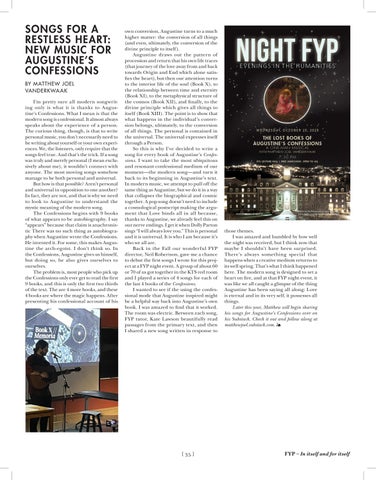
own conversion, Augustine turns to a much higher matter: the conversion of all things (and even, ultimately, the conversion of the divine principle to itself). Augustine draws out the pattern of procession and return that his own life traces (that journey of the love away from and back towards Origin and End which alone satisfies the heart), but then our attention turns to the interior life of the soul (Book X), to the relationship between time and eternity (Book XI), to the metaphysical structure of the cosmos (Book XII), and finally, to the divine principle which gives all things to itself (Book XIII). The point is to show that what happens in the individual’s conversion belongs, ultimately, to the conversion of all things. The personal is contained in the universal. The universal expresses itself through a Person. So this is why I’ve decided to write a song for every book of Augustine’s Confessions. I want to take the most ubiquitous and resonant confessional medium of our moment—the modern song—and turn it back to its beginning in Augustine’s text. In modern music, we attempt to pull off the same thing as Augustine, but we do it in a way that collapses the biographical and cosmic together. A pop song doesn’t need to include a cosmological postscript making the argument that Love binds all in all because, thanks to Augustine, we already feel this on our nerve endings. I get it when Dolly Parton sings “I will always love you.” This is personal and it is universal. It is who I am because it’s who we all are. Back in the Fall our wonderful F Y P director, Neil Robertson, gave me a chance to debut the first songs I wrote for this project at a FYP night event. A group of about 60 or 70 of us got together in the KTS red room and I played a series of 4 songs for each of the last 4 books of the Confessions. I wanted to see if the using the confessional mode that Augustine inspired might be a helpful way back into Augustine’s own book. I was amazed to find that it worked. The room was electric. Between each song, F YP tutor, Kate Lawson beautifully read passages from the primary text, and then I shared a new song written in response to
[ 35 ]
those themes. I was amazed and humbled by how well the night was received, but I think now that maybe I shouldn’t have been surprised. There’s always something special that happens when a creative medium returns to its well spring. That’s what I think happened here. The modern song is designed to set a heart on fire, and at that FYP night event, it was like we all caught a glimpse of the thing Augustine has been saying all along: Love is eternal and in its very self, it possesses all things. Later this year, Matthew will begin sharing his songs for Augustine’s Confessions over on his Substack. Check it out and follow along at matthewjoel.substack.com. ❧
FYP – In itself and for itself