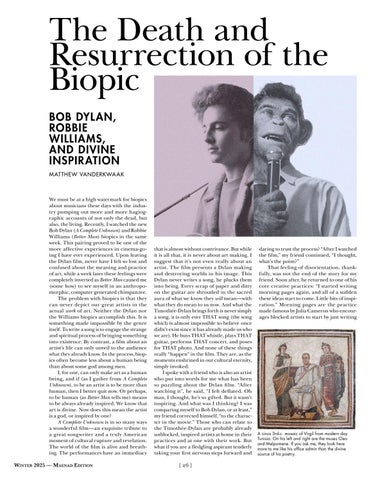
The Death and Resurrection of the Biopic BOB DYLAN, ROBBIE WILLIAMS, AND DIVINE INSPIRATION M AT THEW VANDERKWA AK
We must be at a high watermark for biopics about musicians these days with the industry pumping out more and more hagiographic accounts of not only the dead, but also, the living. Recently, I watched the new Bob Dylan (A Complete Unknown) and Robbie Williams (Better Man) biopics in the same week. This pairing proved to be one of the more affective experiences in cinema-going I have ever experienced. Upon leaving the Dylan film, never have I felt so lost and confused about the meaning and practice of art, while a week later these feelings were completely inverted as Better Man caused me (some how) to see myself in an anthropomorphic, computer generated chimpanzee. The problem with biopics is that they can never depict our great artists in the actual work of art. Neither the Dylan nor the Williams biopics accomplish this. It is something made impossible by the genre itself. To write a song is to engage the strange and spiritual process of bringing something into existence. By contrast, a film about an artist’s life can only unveil to the audience what they already know. In the process, biopics often become less about a human being than about some god among men. I, for one, can only make art as a human being, and if (as I gather from A Complete Unknown), to be an artist is to be more than human, then I better quit now. Or perhaps, to be human (as Better Man tells me) means to be always already inspired. We know that art is divine. Now does this mean the artist is a god, or inspired by one? A Complete Unknown is in so many ways a wonderful film—an exquisite tribute to a great songwriter and a truly American moment of cultural rupture and revelation. The world of the film is alive and breathing. The performances have an immediacy
Winter 2025 — M aenad Edition
that is almost without contrivance. But while it is all that, it is never about art making. I suggest that it’s not even really about an artist. The film presents a Dylan making and destroying worlds in his image. This Dylan never writes a song, he plucks them into being. Every scrap of paper and ditty on the guitar are shrouded in the sacred aura of what we know they will mean—with what they do mean to us now. And what the Timothée-Dylan brings forth is never simply a song, it is only ever THAT song (the song which is almost impossible to believe once didn’t exist since it has already made us who we are). He buys THAT whistle, plays THAT guitar, performs THAT concert, and poses for THAT photo. And none of these things really “happen” in the film. They are, as the moments enshrined in our cultural eternity, simply invoked. I spoke with a friend who is also an artist who put into words for me what has been so puzzling about the Dylan film. “After watching it”, he said, “I felt deflated. Oh man, I thought, he’s so gifted. But it wasn’t inspiring. And what was I thinking? I was comparing myself to Bob Dylan, or at least,” my friend corrected himself, “to the character in the movie.” Those who can relate to the Timothée-Dylan are probably already unblocked, inspired artists at home in their practices and at one with their work. But what if you are a fledgling aspirant tenderly taking your first nervous steps forward and
[ 26 ]
daring to trust the process? “After I watched the film,” my friend continued, “I thought, what’s the point?” That feeling of disorientation, thankfully, was not the end of the story for my friend. Soon after, he returned to one of his core creative practices: “I started writing morning pages again, and all of a sudden these ideas start to come. Little bits of inspiration.” Morning pages are the practice made famous by Julia Cameron who encourages blocked artists to start by just writing
A circa 3rd-c. mosaic of Virgil from modern day Tunisia. On his left and right are the muses Cleo and Melpomene. If you ask me, they look here more to me like his office admin than the divine source of his poetry.