SOCIAL WORK
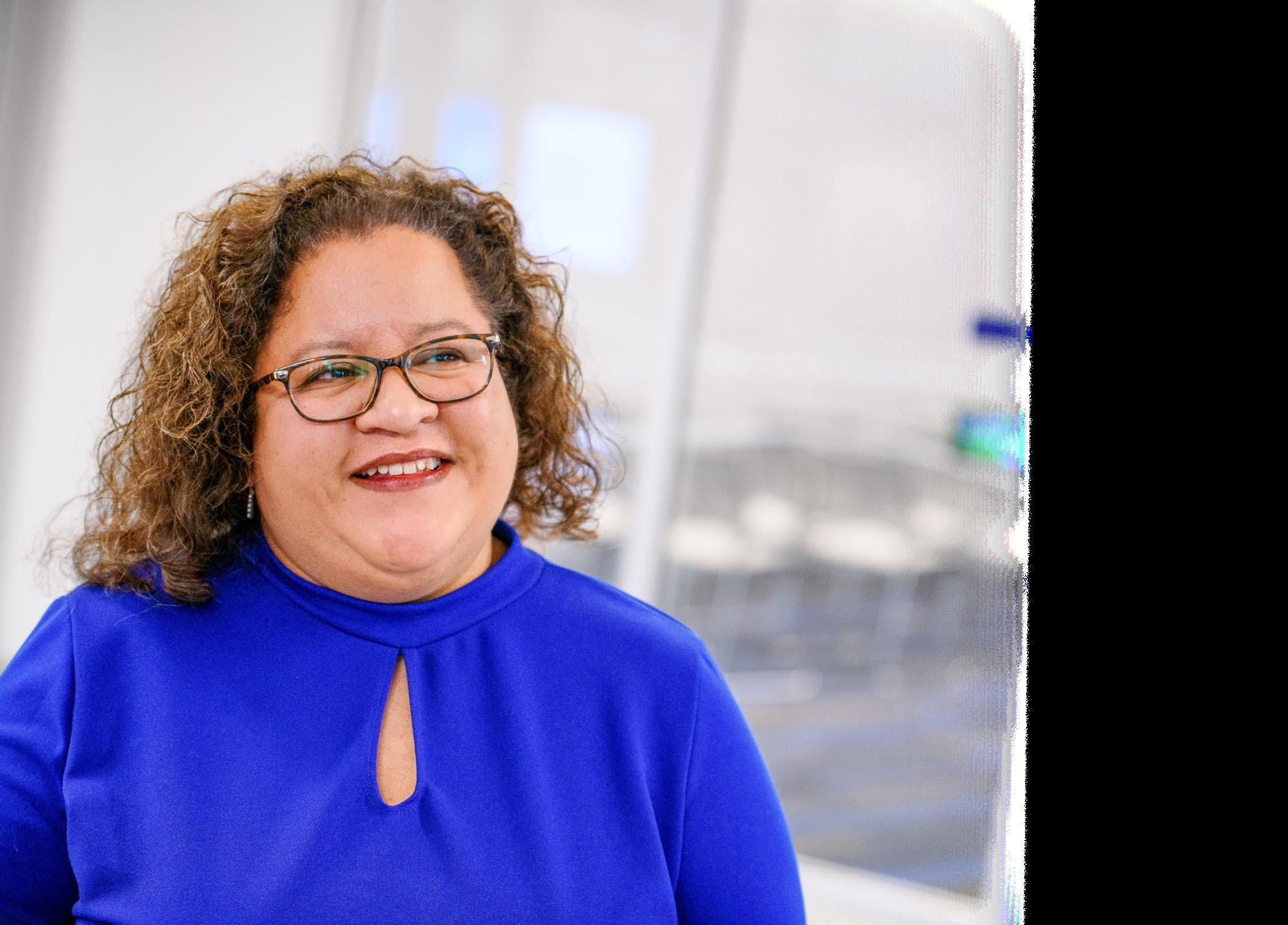
ongratulations on your enrollment in the University of Kentucky’s (UK) College of Social Work (CoSW) Doctorate of Social Work (DSW) program! On behalf of Dean Jay Miller, Associate Dean for Academic Affairs Matt Moore, CoSW faculty and staff, and other members of the CoSW community, I am thrilled to welcome you into our vibrant, dynamic learning community.
As Kentucky’s flagship institution, UK plays a vital role in promoting diversity, inclusion, economic development and human wellbeing throughout the state, and beyond. Likewise, CoSW is wholeheartedly committed to the people and social institutions throughout Kentucky, the nation, and the world. Our DSW program is an outgrowth of this commitment.
FROM THE Director Director
Laura E. Escobar-Ratliff, DSW
“The UK DSW program will equip you for advanced social work practice consistent with meeting evolving societal needs.”
The UK DSW is a one-of-a-kind academic experience. In this program, you will move through a sequenced set of courses that cover advanced practice foundations in social work theory, administration, and evaluation, among others. Because our DSW program utilizes a Core Plus model, you will be able to complete the program in an efficient, affordable way. The UK DSW program will equip you for advanced social work practice consistent with meeting evolving societal needs.
Please know that CoSW looks forward to sharing the DSW journey with you. In preparation for that journey, I ask that you familiarize yourself with the contents of this handbook. The information contained in this handbook will help orient you to policies and procedures associated with the UK DSW program.
Should you have any questions, comments, or concerns, please don’t hesitate to contact me. You can reach me via email at Laura.Escobar-Ratliff@uky. edu . You can also reach out to the CoSW Academic Advising Director, Jaime Wainscott at Jaime.Wainscott@uky.edu
Again, I want to welcome you to the CoSW community and I wish you success in your academic pursuits!
Laura E. Escobar-Ratliff, DSW Clinical Assistant Professor and DSW Program Director
INSTITUTION OVERVIEW
About the University of Kentucky
The University of Kentucky is a public, land grant university dedicated to improving people’s lives through excellence in education, research and creative work, service and health care. As Kentucky’s flagship institution, the University plays a critical leadership role by fostering diversity, inclusion, economic development and human wellbeing.
The University of Kentucky:
About the College of Social Work
For over 85 years, the College of Social Work (CoSW) has been a leader in social work. Our mission is clear: through rigorous research, excellence in instruction, and steadfast service, the CoSW works to improve the human condition. Always, in all ways.
Unequivocally, that mission is actualized through our deeds.
CoSW faculty are renowned academicians steadfastly focused
gerontology, inequality and social justice, poverty, leadership, health disparities, self-care and wellness, sport social work, and suicide, among others.
For more info about CoSW, visit: https://socialwork.uky.edu/. For information about the DSW program, email DSW@uky.edu, call (859) 257-6650 or text DSW to 888-845-0189

Building on the historic traditions of the landgrant research university, the program offers a rich tapestry of educational experiences and opportunities that will support the social work profession’s purpose of promoting human dignity and community well-being.
DOCTORATE OF SOCIAL WORK
(DSW ) PROGRAM
Consistent with a history of visionary leadership, in 2020 CoSW launched Kentucky’s first DSW program. The origins of this program are rooted in a recognition that advanced social work practitioners do, and will, play a vital role in addressing evolving societal challenges. As such, the profession, in general, and CoSW, specifically, must make certain that social workers are able to access education suitable for high-quality practice in a variety of settings.
The CoSW DSW was conceptualized with practitioners in mind. Our DSW is an accessible, yet rigorous, program aimed at ensuring that practitioners are prepared to face the realities of a contemporary practice landscape. In our program, DSW students learn not only how to consume and assess social work practice knowledge, but to contribute to that knowledge in ways that fundamentally shape practice approaches. Ultimately, upon completion of the degree, our DSW graduates are uniquely poised to excel and advance in a competitive job market and capitalize on the forecasted growth within the social work profession.
DSW Mission and Objectives
The faculty of the University of Kentucky’s College of Social Work recognize the need for doctoral-level professionals to lead, develop, and assess social welfare programs, initiatives, and policies locally, nationally and globally. The College’s DSW program guides students to develop the knowledge and skills crucial for this mission through its emphasis on clinical social work, military behavioral healthcare, administrative leadership, sports social work, and social work education. Through course work in these domains, as well as the milestone of a capstone project, students develop the capacity for scholarly inquiry and action that are the foundations for creative, independent and interconnected advanced practice. The College’s DSW program prepares
graduates who are well-equipped to address society’s most complex needs as top-level administrators, planners, policy analysts, clinicians, and program evaluators.
Accordingly, the DSW program is committed to the preparation of creative, intellectual, and visionary leaders in social work. Building on the historic traditions of the land-grant research university, the program offers a rich tapestry of educational experiences and opportunities that will support the social work profession’s purpose of promoting human dignity and community well-being. The DSW program offers a curriculum based in the competing intellectual forces that are the hallmark of contemporary social and behavioral sciences. The program is aimed at educating persons who will contribute
to the social work profession, higher education, and the welfare of individuals, groups, communities, and organizations through leadership in practice, development, research, evaluation, and teaching.
Our mission statement reflects the purpose of professional practice doctoral programs in social work as articulated by the Council on Social Work Education. The purpose of the practice doctorate is to “prepare graduates to advance practice at the micro, mezzo, and macro levels as well as its application in higher education, and/ or leadership” (CSWE, 2020). These skills will come from rigorous study of social problems and their solutions, analysis and critique of evidence based interventions, and acquiring and using analytical tools.
DSW Program Objectives
Students will attain knowledge and skills associated with the ability to:
1. Deconstruct complex social problems through systematic investigation and critical analysis of contributing factors, contributors’ perspectives, and societal impacts to inform the capstone project.
2. Analyze the theoretical frameworks and empirical evidence underlying various intervention approaches, examining their assumptions, limitations, and applications across different contexts.
3. Differentiate between various methodological approaches in social work research, breaking down the strengths and limitations of different study designs and analytical methods.
4. Critique the existing knowledge base addressing social problems through systematic review, appraising the methodological rigor and practical implications of research findings.
5. Evaluate the effectiveness of supervision and leadership approaches in social work settings, critiquing their impact on professional development and client outcomes.
6. Assess the quality and relevance of existing research and practice models within a specialized area of social work, determining gaps in current knowledge and opportunities for innovation.
7. Develop novel theoretical frameworks or practice models that advance understanding and intervention in a specialized area of social work practice.
8. Generate original scholarly contributions through research, publication, and professional presentations that advance social work knowledge and practice.
Evidence of reaching these objectives is assessed via class assignments, students’ self-evaluations, successful progression through the vertically and horizontally integrated curriculum, and the capstone project. Through education in the above areas, graduates of the DSW program develop the theoretical and critical skills of an advanced practitioner that can be applied across all levels of practice. Students thus emerge from the program with the knowledge base for approaching problems, tools for developing approaches to their solutions, and analytic skills for determining whether proposed solutions will work. In sum, graduates should become social workers who make significant contributions as practitioners, administrators, community leaders, scholars, and educators.
CURRICULAR OVERVIEW AND STRUCTURE
Credit Hour Allocation
UK DSW is designed to be efficient. Credit hour allocations are as follows:
• 33 credit hours – Core Curriculum
• 9 credit hours – Specialized Concentration Courses
Initial Orientation
Orientation to the DSW program will occur virtually. Prior to the start of the first semester, students will be given access to an Orientation Course shell to help familiarize them with CoSW and DSW-specific policies and procedures. The Orientation will also provide guided opportunities for students to practice technology-related tasks that will be required of them during their coursework (e.g., uploading documents in various formats, submitting a discussion posting, etc.). Lastly, the orientation will offer a chance for students to connect with, and get to know, the colleagues in their cohort.
Virtual Residency Week
DSW students will enroll in summer coursework during their program: summers 1 & 2 for the two-year and 2.5 year program; summers 1 & 3 for the three-year program. “Residency Week” is designed to allow students to build community, engage
with faculty and other scholars and to start the curriculum in a supported, cohesive manner, effectively establishing their doctoral network from the beginning of the program.
Students will be informed of the dates of residency week during the spring semester. During the week students will participate in keynote lecture(s) on contemporary issues and informal meetings around topics related to the capstone project, writing for publication, networking, and career planning.
Core Curriculum
The pedagogical purpose of the DSW curriculum is to help students understand, apply, and implement advanced practice modalities aimed at addressing some of society’s most challenging problems. With that in mind, DSW coursework is intentionally sequenced in a way that allows students to grapple with foundational principles, demonstrate analytic skills necessary for advanced practice, and critically apply and assess modalities for exponential impact.

Students
Students in the UK DSW three-year model will progress through the program as follows:
DSW Concentrations
DSW students have the option to select one of five unique concentrations for their final year of study: Administrative Leadership, Clinical Social Work Practice, Military Behavioral Health, Sport Social Work, or Social Work Education. Descriptions of each concentration, and respective coursework, are included below.
Administrative Leadership (LDR) Concentration
This specialization encompasses the theoretical and practical foundations of leadership, development, and management
in human services. Classes in this concentration will cover theoretical underpinnings related to administrative leadership (e.g., theories of adult learning as it relates to workforce development, organizational theory in shaping agency culture). Coursework also addresses technical aspects of social work leadership such as leveraging technology, managing finances, supervising staff, and interfacing within a larger institutional context and community setting.
Specialized LDR coursework includes:
SW 861: Business and Technology in Social Work Practice
SW 862: Effectively Engaging Organizations and Communities
SW 863: Advanced Administrative and Supervisory Practice
Clinical Social Work Practice (CSW) Concentration
The CSW specialization is for social work practitioners who seek to move beyond a conceptual and pragmatic understanding of theory and clinical interventions to critical understanding of advanced clinical social work practice which contributes to the advancement of clinical interventions. Classes cover neuroscience, trauma and other factors that influence behaviors and emotions to help prepare students to become advanced practitioners and leaders in their fields of clinical practice.
Specialized CSW course work includes:
SW 871: Advanced Psychopathology and Psychopharmacology
SW 872: Clinical Praxis Theory
SW 873: Neuroscience for Clinical Practice
Military Behavioral Health (MBH) Concentration
The Military Behavioral Health specialization is for those social work clinicians desiring advanced practice knowledge and skill with military populations (i.e., active duty members, veterans, military families). The concentration emanates from CoSW’s expertise in working with military populations and prepares students to provide evidence-based and culturally-
sensitive behavioral healthcare services to veteran and military populations, and their dependents.
Specialized MBH course work includes:
SW 873: Neuroscience for Clinical Practice
SW 881: Trauma Informed Assessment and Diagnoses
SW 882: Evidence Based Methods for Common MBH Diagnoses
Social
Work Education (SWE) Concentration
Teaching/education is a distinct arena of social work practice. The SWE concentration is focused on preparing students to engage in social work education as educators and scholars. The concentration prepares students to address the dynamic and political nature of social work education, develop curriculum grounded in CSWE and NASW competence with an intentional eye to the diverse needs of students and awareness of oppressive systems, and disseminate innovated ideas and practices to a variety of audiences.
Specialized SWE course work includes:
SW 876: Critical Issues in Social Work Education
SW 875: Teaching and Learning for Social Work Educators
SW 877: Engaging Scholarship in Social Work Education
Sport Social Work (SSW)
Concentration
Sport social work promotes individual and community wellbeing through partnerships between the profession of social work and the fields of athletics and recreation. The SSW concentration is focused on preparing students to engage in sport social work through an integrative practice lens. The curriculum challenges students to look at sport social work theory, policy and practice from a micro, mezzo, and macro level of practice. The integrated practice lens prepares students the depth and breadth of sport social work career pathways.
Specialized SWE course work includes:
SW873: Neuroscience for Clinical Practice
SW884: Sport Social Work Theory and Policy
SW885: Sport Social Work in Practice Settings
DSW Capstone Project
The DSW capstone project represents the culmination of one’s doctoral studies and an opportunity for students to translate the knowledge they’ve acquired into action. This final project is the epitome of the practice-focused doctorate and an essential part of the integrative educational experience.
The capstone is designed to help students take what they’ve learned throughout the program and apply it to examine a specific social
problem in depth. Ideally, the topic is connected to the student’s practice experience. When the capstone project is tied to professional experience, students are more able to take knowledge and theory they have learned and apply in a real-world setting.
The capstone project focuses on a single, overarching theme, encompassing a 5 chapter written document. Students will need to decide on a topic for the capstone during Colloquium I (taken summer 2 for two-year and 2.5-year students and summer 3 for three-year students). In Colloquium I students will develop a capstone project proposal. Approval of the proposal initiates the transition from DSW Student to DSW Candidate. The capstone project proposal serves as a conceptual guide for the student as they progress through their concentration courses. Chapters 2, 3 and 4 comprise of scholarly products written across colloquium and the 3 concentration courses so the topic of the capstone project will be connected to student’s chosen concentration area (i.e., Military Behavioral Health, Administrative Leadership, Clinical Social Work, Sport Social Work, or Social Work Education). Students will be expected to develop three scholarly papers examining various aspects of a problem/ issue of relevance to social work. The three products have some predetermined guidelines but do allow for flexibility based
on students’ topics, interests, and abilities. The general template for the capstone project is as follows:
Paper 1: A comprehensive review of the literature on an area of concern to social work practitioners, educators, or researchers (e.g., a review evidenced based practice for a particular problem area).
Paper 2: A conceptual paper detailing a theoretical concept(s) and its usefulness for conceptualizing a social problem/issue.
Paper 3: A practice application paper where students address, evaluate, and/or resolve an existing practice problem (i.e., presenting problem of client, practice issue, etc.) utilizing existing research and theory.
Chapters 1 and 5 serve as the bookends to the project and these chapters will be completed during SW 894: Colloquium II.
Chapter 1 will introduce the project and describe how Chs. 2 – 4 coalesce around the project focus. In Chapter 5, the final chapter of the capstone, students are expected to summarize the project as a whole and connect the project to real-world practice. Chapter 5 provides an opportunity for students to articulate how their project might inform changes to practice, programs, and/ or policies that would lead to desired outcomes related to the topic or issue of focus. In the final chapter, students are to demonstrate how their understanding and analysis of
research evidence serves to advance their practice wisdom in concrete ways.
Capstone Mentor
Capstone mentors are part of a team dedicated to supporting DSW Candidates in completing their Capstone Projects. Mentors are practice doctorate program faculty who provide educational support and coaching through the entire Capstone Project. Capstone mentors partner with candidates for writing and topic guidance, brainstorming sessions, and navigating the Capstone process. While Capstone mentors focus on supporting the development of the Capstone project, the final grade and approval of Capstone papers rest with the course instructors.
Capstone mentors will:
• Explain the Capstone products and guide their integration within your Capstone Project.
• Meet individually with each student at least twice per semester.
• Hold weekly virtual office hours at a regularly scheduled time.
• Be available as needed for emergent, Capstone-related issues.
• Facilitate professional development and mentoring for DSW Candidates, helping them achieve their post-graduation goals through a professional
development plan.
• Communicate regularly with other Capstone mentors and course instructors about DSW Candidates’ Capstone projects and programmatic issues; attend meetings between concentration instructors and DSW Candidates as needed.
• Review and provide feedback on Capstone papers, in conjunction with course instructors, and offer guidance on seeking additional support when needed (e.g., university writing center).
Showcase of DSW Scholars
During the final semester of the program, students will present their finished capstone projects to CoSW faculty and staff, their peers and colleagues in social work practice, and interested members of the community at large. The Showcase will occur in a synchronous online format and will be an annual tradition where CoSW DSW graduates can professionally present their scholarly work to the community. Guidelines for Showcase presentations will be provided to students in SW 894. Participation in the DSW Showcase is mandatory for all graduating students. Students will need to prepare in advance to get needed time off work so they can attend (virtually).
Each student will present for a total of 90 minutes on their capstone project. The schedule of events for the Showcase will be made available in late April and all sessions will be assigned by the program director.
COLLEGE OF SOCIAL WORK
Administrative Faculty
The Director of the Doctorate of Social Work Program in the CoSW is Laura Escobar-Ratliff. The director is responsible for program implementation which includes oversight of student recruitment and enrollment, coordination of the program faculty, scheduling of courses and selection of course instructors, oversight of capstone project and DSW Showcase, and coordination of ongoing program evaluation and curriculum
The administrative faculty of the College of Social Work are as follows:
Justin “Jay” Miller, PhD, MSW Dean, College of Social Work justin.miller1@uky.edu
Matt Moore, PhD Associate Dean for Academic & Student Affairs mamo320@uky.edu
Laura Escobar-Ratliff, DSW DSW Program Director Laura.escobar-ratliff@uky.edu
Natalie Pope, PhD, LCSW PhD Program Director natalie.pope1@uky.edu
Amanda Brown, PhD, LMFT, CSW, MSW Program Director ad.brown1@uky.edu
TRCC-Level 2
Lindsey Munoz, EdD, LMSW-KS Assistant Dean of Pedagogical Possibilities
Support Staff
Lindsey.Munoz@uky.edu
Below is a list of College support staff who DSW students are most likely to interact with during their time in the program. A complete list of CoSW support staff is located on our website.
Jaime Wainscott, MSW, CSW Academic Advising Director jaime.wainscott@uky.edu
Glenn Means, MPA Senior Academic Coordinator, DSW Program glenn.means@uky.edu
Haley Kauffman
Academic Advisor haley.kauffman@uky.edu
Gary Trumble IT Manager trumble@uky.edu
Ray Dowd
Xana Plum
Academic Coordinator/ Senior Data Analyst rdowd0@email.uky.edu
Rebecca E. Meeks Director of Admissions
Executive Assistant to Dean Jay Miller xana.plum@uky.edu rebecca.meeks@uky.edu
ACADEMIC POLICIES
A satisfactory rate of progress toward the doctoral degree is required throughout a student’s enrollment. Doctoral students must at all times maintain at least a 3.0 GPA in their course work. A student who falls below a 3.0 GPA, may be dismissed from the College. The DSW program has a no “E” policy. If a student receives an “E” grade, then they can be dismissed from the College of Social Work. A student earning an “E” may exercise the repeat option on a graduate course prior to graduation, but not afterwards, and count only the second grade as part of the graduate GPA. This action will be initiated by petition of the respective DSW Program Director and may be used only once in the DSW program. A grade of an “XE” prohibits a student from repeating the course.
The DSW Program has a “B” policy for all colloquium and concentration courses. This policy means that students must pass their Colloquium courses (SW892 and SW894) and concentration courses (LDR: SW861, SW862, SW863; CSW: SW871, SW872, SW873; MBH: SW873, SW881, SW882; or SWE: SW872, SW875, SW877; SSW: SW 873, SW 884, and SW 885) with a minimum of a B to progress in the program.
The College has a two “C” policy for all doctoral students. This policy means that if students
receive two “C” grades, then they can be dismissed from the College for academic reasons.
A student earning a second “C” may exercise the repeat option on a graduate course prior to graduation, but not afterwards, and count only the second grade as part of the graduate GPA. This action will be initiated by petition of the respective DSW Program Director and may be used only once in the DSW program. If students elect to retake the course and again make a “C” grade or lower (i.e., so they still have two “C” grades even after using the repeat option), they will be dismissed from the DSW program.
A student may repeat only one course during their time in the DSW program and count only the second grade as part of their program GPA. After completion of the repeated course, students will need to work with their academic advisor to submit the repeat option petition.
When students have completed 6 or more semester hours of graduate course work with a cumulative GPA less than 3.0, they will be placed on scholastic probation. Students will have an additional 6 hours to remove the scholastic probation by attaining a 3.0 (overall) average. If probation is not removed, the student will be subject to dismissal from the DSW Program.
Students who have been dismissed from the DSW Program may apply for readmission after two semesters. Readmission is contingent upon reapplying to the program, which includes a meeting with the DSW Program Director. Students on scholastic probation are not eligible to receive tuition scholarships administered by the Graduate School or the College of Social Work.
Leave of Absence
Each student taking a leave of absence must make a request of the DSW Program Director to go inactive and this request must be approved. Students may extend the leave of absence for two consecutive semesters and only have it granted for a total of three (3) semesters. To request a leave of absence, students must submit their request to the DSW Program Director in the semester prior to the semester in question. If students become inactive, (not taking classes for a semester or two) then they will need to reapply to the program. Please request any Leave of Absence through the DSW Academic Advisor.
Late Assignments
Academic Policies at the University of Kentucky state students must contact their instructor within one week of missing any graded work due to an excused absence. Therefore, students must submit documentation of the excused
absence within a week of missing the assignment to complete the associated work. The instructor shall provide the student with an opportunity to make up the graded work and may not simply calculate the student’s grade on the basis of the other course requirements unless the student agrees in writing. Students should work with their instructor to create a plan (with due dates) for submitting the missed work in a timely manner.
Any late assignment without a documented excuse will be subjected to a 5% daily late penalty. Work submitted without an excused absence more than two weeks from the original due date will not be accepted.
Assigning an Incomplete
An incomplete grade in a course can only be assigned when students have a non-academic disruption in their semester that results in an inability to complete some of the assignments in the normal course of the semester. Academic Policies at the University of Kentucky stipulate students may only request an Incomplete when there is an expectation for the remaining work to be completed within the identified time frame with a passing grade. To establish the possibility of a passing grade, the College of Social Work requires that students demonstrate a modicum of success as evidenced by a passing grade at the midpoint of the semester. As such, policies regarding excused absences will be enforced including the communication requirement of contacting an instructor within one week of a missed assignment. If a student
is not passing the course at midsemester, that student will not be eligible for an Incomplete and should discuss options with their advisor. Until all work has been completed and a final grade is submitted, a student receiving an Incomplete grade will not be allowed to enroll in any course in which their Incomplete course is a prerequisite.
Students must initiate the process of requesting an Incomplete by contacting the instructor and securing approval within the final two weeks of the semester. Students must submit the Incomplete form with identified missing assignments and associated due dates and their signature to the instructor no later than the last day of classes for the semester. Students should plan to address all work identified in the Incomplete form prior to the start of the next semester unless otherwise specified in the form. Any course with an incomplete grade that is not resolved within a year will automatically revert to an E, per UK’s regulations.
Grade Appeals
If a student believes that the student’s academic performance was not the basis for the grade, a grade appeal may be filed in accordance with the following:
Policy
Students in the University of Kentucky College of Social Work have the right to appeal a course grade or academic integrity determination if the student’s academic performance was not the basis for the grade or if the instructor did not follow appropriate procedures. Note, a
grade appeal is not an attempt to re-grade the assignment or project but an assertion of unfair treatment due to being arbitrary or capricious. By definition, an assignment that has a justification for a reduction in grading is not deemed arbitrary or capricious. Students should only appeal when a justification is not present or not reflective of the determined grade.
The Academic Ombud is the officer of the university charged with consideration of student grievances in connection with academic affairs.
Grade Appeal Procedure
A student who wishes to appeal an assignment or course grade must submit a written request (email or letter) to the course instructor no later than one week after the grade is released or a narrative comment is provided to the student. The instructor will review the written request and respond with a determination regarding the appeal within one week from the date on which the student submitted the appeal.
If the student wishes to dispute the instructor’s decision, they must submit a written request (email or letter) to the program director no later than one week after the date the instructor sent a response notification to the student. The program director will review the appeal, develop a consensus, and notify the student and the instructor of the final decision within one week of the appeal submission.
If the student wishes to dispute the program director’s decision, they must submit a written request (email or letter) to
OTHER
the College of Social Work’s Associate Dean for Academic and Student Affairs no later than one week after the date the program director’s notification is sent to the student. The Associate Dean reviews the appeal and notifies the student of the final decision within one week of the appeal submission. The decision made by the Dean’s office is final.
Appeal to the Academic Ombud
If a student wishes to appeal any final decision made by the College of Social Work Dean’s Office, they may submit a request to the Academic Ombud for potential appeal to the University Appeals Board
Academic Offense Procedure
When an instructor determines that a student may have plagiarized or cheated, the instructor will notify the student and request the student meet with the course instructor and the program director (or a designated faculty member) regarding what happened, thus allowing the student an opportunity to explain. Academic dishonesty includes but is not limited to, cheating, piracy, plagiarism, fabrication, multiple submissions, use of artificial intelligence to create content without the explicit permission of an instructor to do so, and complicity in academic dishonesty including posting content to websites for other students to use. Students must respond within 10 days to schedule a meeting to review
the issue(s). At a minimum, if a student commits academic dishonesty, a zero will be allocated for that assignment with other penalties possible including failing the course or being terminated from the program.
Within seven working days after the meeting, or if a student chooses not to meet, the instructor will notify the student whether the student’s action constitutes an academic offense, and if so, the penalty imposed and the student’s right to appeal.
The student then has ten working days to contact Academic Ombud Services to appeal the instructor’s determination that the student committed an academic offense. Once the appeal has begun, the burden of proof is on the instructor. Please see How to Appeal an Academic Offense for more information on the process.
If, after ten working days, the student does not appeal, the Academic Ombud will inform the Registrar and the Registrar will keep a record of the offense. The Registrar will reveal the existence of the offense only if the student authorizes the release of the record or a court-ordered subpoena seeks the student’s entire academic record (not just a transcript). Requesting a transcript will not reveal the existence of the offense record.
Student Code of Conduct
The Student Code of Conduct stipulates expectations for student conduct by identifying the core values of the University of Kentucky and provides a designated process to be implemented when students fail to uphold the core values of the institution.
Transfer of Credit Policy
Students may request a total of 9 hours be transferred into the DSW program. The transferable hours include all post-MSW course work (PhD or DSW) taken at another regionally-accredited university or as a student in another graduate program at the University of Kentucky. Under no circumstances can work experience or life experience count towards the degree in lieu of coursework. Courses could only be accepted if they are deemed to have similar content to CoSW DSW courses. Transfer credit will only be considered for core course and not concentration courses. To request transfer credit, the student should submit a request to the academic advisor, along with a syllabus from the course.
The following rules also apply to credit transfer:
• Course credits applied toward a previously awarded graduate
degree cannot be transferred.
• Course credits must have been completed no more than 10 years prior.
• Transfer of independent work, research, thesis or dissertation credit is not permitted.
• Short courses lasting fewer weeks than the number of credits may not be transferred.
• A student must have been in graduate status at the time the
courses were taken in order for the courses to be transferable.
• A student must be in good academic standing at the time of transfer.
• Only courses assigned a B grade or better can be transferred.
Student Concerns

It is critically important to the College of Social Work to hear all student voices. If you have a concern, please complete the Student Concern Submission Form All form submissions will be reviewed and will receive follow up as appropriate.
ACADEMIC INTEGRITY
Per University policy, students shall not plagiarize, cheat, or falsify or misuse academic records. Students are expected to adhere to University policy on cheating and plagiarism in all courses. Cheating includes using artificial intelligence to create content without the explicit permission of an instructor to do so. The minimum penalty for a first offense is a zero on the assignment on which the offense occurred. If the offense is considered severe or the student has other academic offenses on their record, more serious penalties, up to suspension from the University, may be imposed. Plagiarism and cheating are serious breaches of academic conduct. Each student is advised to become familiar with the various forms of academic dishonesty as explained in the Code of Student Rights and Responsibilities. Complete information can be found on the Ombud website. A plea of ignorance is not acceptable as a defense against the charge of academic dishonesty. It is important that you review this information as all ideas borrowed from others need to be properly credited.
Per the Academic Ombud, all academic work, written or otherwise, submitted by students to their instructors or other academic supervisors (e.g.,
program directors), is expected to be the result of their own thought, research, or self-expression. In cases where students feel unsure about a question of plagiarism involving their work, they are obliged to consult their instructors on the matter before submission.
When students submit work purporting to be their own, but which in any way borrows ideas, organization, wording, or content from another source without appropriate acknowledgment of the fact, the students are guilty of plagiarism.
Plagiarism includes reproducing someone else’s work (including, but not limited to, a published article, a book, a website, computer code, or a paper from a friend) without clear attribution. Plagiarism also includes the practice of employing or allowing another person to alter or revise the work, which a student submits as his/her own, whoever that other person may be. Students may discuss assignments among themselves or with an instructor or tutor, but when the actual work is done, it must be done by the student and the student alone.
When a student’s assignment involves research in outside sources or information, the student must carefully acknowledge exactly what, where,
and how he/she has employed them. If the words of someone else are used, the student must put quotation marks around the passage in question and add an appropriate indication of its origin. Making simple changes while leaving the organization, content, and phraseology intact is plagiaristic. However, nothing in these Rules shall apply to those ideas, which are so generally and freely circulated as to be a part of the public domain.
PLEASE NOTE: Any assignment you turn in may be submitted to an electronic database (such as Turnitin) to check for plagiarism comparison. A penalty for an academic offense, such as cheating or plagiarism, can be as severe as a failing grade on the assignment or failing the course.
Class Recording Notification
The University of Kentucky Student Code of Conduct defines Invasion of Privacy as using electronic or other devices to make a photographic, audio, or video record of any person without their prior knowledge or consent when such a recording is likely to cause injury or distress.
Course meetings may be recorded by the instructor. All video and audio recordings of lecturers and class meetings, provided by the instructor, are for educational use by students in the respective class. They are available only through the Canvas shell for the respective course and are not to be copied, shared, or redistributed.
As addressed in the Student Code of Conduct, students are expected to follow appropriate university policies and maintain the security of linkblue accounts used to access recorded class materials. Recordings may not be reproduced, shared with those not enrolled in the class, or uploaded to other online environments.
If the instructor or a University of Kentucky office plans any other uses for the recordings, beyond this class, students identifiable in the recordings will be notified to request consent prior to such use. In anticipation of such cases, students may be asked to complete an “Authorization of Use” form by a faculty member.
Video and audio recordings by students are not permitted during the class unless the student has received prior permission from the instructor. Students with specific recording accommodations approved by the Disability Resource Center should present their official documentation to the instructor.
All content for this course, including handouts, assignments, and lectures is the instructor’s intellectual property and cannot be reproduced or sold without prior permission from the instructor. A student may use the material for reasonable educational and professional purposes extending beyond this class, such as studying for a comprehensive or qualifying examination in a degree program, preparing for a professional or certification examination, or to assist in fulfilling responsibilities at a job or internship.
OTHER SUPPORT INFORMATION
Academic Advising
Academic advising is a key component of student success at the College of Social Work. Each student is assigned a professional academic advisor who provides personalized guidance throughout their academic journey. Advisors are certified in Appreciative Advising and use a proactive, integrative advising approach that includes academic planning, policy navigation, and ongoing support to help students overcome challenges and achieve their educational goals.
While regular advising meetings are not required unless a student is on academic probation or has specific concerns, all graduate students are encouraged to connect with their advisor as needed. Advisors are available through in-person, online, and phone appointments, all of which can be scheduled via the myUK Graduation Planning System (GPS). This supportive advising model helps ensure students stay on track and have access to the guidance and resources needed to achieve their academic goals
Visit the Academic Advising webpage for additional information and academic planning resources.
Registration & Withdrawal from Classes
The CoSW student services team supports students in navigating registration and curriculum planning. At UK, a course load of 9 credit hours or more is considered full time. All students should adhere to their program models. Changes in registration may affect graduation timelines. If any deviation from the program model is necessary, students should contact their academic advisor to discuss options, resources, and update their curriculum plan as needed. Students can schedule an advising meeting in myUK under “Degree Planning and Registration myUKGPS” or by contacting CoSWAdvising@uky. edu
The DSW program follows the rules of the university as administered by the Registrar’s office for withdrawals and registrations. Complete instructions on how to add/ drop classes or completely withdraw from the University can be found here A grade of E assigned as a result of an academic offense may be changed to a W only by a petition to the University Appeals Board and only after a retroactive withdrawal for the semester in which the grade was assigned is granted. The student must demonstrate that the hardships
enumerated in the request for the Retroactive Withdrawal also resulted in the academic offense in a manner that the student’s culpability was severely diminished as a result.
Course drop and withdrawal dates can be found in the Academic Calendar or in the course details in myUK. Students seeking a withdrawal from a course after the posted deadlines may only do so for urgent nonacademic reasons. Students seeking a withdrawal after the course withdrawal deadlines should work with their academic advisor to submit requests for a permissive withdrawal (after the withdrawal deadline but before the last day of classes), or a retroactive withdrawal (withdrawal after the last day of classes in a semester). More information regarding withdrawal options is available via the Registrar’s office
Financial Assistance
Financial assistance may be available as doctoral students progress through the program. Fellowship opportunities are available to DSW Program students through the University of Kentucky Graduate School include the Wethington/ Matthews/Singletary Fellowships and the Cradle Fellowship. More information about these particular fellowships can be found on the University’s Graduate School Fellowship page. Additional fellowships and/or scholarship opportunities may be available through other institutions. For example, students might consider applying for the CSWE Minority Fellows Program
The University of Kentucky Office of Student Financial Aid and Scholarships is available to provide financial aid to students who would be unable to attend the University without such assistance. We encourage students to contact the Office of Student Financial Aid and Scholarships if they require any assistance with financial aid.
For complete information on tuition and fees, billing and payments, guest access and other financial information, visit Student Account Services
Technology Information
The University has compiled a list of technology information for online students. Students can visit the Tech Help page for information about their linkblue ID account, hardware and software guidelines, Canvas, frequently used apps, and ITS customer service. The UK Technology Help Center has also provided guidelines on hardware and software needs for students, which are particularly important for students in a fully online program like the DSW program. Information about tech assistance to students is available here
Research Involving Human Subjects
All proposals for research involving human subjects have to be approved by the Institutional Review Board. There are elaborate federal regulations governing the review of such proposals. Information on the paperwork and process of the IRB approval at UK is available from the Office of Research Integrity, (859-257-9428).
DSW STUDENT RESOURCES
Computer Purchasing Portal/Ebuy
UK students, faculty, and staff can purchase software at a discounted rate through this website.
TRACS: The Triage, Referral, Assistance, and Crisis Support Program
TRACS: The Triage, Referral, Assistance, and Crisis Support Program is a comprehensive initiative designed to provide immediate support and effective intervention for individuals experiencing various forms of mental health issues and/or crisis. Our program ensures that individuals in distress receive timely and appropriate care, bridging the gap between immediate needs and long-term solutions. We are the gateway for referrals to the UK Counseling Center and make referrals to other on/off campus resources.
Disability Resource Center
Students with documented physical, learning, or temporary disabilities may receive assistance and support from the Disability Resource Center
Office of LGBTQ* Resources
LGBTQ* Resources is University of Kentucky’s central hub for accessing information, groups, and services related to diverse sexual orientations and gender identities and in making sure that
our community is a welcoming, safe, and supportive place for all students, faculty, staff and alumni.
Robert E. Hemenway Writing Center
The Writing Center is available to assist University of Kentucky students, faculty, and staff with the process of writing. Staffed by English graduate students, full-time instructors, part- time consultants, and undergraduate peer tutors, the Center offers free individual and group consultations on prewriting, writing, and rewriting.
Software Download Center
Software downloads of various software applications including Microsoft Office are available for UK students here
Stuckert Career Center
Any current student is eligible for Stuckert’s unlimited use of career services including resume review, mock interviews, workshops, Wildcat CareerLink and the use of the career resource library.
Transformative Learning
UK Transformative Learning is a centralized student support unit on campus that offers academic resources, including academic preparation and coaching (in person and via Zoom).
University of Kentucky Campus Directory
Search for all faculty, staff, and students associated with the university here
University of Kentucky Visitor Center
The Visitor Center offers campus tours and has a variety of printed materials including maps, resource guides, and informational brochures.
Veteran’s Resource Center
The Veteran’s Resource Center was established to continue that tradition of support by providing UK’s military and veteran populations with the service and assistance to ensure that your transition to college is as smooth as possible.
Violence Intervention and Prevention Center
The Violence Intervention and Prevention (VIP) Center works with faculty, staff, students and community partners toward the mission of eliminating the perpetration of power-based personal violence including sexual assault, partner violence and stalking.
Discrimination and Harrassment
In order to foster an environment of respect and dignity for the dignity and worth of all members of the university community, the University
of Kentucky is committed to maintaining an environment free of prohibited discrimination. Any member of the University of Kentucky community who believes they have experienced discrimination, harassment, or retaliation may bring their concerns to the Office of Equal Opportunity (OEO). A staff member of OEO is available to provide information of the investigative and resolution process.
Pregnancy and Parenting Resources
Title IX and University policy protect pregnant or parenting students from discrimination in education programs and activities.
The University will try to ensure that you can continue participating in classes and extracurricular activities by providing you with reasonable adjustments to participate, excusing absences due to pregnancy and childbirth for as long as medically necessary, and allowing you to make up missed work. For accommodation
information and additional resource information visit: https://oeo.uky.edu/keypriorities/pregnancy-andparenting
Institutional Neutrality Policy
https://uknow.uky.edu/sites/ default/files/Institutional%20 Neutrality%20Policy.pdf
Appendix B
Resource Guide for Capstone Project
Examples of Published Literature Reviews
Harding, R.L., Epiphaniou, S., & Jones, H. (2012) How can informal caregivers in cancer and palliative care be supported? An updated systematic literature review of interventions and their effectiveness. Palliative Medicine, 26 (1), 7-22.
Hughes, A.K., & Admiraal, K. R. (2012). A systematic review of HIV/AIDS knowledge measures. Research on Social Work Practice, 22 (3), 313-322.
Lobb, E. A., Kristjanson, L. J., Aoun, S. M., Monterosso, L., Halkett, G. K. B., & Davies, A. (2010). Predictors of complicated grief: A systematic review of empirical studies. Death Studies, 34(8), 673698.
Manafo, E. & Wong, S. (2012). Health literacy programs for older adults: A systematic literature review. Health Education Research, 27 (6), 947960.
Middleton, K. & Craig, C. D. (2012). A systematic literature review of PTSD among female veterans from 1990 to 2010. Social Work in Mental Health, 10 (3), 233-252.
Mier-Chairez, J., Arellano, B., Tucker, S.E., Marquez E., & Hooper, L.M. (2019) Theoretical, empirical, and practice literature on language brokering: Family, academic, and psychological outcomes. Journal of Human Behavior in the Social Environment, 29 (7), 840-860. doi:10.1080/10911359.2019.1621 791
O’Haire, M. E. (2013). Animal-assisted intervention for autism spectrum disorder: A systematic literature review. Journal of Autism and Developmental Disorders, 43 (7), 16061622.
Sentino, P., Thompson, P.L., Patterson, D. & Freeman, D. (2018). A review of literature: An examination of the correlation between attachment styles and adolescent girls’ sexual behaviors, Journal of Human Behavior in the Social Environment, 28 (6), 677-694, doi:10.1080/10911 359.2018.1452171
Simkiss, D. E., Stallard, N., & Thorogood, M. (2013). A systematic literature review of the risk factors associated with children entering public care. Child Care, Health and Development, 39 (5), 628642.
Staton-Tindall, M., Sprang, G., Clark, J., Walker, R. & Craig, C.D. (2013). Caregiver substance use and child outcomes: A systematic review. Journal of Social Work Practice in the Addictions, 13 (1), 6-31.
Turner, W. & Macdonald, G. (2011). Treatment foster care for improving outcomes in children and young people: A systematic review. Research on Social Work Practice, 21 (5), 501-527.
Resources for Conducting a Systematic Review of the Literature
Bronson, D. E. & Davis, T. S. (2011). Finding and evaluating evidence: Systematic reviews and evidence based practice. New York: Oxford University Press.
Crisp, B. R. (2015). Systematic reviews: A social work perspective. Australian Social Work, 68 (3), 284295.
Gough, D., Oliver, S. & Thomas, J. (2012). An introduction to systematic reviews. Thousand Oaks: Sage.
Ham, H. R. & Roussel, L. A. (2012). Evidencebased practice: An integrative approach to research, administration, and practice. Jones & Bartlett Learning.
Higgins, J.P. T. & Green, S. (2008). Cochrane handbook for systematic reviews. New York: Wiley.
Liberati, A., Altman, D. G., Tetzlaff, J., Mulrow, C., Gøtzsche, P. C., Loannidis, J. P., Clarke, M., Devereaux, P. J., Kleijnen, J., & Moher, D. (2009). The PRISMA statement for reporting systematic reviews and meta-analyses of studies that evaluate health care interventions: Explanation and elaboration. PLoS Medicine, 6(7), 339, b2535.
Littell, J. H., Corcoran, J. & Pillai, V.K. (2008). Systematic reviews and meta-analysis. New York: Oxford University Press.
Examples of Conceptual Papers/ Theoretical Application Papers
Chavis, A.M. (2012). Social learning theory and behavioral therapy: Considering human behaviors within the social and cultural context of individuals and families. Journal of Human Behavior in the Social Environment, 22, 54–64. doi:10.1080/1091 1359.2011.598828
Graves, S.B., & Larkin, E. (2006). Lessons from Erikson: A look at autonomy across the lifespan. Journal of Intergenerational Relationships, 4(2), 61-71. doi:10.1300/J194v04n02_05
Joseph, R. (2018). The welfare/self-sufficiency gap among single mothers through theoretical lenses. Journal of Human Behavior in the Social Environment, 28 (6), 731-745. doi: 10.1080/10911359.2018.1458678
Kattari, S.K., Lavery, A., & Hasche, L. (2017). Applying a social model of disability across the life span. Journal of Human Behavior in the Social Environment, 27 (8), 865-880. doi:10.1080/10911 359.2017.1344175
Levy, D. L. (2007). Social justice and lesbian feminism: Two theories applied to homophobia. Advances in Social Work, 8 (2), 319-327.
Examples of Case Application Papers/ Case Studies
See Journal of Clinical Case Studies
Resources for Writing Case Studies/ Theoretical Application Papers
Drotar, D. (2011). Editorial: Guidance for submitting and reviewing case reports and series in the Journal of Pediatric Psychology Journal of Pediatric Psychology, 36 (9), 951–958.
Frawley, J., & Finney-Brown, T. (2013). Writing for publication: case studies. Australian Journal of Herbal Medicine, 25 (3), 1-3.
Hersen, M. (2002). Rationale for clinical case studies: An editorial. Clinical Case Studies, 1 (1), 3-5.
Mackrill, T. & Iwakabe, S. (2013). Making a case for case studies in psychotherapy training: A small step towards establishing an empirical basis for psychotherapy training. Counselling Psychology Quarterly, 26 (3-4), 250-266. doi:10.1080/09515070 .2013.832148
Majumder, K. (2015). A young researcher’s guide to writing a clinical case report. Available here: https://www.editage.com/insights/a-youngresearchers-guide-to-writing-a-clinical-case-report