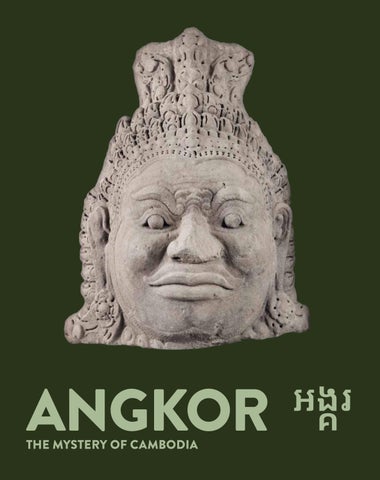
8
FOREWORD
CHHAY VISOTH
KONG VIREAK
ANNEMIEK RENS
17
TIMELINE
18
MAP
20
ANGKOR THROUGH THE LENS OF SCIENCE
SOPHIE BIARD & CHEA SOCHEAT
32
THE 'DISCOVERY' OF ANGKOR
SOPHIE BIARD
42
A CENTURY OF ARCHAEOLOGY IN ANGKOR
56
SOPHIE BIARD & CHRISTOPHE POTTIER
EPIGRAPHIC STUDIES AND UNDERSTANDING OF ANCIENT CAMBODIA
DOMINIC GOODALL & DOMINIQUE SOUTIF
64
SHIFTING VIEWS OF ANGKOR IN THE AGE OF LIDAR
ADAM P. WIJKER
23
ANGKOR AND ANGKOR WAT
24
THE KHMER EMPIRE
29
WORLD HERITAGE
30
HEIRS TO THE THRONE AND TEMPLE BUILDERS
31
TEMPLE ARCHITECTURE
35
COLONIAL POWERS
36
MEET THE KHMER
55
THE KHMER ROUGE
59
CAMBODIA AND INDIA
60
SDOK KAK THOM
63
LIFE IN ANGKOR
67
A MACHINE LEARNING INNOVATION LABORATORY
68
ANGKOR AND ‘GREATER ANGKOR’
75
THE WATERWORKS
76
TERRAFORMING
84
BUDDHA AND THE NAGA LOOTING AT ANGKOR
78
THE ARCHAEOLOGY OF ANGKOR AFTER ANGKOR
88 101
MASTER SCULPTORS
NHIM SOTHEAVIN & MASAKO MARUI
102
LIVING IN ANGKOR
105
ANGKOR: A WORLD WONDER
90
ANGKOR AND SCIENTIFIC RESEARCH
PIPHAL HENG
106
CONCLUSION
IRINI BIEZEVELD
110
KEY OBJECTS
144
NOTES
145
BIBLIOGRAPHY
151
ABOUT THE CURATORS
9
ANGKOR
FOREWORD
ANGKOR IS MORE THAN ONE MIGHT EXPECT Angkor holds a special place in the history and cultural identity of Cambodia. Its temples and monuments are known throughout the world, yet they represent only one part of a much richer history. The sculptures, inscriptions, ritual objects and archaeological materials that have survived from Angkor and other sites across Cambodia allow us to encounter the people who created these monuments and to understand more deeply their beliefs, artistic traditions and ways of life. The National Museum of Cambodia is entrusted with the care and preservation of an important part of this heritage. Among its collections are outstanding works of Khmer art and archaeology spanning many centuries of Cambodian history. These objects are not simply witnesses to a distant past. They carry histories of religious devotion, artistic achievement and human creativity, and remain an important part of Cambodia's cultural memory and identity. It is therefore both a privilege and a responsibility for objects from the collection of the National Museum of Cambodia to travel abroad. Such objects rarely leave Cambodia, and every loan requires careful consideration of their preservation and significance. At the same time, international exhibitions provide an important opportunity for Cambodia's heritage to be encountered and understood by audiences who may not have the opportunity to visit the country themselves. Their journey to the Drents Museum enables visitors in the Netherlands to come face to face with original works created and used in Cambodia centuries ago, and through them to engage more closely with the history of Angkor. Angkor – The Mystery of Cambodia also reminds us that our knowledge of Angkor continues to evolve. Archaeological research and new scientific methods are revealing an increasingly complex picture of the ancient city, its inhabitants, its infrastructure and its relationship with the surrounding landscape. The objects preserved in museums form an essential part of this continuing process of research and interpretation. Yet Angkor is not only an archaeological past. Its temples remain places of worship, and many artistic, religious and cultural traditions with deep historical roots continue in Cambodia today. The preservation of Angkor and its material heritage therefore concerns not only the study of the past, but also the transmission of that heritage to future generations. I am pleased that works from Cambodia can contribute to this exhibition and catalogue, and I hope that they will encourage visitors to discover the richness and complexity of Angkor and to appreciate the importance of protecting cultural heritage for generations to come. On behalf of the National Museum of Cambodia, I extend my sincere appreciation to the Drents Museum, MuseumsPartner, and to the curators, researchers, conservators and colleagues whose collaboration has made this exhibition possible.
Chhay Visoth Director National Museum of Cambodia
11
ANGKOR
FOREWORD
COLLABORATION ACROSS BORDERS This exhibition builds on more than a decade of exchange between Cambodian and international institutions. Since 1992, the Royal Government of Cambodia has entrusted its National Museum of Cambodia with close cooperation and exchanges with various international cultural institutions and museums for the loan of their collection for special exhibitions. During my time as director of the National Museum of Cambodia, from 2012 to 2019, the museum began to further develop partnerships abroad, sharing Khmer art and scholarship with new audiences around the world. This exhibition, and its arrival in the Netherlands, is one result of that work. The exhibition draws on years of research, much of it carried out in close collaboration with Damian Evans and Sophie Biard, whose work on lidar survey and on the history of Angkorian collections has done much to reshape how Angkor is understood. Damian passed away in 2023, and this exhibition also stands as a tribute to the scale and ambition of what he, together with Sophie and other colleagues, set out to achieve. The exhibition and this accompanying publication with contributions from leading archaeologists, art historians, historians, epigraphists, anthropologists and even aerial survey and lidar experts, present not only a new understanding of Angkor's history, but also include a dedicated section on looting and restitution, contributed by the co-authors. That same period also saw a growing number of looted Angkorian sculptures and objects return to Cambodia, handed back by museums, collectors and governments abroad after years of research into their origins. Several pieces in this exhibition carry that history. Taken from Cambodia at one point, and now on display again by choice, they are a small indication of how far that work has come. I am grateful to the Drents Museum, to MuseumsPartner and to colleagues at the National Museum of Cambodia, for their part in bringing it to Assen. It is an exhibition we have worked hard on, in the hope that it tells the story of Angkor to a wide, new audience.
Kong Vireak Under Secretary of State, Ministry of Culture and Fine Arts of Cambodia
13
ANGKOR
FOREWORD
THE MYSTERY OF CAMBODIA The Drents Museum has a long tradition of presenting international archaeological exhibitions and their accompanying publications. We introduce our audiences to outstanding collections from all corners of the world: from China to Iran, and from Armenia to Guatemala. Now we travel to Cambodia to tell the story of the world’s largest religious monument: Angkor. The objects in this exhibition are being shown in Europe for the first time – a landmark occasion of which we are particularly proud. Statues such as the Garuda (guardian) and the famous King Jayavarman VII transport visitors back 800 years to the Khmer Empire. The articles in this catalogue place the objects in the exhibition within a broader historical and cultural context. This catalogue shows how our understanding of Angkor has developed. In recent years, aerial mapping and lidar surveys have given us a much more precise picture of the city’s extent and of the number of people who once lived there. We now know that Angkor was much more than a religious and monumental centre. It was also home to hundreds of thousands of people, who together formed one of the largest urban societies of their time. I would like to thank everyone who has contributed to this catalogue: our colleagues in Cambodia, the authors of this publication, Waanders Publishers, designer Petra Warrink and MuseumsPartner. My thanks also go to Sophie Biard, whose thorough and diligent approach played an important role. I would particularly like to express my appreciation to the curator of archaeology, Irini Biezeveld. I hope that readers, like me, will be deeply impressed by Angkor.
Annemiek Rens Head Curator, Drents Museum
17
ANGKOR
TIMELINE
CENTURY
KINGS
MAJOR FOUNDATIONS
EVENTS
ELSEWHERE IN THE WORLD
9th c.
Jayavarman II Jayavarman III Indravarman I Yaśovarman I
Phnom Bakheng, Phnom Krom & Phnom Bok (Angkor)
The construction of major temples dedicated to Shiva and Vishnu testifies to the gradual settling of the capital in the plain of Angkor.
800: Charlemagne, Europe
During the reign of Jayavarman IV (921-941), the capital moves to Koh Ker (90km northeast of Angkor).
911: Vikings establish the Duchy of Normandy (Europe)
The construction of major temples like Phimai (Thailand) and Wat Phu (Laos) shows the extent of Khmer power and influence across the region.
c. 1050: Chichen Itza, Mexico
Angkor Wat, still the largest religious complex in the world today, is built.
1162: birth of Genghis Khan, Mongolia
Ta Prohm, Preah Khan, Neak Pean, Banteay Kdei, Muren van Angkor Thom, Bayon, Ta Som, Ta Nei
Attacks on Angkor by the Champa kingdom at the East.
1206: First Sultanate of Delhi, India
beyond angkor
The king promotes Mahāyāna Buddhism as the leading religion.
beyond angkor
Mahendraparvata (Phnom Kulen) Bakong, Lolei (Roluos) 10th c.
Harśavarman I Īśānavarman II Jayavarman IV Harśavarman II Rājendravarman II Jayavarman V
Prasat Kravan Pre Rup, Oostelijke Mebon, Bat Chum Ta Keo beyond angkor
9th c.: Borobudur, Indonesia
929: Caliphate of Cordoba, Spain
Koh Ker Banteay Srei 11th c.
12th c.
Udayādityavarman I Jayavīravarman Sūryavarman I Udayādityavarman II Harśavarman III Jayavarman VI
Phimeanakas, Westelijke Baray, Khleang (North and South), Baphuon
Dharanīndravarman I Sūryavarman II Yaśovarman II Tribhuvanādityavarman
Angkor Wat, Chau Say Thevoda, Banteay Samrae
beyond angkor
Preah Vihear, Phnom Chisor, Phimai, Wat Phu
beyond angkor
Beng Mealea, Phnom Rung (Thailand) 12th – 13th c.
Jayavarman VII
Banteay Chhmar, Preah Khan of Kompong Svay 13th c.
Indravarman II Jayavarman VIII Śrīndravarman
14th c.
Śrīndrajayavarman Jayavarman Parameśvara
15th c.
1163-1250: Notre-Dame de Paris
Prasat Suor Prat Leper King terrace, Preah Palilay, Preah Pithu, Mangalartha 14th c.: Cuzco, Peru 1333: Himeji castle, Japan The monarchy moves to the South of Cambodia.
18
ANGKOR
MAP
Phimai
L T
H
A
I
L
A
N
D
A
O
S
Wat Phu Cultuurlandschap / Ancient settlements of Champasak
Preah Vihear
Banteay Chhmar
Koh Ker Phnom Kulen Angkor
Preah Khan Kampong Svay Beng Mealea
Siem Reap
Roluos
Battambang
Sambor Prei Kuk
C
A
M
B
O
D
I
A
M
Longvek Srei Santhor
Oudong (Phnom Preah Reach Troap)
A
Phnom Penh
N
Phnom Chisor Phnom Da
T
E
I V
0 km
50 km
100 km
Ho Chi Minh City
19
ANGKOR
MAP
Banteay Srei
Jayatataka Preah Khan
Phnom Bok
Neak Pean Oostelijke / East Baray
Angkor Thom
Ta Prohm Banteay Kdei
Westelijke / West Mebon
Oostelijke / East Mebon
Takeo
Westelijke / West Baray
Srah Srang
Banteay Samre Pre Rup
Phnom Bakheng Angkor Wat
Prasat Kravan
Preah Ko S I E M
0 km
1
2
3
4
R E A P
Bakong
5 km
←
↑
Overview map of Cambodia and neighbouring countries. Important Khmer settlements are marked with a circle and major modern cities with a square.
Detailed map of the Angkor region showing the most important Khmer sites. Water reservoirs are marked with a drop.