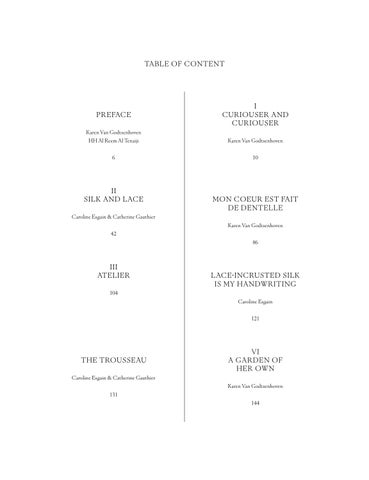
TABLE OF CONTENT PREFACE
I CURIOUSER AND CURIOUSER
6
10
Karen Van Godtsenhoven HH Al Reem Al Tenaiji
II SILK AND LACE
Caroline Esgain & Catherine Gauthier 42
III ATELIER 104
Karen Van Godtsenhoven
MON COEUR EST FAIT DE DENTELLE Karen Van Godtsenhoven 86
LACE-INCRUSTED SILK IS MY HANDWRITING Caroline Esgain 121
THE TROUSSEAU
Caroline Esgain & Catherine Gauthier 131
VI A GARDEN OF HER OWN
Karen Van Godtsenhoven 144
18
Beauty and the Beast, Spring-Summer 1995, Š StÊphane Borremans, model Germaine
19
Alice laughed. ‘There’s no use trying,’ she said. ‘One can’t believe impossible things.’
‘I daresay you haven’t had much practice,’ said the Queen. ‘When I was your age, I always did it for half-an-hour a day. Why, sometimes I’ve believed as many as six impossible things before breakfast.’ Lewis Carroll,
Alice’s Adventures in Wonderland, 1865
14
CURIOUSER AND CURIOUSER
CURIOUSER AND CURIOUSER
Karen Van Godtsenhoven
Growing up in Brussels in the 1970s, Carine Gilson, a high-spirited young girl, was surrounded by the beautiful fabrics her mother worked with in her tailoring atelier where she produced made-tomeasure two-piece suits, dresses, blouses and coats for the ladies of the upper middle class. These clients would have their clothes custom-made so they would fit like a glove, both hugging and shaping the body. They were sophisticated and stern. Gilson’s mother had a predilection for expensive fabrics, for the most resplendent materials ranging from supple jerseys to fragile lace. She and her daughter would shop for these fabrics together in large warehouses and take patterns from different magazines. Teaching Carine to distinguish between different qualities, she instilled in her an understanding of how to assess a fabric, how to make it move between her fingers, to feel its ‘fall’, its suppleness and weight, its tactile qualities which would, when the fabric became a garment, embrace the body – a sixth sense that unites the coordination of hand and eye with a sensuous imagination and capacity for wonder. She also instilled a sense of independence in her precocious daughter, of literally taking things into her own hands, giving the twelve-year-old Carine not just permission but the patterns, tools and materials with which to make her own clothes, hitherto made by her. Armed with an eagerness to learn and a can-do attitude, Gilson thenceforth proceeded to make and wear all her own clothes.
Although her mother’s work was based on the cutting and sewing techniques that are the basis of tailoring (used for daywear), rather than what in couture terms is referred to le flou (draping and sewing around the body, mostly used for evening wear), it was the fluid, sensual silks and diaphanous laces typical of flou that beguiled Gilson. She was mesmerized by the intimate underdresses worn between the body and the outer dress, which spoke to her in a language of emotions and conveyed a sense of curiosity. p. 16-17 Contact sheet from the Japonisme collection, Fall-Winter 1994, © Stéphane Borremans, model Germaine
15
As anyone in the fashion business will tell you, entering the different production areas as a small designer with small quantities and no credit history to speak of is no easy matter. So, for the first ten years Gilson focused on her product, on doing things that went against the grain of what was happening, doing them in a way that they were no longer being done, reviving what had been lost, refabricating what had been lying dormant because it was not profitable. She sees it as a sort of birthing process of a niche product which initially held no attractions for investors because it was not (directly) profitable. Ahead of the curve in terms of the appreciation of slow processes and high-quality niche products, Gilson saw the real value of luxury in the very fact that it was a niche product slowly made.
The creative appeal of Gilson’s lingerie couture was picked up early on by the American high-end department store Barneys, her first client, who understood the market for this luxury product, a market that existed at first in the Middle East and the United States. They nurtured her talent and pushed her to go further, be bolder in her approach to creating a niche product, lingerie made and incrusted with lace by hand. A challenge, certainly, to create a product, whose timelessness is its strength and which alters with the seasons ever so slightly. Like minimal music, Gilson’s work repeats patterns and themes, in an endless quest for perfection. Refining and reworking pieces from her own thirty-year archive she has therefore created a new line, Les Intemporelles, based on those iconic pieces whose relevance is timeless, pieces for which her clients return again and again, that make up the DNA of her universe. In the decade to come, Gilson wants to keep using those models and their patterns, as time has proven their significance. Almost ironically, Gilson does not appear in the official haute couture Parisian calendar because of its stringent, location-based conditions, although she uses couture techniques in her Brussels atelier. Shying away from the fashion scene, she is one of the few people today working away in the mode of the couturiers of bygone p. 26-27 Contact sheet from the Vanda collection, Spring-Summer 2002, © Stéphane Borremans, model Sarah Moon Howe
28
Monica Bellucci, May 2015, Paris, © Bettina Rheims
CURIOUSER AND CURIOUSER
prized goods. She was met with the same sort of questions as when she asked for a loan from the bank: What are you doing here? Who are you? How will you pay for these goods upon delivery? And, just as in the bank, she enthusiastically explained her vision of lingerie couture – and acquired a small piece of Chantilly lace.
1
2
II SILK & LACE
l’Envol, Fall-Winter 2019, © Stéphane Borremans, model Ana
43
2
1
MON COEUR EST FAIT DE DENTELLE
In the quiet recess of her atelier, Carine Gilson communes with her muse, lace, by making still life photographs that capture her creations like rare flowers or birds of paradise in flight. These feather-light, diaphanous pieces in silk and lace are painstakingly arranged and rearranged (perhaps as many as fifty times), folded, draped and fanned out on top of a light source. Like a Rorschach inkblot, the emerging shapes reveal the veiled mysteries hidden in their maker’s mind. The symbiosis of lace and silk becomes a work of art, a chiaroscuro painting of fleeting beauty, captured by lightning. In The Painter of Modern Life, Charles Baudelaire observes that it is not the naked body one desires, but the clothed body, the silhouette clad in silk, velvet and lace: just as in his memories of childhood, where the fabrics of his mother’s clothes would evoke her embrace, he later delights in the sight of his mistress attired in her finery, which he sees as an indivisible unity of body and cloth. In Gilson’s images the gaze is directed by the fabric, the residuum not the body. The body has stepped out of or is yet to be enveloped in the lace. Nonetheless, our eye is mesmerized, held in thrall by the suggestion of affection and desire. Naturally introverted, Gilson has been making these images ever since she began to work with lace. The process gives her a way of quietly speaking and travelling with her own work; it’s the purest way for her to express herself, to redirect her creative energy into her own work, to look at it with new eyes. As keeper of the flame or patient alchemist, Gilson brings the fabrics to life, draping and unfolding them into shapes resembling floral arabesques. The sculpted three-dimensional fabric is arrested in a flat image that seems to quiver with motion: a baroque reverie of ornament, light and movement. The body is absent yet implicit, as the movement of the fabrics seems to hold the curves and twists of a body in 94
Still life, lace-incrusted silk scarf-top, Cérès, Pre-Fall-Winter 2016, © Stéphane Borremans
SILK & LACE
Karen Van Godtsenhoven
95
96 2
Still life, lace-incrusted pleated silk slip dress, Art Nouveau, Fall-Winter 2005, Š StÊphane Borremans
2
4m80
silk is needed to make a long kimono
484 pins
are stitchted on by hand, one by one, to place the lace on an underdress
18 000m
lace flowers are inlaid every year
p. 110-111 Work in Progress, image from the Beautiful Lace & Carine Gilson exhibition at the Fashion & Lace Museum, July 10th 2019 to April 19th 2020, © Stéphane Borremans
113
Image from the Beautiful Lace & Carine Gilson exhibition at the Fashion & Lace Museum, July 10th 2019 to April 19th 2020, © Julien Leroy
2
1
Jacquard tapestry representing La Tubéreuse Casée, Frans Van Dael © Métaphores
146
Bas Meeuws (Netherlands, 1974), Tulip Book (#05), 2012, C-Print on dibond behind acrylic, © Bas Meeuws/ courtesy of Per van der Horst Gallery
1
170
Orientalisme campaign, Spring-Summer 1996, Š StÊphane Borremans, model Germaine
A GARDEN OF HER OWN
Vionnet, Mme Grès, Jeanne Lanvin and Gabrielle Chanel, who – each in her own way – emancipated and elevated the tradition of female craftsmanship in the fashion industry not only into a form of applied art but also into a highly successful business. The savoirfaire of their collaborative practice (with a system of premières, the most important right hand to the designer) inspires Gilson’s own work in her atelier.
The artistry and scientific precision of Madeleine Vionnet inspired Gilson so much that she worked on small dolls for a while, mirroring the practice of her predecessor, who famously worked on threequarter-scale dolls to try out experimental designs that were cut on the bias – diagonal to the fabric’s weave – thus creating a sort of body-hugging, pyjama-like silk cocoon. Vionnet’s eveningwear liberated the body from its constraining corseted carapace and enveloped it in a gentle embrace. Her singular, non-seasonal
Louise Brooks in Ziegfeld Follie’s
171
2
1