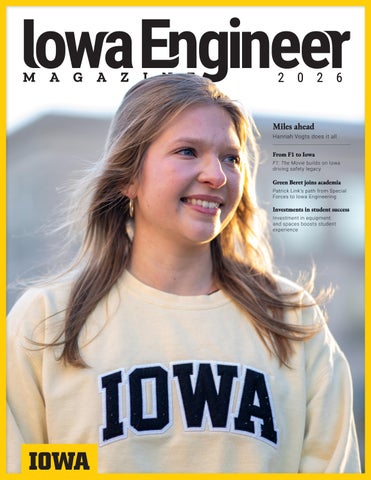
M A G A Z I N E
2
0
2
6
Miles ahead Hannah Vogts does it all
From F1 to Iowa F1: The Movie builds on Iowa driving safety legacy
Green Beret joins academia Patrick Link’s path from Special Forces to Iowa Engineering
Investments in student success Investment in equipment and spaces boosts student experience
{research excellence}
{contents}
Leadership Dean Ann McKenna Director of Marketing and Communications Jason Kosovski
p.
30
Miles ahead
Editorial Team
From marathons to acapella, from tutoring to teaching, Hannah Vogts maximized her time at Iowa
Editor-in-Chief Brian Morelli Creative Director Hailey Boileau Copy Editors Melanie Laverman, Kristine Roggentien Contributing Photographers Aneta Goska, Tim Schoon, and Justin Torner Contributing Writers Kristine Roggentien, Breanna Shea Contributing Illustrator Elizabeth Jordan The University of Iowa College of Engineering Office of the Dean 3100 Seamans Center for the Engineering Arts and Sciences Iowa City, Iowa 52242-1527 Phone: 319-335-5764 Fax: 319-335-6086 iowa-engineer@uiowa.edu engineering.uiowa.edu Iowa Engineer is published for College of Engineering alumni and friends © 2026, The University of Iowa, Iowa City, Iowa
p.
08
From F1 to Iowa
p.
12
Green Beret joins academia
p.
28
Investments in student success
inside this issue [research excellence]
The University of Iowa prohibits discrimination in employment, educational programs, and activities on the basis of race, creed, color, religion, national origin, age, sex, pregnancy (including childbirth and related conditions), disability, genetic information, status as a U.S. Veteran, service in the U.S. military, sexual orientation, or associational preferences. The university also affirms its commitment to providing equal opportunities and equal access to university facilities. For additional information on nondiscrimination policies, contact the Senior Director, Office of Civil Rights Compliance, the University of Iowa, 202 Jessup Hall, Iowa City, IA 52242-1316, 319-335-0705, ui-ocrc@uiowa.edu.
2
3 simulating the moon; reimagining portable oxygen therapy | 4 engineering against the elements | 6 iowa insight: new initiative applies science to iowa’s health problems | 8 from f1 to iowa | 10 scaling light | 12 green beret joins academia | 14 faculty achievements [college news] 16 four decades of engineering and curiosity | 18 research staff nab fulbrights | 20 turning 100 | 22 more than padding the resume | 24 two pioneers [student success] 26 phd student’s algorithm becomes global resource | 28 investments in student success | 30 miles ahead | 34 students save iowa community $60,000 | 35 undergrad turned entrepreneur | 36 building rockets — and engineers [always a hawkeye] 38 stormwater expert traces success back to iowa | 40 molly’s miracles | 42 honored alumni awards | 44 remembering john paul robinson | 45 remembering john forys | 46 in memoriam | 47 graduation by the numbers | 48 alumni notes
Dean Ann McKenna waves to spectators while riding a Zamboni during the STEM Skate Off at the Iowa Heartlanders hockey game on April 11. (Photo contributed by the Iowa Heartlanders)
GREETINGS, FRIENDS AND ALUMNI OF IOWA ENGINEERING! I am delighted to bring you this year’s issue of Iowa Engineer! This issue offers a window into the energy and purpose that define our college. It is a place shaped by passionate faculty and staff, motivated and forward-looking students, and a shared dedication to strengthening communities locally, nationally, and globally. As I reflect upon the last year and look forward to future opportunities, I am inspired by the work of this college. Without a doubt, we take every chance to innovate, inspire the next generation of engineers, and transform communities by improving quality of life. To put it even more succinctly, we create the change that the world needs. Engineering is rooted in possibility. It calls for curiosity, persistence, and the confidence to tackle complex problems. Engineers don’t stand still; they adapt, they imagine, and they act. I see those qualities in action throughout our college: in the way students work
together to solve challenges, in the discoveries emerging from our research labs, and in the far-reaching contributions of our alumni. The impact of what we teach and what we create extends well beyond campus, and this edition of Iowa Engineer captures just a fraction of that broader story. As we move forward, I am excited about the path ahead. Our graduates will continue to lead and innovate in industries, universities, public service, and nonprofit organizations. Our faculty and researchers will push new frontiers, from safeguarding information to transforming communication and protecting natural resources. And our staff will remain essential to our success, supporting students and ensuring the college continues to thrive. Thank you for your continued support of our college community of scholars and learners. Ann McKenna Dick and Judy Smith Dean of the College of Engineering Professor, Mechanical Engineering
engineering.uiowa.edu
1
Thank you.
A
lumni Richard “Dick” (60BSME) and Judy Smith (61BS, education) have endowed the deanship as the Dick and Judy Smith Dean of the College of Engineering, as well as supported facility enhancements, with a $7.7 million gift.
2
Iowa Engineer | 2026
simulating the moon reimaginging portable oxygen therepy engineering against the elements iowa insight: new initiative applies science to iowa’s health problems from f1 to iowa scaling light green beret joins[research excellence] moon reimaginging portable oxygen therepy engineering against the elements iowa insight: new initiative applies science to iowa’s health problems from f1 to iowa scaling light green beret joins academia faculty achievements simulating the
Simulating the Moon
[W
ith revived interest in travel to the Moon — as the Artemis II mission demonstrated — the Driving Safety Research Institute is exploring vehicles that would allow lunar driving. “The gravity on the Moon is only one-sixth of the gravity on Earth, so it has a few effects that make it drive differently,” Chris Schwarz, DSRI director of engineering and modeling research, told Radio Iowa. “Of course, the vehicle is going to feel a lot lighter and more bouncy. When it leaves the surface of the Moon, it gets slippery, so the handling gets really squirrelly.”
The DSRI team — with help from the University of Wisconsin–Madison and the University of Leeds — presented to NASA about simulation capabilities, digital twins, and their experience turning the NADS-1 into a moon rover simulation. They simulated the look and feel of driving across the surface of the Moon during the “Lunar Autonomy Mobility” workshop for the South Pole Pathfinder/Rover project. This was held at the NASA Ames Research Center at Moffett Field, California, last May. ]
Reimagining portable oxygen therapy
[R
esearch born at the University of Iowa (UI) has led to a $2.55 million National Institutes of Health Small Business Innovation Research program grant to develop a tool to help patients with chronic lung diseases. The project focus is a portable oxygen concentrator (POC) that uses an electrochemical process to generate 100% pure oxygen with ambient air as its input. Preliminary testing done through previous NIH-funded research suggests the device could overcome many of the shortfalls of available POCs, such as limited oxygen flow, excessive weight, inconsistent oxygen purity, and noise.
The UI is partnering with Pranions, Inc., a medical device startup built on research of Suresh Raghavan, professor of biomedical engineering, Syed Mubeen, associate professor of chemical and biochemical engineering (CBE), and Austin McKee (17BSE, 22PhD). Ben Dickerhoff (09BS, 13MS) is director of product development for Pranions and principal investigator on
Suresh Raghavan (left), Syed Mubeen (right)
the project. Also contributing is Prasoon Kumar, PhD candidate in CBE, and Sattar Alsaedi, who earned a PhD under Mubeen in 2022. Raghavan and Mubeen are both faculty affiliates of the Iowa Technology Institute. The project has also been supported by UI Ventures, the UI Research Foundation, and the Iowa Economic Development Authority. ] engineering.uiowa.edu
3
Engineering against the elements From flood forecasting to wildfire smoke alerts, Iowa Engineering is building solutions to protect communities in the face of extreme weather events.
[I
n Iowa, extreme weather is not an abstract concern. It is reality. From historic flooding to wildfire smoke drifting into the Midwest to droughts and heat waves, natural disasters increasingly shape how Iowa’s communities plan, build, and respond. The College of Engineering is addressing those challenges with a growing body of research that combines scholarship with a deep commitment to serving the state and its citizens. “An area of pride is our work on the growing threat of extreme weather,” said Ann McKenna, Dick and Judy Smith Dean of Engineering.
Only boats could navigate some submerged streets, such as this one in Cedar Rapids, Iowa, during the 2008 flood. (Don Becker, U.S. Geological Survey)
Residents of Dubuque, Iowa, have suffered the consequences of flooding for years. Dubuque city officials turned to IIHR—Hydroscience and Engineering to ensure a planned $28 million pump station would provide the intended flood mitigation. IIHR scientists built a scale model to demonstrate how the pump station would operate during flood conditions. Physical hydraulic modeling remains a core strength of IIHR. Tony Loeser (pictured, far left), an IIHR engineer, takes a question while meeting with community leaders from Dubuque, Iowa.
4
Iowa Engineer | 2026
[research excellence]
Areas of expertise: REGIONAL RESILIENCE RESEARCH "Together, we’re tackling one of the most pressing challenges of our time.” —ANN MCKENNA, Dick and Judy Smith Dean of Engineering
Through Iowa Technology Institute, faculty are leading a multi-state NSF EPSCoR project with Arkansas, Kansas, and Nebraska, assessing community-level risks from extreme weather while training the next generation of engineers through hands-on summer programs.
EDUCATION & WORKFORCE PREPARATION Engineering faculty are equipping students to design resilient infrastructure through coursework and co-op experiences in hazard mitigation and emergency response, ensuring graduates are ready for an increasingly unpredictable future.
AIR QUALITY & WILDFIRE MONITORING Researchers have developed satellite-based tools, including FireAQ, to track wildfire smoke and air quality across the Midwest, work that has positioned Iowa as a key partner on several NASA missions.
fireaq.uiowa.edu
INFRASTRUCTURE & FLOOD CONTROL Through IIHR—Hydroscience and Engineering, researchers partner with communities around the world to improve critical infrastructure. A recent project designing a model pump station is supporting a $28 million flood-control effort in Dubuque, Iowa.
FLOOD FORECASTING & EARLY WARNING Home to the nation’s only academic research center devoted solely to floods, the Iowa Flood Center (IFC) is advancing flood preparedness and resilience initiatives. IFC's Iowa Flood Information System helps residents, emergency managers, and local officials make informed decisions using real-time alerts, forecasts, and interactive maps. the iowa flood information system is a web platform to access real-time information about stream levels, flood alerts and forecasts, and hydrologic conditions for the entire state of iowa. scan the qr code or visit ifis. iowafloodcenter.org/ifis/app/
Each of these efforts addresses a distinct and pressing challenge. Together, they reflect the college’s focus on not only publications and grants but on the safety, resilience, and wellbeing of Iowans. ] engineering.uiowa.edu
5
Two canoeists paddle their boat on the Iowa River. University of Iowa researchers are studying links between Iowa’s environment and people’s health.
Iowa INSIGHT: New initiative applies science to Iowa’s health problems BY JACQUELINE HARTLING STOLZE
In response to Iowans’ urgent concerns about the state’s rising cancer rates, a new UI research program is growing our understanding of how environmental exposures affect human health.
[M
ore than once, David Cwiertny has overheard students in his University of Iowa engineering classes say, “I don’t feel like I can stay in Iowa. If I do, I’ll get cancer.”
6
Iowa Engineer | 2026
“That’s just not acceptable,” said Cwiertny, the Rose and Joseph Summers Chair in Water Resources Engineering and an IIHR research engineer. “We can’t have our students feeling like they don’t have a future here.” Iowa’s troubling health trends make those fears understandable. The state is one of only a few where cancer rates continue to rise and currently ranks second highest in the nation. Addressing this crisis requires a deeper understanding of how environmental factors affect human health. To meet that need, the University of Iowa has launched the Iowa Integrated Network for Science, Information, and Geospatial Health Tracking (Iowa INSIGHT), a statewide research initiative. Backed by a $5 million founding gift from Sharon and Kyle Krause and an additional $1 million from the Roy J. Carver Charitable Trust, Iowa INSIGHT brings together the Center for Health Effects of Environmental Contamination (CHEEC) and IIHR—Hydroscience and Engineering. Iowa INSIGHT builds on the university’s expertise in environmental monitoring and analysis to close critical data gaps and generate science-based insights that can guide solutions, ultimately strengthening the health and resiliency of Iowans and their environment. For Sharon Krause, the effort is deeply personal. Her long-standing interest in water quality and conservation, combined with conversations with IIHR Director Larry Weber through their shared work with The Nature Conservancy, led her to conclude that Iowa
[research excellence] Sharon and Kyle Krause (center) contributed a $5 million founding gift to help launch Iowa INSIGHT. David Cwiertny (left) and Larry Weber (right) will lead research efforts.
faces a broader environmental crisis affecting human health. Rather than waiting for an opportunity to give, Krause helped create one. “That’s why we’re proud to partner with the University of Iowa to unlock critical research that will pave the way for solutions to address the health and well-being of both the environment and the people of Iowa,” Krause said. Cwiertny, who leads the initiative and directs CHEEC, studies watersheds and the movement of pollutants such as pesticides and “forever chemicals.” Iowa’s unique vulnerabilities demand a more complete understanding, he said. Working alongside Cwiertny and Weber, Iowa INSIGHT researchers are focusing on 4 key areas.
ENVIRONMENTAL MONITORING Leveraging and growing existing environmental monitoring of Iowa’s air and water while expanding analyses to assess risks from emerging threats
BIOMONITORING Building expertise and infrastructure to measure environmental chemicals in human tissues or fluids, generating data needed to link environmental exposures and health outcomes
EPIDEMIOLOGY AND DATA SCIENCE
Cwiertny and Weber both feel a sense of urgency to share the results with Iowans. Traditional academic timelines, Cwiertny said, are too slow for urgent health concerns. “Our first responsibility is getting the information out to the public,” Cwiertny said. To do that, Iowa INSIGHT is developing accessible data dashboards, clear fact sheets, and media stories, along with partnerships with local public health officials. The team plans to host public meetings in all 99 counties to share results and answer questions. “We’re doing this for the people of Iowa — rural, urban, small town, big town, northeast, southwest — wherever you live, and whatever your livelihood,” Weber said. For Cwiertny, the work is about listening as well as research. Iowans should feel that they’ve been heard — that their fears, concerns, and experiences are not being ignored, he said. ] “We’ve got to do it because it’s not getting done,” he added. “We’ve got to figure out what’s going on.”
Establishing associations between environmental exposures and adverse health outcomes, especially cancers, to potentially power future solutions and innovations
KNOWLEDGE SHARING Raising awareness and motivating action among Iowans by making environmental and health data accessible Drainages such as these exist across Iowa’s landscape.
engineering.uiowa.edu
7
From F1
to Iowa 8
Iowa Engineer | 2026
[research excellence]
HOW UI RESEARCH PAVED THE WAY FOR DRIVING SIMULATORS AROUND THE WORLD When audiences watch F1: The Movie, they’re seeing more than Brad Pitt and Damson Idris driving fast cars and training on a high-tech driving simulator. The vehicle dynamics research required for motionbased driving simulators – like what is used in F1 to portray driver training on the big screen – has roots at the University of Iowa. “Seeing F1: The Movie is a reminder that some of the most influential automotive research in the world began right here at the University of Iowa,” said Daniel McGehee, director of the Driving Safety Research Institute. Iowa has been home to not one, but 2 of the world’s most sophisticated driving simulators: first the Iowa Driving Simulator built in 1989; then the National Advanced Driving Simulator (NADS-1) in 2001 — still one of the most advanced motion-based driving simulators in the world.
THE BIRTHPLACE OF VEHICLE DYNAMICS In the 1980s and 1990s, engineers and students at the UI’s Center for ComputerAided Design led by Ed Haug, now professor emeritus of mechanical engineering, laid the foundation for modern ground-vehicle dynamics research. Collaborating with other universities, Haug’s team created software that transformed these dynamics into code for realistic simulation models. They eventually developed the software used to power the original Iowa Driving Simulator, one of the first motion-based driving simulators in the U.S. Their innovations enabled engineers to simulate groundvehicle stress responses before building physical prototypes. This included terrain modeling, load calculations, durability predictions, and tire modeling. These advances led to the concept of the “virtual proving ground,” where engineers could test and refine designs entirely in simulation, changing how manufacturers design vehicles. By the 1990s, their research extended into early studies on anti-lock braking systems, intraocular lens implants, airplane controls, and some of the first automated driving simulations.
The first driving simulator was built in 1989.
THE CREATION OF NADS-1 When the NADS-1 opened in 2001, early research on it included tire failure and loss of control, electronic stability control, hard braking maneuvers, driver distraction, and agricultural applications with John Deere. The design of the NADS-1 became a benchmark for realism in driving simulation, attracting companies like Toyota and McLaren Racing to test its motion capabilities and refine their own simulators. Chris Schwarz, director of engineering and modeling research at DSRI, recalled a visit from McLaren Cars, a high-end sports car maker and F1 racing team: “They brought their vehicle dynamics software, and we put an F1 course into our system. Their drivers gave feedback on how it felt. That helped them tune their own simulator specifications.” Iowa’s legacy of vehicle dynamics research lives on through human factors research in driving safety, including drowsy and distracted driving, drugged driving, and connected and automated vehicles. engineering.uiowa.edu
9
Scaling light ME professor patents laser processing breakthroughs
[A
mechanical engineering professor’s research in laser-based manufacturing technologies — aimed at improving how materials are produced for industries such as aerospace, transportation, and automotive — has recently led to 5 newly issued or pending U.S. patents. Over the past decade, Hongtao Ding, professor of mechanical engineering and researcher at the Iowa Technology Intitute, has introduced several laser-based techniques designed to increase speed, efficiency, and flexibility in materials processing. The goal is to move technology from laboratory demonstrations to realworld application, he said. “Laser technologies are uniquely positioned to shape the next generation of manufacturing,” Ding said. “Our goal is not only to invent new processes, but to develop methods that the world can actually use.”
10,000 TIMES FASTER SOLUTION The now-patented laser-based high-throughput surface nano-structuring (nHSN) method generates largearea superhydrophobic surfaces. Often referred to as “engineered dry skins,” they repel water and ice and offer the promise of transforming aerospace, automotive, and maritime systems. A key achievement in this method is the speed at which it occurs – up to 10,000 times faster than conventional laser surface texturing techniques, according to the research team. Avik Samanta, Ding’s former PhD student and now an assistant professor at the University of South Florida, led much of the research behind the discovery. Scott Shaw, a UI chemistry professor, helped uncover and explain the fundamental chemistry behind the process.
TURNING MOON DUST INTO METAL The patent-pending laser-assisted synthesis from ore reduction (LASOR) is a hydrogen-fueled, laser-driven process that enables 3D printing of metal parts directly from ore powders. “This represents a major breakthrough for green steel and a transformative idea for in situ resource utilization on the Moon or Mars, where raw ores are abundant and manufacturing tools must be compact, energy-efficient, and chemically versatile,” Ding said. ] Ding holds a laser-processed sample produced using the nHSN method.
10 Iowa Engineer | 2026
[research excellence]
3 additional patents have been built off the laser processing platform maskless patterning of metal alloys is a process that allows engineers to control how liquids interact with large-area metal surfaces to create areas that either attract or repel water without using masks, lithography, or chemical coatings. transparent conducting terahertz metamaterials may support future technologies in sensing, imaging, and security applications. laser-enabled edge coating is a pending technology aimed at improving electric vehicle battery production through a laser process that could complete the battery component coating in a single step.
Mohammad Mohammadzadeh Sanandaji, left, and Rahat Mollick, right, conduct research at the Iowa Advanced Technology Laboratories facility. Both are PhD students in mechanical engineering and co-inventors for the LASOR patent.
engineering.uiowa.edu 11
BY PAYTON SPINDLER
After serving as a Special Forces medic across Asia, Patrick Link brings global experience and a problem-solving mindset to biomedical engineering.
[A
fter years serving as a Special Forces medic across Asia, Patrick Link is bringing global experience, creativity, and a problem solving mindset to the Roy J. Carver Department of Biomedical Engineering.
As a young adult, Link was interested in health care but wasn’t sure medical school was the right fit. At age 22, a friend encouraged him to enlist in
the U.S. Army to gain clarity. What followed — a military career culminating as a Special Forces Medical Sergeant — gave him a new perspective on the impact he wanted to make. “Ultimately, it took me trying a lot of things before I figured out what I wanted to do,” he said. “That really allowed me to solidify and know exactly what I wanted to do.”
Left: Patrick Link (top row, second from right) poses during an operation in the Philippines. Right: Link looks out of the top of a tank while training in the mountains of northern Nevada.
12 Iowa Engineer | 2026
[research excellence]
Patrick Link
Resource-limited environments pushed him to improvise, adapt, and innovate, skills he has carried forward. After leaving the military in 2012, Link returned to school, earning degrees in emergency medical care and biology from Western Carolina University. He then completed master’s and doctoral degrees at Virginia Commonwealth University, focusing on mechanobiology, or the way physical forces like stretching or stiffness influence cell behavior. As a postdoctoral researcher at the Mayo Clinic, Link expanded into redox biology, which explores how the movement of electrons inside cells affects their function. National Institutes of Health, the American Lung Association, Boehringer Ingelheim, and the U.S. Department of Defense have supported his work. “I was able to develop a portfolio of how the mechanical environment and the extracellular environment work together to allow our tissues to function properly,” he said. Iowa’s strengths in lung biology and redox science attracted Link. At Iowa, Link aims to translate his combined expertise in mechanics and redox signaling into new approaches for treating diseases such as pulmonary fibrosis, a condition in which scar tissue forms in the lungs and makes breathing progressively harder. The path that led Link to biomedical engineering was far from linear, but he sees every step as essential. “I wouldn’t trade the experiences for anything in the world, and I wouldn’t do them again for anything in the world,” he said. ]
Today, Link leads a research lab in the College of Engineering, which he joined in 2025 with support from the Carver Charitable Trust. His team investigates how tissues heal, or fail to heal, after injury or disease with a particular focus on lung scarring. Link’s military career shaped this path. After completing the Special Forces medical sergeant course, one of the most demanding programs in the military, he became a Green Beret. Deployments across Asia included countries such as the Philippines, Bangladesh, Nepal, and Afghanistan, where Link provided medical, surgical, and even veterinary care to underserved communities. Although serving as team medic, Link also coordinated construction of schools, wells, roads, and outreach programs, which sparked his interest in engineering.
Cell samples are used to develop therapeutic strategies to aid in recovery from lung diseases caused by progressive scarring.
engineering.uiowa.edu 13
Faculty achievements COLLEEN BRINGMAN
GREG LEFEVRE
Roy J. Carver Department of Biomedical Engineering
Civil and Environmental Engineering
Colleen Bringman, associate professor of instruction, has received a 2026 President and Provost Award for Teaching Excellence, recognizing exceptional and sustained contributions to student learning and success.
Greg LeFevre, Robert and Virginia Wheeler Faculty Fellow in Engineering, won the Iowa Mid-Career Faculty Scholar Award for 2026. His work has shaped national conversations on water quality and earned major recognition, including a National Science Foundation CAREER Award.
YONG CHEN Industrial and Systems Engineering Yong Chen, ISE professor and departmental executive officer, is leading a new $1.3 million grant from the National Science Foundation EPSCoR Graduate Fellowship Program to develop next-generation manufacturing systems to make Iowa more competitive in the global marketplace.
14 Iowa Engineer | 2026
[research excellence]
FRED STERN Mechanical Engineering Fred Stern, George D. Ashton Professor of Hydroscience and Engineering, won the Regents Award for Faculty Excellence, honoring the internationally recognized leader in ship hydrodynamics for his sustained record of excellence in teaching, scholarship, and service.
BETH RUNDLETT
FATIMA TOOR
Chemical and Biochemical Engineering
Electrical and Computer Engineering
Beth Rundlett, professor of practice, was named the Sharon K. Tinker Process Safety Professor of Chemical and Biochemical Engineering for a 5-year term, reflecting Rundlett’s dedication to training students in chemical safety and engineering tactics.
Fatima Toor, Lowell G. Battershell Chair in Laser Engineering, made the 2026 class of Senior Members of the National Academy of Inventors, which recognizes emerging academic inventors with success in patents, licensing, commercialization, and translational research.
read more about our high-achieving faculty and research excellence by scanning the qr code or visiting engineering.uiowa.edu/research/research-news engineering.uiowa.edu 15
four decades of engineering and curiosity research staff nab fulbrights turning 100 more than padding the resume two pioneers four decades of engineering and curiosity research staff nab fulbrights turning 100 more than padding the resume two pioneers [college [college news] news] four decades of engineering and curiosity research staff nab fulbrights turning 100 more than padding the resume two pioneers four decades of four decades of engineering and curiosity research staff nab ful—
4 decades of engineering and curiosity Over a 40-year career, Dave Funk has seen a lot of change in his field and the College of Engineering.
[T
he computer systems administrator started working for the college as a graduate student in the 1980s at a time when computer networking was still a “laboratory curio” and the idea of wiring an entire building was almost unheard of, he said. Doug Eltoft, former chief technology officer, recruited Funk to help build a robust computing environment with workstations. From sifting through vendor pitches and evaluating technologies, Funk helped bring the college into a new age. “We went from zero to a running network in just a matter of a few months,” he said. Since then, the job has been constantly evolving with the rapid pace of technological change. The appeal? Intellectual freedom, the absence of rigid clock punching, and the chance to solve hard problems for researchers who rely on systems they barely see. He downplays the symbolism of his 40-year longevity award, which he received last fall, as “just time passing.” Yet his attachment to the college has deepened. “I’ve always been something of a techno geek, interested in machinery, mechanisms, and puzzle solving,” Funk said. He’s always curious, “Just how does that work?” Over his 40 years at Iowa, Funk became the architect behind the college’s computer infrastructure, tackling everything from high-end routers to secure Linux systems for advanced research. “When something isn't working right, something doesn't behave the way we expect it to – the way the documentation says it should – you stop and ask yourself ‘what’s going on’ and try to puzzle it out,” 16 Iowa Engineer | 2026
Dave Funk
Funk said. “I have very good skills at making logical deductions based upon experience and previous information.” The college, too, has changed in some ways. He’s been through additions, remodels, new departments, and new needs. Still, what matters most hasn’t changed: the people and their commitment to students, he said. As for retirement? He’s not quite ready. “This place is comfortable, and going home to an empty house isn’t as much fun.” ]
60 YEARS OF BIKING Dad handed down an old balloontire, three-speed bike to a young Dave Funk in the early 1960s. He learned to work on it and keep it running himself, sparking a lifelong love of problem-solving and a bike commuting habit that’s lasted more than 60 years. Funk has been biking to work just about every day for the duration of his career.
taylor mccabe (left), a 2026 civil engineering graduate, was selected for the ceremonial puck drop at the iowa heartlanders hockey game on april 11. mccabe – pictured with yuki miura, a heartlander fan favorite – has played a part in the most storied years in hawkeye women’s basketball history. (photo courtesy of the iowa heartlanders) engineering.uiowa.edu 17
Research staff nab Fulbrights [K Kate Giannini
ate Giannini, program manager at the Iowa Flood Center (IFC), received a Fulbright Award for a 6-week research exchange with Deltares in Delft, Netherlands. The experience connected her with water resource professionals and researchers from around the world and opened new opportunities to expand existing collaborations.
“Deltares is internationally recognized and leads programs that closely mirror our work, everything from watershed management to water monitoring, drought, and flood resilience,” Giannini said. During the exchange, Giannini worked alongside Deltares’ floodrisk management and climate adaptation teams on a pilot project applying their FloodAdapt planning tool to an Iowa community. FloodAdapt allows communities to look ahead — testing flood scenarios, comparing adaptation strategies, and gaining practical insights into how future floods could impact residents and critical infrastructure. The team selected Columbus Junction, Iowa, for the study, based on the IFC’s longstanding partnership with the community and its unique position at the confluence of the Iowa and Cedar rivers. It is the first inland U.S. community to pilot 18 Iowa Engineer | 2026
the model, with plans to scale the approach to additional communities and regions. Giannini also shared the IFC’s nationally recognized expertise in flood monitoring, prediction tools, water resource management, and community engagement. “We’re able to leverage the work we’ve done in Iowa to strengthen their modeling capabilities and exchange ideas and resources that advance both of our research programs,” Giannini said.
“There’s tremendous value in working together and learning from perspectives across the world.” Giannini plans to remain closely connected with the Deltares team and hopes to return in the coming years to continue expanding the partnership. ]
Kate Giannini holds a copy of IIHR’s Currents while in Delft, Netherlands.
[college news]
Marian Muste
[M
arian Muste, a research engineer and adjunct professor in the College of Engineering, was awarded a Fulbright for spring 2026. He was hosted by the Faculty of Environmental Science and Engineering (FESE) at Babeș-Bolyai University in Cluj-Napoca, Romania. During his Fulbright assignment, Muste taught and conducted research on monitoring water quantity and quality in rivers. This marks Muste’s fifth Fulbright award. “The main impetus for applying for the scholarship is to expand and elevate the ongoing collaboration with Romanian colleagues at FESE,” Muste said. “As an academic professional in water engineering in Romania (until 1991), and
later, as a researcher and educator in the U.S. for 35 years, I have continuously admired the growth of FESE, a school that did not exist in my country in my college years.” The Fulbright U.S. Scholar Program is the U.S. government’s flagship international educational exchange program. Through the program, University of Iowa faculty members, staff, and administrators have opportunities to conduct advanced research, teach abroad, and make an impact on their host communities. “My previous Fulbright awards immensely benefited my professional growth,” Muste said. “These experiences made me a confident ‘ambassador’ of my country abroad.” ]
PATENT AWARDED The United States Patent and Trademark Office awarded Muste a patent for developing a physics-based approach for measuring river flow. Muste’s measurement system continuously and simultaneously measures multiple river flow variables, including stage, velocity, and free-surface slope.
Dean Ann McKenna congratulates Marian Muste for his 30-year longevity award at the annual College of Engineering Longevity and Excellence Awards celebration.
engineering.uiowa.edu 19
Researchers are examining data from a high-performance liquid chromatograph, an analytical instrument used to separate, identify, and quantify the individual components in a liquid mixture.
Turning 100
and dedication to students and colleagues, he helped transform CBE into a globally respected program. Few individuals have shaped a department as profoundly as Greg has shaped CBE.”
Greg Carmichael plays pivotal role in shaping the Department of Chemical and Biochemical Engineering
[W
hen Greg Carmichael arrived at the University of Iowa in 1978 as a young assistant professor, Iowa’s chemical engineering program was at a crossroads. “When I came, I was told, ‘By the way, our senior class has four people,’” Carmichael recalled. “At that point, the department was still defining what it wanted to become.” Nearly 50 years later, the department — now
20 Iowa Engineer | 2026
An early face of the department was an immigrant from Germany named Karl Kammermeyer.
the Department of Chemical and Biochemical Engineering — has nearly 200 students and is celebrating its 100th anniversary of accreditation. CBE marked its centennial with a Milestone Celebration Week engaging faculty, staff, students, and alumni with a series of events, including the Carmichael Symposium to honor the longtime professor. “When Greg arrived at
Iowa, the department was still defining its future,” said Ann McKenna, Dick and Judy Smith Dean of the College of Engineering. “Through decades of leadership, groundbreaking research,
The former gymnast would roam the halls, puffing on a cigar and giving advice. As a researcher, Kammermeyer earned acclaim for applying his knowledge of plastic membranes to help perfect the artificial kidney and a prototype heart-lung machine. He equally made an impact as a teacher and mentor, leaving a “family tree” across industry and academia.
[college news]
“He was a force of nature,” Carmichael said.
engineering as a vehicle to make a difference.
Not so coincidentally, Carmichael would eventually hold the title of Karl Kammermeyer Professor of Chemical and Biochemical Engineering. If Kammermeyer was a pillar of the first 50 years of the department, Carmichael has certainly been a pillar of the last 50 years.
“Environmental problems are due to chemistry, so I decided to become a chemical engineer and learn how to design processing plants that emit less chemicals,” said Carmichael, who would establish the first Eulerian numerical model for regional air pollution during his graduate studies.
The 1970s saw growing public awareness of environmental problems, driven by protests, smog episodes, and landmark legislation such as the Clean Air Act. This inspired Carmichael and many others of that generation to turn to chemical
Greg Carmichael
Iowa would also adapt, incorporating modeling, systems analysis, and environmental applications. Modeling became a foundation for research and training, influencing how the department approached
air quality, atmospheric transport, and, later, climate science. In the 1980s, Carmichael’s work in Japan and across Asia — where he studied the ozone in mountainous regions, dust transport, and heterogeneous chemistry — reflected Iowa’s shift to global problems. Alongside his research, Carmichael served 14 years as department chair and 12 years as associate dean for research and graduate studies. Under his leadership, the department responded to growth in the pharmaceutical, food, and bioprocessing industries, culminating in the 1989 renaming to the Department of Chemical and Biochemical Engineering. Today, CBE’s research portfolio spans air quality and climate, biological and pharmaceutical engineering, polymers and advanced materials, sensing and machine learning, and sustainable energy and water. Faculty and students continue building upon the department’s legacy. Carmichael’s work also continues. He has ongoing service with international scientific bodies, including the United Nations World Meteorological Organization, and recently contributed to a study finding that micro- and nano-plastics in the air
may be warming the planet. “Trained as a chemical engineer studying acid rain caused by sulfur dioxide emissions in the 1970s, Prof. Carmichael’s research has continually evolved to confront some of the most pressing environmental issues of our time, while instilling in CBE a spirit of bold, innovative, and worldclass research,” said Jun Wang, Lichtenberger Family Chair in Chemical and Biochemical Engineering and CBE department head. ]
HISTORY-MAKING ALUMNA Lilia A. Abron delivered the keynote address at CBE's 100th anniversary banquet. Abron is the first African American woman in the nation, and the third woman at the University of Iowa, to earn a doctorate in chemical engineering. She shared memories of her time at Iowa and of using engineering to improve access to clean water in Africa. Abron challenged today’s students to focus their work on clean air, clean water, and clean energy. engineering.uiowa.edu 21
More than padding the resume [I
n 2025, engineering students reported 120 professional experiences with 63 unique employers. While these numbers reflect only selfreported data, they underscore the hands-on learning that is shaping students. “For our engineering students, internships and co-ops aren’t just about getting a job; they’re about discovering what kind of engineer they want to be,” said Kalindi Garvin, director of Engineering Career Services. “These experiences give them confidence, clarity, and a sense of purpose before they even graduate.” Garvin organizes the “employer of the week” program and has led 100 students on nine “career treks” across the Midwest, creating real connections between
students and employers.
Kalindi Garvin
The treks allow students to explore pre- and postgraduation opportunities in different cities. Students tour companies and meet with local alumni and recruiters. Meanwhile, the employer of the week spends time in the Seamans Center, interacting with students through table displays, workshops, and informational sessions. i
what's the difference between a co-op and an internship? co-op a co-op is typically a longer-term, paid work experience that relates to the student’s academic major, often part of a formal program between employer and institution.
CODING FROM OCEAN TO THE SKY
Star Tammes (center), Stephen Broccardo (right)
Star Tammes, a PhD candidate studying chemical and biochemical engineering, interned at the NASA Ames Research Center at Moffett Federal Airfield in California's Silicon Valley. Tammes, who is from Elgin, Illinois, wrote software for SeaSTAR, a suntracking photometer that measures aerosols over oceans — critical for understanding climate and air quality. Field testing aboard NOAA’s R.V. Shearwater combined science with unforgettable moments. “We were bouncing along the waves, keeping the instrument locked on the sun, and suddenly surrounded by dolphins,” Tammes said. 22 Iowa Engineer | 2026
internship an internship is usually a shortterm, often parttime position in which the student gains practical experience in a field. it may be paid or unpaid and is typically informal.
[college news]
DESIGNING ACCESSIBLE INFRASTRUCTURE Thomas Blair, a civil engineering major from Dubuque, Iowa, completed an internship with MSA Professional Services, balancing office design work with on-site observations. He contributed to ADA-compliant sidewalk plans and soccer field layouts using Civil3D, while visiting 6 active projects, including residential developments and road reconstructions. “The support from my coworkers made all the difference,” Blair said. “They helped me through challenges and made the experience enjoyable.”
INTERNSHIP LEADS TO JOB Juliann Pawlowski, a first-generation student from Plainfield, Illinois, worked as a manufacturing engineering intern for a medical device design and manufacturing company in Michigan, the summer after her second year. The internship was made possible through a Hawkeye Experience Grant. The following summer, the biomedical engineering major was a process engineering intern at Procter & Gamble, where she learned about making toothbrushes. That experience turned into a post-graduation role as a manufacturing engineer at Procter & Gamble in Iowa City for Pawlowski, who graduated in May. “Iowa offers so many opportunities,” Pawlowski said. “Wherever you set your horizons, you can reach them at Iowa.”
'NEVER STOP LEARNING’ For Sydney Williams, a first-year master’s student in electrical and computer engineering, internships have been transformative. At Skyworks Solutions, the Cedar Rapids native worked on RF electronics for mobile devices — designing multi-chip modules, troubleshooting coupling issues, and performing lab tests for S-parameters and ruggedness. Williams now uses industry experience as a teaching assistant, helping integrate Cadence tools like OrCAD and PSpice into Iowa’s curriculum. “My top takeaway? Never stop learning,” Williams said. ]
engineering.uiowa.edu 23
2 Pioneers Schnoor and Krajewski leave behind 88 years of service to the College of Engineering WITOLD ‘WITEK’ KRAJEWSKI: MAKING SCIENCE ACCESSIBLE FOR THE PUBLIC
[A
rriving in the United States from Poland with limited English but strong academic training, Witold “Witek” Krajewski built an internationally recognized career in hydrology and water resources engineering. Over nearly 4 decades at Iowa, he became a leading figure at IIHR—Hydroscience and Engineering and cofounded the Iowa Flood Center (IFC), an institution now regarded as a national model for flood preparedness and response. Krajewski’s research focused on rainfall measurement, hydrologic modeling, and flood prediction, including early contributions to the development of the NEXRAD weather radar system. His most visible legacy is the IFC, established after the devastating 2008 floods. “There was life before the Iowa Flood Center,” said Krajewski, who was elected to the National Academy of
24 Iowa Engineer | 2026
Engineering in 2021. “But then the flood came and that changed my life. It just gave me such a strong purpose.” Under his leadership, the IFC developed a statewide network of stream sensors, real-time flood forecasting tools, and the Iowa Flood Information System (IFIS), providing accessible, actionable data to emergency managers, policymakers, agencies, and the public. Krajewski insisted on “no jargon” communication because scientific knowledge must be understandable to be useful. That philosophy helped IFC become a trusted resource for Iowans, from farmers to city officials. “What makes Witek so unusual is that he can translate the theory into a practical, working system that benefits society,” said Anton Kruger, professor of electrical and computer engineering and IFC researcher. Krajewski, who retired in 2026, credits the collective effort behind the center’s success, noting the contributions of students, faculty, staff, and partners across the state.
“We did something special,” he said. “It still is special.” ]
[college news]
JERRY SCHNOOR: ENGINEERING SOLUTIONS FOR A CHANGING PLANET
[A
fter Jerry “Rubber Arm” Schnoor realized professional baseball was not in his future, his trajectory shifted to chemical engineering upon advice from a guidance counselor. Motivated during the first Earth Day in 1970, the then Iowa State University undergraduate decided to apply the principles of chemical engineering to solve environmental problems. “Everyone was so excited,” Schnoor said. “Everybody wanted a better environment. Everybody.” Joining the University of Iowa faculty in 1977, Schnoor quickly established himself as a leader in water-quality modeling, with early work predicting the environmental persistence of banned pesticides. His research expanded to include acid rain, where his modeling informed national policy discussions and contributed to the Clean Air Act of 1990. Schnoor pivoted to phytoremediation or using plants, bacteria, and other natural methods to mitigate toxic substances in the environment. His work demonstrated
the potential of “green” technologies. Schnoor would become an early scholar focused on climate change, teaching one of the university’s first courses on the subject and contributing to international discussions, including attending the 2015 Paris Climate Talks. Over his career, Schnoor, who was elected to the National Academy of Engineering in 1999, advised dozens of doctoral students and taught thousands of undergraduates. “Jerry has the unique ability to not just educate and discover, but to go beyond and inspire people to be good — to the planet, to their community, and to each other,” said Forrest Meggers, associate professor of architecture at Princeton University. Added Emily Jansen, graduate research assistant in civil and environmental engineering, “He brought so much passion and enthusiasm to both his research and teaching roles, and he cared deeply for his students.” Schnoor retired in 2025 after holding the Allen S. Henry Chair Professor in Engineering for more than 20 years. Though officially retired, Schnoor continues to investigate pressing issues, such as environmental factors contributing to rising cancer rates in Iowa. ] engineering.uiowa.edu 25
undergrad turned entrepreneur investment in student success miles ahead students save iowa community $60,000 phd student's algorithm becomes global resource building a rocket — and engineers undergrad turned entrepreneur investment in student success miles ahead students save iowa community $60,000 phd student's [student success] undergrad turned entrealgorithm becomes global resource preneur investment in student success miles ahead students save iowa community
PhD student’s algorithm becomes global resource
[J
onah Marks, who recently earned his PhD in chemical and biochemical engineering, created a better way for scientists to find “transition states” in chemical reactions, a key tool for unlocking new medicines, better catalysts, and advanced materials.
adenine C5H5N5
sulfuric acid H2SO4
sugar C12H22O11
transform from reactants to products in a chemical reaction. Transition state searches are crucial for understanding how chemical reactions occur, a foundational element for advancing medicine, manufacturing, and other fields. “It’s incredibly rewarding to see this work recognized and made accessible to the broader research community,” Marks said. “The expanded impact is what really excites me; having the ML-FSM (machine learning freezing string method) incorporated in Rowan's platform enables many more scientists who don't specialize in computational methods to easily use this method to advance their own research.” Mentored by Joe Gomes, UI assistant professor of chemical and biochemical engineering, Marks created an improved
Jonah Marks
The innovation attracted the attention of Rowan Scientific, a Boston-based computational chemistry start-up, which has adopted Marks’ method as a go-to tool, freely available to scientists and researchers on Rowan’s cloud-based platform. A transition state is the highest energy point that molecules must pass through as they 26 Iowa Engineer | 2026
aspirin C9H8O4
caffeine C8H10N4O2
Joe Gomes
algorithm to make it easier to find these critical molecular structures. Jonathon Vandezande of Rowan Scientific learned about the algorithm and implementation from a preprint of Marks and Gomes’ paper and contacted them. They soon partnered to adapt the academic code into a modern Python package and then made the tool widely available. In a blog post, Rowan explained they chose the package developed by Marks and Gomes because “it provides significant improvements” on existing methods and is a great example of an industryacademia collaboration. Marks’ approach offers a better way to represent molecules, a powerful optimization algorithm, and a built-in check to keep calculations reliable. ]
the lichtenberger engineering library hosts events and activities throughout the year, including a soldering workshop in the spring.
engineering.uiowa.edu 27
The College of Engineering has prioritized updates and upgrades to enhance the student experience.
28 Iowa Engineer | 2026
[student success]
CONTROLS, AUTOMATION, AND ROBOTICS (CAR) LAB
THE WORKBENCH
Mechanical engineering’s CAR Lab has gotten a facelift with a fresh coat of paint and some new robots. In this lab, students practice coding with machines to perform certain tasks.
Students asked, and they got it: a more convenient space to build and collaborate on projects just steps away from the Design Studio.
The newest additions to the lab include ROVER, a quadruped robot dog, and Cognito, a humanoid robot. Engineering students program these robots to do tasks such as having ROVER open doors or Cognito use a grinding wheel.
It is stocked with all the basic hand tools; electronics such as oscilloscopes and soldering stations; machine simulators; and several power tools, such as scroll saws, a laser cutter, sanders, and more.
LIDAR AND RADAR EQUIPMENT
INFORMAT LAB
Contributions from the Roy J. Carver Charitable Trust, Iowa Space Grant Consortium, and NASA enhanced the experience for electrical and computer engineering students.
Inside the new industrial engineering INFORMAT Lab, a conveyor system emulates a real factory production and inspection environment.
An upgraded signal analyzer reaches the lower millimeter wave band, which supports modern technologies such as 5G cellphones, automotive collision-avoidance radar, and precision location devices like Apple AirTags. A sampling oscilloscope allows observations of very short pulses, which are common in radar and LiDAR systems. A new 48-port, 10-gigabit Ethernet switch provides highspeed connectivity essential for medical imaging, AI, and data-intensive research.
Students fill one of three roles: Process tracker: Uses a stopwatch to record time Inspector: Measures and inspects the quality of the writing by the robot arm Controller: Controls the stop and movement of the pallets and the operation of the robot arm Students collect real process and quality data to analyze performance, identify bottlenecks, and improve efficiency. engineering.uiowa.edu 29
miles ahead 30 Iowa Engineer | 2026
[student success]
How a University of Iowa engineer’s early-morning marathon training reinforced her confidence to overcome even the biggest challenges.
engineering.uiowa.edu 31
[B
efore running the 2023 Chicago Marathon, Hannah Vogts was logging 6 a.m. training runs by the Iowa River, all while balancing coursework, research, and a full plate of commitments. The recent University of Iowa graduate had registered through the University of Iowa Dance Marathon’s marathon team, which runs each year to raise money for pediatric cancer patients and research. The goal was helping others, but she also would prove something to herself.
“
If I try, I know I can accomplish challenging things,” she reflected later. “I ran a marathon, so I know.”
That mindset — pushing herself to try new things and staying determined to succeed — came to define Vogts’ path at the University of Iowa, where she tackled the challenging biomedical engineering curriculum while trying her hand at everything from research and teaching to singing and volunteerism. In May 2026, she completed the College of Engineering’s undergraduate-to-graduate (U2G) program, earning bachelor’s and master’s degrees in five years. “Hannah is very personable, and as a leader, she has a peoplefirst mindset,” said Sushma Santhana (24BSE), a former classmate who also teamed up for Dance Marathon and the Chicago Marathon. “As involved as she is, she has great time management skills to be able to balance everything and still make time for those around her. Her unique perspective in being involved with lots of different groups on campus makes her an incredibly wellrounded engineer and student.” Growing up, Vogts was drawn early to math and science, crediting her father’s home improvement projects as a spark for her engineering path. They would do everything from assembling furniture to re-screening a porch. Initially unsure whether to pursue medicine or engineering, Vogts ultimately chose engineering for its blend of problem solving, practicality, and employability. Iowa emerged as the best fit due to its proximity to home and its supportive culture. Vogts recalled being drawn to Iowa’s collaborative environment and the absence of rigid competition. After one semester as a chemical engineering major, Vogts switched to biomedical engineering, where she could pursue a path to improve patient care through technology. She found her groove in and out of the classroom. Tau Beta Pi, which is among the oldest engineering honor societies in the country, awarded Vogts the 2024 Record Scholarship in recognition of academic achievement, extracurricular activities, 32 Iowa Engineer | 2026
[student success]
and the promise of substantial contributions to the engineering profession. As outreach chair for the Society of Women Engineers, Vogts led activities at local schools with an emphasis on encouraging girls to give engineering a try. A semester studying abroad in Italy stands out as one of her most formative experiences. Navigating a new culture, language, and daily routine pushed her to become more independent and adaptable. Vogts stepped into the laboratory, conducting research ranging from biomaterials and 3D printing with silkbased solutions to computational vaccine development. A summer research program at Vanderbilt University explored protein design tools with potential applications in drug and vaccine development, including work on broad-spectrum vaccines for mosquitoborne alphaviruses. As a teaching assistant in the BME senior design course and as lead tutor with the Hanson Center for Communication, Vogts helped students think through the steps rather than giving them answers. Engineering is as much about the process as the outcome, she said. James Ankrum, BME professor and director of the Hanson Center, has been impressed by Vogts’ ability to juggle multiple jobs, school, and clubs. “One of the things I’ve most appreciated about working with Hannah is how dependable she is,” Ankrum said. “I know when I delegate a task to Hannah that it will not only get done on time, but she will return with feedback on how we can improve the assignment or activity in the future.” Drawing on the same mindset she brought to the marathon, Vogts nurtured her diverse interests by joining the “sunset club,” playing flag football at Kinnick Stadium, and singing with the Hawkapellas, an allwomen a cappella group. Looking ahead, Vogts has accepted a job at Boston Scientific in a rotational program for medical device sales and marketing. She knows life may throw unexpected opportunities and challenges her way, and she is ready for that. She has the curiosity and engineering skillset to figure it out.
“
The biggest thing I want to do in my career is to help people,” she said. “Engineering lets you create solutions that can actually improve lives.” ]
engineering.uiowa.edu 33
Students save Iowa community $60,000 Emma Oelmann and Blake Misfeldt developed a preliminary design for a trail in West Burlington for their senior design project.
[T
wo civil and environmental engineering (CEE) students designed a trail that would make a busy business corridor safer for pedestrians, cyclists, and motor vehicles in West Burlington, Iowa.
Emma Oelmann
Blake Misfeldt
The students — Emma Oelmann and Blake Misfeldt — not only addressed a critical safety issue but also earned the city a $60,000 credit from its consulting firm, Bolton & Menk. “The students’ work reduced the scope and cost of what future engineering or consulting firms will need to do,” said Gregg Mandsager, city administrator of West Burlington. Mandsager said the students “gave us professional-level planning, design, and research that will directly inform future projects.”
34 Iowa Engineer | 2026
The student team conducted a site visit, gathered on-site elevation data, and developed a comprehensive design that included horizontal and vertical alignments, trail cross-sections, pedestrian crosswalk layout, adjustments to traffic light timing, material quantities, and cost estimates. Their final product — a preliminary design — included a trail along the north side of Agency Street with pedestrianfriendly intersections and connections to existing trails.
works for Foth, a Cedar Rapids engineering firm. Misfeldt, a fall 2024 graduate from Erie, Illinois, joined the United States Army.
“It pays off to do your due diligence and research,” said Oelmann, the project lead and liaison to city staff. “Understanding the site and the client’s needs really strengthens the design process.”
Paul Hanley is CEE’s senior design lead instructor and served as faculty advisor on the Oelmann and Misfeldt project. CEE students have completed 150 projects in more than 40 communities, often partnering with the Iowa Initiative for Sustainable Communities. ]
Oelmann, a fall 2024 graduate from Williamsburg, Iowa, now
Senior design is a rite of passage for Iowa engineering students who spend a semester or more examining a complicated problem for a client. The students gain experience with a real-world project and feedback from working professionals. CEE students always work directly with communities across the state of Iowa.
[student success]
Undergrad turned entrepreneur Keegan Fogarty builds business, General Robotics, before graduating with ME degree
[K
eegan Fogarty didn’t come to the University of Iowa to start a business. But he’s building a company — General Robotics — that could redefine how small and mid-size manufacturers approach automation. A connection with the John Pappajohn Entrepreneurial Center (JPEC) early in his college journey sparked a passion that has shaped his experience and put him on a path to launching a company of his own. “Basically, we’re developing simulation software that allows engineers to upload a 3D model of their assembly line, drop in a robot, and tell it what to do,” said Fogarty, who earned a BSE in mechanical engineering in May and is working on a master’s degree. “But the real kicker?
The software will ideally write the program for the entire assembly line.” It’s a product born from experience. The native of Princeton, Illinois, interned for three summers at LCN, a small manufacturer that builds door closers. He saw firsthand how automation could help — but also how daunting it was for companies without dedicated robotics teams. “This isn’t about taking jobs,” he said. “It’s about changing jobs.” Fogarty credits Iowa JPEC with helping him think beyond the engineering — customer discovery, market fit, and long-term strategy. Now, with General Robotics gaining momentum, Fogarty is working on an alpha version of the software and speaking with potential users — engineers, engineering managers, and plant managers. “The engineer has to want to use it. The manager has to want to buy it,” he said. “I’m focused on both.” The goal? Build a team, refine the product, and generate revenue before graduation. ]
"Innovation is a key part of being an engineer. At our core, we are problem solvers, and as we move into the future with new technology, there will be new problems to solve. We are the ones who will find those new solutions." —KEEGAN FOGARTY Commencement speaker, 2026 mechanical engineering graduate
engineering.uiowa.edu 35
Building rockets — and engineers Students’ passion fuels opportunity to put engineering into practice.
Scan the QR code to watch the rocket launch!
36 Iowa Engineer | 2026
[student success]
[R
ocketry and aerospace have long fascinated Sam Manley. The undergraduate studying electrical and computer engineering at the University of Iowa brought those interests to life. Manley has been one of the leaders behind a student team building a competition-worthy, high-powered rocket. The effort has been a technical challenge and a powerful learning experience. Building the rocket has pushed students to apply coding, mechanics, circuitry, and teamwork in real time. Concepts that can feel abstract in the classroom take on new meaning in the workshop, often giving students a head start in courses such as Embedded Systems and Computer Architecture. “In order to write good software, you have to know the hardware underneath,” said Manley, a rising senior from Rockford, Illinois. At the end of the previous year, only 5 students were involved in the Aerospace and Rocketry Club. “We looked around and said, ‘We need more people,’” Manley said. Recruiting became the top priority, and the group’s enthusiasm proved contagious. Within months, five
students grew to 35. Support from an Iowa Space Grant Consortium grant for aerospace and STEM learning helped turn their plans into reality. In a basement workshop in the Chemistry Building, students from across engineering disciplines printed and soldered circuit boards, embedded GPS systems, wrote flight software, and designed custom sensors. “This has been a great place to learn the design process,” said Jason Grinstead, a first-year mechanical engineering student from Montgomery, Alabama. “I like how much of this project is practical and hands-on.” Grinstead worked with River Gehling, a chemical and biochemical engineering undergraduate from Kalona, Iowa, on designing the rocket’s fins. Gehling said the experience highlighted the value of collaborating across disciplines. By year’s end, the team had built a 5-foot rocket ready for the Midwest High-Power Rocketry Competition in Minnesota. The rocket would control its roll midflight, log custom sensor data, and decode a flashing “secret message” using a down-facing camera. “We took something without a blueprint,” Manley said, “learned through trial and error, and built a system that worked.” ]
Sam Manley solders a circuit board for the rocket in the basement workshop of the Chemistry Building.
engineering.uiowa.edu 37
stormwater expert traces success back to iowa molly's miracles honored alumni alumni notes graduation by the numbers remembering john forys remembering john paul robinson in memoriam stormwater expert traces success back to iowa molly's miracles [always a hawkeye]alumni notes graduation by the numbers remembering john forys remembering john paul robinson in memoriam stormwater expert traces success back to iowa molly's miracles honored alumni alumni notes graduation by
Stormwater expert traces success back to Iowa
[F
or Jennifer Peterson, a 1996 graduate of the College of Engineering, becoming a Hawkeye was never a question. The Davenport Central alum, who grew up watching Iowa athletics, followed in the footsteps of her parents and other family members. “I was a huge Hawkeye fan,” she said. “I never even wanted to go anywhere else.”
A FOUNDATION OF SUCCESS At Iowa, Peterson quickly found her passion in civil engineering, fondly recalling classes with Forrest Holly and Wilfred Nixon. She credits mentorship from Allen Bradley, who remains a civil and environmental engineering faculty member. They all shaped her academic experience and career readiness. Nixon encouraged her to join the American Society of Civil Engineers’ Student Chapter, where she attended leadership conferences in Washington, D.C., and Dallas, Texas. He tasked students with collecting at least 25 business cards at a networking event.
Now at NV5 (formerly Nolte Associates), she has worked on a range of projects from inventorying storm drain inlets inside the animal enclosures at the world-famous San Diego Zoo, to performing high-level drainage analysis for renewable wind and solar projects, to supporting large-scale FEMA floodplain efforts. As a senior project manager, she focuses on stormwater and water quality engineering projects and provides consulting services to many of the local municipalities. Peterson is also an active leader in the California Stormwater Quality Association, which honored her contributions in developing statewide training on the construction stormwater permit. At the end of her busy day, she credits Iowa’s engineering program — and its small, focused class sizes — with giving her a strong communication foundation and the confidence to be successful. “Communication is one of the most important skills in my job today,” she said. “I am so very grateful to Iowa for helping me with these skills, as sometimes they outweigh the technical skills of the day-to-day job.” ]
“He was always pushing us outside our comfort zone to help us succeed,” she said. “Gaining confidence and attending those conferences prepared me for the real world, helping me speak up and be assertive.”
Jennifer Peterson
Professors not only taught the theoretical side of engineering, but more importantly, the real-world applications, she said.
FROM THE SAN DIEGO ZOO TO FLOODPLAINS After earning a bachelor’s degree in civil engineering, Peterson launched her career at a large architectural and engineering firm in downtown Chicago, working on major transportation projects. In 2001, she headed west to San Diego, where she has spent more than two decades in consulting focused on stormwater, drainage, and water quality. She started her California life at Boyle Engineering, working on recycled and potable water projects, including ways to capture and reuse stormwater. 38 Iowa Engineer | 2026
Jennifer Peterson
Beth Westlake Blanco (07BSE, 09MS, 10MS, 16MS) explored Antarctica on her quest to visit all seven continents. Beyond a polar plunge, seeing a leopard seal lazing on an iceberg, and surviving a hungry whale gliding under her kayak, Blanco had two takeaways for young engineers. 1. You’re allowed to have many once-in-a-lifetime moments; don’t save them all for
retirement!
2. Visiting the Brown research station (one of the few human-made structures on
the continent) gave her a new appreciation for the engineering required to design and maintain facilities in such an extreme environment.
Blanco is currently pursuing a PhD in industrial and systems engineering (ISE) and serves on the ISE advisory board.
engineering.uiowa.edu 39
Molly’s Miracles BY JAZMINE LOPEZ
BME alumna’s legacy lives on through scholarships, nonprofit
[T
he legacy of a 2021 University of Iowa biomedical engineering graduate who lost her life prematurely four years ago persists at Iowa through a scholarship honoring her passion for engineering and her commitment to serving others. Molly Anne Corlett died at age 23 in 2022 as the result of a rupture of a previously undetectable and asymptomatic arteriovenous malformation (AVM) in her brain. For her family, creating the Molly Anne Corlett Memorial Scholarship at the College of Engineering was a way for them to transform grief into purpose. “We’ve tried to take a tragedy and turn it into a triumph,” said Cindy Mason-Corlett, Molly’s mother. “Take this darkness and turn it into light for others and bring light into the world. In her name, she was such a light, and we are trying to carry her legacy forward.”
The scholarship for undergraduate biomedical engineering students supports those who demonstrate academic excellence, along with empathy, service, and a commitment to improving the lives of others. The scholarship is part of a broader effort through the Molly’s Miracles Foundation, created by her family to continue the work she cared deeply about, such as supporting education, service, and opportunities for young people.
CHOOSING IOWA When it came to choosing a college, Molly had scholarship opportunities in her longtime home state of Colorado, but she also felt a strong connection to Iowa. Her father, John Corlett, a 1983 Iowa alum, would bring the family to Iowa for Hawkeye football games, basketball games, and to visit friends and family. From an early age, Molly proudly called herself a “Hawkeye.” Those trips left a lasting impression, even though she thought the nickname was “Hawk Guys” as a young child. At Iowa, Molly rarely missed a Hawkeye home football game and became known among friends for showing up early and cheering loudly from the front rows of the student section. Her parents often spotted her on ESPN broadcasts during games. Even after a full day of gameday excitement, Molly would often head back to the library or her apartment to study, preparing for the coursework of biomedical engineering.
SETTING THE CURVE Academically, Molly participated in Iowa’s U2G program, allowing her to complete her bachelor’s and master’s degrees in biomedical engineering in just five years, graduating with highest distinction. Not until graduation did many of her classmates realize Molly had consistently set the curve on exams. “Molly is, and was, sunshine,” said Molly’s friend, Corinna Carney-Schutte. “She is and was the blueprint in how to be both a leader and a servant, simultaneously boldly stepping into her purpose and excelling at it without any praise in return.”
Molly Corlett (right) volunteered at Adam's Camp in Granby, Colorado. The therapy and adventure program is for children and young adults with physical and cognitive disabilities.
40 Iowa Engineer | 2026
Molly contributed to published research in the National Library of Medicine. She focused on gait analysis and prosthetics in Dr. Jason Wilken’s research lab and was recognized not only for her technical skills but also for her positive presence.
[always a hawkeye] Inset: Corlett, a “superfan” of the Iowa Hawkeyes, became known as “Jumbotron Moll,” “Front Row Molly,” and “Mollywood” because she was often seen on television in her Hawkeye gear.
NEVER STOP GIVING St. Mary’s Hospital benefited from Molly’s weekly volunteerism, and classmates benefited from tutoring. Family would later discover Molly had been helping her apartment's custodian practice English. She donated more than 30 inches of her hair before the age of 15 and spent a summer volunteering at Adam’s Camp while maintaining connections with campers and their families for years afterward. “Even on her worst days, she believed she could be a blessing to others,” Molly’s father said. After graduation from Iowa, Molly began her professional career at Penumbra, Inc., in California, developing medical devices designed to treat brain aneurysms. She loved her work as an engineer overseeing a production line and often told her parents, “I was born to do this.” When Molly unexpectedly passed, colleagues lined up outside the hospital to support her family. After her death she continued to give as an organ donor, saving five lives. ] To learn more about Molly's life, visit mollysmiracles.org
Corlett graduated in 2021 and lost her life a year later.
All photos courtesy of Molly’s Miracles Foundation
engineering.uiowa.edu 41
ALUMNI HONORED AT KINNICK
COLLEGE AWARDEES
The 2026 Honored Engineering Alumni class was recognized during a banquet at Kinnick Stadium on April 16, 2026.
GENE F. PARKIN (1970 BSCE, 1971 MS)
From an inventor to a professor to a data scientist for the National Basketball Association, the class reflected the wide range of career paths and achievements attained by alumni.
Distinguished Engineering Alumni Academy Through research, the longtime University of Iowa professor of civil and environmental engineering has contributed to the wider acceptance of anaerobic biotechnology as a component of municipal and industrial wastewater treatment plants.
YUN-HO SIKORA (1986 BSE) Alumni Service Award The former chief software data architect at Boeing has prioritized developing leadership and STEM skills in diverse, underserved students.
LT. COL. PATRICK "DICE" HIGHLAND (2020 MS, 2022 PhD) Outstanding Recent Alumni Award Highland serves as the sole Chief of Staff of the U.S. Air Force’s Blue Horizons Senior Developmental Education Fellow at the Center for Strategy and Technology at Maxwell Air Force Base, Alabama.
42 Iowa Engineer | 2026
[always a hawkeye]
DEPARTMENTAL AWARDEES DR. MEESHA DOGAN (2011 BSE, 2021 MS, 2017 PhD)
Department of Chemical and Biochemical Engineering
RAJ SHANMUGARAJ (1981 MS)
Department of Electrical and Computer Engineering
Alumni Merit Award
Alumni Merit Award
As co-founder and director of Cardio Diagnostics, Dogan has led the company from breakthrough innovation to national commercialization and public listing.
The retired technology executive has over 40 years of experience in communications, specializing in IP routing, optical systems and components, and intelligent optical interconnects, including leading Acacia Communications from startup to acquisition.
JANE L. DRISCOLL (1995 BSE, 2006 MBA)
Department of Civil and Environmental Engineering
REZA KARGARZADEH (1981 BSME)
Department of Mechanical Engineering
Alumni Merit Award
Alumni Merit Award
While in senior engineering and facilities leadership roles at John Deere, Driscoll directed large-scale capital projects across North America and six additional countries.
Kargarzadeh is the founder, president, and CEO of Engineered Plastic Components, a leading manufacturer of injection-molded plastic products serving the automotive, appliance, medical, and consumer product industries.
VICTORIA A. ADEN (1981 BSIE)
Department of Industrial and Systems Engineering
ERIK NYLEN (2008 BSE, 2010 MS)
Roy J. Carver Department of Biomedical Engineering
Alumni Merit Award
Alumni Merit Award
As operations manager at Banta (later acquired by RR Donnelley), a printing and logistics services company, Aden was responsible for all production, warehouse, and industrial engineering functions on the site in Houston, Texas.
Nylen co-authored the textbook Neural Data Science and has been with the National Basketball Association since 2019, where he is currently the vice president of data science.
engineering.uiowa.edu 43
Remembering John Paul Robinson 1939–2026
Distinguished educator, researcher, and mentor
[J
ohn Paul Robinson, a longtime member of the College of Engineering and a former associate dean, died March 27, 2026, at the age of 87 in Iowa City. He joined the College of Engineering in 1965 and was a steady presence for more than 4 decades until his retirement in 2008. Born in Rhode Island, Robinson earned his bachelor’s degree in electrical engineering from Iowa State University and his master’s and PhD from Princeton University. His scholarly work focused on communication and information theory, including error correcting, compression, and encryption codes, with broader contributions to computer reliability and combinatorial searches. Robinson’s impact, however, extended far beyond
John Paul Robinson tests some weights on a tour of the Iowa Football training facility.
his research. He was widely admired as a teacher and mentor who made highly mathematical material accessible — and even enjoyable. “He was one of the kindest and most thoughtful people I’ve ever known,” said Tom Casavant, professor of electrical and computer engineering. “His ego hardly ever showed. He was a calming presence and very generous with his time, especially with junior faculty.” Colleagues recalled Robinson’s quiet curiosity and dedication. Casavant recalled how he’d “sit with a yellow legal pad, pencil in hand, the page filled with 1s and 0s as he worked through a coding problem.” Others remembered his gifts as a mentor and how deeply he cared about students. “He was my PhD advisor and the one who taught me how to do research,” said Sudhakar Reddy, professor emeritus of electrical and computer engineering. “He was an excellent teacher and research guide, and I’ll always remember his sense of humor.” Outside of work, he was a dedicated runner and an adventurous spirit, as captured in a framed photo on his desk from a memorable skydiving adventure that quite literally landed him in an Iowa cornfield.
Tom Casavant, Jon Kuhl, Sudhakar Reddy, John Robinson (left to right)
44 Iowa Engineer | 2026
John is survived by his wife, Eileen Robinson; three sons, Paul, Mark, and Karl; nine grandchildren; and two great grandchildren. ]
[always a hawkeye]
Carolina at Chapel Hill, and St. Ambrose University. He had a brief stint as a public librarian in West Virginia before starting work at the University of Iowa College of Engineering. In the early days of the internet before Google, he made it easier for engineering students to find information through computer-based searching. “John was always excited about learning and inquisitive about technology and history,” said Matt McLaughlin, chief technology officer. “He was way ahead of the game in getting our students access to new technology and information.” In 2010, Forys was honored with the Arthur Benton University Librarian’s Award for Excellence. Before his retirement, he trained his successor, Kari Kozak, the current director of the Lichtenberger Engineering Library. Doug Eltoft (above), and John Forys (below) in front of the Engineering Library's 56 drive CD-ROM server in 1996.
Remembering John Forys 1949–2025
An unsung hero: Engineering librarian for 35 years
“He was very student-focused, very collections-focused, and very hands-on in his work here,” said Kozak, who described the time he helped move the entire engineering library out the window to the University of Iowa Main Library to allow for renovations (pictured below). After retirement, he and his wife Marsha lived in Georgetown, Texas, for a few years before coming back in 2015 to settle at the Oaknoll retirement community in Iowa City. Forys leaves behind his wife, Marsha, his sister, Patricia Moore, his brother-in-law Peter (Pat) Pitts, two nephews, two great nephews, and one great niece. He was preceded in death by his parents. ]
[A
s a librarian with an engineering degree, John Forys landed the engineering librarian position at the College of Engineering in 1976, where he remained for 35 years before retiring in 2011. He died on December 19, 2025, at the age of 76. “John was a quiet, unsung hero whom we all benefited from,” said Alec Scranton, professor of chemical and biochemical engineering, interim associate dean for undergraduate programs, and former dean. “He constantly strived to provide the maximum possible service, and he established a tradition for excellence that we have continued to build upon.” Forys grew up in Steubenville, Ohio, and earned degrees from West Virginia University, the University of North engineering.uiowa.edu 45
In memori memoriam 1950s Charles Hanson (50BSE) George Latch (50BSEE) John Baum (53BSEE) J. Keith Hultquist (55BSCE, 68MBA)
John Kemp (55BSCE)
Richard Riley (61BSME, 65MS)
Clyde Bradley (58BSE)
John Welch (61BSME)
Francis Jeffries (58BSEE, 64MBA)
Larry Bailey (62BSCHE)
Roger Stoughton (58BSCE)
Arthur Carlson (62BSEE, 64MS, 66PhD)
Carl Anglin (59BSME) Richard Covert (59MS, 64PhD) Leon Lammers (59BSME, 68MS) Alan Leff (59BSEE, 63JD) Richard Morningstar (59BSME) Paul Olsen (59BSEE) Jerry Stringfellow (59BSME)
Richard Fleischman (62BSCE) James McIntosh (62BSCHE, 63MS, 66PhD) Francis Kurrie (63BSME) Gerald Finzel (64BSME) Hugh Fisher (64BSCE) Larry Gibson (64BA, 64BSCHE)
1960s
Gene Sweeney (64BSEE)
Ronald Brown (60BSEE)
William Simpson (67MS)
Garnett Held (60BSME)
James Longstreth (68BSCHE)
George Seaberg (60BSME)
Richard Marr (68MS)
James Skog (60BSE)
1970s
Dale Smith (60BSCE)
Stanley Meyer (70BSCHE)
Darrel Thomsen (60BSME, 66MS)
Rick Naber (70BSCE)
Joseph Maerschalk (61BSME, 65MS)
Frank Swenson (70PhD)
Joseph Rappuchi (61BSCHE)
Robert Beneda (76MS) William Park (76MS) James Bartlett (77BSCE, 79MS) Paul Waytenick (78MS)
1980s Charles Schmadeke (80BSCE) Dwight Iles (81BSME) Gary Biderman (82BSME) Warren Tunwall (83BSME, 93MBA) Paul Hammerschmidt (86BSE)
1990s William Farmer (90BSE) Martin Swanson (92BSE) Nick Schaub (98BA, 02BSE)
2000s Paul Kucera (02PhD) 46 Iowa Engineer | 2026
[always a hawkeye]
Graduation by the numbers 2025–2026
WORLD FLAGS PROJECT
FROM LOCAL TO GLOBAL
41 Iowa counties
22 states and territories
25 countries
SUCCESS IN NUMBERS 29 PhD 70 MS 357 BSE 35
candidates graduating with a minor
46
candidates graduating with university honors
147
candidates graduating with a certificate
88
candidates graduating with distinction
The World Flags Project was created by the Engineering Staff Advisory Council (ESAC) in 2010. The display of flags to represent all current staff, students, and faculty can be found just outside the Lichtenberger Engeering Library in the Student Commons. engineering.uiowa.edu 47
ALUMNI NOTES 1990s Raymond Richards (93BSE, 94MS, 97PhD, 10MBA) was appointed chief technology officer for RTX BBN Technologies. Heather McConnell-Smith (Jewell) (99BSE) was promoted to director of the East Region gas operations with Ameren Corp.
2000s Kristina (Kuraitis) Kennedy (00BSE) was recently promoted to professor of practice at The Ohio State University College of Engineering. Kennedy’s expertise focuses on product development drawing upon her career as an automotive engineer with Honda. Brooke Slavens (01BSE) received the Presidential Early Career Award for Scientists and Engineers (PECASE) for her research on the physical impacts of manual wheelchair use – an area of real-world importance, as more than 90% of wheelchair users rely on manual models. Slavens is the Richard and Joanne Grigg Professor of Mechanical Engineering at the University of Wisconsin–Milwaukee. Karen Troy (03PhD) has been named the John Woodman Higgins Professor of Biomedical Engineering at Worcester Polytechnic Institute. Troy is also head of the Department of Biomedical Engineering and specializes in the area of musculoskeletal biomechanics, particularly clinical applications of quantitative imaging and computational modeling. Joshua Gersten (04BSE) accepted a position in the quality 48 Iowa Engineer | 2026
improvement program at University of Iowa Health Care after working 14 years in various roles at Integrated DNA Technologies. Brett Bathel (05BSE, 05BSE, 07MS), a researcher and team lead at NASA Langley Research Center in Hampton, Virginia, and his colleague, Joshua Weisberger, were named co-winners of NASA’s 2025 Government Invention of the Year for their Compact, Self-Aligned Focusing Schlieren (SAFS) system.
2010s Dave Svac (13BSE) was promoted to senior director of operations at Collins Aerospace.
2020s Kathryn Garn (22BSE), based in Austin, Texas, was promoted to global project manager in the surgical division at Enovis, a medical technology company. In 2025, Garn launched three new hip implants in the U.S. orthopedic market. Alan Ramirez (23BSE) is lead engineer at the Federal Aviation Administration. Jamie Trentz (23BSE, 24MS), based in West Des Moines, was named structural engineer for LeMar Industries, a subsidiary of Brock Grain Systems.
FALL 2025 Fernando Carrillo, civil engineer, Shive Hattery, Iowa City, Iowa. Sofia Espinoza, software engineer, Veeva, Boston, Massachusetts; MS student, University of Michigan. Greg Gerst, systems engineer, Collins Aerospace, Cedar Rapids, Iowa. Sam Gorman, transmission line designer, ITC, Cedar Rapids, Iowa. Blake Jones, industrial engineer, Collins Aerospace, Cedar Rapids, Iowa. Andrew
Kloser, electrical engineer, Design Engineers, Cedar Rapids, Iowa. Jonathan Kruk, mechanical designer, Stantec, Chicago, Illinois. Matthew Kvistberg, Johnson County Ambulance Service, Iowa City, Iowa; MD student. Rachel Loomis, project engineer, Helm Mechanical, Westmont, Illinois. Joe Manternach, design engineer, Garmin, Olathe, Kansas. Faith Maue, technical solutions engineer, Epic Systems, Verona, Wisconsin. Nola Murhammer, field service engineer, Abbott, Minneapolis, Minnesota. Addison O'Grady, process engineer, Procter & Gamble, Iowa City, Iowa. Chase Porter, missionary with FOCUS (Fellowship of Catholic University Students), Fargo, North Dakota. Keian Secrist, MS student, University of Iowa. Carrington Stilabower, project manager, Epic Systems, Verona, Wisconsin. David Verastegui, structural engineer, Axiom Consultants, Iowa City, Iowa
SPRING 2026 Helena Josephine Abodeely, risk consulting analyst, Marsh McLennan, Chicago, Illinois. Brady Christopher Adams, structural engineer 1, Nelson Engineering, Jackson, Wyoming. Molly Mei Albrecht, supplier engineer, Boston Scientific, Minneapolis, Minnesota. Luke Thomas Alby, field engineer, Mortenson Construction. Mariyah Janel Allen, project engineer, Ajinomoto, Eddyville, Iowa. Adrian Andres Alvarez, software engineer 1, Collins Aerospace, Cedar Rapids, Iowa. Brynn Bailey, entry level structural engineer, Stanley Consultants, Des Moines, Iowa. Rose Marie Byersdorfer, civil analyst, Kimley-Horn, Apple Valley, Minnesota. Brianna Nicole Cannoy, MD student, University of Iowa. Jacob Zachary Chay, project engineer, F.E. Moran, Northbrook, Illinois. Meaghan Adair Cone, mechanical engineer, Lockheed Martin, Titusville, Florida. Isabella Pilar
At Iowa, Addison O'Grady (25BSE) was known for being a key player on the women’s basketball team, including in two NCAA Final Four appearances. Conrad, intelligent controls and automation engineer, Procter & Gamble, Iowa City, Iowa. Nicholas F. Covello, project engineer, Traylor Brothers, Sault St. Marie, Michigan. Evelyn Maria Del Campo, associate product manager, CIVCO Medical Solutions, Coralville, Iowa (pictured on right page). Carter Trey DeLanoit, associate engineer, Rite-Hite, Dubuque, Iowa. James Sullivan Derrig, Continental Fire Sprinkler Company, Cedar Rapids, Iowa. Anisa Dominguez, applications/sales engineer, Emerson, Marshalltown, Iowa. Giovanni Scudiero Drosos, project manager, ENGIE North America, Iowa City, Iowa. Lucas Dunlap, piping engineer, Brindley Engineering, Warrenville, Illinois. Tyler Michael Dwinal, MS student, University of Iowa. Kailey Elliott, manufacturing systems engineer, Northrop Grumman, Clearfield, Utah. Jack Thomas Eyrich, structured cabling field engineer, Mortenson Construction. Gabriela Anna Fiedor, wastewater engineer, Strand Associates Inc., Joliet, Illinois. Rhea Ariadne Fisch, PhD student, University of Minnesota. Emily Nicole Formella, MS student, University of Iowa. Marista
[always a hawkeye]
Emily Fraley, structural engineering intern, CDM Smith, Denver, Colorado; MS student, University of Iowa. Eli Herman Friesen, civil engineer 1, Shoemaker Haaland, Coralville, Iowa. Benjamin Sam Gargani, mechanical engineer, AquaAerobic Systems Inc., Rockford, Illinois. Samuel Edwin Greiner, wastewater engineer, Strand Associates Inc., Ames, Iowa. Andrew Paul Heim, engineer, training 1, Stanley Consultants, Des Moines, Iowa. Braden James Hemann, field engineer, Turner Construction, Des Moines, Iowa. Bailey Herrboldt, applications and sales engineer, Emerson, Marshalltown, Iowa. Klaertje Kiyora Hesselink, PhD student, Stanford University. Tony James Hobart, Air Force Officer 32E. Eric Hou, process safety engineer, Fauske and Associates, Burr Ridge, Illinois. Rebecca Ann Hughes, MS student, Northwestern
Baker Group, Cedar Rapids, Iowa. Ethan Timothy Keeney, manufacturing engineer, Brava Roof Tile, Washington, Iowa. Peyton Joseph Kennedy, systems engineer – TAC communications, Collins Aerospace, Cedar Rapids, Iowa. Zdan Kent, MS student, University of Iowa. Tyler Kent, machine evaluation engineer, RFA Engineering, Dubuque Iowa. Reece Elana Kracht, technical solutions engineer, Epic Systems, Madison, Wisconsin. Matthew Nolan Krueger, service controls engineer, TruNorth Automation, White Bear Lake, Minnesota. Anna Elaine Larson, MS student, University of South Florida. Emmy Elizabeth Lewis, engineer intern, KC Engineering, Ankeny, Iowa. Tyler Joel Little, articulated dump truck continuous improvement engineer, RFA Engineering, Davenport, Iowa. Emma Kate
Order of the Engineer For the first time since 2017, the College of Engineering hosted the Order of the Engineer, where graduating seniors, including Evie Del Campo (right), pledged to uphold their devotion to the standards and dignity of the engineering profession. University. John Henry Hughes, control engineer, IFP Motion Solutions, Cedar Rapids, Iowa. Alexis Grace Isenberg, field engineer, Turner Construction Company, Chicago, Illinois. Joshua Zander Jackson, graduate engineer, HBK LLC Engineering, Iowa City, Iowa. Conner Dean Jacobson, project engineer – mechanical,
Mackin, electrical engineer 1 (entry level) – nuclear, Sargent & Lundy LLC, Chicago, Illinois. Ryan Marten, MS student, Baylor College of Medicine. Tyler Jordan McGlasson, MS student, University of Iowa. Thomas James Meltesen, graduate engineering intern, Intel Corporation, Sault Ste. Marie, Michigan; MS student,
University of Iowa. Hope Mickey, MS program, University of Iowa. Alejandro Mirafuentes, process/manufacturing engineer, Marmon Holdings, Louisville, Kentucky. Mishka Mohamed Nour, design professional – electrical, Shive-Hattery, Iowa City, Iowa. Zack Roderick Mulholland, software developer, Epic Systems, Verona, Wisconsin. Jack Muller, assistant civil engineer, Burns & McDonnell, Kansas City, Missouri. Ella Kate Nail, manufacturing engineer, Boston Scientific, Arden Hills, Minnesota. Palin Rajesh Narsian, MD student, Mayo Clinic Alix School of Medicine. Jacob Andrew Oke, mechanical design engineer 1, IMEG, Naperville, Illinois. Tyler Christian Orme, software engineer 1, Collins Aerospace, Cedar Rapids, Iowa. Tara Jo Pas, MS student, University of Iowa. Lydia Christine Pauley, manufacturing engineer, Boston Scientific, Minneapolis, Minnesota. Kaitlin Michelle Pavletich, project engineer, Xiogneix, Milwaukee, Wisconsin. Juliann Pawlowski, process engineer, Procter & Gamble, Iowa City, Iowa. Scott C. Pearson, software engineer, Collins Aerospace, Cedar Rapids, Iowa. Isabelle Anne Pfeiffer, process engineer, Procter & Gamble, Iowa City, Iowa. Benjamin Isaiah Phillips, integration solutions engineer, Epic Systems, Madison, Wisconsin. Kenneth Porter, civil engineer, Delta 3 Engineering, Platteville, Wisconsin. Atif Uddin Qureshi, MD student, University of Iowa. Kristen Ava Remley, clinical specialist – EP, Abbott, Iowa City, Iowa. Joe Renquist, industrial engineer (level 1), Boeing, Everett, Washington. Diego J. Robles Mansilla, industrial engineer co-op, Disney, Anaheim, California; MS student, University of Iowa. Grace Elizabeth Rodriguez, process engineer, Boston Scientific, Arden Hills, Minnesota. Zachary Thomas Schultz, manufacturing engineer,
Parker-Hannifin, Machesney Park, Illinois. Alexandria Rene Sigman, associate specialist – engineering, Merck & Co., Elkton, Virginia. Nicholas Alan Simpson, civil engineer, Atwell, Lombard, Illinois. Theodore James Golden Smith, electrical engineer, Mortenson Construction, Arizona. Jacob Dariusz Staniek, technical sales and applications engineer, American Water Chemicals, Plant City, Florida. Michael Anthony Strahanoski, designer, Hill Group (Hill Fire), Franklin Park, Illinois. Ashley Streck, MS student, Eastern Michigan University. Ella Maris Thompson, wastewater engineering consultant, Strand Associates, Inc., Madison, Wisconsin. Thomas Tsilimigras, software engineer associate, Collins Aerospace, Cedar Rapids, Iowa. Xavier James Uhrmacher, design certification engineer intern, Garmin, Olathe, Kansas. Mia Vekich, process engineer, Procter & Gamble, Iowa City, Iowa. Alexa Vekich, assistant civil engineer – aviation and federal group, Burns & McDonnell, Kansas City, Missouri. Samuel James Vis, civil engineer, CAGE Engineering, Chicago, Illinois. Adam Edward Wagner, designer 1, IMEG, Rock Island, Illinois. Eleanor Grace Willey, project engineer, Xylem, Chaska, Minnesota. Mya Grace Williamson, assistant project manager, Interstates, Inc., Omaha, Nebraska. Kalyn Zitsch, manufacturing equipment engineer, Honda, Russells Point, Ohio.
have an update? send us your news!
scan qr code
engineering.uiowa.edu 49
Office of the Dean 3100 Seamans Center for the Engineering Arts and Sciences Iowa City, IA 52242-1527
Please join us for h week, Octobe r 26-3omecoming 1
2026!
! e t a d e Save th
k mecoming wee o h r fo ts en d u ring st built by enginee t en m u n o m 2025 corn
Scan the QR code or visit engineering.uiowa.edu/party