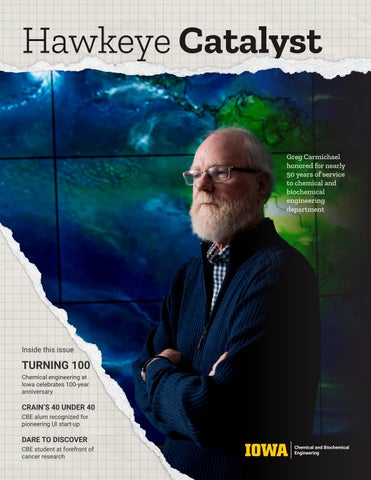
Hawkeye Catalyst Greg Carmichael honored for nearly 50 years of service to chemical and biochemical engineering department
Inside this issue
TURNING 100 Chemical engineering at Iowa celebrates 100-year anniversary
CRAIN’S 40 UNDER 40 CBE alum recognized for pioneering UI start-up
DARE TO DISCOVER CBE student at forefront of cancer research engineering.uiowa.edu/CBE
1
table of contents Leadership Departmental Executive Officer Jun Wang
Editorial Team Designer Hailey Boileau Writer Brian Morelli Editor Alyson Skala Contributing Photographers Aneta Goska, Tim Schoon, and Justin Torner The University of Iowa College of Engineering Office of the Dean 3100 Seamans Center for the Engineering Arts and Sciences Iowa City, Iowa 52242-1527
p.
10
TURNING 100
Phone: 319-335-5764 Fax: 319-335-6086 iowa-engineer@uiowa.edu engineering.uiowa.edu Hawkeye Catalyst is published for College of Engineering alumni and friends © 2026, The University of Iowa, Iowa City, Iowa
p.
14
p.
40 UNDER 40 The University of Iowa prohibits discrimination in employment, educational programs, and activities on the basis of race, creed, color, religion, national origin, age, sex, pregnancy (including childbirth and related conditions), disability, genetic information, status as a U.S. Veteran, service in the U.S. military, sexual orientation, or associational preferences. The university also affirms its commitment to providing equal opportunities and equal access to university facilities. For additional information on nondiscrimination policies, contact the Senior Director, Office of Civil Rights Compliance, the University of Iowa, 202 Jessup Hall, Iowa City, IA 52242-1316, 319-335-0705, ui-ocrc@uiowa.edu.
15
DARE TO DISCOVER
SECTIONS Research Excellence
2 Oxygen concentrator grant 3 Iowa students join NASA mission to study wildfire clouds
4 Focus areas 6 PhD student’s algorithm becomes global resource
Cover Story
In the Spotlight
Awards and Recognitions
News and Updates
10 Turning 100
20 Faculty achievements 21 Student achievements
14 40 under 40 15 Dare to Discover; Cade Machin 16 Railroad project
7 NSF grant to advance air quality monitoring 8 Iowa plays leadership role in NASA’s STRIVE mission 9 SBIR award and publication
17 Shiljashree Vijay 18 New advisory board member; Kirsten Riley
22 More than padding the resume 23 Henry Benton; Ashley Constantino
19 Hossein Zare; Austin McKee
24 Student completes new certificate 25 Student support and new graduates
woman in the United States to earn a PhD in chemical engineering. We were especially honored that Dr. Abron joined us throughout our Centennial Celebration Week, making this historic occasion even more meaningful. The 2025-2026 academic year also marked another period of exceptional growth in our research enterprise. Our external research expenditures increased from $4.1 million in 2024 to a record $5.4 million in 2025. Our faculty's research continues to generate significant scientific, societal, and economic impact. Our students remain at the heart of everything we do. Through internships, cooperative education experiences, undergraduate and graduate research, national competitions, and close mentorship, they receive outstanding opportunities to develop their career path both professionally and personally. As a medium-sized department, we take great pride in fostering a close-knit community where faculty, alumni, advisory board members, and industry partners work together to mentor and support our students. We are especially grateful to our industrial partners for their generous support of our Centennial Celebration and for their continued investment in our educational mission.
GREETINGS FROM THE CHAIR Dear colleagues, alumni, and friends, It is my pleasure to welcome you to the second issue of Hawkeye Catalyst, the official magazine of the Department of Chemical and Biochemical Engineering (CBE) at the University of Iowa. The past 2025–2026 academic year has been a truly remarkable one, marked by many important achievements and reflections in our department's history. In spring of 2026, we celebrated CBE's 100th anniversary. As part of this historic occasion, we hosted a week-long Centennial Celebration in April 2026 that brought together nearly 200 alumni, students, faculty, staff, advisory board members, and friends of the department. The celebration featured our Advisory Board meeting, the Greg Carmichael Symposium, the Centennial Banquet, a Centennial Engagement and Reflection day, and concluded with the University of Iowa AIChE Student Chapter hosting the AIChE Regional Student Conference in Iowa City. Reaching this 100-year milestone is both humbling and inspiring. It represents a century of discovery, innovation, education, and societal impact — and, most importantly, the dedication of our alumni, supporters, faculty, staff, and students who have made this journey possible. Among our distinguished alumni is Dr. Lilia A. Abron, the first African American
As we reflect on the accomplishments of the 2025–2026 academic year, we are inspired and better prepared for the opportunities that lie ahead. I encourage you to explore this issue of Hawkeye Catalyst. Within these pages, you will find inspiring stories that celebrate the innovation, dedication, and collaborative spirit of our community and the many ways our alumni, industry partners, faculty, staff, and students are shaping the future of the Department of Chemical and Biochemical Engineering. Thank you for being an important part of the CBE family. Your continued support and engagement ensure that our next century will be even more impactful than our first. Warm regards,
Jun Wang
Departmental Executive Officer (Chair) and Professor, Chemical and Biochemical Engineering Holder of Lichtenberger Family Chair in Chemical Engineering, College of Engineering
engineering.uiowa.edu/CBE
1
research excellence Oxygen concentrator grant College of Engineering faculty Suresh Raghavan and Syed Mubeen, along with Austin McKee, play key roles in the project.
A
new tool to help patients with chronic lung diseases, being studied at the University of Iowa (UI) College of Engineering, has received $2.55 million in funding from the National Institutes of Health Small Business Innovation Research (SBIR) program. Suresh Raghavan, professor of biomedical engineering, and Syed Mubeen, associate professor of chemical and biochemical engineering, are researching a portable oxygen concentrator (POC) that uses an electrochemical process to generate 100% pure oxygen with ambient air as its input.
The SBIR program funds R&D collaborations between small businesses and U.S. research institutions. In this case, Pranions, Inc. — a medical device startup spun out of Raghavan and Mubeen’s UI research labs — is the project lead. Austin McKee (17BSE, 22PhD) worked with Raghavan and Mubeen and coinvented this device. He was a parttime instructional faculty member in the Department of Chemical and Biochemical Engineering in Fall 2025 and is now the chemical hygiene officer for the UI’s Environmental Health and Safety Office. Raghavan and Mubeen are both faculty affiliates of the Iowa Technology Institute, a research arm of the College of Engineering. The project has also been supported by UI Ventures and the UI Research Foundation. Under a $1 million subcontract of the grant, the UI team will build and test a full-scale prototype to validate performance and safety, paving the way for commercialization that could result in substantial improvements in the quality of care for patients suffering from chronic lung diseases. This technology builds upon, with some variation, an oxygen concentrator Mubeen, McKee, and Raghavan developed in response to ventilator shortages during the COVID-19 pandemic. “This is the logical next step from our recently concluded R01 project, where we developed and patented the core technology,” Raghavan said. “We’re excited to bring this innovation closer to lung patients worldwide.” The NIH grant review panel gave the proposal a stellar impact score, signaling strong confidence in the project’s potential.
Syed Mubeen (left) and Suresh Raghavan (right)
Preliminary testing suggests the device would overcome many of the shortfalls of available POCs, such as limited oxygen flow, excessive weight, inconsistent oxygen purity, and noise. If successful, the project could revolutionize long-term oxygen therapy for over 1.5 million Americans suffering from conditions such as COPD, interstitial lung disease, and pulmonary hypertension.
2
Hawkeye Catalyst | 2026
The UI team also includes Lakshmi Durairaj, associate professor of internal medicine and pulmonology section chief, and Patrick O’Shaughnessy, professor of occupational and environmental health.
watch video
Iowa students join NASA mission to study wildfire clouds The University of Iowa engineering students are helping researchers collect data on pyrocumulonimbus clouds formed by intense wildfires.
E
ngineering PhD student Grant Finneman is participating in a NASA field mission this summer, in a way that very few students will ever experience. He is part of a NASA project that is collecting data to better understand dangerous wildfire-generated pyrocumulonimbus clouds (called pyroCb). The INjected Smoke and PYRocumulonimbus Experiment (INSPYRE) is focused on understanding the fire and meteorological conditions that combine to generate pyroCb and the effects of pyroCb on the atmosphere.
atmosphere — so high that the pilots are considered astronauts and wear a space-like compression suit.
Finneman and team are stationed in Great Falls, Montana, a central location for studying fires from southern Canada through the western United States.
“This is a very unique opportunity for our students, as there are very few instruments like this,” said McGill. “Students learn first-hand how engineers and scientists work together to accomplish a shared mission, something most students don’t get to experience.”
It’s highly uncommon for a student to experience a large, coordinated field campaign, and Finneman gets to see both the hardware and software sides. “I’m involved with both the hardware implementation and the data science behind the software side of things,” Finneman said. “I’m looking forward to seeing all the ins and outs from start to finish.” Ultimately, understanding the pyroCb generated by intense fires means better safety for firefighters and better strategy for fighting these fires. Some wildfires are so intense that they actually generate their own weather, so to learn about pyroCb formation and impacts, researchers fly sensors above the clouds. The Iowa team relies on the Cloud Physics Lidar (CPL), an instrument mounted to NASA’s unique ER-2 highaltitude research aircraft, to collect data. Matthew McGill, professor of chemical and biochemical engineering, is leading the CPL operations — an instrument that he originally developed 25 years ago while at NASA. The team recently expanded its capabilities, including the ability to transmit data in real time using satellite downlink.
Finneman, along with graduate students Jackson Begolka and Sabrina Vlk, are immersed in the day-today work with the primary goal of ensuring the CPL is working properly. They interact with the flight crews, the maintenance crews, and the scientists who dictate the data collection requirements, then retrieve and process the data.
All of this data informs the forecasting models used to forecast fire conditions, emissions, and the movement of smoke — all of which are used in flight planning. This aspect of the project is led by Greg Carmichael, Karl Kammermeyer Professor of Chemical and Biochemical Engineering, and Jun Wang, professor and chair of the Department of Chemical and Biochemical Engineering. The principal investigator of the entire INSPYRE project is David Peterson, PhD, of the U.S. Naval Research Laboratory, who now holds an appointment at the University of Iowa. Added Finneman: “I could not have imagined this experience being better or possible anywhere else other than Iowa. This experience working with McGill and his lab on this project has been amazing. Something most students don’t get to experience.” Left to right: Matthew McGill, Grant Finneman, Sabrina Vlk, and Jackson Begolka in McGill’s Iowa Atmospheric Sensor Development Laboratory
The CPL collects data such as the height, structure, composition, and location of clouds and smoke plumes. The ER-2 aircraft flies above 94 percent of the Earth’s engineering.uiowa.edu/CBE
3
FOCUS AREAS
BUSINESS
BIOCHEMICAL ENGINEERING Students choose from a selection of courses that combine concepts of biology, biochemistry, and engineering. Biochemical engineers combine knowledge of these three areas to manufacture products of a biological nature, including fermentation products and pharmaceuticals. Students who complete this FA often go on to work in the biotechnology and pharmaceutical industries as production leaders or researchers.
The business FA consists of eight core courses within the Tippie College of Business. Students who choose this path gain foundational business knowledge on topics including finance, economics, accounting, marketing, law, and management. Successful fulfillment of all requirements results in a minor in business, which provides students with skills to build and run successful businesses. Past business FA students have applied their integrated business and technical knowledge to many different settings ranging from manufacturing plants to consulting and to corporate offices.
CUSTOM The custom FA is a personalized option recommended for students whose career goals and interests are not consistent with any of the preexisting FA plans. For this FA students work with their academic advisor to develop a course plan.
CHEMICAL PROCESS ENGINEERING
COMPUTATION, DATA SCIENCE, AND MACHINE LEARNING This FA is made for students who intend to blend advanced computation and programming with their chemical engineering degree. This program is customizable based on student interest areas and can accommodate introductory training in cyberphysical systems, remote sensing, advanced simulation, supply chain management, in silico chemistry and biology, bioinformatics, software design, next-generation controls, machine learning, and artificial intelligence.
4
Hawkeye Catalyst | 2026
Process engineering is the design, optimization, and operation of systems that transform raw materials into valuable products. Products that process engineers are involved with include foods and beverages, electronic materials, metals, plastics, fuels, building materials, and pharmaceutics. This topic spans many aspects of engineering, business, applied math, and science.
ENERGY AND ENVIRONMENT Students who are passionate about the environment should consider this path. Courses prepare students to solve environmental challenges and to revolutionize energy systems. Topics include air pollution, climate change, clean and renewable energy, environmental regulations, and sustainable systems. This FA features the Green Chemical and Energy Technologies course that covers topics including solar energy conversion, life cycle analysis, greenhouse gas accounting, and biofuels.
ENTREPRENEURSHIP The entrepreneurship FA allows students to focus on the process of succeeding in the world of startups, innovation, business ownership, and new products. This FA is also designed to dovetail with the college’s certificate in technological entrepreneurship. The entrepreneurship elective FA is well suited for students who intend to start and operate their own business; it also serves students interested in gaining a better understanding of managing innovation in an existing business environment. The wide range of electives permits students to tailor business courses best suited to their individual interests.
OIL AND GAS ENGINEERING Meant for students interested in pursuing careers in oil and gas engineering, this FA explores foundational elements of chemistry, geology, petrochemical refining, and environmental science. The course plan offers several recommendations put in place by experienced advisors with petrochemical backgrounds. Often viewed as the birth of chemical engineering, the petroleum industry provides a host of challenging and lucrative opportunities for chemical engineers. This path provides a unique and focused introduction to the field.
PHARMACEUTICALS Chemical and biochemical engineering is central to the design, formulation, and manufacturing of pharmaceutical products. Students who are passionate about medical applications can align their chemical engineering skills toward a career in pharmaceuticals by choosing this FA. The curriculum features biology, drug delivery, and the mechanisms and chemistry of drug interactions. Course options span many departments in addition to CBE, including biomedical engineering, biochemistry, pharmacy, and pharmacology.
PRE-MEDICINE
POLYMERS The polymers elective FA enables students to study the development of chemical compounds by polymerization, i.e., combining small molecules into engineered networks to produce valuable plastics and other advanced materials. This program is well suited for students who intend to use their knowledge to design new materials; it also serves students interested in gaining a better understanding of the links between molecular scale structure and macroscopic scale properties. Many students in this FA take an advanced chemistry course resulting in a chemistry minor.
Concepts of chemical engineering are naturally applicable to the processes in living organisms. The pre-medicine EFA enables students to apply these concepts to gain a deeper understanding of the atoms and molecules that comprise living organisms, and the pathways through which they operate. This program is well suited for students who intend to use their knowledge to gain acceptance to post-graduate education in the medical field.
SAFETY & HEALTH The safety & health FA prepares students to (i) prevent incidents and accidents in chemical and pharmaceutical manufacturing, particularly those resulting from the unintentional release of hazardous materials and energy into the environment, and (ii) provide a safe and healthy workplace by preventing injuries and hazards in the workplace environment.
SUSTAINABILITY The sustainability FA covers the most important and current topics in environmental science, societal impacts, energy usage, and natural systems. Courses prepare students to understand and discuss these topics as they relate to chemical engineering. The sustainability FA is designed for students pursuing the university-wide certificate in sustainability along with an engineering degree.
engineering.uiowa.edu/CBE
5
PhD student's algorithm becomes global resource
sulfuric acid H2SO4
Mentored by Joe Gomes, UI assistant professor of chemical and biochemical engineering, Marks created an improved algorithm to make it easier to find these critical molecular structures. Marks defended his thesis in November.
adenine C5H5N5
aspirin C9H8O4
J
onah Marks, a University of Iowa (UI) PhD candidate in chemical and biochemical engineering, created a better way for scientists to find "transition states" in chemical reactions, a key tool for unlocking new medicines, better catalysts, and advanced materials. The innovation attracted the attention of Rowan Scientific, a Boston-based computational chemistry start-up, which has adopted Marks’ method as a go-to tool, freely available to scientists and researchers on Rowan’s cloud-based platform.
are crucial for understanding how chemical reactions occur, a foundational element for advancing medicine, manufacturing, and other fields.
A transition state is the highestenergy point that molecules must pass through as they transform from reactants to products in a chemical reaction. Transition state searches
“It’s incredibly rewarding to see this work recognized and made accessible to the broader research community,” Marks said. “The expanded impact is what really
6
Hawkeye Catalyst | 2026
excites me, having the ML-FSM (machine learning freezing string method) incorporated in Rowan's platform enables many more scientists who don't specialize in computational methods to easily use this method to advance their own research.”
caffeine C8H10N4O2
Jonathon Vandezande of Rowan Scientific learned about the algorithm and implementation from a preprint of Marks and Gomes' paper and contacted them. They soon partnered to adapt the academic code into a modern Python package, and then made the tool widely available. "It was great working with Jonah to improve the package for easier integration into our platform," said Vandezande, director of computational chemistry at Rowan, which specializes in design and simulation tools for chemical research and development. In a blog post, Rowan explained they chose the package developed by Marks and Gomes because “it provides significant improvements” on existing methods and is a great example of an industry-academia collaboration. Marks' approach offers a better way to represent molecules, a powerful optimization algorithm, and a built-in check to keep calculations reliable. The partnership shows how universities and companies can work together to turn complex academic research into practical tools for the entire scientific community. By combining Iowa's algorithmic advances with Rowan's cloud infrastructure and user interface, the partnership removes barriers that often make it hard for researchers to adopt new technology.
NSF grant to advance air quality modeling Gregory Carmichael is UI’s Karl Kammermeyer Professor of Chemical and Biochemical Engineering and co-director of the Center for Global and Regional Environmental Research
A
University of Iowa chemical and biochemical engineering professor is a key investigator on a $4.9 million grant to help scientists better model and predict air quality and chemical behavior in the atmosphere.
model that served a broad community from research to operations, spanning academic, private, and military institutions. That model is no longer maintained and will integrate advanced chemistry features into a modern global weather model.
Gregory Carmichael, UI’s Karl Kammermeyer Professor of Chemical and Biochemical Engineering and co-director of the Center for Global and Regional Environmental Research, will lend his expertise in chemical weather forecasting to the project. UI is expected to receive $750,000 for its role.
The research will help scientists better understand how pollutants and chemicals move and change in the air — from local neighborhoods to the entire globe. This is crucial for improving forecasts of weather and air quality, protecting public health, supporting agriculture and energy systems, and guiding environmental policy.
“Modernizing our tools for understanding air quality and weather patterns has never been more critical, so we can make informed decisions that protect public health while ensuring the sustainable management of our agricultural and energy resources,” Carmichael said. The five-year project, funded by the National Science Foundation, aims to develop a new modeling system called CheMPAS-A. This system will replace an older
Smoke-filled sky above University of Iowa Hospital
A key innovation of the project is a flexible, user-friendly coding system that allows researchers to quickly test and improve how atmospheric chemistry is represented in models. This will make scientific collaboration faster and more effective. By using modern software practices and training the next generation of scientists, the project aims to turn complex research into practical tools for society. The work is a collaboration between the University of Iowa, University of Arizona (lead), University at Albany, and the National Center for Atmospheric Research.
engineering.uiowa.edu/CBE
7
University of Iowa plays leadership role in NASA’s STRIVE mission The University of Iowa will contribute to a major new space mission designed to help NASA better understand Earth and improve capabilities to foresee environmental events and mitigate disasters. The project, known as STRIVE — Stratosphere– Troposphere Response using Infrared Verticallyresolved light Explorer — was recently selected by NASA for continued development within the Earth System Explorers Program. The mission carries a cost cap of $355 million, excluding launch, with an anticipated launch date no earlier than 2030, according to NASA’s announcement. Jun Wang, University of Iowa Lichtenberger Family Chair in Chemical and Biochemical Engineering, serves the STRIVE mission as deputy principal investigator, positioning Iowa as a key contributor to this effort. “STRIVE represents the kind of collaborative, impactful research that is central to the University of Iowa’s strategic plan,” says Kevin Kregel, executive vice president and provost. “By supporting scholars like Jun Wang and investing in their success, we strengthen
Iowa’s national research leadership and advance discoveries that improve lives.” Lyatt Jaeglé, professor of atmospheric and climate sciences at the University of Washington, is the principal investigator. Scientists from the NASA Goddard Space Flight Center in Greenbelt, Maryland, including Luke Oman, are also project leadership members. Wang, also professor and departmental executive officer of chemical and biochemical engineering and associate director of Iowa Technology Institute, is an expert in atmospheric chemistry and satellite remote sensing. He has extensive experience with NASA’s Earth satellite observations. For another component, Wang will advise a group of students and scholars in Iowa to develop retrieval algorithms and data products for STRIVE. “I am deeply grateful to NASA for its continued support of the STRIVE mission, and I am thrilled that we’re part of this national collaborative effort to develop a satellite mission to study our home planet in the 2030s,” Wang said. “I sincerely thank the P3 program and the leadership of the College of Engineering and the University of Iowa for their sustained support. This has enabled us to participate in STRIVE’s mission planning and proposal development over the past several years.” The STRIVE mission is expected to provide daily, nearglobal, high-resolution measurements of temperature, a variety of Earth’s atmospheric elements, and aerosol properties from the upper troposphere to the mesosphere — at a much higher spatial density than any previous mission. It also will measure vertical profiles of ozone and trace gasses needed to understand the recovery of the ozone layer.
Discover more at atmos.uw.edu/strive 8
Hawkeye Catalyst | 2026
The data collected from STRIVE can be expected to support longerrange weather forecasts, an important tool in protecting coastal communities where nearly half the world’s population lives. An important aim is improving the ability to track how wildfire smoke and volcanic emissions move through the atmosphere and reveal how changes at high altitudes can influence weather patterns weeks later.
Graduate student Weizhi Deng, supervised by Jun Wang, has published a paper in the prestigious journal Science that was awarded NIH Small Business Innovation Research (SBIR) funding along with a publication demonstrating how wildfires can reverse long-term improvements to surface ozone air quality.
Iowa’s involvement in STRIVE is the latest byproduct of Iowa’s P3 grant program, which invests in strategic priorities of campus. One of the program’s earliest and largest investments was $3.6 million in 2021 to expand space-based research across the university.
linking wildfires and surface ozone pollution and is the study’s first author. “Wildfire smoke has become a major driver of increasing ozone pollution, especially in the western and midwestern United States."
The study also found that the increase in wildfire-driven ozone pollution over the past decade has undercut air-quality improvements achieved before 2015, largely through reductions in automobile emissions, which are a main contributor to surface ozone. “While U.S. air quality regulations have reduced surface ozone, a pollutant linked to respiratory and cardiovascular diseases, this progress has reversed since around 2015,” says Deng, who led the modeling arroma.uiowa.edu engineering.uiowa.edu/CBE
9
Celebrating 100 Years at the University of Iowa The University of Iowa’s Department of Chemical and Biochemical Engineering (CBE) began celebrating its 100th anniversary in spring 2026 with a series of activities that brought together students, alumni, faculty, staff, and international collaborators.
A
t the center of the Milestone Celebration Week was the Carmichael Symposium, honoring Professor Greg Carmichael for shaping the direction of the college and elevating its profile over his nearly 50 years of service to the department. Speakers traced the department’s history through key figures from Karl Kammermeyer’s pioneering work in membrane separations to Carmichael’s transformative research in air quality modeling, atmospheric processes, and greenhouse emissions, making the University of Iowa a premier destination for chemical engineers with atmospheric research interests. The symposium served as an opportunity to celebrate and update research accomplishments of alumni and collaborators. The Milestone Celebration week included several other events, 10 Hawkeye Catalyst | 2026
which provided opportunities for students and alumni to connect, share research, and reflect on the department’s evolution. There was a milestone banquet, alumni panel on the global impact of CBE scholars, student showcase, and history exhibit in the Lichtenburger Engineering Library, and there is a Centennial Reception to come at the annual AIChE meeting in fall 2026. A century of responding to the most pressing challenges
Over the past century, the department has continually evolved to meet the changing needs of industry and society while advancing education, research, and innovation. From its origins in applied chemistry to its current strengths in biochemical engineering, environmental science, atmospheric research, and biotechnology, the department has remained committed to preparing
future leaders in chemical engineering. When Greg Carmichael arrived at the University of Iowa in 1978 as a young assistant professor, Iowa’s chemical engineering program was at a crossroads. “When I came, I was told, “By the way, our senior class has four people,” Carmichael recalled. “At that point, the department was still defining what it wanted to become.” Nearly 50 years later, the department — now the Department of Chemical and Biochemical Engineering — has nearly 200 students and is celebrating its 100th anniversary of accreditation. “When Greg arrived at Iowa, the department was still defining its future,” said Ann McKenna, Dick and Judy Smith Dean of the College of Engineering. “Through decades of leadership, groundbreaking research, and dedication to students and colleagues, he helped transform CBE into a globally respected program. Few individuals have shaped a department as profoundly as Greg has shaped CBE.” An early face of the department was an immigrant from Germany named Karl Kammermeyer. The former gymnast would roam the halls, puffing on a cigar and giving advice. As a researcher, Kammermeyer earned acclaim for applying his knowledge of plastic membranes to help perfect the artificial kidney and a prototype heart-lung machine. He equally made an impact as a teacher and mentor, leaving a “family tree” across industry and academia. “He was a force of nature,” Carmichael said. Not so coincidentally, Carmichael would eventually bear the title, Karl Kammermeyer Professor of Chemical and Biochemical Engineering. If Kammermeyer was a pillar of the first 50 years of the department, Carmichael has certainly been a pillar of the last 50 years. The 1970s saw growing public awareness of environmental problems, driven by protests, smog episodes, and landmark
legislation such as the Clean Air Act. This inspired Carmichael and many others of that generation to turn to chemical engineering as a vehicle to make a difference. “Environmental problems are due to chemistry, so I decided to become a chemical engineer and learn how to design processing plants that emit less chemicals,” said Carmichael, who would establish the first Eulerian numerical model for regional air pollution during his graduate studies. Iowa would also adapt, incorporating modeling, systems analysis, and environmental applications. Modeling became a foundation for research and training, influencing how the department approached air quality, atmospheric transport, and, later, climate science. In the 1980s, Carmichael’s work in Japan and across Asia — where he studied the ozone in mountainous regions, dust transport, and heterogeneous chemistry — reflected Iowa’s shift to global problems. Alongside his research, Carmichael served 14 years as department chair and 12 years as associate dean for research and graduate studies. Under his leadership, the department responded to growth in the pharmaceutical, food, and bioprocessing industries, culminating in 1989 with the renaming to the Department of Chemical and Biochemical Engineering. These areas illustrate the breadth of inquiry pursued at the time, blending traditional chemical engineering foundations with emerging directions in biochemical and environmental applications. Today, CBE’s research portfolio spans air quality
and climate, biological and pharmaceutical engineering, polymers and advanced materials, sensing and machine learning, and sustainable energy and water. Faculty and students continue building upon the department’s legacy.
engineering.uiowa.edu/CBE 11
CBE faculty have played instrumental roles in establishing internationally recognized research centers at the University of Iowa. Prof. K. “Mani” Subramanian was recruited in 2005 to direct the Center for Biocatalysis and Bioprocessing, bringing together faculty and students from across the department to advance biotechnology and biochemical engineering. Prof. Carmichael co-founded the Center for Global and Regional Environmental Research (CGRER) in 1991 and has served as one of two co-directors since its inception, helping establish the University of Iowa as an international leader in atmospheric chemistry and air quality research. Prof. Alec Scranton founded the NSF Industry–University Cooperative Research Center for Fundamentals and Applications of Photopolymerization, which later was directed by Prof. Allan Guymon and has become a nationally recognized center for polymer science and engineering. Carmichael’s work also continues. He has ongoing service with international scientific bodies, including the United Nations World Meteorological Organization, and recently contributed to a study finding micro and nano plastics in the air that may be warming the planet. “Trained as a chemical engineer studying acid rain caused by sulfur dioxide emissions in the 1970s, Prof. Carmichael’s research has continually evolved to confront some of the most pressing environmental issues of our time,” said Jun Wang, Lichtenberger Family Chair in Chemical and Biochemical Engineering and current CBE department head.
HISTORYMAKING ALUMNA Lilia A. Abron delivered the keynote address at CBE's 100th anniversary banquet. Abron is the first African American woman in the nation, and the third woman at the University of Iowa, to earn a doctorate in chemical engineering. She shared memories of her time at Iowa and of using engineering to improve access to clean water in Africa. Abron challenged today’s students to focus their work on clean air, clean water, and clean energy. Chemical and Biochemical Engineering is pleased to share that a gift has been pledged to establish the Lilia A. Abron hard-coin Student Success Fund in the UI College of Engineering. This fund will support scholarships, undergraduate and graduate research opportunities, travel stipends, and other academic activities that promote student success and professional development. Many of you had the opportunity to meet Abron during our 100th Anniversary Celebration, where she participated throughout the event and delivered inspiring keynote remarks at both our banquet and the AIChE Regional Conference. Her accomplishments, leadership, and commitment to giving back exemplify the values that make our alumni community so special. Having outstanding and dedicated alumni like Abron is what makes our work important, rewarding, and impactful. Their continued engagement not only strengthens our department today but also helps create opportunities for future generations of CBE students. Let’s work together for the success of our students.
12 Hawkeye Catalyst | 2026
TIMELINE: 1920s The AIChE student chapter was established in 1924 (sixth in the nation; first west of the Mississippi). The Chemical Engineering program was founded in 1926. 1940s Karl Kammermeyer was appointed head of chemical engineering and was a major force in the department.
1950s
Process Calculations textbook authored by Prof. Karl Kammermeyer and Prof. James Osburn was published in 1956 and was the first of its kind. 1970s Lilia Ann Abron was the first African American woman to receive a PhD in chemical engineering, earning her degree in 1972.
1980s The department was officially renamed to the Department of Chemical and Biochemical Engineering. 1990s The dedicated Process Safety teaching lab was founded, the first in the nation. 2000s ChemE moved from the Chemistry Building to the Seamans Center with expanded and modernized space. 2010s SunHydrogen start-up founded by Prof. Mubeen Syed, now worth over $250M in market value. 2020s The department grows to 15 faculty; annual external research expenditure more than doubled to $5.2M.
RECENT PATENTS: Method for producing polymers with controlled molecular weight and end group functionality using photopolymerization in microemulsions – Alec Scranton (2005) System and method of planar processing of semiconductors into detector arrays – Chris Coretsopoulos (2014) Low-viscosity liquid radiation curable dental aligner mold resin compositions for additive manufacturing – Beth Rundlett (2018) Magneticallyactivated coating for treating biofilms, and associated systems and methods – Eric Nuxoll (2018) Apparatus and method for threedimensional photoelectrodialysis – Syed Mubeen (2023)
engineering.uiowa.edu/CBE 13
in the spotlight CBE alumna makes Crain’s 40 under 40
D
r. Meesha Dogan is the CEO, co-founder, and director of Cardio Diagnostics, where she has led the company from breakthrough innovation to national commercialization and a public listing. A pioneer at the intersection of artificial intelligence, epigenetics, and cardiovascular medicine, she co-invented the company’s core technology during her graduate studies at the University of Iowa and has guided its evolution from concept to clinical impact. Dogan was recently named to both the Cardiovascular Business Forty Under 40 and Crain’s Chicago Business 40 Under 40, which highlighted how her training in a pioneering UI epigenetics lab shaped her career and fueled her mission to transform heart-disease prevention and early detection. Under her leadership, Cardio Diagnostics has secured strategic partnerships, multiple funding rounds, and national recognition, including Fast Company’s Next Big Things in Tech and the Biotech Breakthrough Awards. She holds a PhD in biomedical engineering and both a BSE and MS in chemical engineering from the University of Iowa.
14 Hawkeye Catalyst | 2026
Her achievements build on a growing list of honors — One to Watch from Nature and Merck, Biotech Breakthrough’s Clinical Diagnostics Solution of the Year, and FLIK Woman Entrepreneur to Watch. Her research has also resulted in at least seven granted patents, with more pending.
In addition to her 40 Under 40 recognitions, Dogan is also a recipient of the University of Iowa Alumni Merit Award, which honors graduates who have demonstrated outstanding professional achievement and meaningful impact in their fields.
DARE TO DISCOVER Rylie Uleet, Undergraduate student, chemical engineering Area of research: Harnesses immunity to target tumors Hometown: Minnetonka, Minnesota Faculty mentor/advisor: Aliasger Salem, associate vice president for research and Lyle and Sharon Bighley Endowed Chair and Professor, College of Pharmacy Degree program and anticipated graduation date: BSE in chemical engineering, Spring 2028
R
ylie Ulett is working at the forefront of cancer research, designing polymer-based nanoparticles that deliver immunestimulating signals directly to tumors. Her goal is to optimize these formulations to help the immune system recognize and destroy cancer cells, paving the way for next-generation cancer immunotherapies.
UNDERGRADUATE STUDENT SPOTLIGHT
“Being involved in research at the University of Iowa has helped me become more confident in new situations, improved my understanding of experimental design, and made me excited for a future in research,” says Ulett. Through her work with Aliasger Salem’s research group, Ulett is gaining direct experience in nanomedicine, drug delivery, and cancer biology while contributing to research that could transform patient care. After graduation, she plans to pursue a career in pharmaceutical research and development, advancing innovative therapies that improve lives.
“
Rylie exemplifies the curiosity, dedication, and creativity that define Iowa’s undergraduate research community. Her enthusiasm for discovery and drive to tackle one of the greatest health challenges of our time make her an outstanding representative for the Dare to Discover campaign.” – Aliasger Salem
Cade Machin Do you belong to any organizations outside of the College of Engineering? None outside, but inside the college I’m in AIChE, OXE, and I’m an engineering tutor. Why did you choose the University of Iowa? I’ve been a lifelong Hawkeye fan, but I also enjoyed the smaller, tightknit community that Iowa Engineering offered. What is your favorite class that you have taken at the University of Iowa? Bioseparations What is your favorite place you have traveled to? Hawai’i
Dare to Discover is a University of Iowa campaign celebrating student and postdoctoral research, scholarship, and creative achievements through public displays in downtown Iowa City.
What are some of your hobbies? Going to the gym, fishing, cooking, going to Iowa games, playing intramurals, reading engineering.uiowa.edu/CBE 15
Iowa engineering students learn about satellites through railroad project
O
ver 25 years building airborne and satellite instruments at NASA, Matthew McGill worked on many multilayered projects. Independent teams would build parts that had to match seamlessly with the moment of truth only coming at the point of assembly. Now a University of Iowa professor of chemical and biochemical engineering (CBE), McGill is giving students a hands-on experience to simulate that process. How do scientists and engineers work together to develop top-level requirements? How do you manage interfaces to ensure the components fit together? How do you validate the build before it’s put to use? Those are the questions McGill’s new experiential course, Process and Design for Satellite and Environmental Sensors (CBE:4460), challenges students to explore. Instead of satellites, the class takes on a more downto-earth challenge: building a modular railroad. Each student constructs a segment of a rail line, following an interface control document precisely to ensure mechanical and electrical connections align when the full system is assembled. The payoff? A working model train system. “The goal is to learn how to work like people at NASA, to make a project come together within a few thousandths of an inch,” said Shawn Kopp, a senior CBE student. “Even a slight variation can throw everything off.” The course is an exercise in high-level, technical project management: building a team, defining requirements, creating interface controls, tracking workflows, verifying quality, and troubleshooting hardware and design issues. Students also grapple with real-world constraints like staffing, costs, and part availability. “If you can go into a job interview and talk 16 Hawkeye Catalyst | 2026
about requirements flow, design traceability, and interface control documents, you’re going to quickly set yourself apart,” McGill said. “The course also provides an opportunity for students to use tools and skills they probably have not experienced, and to be creative.” Jackson Begolka, a CBE PhD candidate, stopped by to see the students’ final project. He previously took the class when it first launched and now applies its concepts in the lab while developing an airborne sensor system. “Creating the interface control document forces you to think about how the device will ‘talk’ to other sensors and interfaces and how the system must be formatted to fit together,” Begolka said.
Watch video of the trains in action!
ALUMNI SPOTLIGHT Shiljashree Vijay PhD 2025 How did you choose the University of Iowa? I chose the University of Iowa for its strong emphasis on applied research and collaborative environment in chemical engineering. The opportunity to work on impactful energy and sustainability projects aligned perfectly with my career goals. Describe your career path and the work you are currently doing. My career centers on developing electrochemical systems for sustainable energy. During my PhD, I focused on photoelectrochemical water splitting using CdSebased materials to produce green hydrogen, building expertise in materials synthesis, device fabrication, and electrochemical analysis. Currently, as a senior product and development engineer at SunHydrogen, I lead and support research to develop, refine, and scale manufacturing processes for our nanoparticle-based photoelectrochemical (PEC) hydrogen panel technology. I collaborate closely with interdisciplinary teams — including researchers, engineers, technicians, and interns — focusing on scaling thin-film, device-based PEC systems. How did the CBE department prepare you for your career? The CBE department provided a rigorous foundation in engineering principles and hands-on research, deepening my understanding of electrochemical engineering and semiconductor synthesis. The department’s emphasis on interdisciplinary collaboration was critical for bridging materials science with process engineering. Beyond technical skills like experimental design and troubleshooting, presenting at conferences helped me build vital communication and networking skills. Ultimately, the supportive faculty mentorship and program structure equipped me with the problem-solving mindset needed to succeed in the industry. What advice would you want to share with current or future ChemE students? Focus on gaining hands-on experience through research, internships, or projects alongside your coursework, and always look at how your work translates to real-world sustainability and technology. Build strong fundamentals, stay curious about interdisciplinary learning, and actively seek mentorship. Some of the best career opportunities come from simple conversations and connections!
engineering.uiowa.edu/CBE 17
CBE welcomes new advisory board member
G
ary Machetta is originally from Bettendorf, Iowa, and graduated with High Honors from the University of Iowa in 1991, earning a BS in chemical engineering. While at Iowa, he was recognized as a Collegiate Scholar and received the AIChE Award for Outstanding Achievement.
Gary began his career as a process engineer with Shell Oil in Deer Park, Texas, where he spent five years before pursuing advanced degrees — an MBA from the University of Chicago and a Juris Doctor from the University of Houston. He went on to join John Deere’s highly selective Strategic Management Program, a five-year executive rotational assignment with roles in M&A and Strategic Planning. During this time, he contributed to acquisitions resulting in over $1 billion in inorganic growth for the company. Following his work in corporate strategy, Gary shifted his career to the legal field, focusing on Intellectual Property (IP) law — an area that perfectly blends his expertise in engineering, business, and law. Over the years, he has led and advised on projects spanning industries and technologies, from rebranding Houston’s NFL stadium as NRG Stadium, to drafting and prosecuting hundreds of patents across dozens of countries, to supporting licensing and monetization strategies for innovations in refining, chemical processes, sustainable technologies, and software. Today, Gary serves as Vice President – Intellectual Property for KBR, supporting global operations. He recently completed a term as a member of the University of Iowa Mechanical Engineering Advisory Board and has built a career that touches diverse industries — supporting farmers, commercial and individual consumers, major oil and chemical operators, U.S. government agencies, and even NASA. He believes that no matter the field or technology, an engineering degree from the University of Iowa provides an exceptional foundation for success.
ALUMNI SPOTLIGHT Kirsten Riley BSE, 2000 How did you choose the University of Iowa? I have been a Hawkeye fan my whole life! For college, I was looking for a smaller engineering program that focused on student success. Describe your career path and the work you are currently doing. I’ve worked for the same company since graduation. I’ve worked at 4 different locations in 3 states and traveled around the world over my 25 years with Bayer. I started as a project engineer, spent several years doing process engineering, then led manufacturing teams of increasing size and complexity. I’ve valued the breadth of experience I’ve gained in my career. How did the CBE department prepare you for your career? The department has a strong focus on ensuring we have the tools to be successful engineers. I think the Process Safety course I took with Dr. Murhammer was incredibly valuable to prepare me to look at all operations I’ve supported holistically. What advice would you want to share with current or future ChemE students? Your education at the University of Iowa is just the beginning — you’ll be learning every day! Make sure you take time to enjoy the experiences you have along the way.
18 Hawkeye Catalyst | 2026
GRADUATE STUDENT SPOTLIGHT Hossein Zare Fourth-year PhD Student What drew you to pursue your graduate studies at the University of Iowa? I was drawn here to do impactful, handson medical research, specifically working with the Nuxoll group on ways to tackle tough bacterial biofilms. The collaborative atmosphere and strong resources in the chemical and biochemical engineering department made it clear this was the right place to grow. What has been the most exciting or rewarding moment of your research or graduate experience, and how has that impacted you? The most rewarding moment so far was recently publishing my first-author paper in Biotechnology and Bioengineering, which focused on interplay of dispersion and thermal shock on bacterial biofilms. How has the CBE department supported your growth as a researcher and Graduate Summer Fellow? The CBE department has been a cornerstone of my development by providing an environment where students are truly encouraged to explore and innovate. Faculty members and advisors are always accessible; specifically, my advisor, Dr. Nuxoll, has shown his support all along my research journey. Through seminars, funding opportunities, and career advice, they have consistently pushed me out of my comfort zone. I've evolved from a student learning the ropes into an independent scientist ready for the next step.
FACULTY SPOTLIGHT Austin McKee
earned his BSE, MS, and PhD in chemical and biochemical engineering at Iowa. His doctoral research focused on electrochemical systems, particularly using electrons to transform low- or negative-value feedstocks into useful products. His work also explored surface effects, plasmonic materials, and electrochemical reduction processes, blending fundamental science with practical application. Over the past decade, his work has spanned research labs, startups, and classrooms, with a consistent focus on turning complex ideas into real, working solutions. After completing his PhD, he remained at Iowa as a postdoctoral researcher, contributing to technology that led to startup formation. Together, his postdoctoral and startup experiences provided not only technical growth but also the stability that supported a major milestone in his personal life: growing his family through welcoming his two children.
What advice would you give to undergraduate students who are considering research, graduate school, or applying for fellowships?
Teaching has been another meaningful part of his time in the department. As an adjunct instructor, Austin taught courses ranging from first-year engineering to senior design. He especially enjoyed helping students connect foundational concepts to real-world systems and decisions, while creating an environment where they felt comfortable asking questions, learning from mistakes, and building confidence.
My biggest advice is to get into a lab as early as possible to find out what genuinely sparks your curiosity. When applying for graduate school or fellowships, be authentic about your goals and build strong relationships with your mentors, as their support is invaluable. Most importantly, stay resilient and keep pushing forward, even when the learning curve feels steep.
Today, Austin serves as the chemical hygiene officer in the University of Iowa’s Environmental Health and Safety office, where he manages a campus-wide chemical safety program. The role brings together his technical background, problem-solving mindset, and commitment to supporting safe and effective research.
engineering.uiowa.edu/CBE 19
awards and recognitions HYEONGMIN SEO
Assistant Professor •
New ContractSubgrant, Research (Basic), RII Track-1: Building Capacity across Iowa to Meet Human Needs from Things that Grow. Accelerating synthetic biology for sustainable 1,5-diaminopentane production through nanofabricated highthroughput assay, sponsored by Iowa State University (prime sponsor: US National Science Foundation) - $61,839 •
•
New Contract-Subgrant, Research (Basic), Systems Metabolic Engineering of Cupriavidus necator for Production of Additive Manufacturing Compatible Polyhydroxyalkanoate Bioplastics from Soybean Oil, sponsored by South Dakota State University (prime sponsor: US Department of Agriculture) - $60,000
JUN WANG & GREGORY CARMICHAEL Departmental Executive Officer; Professor • New Grant, Research (Basic), Effective use of Regional and Chemistry-Climate Modeling, and Remote Sensing to Support INSPYRE Flight Planning, Execution, and Data Analysis, sponsored by US National Aeronautics & Space Administration - $572,860
Professor •
New Grant, Research (Basic), Lidar Observations of PyroCb and Smoke for INSPYRE Science, sponsored by US National Aeronautics & Space Administration - $548,312
MARCELO MENA
Environmental Engineering Alumni (MS 2003, PhD 2007)
GREGORY CARMICHAEL •
New Contract, Research (Applied), Global modeling of VMS using an Earth system model and its heterogeneous uptake on atmospheric aerosols, sponsored by Silicones Europe - $51,304
JUN WANG New ContractSubgrant, Research (Basic), Exceptional Events on Air Quality and Public Health at Norther High Latitudes sponsored by University of Alaska (prime sponsor: US National Aeronautics & Space Administration) - $58,656
BETH RUNDLETT
•
•
Attended a reception and presented to His Majesty King Charles III at St. James’s Palace in London following a renewed United Nations call to action on methane emissions
ANDY WANG
Assistant Professor •
•
In March 2026, Assistant Professor Hyeongmin Seo’s Engineered BioSynthesis Lab (EBSL) at the University of Iowa won the USDA-NIFA North Central Regional Sun Grant. Sponsored regionally through South Dakota State University (which houses the North Central Sun Grant Center), the award funds research to develop a microbial platform that converts soybean oil into high-performing PHA bioplastics.
20 Hawkeye Catalyst | 2026
MATTHEW MCGILL
Professor of Practice • Named Sharon K. Tinker Process Safety Professor in Chemical and Biochemical Engineering College of Engineering Teaching Excellence Award
Received the DARPA Young Faculty Award (YFA). The program is to identify and engage researchers in junior faculty positions at U.S. academic and non-profit research institutions and expose them to national security needs and DARPA’s program development process.
SYED MUBBEN
Associate Professor •
New patent approved on December 12, 2025: Electrode for nitrate reduction
KLAERTJE HESSELINK AWARDED FULBRIGHT TO CONDUCT ENVIRONMENTAL CHEMISTRY RESEARCH IN GERMANY For Klaertje Hesselink, the path to a Fulbright study/research grant to Germany began in the classroom after attending a Fulbright event in her first year. During Hesselink’s third year, a course on environmental politics and indigeneity taught by Prof. David Greenwood-Sanchez included a mock Fulbright proposal as a final project. Read the interview!
Hossein Zare’s latest paper was in Biotechnology & Bioengineering.
Parham Parnian’s paper was published in Microbiology Open.
CBE GRADUATE STUDENTS WERE AWARDED DEPARTMENTAL AWARDS AT THE CBE GRADUATE STUDENT APPRECIATION EVENT ON APRIL 2ND! BELOW IS THE LIST OF RECIPIENTS: Vetter Service Award: Hossein Zare, Prasoon Kumar, Weizhi Deng Osburn Teaching Award: Sabrina Vlk Kammermeyer Research Award: Grant Finneman Hossein Zare was awarded a Graduate College Summer Fellowship for summer 2026. Hossein is a PhD student in the Nuxoll Lab.
Hossein Zare
Grant Finneman
Weizhi Deng
Prasoon Kumar
Weizhi Deng won First Place for Best Student Oral Presentation from AMS. Weizhi is a PhD student in Jun Wang’s research lab.
AMERICAN METEOROLOGICAL SOCIETY First Place Best Health Student Oral Presentation is presented to
Weizhi Deng Univ. of Iowa Fire Impacts on USA Ozone Exposure, Mortality, and Attainment of Air Quality Standards: Integrating Observations, Modeling, and Deep Learning presented at the
106th AMS Annual Meeting
Graduate student success and achievements are highlighted each year at our departmental graduate student appreciation event in spring.
January 25 - 29, 2026
Brian Papa Acting Executive Director
Sabrina Vlk
engineering.uiowa.edu/CBE 21
news and updates
More than padding the resume
I
n March, more than 30 chemical engineering students visited Lasaffre in Cedar Rapids for a behind-thescenes look at chemical engineering in action. After checking in and reviewing safety protocols, we suited up in smocks, hardhats, safety glasses, and hairnets and headed into the plant. Students climbed into the industrial elevator, peered into massive fermentation vats and quite literally smelled the yeast in the air. As one student said, “It’s one thing to learn about fermentation in class, It’s completely different to stand next to those massive tanks and realize that is what we’ve been studying all semester.” The Red Star team took real time with our students. They answered questions, explained why certain 22 Hawkeye Catalyst | 2026
processes are designed the way they are, and walked through how they manage quality and safety at every step. Students were able to connect what they are learning to what it actually takes to run a facility like this day in and day out. It gave them a much clearer understanding of the precision and coordination behind something as familiar as a packet of yeast. And yes, we all left with packets of Red Star yeast and bread recipes. A fitting reminder that behind every large-scale biochemical process is something simple and tangible you can hold in your hand and bake in your own kitchen. The tour clearly sparked interest, and it is expected that Red Star will see several internship applications from UI in the near future.
Henry Benton
Ashley Constantino
What company and location did your co-op/internship take place?
What company and location did your co-op take place?
I worked as a maintenance engineering intern at Red Star Yeast up in Cedar Rapids, IA Why did you choose this company? The Introduction to Biochemical Engineering course sparked my interest in fermentation, and I was fascinated by how natural biological processes can be harnessed on an industrial scale to produce everything from food ingredients to pharmaceuticals. Knowing that Lesaffre, Red Star's parent company, is a global leader in biotechnology and biosciences made the opportunity especially appealing. I knew I would have the chance to learn from experienced engineers and scientists while seeing those concepts applied in a real manufacturing environment. What kind of activities did your role include? My role included identifying and implementing process improvements, managing small capital projects from planning through execution, coordinating contractors, preparing permits and conducting site walkdowns, overseeing work to ensure safety and quality, maintaining CAPEX documentation, and executing engineering changes in accordance with the Management of Change (MOC) process. What was your biggest takeaway from the experience? The biggest takeaway from my internship was realizing how much I enjoy working in a plant environment. I quickly discovered that my favorite days were the ones spent in the field rather than behind a desk, taking measurements, talking with operators, coordinating with contractors, or locking out valves for maintenance. Being directly involved with the process and collaborating with the people who keep the plant running made the work far more engaging and confirmed that I want a career where I can spend as much time in the plant as possible.
I completed a co-op at the Sherwin-Williams Industrial Coatings Manufacturing Facility in Moline, IL. Why did you choose this company? I learned that Sherwin Williams was very safety forward, and it was very prominent throughout my time there. I also appreciated that the co-op was a semester long, which allowed me to pursue my summer internship. What kind of activities did your role include? During my internship, I updated over 100 process safety and operating procedures, including Lockout/ Tagout procedures. I revised 23 P&IDs in AutoCAD. I also led a project to repurpose unused bulk tanks, saving the company over $20,000 per year. Lastly, I documented 112 previously undocumented interlocks to improve process safety and give the team a better understanding of the control system. What was your biggest takeaway from the experience? Some of my biggest takeaways included reading and editing P&IDs, learning to use AutoCAD, and communicating with larger teams to work on a project. What advice would you have for students interested in a co-op? I had an amazing time doing my co-op. I believe that if you have an opportunity to gain experience in a field you are really interested in, there is no reason not to do it. The only struggle people have with coops is feeling behind on classes. But, the timeline to graduate is one you create yourself, so if you are happy with what you’re doing, that’s all that matters.
What advice would you have for students interested in a co-op/internship? One of the biggest lessons I learned during my internship was not being afraid to ask for help. It's easy to get fixated on a problem and spend far too long trying to solve it on your own. Often, taking a step back and asking a coworker for advice, even someone you haven't worked with before, can save you hours of frustration. People are generally happy to share their knowledge, and those conversations often teach you more than figuring everything out by yourself.
engineering.uiowa.edu/CBE 23
CBE student first to complete new Applied Climate Science and Energy Technologies certificate
W
hen Karah Hook realized she could delve deeper into her focus area – green energy and the environment – and earn a certificate, it was an obvious choice to pursue it. Hook, from Belvidere, Illinois, will earn a bachelor’s degree in chemical and biochemical engineering this month. She will also be the first student to earn Iowa’s new Applied Climate Science and Energy Technologies (ACSET) certificate. “I want to use engineering to solve climate challenges,” Hook said. “This program gave me insight into companies trying to achieve sustainability goals and using engineering to reduce emissions and climate impact.” The College of Engineering recently launched the ACSET program as a multidisciplinary approach to understanding how the physical principles of the atmosphere are connected to research in weather, climate, environment, and energy technologies. Changing climate affects everyone, and students explore solutions that include emissions reduction, adaptation, and geoengineering. The certificate is designed to provide a broad foundation for students interested in pursuing careers in areas such as air quality, sensor development, emerging energy technologies, and environmental consulting. “The ACSET program is designed to equip students with the understanding and skills needed to pursue rewarding careers developing solutions to help mitigate our changing climate,” said Matthew McGill, professor of chemical and biochemical engineering and ACSET certificate coordinator. “Whether through modeling,
24 Hawkeye Catalyst | 2026
measurements, new technology development, or improved energy sources, there are many career paths for students to choose.” While the certificate targets engineering disciplines including chemical and biochemical, civil, and environmental, it is open to all students at the university. Other target areas include the School of Earth, Environment, and Sustainability; the College of Public Health; and the Department of Physics and Astronomy. As for Hook, she said any student who is passionate about sustainability and developing different energy sources should consider earning the ACSET certificate. “A single person can have a big impact,” Hook said.
DID YOU KNOW? CBE's curriculum has continually evolved to align with emerging workforce needs and the department's research strengths. In spring 1996, Prof. David Murhammer introduced a required junior-level course in chemical process safety, followed by the opening of the Process Safety Laboratory in 1998. CBE became the first program in the nation to establish a dedicated process safety course with an accompanying laboratory — more than a decade before ABET incorporated process safety as an accreditation criterion for chemical engineering programs in the 2012– 2013 review cycle. Building on this tradition of curricular innovation, CBE introduced new undergraduate courses in Artificial Intelligence/ Machine Learning (taught by Prof. Joe Gomes) and Applied Statistics (by Prof. Jun Wang) in the early 2020s to strengthen students' computational and data-analytic skills. In 2023, the department established the Applied Climate Science and Energy Technologies (ACSET) certificate, with implementation beginning in 2024 and significant contribution and leadership by CBE faculty including Prof. Matt McGill and Prof. Jing Zeng. The 18-semester-hour interdisciplinary program brings together faculty from eleven academic departments across four colleges — the College of Engineering, the College of Liberal Arts and Sciences, the College of Public Health, and the Tippie College of Business. The ACSET certificate exemplifies CBE's commitment to interdisciplinary education that prepares students to address the challenges of climate change, sustainable energy, and environmental stewardship.
congrats! SUMMER 2025 Samuel Adesanoye, PhD Advisor: Syed Mubeen Hiba Bhatti, MS Advisor: Jennifer Fiegel
FALL 2025 Luis Jessen, PhD Advisor: Allan Guymon Jonah Marks, PhD Advisor: Joe Gomes
SPRING 2026 Christopher Vidmar, PhD Advisor: Jennifer Fiegel
SUPPORTING OUR STUDENTS Private support is integral to the continued success of the Department of Chemical and Biochemical Engineering. In this newsletter, you’ve seen some of the wonderful accomplishments of students and faculty in the department. Alumni, friends, and CBE community members like you have provided resources for student success, faculty excellence, and programmatic support to bolster and sustain the department. For more information about how to make investments in future success, please contact the College of Engineering team at the UI Center for Advancement or visit the link to the left.
Spring 2026 graduates
engineering.uiowa.edu/CBE 25
Chemical and Biochemical Engineering 4133 Seamans Center for the Engineering Arts and Sciences Iowa City, IA 52242-1527
Save the Date! NOVEMBER 10, 2026 CBE Centennial Reception View full AIChE programfull program here!