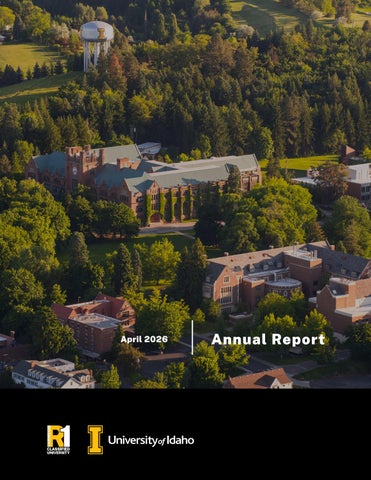
April 2026
Annual Report
Over the past year, the University of Idaho focused on building its foundation for a promising future. After achieving goals in enrollment, research and fundraising, the university introduced a new strategic plan to build on momentum and guide its course through the next five years. In Fall 2025, the university welcomed the second-largest freshman class in school history. In our 10th straight semester of enrollment growth, we posted the largest spring enrollment in our history in 2026. The U of I became the first and only institution in Idaho to receive the Carnegie Research 1 (R1) designation. The university produces more research expenditures than all other higher education institutions combined, and has nationally recognized programs in AI, agriculture, forestry, water, engineering and cybersecurity. When the university’s $500 million fundraising goal was first discussed in 2019, there were many skeptics. But the Vandal Family reached the Brave. Bold. Unstoppable. campaign goal eight months early. The campaign raised over $550 million — far and away the largest philanthropic campaign in Idaho history. More than $160 million from the campaign is dedicated to scholarships, helping the U of I maintain its U.S. News and World Report Best Value status. The average Vandal student receives more than $7,000 in scholarships and aid, which covers more than 2/3 of yearly tuition for in-state students. Throughout the 2024-25 academic year, the U of I community came together to create a vibrant new five-year strategic plan. The result is a simple, practical document to guide operations and priorities through 2030. Building on institutional strengths and utilizing AI technology to improve efficiency and effectiveness, the strategic plan will lead the U of I through a challenging period. The enrollment cliff, funding decreases and a shifting research environment are all challenging higher education and we are investing in strategic areas to get ahead of those changes. Through intentional planning and sound investment, the U of I is building on its success by implementing new educational and operational models for the rapidly changing world economy. Go Vandals!
President Scott Green
2
Student Gems
4
Strategic Plan
6
AI Initiative: teaching, training, curriculum
11
Student Success
17
Research Activities and Expenditures
18
U of I Fundraising
20
Building Our Future
25
Conclusion
student
GEMS year in a row U.S. News & World Report best value ranking
75,339 K-12 students served
11,326
12,383
enrolled in organized clubs via UI Extension
4-H 2,762
total student count for Fall 2025
54
degrees and certificates awarded
U of I Researchers ranked as THE TOP in their fields.
2
ANNUAL REPORT | APRIL 2026 | UIDAHO.EDU|ANNUALREPORT
Freshman retention
up 1.7% from 2024
Idaho resident undergrad enrollment
up 5% over 2024
$151.5M in research expenditures
McCall Outdoor Science School
1,758 K-12 students served
3
STRATEGIC PLAN Intro University of Idaho’s Strategic Plan for 2026-2030 is built on a solid foundation. Growing enrollment, and record-setting fundraising and research puts the university in excellent position for the last half of the decade.
IGNITE student success
DRIVE
The strategic plan will carry the institution through a critical time. Importantly, artificial intelligence is embedded in each pillar of the strategic plan as a tool to elevate student success, partner with Idaho industry, accelerate discovery, enhance operational excellence, and extend the university’s impact. This hard work is a credit to our employees and dedication of the broader Vandal Family. Loyal alumni, innovative faculty and staff, enterprising students and a supportive community have positioned us for national leadership in higher education.
experiential learning for all students
ADAPT
the educational model
HARNESS
research innovation and partnerships
OPTIMIZE
operational excellence
4
ANNUAL REPORT | APRIL 2026 | UIDAHO.EDU|ANNUALREPORT
Strategic Plan Investment Grants Manager: Michele Bartlett, Director of Executive Projects and Strategic Initiatives In November, 2025, University of Idaho announced preliminary award decisions for the 2026-2030 Strategic Plan Investment Grant Program (SPIGP). These awards reflect a major institutional investment in advancing the new strategic plan and strengthening alignment across our five pillars, as well as the university-wide AI initiative. Following a rigorous review process by a broad spectrum of internal leaders and stakeholders including employees and students, 35 proposals were selected for funding across five pillars. These projects reflect broad engagement across the institution and demonstrate strong alignment with university priorities in student success, experiential learning, innovation, research excellence and operational effectiveness.
Program overview SPIGP was launched to catalyze high-impact initiatives that advance the 2026-2030 Strategic Plan. Proposals were evaluated for alignment with pillar goals, measurable return on investment, scalability, and potential to transform operations, research and student experience. Funding decisions were guided by the principles of transparency, collaboration and strategic balance — ensuring that awarded projects represent both immediate institutional priorities and longer-term capacity-building investments.
5
AI initiative: teaching, training and curriculum Champion: Ben Hunter, Dean University Libraries In addition to the five strategic pillars, a cross-cutting AI Literacy and Faculty Development Initiative is advancing campus-wide AI integration in teaching, research and operations.
Currently The university introduced an incentivized training for faculty members using a six-hour course called, “AI in Teaching and Learning.” About 250 people have registered for the training and many have already completed it.
6
A team with representation from every college is working on strategies to integrate AI literacy throughout the curriculum, including disciplinespecific instruction. This summer, incentives will be available for faculty members to integrate AI into their curriculum.
ANNUAL REPORT | APRIL 2026 | UIDAHO.EDU|ANNUALREPORT
AI and Operational Excellence The University of Idaho was awarded a $4.5 million grant leveraging generative artificial intelligence (AI) to streamline administrative processes and drive efficiency in research management. The project represents a transformative step toward reducing administrative burdens. Principal Investigator Sarah Martonick, director of the Office of Sponsored Programs, leads the team, which is
funded through the National Science Foundation’s (NSF) GRANTED program. The goal is to enhance the U.S. research enterprise by improving administration support infrastructure, increasing service capacity and broadening participation by developing institutions across the national research landscape.
7
Strategic Plan Performance Measures: 2025 metrics Student Access / Annual Enrollment:
Headcount (14,931) FTE (10,120) Student Retention:
77%
Student Success /
60%
6Y Graduation:
Student Affordability US News & World Report Best Value Ranking Post-graduation success / starting salary:
average: $61,279 median: $56,670 Research Expenditures:
$151.5M 8
ANNUAL REPORT | APRIL 2026 | UIDAHO.EDU|ANNUALREPORT
STUDENT ACHIEVEMENT LONGITUDINAL DATA 6-Year Graduation Rate (First-time Full-time Freshmen) FY26 benchmark: 59%
Fall 2015
Fall 2016
Fall 2017
Fall 2018
Fall 2019
59%
61%
61%
57%
60%
65 60 55 50 45 40 35 30 25 20 15 10 5 0
First-to-Second Year Retention (First-time Full-time Freshmen) FY26 benchmark: 77%
Fall 2020
Fall 2021
Fall 2022
Fall 2023
Fall 2024
75%
74%
75%
76%
77%
80 75 70 65 60 55 50 45 40 35 30 25 20 15 10 5 0
UI Annual Enrollment (Source: PSR 1 Annual Enrollment Report) FY 26 benchmarks
FY21 (2020-21)
FY22 (2021-22)
FY23(2022-23)
FY24 (2023-24)
FY26 (2024-25)
14,380
12,479
13,007
14,025
14,290
14,931
FTE: 9,651
8,812
8,854
9,175
9,561
10,120
16,000 14,000 12,000 10,000 8,000 6,000 4,000 2,000 0
Headcount
FTE
9
Strategic Plan Conclusion
University of Idaho’s overwhelming success over the past half decade sets the stage for a promising future. The 2026-2030 Strategic Plan provides distinct priorities and clear direction as the university continues to deliver on its land grant mission. The university has already invested in executing the plan, backing strategic priorities and supporting units to carry out their respective roles within the plan. Through the use of AI and technology, the university will become more efficient and effective, while equipping students with the skills they need to thrive in the new economy. As Idaho’s R1 research institution, the U of I is well positioned to lead our state through the last half of the decade and beyond.
10
ANNUAL REPORT | APRIL 2026 | UIDAHO.EDU|ANNUALREPORT
STUDENT SUCCESS AND WORKFORCE DEVELOPMENT A new path to the logging and forestry workforce Growing up in the industry, it is no surprise Maria Kinne was one of the first students to enroll in — and graduate from — University of Idaho’s twoyear program that teaches students to operate logging equipment, plan timber sales and track forest land boundaries, in addition to sustainable forest practices and business competence. Kinne graduated with a job with the state of Idaho. “It’s a seasonal job with the Department of Lands, and after that I will likely apply for another state position, or with a forest management company,” said Kinne, who grew up working with her dad, the owner of Odenwald Forestry near Sandpoint. Although Kinne, who graduated high school in 2021, worked as a receptionist during the week to save money for college, she was in the woods on the weekends operating chainsaws and a mini backhoe to remove and pile forest slash.
Using the U of I Experimental Forest as its outdoor classroom – the forest includes 10,300 acres of actively managed, productive working forestland – she learned to operate equipment including a Caterpillar 538 Logging Processor with Waratah attachments and a John Deere 648L Grapple Skidder, hand fell trees and cruise timber. “We were taught about forest operations on a large scale, and in an office setting,” she said. One of her most rewarding classes was a mapping and surveying course in which students laid out a timber sale using GIS coordinates. “We learned to lay out a unit within land boundaries, which is something you must know if you work in forestry or logging,” she said.
Before enrolling at U of I, Kinne considered attending college, but wasn’t sure what to study. After a couple of years in the workforce her father told her about a program at U of I that may interest her. “He learned about it at a logging conference,” she said. The idea appealed to her. “I knew I didn’t want to go to school for another four years, and since this associate’s degree could be completed in two years, and I could continue to do what I loved – being in the woods, working in the timber industry, I decided to go for it,” she said. She had already acquired some of the know-how to be employed in the forest resource profession, but the program bolstered her skillset and gave her a broad repertoire.
11
U of I team designs AI-driven solutions for Idaho-based sugar processing company For nearly three decades, Amalgamated Sugar searched for a reliable way to automate one of its most challenging pieces of equipment: the steam dryer used to process sugar beet pulp. The breakthrough came through a collaboration with University of Idaho, where a graduate student’s innovative use of artificial intelligence helped turn years of data into a practical safety and efficiency solution. After meeting with Amalgamated Sugar’s leadership at the company’s Nampa facility, doctoral student Hunter Hawkins began thinking about how AI could address the persistent problem of dryer “plugging” events. These blockages force the dryer to be manually shut down and requires employees to enter a hot, pressurized, and potentially flammable environment to clear the system—posing serious safety risks and sometimes costing the company days of lost production. Hawkins, who specializes in computer science and industrial automation, saw an opportunity. While waiting for a delayed flight with John Shovic, director of the Center for Intelligent Industrial Robotics at U of I Coeur d’Alene, Hawkins began
sketching out an AI-driven approach. Drawing on years of historical data already collected from the dryer—nearly 100 different data points—he proposed a hybrid AI system that could predict problems before they occur. “I actually combined two models for this project,” Hawkins said. “I wanted to combine the prediction power of a deep-learning AI model with the explainability of a traditional machine-learning model. The result is a hybrid model that drives a dashboard, giving the Amalgamated team predictions and alerts to potential issues.” The proactive alert system benefits Amalgamated by reducing risk as well as actual damages. Instead of reacting after a shutdown, operators can now intervene early, often restarting the dryer in less than an hour and avoiding dangerous manual inspections altogether. For Amalgamated Sugar, which processes more than 7 million tons of sugar beets annually and produces millions of pounds of sugar each day, the system represents a major step forward in both safety and operational reliability. For U of I, the project highlights the value of industry partnerships that give students real-world problems to solve. “We feel very lucky to be involved with U of I,” said Scott Hyer ‘10, operations manager at Amalgamated Sugar. “They’ve come down to us multiple times and that has helped us gain a better understanding of what they’ve put together and how the process works. Having a local collaboration is very beneficial for both Amalgamated and U of I.”
12
ANNUAL REPORT | APRIL 2026 | UIDAHO.EDU|ANNUALREPORT
Education leadership cohorts help Idaho teachers advance Savannah Fritz ’06, ’25, an English teacher at Meridian High School, knew it was time for a change. After 20 years in the West Ada School District, she wanted to move into education administration while remaining connected to the high school she both attended and now teaches in. To do that, she needed advanced training designed for working professionals — and she knew exactly where to turn: University of Idaho’s College of Education, Health and Human Sciences (EHHS). Fritz recently earned her Master of Education in educational leadership as part of a two-year online cohort created specifically for West Ada teachers and support staff. The program allowed participants to continue working full time while preparing for administrative roles within their district. “We call this a ‘grow your own’ program,” said Bethani Studebaker, director of assessment and accreditation in EHHS’s Department of Leadership and Counseling. “The need in Idaho for trained administrators is really significant right now, which is why we’ve created cohort options within our master of education program.” For Fritz, the degree provided a pathway to influence change. She realized that many of her concerns — teacher turnover, mentoring and access to resources — required a seat at the decision-
making table. “I want to solve problems instead of just raising them up,” she said. Fritz completed the program alongside colleagues like Jill Ayabei ’25, a West Ada coordinator who valued the collaborative, experience-driven nature of the cohort. “Using the expertise of everyone in the room is extremely important in this job,” Ayabei said. The relationships built through the program also paid off professionally: West Ada recently created new Dean of Student Achievement positions, and three cohort members were hired into those roles. U of I’s cohort-based approach extends to the Indigenous Knowledge for Effective Education Program (IKEEP), in which the university supports Native educators pursuing leadership roles while honoring cultural context. Iris Chimburas ’05, principal of Coeur d’Alene Tribal School, is earning her principal certification through IKEEP, continuing a family legacy of Native educational leadership. Across districts and communities, U of I’s Master of Education in educational leadership meets the needs of adult learners seeking career advancement, practical preparation, and the opportunity to lead meaningful change — without leaving the classrooms and communities they serve.
13
Alumni-led mentorship connects U of I students career-ready skills Leah Holmgren, a College of Education, Health and Human Sciences undergraduate student athlete, completed her internship under the direction of two other Vandals whose own experience led them to give back by mentoring current students.
“The students are treated like employees. It’s like an ongoing interview. It gives them the skills to get a job — not just in cardiac rehabilitation but in other areas as well,” Loesch said. “The skills are transferable.”
Kristi Holden and Allyssa Loesch both earned master degrees in exercise science from U of I and work together at Gritman Medical Center’s cardiac rehabilitation clinic.
Mentorship plays a key role in helping students grow during their placements.
“I was unsure if working in a clinic would be something I truly wanted. After meeting all the patients in the Cardiac Rehab program I am excited to continue toward a clinic-based career,” said Holmgren. “Helping others is something I am excited about. Especially after watching Kristi and Allyssa set such great examples. The patient’s success comes from the environment that they create together.”
“I appreciate that Kristi and Allyssa gave me the room to learn without being coddled. This is a great skill to practice for going into the medical field. I also am glad to have gained such valuable hands-on patient experience,” said Holmgren.
EHHS Instructor Emma Grindley, who coordinates the practicum and internship program, said these hands-on experiences are invaluable for students. “Practicum and internships allow students to sample different careers, make connections between the classroom and the real world, and gain experience working directly with real clients and patients,” she said. “All of this helps students grow in knowledge, skills, professionalism, confidence and clarity in career direction.” Holden said the students who come to cardiac rehab gain valuable, real-world experience from day one. “Working at cardiac rehab is a great experience. On day one, students interact with patients,” she said. “Throughout their time with us, they learn the ins and outs of supervised exercise, education and the career. They also get to connect with patients and learn from them, too.” Hands-on experience is a cornerstone of all EHHS programs, woven into every degree’s coursework to ensure students gain real-world skills. Collaborations with industry leaders like Gritman Medical Center provide valuable opportunities for practical learning and professional growth.
14
ANNUAL REPORT | APRIL 2026 | UIDAHO.EDU|ANNUALREPORT
Political science major fast tracks through U of I’s 3+3 program As a youngster, Isabella Sindelar made waves in the classroom and the swimming pool as the kid who loved to argue almost as much as she loved to swim. After earning an associate degree, Sindelar did a deep dive into what she wanted her future to look like. She realized earning a law degree whetted her competitive spirit. Sindelar is in her third year at University of Idaho School of Law enrolled via the 3 + 3 program, a College of Letters Art and Social Sciences fast track that allows applicants to earn a bachelor’s in three years followed by three years of law school. “Because of the fast-track program, Idaho was the only school I applied to,” she said. After her first year of law school, Sindelar earned her bachelor’s, and she and a group of U of I law
students chose to study abroad in Florence, Italy, with peers from Gonzaga University Law. In 2017, U of I’s College of Law became an affiliate school to Gonzaga’s Florence Summer Law Program. U of I law students can join the program thanks to the affiliation and study at the Gonzaga campus in Italy. Sindelar and a U of I teammate won the Best Lawyer-Client Interaction in the program’s annual summer mediation competition. “U of I Law encourages an externship after your first year of law school. I decided I would rather pay for that coursework while learning overseas,” Sindelar said. “I went to Italy, and it was such a great experience learning with students from all over the world. It was really a good deal.” Upon her return, she completed an internship in Lewiston at the Clark and Feeney law firm and joined the student bar association, becoming its president. She also gained hands-on experience at the school’s Community Law Clinic. The clinic offers third-year law students the opportunity to provide free legal services under the guidance of a supervising attorney with cases commonly handled by Idaho lawyers. “We do almost everything an attorney does,” said Sindelar, whose goal when she enrolled in law school was to pursue family law. “We go to court hearings and trials and see the cases through until the matter is over.” Her most memorable experience at U of I was meeting the state’s Supreme Court justices. “We got to know them and see them in session,” she said, “It’s pretty rare. We were pretty lucky. I was kind of star struck and amazed at how accessible they are.” Sindelar, who plans to stay in Idaho, said the 3+3 program that brought her to U of I was a great fit for a motivated student.
15
Student researchers track Idaho wolves, collect DNA and study pack families Hearing the howl of a wild wolf in Idaho’s wilderness areas is one of the rewards students get after days of 10-to 20-mile hikes in the backcountry to collect wolf droppings, locate dens and document wolf gathering and home sites — called rendezvous sites — as part of an ongoing study of wolves in Idaho led by the College of Natural Resources and its USGS Cooperative Fish and Wildlife Research Unit. Peter Rebholz, a former carpenter who came to the West to study big wild animals, and earn his master’s degree at University of Idaho studying Idaho wolves, has been leading U of I student researchers into Idaho’s backcountry for several years as he collects DNA from wolf scat to precisely document the family trees of 20 wolf groups in the state. “We’re out here for nine days at a time hiking, camping, setting up trail cameras and looking for wolves and their rendezvous sites,” Rebholz said. “What we want from the rendezvous sites are genetic samples from scat.” From the wolf feces, Rebholz and the students scrape a few flakes off the top layer that contains
16
the animals’ epithelial cells. The flakes harbor the DNA from the individual that dropped the scat. The samples are bagged, marked and later used to identify the specific animals via its DNA. “We can get a genetic sample from each individual in that pack,” Rebholz said. “From that sample we can create pedigrees — large family trees of these wolf packs, and we’ve been doing this for the same packs for the past 20 years.” From the pedigrees of 20 wolf packs in four main study areas across the state of Idaho — the Coeur d’Alene National Forest, Boise National Forest, Salmon-Challis, and Island Park west of Yellowstone — researchers document the evolution of each wolf pack and annually learn about the pack’s structure. They learn which are the dominant wolves, which are parents, whether any wolves have died and which individuals replaced them. The research helps biologists at Idaho Department of Fish and Game and other agencies learn what effect hunting and trapping has on wolf packs and helps game departments make decisions about wolf management.
ANNUAL REPORT | APRIL 2026 | UIDAHO.EDU|ANNUALREPORT
FY25 RESEARCH ACTIVITY AND EXPENDITURES Expenditures are actual dollars spent on research as a measure of research activity. Research activity is the number of proposals and dollars awarded, not all of which is spent at the time of the report.
Total Research Expenditures by Fiscal Year
Total Research Expenditures in FY25 by Funding Source
155,000,000
$151,511,273
150,000,000
(Dollars in Millions)
145,000,000
$140,412,744
130,000,000
125,000,000
120,000,000
Institutional $27.1
State $46.5
135,000,000
TOTAL
Other $5.0 Business $1.3
$151.5
DOLLARS
$135,900,538
140,000,000
$115,603,021
115,000,000
110,000,000
Federal $71.6
$105,894,523
105,000,000
100,000,000
Portion of Federal Research Expenditures by Sponsoring Agency
95,000,000
90,000,000
FY21
FY22
FY23
FY24
FY25
0
DHHS $13.3
YEAR
(Dollars in Millions) Energy $4.2
Summary of Sponsored Proposals and Awards Activity in FY25 SPONSORED PROJECTS
NUMBER
AMOUNT
Proposals Submitted
764
$297,990,840
AWARDS RECEIVED
NUMBER
AMOUNT
New Awards
409
$65,956,437
Other Actions
177
$44,931,882
TOTAL AWARDS
586
$100,888,319
FY 25 STATS
$151.5 M
in research expenditures
NASA $3.5 DOD $0.4 NSF $20.5
TOTAL
$71.6
Interior $4.7 DOT $0.5 Education $0.6 EPA $0.3 Other $0.3
USDA $23.3
409
new awards
17
invention disclosures
3
new licenses
17
FUNDRAISING HIGHLIGHTS FOR 2025 In Fiscal Year 2025 (July 1, 2024-June 30,2025), donors contributed the largest amount for a single year in U of I history, making FY25 the fifth year in a row in which donors contributed more than $50 million to the U of I. The FY25 fundraising total was $67.6 million, a 29% increase over FY24. More than 7,600 individuals, families and organizations made 15,384 gifts, with $19.3 million going to scholarships and student financial aid; $38.5 million to research and academics; $7.5 million to faculty support; and $2.3 million to facilities, operations and community outreach.
18
Vandal Giving Day 2025 raised $1.28 million in only 1,889 minutes, the largest total in the event’s nineyear history. The one-day effort also pushed the Brave. Bold. Unstoppable. philanthropic campaign beyond the $500 million milestone eight months before its official end on Dec. 31, 2025. By the end of 2025, the campaign raised more than $550 million. More detailed information will appear in the 2027 Annual Report. Donors established 58 new endowments in FY25, including 43 scholarship endowments for funding across colleges, majors and activities, including athletics, 4-H Youth Development, study abroad and Greek Life.
ANNUAL REPORT | APRIL 2026 | UIDAHO.EDU|ANNUALREPORT
STUDENT TESTIMONIALS Macie Grantham ’26 Child Development and Psychology “Being a Vandal has been such a positive experience for me, and the professors and friends I have met have made every second so worth it. Because of the support I’ve received through scholarships, I’ve been able to fully commit myself to strengthening my passion for child development and early education. Donor generosity has opened doors to experiences that have shaped who I am, both personally and professionally. Their investment in students like me truly changes lives, and I am deeply grateful.”
Luna Migueles Miralles Master of Fine Arts “What I love most about being a Vandal is the sense of gratitude it has instilled in me. This community has connected me with inspiring people and opened unexpected opportunities. Scholarship support reinforces my confidence in my work and my decision to move far from home in pursuit of new opportunities. I will carry this encouragement with me as I continue my artistic journey.”
Jon McKenzie ’28 Law “I took a huge leap of faith by returning to higher education as an older student. Without donor generosity, this opportunity would not have come to fruition. In 2024, I was blessed to graduate alongside my two adult children, and in my first month of law school, I was elected by my class as the 1L representative of the Student Bar Association. My wife, our two adult children, our two grandchildren and I send our endless appreciation for this honor.”
James Cornelius ’28 Finance and Marketing “My Vandal experience has been nothing short of incredible! I’ve connected with a community unlike any other, and it’s been transformative in many unforeseen ways. I don’t take a single moment for granted because I know it’s a result of the generosity of others. I only hope that someday I can pay it forward and give other people the same blessings.”
19
BUILDING OUR FUTURE
20
ANNUAL REPORT | APRIL 2026 | UIDAHO.EDU|ANNUALREPORT
Meat Science and Innovation Center Honoring Ron Richard
Idaho CAFE
The Meat Science and Innovation Center Honoring Ron Richard opened in early 2026. Located on the Moscow campus, it will accommodate larger classes of students, greater research and training opportunities and expanded production to match the prestige of the meat science program and its student-run retail arm, Vandal Brand Meats.
Dairy is the No. 1 agricultural commodity in Idaho and this year the U of I will open the nation’s largest research dairy. Located in the heart of the dairy industry in Idaho’s Magic Valley, the Center for Agriculture, Food and the Environment, or CAFE, includes all the components of a typical Idaho dairy built to accommodate 2,000 cows, which represents the average herd size in Idaho. CAFE builds upon current research to develop new technologies to convert dairy manure into valuable products like fertilizers, bioplastics and clean water, helping our dairy farmers achieve sustainable solutions while realizing additional revenue streams. This strategic investment by U of I, in partnership with the state and private industry, ensure the continued national prominence of Idaho’s dairy industry. By the end of 2026, CAFE will have 400 cows on site,
U of I meat science graduates enjoy a 100% job placement rate with employers like Albertsons and AgriBeef. The facility will continue filling a niche as one of the few USDA-inspected plants where northern Idaho ranchers can process their beef. It will also train skilled workers to staff several large meat processing facilities that have opened in Idaho in recent years, including Intermountain Packing in Idaho Falls, True West Beef in Jerome and CS Beef Packers in Kuna. Classes in the new space began this spring semester and a grand opening event is April 10.
building up to a herd size of 2,000 longer term.
21
Campus housing projects
Military Science and Veteran’s Assistance Center
Major upgrades to student housing on the Moscow campus are underway. The South Hill housing project will offer modern, sustainable housing for graduate students, married couples and families at U of I, beginning in Fall 2026. The development includes 451 total beds to meet a range of housing needs and help attract new students. The project replaces apartments that were long overdue for replacement. Undergraduate residence hall improvements are progressing, as well. Ongoing room remodels in Theophilus Tower and Wallace Residence Center are providing amenities like air conditioning. These ongoing projects are crucial for student
State funding awarded in 2025 officially launched the fundraising and planning processes for the Joint Military Science and Veteran’s Assistance Center on the south end of campus. U of I’s land grant mission calls for a focus on military science education, and the new center will greatly elevate the university’s ROTC programs. By renovating Targhee Hall, U of I will provide a functional space where multiple units can gather in one location. A consolidated facility promotes interaction and mentorship among Veterans, service members and future officer leadership of all branches.
recruitment and retention.
22
ANNUAL REPORT | APRIL 2026 | UIDAHO.EDU|ANNUALREPORT
D.A. Huckabay M.D. Medical Education
Maintenance projects
The D.A. Huckabay M.D. Medical Education expansion is nearly complete. Our 80 Idaho WWAMI Medical Education students are already using the extension for simulation training purposes. The extension offers simulation training rooms, faculty and staff offices and a classroom. Use of these spaces will increase with the first cohort of Doctor of Clinical Psychology (PsyD) students that begin instruction in Fall 2026. The extension also offers much needed spaces for other degrees in the U of I School of Health and Medical Professions including: Gerontology, MS; Doctor of Anatomical Sciences, DAS; Masters of Athletic Training, MSAT; Doctor of Athletic Training, DAT. The extension also provides space as well as anticipated future growth in our
Across the university, numerous deferred maintenance projects took place in 2025, including upgrades in Hays Hall and new HVAC systems in the E.J. Iddings Ag Science Building. The projects were funded by the university as well as the state’s Permanent Building Fund, the state legislature and the governor. These infrastructure projects help prevent system failures and preserve our historic campus, improving conditions for our students and employees.
programming.
23
24
ANNUAL REPORT | APRIL 2026 | UIDAHO.EDU|ANNUALREPORT
CONCLUSION After years of steady enrollment growth, increased financial stability, successful fundraising and record research output, the University of Idaho is well-positioned for the future. Across the country, higher education faces a tumultuous future with the enrollment cliff and funding shortages already causing challenges. Thoughtful, community-centered planning and strategic investment in areas of strength —using AI— put the U of I on a path to lead Idaho into the future.
25