WINTER 2026 - 27 | VOL. 42
RESOURCES U of I researcher begins creating a new post-fire tool for rangelands Discover how wildfire research at Rinker Rock Creek Ranch is aiding the development of a new post-fire tool specific to rangeland management.
Students hike, howl and collect DNA in Idaho wolf study Watch and read how U of I researchers track wolf ancestry during a nine-day research hike.
English graduate student creates an archival document recording CNR’s history Learn more about the work of a graduate research assistant that combines archival research and the chronology of CNR from 1984-present.
photo by: Mark Kimsey
STUDENT SUCCESS | SUSTAINABLE SOLUTIONS | THRIVING IDAHO
WINTER 2026 - 27
Volume 42
INSIDE 2 3 4 6 8
10 15 18 20 22 24 24 27
Welcoming readers Letter from the dean CNR making headlines
The College of Natural Resources magazine is published annually for alumni and friends of CNR. Subscription is free. The magazine also is available online in its entirety at uidaho.edu/cnr.
Magazine Staff & Contributors Dennis Becker, dean
Students hike, howl and collect DNA in Idaho wolf study
Annalise Mitchell, writer in residence
Wildfire management research tailors evacuation procedures to individual communities
Ralph Bartholdt, U of I Communications and Marketing
Faculty mentors help CNR students grow through research partnerships
Leigh Cooper, U of I Communications and Marketing
U of I researcher begins creating a new tool for rangelands Grad student collaborates with CNR to catalogue their history
University of Idaho 875 Perimeter Drive MS 1142 Moscow, ID 83844-1142
Online environmental science students make an impact nationwide
Email: cnr-alumni@uidaho.edu
Keeping up with CNR
Photography – U of I Visual Productions. Other image credits noted on the pages where they appear.
In memory Celebrating faculty and alumni retirements Another successful year of fundraising for U of I and CNR
go.uidaho.edu/cnrmag correct QR to come
Design – U of I Creative Services
U of I Moscow is located on the homelands of the Nimiipuu (Nez Perce), Palus (Palouse) and Schitsu’umsh (Coeur d’Alene) tribes. We extend gratitude to the Indigenous people that call this place home, since time immemorial. U of I recognizes that it is our academic responsibility to build relationships with the Indigenous people to ensure integrity of tribal voices.
We want to hear from you! As a part of our CNR
family, it’s important to us that you stay connected. Please keep us informed of your latest news and accomplishments at uidaho.edu/ cnr/alumni-and-friends to share.
Find more stories about the College of Natural Resources and our amazing students and faculty!
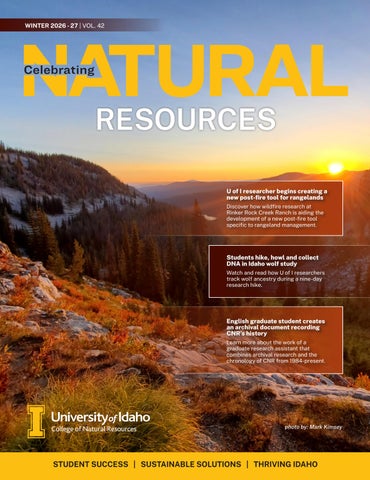
On the cover: The first rays of a sunrise are captured along one of the hiking trails in Gospel Hump Wilderness, an area protected by U.S. Forest Service and located east of Riggins. Photo by Mark Kimsey
Scan QR codes with your mobile device’s camera to instantly access online links throughout the magazine.
2 | WINTER 2026 - 27
LETTER FROM THE DEAN
Photo credit: Dennis Becker.
Dear Alumni and Friends, There are things about a land-grant university that make it stand above the rest. Our mission as established by Congress in the Morrill Act of 1862 is to serve the state, to provide for the education, training, and research needs of our communities in Idaho. What makes CNR so special in that regard is the quality of our student-faculty mentorships and the hands-on training students receive. Whether the class size is seven or 70, our faculty take great care to tailor their mentorship with each student in mind. Our students work closely with professors to open doors to internships, permanent jobs and lifechanging experiences. This ensures that they graduate with knowledge, experience and confidence in their skills to serve in our ever-growing technological world. The stories in this issue feature students who are making valuable connections with their professors. Peter Rebholz, a doctoral student, conducts research on wolf DNA that will help the Idaho Department Fish and Game develop better management practices. Leland Bennion, a researcher at Rinker Rock Creek Ranch in Hailey is studying post-fire burn severity to develop new tools to help ranchers and public agencies better manage rangelands after fires. And
Callie Galford, a graduate student, is creating a living document that captures the rich history of our college and the people who influenced it. Our students don’t just graduate to work for someone, they drive innovation and challenge conventional wisdoms. They strive to make a difference. You — our alumni and friends — are also what makes CNR special. It is because of your mentoring of students when they enter the workforce. It’s you that transforms ideas and information into knowledge for a better future. Your generosity of time, treasure and talent allows our students, graduate and undergraduate alike, to have these experiences. You prepare them for jobs that are vital to our everchanging world. If you are interested in contributing toward student scholarships, research or faculty support, please reach out to me. In the meantime, enjoy the enclosed stories and updates from our students, staff and faculty. We have much to celebrate, and this is just the beginning.
Thanks, Dennis (CNR ’02)
COLLEGE OF NATURAL RESOURCES | 3
CNR MAKING HEADLINES U of I alumnus wins major award for recent screenplay Palouse Screenwriters Photo credit: Maurice Hornocker
David Johnson, a U of I alumnus, received top prize for his screenplay adaptation of his book, “Cougars on the Cliff,” which he co-authored with celebrated CNR professor emeritus Maurice Hornocker. Johnson was presented the Rhodium Award at the Nature Without Borders International Film Festival. As part of the award, Johnson’s screenplay is being considered for production by Polaris Pictures.
Dean Becker discusses natural resources in Idaho podcast
Dean Becker
The Ranch Podcast Photo credit: The Ranch Podcast
Dennis Becker, CNR dean, discusses the complexities of natural resources in America during an interview with The Ranch Podcast. Scan the QR code above to hear the full episode.
U of I partners with Spokane Colleges for smoother degree transfers Tribal Gaming and Hospitality Photo credit: Visual Productions
Rex, one of the stars in Johnson’s award-winning screenplay, poses for his glamour shot.
4 | WINTER 2026 - 27
Spokane Colleges, a community college district in Spokane, Washington, recently signed a new degree transfer agreement allowing its graduates to transfer directly into U of I’s Bachelor of Science in wildlife sciences with an emphasis in human—wildlife sciences.
UI alumnus leads JBLM team to victory U.S. Army Photo credit: Joint Base Lewis-McChord Public Affairs Office
Chris Beck, ’05, led the Joint Base LewisMcChord (JBLM) Species Management and Modeling Team to victory, receiving the 2026 Secretary of the Army Environmental Award for Natural Resources Conservation for their work promoting readiness and on-base species conservation.
Chris Beck (far left) and his team
Bighorn sheep genetics research findings published
NREM student wins award for entrepreneurial product
Photo credit: U of I Visual Productions
Photo credit: Chris Zajchowski
A study conducted by Lisette Waits, distinguished professor of wildlife sciences, alongside colleagues from the University of Montana and Idaho Department of Fish and Game (IDFG), found a significant decrease in gene mixing between desert bighorn sheep and Salmon region bighorns over the past century. This intermixing once gave Idaho’s native bighorn sheep a better chance of survival by increasing genetic variation.
Tyler Christner, natural resources and enterprise management (NREM) student and founder of Boundary Sign, won the annual pitch competition hosted by U of I’s College of Business and Economics. Christner is partnering with a manufacturer in Spokane, Washington to begin large-scale production and sales of the novel product.
Christner (second from left) talks with business professionals at the annual U of I entrepreneurial pitch competition.
Maria Kinne’s story highlighted in local newspaper Bonner County Daily Bee Photo credit: Melissa Hartley
Kinne confidently operates large logging equipment while practicing her skills in the UI Experimental Forest.
Local newspaper Bonner County Daily Bee featured Maria Kinne, ’25, and her trailblazing achievement as one of the first students to enroll and graduate from U of I’s associate degree program in forestry operations and technology. She recently accepted a job with the Idaho Department of Lands in Orofino.
COLLEGE OF NATURAL RESOURCES | 5
FEATURE
U of I researcher Peter Rebholz mimics a wolf howl while on an nine-day research hike in the Salmon-Challis.
Students hike, howl and collect DNA in Idaho wolf study U of I researchers uncover wolf family trees through backcountry fieldwork Article by Ralph Bartholdt, University Communications and Marketing Photos and video by Peter Rebholz Published in December 2025
At the edge of a mist-shrouded meadow near central Idaho’s Salmon River five student researchers stand knee deep in larkspur and Indian paintbrush as one of them uses a funnel to project a mock wolf howl into the silence around them.
6 | WINTER 2026 - 27
After a few tries, a wild wolf returns a howl from a forested mountain slope on the other side of the clearing. U of I wolf researcher and doctoral student Peter Rebholz gives the students a thumbs up. The return howl confirms Rebholz’s hunch that wolves are nearby. “Howling is kind of our ace in the hole,” Rebholz said. “It is our best method to locate wolves.” Hearing the howl of a wild wolf in Idaho’s wilderness areas is one of the rewards students get after days of 10- to 20-mile hikes in the backcountry to collect wolf droppings, locate dens and document wolf gathering and home
sites — called rendezvous sites — as part of an ongoing study of wolves in Idaho led by the College of Natural Resources and its USGS Cooperative Fish and Wildlife Research Unit. Rebholz, a former carpenter who came to the West to study big wild animals and earn his master’s degree at University of Idaho studying Idaho wolves, has been leading U of I student researchers into Idaho’s backcountry for several years as he collects DNA from wolf scat to precisely document the family trees of 20 wolf groups in the state. “We’re out here for nine days at a time hiking, camping, setting up trail cameras and looking for wolves and their rendezvous sites,” Rebholz said. “What we want from the rendezvous sites are genetic samples from scat.” From the wolf feces, Rebholz and the students scrape a few flakes off the top layer that contains the animals’ epithelial cells. The flakes harbor the DNA from the individual that dropped the scat. The samples are bagged, marked and later used to identify the specific animals via its DNA.
“
From the pedigrees of 20 wolf packs in four main study areas across the state of Idaho — the Coeur d’Alene National Forest, Boise National Forest, Salmon-Challis, and Island Park west of Yellowstone — researchers document the evolution of each wolf pack and annually learn about the pack’s structure. They learn which are the dominant wolves, which are parents, whether any wolves have died and which individuals replaced them.
One of the best parts of my job is that I get to live in the national forest for five months every year.” PETER REBHOLZ Researcher, Ph.D. ’26
“We can get a genetic sample from each individual in that pack,” Rebholz said. “From that sample we can create pedigrees — large family trees of these wolf packs, and we’ve been doing this for the same packs for the past 20 years.”
Last summer’s student wolf researchers included (left to right) Jade Cornaby, Kaylie Hallcox, Michael Jensen, Koryna Boudinot.
Last summer’s student wolf researchers included (left to right) Jade Cornaby, Kaylie Hallcox, Michael Jensen, Koryna Boudinot.
The research helps biologists at Idaho Department of Fish and Game and other agencies learn what effect hunting and trapping has on wolf packs and helps game departments make decisions about wolf management. Studying Idaho’s wolves to provide managers with up-todate information on the animals is rewarding and the reason for Rebholz’s field work, but there are additional perks, he said.
“One of the best parts of my job is that I get to live in the national forest for five months every year,” he said. “I get to see places people haven’t visited in years, or maybe at all. There are all these special little corners of the map we get to go in looking for these hard-to-find species.”
To learn more about Rebholz’s research in video format, scan the QR code. COLLEGE OF NATURAL RESOURCES | 7
FEATURE
Wildfires can spread across an area with multiple private-land boundaries, which directly affects the homeowners’ response to the fire.
Wildfire management research tailors evacuation procedures to individual communities Elena Doss is helping communities and policymakers improve wildfire preparedness by studying how people make evacuation decisions By Annalise Mitchell Photos by Elena Doss July 24, 2026
When tornado sirens go off, most parents wouldn’t expect their kid to be running outside to watch it blow through. But for Elena Doss, a doctoral student in natural resources, that was a pivotal part of her childhood. “The weather channel was always on in my house,” Doss said. “That curiosity with natural hazards has stuck with me from a very young age.”
8 | WINTER 2026 - 27
After completing her master’s degree in public policy at Oregon State University, her interests began to narrow into what is now the focus of her doctoral research at University of Idaho. Doss, alongside her advisor Travis Paveglio and other colleagues across the West, is researching wildfire management approaches, including evacuation preferences of rural Idaho communities located in wildfire-prone areas. “I’m specifically interested in the human dimensions of wildfire management,” Doss said. “Like most natural hazards, it doesn’t acknowledge the physical boundaries we’ve created as humans.” For example, a fire could begin on public land, transfer over to private, and come back to public areas. This is one of the reasons why Doss is concerned with the behavioral aspect of wildfire management. “While you can do vegetation maintenance or structural hardening, those decisions across boundaries will direct how you manage that wildfire,” Doss said. “It’s a very human-oriented process.”
prioritize and award funding to rural communities to better their response to wildfires. “My hope is that this research will illustrate a need for more support beyond just the fiscal and physical,” she said. “Since there’s no one-size-fits-all solution when it comes to community improvement, I want my research to provide a flow chart of information that can assist policymakers and leaders when thinking about how to increase the safety of that population.”
Outside of her research, Doss enjoys traveling to different areas in the U.S., including the Koolau Range in Hawaii, pictured here.
She begins her research with the distribution and collection of questionnaires to gain deeper insight into residents’ behavioral responses to wildfire. Doss and her team visit the community, talk directly to homeowners about their wildfire evacuation preference, then leave them with a survey to fill out that will assist Doss in collecting quantitative data.
“
My hope is that this research will illustrate a need for more support beyond just the fiscal and physical.” ELENA DOSS Doctoral student of natural resources
“We structure the survey as a series of either yes/no or multiple-choice statements, which helps us roughly determine how an individual might respond to a wildfire,” she said. “Whether they stay and defend their land, evacuate, or wait and see, collecting this data is crucial in our collaboration with local leaders in building effective response strategies for each community.” After analyzing the survey responses, Doss plans to expand her research by examining the implementation and progress of Community Wildfire Defense Grants (CWDGs) in the Pacific Northwest. The CWDG is a result of the 2021 Federal Infrastructure Bill designed to
As she moves into her third year, she’ll expand her research participants to include public and private actors. By incorporating all sizes and scales of wildfireprone populations, Doss hopes to create a wildfire preparation tool that can be utilized by towns to make tailored decisions rather than a one-size-fits-all policy. “I think gathering different types of data and different types of participants allows us to capture all points of the narrative, and my advisor Travis is one of the best to do it,” Doss said. Though her desire to work with Paveglio was a main factor that led her to pursue a doctorate at U of I, she recalls how she signed the paperwork before even visiting the campus.
“I’ve been taught that when an opportunity presents itself, you jump on it,” Doss said. “U of I was one of those places that you hear about before you see it, so I knew there might be something special tucked away in the middle of Moscow, Idaho.” Coming from larger institutions, Doss wanted a graduate experience that would not only help develop her resume, but also forge her own community and working relationships with academic and industry professionals. “It’s very student-focused,” Doss said. “There’s a different aspect of community and emphasis on handson learning at U of I that I’ve been very grateful to experience.”
COLLEGE OF NATURAL RESOURCES | 9
FEATURE
Alexis Means observes a herd of bighorn sheep from afar to collect data on their feeding behavior.
Faculty mentors help CNR students grow through research partnerships Four faculty-student pairs share how collaboration, research and mentorship are shaping careers in natural resources By Annalise Mitchell Photos by Alexis Means, Greg Latta, Amber Hawes and Grace Ruble July 29, 2026
In the College of Natural Resources, faculty mentorship allows students to gain valuable insight into the scientific process and make career-building connections within the various industries of natural resources. Discover the shared experiences of four faculty-student pairs as they build professional rapport alongside their research projects. 10 | WINTER 2026 - 27
Natural Resources and Society In Idaho, the Idaho Department of Parks and Recreation manages 30 state parks. Each park holds a rich, diverse history that often goes unknown to its visitors — until now. Chris Zajchowski, assistant professor in the Department of Natural Resources and Society, and Amber Hawes, a doctoral student in environmental science, are working with Idaho State Parks to develop interpretive themes for each of Idaho’s state parks. Interpretive themes refer
“
Mentorship is putting people in places where they can be successful and letting them be successful. It’s a bi-directional relationship.” CHRIS ZAJCHOWSKI Assistant professor of parks, tourism and recreation ecology
existing signage and interview park experts to capture their vision for the new themes.
Chris Zajchowski (left) and Amber Hawes (right).
to the deeper meanings and messages that parks want visitors to take away from their visit. “Oftentimes, interpretation is specifically focused on meaning-making or answering the question of ‘why does this matter?’,” Hawes said. “With this project, we’re trying to show that interpretive themes aren’t just a bunch of facts. We’re making signage that educates visitors on the park’s biodiversity, history and relationship with the area.” Zajchowski and Hawes collaborate with park experts to determine which meanings and stories a park wants told and then analyze that park’s existing media, such as educational trail signs or videos in a visitor center, to determine how well they are capturing those current themes. This analysis culminates in a foundational document for each park that can be used to assist with park training and inform future initiatives for interpretive media development. “Working with Chris, I always feel this sense of ‘I’m part of this’,” Hawes said. “We’re in this together, and our passion for making meaningful content for the public shows in that collaboration.” Hawes is finishing the work that a previous master’s student began. She will visit nine parks to analyze their
In addition to their research, Hawes co-teaches an environmental communications class with Zajchowski, which has allowed her to strengthen her teaching skills. This has prepared Hawes to take over as the lead instructor for the course after she gains more teaching experience during her program. Whether they’re working on a new interpretive theme document or preparing a lesson plan, Hawes explains how Zajchowski’s mentorship style is one rooted in parity, empowerment and collaboration. “Whenever I come in with a suggestion or an idea — whether that’s for research or for teaching — I can tell he’s really listening and that he cares about what I’m saying,” she said. “When I’m talking with Chris, it feels like an actual conversation. I feel very empowered to make decisions.” As for Zajchowski, this collaborative approach to mentorship is exactly what he’s trying to accomplish. “Mentorship is putting people in places where they can be successful and letting them be successful,” Zajchowski said. “It’s a bi-directional relationship. When we’re making lesson plans or revising an interpretive document, it’s a brainstorm.” Zajchowski also hopes that his mentorship will provide Hawes with opportunities that will help her flourish in her doctoral program and beyond, whether that be with ISP or another organization that needs people like Hawes to help educate others on public recreational land. “I feel great knowing that Chris is going to continue supporting and helping me come up with ideas no matter what direction it ends up going,” Hawes said. COLLEGE OF NATURAL RESOURCES | 11
FEATURE
Forest, Rangeland and Fire Sciences If wood is heated to an extreme temperature, its chemical makeup can be altered to such an extent that the amount of moisture it absorbs over time decreases. For her senior capstone project, Grace Ruble, an undergraduate student majoring in forest and sustainable products, is developing a new thermally modified wood product with resistance to water damage for building construction. “This new product will hopefully provide businesses with a sustainable yet efficient product that will minimize major issues like mold, warping and swelling,” Ruble said. Armando McDonald, a distinguished professor in the Department of Forest, Rangeland and Fire Sciences, is mentoring Ruble through her project. Their first collaboration was in McDonald’s undergraduate research lab, where Ruble conducted research on recycled plastics and has since completed other projects in his lab. After learning that McDonald would be overseeing her capstone project, Ruble was thrilled. “Even though I’m an undergrad, Dr. McDonald treats me with the professionalism and high-achieving expectations of a graduate student,” she said. “He even lets me use all the expensive machinery in the lab!” She describes McDonald’s mentorship style as supportive and hands-off.
“
Even though I’m an undergrad, Dr. McDonald treats me with the professionalism and high-achieving expectations of a graduate student. He even lets me use all the expensive machinery in the lab!” GRACE RUBLE Undergraduate in forestry and sustainable products
“When we are in the lab, we’re really encouraged to discover things via trial and error,” Ruble said. “Even if my experiment fails, he’s really supportive, because I’m still learning.” McDonald describes his mentorship style as “steering the boat” with his students. Instead of maintaining full control, McDonald prefers to guide his students toward beneficial skills that go beyond academia. “Whatever industry you pursue, you’re going to need good oral and communication skills,” McDonald said. For Ruble, she knows these communications skills
12 | WINTER 2026 - 27
Grace Ruble (left) and Armando McDonald (right).
could help her one day when working with inspectors or stakeholders. Even though McDonald gives Ruble plenty of independence, he still values discipline and hard work. For him, pushing students outside their comfort zone motivates them to do their best. “They’ve really got to understand that what you put in is what you get out,” he said. “That’s what makes a successful career.” And when a student rises to the occasion, McDonald couldn’t be prouder. “Seeing students succeed is really a good thing,” McDonald said. “It’s like a parent seeing their children go off to college. You feel quite proud that they’ve gone past these milestones, especially when you see a student graduate and move onto their next adventure. That’s rewarding.”
Fish and Wildlife Sciences Bighorn sheep are prone to lethal respiratory diseases, the most prominent being bighorn pneumonia. But a large herd living in the John Day River canyon in central Oregon is not just surviving but thriving disease-free. In 2023, Alexis Means, a master’s student in fish and wildlife sciences, applied for a research assistantship posted by the Oregon Department of Fish and Wildlife (ODFW) and Ryan Long, a professor of wildlife sciences at U of I. The position was for one of Long’s recent studies focusing on the bighorn sheep population in the John Day River canyon. Long was asking why this specific population was thriving in numbers, while many other bighorn sheep populations across the western United States were prone to high disease and mortality rates due to disease contracted from domestic livestock.
“
Being able to connect and collaborate with a variety of colleagues in Long’s lab has been extremely valuable, and a really important part of producing strong science.” ALEXIS MEANS Master’s student in fish and wildlife sciences
Out of over 50 applicants, Means stood out due to her previous experience as a project lead on a research project directed by Courtney Conway, a professor of wildlife sciences at U of I, studying sage grouse and cattle grazing in southern Idaho. “We needed someone who had extensive ecology knowledge and field experience, since this job requires months of solitary work in a remote area,” Long said. Means also demonstrated strong communication skills, which was another quality Long was searching for in a student. As the majority of the bighorn sheep population can only be accessed through private property, working well with landowners was a prerequisite for a successful project. “We weren’t going to be risking those relationships that ODFW had worked so hard to establish,” Long said. “Alexis is extremely personable, and very thoughtful in the way she communicates with people. That was a big draw that set her apart.” After joining his lab, Means began her work in the John Day canyon collecting samples of various plants the sheep were eating and assessing their availability to understand the nutritional value of each food source.
Long notes that Means excels in her coding and analytical skills, and that she helped put GPS trackers on the sheep to study their use of the foodscape within the canyon. Long said his mentorship approach mirrors the guidance he received from his master’s professor, Janet Rachlow, a U of I professor of wildlife ecology. “Janet played a supportive role while I conducted research, but she also gave me a lot of independence that let me follow the route I wanted to take with my project at the time,” Long said. “I use a similar strategy with Alexis. I’m more hands-off while she’s in the thick of collecting data, but I’m always available so she can come to me any time she needs to.” His mentorship, then, is individually tailored to each student based on capabilities rather than academic standing. Additionally, everyone in Long’s lab leans on each other, Means said. In fact, Long promotes the motto “doing good science with good people.” “Being able to connect and collaborate with a variety of colleagues in Long’s lab has been extremely valuable, and a really important part of producing strong science,” Means said. Long ensures that a positive environment is cultivated by hosting fun, easygoing events such as lab potlucks and even an elk-calling session with his graduate students. “Ryan’s built an amazing community among the grad students,” Means said. “We rely on each other a lot, and it honestly feels more like working with friends than coworkers. That supportive environment has made a huge difference in my experience and is one of the most rewarding parts of being in his lab.”
Environmental Science The annual industry-focused Foresters Forum hosts hundreds of Inland Northwest forestry professionals to connect, collaborate and present new ideas. Thanks to a CNR alumni connection, current environmental science students are now able to attend as well. About 10 years ago, Greg Latta, associate research professor of forest economics, mentored Chad Washington, a master’s student at U of I. Latta took Washington to multiple industry and academia workshops, exposing him to a wide range of perspectives and career opportunities. “These are the experiences and networking opportunities that played a key role in getting Chad to work for Nuveen Natural Capital,” Latta said while referencing the land-focused asset management organization based in Oregon. A few years later, Washington called Latta to reminisce and discussed how the workshops and conferences they COLLEGE OF NATURAL RESOURCES | 13
FEATURE
attended greatly advanced his career opportunities. The two brainstormed how to provide similar experiences for undergraduate students.
In addition to networking, Wetmore attended presentations from specialized forestry sectors she was previously unfamiliar with.
Financial support arose as the limiting factor for student travel. Washington reached out to his boss to explore how Nuveen could help, and with approval secured, they focused on sending students to attend the Foresters Forum hosted by Northwest Management Inc. (NMI) and Riley Stegner and Associates (RS) at the Coeur d’Alene Resort since February 2023.
“Seeing how the timber industry operates across distinct specializations helped me to realize there is a lot to be discovered,” Wetmore said. “I feel that this realization will help me to approach my career search with a lot more confidence and curiosity.”
“The students I bring are directly exposed to the forestry profession, something that doesn’t often occur until they’re out of college,” Latta said. “Because of the help from our sponsors, they’re able to get a head start on their post-graduate careers.”
In addition, an asset manager from Nuveen joined Latta and the students for a casual dinner, an opportunity
With Latta covering transportation, NMI and RS assisted with reduced registration and hotel costs. Nuveen provided the bulk of the funding and has sent 18 students over four years to the conference. One of these students, Kate Wetmore, describes how attending the forum benefited her academically and professionally. “I was able to reconnect with a few familiar faces Greg Latta (back middle), Matt Roscoe (far right) and four undergraduate students after in the industry, catching up dinner at Cedars, a restaurant on Coeur d’Alene Lake. on life while also discussing future opportunities,” Wetmore said. “I also built new connections with for the students to ask a working industry professional individuals who shared insights and job leads that I forester questions. would not have discovered on my own.” “It’s a neat kind of mentoring opportunity, as students get not only a one-on-one with me, but also a one-onone with a professional forester who shares their career path,” Latta said. It’s a neat kind of mentoring
“
opportunity, as students get not only a one-on-one with me, but also a one-on-one with a professional forester who shares their career path.” GREG LATTA Associate research professor of forest economics
14 | WINTER 2026 - 27
Previously, Washington hosted this dinner, but for the last two years, Matt Roscoe — a Nuveen asset manager — has taken on the role. Latta, Wetmore and the other students who attended the 2026 forum express their immense gratitude to Nuveen, NMI and RS for their support. “It’s truly an incredible experience these students are getting,” Latta said. “They’re learning the things I wish I knew when I was their age, so I truly appreciate everything Nuveen, NMI and RS are doing for them.”
Two years have passed since Rinker Rock Creek Ranch (RRCR) experienced a wildfire that burned through 4,500 acres of the ranch.
U of I researcher gets closer to creating a new tool for rangelands Restoration ecologist works to develop better post-fire decision tools for rangelands at Rinker Rock Creek Ranch By Annalise Mitchell Photos by Leland Bennion July 24, 2026
In September 2024, a wildfire blazed through 4,500 acres of University of Idaho’s premier rangeland research facility, Rinker Rock Creek Ranch (RRCR), including both the land and a portion of its infrastructure at the cow camp. The fire was fully extinguished in five days but, by that time, had burned through an additional 3,000 acres of adjoining lands near Bellevue.
Leland Bennion, a U of I researcher and restoration ecologist, was hired by U of I in partnership with The Nature Conservancy to assess how pre-fire land management affected the severity of the fire. “Pretty frequently, there’s very limited data on the condition of the land before and after a fire,” Bennion said. “When the fire happened at Rinker, it was a great opportunity to relate information we already had on the management of the ranch with effects of the burn.” At RRCR, pre-fire management included cattle grazing and the installation of in-stream structures within water
COLLEGE OF NATURAL RESOURCES | 15
FEATURE
channels. Cattle grazing reduces the density of highly flammable fuels like grasses and shrubs while instream structures increase the ability of the stream to meander and thus recharge existing groundwater reserves, allowing the dirt above-ground to retain its moisture and mitigate the fire.
primarily developed for the forests of the American West,” Bennion said. “Unfortunately, we found that they don’t gather the information necessary to accurately represent burn severity on rangelands.”
For instance, Bennion conducted some analyses of fires archived in the federal database of wildfire where Bennion’s research aims to determine how Rinker’s he compared the given burn severity measurement land management practices with one produced using altered the effects of the fire, satellite imagery and field which could inform future assessments. He discovered When the fire happened at Rinker, management in rangeland that not only were the systems in the West. The results inconsistent, but it was a great opportunity to relate research also focused on they completely ignored the information we already had on the evaluating pre-existing burn survivorship of perennial management of the ranch with effects grasses, which are one of the severity metrics, which are tools used by ecologists to determine main drivers of wildfires within of the burn. the burn severity of an area. They rangelands. are largely divided into fieldThis discovery led Bennion LELAND BENNION based assessments or remotelyto co-author a paper with Researcher at Rinker Rock Creek Ranch sensed satellite methods. representatives from several
“
”
Burn severity is a term used by ecologists to describe the amount of ecological change, such as a loss of biomass, that occurs within an environment due to a fire. For example, the loss of biomass that occurs if a sagebrush-dominated landscape is replaced by cheatgrass after a fire would impact burn severity.
“Another big part of this project was determining whether or not existing burn severity metrics performed well in rangeland ecosystems, since they’re
land management agencies in the West that argues for the development of better, more accurate burn severity measurement tools and decision-making protocols for rangelands.
“Ideally, a burn severity tool would provide land managers with information about which areas of the fire are most in need of rapid intervention in terms of ecological restoration,” Bennion said. “This will then allow funds and resources to be streamlined into those areas.”
Bennion gives a brief lecture while giving a tour of RRCR to CNR undergraduate students. 16 | WINTER 2026 - 27
A crucial part of Bennion’s research is performing post-fire plant community monitoring at RRCR with a group of U of I researchers, interns and other field technicians.
Though the new tool is still in the ideation stage, Bennion hopes it will link samples collected by researchers on the ground with remotely-sensed satellite imagery. For him, the ideal situation would be to release this tool — as well as the research findings that guided him — in 2027. “The idea is that we would take aerial imagery of a post-fire environment and classify that imagery in a way that we feel best resembles the severity of a fire based on observations made on the ground,” Bennion said. “But some of these fires are hundreds of thousands of acres, so we need to be able to increase the scale of our understanding from the ground level to what’s going on across the entire landscape.” After working with RRCR staff and U of I researchers for nearly a year, Bennion looks forward to continuing his research where it all started.
“I was born and raised in Boise but lived elsewhere for about a decade. Right after earning my doctorate, previous colleagues kept telling about this position at Rinker, and I couldn’t help but think that this was the perfect opportunity for me,” he said. As he works to develop a new burn severity tool at RRCR, Bennion keeps U of I’s land-grant mission at the forefront of his research, along with other U of I colleagues. “It’s been really nice to work with a group of people that are passionate about what they do, which I think is really important,” Bennion said. “This group really embodies the values of a land-grand institution, which revolves around a mission to serve the citizens in every county of Idaho.”
COLLEGE OF NATURAL RESOURCES | 17
FEATURE
Graduate student Callie Galford pores over documents in the basement of University of Idaho Library to compile and catalogue CNR’s history.
Grad student catalogues CNR’s rich history English master’s student collaborates with Special Collections and Archives to catalog CNR’s history By Annalise Mitchell Photos by Callie Galford
After graduating with a bachelor’s degree in English, Callie Galford, ’25, had many paths she could take with her post-graduate career: apply for a job in the city, explore remote writing or remain as a trainer and barista at a local coffee shop. An option she didn’t expect was to spend three days a week in University of Idaho’s Library cataloguing historic, archival documents related to the history of U of I’s College of Natural Resources (CNR). “Jennifer Ladino, the director of the English master’s program, reached out to me with this opportunity, which she and her colleagues thought I’d be perfect for,” Galford said. “I was originally going to wait to get my
18 | WINTER 2026 - 27
master’s degree but being considered for an internship like that was something I just couldn’t say no to.” The internship would not only fully cover her graduate tuition as a Master of Arts candidate but also would provide a monthly stipend in return for 20 hours per week of work. The project would be done through the Special Collections and Archives department located in the Library’s basement. “I work on two main projects that go hand-in-hand,” Galford said. “I sort through and catalogue donated boxes of archived material and then, using what I found, create a compilation document that exhibits the history of CNR from 1984 to present day.”
Galford is building on a project pioneered by George Savage, a former professor of forestry at U of I, who created an alumni yearbook that covers the range from 1909, the year CNR became a college, to 1984. “The amount of information we have about CNR’s past is insurmountable,” Galford said. “I think my role is to reinvigorate all of this rich history and bring it forward to
“
I sort through and catalogue donated boxes of archived material and then, using what I found, create a compilation document that exhibits the history of CNR from 1984 to present day.” CALLIE GALFORD, ’25 Master of Arts candidate
the present day, to continue connecting the past with the here and now.” On a typical day, Galford will go down to the Special Collections office where she’ll have some fun chitchatting with her colleagues and supervisors. Then, she’ll head to the processing room where numerous boxes are ready for her to sort through and catalogue. “I’ve discovered so much just from digging through those boxes,” Galford said. “For instance, CNR has a number of journals and publications, one of them being the ‘Women in Natural Resources’ journal formed by the only four women in the entire college at the time.” Her methods for learning about CNR’s history aren’t limited to the processing room. Galford has spoken directly with former CNR professors James Fazio and Jo Ellen Force, who have made lasting impacts on the college, in addition to volunteering at Idler’s Rest, an area used by CNR faculty as an outdoor classroom for decades. “When I was talking to Fazio and Force, they were both saying how they’d like to see what people have been up to,” Galford said. “That was something they always appreciated about the publications at CNR. They’ve made a point to continue their involvement by supporting the college financially and participating in interviews like the ones I conduct.” Though the form of Galford’s project is still taking shape, her mission is to ensure that any audience can explore and discover CNR’s vibrant past with ease. “I think the most important job in all of this is to make it accessible to all generations,” Galford said.
Much of Callie Galford’s time in Special Collections and Archives is spent sorting through donated boxes of archived material which will be catalogued, digitized and potentially used for her CNR alumni project.
She greatly appreciates the support of her supervisors, Mary Ellen Brewick, director of development, and Stephanie Perez, associate director of development. They allow Galford an abundance of creative liberty on the project’s direction while remaining available for collaboration and clarification regarding the minute details of the college’s history. “The whole reason why this position was created was because there are so many people in the present who still care and want this history to continue being preserved,” Galford said. “I think that’s a very beautiful thing.”
When she isn’t in the U of I Library basement, Callie Galford volunteers at Idler’s Rest as another method of collecting valuable information on CNR’s history. COLLEGE OF NATURAL RESOURCES | 19
FEATURE
Online environmental science students make an impact nationwide From pollution research to wildlife conservation, master’s degree students tackle real-world challenges By Ralph Bartholdt Photos by Jacob Cheeseman, Elizabeth Van Camp and Charlee Musiakiewicz March 25, 2026
As a 20-year-old cadet, Jacob Cheeseman was aboard a U.S. Coast Guard cutter that seized 5,000 pounds of cocaine. Cheeseman steered the ship in the waters off San Diego during the operation that netted drugs valued at $78 million. He said the action made him proud to belong to a team that helps make a difference. Cheeseman is still in the “make a difference” business. As part of an online University of Idaho graduate environmental science program, the U.S. Coast Guard lieutenant plans to earn a master’s degree while researching how long industrial pollutants remain toxic to humans after being released into the environment during emergency incidents. “It’s important to me to create public awareness around some of these potentially toxic chemicals that pollute, either on land or in the ocean, following spills across the country,” he said. U of I’s Master of Science in environmental science caters to students from across the globe who want to earn graduate degrees but can’t attend courses on campus. It attracts students with a wide array of professional goals in key areas such as waste management, environmental pollution, policy and law, water science, land use and energy systems, as well as natural history and ecology. Cheeseman belongs to a Coast Guard hazardous materials crew leading a team that responds to spills and similar incidents. Through the online master’s
20 | WINTER 2026 - 27
Elizabeth Van Camp who earned a bachelor’s in social science, enrolled in U of I’s online Master of Environmental Science to study turtle populations along the Mississippi River.
program within the College of Natural Resources he will earn a degree tailored to his interests. “Idaho is known for its online environmental science program,” he said. “There aren’t a lot of these programs out there, so University of Idaho is leading the way.” Another student in the U of I program, Elizabeth Van Camp, collects waterborne DNA in the estuaries of Milan Bottoms, Illinois. Her water samples are tested in a lab to determine the presence of Blanding’s turtles, a native species whose habitat is threatened by large-scale construction along the Mississippi River. On the Atlantic seaboard in Beach Haven, New Jersey, Charlee Musiakiewicz shows people how to catch blue crabs in wire mesh traps, called pots. Her master’s project includes developing a middle school curriculum around Atlantic Coast crustaceans that she will use in the classroom when she becomes a teacher. “These environmental science projects are standard for our students whose interests are often in their home region and who want to make a difference in their communities,” said Professor David Roon, the assistant director of the environmental science program.
As part of her master’s degree, Charlee Musiakiewicz of Beach Haven, New Jersey, is developing a science teaching curriculum around Atlantic Coast sea life, primarily blue crabs.
The graduate program has a thesis option, which must be completed on the Moscow campus, and a non-thesis option for online students. Roon, who has participated in the program for three years, said its success is due in part to its malleability. “The online master’s program is very student centered and allows students to choose both classes and project options in a way that supports their unique goals and professional objectives,” he said. “This structure ensures that the degree is both focused and rigorous, but it also gives students enormous leeway to select courses that align with their personal journey as a scholar.” Since elementary school, Van Camp, who lived along the Mississippi River, loved learning about the swamp and muck and animals that lived in the big river’s estuaries. She earned a social science degree, worked in the medical field, participated in research projects and led nature groups in her time off. She was introduced to Blanding’s turtles through her work as a nature tour guide in the estuaries.
Coast Guard Lieutenant Jacob Cheeseman is studying environmental pollutants while earning an online Master of Environmental Science at U of I.
Musiakiewicz earned a teaching degree with a science emphasis and will use the U of I Master of Environmental Science program to develop a program to teach students about marine life. “Everything I do revolves around marine biology, and I wanted my master’s so I could be better informed,” she said. “This idea of starting an after-school program to teach about marine life and animals is really what I am focused on for my graduate school project.”
Roon said scores of students have completed the program during his tenure and have gone on to leverage their degree to advance in environmental fields including a student who worked as a marine guide in the Galápagos Islands when she enrolled in the U of I program. The student parleyed her master’s work into a I knew I wanted to be more research position in Hoi An, Vietnam, running marine conservation projects. involved in environmental
“
education and research.” ELIZABETH VAN CAMP
Another student, an Alaska Native citizen. did her project on the water quality impacts of the trans-Alaska pipeline.
Master’s student in environmental sciences
“I knew I wanted to be more involved in environmental education and research,” she said. Learning if Blanding’s turtles will be affected by future developments is consistent with her own academic goals. “I wanted to do research in biology, but more on the environmental side,” she said. “When I heard about the commercial development in the wetlands, my objective was to make sure that Blanding’s are protected.” Musiakiewicz’s interest in aquatic life was piqued in a seventh-grade marine science class. Growing up along the Atlantic where she caught blue crabs for the table and started her own business that teaches others to catch them — from cutting bait to setting crab pots. She realized many people on the eastern seaboard knew very little about the ocean’s crustaceans.
“For her, the master’s degree was a pathway to greater job security and mobility,” Roon said of the student who used the degree to advance within a state environmental agency. As a professor in the program, Roon provides logistical help — mentoring students as they select classes, build a study plan and complete the formal requirements of a project. He engages in one-on-one sessions with every student to help them define and refine their goals for the master’s degree, and he helps students find professors to oversee their projects. Van Camp said she chose the U of I program because it checked all the boxes: it was online, rigorous, research-oriented, with a lot of one-on-one mentorships. Cheeseman considers the program the top online master’s in the nation. It also made the number one slot on Musiakiewicz’s list. “It was my first choice, so as soon as I got accepted, I quit looking,” she said.
COLLEGE OF NATURAL RESOURCES | 21
KEEPING UP WITH CNR WELCOME NEW FACULTY AND STAFF
NEW FACULTY
Katarina Bried
Ryan Arp
Austin McGarrah
NEW STAFF
Research Assistant Professor and Assistant Director of The Student Fire Initiative — FRFS
Ashley Bogar
Iree Wheeler
Director of Recruitment and Student Success
Tyler Bostwick
Assistant Professor of Natural Resources and Environmental Management—NRS
Research Specialist—Co-op Unit, FWS
Erin Cousins
Assistant Director—Graduate Student Support
Ryle Flodin
NEW FACULTY APPOINTMENTS Heather Heward
Assistant Research Professor — FRFS
Program Coordinator—Motor Pool
Madeline Goebel
Program Manager I—NRS
Yunmei Huang
Postdoctoral Fellow—FRFS
Brandon Maiersperer
Research Specialist—Co-op Unit, FWS
Taylor Riedner
Business Specialist III
Joanna Minor Scarpare
Administrative Specialist II—FWS
Hannah Stapleton
Research Associate I - Co-op Unit, FWS
Nicholas Voss
Postdoctoral Fellow—Co-op Unit, FWS
22 | WINTER 2026 - 27
CONGRATULATIONS AWARD WINNERS STUDENTS Outstanding Undergraduate Student Awards:
FRFS:
FWS: Dylan Hampton Christian Serrano Abby Evans
NRS: Ben Alabiso
ENVS: Abbie Johnson
OUTSTANDING GRADUATE STUDENT AWARDS FRFS: MS: Andrea “Axel” Wall Ph.D.: Harrison Appiah
FWS: MS: Walker Field Ph.D.: Ariana Cerreta
NRS:
Victor Ryals
Ph.D.: Eli Estey
Ryann Harrington
ENVS:
Grace Ruble Connor Bryant Alexis Melcher Madison Walker
Ph.D.: Kumar Kundan and Madison Doughert
ALUMNI Alumni Achievement Award Carlos Silva
Mid-Career Alumni Achievement Award Derek Best, Daniel Nelson and Fred Noland
International Alumni Achievement Award Noridah Osman
Silver and Gold Award
Lou Lunte and Zach Penney
Honor Associate Alumni Achievement Award
Outstanding Instructor Brian Smith
Outstanding Staff Terry Shaw
Outstanding Student Club
Outstanding Postdoctoral Fellow Boot in the Butt
Awards received by CNR employees from outside organizations
UNIVERSITY AWARDS
2026 CASE RISING STAR AWARD
Krista Bonafantine J.D. Wulfhorst
Awards received by CNR employees from the University of Idaho
Honor Alumni Achievement Award
Excellence in Research and Creative Activity
Dudley Reiser
Ryan Long, professor of wildlife sciences
Celebrating Natural Resources Award
ORED Top Researcher Award:
Bridge Builder Award
Carly Cummings and Alli Kearns
STUDENT-NOMINATED AWARDS Outstanding Faculty Advisor Janet Rachlow, FWS
Marina Subramaniam, Aquaculture Research Institute
NON-INSTITUTIONAL AWARDS
Society for Conservation Biology
Chris Schnepf
Ara Andrea
Outstanding Postdoctoral Scholar
Brian Small, professor of fish physiology, director of the Aquaculture Research Institute
ORED Good PI Citizen Award: Brian Small, professor of fish physiology, director of the Aquaculture Research Institute
Awarded by: Council for Advancement and Support of Education Stephanie Perez
Associate director of development
2025 AWARD OF MERIT Awarded by: Fisheries Management Section of American Fisheries Society Dennis Scarnecchia
Professor of fisheries science and managemen
ORED Research Award
Mike Quist, professor of fisheries management
COLLEGE OF NATURAL RESOURCES | 23
CELEBRATING FACULTY AND ALUMNI
Faculty Retirees Lee Vierling Lee Vierling, distinguished professor emeritus of natural resources and society, has retired after 21 years with U of I. Before joining the CNR family, he earned his bachelor’s degree in geology and completed his doctorate in environmental biology. During his time in CNR, Lee served in a number of principal roles including department head for natural resources and society, associate dean for research, and director of the McCall Field Campus. While he maintained an incredibly productive career, he also maintained many life-long friendships made along
the way. Even in serious moments, Lee knows how to bring light into every situation. Dennis Becker, dean, expresses that “Lee is a thinker. He would always try to find creative ways to solve problems, ask the hard questions, and find the good in situations. He has made CNR a better place.” Because of Lee, CNR is the thriving, vibrant college we know and love. We are grateful for his time with us and wish him all the best as he enters this new chapter.
“
Lee is a thinker. He would always try to find creative ways to solve problems, ask the hard questions, and find the good in situations. He has made CNR a better place.” DENNIS BECKER, DEAN
In Memory Ernest Albes Ernest “Ernie” Albes, 92, passed away on March 7, 2026. Ernie was born and raised in Hugo, Oklahoma where he spent the first 20 years of his life on his family farm. After graduating high school, he volunteered for the U.S. Army, and after serving his term from 1954-57 was honorably discharged. He then went on to receive his bachelor’s degree in zoology from Oklahoma State University (1961), as well as a master’s (1964) and PhD (1968) from
24 | WINTER 2026 - 27
the University of Wisconsin. Soon after, Ernie was a professor of wildlife ecology at U of I from 1973-96. During that time, he served as CNR’s associate dean (1974-82), department head of Fish & Wildlife Sciences (1982-90), and acting dean (1984-85). While he excelled within U of I, Ernie accomplished a great deal throughout the rest of his career, publishing innovative research. Ernie was also a lifetime member of The Wilderness Society, and was instrumental in the management of the Taylor Wilderness Research Center where he served as interim director and conducted bighorn sheep studies in late 1970’s. Outside of his outstanding career, Ernie loved to travel, visiting East Africa, Indonesia, Burma, and the Honduras. He is remembered for his kind spirit and constant advocacy for faculty and students. Ernie is survived by his current wife, Lucille, and son Chris.
Clara Bleak Clara Bleak, ’46, passed away on July 23, 2026 at the age of 101. She was raised in Preston, where her love for nature was encouraged. Her grandmother taught her how to weave baskets out of marsh reeds and make a variety of ceramics from local shale clay. After receiving her bachelor’s degree in art from U of I, she lived and traveled around the world with her husband Ralph until he passed away in 1991. To honor their love of the wilderness, Clara created the Ralph M. Bleak Memorial Endowment for Wilderness Education and Research. This endowment funds summer student internships at the Taylor Wilderness Research Station in the Frank Church-River of No Return Wilderness. She also established the Clara and Ralph Bleak Innovations in Environmental Education, an endowment that supports program costs for students attending the McCall Outdoor Science School. Clara’s legacy of enthusiasm for natural resource education will be remembered and celebrated by the countless students and faculty she supported.
Ronald “Ron” Hardy Ronald “Ron” Hardy Ronald W. Hardy, 79, distinguished professor emeritus and former director of the UI Aquaculture Research Institute, passed away on July 26, 2026. Ron was a trailblazer in his field. From groundbreaking research in sustainable aquaculture via fish nutrition to his appointment as director of the Aquaculture Research Institute, Ron’s passion for fisheries and betterment through research was present in every aspect of his career. His research shaped the foundation of modernday aquafeeds, advancing our understanding of nutrient requirements, alternative protein and oil sources, and the connections between nutrition, genetics, fish health, and sustainability. In addition to his commitment to the lab, Ron served on multiple committees and boards, later chairing the committee behind the 2011 NRC Nutrient Requirements of Fish and Shrimp and becoming an Honorary Life Member of the World Aquaculture Society. Above all, Ron was a generous mentor and friend. His legacy is not just one of publications and accolades, but of passion and servitude to the people in his life. He will be deeply missed by many within the CNR family.
COLLEGE OF NATURAL RESOURCES | 25
IN MEMORY John Hunt John Hunt, ’59, ’61, passed away on April 13, 2026 at his home in Ivins, Utah. A twotime U of I alumnus, John received a B.S. in forest management and a master’s in forestry. He first joined the CNR faculty as acting instructor in 1960 but found a position at Utah State University and later served as distinguished professor of travel and tourism at the University of Massachusetts. He returned to U of I in 1991 as department head of Resource Recreation and Tourism, known today as Natural Resources and Society. He served in this position until 1999 and was inducted into the University of Idaho Alumni Hall of Fame shortly after in 2002. John’s time at U of I was nothing short of remarkable. He was instrumental to the growth of the Natural Resources and Society department, creating innovative ways to bridge resource recreation, tourism and conservation science. He also played a central role in expanding CNR’s research funding, strengthening ties with state agencies, and building both public and private relationships with the university. On top of that, John gave tremendous efforts to bestow the College of Natural Resources with its current name, whose history is documented in the CNR digital archive. Aside from his numerous contributions to the college, John will be missed as a friend. The CNR family will remember his vibrant energy, strong sense of community, and cunning sense of humor.
26 | WINTER 2026 - 27
Molly Stock
Molly Stock, 84, passed away on February 12, 2026. Molly was born and raised in Morris Plains, New Jersey. She earned her Ph.D. from Oregon State University (1972) and joined U of I as an assistant research professor (1978). In 1984, Molly was promoted to a professor position in the Department of Forest Resources, now known as Forestry, Rangeland and Fire Sciences. She taught a popular course in research methods and published a widely-known book titled A Practical Guide to Graduate Research. Molly was a strong advocate for women in natural resources, cofounding the magazine Women in Forestry with Dixie Ehrenreich, which later became Women in Natural Resources preserved in the U of I Library Digital Archives. This publication helped create community and visibility for women working in forestry and related fields. Molly also found immense joy in gardening, reading, the outdoors and equestrianism. Molly will be greatly missed by the CNR family as we remember her trailblazing contributions to our college, her intellect and generosity for others.
CELEBRATING CNR
Another successful year of fundraising for U of I and CNR We are truly astounded by the support of our donors and generous alumni who helped us raise over $7.5 million this past year. Your gifts have funded student scholarships, faculty research programming, and investments in our statewide infrastructure. This allows us to continue delivering the positive, memorable educational experience that many of you remember from your own college days.
This past year we’ve worked with donors who made gifts in many ways — through their estate plans, with multi year pledges to current use funds or endowments, from their Required Minimum Distribution (RMD) or Qualified Charitable Donations (QCD), or donations of equipment and services. If you are considering a donation, we are happy to visit with you!
The mission of the College of Natural Resources is to provide students high quality, hands-on learning experiences. This is also highlighted in the new U of I Strategic Plan, which focuses on reimagining experiential learning and fostering economic growth in our Idaho communities. This is a fantastic opportunity to highlight the results of support from our stakeholders and partners.
You’ve heard it before, but we’ll say it again, every donation, no matter the size, makes a genuine impact on our students and faculty. With the support of alumni and donors like you, CNR students graduate not just with a degree, but with valuable connections, professional experience and interpersonal skills that set them apart.
Thank you for your continued support!
Mary Ellen Brewick
Stephanie Perez
Director of Development
Associate Director of Development
mebrewick@uidaho.edu
stephaniep@uidaho.edu
COLLEGE OF NATURAL RESOURCES | 27
COLLEGE OF NATURAL RESOURCES 875 Perimeter Drive MS 1138 Moscow, ID 83844-1138
Taylor Wilderness Research Station