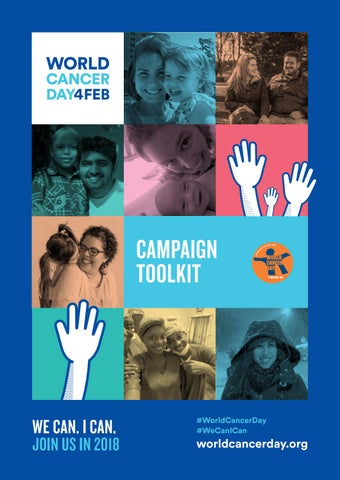
CAMPAIGN TOOLKIT
WE CAN. I CAN. JOIN US IN 2018
#WorldCancerDay #WeCanICan
worldcancerday.org
CONTENTS World Cancer Day 2016-2018: Year 3 – Creating Impact
3
Background on World Cancer Day
5
What is World Cancer Day
5
Why World Cancer Day matters
5
Who is behind World Cancer Day
5
World Cancer Day 2018
6
Key campaign messages
6
Campaign materials
12
Social Media Guide
14
Ready made messages
15
Social media activity
18
19
20
23
Get involved
24
Stop the press
25
Ideas on how to mark the Day
27
Next steps
31
Cover page image credits: The 2018 Campaign Toolkit cover page features a handful of our incredible World Cancer Day supporters, including those living with cancer, health care workers and individuals passionate about the fight against this disease. We are especially grateful to Clare Halloran, Des Dubber, Amit Dilip Gaikwad, Penny Moodie, Melissa Tang, Radiant Racheli and Obinna Oke for allowing us to use their photo here and in other parts of the campaign as we continue to highlight cancer as a global health priority. Instagram image credits from top left to bottom right: @claremh85, @desdubberphotography, @ amitdilip, @p_moods, @shop_hope25, @obinnaoke and @radiantracheli.
2
World Cancer Day 2018 — Campaign Toolkit
WORLD CANCER DAY 2016-2018: YEAR 3 – CREATING IMPACT
The three-year World Cancer Day campaign ‘We can. I can.’ explores how everyone – together or individually – can help reduce the global burden of cancer. Cancer affects everyone in different ways, and everyone has the power to take action to reduce the impact of the disease on individuals, families and communities. World Cancer Day (4 February) gives us a chance to reflect on what we can do, make a pledge and take action. Whatever you choose to do, ‘We can. I can.’ make a difference in the fight against cancer.
The 2016-2018 World Cancer Day campaign explores actions that ‘We can. I can.’ do to save lives, achieve greater equity in cancer care, and make fighting cancer a priority at the highest political levels. We have compiled some key facts and supporting evidence around each of these actions so that no matter who you are – a cancer survivor, a co-worker, a cancer organisation, a carer, a friend, an employer or a student – information is at your fingertips to support and enable you to take action.
World Cancer Day 2018 — Campaign Toolkit
3
WORLD CANCER DAY TRANSLATED Albanian
Dita Botërore e Kancerit
Arabic
PASAULINĖ VĖŽIO DIENA
Macedonian
Светски Ден на Ракот
Azerbaijan
Dünya Xərçəng Günü
Malay
Hari Kanser Sedunia
Bulgarian
световен ден за борба с рака
Mongolian
Хавдартай тэмцэх дэлхий өдөр
Catalan
Día Mundial contra el Cáncer
Nepali
विश्व क्यान्सर दिवस
Chinese
世界癌症日
Nigerian (Igbo)
Ụbọchị Ncheta Ọrịa Mkpụrụ Akụ
Croatian
MEĐUNARODNI DAN BORBE PROTIV RAKA
Norwegian
Verdens kreftdag
Czech
Světový den proti rakovině
Persian
Danish
Verdens kræftdag
Polish
Światowy Dzień Walki z Rakiem
Dutch
Wereld Kanker Dag
Portuguese
Dia Mundial do Cancro
English
World Cancer Day
PRT (Brazilian)
Dia Mundial do Câncer
Estonian
Maailma vähipäev
Romanian
Ziua Mondială de Luptă împotriva Cancerului
Finnish
Maailman syöpäpäivä
Russian
Всемирный день борьбы против рака
French
Journée mondiale contre le cancer
Samoan
Aso Faamanatu o Le Kanesa I Le Lalolagi
German
Welt Krebs Tag
Serbian
Svetski dan raka
Greek
ΠΑΓΚΌΣΜΙΑ ΗΜΈΡΑ ΚΑΤΆ ΤΟΥ ΚΑΡΚΊΝΟΥ
Slovakian
Svetový deň rakoviny
Hebrew
Slovenian
Svetovni Dan Raka
Hindi
Somali
Maalinta kansarka aduunka
Hungarian
Rákellenes Világnap
Spanish
Día Mundial contra el Cáncer
Icelandic
ALÞJÓÐLEGI KRABBAMEINSDAGURINN
Swahili
Siku ya Saratani Duniani
Indonesian
Hari Kanker Sedunia
Swedish
Världscancerdagen
Italian
Giornata mondiale contro il cancro
Tamil
உலக புற்றுநோய் தினம்
Thai
ในวัน มะเร็งโลก
Japanese
4
Lithuanian
Korean
년 세계 암의 날
Turkish
Dünya Kanser Günü
Kreyol
Jounen mondyal kansè pou lane
Vietnamese
Ngày thế giới phòng chống Ung Thư
World Cancer Day 2018 — Campaign Toolkit
BACKGROUND ON WORLD CANCER DAY What is World Cancer Day
Who is behind World Cancer Day
World Cancer Day takes place every year on 4 February and unites the world under a single theme to highlight the on-going fight against cancer. World Cancer Day aims to reduce the number of preventable deaths each year by raising cancer awareness among the general public and pressing governments to take further action against the disease.
UICC is dedicated to taking the lead in convening, capacity building and advocacy initiatives that unite the cancer community to reduce the global cancer burden, promote greater equity, and integrate cancer control into the world health and development agenda.
Why World Cancer Day matters The global cancer epidemic is enormous and is set to rise. Currently 8.8 million people die from cancer worldwide every year, out of which 4 million are premature deaths (aged 30 to 69 years). Over the next ten years cancer deaths are projected to increase to over 14 million per year. Urgent action must be taken to raise awareness about the disease and to develop practical strategies to address the cancer burden. Global disparities in access to prevention, treatment and palliative care are growing exponentially. With the recent adoption of the UN Sustainable Development Goals (SDGs), we are entering a new era for global health. Now more than ever there is a need for a global commitment to help drive advancements in cancer and non-communicable diseases (NCDs), particularly in low- and middleincome countries (LMICs) who are tackling these epidemics with insufficient resources. World Cancer Day is the ideal opportunity to spread the word and raise the profile of cancer in people’s minds, in the world’s media, and on the global health and development agenda.
Founded in 1933 and based in Geneva, Switzerland, UICC is the largest and oldest international cancer organisation. With over 1,000 members and 56 partners across 162 countries, UICC features the world’s major cancer societies, ministries of health, research and treatment institutes, patient groups, and industry leaders.
“World Cancer Day has given us the wonderful opportunity, to join forces with other related NGOs locally and bring forward important messages about prevention, early detection as well as our valuable work in palliative care. Our campaign, that was unfolded both at an above the line (mass media) and below the line level (events), allowed both a wide reach but at the same time brought us one step closer to younger audiences and interact with them face-to-face. We hope to continue this annual institution in order to raise more and more awareness of these very important issues around cancer." Irene Loucaides, Head of Communication & PR, Cyprus Anti-Cancer Society
World Cancer Day 2018 — Campaign Toolkit
5
KEY CAMPAIGN MESSAGES To achieve the objectives of the ‘We can. I can.’ campaign, it is essential that we use one united voice when we speak or write about World Cancer Day.
The following World Cancer Day message suggestions are provided for your use and adaptation. Please feel free to use them as a part of your communications. Our goal is to spread these messages as widely as possible on and around 4 February.
PLEASE SEE THE WORLD CANCER DAY FACT SHEETS FOR ALL SUPPORTING REFERENCES TO THE FACTS AND FIGURES LISTED IN THIS TOOLKIT
WHO ARE WE? • • • • • • • • •
6
Cancer organisations Influential networks Groups of advocates Healthcare providers Professional bodies Employers Media Businesses Schools
WHO AM I? • Individuals • Advocates and agents of change in the community • Patients, their families, friends and carers • Healthcare professionals, team and organisational leaders • Educators
World Cancer Day 2018 — Campaign Toolkit
WE CAN INSPIRE ACTION, TAKE ACTION The first step in driving progress around cancer is to push for actions that we know will improve survival rates and give cancer patients a better quality of life. By working together around common targets and using our spheres of influence, we can unite in driving governments to take decisive action around cancer, commit adequate resources, and embed cancer and other NCDs within broader development planning processes. We can call on governments to step up their response to cancer by pushing for actions that are proven to reduce premature deaths, improve quality of life, and increase cancer survival rates.
PREVENT CANCER Changes in the way we live means that more and more people around the world are exposed to cancer risk factors such as smoking, poor diet, and sedentary lifestyles. Educating and informing both individuals and communities about the links between lifestyle and cancer risk is the first step in effective cancer prevention. Equipping individuals and communities with appropriate and adequate knowledge of the links between lifestyle and cancer can empower people to adopt healthy choices. We must spread the word that more than one third of cancers can be prevented by adopting healthy behaviours.
CREATE HEALTHY SCHOOLS How we educate our children and the next generation is vital for the future of cancer prevention and treatment. Schools have an important role to play in preventing cancer. We must foster a culture of health by providing nutritional meals, discouraging smoking, and making time for recreation and sports, as well as putting healthy food and physical education on the school curriculum. Schools must create healthy environments to give the next generation the necessary tools and knowledge they need to adopt healthy lifestyles and reduce their cancer risk.
CREATE HEALTHY WORKPLACES Many adults spend much of their time working, therefore workplaces are great places to practice healthy habits. Companies and organisations must be encouraged to make healthy lifestyles a priority in the workplace, and to provide education on the benefits of a healthy diet and exercise, the dangers of smoking and other cancer risk factors. Workplaces must be encouraged to implement measures that will motivate and sustain healthy habits throughout a person’s everyday life.
CREATE HEALTHY CITIES Today, 54% of the world’s population lives in urban environments, and this is expected to rise to 66% by 2050. As the world continues to urbanise, sustainable development challenges will be increasingly concentrated in cities. Cities offer important opportunities to expand access to health services for a large number of people as well as ways to engage in active lifestyles and reduce cancer risk factors. We can advocate for city governments to create healthy environments and prioritise cancer prevention, treatment and care at a local level.
World Cancer Day 2018 — Campaign Toolkit
7
SUPPORT OTHERS TO RETURN TO WORK One third of able cancer survivors will not return to work due to the difficulties of reacclimating to work after the disease. Workplaces can provide routine, normality and income to survivors, and employees can play a significant role in supporting their colleagues through their transition back to work. Cancer survivors returning to work may need support through adjusted working hours, help on projects or simply the understanding of managers. Workplaces can provide a safe and welcoming environment to cancer survivors returning to work.
SHAPE POLICY CHANGE Laws and other regulatory measures can be used to reduce exposure to cancer risks including tobacco, alcohol, and unhealthy food, as well as environmental factors. Effective national policies can also improve access to essential cancer medicines, including pain relief medicines, and deliver quality cancer care. Patients, families, healthcare providers and civil society now need to continue to press governments for the implementation of policies and programmes at the national level that translate these commitments into actions. Effective advocacy for policy change at all levels - local, national and global - can reduce exposure to cancer risk factors and improve the access and availability of essential cancer medicines and quality cancer care.
CHALLENGE PERCEPTIONS In many cultures and societies cancer remains a taboo subject. People living with cancer are often subject to stigma and discrimination that may stop them admitting they have cancer and from seeking care and support. Even in communities where cancer is discussed openly, people affected by the disease can sometimes be discriminated against and feel isolated from friends and peers. Governments, communities, schools, employers and media can all challenge perceptions on cancer and dispel damaging myths and misconceptions so that everyone is empowered to access accurate cancer information along with quality cancer prevention and care.
BUILD A QUALITY CANCER WORKFORCE Inadequate education of healthcare providers is one of the most pervasive and urgent obstacles in delivering quality cancer care. Investment in continuing professional development (CPD) to equip healthcare workers with the appropriate tools and knowledge to deliver best practice services across the cancer care continuum is vital. The cancer workforce must be equipped with the skills, knowledge and competencies required to meet the needs of individuals and communities across the cancer continuum.
IMPROVE ACCESS TO CANCER CARE Closing the gap in access to affordable quality cancer care is imperative for maximising treatment outcomes and quality of life for all people living with the disease, including children and adolescents. Of equal importance is addressing the affordability of care to protect individuals and families from financial hardship as a consequence of out-of-pocket expenses. We can advocate for improved access to cancer treatment and services across the care continuum. All people have the right to benefit from these interventions on equal terms, regardless of geography and without suffering economic hardship as a consequence.
8
"I believe World Cancer Day is an inclusive platform for voices from all corners of the world including the remotest areas. Cancer Foundation of India as a team felt empowered raising the collective concern to address cancer prevention. Hopefully next year we will come back bigger and better." Sutapa Biswas, Executive Director Cancer Foundation of India
World Cancer Day 2018 — Campaign Toolkit
MAKE THE CASE FOR INVESTING IN CANCER CONTROL
I CAN
The economic case for investment is becoming a vital piece of the jigsaw to change mindsets around the value of investing in cancer prevention and control. There is already a compelling argument for investing in the prevention of cancer rather than dealing with the consequences. Building the economic case for investment in cancer can change mindsets and allow governments to justify placing cancer control at the heart of their national health plans.
JOIN FORCES TO MAKE A DIFFERENCE The global cancer burden can be reduced through partnerships between governments, civil society and the private sector, that leverage complementary skills, competencies and spheres of influence to accelerate progress on shared goals and aspirations. Combining efforts, identifying and mobilising networks is an essential part of partnerships and plays a valuable role in sharing knowledge and experiences to drive impact and make a difference. By joining forces, civil society organisations, cancer patient advocacy groups and other stakeholders can bolster their advocacy efforts around common issues by creating a united voice for positive change. Working in partnership around proven solutions for cancer can achieve global impact by strengthening advocacy and building capacity around common goals.
“Now, more than ever there is a need for a global commitment to drive policy and implementation of what we already know to push the global fight against cancer to a whole new level. Action taken by every person, organisation, and government can and will reduce the burden of cancer. World Cancer Day is the opportunity to reinforce the message that ‘we can’, as a collective, or ‘I can’ as an individual, take action to help prevent and fight this disease.” Sanchia Aranda, UICC President and CEO, Cancer Council Australia
MAKE HEALTHY LIFESTYLE CHOICES Everyone can take steps to reduce their risk of cancer by choosing healthy options including quitting smoking, keeping physically active and choosing healthy food and drinks. Reducing exposure to ultraviolet (UV) radiation from the sun and other sources, such as solariums, also greatly reduces the risk of many skin cancers. Everyone can make healthy lifestyle choices to reduce their risk of cancer.
UNDERSTAND THAT EARLY DETECTION SAVES LIVES Diagnosing cancer isn’t always easy – not all cancers show early signs and symptoms and other warning signs can appear quite late when the cancer is advanced. However, increasing awareness of signs and symptoms and the importance of timely treatment has been shown to improve survival from cancer. This is because finding cancer early almost always makes it easier to treat or even cure. Healthcare professionals and individuals can be informed of the value of early detection and the importance of seeking care to improve cancer survival.
RETURN TO WORK Although returning to work after cancer treatment can be challenging for many people, managing a smooth transition back into the workplace can be a significant achievement both from a personal and a practical standpoint. A job can restore normality, routine, stability, social contact and income. It is also important for people with cancer who want to return to work to understand their rights. With the right support, people living with cancer can return to work successfully.
World Cancer Day 2018 — Campaign Toolkit
9
TAKE CONTROL OF MY CANCER JOURNEY Cancer patients and families should be empowered to have a greater degree of control over the choices that influence their health and wellbeing, and preserve their dignity at all stages throughout the cancer journey. At the same time, the physical effects associated with some cancer treatments, such as hair loss, weight gain and other changes in body image, can diminish a person’s quality of life and also result in stigma and discrimination. For some cancer patients, managing their physical appearance and addressing changes in body image can be a way of regaining control and preserving a degree of normality. People living with cancer can take control of their cancer journey by being empowered to be active participants in decisions about their care, having their choices respected and their needs met.
LOVE, AND BE LOVED Support from friends, families, employers and colleagues can help a person living with cancer better adjust to the changes cancer brings and help to improve their quality of life. For some people, support may be needed over many years after the initial diagnosis as they continue to live with the physical and emotional impacts of cancer, even when treatment is finished. For many, one of the longest lasting and most devastating consequences of a cancer diagnosis is its affect on sexual health and wellbeing; health professionals and cancer support services can help support these patients to improve their quality of life and that of their partners. Changes in emotional intimacy can also be assuaged with open and honest conversations between partners. Giving hope and support to someone living with cancer can make a big difference in their lives.
ASK FOR SUPPORT Maintaining social support networks and talking about cancer can be central strategies for coping with the social and emotional impacts of cancer, both in the short and long term. This is true for both the person living with the disease and their support networks. Support can come from many sources – partners, friends, family, colleagues, healthcare professionals and counsellors – with some people choosing to join self-help or support groups. People living with cancer and their carers can ask for support to help them cope with the disease.
MAKE MY VOICE HEARD Cancer survivors can give hope to those newly diagnosed with cancer. By sharing their experiences, people living with the disease can play an important role in increasing knowledge about cancer prevention and the importance of early detection. Importantly, they can also give hope and support to others affected by the disease, and reduce fear around the challenges of returning to their everyday life after cancer. The participation of cancer patients and their families in decision-making around cancer policies and programmes can foster a holistic approach to cancer care. Individuals can be part of the conversation through engaging in public campaigns, communicating with decision-makers, and joining with consumer support groups to ensure the patient perspective is heard. In this way, cancer patients and their families can inspire change by helping define the issues that matter to them and advocate for measures to address these. By making their voice heard and being part of the conversation on cancer, individuals can be powerful agents of influence, change and hope for all people affected by the disease.
“It was a wonderful experience for us (staff and students at CPUT) and we have learnt a lot about how to offer such activities in the future. We received very positive feedback and the activities were a success in many aspects…You will see that we used the World Cancer Day materials - sincere thanks for that.” Penelope Engel-Hills, Assistant/ Associate Dean, Cape Peninsula University of Technology
10
World Cancer Day 2018 — Campaign Toolkit
GENERAL CANCER MESSAGES •
Cancer is a disease that knows no boundaries and has, or will, affect us all either directly or indirectly during our lifetime.
•
Actions taken by every person, organisation and government will help reduce the burden of cancer to achieve the goal of a 25% reduction in premature deaths from NCDs by 2025.
•
•
Until cancer awareness is improved globally and actions are taken to prevent and treat the disease, millions of people around the world will die unnecessarily every year.
•
We must act now because the global cancer epidemic is enormous and set to rise. It is predicted to increase from 14.1 million in 2012 to 19.3 million cases per year in 2025.
Cancer is a leading cause of death worldwide, responsible for 8.8 million deaths per year. However, we know that more than one third of these deaths are preventable, and if detected early enough, many cancers are curable.
UICC-FOCUSED MESSAGES •
UICC is dedicated to taking the lead in convening, capacity building and advocacy initiatives that unite the cancer community to reduce the global cancer burden, to promote greater equity, and to integrate cancer control into the world health and development agenda.
•
Founded in 1933 and based in Geneva, Switzerland, UICC is the largest and oldest international cancer organisation.
•
•
With over 1,000 member organisations across 162 countries, UICC features the world's major cancer societies, ministries of health, research and treatment institutes, patient groups and industry leaders. UICC is dedicated to continue working with world leaders to increase their support for cancer control measures and hold them accountable for the cancer commitments made in the UN Global Action Plan on NCDs.
•
World Cancer Day represents an opportunity for UICC, its members and the public to join a global movement of targeted, locally relevant and achievable actions which will reduce the burden of cancer.
•
UICC uses World Cancer Day to advocate for: --
Developing targets and indicators to measure the implementation of policies and approaches to prevent and control cancer
--
Raising the priority accorded to cancer in the global health and development agenda
--
Promoting a global response to cancer.
World Cancer Day 2018 — Campaign Toolkit
11
CAMPAIGN MATERIALS World Cancer Day should be viewed as an opportunity to coordinate global, national and local efforts in the fight against cancer. A core set of materials have been created to support you in developing your own World Cancer Day campaign and provide guidance in adapting the messaging to meet your needs.
• The materials provided have been developed and approved by the UICC Team, however, they should be translated and adapted for use in your own communities and networks. • Template materials currently include global statistics and spokespeople quotes. Where appropriate, please localise your materials by using facts and figures from your own country, as well as your own spokespeople; this will make your materials more relevant to local media.
WORLD CANCER DAY WEBSITE - WORLDCANCERDAY.ORG MAP OF IMPACT An online interactive map showing what and where activities are taking place, on and around World Cancer Day.
WALL OF SUPPORT The Wall of Support is a great tool featuring every WCD-related picture posted on social media platforms using the hashtags #WorldCancerDay AND #WeCanICan.
ALL WORLD CANCER DAY MATERIALS ARE AVAILABLE IN MULTIPLE LANGUAGES ON WORLDCANCERDAY.ORG/MATERIALS
12
World Cancer Day 2018 — Campaign Toolkit
CAMPAIGN POSTER
CUSTOMISABLE POSTERS
The 2018 campaign poster is currently available in over 40 different languages. If you would like to support us with additional translations, please contact info@worldcancerday.org
You can create your own customised poster and social media profile banners, including your logo, key messages and preferred icon or picture. worldcancerday.org/custom-posters
ca
nc
erd
a y. o r g
wo
JOIN US IN 2018 worldcancerday.org
rld
WE CAN. I CAN.
#WorldCancerDay #WeCanICan
INFOGRAPHIC FACT SHEETS The fact sheets give a general overview of the key issues and areas of focus that are highlighted in the 2018 campaign. They include facts and figures and outline important advocacy messages.
Get the facts with the World Cancer Day infographic, highlighting global cancer statistics and trends, along with an action list of what you can do to prevent cancer.
WE CAN
TODAY
I CAN
WE CAN
—VS—
2030
NEW CANCER CASES (PER YEAR)
14m
21.7m
TODAY
2030
CANCER DEATHS nc
e rd
a y. o r g
Join us in 2018 worldcancerday.org
rld
ca
#WeCanICan #WorldCancerDay
ca
nc
e rd
13m
8.2m
TEMPLATE PRESS RELEASE
a y. o r g
2030
TODAY1
wo
rld
#WeCanICan #WorldCancerDay
wo
Join us in 2018 worldcancerday.org
(PER YEAR)
MAKE HEALTHY LIFESTYLE CHOICES
INSPIRE ACTION, TAKE ACTION
ii
SOCIAL MEDIA GRAPHICS Sharing and posting the World Cancer Day graphics designed for Facebook, Twitter and Instagram are a great way to show your support on social media.
Non-communicable diseases (NCDs) – including cancer – are the leading cause of death and disability worldwide.2
A template press release designed for local adaptation and TOP use on and around Cancer 3 5 MOST FREQUENT CANCERSWorld Day 2018 will be available in English, French, 1 Spanish and Brazilian Portuguese in January 2018. Breast
Lung
5
3
Stomach
4 Colorectal
By addressing risk factors, one third of common cancers can be prevented.4 i World Cancer Day 2018 — Campaign Toolkit
LEADING CANCER RISK FACTORS5
13
SOCIAL MEDIA GUIDE SPREAD THE WORD ON SOCIAL MEDIA THIS WORLD CANCER DAY
CONNECT AND ENGAGE: @UICC
@WorldCancerDay
For increased impact, your social media campaign should be integrated in your overall communications plan and aligned with your offline activities. We also recommend the development and use of an editorial calendar to help you plan all key activities before, during and after your event.
@WorldCancerDay
TOP TIP
Use a scheduling tool such as hootsuite.com to proactively program your posts on social media ahead of time, especially for the Day itself when there is so much happening.
14
WORLD CANCER DAY OFFICIAL HASHTAGS #WorldCancerDay #WeCanICan
World Cancer Day 2018 — Campaign Toolkit
READY-MADE MESSAGES
WE CAN
Inspire action, take action
Create healthy cities
• #WeCanICan take action to improve #cancer survival & give #CancerPatients a better #QualityofLife: bit.ly/WCD2018 #WorldCancerDay
• The conditions in which people live & work influence their capacity to lead #HealthyLives. #WorldCancerDay #WeCanICan
• #WeCanICan drive national action from global commitments made by Member States through the #CancerResolution. #WorldCancerDay
• #WeCanICan advocate for govts to create healthy cities & prioritise #CancerControl at a local level: bit.ly/WCD2018 #WorldCancerDay
• #WeCanICan call on governments to push for actions that will reduce premature deaths & improve #cancer survival rates. #WorldCancerDay
Prevent cancer • #WeCanICan prevent #cancer by empowering people to make #HealthyLifestyle choices: bit.ly/WCD2018 #WorldCancerDay • #WeCanICan prevent #cancer by educating individuals & communities about the links between lifestyle and #RiskFactors. #WorldCancerDay • More than 1/3 of #cancers are preventable through adopting #healthy behaviours. More info bit.ly/WCD2018 #WorldCancerDay #WeCanICan
Create healthy schools • Schools can implement measures to motivate & sustain healthy habits throughout a child’s everyday life. #WorldCancerDay #WeCanICan
Support others to return to work • Workplaces can provide a welcoming environment to cancer survivors returning to work: bit.ly/WCD2018 #WorldCancerDay #WeCanICan • #WeCanICan play a significant role in supporting #CancerSurvivors through their return to work: bit.ly/WCD2018 #WorldCancerDay
Challenge perceptions • Govts, communities, schools, employers & media can challenge perceptions about #cancer and debunk #CancerMyths. #WorldCancerDay #WeCanICan • #WeCanICan challenge perceptions and dispel damaging #CancerMyths and misconceptions: bit.ly/WCD2018 #WorldCancerDay
• #WeCanICan create healthy schools to encourage children & adolescents adopting #HealthyLifestyles: bit.ly/WCD2018 #WorldCancerDay
Create healthy workplaces • The conditions in which people live & work influence their capacity to lead #HealthyLives. #WorldCancerDay #WeCanICan • Workplaces can implement measures to motivate & sustain healthy habits throughout a person's everyday life #WorldCancerDay #WeCanICan
"Supporting World Cancer Day each year gives the Samoa Cancer Society the opportunity to not only engage with local community members and their activities, but most importantly, it gives us the platform to highlight and share cancer issues within our country, with government and other health sector providers. Through our advocacy, World Cancer Day is now recognised by the Government of Samoa and the Ministry of Health, as an important day to support and collaborate with the Samoa Cancer Society and the Samoan community in promoting WCD key messages." Shelley Burich, Executive Officer Samoa Cancer Society
World Cancer Day 2018 — Campaign Toolkit
15
Improve access to cancer care • #WeCanICan advocate for improved access to #CancerTreatment & services across the care continuum: bit.ly/WCD2018 #WorldCancerDay • #WorldCancerDay: We can improve access to #CancerCare to maximise outcomes & quality of life for all people living with #cancer. #WeCanICan
Shape policy change • #WorldCancerDay: We can shape policy change to reduce exposure to #cancer #RiskFactors & improve access to quality #CancerCare. #WeCanICan • #WorldCancerDay: We can shape policy change to improve access to cancer #EssentialMedicines including #PainRelief treatments. #WeCanICan
Make the case for investing in cancer control • #WeCanICan invest in #CancerPrevention and #CancerControl. It's cheaper than dealing with the consequences. #WorldCancerDay • #WorldCancerDay: #WeCanICan make the case for investing in #CancerControl and prevention. More info here: bit.ly/WCD2018 • #WorldCancerDay: We can make the case to change mindsets around the value of investing in #CancerControl. bit.ly/WCD2018 #WeCanICan
Join forces to make a difference
• On #WorldCancerDay, #WeCanICan call on govts to take action & implement the national provisions adopted through the #CancerResolution.
• We can mobilise our networks to support efforts to reduce the global #CancerBurden: bit.ly/WCD2018 #WorldCancerDay #WeCanICan
• We can shape policy change to help prevent and fight #cancer: bit.ly/WCD2018 #WorldCancerDay #WeCanICan #CancerAdvocacy
• We can join forces for increased impact & reduce the global #CancerBurden: bit.ly/WCD2018 #WorldCancerDay #WeCanICan #Partnerships
Build a quality cancer workforce • We can build a quality #cancer workforce to deliver quality #CancerCare across the world: bit.ly/WCD2018 #WorldCancerDay #WeCanICan • We can invest in #CapacityBuilding initiatives to equip the #cancer workforce w/ the suitable tools & knowledge. #WorldCancerDay #WeCanICan
READY-MADE MESSAGES
I CAN
Make healthy lifestyle choices • #WeCanICan reduce our #CancerRisk through #HealthyLifestyle choices: bit.ly/WCD2018. Help spread the message on #WorldCancerDay! • As of #WorldCancerDay, I can make #HealthyLifestyle choices & quit smoking to reduce my #CancerRisk: bit.ly/WCD2018 #WeCanICan • #WeCanICan reduce our #CancerRisk by keeping a #healthy weight & having a healthy balanced diet: bit.ly/WCD2018 #WorldCancerDay • #WeCanICan reduce our #CancerRisk through physical activity. #WorldCancerDay
16
Understand that early detection saves lives • #WeCanICan understand that recognising #CancerSigns & symptoms and #EarlyDetection save lives: bit.ly/WCD2018 #WorldCancerDay • #Healthcare professionals & individuals can be informed of #EarlyDetection's value to improve #cancer survival. #WorldCancerDay #WeCanICan • #WeCanICan understand that #EarlyDetection and timely #CancerTreatment are crucial to increase #cancer survival rates. #WorldCancerDay
World Cancer Day 2018 — Campaign Toolkit
Take control of my cancer journey
Ask for support
• #CancerPatients must be empowered to have a greater control on their #cancer journey: bit.ly/WCD2018 #WorldCancerDay #WeCanICan
• #WeCanICan ask for support & talk about #cancer to cope with its social & emotional impacts: bit.ly/WCD2018 #WorldCancerDay #WeCanICan
• #WeCanICan be myself. With the right support, #CancerPatients can feel like themselves again: bit.ly/WCD2018 #WorldCancerDay
• People living with #cancer & their carers can ask for support to help them cope with the disease. #WorldCancerDay #WeCanICan
Love, and be loved
Make my voice heard
• #WeCanICan love & be loved. #CancerPatients can seek assistance to cope with #cancer impact on #SexualHealth & wellbeing. #WorldCancerDay
• By sharing stories, #CancerSurvivors can give hope & support to others affected by cancer: bit.ly/WCD2018 #WorldCancerDay #WeCanICan
• #CancerPatients can seek assistance to adjust to sexual changes & improve sexual intimacy: bit.ly/WCD2018 #WorldCancerDay #WeCanICan
• #WeCanICan make our voices heard & take part in the #cancer conversation to push for changes: bit.ly/WCD2018 #WorldCancerDay
Return to work • With the right support, people living with #cancer can return to work successfully: bit.ly/WCD2018 #WorldCancerDay #WeCanICan "Social media is transforming the way we raise awareness about cancer, and is an essential tool in how we educate and engage the public about cancer-related issues, such as new treatments, prevention, survivorship, clinical trials, advocacy, and funding." Rick Buck, Senior Director of Communications and Public Relations, American Association for Cancer Research
GENERAL MESSAGES: • Today is #WorldCancerDay! Help spread the message that #WeCanICan take action to help prevent & fight #cancer: bit.ly/WCD2018 • 4 February is #WorldCancerDay! Help spread the message that #WeCanICan do something to fight #cancer: bit.ly/WCD2018 • Join the global effort on #WorldCancerDay to raise #cancer awareness and press everyone across the world to take action! #WeCanICan • On #WorldCancerDay help raise awareness that there’s much that can be done to fight #cancer at an individual & collective level #WeCanICan
“We must all work together if we are to free the world from the pain and suffering of cancer. The American Cancer Society has made significant contributions to the remarkable progress we’ve seen in the U.S. In addition, as a global leader, we continue to share our expertise in cancer prevention and treatment to help save more lives. On this World Cancer Day, we can make a difference for millions of people everywhere by committing to actions that will reduce the global threat of the disease.” Gary Reedy, CEO American Cancer Society
World Cancer Day 2018 — Campaign Toolkit
17
SOCIAL MEDIA ACTIVITIES
Support World Cancer Day's social media activities for increased impact and visibility.
SIGNS FOR CHANGE This World Cancer Day, we’re asking you to hold up your sign to make change happen. Using social media, the ‘Signs for Change’ activity is a way to take a stand against cancer; show what actions you’re taking, what you want policy makers to start doing, ask what more can be done, and raise awareness and aid against cancer.
How it works: 1. Choose a sign with one of the 19 ‘We can. I can.’ key messages, available from worldcancerday.org/materials 2. Take a photo of yourself holding the sign 3. Post your photo in honour of someone you know affected by cancer or give a shout out to an organisation that is helping the cancer cause 4. Add the official hashtags to your post: #WorldCancerDay and #WeCanICan 5. Visit worldcancerday.org to see your photo featured on the Wall of Support. Be as creative as you like. Choose one of the 19 key messages - which one works for you? Or, create your own key message, decorate your sign, add your own personal touch and get your friends, family and co-workers, community and workplace involved. Unable to print out the sign? Upload the sign to your phone or tablet or simply write the message on a piece of paper. We’re inviting everyone to be at the centre of World Cancer Day. Join this growing, global movement and show the world that ‘We can. I can’ take action and make change happen, now.
THUNDERCLAP Thunderclap is a tool that simultaneously posts a message on the feeds of supporters via Facebook, Twitter and Tumblr, generating a wave of attention for a campaign. This is a great way to give World Cancer Day visibility and increase the chances of ‘trending’ on social media platforms. The World Cancer Day 2017 Thunderclap campaign was the most successful campaign to date. With over 1,000 individuals and organisations showing their support, we reached 7.8 million people. Help us reach even more people in 2018 by signing up to our Thunderclap from 4 December at worldcancerday.org/thunderclap. Want to know more about how Thunderclap works? Visit worldcancerday.org/faq.
18
World Cancer Day 2018 — Campaign Toolkit
Facebook @worldcancerday To receive the latest news and updates, ‘like’ the official World Cancer Day Facebook page
TIPS FOR WORLD CANCER DAY FACEBOOK POSTS 1. Offer added value Users ‘like’ your page to get news and updates on your organisation in an informal way. Be original and offer added value to your audience (e.g. exclusive information, behindthe-scene photos, infographics, etc.).
2. Straight to the point Avoid lengthy posts, keep them short and sweet (generally between 100-200 characters) in order to catch your audience’s attention and encourage them to share the news.
3. Create a two-way conversation Facebook is about interacting and networking so encourage your audience to share their thoughts and feedback (e.g. on your event). Asking questions is also a good way to get your audience involved in WCD, your event or your organisation.
4. Be timely Your audience will be more likely to engage with posts when they are related to real-time information so be prepared to be active on Facebook on WCD. Also try to respond quickly to comments on your posts to let your 'likers' know you are listening to them.
5. Use engaging photos and videos Entertaining media, such as photos, videos and infographics, get more attention and are more likely to be shared by your audience.
6. Drive website traffic
FACEBOOK BANNER Use the branded World Cancer Day banner as your profile cover to show your support. Download your banner from the World Cancer Day website. worldcancerday.org/materials
Include links in your posts to direct people to your website. Customise the thumbnail by choosing compelling imagery that will blend into the newsfeed experience.
7. Schedule your posts To better manage your time, you can schedule your posts in advance by simply selecting a time and date on the lower right-hand corner of your page’s sharing tool.
World Cancer Day 2018 — Campaign Toolkit
19
Twitter @UICC Use Twitter to be part of the conversation leading up to and on World Cancer Day
Add the World Cancer Day banner to your Twitter page and show your support.
Topic hashtags: #25by25 #Access2Meds #BeatNCDs #BeHealthy #Cancer #CancerAdvocacy #CancerAwareness #CancerBurden #CancerCare #CancerControl #CancerDisparities #CancerInformation #CancerMyths #CancerPatients #CancerPrevention #CancerRisk #CancerSurvivors #CancerResolution #CancerTreatment #EarlyDetection #EssentialMedicines #FightingCancerTogether #Health #HealthForAll #HealthyLifestyle #HealthyLives #NCDs #PainRelief #Prevention #QualityofLife #RiskFactors #SDGs #SupportOthers #SupportThroughSport #TreatmentForAll #UHC #WeCanICan #WorldCancerDay #WorkplaceWellness
Download the banner from worldcancerday.org/ materials.
ANATOMY OF A TWEET User’s profile photo
User’s real name
UICC
Twitter handle (username)
@uicc
Date posted
Event hashtag
Mentioning other users
· 4 Feb
On #WorldCancerDay @ncdalliance is helping us spread the message that #WeCanICan do something against #cancer bit.ly/WCD2018
Link Topic-related hashtag
Ready-made social media graphics available from worlcancerday.org/ materials
User options
20
World Cancer Day 2018 — Campaign Toolkit
HELP SPREAD THE MESSAGE ON TWITTER
UICC @uicc · 4 Feb
Today is #WorldCancerDay! Help us spread the message that #WeCanICan take action to help & fight #cancer: bit.ly/WCD2018
TWITTER GLOSSARY Tweet
A 140-character message posted via Twitter – your message can include text, images, videos, gifs, user handles and links
@username
A Twitter handle is how you are identified on Twitter (eg @UICC)
@
The @ sign is used to mention / identify other users in a tweet
#
A hashtag is used to highlight keywords or topics (eg #WorldCancerDay)
Follow(er)
To follow someone on Twitter is to subscribe to his or her tweets
Reply
A tweet beginning with the @ sign and posted in reply to another user’s tweet
Retweet (or RT)
A tweet sent by another user, forwarded by you. Often used to spread news or share valuable information
Like
A tweet marked with the heart icon to indicate that you liked this specific tweet
World Cancer Day 2018 — Campaign Toolkit
21
TIPS FOR USING TWITTER FOR YOUR WORLD CANCER DAY EVENTS 1. Use a Twitter-friendly tone Strive for an approachable, authentic and friendly communication style that isn’t overly formal. Remember that your followers track you because of what you say and who you are. Try to relate what you hear during an event to your own knowledge and experience by sharing your reactions and opinions. Remember that short is sweet: 120-130 characters is optimal for engagement.
Twitter is about real-time information: tweet about what’s happening in the present. It is hard to find time when you are taking part in an event but commenting and responding in real time to others’ posts adds real depth and value to discussion. Use a scheduling tool (e.g. Hootsuite, TweetDeck) to save time by proactively scheduling tweets before the event.
6. Quote of the day
2. Be their eyes and ears For every person physically present during an event, there are probably hundreds (if not thousands) of ‘virtual participants’ watching from afar, many wishing they could have the same opportunity to be there. Your Twitter insights can give them a virtual front row seat to everything you’re experiencing live. Be conscious of what your followers and other virtual participants might be most interested in reading, seeing, or finding out about – rather than just what you want to tell them.
3. Use the event #hashtag(s) The more people using the same hashtag(s), the more likely they are able to connect with one another and share thoughts and ideas. Hashtags also help users follow the discussion: when you click on a hashtag, you will see other tweets containing the same keyword. Use the official hashtags #WorldCancerDay and #WeCanICan. When taking part in events or campaigns, find out the official hashtag the organisers have chosen and use it consistently.
4. Be original Your tweets will be valued most by your followers if they include something which cannot be easily found elsewhere (eg an opinion, a link to a relevant and interesting site or resource, a picture or video, etc.). Consider adding value to a retweet by including your own view, and avoid posting overused rhetoric about an issue. Stay fresh.
22
5. No time like the present
If you tweet direct quotes, listen out for particularly insightful or original comments and quote them for what they say, not who said them. Don’t forget to insert the speaker’s handle in your tweet to give credit and for higher reach and visibility.
7. A picture is worth a thousand words Visuals are the most liked and most likely to be shared type of content on social media. Use the same rules for photos and videos as you do for text content: add value for your followers and give them something they cannot get elsewhere, such as pictures of the event, of high-profile speakers or of the cover of a newly released publication. You can ‘tag’ the people and/or organisations in the photo if they have a Twitter handle. This can boost visibility, as people and organisations may retweet your post if they are tagged.
8. Amplify advocacy messages Follow organisations you are aligned with and amplify messages to generate more traction and visibility. This also helps to show potential followers who you are, what you advocate for, and that you are supporting and contributing to a common agenda.
9. Engage your online community Twitter is a great tool for engaging and interacting with the online community: mention other users in your tweets (e.g. @UICC) or tag them in images, interact by replying to tweets and ask questions. Twitter is a social network, so be social.
World Cancer Day 2018 — Campaign Toolkit
BE ‘HUMAN’ WITH INSTAGRAM
Instagram @WorldCancerDay Follow us on Instagram and tag us in your own World Cancer Day photos
Instagram is the perfect tool to show the human side and personality of your organisation, engage your audience as well as feature the individuals involved in your event. 1. Go behind the scenes Instagram users look for authenticity, transparency and exclusivity. Offer a glimpse and a better insight into your organisation’s daily life and behind-the-scenes experiences that is not revealed on your other social accounts (eg the event’s preparation, backstage, etc.).
2. Feature people Instagram is a great place to engage in storytelling by featuring people involved in your event (eg organisers, volunteers, public, etc.). They will enjoy the recognition and it will reinforce their involvement.
3. Create engagement with a contest
@worldcancerday Official hashtags: #WorldCancerDay #WeCanICan
It’s easy to create a photo contest on Instagram: Ask users to post a photo using a particular hashtag (eg #WeCanICan), then invite other users to vote for their favourite pictures (eg by ‘regramming’ it) and feature the winner’s photo on your website for example. A contest will raise your event’s visibility on social platforms, even more so if you promote it through other online communications channels.
4. Cross-promote Instagram Don’t forget to cross-promote your Instagram activities on your other social platforms such as Twitter and Facebook. Put an Instagram icon on your website and invite visitors to follow you.
DON’T FORGET TO ADD THE OFFICIAL HASHTAGS #WorldCancerDay #WeCanICan
World Cancer Day 2018 — Campaign Toolkit
23
GET INVOLVED BE PART OF THIS GROWING, GLOBAL MOVEMENT. LET'S UNITE TOGETHER TO REACH AS MANY PEOPLE AS POSSIBLE. WE CAN. I CAN: GET ACTIVE
EVERY ACTION COUNTS Whether you do something as large as running your own World Cancer Day campaign or as simple as sharing our template messages among your networks, every action has an impact. We appreciate that your organisation may have different needs and priorities, so whilst we greatly encourage you to incorporate the Day and the theme ‘We can. I can.’ into existing outreach programmes, we also welcome you to create your own policy/awareness campaigns which are inline with your specific area(s) of focus.
Physical activity has been shown to combat cancer, including: prevention, helping cancer patients manage the side-effects of treatment - such as fatigue, depression and heart damage -, and reducing the risk of the disease worsening or recurring. This World Cancer Day, we're encouraging everyone to be more active - in every sense - in the fight against cancer. Why not partner with local sport heroes, clubs and organisations, and explore how your organisation, school, or city can create an activity or event to bring greater awareness to the cancer cause?
24
“Cancer is a disease without borders. It affects millions of people around the world every day which is why World Cancer Day is so important. By uniting on this day, we want to raise awareness of the disease and what we need to do to reduce its devastating impact. Our ambition is to see more people survive cancer than ever before and World Cancer Day is an ideal platform to highlight the fact that together we can make this happen.” Sir Harpal S. Kumar, Chief Executive Officer Cancer Research UK
World Cancer Day 2018 — Campaign Toolkit
STOP THE PRESS A great way to engage all audiences in World Cancer Day is through your local media. We encourage you to build relationships with influential/ relevant journalists to help generate coverage of your local World Cancer Day activities as an integral part of the global awareness raising movement.
Develop your own media campaigns for national and local audiences by adapting the key messages, social media hashtags, quotable quotes and other resources contained within this toolkit. A template press release will be available mid-January for your use and adaptation to outreach to your local press and media. We also encourage you to use the Day as a hook for any media activities you may want to do around the launch of a new campaign, report or research findings. Visit worldcancerday.org/media for more information.
BLOGS AND NEWSLETTERS If you have a blog or your organisation has a newsletter, this can be a powerful way to reach even more people with World Cancer Day messages. The World Cancer Day team would be happy to contribute a quote, blog post or newsletter article. For more information, contact info@worldcancerday.org
World Cancer Day 2018 — Campaign Toolkit
25
HOW TO DEVELOP OR LOCALISE A PRESS RELEASE
FRAMING THE STORY Media relations efforts need to begin with clearly articulated statements and answer the following five “W’s” to define the story. • Who is central to the story? • What is the news you want to report? (When answering this question think carefully about what you want this story to accomplish) • Why has it happened?
1. Find an interesting news angle (e.g. new data, activities, important event etc.) 2. Define your target group (e.g. wire, trade or consumer journalist) 3. Develop a contact list 4. Develop/write your press release and consider the following: −− Why is the release being written? −− Who is the audience?
• When did it happen? • What will the consequences be? −− A story must be new or offer a new angle in order to be considered news. −− Experts must offer reporters something new, a clear opinion and an additional insight, or they may not write the story or use that expert as a resource and look elsewhere to find the facts needed to write the story. In the worst case, they may discount the story completely.
−− Does the release contain invaluable or newsworthy information that will be used by the target audience? −− What do you want recipients to take away from the press release? Overall tone and structure • Content: ensure that the release is grammatically correct, does not contain any spelling mistakes or errors, and that sources are quoted correctly. • Concise: keep it punchy and do not use unnecessary flowery language (e.g. ‘cutting edge’, ‘revolutionary’). • Factual: fact check your information to ensure it is true and correct.
“World Cancer Day brings together key stakeholders like governments, leaders, communities, partners, and individuals around the world to press for change. Through initiatives like these, UICC works towards reducing disparities in diagnosis and treatment, and reducing the social, economic and development implications of cancer. We see the impact each year of joining forces at an individual, community, or organisational level.” Mamadou Mansour Niang, Chief Executive Officer, Senegalese League against Cancer
26
• Objectivity: virtually impossible to do, but refrain from using over hyped quotes from sources, as they will be presented as being too biased. • Timing: link the release with a more recent news event to make it more relevant. • Obtain approval of press releases by the legal team, communications department, CEO or any relevant decision-maker within your organisation. • Distribute press release via email, mail or fax (as required by your local journalists).
World Cancer Day 2018 — Campaign Toolkit
IDEAS ON HOW YOU CAN MARK THE DAY 1
Disseminate World Cancer Day messages and materials to your networks and communities
2
Publish a news article on your website
3
Help raise visibility of the day on social media
4
Organise a healthy breakfast to promote healthy lifestyles
5
Organise a sport competition/event to promote physical activity
6
Order a weekly delivery of fruits to your workplace, and better yet, replace vending machines with healthy alternatives
7
Organise a fundraising event (concert, theatre, exhibition, etc.)
8
Invite a nutritionist to your workplace to introduce employees to healthy eating habits
9
Set up a public seminar relayed on a local TV channel, radio and the newspapers
10
Put together a media campaign to help raise awareness and educate people
11
Mark World Cancer Day in your local hospital to cheer up cancer patients
12
Put in place a self-examination demonstration station / mobile screening unit
13
Create your own cancer society or patient group
14
Create an advocacy push to encourage your government to prioritise cancer on the health and development agenda
... and much more!
World Cancer Day 2018 — Campaign Toolkit
27
TAKE INSPIRATION Get inspired by others who have supported World Cancer Day
ORGANISATIONS AROUND THE WORLD Australia This year, Cancer Council Queensland held a series of free information sessions in the lead-up to, and on World Cancer Day. The information sessions, provided a chance for individuals impacted by cancer, their families and friends as well as those interested in supporting those with the disease to receive more information and support. Cancer Council Queensland also opened their doors to the community with an Open House, giving locals an opportunity to learn more about cancer and their own work, as well as the chance to meet their staff, network of community and health professionals and volunteers.
Project PINK BLUE chose the occasion of World Cancer Day to launch the Abuja Breast Cancer Support Group - the city's first patient support group. The milestone achievement was commemorated with a medal-giving ceremony for breast cancer survivors attended by leaders from the cancer control community as well as His Royal Majesty Dr. Kabiru Musa, the Emir of Azara. Project PINK BLUE also used the Day to call on the Federal government to set up a national agency for cancer control, urging decision-makers to make cancer control a national health priority.
Portugal
The Chinese Medical Association planned several activities around World Cancer Day, including raising awareness among the general medical community by displaying posters in hospitals and patient centres. The Association also aimed to reach as many people as possible throughout the provinces and regions with a mass media campaign that included television, newspapers, internet and social media.
The Portuguese League Against Cancer challenged everyone to raise awareness of cancer prevention, particularly through activities focusing on healthy lifestyles and physical exercise. Hundreds of schools, companies and sports associations, including football team, FC Porto, accepted the challenge by spreading the message of ‘We can. I can’. FC Porto’s staff, including their coach, proudly wore the World Cancer Day pin for their match against Sporting Cube de Portugal, the players and athletes showed their support by coming onto the playing field wearing World Cancer Day t-shirts, while World Cancer Day messages were promoted on the stadium screens throughout the match.
Maldives
United States
China
For their #WeCanICan Support through Sport initiative, the Cancer Society of Maldives (CSM) teamed up with a number of National sports associations to get everyone across the country active for World Cancer Day. The Society also targeted schools with cancer awareness and prevention messages, including an art initiative for students whose line art pieces would be utilised for an art therapy colouring book for cancer patients. CSM also joined the Support through Sport social media campaign and raised awareness nationwide through TV, radio, and online-newspapers.
28
Nigeria
Staff from the John Wayne Cancer Foundation had a booth for their athletic fundraising program, Team John Wayne, at the Surf City Marathon Expo, where many runners and their family and friends were encouraged to take photos with the ‘We can. I can.’ sign. The Foundation also supported the Day through a rigorous social media campaign to help further spread the word.
World Cancer Day 2018 — Campaign Toolkit
CASE STUDY
CYPRUS ANTI-CANCER SOCIETY The Cyprus Anti-Cancer Society, in collaboration with The Bank of Cyprus Oncology Centre, The Cyprus Association of Cancer Patients and Friends, Europa Donna Cyprus, Europa Uomo Cyprus and the National Nutritionists Association, rolled out a national media campaign across the country focused on cancer prevention. This included a joint press conference with the Ministry of Health and the National Cancer Committee, a national television advertising
GOVERNMENTAL ACTIONS
campaign, a fundraising music event organised by the Cyprus Medical Students Association and an educational programme aimed at young students on healthy lifestyles. The Society also participated in this year’s Support through Sport initiative, partnering with professional football club, APOEL FC to display their support of World Cancer Day at the weekend’s match.
CITIES LIGHT UP THE WORLD
Cuba On the eve of World Cancer Day, Cuba’s government announced a new, national campaign to tackle the high incidence of skin cancer prevalent in the population. As a key part of the campaign, the Cuban Ministry of Public Health created a programme offering free check-ups and consultations by trained dermatologists in schools, hospitals, factories and other institutions around the country. It is the seventh such campaign focused on prevention, early detection, treatment and care.
Kenya Kenya’s Health Cabinet Secretary for Health, Cleopa Mailu, marked World Cancer Day by unveiling a new set of educational materials developed for cancer patients, families, caregivers and health care workers. An international collaboration between the Ministry of Health, the Kenya Network of Cancer Organizations and the American Cancer Society, the materials are based on a study of “Kenyan’s knowledge, attitudes and practices about cancer”. Available in both English and Kiswahili, the booklet and flipchart aims to provide “evidence based cancer information” in easy-to-read language
In recent years, cities around the world have signalled their commitment to the global challenge of cancer by lighting up major landmarks in the World Cancer Day colours of orange and blue. Landmarks including the Empire State Building in New York City, the Skydance Bridge in Oklahoma City, the Jet d’eau in Geneva, and several across Canada - Niagara Falls, the CN Tower in Toronto, City Hall in Halifax, High Level Bridge in Edmonton, Calgary Tower, and Rogers Arena, the Olympic Cauldron and Canada Place Sails in Vancouver - have all lit up their city skylines on 4 February. Get in touch with your city to help us illuminate the world in orange and blue on 4 February.
Israel To mark World Cancer Day, the Israeli Ministry of Health held a joint press conference with the Israel Cancer Association to share updated data on cancer morbidity, survival, and mortality in Israel with the national media. The press conference also provided an opportunity to spotlight the ICA’s nationwide physical activity project, 'Steps to a Healthy Life'® tying in with the World Cancer Day Support through Sport initiative.
World Cancer Day 2018 — Campaign Toolkit
29
INFLUENTIAL CORPORATES
CASE STUDY
Bristol-Myers Squibb In the lead-up to World Cancer Day, Bristol-Myers Squibb brought together an expert panel for a live webinar discussion on cancer survivorship, the role of integrated care, national cancer survivorship programmes and the policy progress needed in supporting cancer survivors. It was also the occasion to hear about new research on integrated care - part of a Bristol-Myers Squibb-sponsored global and multi-pronged research initiative developed with The Economist Intelligence Unit (EIU) titled Global Cancer Survivorship: The Need for Integrated Care.
Merck Group Following the overwhelming participation from the global Merck team last year, Merck were keen to again engage with the oncology community and the wider public to continue to advance cancer care for patients. Combining the #WeCanICan theme and physical activity, Merck developed a dedicated, week-long social media campaign, inviting everyone to post an action shot of themselves ‘jumping’, and sharing why they were ‘jumping in’ to support the fight against cancer. The campaign generated hundreds of posts, including photos, videos and gifs by the Merck global community across Facebook and Twitter.
"MSD is proud to support World Cancer Day, which unites us all toward progress in the fight against cancer. By working together, we can make a difference.” Frank Clyburn, President MSD Oncology
30
BOEHRINGER INGELHEIM In a World Cancer Day first, the team at Boehringer Ingelheim hosted a simultaneous Facebook and Twitter Live event. On the eve of World Cancer Day, the live broadcast brought together a diverse panel of speakers to raise awareness of lung cancer, with the discussion centred on the current challenges faced by the lung cancer community, the role of patient organisations, EGFR mutation testing as well as personalised treatment. Moderated by Jilly Carter, the speakers included UICC Director of Advocacy and Networks, Julie Torode, Medical Oncologist, Professor Anders Mellemgaard, and lung cancer patient, Katherine Davies. Around 1,000 viewers tuned in live with questions being posed directly to the panellists by the Facebook and Twitter community in the live Q&A session. To date, more than 100,000 people in total have viewed the video.
TOOLKIT FOR CORPORATES For more information about corporate activities and how to engage with the private sector to mark World Cancer Day, please download our Corporate Toolkit available from worldcancerday.org/materials
World Cancer Day 2018 — Campaign Toolkit
NEXT STEPS Translate and ‘localise’ materials to best meet your needs Share copies of the materials (printed or electronic) with friendly local media and other stakeholders Provide copies of the materials across all appropriate functions within your organisation (communications, marketing, advocacy, etc.) ‘Localise’ and issue the World Cancer Day press release within your local media market
Host a World Cancer Day event or activity in your home country to highlight the local cancer burden and the global cancer epidemic Add your event or activity to the World Cancer Day Map of Impact on worldcancerday.org/map Be active on social media: engage in our official social media campaign, use our ready-made tweets, promote the Thunderclap and spread the word on Instagram and Facebook.
FEEDBACK YOUR SUCCESSES We hope that both the guidance and the template materials contained and referenced within this toolkit are useful resources. We look forward to working with you in the lead-up to World Cancer Day and then hearing about all your successes, particularly any media coverage of your activities.
THANK YOU FOR YOUR SUPPORT OF WORLD CANCER DAY!
You can also share your stories with us at info@worldcancerday.org for them to be featured on the website and in the toolkit next year.
World Cancer Day 2018 — Campaign Toolkit
31
WORLD CANCER DAY ADVISORY GROUP The purpose and responsibilities of the Advisory Group are to provide input, feedback and support in developing and rolling out the World Cancer Day campaign. Members of the Advisory Group are invited to participate because of their expertise, interest in and/or working knowledge of developing a marketing and communications plan for an international event.
The current World Cancer Day Advisory Group (WCDAG) consists of the following members: • AECC, Spain • Canadian Partnership Against Cancer, Canada • Cancer Australia, Australia • Cancer Council Australia, Australia • Cancer Research UK, United Kingdom • FEMAMA, Brazil • Liga Portuguesa Contra o Cancro, Portugal • National Cancer Institute, Mexico • National Cancer Society Malaysia, Malaysia • NCD Alliance, Global • Movember, Global • Rethink Breast Cancer, Canada • SHAPE History, Global • Uganda Cancer Society, Uganda
UICC WOULD LIKE TO THANK THESE ORGANISATIONS FOR THEIR CONTINUED COLLABORATION AND SUPPORT IN THE DEVELOPMENT OF THE WORLD CANCER DAY CAMPAIGN
32
“It was a pleasure for the Indian Cancer Society to join UICC in this global awareness creation on World Cancer Day and we look forward to working together on more such initiatives.” Sheila Nair, Director General Indian Cancer Society
World Cancer Day 2018 — Campaign Toolkit
WE CAN. I CAN. WITH THANKS TO THE FOLLOWING PARTNERS FOR THEIR SUPPORT OF THE 2018 CAMPAIGN: Visionary Partners
Leader - Partner
Supporters
Please email your questions and updates to info@worldcancerday.org World Cancer Day is an initiative of the Union for International Cancer Control
Union for International Cancer Control 31-33 Avenue Giuseppe Motta • 1202 Geneva • Switzerland Tel +41 (0)22 809 1811 Fax +41 (0)22 809 1810 email info@uicc.org www.uicc.org