State seeks to pull out of partnership with University of Washington
Rebekah Brown ARGONAUT
Idaho House Bill 176 seeks to cut Idaho’s ties with WWAMI, a multi-state medical education partnership including Washington, Wyoming, Alaska, Montana and Idaho. Passed by a 9-5 vote in the committee, it now awaits a vote from the full House.
Dr. Bryn Parker, a local practicing family medicine and obstetrician physician, trained through the WWAMI program. She grew up in the small town of Elk City and, through Idaho’s WWAMI partnership, was able to “get into one of the most exceptional medical schools in the country,” said Parker.
Not only is Parker a WWAMI alumn, but she is also now a WWAMI faculty member. She has been teaching medicine in her clinic to WWAMI students since 2015.
“It would be shortsighted to end the WWAMI partnership,” Parker said.
“This is a program that has been in place for over 50 years. It has proven exceptional education for Idaho students, including myself, and returns Idaho physicians to the state at an incredibly high rate.”
“It is unrealistic and frankly probably cost prohibitive to make any new [medical] program function at all, let alone one as good as WWAMI,” said Parker. “A far better option to increase medical training and physician return in Idaho would be to expand other training options theoretically proposed in HB 176 while still offering the excellent, strong WWAMI partnership.”
UI designated Carnegie R1 research institution
University joins top national ranks, but federal funding cuts may impact research
Julia Kolman
ARGONAUT
Announced on Feb. 13, the University of Idaho has officially reached Carnegie R1 research institution status. UI is the first research institution in the state of Idaho to reach this milestone, as it has joined less than 4% of highereducation institutions in the country in the “very high research activity” category.
To meet this classification, universities must meet two major requirements. They must have at least $50 million in annual research expenditures and bestow a minimum of 70 research doctorates annually. UI announced that the university more than doubled the required research expenditures, totaling $135.9 million in fiscal year 2023, and 80 research doctorates awarded.
In addition to UI’s new R1 status, the university also houses an astounding number of acclaimed scientific professionals, as discussed in UI’s official news release. Fiftyfour UI scientists are recognized in the Stanford-Elsevier Top 2% Scientists List, a number which surpasses all other Idaho research institutions combined with the Idaho National Laboratory.
“Research is in the university’s DNA,” Chris Nomura, UI’s Vice President for Research and Economic Development said. “Achieving R1 Carnegie Classification has been a long-term goal for UI and this is demonstrative of our strong research programs.”
Nomura continued, “As we proceed to expand our research program here at UI, it means we will be more competitive in attracting the best and brightest students and faculty to our institution. These folks in turn will allow us to better compete for funding to expand our research impacts.”
On the topic of recent research
funding cuts proposed by the Trump administration, Nomura said, “The current federal policy changes would be extremely damaging to carry out impactful research not only at UI, but also at universities across the entire country.”
These cuts, which would slash nearly $4 billion in overhead research costs nationwide, were announced by the National Institutes of Health on Feb. 7 and received immediate pushback and a temporary restraining order from Federal Judge Angel Kelley.
“The meaningful research impacts that directly affect the Idaho economy [include] new varieties of potatoes and wheat developed by our scientists, work in preserving rich soil for agriculture, development and training of cybersecurity workforce to keep our infrastructure safe and medical discovery and training to assure human health. [These] could all be set back if these cuts are carried out to completion. It will also directly affect our ability to have students participating in research programs.”
Groups claim voter suppression in Idaho
Youth voter turnout dropped after 2023 registration restrictions
Paige Wilton ARGONAUT
Two Idaho voters’ rights groups are supporting lawsuits against the state that claim college students’ ability to vote is being restricted. The League of Women Voters in Idaho (LWVID) and BABE VOTE, an organization empowering youth voters, are claiming voter suppression in response to recent laws that eliminated the use of student IDs as valid registration documents.
LWVID’s national overhead, the League of Women Voters of the US, are the plaintiffs of the case and are challenging Idaho House Bill 124 and House Bill 340, calling them acts of “disenfranchisement.” These bills made it so the only valid forms of documents to register include Idaho State IDs, passports or a license to carry concealed weapons.
Since these laws went into effect in July 2023, BABE VOTE has
been unable to help 20-30% of Idaho students that they’ve spoken with to complete their voter registration, according to Sam Sandmire, a volunteer and board member with BABE VOTE.
LWVID has already filed a lawsuit against the newly appointed House bills in 2023, but at both the district court and Idaho State Supreme Court, they were dismissed without trial. Now, the National League of Women Voters have filed a new suit, with LWVID and BABE VOTE filing an amicus brief in support.
The repercussions of these laws, as documented by LWVID in a diagram shared with The Argonaut, saw a significant decrease in voter registration and turnout in the 2024 national election.
Between 2020 and 2024, youth voter registration in Idaho among 18–29 year-olds in the general elections dropped by more than 3%. The registration rates among 18–19 year-olds decreased by almost 23% in that same time frame, according to a press release from BABE VOTE and LWVID.
John Keegan | Argonaut
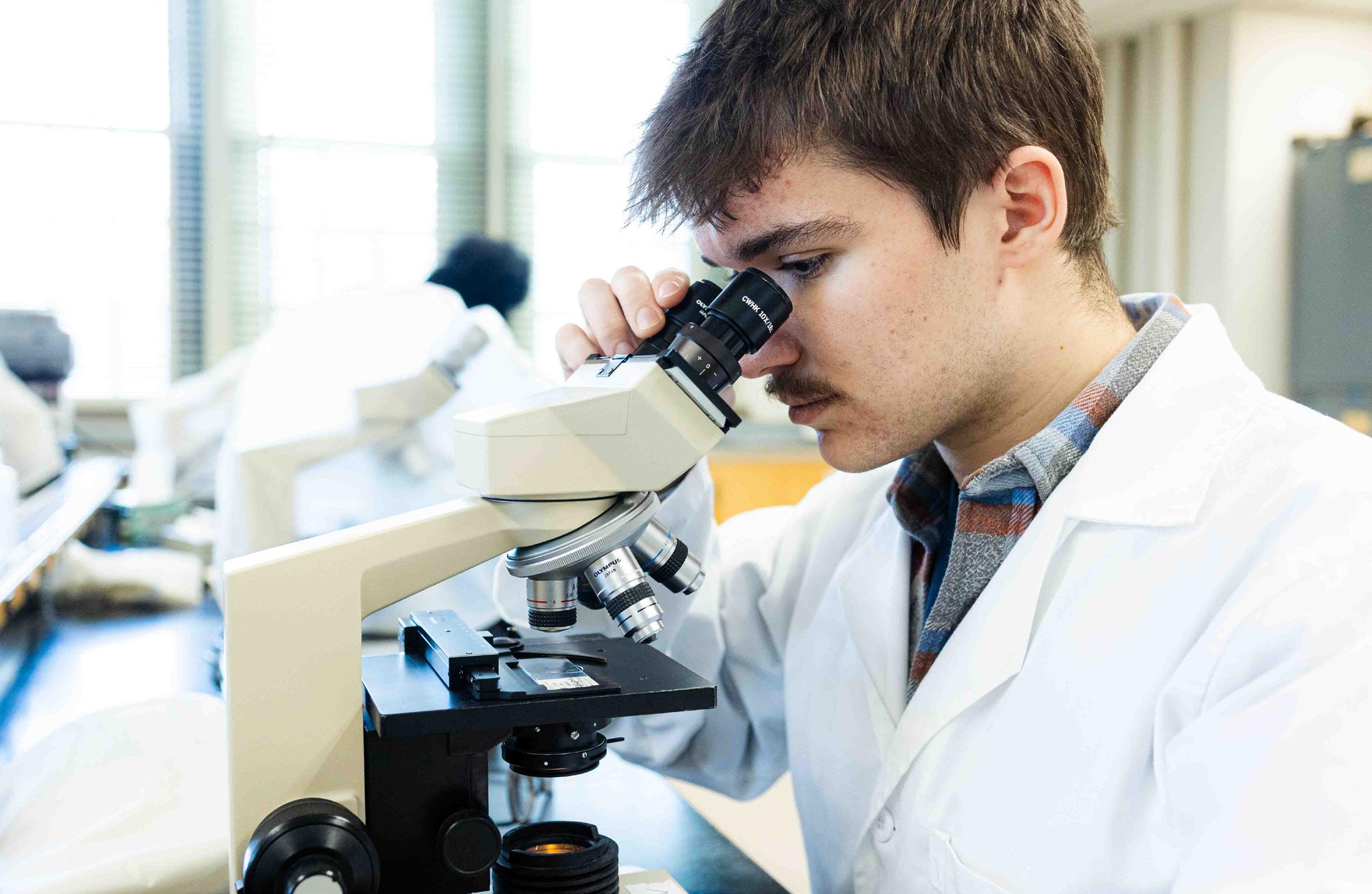
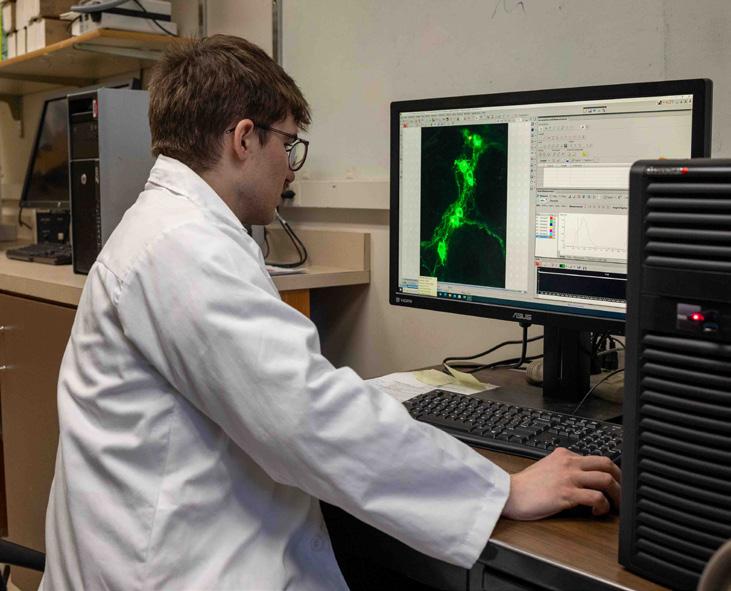
Student Peter Voller examines a mouse embryo under a microscope in a research lab in the Life Sciences South building
Idaho Academy of Family Physicians
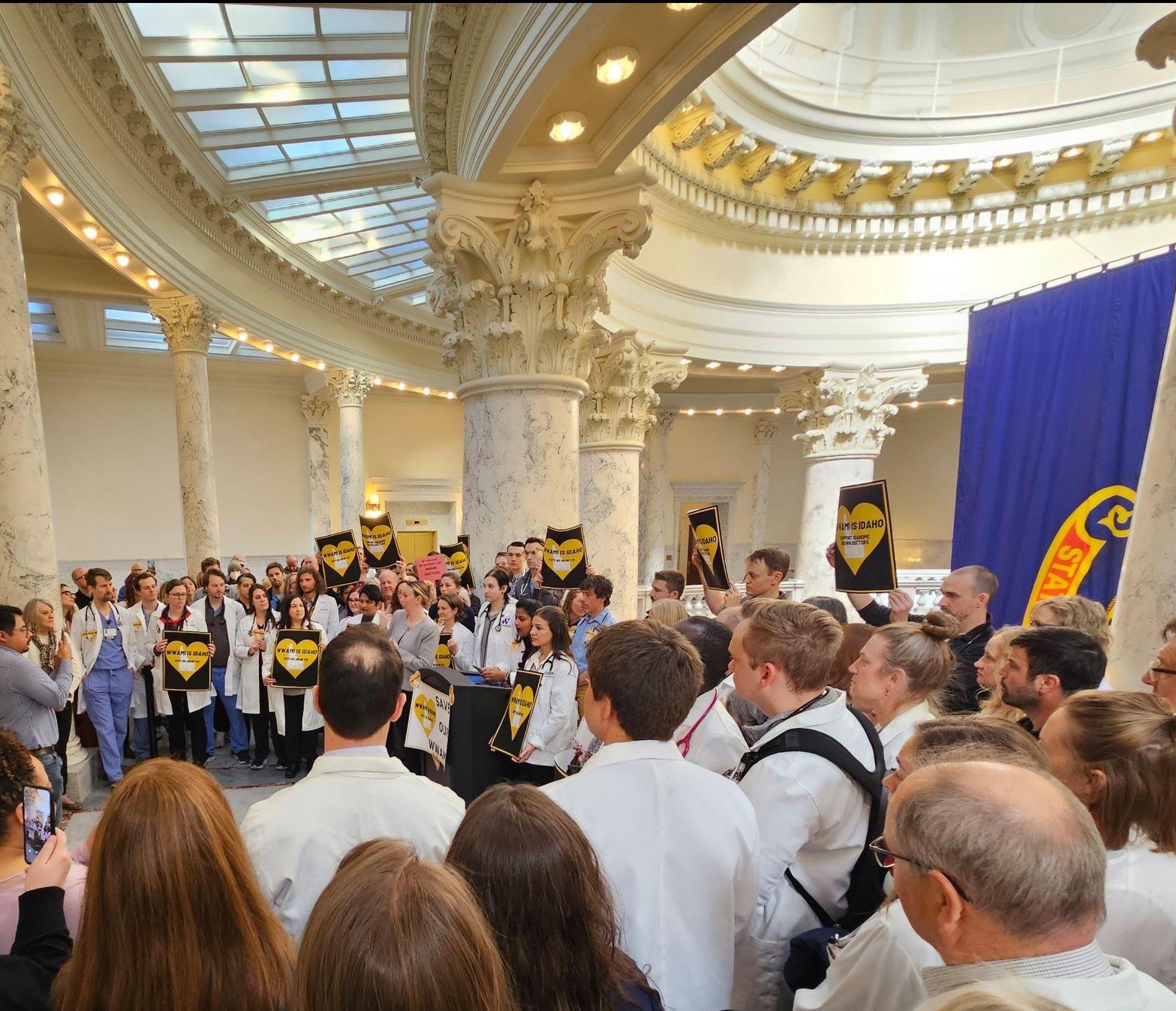
Physicians gather in the state Capitol to object to plans to cut ties with WWAMI
Bill introduced making drag shows 18+
Organizers subject to $5,000 fine if minors attend event featuring “indecent sexual exhibition”
Austin Kiekhefer
A new Idaho bill is seeking to ban minors from attending drag shows or any public event deemed an “indecent sexual exhibition.” House Bill 230, sponsored by Republican Representative Ted Hill of Eagle, was introduced on Feb. 13 and was passed on Feb. 24 by the Idaho House in a vote 54-11.
The bill defines indecent sexual exhibition as anything including “masturbation, sexual intercourse or physical contact with a person’s unclothed genitals or pubic area” and “sexually provocative dances or gestures performed with accessories that exaggerate male or female primary or secondary sexual characteristics.”
If enacted, events and organizers who violated the law are subject to be sued by a minor who was present for up to $5,000 in statutory damages, as well as monetary supplement for any “psychological, emotional, economic and physical harm suffered,” as per the bill.
This bill is being heavily promoted by the Idaho Family Policy Center, a conservative Christian organization focused on implementing Christianoriented public policy statewide.
Liz Woodruff, Executive Director of the Idaho Academy of Family Physicians, said, “Ending WWAMI and trying to transplant it to a different location will disrupt medical education and reduce access to healthcare in Idaho, especially in rural areas.”
“The WWAMI program is deeply embedded with clerkships for medical students, and it takes a long time to establish those relationships,” Woodruff continued.“We would have to start from scratch to establish those relationships, and that’s part of where the disruption would come from.”
“The other thing to note is that the way WWAMI is designed is with a fivestate region,” said Woodruff. “Idaho WWAMI students practice throughout the Northwest region in different communities, which is a great experience. But it also means that people from
Betsy McBride, co-president of LWVID, said that this move by Idaho lawmakers to restrict voting rights was one that they had been anticipating in years prior.
“We knew there would be complications with student IDs, but we could see a trend for the last several years that there was some appetite to begin to restrict voting,” McBride said. “Somewhere there was a group or somebody who decided that students would make a
Edward Clark, IFPC Policy Assistant and co-presenter of the bill, said in a press release, “Our children must be protected from hypersexualized performances in public places. We look forward to seeing this bill pass the House in the coming days, and we call on others to stand with us in protecting the children of our great state.”
The article emphasizes definitions of many terms throughout the bill. Important terms include “host,” “organize,” “minor” and “sexual conduct,” with the latter’s definition being the principal factor at play. It should also be noted that dance and cheer teams for school institutions are exempt from the bill’s definition of sexual conduct.
How this bill could potentially affect local events is unclear. Many cities, including Moscow, Coeur d’Alene and Boise, feature public drag shows during their annual Pride festivals, which this bill would effectively eliminate.
HB 230 awaits a vote in the Senate. If passed, it will advance to Governor Little to be either approved or vetoed.
different parts of the region get to come to Idaho, and it’s a huge opportunity for us to recruit physicians into the state, and that will not be available in another program.”
Established in 1972, Idaho WWAMI is a partnership between the University of Idaho and the University of Washington School of Medicine. The program provides “immersive medical education programs and training opportunities to Idaho’s future physicians,” according to their website.
This bill is sponsored by Representative Dustin Manwaring, House Speaker Mike Moyle and Senator Dave Lent. They proposed that the bill would be a way to “increase medical school capacity amid a doctor shortage and improve Idaho’s return on investment in medical education,” according to the Idaho Statesman.
Once cutting ties with WWAMI, HB 176 would require two new partnerships with medical schools in Idaho or the
good target to start with.”
The polling place for the majority of UI students living on campus and close to campus, the Student Recreation Center, saw 5-7 hour wait lines for those registering day-of as well as preregistered voters due to a number of complications. One of those was students being turned away for not having the proper documentation that would’ve once allowed them to vote.
Fallon Gibbs, a third-year finance major at UI, was one of many students who registered to vote day-of on Nov. 5. His experience was one that many others described also encountering.
Chris Sprague
Jayden Barfuss
Liam Bradford
Hilary Valdez Lexie Yates AJ Pearman
Mountain Time Zone. Several schools in Utah were suggested by Manwaring, including the University of Utah and a medical branch of Brigham Young University which has yet to be established.
According to Moscow-Pullman Daily News, UI staff have said that the university has already pursued a formal agreement with U of U to look into this future partnership.
Manwaring explained that Idaho has had recent issues with UW. Idaho passed a resolution in 2022 that requested 10 additional WWAMI seats within the next two years that have yet to come about, and UW has not agreed to Idaho’s request to restrict spending on abortion care.
“If they want to be a good partner… show us that you’ll respect Idaho values,” Manwaring said.
However, Suzanna Allen, Vice Dean for Academic, Rural and Regional Affairs for UW’s medical school, told the Idaho Statesman that UW does not
“I was in line for approximately five hours, and I was unable to even actually vote as I had to leave for work,” Gibbs said. “I did register, but the whole thing felt like a waste of time.”
For Kendal Shaber, Director of Voter Engagement and Rights with LWVID, the biggest fear is that these effects and trends will continue to worsen.
“So far this legislative session has done nothing to correct some of these difficulties, so I think when they took away the ability to register to vote with the last four [numbers] of your Social Security, that made it so much more difficult for so many groups of people,”
use Idaho’s money to fund any abortion care.
Manwaring did not respond to The Argonaut for comment.
UI students admitted into WWAMI begin their healthcare education journey at UI, starting with an 18-month curriculum that covers essential classes and foundations. Once this is complete, students transfer to the “Clinical Phase,” which includes hands-on opportunities. WWAMI allows for clinical rotations in both urban and rural settings.
Many additional physicians and medical students are also voicing their disagreements with the potential severance. A large group of people wearing white coats and scrubs rallied in the Boise Capitol on Friday, Feb. 21, for a press conference protesting the bill.
The group, who filled half of the fourth-floor rotunda of the Capitol, according to Moscow-Pullman Daily News, could be heard throughout the building, chanting, “Save WWAMI.”
Shaber said.
Not only does this affect newly registered college students who may lack the required documents, it also affects the disabled and elderly, as they may not have the means to acquire documents such as a valid Idaho driver’s license.
Ultimately, Shaber knows the importance of voting and wants to encourage anyone who can to exercise their rights as an American.
“It’s a right, but it’s also a civic responsibility,” Shaber said. “When people don’t exercise that Constitutional right, it makes it a little bit easier for those in power to try and take it away.”
•
•
• Send all letters to: 875 Perimeter Drive MS 4271 Moscow, ID, 83844-4271 or
Connor Anderson | Argonaut
A drag queen performs at the 2023 Boise Treefort Music Festival
Atomic bomb survivor hosts webinar
Kieko Ogura details trauma, devastation of Hiroshima bombings
Joshua Reisenfeld ARGONAUT
Keiko Ogura, an atomic bomb survivor, spoke to University of Idaho students in a webinar on Tuesday in partnership with the Hiroshima Peace Memorial Museum, CLASS and the Habib Institute for Asian Studies. She discussed her experience living through the 1945 bombings.
Ogura was born in 1937 in Hiroshima and raised within a few hundred meters of the eventual hypocenter.
Ogura’s family did not live close to any of the public shelters, which worried her father. Because of this, he moved the family to a small town on the northwest side of Futaba-yama mountain, 2.4 kilometers north of the eventual hypocenter.
During World War II, major Japanese cities suffered air raids from American aircrafts dropping incendiary bombs that leveraged the combustible material of Japanese construction as fuel for district destroying fires.
This tactic, known as firebombing, led to the creation of a force composed of working age citizens, defined as those over 12 years old, to dismantle buildings along major streets and create fire breaks.
Hiroshima Castle was used as a military encampment for over 10,000 soldiers. An underground bunker housed operations that monitored enemy aircraft passing over the country and initiated air raid warnings. Hiroshima residents were repeatedly woken by warnings on the night of Aug. 5, 1945, as many planes flew overhead.
After sunrise, the commanding officers lifted the lockdown and stepped outside with a changing shift of strategic communications personnel. Inside the bunker, a single B-29 bomber known as the Enola Gay caused a state of alarm, but it went unheard by the commanding officers and no air raid warning was put in place.
Ogura’s older brother had worked in the city center demolishing buildings on a road now known as Peace Boulevard. On Aug. 6, 1945, he was working along with 1,000 other students in the potato fields north of the main station. They paused their work to look at a silver dot in the sky.
“Nobody could imagine that a bomb could be dropped from so high in the sky,” Ogura said.
At 8:15 a.m. on Aug. 6, 1945, the first atomic bomb was dropped on Hiroshima. Her brother did not see a bomb fall from its underside and turned back to work before the blast. Those who did not turn away went blind.
Ogura’s father told her to keep close to home that day. He had a bad feeling after the previous night’s air raid warnings. She was outside walking the street in front of her house and saw a flash illuminate everything—seconds later, an impossibly strong wind struck her down.
“I was in a tornado,” Ogura said. She landed in the street unconscious and woke to see a small burning cottage. She thought she had slept until evening; it was quiet and dark. The first thing she heard was her little brother’s cries. She rushed home to find their windows had blown inward, a thousand knives of glass lodged in the opposite wall.
Her father was still home, running late for work. Miraculously, he had been standing at a point along the wall shielded by a large pine tree. Her little brother was bleeding from a roof tile hitting him on the head. Charcoal rained from the sky as the city lit up in flames. Ogura’s white blouse became stained, and unaware of the gravity of the situation, worried her mother would scold her.
During the war, Japanese civilians had been told Shinto Shrines, Buddhist temples and schools would be first aid stations. Ogura’s family lived close to Waseda Shrine, and she set out to find bandages. People covered in burns with peeling skin ran, or if they could not, clawed their way up the shrines’ stairs holding hope of medical relief.
“Water.” The thousands of injured
could only say one word. Ogura ran to the well outside of her family’s home, filling a bucket as fast as she could and returning to the shrine’s stairs. Two people were alive, speaking and reaching for the water. One was smiling, one had a face of fear. They died in front of Ogura, a girl of 8 years and 2 days. For 10 years, she had nightmares that she had killed them by giving them poisoned water.
When the bomb ignited, the fireball measured millions of degrees within microseconds, charring the people directly below the hypocenter and igniting buildings for more than a kilometer. Then the shockwave hit, crumbling buildings onto the thousands of people who ran frantically trying to strip themselves of what was burning.
The force of the blast displaced the air, creating a vacuum that briefly extinguished fires just seconds after they ignited. However, this vacuum triggered a secondary blast as air rushed back toward the explosion’s center, striking survivors from all directions and intensifying the devastation.
The shockwave had immobilized many people under fallen debris. Those who could came to help the trapped people, but many had to be left behind to burn alive screaming for help as the smoldering embers grew in flames.
Her older brother had climbed Mount Futaba-yama on his way home, witnessing the destruction from above.
“The city was completely destroyed. It became a sea of flame,” said Ogura.
Because of the sheer level of destruction, everyone believed the bomb had been dropped on directly on them. Ogura’s mother had said that her older brother was lucky to be working in the fields, believing that he escaped the destruction. Her brother came home
covered in burns and talked about the hundreds who had made their way to the train station, hoping to get away from the destruction.
The city burned through the night. In the following 2 days, thin lines of smoke rose from the blackened wasteland as the thousands of dead were cremated. People who spent too long in the city center searching for their loved ones died soon after, unaware of the radiation poisoning they were being exposed to.
Three days after the bombing, a single streetcar became operational again, though only able to operate on a small stretch of track. Seeing just one thing that wasn’t broken gave people hope and energy to rebuild, according to Ogura.
After the war, American students sent resources, crayons and clothes to the people of Hiroshima who had lost everything. Food, water and shelter were scarce. Orphans gathered under the remaining structures, crying for family that no longer existed.
It took years to rebuild Hiroshima and just as long to forgive the bombers. In war, Ogura says, a punch is thrown, and each subsequent punch is an act of revenge for what came before. It is easy to tell someone else to stop; it is hard to make that choice for oneself. The people of Hiroshima forgave rather than retaliating.
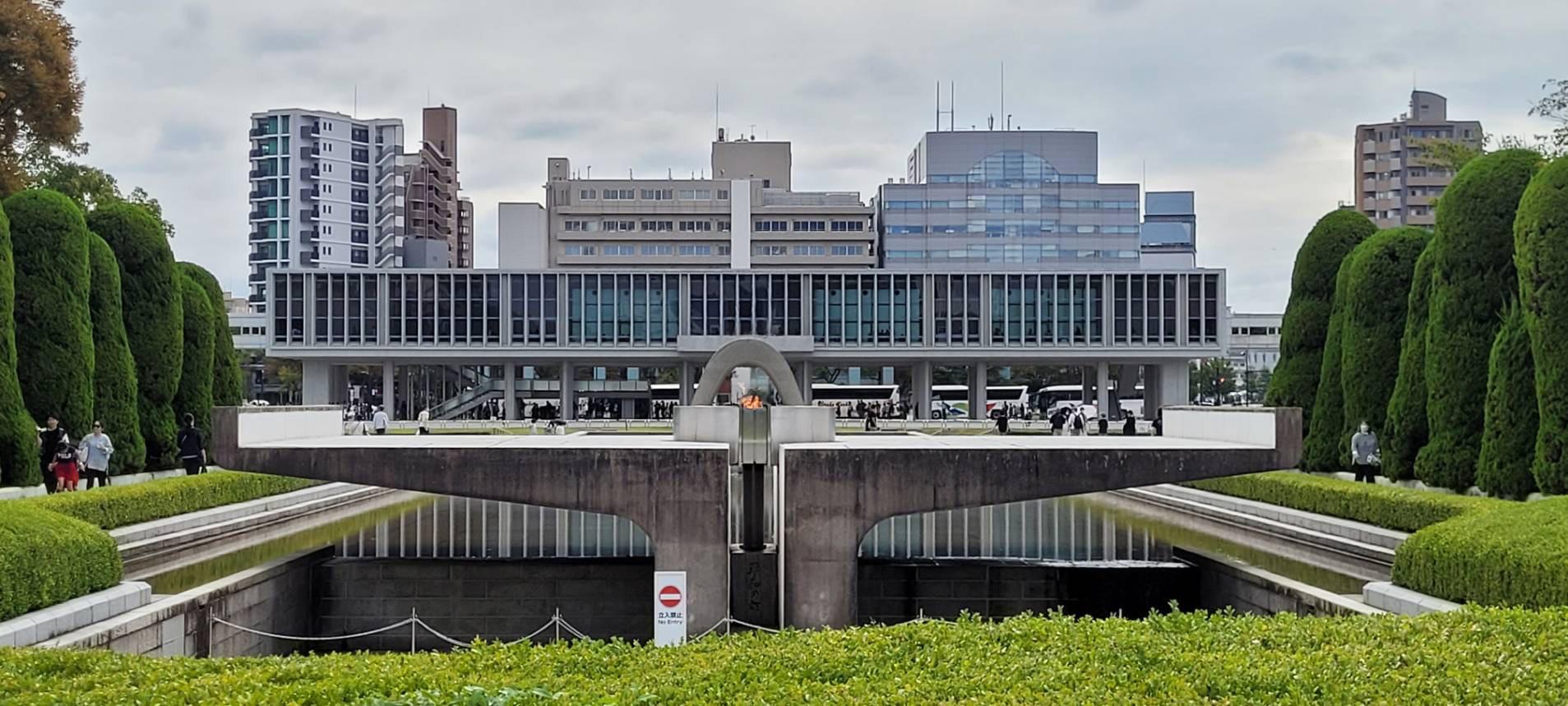
In 2011, Ogura was appointed as the official Atomic Bomb Storyteller by the Hiroshima Peace Culture Foundation. In the center of the Hiroshima Peace Memorial Park burns the Flame of Peace, a sculpture of two hands cupping a flame that will not be put out until the last atomic weapon is disassembled.
Ogura is one of the few remaining survivors from the atomic bomb and holds a story that must be continued so that the world does not forget the devastation of atomic weapons.
Moscow Joann Fabric and Crafts to close Students, locals express sadness over
Megan Kingsley ARGONAUT
Joann Fabric and Crafts, a popular retailer for avid members of the arts and crafts community, has made the decision to close all locations nationwide after filing for bankruptcy a second time in less than a year.
Moscow’s Joann, located at 1854 W Pullman Road, is one of the 850 locations that will be shutting down for good in the near future.
Recent visitors to the store might have noticed the discount signs taped to nearly every shelf. The majority offer 20% off various products, but some range up to 70% on seasonal items.
Despite these savings, the atmosphere is far from positive. Joann staff placed a sign in front of the register to
explain that the staff has no information on the closing date, future closing sales or what their futures will look like after losing their jobs.
While Joann employees were unable to provide statements, many customers have expressed sympathy and regret over the loss.
“I’m so legitimately devastated about it,” Aariah Colie, an Apparel Textile and Design student at UI, said. “I need so much fabric for my classes. I don’t enjoy buying fabrics online because they don’t list the important information I need.”
Another difficulty with buying fabrics online is quantity. Anyone looking to purchase less than one yard at a time may encounter difficulty, as few online retailers offer smaller quantities. In addition, online purchases often result in shipping charges. For beginner sewers, these may both prove deterrents to progressing in the hobby.
At present, the Moscow Joann requires a one-yard minimum for all fabrics and by-the-yard materials. This was not a previous requirement,
but due to the failing finances of the company, some stores have implemented the policy.
This has not deterred loyal customers. One woman thanked an employee as he cut her fabric. “I appreciate your service. I’m going to miss you a lot.”
While there are other craft suppliers in the area, few can offer the variety of Joann, especially in regard to fabrics and yarn. Local businesses offer some solutions, but not everyone has access to them in their areas.
A long-time staple in the crafting community, Joann Fabric and Crafts supplied creatives since 1943.
Joshua Reisenfeld | Argonaut
The Flame of Peace, located at the Hiroshima Peace Memorial Park, burns eternally until all atomic weapons are dismantled
John Keegan | Argonaut
customer walks into Joann during the weeks before
Nepali student’s photography displayed in Colorado gallery
Youbesh Dhaubhadel wants to capture smiles and humanity
Sophia Robertson ARGONAUT
Photographer and University of Idaho student Youbesh Dhaubhadel is currently exhibiting his photography at the Aurora History Museum in Aurora, Colorado, from Feb. 18 to June 8. Titled “Confluence of Festivals: Temple Town to the World,” Dhaubhadel’s exhibit communicates the charm of Nepali festivals.
Originally from Bhaktapur, he captured the rich sense of culture from his hometown and the two neighboring towns of Kathmandu and Lalitpur. The philosophy behind his photography is to capture the commonality of humanity, and this exhibit is no different.
Dhaubhadel said, “What matters is the sense of belonging, and it is the testament that as human beings, we all value that element of sharing with one another. In those festivals, we come together and forget all of our hardships, because people forget tough times when they come together.”
Through this exhibit, Dhaubhadel aims to put Nepal on the map and encourage people to visit and experience
the festivals for themselves.
“Through my art, I want to show that Nepal is a very small country,” Dhaubhadel said. “But I would want to show that Nepal is a rich country. Rich in culture. In terms of the happiness that people exhibit, those people are the happiest in the world.”
Before shifting mediums and focusing on photography, Dhaubhadel was originally an artist who painted and sketched.
“I realized that I could paint and draw sitting in a room. I don’t have to be present in the moment, I can draw out of my imagination,” he said. “But for photography, I have to be in the present moment. And that is one of the reasons I started photography.”
Dhaubhadel has now been a photographer for over a decade and is studying finance and economics at the University of Idaho.
He said, “I am a photographer because I want to show things that I see through my eyes, and I want to be an economist for the sake of the country.”
His experience at UI has been enlightening, both within the College of Business and outside of it.
“Being at UI has given me the opportunity to connect with a lot of people. We humans evolve with the ability to collaborate and communicate and surround ourselves with different cultures and traditions,” Dhaubhadel said.
These different cultural experiences are what fuel his work as an artist. He has found inspirational events on campus like the Lunar New Year celebration, Bangladesh Night, India Night and the Black Excellence Gala. Dhaubhadel explained one particularly meaningful experience he had when visiting the Nez Perce reservation.
“They introduced me as the child from the Himalayas and they let me photograph their Powwow. Isn’t that really beautiful?” He said. “It’s all because of the conversation that I was able to have with them, so I could share
my stories with them and [use photography] to share their stories as well.”
Prior to coming to UI, Dhaubhadel was offered a position as the Production Lead and Art Director for the reality TV show, “Imagine Nepal.” Through this experience, he was able to capture the festivals outside of his hometown.
Dhaubhadel explained some of his work on the show. He said, “I had the privilege of documenting the Lumbini Province, which is the birthplace of Lord Buddha. I did this along with one
of the veteran photographers of Nepal and my mentor too.”
Dhaubhadel will graduate this May and thinking beyond his most recent exhibit, which is his first solo exhibit in the United States, he aspires to travel the world and photograph how people live in different places.
“I do photography because I don’t want to have limitations. The camera lets me capture what I see. I want to capture the smiles and humanity of people that I meet,” he said.
The Palouse Climbing Festival returns
Compete with some of the region’s best climbers at the SRC Brooklynn Jolley ARGONAUT
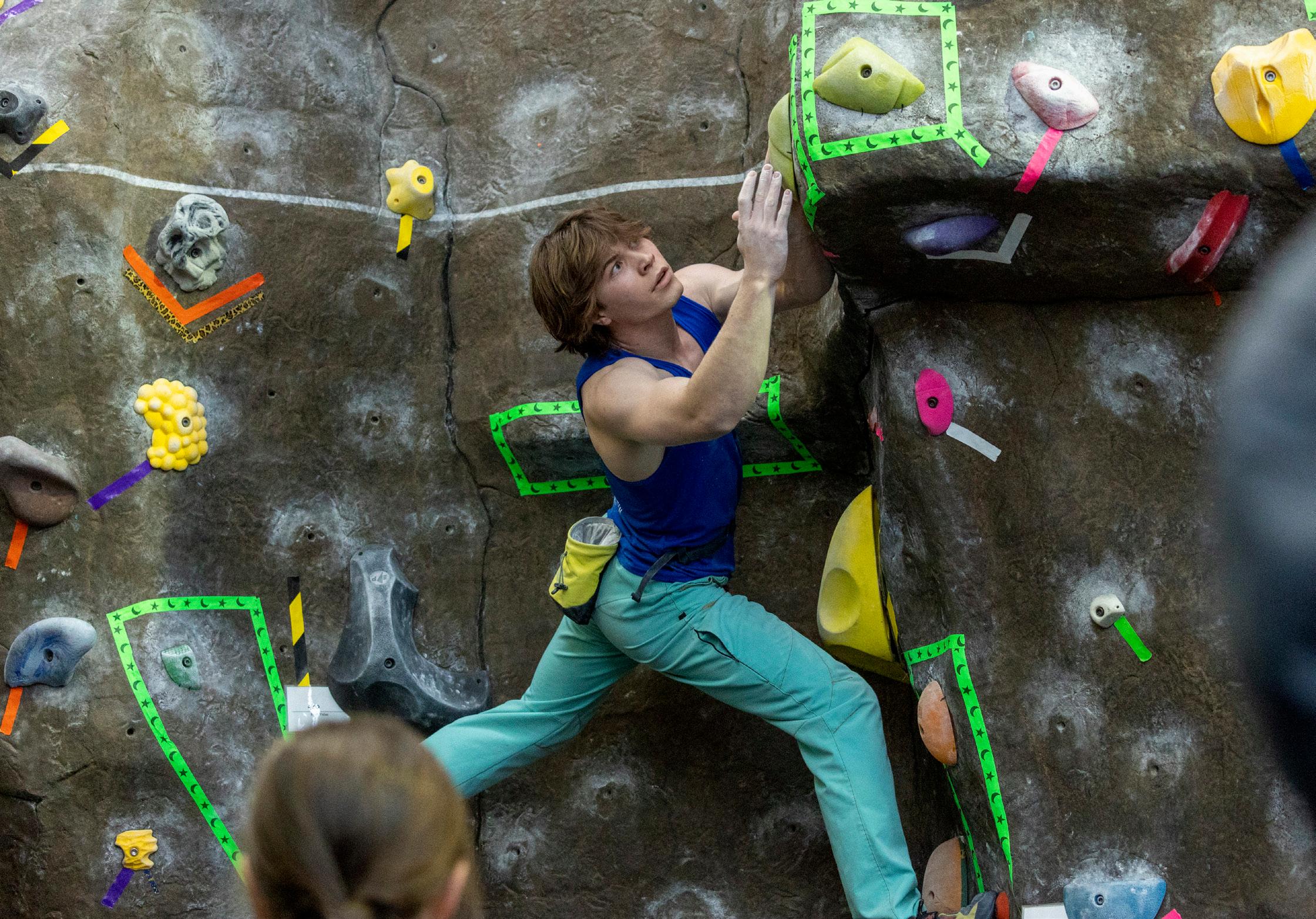
The Palouse Climbing Festival will return on Saturday, March 1 from 8 a.m. to 6 p.m. for all climbing lovers to join and attend.
Compete with some of the region’s best climbers at the Student Recreation Center and show off your climbing skills.
The Palouse Climbing Festival hopes to connect with and inspire climbers in the Northwest through some friendly competition.
At last year’s Climbing Festival, there were contestants from UI, EWU, CWU, Whitman College and more. Secure your spot before it fills up.
According to Hans Zander, the Interim Assistant Director of the Outdoor Program, “The festival is open to all experience levels. We encourage people who may not be ready to compete fully to show up and observe some amazing climbing.”
Register on the UI website and pay the $40 entry fee ahead of time.
The UI Climbing Center is open throughout the year to climbers of all skills levels and even offers many courses on climbing basics if it’s some-
thing you want to try out. If you’re interested in climbing, check out the Climbing Center in the SRC or attend the Palouse Climbing Festival this Saturday to experience
climbing
Palouse Climbing Festival is a great way to connect with local climbers and have a friendly competition,”
Zander said. “We encourage everyone who is interested to come and climb that day.”
Youbesh Dhaubhadel Courtesy Cultural attire at a Nepali festival
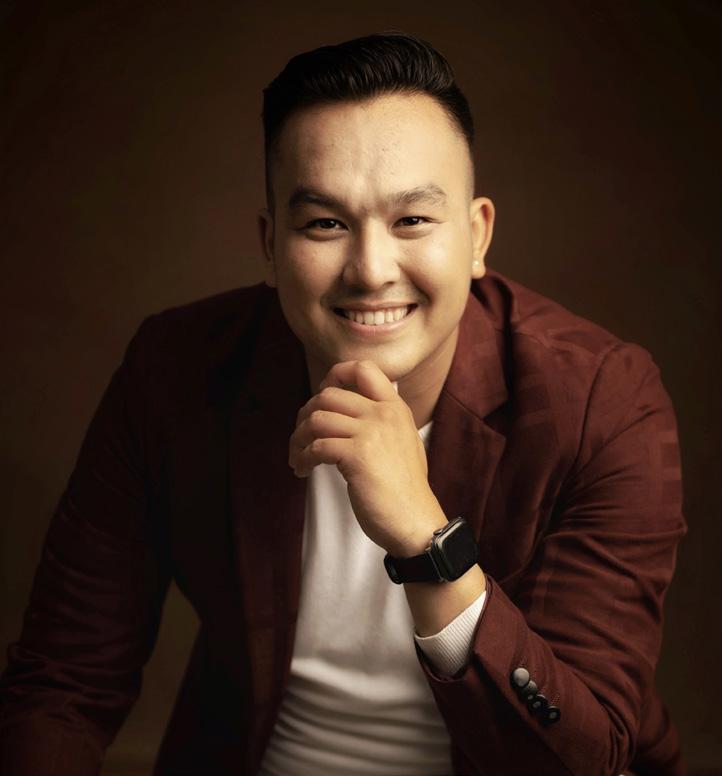
Youbesh Dhaubhadel | Courtesy A headshot of Dhaubhadel
Youbesh Dhaubhadel Courtesy The crowded streets during a Nepali festival
John Keegan Argonaut One of the many climbers competing at last year’s Palouse Climbing Festival
A rise in the acrylic nails trend
Trend turned into a part of women’s creative identity
Brooklynn Jolley
ARGONAUT
Click, click, click: the sounds of acrylic nails tapping on objects are everywhere. They’re clicking on the keyboard of a laptop or the screen of a cellphone.
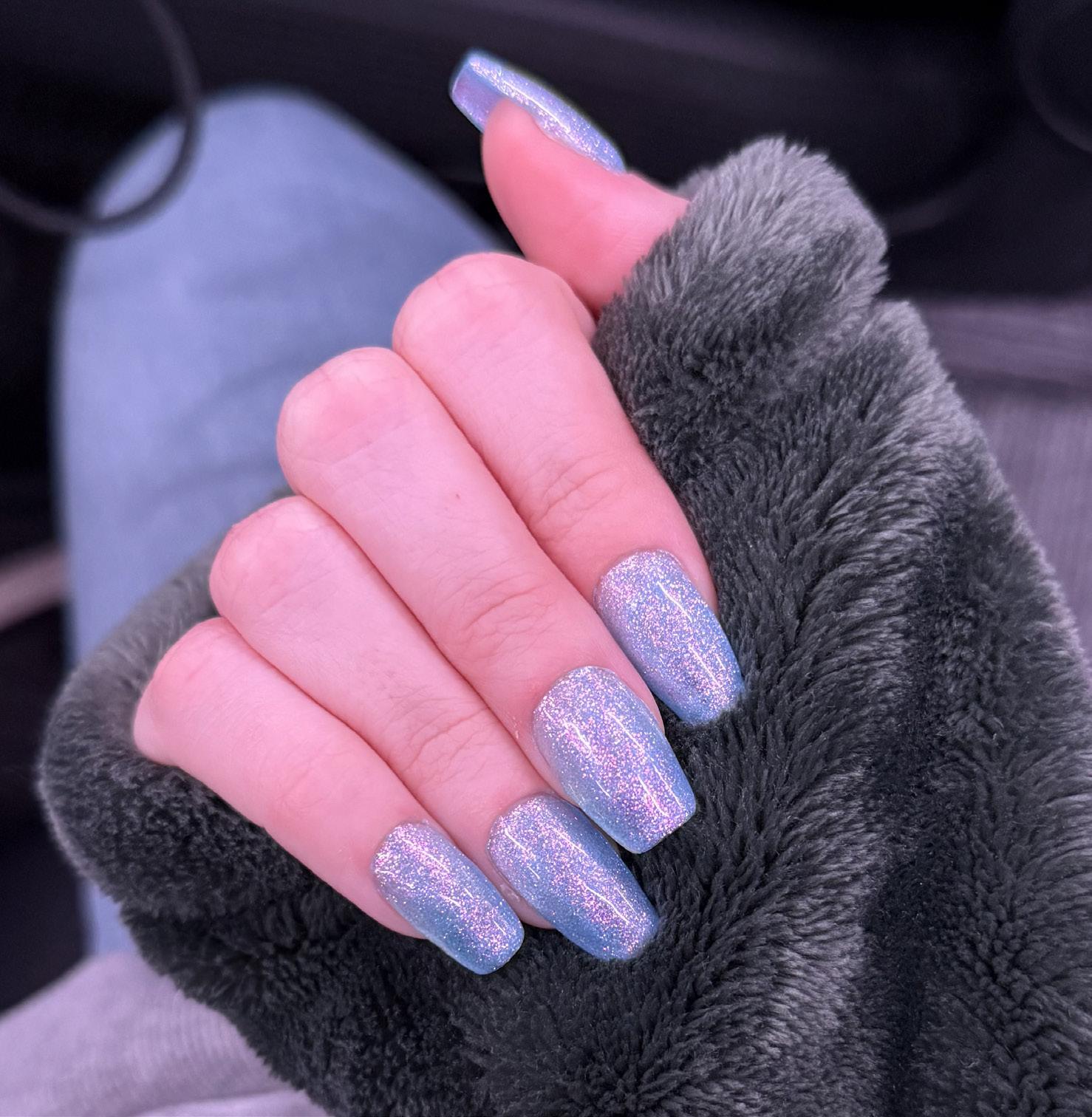
Various colors, designs, shapes and sizes can be seen on many young women’s fingertips. Perhaps they’ve done their nails themselves or paid a professional to do it, but the difference can be hard to tell.
The trend of having acrylic nails or nail extensions of some sort has skyrocketed in recent years. According to Mirium Chandi, the editor in chief of Start Motion Media, nail extensions emerged as a simple beauty trend but have now become part of people’s
confidence or has simply become a part of someone’s identity, everyone has a different reason for getting their nails done.
Quinlyn Rutherfordstone, a freshman Architecture major at the University of Idaho, grew to love having her nails done when she was a child. It was a way that she bonded with her mother. “We did ‘spa days,’ and she’d always paint [her nails], so it made me really happy to have them painted,” she said.
Rutherfordstone has been doing her own nails for four to five years.
For many people, confidence and a sense of completion to their identity is a driving force for wanting their nails to be done.
“I dress up and do crazy makeup and stuff, so it’s weird without my nails to match,” Rutherfordstone said. She spends upwards of seven hours on her nails, focusing more on the artistic side of it, to match her creative personality and vibe that she has crafted for herself.
identities.
Akesha Reid, a writer for Refinery29, wrote that acrylic nails emerged around the 1990s, but really began to grow in popularity in 2019.
Many women you see likely have some type of art on their nails. Whether it’s a nostalgic hobby, helps alleviate anxiety-induced skin picking, boosts
She sees them as more of an art piece and a testament to her identity than just a fashion accessory.
Rutherfordstone feels she is “a little incomplete” without her nails done. Others agree.
Barbara Rivera, a 19-year-old lead optical specialist, has been getting her nails done for about nine years to help
alleviate the anxious tendency to pick at her skin. It’s also become part of her identity.
“When I don’t have my nails done, I feel like something is missing when I look down at my hands,” Rivera said. “I get so used to having them done.”
Rivera has her nails done one to two times a month, depending on how long each set lasts. As one set reaches its extinction, she is ready for another one and has booked an appointment to prevent her nails from being bare.
As the trend has become more popular, the prices for sets from professional nail technicians have also gone up. This spike in price has created more “at-home nail techs,” or people who do nails themselves, without being licensed or intending for it to be their full-time job.
On social media, this trend seems to be popular among women in their late teens and early 20s.
Julissa Gonzalez Mendosa, a freshman Psychology and Child Development major at UI, began doing her own nails between appointments to save money. “Now I only do them myself,” she said. “It was getting expensive, and I wasn’t getting any richer.”
Mendoza would typically pay around $75 in her home state of Oregon. Rivera, who almost always gets her nails done at salons, pays $50 to $60 in Elizabeth, New Jersey, where she lives.
For low income indviduals or college students, this price can make a dent in their earnings or savings, which was the reason why Mendoza began to do her own nails.
Many people are satisfied with the nails they do themselves, which is showcased in an emerging trend on TikTok. Women post a video saying, “Me coming out of my room hours later because I’m my own nail tech,” while showing off their newest set.
Rivera said that she’s had her nails done at home by her sister and many times in a salon.
“The main difference between her sets and the salon sets is [the salon sets] seem to last longer,” Rivera said. “I once went three months with the same set from a salon.”
This trend may be around for a while, as will the unmistakable “click, click, click” sound of acrylic nails tapping away on cellphones and laptops.
“For certain people, nails aren’t just an aspect of design,” Rutherfordstone said. “It can be a passion, a hobby, a confidence boost or even help them medically.”
A guide to skiing as a college student
The best places to ski near Moscow, Idaho
Abby Laurent ARGONAUT
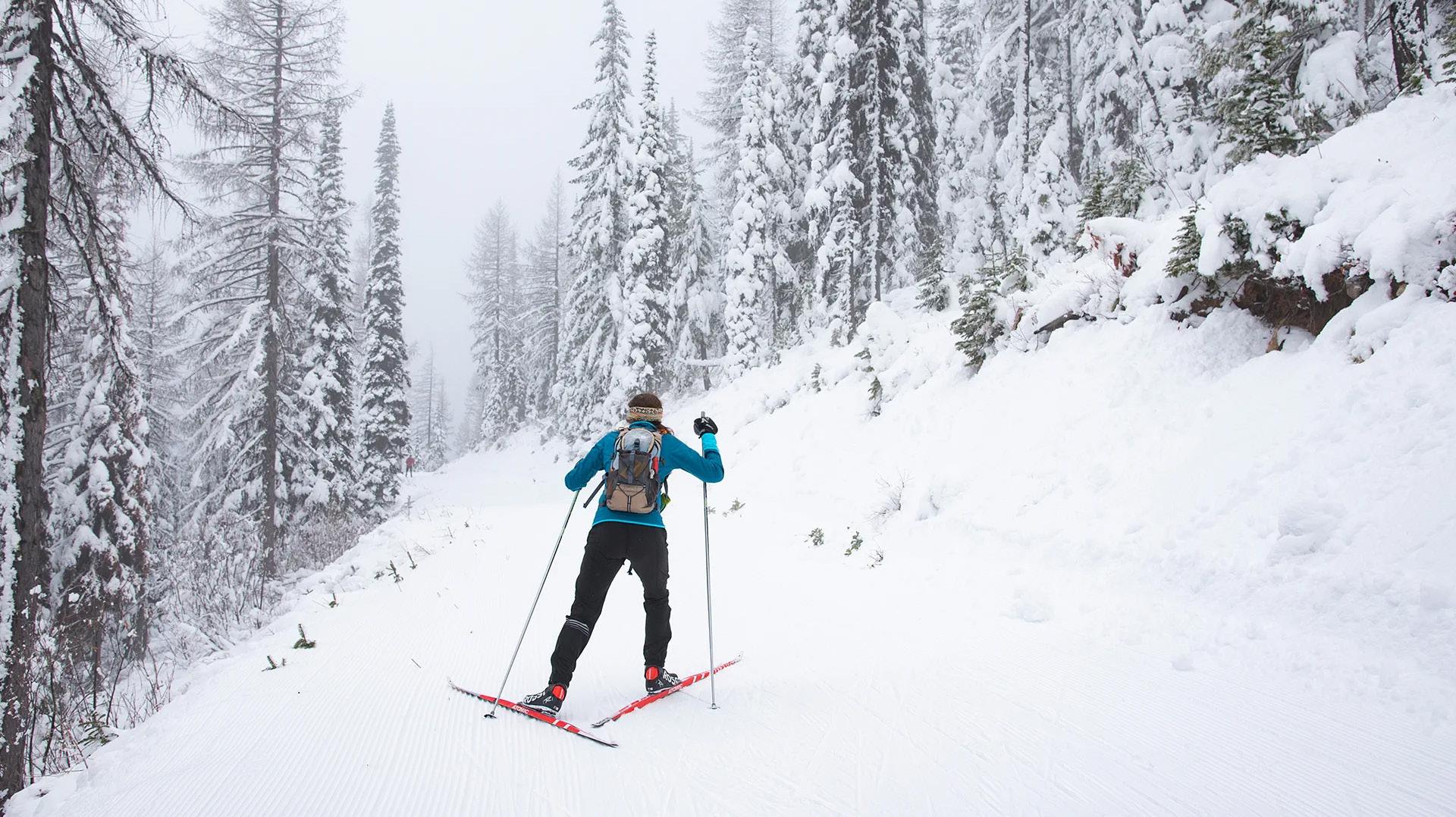
It can be hard to go skiing when you’re a college student. Whether budget or distance gets in your way, or you just want to find the perfect powder day, here is a guide to skiing as a student on the Palouse.
If you’re unsure where to start, a good bet is the Outdoor Program located in the University of Idaho Recreation Center. There, you can find $20 bus rides to Lookout Pass, cheap rentals, tune ups and the occasional ski trip hosted by fellow students.
An Alpine Ski Package, which includes boots, skis and poles, will cost you $32 for two days. The Snowboard package costs the same. As ski/snowboard season depends on weather, most ski areas don’t have a set end-date but instead are projected to be open until mid-April.
Lookout Pass
Two and a half hours away and partially in Montana is Lookout Pass, one of the oldest ski areas in Idaho. They are dedicated to keeping prices low, with $64 weekend lift tickets and $150 season passes for college students. Lookout gets several inches of dry
Horoscopes for March
What does this month have in store for you?
Brooklynn Jolley ARGONAUT
powder weekly, making for amazing skiing on a budget! The Idaho-Montana border runs directly through the area, giving you the opportunity to ski in two states in the same day.
Schweitzer
Located just north of Sandpoint is Schweitzer. It’s known for its highquality skiing and variety in terrain. A day ticket for a college student costs $126 and season passes start at $1,399. Schweitzer offers countless activities and attractions, including luxury lodging, a day spa and a handful of bars. It also offers gorgeous views of the mountain range and two bowls, meaning double the terrain and double the runs. Although the pricing is
steeper, Schweitzer is jam-packed with activities and amenities to make your time worthwhile.
Silver Mountain
Slightly closer to Moscow than Lookout Pass is Silver Mountain Resort, a good middle-of-the-road budget-wise. What makes it stand out from the others is the indoor water park hosted at the resort. The water park is a complimentary addition if you book a room at the Silver Mountain Lodge, though day tickets for skiing are also available for $35. Weekend lift tickets are $67 for college students and a season pass is $509. As it is close to Lookout Pass, it sports the same fabulous powder and snow conditions.
Aries (March 21 – April 19)
Be careful this month and look out for yourself. You may have gone through some difficult situations lately, but March will be a great month for personal growth.
Taurus (April 20 – May 20)
Focus on your emotions this month. Perhaps they’ve been conflicting, and you can’t figure out what you truly want. This confusion will clear up this month if you dedicate the time to sort out how you feel.
Gemini (May 21 – June 20)
You’ve been feeling restless lately, but March will be the time to act. Use your eagerness and pent-up energy for good. Act on your emotions and ideas this month and it will pay off greatly for you.
Cancer (June 21 – July 22)
Don’t feel stressed if you’re feeling more introverted than normal this month. You may need to recharge and spend some time in solitude to release some stress that’s built up. Don’t be shy about spending a day resting in bed or being a homebody.
Leo (July 23 – Aug. 22)
It’s time to get back on your feet and bring your spirits back up. March will be a busy month, but with some hard work and dedication, it will give you many rewards. Try to push yourself a little harder this month and don’t forget to be proud of your work and effort.
Virgo (Aug. 23 – Sept. 22)
You may have had a heavy weight on your shoulders recently, but it won’t last much longer because it will be lifted this month. March will be very eyeopening and will offer you some great opportunities.
Libra (Sept. 23 – Oct. 22)
March will be an amazing month for you. You’ll feel very loved by the people closest to you and there may also be a reward coming your way. Take some time to soak up all the love and positivity from others this month—you deserve it.
Scorpio (Oct. 23 – Nov. 21)
Your work and personal life balance needs help, and March is the month to work on it. Take a step back and focus on the real problems. Put your work aside if necessary and prioritize the special people in your life.
Sagittarius (Nov. 22 – Dec. 21)
You may have been receiving some mixed signals lately. Pay closer attention to them and you’ll figure it out. The universe sends you hints, but you’re an expert at decoding them. Dedicate some time to reflect on the messages you’re receiving.
Capricorn (Dec. 22 – Jan. 19)
You always have a full schedule and a busy life, but March will be a much quieter month. Take advantage of your free time and do something special for yourself. Try to reconnect with friends.
Aquarius (Jan. 20 – Feb. 18)
The pieces in your life that have been foggy will become clear this month. Everything will fit into place perfectly, and you’ll have a much easier view of what the future looks like.
Pisces (Feb. 19 – March 20)
March will be a month full of fun for you. All the effort you put into your work will finally be directed towards some fun experiences.
Brooklynn Jolley | Argonaut A set of at-home acrylic nails
Winter Social brings energy to campus
On Feb. 19, students gathered at the ISUB for ASUI’s annual Winter Social event. Participants enjoyed access to free food, campus resources and exciting activities.
The University of Idaho’s student government collaborated with groups all over campus to make this event a reality. ASUI Vice President Emma Johnston explained why it is so important to provide fun on-campus events for students.
“I think events such as the ASUI Winter Social are a vital part of building up the Vandal community on campus,” she said. “Events that not only provide students with fun and engaging activities but help connect them to other students and organizations help enrich the student experience and strengthen the feeling of connection.”
With the possibility of winning big raffle prizes like a flat-screen TV or electric scooter, this year’s Winter Social attracted a lot of visitors. The entire building was occupied by the event, with 35 clubs and five student vendors distributed throughout.
While grabbing one of the 600 servings of free nachos provided by Idaho Eats, students could enjoy the live DJ with lights.
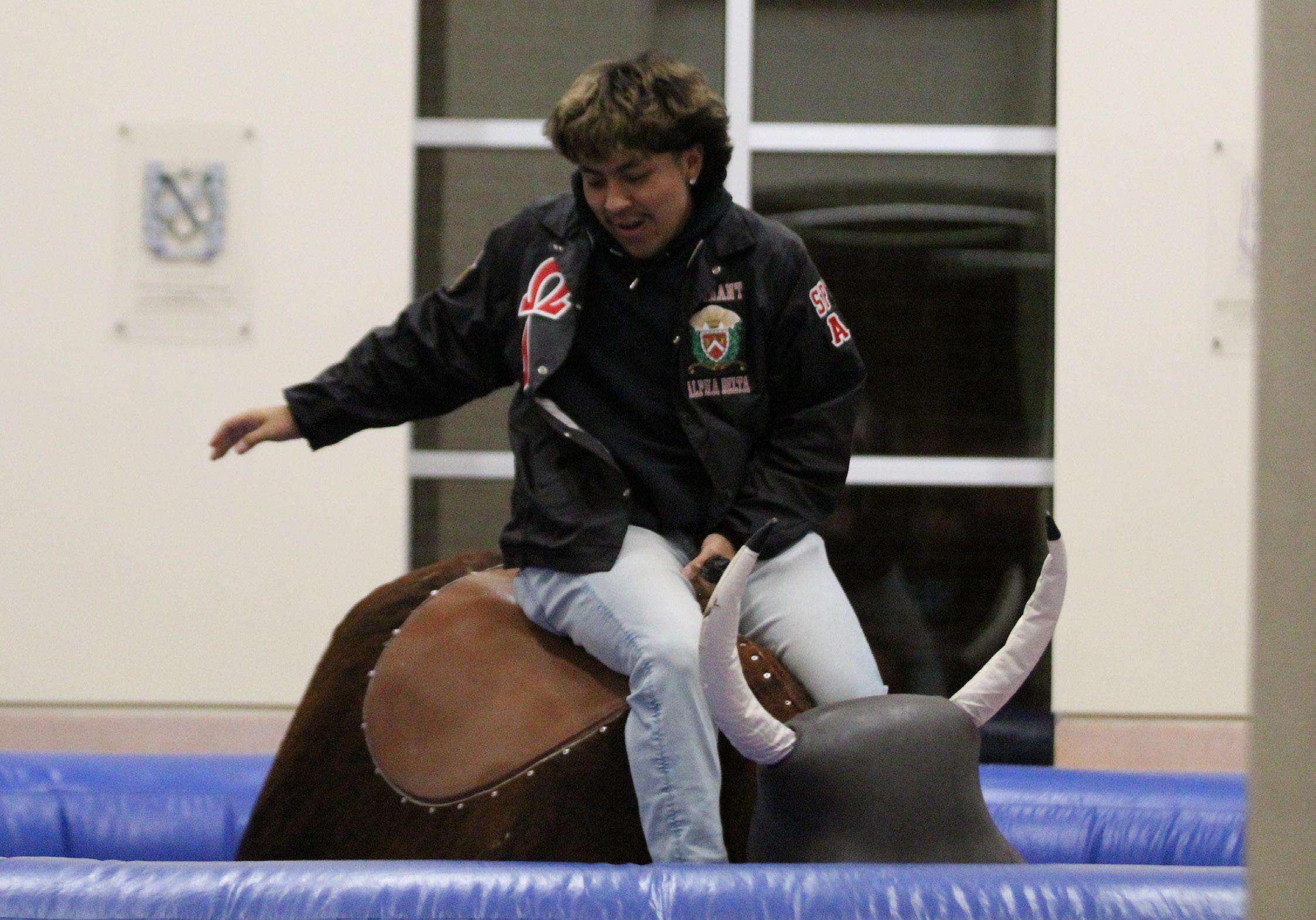
Additionally, they could bounce around the ISUB to enjoy the mechanical bull, casino room, crafting
station or esports games.
Senior Olivia Ponte explained the impact that the Winter Social had on her relationship to campus.
“I feel like this event makes campus a lot more welcoming, especially for newer students. Tonight, I saw people that I have classes with but wouldn’t normally hang out with outside of that. It allowed me to connect with them on a deeper level, and the Winter Social was a really good space to do that,” she said.
Another senior, Brielle Sorensen,
connected this idea to UI’s campus culture.
“I feel like the Vandal family is a very prominent thing about UI, and it’s really cool to watch that reflected in events like the Winter Social that make our school so special. It was fun to watch all these connections being formed while hanging out with some of my closest friends,” she said.
Sorenson continued by emphasizing how important it is for students to join clubs and organizations on campus and
how vital it is to increase their visibility.
“I feel like once a student feels like they are connected to something a little bit bigger than themselves, and they join these different clubs and communities that make them feel empowered and seen and heard, I think that does help to grow their sense of community.”
The ASUI Winter Social provided students with the ability to explore what campus has to offer, while having fun with new and preexisting connections.
Egyptian sun god
Crafting with fabric
Retirement, invested
AND, OR, ...
Sweetened fruit drink
Gatling gun, abbr.
Actress Thurman
Longitude, abbr.
Brightened or started, as in fire; or inebriated
Iron, elementally Across:
that covers the
of youth
farming orgs
for anaphy-
Reagan Jones | Argonaut University of Idaho student Louie Cortez dominates the mechanical bull
MORE Education. LESS
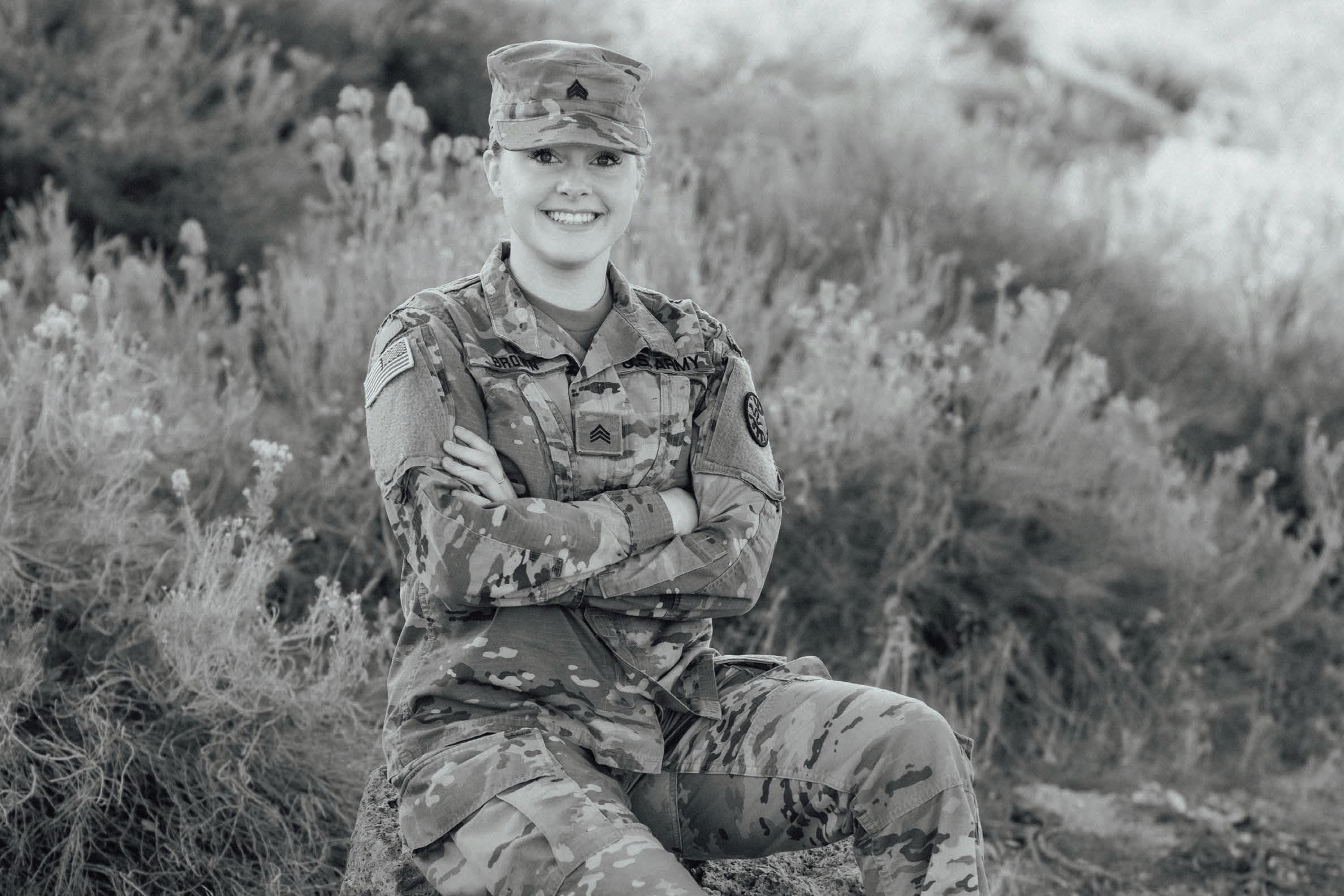
THE MONTGOMERY GI BILL SELECT RESERVE EDUCATION BENEFIT
•Full-time enrollment: $481.00 for each full month
•3/4-time enrollment: $360.00 for each full month
•1/2-time enrollment: $240.00 for each full month
•Less than 1/2-time enrollment: $120.25 for each full month
•TUITION ASSISTANCE
•$8,000 State Assistance per year.
•$4,500 Federal Assistance per year.
•ENLISTMENT BONUS
•$20,000 for qualified MOS
•In-State Tuition for Enlisting
•HEALTH INSURANCE
•$51.95 Individual
•$256.87 Family
Mitchell, one of the Vandals’ most impactful players this season
Jayden Barfuss ARGONAUT
“You’re too small,” are three words Kolton Mitchell has heard his entire life. But instead of letting the doubt define him, it ignited a fire that fueled his every move. Now, as the point guard for the Idaho Vandals, those words are no longer a criticism; they’re the driving force behind every dribble, every pass and every play. With Idaho draped across his chest, Mitchell wears the weight of doubt as a badge of honor, proving that size isn’t measured in inches but in the heart.
“I’ve been dealing with this my whole life,” Mitchell said. “I’ve always been considered the super small guard, short and skinny, and because of it, I’ve developed a gritty mindset, and my competitiveness has always taken me so much further than many people would expect.”
Mitchell decided after a season in Pocatello that he wanted a change and transferred from Idaho State to the Vandals, a place that felt more like home to him.
“When I entered the portal, Coach Pribble reached out to me the first day, and he decided to offer me,” Mitchell said. “Then, after about a week, I decided to commit here. It felt like it was the right place for me. It just felt at home. I loved all the guys that were here and then putting in all the work in the summer and stuff; it felt like it’s paid off this season.”
Mitchell, who grew up an hour and a half away in Coeur d’Alene, Idaho, gets to don the Idaho Vandals jersey and represent the state of Idaho every time he wears black and gold.
“It means a lot. I love the state of Idaho, and it means so much wearing Idaho across my chest,” Mitchell said. “Being just an hour and a half away from home and being able to have people from my hometown and high school come to all my games. Seeing all the people that support me along my whole journey, through high school, and then being able to follow me through my college career, means a lot to me.”
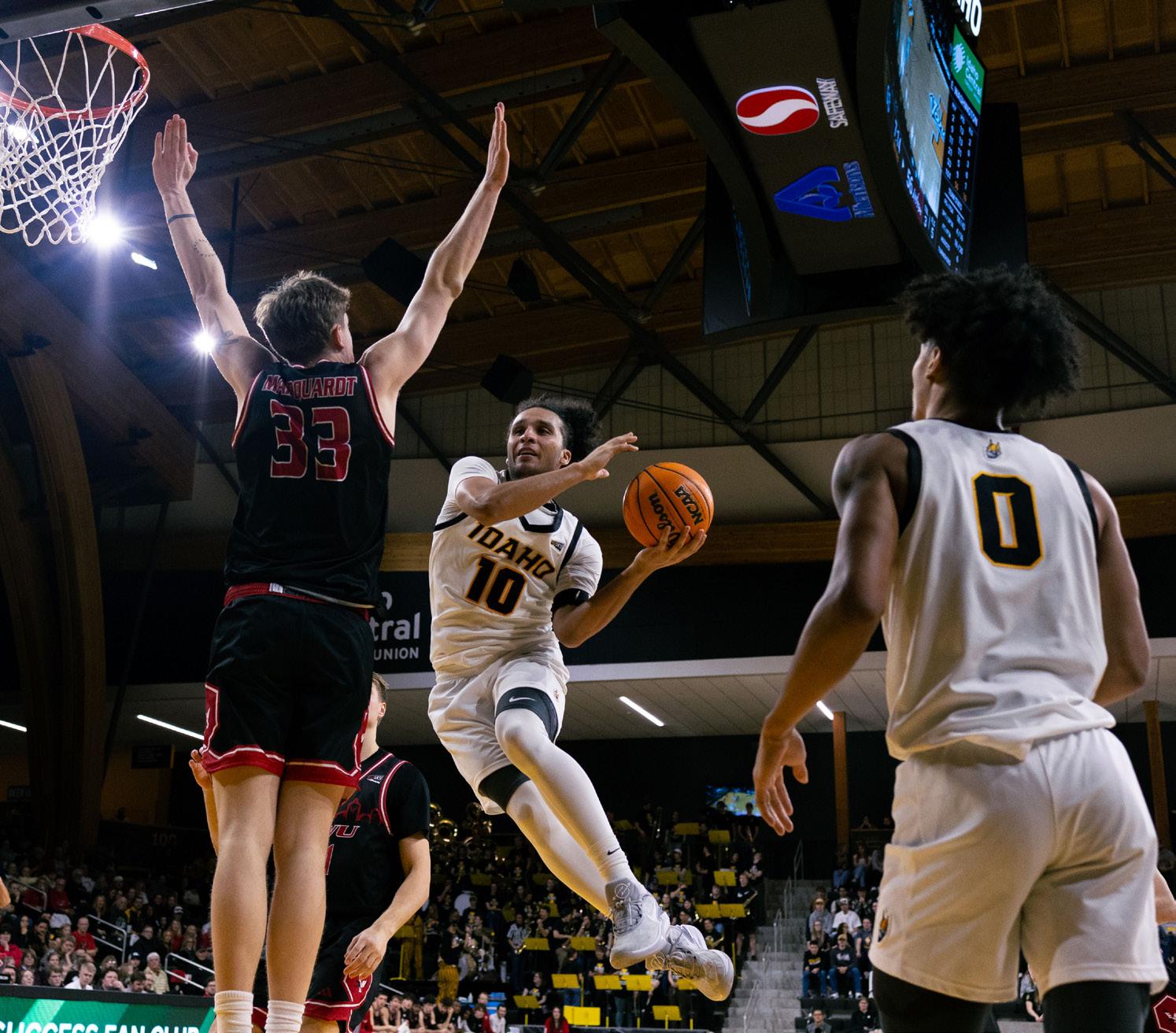
In the words of Head Coach Alex Pribble, Mitchell has been the “spark plug” the Vandals have needed this season. The redshirt freshman guard has been outstanding for the Vandals all season. He has started in all 28 games, averaging 11 points, three rebounds and three assists, and has been key for the Vandals especially in the back half of the season.
“Kolton Mitchell has been a great addition to this program,” Pribble said. “It’s a priority for us at Idaho to keep the best talent from the state of Idaho in a Vandal uniform, and Kolton is just that. He’s a kid who plays the game with a chip on his shoulder. He’s got great confidence, and we’re excited about what he’s accomplished already. The beautiful thing is Kolton’s best basketball as a Vandal is still ahead of him.”
Pribble wouldn’t make the same mistake as former head coach Zac Claus and ignore Mitchell and his unreal talent.
“He’s a winner, I think that’s the most important thing,” Pribble said. “He was a winner in high school, and he’s one of those guys who finds a way to win. I was very aware of Kolton coming out of high school at [worked as an assistant coach] Seattle University. We didn’t recruit him specifically there, but I knew about him a lot.”
“As soon as I made the move to Idaho, he was a no-brainer; we saw his name in the transfer portal. The first thing we did was call him up right away and do everything we could to get him here.”
Mitchell has had his ups and downs throughout the season. One of his major ups and turning points was the second half against Northern Colorado in the Vandals’ thrilling win on Jan. 23.
The night did not start the way Mitchell or the Vandals would have wanted. Northern Colorado controlled things, and they took a 36-26 lead into the locker room. Mitchell had one point in the first 20 minutes.
Mitchell stepped out onto The ICCU Arena and decided to take over and show everyone what he was made of. In the second half, Mitchell rocked
Northern Colorado with 24 points, including six threepointers, two of the biggest moments of the game; a moment that Mitchell thrives on.
“In a game, it’s all about my aggressiveness and then my confidence out there; I’m not afraid of the big moment. I take any challenge. There’s no one that I’m afraid of when I’m out there,” Mitchell said.
The first moment came with just over two minutes to go and the Vandals trailing 68-66. He dribbled to the left, went between his legs, then stepped back to create separation, Mitchell then laced the three-pointer to give the Vandals a 69-68 lead with just over two minutes to go.
After a Northern Colorado basket with 3.4 seconds left, Mitchell called the game for the Vandals. The seconds ticked down, and
started coaching him in fifth grade, we had a little team, and yeah, I said this about him for as long as I’ve coached him, I don’t know what its factor is, but whatever it is, he’s got it. He’s the best competitor I’ve ever coached. He wants to win, whether you’re playing five on five, one on one, checkers or chess. It doesn’t matter to Kolton if he’s doing it; he wants to win.”
A few years later, after getting on Reed’s AAU team, Mitchell walked into LCHS gym for a tryout, and team manager Sam Buffington was blown away by the freshman.
“I was a junior, and it was my first time being a manager. I already knew the other juniors and two seniors we had, but when I saw Kolton for the first time, I didn’t know who he was,” Buffington said.
“I was like, who is this young-looking kid? This is a varsity tryout/practice, I asked around, questioning people, ‘who’s that?’ They said that it was Kolton [Mitchell]. He’s a freshman; he’ll be our point guard and will be great.”
From the time Mitchell walked into the Lake City gym, great was an understatement of what he was for the Timberwolves. He arrived at Lake City, and the Timberwolves, coming off a 3-17 season the year before, needed a spark, and Mitchell and his teammates provided one.
They finished his freshman year 16-10 and got to the state tournament before losing to Borah and Rigby High School to end their season.
The formula was there, and behind the recent addition of Moscow High School transfer Blake Buchanan, Mitchell and the future Idaho Vandal linebacker Zach Johnson, the Timberwolves defied the odds and made it to the 5A state championship game and won against Meridian.
The Timberwolves fell to the Warriors 68-54 and were still on a mission to get the school’s first state championship.
They looked destined for it the year after as the Vandals, with the three stars and other juniors Nathan Hocking and Deacon Kiesbuy, were set for a championship run.
The Timberwolves ran through the
redshirt sophomore Jack Payne threw the pass to Mitchell. He used his speed to get to the right side of the court. He then hoisted a 30-foot three-pointer over former Idaho Vandal guard Quinn Denker, swishing the shot and giving the Vandals the win as the buzzer sounded.
Mitchell has always been better when the lights are shining the brightest, but his true love of basketball started in his driveway, with his dad growing up wishing for a moment like the one he had.
“I fell in love with it from the first time I ever really decided to play,” Mitchell said. “I started playing basketball in first grade, and my dad was a big influence on me. He pushed me to always try my best and work my hardest.”
From that point forward, Mitchell was on a path to being the best basketball player he could be, and former Lake City High School assistant coach Kelly Reed, who had coached Mitchell since the fifth grade, knew right away that he was going to be special.
“He started coming to camp either second or third grade, and you could tell right away he was going to be good,” Reed said. “I
A journey fueled by doubt, Kolton
doubt, driven by heart
regular season, heading off with a 22-1 record and the number one seed in the 5A.
The Timberwolves, however, ran into Centennial who ended their chance at a championship and a loss to Madison two days later, leaving Boise empty-handed.
They left the Ford Idaho Center without a trophy. Still, they left the floor with a fire of passion and a hunger to rebound from this and turn the tears and disappointment into a championship.
Mitchell and the four other seniors were not going to be denied, and they had a historic season. Lake City wanted to challenge itself, and it began the 2021-2022 season with three tournaments, including one with the defending 5A champions, the Owyhee Storm.
Mitchell had the best game of his career, scoring 39 points and breaking the Lake City single-game scoring record in the 80-60 win over the storm, which improved Lake City’s record to 3-0.
Three games later, Lake City participated in the Curtis Winter Classic and took on the two-time state champs and tournament hosts, Curtis. Mitchell had another
outstanding game, scoring 26 points and leading the Timberwolves to a 77-65 victory.
From there, the Timberwolves cruised through the rest of the season, beating everyone by an average of 30 points (the mercy rule in Idaho).
Now, as they stepped into the Idaho Center, it was time to claim their prize. After four seasons of hard losses and long hours of work, Lake City defeated Meridian 75-61 to claim their first state championship in school history, a moment that Mitchell will never forget.
“We had a very tight group; we were all best friends on the team,” Mitchell said. We decided to buy in with our loss our junior year at state, which brought a lot of motivation. Knowing that for the city of Coeur d’Alene, for this high school, we need to get the job done.”
“With three minutes left [in the game], they took their starters out of the game, and we knew we had it sealed,” Mitchell said. “It was a surreal moment, knowing that all the hard work that we put in, all the tears from the years before that. We came up short to finally get it done for our senior year, and our last time ever wearing a Lake City Jersey, and for the town of Coeur d’Alene.”
Mitchell finished his Lake City career as the all-time leading scorer in school history with 1,614 points. He also finished with a 40-2 home record, not losing at home in his last three years. He was also a three-time allstate recipient at Lake City, named 5A All-State twice, and Inland Empire League MVP in 2023. His four years at Lake City were years that will not be forgotten by anyone involved, including Reed, who retired from Lake City after that season, along with head coach Jim Winger.
“Kolton changed the whole basketball culture; he showed up, and instantaneously, we made the state tournament the next year,” Reed said. “His attitude and his competitiveness became infectious. If you take Kolton off of our team, none of what we accomplish happens. The mark he left will never be forgotten.”
The championship and the accolades, however, were not enough as Mitchell only got one Division One offer from Idaho State and was told by several coaches, including former Eastern Washington and current Washington State head coach David Riley, that he was too small to play at the Division One level, a phrase that was sadly the same he’d been told growing up.
“It was tough on me not getting a lot of offers,” Mitchell said. “I got a lot of calls, and I was talking to many schools, but no one really took the shot to offer me, and it was hard on me. That made me play with a chip on my shoulder because I thought I was better than other coaches thought of me.”
Now, every time Mitchell steps onto the court at The ICCU Arena, he’s not just putting on a jersey. He’s carrying the weight of every doubter, or naysayer who told him he wasn’t enough. He’s playing for that kid from Lake City who once dreamed of playing at this level, of being the one with the ball in his hands when the game is on the line.
With every play and every step, Mitchell channels that hunger, that unwavering belief in himself, proving to the world that the greatest fuel comes from the fire others tried to extinguish, and he’s just getting started.
Photos
Men hope to get off rollercoaster
Convincing win over NAU is a turning point as post-season approaches
Liam Bradford ARGONAUT
On Jan. 23, the trajectory of Idaho’s season changed drastically when they hosted the Big Sky’s top team at the time, Northern Colorado, who had not yet lost a conference matchup. The Vandals, who had been middle-of-the-pack in conference play up to that point, stunned the Bears 77-76 on a magical buzzer-beating heave from Kolton Mitchell. Mitchell says that when Idaho is at their best, they can beat anyone in the Big Sky.
After a statement win, it seemed that the Vandals were beginning to create notable distance between their success level this season and their lack of it in previous seasons. However, Idaho was brought right back down to Earth just two days later when they suffered their most detrimental conference loss of the season against the Northern Arizona Lumberjacks in Moscow.
In that game, Idaho had a strong first half, but never claimed a commanding lead, allowing Diego Campisano and company to claw their way into the driver’s seat and steal a home game from the Vandals. The Lumberjacks run an efficient, high-caliber offense that is more than capable of erasing a deficit if their opponent does not showcase physicality for the duration of the game.
Knowing this, Idaho (12-16, 7-8) was vigilant in not allowing any room for Northern Arizona (16-13, 7-9) to come back when the two teams faced again on Feb. 20. On a night when Northern Arizona was displaying its new “Astro Jacks” jerseys, an homage to Flagstaff’s rich space heritage, the Vandals won 83-78, preventing a regular season sweep. This game is a turning point in
the Vandals season as they push to move up in the conference standings before the tournament.
The Vandals jumped out to an 8-0 lead and kept their foot on the gas until the deficit was insurmountable, boasting a 52-28 lead at one point in the second half. Similar to the first meeting, the Lumberjacks went on a hot streak, this time a 48-27 run, which was capped by a Trent McLaughlin triple that shrunk the lead to one possession with under 30 seconds left.
Jack Payne shut the door, making four straight free throws, icing the game and
and scored 25 points. Linhardt’s careerhigh prior to this game was 18; He scored 16 in the first half of Thursday’s game. His performance led the Vandals to a strong first half, scoring 45 points, which is the highest mark they have reached thus far in conference play. They went into the break with an 18-point lead, determined to hold onto it this time.
McLaughlin led a valiant comeback effort, tying his career-highs of 35 points and seven three-pointers. He also had five rebounds and three assists. Despite all this, the Vandal offense did enough to escape
securing a milestone win for Idaho. Payne has been a significant factor in each of the meetings between these two teams. This win makes 2024-25 the most successful season for Idaho in the last handful of years in terms of wins and conference wins.
Though Idaho’s five starters account for 69% of the team’s scoring this season, the offensive catalyst in this game? Junior forward Tyler Linhardt came off the bench
Idaho Swim and Dive springboard into playoffs
26 Vandals to compete in Texas hosted playoff
This week the WAC (Western Athletic Conference) swim and dive championships will commence and the Vandals have 22 swimmers and four divers set to take part in the events down in Houston. UI finished the regular season 5-3 and 4-1 in the conference.
Of the 22 swimmers for the Vandals that will be a part of the championship meet, here are a couple of names to keep in the back of your mind. Starting with sophomore Ginger Kiefer who won the 5K MPSF Open Water Swimming Championship in Long Beach back on Oct. 19. She has also had multiple first place finishes including at the Northwest Colligate Invitational where she took the top spots in the 500-yard freestyle, 200-yard back stroke and the 200 and 400-meter individual medley.
Senior Ella Haskins finished first against Seattle University in the 50 and 100-yard freestyle. She also finished first in the 100-yard backstroke at the NW Collegiate Invite. Freshman Molly Lenarz finished at the top of the list in the 500-yard freestyle both against Seattle U and at the NW Collegiate Invite. Also, second place finishes against Northern Colorado and the College of Idaho.
Junior Madelynn Butler has a couple first place times in the 50-yard freestyle which she set against Northern Colorado as well as the College of Idaho. She placed third in the same event against Washington State.
Junior Grace Ruble has swum her best in the 100-yard butterfly, finishing first in multiple matchups as well as coming in second place a couple of times. She has
also had some second and some thirdplace finishes in the 200-yard butterfly as well.
Flagstaff unscathed.
In a season where the Big Sky has been notably competitive, the Vandals’ two most impactful wins as of today were against Northern Colorado and Northern Arizona. These were considerably highstakes games, as the Bears are currently battling Montana for the top seed, while the Vandals and Lumberjacks are both among the 50% of the conference that has either seven or eight wins.
Silvana Cabrera in the 200-yard butterfly and the 100-yard breaststroke has had a few top three finishes. Amelia Buyers in the 100 and 200-yard individual medley have been in the top five and Natalie Charles has had strong performances in each of the breaststroke distance relays.
The four divers that will be competing are freshman Kaitlyn Blackmer, sophomore Saige Anderson, freshman Abigail Pink, and sophomore Lauren Wierschke. Blackmer finished second in the meter dive with a time of 2:36.85 and third in the 3-meter dive at 2:10.90 when UI went against the Utah tech Trailblazers on Jan. 18.
Against Northern Colorado on Oct. 12, Anderson placed fourth in the 3-meter dive with a time of 2:24.85. She also had a couple of second place finishes against Washington State. Completing the meter dive in a time of 2:19.45 and the 3-meter in 2:29.95.
Pink also had a second and third place finish versus Utah Tech but the opposite of Blackmer. Pink finished second in the 3-meter with a time of 2:19.90 and third in the meter at 2:03.25. She also placed first in the meter against the College of Idaho, recording a time of 2:51.63.
Wierschke had a couple top finishes against the Trailblazers. Placing first in both the meter and 3-meter dives. She recorded 2:37.75 in the meter and 2:48.70 in the 3-meter. She also finished first in the 3-meter against the College of Idaho with a time of 2:41.58.
The WAC Championships take place in the CRWC Natatorium.
The Vandals are in somewhat unfamiliar territory as they are battling with four other teams for the third seed in the tournament, a spot that currently is occupied by Portland State (16-12, 8-7). If the season ended today, Idaho would be in fifth place in the Big Sky, which would be enough to secure a first-round bye. However, the third seed is the ideal position because that team avoids facing any top five teams until the semifinals.
With an unusually tight competition for seeding in the Big Sky, the remaining three games on the schedule are extremely pivotal. The way a team finishes the home stretch of conference games determines their chances of winning multiple postseason games. The Vandals’ biggest game of the season will take place on Thursday when they face off with the Idaho State Bengals (13-13, 8-7) in a repeat of the Feb. 1 matchup that swayed in favor of the Bengals.
After losing in Pocatello, this game is a must-win for the Vandals, who are currently just one spot behind the Bengals in the standings. If the standings remained the same, this game would be a preview of the 4 vs. 5 quarterfinal matchup in Boise. The Bengals are just 3-10 on the road, giving Idaho the perfect opportunity to pick up a resume-boosting victory.
If the Vandals can beat the Bengals in Moscow, they would have a solid chance of securing the fourth seed, but Portland State, who controls their own destiny, will remain in third place if they win out.
Winning out is essentially the only option for the Vandals, who could potentially lose their first-round bye in the season finale with a loss against a Montana State team that currently has the same overall and conference record as Idaho. The Vandals, who beat the Bobcats by five in Moscow to open conference play, will be faced with a challenge against a Montana State team that is 10-3 at home this season.
Idaho also hosts Weber State (10-19, 4-11) on March 1 in the final home game of the season. The Big Sky Tournament begins on March 8 at Idaho Central Arena in Boise.
Indoor Track and Field gets set for Big Sky Tournament
Many UI athletes invited to final indoor event
Track and Field is competing this week in the Big Sky championships down in Flagstaff, Arizona. Multiple UI men and women are competing in various events throughout the meet, which will last a span of three days.
Beginning with the 60-meter dash, only one Vandal is taking part on the men’s side. Junior Cash Jones, who ran a 6.84 in the Husky Classic back on Feb. 14. Jones is also a part of the long jump with two of his teammates.
One of his best events as he set a personal best with 7.11 meters which also took place at the Husky Classic. Freshman Jesuye Doherty is also competing in the long jump. He also recorded a personal best 7.6 meters at the Riverfront Invitational on February 6.
The women have three players running in that event. Adelyn Mitchell, Blossom Omogor and Jana Willems. Omogor and Mitchell are also a part of the women’s 200-meter dash alongside Lara Holzhauer, Rhyan Madden and Alyssa Marsh. The UI women also have a pair of runners for the longer distances such as the 400meter dash and 800-meter run.
The men have quite a few entries in the 800-meter run with seven total runners in that event. However, they only have one par-
ticipant in the mile run, senior Shea Mattson. He ran a mile in 4:09.80 at the UW invite on January 31.
The women have four runners in the mile including senior Katja Pattis who has had some high finishes this season. Both the men and women have two competitors each in the 3,000-meter run. Pattis is also a part of the team competing in the 4,000-meter distance medley.
The men’s 4,000-meter distance medley team is the same that ran a 10:09.93 at the Lauren McCluskey Invitational, the only track and field meet this season that UI hosted. They also have an eight-person team in the 4x400-meter relay, the women on the other hand just have a team of six in that event.
The men also have just one competitor in the triple jump. Freshman Shawn Twumnasi-Ampofo, whose triple jump distance of 15.28 meters leads the conference. The UI women have two competing in the triple jump. The men do have three competing in the high jump while the women just have two. Each UI team has a few competing in the other various events as well, such as the shot put and weight throw. For the women, Mia Sylvester is a part of both those events. She won the weight throw event in front of the home crowd in the Kibbie Dome with a distance of 19.24 meters.
Finally, the last event to round out the competition will be the men’s heptathlon where UI has two taking part. The Big Sky championships run through Saturday and can be streamed on ESPN+.
John Keegan | Argonaut Vandal guard Kristian Gonzalez gets acrobatic while going for a lay-in against EWU
Jackson Hamelund ARGONAUT
Jackson Hamelund ARGONAUT
Is Mahomes a top five all time QB?
Quarterbacks that still outrank the Chiefs’ legend
Liam Bradford ARGONAUT
The “GOAT” debate is a widely prevalent topic in the world of sports. Whether it is Jordan vs. LeBron, Ronaldo vs. Messi, Ruth vs. Ohtani, or some other heated comparison, pundits and fans enjoy discussing which player’s career provides the best case as the greatest to ever play their respective sports.
Patrick Mahomes was drafted out of Texas Tech in 2017, sat behind Alex Smith for a season, and was already a top five quarterback in the league by the time he hit the field as a starter in 2018. In that season, Mahomes won his first MVP and led the Chiefs to the AFC championship game for the first time since the 1993-1994 campaign. Though they were bested by Tom Brady and the eventual champion Patriots in overtime, this game began a seven-year streak of AFC championship game appearances for the Chiefs.
Due to a combination of his raw talent and uncanny ability to rise to the occasion in the playoffs, Mahomes has undoubtedly had the most successful first seven full seasons of his career of any quarterback to ever grace the gridiron.
He has broken countless passing records and has led his team to appearances in five out of the last six Super Bowls, winning three of them. He has three Super Bowl MVP’s and two NFL MVP’s. Some have argued that if the Chiefs had completed the three-peat against the Eagles, Mahomes would have moved into the position of the greatest of all time.
Despite returning to the Super Bowl in 2025, Mahomes was not a top five quarterback this season. He struggled at the start of the year but eventually found his stride as the season wound down. Regardless, recency bias should not be a factor when constructing a list that analyzes a player’s entire career, so I would still consider Mahomes to be the best quarterback in today’s NFL, barring any major changes to the landscape of the league.
However, longevity is one of the most important categories to consider when judging a player’s career, and if Mahomes retired today, his career numbers would not be enough to solidify himself as one of the five best quarterbacks to ever play.
Without further ado, my list of five quarterbacks who had the best overall career, which features primarily modern quarterbacks who benefitted from playing
during a pass-heavy era, is as follows:
Tom Brady:
After spending his college years in Ann Arbor, a heavily-overlooked Brady was drafted in 2000 with the 199th draft pick by the New England Patriots. The Patriots had no intentions of the Michigan Wolverine signal-caller becoming the starter at any point in the near future with four-time Pro Bowler Drew Bledsoe commanding the offense.
However, when Bledsoe took a hit that left him with internal bleeding in his chest cavity along with a partial rib tear, Brady got his chance. What the world did not yet know as they watched the skinny, unathletic 24-year-old quarterback take the field in Foxborough, was that they were about to witness the first glimpse of the undisputed legend that Brady became. A record-breaking 335 starts later, Brady officially retired with seven Super Bowl rings, which is more than any other player or team has won.
The Patriots won 17 AFC East titles and appeared in nine Super Bowls in Brady’s 20-year stint in New England. He won three MVPs, five Super Bowl MVPs and was selected to 15 Pro Bowls. He leads all quarterbacks in many major statistics, including passing yards and touchdowns. His 35 career playoff wins is more than double the amount of the quarterback with the second-most career playoff wins, which happens to be Mahomes with 17.
All this, plus the fact that Brady, at 41 and 43 years of age, is the only quarterback who has beaten Mahomes more than once in the playoffs, entirely contradicts the idea that Mahomes could be considered the top quarterback ever. Even if he surpasses Brady in terms of rings, there will always be the argument that Mahomes, in his prime, had his season ended twice by Brady, who was at the end of his career.
Peyton Manning:
The only quarterback who played in the 21st century that consistently went toe-to-toe with the Patriots dynasty and arguably had better numbers than Brady was drafted in 1998 to the Indianapolis Colts as the first overall pick from Tennessee. Manning’s career numbers are as good as anyone, and he holds a plethora of records that will be challenging to break.
The rivalry between Brady and both Manning brothers throughout their careers is unmatched. Despite Manning being drafted first, Brady won three rings before Manning ever managed to defeat him head-to-head. Brady won the first six meetings against Manning, which included wins in the 2004 AFC Championship and the 2005 AFC Divisional Round. As expected, Brady and Manning are in first and second place, respectively,
in career wins.
However, Manning was finally able to defeat the Patriots in 2005, which is the point where the rivalry between Manning and Brady started to develop. Manning won 6 of his 11 final matchups against the Patriots, which included going 3-0 in AFC Championship games in 2007, 2013 and 2016. In 2013, Manning produced the best season any player has ever had, throwing for all-time records of 5,477 yards and 55 touchdowns.
The major distinguishing factor when comparing the careers of Brady and Manning is Manning’s lack of Super Bowl wins, winning just two in 17 seasons. However, statistically, nobody was as dominant throughout their career as Manning. He has the most MVP awards of any player in league history with five and was invited to 14 Pro Bowls.
Manning finished his career on a high note, retiring after beating the 17-1 Carolina Panthers in Super Bowl 50. Manning was elected to the Pro Football Hall of Fame in 2021.
Joe Montana:
The quarterback who set the standard for postseason success and introduced the concept of a dynasty to the football world cannot fall out of the top three on any reasonable quarterback list. After winning a national championship at Notre Dame, Montana entered the league and instantly cemented himself as a player who elevated his performance in crucial moments.
For decades, Montana was considered the greatest of all time, and this probably wouldn’t have changed if it were not for the 2000s Patriots. The powerhouse franchise that began on the shoulders of Montana in San Francisco was the first utterly unstoppable force in football.
Montana was selected to eight Pro Bowls in 16 seasons. He led the 49ers to four Super Bowl wins from 1982 to 1990, winning the Super Bowl MVP three times. Montana also won back-toback league MVPs in 1989 and 1990. He is undefeated in Super Bowls and holds the all-time record for Super Bowl QBR.
His lack of passing yards and touchdowns is the only reason Montana is a level below Brady and Manning, because he is arguably the most impactful quarterback the game of football has had.
Drew Brees:
Brees is a perfect example of a guy who did everything right. He was not a dual-threat weapon or an exceptionally athletic player, but his fundamentals and football IQ make Brees one of the greatest to ever do it.
Drafted out of Purdue in 2001, Brees spent the first five seasons of his career as a San Diego Charger, being selected to the Pro Bowl in 2004. In 2005, Brees
dislocated his right shoulder and tore his labrum and rotator cuff while diving for a live ball. This was his last snap as a Charger and many speculated that it may be his last snap ever.
Three months later, Brees signed a six-year, $60-million contract with New Orleans, where he had a first-ballot Hall of Fame level career. He led the Saints to the NFC Championship in his first year as the starter. Over his 15 years with the Saints, Brees consistently ranked among the league leaders in every major passing statistic.
The Saints had never been to a Super Bowl before Brees arrival, but shortly after, they beat Peyton Manning’s Colts in Super Bowl XLIV in 2009. Despite being the best player to never win an NFL MVP award, Brees did claim a Super Bowl MVP and was named to 13 Pro Bowls.
He is second all-time in passing yards, completions and touchdown passes. He also was one of the most accurate quarterbacks ever, retiring with a 67.7% career completion percentage. Brees also holds the record for the most consecutive games with a touchdown pass with 54.
Aaron Rodgers:
After going severely under the radar in recruiting out of high school, the underdog Rodgers carved out an illustrious professional career and is now often described as the most talented passer in football history. The quarterback from Berkeley was a controversial draft pick in 2005 as the Packers current starter, Brett Favre was one of the best quarterbacks in the league with seemingly a few years left in the tank.
When Rodgers became the starter in 2008, he did not hesitate to demonstrate his exceptional raw abilities. Statistically, Rodgers is one of, if not the best regular season quarterback in NFL history. He has one of the highest passer ratings of all time, and his ability to protect the football is noteworthy. He boasts one of the lowest interception rates in league history. Rodgers has four NFL MVP awards and won the Super Bowl MVP in 2010 after beating Pittsburgh in Super Bowl XLV.
Rodgers’ strong arm and ability to throw precise passes from long distances helped establish his legacy as one of the most skilled quarterbacks ever. His proficiency in orchestrating game winning drives has made him a feared opponent. Rodgers’ mobility and ability to make plays outside the pocket set him apart from more traditional pocket passers like Manning and Brees.
The only blemish on Rodgers’ esteemed resume is his lack of postseason success since winning the 2010 Super Bowl. Since then, he as 12 career playoff appearances, but no Super Bowl ap-
Duke to win it all and Flagg will bring home hardware
Early tourney favorites and my picks for the Wooden Award
Bryce Norwood ARGONAUT
March is right around the corner, and with the month of March comes one of the biggest sporting events of the year, March Madness. The college basketball regular season is ending, and conference play will be here any moment.
With that being said, it’s never too early to get a step ahead on March Madness, with many teams having a guaranteed spot due to their regular season dominance, and other teams that will need to win their conference championship to punch their ticket into the big dance. In this edition of Wood Talks Sports, I will be giving you my best insight on who to keep an eye on when making your bracket as your potential National Champion.
An interesting metric that I always look out for is the KenPom, an advanced metric system that was made by Ken Pomeroy. This has become a crucial stat to look at when creating brackets in March Madness, as it is a great way to see who can actually win
the whole tournament.
There is one certain KenPom statistic relating to previous national champions, tracing back to 2001. 96% of all champions since 2001 were ranked in the top 21 in KenPom offense before the tournament began. 91% of all champions since 2001 were ranked in the top 31 in KenPom defense before the tournament. These teams are usually very good with a nice record and are extremely balanced. Currently, there are nine programs that fit the criteria. Auburn, Duke, Houston, Florida, Iowa State, Texas Tech, Arizona, Clemson and Maryland all fit the KenPom criteria. I will discuss my two favorites for this season.
Now this might be a little basic, but the Duke Blue Devils are a very good team. Sitting at 25-3, Duke has only lost to top teams in basketball, also known as quadrant 1 games. Duke has a star-studded lineup, including three projected top 10 picks in Kon Knueppel, Khaman Maluach and Cooper Flagg, the favorite for the Wooden Award, as well as the projected no. 1 overall pick, in this years NBA draft.
Duke ranks first in net rating for the KenPom, and top 5 in both offense and
defense. I think this Duke team is one of the most well-rounded Duke teams in a while, so I will have them as a favorite.
Another team that fits the KenPom that I will keep my eyes on is Houston. The Big 12 is arguably the best conference in college basketball, and Houston sits atop the Big 12. Sitting at 24-4 on the year, the Cougars rank third in net rating, and are seventh in offense and third in defense.
Their team is very well rounded, with four starters averaging over double digits scoring on the season. The most impressive part about Houston though is their stout defense, allowing the country’s least number of points at 57.8 points allowed per game.
Another team I will mention that doesn’t fit the KenPom, but is right outside, is the Michigan State Spartans. Coach Izzo elevates his team in March, and there is a chance I could see Michigan State making a run at the title from a 2-3 seed.
With the season coming to an end, I thought we would briefly go over my prediction for who will win the Wooden Award, which is awarded to the best player in college basketball. At this point of the season, it is a two-man race
between Flagg from Duke and Johni Broome from Auburn. Flagg currently averages 19.5 points, 7.7 rebounds, 4 assists, 1.1 blocks, and 1.6 steals. Broome averages 18.6 points, 11.1 rebounds, 3.4 assists, and 2.6 blocks.
Looking at both players, as they are the leaders of their teams, who also sit at 1 and 2 in the rankings, I would have to lean towards Flagg winning the award, since he’s doing this as a freshman and leads his team in all categories.
John Keegan | Argonaut Alabama player dunks in the 2024 tourney
Tariff plans will harm the economy
Relying on U.S. goods is unrealistic
Hilary Valdez ARGONAUT
President Donald Trump has announced his plan to impose reciprocal tariffs on all imported goods. This is on top of his plan to put an additional 25% tariff on Mexico and Canada, which was initially supposed to be implemented on Feb. 2, 2025, but was pushed back a month after the countries agreed to work on an a plan to improve border security.
Trump did, however, already impose a 10% tariff on Chinese imports as no agreement was made.
Nations across the globe are planning their next actions, with many of them wanting to fire back with higher tariffs on U.S. goods.
The onslaught of tariffs is a strategy that Trump is using to make Canada, Mexico and China crack down on illegal immigrants and drugs being brought into the U.S. As well as promote domestic production, not only by encouraging citizens to shop U.S. manufactures but also encourage foreign manufacturers to move their production to the U.S.
However, his constantly changing and confusing plan to create as many tariffs
as possible will ultimately hurt everyday people and their wallets the most.
During Trump’s presidential campaign, he showed his lack of understanding of what tariffs are when he stated, “A lot of people like to say, ‘Oh, it’s a tax on us.’ No, no, no, it’s a tax on a foreign country.”
A tariff is a tax on goods that are imported from a foreign country, so the importers of the goods are the ones who initially pay for the tariff. To compensate and keep making money, the importers then sell the item for a higher price to consumers. Ultimately, it is not the foreign countries’ governments nor the foreign manufacturer who pays for tariffs, but the consumer.
Imported goods make up a significant portion of the U.S. market. Mexico supplies a large amount of our produce, liquor and auto parts. China exports many of its computer chips, textiles and plastics to the U.S. Not to mention Canada, which provides a lot of our lumber and about 60% of our crude oil, meaning that gas prices will also likely go up.
This is not including the incredibly long list of products that will be hit with reciprocal tariffs, especially from places like Thailand and India, who have much higher tariffs on average.
Public transportation has many incredible benefits
Idaho is in need of more public transit
Christopher Sprague ARGONAUT
Public transportation is something that is desperately needed in the United States, and especially in Idaho.
The American Society of Civil Engineers has determined that 45% of Americans have no access to public transportation and that most existing systems are ageing and dilapidated. This is especially bad in places such as Idaho.
The Treasure Valley metro area has had a booming population in the last 20 years, yet the only public transit present there is an underfunded bus system.
As someone who is from the Treasure Valley area and drives there regularly, traffic has become noticeably worse in the last five years.
According to KTVB7 traffic has become a lot worse in the last couple of years and will continue to get worse until the area is overwhelmed. This is simply because of the amount of people that have been moving to Idaho.
There is a simple solution to this–instituting just one commuter rail from Caldwell to Boise would create a massive improvement to transportation inside the Treasure Valley. Other cities such as Salt Lake City and Seattle have commuter rails in their metro areas.
The FrontRunner commuter rail in the Salt Lake City metro area was shown to reduce traffic and emissions in the city. The Sounder commuter rail in Seattle was also shown to reduce traffic congestion in the Puget Sound Area.
Commuter rail projects worked at reducing traffic congestion in both of those major metro areas. It should work at reducing congestion in the Treasure Valley metro area.
There are already existing rail corridors that run from downtown Boise to Caldwell so building upon those
Poorer countries also tend to impose higher tariffs as a tool to boost and protect their economy as they often export much more than they import.
If Trump were to put reciprocal tariffs on these countries, not only will it make products in the U.S. much more expensive, but could also throw the foreign countries economy off, affecting many of the citizens living in them.
His plan might not even help to promote domestic production.
Even if foreign manufacturers were to move operations into the U.S., that process would take years to fulfill, and
during that time, consumers will still be paying more and production will likely slow.
It is also unrealistic to expect U.S. citizens to switch from imported to domestic goods. A lot of the goods people buy in the U.S. are imported and there may be very little domestic replacements for those products. Imported products also tend to be more affordable than their domestic counterparts.
The tariffs Trump is trying to implement not only goes back on his promises to lower food prices but will put additional financial burden on his citizens.
Carnegie R1 status will improve campus life
would cost less than building up completely new infrastructure. This project is absolutely within reach.
Cameron King, a Nampa resident, said, “I think a train to Boise would be good because it would make commuting easier and quicker and allow more mobility in the valley.”
King is not alone: there is public support for commuter rail in the Treasure Valley. The Community Planning Association of Southwest Idaho is currently working on getting feedback about how to improve mass transit in Southwest ID.
The Transportation Association of Idaho is a lobbying group that advocates for developing better transit solutions.
There are many benefits to public transportation that are not talked about enough. For example, public transit is shown to make communities healthier by encouraging walking and reducing cars on the road. Fewer cars on the road reduces pollution and car accidents.
According to HealthAffairs.org, more public transportation also allows people to access health services while providing more options for the elderly and disabled.
Another benefit is the economic impact. By making it easier for people to get to a variety of services, those businesses generate more profit. Building public transportation also creates jobs.
Building a commuter rail in the Treasure Valley would be the start of improving public transportation in other areas of Idaho, potentially being followed by a light-rail in the Boise city center.
Public transportation overall would massively improve the lives of Idaho residents by expanding access to goods and services while also making Idaho healthier. If you are one of the many who support more public transportation in Idaho, reach out to your legislator and voice your support.
How will R1 status impact UI students?
Christopher Sprague ARGONAUT
On Feb. 13, President Scott Green announced that the University of Idaho has officially achieved Carnegie Research Level 1 institution, becoming the first in the state of Idaho. This is an incredible step forward for the university, but students want to know how this will impact them.
To become an R1 institution, UI had to reach $50 million spent on research and grant 70 research doctorates per year. Last year, UI awarded 80 research doctorates and spent an incredible $135.9 million on research expenditures.
Some students have expressed concerns that becoming an R1 institute will raise tuition prices. However, we can all breathe a collective sigh of relief—a study by Justin Callais and Kerianne Lawson found that there is not a significant increase in tuition after getting R1 status.
This study also showed that R1 status does not cause a significant increase in student enrollment. However, it can increase the number applications to the university.
This can be attributed to the fact that students consider university prestige and funding when applying to a school.
Students at UI can expect a slight increase in applications next year, but the same amount of incoming freshman in the fall. We should also not expect a jump in tuition as a result of the R1 status.
However, UI can expect to start receiving more federal grants for research. This will allow for more undergraduate and graduate students to participate in research. Undergraduate research opportunities are something that prospective students take into account when choosing a university.
Also, student research is something that employers, grad schools and others hold in high regard. The more students participate in research, the
better career prospects they will have.
As UI gains more national and international recognition and prestige, students will benefit from the ensuing donations, grants and larger student body.
Ash Moghadam, a third-year Architecture student, commented on the new status.
“Every student, affected or not by the recent achievement of the R1 status, must feel pride and excitement... Reaching higher status showcases that as a university we strive to...take steps toward reaching new grounds, be it in the fields of research, environmental stability [or] overall academic quality.”
One of the reasons UI pushed so hard to get R1 status is that it is an important part of their Vision 2050 long-term development plan.
With Vision 2050, UI plans to expand and renew campus over the next 25 years. This will include renovations, new medical education buildings and increasing walkability.
However, to attract the donors and students necessary to sustain the effort, the Carnegie R1 designation is very helpful.
Also, R1 status shows the Idaho State Board of Education that UI can not only set high goals but achieve them, too. This will help prove to the Board that UI can execute their Vision 2050 plan, which still needs state approval.
Carnegie R1 status will improve the lives of current Vandals and future Vandals. As students of UI, we should be proud of achieving this classification.
Georgia Swanson | Argonaut Shipping boats in the Columbia River
John Keegan | Argonaut Student Peter Voller reasearching nerve cells
The value of the student press
Argonaut joins in celebrating Student Press Freedom Day
Georgia Swanson ARGONAUT
The work schedule of The Argonaut staff is never ending. At any moment of the day, our staff are working tirelessly to procure interviews, attend events, write clear, engaging articles and are always on the lookout for stories we think our audience wants or needs.
We do this work, not because of the pay, but because we think it is important. Student journalists are journalists, and we value our work reporting facts and sharing unique perspectives and voices.
As an independent newspaper, we also have the unique position of holding our university and our student government accountable. As a result, we report on things like the shutting down of diversity, equity and inclusion programs and ASUI’s recent passing of a resolution congratulating President Donald Trump and Vice President J.D. Vance on their election.
We, of course, also get to cover lighthearted things, like the successes of our sports teams or Life section recipes and reviews.
The media landscape is changing rapidly with new technologies and an uncertain political future. With a president who can restrict major media associations like the Associated Press from the White House merely because they refuse to adopt the language of “Gulf of America,” it can seem like press freedoms are under strain.
If threats against the First Amendment’s freedom of speech and freedom of the press this grand are affecting major media organizations, where does that leave smaller, independent presses like university newspapers and other student media organizations?
Today, Feb. 27, marks the eighthannual Student Press Freedom Day and serves as a reminder of the challenges and continuing strengths of student media organizations.
This day is organized by the Student Press Law Center, whose mission in recognizing the day, according to their
website, is to “gather student journalists and their supporters across the United States to spend the day raising awareness about their challenges, celebrating their contributions to their schools and communities and taking actions to protect and restore their First Amendment freedoms.”
The Argonaut utilized SPLC’s invaluable help just last month as the University of Idaho attempted to change our payment system from being outside vendors to university employees.
Mike Hiestand, the Senior Legal Counsel for SPLC, responded to our questions and hesitations about the situation with some of the possible risks of student media coming under the classification of university employees. This included having to disclose private information and records of anonymous sources, being prohibited from report-
concerns.
We, as an independent press affiliated with a public university, consider ourselves lucky in the sense that, at least in the last three years, we have not been pressured by university administrators or interfered with on matters of our budget, our production schedule and the stories we choose to write. We are able to do our jobs and, in general, our administrators do their best to accommodate our requests for information and interviews.
The same cannot be said for other university student newspapers.
Earlier this month, the Editor-inChief of Colorado State University’s independent student newspaper, The Rocky Mountain Collegian, Allie Seibel, reached out to us to tell us that the CEO and the Board of Directors of CSU’s student media administration was pushing for The Collegian to stop print-
ing on any educational matters vaguely deemed “education records” under the Family Educational Rights and Privacy Act, and a restriction of political speech and endorsements as the State of Idaho does not allow public employees (including public university employees) to engage in political speech and endorsements, which is a big part of journalism.
Armed with this information and with a Student Media Advisor who regularly advocates for us as serious and independent journalists, our situation was resolved with the communication of our
ing their weekly newspaper.
Seibel said that with advertising and recent printing alterations made, The Collegian still makes a profit from their print newspaper and wholeheartedly believes that print is still alive and well at CSU.
The Collegian is 133 years old, seven years older than The Argonaut, which makes the pressure on them to stop printing against their will heartbreaking from our point of view as we believe print newspapers to still be of value and important to campus communities. Newspapers are not only a creative endeavor of design, but also make important campus news accessible to collegiate student bodies and are a physical archive of campus culture throughout time.
Related to but beyond the death of print, other student presses are facing hardships. Many public universities have cut funding for their student media branches, including the University of California, San Diego, the University of Kansas, Indiana University and notably the University of Southern California’s newspaper, The Daily Trojan, who asked for financial autonomy last semester and received a major budget cut this semester that affected its printing schedule and staff and editor wages.
We, The Argonaut, are grateful to be
paid through a specific student fee, and we will continue to honor that fee by providing the best coverage we can to our UI audience.
Another notable case of the threat to student journalism is the arrest of student journalist Dilan Gohill, who was covering a pro-Palestinian campus protest at Stanford University in June 2024. After Gohill was arrested, former Stanford President Richard Saller and Provost Jenny Martinez said they “fully support having [Gohill] be criminally prosecuted and referred to the office of Community Standards,” according to the SPLC press release of the resolution of the ordeal in January 2025. It took seven months for both the criminal and Code of Conduct charges against Gohill to be dropped.
This event is terrifying for student journalists who only intend to do their jobs of reporting. It is certainly a worrying situation that everyone should be aware of and protect against.
Covering the Idaho legislature can be interesting and entertaining. Recently the House introduced two bills, one of which protects journalists and the other redefines libel in a harmful way.
House Bill 158, which was unanimously passed in the House this week, says, “No person engaged in journalistic activities shall be compelled to disclose in any legal proceeding, trial before any court, or before any jury the source of any information procured or obtained and published in a newspaper, print publication, digital news outlet, or by a radio or television broadcasting station with which the person is engaged or employed or with which the person is connected.”
While this is certainly a good thing for Idaho news media, it raises the question of why it was not passed sooner as the bare basics of journalism and the press. We are encouraged by this news, but every step forward can lead to a step backwards.
The other recent journalism-related bill introduced in the past week in Idaho was introduced by House Speaker Mike Moyle and seeks to make it a felony crime to knowingly communicate a false statement about another person, turning libel into a felony.
The problem is not the cracking down on libel, it’s the bill defining “publish” as “communicate to a person or persons.” Traditionally, libel is only related to malicious defamation that has been published. Now, the bill leaves question as to whether gossip between people is libel and can be considered criminal felony punishable by the bill’s proposed $100,000 fine and up to five years in prison.
Journalism is an ever-changing field, constantly challenged by government figures, and in student media situationships, other types of leadership. It’s important for us, The Argonaut, to stick up for other journalists, other student newspapers and to continue advocating for our rights and the freedom of the press.
John Keegan | Argonaut Editors of the Argonaut
WWAMI is Idaho’s future
Med school partnerships uphold Idaho’s healthcare infrastructure
Emina Gulbis GUEST VOICE
As a current fourth-year medical student in the Idaho WWAMI/ University of Washington program, I’m compelled to address a major issue affecting the health of Idahoans: the proposed defunding of the Idaho WWAMI program by the Idaho Legislature in House Bill 176.
Idaho WWAMI, in partnership with the University of Washington School of Medicine, has been providing medical education and healthcare to Idahoans for 53 years. This partnership between Idaho and the University of Washington allows aspiring medical students to pursue their education at an academic center of excellence while remaining in Idaho.
As I went through the medical school admissions process in 2021, the drive to learn, train and return to practice in Idaho remained at the forefront of my decision.
My status as a first-generation college graduate meant I wanted to ensure I received the best medical education I could and that I gave back to the community that supported my dream of becoming a well-trained physician. Idaho WWAMI was the clear choice in this regard.
As a student who has gone through the WWAMI program and is set to graduate in three months, I can attest that attending the University of Washington/Idaho WWAMI was the best decision I’ve made.
My choice in schools allowed me to receive a top tier medical education and build connections with many local physician leaders while remaining in my home state of Idaho. I have chosen to pursue an OB/GYN residency and plan to return to Idaho and serve Idahoans afterward.
My clinical exposures in Idaho and the WWAMI physician network has
further instilled a passion to return and serve Idahoans. In fact, the retention rate for physicians who train within Idaho WWAMI is 70%. This physician retention rate is amongst the highest across the country.
HB 176 jeopardizes our ability to retain and recruit physicians to Idaho, which has disastrous impacts on the already strained healthcare network in Idaho. Idaho currently ranks 50th among U.S. states in physicians per capita.
I have had the honor to serve in various leadership roles in free clinics in Idaho that provide care to some of the most underserved patient populations in the state. In every patient interaction, one trend remains clear: accessibility to physicians is scarce.
For decades, Idaho WWAMI has served as the major source of physicians in Idaho. HB 176 will sever this source of well-trained physicians leading to an exacerbation in the physician shortage.
This shortage will lead to major impacts on healthcare accessibility
across the state. Reduced healthcare access will in turn lead to worsening health outcomes for Idahoans.
Funding Idaho WWAMI is essential and any loss of funding of the program will have detrimental impacts to public health in Idaho, especially because the proposed legislation does not describe an actual plan for a future program.
Ensuring the continuation of WWAMI in Idaho is necessary to continue to recruit and build upon the current physician workforce.
We need to work together to continue funding a well-established recruiting network of exceptionally trained physicians, in order to ensure every Idahoan has access to the healthcare they deserve.
Emina Gulbis is a current fourth year medical student at the University of Washington/Idaho WWAMI. She was an Idaho track student during her third year and has done most of her pre-clinical and clinical training in Idaho. She plans to pursue OB/GYN residency and return to Idaho after the completion of her training.
Johnston on
What’s up, Vandals! Last week, ASUI hosted our annual Winter Social, and it was a hit! This event was a lot to put together, and I am really proud of our team for following through. We estimate that we had around 850 people visit the ISUB for the event,
which is a great turnout. If you’ve received an email from our VP, Emma Johnston, please coordinate a time to pick up your raffle prizes at the ASUI Office.
In an effort to remain financially transparent, here’s a breakdown of what all of this cost: $2,000 for the mechanical bull and other entertainment activities, $1,700 for food, $1,500 for the set up of the ISUB and $600 for raffle prizes. Most of these amounts are estimated until we get our final invoices.
After concluding the Winter Social, ASUI is hard at work promoting events like the men’s basketball games, helping with the Residence Hall Association’s conference (shout out RHA!) and working to simplify our funding board process so clubs can have a better idea of how to receive funding.
An important subject I would like to touch on is the resolution ASUI recently passed congratulating President Trump on a peaceful transfer of power.* The resolution, written by a student outside of ASUI and sponsored by Senator Izaak Krohn, was passed after a tiebreaker vote from VP
ASUI did not endorse President Trump, and I want to be clear on that. ASUI is and has always been political, though. We welcome with open arms anyone’s political opinions as long as they aren’t outright bigoted or otherwise inflammatory. Our ASUI members are particularly diverse this year in experience, living groups and political ideologies.
I and other members of ASUI did not vote on the resolutions and generally oppose it, but that doesn’t change elected ASUI members’ ability to be forthright in their opinions on the Senate floor, which I fervently support and always will.
I welcome anyone who would like to have a conversation about this to shoot me an email at marthas@uidaho.edu to set up a time to chat. I pride myself on honest leadership and if students want to have a conversation, I am certainly open to that.
Whether you oppose or support this resolution, if you want your voice to be heard, run for ASUI. ASUI is a great place to have your voice heard on campus and make the change you want to see. I know that has been my experience.
Touching on elections, they are coming up! I encourage any student to put themselves out there and explore running for ASUI Senate, President or Vice President. More information about this will be out soon, but feel free to reach out to talk about it.
Until next time, Go Vandals!
Emma
the Senate floor.
Dakota Steffen | Argonaut
The D.A. Huckabay, M.D./WWAMI Medical Education Building on the Moscow campus
Martha Smith ASUI PRESIDENT
UI and Moscow respond to flooding
Flooding occurred throughout Moscow on Sunday, Feb. 23, as a result of quickly melting snow exacerbated by the day’s heavy rainfall. Temperatures began to rise above freezing last week, with the night of Friday, Feb. 21, being the first in over two weeks to stay above 32 degrees Fahrenheit.
Steve Schulte, Moscow’s Street and Storm Water Supervisor, said the snow water equivalent, the amount of water produced when snow melts, measured 2 inches with an additional 1.4 inches of precipitation over the weekend.
Four buildings on University of Idaho’s campus were affected by the flooding. The basement of Willey suffered backflow from storm water leading to a loss of hot water and limited electricity from Sunday afternoon until Monday at noon. This
temporarily impacted students’ ability to shower and do laundry. Wallace was depowered Monday morning after the breakfast rush at 10:30 a.m. for the replacement of a fuse, and power was restored around noon along with hot water and laundry services for the Willey wing, according to Directory of Facilities Rusty Vineyard.
The basement of Shoup Hall received significant damage from flooding, including damage to some of the costumes stored there.
A groundwater intrusion occurred in the basements of the Sheep Center and Library archive room, though no material was damaged.Vineyard said all spaces are now dry.
Paradise Creek is Moscow’s primary conveyance system, collecting water from Moscow Mountain and the fields to the north and east. It passes through the east side of town and the north part of UI’s campus before exiting parallel to Idaho State Highway 8.
The National Weather Service issued
a flood warning for both Latah and Whitman counties as Paradise Creek rose quickly early Sunday morning, reaching a depth of 10 feet at 3 p.m.
On Monday at 12:30 a.m., Paradise Creek reached a peak depth of 11.21 feet and has been decreasing since, according to Schulte. NWS lifted the flood warning on Tuesday. As of 2 p.m. on Wednesday, water levels are at 6.3 feet.
“Water intrusion or flooding is treated as an emergency,” said Samir Shahat, UI’s Executive Director of Environmental Health and Safety.
Water was reported accumulating at the intersection of Paradise Creek Road and Stadium Drive around 6 p.m. on Sunday. Facilities, Campus Security and Environmental Health and Safety mobilized with three crew members directing traffic by 6:30 p.m. and assisting a car that had stalled due to water in the air intake. By 7 p.m., roads were closed for driver safety until around 7:30 a.m. on Monday, according to Vineyard.
After students vacate Wallace in
May, renovations will occur one wing at a time to update the interior finish, add AC and bolster the electrical capacity. This upgrade to the electrical systems will include moving the transformers from the basement to the ground floor. The renovation plan existed prior to Sunday’s flooding, but will help reduce the likelihood of electrical problems similar to those that occurred in Willey, according to Vineyard.
Flooding in Moscow is often linked to snow melt and is unlikely to occur again this year, according to Schulte. Flooding of this level is referred to as a 100-year storm event, in which historic and statistical data estimates a 1% chance of occurring in any given year. Flooding of this level last occurred in 2019 when Paradise Creek saw a record depth of 11.4 feet and in 1996 at a depth of 11.26 feet.
In the instance of future flooding, Steve Mills, Executive Director of Security and Parking, encourages students to not go around barricades closing roads.
John Keegan | Argonaut
A student stands on the step of the Gooding wing of Wallace, surrounded by water flooding Paradise Creek Street and Stadium Drive
John Keegan | Argonaut
The Student Recreation Center lawn was nearly completely covered in water
John Keegan | Argonaut Paradise Creek north of Theophilus Tower was raised to its highest level in years
John Keegan | Argonaut
A UI Parking and Transportation Service cone blocks Stadium Drive west of Wallace
John Keegan | Argonaut Paradise Creek overflows into tall grass