NOVEMBER 2026
UNIVERSITY OF HAWAI‘I– WEST O‘AHU
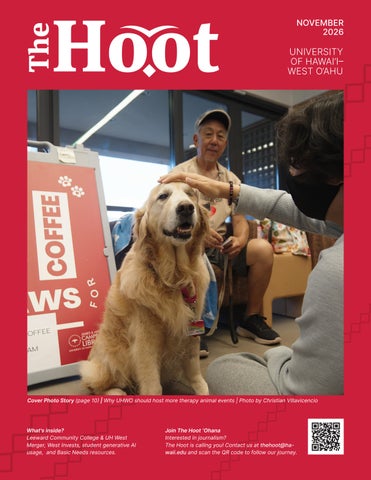
Cover Photo Story (page 10) | Why UHWO should host more therapy animal events | Photo by Christian Villavicencio
What's inside? Leeward Community College & UH West Merger, West Invests, student generative AI usage, and Basic Needs resources.
Join The Hoot ʻOhana Interested in journalism? The Hoot is calling you! Contact us at thehoot@hawaii.edu and scan the QR code to follow our journey.
TABLE OF CONTENTS
2
November 2026
The Hoot
PAGE 3
The Hidden Cost of Using AI To Automate Learning
4
Clearing Debt, Completing Degrees
5
Balancing Troubles for UHWO and LCC
6
Pueo Pilina Brought to You by Student Leaders
8
Opinion: Why UHWO Should Host More Therapy Animal Events
10
Beyond the Classroom: Support for Students' Everyday Needs
Back Cover
Calendar of Events
University of Hawai‘i–West O‘ahu Student Newspaper
91-1001 Farrington Hwy Kapolei, HI 96707
EDITOR-IN-CHIEF Raynette Andrewsen
PHOTOGRAPHER Christian Villavicencio
MARKETING INQUIRIES thehoot@hawaii.edu
LAYOUT EDITOR Tiffany Mueller
SPECIAL THANKS TO UHWO Communications
SMB QUESTIONS smbwo@hawaii.edu
STAFF WRITERS Rosary Argel Mireya Pena Carrasquillo Kayslan Murakami Landon Tupper
SMB ADVISORS Sharla Hanaoka Rouel Velasco Kuʻualoha Kauanoe-Luda
COVER: Therapy animal event (p.10) Photo by Christian Villavicencio
University of Hawaiʻi–West Oʻahu makes no warranties, either expressed or implied, concerning the accuracy, completeness, reliability, or suitability of the information. Nor does the University of Hawaiʻi–West Oʻahu warrant the use of the works is free of any claims of copyright infringement. All views expressed are those of the page author and not of the University of Hawaiʻi– West Oʻahu and/or the University of Hawaiʻi system, and any concerns or comments about these pages should be directed to the page author, and not to University of Hawaiʻi–West Oʻahu. ©NOVEMBER 2026 | The Hoot
The Hoot
November 2026
3
The Hidden Cost of Using AI to Automate Learning
Instructors remain cautious about brain atrophy and loss of critical thinking skills for students STORY & PHOTO BY TIFFANY MUELLER
In a state with one of the country's highest costs of living, many University of Hawaiʻi–West Oʻahu students don't have the luxury of focusing solely on schoolwork. With students holding down jobs and caring for their families while pursuing a degree, the pressure to work efficiently can be intense. For Maya Sunshine Bernardo, a student in the Creative Media program, the struggle to strike this balance helps explain why students are so tempted by generative artificial intelligence, likening it to a form of outsourcing in which a small business hires a bookkeeper to handle tasks it cannot do efficiently. "There's just so many hours in the day. We can't do it all," Bernardo said. But she acknowledges that using AI to improve efficiency is not a perfect solution. While it may alleviate the pressure, it comes at a cost. Relying on AI for certain tasks, she explained, erodes the "authenticity" of creative work. "You can only do that for so long until it's not really you," Bernardo said, noting that bypassing the creative process keeps students from acquiring the skills they are paying to learn. While students like Maya are grappling with the loss of their authenticity, instructors at UHWO say their most pressing concern with generative AI is its cognitive effects. Creative Media professor Marion Ano voiced concerns about the
impact AI usage is having on students' capacity to learn and warns against the potential of declining intellectual resilience and critical thinking skills. "I think we forget that the brain is an actual organ and needs to be exercised," Ano said. She explained that the use of generative AI allows students to avoid mental effort, potentially resulting in reduced problem-solving skills and brain atrophy resulting from a lack of use. Ano argues that the "academic journey is supposed to be difficult," because it helps students build the resilience they'll need in the professional world. And that is when outsourcing to AI becomes problematic. While seasoned professionals in the tech industry, for example, might use AI to speed up workflows, they've already established their critical thinking skills through decades of work without tools like ChatGPT. Ano's concern is for students who are still in the early stages of cognitive development. By outsourcing the parts of their work they struggle with, they're skipping the developmental arc that builds the mental stamina needed for complex problem-solving. "I'm not worried about using AI because I've had so many decades without it," Ano said. "I'm concerned about the arc. My students are younger... they haven't built up that muscle yet."
The real-world cost of bypassing that arc becomes clear as students step into a professional role. In the workforce, problem-solving skills are often seen as a job requirement. If a student relies on generative AI to carry them through all the problematic aspects of their schoolwork, they're leaving themselves without the resilience to problem solve on the job. "If we don't do that as students and you go to a workplace say you don't understand, people start asking, 'Why did we hire this person?'” Ano said. Now, the question becomes: how can students use generative AI to support their learning without threatening their intellect? One solution to preserving a young student's intellectual resilience may not be to ban the technology, but rather to prioritize engagement and interaction between students and faculty. For example, by integrating group discussions and in-class projects in realtime settings, students can force themselves to think critically. Ultimately, the insight for students is that retaining their value in an AI-driven world requires consciously choosing the hard way. For Bernardo, despite the weight of her course load and artistic endeavors, that instinct to do the hard work remains. "Personally, I want to push myself," Bernardo said. "I do want to try to generate my own ideas."
4
November 2026
The Hoot
Clearing Debt, Completing Degrees New debt forgiveness program helps students return to campus STORY BY RAYNETTE ANDREWSEN
This fall, the University of Hawaiʻi–West Oʻahu launched a new program, West Invests, designed to bring stopped-out adult learners back to the UHWO campus to finish their degrees through the use of Hana grants and university services. West Invests is a strategic re-enrollment program targeting adult learners who owe the university past-due balances. It was proposed by Dr. Kaʻiulani Akamine, director of Adults Returning to Education, and was one of 10 program proposals that received a grant from Invest in UH West to fund two years of its operating costs. Invest in UH West is a new initiative established by Chancellor Carlos Peñaloza to support creative projects that advance student success and institutional growth. “A lot of times something happens, you know? They are really good students, but life happens, things happen. Traumatic things happen,” Akamine said. “Our students are juggling so many things at one time, and sometimes it's just too much, and so they have to take a break. Those are the students that I work with.” The program is specific to UHWO. Akamine completed targeted outreach to 300 students over the summer, and five students have re-enrolled for classes this fall through the program. “Every time... I reach out to them, I inevitably have a pocket of students who have this financial obligation, who... may be ready to come back to school but now they have this financial obligation. Things are so expensive that they are
having to choose... 'I can pay for my tuition this semester, but I can't pay for the financial obligation because that's essentially food on my table,'" Akamine said. Based on these observations, understanding the university’s limitations on how to help students with financial obligations that they incur, and determining what support students might need to succeed when they come back, Akamine hopes to create a sustainable solution for students who may not be able to return to UHWO to finish their degrees without the program. According to the National Center for Education Statistics, the median salary of workers with a bachelor’s degree was 59% higher than the salary of workers who completed high school. Despite these statistics, many adult learners drop out before achieving their degree and some leave owing unpaid tuition. Currently, debt from UHWO’s stopped-out adult learners is over $400,000. West Invests converts uncollectible debt into active tuition revenue and supports the UH System’s mission to increase degree attainment among returning adult populations. To encourage adult learners who owe the university past-due balances and want to finish their educational journey, Akamine has developed a program that will help these students through a combination of Hana grants and implementing the university’s supportive services.
To participate in the program, students must have completed at least 60% of their degree program, have an unpaid past-due balance of at least $3,000, a 2.0 or better GPA at the time of departure, and have been out of school for two or more years. Students must also commit to their education by signing a Hana Hou Success Contract and participate in at least two student support services. The Hana grants function as incremental debt forgiveness and are designed to help students get back on track with their degrees. Enrolled students received a $250 Hana Paʻa grant when they began fall classes and for every six credits per semester with a C or better, the student will earn a $1,000 Hana Hou grant to help pay part of the student’s prior past-due balance. "We're the only campus in the entire system that is doing something like this. So this is a brand-new program for our entire system, and it's complicated because students have holds on their accounts," Akamine said. According to Akamine, the program utilizes a multitiered, multilayered approach that requires multiple offices to work together — a collaboration of the Registrar, Financial Aid, Cashier, Records Office, and Advising. These staff found a shared purpose for providing support for students and then, determined what that looks like in this program. Learn more Scan the QR code or v i s i t : w e stoa h u . h a waii.edu/financial-aid/ grants-and-scholarships/
The Hoot
November 2026
5
Balancing Troubles for UHWO and LCC
Why a more connected UH could underserve Leeward institutions BY LANDON TUPPER
|
PHOTO CREDIT: UNIVERSITY OF HAWAI‘I
On Sept. 25, University of Hawaiʻi President Wendy Hensel presented a proposal for a more integrated UH system. Her focus was on the movement of students through the system, and how the wide network of UH can support their academic journeys. Hensel highlighted some benefits for students such as making it easier for students to access scholarships, transfer opportunities and resources.
HAWAI‘I
Last year, UH President Wendy Hensel and Chancellor Carlos Peñaloza hosted forums on closer integration between Leeward CC and UHWO.
Hensel detailed how University of Hawaiʻi–West Oʻahu and Leeward Community College compete directly for students and maintained that due to lack of integration between campuses, enrollment splits students between the two campuses. The proposed solution is a more holistic strategy.
in the process we would lose our identity as a campus. One of the fears is that it could endanger our accreditation from the national accrediting bodies. Another fear that a lot of people had was that this was going to, somehow, be an excuse to start cutting positions,” said Dr. Kealani Cook, a Humanities Professor at UHWO.
Steps have been taken to foster campus integration. Following the retirement of Dr. Maenette Benham from UHWO, Dr. Carlos Peñaloza was appointed. In a historic first, Peñaloza is the chancellor for both UHWO and LCC. In January 2026, he addressed the staff of both campuses; exploring ideas of integration between them. He introduced a framework for co-creating a “Regional Comprehensive Educational Ecosystem.”
“It's a big heavy lift. It's got a lot of moving pieces in it, so it could be something that left everything in chaos if this was not done incredibly carefully,” Cook said.
But the campuses are separate, unique entities with different needs, leaving some UHWO staff members wary of greater campus integration. “I think what a lot of people on campus were anxious or nervous about was that
Both campuses have–on their own–in their own rights, many avenues for academic advancement. There are multiple areas for collaboration for the two institutions. What needs to be upheld is strong representation, as well as initiatives, for each campus. “We need a chancellor who will serve at 150%. UHWO needs someone who will advocate for the needs of our campus,” said Dr. Esther Widiasih, the division chair of Math, Natural and Health Sciences. “I have a full-time job, I couldn’t
imagine having another full-time job on top of that.” Collaboration between the two sister campuses is possible. Strong ties and frequent interplay already exist between the campuses. UHWO and LCC are directly connected by rail stops, with many students taking advantage of the sister campuses study spaces. Students from LCC, after getting their associates, often work to complete their bachelor’s at UHWO. “Transfers are the biggest chunk of our student body, and as a UH system, it should be really simple for someone to come in from any community college in the system,” said Cook. “For example, I teach history. You should be able to come in from any community college in the system with a humanities associates in arts, a focus in history, and be able to get a two plus two. Two years at the community college, two years at the upper division or at the West Oahu, and leave with a degree.”
6
November 2026
The Hoot
Pueo Pilina Brought to You by Student Leaders What it takes to bring one of the semester’s biggest events to life. STORY & ILLUSTRATIONS BY MIREYA PEÑA
Pueo Pilina is where you'll hear the music of lighthearted conversation and see happy spirits buzzing around campus. It’s more than an event. It's a celebration that starts with each student. On Oct. 8, University of Hawaiʻi–West Oʻahu students joined their peers for a day of engaging with faculty and staff, connecting with clubs and organizations, and building relationships. This is an event not only attended by students, but also organized by a student-led committee called the Pueo Pilina Planning Committee. Members come together to create not only a fun event, but a celebration of the Pueo Pilina planning committee members wore identifying buttons during the event to distinguish themselves from attendees.
|
PHOTOS BY CHRISTIAN VILLAVICENCIO
student community that continues to offer a sense of belonging.
Pilina has tied into a lot of skills that I'm studying in my classes.”
An event of this size is made possible through the efforts of a dedicated team of students. The Pueo Pilina Planning Committee consists of six committees: food and drink; entertainment; activities; promo and marketing; clubs and organizations, and volunteers; and prizes and giveaways.
Working for the Student Government, Lutzke saw Pueo Pilina as the next step
Once each student is placed, an experienced student leader works with members to divide tasks and communicate with vendors. Each committee brainstorms, plans, and discusses logistics during weekly meetings. Once a budget is created, it’s then distributed among the committees for purchasing items. “What’s beautiful and unique about this process is you don’t need background in events to join,” said Olivia Chung, co-leader of the Pueo Pilina Planning Committee. “We want to help you get that experience with the group.” According to Chung, 40% of the event is planning, but without volunteers, the event wouldn’t be as successful. This planning committee allows experienced Activity Fee Board members to mentor and guide new committee members and provide them with valuable experience. “I'm always looking to improve my design skills,” said Lena Lutzke, a Pueo Pilina member since fall 2025. “Pueo
“
What’s beautiful and unique about this process is you don’t need background in events to join. We want to help you get that experience with the group.
-Olivia Chung
in her leadership journey through furthering her connection with students and broadening her perspectives. Kayslan Murakami joined the committee to support her campus community. Through this experience, she hopes to gain time management skills, flexibility, and communication skills. The Pueo Pilina committee has grown from 10 Chartered Student Organizations members at its inaugural event in 2023 to 18 members for the fall 2026 event.
The Hoot
November 2026
7
Members of the Pueo Pilina planning team gather for a group photo following the event.
Pueo Pilina has continued to expand with the addition of a leadership team, increased funding from the Chancellor’s Office, and greater involvement from Registered Independent Student Organizations (RISOs). These developments have created more opportunities for students to gain experience and could help
Pueo Pilina events grow in the future. I love the interaction with the students,” said Melissa Wilkins, a previous Pueo Pilina volunteer. “A lot of these functions won't work if the students aren't involved.”
“
I'm always looking to improve my design skills. Pueo Pilina has tied into a lot of skills that I'm studying in my classes.
-Lena Lutzke
Pueo Pilina is growing quickly, allowing students to make a difference in how they create community. Interested students can support that growth by attending, volunteering, or joining the committee for future Pueo Pilina events.
8
November 2026
The Hoot
Opinion: Why UHWO should host more therapy animal events Students deserve more opportunities to experience the comfort and companionship of animals. KAYSLAN MURAKAMI
|
PHOTOS BY CHRISTIAN VILLAVICENCIO
Did you know the University of California, Davis brings therapy llamas to campus during Mental Health Awareness Month? If UC Davis can bring farm animals to students, why can’t the University of Hawaiʻi–West Oʻahu offer these events more often? Therapy animals should be more accessible and more frequently available on campus because of the comfort and wellness benefits they provide. As a student, I believe we need to prioritize
taking care of ourselves, and spending time with therapy animals is one way to relieve that stress. Personally, I get to come home to five dogs, and they make me smile and laugh. Being around animals makes me happy because they make me feel loved and appreciated. After a long, stressful day of classes, coming home to them helps me relax. I feel like they sense my emotions and are there for me through both good and bad days.
A golder retriever gets some attention from students during a Paws for Coffee event.
Animals can support mental health through the connection and companionship they provide. According to Science Insights, dogs show affection through behaviors such as sustained eye contact, which can strengthen the bond between dogs and humans and increase oxytocin, a hormone associated with bonding. Research has also shown the benefits of interacting with animals. According to one report from the National College Health Assessment, more than 60% of college students report experiencing
The Hoot
November 2026
9
overwhelming anxiety. Research from Washington State University in 2021 found that petting animals helped students feel more relaxed and better able to cope with stress. For students balancing classes, assignments and personal responsibilities, taking a break to spend time with animals could help them manage these pressures. “They can help motivate you if you’re having a rough time,” UHWO student Rachel Lyn Takemoto said. “I feel like they also help [me] to find the best in me, so that I can be the best person.” This isn’t to say animals aren’t allowed on campus. Service animals are permitted, but there is a difference between service animals and therapy animals brought to campus for wellness events. “Therapy animals are there to serve a purpose to help multiple students while service dogs are dedicated to one specific student or person,” said Sarah Arios, a Hele Imua intern with UH West Oʻahu Disability Services. “Service animals work on different levels and if you have diabetes and can alert the student or
An owner poses with his therapy pup at Paws for Coffee.
epilepsy and can help you with multiple things. Therapy animals are to help regulate emotions. They are there to essentially give us the break that we need.” Students may feel frustrated after missing an assignment, struggling to communicate with a professor or worrying about their workload. Seeing therapy animals on campus could help cheer them up and give them the encouragement they need to get through the rest of the day. UHWO has hosted events like these in the past, like the Paws for Coffee at a recent Pueo Pilina (pictured). But I believe they should be offered more frequently, throughout the school year. According to Lena Lutzke, a Creative Media senator with the UHWO Student
Students gather around a therapy dog and its owner.
Government, students frequently request therapy animal events. Although the university has hosted these events in the past, organizing them can be challenging. “Pros are students would feel very heard and [that we] really care about them and listen to their concerns,” Lutzke said. “While cons could be the organizing part and contacting the people, who are available at certain times or busy with other clients.” Still, I believe the benefits of bringing therapy animals to campus outweigh the logistical challenges. “I am a person who loves animals…[but] I can’t have a pet. I want to relax…with animals,” said Chellezette Mapp, a UHWO creative media student. I understand how challenging student life can be, and I want to see myself and my peers succeed. For students facing deadlines and the pressures of everyday life, spending time with therapy animals could offer a moment to relax, feel supported and remember they aren’t alone. Bringing therapy animals to campus more often would be a small but meaningful way to show students that their well-being matters.
10
November 2026
The Hoot
Beyond the Classroom: Support for Students' Everyday Needs Access to food, clothing, and health services helps students focus on their education STORY BY RAYNETTE ANDREWSEN
|
PHOTOS BY CHRISTIAN VILLAVICENCIO
Making the decision to pursue your degree is big and one that can quickly become overwhelming. Tuition is only part of the expense. Rent, groceries, gas, textbooks, and other needs quickly add up. In a February 2025 report from Temple University's Hope Center, 79% of students surveyed, who had left college and returned, or were considering leaving, cited basic needs and financial pressures. The report surveyed 74,350 students at 91 colleges across 16 states about barriers to meeting basic needs. Among those surveyed, 41% experienced food insecurity, 48% experienced housing insecurity, and 14% homelessness. When mental health, childcare, transportation, and technology were included, 73% reported basic needs insecurity. Basic needs are an essential foundation that allows students to concentrate on their academics instead of survival. The University of Hawaiʻi–West Oʻahu campus offers student support services through Kumu Ola–Basic Needs Services to help make it easier for students to remain in school and finish their degrees. UHWO students with a valid student ID for the current semester are eligible to use the basic needs services, which are kept confidential to respect students’ privacy. There are on-campus and off-campus services to support food security, clothing access, menstrual equity, kōkua care
The UHWO food security program includes recovered food items from surrounding grocery stores.
services, technology access, transportation assistance, health and wellness. For students with food insecurity, the Pueo Pantry provides nonperishable foods including canned goods, rice, pasta, and ready-to-eat meals and snacks. Students can also access personal hygiene products including menstrual products (which are also distributed in various locations on campus). Students can access the pantry by making an appointment online or stopping by C-215 Monday through Thursday from 9 a.m. to 3 p.m. The Pueo Pantry also has food distributions during each semester that includes fresh bread, fruits, and vegetables that
are recovered from the Mililani Farmers Market in collaboration with Aloha Harvest. These distributions take place on alternating Mondays and Tuesdays. Food Drops are another food security program sponsored by the pantry that includes recovered food items from surrounding grocery stores. This distribution may include perishable and non-perishable items. Distribution takes place at the Campus Center, first-floor breezeway next to the Nāulu Center between 10 a.m. and 1 p.m. Pueo Closet provides both everyday clothes and professional attire. Having clean clothing reduces social stigma associated with poverty and improves students’ confidence. Providing professional
The Hoot
November 2026
clothing also helps students when they attend job fairs, interviews, or networking events. Access is also through the Pueo Pantry. Students who are experiencing financial difficulties due to an emergency such as a job loss, housing emergency, or unexpected medical expense may be eligible for one-time financial assistance from Kōkua Care Services. Students apply online via a Google Form and must be
currently enrolled and have supporting documentation for the need. Students who need technology access (laptops, hotspots, iPads, and other technology) can contact the IT Help Desk in the Library for equipment loans for the semester. Borrowers must complete and sign a borrower agreement form and present their picture ID. There are other items that are available for shortterm loans (four-hour period) including headphones and adapters. Transportation to and from school can also create hardships for students. To alleviate this, UHWO offers a shuttle that operates Monday through Friday from 8 a.m. to 5 p.m. during the fall and spring semesters. There are 15 locations where students can catch a ride and must show a UHWO student ID.
The UHWO food security program includes recovered food items from surrounding grocery stores.
11
UHWO also provides students with health and wellness services including
UHWO keeps students healthy through free, confidential health and wellness services.
free and confidential mental health services for all enrolled students. Individual and group therapy, couples counseling, and psychological assessment services are provided by a qualified mental health professional. Campus Health Services has over-the-counter medications, basic first aid, pregnancy and contraceptive care, certain health checks and tests, health information and education. Students can make an appointment in STAR or drop in C-235 Monday through Friday 10 a.m. to 4 p.m.
Campus resources Fall food distributions Pueo Pantry & Pueo Closet Hours: C-215, Monday-Thursday, 9 a.m. to 3 p.m. or by appointment. Food drops: Campus Center 1st floor, Alternating Mondays and Tuesdays (see dates below), 10 a.m. to 1 p.m. Mililani Farmers Market: Nov. 2, 10, 16, 24 and 30; Dec. 8, 14, 22 and 28. Pueo Food Drops (local grocery stores): Nov. 4 and 18; Dec. 2 and 16.
Basic Needs Support Apppointments: Schedule through STAR Balance under Health & Wellness Visit: Campus Center Student Services in C-236 or email uhwobn@hawaii.edu.
Pueo Shuttle Hours: Monday-Friday, 8 a.m. to 5 p.m. Contact: 808-367-3029 | uhwoshtl@hawaii.edu
Mental Health Support Visit: C-241 | Call: 808-689-2661 | Email: uhwotalk@hawaii.edu Crisis: Call or text 988 (Suicide & Crisis Lifeline)
Campus Health Available Monday-Friday, 10 a.m. to 4 p.m. Visit C-235, call 808-689-2679 or email skelly3@hawaii.edu
Brew & Renew (Free drinks & snacks) Hours: Monday–Friday, 8 a.m. – 4:30 p.m. except holidays Visit: C-214 (Student Life Center)
12
November 2026
The Hoot
CALENDAR OF EVENTS November 2: 2: 3: 11: 26: 27:
Last day to withdraw (semester long classes) with no refund and a “W” grade Last day to submit a Leave of Absence (LOA) for fall 2026 HOLIDAY: Election Day HOLIDAY: Veterans Day HOLIDAY: Thanksgiving Day Non-instructional Day
December 2 & 3: 4: 5 & 11: 11: 15: 16:
Want to have your art published? Scan the QR code to fill out our Creative Submission Form to have your creative.
Cram Jam (tutoring sessions and professor-led final exam study blocks) | Room B-203 | 3-7 p.m. Last day of instruction Final Examination Period Semester Ends Faculty Grade Submission Deadline | 4 p.m. Grades available via STAR
The Hoot’s calling you! We want to showcase student work! • • • • •
Artwork (paintings, drawings, digital art) Creative writing (poetry, short stories, essays) Photography Comic strips and more
Get your art published and build your portfolio. Interested? Fill out our Creative Submission Form through the QR code to have your creative work be published in a future issue!