A global expert is transforming the future of energy exploration.
STUDENT SUCCESS
UH Energy students embark on an inaugural learning abroad trip.
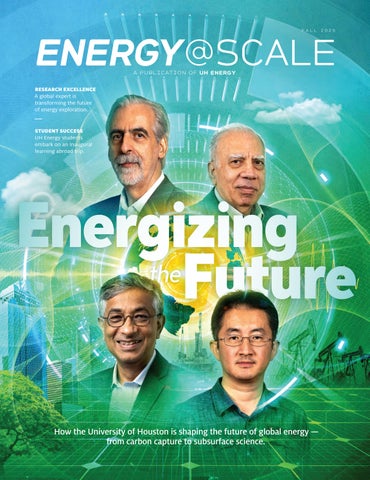
How the University of Houston is shaping the future of global energy — from carbon capture to subsurface science.
ENERGY@SCALE
Welcome
THE WORLD’S DEMAND FOR ENERGY has grown sharply in recent years, and meeting the need for affordable, reliable energy while lowering emissions requires innovative new technologies, transformational policies and a well-informed public.
At The Energy University, we engage the industry and its leaders in impactful pathways that advance solutions at scale and shape the future of global energy.
In this issue, we highlight faculty, students and research programs that begin at the University of Houston and extend their impact worldwide. From our inaugural energy-focused study abroad program in Argentina to the pioneering work of energy expert Robert Stewart to the groundbreaking research in unconventional and offshore subsurface hydrocarbons, UH is making its mark on the global stage.
None of this would be possible without the sustained support of our industry partners, the UH Energy Advisory Board, and other departmental and college-based advisory boards.
We recently launched the Institute for Ecological Resilience. It is designed to integrate the UH Coastal Center and the Texas Institute for Coastal Prairie Research and Education, which are located in Galveston County, with the outstanding work happening across UH and the greater Houston region. We are fortunate to have a Cougar alumnus and nationally recognized conservationist leading the Institute.
Finally, we summarize a recent research white paper published by UH Energy on the upcoming challenges to the Texas power grid and the ripple effects across the energy industry, particularly in the natural gas value chain.
We appreciate your feedback on the stories, research and insights shared in this magazine. Your engagement is vital to shaping the future of energy, and we look forward to continuing the dialogue with you.
Thank you for your continued support of UH Energy.
Warm regards,
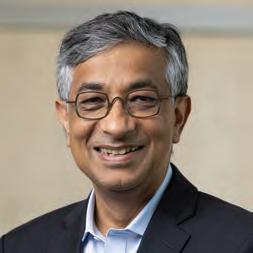
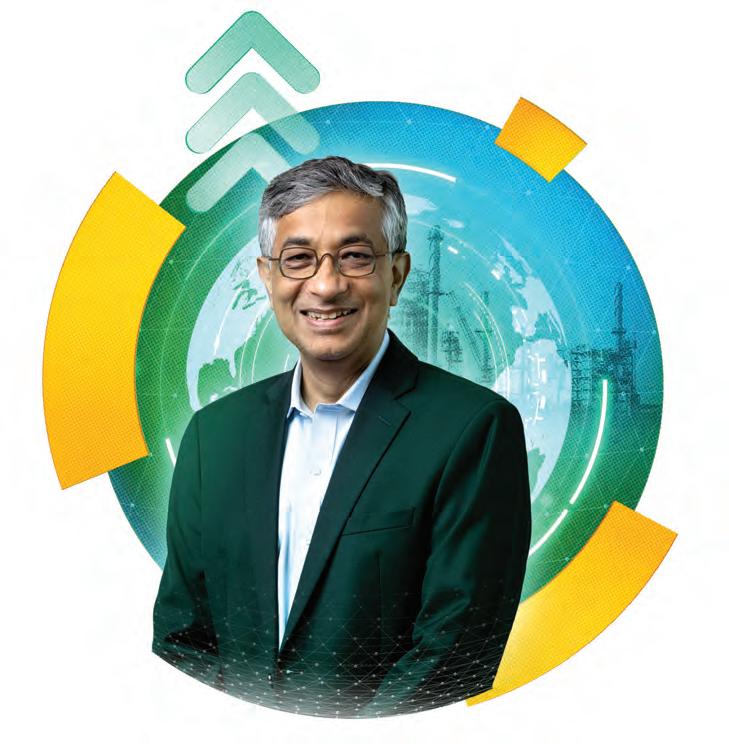
Ramanan Krishnamoorti
Vice President for Energy and Innovation University of Houston
02
RESEARCH EXCELLENCE
The Energy Explorer
Get to know the UH professor looking under the sea to solve the world’s big energy challenges.
WHITE PAPER
Texas Power Grid Faces Growing Strain
VICE
Ramanan Krishnamoorti
PUBLISHER
Lisa K. Holdeman
CONTRIBUTING
EDITORS
Jonathan Adams
Shawn Lindsey
Carrie Taylor
PHOTOGRAPHY & DESIGN
Joseph Bui
Heather Cobb
Benjamin Corda
Anthony Gollab
Jeff Lautenberger
Greg Ortiz 05
Four takeaways from the UH white paper on the future of the state’s electric grid.
06 08 14 16
STUDENT SUCCESS
Full of Energy
UH students embark on the inaugural learning abroad trip dedicated to energy innovation.
THOUGHT LEADERSHIP
Fuel for the Future
Learn why UH has rightfully earned the moniker “The Energy University.”
PERSPECTIVES
The Hidden Cost of Tariffs
Two UH experts explain how tariffs could impact energy infrastructure.
SPOTLIGHT
Jaime González: Rebuilding Nature One Seed at a Time
The UH alumnus spreads the importance of conservation to the masses.
SVP, Growth & Strategy
Chris Phelps
SVP, Editorial & Creative
Jennifer Chininis
EDITORIAL
Design Director
David Radabaugh
Managing Editors
Maria Hieber, Katie Stroh
Art Directors
Katy Rimer, Corrina Spurlin
Copy Editors
Staci Parks, Kelsey Kosh
BUSINESS
VP, Brand Strategy
Cory Davies
Operations Manager
& Account Director
Rosalind Lynam
Account Director
Brianna Barger
THE ENERGY
EXPLORER
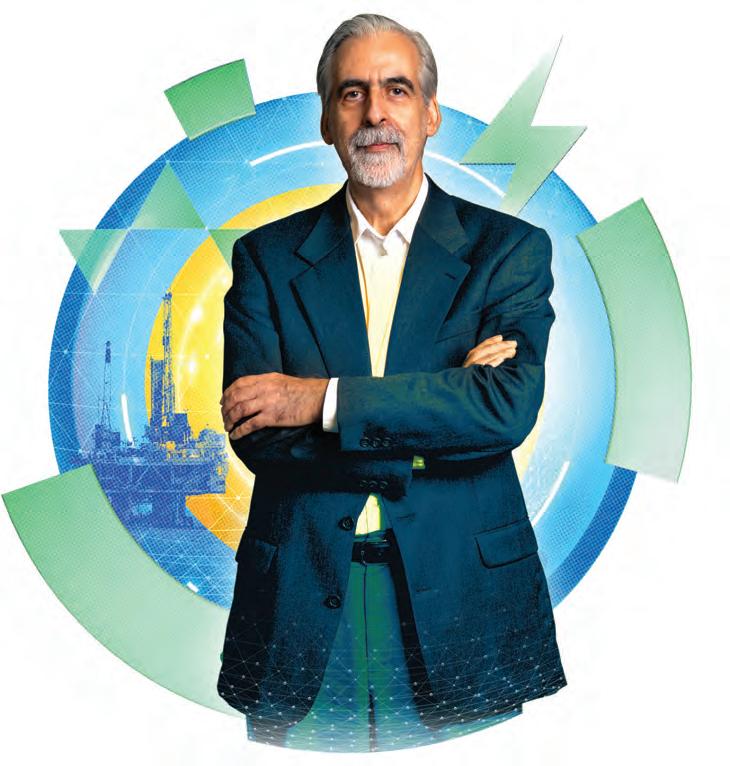
UH professor and global expert Robert Stewart leads a research team looking under the sea to world’s big energy challenges
BY SAM EIFLING PHOTOGRAPHY BY ANTHONY GOLLAB / UNIVERSITY
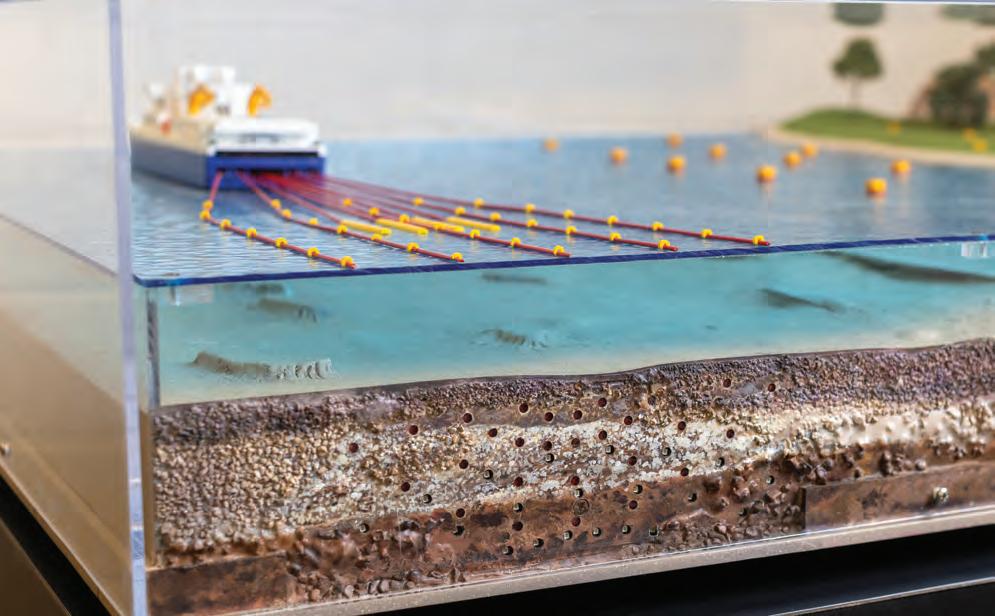
BELOW SURFACE
This diorama, donated by SES Houston, depicts a marine seismic ship towing acoustic sensors while undertaking an echo survey to reveal the rocks beneath the ocean floor.
SINCE HIS YOUTH, Robert Stewart has sought to see below the surface of things as we know them. The son of a nurse and a member of Parliament, he grew up just north of Toronto, Canada, exploring mountains, forests and wilderness around Lake Superior. As a young man, he spent months working at a cancer institute in Toronto, building ultrasonic scanners to locate tumors inside patients’ bodies.
Eventually, he found that a career in geophysics married his outdoor interests with his technical pursuits. Today, Stewart is a professor of geophysics at the University of Houston, as well as the Hugh Roy and Lillie Cranz Cullen Distinguished University Chair in Exploration Geophysics. Whether you are searching for hydrocarbons in a subduction zone or trying to locate unmarked graves in former plantations around Houston, Stewart is your man.
“We work with waves bouncing off anomalies,” he says. “You make a wave, it bounces off something and you make a picture from how it’s bounced off.”
The same essential principle applies when mapping the inside of the body, searching for underground water, peering inside of volcanoes or peeling back the substrate layers of faraway planets — all pursuits of Stewart’s over the
years. In every case, vibrations create echoes. With enough echoes, which scientists interpret via a field of computing called signal processing, a picture emerges. The echoes that have resonated through Stewart’s life stem from his early love of the outdoors and physical exploration.
GAINING A GLOBAL VISION
Family road trips to the Canadian Rockies as a child later helped inspire Stewart’s move west to Alberta, the so-called “Texas of Canada,” to intern at Chevron as a teen. He picked up technical mountain climbing and soon took a gap year to climb in the Himalayas and explore South and Southeast Asia.
“It was radically resetting for me,” he says. “At the time, I was a kind of philosophical hippie. When I got to India, there was horrific poverty and beautiful temples. In Kolkata, I had the chance to meet Mother Teresa. And then the Indian government detonated its first atomic bomb, with Canadian technology, while we were there.”
The world had shifted under the young man’s feet. He took his physics degree with a minor in mathematics from the University of Toronto and headed to Boston to
WORLD EXPLORER
Stewart tests a space suit for NASA in the High Arctic Tundra, the northernmost biome on Earth.
“It’s very graphic in my mind what our students and staff are doing that could be transformative to India.”
pursue a geophysics Ph.D. at the Massachusetts Institute of Technology. There, he focused on earthquakes, resource exploration, rock physics and signal processing. He also embraced the culture of what he calls “geo people” — the sort of outdoorsy, camping, climbing, team players who, like Stewart, obsessed over the physics of rocks and earth.
“It gave us opportunities to travel the world,” he says. “I studied earthquakes in Peru. We worked inside the Soviet Union in semi-covert operations. It was exciting to be doing dam work, subsurface work, water, oil and gas.” He continues to meet up with a group of four other MIT gradschool classmates who also moved to Houston. Once a month, they get together — lunch at Kasra Persian Grill is routine — and hash out the problems of the world.
“The five of us have extremely different backgrounds,” he says. “Different religions, different geographies, different political views. But we all share a love of trying to get to what we perceive as the truth.”
THE FUTURE OF ENERGY EXPLORATION
Now deep into his career as a professor at UH — as a supervisor, he has graduated some 100 graduate students, for which he is enduringly proud — Stewart continues to probe the world around him.
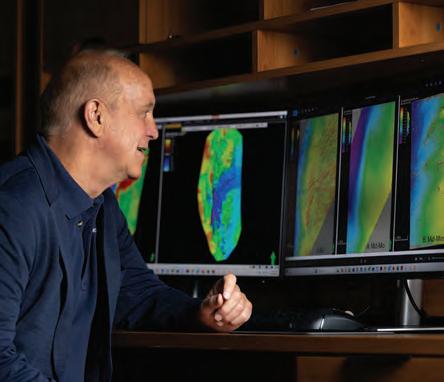
Stewart is the faculty leader of the UH-DGH Center for Hydrocarbon Exploration, which is a collaboration between UH and the Directorate General of Hydrocarbons — an arm of the Indian Ministry of Petroleum and Natural Gas. In this role, he oversees a cohort of students who are sorting through expanses of data from around India to find undersea energy resources that could shape the future of the world’s most populous country. Stewart and his team are working to help the government and energy companies understand the geology of the Indian subcontinent and its boundaries to better grasp the potential for offshore fossil fuel production.
DATA RESEARCH
Stewart analyzes subsurface maps of the Andaman Islands, a union territory of India, for resource prospectivity.
“It’s very graphic in my mind what our students and staff are doing that could be transformative to India,” Stewart says. “When I was a student in Kolkata, the main cooking source was cow dung pressed on the wall and burned at night to heat your food. The most noxious miasmas were the fogs in Kolkata.” Decades after that visit, India has widely adopted coal; Stewart wants to see them produce electricity with cleaner fuel sources.
One day, he believes, the future of energy will belong to fusion. “The sun knows that,” he says. “That’s what it does.” Until then, he explores with an eye toward mitigating the downstream effects of the energy sources that fuel the present. Using fuel anywhere in the world can reverberate around the globe. When the full picture emerges, Stewart knows, it’s all happening on a single, interconnected planet with enduring mysteries beneath us, tantalizingly out of view.
Texas Power Grid Faces Growing Strain
Main takeaways from UH Energy researchers.
POWER DEMAND is quickly increasing across Texas, and new University of Houston research suggests the state’s power grid, in its current form, is not up to the challenge.
As artificial intelligence and data centers multiply across Texas, electric vehicles gain traction, industries embrace decarbonization technologies and temperatures climb, the state’s electricity demand could double — or even quadruple — by 2035, with overall consumption increasing by as much as 300%.
Senate Bill 6, which was approved by Texas Gov. Greg Abbott in June, aims to improve grid reliability. The new law outlines demand response mandates, streamlines interconnection standards and introduces transparent rate setting.
Without significant upgrades to power plants and supporting infrastructure, Texas could see electricity shortages, rising costs and added stress in the coming years, according to the UH white paper “The Future of the Electric Grid in Texas: Opportunities and Challenges in the Next Decade.”
1 Capacity Shortfall Warning
Without new investments, Texas could face an electricity deficit of up to 40 gigawatts at peak power by 2035. The most likely annual capacity shortfall is 27 GW.
2 Natural Gas Strain
Electricity needs could push in-state natural gas demand to between 10 trillion and 16 trillion cubic feet by 2035. (Demand currently sits around 5 trillion cubic feet.) Liquified natural gas exports are also projected to more than triple if under-construction projects begin operations as planned.
Generation Mix (2024)
Since 2022, the baseline year for the scenario modeling, natural gas’s share of the state’s energy mix has declined by 3% and coal’s by 4%, offset by gains in wind and solar generation.
3 Looming Water Crisis
In addition to the expected growth from municipal needs and other sectors of the economy, electricity generation and data center cooling may contribute to a water deficit of up to 3,600 million m3 (~3 million acre-feet) by 2035.
4 Infrastructure Gaps
Rural growth areas (west, far west and north Texas) lack adequate transmission capacity and natural gas pipelines despite being home to the largest upcoming data center projects. Infrastructure backlog is also a factor, with 360 GW of solar and battery projects awaiting ERCOT interconnection. Natural gas plants have been delayed due to supply chain issues and tariffs, and proposed plants have been withdrawn from the state.
Based on the collaborative white paper “The Future of the Electric Grid in Texas: Opportunities and Challenges in the Next Decade,” written by Ramanan Krishnamoorti, Ph.D., vice president of energy and innovation and professor of chemical and biomolecular engineering at the University of Houston, and Aparajita Datta, UH Energy researcher and Ph.D. candidate in political science.
paper, “The Future of the Electric Grid in Texas: Opportunities and Challenges in the Next Decade.”
STUDENT SUCCESS
Full of Energy
University of Houston students embark on inaugural learning abroad trip dedicated to energy innovation.
BY JONATHAN ADAMS
FOOD. CULTURE. PEOPLE. When Virginia Snodgrass Rangel moved to Argentina in 2023, she didn’t just fall in love with the country’s colorful streets, its endearing people and their rich culinary traditions. She discovered a new way to see energy.
While living in Buenos Aires for two years with her husband, who works for an international energy company, the University of Houston College of Education professor immersed herself in a South American country where oil and gas and innovative renewable solutions coexist in unexpected ways. An idea began to take shape: What if UH students could see this for themselves? It was an opportunity to learn about the country’s energy production, sustainability technologies and policies, while also experiencing everything she had come to love.
The Journey Ahead
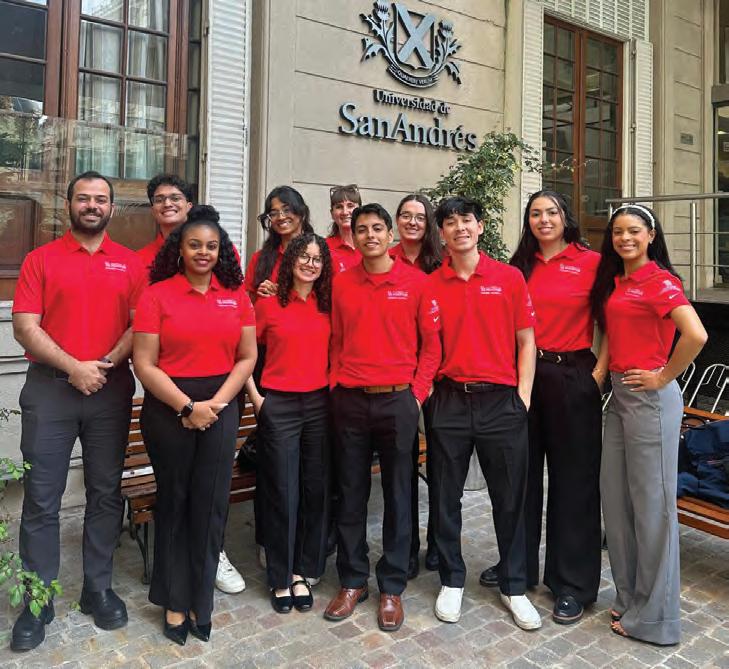
After months of planning, coordinating with deans and faculty across campus, and forging connections with Argentinian businesses and universities, the vision became a reality. On May 24, a pioneering group of 10 students and three faculty members landed in Argentina for UH Energy’s first-ever learning abroad program focused on energy policy and innovation.
Titled “Sustainability in Policy,” the program offered a rare, on-the-ground look at one of the world’s most complex energy landscapes.
“It’s always useful to learn about something from someone else’s perspective,” Snodgrass Rangel says. “A lot of our students were really hoping to learn about renewables, which is only part of the story in Argentina. It’s also one of the world’s biggest oil and gas producers.”
What sets UH Energy apart is its distinctive structure and mission. Rather than being housed in a single college, UH Energy is an interdisciplinary hub that unites students and faculty from across the University — from engineering and business to public policy and natural sciences — with a shared interest in the energy sector. By breaking down academic silos, UH Energy creates diverse learning opportunities for students to understand energy as a social, economic and political driver with global implications.
“What made setting up the trip unique — and a little complicated — was coordinating with each student and faculty member’s college,” says Deidra P. Pernell, executive director of educational programs for UH Energy and one of the staff members on the trip. “But UH faculty, including Pablo Pinto, who is from Argentina, were excited and eager to help us
establish contacts. We ended up having so many opportunities in Argentina, we had to let some stuff go.”
Power Players
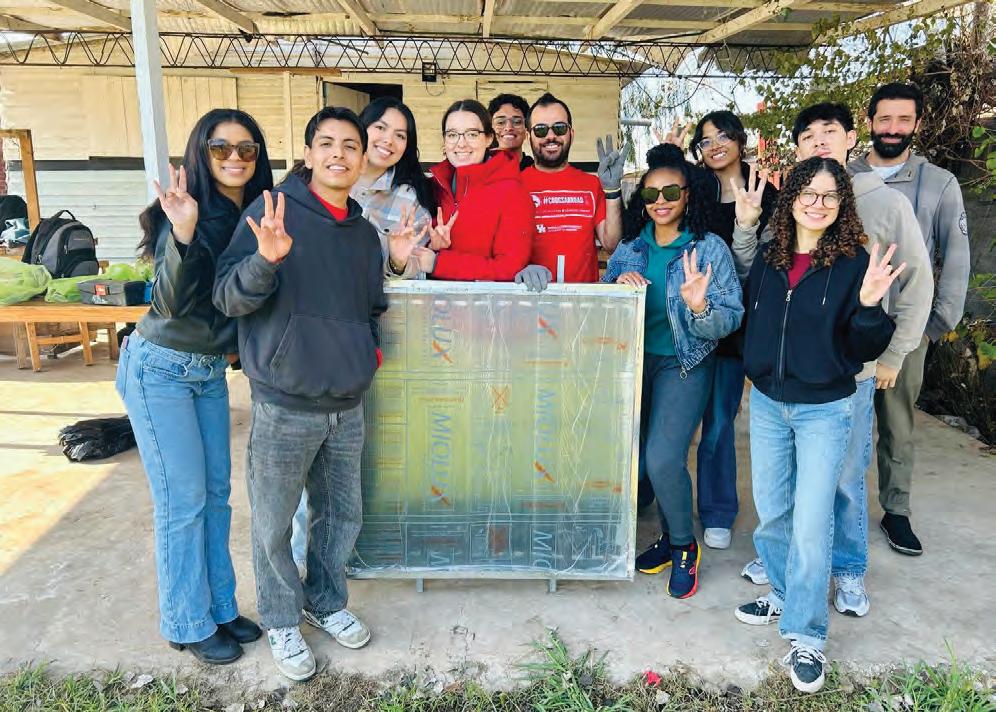
Over 10 packed days, the students and faculty visited nine businesses and three universities across two cities, Buenos Aires and Neuquén. One of the top priorities for the trip was to ensure students were exposed to new experiences, such as visiting oil and gas production sites.
“They got hands-on learning to see what’s happening,” says Cullen College of Engineering Professor Mim Rahimi, who served as the faculty lead on the trip. “We took them to a site in Neuquén, and the students were so excited. It was priceless.”
Although there was a main itinerary full of activities, Snodgrass Rangel says businesses also tailored meetings to each student’s major and set up small groups that catered to their studies.
“One of our students was a computer science major, so they sent her to meet with one of their programmers,” Snodgrass Rangel says. “She was thrilled. Not that she hadn’t learned anything yet, but that was the first time she learned something directly related to what she did.”
Chemical engineering major Vittoria Palomba says the trip transformed her
EXPLORING ARGENTINA
UH professor Virginia Snodgrass Rangel organized the trip to Argentina, where she was joined by staff and faculty members Deidra P. Pernell and Mim Rahimi. Student participants included Afra Nawar, Allyson Diaz, Arsalan Dhukka, Erick Miranda, Harvey Corona, Helena Guzman, Kate Eastes and Vittoria Palomba.
“It helped me connect classroom learning to broader global systems and made me think more critically about the role engineers play in shaping sustainable solutions.”
— VITTORIA PALOMBA, CHEMICAL ENGINEERING MAJOR
UH Energy visited nine businesses to learn about Argentina’s energy industry:
• Pampa Energía
• Central Termica
• Chevron Buenos Aires
• Fundación Nordelta
• Aconcagua Energía
• Aspro Energy
• DP World Buenos Aires
• SharyCo
• Sumando Energías
perspective on engineering’s real-world, global impact.
“It helped me connect classroom learning to broader global systems and made me think more critically about the role engineers play in shaping sustainable solutions,” Palomba says.
Following graduation, Palomba hopes to pursue a career in the energy sector, focusing primarily on sustainable development and innovative solutions to improve energy efficiency and accessibility.
Just the Beginning
Since the group returned from Argentina, Snodgrass Rangel has moved back to
Houston, arriving with a goal. She and her colleagues aim to keep UH Energy’s study abroad program alive, continuing to expand this ambitious, hands-on global learning experience next year in Chile.
Pernell says the title and topic for next year’s trip are still being finalized, but they’re already looking for the next cadre of ambitious UH Energy students to make the expedition.
“Everything is global now, but energy really is global,” Snodgrass Rangel says. “I think the more the University can do to build those international connections will prepare students for what they’re going to find.”
FUEL FOR THE FUTURE
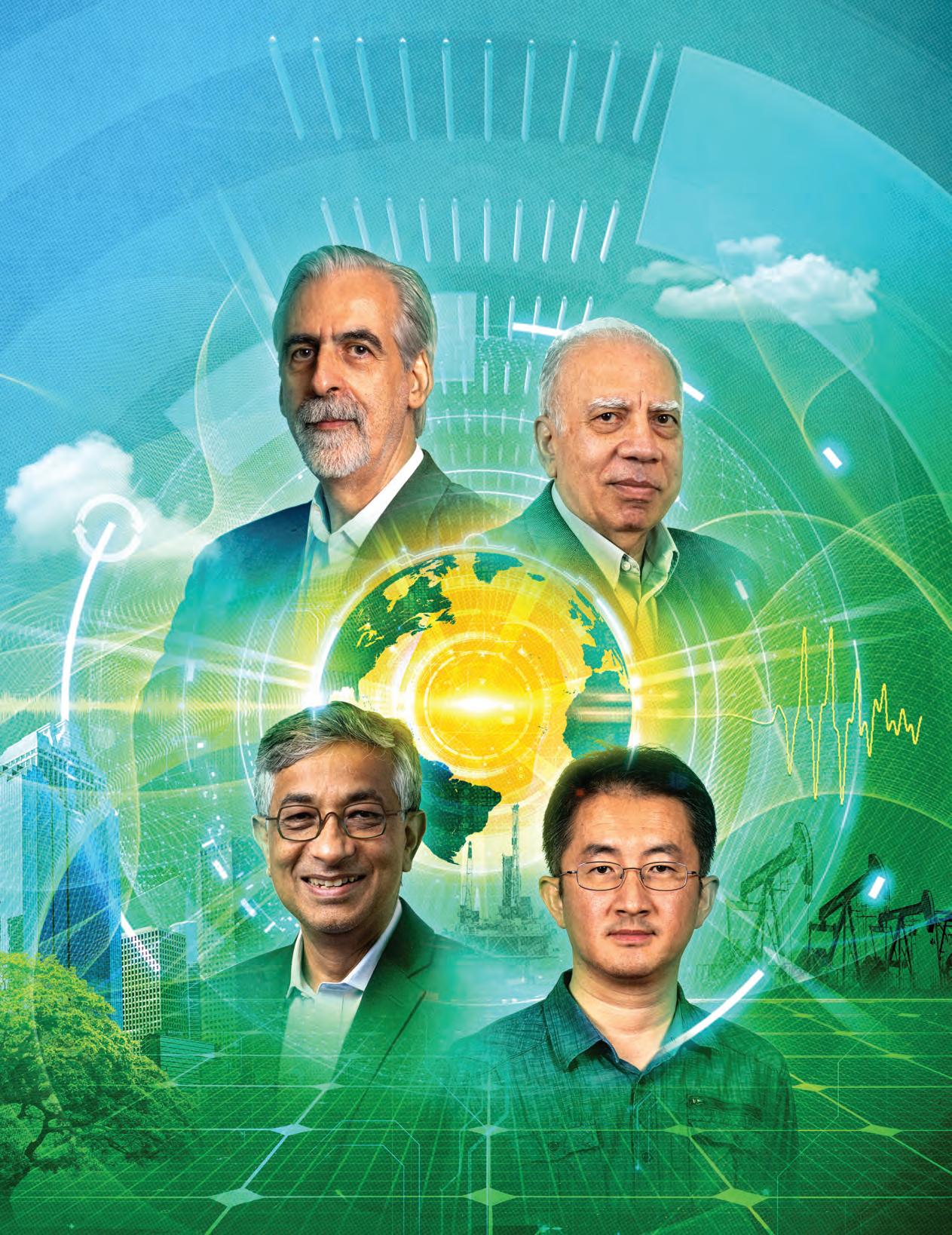
Inside The Energy University: How the University of Houston is shaping the future of global energy — from carbon capture to subsurface science.
BY TYLER HICKS ILLUSTRATIONS BY ANDY POTTS
ON
a steamy midsummer day on the University of Houston campus, Yingcai Zheng, Ph.D., is preparing for a unique challenge.
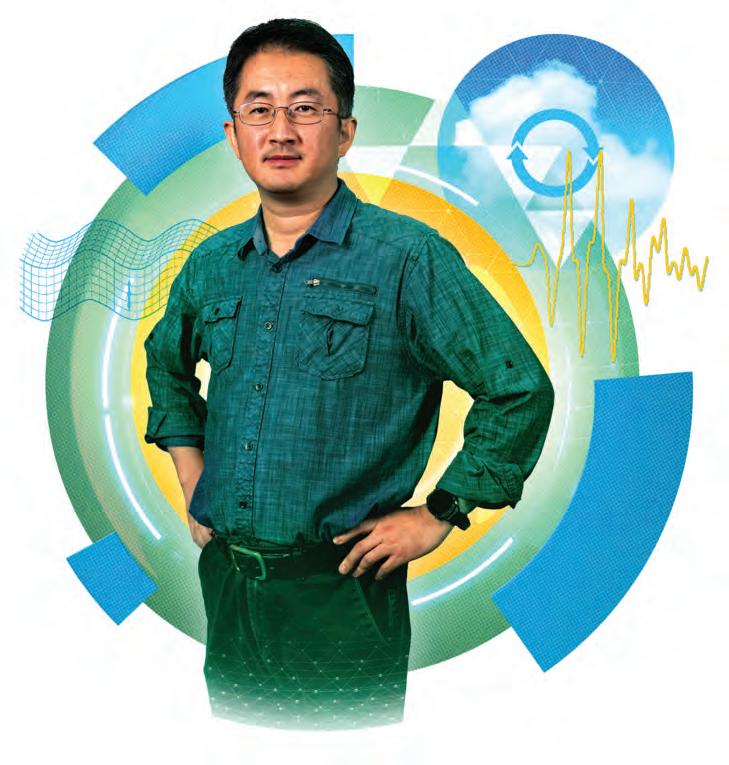
His 17-year-old daughter is visiting his laboratory later that day, and the Robert and Margaret Sheriff Professor in Applied Geophysics wants to do some geochemistry experiments. Nothing too complex, but enough to stoke her interest in this nuanced sector of science.
“It’s a good field,” he says, nodding and looking around his lab. If he’s nervous, he doesn’t show it. Everything about the bespectacled Zheng is calm, relaxed and organized. In other words, he’s precisely the kind of sharp, thoughtful mind you want tackling projects such as carbon capture and storage, one of the projects he’s busy with. It’s the kind of work that might seem abstract at first, but it has major implications for his daughter’s future — and everyone else’s.
“You may not be directly hit by this CO2 problem, but think about rising homeowner and car insurance,” Zheng says. “It’s all related to this.”
By “this” he means the multitude of projects he and his fellow faculty members focus on within the vast and challenging energy sector. Through work on campus and as far away as India’s offshore basins, professors like Zheng collaborate with some of the world’s most prestigious companies and academic partners to shape the global energy ecosystem and drive innovation throughout the oil and gas industry. UH has long been admired for its prowess in the energy field, but thanks to these partnerships and the sheer talent on campus, the University has become the industry’s partner of choice.
It helps that UH professors have decades of experience under their belts. In fact, long before NVIDIA was a household name, geophysicists like Zheng used the graphics processing units that have partly fueled the company’s success. Now, he sees the world’s biggest energy companies use GPUs to try viewing the Earth’s subsurface — spending boatloads of cash and time in the process.
That’s why Zheng is hard at work on a fix that will bring immense value to companies worldwide.
“If you want to make an innovation in that area, you want to do it cheaper and faster, and you want to guarantee the solution you get is the true solution,” he says. “I’m working on a new waveform inversion technique called the direct waveform inversion that enables us to do [it] in a matter of less than five minutes, compared to weeks on thousands of GPUs.”
“We’ve already done demos,” he says later. “It’s not just speculation.”
That’s just one example of Zheng’s work. He’s also exploring earthquake phenomena that could redefine how we think about seismic waves and geothermal energy. True to form, he explains it nonchalantly, as if he’s telling you the time of day.
“We also do innovation from a curiosity-driven perspective,” he says.
For instance, Zheng has long been curious about earthquakes.
Years ago, seismic waves from a distant
earthquake in Alaska triggered smaller earthquakes in California despite the fact that the seismic stress involved was too low.
When they investigated why this happened, Zheng’s team found an amplification effect in volcanic and geothermal regions, where subsurface fractures are filled with water. When the seismic waves originating in Alaska passed through those stress fractures, they became more than 100 times stronger. This was a major breakthrough, showing that even weak seismic waves can trigger earthquakes if certain conditions exist underground, such as the presence of water.
Zheng wasn’t content to stop there; he’s now exploring how to generate seismic waves intentionally. These controlled waves could help make processes, including hydraulic fracturing and geothermal energy extraction, much more efficient.
It’s like Zheng himself says: Earth science is fascinating, and its applications are wide-ranging.
So when it comes to impressing his daughter, he has nothing to worry about.
Yingcai Zheng, Ph.D.
With the help of an accomplished advisory board, UH established collaborative agreements that enabled students to pursue research projects at universities worldwide — and vice versa.
TAKING OFF
It’s not just industry partners who want to work with UH. Sometimes it’s industry veterans.
That was the case for Dimitrios Hatzignatiou, Ph.D., who held multiple senior consulting, teaching and advising positions in Norway before finding his way to Houston. He became a UH professor of petroleum engineering in 2016, the same year his department branched off from chemical engineering. There were few faculty members, and even fewer full-time professors, but all that was about to change.
Hatzignatiou and three fellow newcomers helped establish a doctoral program and recruited additional faculty members to enhance the quality of coursework. Students soon followed, alongside a significant increase in the program’s national ranking. All of this contributed to even stronger interest from partners and research foundations, including organizations from overseas. With the help of an advisory board comprising experienced professors and industry luminaries, UH established collaborative agreements that enabled students to pursue research projects at universities worldwide — and vice versa.
The advisory board also established the interdisciplinary oil and gas research consortia, a particular point of pride for Hatzignatiou.
“Quite often what happens in academia is we have an idea, and then we go out and pitch it to company A, B, C, and see which one, if any, wants to support it,” he says. “In my view, it should be the other way too.”
The University’s consortia make that possible. By fostering consistent dialogue between industry partners and professors, UH oil and gas research consortia — of which there are more than a dozen — help ensure that students develop the valuable, practical, and in-demand skills and knowledge that companies need.
The consortia study everything from seismology to electric power and the properties of fluid and rocks. Taken together, they provide a wellspring of cutting-edge knowledge — or, as Hatzignatiou puts it, “a loop.”
“If we do research that the industry finds has direct application, isn’t that so wonderful?” he says. “Because then we kind of close the loop, and everything we do, one fits the other.”
Dimitrios Hatzignatiou, Ph.D.
THE WHOLE GAMUT
Mohamed Soliman, Ph.D., was one of the four professors who joined UH at the same time as Hatzignatiou. Soliman grew up in Egypt, and after graduating from Cairo University’s engineering program in the 1970s, he had seen another student writing letters to American universities asking about scholarship opportunities and asked, “Why would an American university give you a scholarship?”
The student replied, “They do!” Soliman thought, “Hey, I’m top of the class.” So he wrote and received more than one.
He relays this story with a fun-loving grin, his mind arcing back decades to the day he chose Stanford University for his master’s and doctorate degree. He still remembers the caring, deeply knowledgeable Stanford professors who shaped his future career. When he came to UH, he wanted to provide his students with the same unforgettable experience.
He also wanted to provide ever-expanding research opportunities. With Soliman, UH added an industry veteran with a decorated career: He spent 32 years working at Halliburton, including many years as chief reservoir engineer. His methods for fracturing
and fracture analysis have been adopted by companies around the world, and in 2023, he was inducted into Hart Energy’s Hall of Fame.
As Soliman explains it, UH’s energy research includes both traditional oil and gas systems and emerging renewable technologies, ensuring a holistic approach to the industry’s latest challenges. Soliman, who holds 41 patents, was tight-lipped about some of his research work; he didn’t want to say too much about what he hopes is patent No. 42. But he emphasizes that his work with UH students runs “the whole gamut.”
He’s working on a geothermal project and helping another student with an artificial intelligence-driven project. One of his projects explores plasma stimulation as an alternative to traditional hydraulic fracturing. Soliman’s method uses electrical energy in lieu of water or explosives, thereby minimizing water usage and improving efficiency in the fracturing process.
Even at this stage in his decorated career, after decades of research, he’s anxious to be busy.
“The idea is not only to run experiments in the lab,” he says. “I want to take it to the field.”
When it comes to which projects they pursue and where, UH students now have more opportunities than ever. So do the companies that work with the University.
Mohamed Soliman, Ph.D.
MEANINGFUL SOLUTIONS
When it comes to which projects they pursue and where, UH students now have more opportunities than ever. So do the companies that work with the University.
In 2023, the University teamed up with the Directorate General of Hydrocarbons, the technical arm of the Indian Ministry of Petroleum and Natural Gas. Together, they created UH-DGH Center, a tech-powered geoscience home base, of sorts, that provides critical seismic, well, reservoir and production statistics. These data help energy companies determine where to allocate their research and development investments, further solidifying Houston’s status as a leading energy player on the global stage.
What’s more, under the leadership of Vice President of Energy and Innovation Ramanan Krishnamoorti, 11 of UH’s 16 colleges are
working together to offer interdisciplinary solutions to the challenges facing the energy industry. It helps that UH is also leading a carbon capture consortium, involving 80 entities across the United States, to address regulatory, financial and public concerns about commercial carbon management deployment.
As if that weren’t enough, the University’s Subsea Systems Institute is currently developing novel solutions for deepwater exploration, improving the safety, efficiency and sustainability of this dangerous, resource-intensive work. Collaborating with industry leaders, the institute has recently launched a series of exciting projects. Some UH personnel are using robotics and automation to enhance the safety of offshore energy extraction, while others are employing technologies such as self-powered sensors and electrochemical transistors for environmental monitoring and subsea leak detection.
As impressive as all of that sounds, all the experts in this story say the best is yet to come. After all, it wasn’t too long ago that departments such as petroleum engineering became their own entities, just as it wasn’t too long ago that a powerful Alaskan earthquake seemed forever shrouded in mystery.
The way Krishnamoorti sees it, all these impressive programs are possible because of the innovation that’s woven into the fabric of UH.
“Innovation is a culture, a mindset and an ability to really create ways to come up with solutions that are meaningful,” he says. “A lot of people work on energy-related topics around the country, but very few of them think about the energy systems the way we do in Houston and at the University of Houston.”
The UH approach isn’t about developing a new app or product, he says. It’s about addressing “all aspects of the energy system,” from top to bottom.
That’s how you build meaningful relationships with global companies, and just as important, that’s how you build trust with the public.
And it’s how, as Krishnamoorti says, “UH has become the Energy University.”
Ramanan Krishnamoorti, Ph.D.
PERSPECTIVES
The Hidden Cost of Tariffs
Two University of Houston experts explain how tariffs could impact energy infrastructure.
BY JONATHAN ADAMS
FOR THE PAST SEVERAL years, energy growth and transition have been among the biggest buzzwords in the energy sector.
Industry titans invested billions of dollars in pursuing alternative energy projects. For example, the Houston Business Journal reported in 2023 that ExxonMobil had planned on pouring $17 billion into low-carbon and emissionsreduction projects across five years.
However, those plans and those global changemakers eyeing new market opportunities could soon be slowed, due in part to the Trump administration’s tariff policies that promise to restore America’s manufacturing prowess, grow its revenue and equalize the balance of trade to benefit the United States.
That begs the question: How will tariffs impact the industry’s growth and its pursuit of alternative energy? Two University of Houston experts share their perspectives on what to expect.
Margaret Kidd is an adjunct faculty member of supply chain, logistics and technology at UH and president of the Houston Maritime Center & Museum as of June 2025. Kidd is also a liaison to the Export Competitive Maritime Council.
Ognjen Miljanic, Ph.D., is a Moores Professor of Chemistry at UH’s College of Natural Sciences and Mathematics. Together with his students, he develops new molecules and materials that could aid energy technologies. Throughout his career, Miljanic has been honored with the UH Teaching & Research Excellence and Cottrell Scholar awards, as well as an Alexander von Humboldt fellowship.
The Potential Tariff Toll
TARIFFS IMPOSED ON KEY energy-related imports often aim to protect domestic industries or address trade imbalances. However, these measures can have unintended consequences that ripple through energy supply chains, impeding progress toward clean energy goals and exacerbating existing infrastructure challenges.
One of the most significant yet overlooked effects is the worsening of interconnection backlogs — the delays in connecting new energy projects to the electric grid. These delays grew by 30% in 2023, according to Berkeley Lab’s Energy Markets & Policy.
Solar panels, wind turbines, battery components, natural gas turbines and grid infrastructure rely on a globally integrated supply chain. When tariffs raise the cost or limit the availability of these components, project timelines are set back, and developers face increased uncertainty.
Developers often postpone or cancel projects due to unpredictable costs, which in turn clogs the queue of projects waiting for grid interconnection. These delays directly undermine national and regional efforts to meet energy demand and decarbonization targets and modernize energy infrastructure.
Moreover, tariffs can create mismatches between domestic manufacturing capacity and the urgent demand for energy technologies. While encouraging local production is a worthy long-term goal, short-term overreliance on tariffs without a robust industrial base can backfire. Energy markets operate on tight timelines and thin margins. Any disruption can cascade into lasting impacts on energy availability and prices.
To mitigate these issues, smarter trade policy is essential. Policymakers must balance the need for economic and national security with the realities of energy deployment.
This includes establishing clear exemptions or streamlined import processes for critical energy components, investing in domestic manufacturing through tax incentives in parallel, and improving coordination between trade and energy policy. Ultimately, aligning trade measures with climate and grid modernization goals will be vital to avoid undermining the very energy growth and transition they are meant to support.
IMPLICATIONS
When tariffs raise the cost or limit the availability of components, project timelines are set back, and developers face increased uncertainty.
Impact on the Energy Sector
THE UNITED STATES ALREADY lags behind Europe and China in energy transition, and tariffs will likely increase this disparity in the long run.
Tariffs on some materials are easy to comprehend, and U.S.based alternatives are readily available. Steel and aluminum used in the manufacturing of wind turbines are good examples.
Others, such as rare-earth imports — essential for magnets used in wind turbines and electric cars — are a material effectively available only in China, which forces the Trump administration to tread carefully. The details of the most recent trade agreement with China are murky, but it appears they will keep U.S. imports of rare earth resources accessible.
Increased costs such as these have the potential to stifle growth in alternative energy in the United States for years.
The goal behind the Trump administration’s tariff plan is to spark innovation among U.S. manufacturers, but innovation does not happen in a vacuum; it is slow and expensive. That, combined with cuts made by the current administration in funding for research across multiple federal agencies, will also bring innovative efforts to a crawl — if not pause them entirely.
In a globally connected green energy ecosystem, switching to go-it-alone policies without offsetting the associated cost increases with government subsidies is a bad idea. The most likely outcome for American consumers is that they will be saddled with expensive and somewhat outdated U.S. products as tariffs shield manufacturers from foreign competitors and budget cuts slow down innovation at home.
Additionally, fewer dollars exchanged will inevitably lead to fewer businesses building manufacturing factories and a decline in hiring activity.
MARGARET KIDD
OGNJEN MILJANIC, P h .D.
Jaime González: Rebuilding Nature One Seed at a Time
The UH alumnus wants to spread the importance of conservation to the masses.
BY JONATHAN ADAMS | PHOTOGRAPHY BY ANTHONY GOLLAB / UNIVERSITY OF HOUSTON
LIKE MANY, JAIME GONZÁLEZ spent most of his childhood outside, having grown up in the Aldine area of Texas, where a forest rested behind his home.
It’s where he played with his dog, hung out with friends and built forts. He left that forest behind when he moved to Philadelphia in high school. But when he returned after graduation, González says he found his forest had been turned into a junkyard.
“That’s when I decided I want to work in conservation,” says González, who was recently named founding director of the University of Houston’s Institute for Ecological Resilience.
Established in 2025, the IER brings nature-based solutions to make com munities more resilient to climate and environmen tal challenges. González, who earned his master’s and bachelor’s degrees from UH, will be responsible for the overall management and operation of the IER, which is working to protect and restore local ecosystems, support environ mental education, and guide policies that improve public health and safety — with the goal of helping the region thrive ecologically and economically.
“I wanted to protect this playground, this wonderful place of peace and joy that had been destroyed,” the award-winning conservationist says.
On how he landed his first job: González began by volunteering at the Houston Arboretum & Nature Center in a biotech lab doing rudimentary lab work. Soon he
was encouraged to apply for an interpretive naturalist position. “I became absolutely enthralled with not just the restoration of nature but also the teaching of nature,” he says.
On his reason to focus on city-based conservation: “It’s all part of a continuum of action,” González says. His experience working in the urban
zone at the Houston Arboretum brought his mission for urban preservation into focus. “Here, you can rebuild nature, not just protect it, and it can have all of these benefits for both humans and animals in that area.”
On his top goals for IER: According to González, Houston is one of the most diverse and vibrant cities in the world. “A
ENERGIZE YOUR SKILLS
Our micro-credential programs help professionals stay ahead of emerging industry needs.
PLASTICS CIRCULAR ECONOMY
•Assess environmental and regulatory impacts
•Understand the plastics circular economy
•Explore recycling technologies
•Engage in experts
•Master waste identi cation
MANAGING NON-TECHNICAL RISKS IN ENERGY
•De ne and categorize non-technical risks in energy operations
•Assess environmental and social impacts using key frameworks
•Identify practical tools and emerging risks
In collaboration with the Society of Petroleum Engineers (SPE) – Asset Management Technical Section (AMTS)