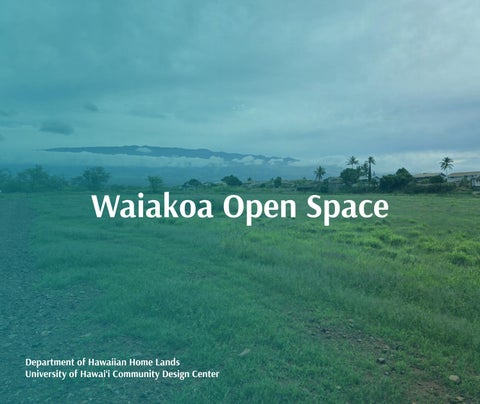
Waiakoa Open Space
Department of Hawaiian Home Lands University of Hawai‘i Community Design Center
IMAGE OR DRAWINGS ACROSS
2
After extensive investigation and survey on the part of various organizations organized to rehabilitate the Hawaiian race, it was found that the only method in which to rehabilitate the race was to place them back upon the soil.
-Prince Kuhio Jonah Kalaniana’ole
3
Prepared For Department of Hawaiian Home Lands 91-5420 Kapolei Parkway Kapolei, HI 96707 Prepared By University of Hawai’i Community Design Center 2410 Campus Rd Honolulu, HI 96822 A special mahalo to community members who contributed during the research phase: Bobby Pahia Hanalei Ekolu Lindsey Germaine Balino This report reflects work completed in Spring 2026 by first year students in the Master of Landscape Architecture program at the UH Mānoa School of Architecture.
4
Students: Schuyler Cole Katie Schuster Jacquelyn Wu Supervisor: Assistant Professor Erin Voss
Table of Contents
Executive Summary
6
Visioning
12
Site Stories
18
Community Considerations
30
Maintenance Considerations
32
Waiakoa Makai Open Space Concepts
48
Waiakoa Mauka Open Space Concepts
102
5
Executive Summary Kamalani is a future housing development in Kīhei, Maui by the Department of Hawaiian Home Lands (DHHL) that will offer housing units for beneficiaries and open space that support cultural practices. While Gentry Homes is the prime designer, students at UH Mānoa School of Architecture were given the opportunity to conduct research and propose designs for the open spaces within the development. DHHL indicated a desire for designs that are low maintenance and include fruiting trees adapted to the environment, keeping in mind the maintenance capabilities of beneficiaries. Additional considerations include a small cultural space, community mail box, and potential synergies with adjacent commercial lots to be developed at a later date. During the spring 2026 semester, students explored ideas of maintenance in the landscape–as ecological stewardship, labor practice, cultural practice, infrastructure, design criterion– and how design can accommodate different publics. Grounded in extensive research and design explorations, students proposed low to medium maintenance designs for an open space that reflects the unique needs of kūpuna and keiki on Maui.
6
The project was conducted as a course integration with DHHL through the University of Hawai’i Community Design Center (UHCDC). First-year students in the Master of Landscape Architecture program in the School of Architecture conducted research, site visits, and interviews with kanaka local to Maui to understand the scope of the site. Each student proposed a design for the central open space (Waiakoa Makai), resulting in three different design concepts, and collaborated on a design for the second open space (Waiakoa Mauka). The site design concepts presented in this document are meant to serve as a starting point for community engagement to inspire conversations among beneficiaries as they envision the design of the collective landscape.
Some of the desires expressed by DHHL for the open spaces in the Kamalani Development include: + Preserve & promote native Hawaiian cultural practices & values + Provide accessible & engaging spaces for intergenerational learning & recreation + Foster community pride, identity, and connection to place + Support cultural education through interactive and interpretive experiences + Encourage stewardship of natural and cultural resources + Create inclusive gathering spaces that strengthen community relationships + Revive traditional games, language, & arts in daily community life + Offer low-maintenance, sustainable infrastructure rooted in cultural relevance
Dwarf Citrus Fruit Trees
Name
Height
Width
Sourcing
Meyer Lemon
5 - 10 ft
3 - 5 ft
Flying Dragon Farm (Maui)
Citrus x meyeri Honey Tangerine
8 - 10 ft
3 - 5 ft
Waihole Nursery (O’ahu)
Citrus reticulata ‘Murcott’ Calamansi
5 - 10 ft
3 - 5 ft
Flying Dragon Farm (Maui)
Citrus x microcarpa Dwarf Mango - “Dwarf Rapoza”
6 - 10 ft
3 - 4 ft
Frankie’s Nursery (O’ahu)
Mangifera indica Olinda Valencia Orange
6 - 10 ft
3 - 4 ft
Flying Dragon Farm (Maui)
Citrus x sinensis ‘Olinda’ Tahitian Lime
6 - 10 ft
3 - 4 ft
Flying Dragon Farm (Maui)
10’
Citrus x latifolia Each house in the Kamalani development will include a dwarf fruit tree for the beneficiary to take care of. Dwarf fruit trees are great for productive landscapes because they are shorter and occupy less volume. This makes it safer and easier for beneficiaries to maintain and harvest trees. The addition of fruiting trees in the landscape supports efforts to increase food sovereignty and food security. Flying Dragon Farm, Waiahole Nursery, and Frankie’s Nursery specialize in dwarf fruit trees and have the capacity to supply large contracts.
Planning spaces for beneficiaries of all ages and abilities is important, as is considering who will be the primary caretakers of the gardens and open spaces in future developments. Plants that are adapted to native ecosystems typically require less water and pesticides to maintain while supporting local biodiversity. Aligning planting palettes with desirable maintenance regimes (organic, permaculture, integrated pest management, etc) is a key consideration when thinking about the sustainability of landscapes.
7
Waiakoa Makai Open Space Concepts Gulch Boardwalk
Hula Mound
Gulch Overlook
Flood Mitigation
Pu’u Waiakoa
Imu Pit/Storage
Community Garden
Entry Gate Open Field
Manu Shade Canopy
Makali’i
Public Restroom Community Mailbox
Kaiaulu o Waiakoa Park
Iwikuamo’o
Vehicle Entry/Road
Hale Ho’okipa
Open Market Tree Stalls
Open Space #1 -Labled
Mala Hoku Entry
Konane Board Boardwalk
Breeze Block Play Space
Manaiakalani
Learning Garden Communtiy Garden
Ka Lupe o Kawelo
Hula Mound Imu Pit
Shaded Gathering Space
Mail Hale 1
Kīhei Kaiāulu Park
Ethnobotanical Garden 1
Halekula Communtiy Orchard
Ulu Maika Court
Mail Hale 2
Ethnobotanical Garden 2
0
8
15
30
60
90
120
Star Compass
Open Space Natural Playground
Nature Walk
Hula Mound Community Garden Plots
Mahi Pono
Toolshed & Education Center
Mailboxes & Community Board Shade Structure
E Ho‘i Ka Piko
Native Plant Garden
Kamalani Development
Mailboxes & Community Board
Kaiaulu o Waiakoa Park He ali’i ka ‘āina; he kauwā ke kanaka Ma ka hana ka ‘ike These guiding principles foster a connection between site and Kanaka through intentionally designed places for play, discovery, community, contemplation, and growing/sharing mea ‘ai.
Kīhei Kaiāulu Park
E Ho‘i Ka Piko
This design emphasizes cultural practice, education, and community stewardship, fostering lasting relationships between people and the land. To support these goals, the space incorporates a variety of educational and cultural elements that encourage learning, gathering, and connection.
The core of this design is to connect generations of kanaka– from keiki to kupuna, past to future– to the ‘āina and facilitating cultural practices. The design takes inspiration from the concept of piko, which symbolizes the continuous and cyclical connection of life.
9
Anticipated Levels of Maintenance
Maintenance Level
Site Area
Responsibility
Maintenance Description
1 - No to Low
Gulch, large native plant massings, planting near houses
Landscapers
General pruning, irrigation, clearing of debris, plant health checks
2 - Low to Moderate
Pathways, park edges
Landscapers
Pruning, clearing of debris
3 - Moderate to High
Lawns, fruit trees
Landscapers, Beneficiaries
Landscapers: Mowing & watering lawns, heavy seasonal pruning Beneficiaries: Light pruning as necessary"
4 - High to Constant
Kaiaulu o Waiakoa Park
10
Community garden
Landscapers, Beneficiaries
Kīhei Kaiāulu Park
Landscapers: Irrigation checks Beneficiaries: Individual plots"
E Ho‘i Ka Piko
Waiakoa Mauka Open Space Concepts
shade structure
accessible walking path large shade trees shade structure dog park bench
Kamalani housing native plantings
dry detention basin
seating
logs + boulders
Waiakoa Makai Waiakoa Mauka As space designed for passive activity, this greenspace is meant to complement the beneficiaries daily habits. The 1/8-mile main loop offers an easy way to neighbors to keep track of their steps during daily walks. Shade structures take inspiration from Hawaiian wayfaring and kite fishing traditions.
Kamalani Development
Waiakoa Mauka
11
Visioning The Hawaiian Homes Commission Act of 1920, a congressional action signed into law by President Warren Harding, provides for the rehabilitation of kānaka Hawai‘i (the native Hawaiian people) through a government-sponsored homesteading program. Through this act, the Department of Hawaiian Homelands (DHHL) was created by the first Hawai’i State Legislature to administer the development and distribution of former Crown and governmental land, over 200,000 acres across the islands, for homesteading by eligible kānaka. In 2022, DHHL was awarded $600 million by the state legislature to address the needs of beneficiaries still waiting for home lands leases. Among the many projects in the pipeline is a housing development on the western side of Maui, known as Kamalani. Kamalani addresses the priorities of DHHL in unique ways:
Housing Development and Infrastructure – 400 single-family houses in an existing and growing neighborhood in Kīhei, Maui
12
Land Stewardship and Resource Management – approximately 4.25
acres of open space spread across two parcels that supports local food production and ‘āina stewardship, populated with lower maintenance native plantings
Cultural Preservation and Heritage Revitalization – cultural amenities and flexible spaces that enable customary activities to continue as well as support future inter/intra generational traditions
Economic Empowerment and Community Development – future communal spaces that support entrepreneurship and resource development of beneficiaries
While Gentry Homes is working on the design and layout of the housing, there is an opportunity for other perspectives to provide concept ideas for the remaining spaces. Master of Landscape Architecture students at the University of Hawai’i at Mānoa School of Architecture were given the opportunity to conduct research and propose designs for the development’s open space. DHHL’s vision for the open space is to foster connections between residents, visitors, and place through
spaces and programming that celebrate native Hawaiian heritage, identity and traditions. The spaces are to be accessible and engaging for intergenerational recreation and education. Additional considerations include low-maintenance designs that promote environmentally responsible stewardship practices while supporting local food systems. During the spring 2026 semester, students explored ideas of maintenance in the landscape–as ecological stewardship, labor practice, cultural practice, infrastructure, design criterion– and how design can accommodate different publics. Traditionally, land maintenance is associated with regular routines of care to preserve the aesthetics and functionality of a space. Privileging active care should not reduce the importance of passive and relational care, rooted in ecological and social systems, that kānaka and kama‘āina have established over generations. Focusing on how landscapes are created and maintained offers opportunities to question how care and labor manifest in public spaces and the ability of design choices that facilitate durability and accessibility.
DHHL Desires Some of the desires expressed by DHHL for the open spaces in the Kamalani Development include: + Preserve & promote native Hawaiian cultural practices & values + Provide accessible & engaging spaces for intergenerational learning & recreation + Foster community pride, identity, and connection to place + Support cultural education through interactive and interpretive experiences + Encourage stewardship of natural and cultural resources + Create inclusive gathering spaces that strengthen community relationships + Revive traditional games, language, & arts in daily community life + Offer low-maintenance, sustainable infrastructure rooted in cultural relevance
13
Entrance Lot
Community Space
Comfort Station
Signage
Farmers Market
Community Mailbox
Community Space
Dog Park
Dwarf Fruit Tree
Kōnane Boards
La’au Lapa’au Garden
Living Fence
Shade Structure
Open Space
14
Food Trucks
Educational Space/ Hale
Food Garden
Hula Mound
Signage
Trail
Ulu Maika / Moa Pahe‘e Field
Imu
15
Stakeholders
16
17
Site Stories The ahupua’a of Waiakoa begins up mauka, at the base of the towering shield volcano of Maui aptly named Haleakalā (House of the Sun). In the moku of Kula, the ahupua’a descends through the Kula forest reserve at around 9,000 ft of elevation. A gulch takes shape and slices through the landscape, forming the northern border of Waiakoa ahupua’a. Nearing the ocean, the gulch joins with another ravine from the ahupua’a of Pulehunui to the North. Waiakoa gulch lets out through Kealia beach (a.k.a. Sugar Beach) and empties into Mā’alaea Bay. “Waiakoa” translates to “Koa’s water” or “the water of the Koa tree”, hinting at the gulch’s source up mauka. Waiakoa Gulch is one of several seasonal ravines that descends from the slopes of Haleakalā, crosses the plains, and finally empties into coastal wetlands surrounding Keālia. Although the gulch remains dry for most of the year, winter brings more frequent rains that revive the flow. This periodic cycle transports freshwater, sediment, and nutrients from the Kula uplands into the coastal plains. The mouth of Waiakoa Gulch is just south of the largest coastal wetland in Maui, known as Keālia Loko i’a (fishpond). Prior to western contact, the wetlands surrounding Keālia supported
18
an abundance of native fish, ‘opihi and hihiwai(Shellfish), limu (marine algae), and native manu (waterfowl). Freshwater delivered through seasonal streams such as Waiakoa Gulch helped maintain the delicate salinity gradients necessary for productive estuarine habitats, making the gulch an important ecological contributor to the fishpond system. Nūpepa records from 1929 reveal W. M. Walker found two man-made ancient platforms in Waiakoa during an archaeological survey, likely heiau. The first he described as a 31 by 40 ft platform trampled by cattle and he found pieces of coral which had been intentionally brought to the site. The second he described as a 36 by 45 ft double terraced open platform facing north to the sea. Three foot blocks of a’a, lava rock, and coral were also found. During the 19th century western contact brought a new era of history to Kīhei, the small subsistence fishing community became an important destination for Pacific whaling fleets. Whaling ships frequently anchored in Mā’alaea Bay and along the Kīhei coast to replenish freshwater supplies and trade with local communities. As whale populations dwindled due to over-hunting towards the
end of the nineteenth century, Kīhei entered into a new era as commercial sugar production expanded across central and South Maui. Irrigation systems diverted water from eastern Maui streams to support extensive sugarcane cultivation on the dry leeward plains. The establishment of plantations dramatically altered the natural hydrology of watersheds, including those connected to Waiakoa Gulch. Drainage channels were modified, wetlands were partially filled or converted, and sediment transport patterns shifted as agriculture intensified across the landscape. While sugar production became a dominant economic force, these changes reduced the extent of native wetland habitats and disrupted the ecological processes that had historically sustained Keālia Fishpond. By the twentieth century, the sugar industry declined, and much of the surrounding agricultural land transitioned toward residential, recreational, and conservation uses. Kealia Beach, more recently known as Sugar Beach, serves as a reminder of the sugar industry boom. It is the largest uninterrupted stretch of beach in Maui stretching 5 miles from Kealia fishpond to North Kihei where it meets Waiakoa. Today, Waiakoa Gulch functions as an
Topographic map of the Island of Maui. Source: USGS, 1930
19
important stormwater corridor, a reminder of the historic watershed connections that once supported Keālia’s thriving estuarine ecosystem as it transports seasonal runoff to the coast. Restoration efforts increasingly recognize the importance of protecting these natural drainage systems to improve water quality, reduce erosion, and preserve the ecological integrity of Maui’s remaining coastal wetlands. To the north of the site is land owned by an agricultural company called Mahi Pono. They grow many orchard and row crops including citrus, coffee, avocado, macadamia nut, ‘ulu, and onion. As of 2026, a map of their field holdings indicates the adjacent property is planned for “Cattle/cattle forage crop or future crop.” DHHL mentioned an interest in exploring collaboration opportunities with Mahi Pono, such as creating a living fence between the properties.
Map of Maui showing Crown Lands (yellow) and Government Lands (green) from the Māhele of 1848. Source: WD Alexander, 1885
20
Map of historical sugar cane operations on the western side of Maui. Source: State of Hawai’i GIS, 2026 21
View to Haleakalā
Elevated berm forms barrier to gulch
5’-10”
Gulch depth comparison
22
Naturalized Kiawe trees along the gulch
Irrigation trash
Site boulders
Evidence of ungulates
Potential old spillway
Signs of erosion
23
Site Analysis RFP Observations
most of the year.
The approximately 81‐acre aggregate project site is located in Kīhei, Maui, designated as Tax Map Key: (2) 3‐8‐004‐035; (2) 3‐8‐004‐036; and (2) 3‐8‐004‐037. The Department has declared that the Project will be designed and built in accordance with R‐0 District standards. The project consists of housing lots, developer‐built homes, and backbone roadway and utilities infrastructure.
Kamalani sits in the rain shadow of Haleakalā, which contributes to its low annual rainfall average (less than 12 inches). When it does rain, it comes down hard and can create flash flood conditions, bringing lots of water and sediment to the coast. Traces of flooding events can be seen in the typically dry Waiakoa Gulch: eroded channel sides show erosion and exposed tree roots. Old railroad bridges crossing the gulch (just outside the boundaries of the property line) become a choke point where large fallen trunks and branches collect and narrow the channel. Community members noted that when it rains heavily, the existing units below the nearby highway flood.
Moku: Kula Ahupua’a: Pūlehunui Watershed: Waiakoa Gulch
Site Observations The site offers views mauka (hikina) toward Haleakalā and makai (komohana) toward Mā’alaea Bay. Persistent NE trade winds keep the winds blowing mauka to makai. During the summer, the average temperature reaches the mid 90s °F and drops into the 70s °F. During the winter, the average high temperature still reaches 80°F while the low can reach 55°F. The site is located on the leeward side of the island and thus remains quite hot and arid for
24
The area’s sugar cane history suggests the soil is slightly acidic. According to the USDA general soil survey, the Waiakoa Makai Open Space is predominantly Pulehu cobbly silt loam (3-7% slopes) and Waiakoa very stony, silty clay loam (3-7% slopes). Both soil profiles are well-draining, with the former’s parent material alluvium and the latter’s volcanic ash. The Mauka Open Space is all Waiakoa extremely stony silty clay loam (3-25% slope). Depending on the design programming, further soil
tests may be necessary to understand the soil conditions and confirm there are no heavy metals or anything toxic. There are huge boulders on site, which indicate there are likely more to be uncovered during excavation. Integrating the boulders into the landscape offers an opportunity to ground the design in the ecological history of the site, while reducing the cost for removal. They can become natural play material, seating, signage, or wayfinding elements. The Waiakoa Makai Open Space area experiences approximately 25 feet of elevation change, which is similar the the approximate 27 feet of elevation change in the Waiakoa Mauka Open Space. A lot of invasive vegetation is present on site, including flammable grasses and kiawe. Clearing the invasive vegetation will be important to help reduce the potential of catastrophic wildfires.
Map of soils across the development. Source: USDA, 2026
25
Existing conditions on site with proposed layout of Kamalani. Contours are derived from NOAA DEM and are approximate.
26
The contours suggest the need for some regrading to ensure water does not flow directly towards the future housing.
27
1923
Source: USGS
1965
Source: USDA
2023
Source: Google
28
Non-native grasses
Site relics
Historical agricultural infrastructure in the gulch
Entry lot
Ornamentals in nearby development 29
Community Considerations The UHCDC team had the privilege of speaking with a few local community members and leaders to learn more about the history of the area and potential community needs. They provided invaluable ‘ike that helped guide the student’s research and design intents. During the conversations, they emphasized the importance for any design to respect ‘āina, kūpuna, and community. Community Members: + Bobby Pahia, co-founder of Hawaii Taro Farm in Waikapū, Maui + Hanalei, a pig farmer who works with Uncle Bobby + Ekolu Lindsey, president of Maui Cultural Lands + Germaine Balino, Maui District Supervisor for DHHL Many of the comments they provided directly inspired students to include certain elements in their designs. For example, the need for childcare for many young families inspired the creation of play areas where children could safely run around and explore while caregivers rested under shaded canopies. Open spaces should be designed with intention and not overprogrammed, but still made attractive. 30
Making sure the space feels comfortable for families while remaining flexible for their changing needs is vital.
Uncle Bobby
This was also a time for the community members to learn more about the Kamalani development from a DHHL representative and start to envision what this new community space could be. While they may not be the beneficiaries of this particular site, they are all working towards bettering the lives of Kanaka Hawai‘i. This initial meeting sets the stage for future community engagement and meetings, with student-led design concepts serving as a starting point for design discussions. The drawings and renders are meant to help open conversations and give the community something tangible to reflect their values on. Because this development is led by DHHL, Kamalani offers a unique opportunity for the beneficiaries to actively participate in the design process for open and park space. DHHL may consider using the app Polis during community engagement sessions with the landscape architect and designers. This tool gathers and analyses community feedback in real-time to understand what large groups of people think. It is currently being explored as a tool to help build community consensus around large land and conservation planning projects around Maui.
https://pol.is/home
Uncle Hanalei
Honor ‘Āina & Kūpuna
Uncle Ekolu
Support Educational Initiatives
“Hawaiian way is to look to the past & elevate to the future”
Customary land practices
Build reminder of relationship to land
Incorporate ‘olelo Hawai‘i in signage like names of wind, rain, & plants “Keep stories alive”
Offer a Variety of Programs
“Education creates pathways”
“Gather & do cultural practices” Open spaces & structures for shade
Look Towards the Future Spaces for keiki
Accessible Design
“Current work creates foundation for young people who are the future”
“Calming, attractive, inviting, inclusive” Easy for community to engage with
31
Maintenance Considerations Sustainability in the landscape starts with maintenance considerations. Maintenance encompasses more than just aesthetic considerations. The longevity and use of public spaces is often determined by how well ecological, social, and cultural needs are balanced. This includes: + Temporal processes (growth, decay, succession, weathering) + Material performance (durability, failure, repair) + Ecological cycles (water, soil, nutrients, disturbance) + Human care (attention, stewardship, labor, knowledge transfer) Planning spaces for beneficiaries of all ages and abilities is important, as is considering who will be the primary caretakers of the gardens and open spaces in future developments. DHHL wants to be intentional in how they plan and develop ‘āina, focusing on spaces that balance maintenance needs with abundance. The following section summarizes research regarding dwarf fruit trees and low maintenance plantings suited to the western Maui climate.
32
Each house in the Kamalani development will include a dwarf fruit tree for the beneficiary to take care of. Dwarf fruit trees are ideal for productive landscapes because they are shorter and occupy less volume. From a cropping perspective, they can be planted in denser stands to create orchards that produce higher fruit yields using less acreage, and are more efficient to manage canopies. For the beneficiary, the shorter heights make it safer and easier to maintain and harvest trees. The addition of fruiting trees in the landscape supports efforts to increase food sovereignty and food security. Plants that are adapted to native ecosystems typically require less water and pesticides to maintain while supporting local biodiversity. Aligning planting palettes with desirable maintenance regimes (organic, permaculture, integrated pest management, etc) is a key consideration when thinking about the sustainability of landscapes. The list of low maintenance plants near the end of the section focuses on native plants. Note, the species chosen were considered as ideal for landscaping purposes and thus the list does not include many shrubs and groundcovers used for ‘ai or la’au. Many of the design proposals in the “Design Concepts” chapter include community garden spaces where these plants can be included.
Plant Sourcing There is a growing demand for native Hawaiian plants in both residential and commercial landscaping. While there are many nurseries across the islands that may carry a couple popular ones, the list at the right focuses on nurseries that specialize in native plants for wholesale. This list serves as a starting point for sourcing. Similarly, many nurseries carry tropical and citrus fruit trees. Flying Dragon Farm, Waiahole Nursery, and Frankie’s Nursery specialize in dwarf fruit trees and have the capacity to supply large contracts.
Dwarf Fruit Trees Maui Flying Dragon Farm, Kula O’ahu Frankie’s Nursery, Waimānalo Waiahole Nursery & Garden Center, Kāne’ohe
Native Plants Oahu Hui Kū Maoli Ola, Kāne’ohe Maui Maui Native Nursery, Kula Hawai’i Island Aikane Nursery, Hawi Future Forests Nursery, LLC, Kailua-Kona Māla Lā’au Hawai’i, Pāhoa
33
Dwarf Fruit Trees 10’
10’
10’
Meyer Lemon
Honey Tangerine
Calamansi
Citrus x meyeri
Citrus reticulata ‘Murcott’
Citrus x microcarpa
Height: 5 - 10 ft
Height: 8 - 10 ft
Height: 5 - 10 ft
Width: 3 - 5 ft
Width: 3 - 5 ft
Width: 3 - 5 ft
Ideal conditions: zones 9-11, in container
Ideal conditions: Heat loving! zones 9-11, in container
Ideal conditions: zones 9-11, in container
Season of ripeness (based on information from Riverside CA: Year-round Thrives in full sun, in extreme desert heat, afternoon shade helps prevent leaf scorch Sourcing: Flying Dragon Farm (Maui) 34
Season of ripeness (based on information from Riverside CA): Throughout the year but mainly in winter/spring Flavor: Sweet and juicy Sourcing: Waihole Nursery (O’ahu)
Season of ripeness (based on information from Riverside CA): Year-round Thrives in full sun, afternoon shade helps prevent leaf scorch Sourcing: Flying Dragon Farm (Maui)
10’
10’
10’
Dwarf Mango - “Dwarf Rapoza”
Olinda Valencia Orange
Tahitian Lime
Mangifera indica
Citrus x sinensis ‘Olinda’
Citrus x latifolia
Height: 6 - 10 ft
Height: 6 - 10 ft
Height: 6 - 10 ft
Width: 3 - 4 ft, Can grow 15 - 20+ ft if left unpruned (aggressive grower)
Width: 3 - 4 ft
Width: 3 - 4 ft
Ideal conditions: zones 9-11, in container
Ideal conditions: zones 9-11, in container
Season of ripeness (based on information from Riverside CA): March - July
Season of ripeness (based on information from Riverside CA): October - December
Sourcing: Flying Dragon Farm (Maui)
Sourcing: Flying Dragon Farm (Maui)
Season of ripeness: July through October Thrives in dry, hot areas and well suited for arid zones
Sourcing: Frankie’s Nursery (O’ahu)
35
Dwarf Fruit Trees
Fruit
Stake (if necessary)
Drip Line
Exposed root flare Watering well Mulch Rootball
3” to 4”
Native backfill or soil Compacted subgrade
min 2 times width of rootball 36
Name
Calamansi
Dimensions
Height: 5-10’ // Width Width: 3-5’
Description
Ideal conditions: zones 9-11, in container Season of ripeness (based on information from Riverside CA): Year-round Thrives in full sun, in extreme desert heat, afternoon shade helps prevent leaf scorch
Maintenance and Care
Watering / Irrigation: Frequency- Young trees need watering every 2-5 days during peak drought periods. Established trees need a deep soak once a week, ensuring the moisture reaches at least 12-18”. Technique- Drip irrigation systems are optimal, watering in early morning or late afternoon to avoid evaporation. Monitor soil- To ensure tree longevity, check soil 2-3” below surface to ensure moisture retention. Soil and Nutrient Management: Management Mulching- 3-4” layer of organic mulch (woodchips or bark) around base of tree to keep roots cool and help with moisture retention, mulch needs to be at least 6-10 in away from trunk to prevent rot and extend out to tree’s canopy width. Mulch should be replaced twice yearly, and old materials need to be removed before new mulching is placed. Fertilization- Fertilize three times a year- heavy fruiting season, new growth period, and dormant/ flowering. Salinity control- periodically perform a “leaching” watering - a very long, deep, soak- to wash away accumulated salts away from root Planting specifics: specifics Depth of Planting- Each tree should be planted into a hole relatively 2x the size of the root-ball, additionally break-up surrounding soil to allow for root expansion. Back-fill soil with 100% original soil. Staking Setup and Specifications (only if necessary)•
Double stake method: Use 2 sturdy wooden (2”x2”x5’) or metal posts. Place them 18-24” from trunk-away from the root ball- and at least 18” deep into firm soil.
•
Wind alignment: Place the stakes on opposite sides of the tree, parallel to the prevailing wind, allowing the tree to sway back and forth between the stakes.
•
Height of tie: 1/3 to 2/3 way up trunk
37
Planting Natives What are Native Plants?
What are Introduced Plants?
Native plants are plants that naturally occur in the environment. In Hawai’i, native plants arrived via three methods: wind blowing seeds or spores, water carrying seeds or vegetation, and birds flying to the island. Native plants can be further classified as endemic (only found in the Hawaiian islands) or indigenous (occur naturally in Hawai’i and other places).
Introduced plants were brought by humans to the Hawaiian islands. Well known introduced plants brought over by Polynesians are often referred to as “canoe plants”. Kalo, Niu, and U’ala are examples of canoe plants. Some introduced plants are considered invasive because they take away resources like space, water, sunlight, and nutrients from native species which then negatively impacts the wildlife that depends on them. Certain species are also highly flammable and if debris is not maintained, it can become dried fuel for wildfires.
Native plants are particularly well-suited for their original climates and as such are typically lower maintenance, requiring less irrigation and pest control. However this does not mean that they require no maintenance. Properly removing debris and keeping native plants hydrated will create lovely, more fire-resilient landscaping.
Native plants found on site: pā‘ūohi‘iaka, pōhinahina, and ‘ilima
38
Installation Recommendations Community Workdays Facilitate community workdays to offer education of native and invasive species. In preparation for site installation, pull the weeds/invasive species and potentially collect seeds and cuttings of native plants to plant in the future. Use the workday as an opportunity to educate on controlled burns to mitigate wildfires by clearing combustible invasive plants. The reintroduction of fire aligns with Hawaiian land stewardship.
Levels of Involvement for Community Workdays High Involvement + Weed + Collect seeds and cuttings of native plants for replanting + Requires storage and maintenance of cuttings Medium Involvement + Weed + Collect and save seeds only + Requires proper storage and organization Low Involvement + Weed only and no collection
Other Recommend drip irrigation and highefficiency sprinklers where possible for conserving water. Group plantings based on water requirements to reduce irrigation equipment needed. If ornamental or lush plantings with slightly higher water needs are desired, consider placing near hightraffic community areas for maximum impact. Keep plants at least five feet away from homes so there is a buffer from potential wildfire. Use native, fire-resilient plants within 30 feet of homes. Clear up excess, drying plant matter prior to the dry season to reduce fuel. See recommendations from Maui County Fire Department.
+ Relies on nursery for seeds
39
Potential maintenance sheets to be given to beneficiaries and placed in areas where maintenance crews will be able to reference best practices. 40
41
Landscape Maintenance Levels Maintenance Level
Site Area
Responsibility
Maintenance Description
1 - No to Low
Gulch, large native plant massings, planting near houses
Landscapers
General pruning, irrigation, clearing of debris, plant health checks
2 - Low to Moderate
Pathways, park edges
Landscapers
Pruning, clearing of debris
3 - Moderate to High
Lawns, fruit trees
Landscapers, Beneficiaries
Landscapers: Mowing & watering lawns, heavy seasonal pruning Beneficiaries: Light pruning as necessary
4 - High to Constant
42
Community garden
Landscapers, Beneficiaries
Landscapers: Irrigation checks Beneficiaries: Individual plots
Approximate Program Spaces in Waiakoa Makai Open Space Concept 1 Circulation: 0.3 miles Gathering Space: 3,500 sf Cultural Amenities: 3,700 sf Garden: 6,500 sf Native Plantings: 35,000 sf
Concept 2 Circulation: 1.5 miles Gathering Space: 4,500 sf Cultural Amenities: 2,000 sf Garden: 7,200 sf Native Plantings: 21,000 sf
Concept 3 Circulation: 0.67 miles Gathering Space: 10,060 sf Cultural Amenities: 5,750 sf Garden: 5,040 sf Native Plantings: 25,120 sf 43
Shrubs
Trees
Low Maintenance Plant List Name Botanical Name
Origin
Height Spread Zone Cultural Use
Hala Pandanas tectorius
Native
20-30'
15-25'
1
Leaves used extensively for lauhala weaving. Fruit used is edible but primarily used in lei and decoration.
Koa Roynoldsia sandwicensis
Native
15-30'
10-20'
2
Wood used for tools and small implements.
Kou* Cordia subcordata
Native
15-30'
25'
1
Wood used for food dishware. Flowers used for lei. Leaves used to make dye. Leaves used for medicine. Roots protect land from erosion.
Koa Roynoldsia sandwicensis
Native
15-30'
10-20'
2
Wood used for tools and small implements.
Kukui Aleurites moluccanus
Native
20-60’
15-40’
3
Oil, wood, and nuts used for light, medicine, and food.
Lama Diospyros sandwicensis
Native
15-30'
20'
2
Wood used for houses, temples, tool handles, fishing traps & torches, medicine, and incense blocks. Fruit eaten.
Loulu* Pritchardia spp.
Native
15-40'
10-20'
2
Leaves used for thatching houses. Wood used in construction. Tree represents traditional Hawaiian shelter systems.
Māmane Sophora chrysophylla
Native
10-30'
25'
2
Wood used for farming tools and house posts. Flowers and seeds used in lei making.
Wiliwili Erythrina sandwicensis
Native
35-50'
35-50'
2
Wood lightweight and buoyant used for Surfboards, ama for canoes, fishing net floats. Flowers used in medicine.
A'ali'i* Dodonaea viscosa
Native
5-15'
5-10'
1
Entire plant used medicinally. Seeds used in lei making.
‘Ākia* Wikstroemia tomentosum
Native
2-6'
3-6'
1
Bark used for cordage. Bark, roots, and leaves used as narcotic for fishing. Berries and foliage used in lei making.
‘Āweoweo Chenopodium oahuense
Native
3-10'
3-8'
1
Leaves used for medicine. Wood burned for spiritual practices.
* Identified as fire-resilient by Surfrider Foundation. ** All plants in the list are drought and salt-tolerant; capable of growing in sandy acidic soils; and prefer full sun. 44
Shrubs Grasses
Name Botanical Name
Origin
Height Spread Zone Cultural Use
Ilie’e* Plumbago zeylanica
Native
1-3’
3-8’
1
Root sap used for tattoo dye. Roots, leaves, and bark used medicinally.
‘Ilima* Sida fallax
Native
2-5'
3-6'
1
Flowers used for ‘ilima lei, which are a symbol of aloha and resilience.
Kī* Cordyline fruticosa
Canoe
4-15’
3-8’
1
Plants used to ward off evil spirits and bring luck. Leaves used for cooking, medicine, and lei making.
Maiapilo* Capparis sandwichiana
Native
2-5'
6'
2
Plant used for medicine to treat fractured or broken bones.
Ma'o* Gossypium tomentosum
Native
5-10'
5-10'
2
Cotton used for padding, cordage, and light textile uses.
Nā’ū Gardenia bringhamii
Native
10-20'
8-15'
2/3
Flowers used for lei. Seed pulp used to make dye.
Nehe* Lipochaeta rockii
Native
2'
4-8'
1
Flowers used for lei.Leaves were used for medicine.
‘Ōhai* Sesbania tomentosa
Native
2-10’
10’
1
Flowers used in lei making.
Pōhinahina* Vitex rotundifolia
Native
2-4'
6-10'
1
Leaves and sap used for medicine. Foliage used to repel insects and make dyes. Leaves and flowers used in lei making.
‘Ūlei* Osteomeles anthyllidifolia
Native
2-10’
4-15’
1
Wood used for tools, instruments, and weapons. Creeping nature celebrated in traditional proverb.
Kāwelu Ergagrostis variabilis
Native
1-3'
2'
1
Grass used for thatching hale. Plants movement in the wind inspire a hula step.
Pili Heteropogon contortus
Native
1-3'
1-2'
1
Grass used for thatching hale, padding mattresses, and adorning hula altars. Burned ashes used to treat ailments.
* Identified as fire-resilient by Surfrider Foundation. ** All plants in the list are drought and salt-tolerant; capable of growing in sandy acidic soils; and prefer full sun. 45
Ground
Name Botanical Name
Origin
Height Spread Zone Cultural Use
Zoysia Grass El Toro Zoysia
Introduced
1.5"
‘Ākulikul* Sesuvium portulacastrum
Native
4-8"
6-12'
1
Flowers, leaves, and branches used in lei making. Foliage used to feed pigs.
Alo’e* Aloe hemmingii
Introduced
1-3’
1-2’
1
Gel from leaves used for skin and hair care.
Pā’ū o Hi’iaka* Jacquemontia sandwicensis
Native
6-12"
6-10'
1
Plant used symbolically in storytelling landscapes. Leaves used for medicine. Flowers used in lei making.
Pōhuehue* Ipomea pes-caprae
Native
4-16”
10-100’
2
Vines used as ropes and struck against ocean’s surface to suoomon larger surf.
Pu’uka’a Cyperus trachysanthos
Native
8-24”
1-2’
1
Grass used in medicinal baths.
1
* Identified as fire-resilient by Surfrider Foundation. ** All plants in the list are drought and salt-tolerant; capable of growing in sandy acidic soils; and prefer full sun.
Large Shade Trees Large trees are an important part of increasing thermal comfort in community and open spaces. Shade provided by the canopy reduces the amount of solar energy and heat that ground surfaces absorb, thus reducing the amount of heat reradiating into the air. Leaves and roots transpire, releasing water back into the air, in another cooling effect. Many large shade trees popular in Hawai’i are nonnative and deciduous and thus might not
46
be considered ‘low maintenance’ because they shed leaves, fruit, and other organic material. A few other trees to consider when designing comfortable community spaces are: + Alahe’e - Psydrax odorata + Kamani - Calophyllum inophyllum + Monkeypod - Samanea saman + ‘Ohe makai - Polyscias sandwicensis + Royal poinciana - Delonix regia
Additional Resources Planting In Hawai‘i
Sustainable Planting Practices
Wildfire Management
Hawaii Backyard Conservation Guide, City and County of Honolulu
Ocean Friendly Gardens, Surfrider Foundation
Brush Clearance Guide, Maui County Fire Department
https://www.honolulu.gov/swq/wpcontent/uploads/sites/32/2023/08/ BYC0316091_final.pdf Go Native! Plant Search Tool, Hawai‘i Forest Institute
https://www.gonativeplants.org/ gonativeplants/ Plant Pono: Hawai‘i Weed Risk Assessment
https://plantpono.org/ Native Plants for Water Conservation, UH Mānoa CTAHR
https://www.ctahr.hawaii.edu/rnre/ native_plants_water_conservation.asp Plant Propagation & Care Manual, hui o Ko’olaupoko
https://www.huihawaii.org/ uploads/1/6/6/3/16632890/plant_ foster_parent_handbook_final_draft_for_ pdf.pdf
https://www.surfrider.org/programs/ ocean-friendly-gardens Reef Friendly Landscaping Guidance, Maui Nui Marine Resource Council
https://www.mauireefs.org/what-we-do/ reef-friendly-landscaping/ Highway Manual for Sustainable Landscape Maintenance, Hawai‘i Dept of Transportation
https://hidot.hawaii.gov/highways/ files/2013/02/Landscape-ch2_ PLANNING.pdf Landscape Irrigation Conservation Best Management Practices, Landscape Industry Council of Hawaii
https://hawaiiscape.starchapter.com/ images/downloads/Documents/lich_ irrigation_conservation_bmps.pdf
https://www.mauicounty.gov/ DocumentCenter/View/154427/MFDBrrussh-Miittiigaattiion-Guiide Re-Planting After Fire: A Fire-Resilient Landscape Guide for Lahaina & West Maui, Surfrider Foundation
https://www.surfrider.org/hubfs/ Lahaina%20%26%20West%20Maui%20 Landscaping%20Handbook_Pages-1. pdf?hsLang=en Playbook for the Pyrocene: Design Strategies for Fire-Prone Communities
https://dev-swa-2019.pantheonsite.io/ wp-content/uploads/2023/10/Playbookfor-the-Pyrocene-SWA.pdf
47
Waiakoa Makai Open Space Concept Designs
48
49
Gulch Boardwalk
Kaiāulu o Waiakoa Park
Flood Mitigation
Gulch Overlook
Two ‘ōlelo no’eau ground different aspects of the site design: He ali’i ka ‘āina; he kauwā ke kanaka
The ‘āina is Chief and we are its servants. This philosophy expresses that the land (‘āina) is our provider, teacher, and caretaker, and humans have a responsibility to respect, nurture, and learn from it. Ma ka hana ka ‘ike
In working one learns.
Entry Gate Manu Shade Canopy
Open Field
Public
C
This philosophy speaks about how knowledge, skills, and cultural practices are best taught not in a classroom but by physically doing the work. These guiding principles foster a connection between site and Kanaka through intentionally designed places for play, discovery, community gathering, contemplation, and growing/sharing mea ‘ai. The site itself is within the ahupua’a of Pūlehunui and is intersected by the Waiakoa gulch. Valued like a chief, the gulch and other mounds are left as they are, nestled between areas for different programming that blend seamlessly.
50
Sized after the Merry Monarch stage, the hula mound is tucked against the North side of the site, wedged between the gulch’s outer mounded barrier and an existing mound to the east. An ADA accessible ramp brings beneficiaries up the existing mounds where they have a 360 degree view of the whole site from the center outward. From this vantage point one can see many design features
such as the gulch boardwalk, hula mound, imu pit, restrooms, community mailboxes, agriculture terraces, and farmers market tree stalls. At the top of the site is the Mahina Garden. All of these design programs offer many learning opportunities for Kupuna and Keiki alike.
Work by Schuyler Cole
Hula Mound
k
Pu’u Waiakoa
Imu Pit/Storage
Community Garden
Makali’i
c Restroom
Community Mailbox
Iwikuamo’o
Vehicle Entry/Road
Hale Ho’okipa
Open Market Tree Stalls Mala Hoku Entry Manaiakalani Ka Lupe o Kawelo
51
52
53
A
A. A walkable mural along an 828 ft path made from concrete aggregate limutextured paver. The makai side of the path has animals and sea creatures, while the mauka side has kahuli and land creatures. Native Hawaiian species will be inlaid into the concrete with recycled green and blue glass aggregate.
54
Concrete aggregate, textured Aggregate bedding course Open grade base reservoir compacted cinder Drainage Large aggregate
Section showing potential construction of the path.
55
A
A. Intentionally curated Native Hawaiian plants reflect moonlight. This area is meant for spiritual reflection and cultural learning with rocks laid out in starlines. The rocks are immovable and can serve as a place for keiki to play during the day.
56
57
Planting plan
58
59
A
A. Each community mailbox contains 96 individual slots and 18 large parcel slots. The oblong shapes on the right side may be used as a “free library/food/produce section that is decided by the needs of the community.
60
61
A
62
A. A dynamic shade structure will resemble a bird spreading its wings. The wings can retract, allowing the feathers to “blow in the wind” as they rotate 360 degrees. Like the birds in a tree, the wings would undulate and offer the community insights into the wind direction on that day.
Shade structures near the imu pit.
63
Open Space #1 Kīhei Kaiāulu-Labled Park A neighborhood park integrating native ecology, cultural knowledge, and coastal landscape systems. Reconnecting community, culture, and ecology within the historic Mā‘alaea region.
Konane Board Boardwalk
Learning Ga
Breeze Block Play Space
This design emphasizes cultural practice, education, and community stewardship, fostering lasting relationships between people and the land. To support these goals, the space incorporates a variety of educational and cultural elements that encourage learning, gathering, and connection. Interpretive botanical displays highlight endemic and Polynesian-introduced plants, sharing their cultural significance, traditional uses, and continuing importance within Hawaiian communities. Breeze block installations tell the stories of local winds, reinforcing the relationship between place, language, and environmental knowledge. At the highest point of the site, a star compass provides an opportunity to engage with traditional Hawaiian navigation while taking advantage of clear views of the night sky. The design also includes a hula mound, ulu maika court, kōnane boards, and gardens. The learning garden can host after-
64
Mail Hale 1
Ethnobotanical Garden 1
school programs, workshops and other community events, creating opportunities for intergenerational knowledge sharing. Community garden plots allow beneficiaries to actively participate in stewardship of the space, fostering a sense of ownership, responsibility, and connection to the land while supporting local food production. Work by Katie Schuster
Halekula Communtiy Orchard
arden Communtiy Garden Hula Mound Imu Pit Shaded Gathering Space
Ulu Maika Court
Mail Hale 2
Star Compass
Ethnobotanical Garden 2
0
15
30
60
90
120
65
66
n Space #1 Context map Makai Mauka
Agricultural Fields
Open Space #1
Planned Kamalani Neighborhood
Existing Neighborhood
N 0
100
200
67
B
A
B 68
A
69
A
B
A. The educational interactive space will include low breeze blocks 2’x6’ that tell the stories of the wind of Kīhei and offer a safe space for children to play on. 70
B. The Halawai Hale is traditionally a gathering space, and will be used for educational and cultural purposes.
71
AB
A+B. A boardwalk would allow for safe interaction with the Waiakoa Gulch and access to the far edge of the site. As a design element including kōnane board inspired mounding on the site help with sediment movement during seasonal flooding events and offer places for discovery for children and residents. 72
73
A
A. The imu is situated adjacent to the large covered gathering space for ease of transport and gathering. Ulu maika courts are around 15’ long, allowing for a range of skills to play. Sheltered gathering space with permeable pavement ground and access road available for family and educational gatherings. 74
75
A B
A. Community planting beds with a rock border and integrated irrigation systems encourage local food production. 76
B. Botanical plates that label the native plants with local names, scientific name, and cultural uses will be present throughout the site, allowing for educational meandering and gathering. 77
A B
A. Enclosed mail stations would include breeze blocks and 200 boxes for each structure. 78
B. Star compass at the highest point on site. 79
80
Material Plan
81
82
Common Name Botanical Name Dimensions
Cultural Significance
Ground Cover Pa’u o Hi’iaka
Jacquemontia sandwicensis
Height: 6-12” Width: 6-10’
Symbolic in storytelling, lei
Pili
Heteropogon contortus
Height: 1-3’ Width: 1-2’
Hale patching, symbolic
Kalai
Eragrostis variabilis
Height: 1-3’ Width: 1-2’
Used in restoration
Pua Kala
Argemone glauca
Height: 2-4’ Width: 2-4’
Medicinal uses
Na’u
Gardenia bringhamii
Height: 10-15’ Width: 8-15’
Lei, spirtually significant, scent
Pohinahina
Vitex rotundifolia
Height: 2-4’ Width: 6-10’
Lei. scent
‘Aweoweo
Henopodium oahuense
Height: 3-10’ Width: 3-8’
Medicinal, lei
A’alii
Dodonaea viscosa
Height: 5-15’ Width: 5-10’
Medicinal, lei
Ilima
Sida Fallax
Height: 2-5’ Width: 3-6’
Lei, spritual significance
‘Ulu
Artocarpus altilis
Height: 30-60’ Width: 30-50’
Staple crop
Kou
Cordia subcordata
Height: 25-40’ Width 30-50’
Lei, wood heavily utilized
Lama
Diospyros ferrea
Height: 20-40’ Width: 15-25’
Spiritual significance, wood used for ki’i (carvings)
Hala
Pandanas tectorius
Height: 20-30’ Width: 15-25’
Laulaha weaving, lei making, edible
Grasses
Shrub
Tree
83
E Ho‘i Ka Piko
Open Space Nature Walk
E Ho‘i Ka Piko is a place of returning to Hawaiian cultural practices and values. The core of this design is to connect generations of kanaka– from keiki to kupuna, past to future– to the ‘āina and facilitating cultural practices. The design takes inspiration from the concept of piko, which symbolizes the continuous and cyclical connection of life. Overlapping and interlocking circles denote the cyclical nature of time linking ancestors to descendants. Each circle denotes particular activities or practices. The overlapping of spaces allows for connection between the generations of Hawaiians engaging in different activities. The design emanates from a central hale, designed with the future beneficiaries in mind. Kupuna can relax in the shaded structure, accessible via a concrete walkway, that is central to other activities such as the hula mound, konane tables and ulu maika. The other circles ripple outwards from the middle as the elders hold the knowledge to be passed down from generation to generation.
Work by Jacquelyne Wu
84
Walking Path
Mailboxes & Community Board
Kamalani Development
Natural Playground Hula Mound Community Garden Plots
Mahi Pono
Toolshed & Education Center
Shade Structure
Native Plant Garden
Mailboxes & Community Board
85
86
87
A
B
B
88
A
89
AB
A. View of the shade structure, accessible via a concrete path.
90
B. These mailboxes and community message board are easily accessible from the road while still having privacy with a curved wall of shrubs behind the mailboxes.
91
A
92
B
A. A tree planted at the end of a nature walk through the riparian restoration area next to the gulch.
B. These are the community gardens and toolshed/plant education center as seen from the East side mailboxes. The shade structure above the mailboxes is a nod to the history of breeze blocks in Hawai’i. The bases of the two shade structures include botanicalpressed concrete.
93
A
94
A. The native plant garden is an opportunity to enjoy the open space while learning about native plants. The placards in front of each plant assist in educating and in keeping Hawaiian names alive.
0
2
5 Feet
95
96
97
98
99
100
101
Waiakoa Mauka Open Space Concept Designs
102
103
Waiakoa Mauka Since the centrally-located Waiakoa Makai Open Space contains lots of programming and cultural activities, Waiakoa Mauka is envisioned as a passive space. Because it is located at the end of a cul-de-sac and offers no street parking, it may be primarily used by immediate neighbors. As such, this open space is meant to complement the beneficiaries daily habits. The 1/8-mile main loop offers an easy way to neighbors to keep track of their steps during daily walks. Shade structures take inspiration from Hawaiian wayfaring and kite fishing traditions. Towards the back of the open space is a fully-enclosed dog park with benches, shade trees, and native plantings to offer exploration opportunities for pups. The compacted paths are ADA-accessible, and the main path is 10 feet wide to accommodate maintenance vehicles if necessary. The native-focused plantings foreground lower maintenance plants. Small landforms offer topographical variation and seek to channel water away from the housing. As the community of Kīhei continues to develop, there are opportunities for new neighborhoods to connect to this open space. If an access path is built to connect the Kamalani development with Hale Pi’ilani Park (Maui County park), they could offer to connect Waiakoa Mauka to any new development.
104
entrance from cul-de-sac
shade structure
Kamalani housing
dry detention basin
accessible walking path large shade trees shade structure dog park bench
native plantings
seating
logs + boulders
105
A
B
B
106
A
107
Grading Plan
108
109
Planting Plan Trees Trees
Mamane Shrubs Shrubs
‘A’ali’i
Kamani Kamani Calophyllum inophyllum Calophyllum inophyllum
Pōhinahina Vitex rotundifolia Pōhinahina
Wiliwili ErythrinaWiliwili sandwicensis
Vitex rotundifolia
Erythrina sandwicensis
‘Ohe makai Reynoldsia sandwicensis ‘Ohe makai
Reynoldsia sandwicensis
Māmane SophoraMāmane chrysophylla
Pandanas tectorius Hala Pandanas tectorius
Wikstroemia ‘Akiauva-ursi Wikstroemia uva-ursi
‘A’ali’i Dodonaea viscosa
Pōhinahina
Vitex rotundifolia
Erythrina sandwicensis
Ma’o
Gossypium tomentosum
‘Ohe makai
Reynoldsia sandwicensis
Māmane
Sophora chrysophylla
‘Ule
Pyrus anthyllidifolia
‘Ilima
Sida Fallax
Hala
Pandanas tectorius
‘Akia
Wikstroemia uva-ursi
‘Ulu
Reynoldsia sandwicensis
110
‘Āweoweo Chenopodium oahuense ‘Āweoweo
Chenopodium oahuense
Ground covers Ground covers
Shrubs
Wiliwili
‘Ule
Pyrus anthyllidifolia ‘Ule Pyrus anthyllidifolia
‘Akia
Reynoldsia ‘Ulusandwicensis Reynoldsia sandwicensis
Calophyllum inophyllum
Ma’o Gossypium tomentosum Gossypium tomentosum
Sida Fallax ‘Ilima Sida Fallax
Hala
Kamani
Ma’o
‘Ilima
Sophora chrysophylla
‘Ulu
‘A’ali’i Dodonaea viscosa Dodonaea viscosa
‘Āweoweo
Chenopodium oahuense
Ground covers Zoysia grass El toro zoysia
Zoysia grass El toro zoysia Zoysia grass El toro zoysia
Pā‘ū o Hi‘iaka Jacquemontia Pā‘ū osandwicensis Hi‘iaka
Jacquemontia sandwicensis
Pili & Kalai grass Heteropogon & Pili &contortus Kalai grass
Eragrostis variabilis contortus & Heteropogon Eragrostis variabilis
Ulu
Kamani Hala ‘A’ali’i ‘Ilima
‘Ohe makai Pā’ūo hi’iaka ‘Āweoweo ‘Ākia Pōhinahina Zoysia grass Ma’o Pili + Kawelu ‘Ūlei
111
A B
A. Views of the shade structure inspired by kites, looking towards Haleakalā.
112
B. Entrance to the dog park. 113