Unit / Theme
Unit 1: All About Us –Body and Senses
Unit 2: Living and Non-Living Things
LS1.A: Structure and Function K-LS1-1
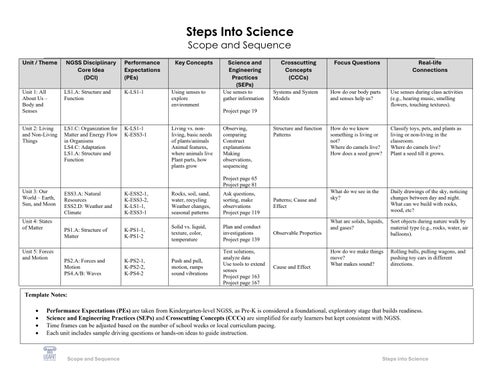
Unit / Theme
Unit 1: All About Us –Body and Senses
Unit 2: Living and Non-Living Things
LS1.A: Structure and Function K-LS1-1
Using senses to explore environment Use senses to gather information
Project page 19
LS1.C: Organization for Matter and Energy Flow in Organisms
LS4.C: Adaptation
LS1.A: Structure and Function K-LS1-1 K-ESS3-1
Living vs. nonliving, basic needs of plants/animals
Animal features, where animals live Plant parts, how plants grow
Systems and System Models How do our body parts and senses help us?
Unit 3: Our World – Earth, Sun, and Moon
Unit 4: States of Matter
ESS3.A: Natural Resources
ESS2.D: Weather and Climate K-ESS2-1, K-ESS3-2, K-LS1-1, K-ESS3-1
PS1.A: Structure of Matter
K-PS1-1, K-PS1-2
Rocks, soil, sand, water, recycling
Weather changes, seasonal patterns
Solid vs. liquid, texture, color, temperature
Unit 5: Forces and Motion
PS2.A: Forces and Motion
PS4.A/B: Waves K-PS2-1, K-PS2-2, K-PS4-2
Push and pull, motion, ramps sound vibrations
Observing, comparing Construct explanations Making observations, sequencing
Project page 65 Project page 81
Ask questions, sorting, make observations Project page 119
Plan and conduct investigations Project page 139
Test solutions, analyze data Use tools to extend senses
Structure and function Patterns How do we know something is living or not?
Where do camels live? How does a seed grow?
Use senses during class activities (e.g., hearing music, smelling flowers, touching textures).
Classify toys, pets, and plants as living or non-living in the classroom. Where do camels live? Plant a seed till it grows.
Patterns; Cause and Effect
What do we see in the sky?
Daily drawings of the sky, noticing changes between day and night. What can we build with rocks, wood, etc?
What are solids, liquids, and gases?
Observable Properties
Project page 163 Project page 167 Cause and Effect
How do we make things move?
What makes sound?
Sort objects during nature walk by material type (e.g., rocks, water, air balloons).
Rolling balls, pulling wagons, and pushing toy cars in different directions.
Template Notes:
• Performance Expectations (PEs) are taken from Kindergarten-level NGSS, as Pre-K is considered a foundational, exploratory stage that builds readiness.
• Science and Engineering Practices (SEPs) and Crosscutting Concepts (CCCs) are simplified for early learners but kept consistent with NGSS.
• Time frames can be adjusted based on the number of school weeks or local curriculum pacing.
• Each unit includes sample driving questions or hands-on ideas to guide instruction.

Grade/Section: KG1
Subject: Science Unit: All About Us Lesson: Body and Senses Introduction (Pages 4–11)
Date: Day:
Standards:
NGSS/CCSS Standards
• LS1.A: Structure and Function
• K-LS1-1: Use observations to describe patterns of what plants and animals (including humans) need to survive.
• PK.AL.1 – Actively engages in play as a means of exploration and learning
• PK.AL.4 – Exhibits curiosity, interest, and willingness to learn new things and have new experiences
• PK.AL.5 – Demonstrates persistence
• PK.PDH.1 – Uses senses to assist and guide learning
• PK.SEL.4 – Develops positive relationships with their peers
• PK.SEL.5 – Demonstrates pro-social problem-solving skills in social interactions
• PK.AC.2 – Demonstrates they are building background knowledge
• PK.ELAL.19 (PKSL.1) – Participates in collaborative conversations with diverse peers and adults in small and large groups and during play
Success Criteria:
I can name the five senses.
I can match senses with the correct body parts.
I can describe what I see, hear, touch, smell, or taste.
UGARIT PUBLISHING
Learning Objectives:
Identify major body parts.
Recognize the five senses.
Understand the role of senses in daily life.
Term: Week: 1
Picture and word matching tasks.
Group discussions and Q&A.
Mini senses drawing book.
What if you could not see or hear?
Which sense do you think is most helpful and why?
Can you use more than one sense at the same time?
Science: Explore body parts and senses through real-life examples (Pages 4–7).
Technology: Use a sensory soundboard or smartboard to identify and label sounds.
Engineering: Construct a tactile 'mystery box' using materials like cotton, bell, lemon, sponge.
Math: Count and categorize items used for each sense.
Book Task References: Page 5 (draw half-body), Pages 6–7 (sense-body part match), Page 8 (identify sense per activity).
Language: Vocabulary building body and senses (eye ,ear, nose ,tongue ,fingers ,see, hear, taste, touch, smell)
Art: Draw and label body, senses and objects.
Music: Sound guessing game.
Identify, observe, investigate,label, draw, match, classify, predict, apply, recall
Students will take part in a sensory walk around the classroom, school garden, or playground to observe sounds, textures, colors, and smells using their five senses. Teachers will provide real-life materials such as cotton, sandpaper, lemon, bell, and sponge to help children experience each sense through handson exploration.
During group activities, students will describe everyday classroom items (e.g., pencil, carpet, tissue, window) using appropriate sensory vocabulary.
At home, children will be asked to identify 3 items they can see, hear, and touch, and bring back drawings or simple descriptions to share with peers.
Teachers will encourage students to use their senses to describe their daily routines (e.g., brushing teeth, eating snacks, washing hands) to make learning meaningful and connected to real-life experiences.
Begin with a “Mystery Box” sensory game. Inside the box, place familiar objects such as a cotton ball, bell, sponge, orange peel, and sandpaper. Blindfold or ask students to close their eyes and use only one sense (e.g., touch or smell) to guess what’s
UGARIT
Create five sensory stations around the classroom, each representing one of the five senses:
Touch: Materials like sandpaper, cotton, and fabric
Bring students together for whole-class instruction using a sensory chart.
Introducing vocabulary: see, hear, touch, taste, smell
Label a body outline with picture cues for eyes, ears, nose, tongue, and hands
Why do we need to protect our senses?
How do our senses help us stay safe?
Parents are encouraged to take photos or short videos of their child using a sense at home and send it to the class teacher. These will be displayed during review.
Encourage students to connect their learning to their daily routines and environments.
Ask:
“What do you use to smell your lunch?”
“Can you touch your teddy bear at home? What does it feel like?”
Allow students to draw or
Conclude with an exit ticket activity:
Each child names or draws one thing they experienced using a sense.
Teachers conduct oral check-ins or pictorial reflections:
“What was your favorite sense today?”
“Why did you like using your nose/eyes?”
Use a simple rubric or checklist to assess:
Emerging Learners & English Language Learners (ELLs): Use real objects instead of pictures. Visual aids and gestures help reinforce vocabulary. Allow use of native language support where possible.
inside the box.
Use guiding questions:
"What does it feel like?"
"Is it soft, rough, or smooth?"
This activity builds curiosity and primes learners for sensory exploration.
Sight: Colorful picture cards and magnifying glasses
Hearing: Shakers, bells, and crinkly paper
Smell: Jars with cinnamon, coffee, or citrus
Taste (optional): Crackers, lemon slices (only if permitted and with allergy checks)
Students will rotate in small groups, explore each station, and share what they experience using full sentences.
Teachers observe and prompt students to use key vocabulary like “soft,” “sweet,” “loud,” and “colorful.”
Use real-life photos to discuss how each sense works
Ask guiding questions:
“Which body part do we use to smell?”
“What can you see in this picture?”
describe one object from home and match it to a sense.
Incorporate simple sentence starters like “I use my ___ to ___.”
Can name 5 senses
Can match sense to body part
Can describe an experience using a sense
UGARIT PUBLISHING
Students with Special Education Needs (SEN): Offer sensory objects with larger textures or sounds. Use fewer stations with 1:1 support and repetition of key ideas.
Advanced Learners: Invite to lead a sensory station or create a short oral presentation describing multiple senses.
Kinesthetic Learners: Movement-based matching games and role-play.
Visual Learners: Diagrams, labeled charts, and picture cards.
Auditory Learners: Songs (e.g., “Five Senses Song”), sound matching activities, and verbal discussions.
Ex 1 A: Learn body parts, page 4.
Ex 1 B: Find a partner and take turns. Point to one of their body parts, and have them say its name, page 5.
Ex 2 A, 2B: Match senses with body parts using visuals from learn book on page 6.
Ex 2 D: Play the guessing game: Act out an action and have your classmates guess which sense is being used from learn book on page 8.
Ex 2 F: Match objects to the sense used from learn book on page 10.
Pair Work: One student draw the body part and other student draw the related objects.
Day5
Project Work: Conduct project activity from learn book on Page 11. Draw a sense and group with others who selected the same sense.”
Finish the drawing, then match each word to the correct body part
Learn body part, Ex A and B pages 4-5
Read each sentence out loud, then act it out. Ex 2 C, page 7. Learn about our senses”, Ex A and B, page 6
Draw something you can safely touch at home. Learn book on page 9, Ex 2 E.
Use a worksheet to match each object (flower, bell, and cracker) to the correct sense.
Work in groups to complete the Body and Senses Poster. Each group presents one sense with matching real-life examples.”