Introduction
What is Steps Into English?
A Clear, Systematic Path to Early Reading Success.
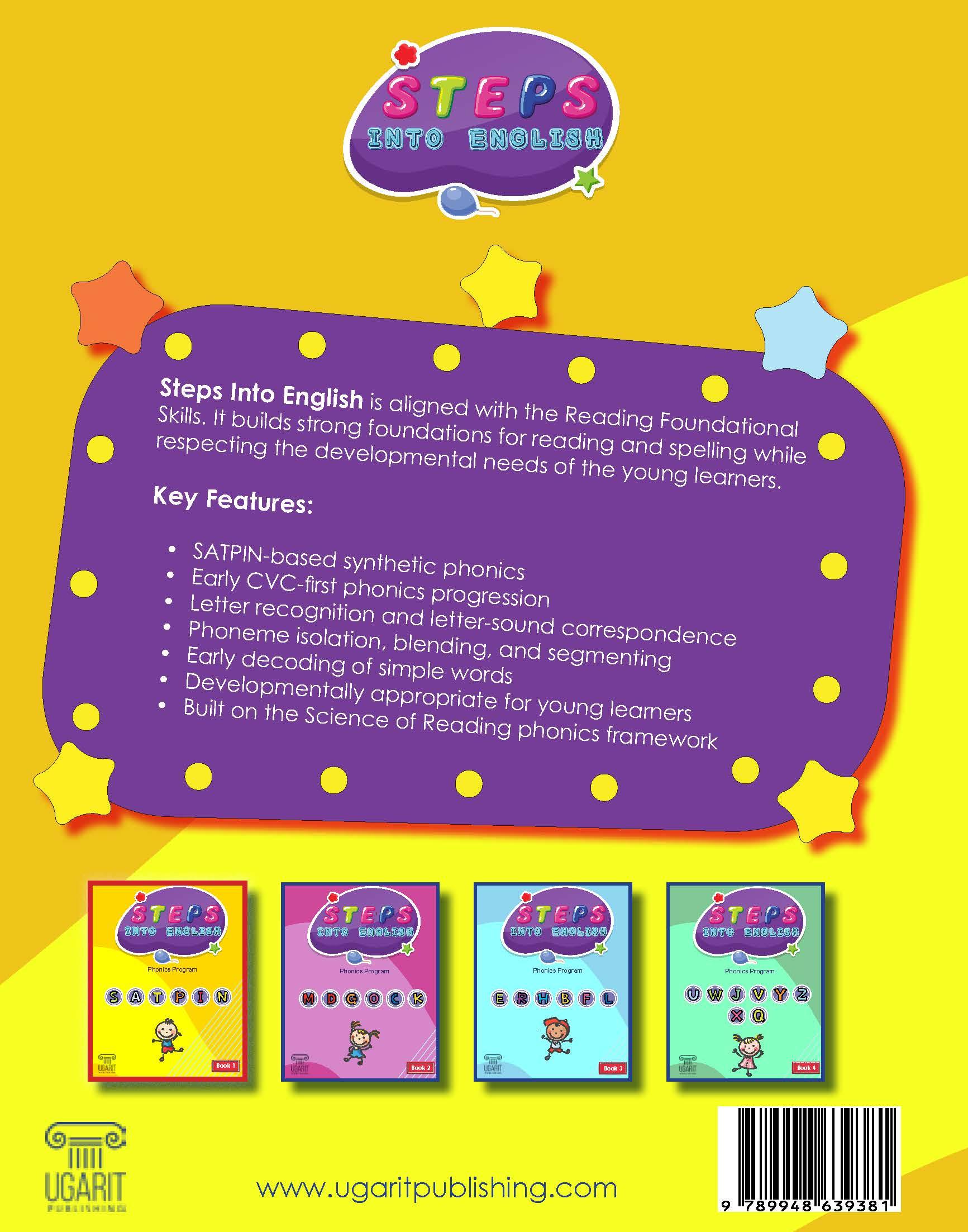
Our phonics program is built on a systematic synthetic phonics approach that reflects best practices in early literacy instruction and aligns fully with the Reading Foundational Skills. It is designed specifically for 4-year-old learners, and prioritizes oral language, phonemic awareness, and early decoding confidence.
Our phonics program is designed to:
• Build strong foundations for reading and spelling
• Support teachers with clarity and consistency
• Respect the developmental needs of young learners
• Prepare children confidently for Kindergarten and beyond
What Makes It Different
• Sounds are introduced for reading success, not alphabet order
• Children blend meaningful words from the start
• Instruction is short, focused, and play-based
• Complex and low-frequency letters are introduced only when children are ready
This approach reflects international best practice in early literacy while remaining fully adaptable to modern classrooms.
What is Synthetic Approach?
Synthetic phonics is a method of teaching reading where children learn individual sounds (phonemes) first and are then taught to blend those sounds together to read words.
In short:
Sound → Blend → Read
How Synthetic Phonics Works
1. Teach individual sounds
Children learn the sounds of letters (e.g., /s/, /a/, /t/), not letter names first.
2. Blend sounds together
Children are taught to synthesize sounds: /s/ + /a/ + /t/ → sat
3. Read real words early
As soon as a few sounds are known, children begin reading simple CVC words (cat, pin, dog).
4. Build complexity gradually
More sounds are added over time, then:
• Longer words
• Digraphs (sh, ch)
• Later spelling patterns
Scope and Sequence.
Book Set Phonimic Focus Objectives Outcomes Alignment
Book 1 s, a, t p, i, n
• Initial Consonants
• Short vowels /a/, /i/
Book 2 m, o, d, c, k, g
Book 3 e, h, r, f, b, l
• Nasal stop sounds
• short vowel /o/
• Recognize and name letters
• Produce letter sound
• Blend and segment
• CVC words
• Expand letter–sound correspondences
• • Blend and segment CVC words with new sounds
• Airflow sounds; liquid sounds;
• short vowel /e/
Book 4 u, w, j, v y, z, x, q
• Short vowel /u/; less frequent consonants
• Consonant variants; complex letter–sound rules
• Discriminate vowel sounds
• Identify medial vowel sounds
• Recognize additional consonant sounds
• Isolate and pronounce short vowel sounds
• Recognize and produce less common consonants
• Apply advanced letter–sound rules
• Recognize complete alphabet
• Orally blends sounds to form sat, pin
• Identifies initial, medial, final sounds
• Reads and builds dog, cat, mop
• Segments phonemes orally
• Identifies /e/ in the middle of words
• Blends sounds to form bed, hen
• Identifies /u/ in CVC words
• Produces correct sounds for w, j, v
• Identifies /ks/ for x
• Recognizes q is used with u
1. Trace the lines.
Tracing
0 0 0
2. Trace and color.
Book

Learning Objectives
In this book, the students will
- Recognize s, a, t, p, i, and n sounds and letters (lowercase)
- Produce correct phonemes for each letter
- Blend and read short CVC words and recognize receptive words
- Write letters correctly
- Develop creativity through drawing and craft-making activities
- Develop the four skills as well as DOK Skills
Receptive Words:
s: sun, snail, snake
a: apple, ant, alligator
t: tent, tree, tiger
p: pen, pencil, paper
i: insect, igloo, ink
n: nut, net, nest
Framework Alignment
RF.K.1.d
Blends and CVC Words: in, on, an, it, at sat, sit, sap, spa, sip, tip, pit, tap, tin, tan pin, pan, pet, pat, nap, nip, in
Recognize and name all upper- and lowercase letters of the alphabet.
- Children identify and name SATPIN letters visually and auditorily.
RF.K.2.b
Count, pronounce, blend, and segment syllables in spoken words.
- Students orally blend sounds to make simple CVC words.
RF.K.2.c
Blend and segment onsets and rimes of single-syllable spoken words.
RF.K.2.d
Isolate and pronounce the initial, medial vowel, and final sounds.
- Continuous sounds (/s/, /n/) and short vowels (/a/, /i/) make this accessible.
RF.K.3.a
Demonstrate basic knowledge of letter–sound correspondence.

1. Look and learn. Repeat the sound
2. Say the word for each picture, then circle the letter s.

snake sun snail
3. Circle the stars that have the letter s in them. Make a hissing sound as you circle each one. 2 S 1 S O S
Trace and write.
5. Listen, then write s under the things that begin with the /s/ sound. Make a hissing sound as you write s.

6. Color the things that begin with the /s/ sound.
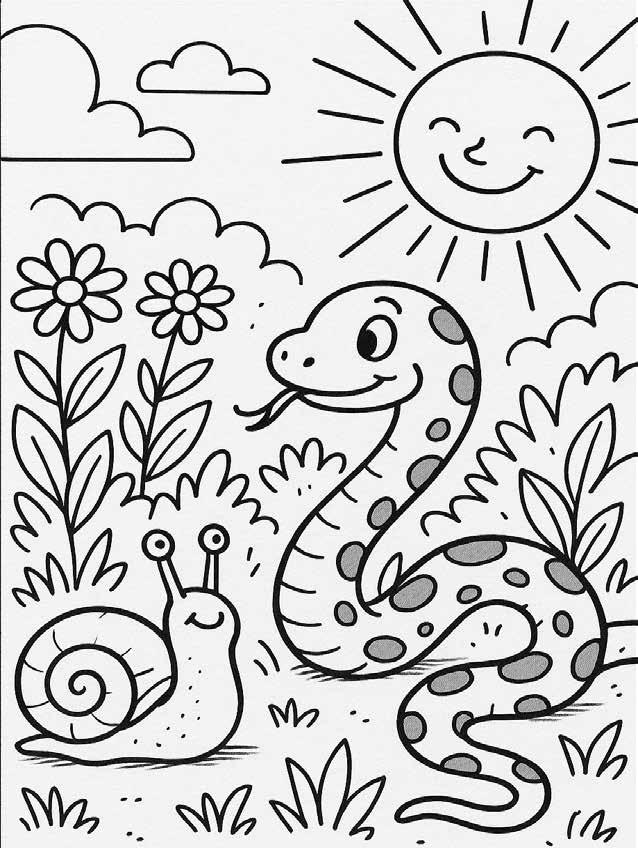
7. Draw something that looks like an s. Then tell your classmate about it.
Use playdough or a shoelace to make the letter s.
1. Look and learn. Repeat the sound . a
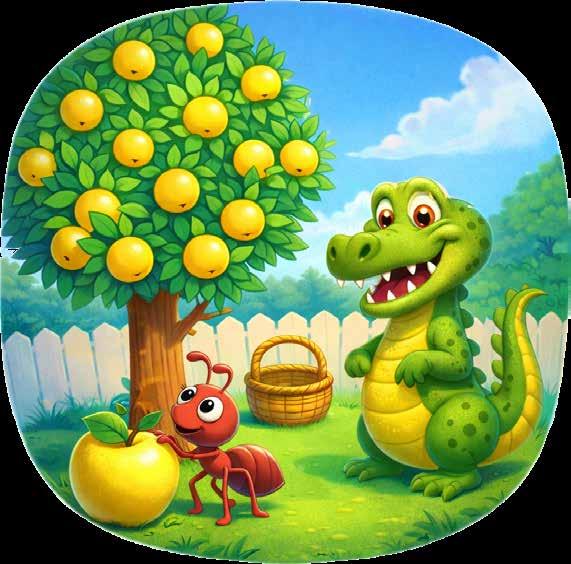
2. Say the word for each picture, then circle the letter a.
alligator apple ant
3. Draw a line from each apple to the correct bowl. Say either /aaaa/ or /ssss/ as you match.
Trace and write.
5. Draw a line to match each sound with the picture that begins with it. Say either /aaa/ or /sss/ as you match.
6. Trace and match, then color the picture.
7. Make a craft of the letter a, then paste it here.
1. Look and learn. Repeat the sound . t
2. Say the word for each picture, then circle the letter t.

tiger tent tree
3. Find and circle the letter t. Say /t/ as you circle each one.
Trace and write.
5. Listen, then color the pictures that begin with the / t / sound in each pair.
6. Say the word for each picture. Then trace the sound it begins with. t s a t s a t s a
t s a t s a t s a t s a t s a t s a
7. Draw something that begins with the /t/ sound. Then tell your classmate about it.
8. I can read...

Ugarit Publishing
UK Office
71-75 Shelton Street
Covent Garden
London WC2H 9JQ
United Kingdom
UAE Office
Sharjah Publishing City Business Centre - H 07
Sharjah United Arab Emirates
Media License Number: 0144582
Trading License Number: 300460
Media File Number: MF-02- 2446769
www.ugaritpublishing.com info@ugaritpublishing.com
Steps Into English - Book 1
The moral rights of the author have been reserved
First published in 2026
Copyright © 2026 Ugarit Publishing
ISBN: 978-9948-639-38-1
All rights reserved. No part of this publication may be reproduced, stored in a retrieval system, or transmitted, in any form or by any means, electronic, mechanical, photocopying or otherwise without the prior written permission from Ugarit Publishing
This work must not be circulated in any other form. Under no circumstances may any part of this book be photocopied for sale
Printed in the United Arab Emirates