SCHOOL:
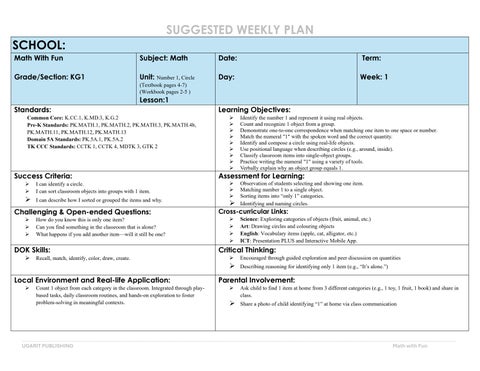
Math With Fun
Grade/Section: KG1
Math With Fun
Grade/Section: KG1
Subject: Math Unit: Number 1, Circle (Textbook pages 4-7) (Workbook pages 2-5 )
Lesson:1
Standards:
Common Core: K.CC.1, K.MD.3, K.G.2
Pre-K Standards: PK.MATH.1, PK.MATH.2, PK.MATH.3, PK.MATH.4b, PK.MATH.11, PK.MATH.12, PK.MATH.13
Domain 5A Standards: PK.5A.1, PK.5A.2
TK CCC Standards: CCTK 1, CCTK 4, MDTK 3, GTK 2
I can identify a circle.
I can sort classroom objects into groups with 1 item.
I can describe how I sorted or grouped the items and why.
Challenging & Open-ended Questions:
How do you know this is only one item?
Can you find something in the classroom that is alone?
What happens if you add another item will it still be one?
DOK Skills:
Recall, match, identify, color, draw, create
Count 1 object from each category in the classroom. Integrated through playbased tasks, daily classroom routines, and hands-on exploration to foster problem-solving in meaningful contexts.
Date: Day:
Term: Week: 1
Identify the number 1 and represent it using real objects.
Count and recognize 1 object from a group.
Demonstrate one-to-one correspondence when matching one item to one space or number.
Match the numeral "1" with the spoken word and the correct quantity.
Identify and compose a circle using real-life objects.
Use positional language when describing circles (e.g., around, inside).
Classify classroom items into single-object groups.
Practice writing the numeral "1" using a variety of tools.
Verbally explain why an object group equals 1.
Observation of students selecting and showing one item.
Matching number 1 to a single object.
Sorting items into “only 1” categories.
Identifying and naming circles.
Science: Exploring categories of objects (fruit, animal, etc.)
Art: Drawing circles and colouring objects
English: Vocabulary items (apple, cat, alligator, etc.)
ICT: Presentation PLUS and Interactive Mobile App.
Encouraged through guided exploration and peer discussion on quantities
Describing reasoning for identifying only 1 item (e.g., “It’s alone.”)
Ask child to find 1 item at home from 3 different categories (e.g., 1 toy, 1 fruit, 1 book) and share in class.
Share a photo of child identifying “1” at home via class communication
Use visual aids (e.g., flashcards, toys, real objects like fruit or classroom items).
Play a simple song or counting rhyme.
Ask thought-provoking questions: What do you see? Can you find just 1 thing?
Show a mystery bag with one item and ask students to guess.
Allow students to manipulate objects (buttons, blocks, pompoms) and group them by 1.
Set up stations: Find 1 red item, Pick 1 fruit.
Pair work: Give your friend 1 object. Let them investigate with minimal instruction to develop curiosity.
Ex 1, page 4, coursebook
Trace and Copy number
Circle Hunt – Find and identify circular objects in the classroom.
Worksheet: Circle the group that has only 1 item.
Ex 1, page 2, workbook
Color the number
Use a whiteboard or chart to write the number "1" and show its symbol.
Model how to count only 1 object from a set.
Discuss shapes: “This is a circle because it’s round.”
Use storytelling or puppets to explain one-to-one correspondence.
Ex 2,3 page 5, coursebook
Find and Identify number
One-to-One Match – Match the number “1” to a single object using cards.
Cut and paste: Match numeral 1 to a picture with one object.
Ex 2, page 3, workbook Trace and write
Encourage students to sort a variety of items into “only 1” groups.
Connect math to a real-life classroom task: “Place 1 pencil in each box.”
Play a game: “Circle Hunt” –find and mark all circles around the class.
Integrate art: Draw 1 item or make a craft circle.
Ex 4, 5 page 6, coursebook
Trace the circle
Identify the circle
Mystery Bag – Pull 1 object at a time and count aloud.
Home task: Bring a photo of 1 item found at home.
Ex 3, page 4, workbook Color the ducks
Ask guiding questions: How do you know it is only one?
Students show 1 object from a basket.
Conduct a quick quiz or worksheet: Circle only 1 item from a group.
Oral reflection: What did we learn today?
For support: Use larger objects, more visuals, repeated modeling, and peer buddying.
For extension: Ask students to group and explain why 1 is different from 2 or 3.
Use visual tools (counters, sand tracing, number mats) based on learner needs.
Ex 6,7 page 7 coursebook
Draw object in circle shape
Make and paste number
Group Sorting – Create groups with only 1 item.
Art: Draw 1 circle and 1 object inside it.
Ex 4, page 5, workbook Find and color the circle
Draw and Tell – Draw one object and explain why it’s only one.
Oral: Name one item from each classroom category (1 book, 1 toy, etc.)
Lesson Vocabulary Standards Counting & Cardinality
Lesson 1 Apple, alligator, balloon, tomato, pan, dish, pizza, pear, cat, cherry, butterfly
K.CC.1, K.MD.3, K.G.2
PK.5A.1
PK.5A.2
CCTK 1, CCTK 4, MDTK 3, GTK 2
Identify number 1 and count 1 object Pg#4-5
Identify sets with 1 Classify classroom items into 1-object groups
Lesson 2 Ant, book, boy, ball, cow, hen, duck, bird, elephant, bike, car, barn, blue
K.CC.2, K.MD.3, K.G.2
PK.5A.1
PK.5A.2
CCTK 2, CCTK 4, OATK 1, GTK 2
Count forward to 2 and recognize 2
Add 1+1 to make 2 Compare 1 vs 2 items
Group classroom objects in pairs
Identify and compose a circle Count 1 object from each category in the classroom. Integrated through play-based tasks, daily classroom routines, and hands-on exploration to foster problemsolving in meaningful contexts.
Compose a circle Group items in twos (e.g., shoes, eyes). Integrated through playbased tasks, daily classroom routines, and hands-on exploration to foster problemsolving in meaningful contexts.
Explain how you know it's just one item (e.g., 'I only see 1 cat'). Encouraged through open-ended questions, peer discussions, and guided reflections during free play and teacherfacilitated experiences.
Explain why two objects form a pair (e.g., 'My eyes are two, left and right'). Encouraged through open-ended questions, peer discussions, and guided reflections during free play and teacherfacilitated experiences.
Lesson 3 Girl, camel, bee, boat, nachos, cheese, fish
K.CC.3
K.G.3
PK.5A.1
PK.5A.2
CCTK 3, CCTK 5, CCTK 6, GTK 2
Count and write number 3 _
Identify which group has 'more' or 'less' _ Compose and identify triangle Use triangle toys or signs around the school. Integrated through play-based tasks, daily classroom routines, and hands-on exploration to
Use positional words: 'I found 3 triangles in the play area'. Encouraged through open-ended questions, peer discussions, and guided reflections during free play and teacherfacilitated experiences.

Lesson 4 Car, lamb, horse, goat, duck, duckling
K.CC.4
K.OA.2
K.G.4
PK.5A.1
PK.5A.2
CCTK 4, OATK 1, CCTK 5, MDTK 3, GTK 2
Recognize number 4 and count sets of 4 Compose 4 using objects Write numbers for groups of 4
Lesson 5 Train, crayon, egg, marker,
K.CC.5
K.OA.3
K.G.2
PK.5A.1
PK.5A.2
PK.5A.3
CCTK 4, CCTK 5, OATK 3, GTK 2
Count and compare up to 5 Compose 5 using smaller groups
Compare two sets to find 'greater'
Sort animals by 4legged type
Compose a square
foster problemsolving in meaningful contexts.
Make square using 4 sticks or straws. Integrated through playbased tasks, daily classroom routines, and hands-on exploration to foster problemsolving in meaningful contexts.
Compose a circle
Count crayons, group by colors (up to 5). Integrated through play-based tasks, daily classroom routines, and hands-on exploration to foster problemsolving in meaningful contexts.
Explain square has 4 equal sides, relate to classroom tile. Encouraged through open-ended questions, peer discussions, and guided reflections during free play and teacherfacilitated experiences.
Lesson 6 Door, key, star, lock, sock, leaf, rope, moon, foil, spoon, dice, coat
K.CC.6
K.OA.1
K.MD.3
K.G.4
PK.5A.1
PK.5A.2
PK.5A.3
CCTK 6, OATK 1, MDTK 3, GTK 2
Compare groups using more/less
Compose 6 using addition
Sort objects by use (kitchen, clothes)
Compose rectangle
Group socks or blocks to show 6 total. Integrated through playbased tasks, daily classroom routines, and hands-on exploration to foster problemsolving in
Justify which group is greater using number words. Encouraged through open-ended questions, peer discussions, and guided reflections during free play and teacherfacilitated experiences.
Explain different ways to make 6 (3+3, 4+2). Encouraged through open-ended questions, peer discussions, and guided reflections during free play and teacherfacilitated experiences.