SCHOOL:
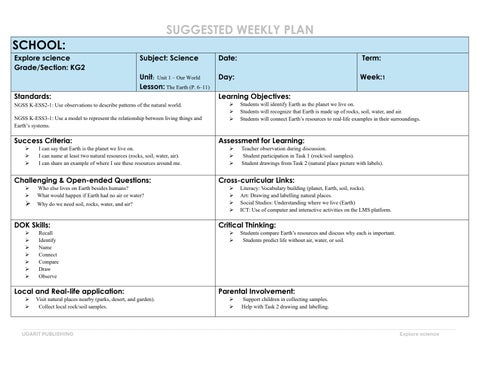
Explore science
Grade/Section: KG2
Explore science
Grade/Section: KG2
Subject: Science Unit: Unit 1 – Our World
Lesson: The Earth (P. 6–11)
Standards:
NGSS K-ESS2-1: Use observations to describe patterns of the natural world.
NGSS K-ESS3-1: Use a model to represent the relationship between living things and Earth’s systems.
Success Criteria:
I can say that Earth is the planet we live on.
I can name at least two natural resources (rocks, soil, water, air).
I can share an example of where I see these resources around me.
Challenging & Open-ended Questions:
Who else lives on Earth besides humans?
What would happen if Earth had no air or water?
Why do we need soil, rocks, water, and air?
Recall
Identify
Name
Connect
Compare
Draw
Observe
Visit natural places nearby (parks, desert, and garden).
Collect local rock/soil samples.
UGARIT PUBLISHING
Date: Day: Term: Week:1
Learning Objectives:
Students will identify Earth as the planet we live on.
Students will recognize that Earth is made up of rocks, soil, water, and air.
Students will connect Earth’s resources to real-life examples in their surroundings.
Teacher observation during discussion.
Student participation in Task 1 (rock/soil samples).
Student drawings from Task 2 (natural place picture with labels).
Literacy: Vocabulary building (planet, Earth, soil, rocks).
Art: Drawing and labelling natural places.
Social Studies: Understanding where we live (Earth)
ICT: Use of computer and interactive activities on the LMS platform.
Students compare Earth’s resources and discuss why each is important.
Students predict life without air, water, or soil.
Support children in collecting samples.
Help with Task 2 drawing and labelling.
Explore science
10 mins
Show the picture of Earth (P. 6).
Ask: “Who else lives on planet Earth?”
Allow students to answer freely (people, animals, plants).
10 mins
Display page 8 (rocks, soil, water, air).
Pass around simple items (stone, small bottle of water, soil in a cup).
Ask students to observe and touch the materials
15 minutes
Say clearly: “The Earth is made up of rocks, soil, water, and air.”
Point to each picture, repeat words aloud with the class. Write key words on the board. Reinforce by asking students to name examples (soil in garden, water in bottle).
10 minutes
Task 1: Students bring soil/rock samples to show. Discuss as a group.
Task 2: Ask students to draw a nearby natural place. Guide them to label (rocks, soil, water, air).
5 minutes
Oral questioning: “Name 2 things Earth is made of.”
Check drawings: confirm labels are correct.
Praise effort and correct gently if needed.
Below Level: Provide picture flashcards (rocks, soil, water, and air). Allow them to match word to image. Teacher prompts answers. On Level: Students identify and name resources in the pictures and complete Task 2 drawing with simple labels. Above Level: Ask students to explain why each resource is important (e.g., “We need water to drink”). Encourage extended sentences. Special Educational Needs: Use real objects (stone, water bottle, soil sample). Provide one-to-one support or peer buddy. Allow verbal answers instead of written.
UGARIT PUBLISHING
Explore science
"Who Lives Here?"
Students will name different living things (animals, plants, and people) and place their images on a large cutout of Earth. This activity is designed to help them visually understand that many different creatures live on our planet.
"Treasure Hunt"
This activity involves a supervised outdoor walk where students collect samples of rocks and soil to observe their different textures and colors.
Ex 1, Task 1, page 8,9, Explore Science Book A.
"My Neighborhood"
Students will draw a picture of their house or a nearby park. They will need to include themselves and one other living thing, such as a pet or a tree, to connect the big concept of a "planet" to their personal lives.
"Home Nature Walk"
For this assignment, students go on a nature walk with their family and draw a picture of the natural place they visit. They must then label the rocks, soil, water, and air they find in their drawing.
Day 3
"Sensory Station"
Students rotate through four stations, each representing one of the components. They touch rocks and soil, play with water, and feel the air from a fan or balloon to explore each element with their senses.
Ex 1, Task 2, page ,9, Explore Science Book A.
"Earth in a Jar"
Students create a small, contained ecosystem by filling a clear jar with soil, small rocks, and water, leaving space at the top for air. This helps them visualize how the four components exist together in nature.
Day 4
"Living on a Farm" Act-Out:
Students will role-play the people, animals, and plants from the farm picture to help them physically engage with the topic.
Ex 1, Task 3, page 10, Explore Science Book A.
Day5
"Our Class Community" Circle Time: The teacher will lead a discussion to help students connect the lesson to their own lives by identifying people, animals, and plants in their classroom or at home.
Ex 1, Task 4, page 11, Explore Science Book A.
"Finish the Scene" Drawing:
Students will be given a worksheet with a simple drawing and asked to draw a person, an animal, and a plant in designated boxes, reinforcing their ability to classify living things.
"Life on Earth" Poster: Students will create a poster using drawings or cut-out pictures of people, animals, and plants to visually represent the main idea of the lesson on a larger scale.
Scope and Sequence
1. Earth & Space Science (ESS)
2. Life Science (LS)
3. Physical Science (PS)
4. Engineering Design (ETS)
Domain Performance Expectations (PEs)
Earth & Space Science (ESS)
- K-ESS2-1: Use observations to describe weather patterns.- K-ESS2-2: Living things depend on places to live.- K-ESS3-2: Solutions to reduce human impact on land, water, air.
Life Science (LS)
- K-LS1-1: All living things need food, water, and air.- K-ESS3-1: Plants and animals (including humans) change their environment.
Physical Science (PS)
Engineering Design (ETS)
- K-PS2-1/2: Pushes and pulls affect motion.K-PS3-1/2: Sunlight warms Earth’s surface; people can use sunlight to warm things.
- K-2-ETS1-1: Ask questions to define problems.- K-2-ETS1-2: Develop simple sketches or models.- K-2-ETS1-3: Test solutions.
Instructional Focus
- Observe and chart daily weather.- Explore seasons and patterns in nature.- Match animals/plants to habitats.- Discuss recycling, water saving, tree planting.
- Sort living vs. nonliving.- Identify needs of plants/animals.- Plant-growing experiments.Observe how organisms adapt or build (birds’ nests, beaver dams, houses).
- Explore pushes/pulls with ramps and balls.Compare gentle vs. strong pushes.- Shadow play and sunlight warming surfaces.- Experiment: ice melting in sun vs. shade.
- Pose simple problems: How can we build a bridge? Provide shade? Protect from rain?- Draw, build, and test solutions with blocks, paper, recycled materials.Encourage iteration (“improve your design”).
Suggested Time Frame
Quarter 1 (Sept–Nov)
Quarter 2 (Dec–Jan)
Quarter 3 (Feb–Mar)
Quarter 4 (Apr–Jun)

Scope and Sequence
• Q1 (Sept–Nov): Earth & Space → Weather, Seasons, Habitats, Human Impact
• Q2 (Dec–Jan): Life Science → Needs of Living Things, Living vs. Nonliving, Environmental Change
• Q3 (Feb–Mar): Physical Science → Motion, Pushes/Pulls, Sunlight Energy
• Q4 (Apr–Jun): Engineering Design → Problem Solving, Building, Testing
Month Domain & Focus Standards
September
Earth & Space Science (K-ESS2-1) Weather & Patterns
October
November
December
Earth & Space Science (K-ESS2-1, K-ESS2-2) Seasons & Habitats
Earth & Space Science (K-ESS3-2) Human Impact & Earth Care
Life Science (K-LS1-1) Living vs. Nonliving
January
February
March
April
Life Science (K-ESS3-1) How Organisms Change Their Environment
Physical Science (K-PS2-1, K-PS22) Pushes & Pulls, Motion
Physical Science (K-PS3-1, K-PS32) Sunlight & Energy
Engineering Design (K-2-ETS1-1) Ask Questions & Define Problems
Instructional Emphasis & Activities
- Observe and record daily weather with a class chart.- Discuss sunny, cloudy, rainy, windy days.- Make simple weather symbols (sun, clouds, rain).
- Compare fall vs. summer changes (clothes, trees).- Match animals to their habitats.- Create a “season wheel” craft.
- Discuss how humans affect Earth (trash, cutting trees).- Class recycling project.- Brainstorm ways to care for the planet.
- Sort living and nonliving objects.- Learn needs of plants and animals (food, water, air).- Start a simple plant-growing experiment.
- Explore how animals change surroundings (nests, dams).- Compare to how humans build homes or cities.- Role-play “be a bird building a nest.”
- Experiment with ramps, toy cars, and balls.- Compare strong vs. gentle pushes.Draw and explain how things move.
- Observe how sunlight warms surfaces.- Compare ice in sun vs. shade.- Do shadow play activities with flashlights.
- Pose a class problem: “How can we keep our playground cool?”- Brainstorm and draw solutions.
Month Domain & Focus Standards
May
June
Engineering Design (K-2-ETS1-2) Build & Model Solutions
Engineering Design (K-2-ETS1-3) Test & Improve Solutions + Review
Instructional Emphasis & Activities
- Build simple structures (bridges, shade, towers) with blocks, paper, or recycled items.- Test and share results.
- Try improving designs (make them stronger, taller, more useful).- End-of-year review: weather, living things, motion, sunlight.- Showcase projects in a mini science fair.