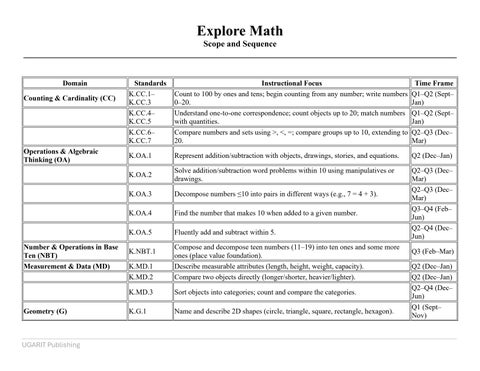
Counting & Cardinality (CC)
Explore Math
Scope and Sequence
Operations & Algebraic Thinking (OA)
K.CC.1–K.CC.3
Count to 100 by ones and tens; begin counting from any number; write numbers 0–20.
K.CC.4–K.CC.5 Understand one-to-one correspondence; count objects up to 20; match numbers with quantities.
K.CC.6–K.CC.7
Compare numbers and sets using >, <, =; compare groups up to 10, extending to 20.
Q1–Q2 (Sept–Jan)
Q1–Q2 (Sept–Jan)
Q2–Q3 (Dec–Mar)
K.OA.1 Represent addition/subtraction with objects, drawings, stories, and equations. Q2 (Dec–Jan)
K.OA.2
Number & Operations in Base Ten (NBT)
Measurement & Data (MD)
Solve addition/subtraction word problems within 10 using manipulatives or drawings.
K.OA.3 Decompose numbers ≤10 into pairs in different ways (e.g., 7 = 4 + 3).
K.OA.4 Find the number that makes 10 when added to a given number.
K.OA.5 Fluently add and subtract within 5.
K.NBT.1
K.MD.1
Geometry (G)
Q2–Q3 (Dec–Mar)
Q2–Q3 (Dec–Mar)
Q3–Q4 (Feb–Jun)
Q2–Q4 (Dec–Jun)
Compose and decompose teen numbers (11–19) into ten ones and some more ones (place value foundation). Q3 (Feb–Mar)
Describe measurable attributes (length, height, weight, capacity). Q2 (Dec–Jan)
K.MD.2 Compare two objects directly (longer/shorter, heavier/lighter). Q2 (Dec–Jan)
K.MD.3 Sort objects into categories; count and compare the categories.
K.G.1
Name and describe 2D shapes (circle, triangle, square, rectangle, hexagon).
Q2–Q4 (Dec–Jun)
Q1 (Sept–Nov)
Explore Math
Scope and Sequence
K.G.2 Correctly name shapes regardless of size/orientation.
K.G.3 Identify shapes in the environment.
K.G.4 Analyze/compare 2D and 3D shapes using informal language.
K.G.5 Model shapes using sticks, clay, or blocks.
Quarterly Emphasis
Q1–Q2 (Sept–Jan)
Q1–Q2 (Sept–Jan)
Q2–Q3 (Dec–Mar)
Q3–Q4 (Feb–Jun)
K.G.6 Compose larger shapes from smaller shapes (e.g., two triangles → rectangle). Q4 (Apr–Jun)
• Quarter 1 (Sept–Nov): Counting to 20, number writing 0–10, classifying objects, introduction to 2D shapes.
• Quarter 2 (Dec–Jan): Counting to 50, addition/subtraction within 5, measurement (length/weight), decomposing numbers ≤10.
• Quarter 3 (Feb–Mar): Counting to 100, teen numbers (place value foundation), addition/subtraction within 10, 3D shapes.
• Quarter 4 (Apr–Jun): Problem solving with addition/subtraction, composing/decomposing numbers, advanced shape composition, sorting and data classification.
Month
September
October
November
December
January
February
March
April
Explore Math
Scope and Sequence
Focus Domains & Skills
Counting & Cardinality (CC)- Count to 10- Recognize and write numbers 0–5One-to-one correspondence
Counting & Cardinality (CC)- Count to 20- Recognize and write numbers 6–10Compare sets (more, less, equal) Geometry (G)- Identify circles, squares, triangles
Counting & Cardinality (CC)- Count to 30- Write numbers 0–10 fluently Geometry (G)- Identify rectangles, hexagons- Compare shapes (same/different)
Operations & Algebraic Thinking (OA)- Addition as putting together- Subtraction as taking apart (within 5) Measurement & Data (MD)- Compare length and weight
Operations & Algebraic Thinking (OA)- Addition and subtraction word problems within 10- Fluency within 5Measurement & Data (MD)- Compare 2 objects directly
Operations & Algebraic Thinking (OA)- Decompose numbers ≤10 in multiple ways- Find the number that makes 10Geometry (G)- Identify 3D shapes (cube, cone, cylinder, sphere)
Counting & Cardinality (CC)- Count to 50- Write numbers 11–20Number & Operations in Base Ten (NBT)- Teen numbers as 10 + ones
Number & Operations in Base Ten (NBT)- Compose/decompose numbers 11–19Geometry (G)- Compose simple shapes into larger shapes Measurement & Data (MD)- Classify and sort objects
May
Counting & Cardinality (CC)- Count to 100 by 1s and 10s- Compare sets up to 20Operations & Algebraic Thinking (OA)- Problem solving with addition/subtraction to 10
Instructional Emphasis
- Number songs, finger plays, counting objectsTracing/writing numbers 0–5- Sorting objects into groups
- Counting with manipulatives up to 20- Introduce “greater/less than” with visuals- Shape hunts in classroom
- Practice number writing- Explore shape attributes (sides, corners)- Introduce teen numbers orally
- Addition stories with objects- Subtraction with pictures- Compare classroom items: heavier/lighter, longer/shorter
- Hands-on problem solving- Math talk: “How do you know?”- Use nonstandard units (cubes, paperclips)
- Ten-frames and counters- Making 10 with manipulatives- Build and compare 3D shapes
- Use base-ten blocks and drawings- Decompose teen numbers into tens and ones- Practice skipcounting by 10s
- Model 18 = 10 + 8- Combine 2D shapes to form new ones- Sorting by color, shape, size
- 100th Day activities- Fluency games with +/–facts- Compare sets and use ≥, ≤ symbols informally
Month
June
Explore Math
Scope and Sequence
Focus Domains & Skills Instructional
Review & Mastery- Fluency within 5- Addition/subtraction within 10- Teen numbers (place value)- Geometry and Data review
- Math centers for review- Real-world problem solving- Prepare for Grade 1 expectations
SCHOOL:
Explore Math
Grade/Section: KG2
SUGGESTED WEEKLY PLAN
Subject: Math Unit: Numbers 0–5
Lesson: Count and Write 1–3 (pp. 2–9)
Standards:
K.CC.1
– Count to 100 by ones and tens.
K.CC.3 – Write numbers from 0 to 20. Represent a number of objects with a written numeral.
K.CC.4 – Understand the relationship between numbers and quantities; connect counting to cardinality.
Success Criteria:
I can count objects in sets of 1–3.
I can read and write numerals 1–3.
I can connect numbers to real objects.
Challenging & Open-ended Questions:
How do you know this group shows 2?
Can you show another way to make 3?
What happens if you add one more to 2?
DOK Skills:
Identify
Count
Match
Race
Write
Explain
Represent
Local and Real-life application:
Count school/classroom objects (1 board, 2 pencils, 3 chairs).
Apply numbers during routines (lining up, snack distribution).
Use daily items to form sets of 1, 2, 3.
UGARIT
Date: Day:
Learning Objectives:
Students will identify, recognize, and count sets of 1–3.
Students will read, trace, and write numbers 1–3.
Students will match numeral symbols with sets of objects.
Term: Week: 1
Assessment for Learning:
Observation of counting and tracing during tasks.
Oral questioning to check understanding.
Workbook practice pp. 2–9.
Cross-curricular Links:
Art: Creativity & Math task (draw fruits – p. 5).
Science: Classify and count living things (birds, insects – pp. 3, 5).
Language: Use of number words in oral practice.
Critical Thinking:
Compare groups of 1, 2, and 3 to explain differences.
Represent numbers with multiple methods (draw, say, show with fingers).
Justify reasoning when showing “how many.”
Parental Involvement:
Practice writing 1–3 in sand, rice trays, or on paper.
Count household items in sets of 1–3 (spoons, toys, shoes).
Draw sets of objects at home and label with numerals.
Present concrete objects: 1 apple, 2 pencils, 3 blocks.
Ask: “How many are here? Show me on your fingers.”
Introduce number rhyme (1–3).
Purpose: stimulate curiosity and activate prior knowledge.
Guide students to pp. 2–3.
Task: identify, count, and color cars, fish, butterflies, and insects.
Partner work: collect classroom objects to form sets of 1–3.
Purpose: hands-on practice with real and visual sets.
SUGGESTED WEEKLY PLAN
Explicit teaching of numerals 1–3.
Teacher models tracing on board → students repeat in air, then on pp. 6–7.
Guided questioning: “Which set shows 2? How do you know?”
Purpose: clarify concepts and correct misconceptions.
Workbook pp. 4–5: balloons, kites, chickens → extend counting.
Art task (p. 5): draw fruits (3 favorites, 2 less, 1 least).
Real-life link: students find items in classroom that match 1, 2, 3. Purpose: extend knowledge through integration and creativity.
Daily Lesson Distribution
Day 1 Day 2 Day 3
Identify and present.
Ex 1,2, page 2,3, Explore Math, Book A
Identify and color.
Ex 4,5, page 4, Explore Math, Book A
Count, show and trace.
Ex 1,2,3 page 6,7 Explore Math, Book A
5 minutes
Workbook pp. 8–9: independent practice (bananas, apples, balls).
Quick oral assessment: flashcards for 1–3.
Teacher checklist: accuracy in counting, tracing, writing. Purpose: confirm mastery of lesson objectives.
Support: Use manipulatives (blocks, counters) with guided tracing. Provide repeated oral counting practice.
Core: Independent completion of workbook pp. 2–9.
Extension: Create simple addition sentences (1 + 2 = 3). Design own “count and draw” task using classroom items
Day 4
Count, show and write.
Ex 5,6,7, page 8, Explore Math, Book A
Day5
Match: Distribute small objects. Ask students to create a set that matches a number card (e.g., "Make a group of 3 blocks").
Trace: Give students tracing sheets. Use fingers first, then crayons or markers, to trace the numerals 1, 2, and 3. Assignment
Identify and color.
Ex 3, page 3, Explore Math, Book A Draw your favorite dish.
Ex Art, page 5, Explore Math, Book A
Count show and trace.
Ex 4, page 7, Explore Math, Book A
Count and color.
Ex 8,9,10, page 9, Explore Math, Book A
Worksheet: Students count the objects and draw a line to match the set to the correct numeral (1, 2, or 3) on the right side of the page.