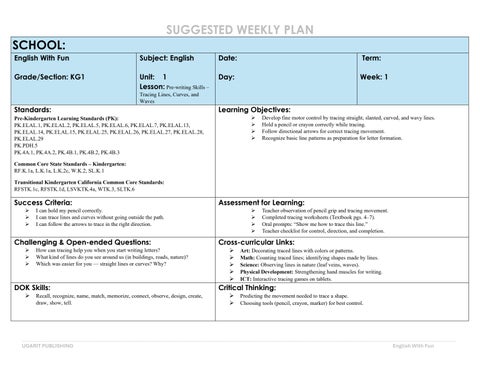
Teacher checklist for control, direction, and completion.
Cross-curricular Links:
Art: Decorating traced lines with colors or patterns.
Math: Counting traced lines; identifying shapes made by lines.
Science: Observing lines in nature (leaf veins, waves).
Physical Development: Strengthening hand muscles for writing.
ICT: Interactive tracing games on tablets.
Critical Thinking:
Predicting the movement needed to trace a shape.
Choosing tools (pencil, crayon, marker) for best control.
SUGGESTED WEEKLY PLAN
Local and Real-life application:
Identify lines and curves on classroom objects (whiteboard edges, round clock).
Trace patterns in sand or salt trays at home.
Begin with a friendly greeting and short discussion: “Before we write letters, our hands need practice making lines. Let’s see how many lines we can find!”
Show large visual cards or posters with straight, slanted, curved, and wavy lines.
Play “Find the Lines” game: ask students to point out similar lines in the classroom (edge of board = straight line, clock edge = curve, waves on a drawing = wavy).
Use body movement: “Let’s be lines! Stand tall like a straight line. Bend like a curve. Move like a wave.”
Transition into today’s task: “Today we will practice tracing lines just like these to get ready for writing letters.”
Purpose: Let students experience lines in a hands-on and sensory way before using pencils.
Sand/Salt Tray
Activity: Place a small amount of sand or salt in trays. Ask students to use their index finger to follow simple line patterns you draw on the board.
String/Ribbon Shapes: Give each group a piece of string. Ask them to place it on the table in the shape of a straight line, a curve, or a wave. Walk around to observe pencil grip readiness, finger strength, and tracing movement.
Encourage peer talk: “What line did you make? How did you do it?”
Display textbook pgs. 4–5 (straight and slanted lines).
Demonstrate correct pencil grip: thumb and finger pinch, pencil resting on the hand.
Show starting points, arrows, and direction — “We always start here and move this way.”
Trace slowly on the board while naming the movement: “Up, down. Up, down.” for straight lines; “Slide up, slide down” for slanted lines.
Have students practice in the air first, then on their book pages.
Provide individual support — guide hands for those struggling, give extra practice sheets if needed.
Parental Involvement:
Encourage children to trace lines in home worksheets or on whiteboards.
Use household items (string, ribbons) to create line patterns for tracing with fingers.
Move to textbook pgs. 6–7 (curved and wavy lines).
Ask: “What do curves look like in real life? (smiles, bananas, rainbows)” and “Where do we see waves?”
After tracing, let students decorate the lines (e.g., turn curves into rainbows, waves into ocean patterns).
Challenge advanced learners to combine lines to form patterns or basic drawings (e.g., a sun with straight rays).
Conduct quick “Show Me” checks students hold up their books to show completed lines.
Ask: “Which line was easiest for you? Which was hardest? Why?”
Use a teacher checklist to mark:
Correct pencil grip
Staying on the line
Following arrow directions
Give individual feedback and praise effort, not just perfection.
Emerging Learners: Use thick crayons, large dotted lines, and shorter tracing paths; model hand-over-hand if needed.
Developing Learners: Give extra lines to trace without dots; encourage steady speed.
Advanced Learners: Introduce more complex zigzag patterns and patterns inside shapes.
Special Education Learner (SEN)/ English Language Learners (ELL) Support: Use tactile outlines (sandpaper letters, raised glue lines); explain with gestures and visuals; repeat demonstrations slowly.
SUGGESTED WEEKLY PLAN
Daily Lesson Distribution
Day 1
Trace the lines
Ex 1,2,3,4,5 student book page 2,3
2
Trace the lines Ex 6,7,8,9,10,11 student book page 4,5
Trace the lines Ex 12,13,14,15,16,17 student book page 6,7
Trace and color Ex 1,2 student book page 8,9
Trace and color Ex 3,4 student book page 10,11
Trace the lines and complete the pattern
Ex 1,2 activity book page 2,3
Trace the lines and complete the pattern Ex 3,4 activity book page 4,5
Trace the lines and complete the pattern Ex 5,6 activity book page 6,7
Trace the lines and complete the pattern Ex 7 activity book page 8
Reflection on Students’ Performance:
Trace the lines and complete the pattern Ex 8 activity book page 9
Zoo Story: Sara and her grandmother talk about animals with ears ears elephant goat horse fox zoo
English with Fun Scope
and Sequence
Retell key details from the story. Answer questions like “Who has ears?”
Identify animals and body parts mentioned.
Identify beginning sounds (e.g., /f/ in “fox”) Listen and respond to questions involving animal sounds and names have
Practice simple oral sentence structures: “The ___ has ears.”
“We have ears, too.” Compare animals using attributes (ears) Name other animals with ears Share opinions: “Which animals do you like to see at the zoo?”
Lesson 1
PKRF.1a, PKRF.2a, PKRF.3a, Look and say: insect, igloo, insect, igloo, ink, Listening to beginning sounds
Recognize and produce the /i/ sound; I Complete sentences using "I am a...";
Make a poster of words and images beginning with the letter I.