Vol. 60, 2026
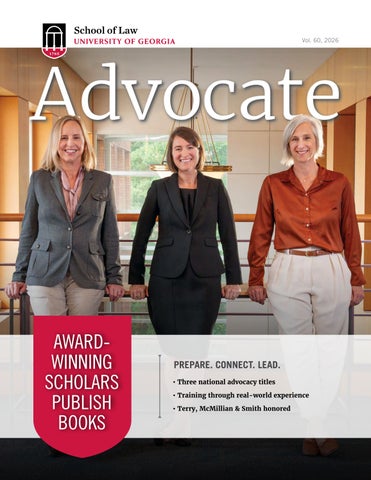
AWARDWINNING SCHOLARS PUBLISH BOOKS
PREPARE. CONNECT. LEAD. • Three national advocacy titles • Training through real-world experience • Terry, McMillian & Smith honored
Redefining what
GREAT NATIONAL Matching Excellence with Access
1
#
BEST VALUE LAW SCHOOL
—National Jurist 2024, 2023, 2020, 2019, 2018
26
#
LAW SCHOOL —U.S. News & World Report 2026/27
LEADER IN
GEORGIA —U.S. News & World Report 2026/27 6th straight year
24
#
INTERNATIONAL LAW —U.S. News & World Report 2026/27
Affordable Legal Education
100% FIRST-GEN COLLEGE GRADS AND VETERANS RECEIVE AID J.D. Program
52%
STUDENTS DID NOT BORROW 2024–25
LOWEST TUITION
AMONG U.S. NEWS
TOP-30 LAW SCHOOLS
Prepare. Connect. Lead.
84% STUDENTS RECEIVE AID 2024-25
it means to be a
PUBLIC LAW SCHOOL Well-rounded Graduates
89%
PARTICIPATION IN 18 CLINICS/ EXTERNSHIPS Class of 2025
79%
SECOND-YEAR STUDENTS SERVING ON A JOURNAL
#9
#12
MOOT COURT AND MOCK TRIAL
PRACTICAL TRAINING
—University of Houston and Gavel Rankings
—National Jurist 2026
2025-26
Real-world Student Outcomes
#6
ULTIMATE BAR PASSAGE RATE —U.S. News & World Report 2026/27
1
#
GEORGIA BAR EXAM PASSAGE
12th straight year leading July sitting
96.5% FULL CREDIT EMPLOYMENT OUTCOMES Class of 2025
#9
FEDERAL CLERKSHIPS —U.S. News & World Report 2026/27
Advocate
Table of contents
6
Three national advocacy titles & other honors
10 lawyers through real-
of 2026 18 Class Commencement
22
Marking the retirements of Casey and Scherr
26 Award-winning scholars publish books
McMillian and 37 Terry, Smith honored
Training tomorrow’s world experience
VOLUME 60, 2026 ISSN 1557-1025 Editor’s note: The Advocate is published annually by the University of Georgia School of Law for alumni, friends and members of the law school community. Please contact the Office of Marketing and Communications at (706) 542-5172 or lawcomm@uga.edu if you have any comments or suggestions.
Dean Usha R. Rodrigues
ABOUT THE COVER: Three of UGA Law’s awardwinning scholars published books over the past year: Brumby Distinguished Professor Sonja West (left) with The Future of Press Freedom (Cambridge University Press); Callaway Chair Elizabeth Burch (center) with The Pain Brokers (Atria/One Signal Publishers) and Caldwell Chair & Meigs Distinguished Teaching Professor Lori Ringhand with We the Voters (Stanford University Press). Photo by Dennis McDaniel.
Associate Dean for Clinical Programs & Experiential Learning Willow Tracy
CONNECT WITH US
Associate Dean for Academic Affairs Laura Phillips-Sawyer Associate Dean for Faculty Development Nathan S. Chapman
Assistant Dean for Admissions & Strategic Initiatives Xavier R. Brown (J.D.’17) Assistant Dean for Career Development Anthony E. “Tony” Waller (J.D.’93)
Email departmental inquiries to: Admissions – ugajd@uga.edu Alumni Relations – lawalum@uga.edu Communications – lawcomm@uga.edu Development – lawgifts@uga.edu Dean Rusk International Law Center – ruskintlaw@uga.edu Law Library – tstriepe@uga.edu Career Development – cdo@uga.edu Heidi Murphy, editor and writer; Adam W. Wynn, principal writer; Caroline L. Passaro, student intern; mPrint Design Studio, design; Kaptiv8, website design and hosting.
Discover us online at law.uga.edu
© 2026 University of Georgia School of Law. The University of Georgia is a unit of the University System of Georgia. An Equal Opportunity, Veteran, Disability Institution. The University of Georgia Foundation is registered to solicit in states where required and provides state specific registration information at ugafoundation.org/charity.
Find this issue online at advocate.law.uga.edu
PREPARE. CONNECT. LEAD.
Changes and opportunities The start of a new academic year is a time of great
distinguished faculty have earned in addition
joy, as our new 2Ls and 3Ls return to campus and
to our new hires. We proudly showcase the
we welcome a fresh cohort of eager 1Ls. Inevitably,
incredibly impactful work of the school’s 17
each August brings back memories of my own 1L
clinics and externships. You will also find
year. Although the first year of law school remains
tributes to Clinical Professor Emeritus Alex
in many ways the same, there are changes and
Scherr and Director of Advocacy Emerita
opportunities ahead for us in legal education. I want
Kellie Casey (J.D.’90), both of whom
to share the School of Law’s direction in three key
recently retired after decades of dedicated
areas.
service to our school and our students.
First, artificial intelligence poses a challenge
Your law school continues to redefine
not just for legal education but for the entire
what it means to be a great national public
practice of law. The School of Law is implementing
law school by matching excellence with
a multilayered strategy to guide our efforts to train
access. Several key rankings and statistics
graduates who can navigate cutting-edge technology
prove our strength: #26 law school, #6
and – as importantly – continue to possess those
Ultimate Bar Passage Rate, 96.5% full
basic critical thinking skills that have always been
credit employment outcomes, and #9 for
essential to successful lawyering. We call this an
federal judicial clerkships, moot court and
“analog meets digital” approach that emphasizes
mock trial. Perhaps even more important,
analytical thinking as much as technological fluency.
we remain one of the best returns on
Associate Professor Christian Turner chairs a faculty task force leading
investment in legal education by offering the lowest tuition among the
this initiative, and two of our new faculty hires will teach in the areas
nation’s Top-30 law schools.
of AI law and policy, data privacy, law and technology, and AI and ethics. Second, changes to the Georgia bar exam administration coming in
The long-term growth and success of UGA Law rely on the work of many. I am grateful for the support of the UGA administration, led by President Jere Morehead (J.D.’80), and for the advice and counsel of
2028 offer another example of challenge and change. For the first time
our three alumni boards. I also lead a team of five talented associate
in roughly 30 years, our students will be able to sit for the Georgia bar
and assistant deans. I am pleased to share that Wilson Associate
before graduation from law school. The school is exploring a variety of
Professor Laura Phillips-Sawyer will serve as our new associate
curricular options for students who take the February bar during the
dean for academic affairs. She follows Martin Chair Andrea Dennis,
final semester of their third year, particularly for those final months
who will return to the faculty after holding this leadership position
after they sit for the bar. Separately, the state of Georgia is changing
for two years and before that serving as associate dean for faculty
bar exam formats, moving to the NextGen Uniform Bar Examination
development for four years.
with a Georgia-specific component starting with the July 2028 sitting.
I want you to know I appreciate your ongoing support of the
Third, we are excited to launch a Sports Law Program. At the
School of Law’s vision. Together, we are preparing the next generation
heart of this new effort is a Master in the Study of Law with a Sports Emphasis. This one-year graduate program will provide aspiring
of legal leaders to succeed and thrive in their chosen professions. Thank you for all you do, and Go Dawgs!
sports agents with the legal foundation they need to be successful, in addition to giving them a technical understanding of Name, Image and Likeness, as well as National Football League and National Basketball
Sincerely,
Association agency. We are confident our J.D. and M.S.L. students alike will benefit from our new focus on sports law, as well as from our enhanced course offerings. Beyond these three challenges and changes, we have much to celebrate. In this issue of the Advocate, you will learn about some of the more notable national recognitions and honors the school’s
Usha R. Rodrigues Dean, University Professor & M.E. Kilpatrick Chair of Corporate Finance and Securities Law
ADVOCATE 2026 University of Georgia School of Law
3
PREPARE. CONNECT. LEAD.
UGA Law creates Sports Law Program Given the rapidly growing and evolving legal landscape of athletic pursuits, the School of Law has launched a Sports Law Program.
Through the USG Scholars program, qualifying students from across the University System of Georgia can now apply
School launches new admissions pathway for USG students
to the School of Law without taking the LSAT or GRE. Photo by Dennis McDaniel.
Last fall, the School of Law created a new admissions pathway for prospective students who earn a bachelor’s degree from University System of Georgia institutions. Students with qualifying academic credentials can apply for admission without taking the Law School Admission Test or Graduate Record Exam. Admitted students also automatically qualify for a $5,000 merit scholarship. “The launch of the USG Scholars program truly reflects our school’s vision of matching excellence with access,” Dean Usha R. Rodrigues said. “USG institutions are dedicated to advancing the prosperity of all Georgians, our state and our nation through the power of education. As Georgia’s flagship law school, we are building on this dedication by removing barriers to access.” To qualify for the USG Scholars program, students must possess a minimum undergraduate cumulative GPA of 3.50 and a score at or above the 85th percentile nationally on either the SAT or ACT at the time the test was administered. These requirements mirror those of our well established UGA Scholars program. The fall 2026 admissions cycle was the first opportunity for students to apply through the USG Scholars program. Assistant Dean for Admissions & Strategic Initiatives Xavier R. Brown (J.D.’17) said this new admissions pathway reflects the law school’s ongoing commitment to expanding access to a legal education for students across the state of Georgia. “This program offers an important opportunity for individuals who may lack access to LSAT or GRE preparation resources and helps address financial barriers commonly associated with applying to law school.” The number of USG Scholars admitted to the School of Law each year will be limited. Due to the extremely competitive admissions process, acceptance is not guaranteed solely by meeting the program’s minimum eligibility requirements.
4
ADVOCATE 2026 University of Georgia School of Law
At the heart of the initiative is a Master in the Study of Law with a Sports Emphasis. This one-year graduate program is specifically designed to provide aspiring sports agents with the legal foundation they need to be successful in addition to a technical understanding of Name, Image and Likeness, and National The new Football League and National M.S.L. degree Basketball Association agency, is a relatively according to Myles B. Solomon, who unique degree serves as the program’s director.
within the
“The new M.S.L. degree is a relatively industry. unique degree within the industry,” Solomon said. “This hybrid – inperson/online – offering allows master’s students to take classes with J.D. students in the courses most beneficial to agents, while taking online classes specifically related to the practice of being a sports agent.” As part of the overall Sports Law Program, the course “Name, Image and Likeness Agency” and others will be added to the J.D. curriculum. “These classes build on the foundation of the longstanding Sports Law class taught by Adjunct Professor John Cooper,” Solomon said. Prior to the creation of the program, the school had a robust externship placement program for college athletics with UGA, the Georgia Institute of Technology and Georgia Southern University. This expanded this past year to include multiple externships within the Atlanta Braves organization. Further rounding out the Sports Law Program is participation in sports-focused negotiation competitions with other law schools. This year, the School of Law fielded teams at the Villanova Professional Football Negotiation Competition and the Tulane International Fútbol Negotiation Competition. Notably, UGA Law finished in the final four (semifinals) out of 28 teams in the Tulane tournament. The School of Law continues to offer the J.D./M.S. in Sport Management and Policy. This dual degree, which can be completed in just four years, provides the theoretical and practical background to pursue career opportunities as a lawyer concentrating on sports issues.
Grants exceed
Summer fellowships provide key steps toward dream jobs With the dream of a career as an “appellate litigator working in the public interest sphere,” rising third-year law student Divya Kishore felt her summer fellowship was a key step in her journey toward achieving that goal.
Kishore worked in the Appeals Division of the Public Defender Service for the District of Columbia this past summer. She said she was excited to learn from
over 5 years
practitioners who were well-versed in the demands of public defense and who understood that representation goes beyond an initial appearance in court or the entrance of a plea deal. “I was grateful for the opportunity to gain exposure to appellate work and learn the nuances of the criminal system in a new jurisdiction.”
The recipient of the School of Law’s largest summer public interest grant, Kishore said the funding provided the perfect opportunity to pursue her passion without worrying about how she would support herself. “I came to law school hoping to pursue a career advocating for indigent defendants who are without the resources to do so themselves. The Bool Simkins Summer Fellowship gave me the freedom to do so, allowing my sole focus to be on gaining skills and knowledge to be a staunch advocate for my clients,” she said.
$1.6M+
Rising third-year law student Divya Kishore, the recipient of the Bool Simkins Summer Fellowship, worked this past summer in the Appeals Division of the Public Defender Service for the District of Columbia.
Kishore is one of 84 students who received summer public interest fellowships from the School of Law this past summer. In total, the school awarded approximately $435,000 to support unpaid legal positions in nonprofits, federal and state government, legal services and policy/impact organizations, and judicial clerkships. While the majority of placements were in the state of Georgia, UGA law students also worked in Arkansas, California, Colorado, Kentucky, Massachusetts, New York and Washington, D.C. Thanks to the generosity of alumni and friends, over the past five years, the law school has awarded more than $1.6 million for summer public interest fellowships.
Students earn multiple competition honors Two quarterfinal finishes at environmental law negotiation competition Two separate teams from UGA finished as quarterfinalists at the Robert R. Merhige, Jr. National Environmental Negotiation Competition, with one team composed of second-year law students Olivia G. Buckner and Camille A. Weindorf, and the other of third-year student Grace M. Craft and second-year student Colin A. Pelletier. The Merhige Competition is an annual event hosted by the University of Richmond School of Law allowing students to practice negotiations involving contemporary issues in environmental law.
UGA lands in final four at Tulane tournament Second-year student Elisa C. Lara and third-year student Supreme Unukegwo finished as semifinalists at the Tulane International Fútbol Negotiation Competition, where students engaged in simulated contract negotiations using real-life international clubs and players surrounding hypothetical scenarios.
Hodges and Moore named semifinalists in tax challenge Second-year students Clifford M. Hodges and Brigman T. Moore finished as semifinalists in the ABA Law Student Tax Challenge. This competition gives J.D. students an opportunity to solve a complex business problem that might arise in everyday tax practice.
Law students Supreme Unukegwo (left) and Elisa Lara (second from left) finished as semifinalists at the Tulane International Fútbol Negotiation Competition. They are pictured with competition mates Vernesha Brown (second from right) and Porter Tynes (right) and Sports Law Program Director Myles Solomon.
ADVOCATE 2026 University of Georgia School of Law
5
PREPARE. CONNECT. LEAD.
ADVOCACY SEASON HIGHLIGHTS
UGA captures three national titles & other honors
National Semifinalists: ABA National Appellate Advocacy Competition Second-year students Divya Kishore (second from left) and Anna Grace Rogers (second from right) finished as semifinalists at the American Bar Association National Appellate Advocacy Competition. The duo’s brief won fourth place and Kishore was named the fifth best oralist. Second-year students Kate Branch (left) and Lisa Calvert also participated and advanced to the national tier of the tournament. Third-year students Kero Gadelrab, Taylor Hoying and Casey Smith served as student coaches and Holly Pierson (J.D.’96) was the alumni coach.
National Champions: All-Star Bracket Challenge UGA won the national championship at the All-Star Bracket Challenge. The team included third-year students Kaylah Holmes (left), Eric Narbo (second from right) and Maya Davis and second-year student Ryan Parimi (second from left). Narbo was selected as the best advocate. Alumni Jonathan (J.D.’16) and Whitney (J.D.’15) Stuart served as coaches. This quartet also captured an AAJ National Student Trial Advocacy Competition regional trophy.
Champions: Intrastate Moot Court Competition The annual Intrastate Moot Court Competition featured an all-Law Dawg final this year. The team of (l. to r.) second-year student Kennedy Nuckles, third-year student Joshua Moran and secondyear student Mya O’Berry won the championship, with second-year students Caleb Smith, Ana Hernandez Lozano and Kemper Higgins finishing as finalists. Smith was named the tournament’s best oralist. Director of Advocacy Kellie Casey (J.D.’90) and Adjunct Professor Cole Harper (J.D.’22) coached the teams along with thirdyear students Avery Hill and Charlotte Umanoff. 6
ADVOCATE 2026 University of Georgia School of Law
National Champions: South Texas Mock Trial Challenge Second-year students Olivia Haas (left), Daniel Lanclos and Eric Gulbranson (right), along with third-year student Dresden Day, brought home the top trophy at the South Texas Mock Trial Challenge. The team won the outstanding brief award in addition to several individual honors. Gulbranson was named outstanding advocate in the preliminary rounds and best advocate in the final round, while Day won most professional and outstanding advocate honors in the preliminary rounds. Director of Trial Advocacy Jeremy Dailey (J.D.’14) and 2012 alumnus Andrei Ionescu coached the team. This marks the fifth time that UGA has won this competition.
National Champions: Claude Pepper Elder Law Competition Third-year students Dustin Batchelor (left) and Kero Gadelrab were named national champions at the annual Claude Pepper Elder Law National Moot Court Competition. Coached by Adjunct Professor Cole Harper (J.D.’22), the team went undefeated throughout the tournament.
Champions: Hulsey/ Gambrell Moot Court Competition The annual Florida/ Georgia-Hulsey/ Gambrell Moot Court Competition pits law students from UGA and the University of Florida against each other in the courtroom. Thirdyear students Frank Easterlin and Grace Johnson, who were coached by Director of Advocacy Kellie Casey (J.D.’90) and Adjunct Professor Cole Harper (J.D.’22), won the competition. Their victory brought the School of Law’s all-time record in this event to 29-12-2.
Regional Champions: National Moot Court Competition Third-year students (l. to r.) Antavious McCarden, Taylor Hoying and Liz Burns won their regional in the National Moot Court Competition and advanced to the national tier of the tournament held in New York. Burns was named the best oralist for both the final round and the preliminary round of the regional competition. The team was coached by Adjunct Professor Cole Harper (J.D.’22) and 2025 alumna Casey Wofford. The National Moot Court Competition, which is co-sponsored by the American College of Trial Lawyers and the New York City Bar Association, annually features more than 1,000 students from more than 150 accredited law schools.
UGA Law captures prestigious Scribes award Class of 2025 alumnae (l. to r.) Mona Abboud, Casey Wofford and Taylor Stablein were awarded the Scribes – the American Society of Legal Writers – 2025 Best Brief-Writing Award for their brief submitted at the 2024–25 National Moot Court Competition, Region VI. This honor marks only the second time that UGA students have won this prestigious writing award presented to the best student brief from the previous academic year’s competition. Notably, the trio finished the National Moot Court Competition as national semifinalists. ADVOCATE 2026 University of Georgia School of Law
7
PREPARE. CONNECT. LEAD.
Students seek public interest opportunities Honors Fellows Program sends students to rural Georgia This past summer, eight students worked in district attorney and public defender offices as well as in judicial chambers located in rural Georgia. They were supported by stipends provided through the School of Law’s Georgia Honors Fellows Program, which was created in 2024 with both public and private resources to help address the scarcity of prosecutors and public defenders in Georgia communities without adequate access to legal services. The rising second- and third-year students were based in the Appalachian, Ocmulgee, Oconee, Middle and Northern circuits as well as in Burke County.
Munger and Favro recognized with Pro Bono Publico honors Third-year law students Emily W. Munger and Mason C. Favro received 2026 NALP PSJD Pro Bono Publico honors. Munger was named the overall winner for her holistic effort to bring a name change clinic to Athens. Favro was selected as a Merit Distinction Finalist. This highly competitive, national award recognizes upper-level law students for their “extraordinary commitment to law-related public service work [that] contributes to the overall growth of pro bono culture within their law school and their broader community.” Notably, UGA Law students received two of the three national awards presented by NALP PSJD this year.
Adoris Gibbs
Sam Motley
Gibbs and Motley named EJW Fellows Third-year law students Adoris M. Gibbs and Samantha R. “Sam” Motley were selected as Equal Justice Works Fellows through the Design-Your-Own Fellowship program. This prestigious post-graduation, two-year fellowship “seeks to create opportunities for lawyers to transform their passion for equal justice into a lifelong commitment to public service.” Gibbs will work at Brown’s Promise through the Southern Education Foundation, while Motley will work at the Georgia Legal Services Corporation.
First-gen students help each other succeed The First-generation Student Association works to foster community among this cohort of students and encourages upper-level students to help first-year students find their way in law school. One key way they support each other is through programming and events intended to assist first-gen students in getting acquainted with “all things” law school and to know whom they can go to with their questions. During the 2025–26 academic year, FGSA organized events like “Lunch with the Dean,” career-oriented Q&A sessions and a variety of social events. First-generation students also benefit from the law school’s First Start Scholars Program, which offers time-management and organization techniques, and one-onone meetings covering a range of topics, including budgets, study plans, academic advising and course selection.
8
ADVOCATE 2026 University of Georgia School of Law
Gathered together are some of the 2025–26 FGSA leadership team members: (front row, l. to r.) Nada Panjwani, Kieley Gayle, (middle row, l. to r.) Cade Mataya, Henry Stoneback, Ane Ferri Victoria, (back row, l. to r.) Mason Gonsisko and Madison Tilton.
Distinguished Law Fellows embrace opportunity
Third-year student Leighlee Mahony (right) and Georgia Sea Grant Legal Program Director Katie Hill (J.D.’08) at the UGA River Basin Center Annual Graduate Water Research Poster Contest in November.
Law students help protect Georgia’s coast For approximately 10 years, School of Law students have been working with UGA Marine Extension and Georgia Sea Grant to provide legal and policy expertise to help improve the environmental, social and economic health of the Georgia coast. The Marine Extension and Georgia Sea Grant unit partnered with the university’s Carl Vinson Institute of Government to develop the Legal Program in 2015. Since then, more than 25 law school students have served as Marine Extension and Georgia Sea Grant Legal Fellows. Katie Hill (J.D.’08), the director of the Legal Program, said, “Often, the work we do focuses on objective policy analysis to inform decision-makers. … Students understand why this type of policy work is extremely valuable for our governmental clients, the state of Georgia, and beyond.”
The Distinguished Law Fellowship offers several unique opportunities for some of the school’s brightest students over the course of their legal education. Considered UGA Law’s most prestigious scholarship, recipients benefit from domestic and international externships, guided research experiences and opportunities to meet some of the country’s top legal, business and government leaders, all in addition to generous scholarship support. During the past academic year, fellows enjoyed a small-group lunch with Judge Britt C. Grant of the U.S. Court of Appeals for the Eleventh Circuit. They also connected with members of the school’s alumni boards and some of their benefactors at receptions. These gatherings allow fellows to engage with leading legal figures and provide crucial help with building strong professional networks. These experiences enrich the fellows’ education and better prepare them for their own career journeys. Initially established in 2016 by a gift from The John N. Goddard Foundation, the Distinguished Law Fellowship program currently has the ability to offer more than 25 full-tuition-plus scholarships. The program is modeled after the university’s prestigious Foundation Fellows initiative, which was established in 1972.
Tamaris M. Henderson, a third-year law student, served as a Legal Fellow last academic year with a focus on derelict crab and lobster traps in coastal states. Her work was related to the Nationwide Fishing Trap Removal, Assessment and Prevention Program, which aims to detect and remove derelict fishing traps that are lost, abandoned or discarded. Henderson established a baseline of current trap-related laws and policies across the United States through the creation of a database of coastal states that regulate fisheries, along with the laws and policies applicable to derelict traps. Third-year student Leighlee M. Mahony added to Henderson’s database of state derelict trap law and policy to further the work with the TRAP Program. She presented a summary of their findings at the UGA River Basin Center Annual Graduate Water Research Poster Contest. She also developed short memorandums on state programs that were used at the annual TRAP Program meeting at the Virginia Institute of Marine Sciences, and she drafted an article on basic derelict trap policy questions that vary from state to state.
Third-year student Trudi Sundberg (left) and first-year student Harrison Russ (right) stand with John Rees III at a recent law school reception. Rees is the son of the late John Bartow Rees Jr., a member of the UGA Law faculty for more than 40 years. Both students are Rees
Mark Risse, director of Marine Extension and Georgia Sea Grant, anticipates there will be a growing need to support the coastal ecosystems as more people move to and develop the coast, and he hopes to expand the fellowship program.
Distinguished Law Fellows.
—Caroline L. Passaro ADVOCATE 2026 University of Georgia School of Law
9
PREPARE. CONNECT. LEAD.
Training tomorrow’s lawyers through real-world experience For nearly six decades, the School of Law’s experiential learning and
habeas petitions, including investigating and reviewing evidence,
clinical programs have provided life-changing experiences for the
drafting motions and conducting witness interviews. Clinical Professor
hundreds of students who have enrolled, not to mention the thousands
Jessica L. Heywood (J.D.’97) oversees this clinic.
of clients who have benefited from the services they received. The school currently offers 10 clinics and seven externships. The Criminal Defense Practicum (formerly the Legal Aid Clinic) is the oldest offering, while the Land Conservation Clinic (established in 2023) is the newest. In recent years, the school has averaged 425 School of Law
Nearly 90 students each year complete the part-time Civil Externship, led by Clinical Associate Professor Elizabeth M. Grant (J.D.’94). Regarding his externship with Senior Judge Richard W. Story (J.D.’78) of the U.S. District Court for the Northern District of Georgia, third-year student Gabriel Murphy said he learned a tremendous
students enrolling or re-enrolling in one of the school’s clinic/
amount about legal craft and the intricacies of the federal courts. “I
externship programs each year and cumulatively engaging in roughly
developed my research and writing skills in a rigorous and welcoming
88,000 service-learning hours annually. More than 26,500 of these
environment that left me feeling especially well prepared to serve as a
hours occurred under the direct supervision of law school faculty
clerk after graduation.”
members directing in-house clinical programs. The following provides an overview of the current clinics and
The Community Health Law Partnership Clinic achieved over 100 health-justice successes on behalf of immigrant families last year,
externships on offer, with highlights from students and recent
including federal litigation benefiting 14 clients and reuniting two
successes.
long-separated families. Other clinic clients obtained medical deferred
Founded in 2010, the Appellate Litigation Clinic is one of the
action, asylum, special immigrant juvenile status, benefits as crime-
older appellate clinics in the country. The clinic accepts cases in the
or trafficking-victims, permanent residence and naturalization. Clinic
Georgia Supreme Court; the U.S. Courts of Appeals for the Second,
students and faculty also made legal presentations to schools, domestic
Fourth, Fifth, Seventh, Ninth, Eleventh and D.C. Circuits; and the
violence shelters and other community organizations. Hosch Professor
Board of Immigration Appeals. This past year, under the direction of
Jason A. Cade and Staff Attorney Kristen Shepherd lead this clinic. The
Thomas V. Burch, third-year students argued six cases. The students
Community Health Law Partnership Clinic Fund, established in 2024
were: Chandler S.K. “Chan” Creswell and Emma Rose Bagwell (Fourth
by Benjamin W. “Ben” Thorpe (J.D.’14) and his mother Dr. Barbara
Circuit), Kerolls “Kero” Gadelrab and Avery C. Hill (Ninth Circuit),
Williams, supports clinic operations and allows for the hiring of post-
Julia A. Gillies and Katelyn W. Hulsey (Ninth Circuit), Jesse L. Sebring
graduate and summer fellows to help broaden the clinic’s impact.
and Mark S. Winokur (Eleventh Circuit), Katie A. O’Neal and Harrison J. Demas (Eleventh Circuit) and Casey E. Smith and Sydney M. McRae (Eleventh Circuit). The Business Law Clinic is a transactional clinic that allows UGA Law students to provide a wide range of legal services to small businesses, nonprofits, start-ups and entrepreneurs while working under the direction of Associate Dean for Clinical Programs and Experiential Learning Willow Tracy. Second-year student Cade Mataya said he learned the practice of business law is an iterative process. “While I never expected that anything I produced would be used without a lot of edits, I learned what the process of improving a document looks like … . Rather than being a static ‘paper-pushing’ practice built purely on precedent documents, business law is a very dynamic process where you learn a variety of things, from how to format a document to analyzing the circumstances that led to a provision being included in a precedent document.” The Capital Assistance Project was initiated in 1998 at the request of the Supreme Court of Georgia. Participating students work at agencies defending individuals charged with or convicted of capital crimes. Students support attorneys with trials, direct appeals and
10
ADVOCATE 2026 University of Georgia School of Law
Appellate Litigation Clinic students Chan Creswell and Emma Rose Bagwell presented oral argument before the U.S. Court of Appeals for the Fourth Circuit in March.
Earlier this year, students in the Land Conservation Clinic visited Woodlawn Gardens Farm, an organic farm near campus, to learn about the process of permanently protecting farms with conservation easements under The Conservation Fund’s Working Farms Program.
The Corporate Counsel Externship, led by Clinical Assistant
The First Amendment Clinic, supported by an endowment funded
Professor Scott Lowry (J.D.’07), provides externship opportunities for
by The Stanton Foundation and directed by Clinical Associate Professor
students in the in-house legal departments of more than 30 corporate
Clare R. Norins, has a three-part mission. The clinic defends and
partners. During 2025-26, more than 65 students participated.
advances freedoms of speech, press, assembly and petition through
Second-year student Porter A. Tynes III said the Corporate
direct client representation; serves as an educational resource on issues
Counsel Externship was the first time his doctrinal coursework came
of free expression and press rights; and provides law students with the
into focus. “Concepts I learned in the classroom moved from theory
real-world practice experience to become leaders on First Amendment
to application, shaping real decisions with real consequences,” adding
issues. The clinic also represents clients in federal and state court at
that it is the kind of experience that “does not just complement a legal
both the trial and appellate levels.
education, it completes it.”
Jordan N. Elwarner, a second-year student enrolled in the clinic for
Stating the experience “bridged a critical gap” in his legal
two semesters, worked on a First Amendment retaliation case in U.S.
education, third-year student Bohdan Krivuts (LL.M.’24) added
District Court from the early stage of drafting and filing the complaint
that his externship provided essential insight into how in-house
up through completing discovery. Elwarner said she gained confidence
teams navigate the intersection of law and business in a corporate
from the experience and that it reaffirmed her desire to pursue a career
setting. “Participating in the externship twice allowed me to gain
in litigation. She elaborated that with each successive piece of the case
a well-rounded perspective on the distinctions in work between
she worked on – be it drafting interrogatory responses, preparing for
legal departments of public and private corporations, providing a
and conducting depositions, or researching and writing memos in
comprehensive perspective on corporate practice.”
preparation for summary judgment – her belief in her own competency
The Criminal Defense Practicum, led by Clinical Associate Professor Elizabeth Taxel (J.D.’09), continues to expand its statewide
to strategically move the case forward increased. Second-year student Elijah T. Echols, who worked for a semester
impact through new partnerships and meaningful contributions to
on a defamation defense case in Georgia Superior Court, said, “From
indigent defense. This academic year students supported resentencing
counseling real clients, to writing briefs, to arguing my first hearing
efforts under Georgia’s Survivor Justice Bill through a new
before a real judge, my time in the First Amendment Clinic was, start to
collaboration with the Georgia Coalition Against Domestic Violence’s
finish, beyond edifying. I am extremely grateful to Professor Norins and
Justice for Incarcerated Survivors Program, and they provided
the rest of the clinic team for modeling excellent lawyering, pushing me
critical support to 10 public defender offices across Georgia.
out of my comfort zone, and providing all the support and mentorship I
Practicum students also contributed to notable successful advocacy in trial and appellate courts. They helped draft a winning
needed along the way.” The Land Conservation Clinic supports private land conservation
brief before the Supreme Court of Georgia on behalf of a child
efforts in Georgia and the Southeast. A cross-disciplinary program for
prosecuted as an adult and a successful brief before the Georgia
law and ecology master’s students, the clinic focuses on transactional
Court of Appeals for an indigent defendant. Most recently, third-year
and policy matters that impact land conservation with clients including
student Anna H. Barrett served as third chair in a successful jury trial
nonprofits, government agencies and university researchers, according
on behalf of a teenager facing a potential life sentence.
to Clinical Assistant Professor Steffney R. Thompson.
Third-year student Margaret F. “Maggie” Carlton said she has
“My experience in the Land Conservation Clinic taught me that legal
gotten hundreds of hours of experience working alongside practicing
tools are only useful if they are practical for the community involved,”
public defenders and their clients. The practicum has allowed her
second-year student Emily V. Harris said. “The Transfer of Development
to develop her skills for reviewing evidence in a case, meeting with
Rights project allowed me to see that successful conservation is about
clients, conducting investigations and advocating on behalf of clients
understanding the totality of the community’s needs, from their
in court. “Everything I learned … during my time in the CDP will
economic needs to their environmental needs. Being a lawyer is more
directly benefit my clients when I start [work] as a public defender,”
than just drafting documents for clients; it is also about finding creative
she said.
solutions to keep communities sustainable for the next generation.”
ADVOCATE 2026 University of Georgia School of Law
11
PREPARE. CONNECT. LEAD.
UGA Law regularly participates in a legal pop-up clinic in Troup County that offers free civil legal advice and referrals to residents. Third-year students Supreme Unukegwo (third from left) and Gordon Wayne (second from right) participated under the guidance of Professors Elizabeth Grant (J.D.’94), Emma Hetherington (J.D.’11) (right), Alex Scherr and Ethan Smith (left). The law school’s participation in the Troup County clinic is supported by a Callaway Foundation grant.
Since 2005, the Mediation Practicum has been training law
(J.D.’94), who serves as director. “PIP is a general poverty law clinic
students to become registered neutrals with the Georgia Office of
that remains a vital part of the law school’s programs by providing
Dispute Resolution. With these skills and the addition of the Mediation
research, advice and referrals for low-income people with problems
Clinic, where students regularly mediate disputes in-person and online
that fall outside other law school clinics or legal services programs.”
for local courts and other entities, UGA Law students are making an
Third-year student Supreme Unukegwo said his practicum
impact in the Athens area and beyond. Just how far beyond can be
experiences deepened his understanding of the barriers many people
demonstrated by Alexandre Jorge Fontes Laranjeira (LL.M.’23), who
face in accessing the justice system. “At a pop-up clinic … I worked
serves as a federal court judge in his home country of Brazil. Upon
directly with clients who had limited prior access to legal services, and
his return to South America, Fontes Laranjeira has used his mediation
those face-to-face interactions reinforced the importance of listening
training and advocated for this dispute resolution skillset to be used
carefully, building trust, and treating every person’s legal matter with
more widely within the Brazilian legal system. Rob McNiff (J.D.’02)
the seriousness it deserves. Throughout each of these experiences,
leads the Mediation Practicum.
Professor Grant challenged us to go beyond surface-level guidance and
The Prosecutorial Justice Program integrates classroom
deliver the same quality of representation we would provide to any
instruction with an externship in prosecutor offices located in
paying client, a standard that fundamentally shaped how I approach
Northeast Georgia. Participating students receive three consecutive
client service today.”
semesters of classroom instruction from Clinical Associate Professor
This spring marked the 10th anniversary of the Atlanta Semester
Melissa D. Redmon beginning in the spring semester of their second
in Practice program. Since its inception, more than 200 students have
year. During their third year, students work in their assigned
externed full-time in the metro Atlanta area at judicial, government,
externship office where they have the opportunity to observe all phases
corporate counsel and nonprofit legal offices.
of a criminal prosecution. Under Georgia’s Third-year Practice Act,
Third-year student Clara McClung Leggett externed for two
students can directly participate in conducting preliminary hearings,
semesters at the Georgia Department of Agriculture and the Georgia
motion hearings, arraignments, juvenile adjudications, probation
Senate Office of Policy and Legislative Analysis. “I learned the
revocations, grand jury proceedings and jury trials.
importance of workplace communication, sharpened my research and
The Public Interest Practicum is the School of Law’s longest continuously running civil law clinic. It has spun off or inspired several other clinics, including the Wilson Family Justice Clinic, the Mediation
writing skills, and expanded my network.” Elizabeth M. Grant (J.D.’94) directs the Atlanta Semester in Practice program.
Clinic and the Veterans Legal Clinic, according to Elizabeth M. Grant
The School of Law welcomes private donations — particularly through permanent endowments — to support the operations of our clinics and externships. Through sustaining donor commitments, the school is able to offer students quality, hands-on learning opportunities and provide legal services that make a true impact on a variety of communities locally and throughout our state and nation.
12
ADVOCATE 2026 University of Georgia School of Law
The School of Law has been offering the Washington, D.C.,
two semesters working in the Veterans Legal Clinic have made a major
Semester in Practice since 2012. Under the leadership of Clinical
impact on my ability to make a difference in clients’ lives and the kind
Professor Jessica L. Heywood (J.D.’97), the offering permits students
of lawyer I want to be,” she said. Of note, Motley secured a highly
to extern full-time in Washington, while attending classes twice per
competitive two-year post-graduate fellowship funded by Equal Justice
week. Placements include a wide range of settings, including federal
Works. She will start her legal career helping veterans with discharge
agencies, the White House, national nonprofits, the judiciary and
upgrade requests that will increase their benefits.
Capitol Hill. The Georgia Law D.C. Semester in Practice Program Endowment provides support for students in this program. The scope of the Semester in Practice programs has broadened in recent years beyond the cities of Atlanta and Washington, D.C.
After Clinical Professor Emeritus Alexander W. “Alex” Scherr retired in June, Brenda J. Gohr assumed the leadership role for the Veterans Legal Clinic. James E. “Jim” Butler Jr. (J.D.’77) provided the lead gift and
Students have enjoyed working in other parts of Georgia – from
ongoing support benefitting this clinic, and he also provides
Columbus to Augusta and Ellijay to Savannah. The school has also
scholarship support for veterans enrolled at the law school.
supported students who externed full-time in other states. Even
The Wilbanks Child Endangerment and Sexual Exploitation Clinic
further afield, clinical faculty partner with the Dean Rusk International
recently obtained an approximately $4.3 million verdict for its client
Law Center to facilitate international student placements.
in the Carroll County Superior Court. Third-year law students Hannah
Second-year student William P. “Wil” Stowers recently
M. Peters and Ellis H.P. Schmitt represented the clinic’s client at the
participated in a full-time semester externship at a law firm in
trial under the supervision of Staff Attorney Brian Atkinson (J.D.’13),
Germany. “I learned how to do one of the most difficult things for
with the support of clinic Director Emma M. Hetherington (J.D.’11) and
a law student: how to assume I know nothing,” he said. “While
Social Work Advocate Jocelyn Crumpton.
remaining confident in my own abilities, starting from a place of
Since opening its doors in 2016, the Wilbanks CEASE Clinic has
vulnerability allowed me to ask better questions, seek help faster, and
provided direct legal and social work services to more than 400
to problem-solve more efficiently. While any externship can teach
survivors of child sexual abuse, exploitation and trafficking. Marlan B.
these, only an externship in a different country and in a different legal
Wilbanks (J.D.’86) provided the lead gift behind this clinic.
system will.” The Veterans Legal Clinic helps Georgia veterans access the
Led by Clinical Associate Professor Christine M. Scartz (J.D.’94), the Jane W. Wilson Family Justice Clinic launched two new projects
benefits they are entitled to from the U.S. Department of Veterans
expanding the geographic reach of the clinic last year. The clinic
Affairs. Since opening in 2018, the clinic has aided veterans from
entered into a partnership with the Gateway Domestic Violence Shelter
across Georgia earn more than $18 million in retroactive awards, debts
in Gainesville, GA, to provide representation to victims in virtual
waived and future payments.
protective order hearings in Hall County. Secondly, the clinic began
Third-year student Samantha R. “Sam” Motley said working in the clinic helped her discover a passion for an area of law she never
representing women incarcerated in state prisons across Georgia in divorce proceedings.
thought she would have a sustained interest in professionally. “[M]y
Third-year student Sam Motley (left) and Veterans Legal Clinic Director Alex Scherr speak with attendees of the Stand Down for Veterans event held at the Veterans of Foreign Wars headquarters in Athens during October. Photo by UGA Marketing and Communications.
ADVOCATE 2026 University of Georgia School of Law
13
STUDENT PROFILES
PREPARE. CONNECT. LEAD.
Bella Chitwood
Chitwood hopes to practice in the Northern Judicial Circuit, which includes her hometown, and sees her law school
HOMEGROWN ADVOCATE
education as preparation to give back to the community that gave so much to her. “I’m particularly interested in family
Growing up in Georgia, second-year student Isabella G. “Bella” Chitwood always knew she would find
law,” she said. “Being from Hartwell,
herself at the University of Georgia. Combining her
there are a lot of smaller practices and individual attorneys who do a lot of
love for school with her desire to help others, she realized early on that law school was the perfect fit for her. “The law has always interested me because it’s always changing and there’s always something new to learn,” Chitwood said. “I also wanted a career where I could help people.” During high school, she discovered the UGA 3+3 admissions process, which allows qualified students to apply to law school during their third year of undergraduate studies. “When I was
important work, and I got experience with how much of an impact one attorney can have on a family.” Her long-term goal is to join a general practice firm so she can stay rooted in her community while serving a range of clients. During her first year in law school, she found an interest in civil procedure and learned how important details are in helping clients. Outside of the classroom, Chitwood participated in the J.
researching majors, I saw the 3+3 program. Psychology was one of
Ralph Beaird 1L Closing Argument Competition and finished as a
the degrees you can do with that, so while I was planning my dual
quarterfinalist. “It was really fun after mainly doing just academic
enrollment courses, I was keeping that in mind,” she said.
stuff, to actually try and put together an argument and talk before
“To get a whole year off the time I might have spent in college, so I can get out and practice and get hands-on experience sooner, that’s really been great,” Chitwood, who is a recipient of the Loudermilk Family First-Start Scholarship, said. A big part of her decision to not only attend UGA, but to accelerate her academic path, was her connection to home. Originally from Northeast Georgia, Chitwood is the second-oldest of five children and commutes daily between home and Athens. “I have a lot of connections with Hartwell, and my family is in Hartwell, but that’s also two hours that are cut out of my day,”
people, and to also get to know more people who were outside of my section,” she said. “I love UGA Law. It’s a great law school, and God has really blessed me here,” she said. “Even though it is a competitive education, it doesn’t actually infringe on our actual personal relationships.” Relationships – both in and out of school – helped Chitwood, who started law school at age 19, through her first year. She knows they will continue to influence her life as she works toward her legal career. “Everybody’s super supportive, super nice, everybody
she said. “The most challenging aspect of law school for me has
congratulates each other when they get something, that’s my favorite
been just balancing my time.”
part of actually being at UGA Law,” she said.
Brigman Moore CALLED TO SERVE As a third-year law student,
Brigman T. Moore has already balanced the roles of soldier, student, husband and father. During his undergraduate years at Georgia Southern University, he enlisted in the Georgia Army National Guard and enrolled in GSU’s ROTC program, excited by the opportunity to serve in more than one way. “I wanted to serve in a military capacity and provide some sort of public service as a civilian too,” he said. “I was learning a lot about history and politics, and it seemed that lawyers made a
14
ADVOCATE 2026 University of Georgia School of Law
Returning to law school came with a set of challenges that he
Carter Christopher BUILDING A CAREER THROUGH CONNECTIONS Recent graduate Carter J. Christopher knew law school was the
I think learning how to use my
path for him since he was in middle school.
brain in this way is when I started
The first time he thought he wanted to go to law school
approaching problems from a
was in the fifth or sixth grade. “My best friend, her dad was an
new perspective and succeeding
attorney, and I thought he was the coolest guy in the world. I was
as a law student,” Christopher,
not quite sure what he did, but I knew I liked who he was.”
a recipient of the Chester C.
What started as admiration gradually became direction for
Davenport Scholarship, added.
Christopher’s own life. He understood his strengths and where
After graduation in May,
those strengths could take him. “I always knew I liked writing and
Christopher joined Kirkland & Ellis in New York City to practice
reading,” Christopher said. “I thought [law school] would be a good
corporate bankruptcy and restructuring.
way to use my skills.” Christopher, who grew up in Hershey, Pennsylvania, attended
While he always knew New York was where he wanted to end up, his path to the Big Apple was forged by the Law Dawg network.
Princeton University where he was a member of the football team.
Through former Dean Peter B. “Bo” Rutledge, he met Michael J.
While the COVID-19 pandemic gave him an additional year of
Sharp (J.D.’91) at the Jefferies Financial Group. The connection
eligibility, he chose to move on after earning his undergraduate
allowed Christopher to complete a semester externship during his
degree in politics.
second year of law school in New York at Sharp’s firm, working in
He was introduced to UGA following his junior year of college. Christopher interned during the summer with Warren R. “Wit” Hall
the office of the general counsel. Christopher said Dean Usha R. Rodrigues, who led his
Jr. (J.D.’92) at Hall, Gilligan, Roberts & Shanlever in Atlanta and had
corporations class, was one of his other primary mentors. “I really
the opportunity to tour campus and fell in love with the environment
liked the way that she taught and required our attention. ... If
and the people.
you were not prepared and paying attention, she would let you
“They always say that the people make the place. Everyone I’ve
know, which I think forced me to critically grapple with materials.
met [in Athens], from my immediate friend group to alumni and
In turn, she was always open to answer questions or respond to
mentors to people that I see every day in class, they’ve really made a
any comments I had,” Christopher said. “I got to form a really
difference,” Christopher said. “Law school can be an isolating place
good relationship with her, and she helped me through a lot of
and with this community you’ll never walk alone.”
law school, whether it was with class, connecting with alumni, or
Law school, however, still required some adjustments. After
kickstarting my career.”
being a top student in high school and attending an Ivy League
Beyond the classroom, UGA Law reshaped how Christopher sees
university, he found that UGA Law challenged him in new ways.
the world. “My view of the world has definitely changed a lot since
“Many people come into law school knowing the answer to a problem but struggle going through the [step-by-step] process.
attending law school,” he said. “A big part of that is the people I interacted with while being there.”
wasn’t expecting. “Counterintuitively, the most difficult part was
network but with educational funding as well. He is the recipient of the
actually coming back,” he said. “It was a huge adjustment trying
Judge Charles B. Mikell Jr. Scholarship Fund, which is one of a series
to balance family life with the rigors of law school again after being
of endowments that combine to guarantee financial aid to all veterans
gone for nearly a year.”
enrolled at UGA Law (often referred to as the Butler Commitment).
Support from the law school community was instrumental in
Active on campus, he served as a notes editor for the Georgia
his transition back to campus. While joining a different cohort of
Journal of International and Comparative Law and president of the Dean’s
students as classmates, he found a strong network specifically among
Ambassadors student organization. Additionally, earlier this year, he
fellow military vets. “Formally, there’s the Armed Forces Association
and a fellow veteran, Clifford M. Hodges, represented UGA Law in the
[law student organization] and, informally, the group of veterans who
American Bar Association Law Student Tax Challenge in San Diego,
currently attend and [those who] graduated from UGA Law is really
where they finished as semifinalists.
tight-knit,” he said. Even during deployment, Moore stayed connected to the Law Dawg network. Overseas, he routinely spoke with Frank G. Lumpkin IV (J.D.’23), who served as a judge advocate for a neighboring task force after Moore “departed theater.” “It was really great to talk to him and hear his experience and to connect with somebody from UGA Law while I was abroad,” he said. The School of Law has supported Moore not only through a strong
This past summer, he worked with two Atlanta firms – Bradley Arant Boult Cummings and Eversheds Sutherland – to continue building the foundation for his future legal career. Although his path to graduating law school has not been traditional, Moore’s journey reflects his goals of serving and making a difference. “Wherever my family and I end up, I want to be well-rooted in my community and to have a positive impact on my surrounding area.”
—All profiles by Caroline L. Passaro ADVOCATE 2026 University of Georgia School of Law
15
Students compete in Arch Madness Second-year student Deymon Fleming runs past another team during the Sports and Entertainment Law Society’s flag football tournament, Arch Madness, during the fall semester.
Law School Life
Gibbs recognized by state bar Third-year law student Adoris Gibbs (left) received the Law School Student Excellence in Access to Justice Award from the State Bar of Georgia. She was nominated by Clinical Associate Professor and First Amendment Clinic Director Clare Norins.
Cultural celebration feeds minds and appetites Law students gathered for the annual International Night event in April, taking the opportunity to try out foods from different parts of the world and engage in various cultures represented by members of the Davenport-Benham Black Law Students Association, First-generation Student Association, Hispanic & Latino Law Students Association, Immigration Law Society, International Law Society, Middle Eastern Law Student Association, South Asian Law Students Association and Student Bar Association.
Rodrigues runs with students Dean Usha R. Rodrigues (center) enjoyed running with students throughout the academic year. For this run, Georgia Athletic Association Professor David Shipley and Callaway Chair Elizabeth Burch also joined in the fun.
Conferences attract leading scholars for timely dialogue Several conferences brought prominent scholars and speakers to campus for discussions on current topics. Some of these events are highlighted below: • Post Professor Pamela Foohey hosted a conference in the fall where she presented her new book, Debt’s Grip: Risk and Consumer Bankruptcy (University of California Press, 2025). In addition to her co-authors, Robert M. Lawless and Deborah Thorne, the event brought leading academics to campus to discuss the book and other crucial topics in bankruptcy law. • Professor Diego Zambrano from Stanford Law School delivered the keynote address at this year’s Georgia Law Review symposium in March. The 2026 symposium, celebrating the 60th volume of the journal, was titled “Polarized Courts: The New Private Enforcement” and featured academics and practitioners from institutions across the country. • Georgia Supreme Court Justices John J. Ellington (J.D.’85) and Andrew A. Pinson (J.D.’11), along with Supreme Court of Georgia Judicial Law Clerk Alexandria H. “Alex” Clark (J.D.’22), discussed geofence warrants in light of the state Supreme Court’s recent decision in Jones v. State. The event was hosted by the Georgia Criminal Law Review. • The Journal of Intellectual Property Law symposium tackled the everchanging landscape of name, image and likeness regulations surrounding
Post Professor Pamela Foohey (left) presented her new book, Debt’s Grip, as part of a conference with co-authors Robert Lawless and Deborah Thorne.
college athletics. UGA Sports Law Program Director Myles B. Solomon and 2022 alumnus Tanner L. Potts, the assistant athletic director of player management for UGA Athletics, spoke as part of a panel explaining the intricacies of NIL and how the laws in this arena are constantly shifting. During this conference, the journal staff unveiled the publication’s new name – the Georgia Journal of Law & Technology. • At the 2026 Red Clay Conference, experts in law, technology and environmental sciences explored the subject of data centers and their overall impact on society. Panelists looked at existing legal structures regarding the centers and their impact on local communities and the environment.
Support allows UGA Law to match excellence with access
GARRARD
Epps
Dodd Butler
WILBANKS
Some key donors were: John G. Alston Sr., James E. “Jim” Butler Jr. (J.D.’77), Clare A. Dodd, Kevin E. Epps (J.D.’08), Henry G. Garrard III (J.D.’71), Thomas J. “Tom” Harrold Jr. (J.D.’69), Distinguished Research Professor & Shackelford Distinguished Professor Emeritus Walter Hellerstein, J. Curtis Lewis III (J.D.’78), W. Gray Reilly (J.D.’14), Ralph M. Snow and Allen W. Yee (J.D.’03) in addition to the Bready Family Charitable Fund, the Lingam Foundation and the Wilbanks Family Donor Advised Fund.
HELLERSTEIN Yee GRIFFIN
Reilly
Several of the specific funds receiving donations included: the Philip H. Alston, Jr. Distinguished Law Fellowship, the Brendan Fair Dodd Scholarship, the Robert G. Edge Distinguished Law Fellowship, the Beverly Renee Epps Scholarship, the James T. Fordham Memorial Scholarship, the John E. “Buck” Griffin Endowment, the J. Curtis Lewis III Endowment, the David E. Ralston Memorial Fund, the Becky and Buddy Snow Scholarship and the Yee Family Professorship.
Ralston Harrold
SNOW
Over the 2025–26 academic year, some of the areas championed by the law school’s loyal donors and friends include: the Alexander Campbell King Law Library, the Dean Rusk International Law Center, the Veterans Legal Clinic and the Wilbanks Child Endangerment and Sexual Exploitation Clinic. Support was also directed to assist military veterans enrolled at the law school and students from rural areas in addition to international programming, summer public interest fellowships and mental health initiatives.
Lingam
Consistent investment in the University of Georgia School of Law propels our mission of redefining what it means to be a great national public law school by matching excellence with access.
Alston
Lewis
BREADY FordhamEDGE
Please join us in preparing the next generation of legal leaders. CALL (706) 542-7959 • VISIT: law.uga.edu/giving • EMAIL: lawgifts@uga.edu ADVOCATE 2026 University of Georgia School of Law
17
PREPARE. CONNECT. LEAD.
2026 CLASS OF
COMMENCEMENT
Elise Joffe is all smiles walking with her diploma. Photo by Dennis McDaniel.
Above: Graduate Vishruth Singireddy gets help with his regalia from Executive Assistant & Journal Specialist Amy Weaver. Right: Platform party members (l. to r.) Maggie Camfield, National Anthem performer Dustin Batchelor, LSAC President-elect Francys Johnson (J.D.’04), Antavious McCarden and Tina Bhatt pose for a photo. Photo by Dennis McDaniel.
18
ADVOCATE 2026 University of Georgia School of Law
Above: Casey Smith and Maddi Hughes (right) celebrate with their diplomas. Photo by Dennis McDaniel. Left: Graduates (l. to r.) Rosalie Vendrell, Supreme Unukegwo, Charlotte Umanoff, John Tomlin and Jessie Thompson are ready for graduation to begin. Photo by Dennis McDaniel.
Chief Justice commissions new graduates as guardians of the law
Photo by Dennis McDaniel.
LL.M. graduates Ji Hun Lee and Victor Azure (right) pose for pictures in front of the stage.
Moments before the Class of 2026 crossed the stage to receive their diplomas, Georgia Supreme Court Chief Justice Nels S.D. Peterson explained the importance of being a good lawyer. While his keynote address briefly touched on issues of competence and career excellence, his primary focus was on moral excellence and leading by example. “You are now the guardian of the rule of law, and even in the heat of the fiercest legal battle, treat all those around you with inherent worth and dignity,” Peterson said.
Graduate Ethan Hammond stands with his father, Joe Hammond (left), and twin brother, Neal, who came specially dressed for the occasion. Photo by Dennis McDaniel.
In encouraging these actions, Peterson briefly explored the dangers of treating people simply as a means to an end rather than as someone who possesses inherent value. He especially noted how important it was for lawyers to treat their opponents in court as people who deserve respect no matter the case or the matter at hand. “Civility isn’t a luxury reserved for situations with little at stake,” he said. Peterson built his remarks around the significance of the rule of law and the vital importance that lawyers protect the rule of law by adhering to it. “It’s easy to dismiss … the rule of law as focused on public interest indicators and government lawyers and public defenders, but the rule of law is the foundation of all legal practice,” he said.
Graduates (l. to r.) Rilee White, Aaron Dasher and Sara Eve Caruthers smile while getting ready.
While he argued the crucial need for lawyers who uphold the rule of law and who devote their careers to helping their community, Peterson also encouraged the new lawyers to build something else of the utmost importance. Making a point to credit his friend and fellow Georgia Supreme Court Justice John J. Ellington (J.D.’85) for the original quote, Peterson said to the graduates, “There’s life outside the courthouse. Get one.”
ADVOCATE 2026 University of Georgia School of Law
19
PREPARE. CONNECT. LEAD.
Gobeil serves as Hines Jurist in Residence Georgia Court of Appeals Judge Elizabeth Gobeil (J.D.’95) served as the 2026 Hines Jurist in Residence. While in Athens, Gobeil met with faculty members to learn more about their scholarship and taught a minicourse alongside Appellate Litigation Clinic Director Thomas V. Burch. During the course, titled “Select Topics in Judicature: Persuading the Judge and Jury,” Gobeil provided students with insights into courtroom practices as they examined trial proceedings from jury selection all the way through the appeals process. Gobeil also took time to help judge the First-Year Appellate Moot Court Competition and lead a coffee break discussion with students on Georgia’s appellate courts. The Hines Jurist in Residence is supported by The Be Kind Fund, which was established in memory of the late Georgia Supreme Court Chief Justice Harris Hines in 2019.
Judge Elizabeth Gobeil (J.D.’95) speaks to students in the Sanders Boardroom as part of her time serving as the Hines Jurist in Residence.
Jurists give students meaningful insights while on campus During the 2025–26 academic year, nearly 25 judges visited campus to participate in events as varied as symposia, lectures, panels and small-group coffee chats. In addition, some served as moot court and mock trial competition judges. Notably, more than half of the jurists were members of the federal judiciary. These interactions provide valuable learning experiences for students. Some of those who came to Athens are listed.
• U.S. Court of Appeals for the Sixth Circuit: Chief Judge Jeffrey S. Sutton, Judge John K. Bush • U.S. Court of Appeals for the Eleventh Circuit: Judge Britt C. Grant • U.S. District Court for the District of Columbia: Judge Ana C. Reyes • U.S. District Court for the Northern District of Georgia: Judge Tiffany R. Johnson, Judge William M. “Billy” Ray II (J.D.’90), Senior Judge Richard W. Story (J.D.’78), Magistrate Judge Anna W. Howard (J.D.’10) • U.S. District Court for the Middle District of Georgia: Judge Leslie Abrams Gardner, Judge Tilman E. “Tripp” Self III (J.D.’97) • U.S. District Court for the Southern District of Georgia: Magistrate Judge Benjamin W. Cheesbro (J.D.’10), Magistrate Judge Brian K. Epps (J.D.’98) • U.S. Court of Federal Claims: Judge Ryan T. Holte, Judge Edward H. Meyers • Georgia Supreme Court: Justice John J. Ellington (J.D.’85), Chief Justice Nels S.D. Peterson, Justice Andrew A. Pinson (J.D.’11) • Georgia Court of Appeals: Judge Elizabeth Gobeil (J.D.’95)
U.S. Court of Appeals Chief Judge Jeffrey Sutton spoke to students during a January coffee chat.
• Other State and County Courts: Judge Norman Barnett (J.D.’10) (Magistrate Court, Cobb County), Judge Nhan-Ai Du (Juvenile Court, Gwinnett County), Judge LaTisha Dear Jackson (Superior Court, DeKalb County), Judge Diana Rugh Johnson (formerly with the Juvenile Court, DeKalb County), retired Judge C. LaTain “Tain” Kell, Sr. (J.D.’87) (Superior Court, Cobb County), Judge Bonnie Chessher Oliver (Superior Court, Georgia Northeastern Judicial Circuit)
UGA Law is one of the nation’s leading producers of Article III judges and was recently ranked #16 for the number of alumni who are currently serving as sitting Article III judges. 20
ADVOCATE 2026 University of Georgia School of Law
House Lecturer Lynn Chastain discusses legal career Chick-fil-A built a quick-service dining empire one chicken sandwich at a time. As one of the key figures behind the scenes of the restaurant giant, B. Lynn Chastain (J.D.’84) often had a front-row seat and provided her own wisdom to the moments that helped shape that empire. “I went to Chick-fil-A to build a real estate portfolio,” Chastain, who retired as general counsel and senior vice president from the restaurant chain in 2020, said. Recalling a conversation she had with the founder and former chairman and CEO of Chick-fil-A, Chastain added, “Truett Cathy said that he wanted to own all of his properties … and I thought that is a brilliant idea.” During the spring semester, Chastain delivered the 43rd Edith House Lecture and provided students with interesting insights from her own vast experience in order to better prepare them for their futures.
Judge advocate general talks on the value of military service Public service has been the heart of Maj. Gen. Bobby L. Christine’s mission for many years. Whether serving as a U.S. District Court judge or in his own private firm, Christine’s focus has been on making sure the people in his various communities get the best assistance from him that they can. As an officer in the U.S. Army JAG Corps, and now serving as the 43rd judge advocate general of the Army, the community that Christine primarily serves is the military and military dependents. Christine used examples from his own career with the JAG Corps to explore what sorts of cases law students might expect to face in their own potential careers and the unusual locations where these cases may present themselves. He shared that he once helped a deployed soldier whose wife back home was facing legal trouble over a pool they recently installed.
Lynn Chastain (J.D.’84) (right) stands with Dean Usha R. Rodrigues and second-year law student Katelyn Klein (left),
“My career path was sort who moderated the discussion, after the Edith House Lecture. of unusual, and my whole purpose in being here today is to share some stories about career path, maybe offer a few challenges, but mostly encourage you in the journey that you have ahead,” she said. At the age of 12, Chastain began her first job as a riverboat hostess at Stone Mountain Park. Her first professional experience out of college was with the State Board of Pardons and Paroles, which gave her an inside view of the justice system. The key moment for Chastain, it would prove, was when she took on real estate law as a young attorney. “I got hooked up with a little-known client called Chick-fil-A during my tenure at Troutman Sanders and I was invited to join them in 1990 before they ever opened the first freestanding [location],” Chastain said, highlighting that Chick-fil-A stores had exclusively been in shopping malls prior to that time. Now, Chick-fil-A has more than 3,400 locations across 48 states, Puerto Rico, Canada and the United Kingdom and has plans to expand into Southeast Asia, which is a testament to the legacy Chastain helped build during her 30-year tenure with the restaurant. The Edith House Lecture is organized by the Georgia Association for Women Lawyers chapter at UGA in honor of one of the first female graduates of the School of Law. House, a native of Winder, Georgia, was co-valedictorian of the law class of 1925, the first to graduate women. The UGA Law Georgia Association for Women Lawyers chapter benefits from an endowed fund established in 2024 to support programming and activities for the group’s members and the greater law school community.
“I found myself sitting under the stars [in Iraq] with my computer, you know, bouncing stuff off a satellite, [searching] Alabama swimming pool law. That’s legal assistance,” Christine told students. “This young enlisted soldier could not concentrate on his job in a war zone – which is the kiss of death – because he was worried about what was happening back home,” he added. As the judge advocate general, Christine manages fewer individual legal assistance cases since he is primarily focused on advancing the mission of the JAG Corps and assisting current JAG officers.
Maj. Gen. Bobby Christine, the 43rd judge advocate general of the U.S. Army and graduate of UGA, visited the School of Law to talk to students about what it means to be a JAG officer.
“I can give a lawyer who wants to develop an expertise in a certain area a meaningful career with progression and rank … and responsibility within a specialty,” Christine said, describing some of the professional opportunities available to law students who consider a path in military justice. Christine graduated from the University of Georgia with a bachelor’s degree in political science before earning his law degree from the Samford University Cumberland School of Law.
ADVOCATE 2026 University of Georgia School of Law
21
PREPARE. CONNECT. LEAD.
Sharfstein delivers Johnson Lecture Legal historian Daniel J. Sharfstein presented the Judge Horace J. Johnson, Jr. Lecture during the fall 2025 semester. The holder of the Lansden Chair in Law, professor of history and director of the George Barrett Social Justice Program at Vanderbilt University, Sharfstein frequently combines his academic backgrounds in history and law to pursue seemingly niche topics in both. He previously received a Guggenheim Fellowship to complete research that led to the creation of his book Thunder in the Mountains: Chief Joseph, Oliver Otis Howard and the Nez Perce War, a look at postReconstruction America. He was also awarded the Law & Society Association’s 2012 James Willard Hurst Jr. Prize for socio-legal history, among other awards, for his first book, The Invisible Line: A Secret History of Race in America. With support from UGA, the School of Law and the School of Public and International Affairs established the Judge Horace J. Johnson, Jr. Lecture in memory of the late jurist, who was a trailblazer in Georgia and a 1982 School of Law alumnus.
FROM COURTROOMS TO CLINICS
Celebrating
Casey retires with nearly 40 national titles and lasting friendships For the last 26 years, the University of Georgia School of Law has been a dominant force in moot court and mock trial. During this period, the advocacy program captured 39 national titles, 65 regional crowns and 18 state trophies, not counting the scores of individual and team honors bestowed on students for oral advocacy or brief writing. This tremendous record is a tribute to the coaching provided by the school’s Director of Advocacy Kellie R. Casey (J.D.’90), who retired on June 1. Casey said she still remembers when then-Dean David E. Shipley interviewed her and called to offer her the position. She added that her first year was one with several key wins, especially the school’s first Intrastate Moot Court Competition win in six years (with UGA teams finishing in first and second in the annual all-Georgia tournament) and Rob McNiff (J.D.’02) winning the Best Oralist Award at the Philip C. Jessup International Law Moot Court Competition (notably, all of his teammates also earned oralist honors that year). UGA Law’s list of impressive wins under Casey’s tutelage includes national titles in the National Moot Court Competition (twice), the Hunton Andrews Kurth Moot Court National Championship (four times) and the South Texas Mock Trial Challenge (five times). UGA teams also earned significant regional victories in the National Trial Competition (12 times), the ABA National Appellate Advocacy Competition (11 times) and the American Association for Justice National Student Trial Advocacy Competition (five times). Additionally, the School of Law dominated at the Intrastate Moot Court Competition, with 18 first-place trophies, and at the annual courtroom battle with the University of Florida, tallying 17 wins. Despite the number of trophies amassed, Casey said she feels her biggest accomplishment is the friendships she has developed with alumni and former students – some of whom count among her best friends today. “I want to be remembered for truly caring about each and every student I have worked with,” she said.
Johnson Lecturer Daniel Sharfstein (center) stands with School of Public and International Affairs Dean Matthew Auer and School of Law Dean Usha R. Rodrigues.
In 2019, alumni Kevin E. Epps (J.D.’08), Jeffrey W. DeLoach (J.D.’03) and Adam L. Hoipkemier (J.D.’08) spearheaded their law firm’s effort to create the Kellie R. Casey Scholarship to recognize Casey’s contributions to the school and its storied advocacy program. At the time, they stated that due to Casey’s
22
ADVOCATE 2026 University of Georgia School of Law
retirements and legacies tireless passion and commitment, advocacy students enter into the
out well-prepared
practice of law “well-prepared to be formidable advocates for their
for the personal
clients.”
and professional
Casey plans to remain in Athens during retirement and is considering working part-time. For pleasure, she is looking forward
challenges of law practice.”
to cooking dinner at night, spending time with family and traveling.
He has many fond
“These are a few things I have kind of missed over the last 26 years,”
memories of his time
she added, noting her regular advocacy schedule of working after 6
at the law school: a
p.m. and on weekends.
student connecting
UGA President Jere W. Morehead (J.D.’80), commenting previously
legal work with
on Casey’s impact, said, “I have known Kellie since she was a Georgia
something that they
law student and an accomplished member of the advocacy program
believe in and realize
that I led at the time. Her record then and her record since that
they can actually
time have been nothing short of superb. She spends countless hours
do, a new clinic
coaching her students to be the best they can be in competitions, and
stabilizing, a new
she is admired and respected by our graduates for her dedication to
clinician discovering
their education and training and her personal mentorship.”
satisfaction in his/her
While earning her law degree at UGA, Casey participated in the school’s moot court program, winning several individual oralist honors and competing as a member of the prestigious National Moot Court Competition team.
Scherr’s legacy includes nine clinics/ externships and a culture of service The name Alexander W. “Alex” Scherr has long been synonymous with clinics at UGA Law. Over 30 years, he played a role in either
work, the collaboration with other faculty to improve a law school rule or policy, the achievement of a life changing result for a client or the satisfaction of helping a person find the next step out of a tough spot. Scherr said “regular contact with students, their energy, their intelligence, and their innate optimism” are what he will miss the most from his time at the law school. “Keeping up with students has kept me honest, focused, and hopeful through good times and bad.” Scherr was not only a leader on the law school’s faculty, but also had a national impact on the field of clinical legal education. He is the author of Learning From Practice and Green’s Georgia Law
creating or shaping many of the school’s clinical and experiential
of Evidence. He served as president of the Clinical Legal Education
offerings, including: the Civil Externship, the Community Health Law
Association, and he advocated successfully for changes to the ABA
Partnership Clinic, the Corporate Counsel Externship, the Mediation
rules that shape how clinics and externships contribute to law
Clinic, the Public Interest Practicum, the Veterans Legal Clinic and
schools. He served on the editorial board of the Clinical Law Review.
the Wilson Family Justice Clinic. He was instrumental in creating the
He organized many regional and national conferences on clinical
Atlanta and Washington, D.C., Semesters in Practice. From 2016 to
education. He also served as a drafter of the Multistate Performance
2018, he served as the school’s associate dean for clinical programs
Test for the National Conference of Bar Examiners.
and experiential learning.
In 2019, he received the prestigious William Pincus Award from
When the 2026-27 academic year commenced on July 1, it was
the Clinical Section of the Association of American Law Schools. In
without Scherr and his steady and guiding presence, as after three
the same year, UGA also recognized Scherr with its Engaged Scholar
decades of service to UGA Law he retired. In his wake, he leaves a
Award. In 2025, he received the inaugural Career Achievement Award
legacy that will continue to shape and mold future lawyers for our
from the AALS Externship Committee. Additionally, earlier this year,
state and society.
the National Law School Veterans Clinic Consortium presented Scherr
Reflecting on his time at the School of Law, Scherr said he is most proud of his role in developing “the amazing collection of
with its Founder’s Vision Award. In retirement, Scherr and his wife, Candace, will live on their
high-quality clinics and externships” the school now offers. Scherr
farm outside of Athens. With “plenty of possibilities but no plans,” he
emphasized that this achievement was the work of many hands:
expects to renew his work as a court-related mediator and “show up
“many other faculty and deans deserve praise” for these programs.
for one-day legal clinics” across the state. He also looks forward to
He noted, “It’s deeply gratifying to see decisions we made 30 years
sleeping late, learning tai chi and photography, writing poems, building
ago or more become what we have now: first-rate experiential
computers, and going on road trips with his wife and their many dogs.
courses that attract good students to the law school and send them
ADVOCATE 2026 University of Georgia School of Law
23
PREPARE. CONNECT. LEAD.
NEW FACES AT UGA LAW Starting this fall, Assistant Professor María P. Angel will lead courses in the areas of torts, data privacy, and AI law and policy. Angel most recently served as a resident fellow with the Information Society Project at Yale Law School. She has also held lecturer positions at the Universidad Sergio Arboleda, the Universidad Externado de Colombia and the Universidad del Rosario. A Fulbright Scholar, she is the author of the book The Datafied Public Administration, Governing through Big Data. She has also written: “From Privacy to the Data Economy: The FTC’s Reframing of its Regulatory Priorities” in the Arizona State Law Journal (forthcoming), “Privacy’s Algorithmic Turn” in the Boston University Journal of Science and Technology Law and “Distinguishing Privacy: A Critique of Privacy as Social Taxonomy” in the Columbia Law Review (co-authored). Angel earned her bachelor’s and law degrees from the Universidad de los Andes and her LL.M. in administrative law from the Universidad del Rosario. In 2024, she received her Ph.D. in Law from the University of Washington, where she served as an articles editor of the Washington Journal of Law, Technology & Arts. Mateusz “Matt” Blaszczyk joined the School of Law as an assistant professor, teaching in the areas of property, law and technology, and intellectual property as well as an undergraduate course titled Law, AI and Ethics.
Clinical Assistant Professor Brenda J. Gohr became the School of Law’s new director of the Veterans Legal Clinic earlier this year, replacing longtime Clinical Professor Alexander W. “Alex” Scherr, who retired in June. Currently holding the rank of Lieutenant Colonel, Gohr has more than 15 years of military service (both active duty and reserve) in the U.S. Air Force. Her work has encompassed military justice matters, operations law and civil law issues in addition to service in the Office of Disability Counsel. Beyond her military work, she most recently served as of counsel for The Veteran’s Advocate and operated her own legal practice specializing in veteran and military law. Gohr also served as an assistant appellate defender for the Iowa Office of the State Public Defender from 2016 to 2019 and as an independent contractor for the law firm Gary Myers, Daniel Conway and Associates during 2015 and 2016. She earned her B.A. cum laude from Bowling Green State University and her Juris Doctor from the Mitchell Hamline School of Law. Taylor Nchako will join the School of Law in the fall semester of 2027 as an assistant professor. She will teach property, environmental law, and a U.S. trade in Africa seminar.
He comes to UGA from the University of Michigan Law School, where he was a Research Fellow in Law and Mobility and co-led a seminar on emerging technologies and the law. Previously, he was a visiting scholar at the Max Planck Institute for Innovation and Competition and served as a law clerk at the U.S. Copyright Office and as a judicial intern at the U.S. Court of Federal Claims.
She is presently serving as a staff attorney for the U.S. Court of Appeals for the Eleventh Circuit. Previously, she was the Climate and Clean Energy Fellow for two years at the Northwestern Pritzker School of Law, where she also taught an environmental justice seminar in the spring of 2025.
His recent articles include: “Copyright’s Nominal Humanism” in the Loyola of Los Angeles Law Review (forthcoming), “Copyright Doctrine before the Tribunal of Science” in the Journal of the Copyright Society and “Impossibility of Emergent Works’ Protection in U.S. and EU Copyright Law” in the North Carolina Journal of Law and Technology.
Her scholarship includes “ESG Backlash in the United States – Investor Concerns or ‘Red Scare’?” in the Journal of Law and Political Economy as well as the forthcoming articles “A Strategic Approach to ESG Reporting” and “Reimagining International Investment Law for the Age of Minerals” in the Lewis & Clark and Washington & Lee law reviews, respectively.
Blaszczyk earned his LL.B. from King’s College London and his LL.M. from Georgetown University. During his studies, he was senior editor of the King’s Student Law Review Forum, an LL.M. adviser and editor of the Georgetown Journal of International Law, and a visiting editor of the University of Bologna Law Review.
Nchako earned two bachelor’s degrees summa cum laude from UGA and a J.D. cum laude from the Northwestern Pritzker School of Law, where she served as the online editor-in-chief of the Northwestern University Law Review.
24
ADVOCATE 2026 University of Georgia School of Law
Last fall, the School of Law appointed Myles B. Solomon as the director of its new Sports Law Program, which is designed to provide students a solid foundation in the rapidly evolving and complex legal landscape of athletic pursuits. While working as a lawyer and agent for more than 20 years, he specialized in the representation of NCAA Division I football coaches, basketball coaches and athletic directors. In addition, he has represented coaches and universities in NCAA infractions cases and compliance reviews. Having represented NFL players as an NFLPA-licensed agent, he has also been at the forefront of NIL representation, serving as general counsel for two NIL-athlete-agentrepresentation firms. He previously served as an adjunct professor at the University of South Carolina in the sport and entertainment management department, where he taught Contracts and Negotiations in addition to Sports Law. He also spent seven years as an attorney with the litigation firm Bassi, Edlin, Huie & Blum in San Francisco. Solomon earned his Bachelor of Science in Sport Administration and his Juris Doctor from the University of South Carolina. Laurie Ann Taylor joined the School of Law this fall as a lecturer. She will teach legal writing. Before coming to UGA, she served as counsel at Bondurant Mixson & Elmore. She also worked for one year as an attorney advisor at the U.S. Copyright Office in Washington, D.C., where she researched and drafted sections of the office’s advisory reports on artificial intelligence. She previously clerked for Judge Cormac J. Carney of the U.S. District Court for the Central District of California and interned for Judge Timothy C. Batten Sr. (J.D.’84) of the U.S. District Court for the Northern District of Georgia. Taylor earned her Bachelor of Arts with highest honors from Emory University and her Master of Music in Voice Performance from the University of Michigan. She received her Juris Doctor cum laude from Harvard Law School, where she served as the editor-in-chief of the Harvard Negotiation Law Review and symposium chair of the Harvard Journal of Legislation as well as earned the Harvard Certificate of Distinction in Teaching twice. Her teaching experience includes multiple fellowships held at Harvard University while attending law school. She was the head teaching fellow for the law school’s CopyrightX course and the undergraduate Conflict Resolution in a Divided World course.
Tim Wilson was appointed the digital initiatives and technology librarian at the Alexander Campbell King Law Library during the spring. He is responsible for the management and development of the law school’s institutional repository and archives, while also participating in the overall operation of the law library. He comes to UGA with almost eight years of library experience, with approximately six years at law libraries. Wilson most recently held the position of digital collections and scholarly services librarian at Florida International University. Previously, he was an electronic resources librarian at the Georgetown Law Library and an electronic services librarian at the St. Mary’s University School of Law. Additionally, he served as a web services librarian for the University of Texas at Dallas for two years. Wilson’s other experience includes serving as a web developer/specialist and teaching abroad in Ukraine (through the U.S. Peace Corps) and in the Czech Republic. Wilson earned his Bachelor of Arts, Juris Doctor and Master of Library and Information Sciences from the University of Alabama. Melissa C. McCall became the Alexander Campbell King Law Library’s instruction and faculty services librarian earlier this year. As such, she guides faculty and student research with materials, instruction and other resources. McCall’s legal career began in the U.S. Virgin Islands. She served as a judicial clerk for Judge Patricia D. Steele of the Superior Court of the Virgin Islands. She was subsequently appointed by the governor as legal counsel in the Division of Environmental Protection, where she would later serve as director. She also worked as an associate at the Law Office of Andrew C. Simpson in St. Croix. Her other legal experience includes serving as a legal analyst for the Delaware Department of State through Epiq and working as an administrative hearing officer for the state governments of Texas and Missouri through Robert Half. McCall earned her B.A. from Binghamton University, her J.D. from Syracuse University, her M.S. from Stony Brook University and her M.L.I.S. from the University of Washington.
ADVOCATE 2026 University of Georgia School of Law
25
PREPARE. CONNECT. LEAD.
NATIONAL RECOGNITIONS, West publishes The Future of Press Freedom An award-winning scholar, Sonja R. West recently published The Future of Press Freedom: Democracy, Law, and the News in Changing Times (Cambridge University Press) with RonNell Andersen Jones. The book is described as an “incisive analysis of emerging threats to press freedom, from technological and economic disruptions to eroding public trust, while proposing innovative legal and policy solutions. The volume tackles cutting-edge issues like artificial intelligence in news production and the evolving definition of ‘the press’ in the digital age.” Specializing in constitutional law, media law and the U.S. Supreme Court, West’s scholarship includes approximately 30 articles appearing in prominent law journals such as the Harvard Law Review, the California Law Review, the UCLA Law Review, the Michigan Law Review and the Northwestern Law Review. Her most recent article is “Abandoning Press Freedom” in the Iowa Law Review. This past year, she delivered presentations to audiences across the country at the University of Chicago, Columbia University, the University of Connecticut, the University of Utah and Yale University as well as abroad at the University of Oxford and the University of Sheffield. She is a two-time winner of the Association for Education in Journalism and Mass Communication Stonecipher Award for Distinguished Research on Media Law and Policy and the recipient of the National Communication Association Haiman Award for Distinguished Scholarship in Freedom of Expression. For 2023–24, she served as a senior visiting research scholar at the Knight First Amendment Institute at Columbia University. A former U.S. Supreme Court judicial clerk, West holds the Otis Brumby Distinguished Professorship in First Amendment Law, a post shared by the law school and the Grady College of Journalism and Mass Communication. She has been teaching at UGA since 2006. 26
ADVOCATE 2026 University of Georgia School of Law
Burch releases The Pain Brokers Drawing on her expertise in the areas of mass torts and multidistrict litigation, Callaway Chair Elizabeth Chamblee Burch has authored a non-fiction investigative exposé that uncovers a complex, predatory scheme preying on women with faulty pelvic mesh implants. The book, titled The Pain Brokers: How Con Men, Call Centers, and Rogue Doctors Fuel America’s Lawsuit Factory, and Burch have received positive reviews. One referred to Burch as “the Jane Goodall of complex litigation.” Another said, “Burch delivers a pulse-pounding legal thriller that hooks you from the start and leaves you gasping for air at the end. … Burch has done the nation a valuable public service by exposing a legal system rotten to the core.” Burch is also the author of Mass Tort Deals: Backroom Bargaining in Multidistrict Litigation and the co-author of The Law of Class Actions and Other Aggregate Litigation. Additionally, her scholarship includes more than 40 law review articles and essays in respected journals, including the Columbia Law Review, the New York University Law Review, the Yale Law Journal Forum, the Cornell Law Review and the Virginia Law Review. She has delivered over 140 lectures at research institutions across the United States and abroad, and she is frequently cited by national and international news outlets. A member of the law school faculty since 2011, Burch is the recipient of the American Law Institute Early Career Scholars Medal, the Zacharias Memorial Prize for Professional Responsibility Scholarship and the Mangano Dispute Resolution Advancement Award. Earlier this year, the School of Law student body presented her with the Ellington Award for Excellence in Teaching.
Ortman authors articles in top law reviews Specializing in criminal law, criminal procedure and evidence, Hosch Professor William Ortman has published articles in the California Law Review (Confession and Confrontation), the Washington University Law Review (Cliff Running) and the Ohio State Journal of Criminal Law (Plea Bargaining Abolitionism: A History) over the past 18 months. His scholarship has also appeared in the Columbia Law Review, the University of Pennsylvania Law Review, the Boston University Law Review, the Vanderbilt Law Review, the Michigan Law Review and the Stanford Law Review. Last summer, Ortman presented on the history of plea bargaining as part of the panel “American Perspectives on Plea Bargaining” at the Michele Taruffo Girona Evidence Week held in Spain. Teaching in the areas of criminal procedure and evidence, he joined the law school faculty last year and was subsequently appointed to a J. Alton Hosch Professorship. Ortman came to UGA Law with 12 years of teaching experience. Most recently, he was at the Wayne State University Law School, where he received multiple teaching awards.
NEW TITLES & HONORS Ringhand authors We the Voters
Phillips-Sawyer assumes associate deanship
Earlier this year, Caldwell Chair & Meigs Distinguished Teaching Professor Lori A. Ringhand published We the Voters: The Constitutional Choices That Shape America’s Elections (Stanford University Press).
Laura Phillips-Sawyer, who holds the Jane W. Wilson Associate Professorship in Business Law, has been named associate dean for academic affairs.
One expert described the book as a “rare work that is thorough, accessible, and scholarly. The neophyte and expert alike will benefit from engaging with her marvelous account of how history shapes how we vote and debate voting.” Another stated that the title “powerfully describes how the Constitution and its history shape the major disputes in American democracy. … This account will educate and empower any reader who wishes to work towards a better American democracy.” Ringhand, who joined the law school faculty in 2008, is a nationally known U.S. Supreme Court scholar who has published extensively on election law related issues. She is the author of more than 20 articles appearing in highly regarded law reviews and she has published three other books, including the awardwinning Supreme Bias: Gender and Race in U.S. Supreme Court Confirmation Hearings. Her other recent scholarship includes: “The Regulation of Presidential Elections” in the Wisconsin Law Review and “Gender, Race, and Interruptions at Supreme Court Confirmation Hearings” in the American Political Science Review. Over the past year, Ringhand shared her expertise on election law through presentations at Florida State University and the Association of American Law Schools Annual Meeting, and she provided expert media commentary to Georgia Public Broadcasting and CNN. Ringhand has long been a leader on the UGA Law faculty, serving as associate dean for academic affairs from 2015 to 2018 and interim director of the Dean Rusk International Law Center for roughly 18 months. She is the recipient of UGA’s highest teaching honor, and she served as a Fulbright Distinguished Chair during 2019. Additionally, she was appointed to the Harmon W. Caldwell Chair in Constitutional Law earlier this year.
Phillips-Sawyer joined the UGA Law faculty in 2020, before which she was on the faculty at Harvard Business School. She holds a M.A. and Ph.D. from the University of Virginia. An expert in U.S. antitrust law and policy, she is a member of the Antitrust Section of the American Bar Association and serves on the editorial board of the Antitrust Law Journal. She is frequently in the media commenting on antitrust cases in outlets such as Bloomberg, BBC News, The New York Times, The Wall Street Journal and National Public Radio. She has published shorter commentary articles in Competition Policy International on labor markets and antitrust law, Concurrences Antitrust Bulletin on U.S. private antitrust enforcement, and ProMarket on antitrust and industrial policy. Broadly, her scholarship explores questions of law and economics, which intersect with legal history, economic thought, business strategy and structure, and political organization. She is the author of American Fair Trade: Proprietary Capitalism, Corporatism, and the ‘New Competition,’ 1890–1940 (Cambridge University Press) and “Restructuring American Antitrust Law: Institutionalist Economics and the Antitrust Labor Immunity, 1890–1940s” in the University of Chicago Law Review. Teaching in the area of antitrust law, she has created the course Antimonopoly and American Democracy for the law school’s undergraduate minor. (This course was made possible by a grant from The Stanton Foundation.) She has also taught in the Terry College of Business, both in the MBA elective curriculum and the Economics Department. Phillips-Sawyer holds courtesy appointments in UGA’s Economics and History Departments, and she has received teaching awards at both the Terry College and the School of Law.
Weeks named UGA vice provost Elizabeth Weeks (J.D.’99), who has served as the University of Georgia’s interim vice provost for academic affairs since June 2025, assumed the position on a permanent basis in February. As vice provost for academic affairs, Weeks provides strategic leadership for the university’s academic programs and initiatives, policy development, governance processes and faculty matters. She chairs the UGA Arts Council and the university’s Leadership Council on Artificial Intelligence, while also serving as co-chair of the Humanities Council. Weeks, who continues to hold the law school’s Kirbo Chair, joined the UGA law faculty in 2011. Her research focuses on health care financing and regulation, health care reform and public health law. She is the author or co-author of two books, with a third soloauthored book scheduled for publication in 2027. She has written nearly 50 book chapters and articles in law reviews, journals and other publications. ADVOCATE 2026 University of Georgia School of Law
27
PREPARE. CONNECT. LEAD.
Turner leads law school’s AI strategy Associate Professor Christian Turner currently serves as the leader of the School of Law’s AI Committee, which is developing a plan to train “complete, modern lawyers” who combine analog deep thinking skills with fluency in cutting-edge technology. As a legal scholar with a Ph.D. in mathematics, Turner’s scholarship has taken an exciting new turn with the explosive progress of generative artificial intelligence. He previously sought to understand law’s conceptual architecture and the varied mental models people bring to legal argument. But since 2022, he has expanded his focus to research AI architectures, build a multimodel research application (enTalkenator) and develop a technical course for law students where they work with AI chatbots and cooperate on large projects using coding agents. This past summer, Turner served as an AI and Society Fellow at the Center for AI Safety in San Francisco, where he conducted research in AI governance. While there, he collaborated with academics in law, economics, international relations and other fields. He also spent a week at the Georgian Institute of Public Affairs in Tbilisi, Georgia, to train faculty and staff and help develop AI policy. Turner’s recent scholarship includes “Artificial Legal Agents and the Alien Stance,” which is forthcoming, and “Attorneys and AI: How Lawyers Use Artificial Intelligence and Analyze Its Impacts” in Proceedings of the ACM on the Human-Computer Interaction. The latter piece is the product of a Presidential Interdisciplinary Seed Grant for which Turner served as the principal investigator.
LeClercq elevated to associate professor Desirée LeClercq, who joined UGA Law in 2024, has been promoted to associate professor with tenure. Teaching Contracts, International Trade and Workers Rights, International Labor Law, Public International Law, and U.S. Labor Law, she also serves as a faculty co-director of the Dean Rusk International Law Center and as the faculty adviser for the Georgia Journal of International and Comparative Law, the Labor and Employment Law (Student) Association, and the International Law (Student) Society. Over the past year, LeClercq organized a transnational conference in Mexico exploring the United States-Mexico-Canada Agreement. She delivered a keynote address in Taiwan at the International Conference on Corporate Sustainability Regulations and Governance on Labor Rights in Global Supply Chains. Additionally, she shared her research with audiences at the University of Texas; the University of California, Berkeley; Washington University in St. Louis and the Association of American Law Schools Annual Meeting. Most recently, she published “Resisting Federal Preemption” in the Alabama Law Review and “Modern Slavery Thriving in the Shadows of West Africa: Why Coubaly v. Cargill Furthers Legal Barriers to Labor Rights Accountability” in International Labor Rights Case Law (with third-year student N’guessan C. Kouame). She also secured a 2025 UGA Teaming for Interdisciplinary Research Pre-Seed Grant to explore “Trade and the Future of Transnational Work,” a project on which she serves as the team leader.
28
ADVOCATE 2026 University of Georgia School of Law
Tucker recognized as part of elite group of business law professors Alston Chair in Corporate Law Anne M. Tucker was recently recognized as part of an elite group of law professors who have published in the most selective peer-reviewed finance journals in the world. She earned this distinction by publishing her co-authored article “Contracts with (Social) Benefits” in the Journal of Financial Economics. She is one of roughly 40 law professors who have ever published in the top finance journals, out of approximately 1,000 tenure/tenuretrack professors teaching business law subjects at law schools. Tucker has also published more than 25 articles in leading law journals. Her recent interdisciplinary, empirical work includes “The Function and Form of Boilerplate in Mutual Fund Disclosures,” forthcoming in the New York University Journal of Law and Business (co-authored), which uses 10 years of securities filings to demonstrate how boilerplate creates shared meaning, reduces transaction costs and lowers regulatory risk. She continues her collaboration with finance faculty on a new paper contrasting active and passive investor engagement in light of the Securities and Exchange Commission’s recent redefinition of “control.” Since joining the UGA Law faculty in 2025, Tucker has presented her scholarship at eight conferences, including the Conference on Empirical Legal Studies at the Georgetown University Law Center and the Tulane Corporate Law Institute. On the international front, she serves as a consultant to the Legal Innovation for Sustainable Investments Foundation, helping to develop a new model impact investment agreement, and she received a UGA preseed grant to work with Associate Professor Desirée LeClercq and Stembler Family Distinguished Professor Christopher M. Bruner on “Trade and the Future of Transnational Work.” She teaches Corporations, Contracts, Securities Regulation and the Corporate Governance Seminar.
Heywood appointed to full clinical professor Jessica L. Heywood (J.D.’97) has been promoted to full clinical professor. Based in Washington, D.C., she has been a member of the law school faculty since 2012, when she was hired to develop the D.C. Semester in Practice program – the law school’s first full-time externship. Since then, hundreds of UGA Law students have externed in Washington with federal agencies, the White House, national nonprofits, the judiciary and on Capitol Hill. Heywood’s role has expanded to include managing and teaching the Capital Assistance Project, the law school’s capital defense externship program launched in 1998. In close partnership with the Dean Rusk International Law Center, she also oversees and teaches students externing abroad. Earlier this year, Heywood received the law school’s Lanier Award for Excellence in Clinical Education. She has served for several years as co-chair of the Association of American Law Schools Clinical Section’s Teaching Methodologies Subcommittee and published “Survey of Capital Cases in Georgia” in the Mercer Law Review in 2024.
McNiff becomes clinical associate professor
May named lecturer
Rob McNiff (J.D.’02), who teaches the Mediation Clinic, the Mediation Practicum and Negotiation, has been promoted to the rank of clinical associate professor.
Caitlin May (J.D.’20), who joined UGA Law in the fall of 2025, was appointed lecturer. She teaches legal writing.
The Mediation Practicum provides general civil mediation training that leads to students becoming registered as neutrals with the Georgia Office of Dispute Resolution and mediating court-referred cases, while the students in the Mediation Clinic mediate on-site and online for the Athens-Clarke County State and Magistrate Courts, The Mediation Center of Savannah and UGA Housing. McNiff recently published “Being There: Perils of Disembodied Mediation” in the Pepperdine Dispute Resolution Law Journal. He is also a registered neutral and approved trainer with the Georgia Office of Dispute Resolution. He has successfully mediated hundreds of cases in many areas of law. Additionally, he provides dispute resolution and mediation skills training to judges, lawyers and mediators.
Before coming to UGA, she served as a voting rights staff attorney at the American Civil Liberties Union of Georgia for three years. In this role, May litigated voting rights complaints in federal and state trial and appellate courts, and she evaluated legislation and litigated complaints under the Voting Rights Act, the Americans with Disabilities Act, the Equal Protection Clause and other state and federal legislation. From 2020 to 2022, May was a staff attorney for Superior Court Judge Bonnie Chessher Oliver of the Northeastern Circuit of Georgia. She earned two bachelor’s degrees in Arabic and international affairs magna cum laude and her law degree cum laude from UGA. During law school, she served as the executive notes editor of the Georgia Journal of International and Comparative Law and was a Justice John Paul Stevens Public Interest Fellow.
McNiff, who joined the School of Law in 2017, received the 2025 Lanier Award for Excellence in Clinical Education.
ADVOCATE 2026 University of Georgia School of Law
29
PREPARE. CONNECT. LEAD.
Striepe receives new classification Director Thomas “TJ” Striepe has been elevated to the classification of senior academic professional. Since 2021, he has led the Alexander Campbell King Law Library, which is home to 600,000 digital and print titles and includes more than 20 librarians and staff. His teaching portfolio includes 1L Legal Research, Advanced Legal Research, Business Law Research and Legal Aspects of Entrepreneurship. He recently published “Effectiveness of Research Plans: A Case Study” in Legal Reference Services Quarterly. He is an active member of the American Association of Law Libraries and the Southeastern Chapter of the American Association of Law Libraries. He has been the chair of multiple committees and has presented frequently at annual conferences. He joined the library in 2011, initially serving as the faculty services librarian and then as the associate director for research services.
Ellis earns promotion Research Services Librarian Brandy Ellis has been promoted to the rank of Librarian II. She supports research services for law school faculty and teaches firstyear, advanced and specialized legal research courses, including Law and Artificial Intelligence. Additionally, she provides legal reference services and serves on the library leadership team. A regular presenter at American Association of Law Libraries Annual Meetings, Ellis has delivered talks on “Bridging Differences in Mentoring Relationships” and “Teaching Ethics – Hallucinations and Misinformation” (as part of the “Teaching the Tech Trainers – AI Edition” panel). She joined the Alexander Campbell King Law Library team in 2023.
Burnett presented with Hall of Fame Award Foreign and International Law Librarian Anne Burnett (J.D.’90) recently received the American Association of Law Libraries Hall of Fame Award. The honor recognizes her sustained leadership and service at the national and regional levels of the AALL and her commitment to teaching and mentoring. Additionally, the award highlights her devotion to foreign, comparative and international law and the meaningful and lasting ways she has strengthened the librarian profession. Burnett, who joined the library team in 1996, serves as the primary provider of reference services for the international, foreign and comparative law collections held at the Alexander Campbell King Law Library. She also teaches research and legal system courses.
30
ADVOCATE 2026 University of Georgia School of Law
Law students recognize faculty and staff Elizabeth Chamblee Burch – Callaway Chair – Ellington Award for Excellence in Teaching Nathan S. Chapman – Associate Dean for Faculty Development & Cleveland Distinguished Chair – Graduation Faculty Marshal Matthew I. Hall – Associate Professor – Brown Professionalism Award Jessica L. Heywood (J.D.’97) – Clinical Professor & Director of Washington, D.C., Semester in Practice – Lanier Award for Excellence in Clinical Education Jean Goetz Mangan (J.D.’11) – Senior Lecturer & Director of Bar Passage – Watson Award for Outstanding Legal Research or Writing Instructor Peter B. “Bo” Rutledge – Talmadge Chair – Graduation Faculty Marshal David E. Shipley – Georgia Athletic Association Professor – O’Byrne Memorial Award for Significant Contributions Furthering StudentFaculty Relations Nikko Terry – Academic Program Coordinator – SBA Award for Outstanding Staff Member Logan E. Sawyer III – Hosch Professor & Director of Undergraduate Studies – UGA Law Excellence in Undergraduate Education Award Additionally, Rutledge was presented with UGA’s First-Year Odyssey Seminar Program Teaching Award, recognizing innovation and excellence in instruction as well as effectively connecting his undergraduate seminar to his scholarship and the three goals of the First-Year Odyssey Seminar Program.
Rusk Center drives international ranking
Participants in the 2026 Global Governance Summer School pose for a photo in front of the Grand Place in Brussels, Belgium, as part of their international learning experience.
Earlier this year, the School of Law was counted among the top 24
students received Sohn Professional Development Fellowships to attend
international law programs in the country by U.S. News & World Report.
conferences sponsored by these groups in Atlanta, New York City and
The school’s influence in international law stems from the Dean Rusk International Law Center’s leadership team: Director Sarah
Washington, D.C. In conjunction with the Washington International Trade Association,
Quinn and faculty co-directors Christopher M. Bruner (Stembler
the center organized a second annual webinar about careers in
Family Distinguished Professor in Business Law) and Desirée LeClercq
international trade and law. Other featured speakers throughout the
(Associate Professor).
year included representatives from the U.S. Department of State, the
Chief among the center’s activities this past academic year was the “Crimmigration as Paradigmatic Migration Control in the United
former senior advisor to the deputy secretary of defense, the consul general of Germany in Atlanta and a former ambassador, among others.
States” conference held in partnership with the Georgia Journal of
Fourteen foreign-trained lawyers came to Athens for the 2025–26
International and Comparative Law. Organized by Hosch Professor &
academic year to earn a Master of Laws. These legal professionals hailed
Community Health Law Partnership Clinic Director Jason A. Cade, this
from 11 countries in Africa, Asia, Europe and the Americas. The group
full-day symposium brought together scholars and advocates to explore
included one judge and two Fulbright scholarship recipients.
crimmigration’s legal foundations, real-world impacts and reform opportunities across the South. In the fall, LeClercq designed and led an independent study focused on international trade. Fifteen students, including J.D., LL.M. and
UGA Law students remain excited about international experiences. Nine students opted for semester-long externships overseas, including two recipients of a grant from the Halle Foundation supporting externships in Germany.
Graduate Certificate in International Law students, spent the semester
This past summer, the highest number of students in the past 10
examining potential trade and investment opportunities between the
years participated in global practice preparation offerings. Twenty-four
state of Georgia and the United Kingdom from an interdisciplinary
secured Global Externships in public and private law placements in
perspective. They researched and wrote a paper examining key
Argentina, Azerbaijan, Belgium, France, Finland, Germany, India, Italy,
export and import sectors of the two locales and then drafted a legal
Japan, Malta, Morocco, New Zealand, Romania, Spain and Vietnam. Two
instrument between the two. At the end of the semester, they traveled
students received the Asia-Georgia Internship Connection Scholarship
to Atlanta to present their draft instrument to the Georgia Department
to support their externships with KPMG in Vietnam and the Kuribayashi
of Economic Development, Eversheds Sutherland and to the British
Sogo Law Office in Japan.
Consulate General in Atlanta. To strengthen the law school’s strategic academic partnerships
Fifteen law students and five graduate students, including three others pursuing the Graduate Certificate in International Law, traveled
abroad, two faculty were selected to serve as Rusk Scholars-in-
to Belgium and the Netherlands to participate in the Global Governance
Residence. Bruner and Wilson Associate Professor in Business Law
Summer School. This summer study abroad is conducted in partnership
Laura Phillips-Sawyer traveled to and spoke at KU Leuven and Oxford
with the KU Leuven Centre for Global Governance Studies.
University, respectively. The school furthered its partnerships with the Atlanta International Arbitration Society, the American Society of International Law and the American Branch of the International Law Association. A total of eight
Additionally, one student enrolled in the 2025 University of Liverpool School of Law & Social Justice Summer School in partnership with the Council of Europe.
—Sarah Quinn ADVOCATE 2026 University of Georgia School of Law
31
Tillman family celebrates courtroom victory First-year law student B.J. Tillman (center) stands with her family after winning the Morehead Best Oralist Award at the 2026 First-year Appellate Moot Court Competition. With B.J. is (l. to r.) her brother Robbie, her mother Audrey Boone Tillman (J.D.’89), her father Chip Tillman and her brother Wesley (J.D.’25).
Law School Life
School of Law Alumni Board Leaders
BOARD OF VISITORS CHAIR Marlan B. Wilbanks (J.D.’86)
LAW SCHOOL ALUMNI COUNCIL PRESIDENT Francys Johnson (J.D.’04)
YOUNG ALUMNI COUNCIL PRESIDENT Gretchen Edelman (J.D.’20)
Corporate Counsel Law Dawgs form community Dozens of UGA Law alumni working as in-house counsel have created their own group to mentor and support students and to create a network of general counsels to share experiences. Gatherings were sponsored by Alston & Bird and Legacy Executive Search, with supporting partners Mercedes-Benz and the Georgia Chapter of the Association of Corporate Counsel. Posing for a photo at the spring event were (l. to r.) second-year law student Kylie Ferguson, Lisa Lemke (J.D.’00), Clinical Professor Emerita Carol Morgan (J.D.’79), Dean Usha R. Rodrigues and Ashoo Sharma (J.D.’01). All UGA Law alumni serving as corporate counsels are invited to join future events. 32
ADVOCATE 2026 University of Georgia School of Law
Alumni honored Several Law Dawgs received notable honors this past year: (clockwise) Betsy Cox (J.D.’80) was named a 2025 UGA Blue Key Service Award winner, David Dove (J.D.’14) was elected chair of the University System of Georgia Board of Regents, UGA President Jere Morehead (J.D.’80) received the Distinguished Career Achievement Award from the Academy of Legal Studies in Business and Don Waters (J.D.’78) was presented with the USG Foundation Elridge McMillan Lifetime Achievement Award.
Students and alumni connect at reception Second-year law students Gurshawn Kaler (left) and Elisa Lara (right) had the opportunity to talk with Santhia Curtis (J.D.’91) and Joel Wooten (J.D.’75) at the Leadership Circle Reception during the spring.
ANSWERS & CLOSURE FOR
Tara Baker
In the Winter 2004 issue of the Advocate, Tara Baker’s family submitted a note that ended with a somber tag: “Tara’s murder remains unsolved. Those of us who loved her still have no answers and no closure.” Finally, more than 25 years after her murder, this statement is no longer true. The School of Law has memorialized the former first-year law student in several ways since the tragic events of January 19, 2001. The Tara Baker Memorial Scholarship was first awarded in the fall of 2005. Graduates in Baker’s class wore white ribbons on their gowns at the 2003 graduation ceremony, where Baker received a posthumous Juris Doctor. Baker’s death was also one of the inspirations for the state of Georgia’s Coleman-Baker Act in 2023, a law that ultimately helped lead to the arrest of a suspect in her case. For those who remember Baker, and for those who have been moved by her story, there is some comfort in knowing that the individual responsible for the crime has at last been held responsible through a recent trial and conviction. Losing this student, classmate and beloved friend forever changed the lives of the members of the Georgia Law community. While nothing can undo the loss that her family and those who knew her felt then and continue to feel to this day, the School of Law honors the answers and closure that have come from the judicial process. The Law Dawg family will always remember Tara Baker.
ADVOCATE 2026 University of Georgia School of Law
33
GRADUATE PROFILES
PREPARE. CONNECT. LEAD.
Brian & Puja Lea LEADING WITH PURPOSE, GROWING TOGETHER For Brian C. and Puja Patel Lea, 2009 graduates of UGA Law, the first day of law school became the foundation for a partnership that has carried them not only through their successful professional lives, but through their personal lives. “It is the classic story – we met on the first day of law school, Section X,” Puja said. Brian added that meeting each other was easily the most memorable experience from his three years at UGA. “What a great way to start your relationship in a town like Athens,” Brian said. “We ate at every restaurant [in Athens] 100 times. It was just a really great place to get off on the right foot, and it is where I later proposed.” Brian and Puja continued to grow together as their professional journeys took off. Brian’s exact career path was not linear. He originally aspired to be a sports agent before a conversation with Hosch Professor Thomas A. Eaton (now retired) changed his trajectory. “[Prof. Eaton] pulled me aside and said, ‘I think you should
“As a young associate and a litigator, I was given chances to go take depositions, to take witnesses in federal court, and to do things that gave me the opportunities to develop my skills in a way that happened pretty quickly, especially at a big law firm,” Puja said. Puja and Brian both reflect on their various experiences and relationships throughout their careers as ways to find personal fulfillment in their jobs. “I’ve been paying it forward to associates – to do those things that I was given the chance to do when I was a baby lawyer,” Puja said. “My mentors at Troutman, many of whom are my partners now, were just giving me a shot, and so being able to do that for others is incredibly rewarding for me.” Brian said he has found public service incredibly meaningful. “Both at Jones Day and the Department of Justice, I’ve been lucky to have really good, talented, excellent colleagues. …
think about clerking and then later litigating.’ It was totally
Those close relationships make the hard times easier and the
unprompted,” Brian said. “I didn’t really know him very well, but
good times great,” he said.
it was some of the best advice I ever got.” Now, after time in private practice with Jones Day, public service with the Department of Justice and as a judicial clerk at the U.S. Court of Appeals for the Eleventh Circuit and the U.S.
While building accomplished careers and making an impact, Brian and Puja have been in each other’s corner every step of the way. “It is really helpful to have somebody at home with
Supreme Court, Brian serves as a U.S. District Court judge for the
that shared background who also understands what you’re
Western District of Tennessee.
going through at different points in your career,” Brian said.
“Memphis is my hometown,” and when the Tennessee
“Someone who can have not just supportive – but informed –
senators made the call for applicants to fill the vacancy on
thoughts about things you’re considering and opportunities you
the court, Brian said he put his name in. “Then once you do
might want to take or not take.”
something like that, you let folks know you’re interested and pray for the best.” Puja’s journey in the legal profession was more
Puja added, “One of the benefits of having someone who gets it is that you have to talk about work less. Talking about the professional aspects of life less means that you have more
straightforward, with her early interests directly reflecting her
time to focus on the other aspects of life and what completes
current position as a partner at Troutman Pepper Locke.
you.”
“I always wanted to go to law school. I went to Georgia Tech
From law school classmates to life partners, Brian and Puja
for undergrad, so IP was always very interesting to me,” she said.
have built a support system for each other that has helped them
“And that’s what I do now. I’m an IP litigator, and my practice
through the ups and downs of their professional and personal
is primarily patent litigation. I help companies that deal with
lives. Even with the success of their respective careers, they stay
technology-related litigation issues.”
rooted in family.
Puja credits opportunities within Troutman as a huge part of
“It’s all family for me,” Brian said. “I’m proud of my career
her professional growth, starting with her summer associate role
and the opportunities I’ve had. I’m grateful for them but, at the
after her second year of law school.
end of the day, it’s about family.”
—Caroline L. Passaro
34
ADVOCATE 2026 University of Georgia School of Law
Kiran Lingam CONNECTING COUNSEL, CREATING COMMUNITY After reshaping his view of what it means to be a lawyer, Sashi K. “Kiran” Lingam (J.D.’06) built a career that combines law, technology and entrepreneurship. When he graduated from Cornell University in 2002, he started working as a financial analyst. This experience in the workforce led him to the corporate side of the legal profession, ultimately pushing him to pursue his law degree. “As I learned about the corporate track, I realized you didn’t have to be a litigator [to be a lawyer], and you didn’t have to go to court,” Lingam said. “I was very much into startups and tech, where you can collaborate and build and do deals, and [liked] that approach to being a lawyer.” Originally from LaGrange, Georgia, Lingam was interested in returning to the Peach State for his legal education. After applying to both UGA Law and the Emory University School of Law, the environment at UGA drew him to Athens. “After visiting both campuses, I was blown away by the culture, experience and just vibes at UGA. I ended up making the call based on that,” he said. After starting law school, he enjoyed the courses that reflected his interest in the corporate side of law. “I had Contracts with Professor [Anne] Dupre (J.D.’88), who’s now passed on; but she was a legend in her own right and was very rigorous. The rigor she brought was emblematic of the law firm experience,” Lingam said. “When you’re going to focus on a corporate background, [Contracts] is sort of the most important [class]. It was also treated with such rigor that I think it lived up to preparing me to go into that world.” Unknowingly, he laid a building block for his future career by creating a network within the Georgia Law community, despite the intense workload that law school brings. “You’re in the library – all day, every day – and grinding through all that, but that was also the most rewarding experience. You make the best friends,” he said. “I am still in touch with a lot of those people, and going through that experience together was probably one of the most fun times.”
Calling it a “side quest” that “carried on,” Lingam said he “set up a Google group for a class and was pretty involved in [developing a] little network within our class.” After graduation, he spent some time working in law firms before joining SeedInvest as general counsel and as the company’s third employee. Lingam’s time with the equity crowdfunding platform was one of rapid personal growth. “I knew the law and how to do deals, but didn’t know how to be general counsel at a startup, so I went looking for others like me,” he said. The search led to the birth of TechGC, which originally was a networking enterprise focused exclusively on creating a safe space for idea exchange and support for general counsels of high-growth tech companies and venture capital funds. The company filled the “need of having peers who are struggling with the same issues at the same time to learn from,” he said. Fast forward to today, TechGC has expanded to serve all in-house counsel under The L Suite and now has 6,000 members, 3,000 of which are general counsels. “We have a highly exclusive program for GCs to connect with each other by company stage, size, industry, etc.,” he said. “We also have programs for their teams, a robust proprietary AI-based platform to facilitate connection, as well as 80 employees at the company focused on helping in-house counsel succeed in their careers.” As the networking company expanded, Lingam stepped into the role of chief executive officer. “I think my biggest adjustment is to actively make that transition from somebody who is doing the work every day to someone who empowers others to lead and grow. That is, I think, my biggest learning curve,” he said. With the added challenge of influencing such a large group of employees, Lingam hopes to leave a lasting impact. “I would love for people at our company to learn how to be entrepreneurs and to go on to do great things,” he said. In a landscape of ever-changing technology that is transforming both the business and legal professions, especially with the integration of artificial intelligence, Lingam said it is important to focus on adapting early in order to achieve maximum growth. “I think AI is going to allow lawyers to have far more impact, far more ability to focus on the most important things, like working with your clients, identifying the real problems and the interpersonal things,” he said. For those who are looking to break out in their fields, Lingam has one piece of advice: “Become an AI expert. … Everybody is looking for that skill set. So for anybody who’s just starting, they will have a huge advantage if they can be early on that learning adoption curve.”
—Caroline L. Passaro ADVOCATE 2026 University of Georgia School of Law
35
PREPARE. CONNECT. LEAD.
Chase Simmons INSPIRING PROGRESS, DELIVERING IMPACT
Over the last nine years, F. Chase Simmons (J.D.’97) has led the
career that tied together advocacy, litigation, real estate and public
three decades of experience, his career has grown alongside the firm.
finance. And, he found he was unexpectedly rewarded with the real-
After graduating from Southern Methodist University with degrees in philosophy and political science, he applied to a couple
world impact of his legal work. “I could take my daughters to a park that was part of a
of law schools before enrolling at UGA Law. Simmons was drawn to
development I’d put together, or go to a soccer game at a stadium
Athens by the school’s reputation.
that I’d financed, and I really liked that part of it,” he said.
“UGA was well-known, it was beautiful,” he said. “It’s highly ranked and highly respected, and you could see that from the outside.” Starting at UGA, similar to many first-year law students, was a bit overwhelming for Simmons. He learned early on what the keys to success were for his peers. “The people who had really taken college seriously, or had had jobs, or had been in the military, were able to kind of treat it like a five-plus-day-a-week job,” he said. “That was a transition. It was a
After almost 20 years of practice, he made the decision to step away from his client base and move into firm leadership. “I’m a very goal-oriented person, and I was ready to make a new set of goals,” Simmons said. “So I thought, ‘What about trying a new career but staying at the only job I’ve ever known?’” After stepping into a leadership position, he developed a clearer idea of the impact he wanted to have on Polsinelli and beyond. At the core of that vision are mentorship and influence. “In the last three or four years, I got a new mentor who was
really good, healthy one for me, but it was definitely a transition.”
from another firm and is retired now. … I don’t know how many
For the next three years, Simmons focused on developing a
people pick up a new mentor when they’re in their 50s, but I did,”
breadth of knowledge without becoming too focused on one specific
he said. “I look on some people I’ve tried to mentor. They’ve had a
area.
lot of influence on me as well, and I hope I can have an influence on
“I really felt like I came out of UGA with no specialty whatsoever, and that really prepared me incredibly for both my legal career and then moving into the business world as well,” he said. During the summer of 1996, following his second year of
them.” He also took the opportunity to see how he and the law firm could make an impact through the Polsinelli Simmons Family Scholarship Fund, which was established at UGA Law in 2023.
law school, the Olympics made it increasingly difficult to find a
Motivated by his work colleagues, and his wife and two daughters,
traditional legal summer job in Atlanta.
the fund supports students enrolled at the law school who are
“After interviewing a little bit in Atlanta and just not finding the
committed to furthering the advancement of women in law.
right opportunities, I went back to Kansas City, where I’d gone to
Beyond his own professional accomplishments, Simmons is
high school, and my mom and stepdad still lived,” he said. “I just
grounded in helping others to reach their own goals. From building
did it for a summer job and ended up, through that process, meeting
relationships with his classmates at UGA to fostering connections
Polsinelli and falling in love with the firm. It was a very small firm at
throughout his career, he has developed a network that strengthens
the time.”
and inspires him.
Simmons then met and fell in love with his wife, who lived in Kansas City, making the move to KCMO an easy one. “Additionally, [Polsinelli] was the definition of a place that you can grow with. Every idea I ever had about changes to my career – what I wanted to build or try – there was an opportunity and a willingness of the firm to allow me to do that.”
36
At Polsinelli, which now has 1,200 lawyers, Simmons built a
Polsinelli law firm as its chief executive officer and chairman. With
ADVOCATE 2026 University of Georgia School of Law
Throughout life, Simmons said, “You’re exposed to other really amazing, sharp people who will end up being a set of lifelong friends and likely clients and colleagues.”
—Caroline L. Passaro
it means to be a DISTINGUISHED SERVICE SCROLL AWARD
Terry, McMillian and Smith honored
PUBLIC LAW SCHOOL Well-rounded Graduates
79%
89%
#9
#12
SECOND-YEAR MOOT COURT PRACTICAL STUDENTS AND MOCK TRIAL TRAINING SERVING ONhonored three alumni The Law School Alumni Council at a luncheon this spring. They are pictured here with their award presenters: —University of Houston —National Jurist (l. to r.) University Professor Emeritus Dan Coenen, Distinguished Service Scroll Award recipient Justice Carla Wong McMillian A JOURNAL and Gavel Rankings 2026
PARTICIPATION IN 18 CLINICS/ EXTERNSHIPS Class of 2025
(J.D.’98), Young Alumni of Excellence Award recipient Andrew Smith (J.D.’17), Dean Usha R. Rodrigues, Director of Advocacy Kellie
2025-26
Casey (J.D.’90), Distinguished Service Scroll Award recipient Mike Terry (J.D.’87) and Jason Carter (J.D.’04). Photo by Justin Evans.
The School of Law recently bestowed the Distinguished Service Scroll
After graduating from law school, she served as a judicial clerk for
Award – the Law School Alumni Council’s highest honor – on Michael
Judge William C. O’Kelley of the U.S. District Court for the Northern
B. “Mike” Terry (J.D.’87) and Justice Carla Wong McMillian (J.D.’98)
District of Georgia.
Real-world Student Outcomes
for their outstanding dedication and service to the legal profession and
McMillian was a Woodruff Scholar at the School of Law. She
the law school. Additionally, Andrew Z. Smith (J.D.’17) received the
completed her undergraduate education at Duke University, where she
Young Alumni of Excellence Award. Terry, a proud Double Dawg, is currently a partner at Bondurant
graduated with honors.
Mixson & Elmore, where he handles cases including high-stakes class actions, civil trials and appeals. He was a member of the plaintiff teams
#6
1
for the three largest verdicts in Georgia history.
She is currently a member of the law school’s Board of Visitors. University Professor Emeritus Dan T. Coenen, her former professor and mentor, gave McMillian her award.
96.5%
#9
Smith is a shareholder at Greenberg Traurig with a focus on
GEORGIA BAR Georgia by the Daily Report and American Lawyer Media in 2021. Throughout his career, community in ULTIMATE BARTerry has served the legalEXAM several capacities, including nearly 20 years as a member of the Atlanta PASSAGE PASSAGE RATE Bar Association’s board, where he was president from 2010 to 2011.
commercial litigation and dispute resolution. In this role, he advises
Report 2026/27 leading July sitting decade on the State Bar of Georgia Board of Governors. Terry is a fellow
of 2025 2026/27 LeadersClass in Corporate Citizenship list, he also Report was shortlisted for the
Terry received the State Bar of Georgia Tradition of Excellence
#
Award in 2024 and was named “Lawyer of the Year” for the state of
a wide array of clients – from Fortune 500 companies to small
—U.S. News & World straight He also served six years in the ABA’s House of12th Delegates and year spent a
FULL CREDIT FEDERAL Though early in his career, Smith has frequently been honored EMPLOYMENT CLERKSHIPS for his contributions to his community. A member of Georgia Trend’s OUTCOMES —U.S.Business News & World 40 Under 40 list and a Rising Star in the Atlanta Chronicle’s
of the American Academy of Appellate Lawyers and a member of the
Chambers Diversity & Inclusion Awards: North America Future Leader
American Board of Trial Advocates.
honor.
Jason Carter (J.D.’04), a fellow partner at Bondurant Mixson & Elmore, presented Terry with his award. McMillian currently serves as a justice on the Georgia Supreme
entrepreneurs – on complex commercial litigation and dispute resolution.
He is an active member of the Lambda Legal Defense and Education Fund, where he has served on the National Leadership Council since 2022.
Court, having been appointed by Gov. Brian Kemp in 2020. A native of
Smith also formerly served on the board of trustees for Quality
Augusta, Georgia, she is the first Asian Pacific American to serve on the
Care for Children, and he is a previous president of the School of Law’s
highest court of a state in the southern United States.
Young Alumni Council.
Previously, McMillian served on the bench of the Georgia Court of Appeals and the State Court for Fayette County. Before joining public
Kellie R. Casey (J.D.’90), director of advocacy and mentor to Smith, presented his award at the ceremony.
service, she was a partner in the litigation group of Sutherland Asbill & Brennan.
ADVOCATE 2025 University of Georgia School of Law
37
School of Law Athens, Georgia 30602-6012 www.law.uga.edu
Jere W. Morehead UGA President Jill S. Walton UGA Vice President for Development and Alumni Relations Usha R. Rodrigues School of Law Dean
MATCHING with
EXCELLENCE Access
1
#
BEST VALUE LAW SCHOOL
—National Jurist 2024, 2023, 2020, 2019, 2018
LOWEST TUITION Support the School of Law in redefining what it means to be a great national public law school
among U.S. News Top-30 law schools
#26
U.S. News & World Report 2026/27
CALL: (706) 542-7959 • VISIT: law.uga.edu/giving • EMAIL: lawgifts@uga.edu