The Magazine of the University of Georgia Morehead Honors College
HONORS 2026
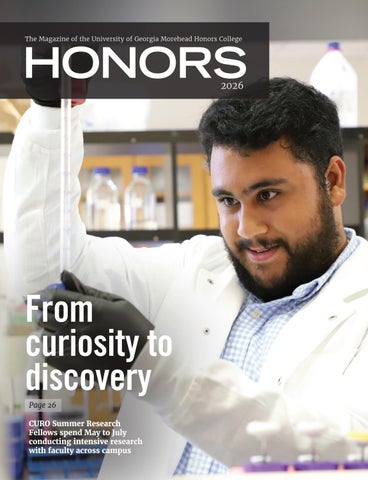
From curiosity to discovery Page 26 CURO Summer Research Fellows spend May to July conducting intensive research with faculty across campus
MOORE RESTORATION Housed on UGA’s historic North Campus, the Jere W. Morehead Honors College is celebrating its fifth birthday in a 150-year-old building. Moore Hall is the only building on UGA’s campus that dates to the late 19th century, with construction completed in 1876. Today, Moore Hall is undergoing major exterior renovations with a full-scale window refurbishment and painting, giving the historic building a freshened view onto North Campus and Herty Field. Read more about the Moore Hall building on page 20.
COVER AND INTERIOR PHOTOS BY STEPHANIE SCHUPSKA
Contents Inside 2
From the Dean
3
Honors in Brief
8
Staff Spotlight
10 Faculty Focus 32 Scholarships 43 Giving
Features 12 Community Impact 14 Global Study 18 Five Years a College 22 Digital Dawgs 26 Cover Story | Summer Research 39 Alumni Stories
On the cover Hanif Zaman was one of 24 undergraduates who spent summer 2025 in Athens as a CURO Summer Research Fellow. We share his story—along with the stories of five other Honors students involved in the program—on page 26.
48 Honors Advisory Board
Morehead Honors College Magazine // 2026
1
STEPHANIE SCHUPSKA
ADMINISTRATION Dean
Margaret A. Amstutz Associate Dean
James Warnock Assistant Dean
Jessica Hunt Assistant Dean
Maria de Rocher
From the Dean
Communications
Stephanie Schupska Development
Debbie Daniel Foundation Fellowship
Tricia Jonas Hackleman
MAGAZINE Editor/Designer
Stephanie Schupska Writers
Lillian Ballance, Hannah Gallant, Aaron Hale, Gracie Howard, Ella Johnson, Ben Limbocker, Allison Mawn, Joy Pope, Stephanie Schupska, Cole Sosebee, Chuck Toney Photographers
Lillian Ballance, David Blacher, Kora Burton, Wingate Downs, Peter Frey, Gracie Howard, Pierre O'Driscoll, Dot Paul, Billy Schuerman, Stephanie Schupska, Andrea Silletti, Andrew Davis Tucker, James Warnock Editorial assistance
Gracie Howard, Ella Johnson, Marlie Scoggins The Honors Magazine is published for students, alumni, friends, and supporters of the University of Georgia Morehead Honors College. For reprint permissions, address changes, or additional copies, email schupska@uga.edu. Copyright © 2026 by the University of Georgia. No part of this publication may be reproduced in any way without permission from the editor. The University of Georgia is committed to principles of equal opportunity and affirmative action. Postmaster | Send address changes to: UGA Honors Magazine 208 Moore Hall, 108 Herty Drive Athens, GA 30602-6116
A college milestone As we celebrate the fifth anniversary of the Morehead Honors College, I look back on my first four years as dean of the college with gratitude. My time in Moore Hall has been filled with the enthusiasm and engagement of so many wonderful people, from our students and faculty to Honors alumni and UGA’s senior leadership. This year, I have witnessed the excitement of students around UGA’s new School of Medicine; visited with Honors alumni from across the country; introduced New York City, Washington, D.C., and Oxford, England, to our first-year Foundation Fellows; and been honored by the gifts of others, particularly this year from Honors alumnus and faithful friend Joel Wooten. As I write this, Moore Hall itself looks a little different. Scaffolding wraps the building, and our beautiful windows are in North Carolina, being carefully refurbished by a company that specializes in historic window restoration. Soon, painters will begin refreshing the outside of our 150-year-old building, and I am excited for you to see the improvements. Our goal is to be excellent stewards of this College, its finances, and our beautiful building, all for the benefit of students. Last summer, we reconstituted the Honors College Advisory Board, bringing together an outstanding group of alumni. In December, Honors senior Finn Walsh was chosen as a Marshall Scholar, one of the most selective graduate awards for Americans. This January, we were delighted once again to be named by College Transitions as the top honors college in the nation. In March, our associate dean James Warnock traveled with 32 of our first-year Honors students to Finland to study sustainable infrastructure. This May, as we said our goodbyes to our graduating seniors, the first students I welcomed during my first months in the college, I had the great honor of delivering the Commencement address at UGA’s graduate ceremonies. From first year to graduation, our students carry with them the community we are building in Honors, one based on thought, respect, and gratitude for the gift of higher education.
Find us online at honors.uga.edu. Find us on social media at:
With thanks, Dean Meg Amstutz
2
Morehead Honors College Magazine // 2026
HONORS in Brief ORBITING DEBRIS
Benjamin Pumphrey presented NASA staff with a bold pitch in summer 2023: use a shoebox-sized satellite with a deployable net to capture space debris. The idea won a $10,000 NASA seed grant from the Marshall Space Flight Center. Benjamin, right, and fellow University of Georgia mechanical engineering student Grant Baumann, left, an Honors student, Foundation Fellow, and Stamps Scholar, have teamed up with 14 students from universities nationwide to develop technology to clean up space. Their project: Skyfall Space. Grant serves as the team’s principal investigator. Benjamin is the team’s lead engineer for technical development, focusing on systems engineering and other technical aspects. The threat of space debris or “space junk” is real and accelerating. The debris are remains from old satellites, scientific experiments, and military tests. The risk of junk colliding with operational spacecraft grows as satellites launch into orbit every day. Space debris about the size of a credit card can cause damage that looks like it was made by a car. “Even tiny pieces of shrapnel will rip through multi-milliondollar equipment like it’s a piece of paper,” Grant says. When two pieces of debris collide at high speeds, they fragment further and potentially create a cascade that can render entire orbital zones unusable for GPS, military, and weather satellites. Skyfall Space targets a critical gap: medium-sized debris, roughly 10 centimeters to a meter in diameter. In early 2025, Skyfall Space secured a second NASA seed grant to further develop the net capture mechanism.
DAVE BLISS
NIC FINK
MIKE MACDONALD
SARAH MERKEL
ANDREW DAVIS TUCKER
Netting a clean (outer) space
Grant’s and Benjamin’s training ground has been the Franklin College of Arts and Sciences’ and College of Engineering’s Small Satellite Research Lab, a student-faculty collaboration that develops and builds miniature research satellites. They joined as first-year students, working on a computational imaging satellite for the U.S. Air Force Research Lab. The experience prepared them for Skyfall Space’s technical challenges. “What I’ve been amazed by at UGA is the scope of the programs offered,” Grant says. “I’ve also had the opportunity to work on hard things with very passionate and smart people.” Grant and Benjamin graduated from the College of Engineering this spring, but they aren’t finished with Skyfall Space yet. The project needs more funding to build the satellite and test the net deployment system in space. It’s the kind of ambitious, boundary-pushing work that has defined their college experience. —Hannah Gallant
AVERY MONTHERO
PHILLIP MOTE
COLBY RUIZ
BRIAN WATTS
EXCELLENCE, RECOGNIZED
From medicine to sports, UGA highlights its 40 Under 40 Eight Honors alumni were selected for UGA's 40 Under 40 Class of 2025. UGA’s 40 Under 40 celebrates young alumni leading the pack in their industries and communities. Morehead Honors College recipients for 2025 were Dave Bliss, assistant coach for the Oklahoma City Thunder, who won the 2025 NBA championship; Nic Fink, Olympic gold medalist and project manager for Quanta Utilities Engineering Services; Mike
Macdonald, head coach of the Seattle Seahawks, who won Super Bowl LX in February 2026; Sarah Merkel, breast surgical oncologist with the Yale School of Medicine; Avery Monthero, sales account executive with Delta Air Lines; Phillip Mote, primary care pediatrics physician with Lee Health; Colby Ruiz, vascular surgeon with South Georgia Medical Center; and Brian Watts, data and research officer with The Pew Charitable Trusts.
Morehead Honors College Magazine // 2026
3
HONORS BY THE
NUMBERS
HONORS in Brief
#1
651
First-year students admitted for Fall 2025
274
KORA BURTON
Named the top Honors college in the nation for the second straight time
BURRITOS & TOURS
Social work lunch & learn field trip Honors students visited the School of Social Work housed in the historic mill site on the North Oconee River in April, where they learned about the school’s mission over free burritos during a lunch and learn. Dean Philip Hong introduced students to the school’s focus of policy, advocacy, community-based organizations, and human-centered practice in promoting change. Then, students were led on a guided tour by Dr. Jane McPherson, center, associate professor of social work and director of the Complex Cloth Project, to see pieces of the brand-new, awardwinning installation detailing the history of the former cotton mill.
Students admitted in Spring 2026 through First-Semester Entry DEVELOPING LEADERS
2,900 Total Honors students
5
years
In 2026, Honors is celebrating its fifth anniversary as a named college.
4
Morehead Honors College Magazine // 2026
Training ambassadors In March, the University of Georgia’s inaugural cohort of the Fanning Student Ambassador Leadership Certificate program graduated during a ceremony on the Athens campus. This professional development initiative equips student ambassadors from across UGA’s schools and colleges with leadership skills and career readiness. The Morehead Honors College was represented by Honors ambassador Creed Barrett, a junior studying biomedical physiology on a pre-med track. The program, developed and facilitated by the J.W. Fanning Institute for Leadership Development, a unit of UGA Public Service and Outreach, was made possible through a grant from the UGA Parents Leadership Council, which annually awards funding to campus programs dedicated to enriching the undergraduate experience. “Student ambassadors play an important role in shaping how prospective students and families experience the University of Georgia,” said Jason Edwards, Fanning Institute faculty member. “Thanks to the generous support of the UGA Parents Leadership Council, we brought together a cross-campus team to cocreate this one-of-a-kind program. ”
TINY ADVENTURES
Sophia Nguyen, a thirdyear Honors student majoring in international affairs and art history, takes a closer look at a tiny oval ambersnail crawling on a tree branch. She learned about local wildlife in Ecuador while on a spring break trip with the Foundation Fellowship.
ANDREA SILLETTI
Cloud forest lessons
Morehead Honors College Magazine // 2026
5
HONORS in Brief GAME CHANGERS
Whether it’s prepping a surface months in advance, helping repaint lines, or standing by on game day for quick turf repairs, his job is hands-on and always evolving. “I’m very proud of what I do. I think we have a very important job when it comes to UGA athletics, and I’m honored to be a part of it.” On game day, Tristan arrives early to set up and stands ready to assist on the field until the game ends—closer to the action that most fans could dream of being. “We’re a very small part of a very large group of people that go into a game day for football,” Tristan says. “We hold Sanford Stadium to a very high standard, just like UGA Football is held to a very high standard.” —Cole Sosebee
FULFILLING THE DREAM
Mentorship and opportunity Jhaycee Barnes is not one to shy away from opportunity. She’s often pursuing exposure to new mentor relationships and chances to try new things. In January, Jhaycee received the President’s Fulfilling the Dream Award at the 22nd Martin Luther King Jr. Freedom Breakfast. The award is given to individuals in the UGA and Athens-Clarke County communities who are working to make Rev. Martin Luther King Jr.’s dream a reality. In May, Jhaycee graduated with degrees in economics and political science with a minor in Spanish. As a senior in high school, Jhaycee wanted to apply to UGA and the Foundation Fellowship. “I came here for the interview weekend, and it was the most life-changing experience,” Jhaycee said. “Everything that I wanted out of the college experience was here at UGA through the Fellowship.” Jhaycee served as a campus tour guide through the UGA Visitors Center. She is a member of Delta Sigma Theta Sorority Inc. and is a DST legacy. She joined the Student Government Association and, this year, served as vice president of SGA. Now that she has graduated, she is working for the Boston Consulting Group in management consulting. Down the line, she hopes to continue doing strategy work. “I love connecting with people,” Jhaycee said. “I feel like a success with someone that I help is a success for me as well.” —Allison Mawn
6
Morehead Honors College Magazine // 2026
BILLY SCHUERMAN
Tristan Lowery, an Athens local who grew up around UGA sports, never imagined that he would be a part of something so iconic. As a Clarke Central High School student, he dualenrolled at the university and, without much thought, selected turfgrass management as a major. That decision, combined with strong faculty mentorship and a lifelong love of sports, set him on a path that merged science, hands-on work, and the thrill of competition. Tristan, an Honors student who graduated in May, later added a horticulture minor, a good combination for anyone managing full athletic facilities from fields to flowerbeds. As part of UGA’s athletics grounds crew, Tristan helps maintain several high-profile fields, including the football practice facility and Dooley Field at Sanford Stadium.
DOROTHY KOZLOWSKI
Learning under the stadium lights
GOLD DOME LEARNING
CLASSROOM TO STAGE
Day at the Capitol
Pageants & service
SUBMITTED
The Arch Policy Institute hosted its annual API Day at the Capitol in mid March. API is a non-partisan, student-run policy think tank sponsored by the Morehead Honors College. Honors students traveled to the state capitol in Atlanta to learn about the state-level policy-making process, observe the state’s ongoing legislative session, and meet with Athensarea representatives, including state Sen. Frank Ginn and Reps. Spencer Frye, Houston Gaines, and Eric Gisler. They were joined on the trip by Emma Grace Jarvis, API co-executive director, other members of the API leadership team, and Kora Burton, Honors student affairs professional.
For Jackson Swann, pageants are more than just competitions: they’re a platform for service. An Honors international business and management major with a fashion merchandising minor, she was first-runner up in the 2026 Miss UGA Pageant and received the competition’s Miss Congeniality and Interview Awards. Jackson has been doing pageants for most of her life and is passionate about helping others, with her current community service initiative, Hands That Heal, addressing the well-being crisis in healthcare professionals. She has also been the recipient of the Gold President’s Volunteer Service Award for her volunteer work. “Being an Honors student is not just a title you hold as a student; it is a lifestyle you carry with you in all aspects of life,” Jackson said. “The dedication, leadership, and communication skills I have learned being in the Honors College supported and truly helped me excel at Miss UGA.” Outside of Hands That Heal, she is part of Wesley at UGA and has volunteered extensively with the Ronald McDonald House, Hands Across Atlanta, Toys for Tots, and other nonprofit organizations. At just 14, she launched her own cosmetics company, Swann Beauty, making lip glosses by hand that were sold across four states. Last summer, Jackson interned for ASHLEYlauren, a leading women’s formal wear designer, and plans to pursue a career in the fashion industry after graduation. —Gracie Howard
HONORS BANQUET
Outstanding recipients WINGATE DOWNS
Each year, the Morehead Honors College celebrates a select group of outstanding seniors during the Honors Banquet. Five of the recipients are chosen by their colleges, and seven are selected by the Honors College. Students are listed in the order they appear in the photo. From left to right are Dominic Roselli, Outstanding Honors Student in Business Award; Nikita Jha, Joy P. Williams Science Award, Physical Sciences; Erin Suh, Joy P. Williams Science
Award, Life Sciences; Matthew Schmitt, Alan J. Jaworski Science Award, Life Sciences; Zahin Hoque, Alan J. Jaworski Science Award, Physical Sciences; Meagan McColloch, Outstanding Honors Student in the Humanities Award; Bridget Goodman, George M. Abney Award; Sara Anis Ali, Outstanding Honors Student in the Social
Sciences Award; Gabriela Sanchez, Mary Frances Early College of Education Award; Audrey Knoper, Dr. Ashlee Nicole S. Tillery Award; Keirsten Nizen, Outstanding Honors Student in the College of Family and Consumer Sciences Award; and Widener Norris, Wooten Outstanding Honors Student Award.
Morehead Honors College Magazine // 2026
7
STAFF SPOTLIGHT
Curiosity taking root: Andrea Silletti uses her background studying plants to guide undergraduate researchers through CURO By Gracie Howard are majoring in fields ranging from humanities to social sciences to business. “I feel lucky to work with the best students on campus, because very few students have to do research for their degree,” Andrea said. “I really am fortunate to work with this population of students, because they’re just putting so much energy into what they’re doing. They give me hope for the next generation.” Andrea is also back at work on her own studies. She is earning a PhD through UGA’s Louise McBee Institute of Higher Education and plans to conduct dissertation research focused on undergraduate research experiences in higher education. Outside of UGA, Andrea enjoys sewing, reading, baking, and traveling to state parks around Georgia with her husband and two children, who are undergraduates at UGA.
Read more about one of Andrea's
8
Morehead Honors College Magazine // 2026
major projects, the annual CURO Summer Research Fellowship, on page 26.
STEPHANIE SCHUPSKA
A
ndrea Silletti combines her passion for research with her love of working with undergraduate students. As the program coordinator for the Center for Undergraduate Research Opportunities, she oversees CURO operations, conducts outreach and workshops, processes applications for various programs and classes, and oversees the CURO Symposium, UGA’s annual undergraduate research showcase. CURO facilitates faculty-mentored research with UGA undergraduates who are in any year in their bachelor’s degree, including those in their first semester. Even with all her responsibilities, students are Andrea's top priority. “A lot of students, I meet them first when they’re first starting college, their first semester, and maybe they’re not sure what research is or how it’s going to fit into their college experience,” Andrea said. “And then I get to see them all four years. I’ve really seen them just develop as students and as researchers and as individuals, and it’s been really satisfying.” Just like her students in CURO, Andrea was also an undergraduate researcher, sharing that it “was a really big and important experience in my life.” She completed work in plant ecology before graduating with her bachelor’s degree in environmental studies. Her master’s degree is in general biology, and for her thesis, she conducted research in ecology, examining tallgrass prairie and the plants competing for essential and limited resources like light, nutrients, and water. Prior to working for CURO, which is housed in the Morehead Honors College, Andrea was a lab manager at the Odum School of Ecology. She was also an ecologist with the U.S. Forest Service and a research associate at Oak Ridge National Laboratory. “Having something of a history of being involved in research does help me to interpret or have an understanding of the research process, how to apply it, and how it works,” Andrea said. Although her research background is in ecology, Andrea aims to encourage undergraduates of all majors— not just those from STEM fields—to conduct research that interests them. According to Andrea, the most rewarding part of her job is working with the many bright students at UGA, who
JAMES WARNOCK
SUBMITTED
J
ames Warnock, associate dean for the Morehead Honors College, traveled to Finland with firstyear Honors students through UGA’s Connect Abroad program. Over spring break, they learned about what is often considered the world’s happiest country through a lens of sustainability, equity, and innovative thinking. With Finland aiming for carbon neutrality by 2035 and 75% of its land covered in forests and a vast natural landscape, the country provides a unique chance to study the intersections of ecological stewardship and sustainable development. While abroad, students had the opportunity to witness real-life case studies presented in the Smart Cities of Kalasatama and Jätkäsaari and visit the Aalto House and Studio Aalto, the former home and offices of renowned Finnish architect Alvar Aalto. Since their construction in the mid20th century, the Aalto properties have acted as hubs of design innovation, with the architect experimenting with plans that went on to shape buildings, urban environments, and sustainability across Finland and the world. According to Dr. Warnock, Aalto
saw architecture as a vessel to improve human life. “Long before sustainability became a buzzword, Aalto was designing buildings that worked with nature rather than against it,” Dr. Warnock said. As the environment goes hand-inhand with sustainability, students also enjoyed the opportunity to connect with the country’s natural landscape. On the program’s final day, the group traveled out of Helsinki, Finland’s capitol, to Nuuksio National Park, which features a plethora of lakes, cliffs, and forests—offering visitors a slowed pace of life and a deepened connection to nature. With the park being located less than one hour outside of Helsinki, Honors students took into consideration that protecting natural spaces is a human priority in addition to an environmental one. “For our students, this experience was more than just a scenic hike. It was a powerful reminder that sustainability, mental health, and quality of life are deeply interconnected,” he said. “Finland doesn’t just talk about these ideas. It lives them.” —Gracie Howard
JAMES WARNOCK
First-year Honors students ‘connect abroad’ to learn in Finland
JAMES WARNOCK
SUBMITTED
Sustainability & ecological stewardship
Morehead Honors College Magazine // 2026
9
FACULTY FOCUS
Maryann Gallagher Fostering ‘enormously rewarding’ undergraduate research at UGA
PETER FREY
By Stephanie Schupska
W
hen Maryann Gallagher stepped onto the stage at the Classic Center to give the keynote talk for the 2026 CURO Symposium, it was the second time she had done so for an event hosted by the Morehead Honors College. On March 31, she was honored with the Morehead/Bullock Outstanding Honors Faculty Award at the Honors Graduation Banquet. Less than a month later, on April 20, she spoke on the value of undergraduate research to a room of undergraduates, their faculty mentors, and University of Georgia administrators. Her work with undergraduates is extensive: She mentors students in her classes and as the director of the Richard B. Russell Security Leadership Program at the Benson-Bertsch Center for International Trade and Security. She is a senior lecturer in the School of Public and International Affairs, or SPIA, and an affiliate faculty member in the Institute for Women’s Studies. Dr. Gallagher’s research and teaching interests include American foreign policy, gender in international relations, and the scholarship of teaching and learning. She teaches upper-level courses and a first-semester practicum course and supervises the research semester for students in the Security Leadership Program. On April 24, she was busy with her own research event as the faculty organizer of SPIA’s annual Undergraduate Research Colloquium. This all-day event celebrates the research experiences of SPIA’s outstanding undergraduate students and the faculty who facilitate their work.
10
Morehead Honors College Magazine // 2026
Below, we take a peek into her life as a faculty member and learn about what makes her connection to the Honors College so special. What does your typical workday look like? The focus of the day really depends on the day of the week, but one constant is responding to lots of emails. On teaching days, I teach three courses: the two Security Leadership Program courses and a large section of another international affairs course. On non-teaching days I have office hours and meetings with students to discuss everything from their research to career planning. I also have weekly meetings with my peer learning assistants, with students in the Women, Peace, and Security Local Diplomacy Lab, CURO students, and with the staff at the Benson-Bertsch Center for International Trade and Security. Excitingly, I just started in UGA’s inaugural cohort of Creative Engagement Wing Fellows, where I’ll be developing ways to include podcasting in my courses, and that meets most Fridays. In between, there’s lots of other meetings, writing letters of recommendation, grading assignments, prepping classes, and hopefully getting to do a few hours of research. What has been a favorite memory of working with Honors students and/or with CURO students? It’s hard to pick just one as there have been so many wonderful memories, from seeing CURO students present
Maryann Gallagher discusses research with Honors student Justin Cohen in the Benson-Bertsch Center for International Trade and Security.
their research to so many inspiring discussions in my Honors women and world politics courses. But if I could pick two (cheating just a bit), the first is the reunion celebrations I’ve had with students from the Honors women and world politics course. We had a gathering of several cohorts at my house back in 2018, and the 2021 group had a reunion on campus. The mix of the small class size and the topic of the course often leads to students developing a bond that goes beyond the typical class. My second favorite memory is conducting interviews with prosecutors and investigators at the international courts in The Hague with my CURO student and co-author, Zoe Li, a Foundation Fellow who graduated in 2019. What comes to mind when you think about the Morehead Honors College? CURO! While I know the Morehead Honors College does so much more, the impact of the Center for Undergraduate Research Opportunities (CURO) is profound and felt across campus. I spend time in all my courses sharing how remarkable UGA is because of its commitment to undergraduate research, and CURO is the heart of that. The program supports undergraduate research with time through course credit, mentorship through faculty, and money through research awards. How do you think Honors has strengthened the University of Georgia? Honors does so much for the entire UGA student body and alumni, not just Honors students! From CURO research, which is open to all students, to the wonderful people in Honors who support all students and alumni in the competitive awards and scholarships process. The opportunities created by the Morehead Honors College support the success and development of all students on campus. How has Honors enriched your work as a faculty member? Honors has given me a way to foster undergraduate research through CURO that has been enormously rewarding. I have been able to work closely with students and see them develop their voices as scholars. It has also supported my professional development by fostering coauthor relationships with my CURO students.
STEPHANIE SCHUPSKA
Morehead Honors College faculty teaching and mentoring award recipients The Morehead Honors College celebrates excellence each year through its Distinguished Faculty Awards. These awards recognize outstanding faculty who have demonstrated a notable commitment to high-quality instruction and creativity related to teaching and mentoring students in the Morehead Honors College. 2025-2026 Lothar Tresp Outstanding Honors Professor Awards This award recognizes superior teaching and dedication to Honors students. Two recipients are selected each year. • Susan Rosenbaum, associate professor in the Department of English and co-director of the Interdisciplinary Modernisms Workshop in the Franklin College of Arts and Sciences • Fausto O. Sarmiento, professor in the Department of Geography and director of the Neotropical Montology Collaboratory in the Franklin College of Arts and Sciences 2025-2026 J. Hatten Howard III Teaching Award The award was established to recognize faculty members who exhibit special promise in teaching Honors courses early in their careers. • Rubén Maíllo-Pozo, senior lecturer of Spanish in the Department of Romance Languages in the Franklin College of Arts and Sciences 2025-2026 Morehead/Bullock Outstanding Honors Faculty Award The award recognizes faculty members of any rank for superior teaching, mentoring, and dedication to the growth of Honors students. • Maryann E. Gallagher, senior lecturer in the Department of International Affairs and director of the Security Leadership Program in the School of Public and International Affairs 2025-2026 Floyd C. Newton, Jr. Outstanding Honors Faculty Award The award recognizes faculty members of any rank for superior teaching, outstanding instruction, and dedicated mentoring of Honors students. • Gulcan Saglam, senior lecturer in the Department of International Affairs in the School of Public and International Affairs
Morehead Honors College Magazine // 2026
11
COMMUNITY IMPACT
A mountain of backpacks Student-run nonprofit gathers volunteers and supplies for its annual Homeless Heroes Day By Ben Limbocker
E
ach year, Homeless Heroes Day brings together volunteers from corporations across Atlanta to deepen their understanding of homelessness while packing and distributing backpacks filled with essential items. The event, held in the fall, serves individuals experiencing homelessness throughout the city, with a particular focus on veterans. Homeless Heroes Day is organized by The Backpack Project, Inc., a fully student-run nonprofit at the University of Georgia dedicated to packing and distributing backpacks filled with essential items for individuals experiencing homelessness. The Homeless Heroes Day in 2025 was led by two students in the Morehead Honors College: Ben Limbocker, serving as chief executive officer, and Megha Nair, as chief operating officer. With the support of their leadership team, they coordinated efforts that raised over $40,000, packed 1,520 backpacks, and brought together more than 250 volunteers. “Each backpack makes a meaningful impact for someone experiencing homelessness and, especially during the cold winter months, helps ease an immediate burden,” Ben shared. “Packing and distributing this number of backpacks in a single day is an incredible accomplishment that provides critical support to individuals across the greater Atlanta area.” After packing at the Westside Warehouse in Atlanta, each of the corporate sponsors transported the backpacks they had packed to nearby shelters. In 2025, they were able to donate backpacks to five different shelters. “I was incredibly proud to share the impact of this year’s Homeless Heroes Day,” Megha said. “I had the honor of coordinating with outstanding corporate partners to serve our veterans experiencing homelessness in Atlanta.” Corporate and community partners included QTS Data Centers, Credigy, Ameris Bank, KPMG, and USHEALTH Advisors. Gateway Center, Nicholas House, Inc., The Salvation Army, Veterans Empowerment Organization, and Crossroads Community Ministries also exhibited the real-world impact of each backpack to the volunteers and assisted in distributing the backpacks across Atlanta. Chick-fil-A Restaurants donated breakfast. “Each backpack makes an incredible impact,” Ben shared, and “we were able to meaningfully ease the burden for individuals experiencing homelessness.”
12
Morehead Honors College Magazine // 2026
Photos by Pierre O'Driscoll. Left, top: Backpacks have been packed and are ready for their recipients after Homeless Heroes Day in 2025. Middle: Ben Limbocker, right, shares about the impact of The Backpack Project Inc. and Homeless Heroes Day with Mark Arnold, left, from The ATL Now. Bottom: Honors students Megha Nair, left, and Yoshika Ankem hold up the backpacks that will later be distributed across Atlanta to those experiencing homelessness.
COMMUNITY IMPACT
Right, top: UGA undergraduates Megha Nair, left, Ben Limbocker, center, and Molly Sims stand in front of a sign displaying the 1,520 backpacks packed. They led the planning and execution of the event as chief operating officer, chief executive officer, and chief of staff, respectively. Bottom left: Backpack Project team members prepare for the 250-plus volunteers about to walk through the door of the Westside Warehouse in Atlanta. Bottom right: Honors student Cohen Coolidge checks in a volunteer at the event.
Morehead Honors College Magazine // 2026
13
GLOBAL STUDY
Insects, economies & country relations Oliver Safir, Tybet New & Ella Colker learn around the world through funding from the Honors International Scholars Program By Ella Johnson, with photos submitted by the students
14
Morehead Honors College Magazine // 2026
This page: Oliver Safir visits with llamas and alpacas in Quito, Ecuador. Facing page, top: Oliver takes Hairy Dawg on a hike in Ecuador. Bottom: Tybet New attends a performance in Vienna.
EXAMINING A WORLD OF INSECTS
F
rom spending the summer sailing on the choppy Pacific waters around the Galapagos in search of remote lava tunnels to exploring Ecuador’s cloud forest jungles at the Maquipucuna Reserve for unusual insects, Oliver Safir was not just an Honors student taking a summer course: he was an outdoor field researcher. An entomology and applied biotechnology double major, Oliver traveled to Ecuador and the Galapagos Islands with the UGA College of Agricultural and Environmental Sciences for a three-week summer course in tropical entomology and evolutionary biology. Oliver is interested in pursuing medical entomology—the study of insects and how they impact human and animal health—particularly as it relates to tropical and subtropical diseases. Instead of learning about biodiversity in a classroom, Oliver went out onto the walking trails every day and night, capturing memorable insect images and identifying samples for research and
“
GLOBAL STUDY
“Honors has given me so many resources, and that’s something I’m really thankful for. I immersed myself in the biodiversity of Ecuador in the cloud forest and truly learned what biodiversity means and why we should protect it.” - Oliver Safir, entomology & applied biotechnology
discussion. In Ecuador, the program took on more of an entomology focus with students attending lectures and labs related to tropical entomology and insect natural history. Oliver particularly loved examining the moth sheet—a white sheet hung vertically with a bright light source positioned in front of it. This field technique is used by entomologists to attract and observe moths and other nocturnal insects. “Every night we set up a blacklight and saw the plethora of moths that swarmed it, seeing moths bigger than your hand, moths with bright orange bodies and clear wings, and moths that looked identical to leaves or moss,” he said. In the Galapagos, there was a special emphasis on evolution and marine biodiversity. Oliver and his group took daily snorkeling trips, closely observing the islands’ unique fauna. They hiked the Isabela, Santa Cruz, and San Cristobal Islands, observing birds and other animals
while searching for new insects. Their firsthand experience of Darwin’s theory of evolution was reinforced at the Charles Darwin Research Center and the biodiversity center in Quito, as they went behind the scenes into their entomology collections. Beyond research, Oliver explored local culture through visits to coffee and cacao plantations and visited the ecotouristic towns that neighbor the Maquipucuna Cloud Forests in the Chocó Andino Biosphere Reserve. He was surprised at the welcoming culture of the region and was in awe of the community’s shared commitment to protecting their forests. These field experiences now inform Oliver’s work on campus as an executive of the undergraduate entomology club, called Bug Bites, through which he organizes insectcollecting trips, lectures, and tours. He is also a research assistant at UGA and works in associate professor Kevin Vogel’s lab studying kissing bugs and their bacterial interactions, crediting Honors for making the opportunity possible. “Honors has given me so many resources, and that’s something I’m really thankful for,” Oliver said. “I immersed myself in the biodiversity of Ecuador in the cloud forest, and truly learned what biodiversity means and why we should protect it.”
ADAPTING TO GLOBAL ECONOMIES
Fresh from her first international flight, Tybet New arrived in Vienna ready to deepen her economics knowledge. What she didn’t know was how the city and its international community would reshape her perspective entirely. The economics major spent spring 2025 at the Vienna University of Economics and Business, where she had access to specialized courses in behavioral economics, sustainability, and supply chain management. She studied Austria’s service-based economy firsthand, learning how its competitive dynamics differ fundamentally from U.S. manufacturing approaches. The exchange format gave Tybet the independence to build connections organically within a cohort of students
Morehead Honors College Magazine // 2026
15
GLOBAL STUDY from over 100 countries. In group consulting projects examining real companies, she quickly discovered her assumptions about shared business knowledge didn’t hold up. “I had to quickly learn normal business acumen and models familiar to Austrian students at this university but not to myself,” she said. These lessons extended beyond the classroom during a guided tour of the United Nations headquarters, where she met with officials who offered insights into differences in international work culture and how global companies adapt to local markets—perspectives that directly informed the consulting work she was doing with her multinational team. These academic experiences gave Tybet a new perspective on business dynamics between Western Europe and the U.S., but Vienna offered more than professional development. The city’s renowned arts scene and public museum system offered cultural access outside of the classroom with incentives for students on discounted tickets to artistic and cultural events. Tybet was able to see several ballets and operas at a fraction of the cost. “I study business and STEM, and yet I found so much joy in learning about art, its history, and how it can truly tell a thousand stories in one image,” she said. Her semester abroad shaped her into a more reflective and intellectual thinker—a mindset she now brings to everything she does back home at UGA. On campus, Tybet is a part of the Georgia Kickstart Fund and Delta Sigma Pi business fraternity. Tybet applied to Honors mid-semester freshman year, and she loves being part of an interdisciplinary community beyond the Terry College of Business. Through Honors, Tybet enjoys access to different perspectives and approaches from students and faculty across campus and participates in lunchbox lectures and book discussions. “There are so many resources and opportunities in Honors that I tell myself all the time, I can’t believe I almost missed out on this,” Tybet said.
RESEARCHING INTERNATIONAL RELATIONS
Exploring beautiful mosques, trekking across the Sahara Desert on camelback, and enjoying all the tagines and pastillas she could, Ella Colker made the most of her time abroad in Morocco. But her time in the North African country wasn’t just cultural immersion—it was serious academic fieldwork. Ella, an Honors student majoring in international affairs and political science, traveled to Morocco with the first instance of the UGA GLOBIS Maymester. She came to learn about the study abroad opportunity through her research mentor, Eli Sperling, the program’s director. Her research on campus examines Israeli-Moroccan relations, and Dr. Sperling recommended that Ella take the opportunity to continue her research abroad. That opportunity took shape across five Moroccan cities, including Rabat, Fes, Merzouga, Marrakech, and Casablanca. Alongside Dr. Sperling’s course in Middle Eastern politics, which included six lectures on the history of politics across the region, students were required to complete a guided, independent research project. Ella decided to research the extent to which the Moroccan government censors public discourse about Israel following the controversial Abraham Accords. She conducted field interviews with several Moroccan professors, government officials, and tour guides, building on her previous research. While attending class and conducting independent research represented a large part of the program, most of Ella’s time was spent in the field experiencing the rich culture of the region firsthand. Prior
16
Morehead Honors College Magazine // 2026
“
GLOBAL STUDY
“My time abroad exposed me to people and perspectives that I likely would never have met otherwise, and at the same time, established further that this is really something that I would want to do with the rest of my life.” - Ella Colker, international affairs & political science
to her departure for Morocco, she completed two semesters of Arabic, providing a robust language background for her time abroad. “I was able to order food, buy souvenirs in the markets, and make small talk about topics like the weather,” Ella said. “The whole experience made me more excited to continue learning Arabic at school.” This language immersion and field research experience reaffirmed Ella’s career path. She plans to complete a one-year master’s program at Tel Aviv University while continuing to practice Arabic and Hebrew. Following her master’s degree, she aspires to attend law school to eventually become a foreign policy advisor. She credits Honors for making her career opportunities possible. “Honors has helped me focus on academics and involvement instead of on trying to find things that will pay me the most money. I feel very supported,” she said. Back on campus, Ella’s interest in politics is not limited to academics and research —it informs every aspect of her involvement. She is a SPIA ambassador, a Frye Fellow, and a longstanding member of the UGA Student Government Association, serving as a member of the cabinet’s campus service outreach team and a volunteer at the Professional Clothing Closet. “My time abroad exposed me to people and perspectives that I likely would never have met otherwise, and at the same time, established further that this is really something that I would want to do with the rest of my life,” she said.
Facing page: Tybet New ice skates at the annual Wiener Eistraum, or Viennese Ice Dream, located around City Hall in Vienna, Austria, top, and travels along the First Cliff Walk by Tissot Grindelwald in Switzerland. This page: Ella Colker makes friends with a camel, top, and learns how to throw a vase during a pottery class at Mosaïque et Poterie de Fès in Fès, Morocco. Morehead Honors College Magazine // 2026
17
ANNIVERSARY NOTES | CELEBRATING OUR HISTORY
Five years a college Named for UGA President Jere W. Morehead in 2021, the Morehead Honors College is celebrating its fifth birthday in 2026 By Chuck Toney
I
t was a fairly routine item on the agenda for the University System of Georgia Board of Regents meeting in May of 2021, the naming of a college. But for the University of Georgia, the UGA Foundation trustees who led the effort, and the namesake of that college, it was anything but normal. The Jere W. Morehead Honors College was unanimously approved by the Regents at that meeting, the final act in a long process of deliberation about the role and the future of Honors education at the university. Morehead, who was now UGA’s 22nd president, served as director of the Honors Program from 1999-2004. He remained an Honors advocate as he advanced through university administration, from vice president for instruction to provost before being named president in 2013, according to John Spalding, an emeritus trustee of the UGA Foundation.
ANDREW DAVIS TUCKER
18
Morehead Honors College Magazine // 2026
DOT PAUL
WINGATE DOWNS
Facing page: Moore Hall in the early morning. Above, left: Dean Meg Amstutz shakes hands with a student at the Honors Graduation Banquet in March. Above, right: David S. Williams, founding dean of the Morehead Honors College, chats with Foundation Fellows in the Moore Hall lobby in 2008. Right: UGA Foundation trustees and UGA administrators gathered with President Jere W. Morehead for the Honors College ribbon cutting in 2021.
“There are a lot of choices for academically talented and intellectually curious high school students. The Honors College helps attract them to UGA just like the Honors Program attracted me, with a nudge from my uncle, Dr. Phinizy Spalding, in 1978,” he said. At the time, Spalding was focused on the University of North Carolina. He would have attended UNC if his uncle hadn’t brought him to UGA’s campus and introduced him to Lothar Tresp, who was the director of the Honors Program from 1967-1994. “I saw that UGA could offer an Ivy League quality education at an SEC school, and I could have the best of both worlds,” he said. “Being in Athens, with all it offers, made it even more attractive.” A UGA Foundation Trustee, Spalding recounted that Morehead had a clear vision for the Honors Program to become its own college, with Morehead creating an Honors Advisory Council and asking him
ANDREW DAVIS TUCKER
to join. Spalding credits the nowuniversity president with continuing to focus attention and, importantly, financial resources on the Honors Program. Bill Griffin, an emeritus Foundation trustee and a leader in the naming effort, says that the idea of elevating the Honors Program to college status had been discussed for years. President Morehead “established the priority to name the Honors Program for someone, which also meant it would become a college.” When Griffin and several other trustees completed their terms on the Foundation board, they saw it as a goal they could achieve in conjunction with the UGA Foundation. “We agreed that whatever Jere was
supporting as a strategic initiative for the university was what we were going to support,” he recalls. “As emeritus trustees, we would take the lead on the naming and raise the money needed to accomplish that. And as we discussed it, we decided that the college should be named for Jere Morehead.” “It was an exciting project. Everybody wanted to be invited to honor him in this way. We knew that nothing we could have done would have touched his heart more than naming the Honors College for him.” The Honors Program began at UGA in 1960 under the direction of faculty member C. Jay Smith, Jr., with Tresp taking over seven years later. In his history of Honors education at UGA, David S. Williams, who served as the
Morehead Honors College Magazine // 2026
19
Honors Program’s director for 18 years and is the founding dean of the Honors College, wrote: “To many people of a certain age, Lothar Tresp was the Honors Program.” Under Tresp’s leadership, the program was expanded from its home in the Franklin College of Arts and Sciences to include every undergraduate college and school at UGA and was made a unit of the vice president for instruction. That status made the Honors Program a crucial element of UGA’s academic reputation nationally. Naming the Honors College for President Morehead is a fitting tribute, according to Howard Young, one of the emeritus trustees involved in the fundraising effort to support the recognition. “As director of the Honors Program, he was an advocate for the students and the resources they needed to succeed, and as provost and president he has continued to be a strong voice for Honors,” he said. “It was no surprise that we were able to raise $12 million in a relatively short period of time to show the university’s commitment to the Honors College. When people learned that it was going to be named for Jere, they wanted to contribute, and that speaks volumes to how people feel about him.” “The Honors College is a very special place inside a very special place. It is UGA’s crown jewel and I am so proud of the students.” Meg Amstutz, dean of the Morehead Honors College, echoes the language of the UGA charter, written in 1785 by Abraham Baldwin, the university’s first president, who described the youth of Georgia as “the rising hope of our land.” “These students are our hope, and our students
are filled with hope, and that is a great recipe for the future,” she said. “Our people, the students, faculty, and staff, are what make the Morehead Honors College great. We know our students are going to make a difference in the world, and that makes this work a privilege for all of us.” The structure of the Honors College is unique: There are no separate Honors College faculty. Instead, it draws on the contributions of faculty from every undergraduate college and school to provide instruction and mentorship. That gives Honors students the ability to live in two worlds. “The students see it as a way to affiliate with Honors as closely as they do with their home college or school,” Amstutz said. “They also have the opportunity to interact with students from other academic areas in ways they would not have if they were outside the Honors College. Offering a small liberal arts college environment within this large, active research university has been of great benefit to our students.” Chloé Kelley was one of those students. She tells a powerful story about Morehead from when she was a Foundation Fellow in the Honors Program. Now a Foundation trustee, she appreciates his commitment to students, collectively and individually. “President Morehead was an important part of my time at UGA. He was director of the Honors Program, and I was a student,” she recalled. “College was admittedly overwhelming for me, and my first semester grades were not what they should be. He sat down with me and asked me what support I needed to be successful here.
Honors Ambassadors descend the steps of Moore Hall in fall 2021.
STEPHANIE SCHUPSKA
HISTORY OF MOORE HALL Moore Hall, known as Moore College until 2021, is the only building on the University of Georgia campus that dates to the late 19th century, with construction finalized in 1876. The building is named after Richard D. Moore, an Athens physician and member of the university’s board of trustees who was vital in persuading the city to fund the building’s construction. Designed by Leon Henri Charbonnier, a UGA professor of mathematics and engineering, Moore Hall is UGA’s only piece of Second Empire architecture. The building features a mansard roof; its double slopes create a full-height top floor instead of shallow storage space. Prof. Charbonnier reported in the Northeast Georgian newspaper on May 19, 1875, that the building was a gift of the city of Athens to the University of Georgia in 1874. He shared that contracts for the building were made on May 15, 1874, with the
20
Morehead Honors College Magazine // 2026
e of ring the tim as taken du from 1875. w l al H re oo g ograph of M e Board of Trustees lo storic phot th Left: This hi y. Right: Text shows bugg horse and
“He is such an incredible leader, and I knew in that moment that he wanted me to have a great experience as an Honors student. Jere always puts the students first even in his role as president, and he does it with such a genuine personal touch that it makes this huge university feel smaller.” That legendary commitment to the students at UGA is evident when Morehead speaks about the Honors College that now bears his name. “Honors creates a community within a large public institution where the best and brightest students feel supported and provided with the resources they need to have a successful academic experience at UGA,” he said from his office on North Campus. “On a campus with 30,000-plus undergraduates, having 10 percent of those students eligible to participate in these elevated experiences is critical. “It was a tremendous honor to have the Honors College named for me. I was very moved by the support of the trustees, past students, and the Board of Regents. It was a humbling and rewarding experience.” Morehead is quick to credit his predecessors in the history of Honors education at UGA, Tresp and Williams, for the foundational work they did. The current dean also receives his praise. “Meg is doing a fantastic job as dean. She is a beloved figure in the Honors College,” he said. The Morehead Honors College was recently noted among the Top 5 Honors colleges nationally by Forbes, as well as being named top honors college in the nation for the second time in January. That external recognition from Forbes and College Transitions is gratifying, Amstutz said, but she observes an almost daily occurrence that is equally gratifying. “I love to look out our windows and see the Visitors Center tour groups stopping on Herty Field behind Moore Hall,” she said. “The Morehead Honors College is a point of pride for the institution.”
ground broken for foundation on June 17, the cornerstone laid on July 9, and the building covered in by Oct. 15, 1874. “The building has been constructed of the best material and in the most substantial manner,” Prof. Charbonnier stated, adding that “the first floor will be occupied by the Department of Chemistry; the second floor is appropriated to the Department of Natural Philosophy; and the third floor will be for the Engineering Department.” Minutes from the log of the UGA Board of Trustees correspondence and reports recorded in July 1875 note that “on the 19th day of June last the new building known as Moore College was opened and publicly dedicated to Science and the Mechanic Arts.
…lectures to which the public were invited were delivered on four successive days. The lectures were [able] and appropriate, the attendance was large, and the occasion was one of profit as well as one of pleasure and enthusiasm.” Moore Hall originally housed the State College of Agriculture and Mechanical Arts. Other departments, such as engineering, physics, astronomy, and romance languages, were sited in Moore Hall throughout the years. The building was first renovated in the late 1930s, and the exterior stucco was believed to have been installed at this time. After a full renovation, the Honors Program moved into the building in 2001. In 2021, the Honors Program was renamed the Jere W. Morehead Honors College. Today, Moore Hall is undergoing major exterior renovations with a full-scale window refurbishment and painting, giving the historic building a freshened view onto North Campus and Herty Field. —Olivia Kosobud and Gracie Howard
Morehead Honors College Magazine // 2026
21
Digital connections Six Honors students share their stories on social media as Digital Dawgs for the University of Georgia By Gracie Howard
22
Morehead Honors College Magazine // 2026
CHAMBERLAIN SMITH
B
etween the flashes of phone cameras and video shoots with friends, Digital Dawgs— the University of Georgia’s group of student social media ambassadors—view promoting UGA’s campus and student life as more than just an extracurricular or a resume builder. It’s a way to tell their own unique narratives and connect with others at UGA, in the Morehead Honors College, and beyond through digital storytelling.
GRACIE HOWARD
Honors Digital Dawgs Luke Krohn, MJ Pitt, Swetha Pendela, and Laila Carter gather for a group photo outside of Moore Hall on North Campus.
Their career interests range from health care to journalism, with their majors covering everything from economics to pharmaceutical sciences. Swetha Pendela (uga.swetha) Swetha, left, is pursuing dual majors in biochemistry and molecular biology and international affairs on the pre-med track. She shares her life on an Instagram account that is budding close to 1,000 followers, using her platform to relieve stress while studying for the MCAT, share her undergraduate research, and allow people to follow her day-to-day schedule. Swetha’s goal is to show her fellow Bulldogs that Honors students are more than just academics: they can be fun, too. She shares her point of view through silly videos on campus, taste tests, and selfies with friends. “One thing I’ve learned as a Digital Dawg is that everyone has a story to share, and your story is valuable,” said Swetha, a fourth-year Honors student and second-year Digital Dawg.
GRACIE HOWARD
Zion Brannon, Laila Carter, Jackson Dollar, Luke Krohn, Swetha Pendela, and MJ Pitt represent UGA and the Honors College as Digital Dawgs. An initiative of UGA’s Division of Marketing and Communications, Digital Dawgs share their student experiences through videos, photos, and direct engagement with followers on Instagram.
Luke Krohn (uga.luke) Fun is a word that Luke, a fourth-year ecology and environmental economics and management major, is also familiar with. In fall 2024, Luke had a viral moment after appearing on a campus open mic video on UGA’s social media accounts. He shared that his goal for the semester was not to make As, land an internship, or join campus organizations—but to befriend the turtles at the turtle pond. Managed by the Warnell School of Forestry and Natural Resources, the often-overlooked pond had been under construction for several years. Luke’s shoutout gave Warnell’s turtle pond a wave of love and attention. “Giving voice to all of the communities that you’re a part of or around is important, no matter who has the most resources,” Luke said in reference to his college, the Odum School of Ecology, which is located on South Campus right next to Warnell.
Digital Dawgs is important because it allows you to give a voice to all of the communities that you're part of or around, no matter who has the most resources. LUKE KROHN
Morehead Honors College Magazine // 2026
23
As a Digital Dawg, Luke is hands deep in scientific communication, helping “people learn without them realizing it” through content such as his turtle moment, involvement in UGA’s garden club, and study abroad in Uruguay, where he explored international agribusiness and diversified livestock.
LAILA CARTER
The Digital Dawgs program has been a really fun experience, and I wouldn’t change it for the world.
GRACIE HOWARD
GRACIE HOWARD
Being a Digital Dawg has taught me to always go into things with an “I can” mindset, because for the most part, things will work out if you try.
Being a Digital Dawg has taught me the importance of collaboration and communication. That’s a life skill that’s applicable in any space. ZION BRANNON
GRACIE HOWARD
GRACIE HOWARD
JACKSON DOLLAR
I love being in Digital Dawgs because it helps you gain confidence and break out of your shell. MJ PITT
24
Morehead Honors College Magazine // 2026
Laila Carter (uga.laila) Laila, a second-year Foundation Fellow majoring in journalism and a first-year Digital Dawg, is working toward a career as an entertainment reporter. Creating engaging digital content and interviewing peers on her UGA-affiliated social media is great practice. “Being a Digital Dawg has taught me to always go into things with an ‘I can’ mindset, because for the most part, things will work out if you try,” she said. Laila hosts a “Walking the Dogs” interview series on her Instagram account, in which she pulls out her phone while she and an interview guest walk around campus. As they’re walking, she pushes record and asks her guests questions about themselves, their lives, careers, and goals. Producing this content has helped her combine her love of interviewing with getting to know her fellow students and exploring new parts of UGA. “Being equipped with the skills to know how to participate in digital media and not have to learn it all when I get into the workforce is something that’s really helpful and valuable,” Laila said. “It’s helped me with asking questions and being more comfortable interviewing and talking to people one-on-one.” Jackson Dollar (uga.jackson) Jackson, a fourth-year exercise and sport science major and second-year Digital Dawg, has become better equipped for his future career as a physical therapist through gaining skills traditionally unconventional for someone in healthcare. Digital content creation, he said, makes him an especially unique candidate for jobs. “Some companies and clinics might be looking for someone who, yes, is a licensed physical therapist, and yes, is going to be a good one,” Jackson said. “But also, they might have the added benefit of, ‘oh, this person can also take over some of our media promotion stuff on the side.’ “The Digital Dawgs program has been a really fun experience, and I wouldn’t change it for the world.” Zion Brannon (uga.zion) Zion, a senior pharmaceutical sciences major, is using her Digital Dawgs account to gain greater visibility for Honors and undergraduate research. “Being a Digital Dawg has taught me the importance of collaboration and communication,” Zion said. “That’s a life skill that’s applicable in any space.” Through her research-based content on Instagram, Zion attracted the attention of the University System of Georgia’s Board of Regents. She was invited to speak at their August 2025 meeting in honor of GALILEO’s 30th anniversary. GALILEO, a digital scholarly database
sponsored by the Board of Regents, is free to all Georgians through schools, colleges, and public libraries. In her speech, Zion shared that “GALILEO has been more than a research tool—it has been a catalyst for my curiosity, a bridge between questions and answers, and a springboard for my career in science.” “Being a Digital Dawg is the reason that they found out about me,” Zion said. “From there, I went and gave the speech, met with all the Regents, and it was a great opportunity. That, I would say, is the biggest opportunity that has come from being a Digital Dawg.”
SUBMITTED PHOTOS
MJ Pitt (uga.mj) MJ has become more prepared for her future in the consulting industry by being exposed to people she would not normally have the opportunity to get to know, such as those pursuing medical and media fields. Plus, watching content produced by other Digital Dawgs helps her learn about aspects of different careers, she said, which will, in turn, help her with hers. “I love being in Digital Dawgs because it helps you gain confidence and break out of your shell,” MJ said. A Foundation Fellow, third-year economics major, and first-year Digital Dawg, MJ said her Introduction to Honors class (HONS 1000H) required during her freshman year helped prepare her for her current ambassador roles in Honors and at UGA by teaching her about self-reflection. “It’s a lot easier and better for others when you’ve done deep reflection, and you can give better insights on your experience,” MJ said. “I definitely feel like I’ve been better at that because of Honors.” From getting one step closer to their career goals to highlighting their passions and day-to-day campus life, Digital Dawgs in the Morehead Honors College are giving new meaning to what it means to represent the university. Together, they remind their fellow Bulldogs that everyone’s story helps shape life at UGA.
Photos, top to bottom: Honors Digital Dawgs share content on their daily lives through their branded Instagram accounts. Jackson Dollar includes videos and photos of his time in the Redcoat Marching Band. Zion Brannon met Sonny Perdue, chancellor of the University System of Georgia, after speaking about GALILEO. Luke Krohn posed outside of Moore Hall to share about his favorite college. MJ Pitt stood in front of the “Wings of Mexico” sculpture while in Chicago.
Morehead Honors College Magazine // 2026
25
COVER STORY | UNDERGRADUATE RESEARCH
From curiosity to discovery Through CURO, students conduct intensive research with faculty across the University of Georgia campus. Story & photos by Stephanie Schupska
E
ach summer, a small group of undergraduates gain their research footing at the University of Georgia through the CURO Summer Research Fellowship. Over the shortened semester, 24 students spend 40 hours a week delving into a range of topics, including music therapy, biotechnology, physics education, psychology, anthropology, mechanical engineering, health promotion, and fabric design. The goal is to build a community of students who learn from each other while exploring career options in research, according to Andrea Silletti, program coordinator for the Center for Undergraduate Research Opportunities. “We build our workshops and activities around helping our students make the most of their summer of research and learning,” Andrea said. “There are always so many great projects, and I enjoy meeting our students each summer and learning more about their research.” CURO supports the development of future researchers by creating pathways for students to engage in meaningful experiences. A $3,000
26
Morehead Honors College Magazine // 2026
scholarship helps cover summer expenses, and students build a cohort through workshops and events. They are required to work 320 hours between May 1 and July 31 on immersive faculty-mentored research. “CURO remains one of the best tools at UGA for inspiring undergraduates to work in our research laboratories, work in teams, and develop new skills,” said faculty mentor Brandon Rotavera, an associate professor in chemistry and engineering who guided Samantha Lewis, a biochemical engineering major, through her summer fellowship. As the students began their summer of research, Andrea helped the cohort get to know each other through an ice cream and icebreaker session. Workshops throughout the semester covered communicating and presenting research, writing personal statements and resumes, and considering a career in research. They featured UGA faculty and staff from the Career Center, Active Learning, Willis Center for Writing, Health Center, and Morehead Honors College.
At the end of the summer, students, family members, research mentors, Honors staff, and other UGA employees gathered for a day-long forum. Summer fellows presented their findings either through a 10-minute presentation or during a lunchtime poster session. “The forum presents an excellent opportunity to hear about the remarkable research being conducted by our undergraduate students,” said James Warnock, associate dean of the Morehead Honors College. “I am consistently astounded by the diverse range of research projects being undertaken and the remarkable advancements our students achieve in a relatively short span during the summer.” Each March, the process begins again as a new group of students submit their applications, faculty mentors give their approval, and CURO staff select summer fellows. Between 20-30 CURO Summer Research Fellowships are awarded each summer depending on the availability of funding and faculty mentors.
HANIF ZAMAN
Majors: Biochemistry & molecular biology, philosophy Mentor: Dr. Camilo Perez, assistant professor, Department of Biochemistry and Molecular Biology, Franklin College of Arts and Sciences Additional co-authors: Eric Céster Díaz, graduate assistant; Isaac Kiefer, undergraduate researcher Study title: “Optimization of LicD2 Expression and Purification” What that means: Hanif studied a protein found in pneumonia with the goal of finding ways to make the disease less harmful.
Hanif spent the summer working as a molecular architect in Camilo Perez’s structural biology lab. Housed inside the Davidson Life Sciences Building on South Campus, it’s a space Hanif is very familiar with. He has been working with Dr. Perez since fall 2024, first studying proteins in Streptococcus mutans, a bacteria that causes tooth decay and can lead to other serious health problems. His protein of study for summer 2025
Hanif Zaman studied the protein Streptococcus pneumonia, a bacteria that causes pneumonia, in Dr. Camilo Perez's lab. was Streptococcus pneumonia, a bacteria that causes pneumonia. “The protein I’m looking at is a part of a pathway that makes this bacteria harmful to us, that gives this bacteria its pathogenicity,” he explained. “By understanding how this protein works, we can maybe determine whether or not taking out this protein would be enough to nullify the bacteria.” The Perez lab studies the mechanistic biology of cell wall assembly and membrane proteins. With bacteria like S. pneumonia, their goal is to understand how a tiny protein within a tiny bacteria works. Scientists down the road can then use their research to help discover and develop new medicines, vaccines, and other therapies. “Early participation in research courses plays a critical role in the development of undergraduate talent, as it exposes students to hypothesis-driven research, data analysis, and scientific communication,” Dr. Perez said. “Hanif is one of those exceptional students who, through his enthusiasm and dedication, has fully embraced the research opportunities at UGA and has grown remarkably as a young scientist. Working with him has been a highly rewarding experience for everyone in my lab.” Hanif works at one of the early starting points in drug development through his research. And he moves all over the lab in his quest to discover more about this S. pneumonia protein.
He’s pipetting, adjusting expensive equipment, pulling vials out of a centrifuge, working with columns, and analyzing 3-D structures on a computer. It’s that last piece, a 3-D structure built using an artificial intelligence program called AlphaFold, that he shares during his end-of-summer presentation. “AlphaFold recently won a Nobel Prize because it’s just so amazing,” Hanif said. “AlphaFold has taken studies that usually take years to do and brought it down to months. Basically, we give it a protein sequence, and it predicts the gene’s structure. The structure itself is not perfect; it’s a prediction. But by using it, we have a clear idea of what the protein may do. And from there, we can start to tailor our experiments and tests toward taking the prediction that it gives us and making it reality.” Hanif credits the CURO Summer Research Fellowship with giving him the opportunity to work full-time in the Perez lab and to “dive into what research is and being able to do a lot more of it,” he said. He continued his research on S. pneumonia and S. mutans into the fall and spring semesters. His plans after graduation include medical school and possibly an MD-PhD program. “I really want to weave research both into my studies in med school and how I approach patients in the future,” he said. “I want to offer the newest technologies to really help people out.”
Morehead Honors College Magazine // 2026
27
At the CURO Summer Forum, Lauren Smith presents on the music therapy research she conducted with Dr. Ellyn Evans.
LAUREN SMITH
Majors: Music therapy, psychology Mentor: Dr. Ellyn Evans, associate professor of music therapy, Hugh Hodgson School of Music Study title: The Effects of Live Versus Recorded Music on the Engagement of Adults with Intellectual and Developmental Disabilities in Music Therapy What that means: Lauren studied participation of adults with intellectual and developmental disabilities during music therapy sessions.
Lauren stands to the edge of the grass, clipboard in hand, as master’s student Celia Nolan strums on a guitar. She can feel the energy of the summer campers seated in front of her, but her role in the music therapy session doesn’t include drums or clapping or singing along. Her job is counting, recording the participants as they engage with the music. The music therapy sessions are offered as part of a summer camp for adults with intellectual and developmental disabilities. By partnering with the Athens-based organization Extra Special People, UGA music therapy faculty are able to provide therapy for the ESP participants along with training for their students. “Music therapy is using music to achieve non-musical goals,” Lauren explained. “Music touches so many different areas of the brain, and you can
28
Morehead Honors College Magazine // 2026
use music therapy for communication goals, motor goals, social goals, or emotional goals. It’s so all-inclusive.” Lauren spent the summer working on a research project with Ellyn Evans, associate professor of music therapy, and Celia Nolan, her graduate assistant. Their goal was to see whether ESP participants would engage differently with live music versus recorded music. As the undergraduate researcher, Lauren attended the outdoor therapy sessions with a pen, clipboard, and list of students. Every 45 seconds, she would look up, observe all of the participants—usually about 20 people—and record their engagement levels. This could range from active engagement (playing or trying to play an instrument) to passive engagement (facing the person playing music, making eye contact, smiling) to not engaged (looking off somewhere, not paying attention). “What we’re looking at specifically is engagement,” Lauren said. “We’re looking at engagement as a form of communication for this population because a lot of them don’t have the verbal skills to communicate things like, ‘I like music therapy,’ ‘I like doing this,’ ‘this is fun,’ or ‘I enjoy this.’” After recording a summer of therapy sessions and calculating the data, Dr. Evans and her team found a significant connection between live music and increased engagement when compared to recorded music and engagement. “I’m so grateful to Dr. Evans for mentoring me through all of this,”
Lauren said. “Her expertise has allowed us to contribute valuable research on an often-marginalized population, and we’ve actually been able to apply some of our findings in real music therapy sessions.” Lauren’s journey to research started with a Café CURO, an informal coffee meeting held at locations around UGA’s campus. As a music therapy student focused on voice, guitar, piano, and percussion, she assumed she would need to do research in a field like psychology. By connecting with Andrea Silletti, Lauren discovered that if she could find a faculty mentor, she could do research through the CURO Summer Research Fellowship program. Adding in the group approach of the CURO Fellowship made the experience “a great community, and I’m grateful to have had a cohort of people doing this along with me,” she said.
EUNICE STEPHEN
Majors: Genetics, applied biotechnology Mentor: Dr. Kaixiong Ye, associate professor, Department of Genetics, Franklin College of Arts and Sciences Additional co-author: Susan Adanna Ihejirika, doctoral student Study title: “A Large-Scale Systematic Discovery of Gene-Diet Interactions Modifying the Impact of Dietary Habits on the Human Circulating Metabolome” What that means: Eunice analyzed data to further study the connections between peoples’ genes, what they eat, and how their health is affected.
Eunice spent the majority of her summer studying the intersection of genetics, dietary intake, and different health outcomes. Since her sophomore year, she has worked in the lab of associate professor Kaixiong Ye. She spends much of her day analyzing and coding health information collected through the UK Biobank, a database in Great Britain that collects genetic and dietary information—in addition to other
Eunice Stephen explored gene-diet interaction with Dr. Kaixiong Ye. metrics—on the more than 500,000 people involved in the research study. “My research is related to food and to dietary interactions,” said Eunice, who graduated in May. She plans to pursue a doctorate in bioinformatics. “Even when different people have the same diet, how food is metabolized works a little differently for different people,” she explained. “We’re looking at how genetics might affect why that happens.” Eunice is focused on learning more about how genes affect something called circulating metabolites. These small molecules circulate in the blood and deliver nutrients to different parts of the body. Circulating metabolites are markers of health outcomes. “This kind of research is important for personalized nutrition in the future because health care is going toward becoming more personalized,” she said. “This research helps us understand better how our genes affect our response to diet.” Her research revolved around statistics, math, and data modeling as she looked for connections between diet scores and genotypes. Eunice’s search for a summer-long research program started in her lab. A conversation with her mentor led to a suggestion that she look into the
CURO Summer Research Fellowship. She decided to apply for the program because of the mentorship and workshops that came with it. She looked forward to meeting other student researchers in different fields. Initially, the idea of 40-hour work weeks intimidated Eunice. “I was kind of afraid the days would feel long because it’s so many hours per day, every day,” she said. “But I was surprised that once I got into it, I didn’t really feel time passing My research is in bioinformatics, and doing it full-time made me able to envision myself doing something similar in the future.” When Eunice started working in Dr. Ye’s lab, she was just beginning to learn about coding and bioinformatics. “It’s way more rewarding than I thought it was going to be when I started coding,” she said. “Being in the lab helps me understand more about what goes behind the research we talk about in class. It’s a lot of problemsolving. Those kinds of skills are widely applicable.” Eunice also learned about academic writing. As she collaborates with Dr. Ye’s graduate students on a manuscript, she’s finding out how hard writing journal articles can be. She’s also finding out how fulfilling it is to put so much effort into something. “I want to do grad school and get a PhD because I want a career in research,” she said. “This full-time experience really solidified for me that I really do enjoy it.”
JAMES SQUIRES
Majors: Mathematics, physics Mentors: Dr. Nandana Weliweriya, senior lecturer, physics and astronomy; Dr. Nicholas Young, assistant professor of physics, Franklin College of Arts and Sciences Study title: Improving STEM Education by Predicting Classroom Performance via Statistical Learning Models Trained with Student Social Dynamics What that means: James studied ways to improve physics education by researching ways to predict classroom performance through statistical learning models.
James stands at the front of a lecture hall in the physics building, rows of seats set stadium style stretching upward toward the back wall. The classroom holds just over 200 students, a typical size for an introductory physics class at a large university. His faculty mentors, Nandana Weliweriya, senior lecturer, and Nicholas Young, assistant professor, have tasked him with helping to find a way to improve STEM education by predicting student performance in a large classroom setting. “The goal is to allow teachers to find ways to intervene for the at-risk students,” James said, which would let faculty members “predict student grades in large lecture classes early on, midway through the semester, with
James Squires researched the social dynamics influencing student success in introductory physics classes with Dr. Nandana Weliweriya and Dr. Nicholas Young.
Morehead Honors College Magazine // 2026
29
fair accuracies, because in a classroom this large, you’re not going to know everyone.” Students taking a large section class need an introductory physics course because their major requires it. A typical student in one of these courses is majoring in engineering, biology, or a pre-med track. “Physics is important to them, but it’s not their main focus,” James said, sharing that he had been an engineering major before switching to mathematics and physics. In a room of 20 to 30 students, a professor has the ability to go beyond sharing a lesson or concept. If a student misses several classes, the professor notices and can make sure they’re okay, James said. In a large class, where that’s not possible, engagement is very important for a student’s overall success. The research James is conducting started in spring 2025, when 55 students participated in an initial survey. The students answered questions that asked about their highest level of prior experience with physics, their motivation to succeed in the course, their expected grade, the number of peers they had in the course, how many hours they studied with peers, and where they studied with peers. The researchers’ goal was to determine whether social behavior could predict grades. “While other research has used academic information such as grades to predict future performance, few studies have included student social behaviors, too,” Dr. Young said. “James’s work fills that gap.” As James processed the survey data, he looked for anything interesting, especially correlations between survey answers that might help indicate student performance. For example, he was curious to see whether a student’s motivation was connected to the number of peers they had in the class. As he analyzed the data and developed algorithms, James spent time reading about statistical learning. He also tried different functions in Python, a programming language that can be used to examine data. Over the fall 2025 and spring 2026 semesters, the research team continued to collect survey results from around 400 undergraduates, gathering data from students taking different
30
Morehead Honors College Magazine // 2026
sections of physics taught by different instructors. “We’re scaling up the research as it goes,” James said.
CARSON KENNEDY
Major: Exercise sports science Mentor: Dr. Christopher Modlesky, Athletic Association Professor of Kinesiology, Mary Frances Early College of Education Additional co-author: Dr. Alessandra Bento Matias, postdoctoral associate and research coordinator Study title: Investigating the Neuromuscular Connection in Children with Cerebral Palsy What that means: Carson studied the link between brain activity and leg muscle movements in children with cerebral palsy.
PEYTON MACIK
Major: Biomedical physiology Mentor: Dr. Christopher Modlesky Additional co-author: Shelley Jakiel, graduate research assistant Study title: Evaluating the Relationship Between Loading Rates and Areal Bone Mineral Density in Children with Cerebral Palsy During Gait What that means: Peyton studied how heel-to-toe movement in children with cerebral palsy is correlated with bone development in the thigh.
Carson and Peyton spent the summer in a spacious kinesiology lab on the second floor of the Ramsey Student Center, sorting data and examining study results under the mentorship of Christopher Modlesky, Athletic Association Professor of Kinesiology. His lab, the Neuromusculoskeletal
Health Laboratory, is researching musculoskeletal health in children, particularly those with cerebral palsy, and working on treatment strategies to increase their physical activity while combating bone and muscle deficits. Cerebral palsy, the most common childhood motor disability, results from brain damage and involves paralysis or partial paralysis, muscle weakness, and loss of movement, Carson explained. The damage to their brains occurs around birth, and children with cerebral palsy move differently than children without the condition. Carson worked to understand how the children’s lower limb muscle activity connects to their blood oxygenation patterns in the brain, while Peyton investigated how movement affects bone mineral density. Their projects were part of a larger study of 88 children, including those with cerebral palsy and typically developing control children, matched by age and sex. The trials, held from spring 2019 to winter 2024, involved participants ages 5 to 11 years old. “We are so lucky to have excellent students like Carson and Peyton contribute to our research focused on children with cerebral palsy, especially considering their interest in the medical field,” Dr. Modlesky said. “There is a great need for more physicians and other clinicians who can help manage the care of children and adults with cerebral palsy in Georgia and the U.S. Including undergraduate students in our research also provides valuable mentorship opportunities to our postdoctoral and graduate researchers.” CARSON'S PROJECT “This summer, I was looking at neural activity in children with cerebral palsy and trying to find a relationship between that and their lower limb muscle activity,” Carson said. Children with cerebral palsy often have abnormal muscle tone—either stiff and tight or relaxed and floppy. In his research, Carson was looking for a link between the children’s brain blood oxygenation patterns in their prefrontal cortex and their muscle activity. The prefrontal cortex oversees primary functions such as planning, strategy, and executive decision making; is responsible for
Peyton Macik, left, and Carson Kennedy analyzed data involving children with cerebral palsy with Dr. Christopher Modlesky, below right.
motor planning; and contributes to evaluating and predicting outcomes, he explained during his final presentation. Establishing a connection could help physicians and physical therapists find better strategies to treat and strengthen the children’s muscles to allow them to move more easily. Carson’s primary job was to process the data collected from study participants. Each child had gone through a series of activities, like stepping up on a block or walking in a certain area, and sensors attached to their bodies marked their movements. The data from 15 children with cerebral palsy were matched to data from 15 typical developing children who had similar characteristics, such as age and sex. Carson looked at prefrontal cortex activity related to a progressive lateral step-up test, which had the participants first step on a flat surface. Then, with one foot steady on a block, they would use their other foot to step on and off the block, which measured either 3.9 inches (10 cm), 5.9 inches (15 cm), or 7.9 inches (20 cm) in height. The study found that children with cerebral palsy employ different muscles than typically developing children and also lock their knee joints for greater stability while stepping up. Their brains also activate differently. PEYTON'S PROJECT Peyton’s research was guided by her classroom studies on bone physiology, particularly a concept she learned called Wolff’s Law. The concept explains the more healthy stress people put on their bones, the stronger their bones will be. Children with cerebral palsy often have weaker bone mineral density because they put less stress on their bones. “Often, the goals of physical therapists and clinicians is to increase bone health in these children because that will also help decrease the risk of osteoarthritis, osteoporosis, and fractures,” she said. “It will also generally help increase their physical activity levels and their quality of life.” Peyton examined participants’ gait, or how a child might move through the motion of walking. Gait involves two main forces: 1) a heel strike, when the heel touches the ground, or, for this study, touches a force plate, and
2) toe off, which happens right before someone shifts their weight to their other leg. She studied how those forces correlate to bone mineral density at the knee. Her study included 28 children, or 14 matches, which was a subset of the larger study of 88 children. “There’s so much instability in children with cerebral palsy, and if a participant had both feet touching the same force plate, we can’t use their data,” she said. “A lot of times they would have to take like 11 or 12 gait trials because you have to get one clear footfall to have that data be usable.” The study found that while both groups of children put significant force on their heels when they landed on the ground and when they pushed off with their toes, or toe-off, the difference in the forces in children with cerebral palsy was much larger than in the control children. In addition, the lower force generated during toe-off was related to low bone mineral density in children with cerebral palsy. The results could guide gait therapies, helping patients to improve their rate of force during toe-off, which could help support their bone strength over time. IMPACT OF RESEARCH Carson was touring colleges when his neighbor from north Atlanta offered to show him around his lab at UGA. “I loved it, and I decided to go to UGA that day,” he said. “I wanted to get into research after seeing all the stuff he did.” Carson plans to go into medicine, and Peyton plans to become a physician assistant. They were interested in continuing their undergraduate research, for the experience and to help them as they apply to medical and PA schools. The reason Carson and Peyton chose summer research came down to their mentors in the lab, particularly postdoctoral associate Alessandra Bento Matias and graduate research assistants Shelley Jakiel and Simin Rahman. “They work with us, and they are so willing to help us on the projects,” Peyton said. Carson agreed. “We enjoy the lab so much because of the Ph.D. and master’s students who make it a lot of fun.”
Morehead Honors College Magazine // 2026
31
“
STEPHANIE SCHUPSKA
SCHOLARSHIPS
Finn Walsh
MARSHALL F
inn Walsh will build on her studies in infectious disease this fall as the University of Georgia’s newest Marshall Scholar. The scholarship is among the most selective graduate awards for Americans. This year, 43 students were named Marshall Scholars, and nearly a third are from public or state universities. UGA was the only institution in Georgia to have a recipient. Finn, an Honors alumna from Atlanta, graduated in May with a bachelor’s degree in genetics and a minor in Spanish through the Franklin College of Arts and Sciences. She has conducted undergraduate research through the Center for Undergraduate Research Opportunities, with the majority of her work in the Odum School of Ecology. Up to 50 students are selected each year for the Marshall Scholarship, which is designed to strengthen the enduring relationship between the British and American peoples, their governments and their institutions. The scholarship allows up to three years of fully funded graduate study at any university in the United Kingdom. With the addition of Finn, UGA has had 10 Marshall Scholars since the scholarship’s inaugural class in 1954.
32
Morehead Honors College Magazine // 2026
Finn Walsh works with her faculty mentor, Andrew Park.
Finn is interested in how the connections among humans, animals, and ecosystems impact the health of all three. She conducted research on parasite and pathogen movement between mammals on land and those in the water. As a Marshall Scholar, she plans to pursue two master’s degrees: medical anthropology through the University of Edinburgh and one health through a program jointly offered by the Royal Veterinary College and the London School of Hygiene and Tropical Medicine. After her time in the U.K., Finn will pursue an M.D.-Ph.D. in the U.S. She plans to work in infectious disease control, specializing in vector-borne diseases. “Infectious diseases simultaneously fascinate and terrify me,” Finn said. “They have shaped our health, our history, and even our genome. I’ve grown to appreciate the interconnected nature of the health of different species and its relevance to emerging diseases. In pursuing a career as a physician-scientist, I hope to combine medical knowledge of infectious diseases and a broader understanding of prevention and control strategies. “I am confident that the experiences I will have and relationships I will develop as a
“Infectious diseases simultaneously fascinate and terrify me. They have shaped our health, our history, and even our genome. I’ve grown to appreciate the interconnected nature of the health of different species and its relevance to emerging diseases.” - Finn Walsh
Marshall Scholar will form the cornerstone of the rest of my career.” Finn conducts research with Andrew Park, an associate professor in the Odum School of Ecology, studying parasite and pathogen transmission between terrestrial and marine mammals. She met Dr. Park in the fall of her freshman year while attending a seminar on the history of epidemics. Soon after, Finn joined his lab group. Finn has traveled and researched extensively during her time at UGA. She has studied different vector species of the Southeast through a UGA domestic field study program; researched cell division as a visiting student researcher at the University of Oxford; processed labs alongside veterinary students at Kerala Veterinary and Animal Sciences University in India; spent a semester at Oxford as an associate member of Keble College through the UGA at Oxford program; conducted conservation genetics at the BIOMOL Lab in San José, Costa Rica; and curated over 200 seed specimens as a seed bank volunteer lab assistant at the Atlanta Botanical Garden. Finn is a Crane Leadership Scholar and a member of Phi Beta Kappa and Sigma Delta Pi. —Stephanie Schupska
J
DOROTHY KOZLOWSKI
ustin Cohen will continue his studies in political science and international affairs in Washington, D.C., this fall as a James C. Gaither Junior Fellow. The highly competitive program, run through the Carnegie Endowment for International Peace, offers one-year fellowships in Washington, D.C., to students seriously interested in pursuing careers in international affairs. Justin is one of 18 graduating seniors and recent graduates to be awarded the Gaither Junior Fellowship. The University of Georgia is one of only three public institutions represented among this year’s recipients, with fellows selected from a pool of applicants nominated by several hundred participating universities and colleges. Justin is UGA’s fifth Gaither Junior Fellow, and the first since 2016. An Honors alumnus from Marietta, Justin graduated in May with bachelor’s degrees in political science and international affairs in the School of Public and International Affairs. He earned a minor in Jewish studies and a certificate in applied politics. He was a
STEPHANIE SCHUPSKA
SCHOLARSHIPS
Justin Cohen
GAITHER Security Leadership Program Fellow and plans to dedicate his career to exploring and improving how institutional structure and design are shaping the changing nature of governance. “I’m honored to be joining the Carnegie Endowment for International Peace as a Gaither Junior Fellow,” he said. Justin has worked with a variety of governmental offices at the national level, drafting legislation introduced into
Justin Cohen chats with his faculty mentor, Maryann Gallagher.
Congress, briefing Presidential cabinet officials on appropriations negotiations, and preparing U.S. Department of State leadership for oversight hearings. “I entered politics through campaigns as a teenager and have since worked across legislative offices, executive agencies, and policy organizations,” he said. “These roles provided a close view of how institutional design shapes outcomes in practice.” —Stephanie Schupska
Sudhan Chitgopkar
KNIGHTHENNESSY S
udhan Chitgopkar, a University of Georgia alumnus from Cumming, will work to merge his knowledge of computer science with studies in law as a 2026 Knight-Hennessy Scholar, a fully-endowed, multidisciplinary leadership development program for graduate students at Stanford University. Sudhan graduated summa cum laude from UGA in 2023 with bachelor’s degrees in computer science and international affairs from the Franklin College of Arts and Sciences and the School of Public and International Affairs, where he was a Security Leadership Program Fellow. He then earned a master’s degree in computational science and engineering from Harvard University in 2024. Sudhan will pursue a Juris Doctor at Stanford Law School. His longterm intention is to work at the intersection of law and computation, “shaping doctrine to ensure algorithms are transparent, fair, and democratically governed,” he said. His goal is to not only apply algorithms to policy challenges but also to the governance of algorithms themselves.
Morehead Honors College Magazine // 2026
33
STEPHANIE SCHUPSKA
SCHOLARSHIPS
Vaughn Frost & Annie Mehta
F
rom simulating the development of habitable exoplanets to harvesting the potential of miniscule vibrations, two University of Georgia undergraduates have been honored for furthering research in their fields of study. Juniors Vaughn Frost and Annie Mehta are among 454 undergraduates from across the nation this spring to be recognized as Barry Goldwater Scholars, for research in the fields of mathematics, engineering, and natural sciences. Vaughn is a Foundation Fellow, Stamps Scholar, and Honors student from Mountain Brook, Alabama, and is majoring in mechanical engineering in the College of Engineering. Annie is from New York City and is majoring in physics and astronomy in the Franklin
College of Arts and Sciences. Both started conducting research in the spring of their freshman years, and both have worked with CURO. Vaughn plans to pursue a doctorate in mechanical engineering, specializing in acoustics, vibrations, and fluidstructure interactions. His goal is to study the minuscule movements of vibrations to find methods to prevent their destruction and harvest their potential. Annie plans to pursue a doctorate in computational astrophysics. Her goal is to narrow the search for habitable exoplanets by developing more advanced simulation software for analyzing early star formation. She wants to promote accessibility to the findings through open-source software. —Stephanie Schupska
STEPHANIE SCHUPSKA
GOLDWATER
Melanie Frick
UDALL
34
Morehead Honors College Magazine // 2026
BETH ANNE DEKEIZER
M
elanie Frick plans to center her career on sustainable land management and conservation in connection to solar energy generation. In recognition of these pursuits, the University of Georgia junior was one of 65 undergraduates nationwide to be recognized as a 2026 Udall Scholar, an award given for leadership, public service, and commitment to issues related to the environment. An Honors student from Athens, Melanie is majoring in ecology in the Odum School of Ecology and earning minors in horticulture and landscape studies and a certificate in sustainability. She intends to pursue a master’s degree in ecology focused on integrative conservation and sustainability. Her goal is to guide solar energy development in a way that will protect native habitats and sensitive lands and increase plant restoration.
LILLIAN BALLANCE
SCHOLARSHIPS
Second in the nation for Boren Awards
S
even undergraduates were selected as Boren Scholars in 2025, giving the University of Georgia a rank of second in the nation as a top-performing institution for Boren Scholarships—and also second for total number of Boren Awards. The students will receive funding to study critical languages in Kazakhstan, Senegal, and Brazil in exchange for a year of federal service. This year marks the fifth year in a row that UGA has been named a top-performing institution for Boren Scholarships. UGA has had 112 Boren Scholarship and Fellowship offers to date. The following recipients were awarded a Boren Scholarship to support their participation in a capstone-year program to study Russian and complete an internship in Kazakhstan as part of the Russian Flagship program. Sara Adkins of Gainesville is majoring in Russian, German, and Spanish. Mercedes Bengs of Hot Springs, South Dakota, an Air Force ROTC Cadet, is majoring in international affairs and Russian with a minor in German. Nicholas Heiniger of Marietta is an Honors student majoring in international affairs and Russian. Jessica Sobieski of Roswell is majoring in international affairs and Russian. Jack Williford of Augusta is majoring in international affairs and Russian with a minor in linguistics. The following recipients were awarded Boren Scholarships to support their participation to study French in Senegal and Portuguese in Brazil. Mark Adams of Peachtree City is an Honors student majoring in French and international affairs with a minor in English and a global studies certificate. He was awarded a Boren Scholarship to study French in Senegal through Boren’s African Flagship Languages Initiative. Madison Dixon of Marietta is an Honors student majoring in finance and international business with a minor in Portuguese. She was awarded a Boren Scholarship to support a capstone year program to study Portuguese and complete an internship in Brazil as part of the Portuguese Flagship program. —Stephanie Schupska
Keaton Coletti named UGA’s first Truman Fellow
K
eaton Coletti, a Ph.D. candidate in mechanical engineering at the University of Georgia, was named a Truman Postdoctoral Fellow at Sandia National Laboratories. The fellowship is a highly competitive, three-year appointment designed to attract exceptional early career scientists and engineers to pursue independent research that directly supports Sandia’s national security mission. The appointment provides fellows with access to worldclass facilities and mentorship from senior technical staff. “I’m very excited to be a Truman Postdoctoral Fellow at Sandia,” Keaton said. “I’ve interned at Sandia for several years now, and I think that it’s an outstanding place to work. In addition to having my research funded, I’ll be working with some of the best minds in engineering and applied math. I’m eager to see what we can accomplish.” This is the first time the fellowship has been awarded to a UGA student. Keaton is one of two doctoral students nationally to receive the award. “I have worked with Keaton since his first year as an undergraduate, and across thousands of interactions, he has never failed to impress me,” said Ben Davis, Keaton’s doctoral advisor and associate professor of mechanical engineering. “He combines deep mathematical rigor with practical engineering intuition in a way that is genuinely rare.” Keaton’s research focuses on inverse problems, uncertainty quantification, and optimization with applications in vibrations and acoustics. He has produced a strong record of peer-reviewed publications in this area. Keaton received bachelor’s degrees in mechanical engineering and mathematics from the College of Engineering and Franklin College of Arts and Sciences. He was a Foundation Fellow and Honors student in the Morehead Honors College. — Lillian Ballance
Morehead Honors College Magazine // 2026
35
SCHOLARSHIPS
2026 top producer of Fulbright U.S. students
E
36
Morehead Honors College Magazine // 2026
SUBMITTED
leven University of Georgia students received Fulbright offers for the 2025-2026 academic year, placing UGA among the top producing institutions for Fulbright U.S. students in 2026. This is the fourth year in a row UGA has been named a top producer. Of the 11 UGA students and recent alumni who were offered Fulbright awards, five were able to accept. Three are teaching English in countries including France, Spain, and Uzbekistan. Two are conducting research; their countries are Indonesia and Laos. The Fulbright U.S. Student Program offers research, study and teaching opportunities in more than 160 countries to recent college graduates and graduate students. As the flagship international educational exchange program sponsored by the U.S. Department of State, it is designed to increase mutual understanding between the U.S. and countries worldwide. Among UGA’s recipients, Jacqueline GaNun is currently teaching English at a high school in Saint-Ouen-l’Aumône, a small town northwest of Paris. Jacqueline, an Honors alumna from Savannah, graduated from UGA in 2023 with bachelor’s degrees in journalism and international affairs and a minor in French and in 2025 with a master’s degree in journalism. Jacqueline encourages her students in Saint-Ouen-l’Aumône to speak as much English as they can. She uses group activities and games to help them in their learning, from pretending they’re on “Shark Tank” to working as news broadcasters. “I love working with my students,” she said. “It has been so interesting to get to know them and see their confidence in speaking English grow.” Jacqueline lives in Paris and takes the train to work. In the evenings and on her days off, she explores the city’s 20 arrondissements, or districts, which gives her the opportunity to practice speaking French. “Being immersed in a different culture has been such a formative and unique experience,” Jacqueline said, “and I know it will inform my future work as a journalist.” The Morehead Honors College offers assistance to all UGA students and recent graduates interested in the Fulbright U.S. Student Program. The campus deadline for 2027-2028 is tentatively set for Sept. 1, 2026. —Stephanie Schupska
2025-2026
Crane Leadership Scholars
F
or 2025-2026, 12 Honors students were recognized for their exemplary leadership efforts as recipients of the William Moore Crane Leadership Scholarship. The $2,000 scholarship, awarded to third-year students in the Morehead Honors College, recognizes leadership in extracurricular activities and/or involvement with civic or community organizations. Our students’ leadership experiences range from the Security Leadership Program and Mahjong @ UGA to MATHCOUNTS, Arch Society, and the Student Government Association. Administered by the Morehead Honors College and Engagement, Leadership, and Service within the UGA Division of Student Affairs, the scholarship is named in honor of a 1921 UGA graduate who was influential in the founding of the UGA Alumni Society. Read more about the 2025-2026 scholars on pages 37-38.
→
Jasmine An
Zoe Anthos
Eniola Badejo
Jasmine’s interests lie in geriatric care and health literacy. As a CURO research assistant at the UGA CARE Center, Jasmine studies caregiver dynamics in individuals with dementia through a horticultural therapy lens in the Meet Me at the Garden program. She works as a dental assistant at Yes Dentistry & Implant Center and plans to attend dental school to become a general dentist focusing on geriatric care and oral health education.
An undergraduate research assistant with the NeuroTIDE Lab in the Institute of Gerontology, Zoe is passionate about equitable and accessible healthcare, especially for older adults. Her leadership roles include Honors teaching assistant, parent relations coordinator for Delta Phi Epsilon sorority, and cofundraising chair for Equal Education Athens. Zoe plans to pursue a PhD in women’s and maternal health.
Eniola is a George W. Woodruff Scholar, studying at the intersection of media, business, and technology. A CURO Honors Scholar, he conducts research with Dr. Glenna Read on gender bias and media framing. Eniola serves as the SGA’s director of campus service outreach and is a partnership strategy intern with NBCUniversal in New York. After graduation, he plans to continue exploring the intersection of media, tech, and business.
Edwin Cheung
Ella Colker
Daniel Ferrer
Edwin is president of Mahjong @ UGA and Free Time Finance, promoting cultural and financial activities on campus. His roles include teaching assistant for ECON 4010, business intelligence analyst for the Office of Faculty Affairs, and IT technician in the Terry College. Postgraduation, Edwin plans to continue his journey developing Mahjong nationally and improving financial literacy among college students.
As SGA director of campus service outreach, Ella translates student feedback into actionable initiatives. She is the undergraduate representative on the University Council Curriculum Committee and a Public Service and Outreach Student Scholar. Her work includes the Fulton County District Attorney’s Office and on political campaigns. Ella intends to attend law school before pursuing a career in public service.
Daniel is a Leadership Fellow with the Institute for Leadership Advancement, student representative on the MIS Advisory Board, and executive team member of Terry Student Consulting. He is a former member of the Atlas Business Society and Magellan Program. Daniel tutors middle school students through MATHCOUNTS. He plans to pursue a career in management consulting.
Hometown: Austin, Texas; Major: Biomedical Physiology; Minor: Gerontology
Hometown: Marietta; Majors: Mathematics, Management Information Systems, Economics
Hometown: Loganville; Major: Psychology; Minors: Statistics, Gerontology; Master’s: Public Health
Hometown: Atlanta; Majors: Political Science, International Affairs; Minor: Law, Jurisprudence & the State
Hometown: Powder Springs; Major: Business Administration
Hometown: Alpharetta; Majors: Finance, Management Information Systems; Certificates: Personal & Organizational Leadership, Financial Technology
Morehead Honors College Magazine // 2026
37
Alli Gay
Jiya Porwal
Hometown: Philadelphia, Pennsylvania; Major: Data Science
Hometown: Marietta; Major: Environmental Engineering; Certificate: Geographic Information Science
As cofounder and vice president of marketing and engagement for Kappa Theta Pi, Alli cultivates community for students passionate about technology. She works as a research assistant in the Socially Responsible Tech Lab in the School of Computing, is a member of UGA’s Club Cross Country and Track and Field, and gives back through Delta Zeta. Alli plans to obtain her master’s degree in statistics and pursue a career in data analytics.
Jiya serves as internal vice president of the Society for Asian Scientists & Engineers and as editor and website chair for StillPoint literary arts magazine. As an undergraduate researcher in the IRIS Labs, Jiya uses satellite photography to track marsh loss and map critical infrastructure impacts in Savannah’s coastal wetlands. Jiya plans to pursue a PhD in oceanography with a remote sensing focus.
Aarya Shah
Che “Sasho” Yang
Mark Zimmer
In 2025, Sasho spent a semester in Spain at the Public University of Navarre, where he took unique food science classes in Spanish. He worked as a food safety intern for Wayne-Sanderson Farms in Alabama. He is an undergraduate research assistant in the genetics department. Sasho has led UGA’s premier jazzinspired acapella group, Classic City Jazz, as a music director since his first semester at UGA. He will complete his B.S.A and M.S. in food science.
Mark serves as executive director of engagement for the SGA, directorgeneral of the Model UN team, and an inductee of the Dean William Tate Honor Society. He is a Security Leadership Program Fellow, a Public Affairs Professional Scholar in Applied Politics, and a UGA Presidential Scholar. He hopes to attend law school, pursuing a career in criminal and constitutional law.
Hometown: Suwanee; Majors: Political Science, Criminal Justice, Sociology; Minor: Law, Jurisprudence & the State Aarya is a justice for the University Judiciary, where she helps adjudicate Code of Conduct cases. She is a member of the Arch Society, a preprofessional student ambassador, was a criminal justice legislative fellow with the Spencer Frye Fellowship, and is a program intern for CASA (Court Appointed Special Advocates). After graduation, Aarya plans to attend law school, where she hopes to pursue a career as an attorney.
38
Morehead Honors College Magazine // 2026
Hometown: Beijing, China; Major: Food Science; Minors: Jazz Music, Biology
Claire Scafidi
Hometown: Kennesaw; Majors: International Affairs, Spanish, Latin American & Caribbean Studies; Minors/ Certificates: Global Studies, Studio Art A Carl Vinson Research Fellow, Claire researches how cultural symbols can be incorporated into the landscape. She is a SPIA ambassador, Security Leadership Program Fellow, Loch Johnson Society and Georgia Political Review writer, Honors global affairs and history book discussion coleader, and Honors teaching assistant. She plans to pursue graduate studies in immigration and displacement.
Hometown: Carrollton; Majors: Political Science, Economics, International Affairs; Minors/Certificates: Spanish, Applied Politics, Public Affairs Communications
Newest Alumni | HUMANITIES
Curiosity and faith meet science in
Madeleine’s multidisciplinary journey “I was struck by the violent history, but also by how dominant the Catholic presence was,” she said, noting that Catholics maintain ownership of the cathedral built atop a former mosque. She returned to Granada for four months during her junior year, this time conducting an independent research project while completing coursework entirely in Spanish. She interviewed local church members, gained behind-thescenes access to Holy Week preparations, and met with the mother superior of a cloistered convent. “For my independent study, I went in with some degree of skepticism because I didn’t understand how anyone could be so devoted,” Madeleine admits. “To me, spirituality is bigger than what one religion could capture. But the devoutness of the people during Holy Week provided me with an appreciation.” Her undergraduate thesis, “Mary: The Procession of Historical Syncretism and Annexed Sephardic Tradition,” examines how Catholic iconography of Mary has preserved elements of the textile traditions of Sephardic Jews who settled in Spain in Granada’s churches. The openness to having her assumptions challenged, an experience she first encountered during Holy Week, ultimately crystallized into her research, where questions about faith, culture, tradition, and continuity moved from a private reflection into an academic pursuit. She presented her research at the 2026 CURO Symposium in April during the poster session. “Madeleine exemplifies the qualities faculty value in Franklin students, Honors students, and religion majors,” Dr. Roberts said. “Her curiosity and drive have led her to pursue study abroad, independent research, a CURO presentation, and a culminating undergraduate thesis.” Madeleine is exploring career paths that unite her varied interests. Her ideal career is “to explore the physiological mechanisms that lead to spirituality, to identify the place for AI in all this, and to apply that knowledge,” she said.
SUBMIITED
W
hen Madeleine Coleman arrived at the University of Georgia, she had an ambitious goal: to study Buddhist research in Tibet. Four years later, she has earned bachelor’s degrees in cognitive science and religion, along with a minor in Spanish, from the Franklin College of Arts and Sciences and the Morehead Honors College. While her studies did not end up taking her to Tibet, she did go on an equally expansive journey. From Granada’s ancient churches to Vienna’s musicology labs, Madeleine explored subjects as varied as mathematical topology and the ethics of artificial intelligence. Along the way, she discovered how seemingly unrelated fields can intersect and illuminate one another in unexpected ways. For her, it was never science or faith, technology or humanity. It was always science and faith, curiosity and conviction. “Within Franklin and the Honors College, I have been able to create my own liberal arts college on a big university campus,” Madeleine said. That flexibility allowed her to pursue what might seem an unlikely combination of interests. “I wanted my studies to reflect the intersection of human life and technology, and the ethics of AI and where it is going.” She credits UGA mentors with helping her build self-confidence as a scholar, especially her advisor and research mentor, Jason Roberts, a senior lecturer in the Department of Religion. “Dr. Roberts has been instrumental in building my confidence as a researcher,” she said. “In fall 2024, when I came to him with a potential research project for my study abroad, I didn’t know it would turn into three semesters of work and my senior thesis. His guidance has kept me on track to publish a paper while helping me manage the sometimesoverwhelming scale of the task.” Madeleine’s curiosity led her to study abroad in Granada, Spain, twice. A visit to the Mosque-Cathedral in Córdoba proved especially transformative.
DAVID BLACHER
By Joy Pope
Madeleine Coleman, top photo, studied how textile traditions of Sephardic Jews were preserved in Catholic iconography of Mary, bottom photo, during her time as an undergraduate at UGA.
Morehead Honors College Magazine // 2026
39
SUBMIITED
Alumni | LAW
From Athens to New Haven With support from the Cora Nunnally Miller Award, Anthony Potts continued his studies at Yale Law School By Gracie Howard
H
onors alumnus Anthony Potts (BA ’21) is studying at Yale Law School, helping the American Bar Association rewrite its model procurement code, and working as an editor at the Yale Law Journal. His journey to New Haven, Connecticut, started in Athens as a CURO Honors Scholar, UGA’s top undergraduate research scholarship. Originally an economics and management information systems double major at UGA, Anthony took a course in criminal procedure, during which a guest speaker brought up a problem about accessing jail data in Georgia; the state has an unusually high number of counties, each with its own jail. Through the following semesters, Anthony was able to tie together his interest in computer science with his budding interest in law by collecting and studying local incarceration data. The research culminated in 2020 with a publication in the Georgia Law Review. Anthony’s passion for research was born. While in Honors, he conducted undergraduate research through the Center for Undergraduate Research Opportunities and helped draft policy through the Arch Policy Institute. “The skills I built as a UGA student, like working with professors through data analysis and thinking across fields through applying my background in computer science and economics to the law, have been very helpful,” Anthony said. In 2023, he began attending Yale Law School with support from the Cora Nunnally Miller Award. The scholarship is given annually to one Honors student or alumni who plans to continue their studies at either Harvard or Yale law schools, granting partial reimbursement
40
Morehead Honors College Magazine // 2026
of tuition for up to three years. According to Anthony, the award allowed him to pursue areas of law he has genuine interest in, like procurement law, which sets the rules for government acquisition of services or property. Without the scholarship, he would have felt the pressure to pursue jobs or internships more for their pay grade due to the high cost of law school. “The scholarship gave me added security to pursue research outside of class instead of working an externship where I could earn more money,” Anthony said. “It’s a huge weight off my shoulders.” Anthony’s research focuses on public, state, and local procurement, specifically on competitive-bidding rules, which determine how the government chooses among bids from marketplace suppliers. His research will be published in a forthcoming Yale Law Journal issue as a student note. “State and local governments disburse around $2 trillion every year on government contracts, which is actually a larger amount than the federal government. Many of the laws that determine how that money is spent have been unchanged since the 1700s,” Anthony said. “I’m researching how the application of these laws may have drifted over time and what revisions might make the government’s acquisition of infrastructure more affordable and higher quality.” Anthony’s work has even started to manifest outside of Yale’s classrooms.
After viewing his research, he was contacted by the American Bar Association to help rewrite its Model Procurement Code, which was originally written in 1979 and has only had one modest update since. The procurement code provides states and the thousands of counties across the U.S. with a baseline model for procuring government contracts. Anthony is also an editor at the Yale Law Journal and is set to graduate from Yale in 2026, after which he will begin a clerkship on the Court of Federal Claims in Washington, D.C. The COFC handles legal claims filed against the U.S. government, including claims involving government contracts and grants. His strong start at the Morehead Honors College has given Anthony a leg up on his law school journey—and he gave advice for current Honors students interested in a similar career path. “I would say to take courses in fields and from professors you find fascinating and not just in the pre-law track,” Anthony said. “I’ve benefited so much from classwork and research outside of law, including in sociology and in economics. I use that background all the time, and it makes me see the law in a different light.”
STEPHANIE SCHUPSKA
Alumni | MEDICINE
Guiding the next generation Sara Sohani took a hands-on approach as she helped lead a mini-medical school camp By Stephanie Schupska
S
ara Sohani (BSFCS ’23, BS ’23) sits on a padded exam room seat, legs dangling over the floor. One by one, high school students move to stand in front of her, raising their index fingers up to her eye level. Their eyes meet first—the gaze of a medical student to a high schooler—and then she extends her finger to meet theirs. It’s a simple step in a neurological exam, and Sara, now a rising third-year medical student at the Augusta University/ University of Georgia Medical Partnership, helped middle and high school students apply what they learned about the basics of checking a patient’s reflexes as they moved through a week-long medical school camp. The Mini-Medical School Summer Academy is offered each summer on UGA’s Health Sciences Campus. The program is run by the Office of Community Engagement at the AU/UGA Medical Partnership and the UGA School of Medicine, in conjunction with the Georgia Center for Continuing Education and Hotel. It is a signature outreach initiative designed to connect the medical school with schools and communities across Georgia. In 2025, the summer academy served 200-plus secondary school students from around the Southeast over its six weeks. Participants chose to attend during a week designed for their age group, with separate weeks offered for middle and high school students. The summer academy has two main purposes: get students interested in a career in medicine and bring down the intimidation factor of medical school, said Sara, the student director of the academy in 2025. “Mini-Medical School Summer Academy is about more than a summer experience—it’s about planting seeds for Georgia’s healthcare future and helping address the state’s most urgent workforce needs,” said Jason M. Payton, who leads of the Office of Community Engagement. Sara graduated with honors from UGA in May 2023 with bachelor’s degrees in psychology and nutritional sciences. She credits much of her success in the Morehead Honors College to her Honors advisor, Michele Collier-Thomas, who is now a senior pre-health advisor in UGA’s Pre-Professional Advising Office. “Being in Honors and being able to register earlier and have smaller class sizes really allowed me to be able to do both of my majors, which were in two totally separate colleges,” Sara said. “Honors really helped me be able to actually have all of the classes I needed on my schedule.”
Sara Sohani walks through the steps of a neurological exam during a session of the Mini-Medical School Summer Academy in 2025. Originally from Marietta, Sara was automatically admitted into Honors based on the rigor of her high school coursework, test scores, and extracurricular activities. “Being in the Honors College and being part of that smaller percentage of students, I felt like I was going to be very supported,” she said. “And I feel like that here at the Medical Partnership, very supported. Our faculty are amazing.” A week at the summer academy looks like this: Students attend five to six lectures focused on different body systems. They then participate in activities or case studies based on the lectures. Students are introduced to clinical skills, such as suturing, taking a medical history, talking to a patient through simulation lab, and conducting a neurological exam. They also select from a variety of electives, including injections, phlebotomy, wilderness medicine, and a virtual dissection screen known as an Anatomage table. The summer academy, Sara said, was very much a team approach. “My counselors and my assistants were phenomenal,” she said. “They were very flexible and very creative.” Sara was attracted to working at the summer academy because of her love for kids; she is about 90% sure that she’ll specialize in pediatrics. She also wanted to share her excitement for combining medicine with service. “I’ve wanted to go to medical school since I was about five, when my parents got me a book about the human body,” she said. “Service is a big part of my religion—I am Ismaili Muslim—and my eventual goal is to work internationally in underserved areas for an organization like Doctors Without Borders.”
Morehead Honors College Magazine // 2026
41
Alumni | MEDICINE + TECHNOLOGY
Health & data Ganeshan sisters share a similar path to different fields By Aaron Hale, photos by Andrew Davis Tucker
L
ike many siblings, Smitha and Shreya Ganeshan have plenty in common. Each sister studied at the University of Georgia as a Foundation Fellow, led tours through UGA’s Visitors Center, and took a keen interest in technology. Still, the Ganeshans, who grew up in Johns Creek, took different paths when it came to their careers. One chose medicine; the other dove into the tech industry. Dr. Smitha Ganeshan (BS ’14), top right, is an assistant clinical professor of medicine at the University of California, San Francisco, and the medical director for clinical AI programs at the UCSF Medical Center. Her younger sister, Shreya (BS ’18, AB ’18), bottom right, served as a data scientist working on Google Photos and Google One teams, where she used data analysis to improve user experience. Today, they both work in the greater Bay Area and live about 10 minutes apart in the Haight-Ashbury District of San Francisco. CLINICAL INNOVATION Smitha always knew she wanted to care for patients. But after watching her aging grandparents’ experience in healthcare, she also resolved to help improve the broader health system. While at UGA, she worked at the Athens Nurses Clinic (now the Athens Wellness Clinic) while studying biology through the Franklin College of Arts and Sciences. As a Foundation Fellow, she had the opportunity to travel and conduct research with faculty. “Mentorship at Georgia is unparalleled,” she says. “I was fortunate to learn from so many incredible mentors.” After being awarded a Truman Scholarship, Smitha went to Harvard to earn an M.B.A. and an M.D. “I went to business school to learn how to build effective teams,” she
42
Morehead Honors College Magazine // 2026
says. It also taught her to evaluate and implement new technology in clinical settings. At UCSF, Smitha cares for patients and evaluates which artificial intelligence tools the hospital should adopt to improve workflows and allow clinicians to spend time with their patients. “When a patient comes into the hospital, often they have a complicated medical history,” she says, “especially at a place like UCSF.” Smitha helps implement tools that can summarize pages and pages of notes and medical histories, so clinicians have the information they need before meeting with patients. When it comes to improving patients’ experience, Smitha says, “I think the healthcare industry has a lot to learn from other industries.” A PICTURE’S WORTH One and a half billion. That’s how many people use Google Photos worldwide. Shreya’s job was to use data to improve the product for all those users. That involved building models and digging into how users interact with the product. She also experimented with these models to define new metrics and create tools from her findings. But the job is much more than numbers to her. “I think images are sort of an untapped source of richness about our lives,” she said. Making those images—full of memories and connections—shareable and accessible enriches people’s lives, she says. Before landing at Google (and now at Roblox), Shreya followed her sister to UGA, drawn by Smitha’s experience and the range of activities. Rather than work through an established path like pre-med, Shreya says she used her Foundation Fellowship as an “incubator” to explore ideas. She
majored in statistics in Franklin College and economics in the Terry College of Business. “Developing relationships with professors early catapulted my curiosity about statistics, about using data to solve really thorny problems,” she says. SIBLINGHOOD The sisters feel fortunate to be so close to each other, even if so far from Johns Creek. They see each other almost every week, but they’re trying to get one more Ganeshan to San Francisco. The youngest of the three siblings, Shashank (BS ’23, AB ’23), is another Georgia grad and former Foundation Fellow. He’s working at Microsoft in Seattle, but his sisters are intent on luring him down to the Bay. And something about that bond continues to bring them together through shared experiences—like UGA—while also forging their own paths.
SUBMITTED
Giving | PARENT SOCIETY
Stillwagon family provides student support through the Honors Parent Society By Gracie Howard
M
aking the transition from a tiny high school in Southeast Georgia to a bustling SEC university is no easy feat for any college freshman. But according to Jason and Carrie Stillwagon, the Morehead Honors College helped both of their Bulldogs make the most of university life. For Riley and Ava, two of the Stillwagon children, Honors was a vital part of their time spent at UGA, providing support and learning opportunities through resources like study abroad, CURO research, book discussions, talent shows in Myers Hall, thoughtful advisors, and programs like Honors in Washington. Riley graduated with a bachelor’s degree in biology in 2022. Ava, a Foundation Fellow and astrophysics major, is set to graduate in 2027. “After coming from a small, independent school, one of the most significant benefits of UGA was the breadth of opportunities a large research university provided, especially for their STEM majors,” the Stillwagons said. “At the same time, Honors allowed Riley and Ava to connect with the university on a more personal level, offering them the best of both experiences.” Although he finished up college with a biology degree, Riley felt a career in music calling him even before graduation. Riley is now a musician, producer, and audio engineer with two businesses—his production company,
Everything After Sound, and his band, Recess Party. Taking a different path than her brother, Ava has been active in STEM programs at UGA through serving as a member of MATHCOUNTS and presenting her research at the annual CURO Symposium. Inspired by their own children’s success in Honors, the Stillwagons are members of the Honors College Parent Society, which helps them connect with and stay informed on the Honors community and support transformational opportunities for current and future Honors students. “Finding a school community where our children could find their creative, academic, and social interests has always been a priority for our family,” the Stillwagons said. “As Georgia residents, we are grateful to have such an outstanding Honors College in-state. Since Riley and Ava were able to use their time at UGA to enrich both their lives and ours, giving back allows us to help create those same opportunities for future students.”
Help us support more Honors students! To learn more about the Honors College Parent Society, visit https://honors.uga.edu/alumni-giving/parent-society/ or contact Debbie Daniel at dadaniel@uga.edu.
Morehead Honors College Magazine // 2026
43
Giving | MOREHEAD AWARD
QA &
SUBMITTED
2026 Morehead Award recipient: Honors alumnus Joel Wooten shares his love for the University of Georgia by paying back ‘what had been so generously given’
I
n March 2026, the Morehead Honors College recognized Joel Wooten with the Jere W. Morehead Award. As the college’s top honor, the award acknowledges outstanding alumni and friends who have made significant contributions to the college and its students. Recipients are recognized each spring at the Honors Graduation Banquet. As an alumnus of the Honors Program, Joel has given to Honors through his time and resources, most recently funding the Morehead/Bullock Outstanding Honors Faculty Award, which recognizes faculty members of any rank for superior dedication to the growth of Honors students. He also established the Wooten Outstanding Honors Student Award for an Honors student who has demonstrated exceptional leadership. Both awards were first given in 2025. Joel graduated from UGA in 1972 with a BBA degree, magna cum laude with general honors. In 1975, he received his law degree from the UGA School of Law. In 1975, Joel started his legal practice in Columbus. He focused on insurance defense and corporate litigation, handling cases for such companies as Coca Cola, Georgia Farm Bureau, Georgia Power, and Aetna. Since 1988, he has successfully represented individuals and injured parties in cases against major corporations, insurance companies, drug and chemical companies, automobile manufacturers, and many others. He is a partner at Peak Wooten McDaniel & Colwell LLP, a plaintiff’s civil litigation firm.
44
Morehead Honors College Magazine // 2026
Joel has served in numerous local and state leadership positions, including chair of the Georgia Ports Authority from 2021-2023, and a board member since 2013. He was chair of the University System of Georgia Board of Regents in 2004–2005 and a member from 1999-2006. He is currently chair of the State Bar Business Court Committee. He has been recognized as one of Georgia Trend’s 100 Most Influential Georgians and repeatedly selected as a Georgia Super Lawyer. He and his wife, Sybrina, live in Columbus and have five children. What drives your continuing connection to the University of Georgia and to the Morehead Honors College? When I started as a freshman at the University of Georgia in 1968, I knew almost no one at UGA other than a very few students, but the professors and administrators went out of their way to make me feel welcome. I came from a small high school in southeast Georgia, and one of the counselors told me that I probably shouldn’t go to UGA but would be better off going to a smaller school like South Georgia College or Georgia Southern where I wouldn’t be lost in the masses. The welcome I received at UGA and the understanding and the offers of assistance and support meant a lot to me. I will never forget how Professors Grady Hucherson and Chuck Bullock, administrators like President Fred Davison, Dr. George Parthemos, Dean Bill Flewellen, Allan Barber, Louise McBee,
Giving | MOREHEAD AWARD
Joel O. Wooten (BBA ’72, JD ’74), partner, Peak Wooten McDaniel & Colwell LLP
and many others made me feel welcome and wanted. They encouraged me not only to study hard but to be active and to get involved in student organizations. I want to help continue that welcoming tradition at UGA, and I also want to support the university in continuing to support not only academic excellence but also student leadership opportunities. How do you hope your contributions impact students? I hope to help outstanding students—particularly those with financial needs—come to UGA and excel in their education and their future lives. When they are successful, I hope they will remember to give back so they can help future students come to UGA, study, explore, and excel down the road. The university has changed a bit since your student days. What changes surprise or impress you the most? I thought UGA was large when I arrived as a freshman. In 1968, the university student body had been growing, and the university was hiring lots of new faculty. Now it is more than twice as large and still growing. I continue to be impressed by the personal attention and assistance given to the students coming to Athens to study and learn. I also am impressed by the academic excellence of the professors and the quality of the student body in Athens. It gets better and better each year, and the number of new experiences—experiential learning, research opportunities, national internships, and international studies abroad—continues to increase. Was there a moment when you first realized giving of your time and resources was going to be part of your life? While I was a student at the Business School and later at the Law School, I was impressed by the kindness and care of so many people here at the university to help a young, smalltown student who had never been to Athens before I applied to UGA. The kindness was amazing, and I will never forget that. After I graduated and began working, I always knew that, one day, I wanted to be able to give of my time and resources to the University of Georgia to try to pay back in some small fashion what had been so generously given to me. What excites you most about the direction the university is heading? The Terry College of Business, the Law School, SPIA, the AG School, the Vet School and other traditional entities are all excellent, and they continue to improve and do wonderful work. However, it is particularly exciting that we will now have the College of Engineering, the School of Medicine, and the School of Nursing on campus to give even more opportunities for students to study in much-needed areas.
WINGATE DOWNS
“
"After I graduated and began working, I always knew that, one day, I wanted to be able to give of my time and resources to the University of Georgia to try to pay back in some small fashion what had been so generously given to me."
Joel Wooten, left, attends the Honors Graduation Banquet in March with his wife, Sybrina, Dean Meg Amstutz, and UGA President Jere W. Morehead. These graduates will go all over Georgia and the nation and offer much-needed relief for areas that are stressed and need even more skilled graduates with specialized expertise. I also am so impressed by the ever-increasing annual support to the University of Georgia Foundation by friends, faculty, and alumni to help the university continue its programming, opportunities, and scholarships. What does the Morehead Honors College mean to you? It means even more opportunities for students at UGA. When I started at the university in 1968, there was not an Honors College, but there was a small Honors Program that had started a few years earlier. Under the leadership of Dr. Lothar Tresp, who was its director, it offered small, stimulating classes with the best professors on campus. When I heard about it, I was intrigued, and I took two Honors courses my first quarter on campus. I was hooked and tried to take as many Honors courses as I could, usually two Honors courses a quarter, the rest of my undergraduate time in Athens. Not only did I get to have small classes and the very best professors, but I also got to meet many of the smartest and most involved students at UGA in those Honors classes. In 1968, there was no Foundation Fellows program at UGA. To have the Foundation Fellows program is incredible. To have a separate Honors College with its own dean and administrative staff overseeing thousands of incredibly bright Honors students who have access to hundreds of degree programs and outstanding professors is an amazing asset for UGA and for the state of Georgia. I am so proud that the University of Georgia, the University System Board of Regents, and many, many Georgia alumni had the vision and foresight to start and to fund such a wonderful program and college.
Morehead Honors College Magazine // 2026
45
SUBMITTED
Giving | LECTURE SERIES
From one Fellow to the next By Stephanie Schupska
46
Morehead Honors College Magazine // 2026
Maggie Crowder Lawrence, Fellows Class of 1985, celebrates her time in Honors by establishing a lecture series to ‘challenge and broaden the perspectives’ of the university community.
W
hen the invitation to the Foundation Fellowship’s 50th anniversary celebration arrived in her inbox in 2023, Maggie Crowder Lawrence answered with a gift. “It was important to me to acknowledge in a tangible way how the Foundation Fellowship had changed my life, and it felt right to create something that would benefit both current Fellows and the broader university community,” she said. Maggie’s gift catalyzed a lecture series that will soon bring scholars to the UGA campus every year. Her contribution—along with a second gift from Jim and Janet Granade in honor of their son, Jim Granade III, Fellows Class of 1991—transformed the lecture series into the Foundation Fellowship Distinguished Visiting Scholar fund. It will be used to attract distinguished speakers and visiting scholars in residence to UGA to enhance the intellectual climate of campus. Her hope is that speakers coming to UGA will “challenge and broaden the perspectives of not just Fellows, but all students and the university community as a whole,” Maggie said. Maggie’s connection to UGA started in 1981 when she moved to Athens as a freshman. She decided to pursue a degree in broadcast journalism, and the Fellowship gave her opportunities beyond her classroom walls. “The Foundation Fellowship offers so much more than money to its recipients,” she shared. “For me, it opened doors—to the academic opportunities of UGA’s
SUBMITTED
Giving | LECTURE SERIES
Honors College and the Grady College of Journalism and Mass Communication; to enrichment events like dinner seminars, including one where Dean Rusk talked about the Cuban Missile Crisis; to lifelong friendships; and finally, to a life lived where learning remains a joy.” Maggie looks back on the dinner with Dean Rusk as a key example of what the Fellowship provided her. “The opportunity to talk with people like Secretary of State Dean Rusk and other faculty set me on my career path as a journalist and communications professional,” she said. “I can still hear Secretary Rusk say I must be a journalism major after I asked him to reflect on the Vietnam War as we approached the 10th anniversary of the fall of Saigon.” The dinner with Dean Rusk is in a collection of other important memories for Maggie, including a spring break trip to Sapelo Island. A state-managed barrier island, Sapelo played a key role for Fellows traveling away from Athens in the early days of the program. “I will never forget standing on Nanny Goat Beach huddled around Dr. Eugene Odum as he held a branch of marsh grass with several tiny fiddler crabs clinging to it and talked about the web of life that the salt marshes of Sapelo Island anchored,” she said. “Only as a Foundation Fellow would someone like a me, a non-science major, have the chance to talk with the man now known as the father of modern ecology. Now, nearly 40 years later, I cannot look at a marsh or a beach without remembering
Facing page: In summer 1984, Maggie Crowder Lawrence used a Fellows travel stipend to study abroad in England. She's standing on the deck of the Cutty Sark. This page: Maggie and her daughter Julia visited Kerið Crater Lake while in Iceland.
Dr. Odum and his lessons from that long ago beach walk.” After graduating from UGA in 1985, Maggie moved to Alabama. She spent 34-plus years working for Auburn University in communications. Since 2022, she has been a writer-editor for the USDA National Institute of Food and Agriculture. Maggie continues to carry what she learned at UGA with her, both in her career and at home, where she can be found in her garden or out birding. She has never stopped exploring, sharing that “my daughter and I are currently planning our next international adventure after a trip to Iceland.” The university echoes through her life in ways that inspire her to share with future generations of UGA students. “A gift, no matter how modest, when combined with other gifts changes UGA students’ lives and campus experiences,” she said. “We can make a difference in current and future students’ lives by making a gift. Past donors did that for us, and I believe we should follow their example. You know that by giving nothing, you have no impact, but you can never know how great an effect even a small gift can have.”
Join us to add to the fund! Make a gift by contacting Debbie Daniel at dadaniel@uga.edu or visiting give.uga.edu/ff50.
Morehead Honors College Magazine // 2026
47
STEPHANIE SCHUPSKA
Giving | HONORS ADVISORY BOARD
From left to right are Dean Meg Amstutz, Christy Szalwinski, Bret Schiller, Brooks Andrews, Jen Sucre, Vijaya Palaniswamy, Avery Monthero, Kevin Patrick, Jim Granade, Susan Waltman, and Debbie Daniel. Not pictured is Phillip Hight.
Promoting & serving: The Honors College Advisory Board
T
he Morehead Honors College Advisory Board is a group of alumni and friends who serve as advisors to the dean and help advance the college through cultivating prospective donor relationships and strengthening existing ties between Honors and businesses and communities. The board assists the dean in building a community of scholars based on thought, respect, and gratitude for the gift of higher education. Up to eight new board members will be selected for three-year terms each fiscal year. In addition to fostering connections with donors, members serve the college by promoting Honors among friends and colleagues, providing annual leadership gifts,
To learn more about the Honors Advisory Board and its members, visit https://honors.uga.edu/alumnigiving/honors-advisory-board/.
48
Morehead Honors College Magazine // 2026
attending annual meetings and programs, and responding with thoughts and ideas on Honors matters identified by the dean. “Our advisory board members are the best, and they serve an important role in bringing a range of perspectives to help us advance the college and provide the best possible opportunities for our students,” said Debbie Daniel, director of development at the Morehead Honors College. The 10 alumni currently serving on the advisory board are: • Brooks Andrews (BBA, MA ’07) is a managing director with EW Healthcare Partners, a private equity firm focused on investments in healthcare. • Jim Granade III (AB ’91) earned his Doctor of Dental Medicine degree from the Medical College of Georgia and has been in private practice since 1995. • Phillip Hight (BBA ’96) cofounded Hight Knox Properties in 2015 and has been active in industrial real estate for the last 25 years. • Avery Monthero (BSFCS ’17) is a sales account executive at Delta Air Lines.
• Kevin Patrick (AB ’05) is the founder of Kevin Patrick Law and has been recognized as an AV-Preeminent attorney and a Georgia Super Lawyer. • Vijaya R. Palaniswamy (BS, AB ’99) is a senior director in the legal department at Bloom Energy. • Bret Schiller (BBA ’99) is a managing director and group head of healthcare in JP Morgan’s global corporate banking division. • Christy Boudreau Szalwinski (BBA ’10) is a managing director in private credit within the asset management division of Goldman Sachs. • Jennifer Sucre (BS, AB ’03) is an associate professor of pediatrics and cell developmental biology at Vanderbilt University Medical Center. • Susan Waltman (AB ’73, MSW ’75) is special counsel for the Greater New York Hospital Association. Nominations for the advisory board are received on a rolling basis with a January 1 deadline for consideration. Nominees will be approved for membership by July 1. —Gracie Howard
+ADDING OPPORTUNITIES
FOR OUR STUDENTS, ONE GIFT AT A TIME Your gift provides support for undergraduates in the Morehead Honors College—both now and in the future!
+
Donate at give.uga.edu/honors
Nonprofit Org. U. S. Postage
PAID
SUBMITTED
Moore Hall, 108 Herty Drive University of Georgia Athens, GA 30602-6116
Wall of Love
Athens, GA Permit No.
Georgia Grace Hayes, an Honors student majoring in finance and international business, traveled to Paris as a part of the UGA à Paris program in summer 2025. While her studies focused on French, her adventures led her to a place in Paris where 250 languages are displayed at once. Le Mur des je t’aime, or the Wall of Love, is located in the Jehan Rictus garden square in Montmartre, Paris, and displays the words “I love you” written 311 times in 250 languages. Between her classes and her excursions, Georgia Grace was fully immersed into the French and Parisian cultures, further affirming her goal of pursuing a career in international business.