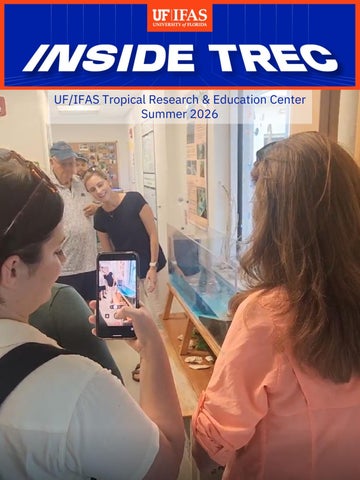
UF/IFAS Tropical Research & Education Center Summer 2026
Table of Contents
Director’s Message …………………….... 3 Research Report …………………….….... 4 EDIS Publications ………………………... 6 Publications …………..………………….... 7 TREC in Focus Graduate Student: Jhotsana Adhikari ……..………... 8 Postdoctoral Researcher: Dr. Andrew Mann ………………... 8 Circle of Friends: Dr. Victoria Adeosun …………... 9 Awards & Accomplishments .…….... 10 Faculty Grants .……........................... 12 Upcoming events ……………………….. 13 Let’s get Social! ………………………..... 14 Inside TREC is a quarterly newsletter distributed by the Communications & Marketing Development Unit of the UF/IFAS Tropical Research & Education Center (TREC) via email and can be found on the TREC website. You may forward any questions or comments about this periodical to Monique Scoggin.
2 | Inside TREC
From the Desk of the Director
From the Desk of the Director It has been an incredibly active and rewarding stretch here at the UF/IFAS Tropical Research and Education Center, and I’m excited to share a few highlights from what’s been happening across our programs. Let me start with some wonderful faculty news. This year, Dr. Daniel Carrillo struck what I like to call “double gold.” He received the prestigious UFRF Professorship, an honor reserved for tenured faculty with a distinguished and current record of research excellence. It’s a major recognition of his contributions and the momentum of his research program. On top of that, he was promoted to full professor; a milestone that reflects years of dedication, leadership, and impact. A truly outstanding year for Dr. Carrillo. We also have big news from Dr. Geoffrey Meru, who secured a major USDA Specialty Crop Research Initiative grant as Project Director for “Beyond Decoration: Advancing Pumpkin Sustainability for Culinary and Environmental Impact.” This award totals more than $3.2 million, with over $1.2 million supporting research right here at TREC. The project brings together UF, Cornell, UMass, and the University of New Hampshire in a multi-institutional effort launching later this year. The goal is to rethink pumpkin sustainability from field to kitchen table, reducing pre-harvest losses, expanding culinary uses of edible ornamental and hull-less pumpkins, and even nudging consumer behavior toward more sustainable choices. It’s an exciting project with real potential to reshape how specialty crops are grown and used. Recently we concluded the interview process for the Assistant Professor of Tropical Fruit Crops – Horticulturist position, following the retirement of Dr. Jonathan Crane. Filling his shoes is no small task, and the search turned out to be one of our most competitive ever, with 66 applicants. Thanks to the leadership of Dr. Bruce Schaffer, our faculty statesman and seasoned search committee chair, we narrowed the pool to three exceptional finalists and have selected a candidate we hope to welcome later this year. Our students continue to make us proud as well. Several received prestigious scholarships, including Gabi Foursa, Paola Villamarin, Mohammad Alamgeer, and Kertye Myrtil. We also hosted the 9th Annual South Florida Student & Postdoc Research Symposium, drawing more than 120 participants for a vibrant day of poster and oral presentations. Thanks to our stakeholders who helped to judge the competition and sponsored the event. As October arrives, we’re gearing up for One
Night in the Tropics, our signature FUNdraising
event held the first Saturday of November to kick off Miami-Dade County Farmers Month. This year we’re launching Challenge 250, an initiative to raise $250,000 to help our scientists respond quickly to emerging pest and disease threats. If you’ve joined us before, we look forward to seeing you again— and if not, put on your dancing shoes and join us or you will be missing one of the most memorable evenings in South Florida agriculture.
Edward “Gilly” Evans Inside TREC | 3
Research Report
4 | Inside TREC
Research Report (continued) In this installment of The Science Behind, we’ll delve into the work of Dr. Fredy Ballen, a Data Management Analyst II in the Agricultural Economics lab at the UF/IFAS Tropical Research & Education Center. Dr. Ballen has been an Analyst at TREC for 15 years. In that time, he has been included in over three dozen publications and earned his Doctorate in Natural Resource Policy. A couple of projects that Dr. Ballen is working on include the potential introduction of alternative crops to Florida’s agricultural produce market—namely, finger lime and dragon fruit . Each crop is appealing in its own way, but ultimately the integration of either would provide supplemental income and revenue to a local family. Finger Lime Finger limes are a citrus variety native to Australia and are characterized by their “round to teardrop-shaped juice vesicles that burst into individual juice sacs when the fruit is cut.” Most species of Australian limes are Huanglongbing (HLB) tolerant. This is enticing to Florida citrus growers whose crops have been decimated by HLB in the last decade. While incorporating the HLB tolerance into conventional citrus cultivars can create new HLB tolerant citrus hybrids, this work will take time. Meanwhile, some growers have opted to grow finger limes. But should everyone grow finger limes? How much is too much? Dragon Fruit Dragon fruit is native to Mexico and Central and South America and typically grows well in tropical and subtropical climates mostly free of frosts and freezes, making it appealing to many Florida growers. Another appealing factor is demand. With dragon fruit being promoted as a super food, consumers across the country are getting really interested in the fruit. Consumer Preferences And that’s right where Dr. Ballen enters the scene. Dr. Ballen looks at what motivates consumers to purchase these new agricultural products. Since demographics aren’t enough, economists have expanded to include sensory attributes and personality traits in their analyses. What is it about this fruit that’s appealing? Is it the appearance? The sweetness? The juiciness? While some consumers are motivated by their carbon footprint or the proximity of origin of the foods they’re consuming, others are only concerned with the health benefits. Discovering what the consumer wants, how much they’re willing to pay, and how frequently they will purchase the fruit are just some of the questions that economists consider in their commodity analysis. As Dr. Ballen wraps up publications on these commodities, we invite you to stay tuned to learn more.
Inside TREC | 5
Publications EDIS Publications
Li, Y., Liu, J., Hammami, A. M., & Guan, Z. (2026). “The US strawberry industry: An overview of production and trade, FE1179, 8/26”. EDIS 2026(4). DOI: https://doi.org/10.32473/EDISFE1179-2026 Myrtil, Y. K., Lacerda, V. R., Li, X., Liu, G., Tsouvaltzis, P. (2026). “Edamame for Florida: A nutritious leguminous crop with growing market demand, HS1521, 5/2026”. EDIS 2026(3). DOI: https://doi.org/10.32473/EDIS-HS1521-2026 Sanchez, F. W., Crane, J. H., & Schaffer, B. (2026). “Maprang (Bouea macrophylla Griff.) fruit trees: Botany and commercial cultivation in south Florida: HS1528, 8/2026”. EDIA 2026(4). DOI: https://doi.org/10.32473/EDIS-HS1528-2026 Sanchez, F. W., Crane, J. H., & Schaffer, B. (2026). “Rollinia (Annona mucosa Jacq.) fruit trees: Botany and commercial cultivation in south Florida, HS1523, 6/2026”. EDIS 2026(3). DOI: https://doi.org/10.32473/EDIS-HS1523-2026 Zhang, S., Dutra, P., Gazis, R., Crane, J., & Wasielewski, J. (2026). “Off-season pruning effectively reduces dragon fruit canker, PP390, 7/2026”. EDIS 2026(4). DOI: https://doi.org/10.32473/EDIS-PP390-2026
Research Publications Alcón-Bou, N., Fox, Jean-Paul, Albrecht, U., Bayabil, H., Guzmán, Sandra M., Rossi , L. (2026). Physiological responses of scion and rootstock in grafted grapefruit trees under salinity stress. Journal of Experimental Horticulture 2, 100016. DOI: https://doi.org/10.1016/j.jxh.2026.100016 Corea, B. A., Pancher, T. M., Calandriello Calio, D., Tassi, A. D., Pereira, L. R., Carrillo, D., Harakava, R., Novelli, V. M., Kitajima, E. W., Ramos-Gonzalez, P. L., Freitas-Astua, J., Gonzalez-Ibeas, D. (2026). Identification of Partitivirus-like RdRPs in the Brevipalpus yothersi Genome supports viral-to-arthropod horizontal gene transfer. Viruses 18(8), 892. DOI: https://doi.org/10.3390/v18080892 Fischman, H. S., Angelini, C., Reisinger, A. J., Dix, N., Dietz, K., & Smyth, A. R. (2026). A collaborative framework for producing science and management recommendations to restore water quality: A case study from the Guana Estuary, Florida. Estuaries and Coastsm 49 (131). DOI: https://doi.org/10.1007/s12237-026-01738-x Gutierrez-Rodriguez, E. A., Gazis, R., Crane, J. H., Manosalva, P. M., Schaffer, B. (2026). Laurel wilt susceptibility and physiological responses of two commercial avocado cultivars on experimental unreleased phytophthora root rot—resistant rootstocks. HortScience 61(7): 1411-1418. DOI: https://doi.org/10.21273/HORTSCI19366-26
6 | Inside TREC
Publications Research Research Publications (cont.)
Hoyt, B. K., Shands, A. C., Crane, J. H., Navia-Urrutia, M., Gazis, R., Cano, L. M., Ashikari, A., Tian, M., Jifon, J., Serrato-Diaz, L. M., Goenaga, R., Grunwald, N. J., & Manosalva, P. (2026). Phylogenomic analysis of Phytophtora cinnamomi collected from avocado in the United States reveals links to two A2 panglobal clonal lineages. Frontiers in Plant Science, . DOI: https://doi.org/10.3389/fpls.2026.1870818 Kong, X., Rice, S. E., Kramer-Dew, H. S., Zimmerman, A. R., Martyniuk, C. J., Her, Y., Bean, E., Judy, J. D., Li, Y., Wilson, A. E., Wang, D. (2026). Multiphase coupling of phosphorus and organic matter across water-particle interaction in aquaculture ponds. Journal of Hazardous Materials, 514(142793). DOI: https://doi.org/10.1016/j.jhazmat.2026.142793 Lee, J., Jeong, W., Her, Y., Kim, J. J., Bhattarai, R., Yu, D. J., Jeong, H. (2026). Human social sensing for characterizing long-term water-related discourse dynamics: Implications for sociohydrological analysis. EGUsphere. DOI: https://doi.org/10.5194/egusphere-2026-3395 Pierre, K., Vargas, A., Meru, G., Schaffer, B., Jones, J. B., Zhang, S. (2026). Effects of salinity on Bacterial Spot disease, physiology, growth, fruit quality, and transcriptomic responses in tomato plants. Plant Sciences, . DOI: https://www.preprints.org/manuscript/202607.0845 Potts, J., Brewer, S. E., Thakur, S., Chambers, A. H., & Wu, X. (2026). CRISPR/Cas9-Mediated Editing of eIF4E and eIF(Iso)4E Genes in Papaya (Carica papaya L.). Journal of Americal Society of Horticultural Sciences, 151(4): 347-356. DOI: https://doi.org/10.21273/JASHS05574-25 Regmi, A., Kefelegn, G. A., Birhan, D. A., Bayabil, H. K., Mylacarapu, R., Sandhu, H. S., & Hailegnaw, N. S. (2026). Enhanced-efficiency fertilizers and biofertilizers: Mechanisms, synergies, and opportunities for improving nutrient use efficiency – Review. Journal of Soil Science and Plant Nutrition. DOI: https://doi.org/10.1007/s42729-026-03433-z Sabety, J., Serrano, A., Singh, J., Cobb-Smith, D., & Khan, A. (2026). Scion and rootstock genotypes drive root system dynamics in modern apple orchards. Fruit Research, 6:e022. DOI: https://doi.org/10.48130/frures-0026-0017 Song, J., Ginori, J., Mendez Urbano, F., Thompson, L., Huo, H. Wilson, S., Altland, J., Wu, X., & Ma. Y. (2026). New estimation of genome size in the highly diverse genus Begonia. Journal of the American Society for Horticultural Science, 151(3), 161-170. DOI: https://doi.org/10.21273/JASHS05584-25 Stone, R., Chen, S., Moon, P., Chen, J., & Wu, X. (2026). Flow-cytometric analysis of nuclear DNA content in vanille germplasm and interspecific hybrids: Implications for breeding and conservation. Horticulturae, 12(9), 1066. DOI: https://doi.org/10.3390/horticulturae12091066 Vargas, A. I.. Sarkhosh, A., Singh, J., Li, Y., Rodriguez de Souza, E. Kim, D., Her, Y. G., & Schaffer, B. (2026). salinity affects physiology, growth, and nutrient uptake of papaya in a calcareous soil. Scientia Horticulturae, 366, 115043. DOI: https://doi.org/10.1016/j.scienta.2026.115043 Villamarin, P., Hahn, P. G., Ampatzidis, Y., & Revynthi, A. M. (2026). Laboratory evaluation of commercially available and naturally occurring predatory mites against Thrips parvispinus (Thysanoptera: Thripidae). Experimental and Applied Acarology 97(4). DOI: https://doi.org/10.1007/s10493-026-01147-6 Wu, X., Taco, A., Moon, P., Potts, J., Schaffer, B., Li, Y., & Kong, Y. (2026). Vegetative growth and physiological responses of Vanilla planifolia to low-level LED light density in controlledenvironment systems. HortScience 61(9), 2106-2110. DOI: https://doi.org/10.21273/hortsci19498-26
Inside TREC | 7
TREC in Focus Jyotsana Adhikari, a Masters student in Dr. Young Gu Her’s Hydrology and Agricultural Engineering lab, recently invited us to the field to explain her research. For this research, Jyotsana is evaluating two Best Management Practices (BMPs): soil-moisture-sensor-based irrigation and cover crops separately and in combination. The goal is to understand how these practices affect irrigation water use, nutrient movement and leaching, soil quality, and crop performance. By comparing the treatments, the study will determine whether combining these BMPs can improve water and fertilizer use efficiency while reducing nutrient losses to the environment. In this video, Jyotsana and Dr. Qibing Wang collect the first round of water samples from lysimeters installed below the root zone prior to the crop plantation. These samples will be analyzed to understand nutrient movement and leaching under the different treatments. Click here to watch! In this edition of TREC’s Post Doc Exposé, we feature Dr. Andrew Mann, a post doctoral researcher in Dr. Romina Gazis’ Tropical Fruit Pathology Lab. How did your previous experiences prepare you for your role at TREC? My current research focuses on finding ways to manage the pathogen that causes laurel wilt of avocado. Laurel wilt is caused by an invasive fungus that is vectored by several ambrosia beetle species, including the invasive redbay ambrosia beetle. To do this, others in the Gazis’ lab and I are working on projects to evaluate fungicides, organic compounds, and biological control options that may provide avocado growers with cost-effective ways to protect their trees from laurel wilt. I am also working on some projects to better understand the microbiome of avocado trees and the fungi associated with ambrosia beetles. One microbiome project I am especially excited about will help researchers across several fields better assign species names to their sequences. During both my M.S. and my Ph.D., my research focused on fungi associated with beetles that attack trees. So much of the work I am doing here at TREC builds on the skills I gained in graduate school, just in a different system. My M.S. work at Colorado State University focused on the biological control of a bark beetle in Colorado using a fungal pathogen. My Ph.D. at the University of Minnesota focused more on the microbiome of beetles and trees, where I examined how attacks by different beetle species change the fungal and bacterial communities within trees. I also described a few new fungal species associated with a bark beetle that is currently causing significant damage to conifers in Minnesota.
8 | Inside TREC
The TREC Circle of Friends was established by Center Director, Dr. Edward “Gilly” Evans, to encourage former, present, and future personnel at the Center to stay in touch. As he mentioned once: “once a Trekian, always a Trekian.” In this installment of the Circle of Friends, we reconnect with Dr. Victoria O. Adeosun (nėe Adeleye). Dr. Adeosun earned her PhD in Dr. Dak Seal’s lab while at TREC. Presently, she is a stay-at-home mom with plans to enter the workforce in 2027. What is a fond memory that you have of your time at TREC? Some of my fondest memories are not of major events, but of the simple everyday moments and the sense of belonging to a community like TREC. I always liked the name “TREKIANS,” and I was proud to be one. I remember texting friends across different TREC labs to see if they were ready to head home for lunch or finished for the day and wanted to grab dinner. Sometimes my housemates and I, along with friends from other TREC houses, would gather around a table for food, games, and good conversation on the weekends and some holidays. Those moments of togetherness made TREC feel like more than just a workplace, it felt like a family. And whenever something good happened to a TREKIAN, I loved hearing Dr. Evans say, “Thank you for putting TREC in the spotlight.” It always reinforced the pride we felt in being part of the TREC community. Looking back, what piece of advice would you give yourself when you started at TREC? Looking back, one thing I would make more time for experiences outside of school. Graduate school can easily become all-consuming, and I often focused so much on the next deadline, milestone, or goal that I did not always pause to fully appreciate the journey along the way. I also would take more time to celebrate my small wins instead of waiting until graduation to recognize how much I had accomplished. Progress in graduate school is often gradual, and it is easy to overlook personal growth when you are constantly working toward the next objective. Looking back now, I realize that every challenge overcome, every exam passed, every presentation delivered, and every milestone reached was worth celebrating. While I am proud of where the journey led me, I have learned that it is just as important to appreciate the process as it is to celebrate the destination. Who has had the greatest influence on your career? My Professor, Dr. Dakshina Seal (first for the opportunity to be one of his students), my mentors, and all my academic advisors throughout graduate school through their feedback, support, guidance, and recommendations.
Inside TREC | 9
Awards & Accomplishments Dr. Daniel Carrillo was recently awarded the prestigious University of Florida Research Foundation (UFRF) Professorship. UFRF Professorships are granted to tenured faculty who have demonstrated a distinguished and current record of research. These awards recognize outstanding recent contributions and encourage continued excellence. Selection is based primarily on (a) the faculty member’s performance over the past five years and (b) evidence of a strong, forward-looking research agenda that promises continued distinction in their field. In further recognition of his hard work, commitment, scholarship, service and achievement, we’re happy to announce that Dr. Carrillo was recently promoted to full Professor! Make sure you congratulate him, if you haven’t already. Drs. Fitsum Teshome, Haimanote Bayabil, and Bruce Schaffer were recognized at the 19th Annual Florida Agricultural Experiment Station Research Awards Ceremony at the Champions Club of the Ben Hill Griffin Stadium for their publication, “Improving soil moisture prediction with deep learning and machine learning models”. The publication was selected as a UF/IFAS High Impact Publication due to its strong influence and visibility within the research community. The study was published in Computers and Electronics in Agriculture , a top-tier Q1 Scopus journal with an Impact Factor of 8.9 and a CiteScore of 15.1. You can access the publication here. In June, the Florida section American Society of Agricultural and Biological Engineers recognized Dr. Bayabil for his outstanding service to the profession, FL ASABE and ASABE at large.
10 | Inside TREC
more Awards & Accomplishments ;) Four students from the UF/IFAS Tropical Research & Education Center graduated this summer. Dr. Sisi Chen Dr. Jesse Potts Dr. Prerna Sabharwal Alejandra B. Taco Vilatuna Paola Villamarin, a PhD student in Dr. Alexandra Revynthi’s Ornamental Entomology lab, was awarded over $3,000 from the Buster DeMott Family Fishing Tournament, an FNGLA, Miami-Dade Chapter initiative. Muhammad Alamgeer, a PhD student in Dr. Zachary Brym’s Agroecology lab, was awarded the William C. and Bertha M. Cornett Fellowship in the amount of $1,500 for the 20262027 academic year by the UF College of Agricultural and Life Sciences. Gabrielle Foursa, a PhD student in Dr. Ashley Smyth’s Coastal Biogeochemistry lab, has been selected to receive the prestigious Aylesworth Scholarship, a distinguished “career” award issued by Florida Sea Grant and presented to graduate students conducting applied research that supports Florida’s coastal resources and working waterfront communities. This scholarship is a significant recognition of Gabi’s dedication, impact, and commitment to research that serves Florida’s coastal stakeholders.
On Friday, July 24, the South Florida Graduate Student Organization and TREC Social Committee held the 9th Annual South Florida Student and Post-Doc Research Symposium at the UF/IFAS Extension Miami-Dade County office. Over 100 people attended the Symposium with the top prizes in each category going to Student Poster Presentation Competition Student Oral Presentation Competition 1st Place - Suraj Melkani 1st Place - Rachel Kalicharan 2nd Place - Wenhao Liu 2nd Place - Lainey Kemmerer 3rd Place - Berson J. Valcin 3rd Place - Benjamin Merritt Postdoctoral Oral Presentation Competition 1. Sasha Kay Clarke, 1st Place
Inside TREC | 11
Grants issued this summer A multi-institutional collaboration, led by Dr. Geoffrey Meru, was recently granted over $3.2 million to “advance the sustainability of pumpkins in the U.S.” The group aims to reduce preharvest losses, enhance post-harvest utilization, and improve multi-use pumpkins. Stay tuned to the TREC website to learn more about this grant. Dr. Shouan Zhang received over $160,000 from the USDA APHIS to work on the “Development of a Steam Treatment for Mitigating Phytophthora Pathogens in Fruiting Vegetables and Their Seeds”. The USDA APHIS awarded over $300,000 in grants to Dr. Dakshina Seal for multiple research projects. The grants will allow Dr. Seal’s lab to conduct research on “Integrated Pest Management of Two-spot Cotton Leafhopper in Vegetables”; “Cotton Jassid (Amrasca biguttula) Natural Enemies: Evaluation of Agents Immediately Available to Aid Growers”, “Developing Phytosanitary Treatments to Limit the Spread of Two-Spot Leaf Hopper (Amrasca biguttula)”, and finding a “Multi-state Response to Monacha ocellata and Improved Gastropod Treatment Study”. Dr. Edward “Gilly” Evans was awarded over $120,000 by the Department of Education for participating in the 2026 STEM SMART summer program hosted Miami Dade College. Dr. Romina Gazis was awarded just over $120,000 to work on the “Enhancing Detection Capacity for Scab-Causing Elsinoe Species Pathogenic on Avocado Crop in the U.S.” from the USDA APHIS. Dr. Alexandra Revynthi was awarded just over $100,000 to work on the “Chemical control of the two-spot cotton leafhopper in ornamentals” from the USDA APHIS. She also received nearly $40,000 from the National Horticulture Foundation to work on the “Chemical control of the invasive pest two-spot cotton leafhopper”. Dr. Daniel Carrillo was awarded $20,000 by the USDA APHIS to investigate “Ash Leaf Production”.
12 | Inside TREC
Upcoming events Who: What: The UF/IFAS TREC’s annual fundraising event: >>> When: November 7 beginning at 5:30 pm Where: The Oasis at the UF/IFAS Tropical Research & Education Center Why: To raise funds for rapid response research for our south Florida growers
Dr. Xingbo Wu will host the 11th Independent Plant Breeders Conference at the Fairchild Tropical Botanic Garden this year. This conference offers an excellent opportunity for plant breeders, industry partners, and experts to engage with the growing demand for new crops in the U.S. It will provide valuable insights into commercialization and partnerships, while fostering a collaborative environment for networking, feedback, and innovation in plant breeding. Participants will also have the opportunity to tour Fairchild Tropical Botanic Garden, a world-renowned leader in tropical plant conservation and research. To see the lineup of speakers, visit the IPBC website. Student scholarships are now available! Register now as spaces are filling up and hotels in Miami sell out quickly in November!
Inside TREC | 13
Marketing & Communications 456 followers est 2025
1,757 followers est 2021
3,137 followers est 2015
2,213 followers est 2017
1,286 subscribers est 2018