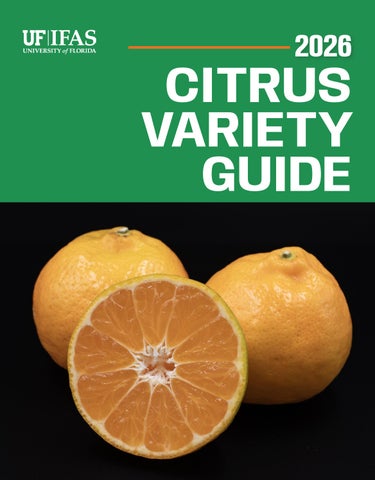
2026
CITRUS VARIETY GUIDE
NEXT GENERATION CITRUS SOLUTIONS FOR FLORIDA’S JUICE AND FRESH MARKETS From Foundation to Innovation: The UF/IFAS CREC Legacy The UF/IFAS Citrus Research and Education Center (CREC) citrus breeding program was born in the mid1980s with a singular mission: to provide Florida growers with a competitive edge through superior scion and rootstock genetics. Led by Jude Grosser and Fred Gmitter, the program’s first two decades were defined by a relentless pursuit of technological expertise. By pioneering somatic hybridization and exploring somaclonal variation, new tools were developed to expand the limits of conventional breeding. These efforts allowed us to create polyploids for seedless fruit and hardy new rootstocks, while simultaneously diving into the genomic space to develop the linkage maps and molecular markers that improve selection efficiency.
Navigating the HLB Era and Cultivating a Profitable Future The landscape changed forever in 2005. The arrival of Huanglongbing (HLB, or citrus greening) ushered in a new, more urgent era for the CREC program. As the epidemic swept across the state, program focus shifted towards resilience and tolerance to HLB. We have spent the last two decades meticulously creating genetic diversity and making selections that demonstrate field tolerance to this devastating disease, ensuring that the Florida citrus industry can withstand the pressure of this "new normal". On the other hand, as the industry adapts, so do we. For growers investing in Citrus Under Protective Screen (CUPS) to bypass HLB entirely, the economic stakes are higher. To support the infrastructure costs of these systems, we are also prioritizing the development of ultra-high-quality cultivars capable of fetching the premium marketplace prices necessary for a solid return on investment. Our current efforts also include the initiation of multiple field trials to combine the best new scions with the best new rootstocks – the fastest way to identify combinations that can be sustainable and profitable in our HLB-endemic Florida.
What follows are brief descriptions of our program's most recent releases—creations designed to keep the Florida citrus industry productive, sustainable, and, most importantly, profitable.
2 UF/IFAS Citrus Variety Guide 2026
True Sweet Oranges
'OLL-DC-3-36' AND 'OLL-DC-3-40' U.S. PPAF Key Points • Two new OLL sweet orange clones developed from the nucellar seedlings from 'OLL-8' • Late maturing selections that more reliably meet maturity standards than ‘Valencia’ • Show superior overall tree health, productivity, canopy development, and yield • Strong candidate for sustainable Florida citriculture • Recommended Production Systems: Conventional, home garden
'OLL-DC-3-40'
'OLL-DC-3-36'
• Primary Market Use: Fresh market, processing
4
TRUE SWEET ORANGES
VALENCIA 'N40-16-7-11' U.S. PPAF Proposed name: Last Man StandingTM
Key Points • True 'Valencia' somaclone with strong HLB tolerance comparable to the 'Donaldson' tree • Original tree 34-years old on Swingle citrumelo rootstock still producing good fruit • Produces typical late-maturing 'Valencia' fruit with high soluble solids under HLB pressure • 3-year-old trees (no IPCs or OTC) are larger than adjacent 7-year-old 'Valencia' trees • Produces Grade A NFC juice without the need for blending • Recommended Production Systems: Conventional, home garden • Primary Market Use: Fresh market, processing
HAMLIN 'N14-10' U.S. PPAF Key Points • One of three original 'Hamlin' somaclones selected based on multiple years of juice quality data • Highest °Brix and soluble solids among hundreds of 'Hamlin' clones evaluated • Improved °Brix up to 12.2 • Matures a few weeks earlier than the previously released 'Hamlin' clone N13-32 • Provides growers with an early-season 'Hamlin' alternative to battle the current °Brix crisis • Recommended Production Systems: Conventional, home garden • Primary Market Use: Fresh market, processing
TRUE SWEET ORANGES
5
Florida Citrus Production Guide The latest recommendations from UF/IFAS
New 2026–2027 Florida Citrus Production Guide
Now Available at Your Local UF/IFAS Extension Office or Research Center.
Sweet Orange-Like Hybrids
'UF 1859' U.S. PP36743 Key Points • Sweet orange-like hybrid with potential future classification as a true sweet orange • Nearly seedless triploid selection developed from an interploid cross of 'LB89' Sugar Belle® × ['Nova' mandarin hybrid + 'Succari' sweet orange] somatic hybrid • Distinctive fruit shape, color, and flavor provide excellent consumer appeal • Exceptional external and internal color development with minimal cold induction • Harvest from late November-early January • Recommended Production Systems: Conventional, screen-protected (CUPS), home garden • Primary Market Use: Fresh market, processing
'104' U.S. PPAF Key Points • Sweet orange-like hybrid with potential future classification as a true sweet orange • Nearly seedless triploid selection developed from an interploid cross of 'LB8-9' Sugar Belle® mandarin × ['Hamlin' orange + LB8-4] (LB8-4 is an unreleased proprietary breeding parent from 'Clementine' × 'Minneola') • Produces large attractive, usually seedless fruit with a unique flavor profile • Harvest from December-February • Recommended Production Systems: Screen-protected (CUPS) • Primary Market Use: Fresh market, processing
8
SWEET ORANGE-LIKE HYBRIDS
Juice Blending Hybrids
'C4-10-42' U.S. PPAF Proposed name: ‘Tough & Tasty’ Key Points • Seedless triploid mandarin hybrid • Parentage: 'LB8-9' Sugar Belle® × ['Nova' mandarin hybrid + 'Osceola' mandarin hybrid] somatic hybrid • Trees have shown good HLB tolerance in 5 locations, including trees topworked onto HLBcompromised ‘Valencia’ on Swingle rootstock • Excellent candidate for NFC juice blending at the legal 15% level • December maturity with very rich, sweet flavor • Juice color up to 42, with °Brix reaching 18 and maintains excellent flavor after pasteurization • Potential limitations: small fruit size, and fruit does not peel easily • Recommended Production Systems: Conventional, home garden • Primary Market Use: Fresh market, processing (NFC blending candidate)
'RBA-13-18 ' U.S. PPAF Key Grower Points • Diploid hybrid from 'LB8-9' Sugar Belle® × 'Ortanique' • Showing strong HLB tolerance at multiple locations, ranked in the top 95th percentile for tree health and NDVI in trees topworked onto HLB-compromised ‘Valencia’ on Swingle • Fruit matures in December and can hold on the tree into February • Juice quality: 12–14 °Brix with a 38 color score • Pasteurized juice has a pleasant, sweet orange-like flavor profile • Low limonin content (1.6 ppm), reducing bitterness risk in juice • Produces good-sized, firm fruit suitable for trucking to juice plants • Recommended Production Systems: Conventional, home garden • Primary Market Use: Processing (NFC blending candidate) 10
JUICE BLENDING HYBRIDS
Mandarins
'MARATHON' U.S. PP31347 Key Points • Diploid mandarin hybrid from 'Daisy' mandarin × 'Mukaku Kishu' • Vigorous field trees • Very few symptomatic fruit observed on HLBpositive trees • Completely seedless under all circumstances, easy to peel, and early maturity • Good color and flavor with strong fresh market appeal • Responds well to ethylene degreening • Firm fruit that performs well in long-term cold storage • Recommended Production Systems: Conventional, home garden • Primary Market Use: Fresh market
'RES 19-56' U.S. PP36744 Key Points • Diploid mandarin hybrid from 'Daisy' mandarin × 'Mukaku Kishu' • Rich-flavored, zipper-skin mandarin, Cutie®/ Halo® sized fruit • Early maturing selection, ready in September ~10 °Brix with a 16.5 maturity ratio • Holds on the tree through November, extending the harvest window • Precocious and heavy-bearing trees • Demonstrates good postharvest storage capability • Recommended Production Systems: Conventional, screen-protected (CUPS), home garden • Primary Market Use: Fresh market
12
MANDARINS
GATOR BITESTM '18A-9-39' U.S. PP36088 Key Points • Triploid hybrid developed from interploid cross of 'Clementine' × ['Murcott' + 'LB8-9' Sugar Belle®] somatic hybrid via embryo rescue • Rich-flavored, zipper-skin mandarin that colors on the tree • Matures around Thanksgiving in CUPS and, about one month later when grown outdoors • Completely seedless in CUPS; 1–2 seeds per fruit when grown outside in mixed blocks • Fruit size is similar to Cuties®/Halos® mandarins • Recommended Production Systems: Conventional, home garden, screen-protected (CUPS) • Primary Market Use: Fresh market
'KE-9-9' U.S. PPAF Proposed name: ‘Autumn Amour’ Key Points • Triploid tangerine from an interploid cross of 'FallGlo' × ['Murcott' + LB8-8] (LB8-8 is a low acid sibling of 'LB8-9' Sugar Belle®) • Produces medium-sized fruit (larger than 'Clementine'), easy to peel, nearly seedless • Excellent internal and external color development under Florida conditions • Matures in October and holds well into January • Completely seedless in CUPS, outside trees may have 1–2 seeds per fruit • Early harvested fruit responds well to ethylene degreening • Recommended Production Systems: Screen-protected (CUPS), home garden • Primary Market Use: Fresh market
MANDARINS
13
'C7-12-18' U.S. PPAF Proposed name: ‘Tangeriffic’ Key Points • Triploid tangerine hybrid from an interploid cross of 'LB8-9' Sugar Belle® × ['Succari' sweet orange + 'Murcott' tangor] somatic hybrid • Produces medium-sized fruit (larger than 'Clementine'), easy to peel, nearly seedless fruit with a very rich, sweet, pleasant flavor • Matures in November and holds well into January • Bright orange external color becomes more intense in late November • Completely seedless in CUPS, outside trees may have 1–2 seeds per fruit • Recommended Production Systems: Screen-protected (CUPS), home garden • Primary Market Use: Fresh market
'1424' U.S. PPAF Proposed name: ‘Sweet Gem’ (previously referred to as Greenie) Key Points • Diploid mandarin hybrid from LB8-8 (UF proprietary breeding parent from 'Clementine' × 'Minneola') × 'Mukaku Kishu' • Completely seedless fruit, easy to peel with a distinctive shape, color, flavor, and aroma • Late September maturity, with harvest extending into mid-November • Often green peel when mature in Central Florida; may turn orange with cool-night exposure • Consistently ranked as best tasting selection in fruit displays • Performing very well in North Florida; high °Brix fruit harvested in North Florida performed well on a commercial packing line • Recommended Production Systems: Conventional, screen-protected (CUPS), home garden • Primary Market Use: Fresh market 14
MANDARINS
'C4-14-51' U.S. PPAF Proposed name: ‘Tangelicious’ Key Points • Triploid tangelo hybrid from an interploid cross of 'LB8-9' Sugar Belle® × ['Nova' mandarin hybrid ('Clementine' × 'Orlando') + 'Succari' sweet orange] somatic hybrid • Produces medium-sized, seedless, easy-peel fruit with sweet, pleasant flavor suitable for both fresh market and processing • Matures in December and holds through January • Validated by a major juice company as a good NFC juice blending candidate • Demonstrated ability to improve NFC juice color and flavor, juice with 15 °Brix and 42 color score • Good candidate for the dooryard market • Recommended Production Systems: Conventional, home garden; has not been tested in CUPS • Primary Market Use: Fresh market, processing
'18A-10-47' U.S. PPAF Proposed name: ‘Wow’ Honey Murcott Key Points • Nearly seedless 'Murcott' selection developed via somatic cybridization and budwood irradiation • Maintains the core traits of standard Honey 'Murcott' with just 0–3 seeds per fruit (1.4 average) • Peels easier than standard 'Murcott' • Builds on the established market that already accepts seedy Honey 'Murcotts' • Recommended Production Systems: Screen-protected (CUPS) • Primary Market Use: Fresh market, processing
MANDARINS
15
'KW-5-7' U.S. PPAF Proposed name: ‘Durable Dancy’ Key Points • Cybrid 'Dancy' tangerine selection developed via protoplast fusion research • Originated during efforts to create a G1 'Satsuma' + 'Dancy' somatic hybrid for triploid breeding • Apparently tolerant of Alternaria brown spot disease (unlike the original 'Dancy') • Reduced seed count compared to standard 'Dancy' (generally about half as many seeds) • Recommended Production Systems: Conventional, screen-protected (CUPS), home garden • Primary Market Use: Fresh market
N40W-5-1 Proposed name: ‘Tasty Snack’ Key Points • Low-seeded selection derived from 'Nova' developed via budwood irradiation • Doesn’t exhibit the granulation issue found with sibling 'N40W-6-3' Seedless Snack • Exceptional flavor and aroma • Slightly earlier maturity than 'Nova' • Can be peeled, but not a zipper-skin • Recommended Production Systems: Home garden; not tested in CUPS • Primary Market Use: Fresh market
16
MANDARINS
Grapefruit
N40-16-11-7 U.S. PPAF Proposed name: ‘Crimson Queen’ Key Points • Dark red grapefruit somaclone developed via somatic embryogenesis from an embryogenic callus line initiated from a commercially purchased red grapefruit • Selected for superior fruit quality, attractive appearance, deep internal/external color, and flavor • Fruit quality comparable to 'Star Ruby' with similar attractive blush • °Brix ranges from 10–13; Juice color scores: range from 40.6 to 41.3 • Does not show common 'Star Ruby' problems observed in the Indian River area (notably heavy leaf blotching and stunted growth) • Superior performance compared with all available commercial red grapefruit clones in MAC trials • Recommended Production Systems: Conventional, screen-protected (CUPS), home garden • Primary Market Use: Fresh market, processing
'C2-5-3' U.S. PPAF Proposed name: Pink RosieTM Key Points • Triploid grapefruit type hybrid developed from an interploid cross of 'Hirado Buntan Pink' pummelo × ['Succari' sweet orange + 'Hirado Buntan Pink' pummelo] somatic hybrid • Produces attractive, pink-fleshed, nearly seedless fruit, completely seedless in CUPS • Very early, maturing in September, ahead of all commercial grapefruit • Late September fruit quality: ~10 °Brix and ~15 maturity ratio • Flavor is sweet with a grapefruit-like profile • Trees show better HLB and canker tolerance than standard grapefruit • Recommended Production Systems: Conventional, screen-protected (CUPS), home garden • Primary Market Use: Fresh market 18
GRAPEFRUIT
Lemons and Limes
'CE-D5-1-9-42' U.S. PP36742 Proposed name: BeatrizTM Key Points • 'Cook Eureka' budwood irradiated and planted in Ft. Pierce grove in 1999 • Part of a large project supported by a major beverage company to increase lemon peel oil production • Selected in 2017, because of early productivity and nearly seedless fruit • Precocious and productive bearing capability • Fruit, juice, and peel oil yields in field trials have been in the mid–high ranges, across several seasons • Fruit shape, size, juice percentage, aroma and flavor are typical of 'Eureka' lemon • Recommended Production Systems: Conventional, home garden; not tested in CUPS • Primary Market Use: Fresh market, processing
'C4-5-14' U.S. PP37293 Proposed name: FiestavilleTM Key Points • Triploid, lime-like hybrid developed from an interploid cross of ['Santa Teresa' lemon + 'Lakeland' limequat] somatic hybrid × 'Cook Eureka' lemon • Fruit resembles 'Key' ('Mexican') lime more than 'Persian' lime in size, color, and flavor • Average fruit size is smaller than 'Persian' lime • Interior flesh becomes more yellow as fruit matures (not green like 'Persian' lime) • Fruit is highly aromatic, very juicy, with a strong lime fragrance • Trees bloom multiple times per year, providing nearly year-round fruit availability • Recommended Production Systems: Home garden; not tested in CUPS • Primary Market Use: Fresh market
20
LEMONS AND LIMES
Finger Limes
UF SUNLIME (PP34,493) Key Points • Finger lime hybrid that produces elongated fruits about 2.7 to 3.1 inches long • Exhibits tolerance to Huanglongbing (HLB; citrus greening) • Makes a medium-sized bush; trees at 7 years old were 8 feet tall in Lake Alfred, Florida • Fruit contains distinctive “citrus caviar” juice vesicles that separate into individual pearls when the fruit is cut • Trees flower sporadically throughout the year, with the main bloom in February-March • Fruit develops attractive red anthocyanin coloration in both the peel and juice vesicles under Florida conditions • Recommended Production Systems: Conventional, home garden • Potential Market Use: Fresh market
UF REDLIME (PP34,188) Key Points • Finger lime with good cold tolerance • Produces narrow, oblong fruits that taper slightly at both ends and typically measure 3.5 to 5 inches in length • Exhibits tolerance to Huanglongbing (HLB) • Trees have a more open, less compact canopy than many commercial finger lime varieties, facilitating harvesting and reducing thornrelated fruit damage • Fruit contains distinctive “citrus caviar” juice vesicles that separate into individual pearls when the fruit is cut and used in gourmet cuisine • Maintains internal red coloration even in South Florida conditions, where anthocyanin expression can be challenging in many citrus cultivars • Recommended Production Systems: Conventional, home garden • Potential Market Use: Fresh market
22
FINGER LIMES
UF WHITELIME (PPAF) Key Points • Finger lime with good cold tolerance • Characterized by white-colored juice vesicles. There is no anthocyanin in the pulp; however, it is present in the mature peel. • Trees flower sporadically throughout the year. The main bloom occurs in February-March. • Forms a pretty bush with pendulous architecture • Fruit contains distinctive “citrus caviar” juice vesicles that separate into individual pearls when the fruit is cut and used in gourmet cuisine • Recommended Production Systems: Conventional, home garden • Potential Market Use: Fresh market
Citrus
Fruit Variety Display December 17, 2026 UF/IFAS Citrus Research and Education Center
UF/IFAS Citrus Research https://citrusresearch.ifas.ufl.edu
NOW AVAILABLE
Digital
Florida Citrus Variety Profiles
An expanded online version will complement this guide, providing 24/7 access to additional variety profiles to assist with variety selection and management decisions.
Join the UF/IFAS Citrus Team email list for release notifications.
https://crec.ifas.ufl.edu/citrus-research/newsletter-signup/
Rootstocks
UFR-18 (ORANGE 14) PPAF Key Points • Allotetraploid ‘tetrazyg’ hybrid from the cross of two somatic hybrids [(‘Nova’ + HBPummelo) x (Cleo + trifoliate orange)] • Good HLB tolerance • Good tolerance to the Diaprepes/Phytophthora complex • Tolerant of sting nematode • Makes medium Swingle sized trees • Amenable to seed propagation • Wide soil adaptation
STR-4-1 PPAF Proposed name ‘Defiance’ Key Points • Mutant of commercial X639 (Cleo x trifoliate orange) • Showing exceptional HLB tolerance, better than wildtype commercial X639 • Vigorous feeder root system • Establishes strong sweet orange trees without IPCs with proper grove care • Efficient in tissue culture micropropagation • Encourages early fruit bearing • Expected to subsequently be amenable to seed propagation
26
ROOTSTOCKS
UF/IFAS CREC BREEDING TEAM
Fred Gmitter
fgmitter@ufl.edu
Manjul Dutt
manjul@ufl.edu
Jude Grosser jgrosser@ufl.edu
Debora Fragoso
deborafragoso@ufl.edu
ACKNOWLEDGEMENTS Jamie Burrow, UF/IFAS CREC Extension Program Manager Tonya Weeks, UF/IFAS CREC Graphic Designer
REQUESTS For additional copies, please contact John Chater, jchater@ufl.edu, 863-956-8662 Jamie Burrow, jdyates@ufl.edu, 863-956-8648
An Equal Opportunity Institution.
John Chater jchater@ufl.edu
Misty Holt
mholt@ufl.edu
2026
CITRUS VARIETY GUIDE
PROVIDED BY UF/IFAS CITRUS RESEARCH AND EDUCATION CENTER 700 EXPERIMENT STATION ROAD LAKE ALFRED, FLORIDA 33850