Elias Sayour’s patients inspire pioneering mRNA cancer vaccine research
A Scientific “Miracle” Data Drives Destinations Invisible Hand Solving the Cleft-Palate Puzzle SPRING 2026
12 Igniting Immunity Elias Sayour’s patients inspire pioneering mRNA cancer vaccine research
6 20 24 36 30 Extracts News from around the university A Scientific “Miracle”
Gene therapy has moved from novel concept to lifesaving treatment Solving the Cleft-Palate Puzzle
Early teamwork helps align tiny faces
Data Drives Destinations
UF is building a tech-powered roadmap for the tourism industry
Invisible Hand
What is AI doing to our digital conversations?
The Conversation
The future with GLP-1 medications
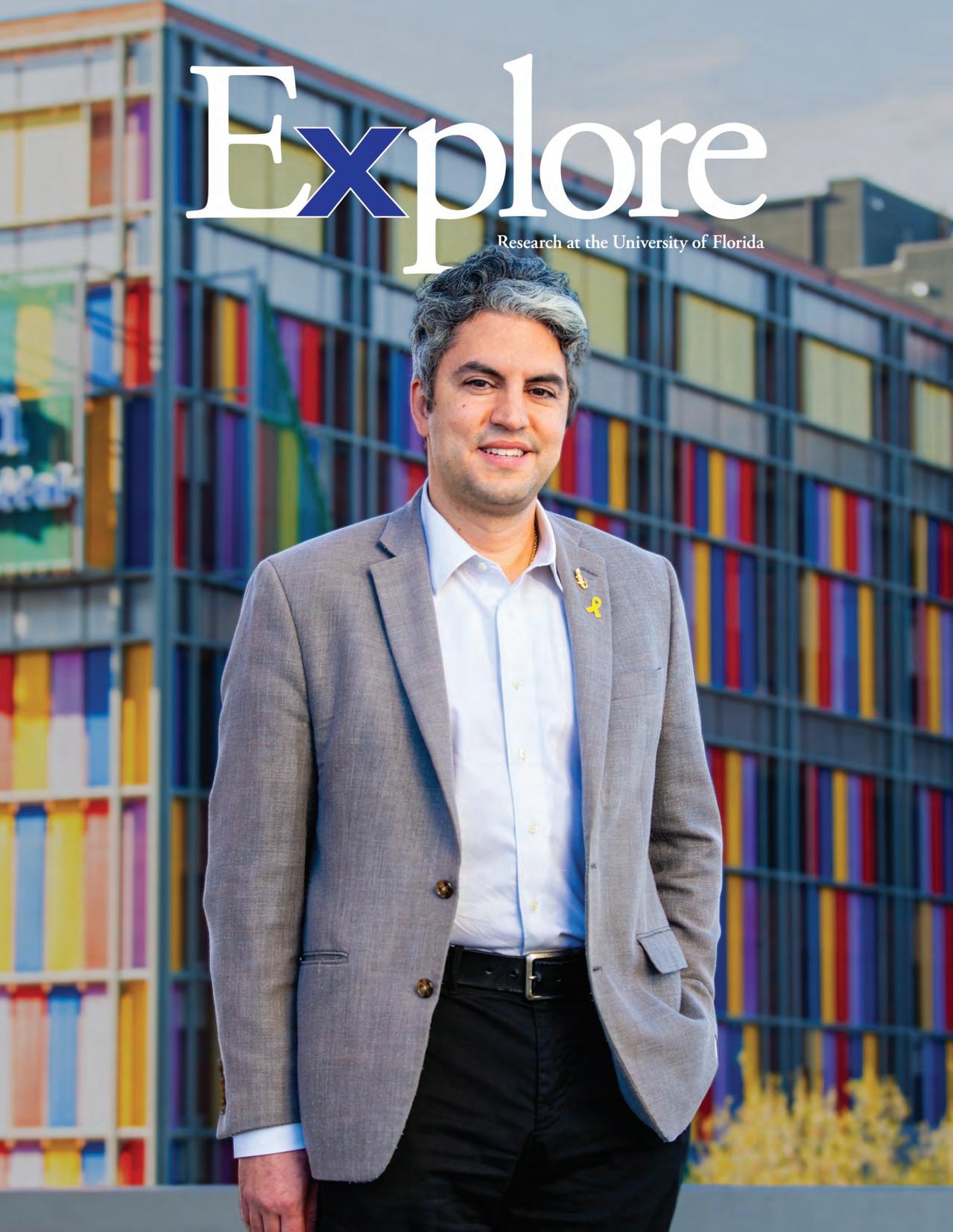
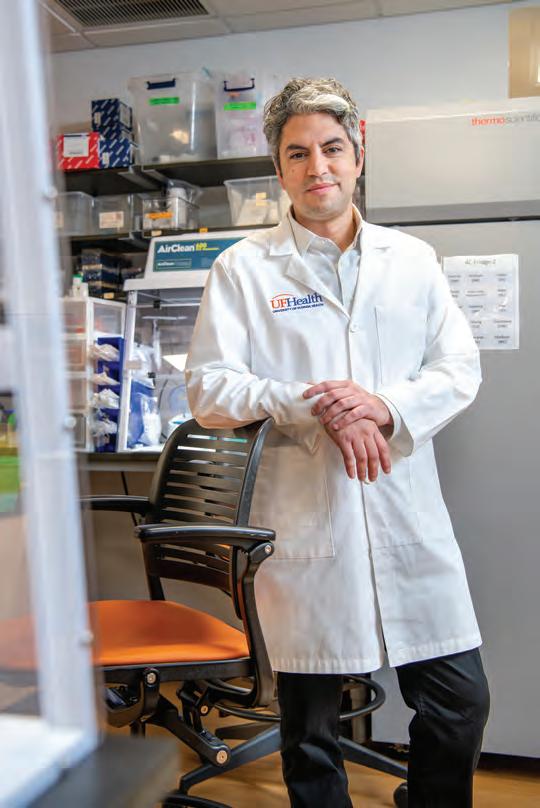
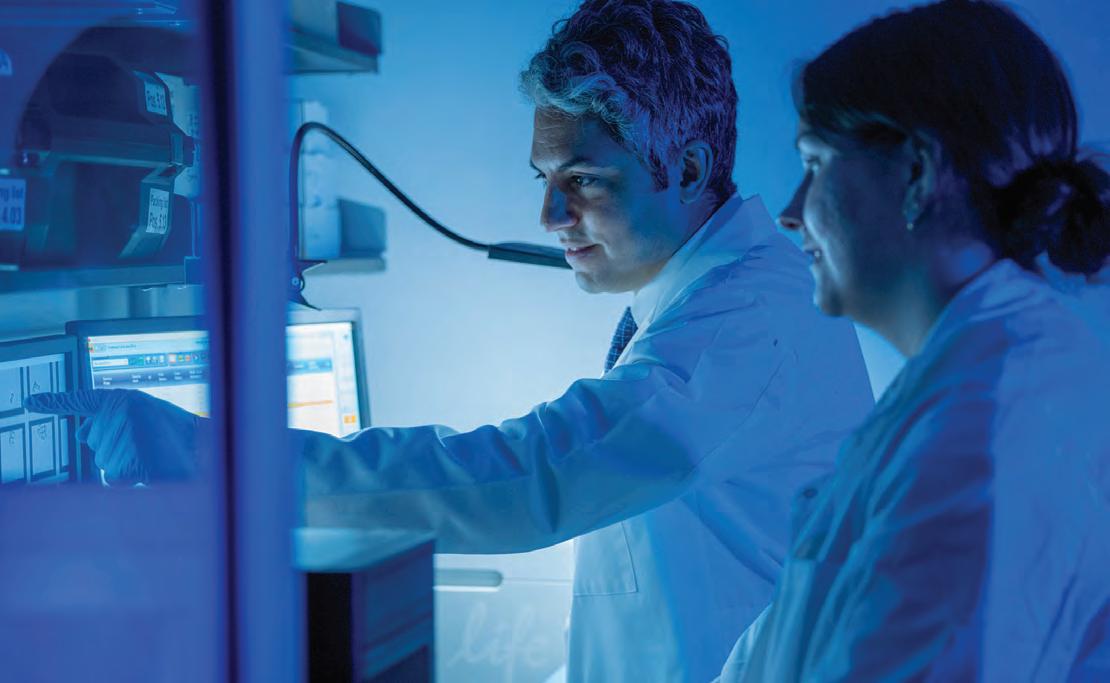
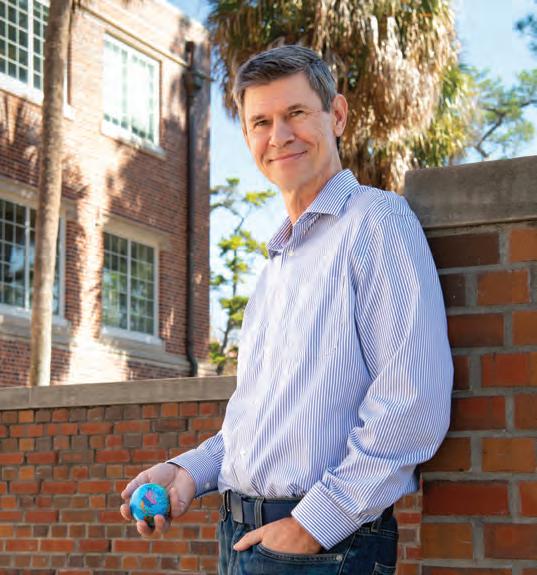
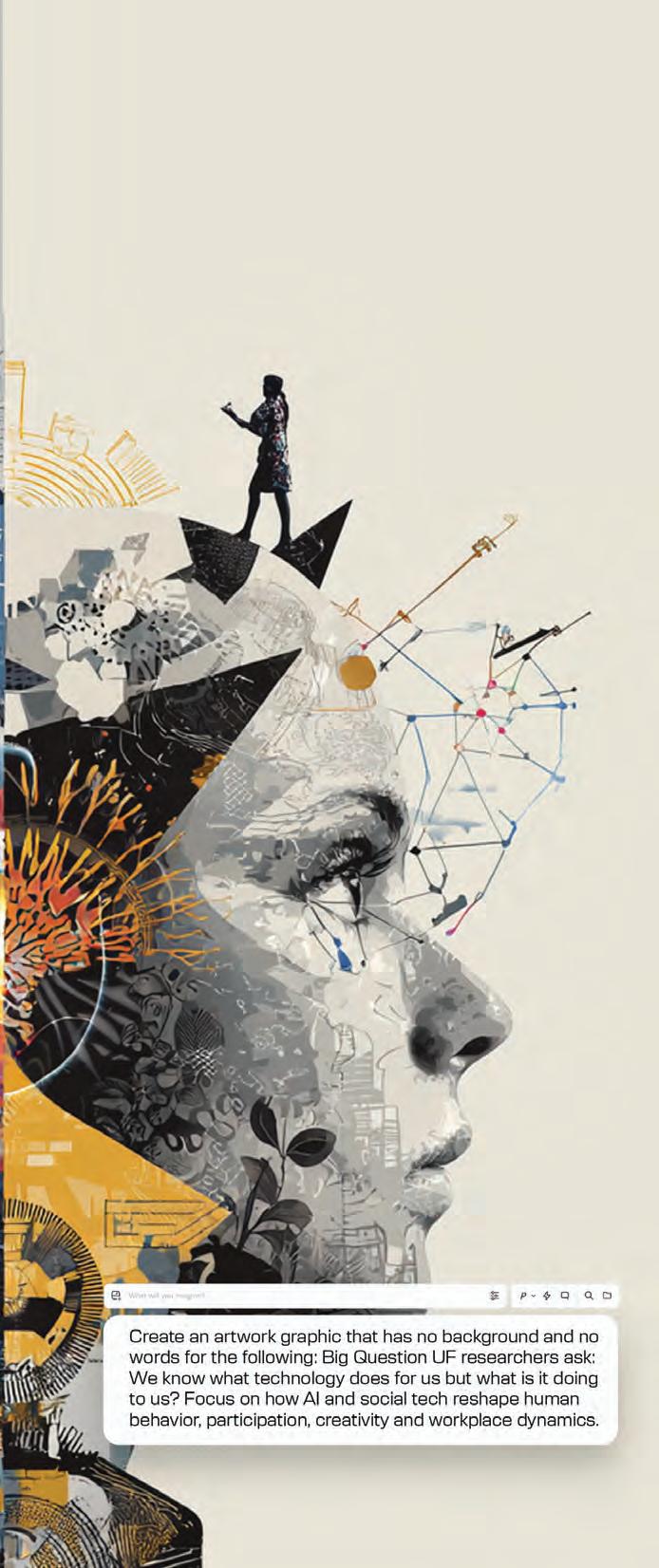
About the cover: Dr. Elias Sayour outside UF Health Shands Children's Hospital. Sayour is developing immunotherapy treatments for brain and other cancers.
Design and Illustration: Khary Khalfani Ivan Ramos
Writers: Douglas Bennett Joe Kays
Anna Boone
Cindy S. Spence
Social Media: Phillip Frohm Hunter Altman
Copy Editor: Bruce Mastron
Printing: RR Donnelley, Orlando
Member of the University Research Magazine Association www.urma.org
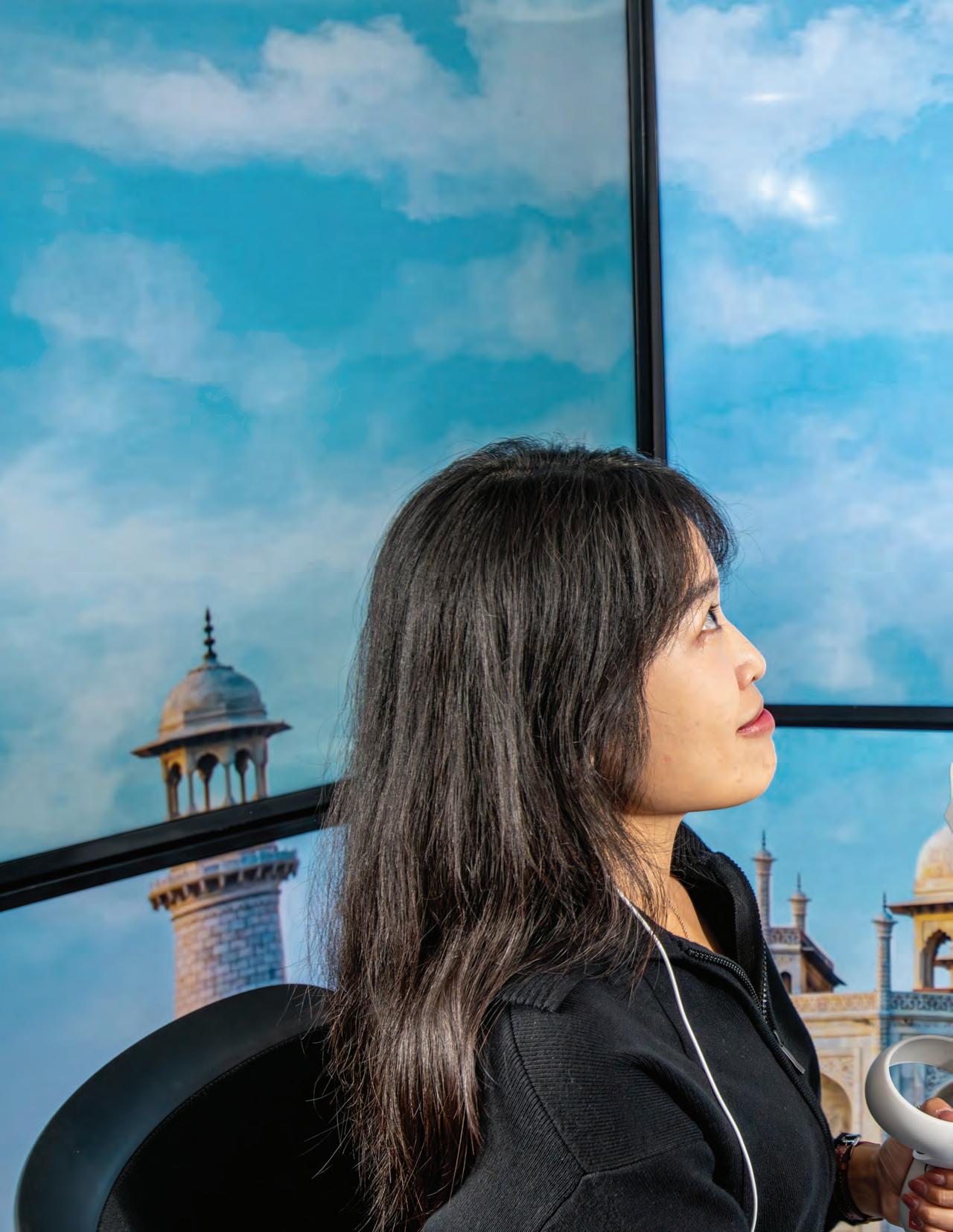
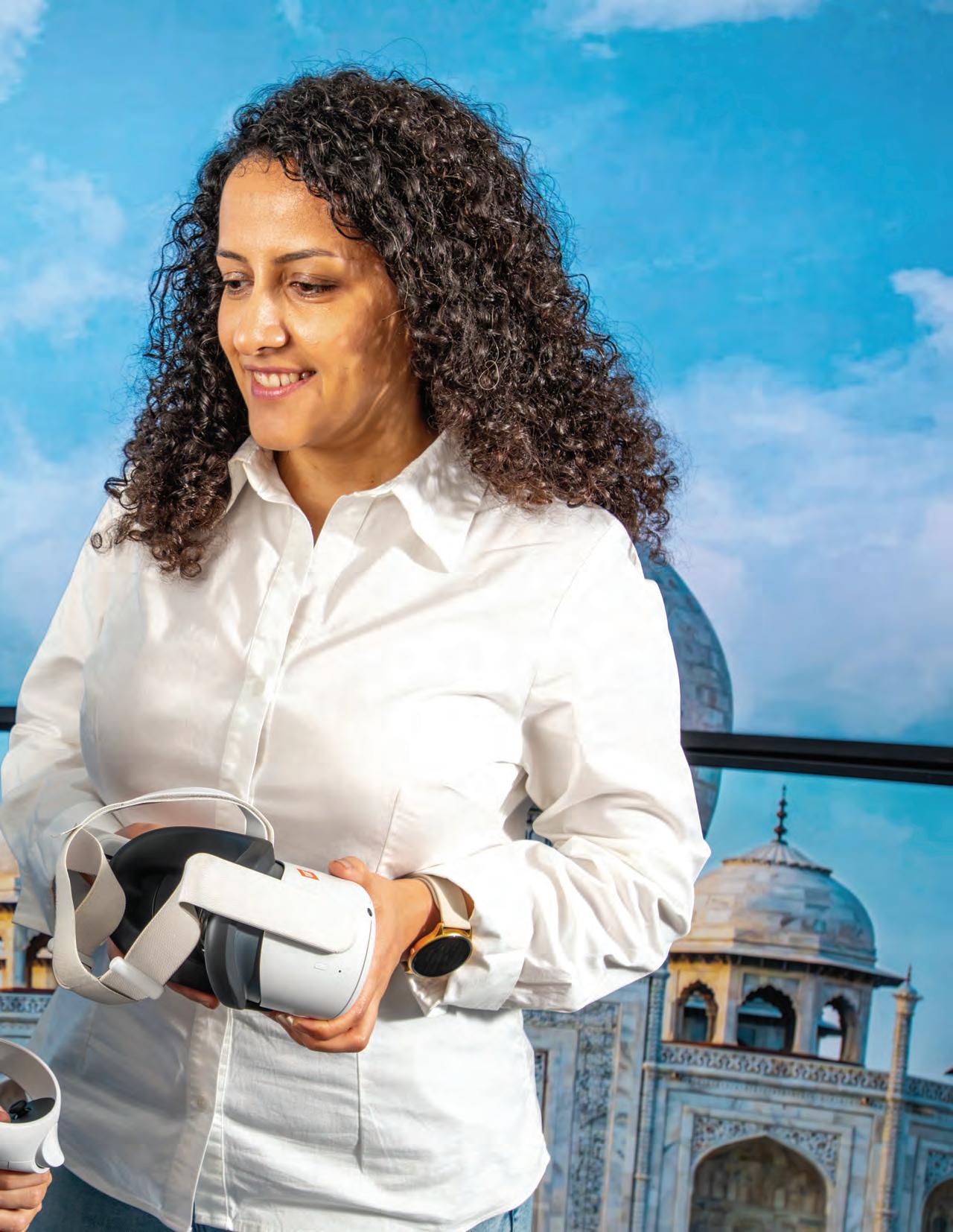
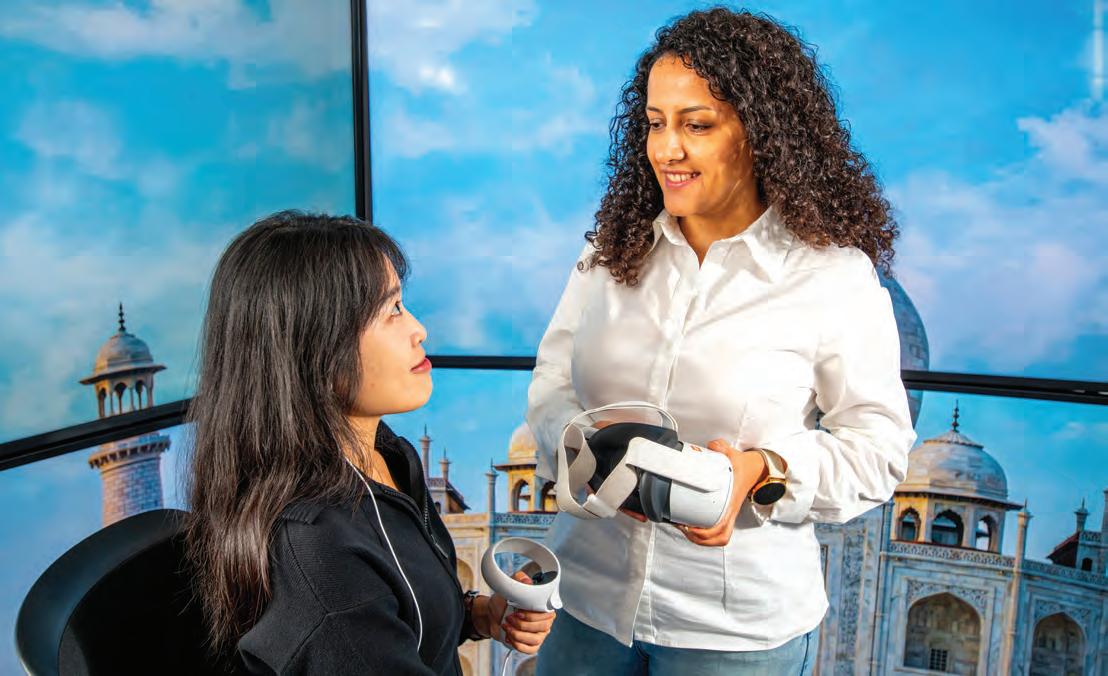
Doctoral students Jiwoo Jung (left) and Rezvan Eftekhary demonstrate some of the virtual reality equipment used in their tourism research.
A Biomedical Ecosystem
Florida faces steep and growing health challenges, from rising rates of Alzheimer’s and Parkinson’s to escalating burdens of cancer and diabetes. Florida’s geography, rapid population growth and uneven distribution of health care resources create additional layers of complexity.
Fortunately, the University of Florida has built a fully integrated biomedical ecosystem to address those challenges, using the most advanced tools in artificial intelligence, data science, translational infrastructure and community partnerships. It’s not simply another research hub. As t he vice president for research at UF, even I sometimes need reminders of just what a powerhouse we have, and I had a frontrow seat in March when National Institutes of Health Director Dr. Jay Bhattacharya visited campus to hear from our faculty about their work.
Many of these advances are tied to UF’s investment in artificial intelligence, anchored by HiPerGator, the fastest supercomputer owned and operated by a university in the U.S. HiPerGator is the computational engine that allows UF researchers to work with massive biological datasets, run complex modeling workflows in cancer research and neuroscience, develop clinical prediction tools, and power virtual realities for training and testing.
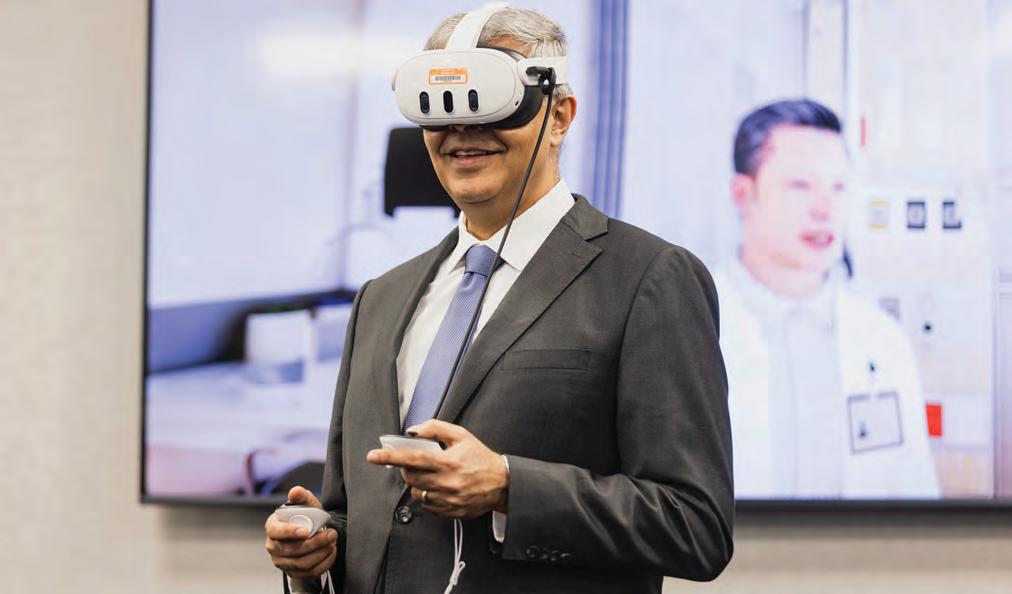
For example, in the UF Intelligent Hospital program, AI models digest gigabytes of real environmental data like room temperature, light and noise, and patient data like heart rate, blood pressure and oxygen saturation, to create virtual intensive care units that are being rigorously tested before being rolled out for training and, ultimately, for patient care. To experience this firsthand, Director Bhattacharya donned an immersive headset and quizzed a virtual doctor in a virtual UF hospital room about a hypothetical gallbladder surgery.
If HiPerGator is the engine, then the OneFlorida+ Research Network is the fuel. This statewide databank connects millions of electronic health records from multiple health systems (all names and identifying details are removed for privacy) with cancer registry information, mortality data, Medicaid claims, geographic indicators and social conditions. OneFlorida+ gives researchers a constantly evolving map of how diseases unfold across Florida’s various populations. Feed that data into advanced modeling systems running on HiPerGator, and the result is a dynamic platform for discovery.
The network lets UF investigators run virtual clinical trials in days instead of months and with thousands of patients instead of dozens. It helps researchers understand health disparities between coastal and rural communities, between older adults and working families, and between populations with different levels of access to specialized care. It guides implementation studies that examine what works in Tallahassee versus Palatka versus Miami. And it broadens participation by pulling community clinics and partner hospitals into the research enterprise, a priority Director Bhattacharya has championed to ensure that breakthrough science emerges from institutions across the nation, not just a select few. UF’s work also fits neatly into his push for reforms that he sees as critical to restoring public trust in science.
Where discovery and data meet, UF has built the infrastructure to carry ideas the rest of the way. UF has invested in multiple GMP (Good Manufacturing Practice) facilities, specialized plants built to exacting standards to produce safe and effective pharmaceutical and medical device products. These allow researchers to produce
NIH Director Jay Bhattacharya donned virtual reality glasses to participate in a demonstration of UF Health’s Intelligent Hospital program.
clinical-g rade materials for early phase trials, whether they are working on cell therapies, biologics or next-generation vaccine components — and do it all on the UF campus without outsourcing anything.
In addition, researchers at The Wertheim UF Scripps Institute for Biomedical Innovation & Technology in Jupiter are building and implementing tools more commonly found in industry to speed the pace of discovery. These include robotic high-throughput compound screening; AI-guided studies of RNA-linked diseases; engineered antibody treatments for cancer; natural product-inspired drug development; novel antiviral and antibiotic discovery, and much more.
These facilities mean Florida researchers can test discoveries in real communities with unusual speed. The UF Health Cancer Institute’s partnerships with oncology practices across the state, the UF Diabetes Institute’s collaborations with rural health networks, and the Evelyn F. and William L. McKnight Brain Institute’s deep relationships with neurodegenerative disease communities all feed into this system. The result is a virtuous cycle: Ideas begin in UF labs, move through data-d riven refinement, become trial-ready products, are tested in statewide clinical settings, and then return to UF to guide the next iteration.
Another thing that sets Florida apart is how far this ecosystem extends beyond traditional biomedical boundaries. Through UF’s Institute of Food and Agricultural Sciences, the university maintains a presence in all 67 counties. Food-a s-medicine initiatives, crop improvement strategies and chronic disease prevention programs travel through the same network that has long supported Florida’s agricultural economy. In an era when NIH is placing new emphasis on broad participation and equitable impact, this reach is one of Florida’s unique strengths.
This is what Director Bhattacharya saw during his visit, and why I believe UF’s model resonates with the direction he has outlined for national science. It supports bold, high-risk ideas by giving investigators the infrastructure and data they need to pursue them. It reinforces reliability by embedding replication and real-world testing into the scientific workflow. It broadens participation by ensuring that research includes urban and rural settings, advanced hospitals and frontline clinics, faculty experts and community partners.
The system UF has built can discover, test, build and deliver solutions at a pace and scale suited to the needs of the state. Bhattacharya’s visit made clear to me that this ecosystem is not only an asset for Florida but a model for the country, a reminder that the future of American health will be shaped by institutions that can connect ideas to outcomes with speed, rigor and purpose.
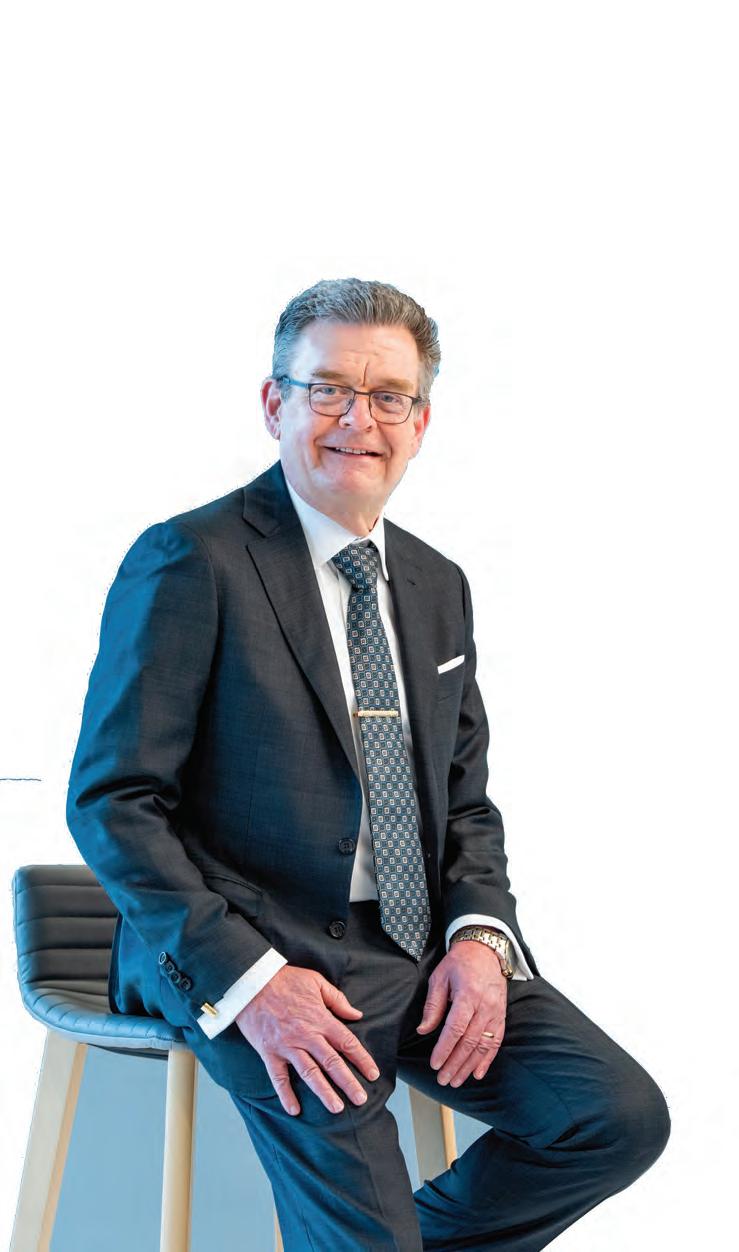
David P. Norton, Ph.D. Vice President for Research
Unraveling the mystery of chameleons’ wandering eyes
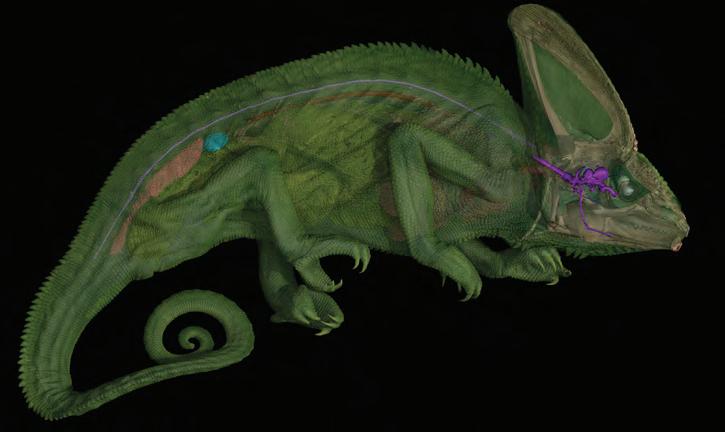
Chameleons’ wandering eyes have fascinated and puzzled scientists since the days of ancient Greece. Now, after millennia of study, modern imaging has revealed the secret of their nearly 360-degree view and uncanny ability to look in two different directions at once. Behind their bulging eyes lie two long, coiled optic nerves — a structure not seen in any other lizard.
The chameleon’s darting eyes are easy to observe, but scientists have never fully understood the optic nerve that makes such movement possible. Edward Stanley, director of the Florida Museum of Natural History’s digital imaging laboratory, was visiting Juan Daza’s lab at Sam Houston State University in 2017. That’s when Stanley first spotted the unique shape in a CT scan of the minute leaf chameleon. The coiled optic nerves were unlike anything he had seen before.
“Chameleon eyes are like security cameras, moving in all directions,” explained Daza, an associate professor and author of a recent study describing the trait. “They move their eyes independently while scanning their environment to find prey. And the moment they find their prey, their eyes coordinate and go in one direction so they can calculate where to shoot their tongues.”
Still, both scientists were initially cautious. Chameleons have been studied for ages. Surely, they weren’t the first to make this discovery. Chameleons are native to Africa, Europe and Asia. Beyond their color-shifting skin, the lizards have an impressive repertoire of tree-dwelling traits. They use their grasping tails to steady themselves and their oven mitt-shaped feet to creep along branches. Chameleons also have a long, sticky, ballistic tongue, which can go from zero to 60 mph in one-hundredth of a second to snatch prey.
Scientists now better understand the optic nerves that allows chameleons to have such darting eyes.
The team went deep into stacks of research in search of evidence of coiled optic nerves, even bringing in language experts to decipher old texts published in French, Italian and Latin.
Over 2,000 years ago, the Greek philosopher Aristotle erroneously theorized that chameleons lacked optic nerves, instead declaring the eyes were directly connected to the brain — which allowed their independent movements. In the mid-1600s, Roman physician Domenico Panaroli challenged Aristotle’s views, arguing that chameleons do have optic nerves, but — unlike in most other animals — they do not cross. This cross causes the image viewed in the right eye to be processed on the left side of the brain and vice versa. Panaroli believed that without this crossing structure, chameleon eyes could move freely.
Isaac Newton also propagated Panaroli’s theory in his 1704 book Optiks. In contrast, French anatomist Claude Perrault sketched the animal’s two optic nerves crossing before continuing in a straight line in his 1669 book on chameleon anatomy. While overlooked by Newton and many others, this was one of
the earliest and most accurate renditions at the time.
As years passed, scientists’ observations came close but ultimately fell short of capturing the true shape of the optic nerves. So how, after centuries of interest and study, could the true structure of a chameleon’s optic nerves remain hidden?
The answer lies in the power of CT scanning and open data. Scientists once relied on dissections — an imperfect and destructive way to see the inner workings of the chameleon’s anatomy.
Today, CT scanning allows scientists to visualize structures hidden within specimens, including the space beneath a chameleon’s skull.
The research team analyzed the CT scans of over 30 lizards and snakes, including three species of chameleons. They created 3D brain models for 18 of the lizards and measured their optic nerves. All three chameleon species studied had significantly longer and more coiled optic nerves than other lizards. The results confirmed that what Stanley had seen in Daza’s lab was no fluke.
Brooke Bowser
Seeds of Innovation: UF-based program fast-tracks plant breeding
The University of Florida is the new home for an important partner in the effort to provide nutritious food for the nation and keep farms competitive — a USDA-Agricultural Research Servicefunded program called Breeding Insight. The initiative supports public breeding efforts through more than 61 programs at the USDA as well as university-based efforts across the country.
Scientists at Breeding Insight use advanced prediction methods — including high-performance computing and artificial intelligence — and custom software applications to dramatically accelerate the development of new pestand disease-free crops that are more robust and nutritious.
They also bring their expertise to ornamental crops that support healthy ecosystems, as well as animal breeding programs.
Breeding Insight scientists know how to rapidly translate discoveries from lab to field, which underpins real-world impact. Breeding Insight was recognized with the 2024 USDA Secretary’s Honor Award for “their outstanding contribution to providing all Americans with safe, nutritious food.”
Among the nearly 50 species currently supported by Breeding Insight, 10 are among the top agricultural products for Florida: blueberry, alfalfa, strawberry, watermelon, lettuce, cucumber, sugarcane, citrus, potato and commercial beekeeping, said Moira Sheehan, director of Breeding Insight.
They also support the honeybee and aquaculture industries to breed for improved genetic stock that are more durable. That helps growers and producers gain the best yields and market value while consumers benefit from U.S. agriculture production.
In addition to helping to breed crops that resist emerging pests and diseases,
Breeding Insight scientists work to improve plant varieties to be more easily harvested through automation, saving labor and costs; extend the shelf life of fruits, nuts and vegetables; and develop efficiencies in crops with long growing cycles, such as pine and fruit trees.
“The shift of the program to the UF Institute of Food and Agricultural Sciences solidifies UF as the world’s best plant breeding program and brings additional seed funding and data analytic resources to UF/IFAS plant breeders,” said Damian Adams, UF/IFAS associate dean for research, who will manage the Breeding Insight program. “It also positions us to better support the agriculture industry in Florida through accelerated precision-breeding efforts.”
Several universities vied to be Breeding Insight’s new home, but Adams and Sheehan said UF/IFAS was chosen because of the strength of its agricultural programs, stakeholder standing and UF’s world-class computing infrastructure — including the HiPerGator supercomputer.
“We are proud to serve as the new host of Breeding Insight,” said Scott Angle,
UF’s senior vice president for agriculture and natural resources. “The UF/IFAS world-class plant breeding program and nearly 300 Florida-produced commodities make this the perfect home for the program. Feeding the world will require that new plant varieties be developed at a much more rapid pace, and we are confident that Breeding Insight and UF/ IFAS combined will be an important part of that effort.”
Additional Florida crops can be supported in the future, including cabbage, peanuts, cantaloupes, avocado and nursery plants, Sheehan said. Breeding Insight also hopes to expand to help Florida’s aquaculture industry for farm-raised tilapia, catfish, sturgeon, red drum, oysters and clams.
“I’m also excited about what Breeding Insight can bring to the table with novel varieties that work for smart farms, automated harvesters and other AI-driven tools,” Adams said. “This is an exciting partnership that can help Florida agriculture transition to high tech and stay ahead of the competition.”
Brad Buck
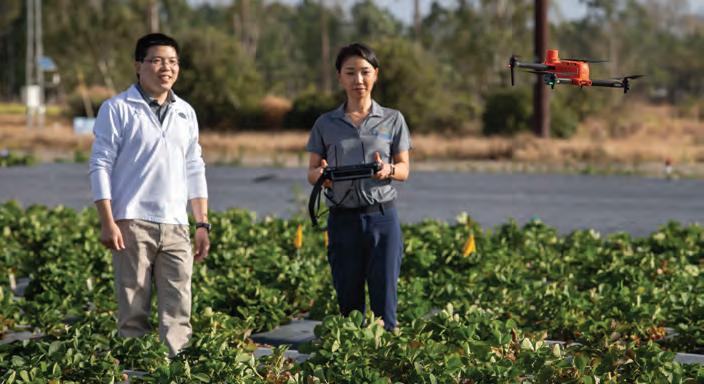
Kevin Wang (l) and Dana Choi — both assistant professors of agricultural and biological engineering — fly a drone at the UF/IFAS Gulf Coast Research and Education Center in Balm.
Tyler Jones
UF scientists uncork new era of disease-resistant wine grapes
In a milestone for Florida agriculture, researchers have grown and harvested wine grapes that resist the main bacterial disease that has long prevented the state from establishing a large-scale wine industry.
Researchers successfully grew five grape varieties in Citra, Florida, that are resistant to Pierce’s disease, a bacterial infection that kills the vines and shrivels the grapes. The effort by Ali Sarkhosh, an associate professor of horticultural sciences in the UF Institute of Food and Agricultural Sciences, produced a harvest of grapes that resulted in 13 cases of wine.
While Florida has a thriving muscadine grape industry, the global market for muscadine wine is small compared with wine made from Vitis vinifera, the grape species behind worldfamous wines such as cabernet sauvignon, sauvignon blanc and merlot. Florida is already the nation’s second-highest wineconsuming state, behind only California, with an industry valued at $15 billion in 2022. Yet most of the wines served are produced elsewhere, primarily in California, Oregon and Washington.
Sarkhosh said he hopes this research will offer a potential additional crop for muscadine grape farmers. As of 2017, there were 547 Florida vineyards growing muscadine and hybrid grapes.
“This could be an enormous opportunity for vineyards in Florida to expand into additional types of wine for a wider market,” he said. “This could be the start of a new chapter for Florida wine.”
UF researchers worked with Château Le Coeur, a winery based in DeFuniak Springs, Florida, to make the wine from their harvest. The wine was crafted with 75% Florida-grown fruit and blended with 25% cabernet sauvignon and merlot.
The grape used in the wine collaboration is a hybrid called “Erante Noir” and was developed at
the University of California, Davis. It carries the genes of sauvignon blanc and cabernet sauvignon.
John Choquer, the owner of Château Le Coeur, emphasized the potential for the collaboration.
“If we are successful in growing in the area and combating Pierce’s disease effectively, it will be a strong growth industry and emerging market for agritourism,” he said.
Early tastings point to a dark, fruitforward wine. Château Le Coeur named this debut wine “Genial,” a French expression for something new and innovative.
Choquer is also planting a variety of traditional wine grapes, red and white, at his vineyard. He said his winery is grateful for UF’s support and collaboration as he works to create a Florida-based traditional wine industry.
“This is not a short-term experiment,” Choquer added. “We plan to test more Pierce’s disease-resistant and traditional vinifera varieties, refine vineyard practices and build a new type of wine industry here in Florida. There will be challenges
and there will be setbacks, but the potential is also so great. There is such a strong market potential here in Florida.”
Meredith Bauer-Mitchell and Eva Sailly
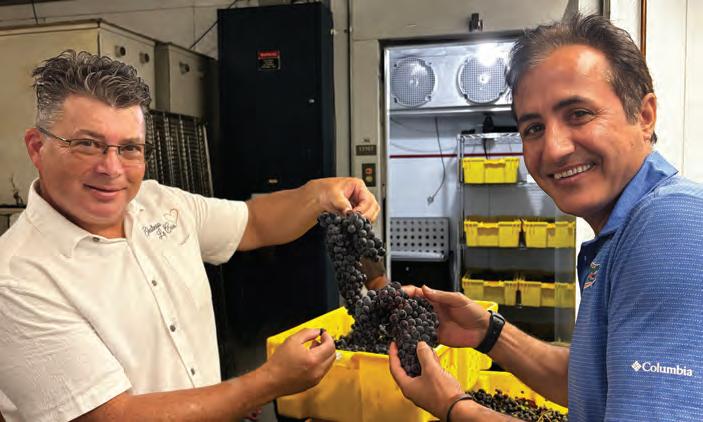
Château Le Coeur owner John Choquer (left) with UF/IFAS associate professor Ali Sarkhosh.
Disease-resistant wine grapes
Eva Sailly
Promising compound to halt pancreatic cancer growth identified
University of Florida Health scientists helped find a promising new way to attack and kill pancreatic cancer cells by identifying an overlooked weak spot on a protein that supercharges the lethal cancer’s growth.
After finding the ideal location using artificial intelligence and UF’s HiPerGator supercomputer, researchers screened nearly 140,000 compounds to find the best match to exploit this newfound vulnerability in the cancerous cells.
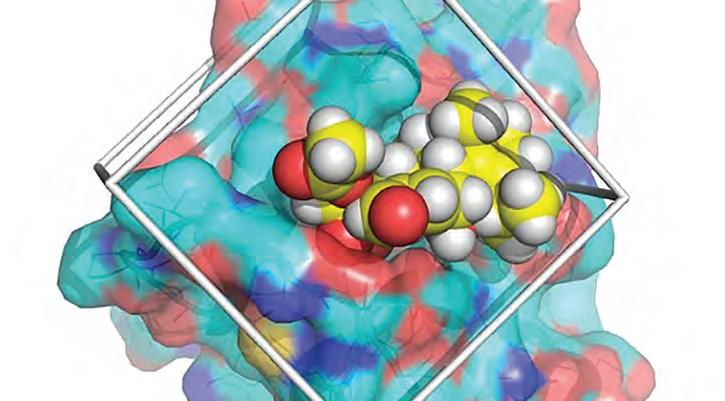
The top contender is a compound called striatal B, a byproduct of a family of organisms known as “bird’s nest fungi,” named for the shape of their fruiting bodies, which resemble nests.
Paired with a chemotherapy drug, striatal B turns off the protein’s messaging to cancer cells that drive them to multiply, according to a recent study published in Biomedicine & Pharmacotherapy.
“These are exciting findings,” said UF Health immunologist and structural biologist David A. Ostrov, a co-author of the study. “This is one of the strengths of drug discovery at the University of Florida — our ability to target unique and unexplored structural pockets on proteins.”
While more research, including clinical trials, is needed to confirm safety and effectiveness in patients, Ostrov said, “these early results mark a significant step in the search for new treatments.”
The compound and chemotherapy drug combination proved effective in tests using laboratory-grown human pancreatic cancer cells and mouse cancer cell lines.
The road to the discovery began in Texas. Ostrov’s former UF Health colleague, Robert A. Hromas — now dean of the University of Texas medical school in San Antonio — asked Ostrov to help his team. He wanted to tap Ostrov’s expertise in mapping proteins to find druggable spots.
The image depicts a model showing how Striatal B (represented by the spheres) connects with a protein that supercharges pancreatic cancer cells. Blocking this protein could slow the cancer’s rapid growth.
“We’re all still Gators,” said Ostrov, who is a member of the UF Health Cancer Center.
The Texas researchers had identified a promising agent they believed might bind well to a protein, STAT3, that is integral to the cancer’s growth. Ostrov hunted for the best location.
Ostrov is, in a sense, a cartographer, mapping the complex folds, valleys and ridges that compose a protein’s threedimensional surface. Proteins carry out nearly every job in the body, from controlling growth to fighting infection.
STAT3, working properly, fights infection and inflammation by turning on genes in an immune response. It also regulates how cells grow and divide, and then deactivates when the job is done.
In cancerous cells, however, STAT3 acts like a car with its accelerator stuck.
“Mutations in some cancer cells turn STAT3 on, and keep it on,” Ostrov said. “So, it keeps sending signals to the cancer cells telling them to grow and keep dividing.”
Ostrov used artificial intelligence software to predict STAT3’s labyrinthine shape. The AI tool he used has been trained on hundreds of thousands of other proteins whose structure has already been confirmed in the lab with older methods, such as X-ray crystallography.
The AI learned the rules of how all proteins twist, curl and fold into complex patterns and can predict an unmapped protein’s geography. Scientists can then confirm the findings in the lab.
Ostrov identified an area on STAT3 called the linker domain that had previously been thought inconsequential as a landing zone for drug candidates.
The chemical agent that Texas researchers asked Ostrov to screen attached to the linker domain better than any other part of STAT3, he said. This surprised the team. Ostrov, however, thought expanding the search might uncover an even better drug candidate.
Ostrov’s team analyzed digital copies of the 140,000 compounds from a National Cancer Institute database and found one more effective than the compound originally suggested by the Texas researchers. This was striatal B.
“No one has ever solved the full crystal structure of the STAT3 protein,” Ostrov said. “Now, with the power of artificial intelligence, we can predict its complete structure and reveal drug targets that were previously invisible. This opens the door to faster drug discovery and more personalized treatments.”
Bill Levesque
Magnetic breakthrough promises cleaner, faster metal production
Imagine if producing steel parts for agricultural equipment or even aluminum soda cans required only a fraction of the energy it does today. A University of Florida-led innovation may soon make that a reality.
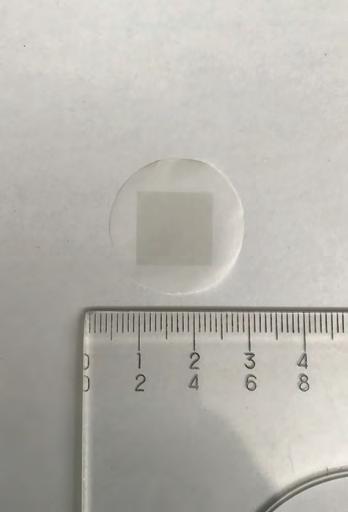
In a groundbreaking collaboration backed by a nearly $11 million federal grant, UF researchers have developed a first-of-its-kind superconducting magnet that could advance metal production and position the United States as a global leader in alloy production.
Funded by the U.S. Department of Energy’s Advanced Manufacturing Office, the project uses InductionCoupled Thermomagnetic Processing, or ITMP, an advanced manufacturing method that integrates magnetic fields with high-temperature thermal processing.
The national consortium of industry, academic and national laboratory partners is now led by Michael Tonks, a materials science and engineering professor. He succeeded Michele Manuel, the project’s longtime leader.
“This revolutionary technology has the potential to substantially reduce the cost and energy use of heat treatments in the steel industry, and we are excited to help pave the way for its adoption in industry,” Tonks said.
It’s not just any piece of equipment. It’s a custom-built superconducting magnet with a unique ability to combine magnetic fields with high-temperature thermal processing.
A partnership with the UF physics department, Oak Ridge National Laboratory and six companies interested in the technology, has developed a magnet and cylinder induction furnace that now sits atop a 6-foot-high platform. The prototype, which cost more than $6 million to purchase and install, is capable of processing steel samples up to 5 inches in diameter — making it a rare asset for academic research.
Yang Yang, a science research faculty member, estimated ITMP could reduce steel processing time by as much as 80%, cutting energy use and operational costs.
“Thermomagnetic processing changes a material’s phase stability and kinetic properties, accelerating carbon diffusion in steel, Yang said. “Traditional furnaces cannot achieve these advanced material properties.”
The system works by modifying the driving forces for important steel phase changes, which shortens heat treatment.
“What normally takes eight hours can be done in just a few minutes.” Yang explained. “The magnetic field acts as an external driving force to make atoms diffuse faster.”
Unlike conventional energy sources such as electricity or natural gas, the ITMP process uses volumetric induction heating along with high-static magnetic fields to lower energy consumption. The project still requires additional research and testing.
At the Oak Ridge lab, researchers emphasized the rarity of UF’s prototype: an unprecedented combination of magnetic field strength and ability to process large samples and components.
“This could significantly advance U.S. manufacturing and process efficiency
for heat treatment of materials such as metal alloys of steel or aluminum,” said Michael Kesler, Oak Ridge’s research scientist and lead collaborator.
Kesler noted successful implementation of this technology could contribute to a reliable energy grid and more efficient industrial electrification. UF researchers say it could also reduce carbon emissions, supporting cleaner, more sustainable manufacturing processes.
The tall, two-level magnet now resides in the Powell Family Structures and Materials Laboratory on UF’s East Campus. While Engineering students will have future opportunities to use it for research and experiential learning, UF researchers are optimistic about potential industry adoption for industrial manufacturing in the next five to 10 years
The award is part of a $187 million DOE initiative to strengthen competitiveness in U.S. manufacturing. If successful, the innovation could redefine how the world shapes the materials of tomorrow.
Paris Carter
A superconducting magnet developed by UF researchers could advance metal production.
Atom-thin filter may supercharge battery performance
Longer-lasting phones, lighter drones and electric cars that drive farther are just some of the possibilities arising from a new battery separator design by University of Florida researchers and their partners.
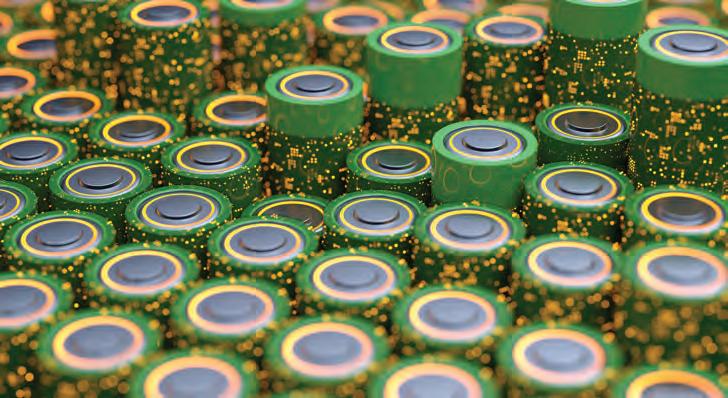
Think of a tiny coffee filter, but this one works inside a battery. The team recently showed that a one-atom-thick filter can block sulfur chains from shuttling within the battery, potentially unlocking the long-awaited promise of lithium-sulfur batteries.
While lithium-sulfur batteries pack more power in a lighter package compared with the more conventional lithium-ion batteries, their fatal flaw is that sulfur doesn’t cooperate well inside the system. It clumps into long chains that clog up the works, draining the battery’s power and cutting its lifespan.
Engineers from UF, Purdue University and Vanderbilt University developed a high-performance filter that works at a molecular level to fix the problem.
“It’s like a microscopic coffee filter or
a bouncer at a club,” said
an associate professor of mechanical and aerospace engineering at UF who authored the recent study. “Tiny lithium ions slip through easily, but bulky sulfur chains get blocked.”
Today’s lithium-ion batteries power nearly everything we carry and drive, from smartphones to electric vehicles. They work well, but have hit limits on how much energy they can store for their weight.
“Lithium-ion batteries have been perfected over a long time, and they work very well,” Kidambi said. “But lithiumsulfur can be much lighter and can store more electrical energy.”
An average electric vehicle battery weighs about 1,000 pounds and gets about 200 to 250 miles of range. With lithium-sulfur at the same weight, a driver can go farther on one charge, Kidambi said. Cellphones would last longer between charges, and lighter batteries would let drones stay in the air longer.
To make the filter, the researchers used a method called chemical vapor deposition. They start with a copper foil, heat it and flow a vapor over it. The chemical reaction leaves behind a film of graphene with perfectly defined openings to separate the lithium from the sulfur chains.
When they tested the design, the
difference was striking. Unfiltered batteries began losing performance quickly. With the one-atom-thick filter, batteries held nearly all their capacity over more than 150 charge-discharge cycles.
“They performed quite well,” Kidambi said. “The others dropped off with each charge and discharge, but the ones with our filter held steady.”
The potential applications extend well beyond consumer devices. Kidambi pointed to freight trucks, trains and even ships, where battery weight becomes a major obstacle.
“As you move from cars to trucks, trains or ships, the battery weight rises exponentially because you need more energy to move them,” he said. “That’s called weight compounding. The battery starts to weigh almost as much as the load it’s supposed to move.”
Much work remains before lithiumsulfur batteries with atom-thin filters could be manufactured at scale and placed into everyday devices, but Kidambi is encouraged by their progress.
“There’s real scientific success in being able to show that we can solve a problem, and we can solve it by engineering at the atomic level,” he said. “That is exciting for me.”
Karen Dooley
Piran Kidambi,
A tiny, high-performance filter has been found to extend the power and lifespan of lithium-sulfur batteries.
ING IMMUNITY IGNI
“I wish there was a cancer vaccine.”
Elias Sayour’s patients inspire pioneering mRNA cancer vaccine research
By Michelle Jaffee
The look in her eyes and her next words would be etched forever in the mind of Dr. Elias Sayour.
Months earlier, the girl’s right leg was amputated, the best chance to rid her body of cancer. But the cancer came back anyway, this time in her lung.
The young teenager understood exactly what this meant. If you knew the cancer was gonna come back, she asked Sayour, why’d you cut off my leg?
He’d made the best decision he could with the information he had. But such experiences during his pediatric oncology fellowship shifted something deep inside Sayour, seeding what would become an urgent refrain. He saw preschoolers with permanent brain damage from radiation or surgery. Kids who died of infections or other complications after chemotherapy.
Framed photos of patients lost began taking up permanent residence on his office bookshelves.
Everything he’d dreamt about and worked toward for years had led to this point, but now, he wasn’t so sure about this path and its pain. He viewed the treatments he was dispensing as crude. Even when they cured, the cost seemed too great.
Sayour couldn’t stop thinking about what he’d learned during his residency in general pediatrics, about the gold standard of disease prevention in children, the guardian angel: Vaccines.
“I wish,” he told a colleague, “there was a cancer vaccine.”
His colleague smiled knowingly. “You have to meet this guy, Duane Mitchell.”
The moment would mark the start of a giant career pivot, from primarily caring for patients to conducting research and then shepherding it from the lab to human clinical trials. His “more heart than head” instinct told him this was the path of hope.
Specifically, he would focus on mRNA cancer vaccines.
He could see a glimmer of their potential to “wake up” the immune system against cancer.
What he didn’t know, couldn’t know, is that a future global pandemic would accelerate the development of mRNA-based vaccines — creating an unexpected opportunity to test a hypothesis for cancer treatment.
Glioblastoma Cells
Taking Care of Others
Growing up in Brooklyn, New York, Sayour visited his own pediatrician more often than just for the annual checkup, as he was prone to stomach viruses. Even as a 6-year-old boy, he noticed the comfort offered by his doctor.
“I remember kind of being enamored with this idea of taking care of others,” he recalls.
He could see himself in that role, and the vision became a guiding force when he felt out of place.
In school, he noticed his packed lunches looked different from the other kids’, and he spoke differently, too, having not yet mastered English. At home in his tight-knit family, he and two sisters, one older and one younger, spoke Arabic with their Syrian-immigrant parents. His dad, an electrical engineer, rose from an entry-level position to become senior vice president of a fire alarm systems company; his mom devoted herself to her children and encouraged them to pursue their passions.
After years of intense focus on academics at his all-boys Catholic high school, Sayour let loose a bit at Fordham University. At one point, he let his GPA sink to 2.7 and risked losing his scholarship.
“There’s no way you’re going to medical school,” he heard more than once.
Looking back on that bumpy time, he says, “I think that’s why it’s so important to have that initial seed of belief. I credit my mom with that, planting that original seed.”
He was less concerned with proving himself to doubters and more with showing himself he could do it. He embraced Emerson: “To finish the moment, to find the journey’s end in every step of the road, to live the greatest number of good hours, is wisdom.”
Against the guidance of his adviser, Sayour doubled down: He added a second major, biology plus chemistry, and got serious. He lifted his GPA to 3.8.
In medical school at the University of Buffalo, he’d often go without a winter coat, even on subzero days. A coat signaled you were leaving the hospital, and back then the expectation was that med students never left.
For his residency in general pediatrics, he trained at a busy New York City clinic, at times relying on his limited Spanish. He struggled to get along with his attending physicians, who criticized him for moving too slowly.
“It felt like McDonald’s for health care,” he says. “Like, just get them in and get them out. I didn’t feel like I was giving patients comfort. I didn’t feel like I was giving them time.”
It came to a head one day when an infant was brought in for a postpartum weight check. When Sayour checked the chart, the newborn screening was positive for a devastating diagnosis, a rare genetic disorder that typically means death before age 2.
Sayour spent close to an hour with the mom, explaining the findings and offering all the support he could. But when he stepped out of the exam room, his attending physician berated him for spending too long on the weight check.
He felt a dream die that day, he says, and still grimaces talking about it. “The baby has Krabbe leukodystrophy,” he attempted to clarify. The attending snapped: “You let the geneticist worry about that.”
Sayour knew his long-planned path had to change. He recalled that in his hematology-oncology rotation in med school, he was able to care for the whole patient.
“Nobody was telling me I spent too much time with a patient,” he says. “And that mattered to me.”
He headed to Duke University for a fellowship in pediatric hematology-oncology. One of his mentors there, Dr. Jennifer Rothman, remembers him as hardworking and modest.
“He was one of those quiet, smart, engaging, compassionate worker bees who never drew attention to himself,” Rothman says. “He feels things deeply. He’s just a great soul.”
John
Jernigan
Elias Sayour
“He was one of those quiet, smart, engaging, compassionate worker bees who never drew attention to himself. He feels things deeply. He’s just a great soul.”
– Jennifer Rothman
Months into his fellowship, as his dismay over insufficient treatment options grew, Sayour heard about Duane Mitchell and his work on therapeutic vaccines for brain cancer.
In their first meeting, Sayour described his anguish over side effects. Mitchell nodded.
“This is unacceptable,” Mitchell said. “We need to do something about it. We need to attack cancer in a focused, targeted way that spares normal tissue.”
For once, Sayour says, “I actually felt seen.”
Mitchell’s lab was already at capacity for trainees that year, 2011. But he could see Sayour’s passion and agreed to stretch his staff.
That’s when Sayour first learned about the concept of RNA vaccines for cancer. Soon, he would focus on a type called mRNA — long before those four letters would become a household term during the COVID pandemic.
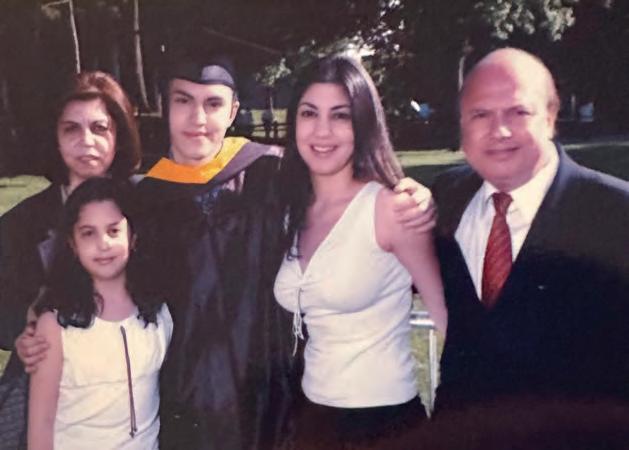
Sayour with his family at his Fordham University commencement.
“Elias had that combination of being brilliant but also extremely resilient and extremely persistent.” – Duane Mitchell
Sayour’s first assignment was as project leader for a new grant to develop cancer vaccines by combining lipid nanoparticles and mRNA, an innovative technique that was showing promise in early mouse studies.
Short for messenger RNA, mRNA is a molecule found inside every cell — including tumor cells — and carries the instructions from our DNA for making proteins. In cancer vaccines, mRNA works by using our own cells to produce harmless fragments of a target protein. Our immune system then reacts to this protein, attacking it and creating an effective response for the future.
While vaccines to prevent infectious diseases train the immune system to recognize and react to specific viruses or bacteria, the goal with cancer vaccines is to recognize existing malignant cells as the invaders, augmenting other treatments.
Mitchell’s lab employs what’s known as a translational approach, using mouse models and cells from human tumor biopsies to develop new treatments, then scaling them up, manufacturing them and testing them in first-of-their-kind human clinical trials. It’s a painstaking process that takes years of work and millions of dollars from the government, foundations and donors to accomplish.
For Sayour, the plan was to spend a single year in the lab while continuing to care for patients. But a few months in, he asked Mitchell if he could stay on and start a Ph.D.
“There are a lot of people who pursue research because they love science, and they like the idea of discovery,” Mitchell says. “And then there are a smaller number who really believe that ‘If I dedicate my life to this endeavor, we might be able to make a difference for other people.’
“Elias had that drive.”
Years later, after suffering many early grant rejections, Sayour would evolve into a prolific grant writer, telling compelling stories with hypotheses and data. He would build a robust funding portfolio comparable to any of the country’s top investigators.
His tenacity was something Mitchell saw from the beginning.
“I’ve had fellows who start fast, but they don’t have the resilience to get through the difficult stages of research,” he says, “and others who, though nothing seems to be working for a long time, there’s no quit in them. They always come through with amazing results over time. And Elias had that combination of being brilliant but also extremely resilient and extremely persistent.”
So, in 2013, when Mitchell was recruited to the University of Florida and offered the chance to bring his own team and build a new Brain Tumor Immunotherapy Program within the Preston A. Wells Jr. Center for Brain Tumor Therapy, Sayour was one of his first hires.
At UF’s McKnight Brain Institute, Sayour dove into developing personalized mRNA cancer vaccines, using an individual’s own extracted tumor cells to create custom vaccines. Early results in mouse models showed that his high-tech method could quickly reprogram the immune system to attack glioblastoma, a notoriously treatment-resistant brain cancer with a prognosis of 12 to 18 months.
It was during these preclinical experiments that Sayour stumbled upon an incredible discovery: The mRNA vaccines didn’t have to be personalized. To his surprise, even completely nonspecific mRNA vaccines, which were used in a control group, could, in Sayour’s words, “wake up the sleeping giant that is the immune system to fight cancer.”
Jacqueline Hart
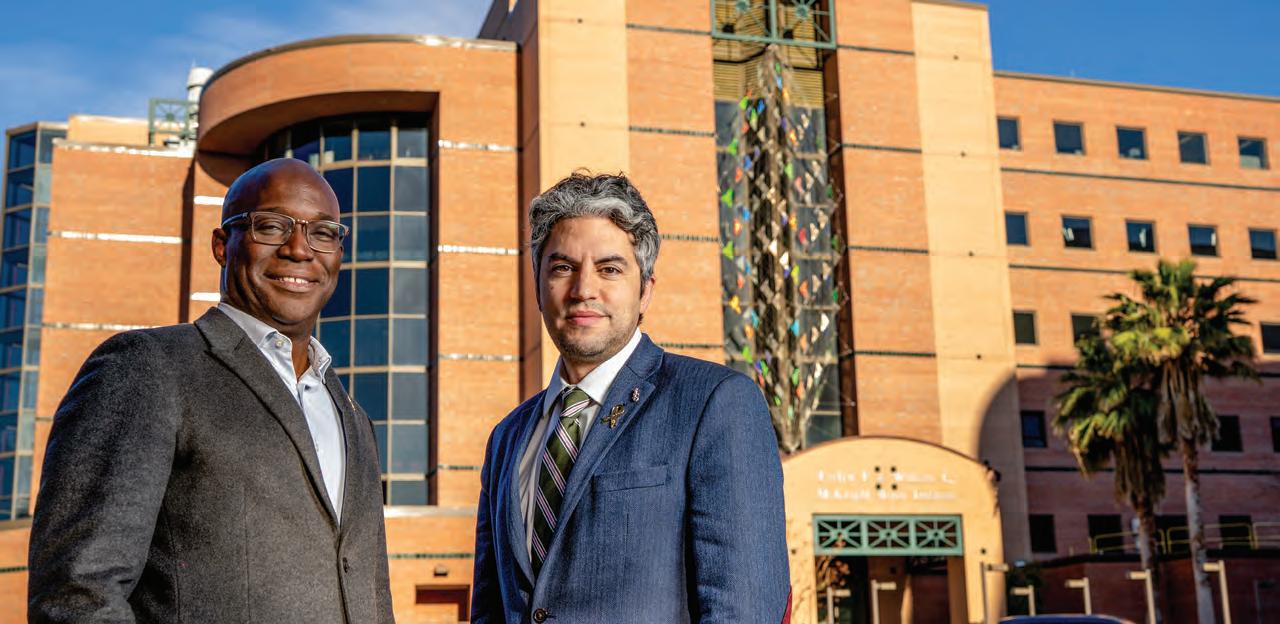
Duane Mitchell and Elias Sayour at UF’s McKnight Brain Institute.
An Emerging Paradigm
For three decades, two main ideas have dominated cancer-vaccine development: to identify a specific target expressed in many people with cancer, or to tailor a personalized vaccine that’s specific to proteins expressed within a patient’s own tumor.
Sayour’s work suggested a third emerging paradigm.
What he found was that by pairing his patented experimental “nonspecific” vaccine with standard anticancer drugs called immune checkpoint inhibitors, he could trigger a strong antitumor response in lab mice. His formulation was “nonspecific” in that it was designed not to target cancer specifically, but rather just to mobilize a strong immune response.
This discovery established the basis for the idea that mRNA vaccines — even those not specific to any tumor or virus — could boost the effects of immunotherapy drugs designed to “release the brakes” of the immune system to fight cancer cells.
And in contrast to the high cost and time-consuming nature of personalized vaccines, Sayour’s discovery would bring the research field one step closer to a universal, off-the-shelf cancer vaccine.
Then a global pandemic provided a natural experiment.
The advent of the mRNA COVID vaccines during Operation Warp Speed sparked a hypothesis from Dr. Adam Grippin, a resident in radiation oncology at the University of Texas MD Anderson Cancer Center who conducted research in Sayour’s lab while completing his M.D.-Ph.D. at UF.
Grippin asked: If nonspecific mRNA vaccines can wake up the immune system against cancer, what happens to patients who receive the COVID vaccine while also undergoing conventional immunotherapies?
UF and MD Anderson researchers then set out to analyze over 1,000 medical records, retrospectively studying whether MD Anderson cancer patients who received COVID shots lived longer than those who didn’t.
Their findings, published in Nature in October 2025, made headlines from Brazil to South Africa to Ukraine and beyond:
• “Study finds mRNA coronavirus vaccines prolonged life of cancer patients” — The Washington Post
• “Is this the beginning of the end for cancer? mRNA breakthrough hints at universal vaccine” — The Times of India
• “mRNA Covid vaccines may help some cancer patients fight tumors” — France24
The study’s Altmetric score, a measure of news coverage and social media engagement for research papers, soared to over 7,000 — the seventh highest among more than 1 million papers assigned a score in 2025.
The Clinical Research Forum in Washington, D.C., which honors the nation’s most outstanding research, named it a Top 10 Clinical Research Achievement Award winner for the year.
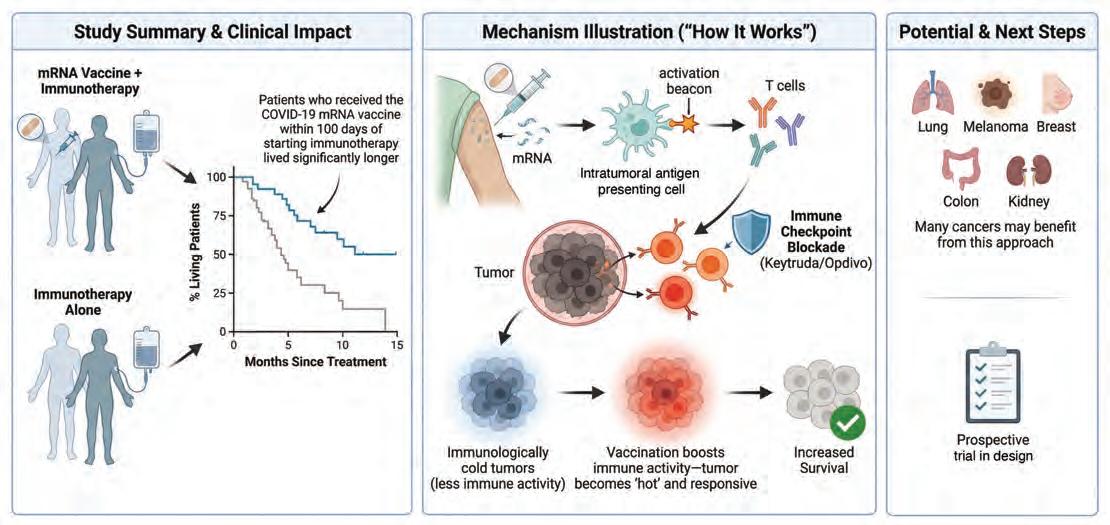
How COVID-19 mRNA Vaccines Boost Immune Response Against Cancer When Paired With Immunotherapy
Here’s what the researchers found: Patients with advanced lung or skin cancer who received a COVID vaccine within 100 days of starting immunotherapy drugs lived significantly longer than those who did not receive the vaccine.
In the lung cancer patients, getting the vaccine was associated with a near doubling of median survival, from 20.6 months to 37.3 months. In the metastatic melanoma patients, median survival increased from 26.7 months to a range of 30 to 40 months; at the time the data were collected, many melanoma patients were still alive, meaning the vaccine effect could be even stronger than in the lung cancer patients.
To back up their observational findings, Sayour’s lab used mouse models to pair immunotherapy drugs with an mRNA vaccine targeted specifically at COVID spike protein. Those experiments showed they could turn unresponsive cancers into responsive ones, thwarting tumor growth.
“One of the mechanisms for how this works is when you give an mRNA vaccine, that acts as a flare that starts moving all of these immune cells from bad areas like the tumor to good areas like the lymph nodes,” Sayour says.
Importantly, notes Dr. Eli Gilboa, a pioneer in the field of cancer immunotherapy, the discovery was not the result of a single study, but rather a comprehensive set of studies published by Sayour in top-tier journals.
“Dr. Sayour has made a groundbreaking contribution in how to promote immune responses against tumors, which is the holy grail of cancer immunotherapy research.”
– Eli Gilboa
Lung Cancer Cells
“Dr. Sayour has made a groundbreaking contribution in how to promote immune responses against tumors, which is the holy grail of cancer immunotherapy research,” Gilboa says.
Over time, scientists have explored various potential methods to elicit such responses.
“Dr. Sayour’s approach stands out in its simplicity and elegance,” says Gilboa, who was Mitchell’s mentor and serves as director of the Dodson Interdisciplinary Immunotherapy Institute at the University of Miami. “It’s very counterintuitive. It stands out because it’s not tumor-specific, but it elevates acrossthe-board immune activity in the patient. It revs up the patient’s immune system.”
The findings still need to be confirmed, and Sayour and his team are currently designing a large randomized clinical trial, planned to start this year.
If effective in a prospective trial, it would mean that a widely available vaccine capable of jump-starting a patient’s response to immunotherapy already exists — and that scientists could start developing an even better universal cancer vaccine.
In the meantime, Sayour is also moving forward with personalized mRNA vaccines for glioblastoma, building upon a first-ofits-kind human clinical trial that he detailed in Cell in 2024.
In that study, a vaccine that used a patient’s own tumor cells and a newly engineered complex delivery mechanism spurred a vigorous immune-system response to fight the tumor in four adult patients with glioblastoma.
The patients either lived disease-free longer or survived longer than expected, and the results mirrored those in 10 pet dog patients suffering from naturally occurring brain tumors whose owners enrolled them when they had no other treatment options.
That breakthrough will now be tested in a Phase 1 pediatric clinical trial for brain cancer.
“He has multiple iterations that have moved into clinical trials, across multiple disease populations of patients with cancer,” Mitchell says. “So to build a translational and clinical program around your science that is treating both adults and children with distinct diseases is an extraordinary accomplishment.”
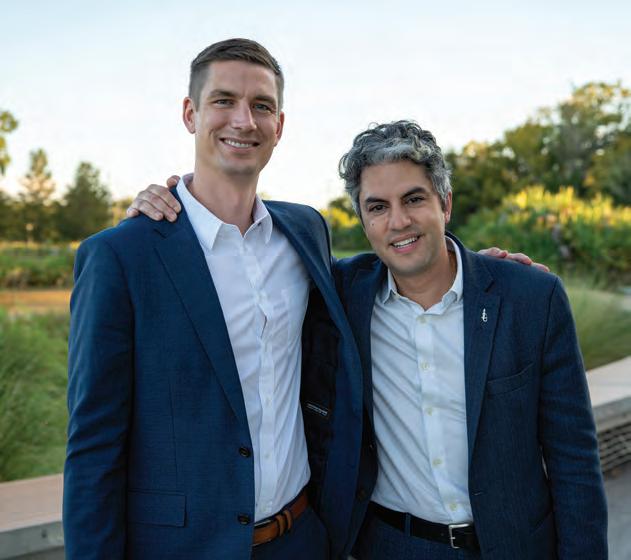
Sayour with collaborator Adam Grippin.
Back to the Lab
Now 44, Sayour runs his own lab that has grown to over 30 members, from junior faculty to undergraduate volunteers, and he continues to see patients too.
Parents of his patients often stay in touch. One couple made him a memorial photo album of their son, which Sayour keeps in his office near photos of his own three young children. Other parents, such as Cole Dooley, maintain a connection to Sayour through their joint advocacy for new treatments.
Dooley, a pediatric anesthesiologist, lost his 6-year-old daughter Phoebe in 2018 to diffuse intrinsic pontine glioma, or DIPG, a childhood brain tumor with a median survival of less than a year.
“Her hospitalizations were so crisis-centered, and I remember walking away from my interaction with Dr. Sayour thinking, ‘Oh my gosh, he was so calm, he was so personable’,” says Dooley. “The way he tilts his head, you know that he’s listening to you. The way he interacted with my daughter was very caring. He’s just a very soft-spoken, gentle human being.”
One day last summer, amid changes to funding mechanisms at the National Institutes of Health, Sayour learned that a grant he had anticipated to support a clinical trial for patients with DIPG would not be awarded.
The news was deeply disappointing to him and to the families who turn to him in their darkest times.
“DIPG is such a difficult-to-treat tumor that they think finding out how to treat it could potentially lead to further treatments for many other diseases,” says Dooley. “These types of treatments hold a lot of hope for people who have had no options before.”
The next day, Sayour headed back to the lab, his sights set on moving closer to cures for children who are dying right now.
He had work to do, to find the journey’s end, in every step of the road.
Elias Sayour, M.D., Ph.D.
Stop Children’s Cancer/Bonnie R. Freeman Professor for Pediatric Oncology Research College of Medicine elias.sayour@neurosurgery.ufl.edu
Stacey
Steinberg
Jacqueline
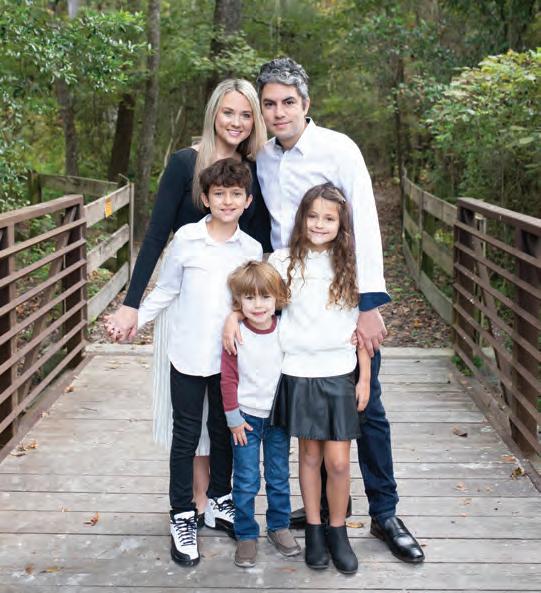
Sayour with his wife and children.
A Scientific “Miracle”
Gene therapy has moved from novel concept to life-saving treatment
By Cindy Spence
Amber Lavoie’s “mom gut” was churning. Something was wrong with her newborn baby girl; she could sense it.
It was March 2020. She was on maternity leave but preparing to go back to work just as the world shut down for the COVID19 pandemic. Home all day with Payton, barely 1 month old, she noticed unsettling things: Payton didn’t squirm or fidget, her legs barely moved, she felt almost limp in Amber’s arms.
“We couldn’t get a doctor’s appointment; no one would see her,” Amber recalls.
Over the phone, doctors and nurses assured the skittish new parents everything was fine. Still uneasy, the Orlando couple persisted as weeks went by until they finally got a neurology consult. The news was devastating.
“The doctor said, ‘Mom and dad, sit down. I believe your daughter has SMA.’”
The Lavoies had never heard of Spinal Muscular Atrophy, a rare genetic disorder, and asked the doctor what the diagnosis meant.
“He said to take her home and love her while we could.”
SMA is often fatal by a child’s second birthday, and after the initial shock, desperation set in. Amber filmed a video of her daughter’s awkward movements and posted it on social media, hoping someone might see it and have some advice. A friend who works at the University of Florida saw the post and asked if she could share it.
Soon after, Amber got a call from the UF Powell Gene Therapy Center from a doctor who spent 30 minutes on the phone with her, answering a barrage of questions, but one most of all.
“I asked her if this was really SMA. She said, ‘SMA is what I do. Mom, I need you here tomorrow.’
“We packed up and headed for Gainesville.”
Payton Lavoie listens to her mom speak at the celebration of the 100th gene therapy treatment.
Working against time
The Lavoies had spent weeks looking for answers, and all the while SMA was stealing Payton’s muscle function, her body becoming ever more still in Amber’s arms. Her already limited leg and arm movements deteriorated. She didn’t smile.
“Days matter, and we had already lost weeks looking for answers,” Amber says. “Time was not on our side.”
The family was met at UF Health by a team of doctors, nurses and lab workers. Tests were rushed to confirm the diagnosis, and Payton was treated the next day, a Friday, surrounded by the medical and research team. That Saturday morning, Dr. Barry Byrne, director of the center, came in to do her lab work.
studies, and two clinician scientists — Byrne and Dr. Terry Flotte — came on board.
Today, thanks to the journey begun decades ago, UF is regarded as a legacy hub for gene therapy science and advances, and UF Health was the first institution in the U.S. to administer the gene therapy to treat children with SMA after it received FDA approval in May 2019. Payton was just the fourth patient.
A recent medical journal review of gene therapy research showed that UF is the world’s top-ranked institution for published gene therapy research and Byrne is among the world’s most-published authors in the field of AAV gene therapy research and holds 25 patents.
“Probably within 12 hours, we started noticing a change. She could lift her forearms,” Amber says. “We felt like we were in the middle of a miracle.
“It seemed like we opened the place and closed the place each day we were there, but we were never by ourselves.”
Treating the once untreatable
A century ago, the link between inheritance and some diseases was known, but the idea of delivering a new gene to take over for a defective gene was just an intriguing what if. Which gene is defective? How do you get a new gene into the body?
Advances in molecular biology accelerated in the 1970s, and by the late 1970s and early 1980s, a group of UF College of Medicine researchers were investigating an oddball little virus that seemed to travel with disease-causing adenoviruses but caused no harm itself. They called the sidekick adeno-associated virus, or AAV.
Viruses are notoriously good at entering the human body. The researchers’ novel idea: Use the harmless AAV as a vehicle to deliver beneficial genes that could silence defective genes or replace them with healthy genes.
In the early days, the researchers would meet most Fridays over pizza and beer and discuss the rapidly advancing science. Two of the group’s leaders, Dr. Kenneth Berns and Dr. Nick Muzyczka, laid a foundation that attracted other scientists, including Byrne, while also educating the next generation of genetic medicine practitioners.
Muzyczka’s doctoral student, Jude Samulski, started his studies in 1978, investigating the potential of AAV and detailing in his 1982 dissertation how to clone it, a crucial first step to using it for gene therapy.
Samulski and Byrne were colleagues before Byrne came to UF, and Byrne said for all the potential that the scientists saw in AAV, gene therapies were decades away.
As genetic mapping picked up in the 1990s, the question of finding genes was answered. The Human Genome Project was completed in 2003. As Berns and Muzyczka advanced the basic science of AAV, research began to focus on translating the science into clinical
Barry Byrne
“In the late 1990s, Ken and Nick envisioned a collaborative group of scientists working both on the basic science and the translational work,” Byrne says. “This was the only place in the country that had conceived of partnering the basic science and the translational science to further human gene therapy.”
From proof of concept to manufacturing
The group confirmed that AAV could, in fact, reach a wide variety of different muscle cell types and correct them, essentially permanently, Byrne says. The next step was manufacturing therapies.
“That took at least 10 years to figure that out,” Byrne says. Early on, researchers realized knowledge alone would not move clinical studies forward or, eventually, help patients like Payton, with little time to waste waiting on a medical shipment. Byrne said the studies and the patients they aimed to help would both need ready access to therapies that could be infused.
UF solved that roadblock when the McKnight Brain Institute was built in 1998.
Founding director William Luttge had the foresight to include in the institute’s design a facility for manufacturing gene therapy products, a decision that created a unique advantage for work at the Powell Gene Therapy Center.
The Mechanics AAV of
“Once we knew we had the programs that would be amenable to gene therapy, we had to know how to make gene therapies,” Byrne says. “There were no pharmaceutical companies, there were no biotechnology companies doing this, not even any other universities interested in manufacturing products for clinical trials. So, we built a facility.”
The American Society of Gene Therapy was founded in 1996. In the early meetings, AAV was pretty much ignored, but that didn’t last long.
“Now the majority of what is presented at the annual meeting — there’s now about 8,000 participants — is about AAV,” Byrne says.
“And it all started here.”
“It’s changed us a lot. Every day is truly a gift we didn’t think we were going to get.”
– Marty Williams
How to save a life
During her pregnancy in 2021, Marty Williams and her husband Chad were screened for multiple genetic traits, and she found out she was a carrier for SMA.
“I figured, what are the odds?” she recalls.
Bloodwork in newborn David’s first week of life came back positive for SMA, and Marty started Googling.
“I freaked out. He had this horrible disease,” Marty says.
Through her network of family and friends in her Atlanta community, Marty found a doctor in Utah who agreed to see David — but not for six long weeks, an eternity for a baby losing muscle function by the day. A friend put her in touch with a nurse at UF, who offered hope and an appointment.
“They opened the facility on a Saturday to get David dosed,” Marty says.
As David hit all the milestones for babies growing into toddlers, Marty says she felt she was watching a miracle. And, when she and her husband decided they wanted David to grow up with a sibling, David’s experience with gene therapy gave them the courage to try again.
The UF team set up a suite of appointments around James’ due date, and after his blood work showed SMA, there was no need to Google. The family packed up the car and drove to Gainesville.
“They moved mountains for us,” Marty said at a celebration in May of UF’s 100th gene therapy treatment. “This doesn’t happen at other institutions.”
David, now 4½, and James, now 2½, are typical boys, with a little sister who did not have SMA, Marty says. David likes to brag that he’s faster than some of the kids in his class, and he loves soccer and baseball. His mom finds wonder in the ordinariness of his and James’ little boy lives.
“We get to forget that they have SMA,” Marty says. “Our kids shouldn’t be alive, but every birthday, we get to celebrate their lives. They’ll probably never know the significance of that.
“It’s changed us a lot. Every day is truly a gift we didn’t think we were going to get.”
Marty and Chad Williams say their boys James and David have a chance to be typical children thanks to UF’s gene therapy program.
Byrne says UF’s infrastructure and holistic approach to patient care is important when time is of the essence. Treatments can bog down if a drug isn’t available, or the medical financial system drags, or families can’t stay near the clinic for two months, or even don’t have gas money to travel to Gainesville.
The UF team addresses all those things, Byrne says, because “the patient is our true north.”
Amber Lavoie says her experience at UF reminds her of the phrase “it takes a village to raise a child.”
“The team at UF became our village. These people were missing their own children’s soccer games, birthday parties, family dinners and working late so families like ours can have hope, have a future.”
Barry Byrne, M.D., Ph.D. Associate Chair of Pediatrics, Director of the Powell Gene Therapy Center College of Medicine barry.byrne@ufl.edu
This article originally appeared in the Spring 2026 issue of the Florida GATOR alumni magazine.
SOLVING the Cleft-Palate Puzzle
Early teamwork helps align tiny faces
By Anna Boone
At their 20-week ultrasound, Ton Tu and his wife learned their daughter would be born with a cleft lip and palate.
“Initially, we were shocked,” Tu says.
The shock quickly turned to practical questions about their baby’s health, appearance and how to care for a newborn with the condition. After the diagnosis in Tallahassee, the Tus were referred to the UF Health Craniofacial Center.
The center serves as the coordinating hub for Florida’s Cleft and Craniofacial Network, creating a vital safety net for families across the state. This role ensures that world-class cleft and craniofacial care is accessible for every Florida child who needs it, especially those with the most complex cases or who rely on Medicaid.
During pregnancy, the shelves that form the roof of the mouth normally rise and fuse while muscles migrate into place to allow normal speech. If the biological processes at play stall — most often between weeks four and nine — the result can be a cleft lip, a cleft palate or both.
“Think of a baby’s face as a puzzle,” says Jonathan Sorsok, a pediatric dentistry resident. “Most of the time, the pieces
connect perfectly. But if one piece doesn’t fuse, the result is a cleft lip or palate. This small moment in development becomes a lifelong challenge for the child and family, but it is also where our story as clinicians begins.”
In the first six weeks after birth, residual maternal hormones make newborn cartilage especially flexible, so UF experts can use gentle presurgical guidance to align the lips, gums and nose before surgery.
When an infant receives this early, pre-surgical care, the benefits are clear: improved feeding, less tension required for the first operative repair and, potentially, a reduced number of future surgeries.
In Florida, about 1 in every 700 to 1,000 babies are born with a cleft lip, palate or both. That translates into hundreds of new cases statewide each year.
“These statistics show just how common it is,” says Kaitria Abbatematteo, a UF pediatric dentistry resident. “But behind every number is a real story, a real baby, and a family who needs our help.”
Many families first learn the news at delivery, as some clefts can be hard to see on a standard ultrasound.
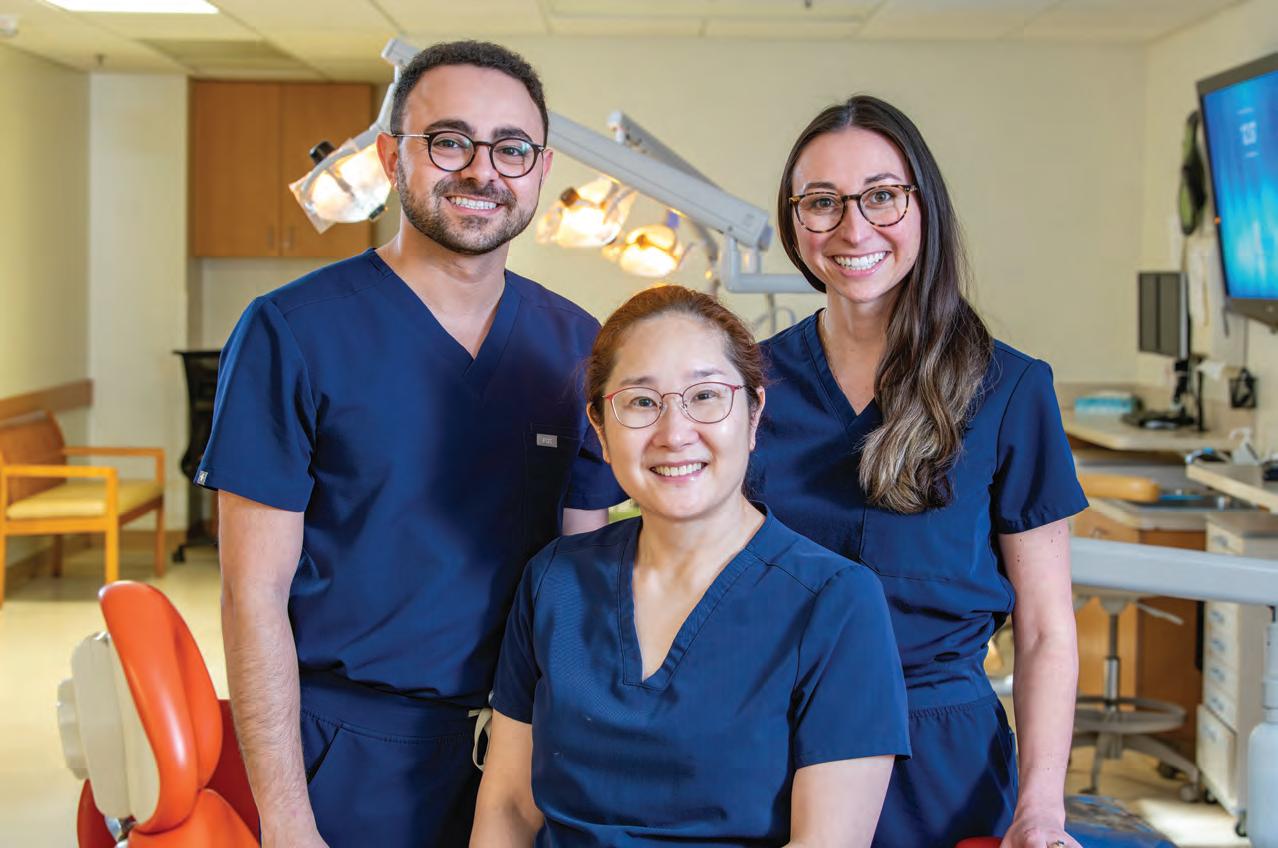
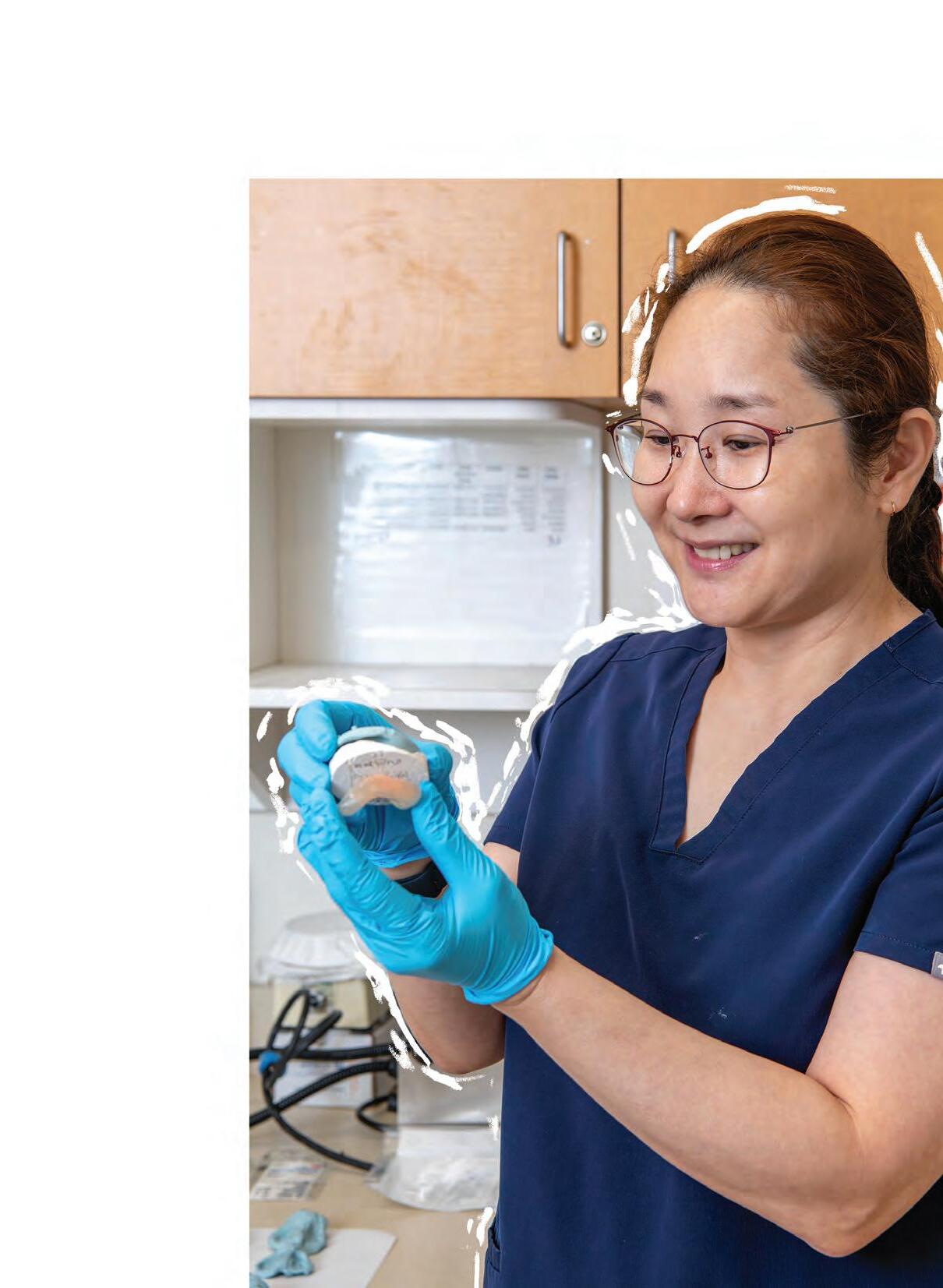
Pediatric dentistry Residents Jonathan Sorsok and Kaitria Abbatematteo (rear) and Mi Sook Lee, clinical assistant professor of pediatric dentistry, are helping to reshape the faces of infants affected by cleft lips and cleft palate.
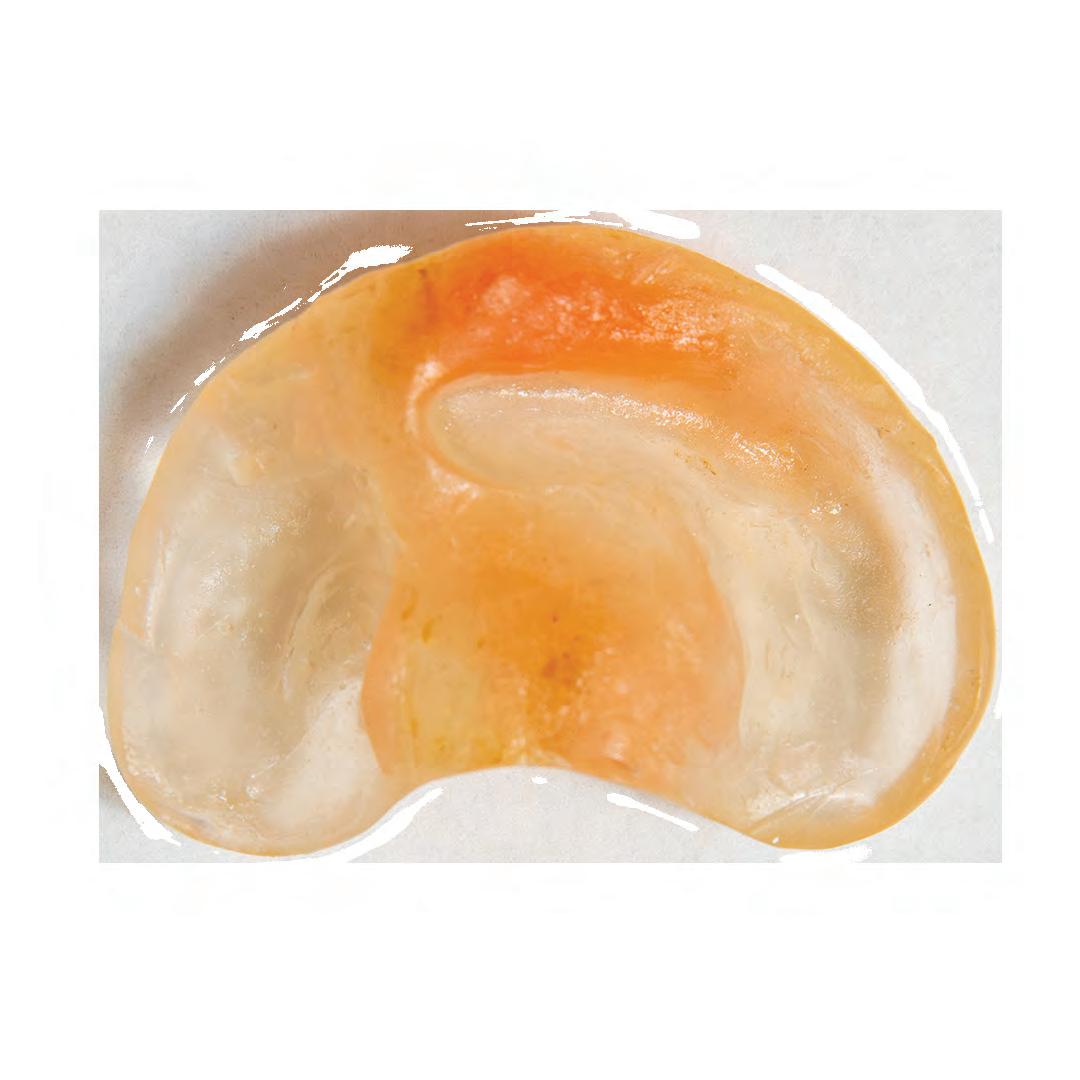
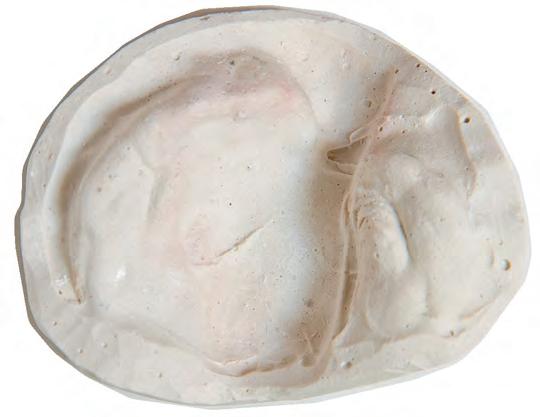
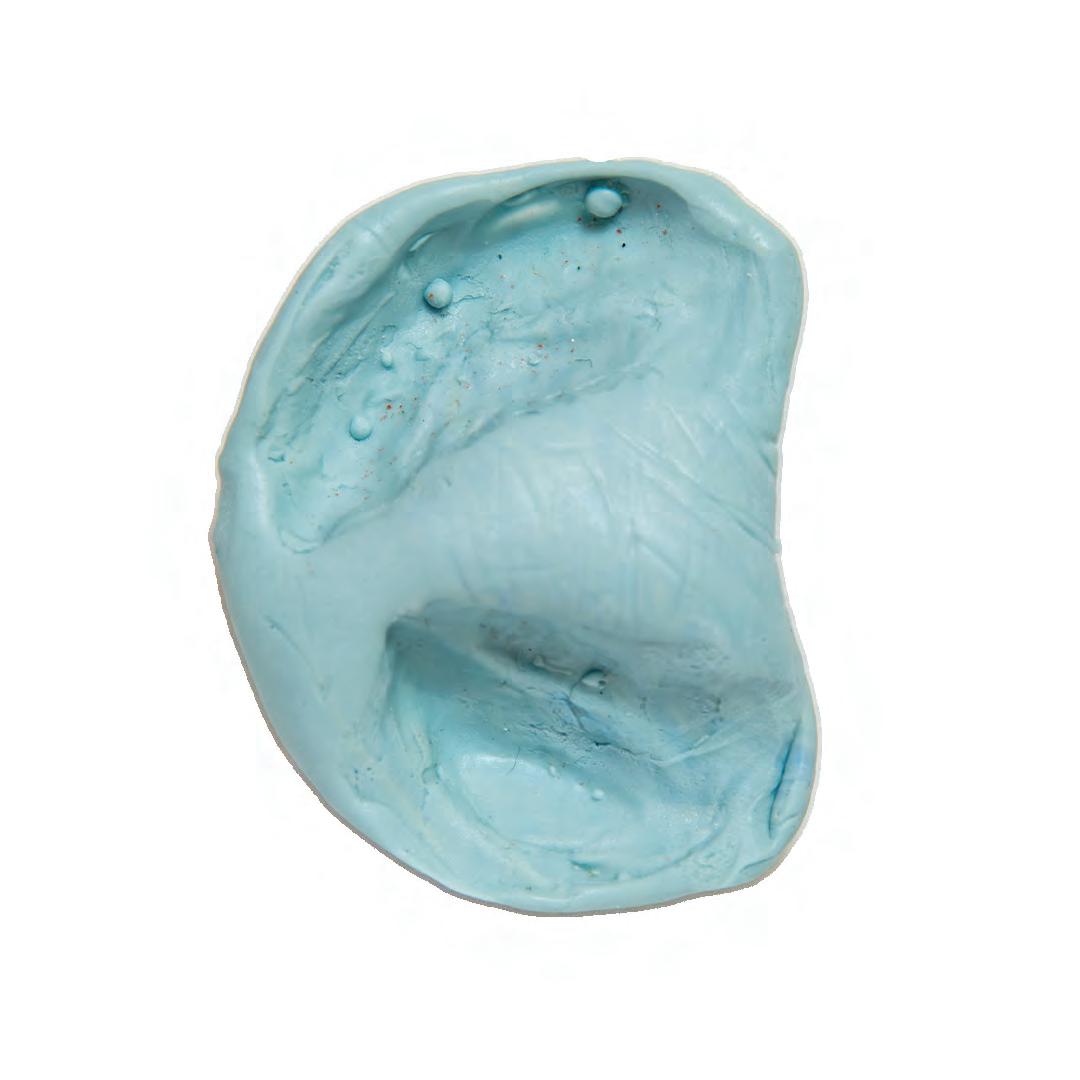
Impressions of a baby’s mouth inform the molding of a NAM appliance, which gently guides parts of the palate and nasal structures into closer alignment.
Sometimes the seam runs through the upper lip and into the gumline, tugging the nose off center and creating a cleft lip. In other cases, the lip looks intact but the roof of the mouth opens into the nasal cavity — known as isolated cleft palate. In both cases, the “puzzle pieces” are present and compatible, but the connection has failed.
“When we approach this ‘puzzle,’ we first identify the child’s immediate needs,” Sorsok says.
Care at UF begins with what’s urgent for a newborn: feeding. Unlike a cleft lip alone, a cleft palate prevents an infant from generating the suction necessary to nurse or feed from a standard bottle. Without alternative feeding techniques, there’s a risk of fatigue during feeding or poor weight gain, and milk can flow into the exposed nasal cavity.
Once an infant is successfully feeding, the pre-surgical infant orthopedics (PSIO) team maps the child’s craniofacial anatomy in 3D. To build a road map for care, they plan backward from essential long-term outcomes, including clear speech, proper hearing, stable breathing and natural facial
“It really does take a team,” Sorsok says, acknowledging the interdisciplinary cohort of expert UF clinicians who converge to treat these patients. “Most importantly, we can’t do it without the families and patients, who are true partners in this journey.”
The treatment journey starts early and runs through adolescence, requiring active parental involvement.
“This can be a challenge for families,” Abbatematteo says. “It’s a huge time commitment and financial responsibility, especially if they have other children or have to take time away from work.”
For the Tus, weekly trips to Gainesville were draining but
“Our daily routines and work schedules were significantly disrupted for nearly eight weeks,” Tu says. “Although this period was demanding, being so involved helped us feel actively engaged in our baby’s care and progress.”
At their prenatal consult, the PSIO team explained what to expect in the delivery room, feeding intervention options and the plan for the first months of treatment.
“What stood out most was how genuine and compassionate the doctors, nurses and all support staff were,” Tu says. “They took the time to listen to our concerns, explain everything clearly, and make sure we understood each step. We never felt rushed, and their warmth and reassurance helped us feel supported and more at ease during a very stressful time.”
“NAM fabrication is designed to be safe, reproducible and adaptable to each infant’s anatomy and clinical needs.”
— Mi Sook Lee
to meet, rather than pulling distant segments together under tension.
“The better you set patients up for success during surgery, the better the outcome,” says Matthew Cooke, UF’s pediatric dentistry program director. In most clinics, NAM appliances are fabricated at off-site laboratories, which can delay the start of treatment. Since 2024, UF has offered rare in-house fabrication, allowing the facial molding to begin in the first weeks of life when a baby’s cartilage is most malleable.
Mi Sook Lee, a clinical assistant professor of pediatric dentistry, introduced that capability to UF after specialized training at Duke University under Barry Grayson, who pioneered the NAM technique in 1993.
“Not a lot of people in this country have the skill set,” Sorsok says. It’s a trajectory UF’s Craniofacial
Center knows well — advancing foundational techniques while expanding access to coordinated care.
In the 1970s, UF surgeon Leonard Furlow noticed that many palate surgeries closed gaps but left the key palate muscles in the wrong place. He introduced a zigzag repair that lengthened the palate and moved those muscles back where they could work together. That shift helped many children achieve clearer speech with fewer follow-up operations.
Today, the center applies that same logic to presurgical care: recreate, as much as possible, the gentle forces that shape tissues in the womb.
“NAM fabrication is designed to be safe, reproducible and adaptable to each infant’s anatomy and clinical needs,” Lee says.
On the first visit, she takes a gentle, fast-setting impression of the upper jaw while the baby sits upright to protect the airway.
Using the mold, she designs a custom plate with a specialized curve at the back to help prevent gagging.
At each appointment, the team fine-t unes the appliance, adding or shaving away material to nudge the palate toward the midline. The gap can close by 1 to 2 millimeters per week — a deliberate, steady pace that moves bone safely.
“When the first NAM is placed, everything needs to fit snugly,” Abbatematteo says. As the segments begin to move closer together, the infant is also growing rapidly. This simultaneous shift in the treated tissue, compounded by the baby’s natural development, means the original appliance needs frequent adjustments to maintain a precise fit.
The first infants to enter the PSIO program after UF began offering NAM fabrication in 2024 are now recovering from their initial lip and palate repairs. Early observations show reduced
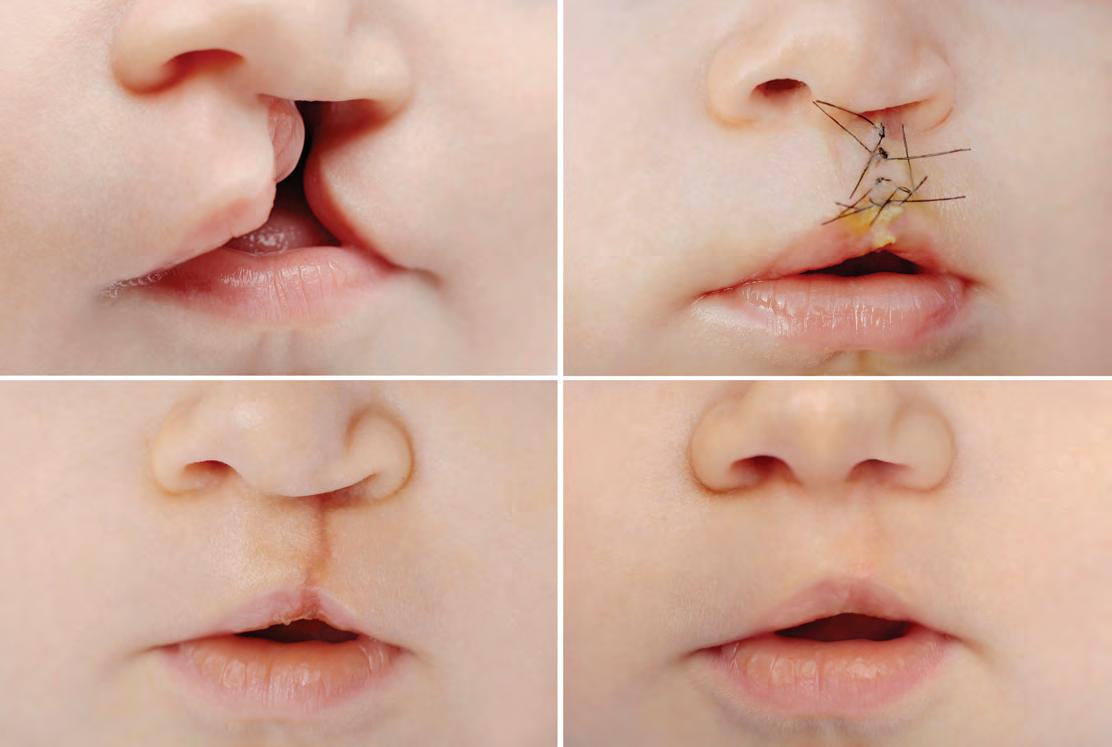
The outcome of a cleft lip repair procedure.
“The most important part of having access to early, specialized care at UF was the long-term impact it had on our baby’s progress and our family’s journey.”
— Ton Tu
cleft width, improved gum alignment and better nasal symmetry before the first lip surgery. As more infants are treated and analyzed, Lee expects the impact to become even clearer.
But for families like the Tus, the results already reveal the transformative nature of this care. The Tus’ daughter is now healing from her first cleft lip and nose repair surgery. She may need up to three more surgeries, including cleft palate repair, an upper jawbone graft and a final aesthetic correction.
“The most important part of having access to early, specialized care at UF was the long-term impact it had on our baby’s progress and our family’s journey,” Tu says.
After neonatal PSIO, the treatment shifts from molding to repair. Between 3 to 12 months of age, surgeons repair the lip and palate.
From roughly ages 1 to 7, speech-language pathologists listen for air escaping through the nose during speech while audiologists track middle- e ar fluid and hearing health. Between ages 6 and 8, orthodontists and pediatric dentists begin the precision planning for a bone graft to stabilize the upper jaw. That procedure provides the necessary foundation for permanent teeth and typically occurs between ages 8 and 10.
During adolescence, orthodontists and oral and maxillofacial surgeons collaborate to refine facial balance and bite alignment. The final phase of care focuses on restorative and aesthetic precision: A plastic surgeon may perform revisions to the nose and lip for symmetry, while dental specialists address missing teeth to complete a functional smile.
“It truly requires a whole village to treat these children,” says Cooke. By the end of this nearly 20 -ye ar process, most patients have had every major section of the puzzle — lip, palate, teeth, jaw, speech and hearing — adjusted. The craniofacial structures they bring into adulthood function well and no longer show signs of the complex puzzle that was solved.
“Beyond the clinical benefits, we’re trying to give parents a sense of hope,” Sorsok says.
Tu’s advice to parents entering the same journey of treatment: Practice patience with your baby and grace with yourself.
“Progress may feel slow, but with consistency, support and time, it does get better,” Tu says. “Having a coordinated and experienced team gave us clarity, confidence and reassurance during a very overwhelming time.”
Mi Sook Lee, D.M.D., M.S.D., Ph.D. Clinical Assistant Professor of Pediatric Dentistry MLee2@dental.ufl.edu
Jonathan Sorsok, D.M.D. Pediatric Dentistry Resident JSorsok@dental.ufl.edu
Matthew Cooke, D.D.S., M.D., M.P.H. Program Director & Professor of Pediatric Dentistry matthewcooke@ufl.edu
Related website: https://craniofacial.pediatrics.med.ufl.edu/
Data Drives Destinations
UF is building a tech-powered roadmap for the tourism industry
By Doug Bennett
Choosing a vacation destination — or even merely a hotel room — can be a decision fraught with emotions and uncertainty. The University of Florida’s Eric Friedheim Tourism Institute has high-tech answers for that.
As a bridge between leading-edge research and tourism-industry needs, the institute is at a pivotal, invigorating moment. Its research output is crucial to nurturing Florida’s largest industry, institute Director Rachel J. C. Fu says. That means focusing on artificial intelligence, robotics and Big Data analytics to make tourism-related businesses more insightful and responsive.
“AI and robotics are not optional. They’re the future of tourism and hospitality,” says Fu, a professor and chair of the tourism, hospitality and event management department in the College of Health and Human Performance.
In other parts of the world, robots are already cleaning hotel rooms, delivering room service and handling some guest services. In the United States, those practices are catching on more slowly. EFTI, Fu says, is poised to lead the way: Technology like AI and robots can make travel smoother and more enjoyable for guests — and more efficient for businesses.
For Fu and the EFTI, Big Data and AI are just part of the picture. Institute researchers have written the blueprint for the cruise industry’s pandemic response, produced groundbreaking work on overtourism and brought clarity to the sometimes dizzying world of online hotel reviews.
EFTI’s research findings are powerful assets that drive service innovation across the restaurant and hospitality industries, says Bob Schalow of Diversified Restaurant Group. The institute’s work translates complex data analytics, AI applications, and consumer-behavior modeling into practical strategies. That helps companies personalize guest experiences, optimize labor and supply-chain systems and reimagine service delivery with automation and robotics, he notes.
“For hospitality leaders seeking to stay competitive in a rapidly evolving landscape, EFTI’s research serves as both a road map and a catalyst for smarter, tech-enabled decision making,” says Schalow, an EFTI Industry Advisory Board member and senior vice president at DRG, which operates more than 300 restaurants.
Photography by John Jernigan
Virtual Vacation
When Andrei Kirilenko was studying climate change a decade ago, he wasn’t thinking about a career in tourism research. Ultimately, that partial career pivot ended up feeling very natural.
“I think of myself as a data scientist,” says Kirilenko, an associate professor in the Department of Tourism, Hospitality and Event Management.
Now, he uses technology to reveal prospective tourists’ excitement or fear about travel destinations. Bringing a methodical, data-driven approach to travel decisions benefits tourists and businesses alike: Booking an expensive, non-refundable trip can be a stressful process. Meanwhile, businesses often struggle to tailor their messages to different types of travelers.
Andrei Kirilenko, an associate professor in the Department of Tourism, Hospitality and Event Management, uses Big Data and virtual reality to drive precision tourism research.
Emotional arousal matters because tourists can’t sample a travel experience before committing.
“You can’t preview a vacation. You have to just decide — either I’m going or I’m not,” Kirilenko says.
In his virtual reality lab, heart rate monitors and skin conductance sensors measure study participants’ reactions to tourist destinations. The data are paired with questionnaires that help researchers understand what motivates travelers. Some people want to see real, ancient artifacts. Others are less concerned about authenticity and might prefer a replica of an entire village. A 2025 study by Kirilenko and his colleagues revealed how participants’ heart rates reflected their emotional engagement with virtual reality videos of Hobbiton. The New
Zealand movie set and tourist attraction replicates a hobbit village from “The Lord of the Rings” and “The Hobbit.”
The findings showed how emotions can shape pre-visit perceptions and offered evidence for how marketing materials can be tailored to people with different “tourism personalities.”
“Physiology doesn’t lie to us,” Kirilenko says.
UF is one of just a few academic institutions in the world using data mining, artificial intelligence and physiological sensors for tourism research, according to Kirilenko. More broadly, EFTI has hosted an array of Kirilenko’s research projects focusing on overtourism, virtual reality travel and AI-assisted research.
After gathering data from the Miami, Orlando, St. Augustine and Panhandle
tourist markets, the researchers found that one-third of residents wanted fewer tourists even before environmental or infrastructural crises emerged. Tourism also affected residents’ perception of quality-of-life issues such as racial inclusion and crime in ways that weren’t necessarily accurate, the researchers determined. Using data to identify the early signs of overtourism shifts the debate from anecdotal protest narratives to methodical “destination management,” Kirilenko says.
“Detecting discontent with overtourism before it evolves into open hostility or policy backlash — as seen in Venice or Barcelona — is essential for sustaining tourism growth,” the researchers wrote.
EFTI Ph.D. students Jiwoo Jung (left) and Rezvan Eftekhary show the virtual reality equipment used in tourism research.
People as Sensors
The overtourism study and others by Kirilenko make use of one of his preferred — and most powerful tools — people as sensors. He explains it this way: Most of us leave footprints, either actual or digital ones, in life. Much of that can be captured and analyzed by AI and Big Data, revealing otherwise hidden clues about travel and recreational habits. For Kirilenko, that has included mining Instagram for recreation patterns at a large lake on the Texas-Oklahoma border. That helped the U.S. Army Corps of Engineers better understand how the area was being used for recreation.
Kirilenko has also analyzed social media posts to better understand tourists’ “co-visitation” habits — the sites and activities people are grouping together. The goal, he says, was to discover the less-explored parts of Florida to drive return visits from U.S. visitors and spark international tourists’ interest in new destinations.
“All of us are sensors in our environments. If I observe the individual social media habits of enough people, I can draw bigger-picture conclusions,” Kirilenko says.
One of his ongoing projects involves identifying ecotourism hotspots around the country. To do that, he’s mining data from more than 2 million people who use a plant and animal-identification app — more than 1 billion species identifications in all. Whether it’s butterflies, bees or mushrooms, Kirilenko is crowdsourcing biodiversity hotspots. Ecotourists can easily learn where their favorite species are clustered and city officials can use the details to promote those activities, he says. So far, the analysis has turned up one notable surprise: Biodiversity in urban Detroit, where nature is reclaiming neglected neighborhoods.
That, Kirilenko says, underscores the power and precision of Big Data analysis in everything from public opinions about climate change to finding hidden troves of plants and animals.
“For me, Big Data is like a gift from God,” he says.
Building A Better Robot
For travelers who encounter a service robot or find clarity in a morass of online hotel reviews, Hengxuan “Oscar” Chi is a driving force behind those experiences. Chi, an assistant professor of tourism, studies the impact of AI and other technology on the delivery of services — especially in hospitality and tourism.
“People’s perception drives everything,” Chi says.
That idea propels much of his research, which includes designing more appealing robots for service industries and helping consumers and business owners better understand online hotel reviews.
With robots, Chi is working to unravel a dilemma. Customers often respond positively when robots show
humanlike behavior. Yet there’s also a limit to that: Robots with overly human features aren’t always better received by customers.
To help hospitality businesses choose or design optimal robots, Chi developed a four-dimensional scale to boost the machines’ perception as humanlike. That includes a human appearance; social intelligence that emphasizes responsive, natural interactions; “emotional awareness” that reacts to customers’ moods; and self-awareness that suggests a degree of “personality.”
Some of those traits matter more than others. A service robot’s social and emotional intelligence are more impactful than its appearance, Chi notes. A new EFTI-funded study will test which robot features matter most to hotel guests.
“Developers believe humanlike robots perform better — but is that true?” Chi says.
Having relatable robots is something of an imperative for the hotel industry, he notes. A confluence of factors is pushing the hospitality industry toward more automation. Hotels in Europe and Asia are already making significant use of robots for cleaning, room service, guest check-in and basic, information-related services. For U.S. hotels, Chi says, that level of automation is coming eventually.
His research aims to help the hospitality industry get that right — and not just for guests. Robots, Chi notes, are no panacea. Hotel guests might appreciate the novelty but that acceptance isn’t universal. Automation is also potentially demoralizing for workers who spend more time around robotic colleagues.
“Unlike retail shopping, customers expect a certain level of human interaction within a hotel,” he says.
Hengxuan “Oscar” Chi, an assistant professor in the Department of Tourism, Hospitality and Event Management, studies how AI, robots and other technology influence the delivery of services — particularly in tourism and hospitality.
Chi’s other work has delved into a dilemma that many travelers face repeatedly: How much to trust AI-generated hotel reviews versus those created by humans. Popular hotels and restaurants may have thousands of reviews, creating information overload for consumers. To address that, major travel websites deployed AI to produce concise, readable summaries of customer feedback.
Chi set out to learn how AI summaries affect customers’ decision making — and whether people react differently to AI and human reviews. To answer those questions, about 800 study participants were randomly assigned to read one of two hotel review summaries. The content of both reviews was identical, with the only difference being its label as AI-generated or written by a human traveler.
The review was labeled as being written by either “Olivia Bennett” or a language model called ReviewGPT.
“Amazing hospitality management with seamless and dedicated 24/7 customer service. Nice rooms with good views. Very beautiful and clean property. Extra courteous staff eager to assist and help you. …” the review said.
Among the study participants, positive reviews written by humans were deemed more trustworthy than AI, Chi found. The human-authored reviews were also associated with stronger intentions to complete a booking. Negative reviews from AI and humans influenced travelers’ decisions equally.
The study participants also trusted human reviews more, leading them to spend 25% more time scrutinizing AI reviews. That suggests people process AI-generated content more carefully and pay closer attention to the details it presents. Ultimately, Chi says, both approaches have value: Travelers’ reviews offer the emotional authenticity of human feedback. AI delivers clear, efficient summaries from large volumes of customer opinions.
“Picking a vacation spot is a very emotional decision, while AI is cold and factual,” he says.
Going forward, Chi says further integrating technology into service industries — especially tourism and hospitality — is an imperative. Yet he’s also thinking deeply about whether that technology has a tipping point of diminishing benefits. He asks the big, provocative question: How much technology does a particular industry — or society — need?
“My focus in the future is also to see where we should stop with technology development,” he says.
Real-world Relevance
EFTI’s evidence-based research translates abstract consumer and market signals into actionable guidance for the hospitality industry, says Pavan Kapur, chief strategy officer at Dreamscape Hospitality and president of Shanti Consulting. In particular, the institute’s analyses of demand, pricing and consumer behavior allow cruise line companies to optimize price and service offerings to match evolving traveler preferences. Among other businesses, EFTI’s work helps loyalty-program providers as well as gaming- and entertainment-focused properties optimize their product and pricing strategy, according to Kapur.
“For industry leaders looking ahead, EFTI scholars’ white papers provide not just insight but a research-backed roadmap to boost customer satisfaction, operational efficiency and long-term growth in an increasingly data-driven hospitality world,” says Kapur, who is also a member of the institute’s Industry Advisory Board.
Fu, the EFTI director, says the institute’s distinctiveness stems from its blend of academic rigor, student preparation and industry relevance. A new program offering a master’s degree in AI-driven
hospitality is expected to launch in early 2027 at UF’s nascent Jacksonville campus. That assures a new generation of hospitality leaders and managers will be conversant with relevant AI technologies while also offering new skills to those already in the industry or looking for a career change, Fu says.
Likewise, crucial research on topics such as overtourism and the cruise industry’s strategies amid a pandemic are potentially transformational and unlikely to have happened without EFTI, Fu says. The cruise industry research, published in 2025, provided new insights into how pricing, vaccine perceptions and cruise companies’ health-protecting behaviors influenced traveler’s interest in cruises.
EFTI’s efforts are important for travelers, policymakers and businesses alike, Fu says. Government leaders who make decisions about infrastructure and tourism-related policies are better informed due to overtourism research. Travelers benefit from EFTI’s work on robots and AI solutions. Hospitality companies learn ways to leverage AI for improved customer service, logistics and marketing.
“AI is not just a tool. It provides essential infrastructure for the tourism and hospitality industries and travel research,” Fu says.
Hengxuan “Oscar” Chi
Assistant Professor of Tourism, Hospitality and Event Management h.chi@ufl.edu
Rachel Fu
Director, Eric Friedheim Tourism Institute Professor and Chair, Department of Tourism, Hospitality and Event Management racheljuichifu@ufl.edu
Andrei Kirilenko
Associate Professor of Tourism, Hospitality and Event Management andrei.kirilenko@ufl.edu
“AI is not just a tool. It provides essential infrastructure for the tourism and hospitality industries and travel research.” — Rachel Fu
Invisible Hand
What is AI
By Doug Bennett
In an era when artificial intelligence and social media are driving news feeds, workplace chats and buying decisions, a group of University of Florida business researchers are asking a provocative question: We know what technology does for us, but what is it doing to us?
Liangfei Qiu studies social technology — how digital tools shape human behavior, and vice versa. AI, his research shows, can have a double-edged effect. Sometimes, it boosts participation among users in online forums. In other cases, over-reliance on AI reduces the pool of creative, problem-solving ideas, he says.
Recent research by Qiu and his colleagues focused on users’ behavior on Stack Overflow, where some 30 million platform developers and computer programmers gather to share knowledge and ideas. The researchers analyzed data from more than 3.2 million questions and 1.2 million answers on the forum.
Those who used AI produced answers that were easier to read and about 23% shorter. But the researchers also found a tipping point: Users were less likely to contribute voluntarily when AIgenerated answers were prevalent. Human responses to help-seeking posts dropped significantly as AI-generated content took over.
That phenomenon isn’t unique to software development forums, he notes. The same behavior patterns should hold true for more mainstream question-and-answer sites like travel advice on Quora or Reddit’s appliance repair forums.
The study is believed to be the first of its kind to explore how generative AI affects voluntary knowledge sharing.
As UF researchers’ work shows, generative AI can be profoundly influential. These AI-generated images represent yet another side of its capabilities.
doing to our digital conversations?
“Humans, by nature, can be somewhat lazy. If you don’t already have AI answers, people will think about solutions to a question from many different perspectives. In the long run, if the diversity of ideas and perspectives is reduced, it hurts the platform,” says Qiu, a professor of information systems and operations management in the Warrington College of Business.
Stack Overflow chose to ban the use of generative AI tools like ChatGPT, but Qiu and his colleagues instead suggest a more nuanced approach, permitting AI usage while promoting responsible and moderated use. That would allow users of Stack and other online forums to benefit from efficiency and learning opportunities without compromising content quality.
“Our results indicate that when users learn how to use these tools thoughtfully, they can produce answers that are not only concise but also easier to understand, which benefits the whole [online] community,” the researchers wrote.
More broadly, Qiu’s work has shown how technology can be leveraged in diverse ways, helping companies develop products that are the next big thing. When a mid-sized kitchenware company wanted a better way to capitalize on next season’s emerging trends, it turned to Qiu for data-driven advice. He went to work harvesting massive amounts of product reviews from Amazon and social media sites like Instagram.
“We know that social media is more ‘noisy’ and much more unstructured, but it has early prediction power because before people post online reviews, they talk about products on social media,” he says.
“Social media has fundamentally reshaped how we design products. Instead of guessing what people want, we can now see emerging behavior in real time — what they’re using, modifying, celebrating, or complaining about.”
— Liangfei Qiu
Qiu’s methods helped houseware manufacturer Epoca International’s development team lean into the best shapes, patterns and optimal shade of pink for its Paris Hilton-branded products, says Chief Executive Officer Brian Melzer.
“Social media has fundamentally reshaped how we design products. Instead of guessing what people want, we can now see emerging behavior in real time — what they’re using, modifying, celebrating, or complaining about,” he says. “That signal lets us spot microtrends months before they hit retail. It shortened our innovation cycle, sharpened our intuition and helped us design with the consumer’s lived experiences, not our assumptions.”
Qiu says that by analyzing many subjective opinions, an objective consensus can emerge, making new product design less of a guessing game.
“The product designers can look at online reviews and social media posts but not in a data-driven way. When we dig deeper into large amounts of social media data, we can know what features make a product viral or trendy,” he says.
Another study Qiu conducted in 2023 looked at how generative AI answers affect peoples’ participation in online knowledge-sharing platforms like Quora — and illustrated how AI and human answers vary in tone and content.
Social Technology In Action
Priming
the Pump Balance Matters
54 99% 12.5%
When a person asked ‘What’s the best parenting advice?’, an AI bot said, in part, “There is no one-size-fits-all answer to this question, as every child and every parent is different. However, some general tips that might be helpful include: Show love and affection to your child every day. Set clear boundaries and consequences for behavior. Encourage your child to express their feelings and listen actively to what they have to say. …”
People answered the question quite differently: “My husband likes this saying that the best thing that a man can do for his children is to love their mother. … I believe once you have a happy and stable marriage, it creates an invisible castle around the kids.” Another person wrote, “My wife and I figured this out on our own by doing it and seeing the results years later. Read to your kids every night. Feed them a good dinner without sugar to fill them with nutrition. …”
Those findings and others like it reinforce the value of studying social technology, says Hsing Kenneth Cheng, chair of the information systems and operations management department,
Percentage of companies reporting productivity gains due to internal knowledge-sharing “social”
After AI-generated summaries appear, consumers are more likely to write their own product reviews.
Employees who both ask and answer questions in a company’s online forums are 18% less likely to resign.
who has co-authored multiple social technology papers with Qiu and Professor Jingchuan Pu. In recent years, their work has shown how online knowledge-sharing behaviors can predict employee turnover and assess workers’ engagement with peers and supervisors.
Online environments change power dynamics, motivation and relationships, Cheng notes.
“These studies reveal that AI-mediated systems are not neutral. They shape who participates, how much effort is invested, and even career outcomes,” Cheng says.
Down the hall from Qiu, Jingchuan Pu explores how digital platforms shape human behavior and knowledge sharing. It’s far from an abstract concept: Online behaviors at work can predict tangible outcomes like employee turnover and promotions.
One recent paper by Pu, Qiu, Cheng and their collaborators was among the first to use corporate online community data to predict turnover. Workers at a large Chinese company who both provided and sought information in its online community were
UF business researchers have studied how AI-written summaries can influence consumers to write reviews.
about 18% less likely to quit their jobs, the researchers found. Companies could use the findings to identify employees at risk of quitting and target them with retention programs, Pu says.
In other studies, Pu and his collaborators have addressed how corporate knowledge-sharing communities affect employees’ behavior. Call it the “boss effect”: Workers exert greater effort when answering questions from higher-ranking colleagues and those who do are more likely to get promoted. In a separate study, they found that revealing users’ identities in online communities influences participation. Users who are identified write longer, more thoughtful content but also post less frequently — possibly due to concerns about their reputation or judgment. Image motivation often drives behavior, the researchers found. When workers are identifiable in company forums, they either post “high effort” results or default to posting anonymously, if possible.
“Digital platforms don’t just reflect behavior, they shape it,” Pu says. “Even small changes in visibility — like showing someone’s location — can reshape how people interact.”
Some of Pu’s ongoing work involves studying how AI influences the way people generate their own social media images. In an upcoming paper, Pu found that text-to-image AI tools create idea fixation, leading users to mimic those styles in their own photos. He calls it the “IKEA effect”: After seeing a living room in the Swedish retailer’s store, the desire to completely replicate it at home is strong.
“We indeed found out that as people start to use AI to help create photos, the photos they took later were very similar to the AI ones,” Pu says.
In another use of intelligent systems, Qiu and his collaborators designed the framework of an AI system that detects criminal activity in real time while also emphasizing privacy preservation and ethical deployment for public safety agencies. He’s also shown how “responsible AI” could help law enforcement with earlier crime detection that doesn’t compromise civil liberties.
Using Internet of Things technologies such as wireless cameras, RFID readers and other devices, the researchers set out to automatically identify locations where smuggling crimes were likely to take place. To do that, they processed data from devices in public areas including roads and toll booths. The system monitors for four general types of activity in real time to filter out potential smuggling activities, such as drivers taking longer routes or making multiple trips through an area to look for police. Those features are used to train predictive models that flag suspicious vehicles. A data synthesizer protects personal data while training the system’s predictive models. To avoid discrimination, the system focuses on common criminal behaviors rather than personal identifiers like race and gender.
That 2025 study showed the IOT-enabled system could achieve high-performance crime detection and has the potential to increase border surveillance efficiency, the researchers noted.
Studying social technology is important because many companies rushed headlong into corporate knowledge-sharing
Business Professor Jingchuan Pu studies how digital platforms influence human behavior and knowledge sharing.
platforms in the mid-2010s without considering how it could affect employees’ behavior. More recently, the proliferation of AI-generated review summaries on e-commerce websites can have the unintended effect of homogenizing future reviews. Pu’s research aims to delve into those issues.
“Companies are implementing AI without fully understanding its behavioral consequences,” he says.
Hsing Kenneth Cheng
John B. Higdon Eminent Scholar Chair, Information Systems and Operations Management Department kenny.cheng@warrington.ufl.edu
Jingchuan Pu
Associate Professor of Information Systems and Operations Management Jingchuan.Pu@warrington.ufl.edu
Liangfei Qiu
PricewaterhouseCoopers Professor of Information Systems and Operations Management liangfei.qiu@warrington.ufl.edu
The future with GLP-1 medications
Dr. Amy J. Sheer
GLP-1 drugs have ushered in a new era in weight loss
In just a few years, medications such as semaglutide and tirzepatide, known by the brand names Ozempic, Wegovy, Mounjaro and Zepbound, have gone from niche diabetes treatments to household names, reshaping how America thinks about weight loss.
A November 2025 Kaiser Family Foundation poll found that 1 in 8 U.S. adults have tried a GLP-1 medication for weight loss, diabetes or another condition. And we expect that number to rise now that one of these drugs, Wegovy, has become available in pill form, increasing its accessibility for many people.
These drugs’ ability to help patients lose anywhere from 15% to 20% of body weight has made them one of the most powerful nonsurgical obesity treatments ever seen.
GLP-1, short for glucagon-like peptide-1, is a hormone your gut normally makes that helps control blood sugar and appetite after eating. It signals the pancreas to release insulin when blood sugar rises and slows how quickly food leaves the stomach, which helps people feel full sooner.
Modern GLP-1 medications are designed to amplify these effects, leading to better blood sugar control and substantial weight loss for many patients.
But success brings a new question that millions of people are confronting: What happens after the weight comes off? And just as importantly, what should patients do when their progress suddenly stalls, even while still on the medication?
As an obesity medicine physician, I’ve seen firsthand how lifechanging GLP-1 drug therapy can be for my patients. But I also remind each of them that no medication – GLP-1s included –replaces the foundational importance of nutrition, physical activity, sleep and mental health. These lifestyle pillars are essential for maintaining muscle and bone health, preventing significant weight regain and supporting long-term cardiovascular and metabolic health.
The key is simple but critical: Every weight-loss or health plan must be tailored to each person.
How the body responds to weight loss
In 2023, the Centers for Disease Control and Prevention reported that more than 40% of American adults live with obesity. For most people, the real challenge isn’t losing weight – it’s keeping it off.
Researchers have known this for decades. As early as the
mid-20th century, studies of commercial diet programs showed that while short-term weight loss was common, regaining weight long term was the norm.
This is because when people lose weight, the body’s natural inclination is to return to its previous weight – a phenomenon called metabolic adaptation. As a result, the brain releases more of the hunger hormone ghrelin and dials down leptin, one of the hormones that signals fullness and energy sufficiency.
The net effect is simple: After weight loss, people are hungrier, feel less satisfied after eating and burn fewer calories than expected. The body interprets weight loss as a threat to survival and responds by slamming the brakes on metabolism through sophisticated energy-conserving mechanisms. Put plainly, when there’s less body weight to maintain, the body does less work –but it also becomes extra efficient, burning fewer calories than predicted and nudging weight back up.
Add to that an environment filled with ultraprocessed foods, oversized portions, high stress and limited time for movement, and it’s no surprise that so many people’s weight ends up yoyoing despite their best efforts.
Putting GLP-1 drugs to the test
Clinical trials on GLP-1 medications also follow these wellestablished patterns. A pivotal 2021 clinical study of more than 1,900 adults, known as the STEP 1 trial, laid the groundwork
for the use of these drugs as a treatment for weight loss.
But a follow-up 2021 study, known as STEP 4, showed that within 48 weeks of no longer taking semaglutide, participants regained approximately two-thirds of their prior weight loss, while those who remained on GLP-1 drug therapy continued to lose weight.
This is not because people lack discipline, but rather because their biology fights hard to return to its old set point.
Lower-cost, longer-term maintenance
Although obesity is now widely recognized as a chronic disease, clinical guidance has not kept pace with this new generation of highly effective medications.
For most patients, the most effective long-term strategy after achieving a target weight is to continue GLP-1 t reatment. Clinicians aim for the lowest dose that still helps regulate appetite and stabilize weight.
Another option patients may pursue is to slowly taper off the drugs over about three to six months and to focus on reinforcing lifestyle choices that support goals for overall health and weight maintenance.
When your weight plateaus on a GLP-1 drug
Plateaus in weight loss are normal, even on GLP-1 drug therapy. In clinical trials, weight loss with GLP-1 medications tends to follow a predictable curve: rapid early losses during drug initiation and dose increases, a gradual slowing and eventual plateau. A plateau, typically defined as little or no weight change for eight to 12 weeks, is not a sign of failure but rather the body adapting to a lower weight.
But before assuming that a GLP-1 medication has stopped working, clinicians will typically consider how the patient is using the drug, such as whether it’s being taken properly, with little to no missed doses, and whether it is being stored properly.
Clinicians will also evaluate a patient for medical conditions that might make weight loss more challenging, such as perimenopause or hypothyroidism, which is underactive thyroid.
They will also take into consideration whether the patient is on other drugs that might be obesogenic, meaning causing weight gain, or if they are using an FDA-approved GLP-1 drug
versus a compounded medication, which can have variable quality and unknown efficacy.
Balancing weight loss with bone health
Helpful strategies to prevent weight regain related to diet include building meals around lean protein and noticing where calories might be creeping in, such as snacks, sugary drinks and alcohol.
With GLP-1 drugs, the goal for nutrition has shifted from calorie restriction to calorie quality. Aim for a healthy balance of vegetables, lean proteins and whole grains. And make sure your water intake is sufficient, especially since GLP-1 medications not only reduce hunger but can also reduce feeling thirsty.
When it comes to movement and exercise, people can add resistance training, increase their exercise intensity or both.
With any weight loss, no matter the method, people lose not only fat but also some muscle and bone. In clinical trials of GLP-1 medications, fat loss far outweighs losses of lean mass. However, any loss of lean mass matters because it can affect physical function, fracture risk and how well the body maintains weight and metabolic health over time.
Weight loss reduces the mechanical load on bones, which can lead to lower bone density and, in some people – such as those who are postmenopausal, as well as people over age 65 – an increased risk of fracture. Because bones adapt to the weight they carry, losing weight means less stress on the skeleton, and over time this can lead to small decreases in bone strength. This underscores the importance of resistance exercise for strength training, adequate protein intake during GLP-1 therapy and close monitoring for patients who are at higher risk of fracture.
Next-generation therapies, which include combinations of GLP-1 drugs and other peptides, are being studied for their potential to better preserve muscle and bone compared with GLP-1 drugs alone.
Patients on GLP-1 drugs who are experiencing a plateau may also want to talk with their doctor about considering a dose adjustment, medication switch or adding an additional drug.
If GLP-1 medication doses cannot be increased due to side effects, doctors will consider all options for other medications and for optimizing lifestyle, such as nutrition, exercise and sleep, to support the patient’s goals.
Amy J. Sheer Associate Professor of Medicine amy.sheer@medicine.ufl.edu
To ready more articles by UF faculty, visit https://theconversation.com/institutions/university-of-florida-1392
Gainesville, FL 32611-5500
Visit us online: explore.research.ufl.edu
Research & Impact
For over 75 years, America’s great research universities have worked in partnership with the