FALL 2026
Harvesting Solutions
UF’s Global Food Systems Institute focuses on virtuous cycles
Proton Pioneers
Taking Flight
The American Experiment
Tyler Jones
Fall 2026, Vol. 31, No. 2
About the cover:
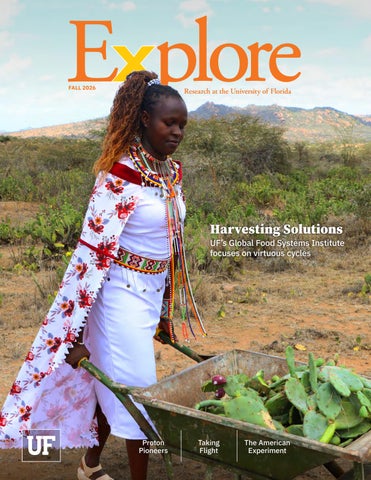
In the dry lands of rural Kenya, a UF researcher and his collaborators are improving lives by turning an invasive cactus into livestock feed and fuel for cooking. Cover photo by Willis Oswino
Stuart R. Bell President David Norton Vice President for Research
6 14 24
Extracts News from around the university
Proton Pioneers 20 years of treating and tracking cancer patients has helped prove the power of proton therapy
32
Taking Flight
38
The American Experiment
Board of Trustees Mori Hosseini, Chair David L. Brandon Matthew M. Bravo Richard P. Cole Christopher T. Corr Jed V. Davis James W. Heavener R. Raymond Issa Daniel T. O’Keefe Rahul Patel Marsha D. Powers Fred S. Ridley Patrick O. Zalupski
For wild turkeys, the first two weeks are crucial
Explore is published by UF Research. Opinions expressed do not reflect the official views of the university. Use of trade names implies no endorsement by the University of Florida. © 2026 University of Florida. explore.research.ufl.edu
Two Hamilton School scholars revisit the ideas that launched a nation and continue to define it
Editor: Joseph M. Kays joekays@ufl.edu
Harvesting Solutions
Associate Editor: Douglas Bennett
UF’s Global Food Systems Institute focuses on virtuous cycles
Art Director: Ivan J. Ramos Design and Illustration: Khary Khalfani Ivan J. Ramos Writers: Douglas Bennett Allen C. Guelzo Joseph M. Kays Paul C. H. Lim Meredith Mitchell-Bauer Social Media: Phillip Frohm Hunter Altman Copy Editor: Bruce Mastron Printing: Hartley Press, Inc., Jacksonville Member of the University Research Magazine Association www.urma.org For narrated stories and audio extras, follow Explore Audio.
Follow us on social media: University of Florida Research uf.research UFresearch
$1.34 Billion
2026 Sponsored Research Expenditures
Thinking About Tomorrow
T
wenty years ago, leaders at the University of Florida made a bold bet on the future. At the time, proton therapy was still an emerging approach to cancer treatment. The facilities required major investments, insurers questioned whether the additional cost was justified and relatively few patients had been treated nationwide. Success was far from guaranteed. Yet UF researchers and clinicians believed the technology held the potential to deliver more precise treatments, reduce side effects and improve the lives of cancer patients. They were looking beyond the challenges of the moment and imagining what cancer care could become. In this issue of Explore, we highlight how that vision has become reality. The UF Health Proton Therapy Institute has treated more than 13,000 patients, conducted groundbreaking clinical research and helped establish proton therapy as a proven treatment option for many forms of cancer. Its impact extends far beyond the patients who walk through its doors. The institute has helped educate medical students, residents, fellows, physicists and radiation specialists, including generations of University of Florida trainees who have learned there alongside some of the field’s leading clinicians and researchers. Many of those former trainees now lead programs across the country and around the world, extending UF’s influence far beyond Jacksonville. The people at the institute are proud of what they have accomplished, but they are still focused on what comes next.
In many ways, the story of the Proton Therapy Institute embodies the long-view approach that drives UF Research and the University of Florida, As new UF President Dr. Stuart Bell has said, great universities build on their strengths while continually looking ahead. Twenty years ago, UF invested in proton therapy because researchers believed cancer treatment could be better. Today, scientists and clinicians at the Proton Therapy Institute and across UF are using artificial intelligence, predictive analytics and other emerging technologies to address the next questions. The Proton Therapy Institute began with a belief that cancer treatment could be better. Across the university, researchers are pursuing that same goal in countless ways, whether improving human health, strengthening food systems, protecting natural resources or deepening our understanding of society. That collective commitment to discovery helped propel the University of Florida to a record $1.34 billion in research activity during fiscal year 2026, but the true measure of that work is not found in a number. It is found in the lives improved, the opportunities created and the possibilities that emerge when we invest in the future. At its core, research is an investment in the future. Every breakthrough, insight and creative work featured in these pages reflects UF’s commitment to expanding knowledge, solving problems and creating opportunities for generations to come.
David P. Norton, Ph.D. Vice President for Research 4 Explore | Fall 2026
A Window Into the Brain Often called “the window to the soul,” the eyes may also offer clues about something less poetic but just as important: the health of the brain. A new study of tens of thousands of patients revealed that cheap, simple and common photographs of the retina can accurately predict many of the most common risk factors that are associated with developing Alzheimer’s disease. “We know that Alzheimer’s disease develops over decades, but most of the diagnostic tools focus on late stage pathology when it is too late to intervene,” said Ruogu Fang, a professor of biomedical engineering who led the study. “By looking at novel biomarkers, like retinal health, we offer new opportunities to identify patients at risk, offer appropriate tests and encourage them to develop healthy lifestyles to mitigate their risk.” Fang and her collaborators published their findings this summer in the Journal of Alzheimer’s Disease. The work was supported in part by the National Science Foundation. Many patients routinely have pictures of their eyes taken. Those with diabetes, glaucoma or cataracts will have
many retinal photographs taken over the years. Even regular eye exams for prescription glasses can capture photos. That near-ubiquity makes analyzing retinal photographs simple and low-cost compared with other, more expensive technologies like MRIs. By using machine learning to analyze these retinal photographs from more than 40,000 patients in a United Kingdombased patient data bank, Fang’s group was able to identify regions of the retina associated with Alzheimer’s risk factors, such as the arteries and optical nerve. “With the assistance of AI, we are now able to identify subtle retinal variations that were formerly overlooked across thousands of subjects, which may function as reliable indicators of future disease risk,” said Seowung Leem, a doctoral student at UF and first author of the publication. The AI model accurately predicted biological characteristics like sex or blood pressure as well as lifestyle factors associated with developing Alzheimer’s, such as smoking, alcohol use and even insomnia. While many of these factors
are captured in patients’ medical charts, those records are often incomplete. Some, like alcohol and smoking, rely on unreliable self-reports. So retinal photographs may provide another, more objective way to detect these risk factors. Plus, the retinal images can capture damage accumulated over the years, which will vary between patients who share similar risk factors. “Retinal morphology could provide measurable indicators of neurovascular integrity, which is highly relevant to Alzheimer’s disease vulnerability,” Fang said. “In this sense, retinal imaging functions less as a surrogate questionnaire and more as an integrated biological sensor of cumulative risk.” Fang’s group has already established that retinal photographs can detect active cases of Alzheimer’s disease. But scientists now believe the disease progresses over many years, even decades. So identifying early risk factors could better identify patients who could respond to earlier interventions — including protective lifestyle changes, some medications or even brain training — before irreversible damage to the brain takes place. Eric Hamilton
The Lead | Extracts
5
A City That Refused to Disappear The city of St. Augustine has the distinction of being continuously occupied longer than any other European settlement in the continental United States. A large portion of its physical history, including more than 1 million artifacts, is curated at the Florida Museum of Natural History. Now, that history is making its way online. With funding from the National Endowment for the Humanities and in collaboration with the Digital Archaeological Archive of Comparative Slavery (DAACS), the Florida Museum has launched Interactive Digital St. Augustine, or iDigStAug, an online database dedicated exclusively to the archaeology of colonial household sites in the city. We’ve started this new website to get the collections online in a way that allows both researchers and the general public to view it,” said Gifford Waters, collection manager for historical archaeology at the Florida Museum. Waters and other archaeologists at the Florida Museum worked with DAACS to choose collections from three colonial household lot sites in St. Augustine. The team at DAACS reanalyzed artifacts from those three sites and entered the details into the iDigStAug database. Though well-established now, St. Augustine has come close to falling off the map on more than one occasion throughout its long history. Its first few hundred years were especially tumultuous. Less than a year after it was founded by the Spanish in 1565, St. Augustine was relocated from the mainland to Anastasia Island due to conflict with the indigenous
6 Explore | Fall 2026
A historic map of St. Augustine
Timucua, whose village the Spanish were living in. It was relocated again in 1572 after being partially destroyed by a mutiny and heavy erosion threatened to wash what was left into the sea. Throughout the 20th century, St. Augustine became increasingly threatened by a different type of erasure. In response, Florida passed a law in 1959 that established the Historic St. Augustine Preservation Board, tasked with acquiring and restoring dilapidated or destroyed colonial-era houses. For the next 38 years — until it was disbanded in 1997 — the board worked with archaeologists, historians and architectural historians to carefully excavate those sites and build faithful reconstructions of the houses. Because of this bottleneck, the iDigStAug website currently has information for three colonial houses, representing some 51,000 artifacts. That
is a drop in the pail compared with the amount of data that will eventually be available on the site. Ultimately, nearly everything from St. Augustine — from the smallest bead made by Native Americans to a trove of British contraband found in the ruins of a harbormaster’s house — will be easily accessible to the public. Users can also access high-resolution, hand-drawn maps of St. Augustine as it looked through the colonial ages. Those interested in a particular type of artifact or data type can specify what they’re looking for using the website’s query function. “You can pick which category you’re interested in, things like beads or Spanish pottery or Native American ceramics, and immediately find simplified information about what was found at each site or all of the sites.” Jerald Pinson
Beneath the Surface One day, the ground is stable. The next, it isn’t. A stretch of road buckles. A home’s foundation cracks. A sinkhole opens seemingly out of nowhere, swallowing part of a yard, a vehicle or a piece of critical infrastructure. In Florida, such events are a constant reminder that some of the state’s biggest threats lie hidden beneath the surface. Decades of slowly dissolving limestone can create underground voids that remain undetected until the ground above them suddenly gives way.
The challenge for scientists, engineers and community planners has long been the same: How do you find a sinkhole before it finds you? Researchers at the University of Florida believe artificial intelligence may help answer that question. Minhee Kim, an assistant professor in UF’s Department of Industrial and Systems Engineering, believes combining technologies such as satellite imagery, GPS and LiDAR — a remote-sensing system that creates detailed threedimensional maps — with advanced machine-learning models, can reveal patterns associated with sinkhole formation long before collapse occurs. The stakes are particularly high in Florida, one of the most sinkhole-prone
regions in the nation. Beneath much of the state lies limestone bedrock that slowly dissolves as water moves through it, creating underground cavities that can remain hidden for years before collapsing without warning. Thousands of sinkholes are reported across Florida annually, and the damage they cause costs millions of dollars. Individual insurance claims routinely exceed $100,000, while roads, utilities and other public infrastructure can require extensive repairs. Despite the financial and public-safety impacts, accurately predicting where a sinkhole might occur has remained one of geology’s most difficult challenges. Traditional approaches rely heavily on historical records, field inspections and localized geological assessments. While effective, they can be time-consuming and may not capture the full complexity of underground systems. Artificial intelligence offers a different approach. With support from a National Science Foundation grant, Kim has partnered with Chunli Dai, an assistant professor of geomatics at UF, to develop an AIpowered system capable of identifying early warning signs of sinkhole activity. Their models draw from a wide range of data sources, including satellite imagery, GPS measurements, soil characteristics, groundwater conditions and weather records. Rather than examining each dataset independently, the AI system analyzes them together, searching for subtle relationships and environmental conditions associated with past sinkholes. The diversity of information is critical. Satellite imagery, for example, can be limited by cloud cover or poor weather conditions. When one source of information is unavailable, the system can use other datasets to fill in the gaps.
The result is a more complete picture of risk across larger geographic areas. Researchers are actively collecting geoscience data throughout Florida to train and improve the system. And, because the models continuously learn from new information, their forecasts can become more accurate over time. Ultimately, the team plans to release an open-source software platform that will allow users to input geoscience data and generate sinkhole risk estimates. More accurate risk assessments could help local governments guide development decisions, transportation agencies protect vulnerable infrastructure, utilities prioritize investments and planners identify areas that may require additional monitoring. In that sense, artificial intelligence is less of a crystal ball than an early warning system — one that helps experts make better decisions before problems become emergencies. For Florida, where growth continues to reshape communities across the state, understanding what lies beneath the surface may be essential to building a more resilient future. And thanks to advances in artificial intelligence, that future may be easier to predict than ever before. Dave Schlenker
The Lead | Extracts
7
Closing the Care Gap With funding from Google. org, Google’s philanthropic arm, the University of Florida Diabetes Institute is using artificial intelligence to improve diabetes detection, expand primary care provider training and strengthen care for the millions of Floridians living with diabetes or at risk of developing the disease. More than 11% of Americans have diabetes and another 28% have prediabetes, according to the American Institutes for Research. Diabetes is a chronic disease that affects how the body processes blood sugar. It can wreak havoc on the heart, kidneys, eyes, nerves and other organs if not properly managed. Given its rapid growth in the U.S. and a national scarcity of adult endocrinologists, more than 90% of diabetes care is delivered in primary care settings. But limited access to diabetes specialists and insufficient training for general practitioners often results in patients being misdiagnosed or underdiagnosed. The UF Diabetes Institute has worked to address that by training physicians from more than 120 clinical sites across the state. The funding will allow the Project Extension for Community Healthcare Outcomes Diabetes, or ECHO, initiative to expand. It works to address gaps in diabetes care through physician training and patient screening in rural and underserved areas. “At Google, we believe that information is a determinant of health, and access to the right clinical guidance at the right time can transform lives,” said Garth Graham, global head of healthcare and public health at Google and YouTube, and former assistant dean for health policy at the UF College of Medicine’s Department of Medicine. “We are deeply proud to support the
8 Explore | Fall 2026
University of Florida as they pioneer new ways to scale clinical expert guidance using technology. “This work is so important as healthcare is deeply personal, and by helping local doctors deliver more practical care on the ground, we can ensure that families all across Florida, no matter their ZIP code, have a fair shot at a health future.” Ashby Walker, an associate professor in the UF College of Public Health and Health Professions and Diabetes Institute associate director of community and population health, and Michael Haller, a pediatric endocrinologist and Diabetes Institute associate director of medicine, will lead the project. The support will allow researchers to create an AI-powered virtual assistant that provides primary care clinicians with guidance for diagnosing and managing diabetes. Additionally, the institute will expand the program to clinical sites throughout Florida. “The Google.org funding and transformative program have the capacity to educate healthcare professionals and improve the lives of those living with diabetes today,” said Todd Brusko, the Diabetes Institute’s director. “Amplifying the results of our original program success can have far-reaching benefits to other serious conditions such as heart disease, stroke risk and neuropathy, with the potential to improve outcomes for millions of patients across the state, the
nation and the world.” AI-assisted module topics will range from continuous glucose monitoring to nutritional guidance. ECHO’s diabetes support coaches will provide mentoring to patients through enhanced access to “food as medicine” resources designed to reduce diet-related stress and food insecurity. The program can be scaled and adopted by other institutions. “The University of Florida’s Project ECHO Diabetes is not only leading the discussion on how to leverage AI within rural Florida communities but also empowers healthcare providers to deliver routine specialty care to those in need. Thank you to Google.org for their generous support of Project ECHO Diabetes. This grant will help integrate AI technology to address disparities in healthcare access, food security, identify geographic hotspots in Florida, and allow for much-needed training of additional primary care physicians for real-time support of patients,” said Florida House Speaker-designate Sam Garrison of Fleming Island. “This is an exciting development and innovative approach to expanding access to care for adults and children living with Type 1 and Type 2 diabetes here in Florida.” Google.org’s funding also will support the development of AI-assisted tools to identify patients at risk for diabetes or those who have been incorrectly diagnosed. Maddy Durand
Disarming Gum Disease For years, treating gum disease has meant scraping away plaque, cutting out damaged tissue or turning to antibiotics that kill bacteria indiscriminately. While newer therapies can regenerate lost tissue, doctors still lack a precise way to stop the infection without harming the mouth’s healthy microbiome. New research from the UF College of Dentistry offers a breakthrough. Researchers have discovered that the primary bacterium driving gum disease carries an internal “genetic brake” that controls its own aggression. By locking this brake in place, future treatments could silence the pathogen while leaving beneficial bacteria untouched. The study, led by oral biologist Jorge Frias-Lopez, focused on Porphyromonas gingivalis. Scientists call this bacterium a keystone pathogen. Like a social media influencer, its power comes from swaying the crowd. Even in small amounts, P. gingivalis can manipulate the entire microbial community, turning a healthy mouth into a diseased one. This microscopic troublemaker drives a massive public health challenge. In the United States alone, gum disease affects about 42% of people over 30 — roughly 2 in every 5 adults. It’s also a leading cause of tooth loss, destroying the bone that supports the teeth. Beyond the physical toll, the economic impact is staggering: the U.S. loses over $150 billion annually to the disease, mostly from lost productivity as people miss work for treatment. To find a better solution, Frias-Lopez’s team looked inside the bacterium’s own genetic instruction manual, zeroing in on a specific section called a CRISPR array. While CRISPR is famous as a geneediting tool, it evolved as a bacterial immune system. When a virus attacks, bacteria capture snippets of the invader’s
DNA called “spacers” and use them like molecular “wanted posters” to spot and destroy returning viruses. However, the array investigated by Dr. Frias-Lopez’s team — previously designated CRISPR array 30.1 — broke this pattern. Its spacers didn’t match any known viruses. Scientists call such mystery sequences CRISPR “dark matter” or “orphan arrays” because they contain genetic code with no obvious target or known origin. In this case, the team found that the dark matter had a target. It just wasn’t an outside invader. Instead, the spacers matched the bacterium’s own DNA. Why, the researchers wondered, would a germ store a weapon against itself? To find out, they used gene editing to delete array 30.1. Rather than weakening the bacterium, cutting this genetic brake made P. gingivalis hyperaggressive. Without the array, the germ produced twice as much biofilm, the sticky buildup that forms dental plaque. In tests, the altered strain proved far more lethal, killing half the hosts in 130 hours compared with 200 hours for the normal strain. It also triggered much stronger inflammation in human immune cells. In a cunning survival strategy, P. gingivalis uses array 30.1 to throttle its own aggression. By keeping it just below the level that triggers a full-scale immune attack, the pathogen stays hidden in the gums, turning what could be a brief
battle into a yearslong chronic infection. Current treatments rely on deep cleaning below the gum line, tissue removal or antibiotics. While effective at reducing bacteria, these blunt approaches kill indiscriminately, harming beneficial microbes and contributing to antibiotic resistance. Frias-Lopez’s findings point to a smarter strategy: Mute the “bad influencer” rather than silencing the entire community. Future therapies could employ engineered bacteriophages, or viruses that target specific bacteria. Scientists could design these viruses to seek out P. gingivalis and inject a CRISPR instruction that locks the genetic brake in place. This would restore peace to gum tissue without disrupting the mouth’s microbial balance. The implications of the research reach beyond oral health. Scientists have established clear links between gum disease and serious issues like heart disease and diabetes. Research shows that in more than half of gum disease patients, bacterial toxins leak from inflamed gums into the bloodstream. Once in circulation, these toxins travel to vital organs, triggering inflammation throughout the body. By keeping P. gingivalis in check, this therapy could do more than save teeth; it could reduce the body-wide inflammation that makes gum disease a silent threat to whole-body health. Anna Boone
The Lead | Extracts
9
Molecular Velcro
A new material uses electrical charges to trap one of the most abundant versions of “forever chemicals” known as PFAS.
A new gel-based material developed by University of Florida chemical engineers filters PFAS “forever chemicals” from water more efficiently than many widely used commercial options. The advance offers a potential new path to filtering out PFAS, which has been linked to health effects including birth defects and some cancers. Importantly, the new material doesn’t itself use fluorine to trap PFAS, helping to reduce fluorinated chemicals in the filtration supply chain. “One of the big challenges is that these chemicals are present at such low concentrations, so they’re very difficult to detect and separate, but they can still impact human health,” said Joshua Moon, an assistant professor of chemical engineering who led the recent study. “It’s like putting a drop of food coloring in an Olympic-sized swimming pool and then trying to get all the food coloring back out. It’s not easy.”
10 Explore | Fall 2026
Moon and his doctoral student Lakshay Dhamania published their findings in the journal Energy and Environmental Materials. Moon’s lab is now working to further test and refine their PFAS-filtering methods for potential application in commercial and municipal water filtration. In what Moon describes as “molecular Velcro,” the new material uses electrical charges designed to trap PFOA, one of the most abundant versions of PFAS in the environment. The gel allows PFOA molecules to bind throughout the material rather than only on its surface, improving its filtration capacity. The gel can then be used multiple times by flushing out the PFOA with common solvents. One of the researchers’ goals was to identify a way to filter out PFAS without relying on fluorinated materials. If those materials break down, they can potentially release fluorinated compounds back into the environment.
“A lot of the materials out there either don’t work well or have to rely on using fluorinated stuff to bind PFAS. We were able to develop these gel-type adsorbents that work well without having PFAS-like substances in the material itself,” Moon said. For Moon, the long-term goal extends beyond a single filtration material. By building polymers whose chemistry can be adjusted piece by piece, the researchers hope to uncover broader rules for trapping PFAS. That includes compounds that are harder to remove from water than PFOA. “Maybe we can create new design principles or a better understanding of existing materials to overcome some of the big challenges that commercial treatment processes can’t really do,” Moon said. Eric Hamilton
Building a Better Gut Barrier As many as 3 million Americans suffer from inflammatory bowel diseases like ulcerative colitis and Crohn’s disease. Luiz Roesch and Brent Sumerlin think synthetic mucus might give them relief. Doctors typically treat the inflammation in the bowels that can lead to diarrhea, stomach pain, fatigue, nausea and weight loss. But Roesch, a microbiologist, and Sumerlin, a chemist, think their artificial mucus could prevent the problem in the first place. By restoring the gut’s mucus barrier – a protective layer that keeps microbes and toxins away from intestinal cells – the material could help prevent the immune reactions that drive inflammation. “We want to target the source of the inflammation, which are the bacterial toxins. When we block the toxins, inflammation is reduced,” says Roesch, an associate professor of microbiology and cell science at the UF Institute of Food and Agricultural Sciences. Roesch also sees a host of other potential uses for synthetic mucins. That includes using them alongside existing IBD treatments to reduce reliance on immunosuppressants. With different chemical compositions, synthetic mucin might also be useful for treating issues in the lungs, mouth and reproductive tract, as well as in veterinary applications. Making mucin – the main ingredient of mucus – in the lab has plenty of scientific hurdles. In nature, mucin is a long, chain-like protein that is densely decorated with short chains of sugars. Gut mucus also has to be selective, trapping toxins but allowing water, gases and nutrients to pass. For now, there is no synthetic mucus on the commercial market. Roesch and Sumerlin aimed to duplicate how mucin works in the body. The synthetic mucin closely mimics the function, size and architecture of its natural counterpart.
“We could never really replicate that sort of complexity. Instead, we made polymers that behave like natural mucin,” Sumerlin says. Artificial mucin represents a potentially significant change in how IBD can be treated, Roesch says. While existing medications focus on calming the body’s immune system after the fact, a robust mucus layer may stop inflammation from happening. The synthetic mucin has already undergone toxicity and efficacy testing in cells and a trio of tests in mice, Roesch says. Roesch’s group dissolved the polymer in water and gave it to mice. It worked immediately: Mice with low levels of natural intestinal mucus showed broad improvements in inflammation and overall gut health. Later, mice with colitis – colon inflammation that depletes the mucus barrier – gained weight and recovered from inflammation after the synthetic mucin treatment. “I don’t think any of us expected it to work on the first try,” Sumerlin says. “It took Luiz being very brave at the beginning and saying, ‘Hey, let’s give this a try.’” Scientists already knew how to assemble the long chains of atoms used to create polymers. They also know how to create very complex polymers. Doing that together is exceptionally difficult. Sumerlin found a breakthrough that does both, using light instead of heat to more directly activate and regulate the polymerization process. That, he says, is a “perfect tool” for producing synthetic mucin. Sumerlin was already working on the improved polymerization techniques when Roesch came along with the idea for a therapeutic use. After being introduced by a former colleague, Roesch reached out to Sumerlin about synthetic
mucin. It was a long-held idea for Roesch but he lacked the expertise to produce the material. “UF had the perfect combination of factors that allowed this to happen,” Sumerlin says. “The fact that the artificial mucin application came second speaks loudly about the need for basic science research. The researchers say the synthetic mucin could one day be produced as a powder that can be mixed with water or other liquids and taken regularly to manage IBD symptoms. “Hopefully, we can reduce symptoms and keep IBD patients in remission for a longer period of time,” Roesch says. Further testing in humans and FDA approval will be required. The team hopes to start an initial-phase human clinical trial focusing on safety and dosages later this year. The synthetic mucin is mass-producible at room temperature, which makes the process much simpler. “The symptoms of IBD can be incredibly disruptive. Many people have just become accustomed to living with that,” Sumerlin says. “If we can help them live something that resembles more of a normal life, that would be our ultimate goal.” Doug Bennett
The Lead | Extracts
11
Q&A Following the Electricity Behind AI
A
s artificial intelligence becomes part of everyday life, so do questions about the infrastructure that powers it. From electricity and water use to the rapid growth of data centers, communities across the country are grappling with what the AI boom means on the ground. Ted Kury, director of energy studies at the University of Florida’s Public Utility Research Center, explains why data centers have suddenly become a public issue, what people misunderstand about their resource demands and how the technology may evolve in the years ahead.
Q: Haven’t data centers existed for a while? Why are people suddenly paying so much more attention to them? Ted Kury: We’ve had data centers as long as we’ve had the internet. What’s changed is the visibility of some of these new hyperscale facilities. When data centers were just regular electricity customers sitting in buildings, people didn’t pay a lot of attention. But now you have some of these facilities with 50- or 100-megawatt demand. That’s different for folks, and it places different strains on the infrastructure. The other difference is speed. If you were building a refinery, for example, it might take four or five years to build. The infrastructure could grow along with 12 Explore | Fall 2026
the project. With data centers, you’re often looking at development times of 12 to 18 months or less. Utilities have always had to adapt to new forms of demand. What makes data centers different is not only the scale but the pace of development and the uncertainty around it. A company may be proposing facilities in multiple locations because it hasn’t chosen a final site yet. Utilities have to account for all of those possibilities even though only one project may ultimately get built.
Q: We all use the internet, streaming services and increasingly AI tools. Why do data centers seem to generate so much resistance? Kury: People generally understand that if infrastructure such as power plants or transmission lines aren’t built it will affect their access to electricity. Data centers are a little different because whether you’re doing a Google search or streaming a television show or talking to AI, you don’t really care which data center is processing that information. It could be in Miami or it could be in Chicago. For a lot of people, that reinforces the idea of, “Why does it have to be here?” Why does it have to utilize our electricity grid or our water resources?
A data center under construction near existing data centers. Read the complete interview at explore.research.ufl.edu.
Ted Kury
Q: People usually think of AI as software and algorithms. How different does it look when viewed through the lens of electricity and infrastructure?
Q: One of your more interesting observations is that people often don’t appreciate the costs behind technologies they use every day.
Kury: People are becoming much more aware of the resource costs. Companies have been using data and machine-learning tools for years, but now we’re seeing the technology scale up rapidly, and people are starting to think about what that requires. They understand what AI can do. Now they’re asking about the electricity, the water and the infrastructure needed to make it work. They’re also asking broader questions about its impact on jobs, education and other parts of society. The scale of the technology has made those questions much more visible.
Kury: Convenience has costs that aren’t always obvious. Twenty years ago, you couldn’t order a product online and have it arrive the next day. That wasn’t the norm. Now people expect it. But that convenience requires distribution centers, transportation systems and infrastructure. AI is similar in some ways. People focus on what the technology can do, but they don’t always think about what it costs to operate. That’s not an argument against the technology. It’s just a reminder that every convenience has a cost somewhere in the system.
Q: When communities debate data centers, what should they focus on? Kury: They should focus on understanding all of the costs and benefits. There isn’t a universal answer that a data center is good or bad. It’s going to impact every community differently. Communities need to understand what they’re getting, what they’re giving up and what trade-offs are involved. What are the impacts on electricity infrastructure? What are the impacts on water resources? What jobs are being created? What tax revenues are being generated? The communities that do the best job are the ones that have a very clear understanding of what they want out of the deal and a very clear understanding of the trade-offs before the agreement is signed. The Lead | Q & A 13
14 Explore | Fall 2026
PROTON PIONEERS 20 years of treating and tracking cancer patients has helped prove the power of proton therapy By Joseph Kays
A
lmost every day, a patient steps to the giant wind chime at the center of the UF Health Proton Therapy Institute lobby, grabs the large rope hanging from it and pulls, producing a deep, satisfying tone that echoes through the building. They’re older men with prostate cancer and children with brain cancer. They have just completed weeks of treatments and now can return to home to resume a normal life. Family, doctors, nurses and radiation therapists join in the celebration, which always includes smiles and tears. In the 20 years since the institute opened on the UF Health campus in Jacksonville, thousands of cancer patients have rung that chime to celebrate the completion of their treatment, and Nancy Mendenhall, the founding medical director of the institute, says it never fails to inspire her. “How could it not?” she says. “That’s what it’s all about.” When UF committed to building the institute in the early 2000s, there was significant risk. Proton facilities were extraordinarily expensive, insurers questioned whether the added cost was justified, and relatively few patients had been treated nationwide. Success would depend on demonstrating that the technology could improve patients’ lives, not simply deliver radiation in a more sophisticated way.
Feature | Proton Pioneers 15
But after treating 13,000 patients from all over the world, leading multiple large-scale clinical trials and publishing nearly 500 papers in the top journals, Mendenhall says the results speak for themselves. “I think we’ve established beyond a shadow of a doubt that it’s extremely effective and very, very safe, and there is enormous promise that the long-term outcomes for all of these survivors of cancer will be better,” Mendenhall says. “I don’t think we get any insurance rejections now because of the claim that it’s experimental, which we did for the first 10 or 15 years.”
“I think we’ve established beyond a shadow of a doubt that it’s extremely effective, and very, very safe.” Nancy Mendenhall
Photons or Protons Almost since the discovery of X-rays, or photons, in 1895, doctors saw the potential of radiation to treat cancers. But for most of the last 130 years, that treatment has come with significant collateral damage to healthy tissue surrounding a tumor. The dose delivered by traditional X-rays starts high and gradually decreases as the radiation passes through the body, meaning healthy tissue located before and after the tumor is also exposed to enough radiation to increase the risk of shortterm side effects like fatigue and skin irritation and longer-term side effects like cognitive deficits, lung scarring and urinary problems.
16 Explore | Fall 2026
In the 1970s and ’80s, doctors began exploring the possibility of using a different form of radiation energy, protons, to achieve similar results but with fewer side effects. Protons are charged atomic particles that have mass, so the distance they travel can be predicted and controlled. Because protons deposit most of their energy when they stop at a specific depth within the body, the area being treated for cancer receives the majority of the radiation dose, and healthy surrounding tissue receives little or no radiation.
Dr. Nancy Mendenhall
Mendenhall had a little experience early in her career with proton therapy for a very select number of brain and eye cancers, but it wasn’t until researchers from Loma Linda University in California, which had opened the first proton treatment facility in the United States in 1994, published a paper in 1998 about their success treating prostate cancer that she fully appreciated the potential. “When I read that 1998 paper, I thought, ‘Of course you could use protons in prostate cancer, and by the way, anything else that we do with radiation,’” she says. “So I decided I just had to bring it to the attention of our dean.” Mendenhall says “the stars aligned” because the leadership in the UF College of Medicine immediately grasped the significance of the new technology and committed the college to pursuing a facility. Ultimately, the $125 million facility was funded through state grants, municipal bonds and private donations. Today, the institute in Jacksonville is one of the world’s leading proton treatment centers and the largest of its kind in the Southeast. Following a $44 million expansion completed in 2023, the 108,000-square-foot facility includes five treatment rooms, treats approximately 100 patients each day and employs more than 125 staff members.
(left) The front entrance to the UF Health Proton Therapy Institute in Jacksonville, FL. This year marks the facility’s 20th anniversary.
Saving Children Daniel Indelicato was completing his residency in radiation oncology at the UF College of Medicine just as the Proton Therapy Institute was rising in Jacksonville. “I literally got to see this place grow from a hole in the ground up,” says Indelicato. “I knew I wanted to do pediatrics and I also knew that this proton technology could be very, very important in pediatric radiotherapy, so I got exceptionally lucky that I came out of training at the exact time that there was this new opportunity in our field, and at the University of Florida.” Dr. Danny, as he is known by patients and staff alike, joined the team straight out of residency and today directs UF’s pediatric radiotherapy program. “At first, when we were the only proton center in the Southeast, when we were one of four in the country, it was very understandable for a lot of pediatric patients to come through the door because there weren’t many other options,” he says. But as more proton centers opened around the country and internationally, Indelicato expected demand at UF to slow. It hasn’t. “It turns out that families and patients aren’t just coming for the proton therapy. That’s crystal clear now, because they have 45 other places they can go in the United States, they have another 50 places they can go outside of the United States,” he says. But for patients and families facing one of the most frightening moments of their lives, how the treatment is managed is as important as the technology. “They’re coming to the University of Florida for something beyond just the technology. They’re coming for the entire comprehensive experience that patients and families have, from the medical expertise in rare tumors to the culture of care that we’ve built over the past two decades.” Feature | Proton Pioneers 17
A Family Finds Hope One of those families was the Mulhollands. Mollie Mulholland was 2 years old when doctors diagnosed her with rhabdomyosarcoma, a rare tumor located near her eye. The recommended treatment combined chemotherapy and radiation. Because of the tumor’s location, proton therapy offered the possibility of delivering an effective dose while reducing the severity of side effects to nearby healthy tissue. In 2018, Fiona and Declan Mulholland temporarily relocated their family from Northern Ireland to Jacksonville for nine weeks. Mollie underwent five and a half weeks of proton therapy while also receiving chemotherapy. “It’s hard to have hope in the middle of a storm like the cancer diagnosis of your child. However, proton therapy was the key to Mollie’s survival. We got the best treatment available to her,” her parents said during a follow-up visit to Jacksonville in 2023. The family’s experience also illustrated what Indelicato means by a comprehensive culture of care. Radiation therapists greeted Mollie in the treatment room with her favorite song from Disney’s Frozen to help calm her anxious thoughts and feelings. While Mollie was in treatment, her sister Grace did arts and crafts in the lobby with the artist-in-residence. “They took an experience that was traumatic for all of us and delivered it in a fun way,” Declan says. “The team truly made this a family-friendly experience.”
Dr. Daniel Indelicato
18 Explore | Fall 2026
Indelicato is a passionate advocate for this comprehensive approach, which includes not just doctors, nurses and radiation therapists, but child life specialists and social workers. It’s not just new technology, but pediatric-themed spaces and a wide range of programming matched to each patient’s developmental stage. “Although these efforts are more abstract than a new cyclotron or medical device, I have come to believe the care environment is every bit as important to our mission in caring for children with cancer.” Because doctors are aiming for millimeter accuracy, patients must stay extremely still during treatments, which can be hard for a child. “If a child can’t stay still, we have to put them to sleep with anesthesia each day for six weeks. And there’s some kids where that’s absolutely necessary and that’s what we do because it’s that important,” Indelicato says. “But if we can avoid it, it makes a major difference for that patient’s treatment course: they don’t need the anesthesia drugs each day, they can wake up and have breakfast, we have flexibility in the scheduling of their treatment, etc. “But it also is a cost issue,” he continues. “By hiring a child life specialist who can help get a 6-year-old through treatment without needing anesthesia, not only do you have all those quality-of-life benefits that I’ve just described, but you also save the healthcare system hundreds of thousands of dollars a year.”
“I have come to believe the care environment is every bit as important to our mission in caring for children with cancer.” Daniel Indelicato In fact, a UF medical student recently published a paper estimating that for a center with 100 patients under treatment per year, a full-time child life specialist in pediatric radiation who works with young patients to teach them how to relax and keep still, can save the healthcare system more than $700,000. “It’s a win-win,” Indelicato says. “It’s better for the patients and it’s better for the economics.”
Prostate Power From the beginning, Mendenhall knew that treating prostate cancer was going to be a major part of the institute’s mission, as it had been at Loma Linda. “We expected maybe 15 or 20 percent of our population would be prostate patients, but the men who had been treated at Loma Linda knew fundamentally that their quality of life was better, and they told all their friends,” she says. “From day one,
From left: Fiona, Mollie, Grace and Declan Mulholland
we had enormous demand from prostate cancer patients from all over the country and now we’ve treated over 7,000 prostate cancer patients.” Mendenhall says the high volume of prostate cancer patients at UF, and now at other proton facilities around the country, has enabled more statistically valid clinical trials comparing the efficacy of photon and proton treatment and the development of new approaches that protect adjacent organs and reduce side effects. In 2017, Mendenhall received an $11.9 million grant from the Patient-Centered Outcomes Research Institute to lead a national study designed to directly compare proton therapy and conventional radiation therapy for prostate cancer. The COMPPARE study has enrolled more than 2,500 men at 51 centers nationwide and continues to collect data on treatment decisions, cure rates, quality of life and side effects. Initial results reported earlier this year found no significant differences between proton and photon radiation therapy in cure rates and quality of life, reaffirming Mendenhall’s belief that proton can become the “standard of care” for most prostate cancers. But Mendenhall also says the risk of radiation-induced secondary cancers and other late-onset side effects may not become evident until five years or more after treatment. “These are three-year outcomes that we’re reporting,” she says. “I suspect that as we get more data at five years, the differences will start to appear.” Feature | Proton Pioneers 19
The Next 20 Years Both Mendenhall and Indelicato say artificial intelligence is already having a significant impact on their field, and they welcome UF’s new AI-focused Jacksonville campus just down the road from the institute as a place to develop new partnerships. “UF investing in a new campus right down the street from us is such a great opportunity,” Indelicato says. “It’s fantastic for the City of Jacksonville and it’s fantastic for the Proton Therapy Institute.” As a specialty built on advanced technology and sophisticated treatment planning, radiation oncology is particularly well positioned to benefit from new computational capabilities, Indelicato says. “I use it in my job probably every day, already,” he says. “It really helps with decision-making when you have large volumes of data to sort through.” Mendenhall says that while AI is not yet used to define cancer targets for treatment, it is helping physicians complete some of the most time-consuming aspects of treatment planning, like mapping surrounding organs on hundreds of CT scans. “I recall a pediatric cancer case in which a resident spent 21 hours creating an initial set of contours for a single treatment plan,” Mendenhall says. “AI programs trained to recognize the bladder, rectum, femurs, lung tissue, heart and numerous normal tissues are helping to eliminate much of that burden, allowing clinicians to focus more attention on care decisions and patient outcomes.” Researchers are also exploring AI’s potential to analyze millions of data points across thousands of cases to predict how certain patients will respond to treatment. Mendenhall and her colleagues are developing studies that use data from prostate
“…coming back we realized that it was not just the city, but the people who cared for us that made it feel like home.”
Declan Mulholland
cancer patients, genetic profiles and radiation dose information to identify which patients may need more aggressive therapies or alternative approaches. “We’re all interested in predictive outcomes because if we can identify in advance which patients may not do well and need another approach or more aggressive therapy, that will be very helpful,” she says. Indelicato believes UF holds a unique advantage in developing future AI applications because of the depth of its clinical data. The Department of Radiation Oncology has tracked patient outcomes for decades and built research infrastructure that links treatment information with long-term results. Pediatric proton therapy is a relatively rare field, and many institutions lack the patient volume and follow-up data necessary to create reliable AI models. “The quality of an AI model depends on inputs,” Indelicato says. “We’ve treated 2,500 patients. I think we at the University of Florida are better positioned than anybody else for the inputs.” He adds that all that patient outcomes data, including information from both proton therapy and conventional radiation treatments, gives UF an exceptional foundation for building AI tools that can improve care for future patients. “It will never be a totally automated procedure, but there is the expectation that it will help us with treatment planning, which is really a manual, iterative, laborious part of the work, requiring human oversight to assure safety and quality,” Mendenhall says.
The Next Generation Patient care and research are two pillars of the institute’s mission. Education is the third. Over the past two decades, faculty and staff have educated physicians, physicists, dosimetrists and radiation therapists who now lead programs across the United States and around the world. As proton therapy expanded nationally, many of the institute’s most experienced professionals were recruited to help launch new centers, extending UF’s influence far beyond Jacksonville. “We’ve trained the medical directors, physics directors and physician directors for half the centers in the country,” Mendenhall says. “We’ve been able to have an impact that goes beyond the walls of this building and the patients we’ve treated directly here.” 20 Explore | Fall 2026
Mendenhall notes that education has always been a core part of the institute’s academic mission. Residents from the University of Florida, Moffitt Cancer Center and Mayo Clinic rotate through the program each year, while one of the nation’s earliest pediatric proton therapy fellowships has trained specialists who now practice in Canada, Japan, England, Singapore and other countries. “The impact of this place from an educational standpoint is global,” she says. For Indelicato, one of the most rewarding aspects of the institute’s legacy is seeing former trainees take what they learned at UF and build programs of their own. “When I go to these professional meetings and I see these radiation oncologists and physicists who trained here now running their own programs at other centers, it fulfills me,” he says. “The next generation, we’ve got to bring them up. We’ve got to let them see the value of the technology and then keep it growing.” The institute’s training environment offers students and residents exposure to an unusually broad range of technologies and patient populations. Rather than learning a single treatment platform, trainees gain experience with proton therapy, conventional radiation treatments, brachytherapy and specialized pediatric care, all within one integrated program. “These student radiation therapists, when they graduate and they’ve done a year of clinical rotations here, they are head and shoulders above their classmates,” says Bradlee Robbert, the institute’s director of operations. Through partnerships with schools across the nation, Robbert says the institute helps prepare the next generation of radiation professionals while providing hands-on experience that few centers can match. The institute’s impact is measured not only by the patients it treats today, but also by the clinicians and scientists it prepares for tomorrow.
Going Home When the Mulhollands returned to Jacksonville in April 2023, the news for then 7-year-old Mollie was good. Indelicato, one of the most experienced pediatric radiation oncologists in the treatment of rhabdomyosarcoma, told them her scans showed the residual tumor was stable. The visit also allowed the family to reflect on the relationships they had formed with institute staff and the Jacksonville community. “Jacksonville felt like home back in 2018,” Declan says. “But coming back we realized that it was not just the city, but the people who cared for us that made it feel like home. Coming back felt like we were coming home because of the people.” I understand what he means. In 2019, after completing my own course of proton therapy at the institute, I walked to the center of the lobby and rang the chime, my wife by my side.
Bradlee Robbert
At the time, I wasn’t thinking about clinical trials, publication counts or the future of artificial intelligence. I wasn’t thinking about 20 years of research or the hundreds of people who helped transform proton therapy from a promising technology into a proven tool against cancer. I was thinking about getting on with my life. Over the past two decades, thousands of patients have pulled that rope. The Proton Therapy Institute has given them the opportunity to get on with their lives. Nancy Mendenhall Medical Director and Professor Department of Radiation Oncology menden@shands.ufl.edu Daniel J. Indelicato Professor and Associate Vice Chair Department of Radiation Oncology dindelicato@floridaproton.org Bradlee Robbert Director of Operations brobbert@ufl.edu Related website: https://www.floridaproton.org/
Feature | Proton Pioneers 21
Benefits of Proton Therapy Entrance Dose
Entrance Dose
vs.
Tumor
Tumor
Exit Dose
CONVENTIONAL RADIATION THERAPY Deposits most energy before target
PROTON THERAPY Deposits most energy on target
Interactions with DNA
PHOTON THERAPY Causes scattered DNA damage
22 Explore | Fall 2026
PROTON INTERACTION Creates concentrated damage that is harder for cancer cells to repair
Facts & Figures Project Timeline: • • •
1998 – Institute planning begins 2002 – Funding secured 2003 – Construction begins
• • •
2006 – First patient treated (Aug. 14) 2016 – Expansion and upgrades begin 2023 – Expansion complete
FACILITY SPECS: • • •
•
• •
108,000 square feet Provides both proton therapy and conventional radiation therapy Five treatment rooms, all equipped with latest technology – including pencil beam scanning – for treating broadest spectrum of cancers Each gantry is three stories tall, weighs 100 tons and is powered by two, 1.5 horsepower motors A 220-ton cyclotron accelerates the protons to two-thirds the speed of light Cyclotron walls are 18-ft thick and made of high-density concrete
Cost: • •
$125 million – funded through state grants, municipal bonds, and private donations. $44 million – cost of fifth treatment room and upgrades to existing equipment
Feature | Proton Pioneers 23
UF’s Global Food Systems Institute focuses on virtuous cycles By Doug Bennett
I
n the drylands north of Nairobi, Kenya, an invasive cactus is rewriting the ecology of the historical rangelands of the Maasai people. The prickly pear cactus has spread across overgrazed lands, crowding out vital grasses and evading eradication. But where others see a scourge, UF agronomist Jose Dubeux finds life-sustaining solutions. Instead of working to eradicate the plant, Dubeux uses it to solve problems and improve lives. In his circular system, crushed cactus becomes animal feed. Biodigesters turn the animals’ manure into methane for cooking food. Vertical vegetable gardens thrive on fertilizer from the digesters and stored rainwater. Solar lights are a game-changer for children’s education. The Kenya project is among many overseen by UF’s Global Food Systems Institute, which connects faculty from an array of disciplines including animal science, public health, epidemiology and horticulture. Together, they take on some of the world’s toughest challenges in regions of dire need: Helping Parkinson’s disease patients grow the medicine they can’t afford to buy. Reducing children’s stunted growth with high-protein foods. Boosting farmers’ yields and optimizing planting strategies. The GFSI is one of the few U.S. university institutes that unifies research, teaching and agricultural extension programs into a single global food systems hub.
24 Explore | Fall 2026
“When children are deficient in micronutrients, the brain doesn’t form well and it’s almost irreversible.” Adegbola Adesogan “I don’t know any group that does that the way we do it. We catalyze collaboration across departments, colleges and countries,” says Adegbola Adesogan, the institute’s director and the E.T. and V.C. York Professor of International Agriculture. For Adesogan, the institute’s work is both urgent and deeply personal. Some 25 years ago, a church newsletter recounted his early years in Nigeria. “A giant of a man, Adegbola was a loner with a reputation for being able to sink a pint of lager faster than any other student on his university campus. If anyone crossed him, he would write their name in his little black book, plotting the revenge he would take,” it says. As a young man, Adesogan eventually turned fully to God. He began channeling his energy into sustainable livestock nutrition. Today, Adesogan speaks eloquently and
ambitiously about bettering the world. That means addressing the tragedy of stunted growth, leveraging animalsource foods and taking on the stark reality of malnutrition. “When children are deficient in micronutrients, the brain doesn’t form well and it’s almost irreversible,” he says.
A Cactus-Powered Future Dubeux gained cactus forage expertise in his native Brazil, but it was a chance encounter with a European philanthropist that led to funding for the Kenya project through the Sicily-based dryGrow Foundation. For about 30 residents of Laikipia County, a central region north of Mount Kenya, the project has been life-changing, Dubeux says. Residents struggle with the invasive cactus, limited animal feed and little firewood, which is risky to gather because of wild animals. There’s no electricity and indoor smoke causes respiratory illnesses. While the cactus-feed effort has brought remarkable changes for families, the raw plant is no panacea. It has to be ground up, fortified with fiber and protein, and pelletized. In a 2025 trial, Dubeux found that goats in Kenya gained almost 20 pounds in 85 days with cactus pellets while needing less water — significantly better than grazing In rural Kenya, an invasive cactus is being used to feed animals and improve residents’ lives.
Feature | Harvesting Solutions
25
Women in south Madagascar sell cactus fruit. The plant is an important part of their livelihoods because it provides fruit, fodder and energy. UF researcher Jose Dubeux and his collaborators established that the invasive red cactus found there can be used as livestock feed.
26 Explore | Fall 2026
Kenneth Oduor
goats. Two years earlier, he showed that supplemental cactus feed could spike milk production in camels. It’s prized as a superfood in Kenya, often selling for twice as much as cow’s milk. “By feeding this cactus to the camels, they doubled milk production,” says Dubeux, a professor of agronomy at the Institute of Food and Agricultural Science’s North Florida Research and Education Center in Marianna. That, he adds, is just the start. Cactus and animal manure are loaded into a biodigester, producing methane that’s cleaner burning and more abundant than wood. “It’s like a large, artificial intestine,” Dubeux says. “You feed materials in one end and gas for cooking comes out.” As a doctoral student working with Dubeux on the goat trial, Kenneth Oduor saw the project’s profound effects on families. Goats that were fed cactus pellets gained nearly twice as much weight compared with other feed. The cactus pellets also help animals survive droughts, reducing the need for distress slaughter. Biogas eliminates the need for long, dangerous firewood trips and improves air quality in homes. “Going into the bush to look for firewood is a dangerous expedition. They sometimes face lions and leopards,” says Oduor, now a postdoctoral associate at Florida A&M University. For Dubeux, no detail was too small. The methane-producing Ground cactus is dried and processed into pellets.
Jose Dubeux
system was designed using only local materials. He insisted on hearing from Maasai women, who emphasized the need for reliable cooking fuel. Next, he wants to expand the system to more families, though funding is limited. Equipping a household costs about $5,000 including a biogas-powered cactus crusher. For about $100,000, Dubeux can scale up production of cactus pellets to make them a salable commodity. “Our approach is a little different,” he says. “It’s to add value to the cactus for the local population as we are combating the infestation.”
One Egg, Big Impact
In the central Kenya countryside, a UF-led project turns invasive prickly pear cactus into animal feed and gas for cooking.
Sarah McKune aspires to change the trajectory of poor children’s lives — one egg at a time. Her work addresses some of the world’s most persistent and devastating global health challenges: child stunting, malnutrition and impaired cognitive development in low-income countries. A professor of environmental and global health in the College of Public Health and Health Professions, McKune’s research is driven by a central question. “How can we optimize the relationship between people, their animals, and the environment to yield more positive health outcomes?” she says. The humble egg is a perfect tool for that, McKune says. Her work has consistently shown that eggs are a clean,
Feature | Harvesting Solutions
27
practical and affordable path to improving child development — sometimes dramatically. A 2020 study by McKune and her collaborators found that boosting egg consumption among 260 mother-child pairs in 18 rural villages in the West African country of Burkina Faso significantly reduced the number of children who were underweight or dangerously thin for their height. Subsequent findings, including a 2024 analysis, revealed that just one additional egg per week resulted in a 1.9% increase in children’s problem-solving scores. Children who ate eggs regularly throughout the trial were much less likely to have delays in important skills like talking, moving and interacting with others. For McKune and the children’s mothers, the effects were no less impactful. “I almost didn’t believe the data as it was coming in. We were asking people to report children’s eating behaviors, so I wondered: Was someone cooking my books? Then, you measure the kids again and see they’re actually growing in a completely different way,” McKune says. Mothers who participated in the study later told government officials they were skeptical at first. Before long, their children were clamoring for eggs. “The kids started acting differently and looking differently. They weren’t getting sick as often. As a mother myself, I know the power of that built-in, positive reinforcement and it’s amazing,” she says. But boosting egg consumption in Burkina Faso required
more than just new eating habits. It meant changing minds and addressing social norms. McKune’s “One Egg” project introduced culturally tailored messaging to overcome beliefs that children who ate eggs were destined to become thieves. During the study, some children were given four chickens in addition to the behavior-change package. Egg consumption nearly tripled in those children. Just as importantly, mothers were empowered to manage their egg supply. Some eggs were used to feed their children, while others could be sold to buy chicken feed or other essentials. Fathers also became allies in the effort, asking if children had gotten their eggs. “Women control chickens all over the world,” McKune says. “When women are making decisions in a household, children’s health outcomes improve.” McKune put much focus on nutrition in the first 1,000 days of life, when crucial brain development activity happens through myelination. Like insulation on an electrical cable, myelin helps develop faster, more coordinated thinking, moving and learning in children. Eggs are a safe, scalable and affordable way to supercharge that process, she says. With 149 million children affected worldwide by stunted growth, McKune sees the urgency of her work. Next, she wants to bring the egg program to the Philippines, Guatemala and Honduras, where growth stunting is particularly common. McKune’s expertise in egg nutrition and animal-source foods also helped catalyze UF’s Brain Food Initiative, which was devised by Adesogan. The project was part of the Feed the Sarah McKune
During a project in Niger, a researcher collaborating with UF’s Sarah McKune (right) measures a child’s middle upper arm circumference. The information is used to rapidly assess child nutritional status in the field, a crucial step before referring undernourished children for care.
28 Explore | Fall 2026
Tara Wilfong, M.D., M.P.H.
During the One Oeuf (“One Egg”) study in Burkina Faso, Sarah McKune’s research team held monthly training and information sessions with participating women to reinforce a “One Health” approach to child growth. The topics included the preparation and feeding of eggs to infants, chicken husbandry and other information.
Future Innovation Lab for Livestock Systems, a collaboration involving McKune, Adesogan and several faculty from UF and other institutions. Since late 2025, the effort has brought McKune, Adesogan and UF scientists in medicine, public health, agriculture and other disciplines together to study food systems that support brain development and reduce growth stunting. The BFI is one of the few programs in the U.S. to study the biology of braindevelopment nutrition alongside the food systems and cultural realities that determine what people actually eat. It has already produced papers on food taboos and plant- and animal-source brain foods. “The Brain Food Initiative is a unique opportunity to examine and build on the evidence that consumption of animalsource foods, fruits, vegetables, and nuts contributes to reduced infant and childhood stunting and improved cognition and health,” Adesogan says. The initiative, McKune says, is an opportunity to amplify what she does best — finding nutrition solutions that improve child development — from what she calls “the 20,000-foot level.” But ask McKune what she’ll never forget and it’s an intensely personal, close-up scene. It was 2007, and she was in Niger to collect data on outpatient malnutrition centers after a food crisis. A weary mother arrived with triplets, 27 days old but each weighing no more than about 2 pounds. The journey was 22 days with babies too weak to nurse. The mother and another woman willed the babies to survive, extracting breast milk onto a cloth and dripping it into the infants’ mouths. Even a seasoned nun at the feeding center was stunned by the mother’s resolve, McKune says.
That moment echoes what McKune’s mentor, the late Emory University smallpox eradication pioneer William Foege, once told her: “Don’t ever forget that every number you count is a person, a person’s child, a person’s mother.” Those memories and those words, McKune says, are what propel her. “These extraordinary things happen in the world all the time. The will to live, the will to survive, the desire to protect a child, and the belief that you can do it, that you can get there,” she says. “It was years before I could tell that story without crying.”
A Plant for Parkinson’s For Dr. Michael Okun, a nondescript, tropical bean is a lifeline for patients struggling with the effects of Parkinson’s disease. Okun, a UF Health neurologist, hails the velvet bean as a potent, affordable and accessible source of L-DOPA. The brain processes L-DOPA into dopamine, quieting tremors and easing muscle stiffness in Parkinson’s patients. More than 10 million people worldwide are estimated to be living with Parkinson’s — a figure that’s expected to explode to 25.2 million with aging populations. Getting levodopa — the essential dopamine-replacement therapy for Parkinson’s — is cheap and easy in first-world countries. In developing nations, it’s often unaffordable. Okun bristles at that. His goal is simple but sweeping: ensure 100% access to the drug. “It’s an absolute travesty that we have this treatment that’s so effective for Parkinson’s, and yet the majority of people can’t get access to it,” he says.
Feature | Harvesting Solutions
29
He also knows how well patients in the initial stages of Parkinson’s respond to small amounts of dopamine. While the velvet bean is potentially powerful, it’s also deeply flawed: The plant is invasive and unpredictable. Its raw beans can be toxic and deliver inconsistent L-DOPA levels. None of that deterred Okun. A few years ago, he approached then-Provost J. Scott Angle with an audacious goal to breed a reliable, plantbased dopamine source. “I’d like to build this,” Okun told Angle. “I’d like to figure out how we can engineer this thing.” Angle asked Adesogan, who had graduated three doctoral students working on the plant, to build a team. Adesogan worked with the Chris Gunter, chair of the Horticultural Sciences department, on the task. Before long, UF had a multidisciplinary team of scientists on the case. Kelly Balmant, an assistant professor of horticultural sciences, is sequencing the plant’s genome. Guodong “David” Liu is the field scientist, testing dozens of velvet bean varieties in different soils and climates. Okun will provide clinical direction and dosing expertise. Jeongim Kim, a plant geneticist, is studying how the plant produces L-DOPA. Adesogan networks with global researchers to gather velvet bean varieties from around the world for testing at UF, while also exploring the best methods for storing and preparing the plant. Funding for the study is being provided by UF’s Institute of Food and Agricultural Sciences and the Norman Fixel Institute for Neurological Diseases, part of UF Health. Without Balmant’s expertise, a better velvet bean never happens. Her work is essential to identifying the genes that cause toxicity and produce L-DOPA. It’s also crucial for building a stable, chemically consistent plant strain. A group in China previously sequenced the velvet bean genome, but the data isn’t available. So UF is doing it from scratch. That means decoding the DNA of 56 velvet bean varieties from around the world. Balmant’s efforts are the project’s genetic road map, identifying the traits for toxicity to enable future gene editing. She’s also working with a UF biomedical engineer to test whether a food-based inhibitor could help reduce the velvet
Dr. Michael Okun
30 Explore | Fall 2026
bean’s nausea side effect. “For any kind of follow-up work and plant development, we need the genome,” she says. When UF scientists in various disciplines collaborate, the results can be life-changing for people around the world, Balmant says. Parkinson’s patients who can’t afford medication could one day grow their own beans. Taking the velvet bean from an unreliable supplement to a natural, predictable therapy is the holy grail. “If I get one spoon of the right cultivar, I know exactly how much L-DOPA I’m getting,” she says. To get there, Balmant needs Liu to sort out the plant’s many botanical wild cards. L-DOPA levels can vary from 3% to 10%. Temperature, weather and soil conditions play big roles in that, says Liu, an associate professor of horticultural sciences. Liu’s job is to find an elite variety of velvet bean with weather resiliency and potent, stable L-DOPA. He grows the velvet beans, identifies the best candidates, and will hand them off for pharmaceutical evaluation and refinements to reduce toxicity and improve L-DOPA consistency. His field trials are essential — and sometimes exceptionally difficult. Recently, only 18 of his 24 samples sprouted. Then, an early frost killed their leaves before maturity. The roots survived, allowing Liu to recover some seeds. Liu recently replanted about 60 varieties of velvet bean gathered by Adesogan from 15 countries, drawing on global germplasm — essentially the seeds and plant lines that hold a crop’s genetic traits. Collecting velvet beans from various environments across the world, one of Adesogan’s tasks, is crucial for identifying the varieties with the best L-DOPA levels, Liu says. Adesogan provides expertise in translational agricultural research and plant-derived bioactive compounds, helping to better understand the best cooking methods for preserving L-DOPA and reducing toxicity. Ultimately, the final solution may not even be the velvet bean. The L-DOPA pathway could be transferred to another bean, such as fava or cowpea. That effort, led by UF Professor and bean genetics expert Eduardo Vallejos, could allow researchers to sidestep some of the velvet bean’s undesirable traits. As the research unfolds, Okun continues to feel the tug of a moral imperative. People around the world shouldn’t have to choose between feeding their families and treating Parkinson’s, he says. That’s part of Okun’s larger goal of achieving 100% access to dopamine therapy. “If you could get a plant that grows in your garden, people around the world will be able to treat their Parkinson’s,” he says.
Modeling Agriculture’s Future In a dim, tidy office near the center of campus, Gerrit Hoogenboom quietly shapes global food security and agricultural decisionmaking across continents. As one of the world’s most influential crop modelers, he’s the lead architect and longtime steward of a team that runs DSSAT, the Decision Support System for Agrotechnology Transfer. The system helps researchers, governments and multinational agribusinesses better understand crop growth, weather’s effects on yields and how to optimize production while reducing environmental impacts. On Hoogenboom’s watch, the system has grown from modeling six crops to about 50, including soybeans, wheat, rice, peanuts and vegetables such as onions and radishes. He’s also overseen major expansions including greenhouse gas modeling and long-term crop rotation. The system takes in data about weather, soil, crop genetics and planting practices. Scientific equations then simulate growth, crop yields, water use and other outcomes. That, Hoogenboom says, delivers myriad benefits that can take much of the uncertainty and guesswork out of agriculture. His models help answer challenging long- and short-term agricultural questions: What’s the optimal amount of fertilizer to maintain yields without polluting the water supply? Which varieties of citrus will thrive in 2050? When should farmers plant to avoid a drought? “We bring knowledge from many different disciplines together. We are running these models for the entire planet,” he says. For Hoogenboom, an early exposure to plants shaped a lifelong interest in crop production. His parents owned two acres of vegetable greenhouses in the Netherlands. In college, he blended that with a love of math and interest in global agriculture. Today, DSSAT is the gold standard for crop modeling worldwide. Since its 1986 release by UF’s James Jones — who’s now a distinguished professor emeritus of agricultural systems modeling — DSSAT has been deployed in more than 190 countries. Hoogenboom eventually made the system open-source, meaning its capabilities are available to anyone. All of that has been done on a shoestring budget: UF pays Hoogenboom’s salary but DSSAT receives no dedicated funding. Money sometimes trickles in to help model a specific crop. He channels those dollars into maintaining the system’s software and upgrading its modeling components. “We have zero money to run the program. It’s all done on a volunteer basis,” he says. Despite running a globally essential agriculture tool with a small team, Hoogenboom is never finished tinkering. He’s working with the International Food Policy Research Institute to merge mechanistic models with generative AI to give farmers real-time, location-specific advice. There’s also work to be done
Gerrit Hoogenboom
on crop-quality prediction, which helps farmers raise plants with optimal protein, starch, or oil content. And then there’s Hoogenboom’s retirement pledge — a vow to model fruit tree crops starting with citrus. It’s especially challenging because perennial fruit trees have different biological and structural behaviors than annual crops. To compound the issue, there’s a dearth of fruit-tree data that DSSAT needs. “One of the promises I’ve made before I retire is to have a model for fruit tree crops,” he says. DSSAT remains wildly popular among agriculture experts. Its output is downloaded daily around the world and has been accessed about 30,000 times in the last 10 years. Hoogenboom is especially proud of the system’s impact: Food security depends on understanding changing weather, pest and disease patterns. Developing countries need tools like DSSAT, not just aid. Farmers need better information to cope with weather variability. “If no one’s asking for a copy of the software, I would quit tomorrow,” he says. Adegbola Adesogan, Ph.D. Associate Vice President and Director, Global Food Systems Institute adesogan@ufl.edu Kelly Balmant, Ph.D. Assistant Professor of Horticultural Sciences balmant@ufl.edu Jose Dubeux, Ph.D Professor of Agronomy dubeux@ufl.edu Gerrit Hoogenboom, Ph.D. Professor and Preeminent Scholar, Agricultural and Biological Engineering gerrit@ufl.edu Guodong “David” Liu, Ph.D Associate Professor of Horticultural Sciences guodong@ufl.edu Sarah L. McKune, Ph.D Professor of Environmental & Global Health smckune@ufl.edu Michael S. Okun, M.D. Director, Norman Fixel Institute for Neurological Diseases okun@neurology.ufl.edu
Feature | Harvesting Solutions
31
32 Explore | Fall 2026
TAKING FLIGHT For wild turkeys, the first two weeks are crucial By Meredith Mitchell-Bauer
K
elly O’Neil presses her face against the glass of an incubator where a clutch of six tiny turkeys are beginning to emerge from their eggs. As the first hatchlings, called poults, peck their way out, O’Neil, a University of Florida postdoctoral researcher, cheers them on. “Hey, little guy!” she says. “Welcome to the world!” If the first thing the poults see is O’Neil, they will begin to bond with her as their mother — a process known as imprinting — and enter a crucial race for survival, a process UF wildlife researchers hope to facilitate. Researchers at the UF Institute of Food and Agricultural Sciences’ Game Lab are studying wild turkeys from the nest to adulthood to understand why turkey populations in the southeastern United States are declining — and what land managers can do to reverse the trend. For decades, wild turkeys were considered one of North America’s great conservation success stories. Due to hunting and habitat loss, the birds were on the brink of extinction in the early 1900s, with their population down from millions to less than 200,000 by the 1930s. Beginning in the 1970s, however, regulated hunting and habitat restoration programs caused populations to rebound, reaching a high of about 6.5 million birds, according to the National Wild Turkey Federation (NWTF). But in recent years, that trend has reversed — likely driven by sweeping changes to the Southern landscape that have fundamentally impacted whether young turkeys survive. Feature | Taking Flight
33
“One thing that is very consistent … and probably explains a lot of what we’re seeing … is habitat,” says Marcus Lashley, an associate professor of wildlife ecology and conservation. Across the Southeast, the amount, quality and connectivity of turkey habitat have all changed in recent decades, driven by development, intensifying land use and shifts in how forests and fields are managed. As that habitat base shrinks or degrades, Lashley says, the number of birds the landscape can support declines with it. But the issue is not just how much habitat remains — it’s the kind of habitat that’s disappearing. Turkeys depend on open, plant-diverse landscapes for nesting and raising young, and that type of cover has become increasingly scarce. “The common denominator … is that we are very limited on high-quality nesting and brooding cover,” Lashley says.
Two Weeks The first two weeks of the poults’ lives are the most vulnerable, as they rely on a delicate balance of vegetation that is dense enough to hide them from predators on the ground and in the air, but open enough for a hen to see approaching danger. It must also support the insects they need to grow. As forests mature, fire declines and diverse landscapes are replaced by monocultures, that balance begins to break down. Vegetation may be too sparse to provide cover or too thick to allow visibility, while tangled ground conditions can slow young birds or trap them entirely. The result is that in the wild only about two out of 10 poults survive to two weeks, when they should be strong enough to get off the ground into low-hanging branches, Lashley says. “If habitat quality is poor and we have fewer nests that hatch, and fewer poults that survive, then the whole population declines,” he says. Wild turkeys are a crucial part of Florida’s ecosystem. They act as both predators and prey, helping control insects and small pests while serving as a food source for animals such as foxes, hawks and eagles — as well as humans.
Tyler Jones
(left) Turkey poults in a foraging plot. Kelly O’Neil (below) of the UF Game Lab releases a brood of wild turkey poults into a vegetation plot in Gainesville as part of a foraging experiment.
34 Explore | Fall 2026
“Each treatment has a different combination of native forbs so that we can work out how plant diversity and structure affects poult success.” Kelly O’Neil But the stakes extend beyond ecology. The elusive Osceola turkey, found only in Central and South Florida, plays an outsized role in both hunting culture and Florida’s outdoor economy because it is one of the four subspecies required to complete the coveted “Grand Slam,” a lifelong goal for many dedicated turkey hunters, according to the NWTF. Each spring, Osceola turkeys draw some 25,000 hunters to Florida from across the country eager to pursue the rare bird as part of that achievement, making it a key driver of hunting-related travel and spending in the state. Those hunters spend about $30 million annually on guides, accommodations, food and gear. Ricky Lackey, a district biologist for the National Wild Turkey Federation, says turkey hunting helps fund conservation and preservation of the wild birds, as well as many other species of animals in Florida. “Turkey hunting popularity in Florida generates significant funding through license sales,” he says. “The specific permit that is required in Florida to hunt wild turkeys is used to fund things such as habitat enhancement on public lands, as well as continued wild turkey research. This all leads to a healthy and sustainable turkey population.”
Building Better Habitat At a research site east of Gainesville, UF scientists are trying to answer one of the most pressing questions about turkey ecology: What exactly do young turkeys need to survive? They have created carefully controlled experimental plots that vary in the species present, the relative abundance of different vegetation and their structure, such as vegetation height and density. These vegetation mixtures test which aspects of plant composition and structure influence poult success. “Each plot is 2,000 square feet and contains a unique vegetation treatment,” O’Neil says. “Each treatment has a different combination of native and non-native forb and grass species so that we can work out how plant composition and structure affect poult foraging success. We selected these species to simulate different variations of early succession communities that poults in the wild forage in.” Lashley, O’Neil and their students collect eggs from nests that have been abandoned or the hens have died and raise them in the lab. When the eggs hatch, a researcher is there, so the poults imprint and follow them as they would a mother hen. In the weeks that follow, researchers effectively become that hen. Feature | Taking Flight
35
Marcus Lashley
“For about two weeks, six people have to be here from daylight to dark being turkey mama,” Lashley says. “They’re spending all day watching these birds and writing down everything they do. Every time they do something for the first time, every physiological measurement — everything gets recorded.” The faster the poults grow and the sooner they can fly, the more likely they are to survive, Lashley says. To measure progress, researchers have built simple structures in the enclosures — perches and barriers that allow them to track when poults gain the strength to jump, climb or fly short distances. “They need to get elevated to roost as quickly as possible,” Lashley says.“Getting even a couple of feet off the ground dramatically affects survival.” The research is designed to isolate one of the most difficult variables in wildlife biology: habitat itself. In the wild, poults must navigate both food availability and predation simultaneously, making it nearly impossible to determine cause and effect. In this controlled setting there are no predators, so the researchers can focus on how vegetation and insect communities alone influence survival. “We’re isolating the effects of vegetation structure and food availability from predation,” Lashley says. “It’s not that we’re ignoring predation — we’re going to do that in other experiments — but right now we’re asking what role vegetation is playing.”
36 Explore | Fall 2026
As the birds mature, researchers continue to follow them. At about a year, they’re ready to mate, and Lashley’s research team is ready to track them as they go about this vulnerable time. In one study, Game Lab researchers tag wild hens in the winter before they begin to nest, putting a little backpack-like GPS transmitter on the turkey. The GPS helps researchers track those turkeys as they mate and nest and determine how long they survive afterward. Over the past two years, they’ve tagged about 150 turkeys. Over the past five years, they’ve tagged about 300 Osceola turkeys specifically. In another study, researchers went to the UF/IFAS DeLuca Preserve in Okeechobee and tracked the vital signs of Osceola turkeys as they bred, and then tracked the survival of their poults to see how that specific ecosystem was faring. The next study on Lashley’s docket is to introduce a population of wild turkeys to a 10,000-acre site in Osceola County to test some of the vegetation and management ideas developed during other studies. “We’re going to take what we find here and measure it in the field — see if it translates into real turkey populations,” Lashley says. The research may also reveal longer-term effects — including whether early habitat conditions shape a turkey’s behavior, diet or reproductive success later in life.
West Flight Pen
J
G
B
L
“The common denominator…is that we are very limited on high-quality nesting and brooding cover.” Marcus Lashley
Enclosure
D
E
East Flight Pen M Researchers used these one-half acre flight pens, or large outdoor aviaries, to study turkey poult foraging. Each area is a variation of an “early succession” plot, a type of vegetation community that has been reduced to near-historic lows but is crucial for turkey poults and other species to thrive. The goal of the 2025 trials was to assess which characteristics of early succession vegetation affected poult foraging efficiency. To accomplish this, groups of poults were assigned to forage on a particular plot every day for their first two weeks of life. After that, poults stayed in the smaller sub-enclosures (orange rectangles) for their first few months until they were large enough to safely free-roam the flight pens.
F
D
A I
N
H
C
K
Enclosure
Umbrella Species Lackey said Lashley’s team’s research will be invaluable for making sure investments in turkey populations are going to the right locations and to address the biggest needs. “The research that is being conducted through UF will definitely continue to inform the management of the bird. Utilizing science to inform management will ensure that we have sustainable and healthy populations of wild turkeys,” Lackey said. Lashley says one of the things that has surprised him about this project is how quickly the researchers and students in the lab have embraced turkey conservation. “No one in my lab was a turkey person before, and they have all gotten sucked in,” he says. “We’re all going to be speaking turkey by the end of this.” Beyond the lab, wildlife managers, conservationists and landowners regularly send questions, photos and observations from across the country — all searching for answers. “It’s been really eye-opening that people would care that much about something we’re so passionate about,” Lashley says. And the implications go far beyond turkeys alone. “Turkeys are a great umbrella species,” he says. “When we have healthy turkeys, it benefits a lot of other important species. If turkeys thrive, Florida’s environment thrives.” Marcus Lashley Associate Professor of Wildlife Ecology and Conservation marcus.lashley@ufl.edu Kelly O’Neil Postdoctoral Researcher of Wildlife Ecology and Conservation luckyirishk@ufl.edu
Feature | Taking Flight
37
American Experiment The
Two Hamilton School scholars revisit the ideas that launched a nation and continue to define it
T
his year’s 250th anniversary of the Declaration of Independence offers an opportunity not only to celebrate the American founding, but also to revisit the ideas and debates that continue to shape the nation. At UF’s Hamilton School for Classical and Civic Education, faculty members are engaged in those conversations every day through their teaching, scholarship and public engagement. These essays, written by Professors Allen C. Guelzo and Paul C.H. Lim, reflect on that spirit of inquiry. As scholars of history, politics, religion and civic thought, they bring their own perspectives to the American story while inviting readers to consider what the nation’s founding legacy means today.
38 Explore | Fall 2026
Lincoln’s Declaration How our 16th president made the Declaration of Independence the nation’s moral compass
T
here was never any question in the mind of Abraham Lincoln about the importance of the American Revolution. “Of our political revolution of ‘76, we all are justly proud,” Lincoln said in 1842. “It has given us a degree of political freedom, far exceeding that of any other of the nations of the earth.” But it was the Declaration of Independence which was at the core of the Revolution for Lincoln. At Independence Hall, en route to his inauguration as the 16th President, Lincoln announced that he “never had a feeling politically that did not spring from the sentiments embodied in the Declaration of Independence,” and “would rather be assassinated on this spot than to surrender” its principles. His longtime law partner, William Herndon, remembered that whenever Lincoln was “eulogizing the Declaration of Independence,” he would stretch both of his hands “out above his head at an angle of about 50 degrees,” as though he was “appealing to some superior power for assistance or support; or that he might embrace the spirit of that which he so dearly loved.”
The most important of the Declaration’s principles was the one Lincoln singled out at the opening of his Gettysburg Address in 1863, that all men are created equal. In 1776, Allen C. Guelzo Professor of Humanities the Revolution’s leaders founded “a Hamilton School new nation, conceived in liberty and dedicated” to this “proposition,” he said. Even earlier, in 1858, Lincoln insisted that this “proposition” was “the father of all moral principle” for the American republic. It was the ground on which anyone around the world who loved liberty could claim to be “blood of the blood and flesh of the flesh of the men who wrote that Declaration.” But almost as important for Lincoln was the Declaration’s assertion that governments act legitimately only when they act with the consent of the governed. Consent was “the leading principle — the sheet anchor of American republicanism.” And though consent could be obtained in a variety of ways — through elections, town-hall meetings or newspapers — consent itself was non-negotiable. Otherwise, “any people anywhere, being inclined and having the power, have the right to rise up and shake off the existing government, and form a new one that suits them better.” But that raised an important question: How did Lincoln reconcile the Declaration with the Constitution? The Declaration spoke eloquently about equality and consent, but the Constitution talked about neither. In fact, for many opponents of slavery, the Constitution was defective precisely because it failed to deal with slavery. But Lincoln turned to the Old Testament’s book of Proverbs for an answer. “A word fitly spoken,” Lincoln recalled, is like “an apple of gold in a picture of silver.” The Declaration was “the word, fitly spoken which has proved an ‘apple of gold’ to us,” while the Constitution and the Union it created “are the picture of silver, subsequently framed around it.” The Declaration was the heart of the American experiment, but the Constitution adorned and protected it. So, much as he begged his hearers in 1856 to “come to the rescue of this great principle of equality,” he immediately added, “Don’t interfere with anything in the Constitution. That must be maintained, for it is the only safeguard of our liberties.”
Abraham Lincoln
Feature | The American Experiment 39
Just as important for many critics since is Lincoln’s reverence for the Declaration’s author, Thomas Jefferson, before all the other revolutionary figures. Today, we have come to understand many of Jefferson’s shortcomings. The man who preached human equality kept over 100 human beings as slaves, and sold some of them to pay for his wine cellar. And the man who demanded that consent be the cornerstone of good government made one of those slaves, Sally Hemings, into his mistress and very likely the mother of four of his children, without any trace of consent on her part. Lincoln understood these problems in Jefferson, and especially Jefferson’s treatment of Hemings. Herndon remembered that the Hemings affair made “a powerful impression” on Lincoln, so much so that “Mr. Lincoln never liked Jefferson’s moral character after that.” But Lincoln drew a sharp distinction
Thomas Jefferson
between Jefferson’s private vices and public virtues. Whatever moral guilt Jefferson earned by his personal behavior, still “the principles of Jefferson are the definitions and axioms of free society,” The Sage of Monticello, Lincoln noted, deserved at least some measure of redemption for being “the man who, in the concrete pressure of a struggle for national independence” made “an abstract truth” — that all men are created equal — the first rule of the Declaration. “And so to embalm it there, that today, and in all coming days, it shall be a rebuke and a stumbling block to the very harbingers of re-appearing tyranny and oppression.” Beyond the Declaration, Jefferson’s writings crop up time and again in Lincoln’s letters and speeches. Even Lincoln’s warning in the midst of the Civil War that Americans must “nobly save, or meanly lose, the last best hope of earth” is an echo of Jefferson’s warning in 1820, “We are the world’s last hope; and its loss will be on our heads.” For Lincoln, neither the Revolution nor the Declaration were mere artifacts of a long- gone or irrelevant past. They formed the substance of what he called “our ancient faith,” and that faith served to strengthen him in the hour of the nation’s greatest crisis. And what it did for Lincoln in the Civil War, it may yet do for us in our lifetimes.
40 Explore | Fall 2026
From Exodus to Independence How biblical ideas helped shape the American Revolution
N
one of the Founding Fathers were born revolutionaries. They were born British subjects. By 1732, when Georgia received its royal charter, all 13 colonies had been established as part of the British Empire. What unfolded between 1732 and 1776 transformed British colonists into revolutionaries: They declared independence, fought a war, and emerged as a sovereign nation, invoking the language of “the Laws of Nature and Nature’s God” in the Declaration of Independence. As we mark the 250th anniversary of that Declaration, it is worth considering a lesser-known dimension of America’s founding: the role of religion. Religion did not act alone, nor did it replace political theory or Enlightenment philosophy. Rather, it furnished many Americans with the moral and theological vocabulary through which political arguments could become more legible and persuasive. Ideas change history — but only after they transform how people imagine the world: what is possible, desirable and indispensable. Long before Americans read the Declaration of Independence, they read the Book of Exodus. The story of Israel’s deliverance from Egypt, the crossing of the Red Sea, the giving of the Law and the journey toward the Promised Land provided a powerful framework through which many colonists understood liberty, providence, and political oppression. The revolutionaries were not inventing a new language of freedom. They inherited and adapted an ancient biblical pattern from Exodus: oppression, divine judgment, deliverance, and covenant responsibility, both civic and religious. Colonial Americans learned to think about liberty through religious language before they argued for political independence. By 1776, biblical ideas, Protestant theology and Enlightenment political philosophy had become intertwined in crucial ways that shaped the Revolution. Those forces continue to shape conversations about liberty, conscience and the proper relationship between political and religious authority.
During the Revolutionary War (1775–83), the faithful British subjects and the British sovereign all prayed to the same God, yet for diametriPaul C. H. Lim cally opposite outcomes. This was not Professor and Associate Director simply a conflict between religion and Hamilton School belief and political ambition. It was a conflict among people who shared a religious inheritance but interpreted the vectors of political authority divergently. The lesson of Exodus was that God was not apathetic to human suffering caused by oppressive political power. Yet Romans 13 from the New Testament raised another crucial question: If civil authority is truly ordained by God, when may rulers be resisted? Many Protestant thinkers argued that government is indeed established by God, but it is also accountable to God. When godly rulers became ungodly tyrants, abusing their entrusted authority, resistance by subjects could become a moral obligation, rather than an act of lawless rebellion. After all, Acts 5:29 recorded the early Christian Founders declaring that their sense of ultimate allegiance was not human authorities but God. The Scottish theologian Samuel Rutherford expressed this argument powerfully in Lex, Rex (1644) — Law is King (not King is Law!) — which became one of the key texts in Reformed political thought. His emphasis on limited government and resistance to tyranny formed part of the intellectual inheritance of Presbyterian leaders such as John Witherspoon, a signer of the Declaration and president of Princeton.
Feature | The American Experiment 41
The Declaration’s appeal to the “Laws of Nature and of Nature’s God” did not emerge in a vacuum. Many Americans understood natural law through a biblical lens. Because human beings were created in the image of God (Genesis 1:26–27), they possessed a dignity that no king or Parliament had bestowed — and therefore no king or Parliament could rightly take away. Liberty, in the colonial imagination, was not a gift of government. It was a gift from God. The central challenge facing the colonists was not whether rebellion was desirable, but whether resistance to the Crown could be justified in light of their long-standing convictions about law, government and obedience to God. In fact, the revolutionaries argued that they were defending the guarantee of individual protection from tyrannical encroachment, as guaranteed in the ancient British constitution and the rights of Englishmen to oppose ministerial corruption and parliamentary overreach, both of which they saw in several oppressive Acts enacted by the British Crown and Parliament — the Stamp Act (1765), the Townshend Act (1767) and the Intolerable Acts, including the Boston Port Act and a new Quartering Act (1774). They bristled under these oppressive edicts. The Founders were not born revolutionaries. They became revolutionaries only after concluding that fidelity to God, conscience and the rule of law required resistance to political power. Whether one agrees with their conclusion or not, their journey reminds us that the American Revolution was not merely a political event. It was also the culmination of a long moral and religious conversation about the source of liberty itself and the recipients thereof. 42 Explore | Fall 2026
Yet the promise of 1776 was not fully realized in Philadelphia. The words “all men are created equal” and the claim to an “unalienable Right” to “Life, Liberty and the pursuit of Happiness” remained an unfulfilled promise. It was not until Jan. 1, 1863 when Abraham Lincoln signed the presidential executive order of “Emancipation Proclamation” that a greater correspondence between the ideal of founding principles and their embodiment became visible. As a first-generation American, I can honestly — and proudly — say this bold experiment in pursuing life, liberty and happiness for all people is what drew me to these shores from Seoul, Korea, in the winter of 1983 as a teenager. It continues to inspire faith, hope, and love as I now teach and serve at University of Florida’s Hamilton School. Allen C. Guelzo Professor of Humanities, Hamilton School aguelzo@ufl.edu Paul C.H. Lim Professor and Associate Director, Hamilton School paul.lim@ufl.edu
A Sense of Place Hamilton School’s future home breathes new life into a historic campus building
O
ne of the University of Florida’s most recognizable historic buildings is preparing for a new chapter. The former UF Infirmary, a Collegiate Gothic landmark on the National Register of Historic Places, is being transformed into the future home of the Hamilton School for Classical and Civic Education. The project represents more than a renovation. It is an effort to connect the university’s future with its past, creating a space designed explicitly around the school’s mission of sustained inquiry, discussion and civic engagement. Since its creation in 2022, the Hamilton School has grown rapidly, attracting faculty from leading universities and establishing programs focused on history, political thought, law, economics and literature. Until now, however, the school has operated from multiple locations across campus. The renovated infirmary will provide a permanent home designed around the educational experience the school seeks to foster. The building itself offers a powerful symbol of continuity. For generations of Gators, the infirmary served as a place of care and recovery. Its new role shifts from healing bodies to cultivating minds, while preserving the architectural character that has made it a familiar part of the campus landscape. Renovation plans call for maintaining the building’s historic exterior while creating modern teaching and gathering spaces within.
Designers have emphasized natural materials, warm lighting and inviting communal spaces. Rather than the sleek glass-andsteel aesthetic common to many contemporary academic buildings, the new Hamilton School intends to create an atmosphere influenced by historic centers of learning. School leaders have pointed to the residential colleges of Oxford and Cambridge as inspiration for spaces that encourage students and faculty to linger, converse and engage deeply with ideas both inside and outside the classroom. The renovated facility will include seminar rooms, reading and study spaces, faculty offices and a lecture hall capable of hosting larger events. A bright winter garden and central lobby will serve as gathering places for formal and informal exchanges. Throughout the design, light serves as both an architectural feature and a metaphor for the school’s educational mission, creating spaces intended to inspire curiosity, reflection and leadership. The project has benefited from support from the State of Florida and university leadership, who view the restoration as an investment in both historic preservation and academic innovation. Hamilton School materials describe the effort as preserving an important campus landmark while adapting it to serve future generations of students. Renowned architects with experience on projects such as Harvard University’s Widener Library and the George W. Bush Presidential Library are contributing to the transformation. For UF, the new home represents an important milestone in the Hamilton School’s evolution from a promising academic initiative into a permanent part of the university landscape. For students, it offers something equally valuable: a place intentionally designed for conversation, contemplation and the exchange of ideas.
Feature | The American Experiment 43
Non-Profit Organization U.S. Postage PAID Gainesville, FL Permit No. 94
Explore Magazine Box 115500 Gainesville, FL 32611-5500
Scan this code to join our mailing list or update your mailing address.
Visit us online:
explore.research.ufl.edu
What is UF Research doing for you? Follow us to find out.
University of Florida Research uf.research UFresearch
research.ufl.edu