An Interview with Duncan Whitty
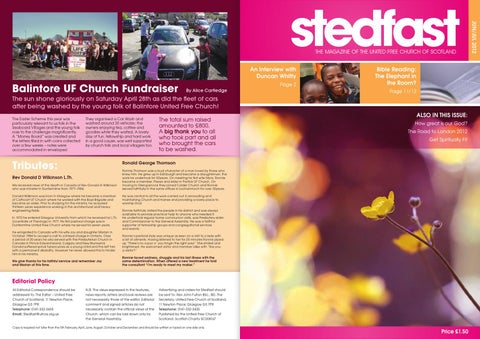
Balintore UF Church Fundraiser
Page 2 By Alice Cartledge
JUN/JUL 2012
THE MAGAZINE OF THE UNITED FREE CHURCH OF SCOTLAND
Bible Reading: The Elephant in the Room? Page 11/12
The sun shone gloriously on Saturday April 28th as did the fleet of cars after being washed by the young folk of Balintore United Free Church! The Easter Scheme this year was particularly relevant to us folk in the Seaboard Villages and the young folk rose to the challenge magnificently. A “Money Board” was created and the letters filled in with coins collected over a few weeks – notes were accommodated in envelopes!
They organised a Car Wash and washed around 30 vehicles; the owners enjoying tea, coffee and goodies while they waited. A lovely day of fun, fellowship and hard work in a good cause, was well supported by church folk and local villagers too.
Tributes:
The total sum raised amounted to £800. A big thank you to all who took part and all who brought the cars to be washed.
ALSO IN THIS ISSUE: How great is our God? The Road to London 2012 Get Spiritually Fit
Ronald George Thomson
Rev Donald D Wilkinson L.Th. We received news of the death in Canada of Rev Donald G Wilkinson who was minister in Dunfermline from 1977–1984. Donald Wilkinson was born in Glasgow where he became a member of Cathcart UF Church where he worked with the Boys Brigade and became an elder. Prior to studying for the ministry, he acquired thirteen years experience working in the architectural and heavy engineering fields. In 1972 he entered Glasgow University from which he received his L.Th. (Licentiate of Theology) in 1977. His first pastoral charge was in Dunfermline United Free Church where he served for seven years. He emigrated to Canada with his wife Joy and daughter Marian in October 1984 to accept a call to a linked charge in Ontario. Over a period of 20 years he also served with the Presbyterian Church in Canada in Prince Edward Island, Calgary and New Brunswick. Donald suffered spinal tuberculosis as a young child and this left him with a permanent disability. However he never allowed this to hinder him in his ministry.
We give thanks for his faithful service and remember Joy and Marian at this time.
Ronnie Thomson was a loud character of a man loved by those who knew him. He grew up in Edinburgh and became a draughtsman, the work he undertook for 50years. On meeting his first wife Myra, Ronnie became a member, Preses and elder in Partick UF Church. On moving to Glengarnock they joined Calder Church and Ronnie served faithfully in the same offices in Lochwinnoch for over 30years. He was central to all the work carried out in renovating and maintaining Church and manse and providing a lovely place to worship God. Ronnie faithfully visited the people in his district and was always available to provide practical help to anyone who needed it. He undertook regular home communion visits, was Presbytery elder and Commissioner to the General Assembly. He was a faithful supporter of fellowship groups and congregational services and events. Ronnie’s pastoral style was unique as seen on a visit to a lady with a list of ailments. Having listened to her for 20 minutes Ronnie piped up “There’s no a pun o’ you hingin the right way!” She smiled and brightened. He welcomed visitor and member alike with “Are you a visitor?”
Ronnie faced sadness, struggle and his last illness with the same determination. When offered a new treatment he told the consultant “I’m ready to meet my maker.”
Editorial Policy All Editorial Correspondence should be addressed to: The Editor – United Free Church of Scotland, 11 Newton Place, Glasgow G3 7PR Telephone: 0141-332-3435 Email: Stedfast@ufcos.org.uk
1
N.B. The views expressed in the features, news reports, letters and book reviews are not necessarily those of the editor. Editorial comment and signed articles do not necessarily contain the official views of the Church, which can be laid down only by the General Assembly.
Advertising and orders for Stedfast should be sent to: Rev John Fulton BSc., BD, The Secretary, United Free Church of Scotland, 11 Newton Place, Glasgow G3 7PR Telephone: 0141-332-3435 Published by the United Free Church of Scotland. Scottish Charity SC008167
Copy is required not later than the 5th February, April, June, August, October and December, and should be written or typed on one side only.
2
Price £1.50
Contents 2/3
An Interview with Duncan Whitty
4
March Youth Assembly: “How great is our God?”
5/6
A Day with the Children at: The Rerotlhe Day Care Centre
7/8
The Road to London 2012
8
Farewell Service for Rev J P Coltman
9
Get Spiritually Fit
10
Moderator’s Final Reflections
11/12
Bible Reading: The Elephant in the Room?
13
Trinity Choir from Gaborone Visit Scotland
14
The Sabbath Day: A Personal View
15
The Church in China: An Alternative View
16
‘Running the Race’
17/18
Glimpses from Our Past: 1929 Onwards
18
The King, the Snake and the Promise
An interview with Duncan Whitty — A student in training for the ministry of the UF Church Interviewer: Jan Cross 13 Tell us a little about your early life...
2
7/8
So your first memory of church wasn’t a positive one! How and when did ‘church’ begin to have real significance for you?
19 Balintore UF Church Fundraiser 19
Tribute: Ronald George Thomson
19
Tribute: Rev Donald D Wilkinson L.Th.
I was brought up as the eldest of four children in the town of Haddington, East Lothian. My parents had a house with a large garden which we enjoyed making the most of! My father was Church of Scotland and my mother was Belgian and a Catholic and sent us to the local Catholic primary school, which was just over the garden wall! My earliest clear memory of church was being told off by the parish priest for going up for communion with my hands in my pockets! The highlight of the year was always our trip over to Belgium to visit our nan and wider family. She had a house on the edge of some woods outside Antwerp so there was lots to explore. I never learned the language (Flemish) but always felt excited to have that European link.
16
Editorial Well the summer sports season is almost upon us and between European Football Championship, Wimbledon, the British Golf Open and the Olympic and Paralympic Games it will be hard for even the less interested not to swamped by the media coverage. For those who are excited by the prospect of so much sport on the horizon there is an article by Rev Neil Urquhart, minister of Fullarton Parish Church and an Olympic Sports Chaplain, in which he shares his experiences of life up close to the athletes at these major sporting events. While some are happy to opt out of the sporting frenzy, there are some activities we are encouraged not to opt out of as Christians if we are to finish the race. Lawrence Sum of the Scottish Bible Society in the Get Spiritually Fit article reminds us we are like “athletes in training” and through self-discipline, obedience to God’s Word and adopting the single-mindedness of an athlete in training, we can focus on the goal of knowing Christ. If the Bible then is a “gymnasium of the soul”, having recently attended a presentation by Biblica (formerly International Bible Society), I can highly commend their article on the Community Bible Experience (CBE). Hopefully you and your church consider engaging with the Bible in this new way that could be as life-changing for you and your church as it has been for others. Should you decide to give it a go your feedback on this, or any other events that are happening in your church, would be much appreciated.
19
Well, through teenage years and during my time at university I continued going to church, largely out of duty, although sometimes I felt a sense a peace there. I didn’t have a relationship with Jesus though; I was a churchy person but not a Christian. I began seeking God seriously when I was twenty three and found him (or He found me) when I volunteered for three weeks with a Christian charity called ‘Mercy Ships’. So I didn’t come to know Jesus in church but through being part of that Christian community onboard the ship ‘Africa Mercy’ on the river Tyne. Their church started to become exciting to me and I started going out of joy not just duty.
How would you describe a ‘churchy’ person from your own experience? I’d say a ‘churchy’ person is someone who goes to church maybe out of habit or a sense of duty or because he/she enjoys it, but he/she hasn’t made that life changing decision to follow Jesus and isn’t a Christian. Being part of a church going family kept me going to church even after I’d left home, it was just what I’d always done – that and the feeling it all might be true. I think God encouraged me to keep going – I remember feeling a sense of joy attending a Christian Union meeting at university once for example. I think that feeling was God’s encouragement for me that I was in the right place!
So what happened with the Mercy ship experience that turned everything around for you church and faith wise? I was searching for faith and thought to myself that the best way of finding out if Christianity is true was be living in a Christian community for a while. I signed up as a volunteer for just a three week stint on the Christian ship ‘Africa Mercy’ which had a small crew onboard helping convert her from a train ferry into a hospital ship I was struck by the genuine care and love that the crew showed. One evening I found myself sitting in the dining room of the ship speaking to another volunteer, a retired sheep farmer from New Zealand named Jim Dean. He told me about the amazing, miraculous things God had done in his life since he became a Christian, for example, healing him of depression. I remember thinking to myself that this guy was telling the truth, he wasn’t making these stories up. I then remember thinking of questions to ask him about things like the Catholic church and the Afghanistan conflict and he answered my unspoken questions before I could open my mouth. I had the realisation at that moment that God was speaking to me through this man and that the Jesus I had heard about so often was real and that I had to follow him. I prayed a prayer committing my life to him that evening in my cabin, it felt like a burden had come off me when I did, it was a great feeling! I immediately signed up for another eight months onboard the sister ship ‘Anastasis’ in West Africa!
Alastair Wright Stedfast Secretary 1
2
An interview with Duncan Whitty (cont.) — A student in training for the ministry of the UF Church
March Youth Assembly:
Interviewer: Jan Cross By Laura Mackenzie
www.mercyships.org.uk
And nothing of the nitty gritty of living in very close quarters with other Christians on board the ‘Anastasis’ put you off?!
So here you are now in May 2012 in the process of training for the ministry of the United Free Church of Scotland! How did that come about?
No, its funny how you adjust to being cooped up with three hundred others in a tin can when you need to. Cockroaches crawling out of the shower drains woke you up in the morning though! At least sea sickness wasn’t a problem; we were in port for most of the time. The (Scottish) chief engineer joked it was like working on an oil rig; we never seemed to move!
Well in 2005 I was back in Scotland and completed a Youth With A Mission (YWAM) course. One evening I joined with some of the Edinburgh YWAM team in putting on a small youth event in Ebenezer UF church in Leith. I walked through the door of Ebenezer to see a familiar person sweeping the vestibule floor. She looked up and immediately said ‘you’re a Whitty!’
Once you landed on dry land again how did you go about living as a Christian?
It was one of my former teachers from Haddington – Ruth Johnstone, who was an elder in Ebenezer. Anyway she soon roped me into helping with the Ebenezer Friday evening kid’s club, which I did for some years – the habit of obedience to your teachers is hard to break! In 2009 I felt the call to train for church ministry, and enrolled in a Bachelor of Divinity course in Edinburgh University. I became a member of Ebenezer, applied to be a student in training for the ministry with the UF Church, did a three month placement in Sauchie church, and was accepted as a student last year!
‘Re-entry’ was difficult for a while, going from a very exciting, spiritual and supportive community to normal life and a 9–5 job took a few months of adjustment. I started work in an engineering office in Skipton and joined the local Baptist church which had some people of a similar age as myself. Finding a good group of Christian friends in a small town like Skipton was a great blessing and really helped me stay strong in my faith. I also took some week-long holidays to rejoin the Africa Mercy which was still getting overhauled on the river Tyne! I also tried to make time every day to pray and focus on God – making the decision not to watch TV helped with that one; it freed up a lot of my time!
Can you describe how God called you specifically into the church ministry? Various things lined up to make me believe God was calling me to church ministry. I felt my gifts and abilities and experience of doing pastoral type work were suited to the role. I felt God speak to me through some things a couple of my friends said to me about ministry. The clincher was that after thinking and praying about it for a period, the first time I attended a service at Ebenezer, the visiting preacher gave a sermon on the call of Samuel; this spoke quite strongly to me about me being called.
And finally, where are you in the whole process of preparation for ministry?
3
I’m starting a church placement in Bannockburn which will last till the end of the year, then another placement in a second church will follow – the whole process including such things as Bible exams and trials for licence is set to run to near the end of 2013. Not long really, time flies!
The young people met together for a long weekend at the Cairngorms Christian Centre, Aviemore from Friday 30th March until Monday the 2nd of April. Our theme was ‘How great is our God’ looking at creation, God’s plan for His world, His plan for us as His people and His plan for us as individuals. We began the weekend by looking at the world in which we live and recognising that the same God who made the universe, knows and loves us! Our aim was to catch a glimpse of how amazing and huge our God is. The evening session reminded us of just how great our God is, how unchanging He is and that He is in control. It was great to spend time in worship and prayer as a group thanking God for these facts. There were twenty young people at the Youth Assembly, some new and some who have been coming for a while. There is always a lovely atmosphere as the group gel well together. It’s such an encouragement to see young people coming together and sharing in fellowship and discussion with each other. Both Saturday and Sunday mornings began with a time of prayer before breakfast then morning worship and the teaching sessions. Robert Owens started with a session on biblical interpretation. The young people were given verses with no bible references and asked to decide together what these verses are commonly understood to mean. Then when the verse references were given and the young people put them into their contexts, they were surprised to see the real meanings of some verses that are often taken out of context. This was an excellent session and helped us to see how important it is to treat the Word of God properly and to set verses in context. If we are to understand God’s plan for His world and for us, we need to understand how to read His word. The idea of looking at God’s bigger picture was introduced, helping us to see the bible as a whole. We had a study on Genesis and Matthew and copies of ‘God’s Big Picture’ by Vaughn Roberts were given to all of the young people to help them continue with their bible study at home. Saturday afternoon was spent at Loch Inch enjoying the sunshine with some playing football, walking, kayaking and the rest of us enjoying tea and cake! On Saturday evening teams competed against each other at various challenges and quiz rounds. The teaching then carried on to explore God’s plan as set out in the bible for us as His people, what we need to ‘put on and put off’ as Christians. We looked at holiness and what it means to be set apart. This session was developed even more to looking at what God requires from us. We thought about what we can do as Christians to share our faith with others and serve God, touching on Romans 1 where Paul talks of not being ashamed of the Gospel. It was such an encouraging weekend as we studied
together, worshiped together and learned more. Having the longer time allowed for us attend a local service in Badenoch on the Sunday morning and time was also given for the anonymous question box. Just before the final session on the Sunday Diane Ledingham who was cooking for us shared her recent experiences of her visit to Uganda with the Cogwheel Trust. It was great to hear of and see the wonderful work being done there. We were both inspired and humbled by hearing of Diane’s trip. The young people were excellent and it was such a joy to see their passion for the Word of God and for living out their faith in a way that is evident to those around them. These young people have the enthusiasm to study God’s word and through God’s faithfulness to them they are learning and growing in their faith. They are hungry to learn more and want solid teaching. They want to grapple with and discuss the difficult passages, as well as the easier ones, and most of all they want to live what they learn to glorify God; we really have much to thank and glorify God for. Below are thoughts from some of the young people who were at the Youth Assembly: “Once again the Youth Assembly was a fantastic opportunity to get together with like minded young folk. Over the weekend I learnt a lot about God’s plan for us as individuals, churches and creation and how important it is to read the bible contextually and not just extract verses to suit our situations.” — Cat McKenzie, Torry “A wonderful uplifting experience where God was putting the pieces in place to open our minds to his Grace and Love!!” — Ross McNaughton, Darnley “I think the Youth Committee and Laura had a difficult task when planning for the Youth Assembly in March, because there was such a wide range of young people at it! But having been there and experienced the teaching and fellowship we had, I can say they handled it really well – the teaching was not complicated but still deep and rich, and everyone got on with everyone – a great Youth Assembly.” — Nathan Owens, Drumchapel “Youth Assembly was a great experience where everyone was able to come together to share in worship and learn more of God’s glory.” — Andrew Brown, Darnley We look forward to the second Youth Assembly taking place in October and thank you for your continued prayer support for these events and for the young people.
4
A Day with the Children at:
By Tina Kort and Saralee Molodi
Our destination is some 150 kms. southwest of Gaborone. The road is tarmac until we come to the sign for SEHERELELA and we turn off on to a bush road. It’s only 14 km. to the village but it takes a while as we have to share the road with donkeys and cows which have no time schedule; they aren’t in a hurry to make way for vehicles. In places the road needs to be carefully negotiated due to its many dips and corrugations; in the rainy season this means weaving from side to side through the puddles. But it isn’t an unpleasant journey. In fact it is a lovely change from the busy roads, tall buildings and the “hurry up” life in the city! We arrive at the small house out of which Rerotlhe pre-school functions. It is still early so only the children who have walked in with their school-age brothers and sisters are there. Primary school starts at 7 so the little ones have to wait till 8:30 for their school to open. Time doesn’t mean much to them so they amuse themselves quite happily. The teachers finally arrive and start the morning activities with those who have come. Others will dribble in one by one during the morning.
5
Some parents and caregivers haven’t yet grasped the great benefit their children can get from the pre-school so it isn’t a priority for them to get the children ready and off to school on time. This is a very rural community; people live as they have lived for so many years..tending the fields and livestock, most of their actions ruled by the rising and setting of the sun, by the heat of summer, the blessing of rain, and cold of winter. And yet... technology has made its inroads. Cell phones seem to be the extension
of many a hand. The Batswana love to socialize and cell phones make their family and friends so much more accessible. The pre-school has a register of some 70 children but many do not intend regularly. Water shortages mean that children cannot be bathed in the morning and there may not even be enough to cook with. It may be a broken pipe or the breakdown of the generator at the borehole; repairs take time, especially if the mechanics have to come from a distance. But
the children love to come, especially as a good meal is provided. They don’t always get that at home. Neither do many of them have their own toys. The school has a good supply now, thanks to donations from city folk, and you can be sure that they are well used. Soon they will have some of the outdoor play facilities that our own children take for granted. Swings, a slide, a seesaw and a jungle gym are being erected, with a covering of shade cloth to
protect the children and equipment from the very hot summer sun. With temperatures of 40 degrees the steel can get hot enough to burn the children’s hands and other exposed body parts. Wood did not seem the best option because of the presence of termites which are hungry, undiscriminating little critters. It is April 26, 2012 and the cooler weather has come. We have come to distribute the beautiful jerseys which arrived from Scotland in time for Christmas. However, since Christmas is
mid-summer here, it was not wise to give them at that time; they may not have survived till winter, another 4 or 5 months away. We gather in the local community hall; the local chief and two of his assistants have come to take part as this is an occasion which affects many families under their leadership. The children sit quietly on one side of the room, not exactly sure what their elders and the visitors are up to.
As always, we open with a prayer and a welcome from the pre-school co-ordinator. The chief also gives a word and Pastor Emanuel translates for the benefit of those who don’t know Setswana, the local language. Then the children are lined up, from the smallest to the tallest and we begin fitting the jerseys on them.
A few are frightened of the white visitors and the teacher takes them in hand. It is a real joy to participate in a ministry such as this.
Finally all are decked out in their new jerseys. A few roll on the floor in playful excitement, but most hold the excitement in until they can get out and show off their new possessions to siblings and parents/caregivers. With a final work of thanks from the chief, the children head for the primary school where a nourishing meal awaits them. They gather in the shade of the tree and one of the workers comes with a jug of water, pours it over each of the children’s hands to wash them...
a normal procedure before eating a meal in Botswana. Then comes the food and they dig in.
All is quiet as they enjoy the meat sauce, rice and a vegetable. The playground equipment, the jerseys, and the food have all been provided by the great generosity of the United Free Church of Scotland. The children have little understanding of this but the Lord knows. It was He who said “And if anyone gives even a cup of cold water to one of these little ones because he is my disciple, I tell you the truth, he will certainly not lose his reward.” (Matt. 10:42)
The thought of the reward is wonderful but the sense of being part of fulfilling God`s will in doing this for a remote village in Botswana has its own reward.
6
The Road to London 2012 Rev Neil Urquhart, minister of Fullarton Parish Church, Irvine speaks about his involvement as a chaplain at the Olympics and Paralympics in London
Training Required:
Serving at Delhi 2010:
I felt like a ‘piece of popcorn in a microwave’ riding the Megabus Sleeper to London. My ‘Dick Whittington’ trip was for a golden day of preparation for the London Olympics & Paralympics. The dear folk of Fullarton Church are giving me 2½ extra weeks off along with my own 2 weeks of annual leave, to serve as a volunteer Gamesmaker Chaplain. However it does involve a few whistle-stop day visits to the Big Smoke to prime & prepare.
It was a wonderfully rewarding experience to work alongside Indian brothers & sisters, & to serve people from all over the World congregating in India’s melting pot, Delhi. Sports Chaplaincy provides a vital pastoral safety net for athletes & their staff, supporting countless numbers who attend the Multi-Faith Centre looking for spiritual sensitivity, support, services, counselling & encouragement.
I’m rarely able to sleep on moving transport, but due to being absolutely ‘whacked’ I was hopeful that this new ‘Megabus’ experience might buck the trend & gift much needed shuteye. How wrong could I be (the photo shows me optimistically settling down for the night), confirming that ‘bus & sleep’ are a contradiction in terms! Thus, at 7 a.m. I emerged from the London’s Underground like a zombie from ‘Sean of The Dead’, searching for my powwow.
How’d you get this gig Neil!?
7
Through my role as chaplain of Kilmarnock FC & involvement with ‘Sports Chaplaincy UK’ (SCUK, formerly known as SCORE) I had the honour & privilege of acting as a sports chaplain in the Athletes’ Village at Delhi 2010 & hope to be involved similarly with Glasgow 2014.
Chaplains have to be flexible & respond to individual & group needs.’ People find safe space to simply ‘be’ and pray in the face of pressures. There are readily available hankies and shoulders to cry on when dreams are dashed & songs of praise to celebrate success and give God the glory, as well as restful room for daily devotions.
Major Games’ Chaplaincy: For decades SCUK has been involved with Major Sports’ Event Chaplaincy and in 2002 organised & coordinated the entirety of the ‘multi-faith’ chaplaincy provision at the Manchester Commonwealth Games (CG). 40 chaplains from the Commonwealth’s main major religions, in 4 distinct teams, delivered much appreciated, sensitive pastoral
& spiritual support to athletes, administrators, spectators, media representatives, volunteers and others associated with the Games. This took place in the Athletes’ Village, Games Venues, Public Areas around the main stadia, and Manchester City Centre. As a result of his leadership experience, Rev. John Boyers (then SCUK’s National Director & present chaplain to Manchester Utd) served as a consultant in the provision of religious services’ for the Athens 2004 Olympics & Paralympics. At Melbourne 2006 (CG) a similar chaplaincy provision was in place. At Delhi 2010 provision was much reduced, the Village team including 5 Christian, 3 Hindu, 3 Muslim, & 2 Buddhist chaplains (see photo). But a resounding message was delivered to the World about how, with a shared task (pastoral support for athletes), mutual respect & good humour, we can live & work harmoniously together! This is not to compromise the distinctive nature of one’s own faith, rather to show that, while differing on points of faith, we can still co-operate and work together. At London 2012 there will naturally be more major world faiths represented in the chaplaincy teams than at the Commonwealth Games. The number of sports chaplains for each faith is worked out percentage wise in relation to the respective faith populations of competing countries.
Back in the big Smoke! I might have been rather sleepy at my London training but it brought home the excitement of being involved in such a mammoth & historic event. Over 204 countries bringing teams to the Olympics & over 160 to the Paralympics; 16,500 beds for athletes & their support staff in the Athletes’ Village alone (satellite villages swell the numbers); over 200,000 Gamesmaker volunteers, plus millions of spectators, will congregate to celebrate the ‘Greatest Show On Earth’, joined by billions of TV viewers worldwide. Volunteers like myself don’t get tickets to watch the games, rather we’ll be serving & supporting behind the scenes. But don’t feel sorry for us; okay the Megabus didn’t live up to my dreams but I’m confident the ‘Megabuzz’ of serving in London 2012 will!
Farewell Service for Rev J P Coltman at Milngavie By Andrew Scott Members of the congregation together with friends from the local churches and from further afield gathered in Milngavie on Wednesday 28th March for a Farewell Service for Patrick and Cecile. It was an occasion tinged with both sadness and joy. Worship was led by the Moderator of Presbytery, Rev Dr. John Evans. He reminded us that his experience mirrored Patrick’s in that he left Scotland to minister in the southern hemisphere in New Zealand while Patrick left the southern hemisphere to minister in Scotland. The preacher was Rev George McDonald, a South African ministering currently serving the Church of Scotland in Bonnybridge. A good number of UF congregations were represented and Elizabeth MacKay and Rev Deirdre Lyon took part in the service. From the Milngavie churches Rev Fergus Buchanan underlined how his own ministry had been influenced by the input from recent ministers in the town from the Middle East, Malaysia, and now South Africa. It was an emotional close to the service as we sang “God be with you till we meet again.” The theme for the evening had been “New Beginnings” and the preacher’s message came from Joshua chapter 1: “Do not be dismayed for the Lord your God is with you wherever you go.” Patrick and Cecile will shortly be returning to South Africa. They await God’s call on their future service. 8
Moderator’s Final Reflections By George McRobb
Get spiritually fit Lawrence Sum of the Scottish Bible Society writes about how we can be spiritually fit amongst the physically fit
Among the glamour and fanfare of the Olympic Games, there will be those who can’t wait to hear the sound of a starting pistol to signal the beginning of the many competitions. Equally there will be those who aren’t interested in sport or which country leaves London with the most medals. Whatever your feelings are about the Games, there are some similarities worth noting between sport and the Bible.
managers of all time, is famed for looking forward, never resting on past successes or failures. Many athletes are asked what winning a hard-earned prize or falling short of winning feels like but so often there is no answer. They are already looking forward to the next competition. Paul’s letter to the Philippians encourages this too. He says that we should press on and look to the future no matter what’s happened in the past (Philippians 3:13). In our hearts, many of us know that reading and engaging with the Bible is important every day. However, so often we get distracted or find other things to do. This is why Paul said that like an athlete, it takes great motivation and discipline to keep repeating the daily training routines and each time finding a way to improve our performance in engaging with God’s Word. Combine this with being forward-looking, we should be encouraged that if we feel we haven’t been consistent in reading our Bibles before now, we can start changing that today.
It has been said that the Bible is the ‘gymnasium of the soul’ and we are like athletes in training. In Philippians, Paul warns us of life’s distractions and the downfalls of self-centredness. He also tells us that through self-discipline, obedience to God’s Word and adopting the single-mindedness of an athlete in training, we can focus on the goal of knowing Christ to have a joyful life.
It can be said that Paul was Timothy’s ‘coach’ and his training manual included the need to have spiritual fitness (1 Timothy 4:7 & 8). Reading and engaging with the Bible gives us spiritual fitness as we immerse ourselves in God’s Word and live out the teachings of Jesus. The effect this will have on our lives is something we all know: the Bible changes lives.
Last year we celebrated the 400th anniversary of the King James Bible and projects like Biblefresh and The People’s Bible gave us plenty of focus on the Bible. Some people said this was a real encouragement to read and engage with our Bibles. Momentum and consistency are hallmarks of success for athletes and this applies to Christians as we look to capitalise on the momentum from last year to ensure that we as a community continue to read and engage with our Bibles as well as seek to introduce it to those who haven’t read it.
This challenge is not without hardship and suffering but as Paul testifies, he “fought the good fight” and finished the race (2 Timothy 4:7). Through being spiritually fit and focusing on the goal, the reward is to know God better, which is seen in our lives and in the lives of those with whom we share the Good News.
Great Britain will be a hub of sporting activity over these next couple of years. This year the 2012 Olympic and Paralympic Games come to Great Britain with London as the host city. Scotland will play a part in the Games as venues outside of London will be used, with Hampden Park in Glasgow hosting eight football matches in both the men’s and women’s competitions. Fast forward to 23rd July 2014 and Glasgow will take centre stage as the host city for the Commonwealth Games.
9
Another hallmark of athletes is to always look forward. Sir Alex Ferguson, one of the most successful football
Athletes train daily, conditioning their body and minds. We would do well to apply the same discipline to our own daily engagement with God and his Word and so improve our own spiritual fitness in order to serve God here and now.
Where has the year gone? A year in which I’ll have visited 17 Congregations, driven just over 5,000 miles; traveled by train and plane across the UK and across continents; I thank God that I’ve had no difficulties on any of my journeys. The highlight of my year was undoubtedly my visit to Botswana, details of which appeared in a previous issue of Stedfast. At the time of writing I’ve just returned from Shetland where I conducted worship and conveyed greetings to both the Cunningsburgh and Sandwick Churches. It was a joy to be back in Shetland after nearly 20 years and to share with the folks on the Island. Nearer home I enjoyed an informal and very happy time at the Glasgow & District Women’s Presbyterial Rally at Lochwinnoch. Even nearer to home I had the pleasure of listening to Alan Myles of Scripture Union at the meeting, in Lossiemouth, of the Women’s Presbyterial Association for Aberdeen & the North. While seeking to encourage our congregations, both large and not so large in their endeavours for the Lord, I have come to the opinion that there is much to be said for smaller congregations. The Minister/Pastor knows the flock, and the flock know each other, in ways that are not always possible in larger congregations. They are able to build personal relationships of trust; sharing the very personal love and care of Jesus. On a more formal note, I’ve attended each of the 7 General Assembly Committees at least once and met with the Friends of the Students.
As representative of the UF Church, I have had meetings with the leaders of the 8 other denominations at which we shared many things. Whilst there are differences between us there are many more things which we have in common. It was my privilege to attend a Mass in St. Mary’s Metropolitan Cathedral in Edinburgh at which Keith, Patrick, Cardinal O’Brien was the celebrant. Interesting conversations were had with Nigel Baker, who is Her Majesty’s Ambassador to the Holy See, and also with Archbishop Antonio Mennini, the Apostolic Nuncio to Great Britain.
It has been a privilege to serve God’s Church as Moderator which is the highest honour the UF Church can bestow, especially, on an Elder. I’ve been much aware of your prayers for me during the year and thank you all for your support. Recently I have been reflecting on John the Baptist’s words in John 3:30 and trust that indeed “He has become greater” during the year thanks to the encouragement of so many people. However regarding “I must become less”, well that is still ‘work in progress’. My grateful thanks to the “Dynamic Duo of number 11” viz. John and Helena for their forbearance, support and help in so many ways. Finally to my successor, Ian, I pray that he will have a fruitful and profitable year as our Moderator. May he know God’s richest and choicest blessings.
On the political front, I and other Church representatives will have met with the First Minister. Our questions have already been submitted to him on three topics. Also at the Scottish Parliament, the Scottish Bible Society has arranged a reception, hosted by an MSP, to thank all who contributed to the “Peoples Bible” event last year. In May I will have attended the Church of Scotland Assembly; the Synod of the Methodist Church in Scotland and the Congregational Church Assembly. I will also be meeting with the Trinity Choir from Botswana in Craigmailen UF Church later in June.
10
Reading:
By Stephen Cave, Executive Director, Biblica Europe
The Elephant in the Room?
It is arguably one of the biggest elephants in the room for the western church – we have stopped reading the Bible! Numerous surveys have reported the unvarnished reality: we have more Bibles than ever, but less and less real engagement. Americans alone buy 25 million Bibles every year, not counting the millions given away by churches and other ministries. The Bible is not only the best-selling book of all time; it’s the best-selling book every single year! Yet Bible reading is going down, not up. Willow Creek’s groundbreaking REVEAL study uncovered a surprising hunger for God’s Word among congregations: 87 percent of churchgoers identified in-depth Bible study as “very” or “critically important.” No other spiritual need scored this highly. But it also contained more sobering news: only 20% said their churches offered in-depth Bible engagement. There is a compelling opportunity in those numbers. As the REVEAL authors concluded, “The Bible is the most powerful catalyst for spiritual growth. [Its] power to advance spiritual growth is unrivaled by anything else we’ve discovered.” This is backed up by research in the UK. The Evangelical Alliance’s ‘Snapshot’ survey of 17,000 UK Christians in 2010 revealed that time spent reading the Bible was the
Three barriers to engagement...
1
Too many of us read Scripture in fragments
From topical reference Bibles to verse-of-the-day emails, we’ve parceled Scripture into bite-sized fragments. Even verse divisions – added in the mid-1500s – encourage fragmented reading. We’ve made the Bible feel more like a reference book than a story. Most bible books were meant to be read as whole units, from beginning to end. Yet if we engage the Bible at all, we’re more likely to do so a verse here or a chapter there. We’ve refashioned God’s Word in the image of our sound-bite culture and lost sight of the bigger story.
11
only measurable factor that changed the behaviour pattern of Christians when it came to the outworking of faith in mission, volunteering, giving and community engagement. But how many of us have figured out how to unleash this power in our church communities? Not only that, how can we encourage the church to be passionate about supporting Bible translations for others when we’re not so interested in it ourselves?! For more than two centuries now, Biblica (formerly International Bible Society) has translated and distributed Bibles all over the world. We’ve been privileged to serve as stewards of the NIV, the most widely read contemporary English version of the Bible.
But we’ve come to realize that it’s not good enough to ask: “Do people have the Bible?” We also have to ask: “What kind of experience are they having with the Bible?”
We’ve discovered at least three barriers that might be getting in the way of meaningful Bible engagement:
2
Too many of us read Scripture without a sense of context
We all know the Bible is an ancient book, the product of a world vastly different from our own. But if we are to discover the Bible’s implications for our lives today, we have to bridge the gap between its world and ours. We haven’t fully come to grips with the reality that the Bible was written for us, but not directly to us. In the words of N. T. Wright, have to learn to read “with 1st-century eyes.”
3
Too many of us read Scripture without in isolation
Many of us treat Bible reading as an individual pursuit! We have private devotions and personal quiet times. We’ve been taught to ask questions like, “How does this verse apply to me?” Personal Bible study is a wonderful thing. But in prioritizing individual experience over the community, we may have been unwittingly influenced by our Western, me-centric culture more than we care to admit. But Bible books were mostly written to whole communities, to be read during public gatherings. Think of the many times Israel assembled to listen to the Law – or when Paul instructed that his letters be read aloud to the entire local church.
Three C’s to engagement... The complete Bible Study notes, cross-references, and verse numbers have a role to play; but they encourage us to read in fragments. We need a panoramic view of the entire story.
However, we believe these barriers can be overcome – by focusing on three C’s of engagement: Understood in context Before we can ask the question, “What does this passage mean to me?” we need to ask, “What did it mean to the original audience?”
Community Bible Experience: A step toward better Bible engagement At Biblica, we’ve spent the last couple of years turning our vision for Bible engagement into concrete reality. We started by designing a different kind of Bible – one that presses the “undo” button on much of the artificial formatting that’s been added to Scripture over the years. We published a new edition, The Books of the Bible, without chapter and verse numbers, cross references, or study notes. We restored the natural section breaks and arranged the books more chronologically. We included introductions that reveal the context and literary structure of each book. But we didn’t stop there, because a better Bible experience demands more than just another Bible product. It takes a whole different approach to the Bible: the whole community of faith experiencing the whole story of redemption. We developed an approach which we call the Community Bible Experience (CBE). Over eight weeks, you read a section of Scripture (starting with the New Testament) from beginning to end, and share the experience through small groups that are more like book clubs than Bible studies. This experience isn’t about mining all the right answers; it’s about helping people experience God’s Word on its own terms, whole communities immersing themselves in God’s story. Already CBE is generating powerful stories of transformation in America, Africa and now in the UK. “We’ve never engaged so much of the Bible at one time,” said Brad Gilliland, pastor of Immanuel Community Church in Colorado. “In terms of what God is doing, I feel like we’re the strongest we’ve been in a long time.”
Experienced in community Recovery movements understand that great undertakings are far more likely to succeed when they are group efforts. Individuals shouldn’t be left to go it alone. Our Bible experiences will be richer and more meaningful when we share them with the whole community of faith.
An invitation Now we’re looking to spread the initiative in the UK and we’re looking for churches who might like to help it develop. Biblica will provide copies of The Books of the Bible, New Testament edition, at a reduced cost of £3.50. We will also provide online access to a downloadable audio version of The Books of the Bible and a digital resource pack, including: • Promotional video • Reading plan • Discussion guide
In return, if CBE proves a blessing to your church, we’re asking that you think about an offering at the end to help our Chinese Bible distribution so that others can have the Bible in their language. We believe a better Bible experience is possible. It starts with the complete Bible, understood in context, and experienced in community. Our prayer is that engaging the Bible in this way will be as life-changing for you and your church as it has been for others. To learn more or to sign up for a Community Bible Experience, you can email: mark.finnie@biblica.com Visit the Community Bible Experience website at:
www.biblica.com/cbe
12
Trinity Choir from Gaborone visit Scotland
The Choir from Trinity Congregational Church, Gaborone, Botswana will be visiting Scotland between Wednesday 13th and Saturday 23rd June. They wrote to us last year to say they would like to visit Scotland ‘where most of our missionaries came from and where some of our ministers were trained’. So their main purpose is to make contact with the United Free Church of Scotland and to see something of Scotland. There will be a number of opportunities to hear the choir sing and meet with the choir members during their time here.
A day of rest
• Bo’ness: Craigmailen UF Church
• Blantyre: David Livingstone Centre
Saturday 16th June at 2pm This concert will last approximately an hour and then they will be touring the exhibition to learn more about the pioneering missionary work of David Livingstone.
— Letter to Stedfast Committee by Archie Ford in response to the ‘Sabbath Day’ article in April / May 2012 Edition of Stedfast
Andrew Scott’s article on the Sabbath has certainly had me thinking of the benefits, observing the Lord’s Day could bring to the people of Scotland today. I suspect that few people in our communities give any thought to Sunday being in any way special or of possible benefit to their general well-being. It has become one of seven days to work, play or undertake the normal activities of life. Some months ago I had a lovely chat with a family who have become regular church attenders. They told me that coming to church and pausing from their usual schedule on Sundays had significantly changed their lives.
The choir – we expect to have about 36 people coming – will be staying at the Bible Centre, Inchinnan and part of their time will be spent on sight-seeing trips around Scotland. They will be giving several concerts during their visit and these will be as follows:
Friday 15th June at 7.30pm An opportunity to welcome the choir to Scotland and hear them sing.
The Sabbath Day: A Personal View
Also on Sunday 17th June smaller groups will be visiting a number of congregations to meet folk and take part in services. We are sorry that it is not been possible to arrange concerts north of the central belt but it is difficult to find a suitable venue where a reasonable number of congregations can come together.
In times past, Sundays had been a day to shop, catch up with household chores and to get ready for the week ahead. It was really another working day. It is possible that many people do not have a day to rest built into their week. Days and weeks roll on leaving little time to stop, reflect on life, relationships, family or God. As Andrew reminded us in his article “The Sabbath is made for man, and not man for the Sabbath.” It is a gift from God that we can enjoy as we cease from our weekly toil and take time to be blessed by the world around us, its people and God.
A family day The family in question have found that they spend more time together doing enjoyable things, playing together, eating together and talking together. It is not difficult to appreciate the positive effect this has on family life. In general the world and its people are in too much of a hurry to speak or listen and it has a serious impact on families. The Lord’s Day for mums, dads, children, grandparents, aunts and uncles or lonely neighbours to be together is such a blessed opportunity to build homes and communities.
• Edinburgh: St Giles Cathedral
Tuesday 19th June at 12.15pm This will be a lunch-time concert and there is an admission charge to St Giles.
• Glasgow: St George’s Tron Church
Wednesday 20th June at 1pm They will take part in a lunch-time service. It is hoped they will be singing in Buchanan Street during the morning to publicise the service.
• Glasgow: Cathcart Trinity Church of Scotland 13
Friday 22nd June at 7.30pm This will be the final concert and an opportunity for those in the west of the country to hear them and to bid them farewell as they prepare to leave for home.
In Botswana the choir sees its mandate as:
—
To preach the Word of God in song
—
To lead the congregation in song during worship services
—
To participate in inter-denominational activities as a way of fellowshipping
—
They have also produced two CDs and a DVD so that their music can be shared more widely.
This is an extremely accomplished Choir and the Overseas Committee would encourage all who have the opportunity to go along and hear them!
What about hospitals and the economy? We all recognise that caring for the sick and needy is essential. Some people will have to give up some Sundays to provide vital services. On a rota basis this can allow everyone to enjoy rest and time with their family. This is a long way from what we experience today with Sunday used as another working day and shopping day. A forceful argument is made by some that 7 day opening is necessary to build a strong economy. Yet some of the strongest economies in Europe including Germany have been very successful and operate with the benefit of all but essential shops closing on Sundays.
A day to worship God It is encouraging to hear that church attenders find great benefit from Sunday Services. “It is so nice to have an hour of peace and reflection.” “I feel the better of having come.” “It is lovely to be able to hear God’s word and be uplifted by it.” “I like the challenge.” “God was so real and I was blessed.” “It is so nice to have the time to worship and give thanks to God.” This is no surprise to Christians as Andrew reminded us in his quote from Augustine “thou has made us for thyself and our hearts are restless until they find their rest in thee.”
Let us continue to tell others of the blessings and benefits of the Lord’s Day!
14
The Church in China: An Alternative View
‘Running the Race’ Saturday 25th August Dunblane High School
— Letter to Stedfast Committee by Rev David Cartledge in response to ‘The Church in China’ article in April / May 2012 Edition of Stedfast
15
The article on the Church in China by my good friend Patricia Johnston has stirred up something of a hornet’s nest. While she makes the distinction between “registered churches” and “unregistered churches” she doesn’t elaborate on the actual benefits of being registered (from a state perspective) and the actual disadvantages or drawbacks of the unregistered churches (from a state perspective). The idea that a church ought to be registered by the state authorities should be anathema to every Presbyterian in Scotland. All Presbyterians in Scotland have steadfastly resisted state control over spiritual affairs. There have been occasions in past centuries when not a few gave their lives in so doing. If the Reformers had meekly caved in to governments and conceded the right of religious freedom the United Free Church wouldn’t be here today. I think that the Scottish martyrs we honour such as Patrick Hamilton in the early part of the sixteenth century and the covenanters (among them such revered names as Samuel Rutherford, and George Gillespie) who strongly opposed state interference in the church in the seventieth century would be horrified at any kind of control in spiritual affairs. It has been estimated that over 18,000 covenanters were either banished, outlawed or executed. Indeed, the period 1681-1688 became known as “the killing times”! Moreover, what are we to make of the Chinese Government’s position in light of the Universal Declaration of Human Rights
which maintains the freedom of individuals to worship as they choose. It is rather ironical, by the way, that Patricia’s article should appear in the same issue of Stedfast as the article” Our Heritage” by the Senior Principal Clerk! Incidentally, I can just imagine what a group of Presbyterians might say today if restrictions were placed upon them simply because they were not on the Government’s authorised list! In response to the concern regarding “negative foreign influence” the point has to be made that the church of Jesus is a worldwide fellowship of believers subject to Christ. We are brothers and sisters together and the idea that we should not interact with each other and help each other in entirely biblical ways would have been anathema to Paul the apostle. It is worth bearing in mind that one day all authorities, including Chinese, will have to give an account to the Lord of the Universe. There is a higher authority than governments and the overriding loyalty of Christians is to that authority. When the early Christians were forbidden by the Sanhedrin to preach they disobeyed and continued to preach! So too did the Reformers and the Covenanters. If they hadn’t we wouldn’t be here as Presbyterians. When a government forbids us to do what God requires us to do there can be no question as to whom we should obey. As Peter the disciple put it, when it comes to the crunch, “We should obey God rather than man.”
I also want to raise a question mark concerning the so-called “illiterate members” with “no reliable theological training”. If they are illiterate why is there such a demand for Bibles among the unregistered churches? And why are the Chinese authorities so concerned to stop the circulation of “unauthorised” literature, including Bibles? So far as their lack of “reliable theological teaching” is concerned the same was true of many of the early communities of Christians, left behind after Paul had moved on to yet another place. Yes, it is one of the reasons why Paul had to deal with difficult issues, even heresies. But he didn’t give up on them, not even the church at Corinth. Oh, and he was an outsider, a Jew travelling around the Roman Empire – though, unusually for a Jew, a Roman citizen. But certainly not a welcome one. The authorities finally got rid of him also. He too was a trouble-maker. There is also the question as to what is “orthodox”. A Master’s degree or even a PhD is no guarantee of orthodoxy! History, including modern history, is littered with highly educated Christian leaders in traditional denominations who have (for example) denied the deity of Christ, the bodily resurrection of Christ (so essential to Pauline theology), or have insisted on baptismal regeneration, etc. Some of the simplest of believers have been more orthodox than some of their teachers.
Leaflets about ‘Running the Race’ will be circulated to congregations later in June and copies will be sent to those who attended last year’s event. They will give information about the day including the range of topics being covered in the various workshops. The event will take place at Dunblane High School on Saturday 25th August from 10am–4.15pm. These events have proved to be encouraging opportunities to meet, worship and learn together. We are delighted that the main speaker will be Rev Willie Black who retired last year after 13 years as minister of the High Church in Stornoway. Prior to that he was minister of Kinlochbervie and Durness followed by 15 years in Korea with OMF. Willie is an inspiring Bible teacher and we look forward to his input on the day.
The programme for the day is a little different this year and timings will be approximately: • • • • • •
10.00am–11.20am 11.30am–12.30am 12.30pm–1.45pm 1.45pm–2.45pm 2.45pm–3.15pm 3.15pm–4.15pm
Opening session Workshops 1 Lunch Workshops 2 Tea Break Closing Celebration
Following the opening session there will be two series of workshops – each lasting for an hour. Among topics we hope to cover are: Mental Illness is a serious issue for many folk today and for their families. What are the issues involved? Who can people turn to? How can we support people in such circumstances? Led by Marion Carson, a former psychiatric nurse. Identity: As Christians we can feel like aliens in a secular society. How can we respond and what is our ‘identity’ in Christ? Led by Richard Tiplady, Principal of International Christian College.
Encountering Non-Christian Spiritualities: Our society has moved from organised religion to spirituality, an outer authority (God) to self as authority. This workshop will look at some of the ideas and practices which compete with Christianity and suggest how to build bridges into these communities. Led by Rory Mackenzie of International Christian College. Ministry of Encouragement: We all respond well to encouragement! This workshop will help us think practically about the value and benefits of encouraging one another. We need more people like Barnabas! Led by Archie Ford from Lochwinnoch. Reaching your community: Our churches are all surrounded by communities but how can we make contact with them and engage with these folk. Some practical ideas from Bruce McDowall (Uddingston) and Ralph Dunn (Portobello). Hot Potatoes: and how we respond to them in a way that does not close off the conversation. How can we begin with the Bible and work through the issues so that we have a confidence in dealing with them and speaking about them. Led by Ann Allen (Church of Scotland) & Ian Lloyd from Aberdeen: Torry Reliability of the Bible: Can we trust the Bible and what we read there, can we have confidence in it? Led by Fiona Macdonald from the Scottish Bible Society. Missionary Support: Many people have gone to serve in mission around the world but how can we support them and how can our congregations develop and promote support those involved in mission? Such links can be beneficial for us all. Led by Denis and Elizabeth Shutte who have long experience with the work of Wycliffe Bible Translators. Fuller information will be given in the leaflet. Why not invite others to come with you – including your neighbours in churches of other denominations who might find the day of interest. As previously, there will be a crèche, children’s programme and teenage programme. Please pray for the event and for those involved in planning it!
16
The King, the Snake and the Promise
Glimpses from Our Past: 1929 Onwards
at St Ninians Sunday School By Margaret Keane The Alexander Forrester-Paton, Rev James Barr and Rev Dr David M Forrester in May 1935 at the opening of Shieldhall and Drumoyne. Alexander F P was Finance convener (he was the owner of Paton s threads in Alloa.) James Barr and David Forrester were Principal Clerks. Also present is a young Rev Colin MacDonald who was Senior Principal Clerk from 1948–1975.
By Rev A. D. Scrimgeour
It was a resilient and determined body of men and women who emerged from the spiritual and economic traumas of the 1920s to form the United Free Church of Scotland (Continuing). Written off by many but inspired by the belief that they were the bearers of a worthy heritage they were to rise to the challenge presented to them and so outgrow the “Continuing” tag which they were to bear for the first five years of their existence. Many of the beliefs and practices which sustained them in these early years were inherited from their past but with greatly reduced numbers and limited material resources there developed an increasingly widespread `make do’ philosophy, and, with it, a welcome openness to the possibility of change. And changes there were. Most notably the General Assembly was to agree to the proposal that all offices of the Church should be open to any member in full communion, thus opening the door to the possibility of women being eligible for ordination to the ministry or the eldership, and ruling elders being eligible to serve as Moderators of Presbytery and General Assembly. 80 years ago such developments were highly innovative and controversial but even the proceedings of the General Assembly itself were to become a little less austere in their more homely surroundings. The same issues of the day were to be debated with the same passion and enthusiasm but it was to become more of a family occasion as friend met friend and shared news of the successes and disappointments of another year. That sense of belonging and family has remained a welcome feature of the “Continuing” Church and owes much to the contribution of innumerable courses and conferences, and the ever-present informative and inspirational pages of Stedfast. Despite the many pressing demands competing for the attention of congregations in the early days of their continuance, there was from the beginning an overwhelming desire to maintain the strong missionary tradition of the Church from which they had come and to serve men and women in the name of Christ not only in Scotland but overseas.
17
Several Possible spheres of activity were considered but it was the offer to work in association with the London Missionary Society in and around Molepolole, a hitherto undeveloped area on the edge of the Kalahari Desert, which won the day. It proved to be an inspired choice
and for nearly 50 years not only countless men and women but generations of Sunday school children were to experience the thrill which the name conjured up. Molepolole and the Scottish Livingstone Hospital were to become a rich source of inspiration and encouragement to the Continuing Church and to make their own significant contribution to the establishment of the Republic of Botswana. At home, a major issue confronting the fledgling Church was how to fulfil its accustomed provision for a well-trained ministry. The former highly respected training establishments which had served the United Free Church so well over the past three decades were now part of the union and no longer regarded as providing an appropriate long-term solution to the problem. Once again, however, the “Continuers” were to discover that they were not without friends. Clearly unable to provide an adequate course of training from their own resources they welcomed the invitation to share in the training facilities provided by the Edinburgh based Congregational College and to accept responsibility for the appointment of a Professor of New Testament Language, Literature and Exegesis. So began a fruitful and providential arrangement which was to be mutually beneficial to both parties until the retiral of Professor Allan Barr some 40 years on. Happily, most of the essential building blocks were in place before the outbreak of the Second World War. The steady growth in membership which by now had passed the 23,000 mark had been maintained and an optimistic Church was ready to take its first tentative steps into the realm of Church extension. With a few notable exceptions congregations had emerged relatively unscathed from the disruptive effects of war, and inspired by high profile evangelistic campaigns, congregations were being encouraged to take a critical look at their priorities and their commitment to outreach and evangelism. The emergence of large urban housing schemes were also presenting a renewed challenge to the possibility of church extension but building costs were steadily rising and imposed serious limits upon what was possible. Youth Fellowships were a widespread feature of church life and venues such as Rhu, Kirn, Troon and Alloa housed well attended and lively annual Conferences. For many of the younger generation a weekend away from home and family was in itself a novel experience in those days but events such as these were to prove for many a highly formative and informative introduction to a future lifetime of Christian commitment and service.
Reports of the proceedings of successive General Assemblies tell their own story of a Church which sought faithfully to address not only the familiar issues which had exercised the minds and consciences of their pre-union predecessors but the many fresh concerns and challenges of the post war era and the growing desire to promote better relationships between the Churches. At such a time it is perhaps important to remind ourselves that, however the events of 83 years ago may have appeared to some, the dissident minority of 1929 were not schismatic by nature. Their decision not to enter the much-heralded union was not lightly taken but the outcome of a lengthy period of soul-searching and negotiation, and firmly based on important matters of principle. It is also worthy of note that from its inception the Continuing body was committed to cherishing “a spirit of brotherhood towards all the faithful followers of Christ.” It was and is a declaration of intent which has stood the test of time and meant that members of other Churches are welcomed to communion and ministers of other Churches may “on invitation, administer the Sacraments.” It is also a declaration which has encouraged us as a Church to play our part in many of the ecumenical initiatives which have been a developing feature of church life locally and internationally in the post-war years.
For the past 83 years and far beyond its anticipated ‘sell-by’ date the United Free Church has sought to fulfil its declared obligation “to witness to the truth of the Gospel and to serve men and women in the name of Christ, with regard alike to their spiritual and material welfare.” There is much for which we have good reason to give thanks.
Are you working with Children in our church? Then this resource could be for you. ‘The king the Snake and the Promise’ is an Australian Children’s Programme available from the Good Book Company. As we are a small Sunday School this session anything from 3 to 6 children it was an ideal programme for us to follow. It consists of an enhanced CD with songs, sheet music and teaching material for a ten week programme following the Bibles revelation of God’s plan. Everything is there for you to use, games, teaching material, songs to sing (or listen to) and a fantastic banner to make covering from Adam and Eve to the Cross and Heaven. We had a great time following the characters. As it was a ten week programme we covered 5 weeks, had a break and did something else then returned to it. Showing our finished banner to the congregation on Easter Sunday. As the banner is a Bible timeline we now have a good resource to display for all to see. The CD is available from the Good Book Company at www.thegoodbook.co.uk. All the lessons are ‘photo-copiable’, as is the sheet music. The song CD is also an excellent resource for the future.
Dalreoch United Free Church, Dumbarton – a postwar “new build” opened in 1989”
The picture shows some of the children holding the finished banner.
18