I would like to express my heartfelt thanks to the whole denomination for the lovely cards, words of encouragement, kindness, support and the many prayers over the last few months. I was very conscious of God’s presence and God’s praying people throughout this time.
THE MAGAZINE OF THE UNITED FREE CHURCH OF SCOTLAND
Stop Living for Jesus!
FEB/MAR 2012
Thank You A Time to Live Page 9/10
Page 5/6
— Wemyss Billows
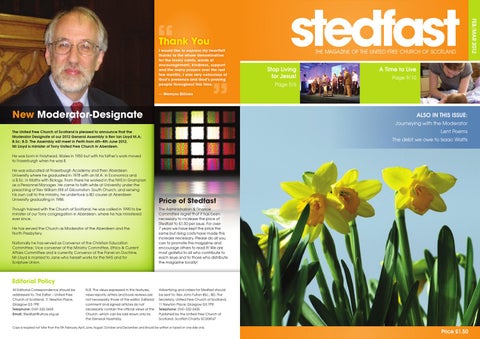
New Moderator-Designate
ALSO IN THIS ISSUE: Journeying with the Moderator Lent Poems
The United Free Church of Scotland is pleased to announce that the Moderator Designate of our 2012 General Assembly is Rev Ian Lloyd M.A; B.Sc; B.D. The Assembly will meet in Perth from 6th–8th June 2012. Mr Lloyd is minister of Torry United Free Church in Aberdeen.
The debt we owe to Isaac Watts
He was born in Holyhead, Wales in 1955 but with his father’s work moved to Fraserburgh when he was 8. He was educated at Fraserburgh Academy and then Aberdeen University where he graduated in 1978 with an M.A. in Economics and a B.Sc. in Maths with Biology. From there he worked in the NHS in Grampian as a Personnel Manager. He came to faith while at University under the preaching of Rev William Still of Gilcomston: South Church, and sensing his own call to the ministry, he undertook a BD course at Aberdeen University graduating in 1988. Though trained with the Church of Scotland, he was called in 1990 to be minister of our Torry congregation in Aberdeen, where he has ministered ever since. He has served the Church as Moderator of the Aberdeen and the North Presbytery. Nationally he has served as Convenor of the Christian Education Committee; Vice convener of the Ministry Committee, Ethics & Current Affairs Committee and is currently Convenor of the Panel on Doctrine. Mr Lloyd is married to Jane who herself works for the NHS and for Scripture Union.
Price of Stedfast The Administration & Finance Committee regret that it has been necessary to increase the price of Stedfast to £1.50 per issue. For over 7 years we have kept the price the same but rising costs have made this increase necessary. Please do all you can to promote the magazine and encourage others to read it! We are most grateful to all who contribute to each issue and to those who distribute the magazine locally!
Editorial Policy All Editorial Correspondence should be addressed to: The Editor – United Free Church of Scotland, 11 Newton Place, Glasgow G3 7PR Telephone: 0141-332-3435 Email: Stedfast@ufcos.org.uk
1
N.B. The views expressed in the features, news reports, letters and book reviews are not necessarily those of the editor. Editorial comment and signed articles do not necessarily contain the official views of the Church, which can be laid down only by the General Assembly.
Advertising and orders for Stedfast should be sent to: Rev John Fulton BSc., BD, The Secretary, United Free Church of Scotland, 11 Newton Place, Glasgow G3 7PR Telephone: 0141-332-3435 Published by the United Free Church of Scotland. Scottish Charity SC008167
Copy is required not later than the 5th February, April, June, August, October and December, and should be written or typed on one side only.
2
Price £1.50
Contents 2 Shetland Youth Conference 3 Journeying with the Moderator 4 Lent Poems 1 & 2 4 Book Review 5/6 Stop Living for Jesus! 7/8 The debt we owe to Isaac Watts 9/10 A Time to Live 11 Lent Poems 3 & 4 11/12 Certified in Mangalsen 13/14 Visit to Botswana 15 Read the Bible in a Day 16 Tributes: Peter Divine & Robert Clark 17 Christmas at Balintore 18 Tell it Again 19 New Moderator Designate 19 Thank You
3
2
Jesus the Truth and the Way
7/8
15
13/14
18
Editorial This year Lent begins on Ash Wednesday 22nd of February. It is a Christian tradition to reflect at this time on the temptation of Christ in the wilderness (Luke 4:1-15) when He fasted and prayed in preparation for the ministry that lay ahead. On pages 4 and 11 of this edition, through the powerful medium of poetry, Rev Archie Ford invites us to pause from life’s distractions and share his meditations on God’s call upon our life. One man who overcame opposition in response to God’s call on his life was Isaac Watts. Andrew Scott reveals how Watts took on the prejudices current in his time and helped to transform the worship of the protestant dissenting churches. This article is by way of introduction to the whole subject of the hymns we know and love. Stedfast will shortly be inviting readers, through their congregations, to tell us about their favourite hymns and what they mean to them. As well as an interesting update from our own moderator, George McRobb, there is a challenging article from Alan Donaldson, General Director of the Baptist Union of Scotland, who invites us to stop living for Jesus. You can find out on Page 6 on how the Baptist Union of Scotland are facing up to the fresh challenge of what it means to live, under Christ’s Rule. Alastair Wright Stedfast Secretary 1
Shetland Youth Conference When we were asked to write a report on the Youth Weekend at Sumburgh, we weren’t sure how we would be able to condense such a full weekend into just a few words. There were seven young people who came up from the mainland along with a range of people from Shetland taking our number to about 30 over the four days. Each day had the same format which began and ended with quiet times whereby the lads and lasses were split and someone from each group shared a thought before having a time of prayer. This focussed everyone on God for the day ahead and at night gave us a chance to reflect and thank Him for all He had given us that day. The lads studied 1st and 2nd Thessalonians and the lasses looked at various passages from the bible. We had teaching sessions morning and evening which were followed by discussion times. This allowed us to get right into the heart of God’s word and an opportunity to talk through the different ideas covered during the sessions. This left each afternoon free to explore Shetland. We were blessed with lovely weather and were able to explore St Ninian’s Isle, Sumburgh Head and Scousburgh Hill on the Saturday. Sunday gave folk the chance to rest before travelling up to Cunningsburgh to have our Sunday evening meeting
at the church. This was a blessed time of fellowship and ministry with Nathan Owens speaking on Jesus the Good Shepherd. It was really good to be able to spend time with the congregation as they are very supportive of the younger folk and gave the weekend a lot of encouragement and support. On the Monday we all went to Lerwick; some went to the leisure centre and some went for coffee and a wander through the metropolis of the town centre.
This really hit home for a lot of people. The assurance that we have a God who can give us everything we need but much more in that, He is everything that we need. Jesus doesn’t just do what he says but is what he says, in that Jesus doesn’t just show us the truth and the way, but is the Truth and the Way. Also that we should never doubt His provision for us and that he will help us through all trials. One camper said that she had been challenged to ‘get her act together’ which in turn was a challenge to everyone else.
The theme of the weekend was ‘The Names of Jesus’ and focused on the names found in John’s gospel. The weekend consisted of 7 main teaching session that were taken by a variety of speakers, young and old. The names we covered over the weekend were ‘The Word of God’ (Martin Whitehead), ‘The Resurrection and the Life’ (Alasdair MacPherson), ‘The Lamb of God’ (Martin Paterson), ‘The Good Shepherd’ (Nathan Owens), ‘The Bread of Life’ (Andrew Adamson), ‘The Gate’ (Bruce Rosseter) and ‘The Way, the Truth the Life’ (Gordon MacKenzie). Although everyone was speaking on different topics within a theme, God’s sovereignty was evident in how seamlessly each session flowed into the next. During the session on the Bread of Life it was pointed out to us that Jesus is what He gives us. For example, He gives us love but is love or gives us peace but is peace.
On reflection of the weekend, we could never have imagined how well the whole thing went. Everyone who was there went away refreshed, encouraged but most of all challenged to live for Him. Personally we were overwhelmed by God’s sovereignty and provision for the weekend, both financially and spiritually. We would like to thank those who gave up time to be in the kitchen and everyone who provided financially and supported the weekend in prayer. Definitely worth doing again!
2
Journeying with the Moderator
Lent Poem
By George H. McRobb
By Rev Archie Ford
For example Action of Churches Together in Scotland (ACTS) arrange for meetings of the leaders of the nine member Churches once or twice a year. I found these meetings particularly interesting where the subjects of “The Ascension” and “Leadership” were discussed. It was good to take part in these meetings and to share many things which we have in common with others. It is good to be able to meet with other Moderators etc in a relatively informal way.
This was a joyous occasion where I was joined by Rev Robert and Mrs Jane Owens. King James just happened to be there also: My verses for the Peoples Bible were Genesis 1 verses 9 and 10 and I have a certificate to prove it. This Bible was presented to Her Majesty the Queen in Westminster Abbey last November. The Botswana experience was a very memorable trip, details of which appeared in this and also the previous issue of Stedfast. Although there was sadness at the passing of Mary Merriweather, it was a privilege to represent the United Free Church at the funeral services. I am indebted to Rev Andrew McMillan who deputised for me at the visit to Edinburgh of the President of the World Communion of Reformed Churches and to the Rev Martin Keane who attended the Assembly of the Baptist Union of Scotland on my behalf.
3
The 400th. Anniversary of the King James Version of the Bible was marked at Edinburgh Castle with the launch of the People’s Bible. (Hundreds of people gathered at Edinburgh Castle in June 2011 for the launch. Between June and November thousands of people across England, Scotland and Wales responded to a call to ‘Make your mark in history’ and handwrite verses of the Bible, using a digital pen, to mark the 400th anniversary of the King James Bible.)
I have had the pleasure of visiting in the homes of Mr John Gray, Mrs Ann Alexander and Rev & Mrs J. G. McPhee during my travels. I have enjoyed my lengthy ‘phone conversations with Mrs Wemyss Billows and trust that she is now enjoying reasonable health after her surgery. It was good to meet up with her and her daughter Heather on the last day of 2011. I hope to visit Mrs Joy Petrie in the near future.
1 2
Lent returns And sterling hearts Determined, disciplined and stout Confront the 40 days With want Of chocolate, cheese or chips. Some exercise and don a kit That favourably re-shapes hips Or in a spiritual vein More Bible words or longer prayers May emanate from gladdened lips
Possibly most folks think that the Moderator only visits our various Congregations on a Sunday and that’s it. Well I can assure you this is not the case. Since becoming Moderator last June I have travelled around 2,600 miles by car involving not only Sunday visits to various Congregations but also attending a number of other church and inter church meetings.
My visits to five of the General Assembly Committees (so far!) were informative and I wonder if we really, as a Church, appreciate the hours of work in which the Committees are involved? It is my desire to visit the remaining two Committees before my Moderatorial year ends. To date I have visited ten of our Congregations and it has been a great joy to me that in spite of lower numbers and vacancies there is a good spirit in these Fellowships. I still have other Congregations to visit by the end of May and I look forward to giving details of these at the General Assembly. I have tried to encourage all of the Congregations in their endeavours for the Master and have reminded them and myself of 1 Thessalonians 5: 24. “The one who calls you is faithful and he will do it”. My thanks to Gary and Elspeth of the Murrayfield Manse in Bannockburn which has become my second home... the General Secretary informs me that unlike Members of Parliament it is not claimable! Special thanks also to Kevin who gives up his bedroom for the Moderator! I trust that you have enjoyed your travels with me and look forward to more in coming days.
Lent returns To a world where I alone am queen or king and what I want is key Yet thoughts are drawn to Jesus in a dry and desolate place famished, starving his mind and body yearning sustenance The tempters voice Imploring him to ease the pangs of personal need, Turn stones to bread Go home to carpenters bench Good living and An easier life. But firm he stood Tried, tested, Shaped ready for His Father’s work... TBC...
Book Review Prayer – Does it make any difference? By Philip Yancey. Reviewed by Ian Shering. Published by Hodder & Stoughton (2006) ISBN-10: 0340909080: £7:99 (Kindle £4.99).
There have been many books on prayer and no doubt there will be many more as it is such an important aspect of the Christian life. I’ve read quite a few and I have often been left feeling guilty and vowing to intensify my prayer but never really getting round to it. Others have left me a bit puzzled because what I have read does not seem to square up with my experiences. Often I’ve been left frustrated which of course leads to guilt! This book by Philip Yancey is different. He takes an honest and realistic look at the problems surrounding prayer that most of us have experienced and chews them over thoroughly. At all times he emphasizes the essential nature of prayer while looking at the problems we are often too embarrassed or afraid to admit, or ask the minister about! Questions such as: Why pray? Does prayer matter? What difference does it make? Does prayer change God? Written prayer v. spoken prayers, how do we pray? Why is prayer so hard at times? How to be persistence in prayer? What about praying for physical healing and miracles? Philip Yancey discusses each topic sensibly in the context of scripture, and what I particularly like, doesn’t give trite answers! He admits the problem areas and that there are often no simple answers. However this in no way devalues prayer, quite the reverse. I was blessed by the chapter entitled, “Prayer and God: What does it mean to God to have us pray?” Something I had never thought about. He says:
No message comes through more forcibly in the Bible than that the human species matters profoundly to God. God created the world with humanity in mind, set us in its centre, continued to love us despite our failings and even sent his son on a rescue mission. And our response to all these gifts has an actual and deep effect on this God! Wow! Prayer matters to God! The chapter; “Unanswered prayer – living with a mystery” is, strangely enough, also an encouraging one. (He does avoid the usual response that all are answered only the answer is no! – I don’t like that one either.) He quotes unanswered prayers from scripture, Paul, Moses, David, even Jesus himself. Yancey asks the question: if that prayer had been answered in the way it was asked, what would have been the consequence? God’s answer to prayers is: “In My way and In My time”, which is always the best way and the best time! One last quote regarding a challenging example of what to pray for is from members of the persecuted Chinese church: “Don’t pray for us to be released from prison, please pray for the courage and strength so that I can witness boldly in the prison and not lose faith.” Makes one think! This is a book which should be read.
4
Stop Living for Jesus! By Alan Donaldson – General Director of the Baptist Union of Scotland
“The Iron Lady” starring Meryl Streep has brought back to our radios, television and newspapers the question asked by political commentators: what was Margaret Thatcher’s legacy? Many have pointed to the rampant individualism that arose at that time and has continued to this day. I’m not sure that Margaret Thatcher alone can take the blame for such a seismic shift in Britain but it is one of the challenges that face the church today. Materialism, the disintegration of the extended family, the breakdown of many marriages and possibly the growing sense of nationalism are all signs of a society that has been and continues to respond to “me” being the centre.
Today religion in Scotland is blamed in some quarters for sectarianism, terrorism, child abuse and inequality. In a post modern culture the church is often rejected along with a whole host of other institutions. Some of our churches have decided that they will simply sit it out. They have barricaded themselves away from engagement with others and are waiting “faithfully” for things to change. They continue to do what they have always done, refusing to engage this changing culture, but there is an alternative radically faithful response. There is a story told of two shoe salesmen who went to Africa in the early 20th century. One wrote back, “situation hopeless they don’t wear shoes.” The other wrote back, “great opportunity, they don’t wear shoes yet.”
The challenge as I see it and the contrast between the two calls to follow, I want to describe this way: stop living for Jesus and start living like him
5
Alongside these changes we have experienced large changes in the church in Scotland. Some have described it as the fall of Christendom, a place where you can no longer take for granted a Christian heritage or Christian default position. This is easily illustrated in Scotland by the Scottish government’s consultation on same sex marriage which if implemented would remove the Christian default view of marriage.
Within the Baptist Union of Scotland we are trying to change our perspective of the current situation to say, never in Scotland’s history have there been so many people to share the wonder of Christ with. As Christians when we consider what God has done and can do, surely we can’t just sit week by week in our seats rolling with the ebb and flow, smiling at friends, worshipping with favourite
songs and listening to great preaching. After all, Jesus called us to follow him. His lifestyle is to be our example. To go, to love, to share, to give, to pray, to heal, to forgive, to teach, to restore, to build, to grow, to feed, to clothe, to visit, to follow him. That is the calling that we must engage with right now in Scotland. As I read Scripture there are essentially two callings to follow Jesus on the lives of the first disciples and both begin by the sea of Galilee. Fishing nets in hand, sand between the toes and those words to Peter, “follow me.” The disciples followed in apparent ignorance of who they were following the first time. Captivated by this charismatic leader they accepted the call to live for Jesus (Matthew 4): to be his disciples to go on mission with him, fishing for men, to learn from him. They had served him, collecting food in Samaria, arranging upper rooms in Jerusalem, they lived with and for Jesus for three years. The second time (John 21), the call to follow is quite different, now they are invited to follow Jesus knowing who they are following and what the calling is: “To deny yourself, take up your cross and follow me.” The challenge as I see it and the contrast between the two calls to follow, I want to describe this way: stop living for Jesus and start living like him. That is the fresh challenge we are looking at right now in the Baptist Union of Scotland, as we centre around the phrase living “Under Christ’s Rule.”
I want to look at this phrase a little deeper, breaking it down into four areas:
1 Reliance upon Christ Living under Christ’s rule simply means relying on him. In John 21 when the disciples relied on Jesus and cast their nets on the other side, he brought fruitfulness. 1 Thessalonians 5v24 reminds us; “The one who calls you is faithful and he will do it.” Now there is a challenge here for those of us who have travelled this Christian journey for many years. The truth is that we can easily become self reliant, reliant on the gifts, abilities, patterns and traditions we have developed. We can also become comfortable and accepting of the lack of fruitfulness that we see. We no longer expect the church to grow, lives to be transformed and communities to be radically changed. Living under Christ’s rule means learning to rely on him again: taking him at his word, living out his word, prioritising his word over our tradition, prioritising his word over perception, prioritising his word over our budgets.
2 Recovery from sin Living under Christ’s rule also means recovery from sin. Jesus aids that recovery from sin in John 21, he does not want Peter to be held back by his triple denial. So Jesus restores him through three more questions that allow him to affirm his love for Jesus. It’s a restorative practise that allows Peter to know that he is forgiven as well as set free from guilt and shame. Let’s state the obvious, we all sin. We sin financially, sexually, we abuse power, we suffer arrogance, pride and jealousy. We can gossip, criticise and a host of other stuff. We all need to experience forgiveness, we need acceptance and love, reassurance and restorative relationships. Christ wants us to be free of those sins, not chained by them. So Christ gives Peter his ministry back through this act of recovery. Someone described it like this. “It’s the wonder of being trusted again by God in the place where I disgraced him.”
Missionally there are huge numbers of people who need help to recover from sin, not only to be confronted with it. Living under Christ’s rule means discovering afresh how Christ dealt with sin and sinners and bringing this into our understanding of the gospel.
3 Responsibility for others In following Jesus, Peter is to care for the sheep. He is given responsibility to look out for others. The New Testament is full of ‘one another’ sayings, the most common of which is “love one another.” Here is an opportunity for the church to demonstrate a value that has been lost by our current wider society. As materialism, individualism and an independent spirit grows, the opportunity exists for the church to demonstrate another way: a way of putting others first, of drawing people together, of welcoming the stranger into the community and learning to share all that we have. We must be relational in our mission. For too long, churches have tried to do presence without engagement. They have a Sunday morning presence in a geographical place but there is little engagement with the community. Our doors are open, the notice board says that we are here but we fail to create space and time for true community.
4 Real Cost Finally as I break down this phrase, living under Christ’s rule, I want to point out the fact that this is costly. The conversation in John 21v18 suggests an invitation to surrender your life, or at least control of your destiny. There is a challenge for Christians to follow the dreams that Christ has for us, to surrender our individual and community dreams to live like Christ rather than simply for him. So I find myself at the beginning of 2012 asking the question; Does the church need to stop living for Christ to start living like him? And in asking the question of the church I must also ask it of myself.
6
The debt we owe to Isaac Watts By Andrew Scott
Stedfast will be inviting readers to tell us about their favourite hymns and what they mean to them. Congregations will receive details soon. By way of introduction to the whole subject of the hymns we know and love here is a look back at the man who could be called the father of the Christian hymn. The United Free Church prides itself on its hymn singing tradition. Where does that tradition come from? It doesn’t come from the Reformation because the Westminster Confession of Faith only speaks of psalms: “it is the duty of the Christian to praise God by singing of psalms” says the Westminster Directory of Worship (1647). Hymn singing came later. If you were to ask who or what changed the churches of the Reformation from psalm singers to hymn singers who also sang psalms the answer would be that the person most responsible was Isaac Watts. Isaac Watts was born in Southampton in 1674. He came from a family of protestant dissenters who were excluded from the universities and professional life. However change was in the air. In 1688 King James was forced to issue a Declaration of Indulgence which gave new privileges to the dissenters, in particular the right to worship freely. It allowed the church the Watts family attended to acquire its own meeting house in an area of Southampton beyond the Bargate. Isaac’s father was appointed a deacon in the summer of 1688. A few months later William of Orange landed on the south coast not far from Southampton. From then the days of the rule and influence of King James were numbered.
7
The chorus we sing with that hymn today “We’re marching to Zion, beautiful, beautiful Zion” was added later and was not part of Watts’ original composition.
The story goes that young Isaac used to complain to his father about the poor quality of the praise in the church. Mr Watts senior retorted: “Well then, Isaac, produce something better. And Isaac did.
For example Psalm 72:
He was prolific. He produced an outpouring of psalms and hymns. There was the Psalms of David; there was a book of hymns “collected from the Holy Scriptures” (what today we would call paraphrases); there was a book of hymns called “Hymns composed on divine subjects” (what today we would just call hymns); and there was a book called “Hymns prepared for the holy ordinance of the Lord’s Supper”.
Psalm 90:
In the late 17th century there was a prejudice against the singing of hymns. They were regarded as Popish and unscriptural. That prejudice died hard. It is true that most of the hymns of the period were meagre and poor. Isaac Watts changed all that.
From the hymns section come more “standards” that we sing today:
In 1707 his whole collection was gathered together and published under the grand title “The Psalms of David imitated in New Testament language together with hymns and spiritual songs.” From the Psalm section we have many of today’s “standards” although they appear as hymns in modern hymnbooks rather than psalms.
Jesus shall reign where’er the sun Does His successive journeys run His kingdom stretch from shore to shore Till moons shall wax and wane no more. Our God our help in ages past Our hope for years to come; Our shelter from the stormy blast And our eternal home. And the ever popular Psalm 92:
Sweet is the work my God my king To praise thy name give thanks and sing; To show thy love by morning light And talk of all thy truth at night.
Come let us join our cheerful songs With angels round the throne Ten thousand thousand are their tongues But all their joys are one. Or
I’m not ashamed to own my Lord Or to defend his cause Maintain the honour of his word The glory of His cross. Or
Come we that love the Lord And let our joys be known Join in a song with sweet accord And thus surround the throne.
It is one of his hymns from the section “Hymns prepared for the ordinance of the Lord’s Supper” that probably ensures that the name of Isaac Watts will live on for many a year. The hymn of course is the one that Matthew Arnold described as the “finest hymn in the English language”:
“When I survey the wondrous cross.” The inspiration for the hymn came from Galatians chapter 6 verse 14:
“But God forbid that I should glory save in the cross of our Lord Jesus Christ by whom the world is crucified unto me and I unto the world” as Isaac Watts would have known it in the King James Version. The hymn we sing today has four stanzas, but Watts wrote it with five stanzas. This fifth stanza has long disappeared from our hymnbooks, but the 1707 edition places it as the penultimate verse:
“His dying crimson like a robe Spreads o’er his body on the tree; Then I am dead to all the globe, And all the globe is dead to me.” This stanza beautifully brings out the impact of the second half of Galatians chapter 6 verse 14. Isaac Watts took on the prejudices current in his time and helped to transform the worship of the protestant dissenting churches. He was the Graeme Kendrick or the Timothy Dudley-Smith, or the Keith Getty of his day. But he was more because he was a pioneer. Physically he was small and unprepossessing in appearance, but spiritually he was a giant, a man of strong faith whose epitaph could be lines from his rendering of Psalm 23:
“The Lord my shepherd is I shall be well supplied Since He is mine and I am His What can I want beside?”
8
A Time to Live by Alice C. Cartledge
A Time to live, and a time to die: an aid to orientation of the CPCE Council on death-hastening decisions and caring for the dying. More and more these days we hear cries for ‘death with dignity’ and ‘the right to die’. To our discredit many of us feel unable to debate the issue convincingly for we are unsure of an appropriate Biblical response to the complex issues involved. At a recent meeting of the Church and Nation Committee my husband volunteered me to review this book and I confess I had mixed feelings about it. I did however, find it immensely interesting, challenging and helpful. I believe it should be required reading for every minister, pastor and elder not because it provides any pat answers but because it provides a wealth of understanding of the real issues involved in the secular world’s cry for ‘dignified death’. I also believe that lay members will find it very helpful.
9
This publication comes from the Community of Protestant Churches in Europe and is a considered contribution to the ongoing debate about “the question of deciding for oneself on the end of life”. Recognising that each denomination / church had produced its own contribution to this debate but that
“Mutually exclusive protestant positions on this question would not be a satisfactory contribution to the social debate” the Council set up a specialist panel in 2008 to consider all the angles in this very difficult area of discussion and decision. It is not presented as a conclusion to the debate or a solution to the difficulties, but as an aid and encouragement to the churches as they continue to address the problems posed by ever more medical advances and attempts at legislation in European countries about end of life decisions. This is a very thorough study of all aspects of this difficult area. The issues of withholding / withdrawing lifeprolonging treatment, palliative care, euthanasia, and assisted suicide are all dealt with in some depth. The ethics and morals of deciding on appropriate actions are examined from the points of view of the patient, family and friends, involved medical staff and involved pastoral carers. Basic to all the discussion is a clear affirmation that all human life is created in the image of God and that human life’s unabridged and absolute dignity is grounded in God’s loving acts of creation and
justification. This fundamental dignity does not rest in its functionality, utility or independence. Nor does serious illness or disorder (even for a whole life time), or complete dependence on the care and assistance of others “conflict with or detract from human life’s basic dignity.”
The wishes of the patient are seen as paramount – both the right to expect treatment and the right to deny it. The issue of ‘living wills’ or ‘advance directives’ is fully examined and guidance given on the real weight to be attached to such documents. This report does not only advocate a Christian approach to the terminally ill, it calls the church to be active in a civil society, protesting “when legal barriers which protect life are torn down” and helping create “an environment in society which fosters a fulfilled life for every member of society including those near to death.”
Attention is focused on the responsibility of all Christians to care for others particularly near the end of a life span, particularly the pastor’s duty to help the dying to prepare for death – indeed accompanying the terminally ill should be “a central dimension of their ministry.”
As the euthanasia lobby continues to agitate, it will be essential for all Christians to have a firm grasp on what ‘human dignity’ is really about and what an appropriate Christian attitude should be towards the dying. This book will go a long way to providing that information.
Further information about this publication is available at www.atimetolive.eu or from Church Office.
10
Certified in Mangalsen! Lent Poem (cont.) By Rev Archie Ford
3
Lent returns Midst struggles to survive, achieve, or win and calls to use whatever means to meet our ends. On mountain top the devil offers Jesus all the fame and glory he could want Just bend the knee And will, to darker arts And sleight of word and deed Or backhand ways. In light of day So crystal clear with truth and good did Jesus set his way and life on God alone.
4
11
Lent returns To busy lives Where needs are met When we request Doctor, trade or friend should answer now at beck or call. Hence there upon the Temple peak The devil calls to Jesus Trust in God throw yourself On Him, who rules all things Jump, test , if he is there for you? Instead he journeys In obedience to the Cross and on to empty tomb where life is found abundantly when God bids us.
By Adrian Rootes
On Saturday 3rd December I was listening to a sermon being preached on 1 Kings 17 (the widow of Zarephath). The preacher was making the point that what the Lord gives you is enough for you; the jar of flour will not be used up and the jug of oil will not run dry. I was in Ramghat church in Pokhara, Nepal and I could concur with the preacher. It was 12 years since I had lived in Nepal, working with the International Nepal Fellowship (INF) but my language jar (which had never overflown with natural ability!) had not run dry and I had been able to carry out some translation work as part of an INF medical camp.
The camp was no holiday camp – we saw 1,367 patients and 141 of them had surgery (132 being major operations). My job was to work with three audiologists and an audiometrician who were all from Switzerland. In particular I was to explain to the Nepali patients what would happen when they had their audio test and also work with patients who were being fitted with hearing aids. We carried out 550 hearing tests and fitted 163 patients with hearing aids (patients ranging from 4 years old to 77). Mangalsen is at the end of a road – many of the patients had walked for hours or more than a day to
The camp in question was an ear camp run in the small town of Mangalsen in the far west region of Nepal. Mangalsen doesn’t feature in the Lonely Planet guidebook to Nepal and neither do many of the places that the camps programme of INF visits. The concept of the programme is to take the love of Christ to remote and poor communities which have limited access to medical facilities. Since 1993 there have been more than a 100 camps; treating tens of thousands of outpatients and performing thousands of operations. An average camp lasts about 8 days and the team is made up of about a dozen Nepali staff and about the same number of volunteers (mainly foreign but some are Nepali). The camps are organised with support of the Nepalese health service who provide the premises and help with the advertising. Ellen Findlay, a nurse from Wishaw, has been at the heart of the programme. Although Ellen has officially retired from INF she still puts in a tremendous amount of work and regularly goes to Nepal to work in the camps.
get there. Most of them could not have afforded the cost of the hearing aid or the operation that they received. Deaf twins came and were fitted with hearing aids and could hear. The twins were excited to hear sounds and the mother could hardly believe what was happening. Please pray that they will now be able to learn to speak.
I set off from my flat in Glasgow at lunchtime on Friday 18th November and arrived in Mangalsen (four flights and a road trip later) on Monday evening – the final part of the journey was a 14 hour landrover journey. I had a theory that it would be better to travel on scary roads at night when you couldn’t see very much. However having sat in the front seat as we went round innumerable hairpin bends on high mountain rounds I think I’d have been happier if the driver would have more warning of what was coming next!. The drive was so taxing that on the way back it was done as a day and a half drive with an overnight stop. Mangalsen is built on a hillside and therefore so was my “hotel”. You needed a head for heights just to get to my room – a walk along a narrow ledge overlooking some roof tops – and to go the toilet/washing facilities – two steep flights of ladders down through a hole in my “verandah”. Unfortunately I’ve not got a good head for heights!! The restaurant staff were cheerful and welcoming but hygiene wasn’t high on the agenda – even Ellen succumbed to the dreaded Big D. I escaped that but instead had one uncomfortable night with a stomach swollen to the extent that I thought I was going to give birth!
At the end of the camp the local government officials put together a little ceremony and thanked the team for their work – it was a really nice touch. We all got a certificate and a gift (a Nepali hat for the men and a shawl for the ladies). So I now have a certificate stating that I conducted myself “in a very professional manner at all times” – not sure if I have done that before in the NHS! The foreign members of the team then headed off to Kathmandu and home. Ellen may be almost 70 but she stayed on to await the arrival of a second team of foreigners who would together with the Nepali INF staff would run another camp in Mangalsen (general surgery).
Please pray for the work of the camps programme – for financial support (to pay for the Nepali staff and the medical supplies /equipment) and for foreign volunteers with the necessary skills. Praise God for the lives that are touched in camps – patients, relatives and non Christian Nepali staff and volunteers. One Nepali surgeon was so impressed (“I’ve never worked with such an experienced surgeon as M and he is so humble. Tell me what motivates him?”) that he asked for a New Testament. There those who are interested in the Gospel but making a stand in their society is a big step. One staff member acknowledges that he believes in his head but not in his heart: “Society would disown me. I have to think of my family and my parents”. Please pray that they would have the courage to surrender all to Jesus.
12
My Visit to By Mary Macintyre
As I grew up the word ‘Molepolole’ was synonymous with The Scottish Livingstone Hospital, the Missionaries working there and the Church. Later it was the Flying Mission (FM). I therefore decided that I would visit Botswana after attending the Assembly in Mozambique.
Saralee and Kerileng from FM welcomed me at the airport and took me to the home of Tina, also FM staff, who kindly gave me hospitality for the first night before I went to a Game Park for two nights. On return Joy and Willie Crosbie welcomed me to their home. They took me to Molepolole Church on the Sunday where I experienced a very interesting and varied service, all in Setswana! I was asked to speak and gave greetings from our churches etc. We had our lunch on the patio of Mary Merriweather’s empty home, looking out at her beautiful bougainvillea and garden. It was sad to think of her recent death but wonderful to hear about and see some of the school she had founded and the amazing progress it has made from five to five hundred pupils. She will be greatly missed by many people. Joy showed me around the remains of the old hospital nearby and, although sad to see its’ state of disrepair it was good to be shown around by Joy with her knowledge of it and hear some stories. The present church minister has ideas about using some of the buildings for either a hospice or for elderly daycare. The modern government hospital stands where some of the Mission Hospital personnel had their homes. Joy took me to visit the Merriweather Memorial Church built in memory of her father in Gabane also to see the David Livingston Memorial at Kolobeng and other places of interest.
Visit to the Flying Mission Saralee Molodi the office manager of the Care Ministries introduced me to the staff in the office that morning and I was invited to join them for their devotional and prayer time. FM are thankful that after a year of waiting they have once again been granted the tender to do the medical mercy flights for Botswana’s Ministry of Health. The Care Ministries continue to be involved with teaching Better Choices and Life Skills, helping to facilitate the care of orphaned and vulnerable children (e.g. Rerotlhe) and working with those in need such as those with HIV/AIDS. A big challenge these days is dealing with Multiple Concurrent Partnerships where a girl may have 2–4 boyfriends providing money for income and they in turn often have 2 or more girlfriends and so the network grows causing many problems. The Care Workers thankfully still have the freedom to share about the love of Jesus.
Update on Rerotlhe Knitting Project The response to this has been amazing! Thank you all so much. One hundred and forty jumpers / cardigans were sent and I heard that most had arrived and they were very delighted with them. We are currently looking for a cheaper way to send the remaining items. Some knitters have asked if we will require more for next Christmas! I will let people know. The programme also needs suitable educational books / toys / games for this age group but we would need to find a way to send them. I will keep you posted!
At Christmas FM still distribute 400–600 Bibles to patients and staff at the hospital and although there was not one bible at the time of my visit, a donation since enabled them to get the bibles required – a real answer to prayer. They would appreciate our prayers for the future as they have gone through a rough patch and face many challenges but continue to be a witness for Him in Botswana.
13
Footnote: For this those who are curious about the Rerotlhe Project and are wondering what it is about, it is intended to have a fuller article in the next edition of Stedfast.
14
Reading the Bible in a Day. by Steve Marr
Saturday, October 29th 2011, saw Chryston UF Church host a unique event. Starting at 10am, a group of people gathered to do something that none had attempted before... The whole of the Bible was going to be read in one day!
The event allowed the Church to come to the public’s attention – the local newspaper ran an article on the event – and it gave us an opportunity to engage with our community. For a number of members of the Church it re-ignited a passion for God’s Word and brought us closer to one another as we consider what God is saying to us in the pages of Scripture.
So what is the long-term effect of this event? Who knows! It was certainly wonderful to take part in and something that we would heartily recommend to all Churches who care about making the Word of God central to their lives. It’s relatively easy to organise and carry out. So why not give it a go? It’s no big secret! It’s been done and all the information you need to do it in YOUR Church is available. Why not set a date to try it and see how God blesses the Church as you do?
15
Now this seems a HUGE undertaking. How could it be done? There are almost 1200 chapters in the Bible and if each could be read in only 3 minutes, it would still take days to read it straight through. But that’s where the many members and volunteers came into action. Instead of just reading the Bible straight through, each chapter reference was written on a slip of paper and the people took one away and read it before returning again and again to read more. With each person reading at the same time, it cut the time down and instead of taking about 60 hours, the Bible reading was completed in 6 hours, 1½ minutes!
Some people stayed for the whole time, others came and went as their schedules permitted. Some read one or two chapters, others read entire epistles. Refreshments were available for all to stop as required and the whole event continued without a hitch!
So why did the Church do this and what benefits have we seen? With the 400th anniversary of the King James version of the Bible, the Church thought this a good way to publicise and celebrate it.
Tributes Mr Peter Devine Elder: Leith Ebenezer 24th October 1923 to 21st December 2011 Peter Devine was born in 1923 in Newhaven, one of seven of a close family. On leaving school he worked in Harkness-Bowman pharmaceutical manufacturer. Then he moved to Bruce Peebles & Co. Ltd. the Edinburgh industrial electrical engineering company. He was called up to serve in the army during the war. He was wounded in action in Coln, France in 1944 and his heath was never good throughout the rest of his life. He moved to employment in the United Wire Works, where he continued until in 1982 he retired early. He and May were married in 1953 and lived in the same house all there married life. May’s parents were members of Ebenezer so Peter and May started attending and both became very active members. Peter was ordained as an Elder. He was a conscientious worker a good visitor and active participator in the life and worship of the congregation. He was one of the team of helpers when the General Assembly was held in Ebenezer. Throughout his long life he had a constant battle with serious and debilitating illness; but with courage and determination, he overcame these periods of illness, fighting back to a reasonable measure of strength.
Mr Robert Clark Elder: Greenock St Andrew Square Robert Clark was born in Greenock in 1930 and was brought up in a loving family home as an only child. After leaving school he embarked on an apprenticeship as a Marine Engineer. He travelled the world and was often away for periods of up to 18 months. He became a Chief Engineer. Later he went on to work on the supply vessels in the North Sea and then on the tugs and dredgers on the Clyde until his retired in 1994. Robert and Cathie were married in 1955 and they had four children. Although away for long periods of time while at sea, his family remained to most important thing to him. He was also a much loved Granddad to his eight grandchildren and thoroughly enjoyed the times he spent with them. He was a faithful member of St Andrew Square United Free Church and was ordained an Elder in 1979. In April 1996 he took on the role of Treasurer and latterly was a Presbytery Elder and Assessor Elder in the church at Largs. In many ways, Robert in his retirement was busier than ever before with his continuing interest in ships and his membership of the Probus Club. He was always keen to learn and recently discovered the new world of Google and e-mail.
We want to give thanks to God for the long and eventful life of Peter Devine. Our thoughts and prayers are with his wife May and the church family and his many close friends.
16
Christmas at Balintore UF
Tell it Again: Re-storying the Church for Mission Friday 23rd March at Uddingston Park Many who were at the Assembly greatly appreciated the contributions from Rev David Thompson who is Mission Development Officer with the Presbyterian Church in Ireland (PCI). He helped us think about how we can engage with our communities which is something we often struggle and introduced us to the ‘Tell It Again’ material. This is a Mission Toolkit which contains a mixture of biblical reflection, tools for understanding congregational and community life, opportunities for involvement in mission both locally and further afield, and a template on which to base your final mission plan. You can find out more about it on their website: www.missionireland.org/mission-plan.asp
17
Christmas celebrations got off to a good start on Tuesday December 13th when the Ladies Meeting had their Christmas night, an annual event when the local Churches’ Choir, set up in 2002 by Mrs Wemyss Billows with all four of the local churches represented in its ranks play a major part. Items included “While shepherds watched their flocks by night” to the tune Cranbrook (which is now associated with “On Ilkla Moor baht ‘at”), and “Have you heard” to the tune of Jingle Bells. In Wemyss’ absence the choir was very ably led by Geordie Oliver. The speaker was Annie Barclay now from Golspie but originally from Balintore; she found five first cousins in the congregation! After the meeting there was “Pass the Presents” and tea in the church hall which provided a lot of fun.
Sunday School parties took place on Saturday December 17th. and were their usual lively affairs. On Sunday December 18th the Rev David Cartledge led a Family Service in a comfortably full church. It was good to see so many visitors as well as family friends. The ever increasing Sunday School sang their songs and answered all the quiz questions so well. They also enjoyed tearing open the huge parcel and finding nothing inside! There was a special treat in store for us when we went along to the united churches’ carol concert in the Seaboard Hall on Sunday evening for Wemyss was wheeled in by grand daughter Caitlin! She conducted the choir from her wheelchair! She has
For those who are interested in using some of the materials in their congregations, the Christian Education and Evangelism Committee is arranging a further opportunity to meet with David Thompson. This will give time to think about how this toolkit can be worked out and applied in local congregations. The Committee would strongly encourage congregations to send 2 or 3 people along so that they can think things through together and be better able to share their thoughts when they return to their local congregation.
been making slow progress since her major surgery in November and it was a joy to see her determination to get back into action. On Christmas day the service was conducted by our good friend Greer Johnston from Lairg and a good number turned out to celebrate Jesus coming to us.
2011 has been an important year for us and we look forward to continuing to reach the local community with the gospel in 2012.
The event will take place on Friday 23rd March in Park Church, Uddingston from 10am–3.30pm Further information from Church Office. 18