February/March 2011
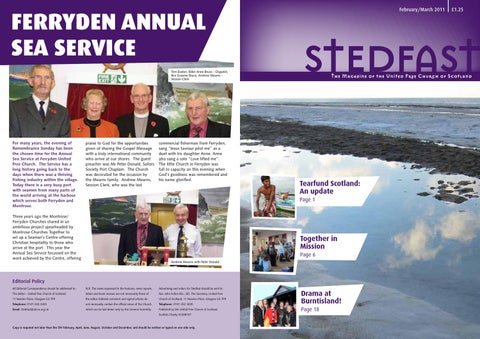
FERRYDEN ANNUAL SEA SERVICE Tom Easton, Elder Anne Bruce - Organist, Rev Graeme Bruce, Andrew Mearns Session Clerk
For many years, the evening of Remembrance Sunday has been the chosen time for the Annual Sea Service at Ferryden United Free Church. The Service has a long history going back to the days when there was a thriving Fishing industry within the village. Today there is a very busy port with seamen from many parts of the world arriving at the harbour which serves both Ferryden and Montrose.
praise to God for the opportunities given of sharing the Gospel Message with a truly international community who arrive at our shores. The guest preacher was Mr Peter Donald, Sailors Society Port Chaplain. The Church was decorated for the occasion by the Mearns family. Andrew Mearns, Session Clerk, who was the last
commercial fisherman from Ferryden, sang “Jesus Saviour pilot me” as a duet with his daughter Anne. Anne also sang a solo “Love lifted me”. The little Church in Ferryden was full to capacity on this evening when God’s goodness was remembered and his name glorified.
Tearfund Scotland: An update Page 1
Three years ago the Montrose/ Ferryden Churches shared in an ambitious project spearheaded by Montrose Churches Together to set up a Seaman’s Centre offering Christian hospitality to those who arrive at the port. This year the Annual Sea Service focussed on the work achieved by the Centre, offering
Together in Mission Page 6 Andrew Mearns with Peter Donald
Editorial Policy All Editorial Correspondence should be addressed to:
N.B. The views expressed in the features, news reports,
Advertising and orders for Stedfast should be sent to:
The Editor – United Free Church of Scotland,
letters and book reviews are not necessarily those of
Rev. John Fulton BSc., BD, The Secretary, United Free
11 Newton Place, Glasgow G3 7PR
the editor. Editorial comment and signed articles do
Church of Scotland, 11 Newton Place, Glasgow G3 7PR
Telephone: 0141-332-3435
not necessarily contain the official views of the Church,
Telephone: 0141-332-3435
Drama at Burntisland!
Email: Stedfast@ufcos.org.uk
which can be laid down only by the General Assembly.
Published by the United Free Church of Scotland.
Page 18
Scottish Charity SC008167
Copy is required not later than the 5th February, April, June, August, October and December, and should be written or typed on one side only.
£1.25
D N U F R TEA D N A L T O C S – AN UPDATE
In this Issue... 17
6
9 1
Tearfund Scotland - An Update
6
Together in Mission
11
George McRobb Appointed as Moderator Designate
2
World Day of Prayer 2011
8
Gracious Endings And Productive Beginnings
12
Meet the Team: Youth Visit 2011
4
A Church for the Future?
9
Happy Birthday to Willie!
14
Farewell to Rev and Mrs Ray Smart
5
The Rage Against God by Peter Hitchens
10
What Does Lent Mean To You?
16
KJB - The Book That Changed The World
Editorial So what is a ‘Minister’? I looked for some definitions in the church context and they tended to speak about it being a ‘profession’ and involving ‘duties’. It is easy to see ‘Ministry’ as having to do with status and position. The best definition I came across was ‘one who serves’. That has echoes of Jesus words in Luke 22.27 ‘I am among you as one who serves’. Ministry is really about serving in the name of the One who came to serve. It is good in this issue of Stedfast to pay tribute to two men who demonstrated such an attitude in their ministries over many years within the United Free Church of Scotland. Their lives demonstrated what they preached. It is also good to hear from those who are involved in ministry today about their varied experiences of serving God. Ministry, of course, in its broadest sense is something in which all Christians are called to be involved. It is good to hear of the preparations being made by the team of young people from Scotland as they look forward to joining with the young people from southern Africa in mission in different parts of Scotland. Every day we have opportunities to serve others in Jesus name through what we do and say and are. Are we humble enough to grasp those opportunities to serve others and to serve Him? John Fulton
Shenjing Hospital
We invited Tearfund Scotland to give us an update on the work they are involved in and their priorities for the next few years. The heartbeat of Tearfund Scotland is a passion for Jesus, a passion for prayer, and a passion for the poor. Our tenyear vision is to see 50 million people worlwide released from material and spiritual poverty through a worldwide network of 100,000 local churches. Scotland Tearfund director Lynne Paterson says, “Our role in the Scotland team is to partner with the Scottish Church to bring God’s kingdom to the poor and marginalized across the world. We want to care for the poor out of a passion for Jesus. We want to make connections with Scottish churches, calling them to pray and to give, to join in community with
churches overseas who are seeking to impact their communities for Jesus.” The outcome of such connections can already been seen in Lima, Peru, where Tearfund partner Agape is working to address the spiritual and material poverty that blights so many lives. As families fled terrorist attacks in rural Peru throughout the 1980s and early 2000s, vast shanty towns sprang up on the outskirts of Lima where many have no water, sanitation, schooling or electricity supply. Having left their original communities behind, families such as Maribel’s struggle without the support of relatives, and it is common for men to abandon their partners to look after their children alone. Here is where Agape steps in. The Greek word agape is used in the New Testament to refer to the divine,
unconditional, self-sacrificing love that God has for humanity. That is the kind of love that Tearfund – and the partners it works with – seek to reflect. Agape has developed a series of programmes to help struggling families cope with the extreme poverty they face in Lima. It aims to prevent domestic violence, to promote biblical values of love and forgiveness, and to empower people to generate their own income through learning skills and crafts and by developing small businesses. As hearts turn to Christ and lives are transformed, such new creation is the most incredible miracle there is – and that is why prayer is fundamental to everything Tearfund does. As Oswald Chambers said, “Prayer does not fit us for the greater work; prayer is the greater work.” The team in Scotland are well aware of the centrality of
1
prayer as we seek to build on the amazing work that has been done over the years by previous staff and volunteers. We want to see a movement of passionate churches throughout Scotland equipped to be Christ’s ambassadors to the people the world too often forgets – the very people God calls us to remember in Psalm 82:3: “Defend the weak and
the fatherless; uphold the cause of the poor and the oppressed”. Global Poverty Prayer Week, which runs from 27 February until 6 March 2011, will see a brilliant opportunity for individuals and churches to join with Tearfund in calling out to God for transformation and breakthrough as we seek to work together to alleviate spiritual and material poverty
throughout the world. Our vision is to raise a prayer movement which runs beyond the week itself – a Global Poverty Prayer Movement. Our free One Voice pack has helpful materials including a film to help inspire you as you pray. There’s a seven-day prayer guide covering the seven days of creation and four prayer pods each considering the life of someone living in poverty – putting the spotlight on global poverty issues. If you would like to order the One Voice pack please call the Scotland office on 0141 332 3621 or visit www.tearfund.org In 2011 there will also be a new opportunity for individuals to give regularly to Tearfund and to receive updates on how their money is making a difference in communities – including monthly video updates and prayer points. Lynne comments, “We want to see the good news being proclaimed to the poor by the church in Scotland. And like Cornelius in Acts 10, for the church’s prayers and gifts to the poor to be a fragrant offering that delights the heart of God.”
World Day of Prayer 2011 World Day of Prayer is an international movement, which unites Christians from all over the world in prayer on the first Friday in March each year. This year the service comes from Chile and is on the theme “How many loaves have you?”. We are called to reflect on the miracle of the feeding of the five thousand and to answer the questions: What are your gifts? What can you share?
2
You are invited to join in a local service and to continue to pray throughout the year. Visit www.wdpscotland.org.uk for more information.
Tribute:
Rev James Cassels MA 1st October 1917 - 28th November 2010
Born and brought up in Wishaw, the Cassels’ family were members of the United Free Church – Jim remembered the foundation stone being laid for the new church in Kirk Road. He attended the local primary school and Hamilton Academy then went to Glasgow University where he graduated MA with Honours. He completed his education with Theological training for the ministry attending the United Free Church College in Edinburgh. He was Student Pastor at Grangemouth for more than two years. He began his ministry and was ordained in Rothesay in 1942, the same year he got married to Pearl McQueen. Their first son Jim was born in 1943 and the family moved to Dunfermline in 1944. Tragedy struck when Pearl died in 1947 it was devastating blow for the young minister. He remained unstinting in his charge. In 1949, he resigned his charge at Dunfermline to become the General Secretary of the Scottish National Christian Endeavour Union, an appointment he accepted for two years. The thoroughness of his work in Christian Endeavour caused much enthusiasm through out the Movement in Scotland. He was elected President of the Scottish National Christian Endeavour Union. During a holiday at the Christian Endeavour Holiday centre at Ardeneden House, Tighnabruaich he met Evelyn Beattie who was from Portobello Baptist church and they got married in 1950. Jim returned to the ministry of the United Free Church and for several months he gave himself to
the cause at Hamilton before accepting a call to Moffat. The family was increased at this time with the birth of his second son David in 1952 and their third son Alan was born in 1955. He accepted the call to Leith: Ebenezer where he worked to consolidate and advance the witness of the United Free Church of Scotland and he served for 29 years. During this time he had a quite outstanding pastoral ministry, well respected and appreciated. He was a faithful follower of the Lord Jesus Christ, a faithful minister, an excellent leader and a mentor for all who new him. Redevelopment in the area made it necessary for the congregation to leave its building and move to temporary accommodation for some years. The new Church was built and opened in 1984. In General Assembly and Presbytery Committees Jim Cassels was constantly vigilant. He served on most Assembly Committees and for a time was Vice-convener of the Home Area Committee. In 1961 he was called to become the Convener of the Overseas Committee, and possibly in this capacity did his greatest work for the Church as a whole. His ability and sound judgment was needed for the many complex problems which were arising and he was not been found wanting. His visit to Molepolole in 1964 won for himself the personal
affection and complete confidence of all associated with our work in Bechuanaland (Botswana). He became Principal Clerk to the General Assembly, and Moderator in 1966 as his outstanding service was recognised He retired from Leith in 1984, although he was also called again to serve the denomination as Moderator of the General Assembly in 1989, another memorable year of travel and visitation. He and Evelyn continued as members of Leith Ebenezer Church and very much appreciated the continuing support they received from members and friends. He was essentially a very private person. Thorough and meticulous in all his work and exacting in his expectations, he was passionate, articulate, and formidable. His powerful presence at key moments in the history of the United Free Church helped steer the Church and formulate its voice on matters of the day. In practical terms he was always ready to help people in need and where he could show kindness and help, he would go the extra mile. A Christian gentleman, who was respected, appreciated and loved.
3
A Church for the Future?
We invited Rev John Humphreys, Moderator, The National Synod of Scotland of the United Reformed Church to share some thoughts from his perspective.
It is a privilege to be asked to contribute to Stedfast. In doing so I offer the greetings of the United Reformed Church Synod of Scotland to the United Free Church community. The United Reformed Church is a small part of the church catholic in Scotland, England and Wales formed by three church unions which took place between 1972 and 2000 (involving the Congregational Church of England and Wales, the Presbyterian Church of England, the Churches of Christ and the Congregational Union of Scotland). John Fulton has asked me to share with you something I wrote for our quarterly magazine. I reflected on some words of one of one of our church members during an informal conversation. She’d noticed that many church people seemed to be more worried about whether there is to be a future for the church than they were about whether there is a church for the future. Now, these two phrases set my mind thinking! Which is the best question? “Is there a future for the church?” or “Is there a church for the future?” The two are different.
4
I invite you to play a game with the two questions. Ask a range of people how they respond to the two questions. Make a list of how people hear them, what sorts of things come to mind. For example: “Is there a future for the church?” • makes me think of money worries • makes me think about maintenance: asking if there is a future sounds to me like: how long can we carry on (as we are)? • reminds me that I’ve even heard
people saying “as long as it sees me out!” • it tends to make us introverted? Can my church survive? • it can even shut God out, deny vocation and the imagination of God On the other hand, “Is there a church for the future?” • makes me think of God doing new things • makes me think of church which is modelled not on yesteryear but on discovering where and how we meet Jesus in today’s cultures and challenges • makes me think positively that there is yet more ‘light and truth to break forth from God’s Word’. • I’m reminded it is a question that others in other denominations are asking and yet we’re not sharing the question • makes me want to explore the scriptures, contemporary art, drama, novels etc to discover more of how others also see God • it gives me hope, especially when I realise that we are not now the sum total of all that God can imagine for his world and church! Try chatting these two questions through with some friends, colleagues, acquaintances and complete strangers. It needn’t be with folk from your own congregation (we can help each other by sharing our anxieties and hopes). Listen particularly to fresh thinking. Compare and contrast the two questions. Make a list of the thoughts and the ideas each leads you towards. Two things will become clear. The first is that the two statements lead you in different directions. The one is limiting,
it leads us into the usual conversations, often negative about the future and even the present, often negative about others outwith the church and tending towards a blame attitude (blaming TV/ Sunday sports/ the parents etc.). And of course the other statement leads you to explore what a church for tomorrow might be like if we’re honest enough. Even more importantly the second question invites us to explore God’s call for today. The second thing is that our answers come from different places. All too often the first question invites answers based on the church of yesterday. The pattern of present day church life reflects that of the 18th and 19th centuries when the context was very different. The church spoke to the culture and society of its time, but seems to have continued to repeat those things deemed important in the past, even though our present context is so very different. The second question invites answers from the future. In our tradition of reformed and reforming pilgrimage we should not be surprised by this. Just as we fully understand and appreciate that with time and surrounding circumstances our family lives also change so too the life of our churches. New generations promise reform! Instead of living as victims of change, as congregations often do, we are actually called to determine and plan for the changes that we discern to reflect the nature of God as known through Christ. If I had a £1 for every time I have said: ‘there isn’t an 11th commandment that says ‘if thou art a church thou shalt decline and close!’ But repetition
comes with age! I find it strange that churches don’t grow. Having been brought up in a Congregational Church which as a child I remember meeting in someone’s home, then moving to a village hall, then building a church, manse and hall in my teenage years, I really find it hard to understand why so many congregations have opted for decline. A church for the future isn’t necessarily going to look like what we are used to churches looking like (especially if our image of church comes from the last century or even 19th century). Some might, however many will look different as our God continues to create. A church for the future is called to realise more deeply the inclusive embrace of God in Christ. We’re called to rid ourselves of the prejudgements that minimise God’s ability to love, relate to and delight in the whole sweep of humanity, giving to each dignity. A church for the future will never cease to explore God’s desire to create peace with justice. There are a significant number of congregations asking the second question positively and in exciting ways: “Is there, is our church for the future?” Congregations (in each of our denominations) are doing strange and wonderful things, some realising how much of an inhibition a building can be, others are seeing that buildings are not being used to their fullest potential. Some are exploring different worship patterns, new (to them) ways of relating to the local community. Some are making new relationships, and others are simply enjoying growth. “Compare and contrast”; this isn’t an exam question, but it could project us into celebrating the vibrant gospel into and for the future so that the faith of 21st Christianity may flourish and inspire.
The Rage Against God by Peter Hitchens Continuum International Publishing group. ISBN 978-1-4411-0572-1 Reviewed by Ian Shering
This is a book well worth being read on two accounts; the first is that it describes the journey to faith of an adult man of the world, a journalist, from being a committed atheist to being a committed Christian. Secondly, Peter Hitchens is the brother of Christopher Hitchens. Christopher is one of the ‘top three’ of the ‘new atheists’, another is Richard Dawkins. Two brothers who both were committed atheists, but with Peter coming to faith in Jesus later in life.
great Soviet ideal, the atheistic state had created this kind of society. He comments. “I have since concluded that a hitherto Christian society which was deChristianised would also face such problems, because I have seen public discourtesy and incivility spreading rapidly in my own country as Christianity is forgotten.” This caused him to rethink many of his ideas and slowly a recognition of the truths of Christianity grew and it was one Christmas that he rediscovered his lost faith.
Peter burned his Bible when he was at boarding school and only 15years old. He felt’ like many of his generation’ that he had outgrown the ‘nursery myths’ of God and heaven. He found that the country was replacing religion with people or social conscience. He went to the USSR as a journalist and lived in the suburbs of Moscow. He saw at first hand the harsh and dangerous world of the society there. An example he quotes is that when it rained, all the traffic stopped, drivers leapt out and fitted their windscreen wipers. To leave them on was to have them stolen. The
In the remainder of the book he addresses atheism and discusses three of its failed arguments. He says that if a state becomes atheistic, then the state takes the place of a fake religion with personality cults such as that of Stalin. Peter frequently addresses atheistic arguments made by his brother and by doing so robs them of much of their force. All in all this is a thought-provoking book on the current state of society and its attitude to Christianity.
5
Together in Mission
is only the tip of the iceberg. However it is very worthwhile as it’s often at camp, when children are away from their familiar, restrictive environments of peer pressure, that children put the things they learn about God’s love into place and are open to Christ. Hopefully this has given some insight into my work at the coal face with BCM. However a large part of the role takes place behind the scenes in facilitating the wider participation of others in the work. This involves the provision of training, support and mentorship for individuals and groups involved in existing programs. What do I really desire and pray to see happen? Firstly, I’d ask you to pray for the mission to our children. If we are serious about wanting to see God move and about our involvement in
What is BCM? The letters stand for “Bible Centered Ministries”. The organisation is described as a “global non-denominational ministry dedicated to reaching children and developing Churches.” Founded in 1936 by a former missionary to the Philippines called Bessie Traber, she started the work of BCM in Philadelphia in the USA. Today BCM has over 700 missionaries serving in more than 50 countries. BCM is involved in numerous outreach programmes and projects, but one of its core ministries is in reaching out to children with the good news about Jesus Christ. At the top of my list of what I do as a missionary you will find the weekly Bible clubs. A recent new start up has been at Stepps Primary school which is only about a mile away from my church in Chryston. In fact five out of the eight Bible clubs Liz and I run are in schools with the others held in churches.
6
A Bible club program is fairly simple. There’s a Bible story, quizzes, singing, prayer and loads of fun. Nothing too
Steve Marr is the part-time Pastor at Chryston. He and his wife Liz are also missionaries serving with BCM. In this article Steve describes what this involves and explains the ways others could consider supporting this important work. complicated, you might think – and you’d be right! The children respond to those who are genuine and love them. When the Gospel is shared in that sort of atmosphere, God makes a big impact in their lives. Then there’s schools work which can involve speaking at school assemblies and teaching religious education classes. While school assemblies can be more formal, the use of visual aids, such as puppets and costumes, are often positively encouraged. Religious education classes are even more open to the things of God. When a teacher comes and asks “Could you teach my class about Easter? How many half hour sessions would you need?” What would you say?! Of course, you have to be sensitive in how you say things. Prefacing a lot of the truth with sentences like “this is what the Bible says” or “Christians believe that ….” gets past most objections that could be raised. However, if a child asks directly what you believe, then you can say it like it is without fear of sanction
because its in response to their enquiry. Also in the area of schools ministry is the role of chaplaincy. This covers things such as taking end of term services for schools and providing support and assistance to children and teachers whenever they face problems or difficulties. In the past year that has meant visiting children in hospital, providing a listening ear and comfort to individuals who have lost a loved one and giving spiritual input when a major decision has had to be made. A willingness to spend time and allow the one in need to talk is probably the most important asset for this. Many schools are seeing the value of the love shown by God’s people in simple, practical ways. It’s something that is needed more and more and it’s something that everyone who loves the Lord can support. During the summer time there are camps and outreach programs to plan, staff and run. Camp is a vital extension of the Bible Club ministry but the actual time spent in physically doing the camp
extending His Kingdom, we have to pray. Secondly, there is an opportunity for others to join in this work ideally those able to make a commitment of at least two years. This allows time for training and through practice to better understand their calling. Just about all of the things mentioned could be experienced and expanded with some more help from those willing to go into the harvest field. Who knows they may stay and support others to come on board! Thirdly there is a real need for God’s people to adopt a project and raise funds for items like transport, craft materials, and financial support to enable children to attend. It’s also great to have ideas for camp programs and all sorts of other things that they could share to take some of the
Tribute to Rev David Watson 1925 - 2010 David was born in 1925 in Tayport, an only child. His first job was at DC Thomson, the publishers, before joining the Royal Air Force as a wireless operator and served in various countries including Germany. He was with a forward signals unit near Belsen Concentration Camp and was in the camp as part of the liberation. That experience shaped much of his later life, though he rarely, if ever, spoke of it. He met his wife Margaret at the church Sunday School where both were teachers. After a four year engagement, they married in 1952 and had three children, Kenneth, Caroline and Ruth and 5 grandchildren. In 1964 he applied for the ministry of the United Free Church, studied at St Andrews to gain further qualifications, then at Glasgow University for 2 years, then at the Church Theological College in Edinburgh for 3 years. The family moved to Gordon in Berwickshire where David was the student pastor. He was ordained and inducted to the Ministry in Dunfermline in 1970, despite being knocked down by a bus in 1969 and sustaining serious injuries. In 1977 the family came to Cumnock when David became Minister of St Andrews United Free Church, where he remained until his retirement in 1989 after a heart attack the year before.
planning burden off my shoulders. Lastly, I’d love to see this sort of ministry transplanted to where you are. Yes, there are some things that just might not be possible as far as the schools work is concerned, but running a Bible club or even a camp, depending upon the time available, could happen in churches, homes and just about anywhere. Being in mission isn’t about one person working alone for Jesus. We are all part of the body and as such every part has to do what it’s supposed to. That may be face-to-face contact; it might be in prayer; or it could be in meeting a need. Always remember that you have the potential to play a vital part in mission. We’re all part of His team bound together in His service. Jesus, you and me – what an awesome combination!
His preaching was always relevant and thoughtful, scriptural, with a large element of teaching. His pastoral work was always compassionate and caring. He was never much interested in church politics, but more interested in people. He was known for his approachability, his humility, trustworthiness and confidentiality. David was a great reader of history and historical novels and books about the Second World War. He always had a book in his hand. He was a singer, with the Dundee Gospel Male Voice Choir and Caird Avenue Church Choir, and in his younger days went round all the Mission Halls singing duets with Margaret. He was a member of Cumnock Blind Club and the Living Memory Group, and through the Opportunities in Retirement group enjoyed walking and swimming. Deteriorating eyesight was a big challenge for David since it meant he could no longer read but he liked having the television on, particularly for factual programmes and documentaries. His eyesight didn’t prevent his singing since he knew most hymns by heart and would still sing along as Margaret played the piano in the house. There are two things that define David Watson – family and faith. From start to finish, David was a loving husband, devoted father and proud grandfather. Dignified, compassionate, humble, approachable, patient, independent, humorous, strong willed, proud, a fighter with a tenacious grip on life, learned, intellectual with insight and wisdom, teacher, preacher, family man – there are so many ways to describe David Watson but none better than true servant of God. ‘Well done, good and faithful servant, enter thou into the joy of the Lord.’
7
GRACIOUS ENDINGS AND PRODUCTIVE BEGINNINGS Rev Andrew McMillan reflects on endings and beginnings Gracious Endings The retirement of a minister or his call to a new ministry is a time of joy, thanksgiving, stress, and anxiety for the congregation and minister. Over 28 years in Knightswood and 8 years in a linkage with Duntocher including 3 years with Clydebank, there had developed trust and confidence between minister and people. There isn’t the time here to write of the years of past service that I so appreciated with all its accomplishment. Few could anticipate what a radical reorientation of life, and the changes that would be required responding to a new call! There were various events to help soften the blow of moving on. Opportunities to say farewell, there was the final Boys Brigade display – they had already presented me with a laptop to mark my retirement. Attending final school assemblies, in Carleith, and Blairdardie, where working with staff and children had been a delight. Drumchapel Hospital staff surprised me by arranging a special tea and presentation as I retired as their chaplain. Knightswood had an exceptional farewell social evening on Saturday 4th September, the numbers kept on growing and many from neighbouring congregations joined with us on the night. Where our own folk led and took part as well as guests speakers- it was a mixture of fun and seriousness, and very generous presentations concluding with an enjoyable buffet supper.
8
However, the most memorable times were the final acts of worship in the two congregations. We had our last communion service in Duntocher.
Rev Andrew McMillan (left) with Rev Ian Boa, Interim Moderator at Leith
That was followed by a special lunch after the service, to which were invited representative from our neighbouring churches, Trinity Church of Scotland and St Mary’s Roman Catholic Church. There were presentations and with them most moving tributes from the Sunday school and members. Gifts were also presented from Trinity and St Mary’s as well as personal gifts. It was all very much appreciated. Knightswood’s final service was also Communion. Robert Owens and the whole congregation of Drumchapel had decided to join with us. The atmosphere of the act of worship was for me extremely moving, from our opening Psalm 43 ‘O send Thy light forth and Thy truth’, to the closing Paraphrase 63 ‘Behold the amazing gift of love’. Robert also took part and made a presentation on behalf of Drumchapel; our congregations
have done so much together over the years. After the service a special tea was provided for further fellowship and then our final emotional goodbyes!”
Productive Beginnings Leith Ebenezer had been vacant for some time and when I was first approached by their interim moderator I had explained that I was approaching retirement, but wished to continue if possible in ministry for a further short period. After meeting with the vacancy committee, and preaching as a guest, the result was an invitation to preach as sole nominee for the appointment at Leith Ebenezer. Their warmth and enthusiasm was so encouraging and I accepted the call at the Presbytery of the West in May 2010
All the preparation had gone to plan we arrived in Edinburgh to begin a new ministry. The clerk to the board of managers and the board of managers of Leith: Ebenezer had been very efficient, in such a short time span, finding, purchasing and preparing the new manse for our arrival. They have been generous in their provision and support for comfort as we settled in to our new home.
HAPPY BIRTHDAY!
A large congregation assembled for the appointment service on the 2nd October. The service began with the act of worship being led by Ralph Dunn who preached a challenging sermon. Martin Keane, the moderator of Presbytery, conducted the appointment service with warmth and dignity; these familiar words (questions of commitment) never lose their power or significance. Gary Barclay gave the changes to minister and congregation which were very encouraging. The afternoon continued with an enjoyable afternoon tea then a relaxing welcome social with guests taking part with musical items and words of welcome and presentations. It takes a great deal of effort and concentration to pick up the reins of pastoral ministry in a new congregation. The learning curve has begun and it is a privilege and honour to begin preaching and visitation. All with the purpose of see the church: “grow warmer through fellowship; grow deeper through discipleship; grow stronger through worship; grow broader through ministry and grow larger through evangelism.” (R Warren) Already we are benefitting spiritually and looking forward with anticipation, being involved in a new and exciting chapter in the history of Leith: Ebenezer United Free Church.
Happy Birthday to Willie!
Anyone passing the Wishaw United Free Church on Wednesday 05 January 2011 at midday would be excused if they thought that there was a service on. All the usual Sunday morning cars were parked in the parking area and all the familiar faces were seen entering the premises. But the reason for the activities was more festive than usual. Everyone was there to have a surprise birthday party for the latest octogenarian of the congregation. Willie Martin,
elder at Wishaw for more than 34 years, was well and truly pleasantly surprised, if not a little shocked, when he entered the church hall to be greeted by the singing of “Happy Birthday to you”. The party was arranged by Willie’s daughter and granddaughter who thought it fitting to have it in the church hall since all Willie’s closest friends were members anyway. In the end it was a lovely afternoon of fellowship (and, needless to say, lots of blethering) thoroughly enjoyed by everyone.
9
WHAT DOES LENT MEAN TO YOU? Lent begins on Wednesday 9th March but what is ‘Lent’? A reflection by Rev Graeme B Bruce, from Ferryden and Montrose: Knox’s. into a treasure trove and a searcher into a gleaner of secrets.”
What does Lent mean to you? If I had been asked that question thirty five years ago I would probably have answered, “Very little”, Holy Week, yes, Palm Sunday through to Good Friday and then Easter. But “Lent” that was a season which other Christians observed. So what has changed?
10
The answer is meeting and sharing with those Christians and discovering for myself how Lent can be a rich time of blessing in preparation for Easter. Through meeting and learning to share spiritual insights from a variety of traditions Lent becomes a time for forging new friendships as we study God’s Word together. For me, the season of Lent is a time to stop and consider all that goes on around us, a period of reflection, challenge and prayer. It is a time to encounter afresh what the Holy Spirit is saying to the Church as it seeks to bring the message of the Gospel to our individual communities. I have discovered that as we open ourselves to the challenges of the Holy Spirit it is then that we encounter its mysterious force. Lent has become important to me through taking time to share
with Christian friends from a variety of traditions for a few hours once a week. In setting ourselves apart from our daily distractions and seeking to disconnect the wires of claiming voices and pursuing demands, there is the opportunity to recover our inner selves in the space and time we offer to God. In Psalm 40 we read; “I waited patiently for the Lord; he turned to me and heard my cry... He set my feet on a rock and gave me a firm place to stand. He put a new song in my mouth a hymn of praise to God”. The Psalmist’s example somehow or other seems to sum up the true meaning of Lent for myself in its opportunity to give up more of self and offer more to God. Joan Puls in her book “Every bush is burning” speaks about taking this time during Lent to encounter the Holy Spirit and says: “The Holy Spirit does not force an entrance into our crowded lives and cluttered consciousness. The Holy Spirit does not reward our searching with instant spectacular results. Rather the Spirit waits for a vulnerable moment, a sign of recognition, a cracked rim on our closed hearts, and slips in to prompt through a casual event a miracle of grace. The Spirit turns an empty space
In asking myself the question ‘What does Lent mean to you’ I have also asked two very good friends that same question with differing answers. Peter an enthusiastic octogenarian and devout Christian who for the last forty years has never missed the annual Christian Aid walk despite some physical handicap and who last year nearly left me trailing behind. This is what he has to say....... “In March 2005 I was joint leader of Lent Studies for Montrose Churches Together with Graeme on “Voices from the South” We shared 5 themes from the United Nations Millennium Development Goals. Mine included Trade, and one aim was “to buy fairly traded products as a way of sharing earthly wealth.” I decided to investigate Fairtrade, and discovered Montrose could become a Fairtrade Town. Three years later, after an increasing amount of time and effort, this was achieved. Now I am encouraging the other six Angus towns to follow suit, so that we can become a Fairtrade Zone and Scotland a Fairtrade Country. I have become an advocate of Fairtrade, and looking back believe this experience to be the work of the Holy Spirit. Lent 2005 changed my life.” My second friend is Mary, whom I first knew as a young girl when her father was a Parish Minister in Kincardineshire. Mary is now the Methodist Minister in Montrose and Superintendent of the Circuit. This is what she has to say........ “I find Lent to be most important as
an opportunity to make and take time to consider the year past and prepare for the most important time in the Christian Year, Easter. One year I met Sister Elizabeth who had just arrived in Montrose from Geneva where she had served her Church at the World Council of Churches. Elizabeth now offers in her home at Boswell House in the High Street, a place of quietness for spiritual reflection. I took advantage of the evening sessions and found them to be most beneficial as I shared with people from different Christian backgrounds. At a time when I am usually trying to help others it was most refreshing to relax and pray as it offers the time and space to step off the treadmill. If left on my own all of this could slip. Lent is like Advent when we can take time to reflect on the enormity of what has been done for us through the grace of God. While much of it is beyond our understanding, Lent helps to bring some perspective to those gracious acts of God.” So what does Lent mean to me? I believe that the weeks leading up to Good Friday and on to Easter offer a wonderful opportunity to respond to the activity of God through the work of the Holy Spirit. Lent invites me to examine those areas of life where refreshment and rejuvenation are most needed and to consider where in this process God might be leading me. ‘Lord, whose touchstone is the desert and the cross, draw near with your ancient strength which we experience but do not understand. Accompany us throughout the weeks of Lent, so that, journeying with Jesus in desert places, we may by your mercy renew our commitment to Christ and our vocation to the way of the Cross.’ From ‘Seasons and Celebrations’ compiled by Donald Hilton
George McRobb Appointed as Moderator Designate
The Moderator Designate of our 2011 General Assembly is Mr. George H. McRobb from Aberdeen. The Assembly will meet in Perth from 1st to 3rd June 2011. Mr. McRobb is only the ninth Elder to be appointed as Moderator in almost 82 years. Born in Aberdeen he was brought up in Rosemount Church of Scotland where his father was an Elder and also Sunday School Superintendent. It was there under the ministry of Rev. John Mowat that he came to faith. After serving in the RAF he returned to Aberdeen and became a member of Torry United Free Church. He is an Elder in the Torry Church and was Session Clerk for a time. He has also been Moderator of the former Presbytery of Aberdeen & the North and also of the Presbytery of the North. He has served on various Committees of the Church over many years and is currently a member of the Administration & Finance Committee. He chaired the group in the 1990’s which
introduced a workshop programme during the General Assembly and this then developed into a separate day event at the end of August. Mr. McRobb has been an Interim Moderator for some 22 years in three different congregations within the Presbytery of the North. He has been Secretary/ Treasurer of Bible Land Mission, Beirut for more than forty years and in this connection he has travelled to 27 different countries worldwide. While serving the Mission in Beirut in 1989 during the war in Lebanon that he found himself unable to leave due to the fighting and had to remain under cover for three weeks before escaping back to Cyprus. This gave him a taste of how life is for many Christians around the world today. Please remember George in your prayers as he prepares for the General assembly and for visits to congregations over the following year.
11
Meet the Team: Youth Visit 2011 The Twelve Disciples. The team for the Youth Visit are busy preparing for an exciting three weeks in August, and we thought we would introduce you to the Scottish half of the team in this issue of Stedfast. The young people range in age from 16 to 27 and come from the three presbyteries. The team have also been chosen in Southern Africa and we will be introducing you to them in a later issue. The young people from the UF are very excited about what they will be doing alongside the congregations and would value your prayer support. The team is made up of the following young people: 1)Alasdair Keane: St Ninians UF 2)Rachel Keane: St Ninians UF 3)Carol Owen: Chryston UF 4)Kirsten Boettcher: Cathcart UF 5)Ruth Fulton: Cathcart UF 6)Andrew Brown: Darnley UF 7)Ross McNaughton: Darnley UF 8)Allan Brown: Drumchapel UF 9)Nathan Owens: Drumchapel UF 10)Martin Patterson: Uddingston Park UF 11)Jennifer Wilson: Uddingston Park UF 12)Catherine McKenzie: Torry UF
12
The team had their first training weekend at Stroove House, Skelmorlie from the 21st-23rd January where they began their preparation for the various projects they will take on over the three weeks. The UCCSA half of the team will follow the same training programme so that once the two halves of the team come together they have been looking at the same topics and will be able to work well on the projects together. This is a very exciting time for the young people and indeed for the denomination and prayer is vital! Please pray for this venture. We have set out some specific prayer points for the three weeks and would value and appreciate your prayers for all aspects of this important venture. Please pray especially for the
7
Rev Jim Neil reports on the visit of the Mime and Drama Team from Lancaster, Pennsylvania to Burntisland and Kinghorn, Fife from 4th -15th November 2010
8
young people as they serve God in this way and look out because a team may be coming to a church near you!
The visit of the Mime and Drama Team from Pennsylvania was led by Tim King (in the jeans!). At 18 years of age he was the founder and inspiration of Mime and Drama Team Ministry! This visit was very special and built on the foundations laid in previous visits – their first being in 2006. Many months had gone into the planning of this 10-day visit at the invitation of Erskine U.F. Church and the Parish Churches of Burntisland and Kinghorn
Prayer Points from February to August: Please pray for the Youth Visit taking place from the 6th-29th of August 2011. Thank God for this opportunity for young people to work with our congregations as they reach out to their communities with a series of special events. Pray that God would be honoured and glorified in all aspects of this mission and that many would hear the Good News of Jesus Christ.
6 5
Please pray for the two halves of the team as they have their training weekends. Pray that they will be challenged and blessed as they work together on the presentations they will deliver throughout the three weeks of the mission.
9
4
Please also pray for the UCCSA half of the team as they begin the application process regarding visas to visit Scotland. Pray that they will be granted the paperwork they require to join us here as part of the team.
10
Please pray for the congregations preparing to have a team with them in August. Pray that they will be blessed in their efforts with the team to reach out to their communities. Pray that a real sense of fellowship will be felt as the teams and congregations work together in service to God.
3
11
1 2
Drama at Burntisland!
12
The team was smaller this time but their schedule intensely busy. During their stay they fulfilled over 25 engagements, travelled 650 miles, performed in front of over 2,500 school children in 5 schools, made appearances on Radio Lollipop at a Fireworks show on Guy Fawkes night, did open air ministry in the shopping precincts of Kirkcaldy and St. Andrews, took part in three church services, held mime and drama workshops with the local Youth Fellowship and generally lit up all our lives by their shining witness and inspired presentations of the gospel wordlessly and in spoken ministry. Their participation in the Remembrance Service in Erskine in front of a very large community congregation of over 300 was memorable. However the real blessing for the churches was the quality time spent with the local youth fellowship. The team tutored them over 3 evenings enabling them to do their own
Mime and Drama Presentation at an evening service in Kinghorn, which they later repeated at our Community Carol evening on 19th December. The local churches Associate Youth Worker, Chris Beattie, gained immensely from the experience and forged an immediate bond with the team. In it all God was good. We were blessed too in receiving ÂŁ500 from the United Free Church to offset the costs of transport. The team could not have been better served with generous hosts and catering lovingly supplied by volunteers from the three congregations. The team did get one day off which they spent in Stirling at the Castle and shopping in the mall. It was the only day in their tour when the sun shone gloriously all day! This experience has been amazingly good and already we see further prospects to develop this international bond with new ways of building on what has been achieved. The local Youth Fellowship has been given a real shot in the arm and has visibly grown in spirit and confidence. Yes, this visit was very special with some young lives challenged and changed. 13
Farewell to Rev and Mrs Ray Smart On Saturday November 13th. 2010 a good number of members and friends of Balintore United Free Church filled the Seaboard Memorial Hall to say good bye to the Rev and Mrs Smart who had answered a call to St John’s United Church, Pietermaritzburg. In 2007 the congregation of Balintore United Free Church quickly warmed to Ray and Ellie’s open friendship and lively personalities – there was always a ready response to his “Good afternoon/Good Evening, good people.” at the start of Sunday services or midweek Prayer Meetings. Both Ray and Ellie made distinctive contributions to the life of the church. Ray was a great encourager and he regularly encouraged those already working with the children and young people, as well as those involved in keeping the buildings and grounds clean and tidy. His ministry encouraged members to take part in the work and witness of the church as their gifts allowed which resulted in several changes, all for the better of the life of the church and congregation. A weekly intimations sheet is now prepared and printed off by a member. Children receive attractive work sheets to complete during the services. Some members took a share of the Children’s Message each Sunday. A computer and projector in the church created the need for a rota of “data projectionists” to project praise and scripture readings at all services; the improvement in congregational singing is due in some part to being able to look up at the words on the wall instead of down at the book.
14
care, often away from home for long stretches. Those who lost loved ones spoke warmly of Ray’s comfort and attention in the hard times. Early on, Ray was well known in the wider villages’ community; he was a regular visitor to the Lunch Club who paid tribute to his involvement in an issue of the Seaboard News. He introduced a Christmas Morning service in the Pavilion each year which was attended and enjoyed by folk from church and community alike. He was involved in the Community Council and a group concerned about the facilities available in the villages for teenagers. He has a pastor’s heart and was often called upon by people in the community who found themselves in crisis situations. He became a ‘kent face’ in the village and was greeted by name by many who have never associated themselves with any of the local churches. Ellie, who had never had to lead a Ladies meeting before, revitalised the
By Alice Cartledge Ray’s joy in the Lord found expression in his love of music and song and he enhanced the musical side of church life by encouraging the gifted to play and sing at services. When he asked for favourite hymns and psalms for his last Prayer Meeting he was inundated with requests, not all of which could make it to the programme. He and Ellie, who was ‘famous’ for moving in rhythm whenever she sang, even joined the choir singing at their farewell evening in the Seaboard hall! Ray’s concern was that Christian believers should grow in their knowledge of the Bible and their faith. To this end he introduced a Home Group in the Manse on Thursday
evenings where, after enjoying a sumptuous repast, the members would settle down to some hard study and discussion of Biblical principles and Christian witness. There is much benefit in meeting in small groups to learn and discuss the faith and this meeting grew over its short lifetime. He challenged members to learn as much scripture as they could by heart so that we would never be lost for words of witness. Ray sought to encourage the congregation to see each other as brothers and sisters in Christ, to pray for each other and to care for each other. He was a regular visitor to those who were sick, housebound or in
monthly Meeting with her friendly personality. She introduced a Bible quiz each month, an annual meal out in a local hotel, a system whereby each lady received a Christmas present from the group and persuaded the committee to run the meeting for the whole year instead of just a ‘season’. Numbers at this meeting have grown and the committee have already planned the next 12 months’ activities. Ellie has a gift of hospitality and it was a real treat to be entertained in the Manse whether for coffee and cake or a very substantial Sunday lunch.
only kindness and generosity to others in all situations. They will be greatly missed in church and community alike but it is to be hoped that the good work they began will continue and go from strength to strength. Please Note: Change of Morning Service time at Balintore UF Church For the benefit of people holidaying in the Highlands and who may plan to worship at the Balintore Church, please note that the morning service now starts at 11 am.
One of Ray’s recurring themes was the need for Christians to obey the Lord’s command in John 13:34: “As I have loved you, so you must love one another. By this all men will know that you are my disciples, if you love one another.” He was an excellent example and challenge to us all as he displayed the fruits of the Spirit (Galatians 5:22) to everybody on every occasion. He was a Christian gentleman, showing
Tribute to Daniel Macfie: Burntisland: Erskine Erskine was saddened by the death of Dan Macfie after many years of illness. He was lovingly cherished and respected by all who knew him and is greatly missed by his wife Mildred, his children and grandchildren. Dan was proud of his Isle of Bute roots though in childhood his family moved to England. Dan proved himself to be a gifted scholar and soon rose in his profession as an industrial chemist to become a company director with British Aluminium. He was called upon to modernise the Aluminium works in Burntisland as Technical Director and Works Manager. This move brought him into contact with the Erskine Church. His qualities were soon recognised when and he was subsequently ordained as an elder. He was a most
loyal and diligent elder for over 27 years, 22 of which he served as Session Clerk. He went about his Christian life with quiet circumspection, belying the great energies and gifts he freely used, not just in his professional life but also in public service. Dan held many diverse public responsibilities including Chairman of the Fife Enterprise Trust and the Chamber of Commerce, President of the Rotary Club of Kirkcaldy and co-founder of the Rotary Club in Burntisland and Kinghorn, advisor to groups in Kirkcaldy’s College of Technology and the Fife Health Board, author of a book published by the Financial Times and recipient of the Paul Harris Award for his life of service. He was first and foremost a family man with a strong servant heart, intuitively bright and greatly respected by all who knew him. Erskine has lost a man of God with a steadfast and strong spirit but heaven’s calling was not too soon, for he is at rest and will always be lovingly remembered. 15
K.J.B
THE BOOK THAT CHANGED THE WORLD
. e l b i B s e m a J The King During 2011 there will be many events to mark the 400th anniversary of the publication of the King James Bible or the Authorised Version. Many of us grew up with that version and although we now have a variety of modern versions which make it easier to understand the text, often verses and phrases from the AV stick in our minds. KJB The Book that Changed the World is the title of an excellent new film/ DVD produced and directed by Glasgow based Norman Stone. He began his film career as the BBC’s youngest producer/ director and initially worked on the ‘Everyman’ documentary series and established his career in 1984 when he invented, developed and directed Shadowlands (about C S Lewis) for BBC 1. Since then he has been involved in many productions including ‘Miss Marple’, ‘The Narnia Code’ and ‘Man Dancin’ ’. Norman is married to broadcaster Sally Magnusson. Recently we spoke (by phone) to Norman about this new drama documentary telling how the King James Bible came about. He came across as a warm, friendly individual who is passionate about his work and has a deep desire both to communicate with people and to entertain and stimulate them.
16
What led him to decide to make this film? It started when someone came to see him and asked if he knew it was the 400th anniversary of the KJB in 2011. He acknowledged he didn’t know that and the more the person spoke about it, the less inclined he was to make any film. Stone confessed that he glazed over as the person spoke about a film including collections,
exhibitions, museums and parchments; he couldn’t exactly see a gripping story in that! However some time later he read the book ‘Power and Glory’ by Adam Nicholson which tells the ‘story of Jacobean England and the making of the King James Bible’. This gave him ‘a quite different perspective, ‘the feel, smells and grammar that was in the history’. It introduced him to the characters and gave the story a dramatic edge as he found there were interesting characters involved, some of whom were far from perfect, and out of it came something wonderful. ‘I was interested in making the film provided I could get drama into it’ so that it wasn’t just an academic documentary. ‘I did not want an academic lecture, I wanted story telling’. He found financial backing for the project and production got under way. The film was shot in various locations including Stirling Castle and Westminster Abbey with most of the planning and production work done in Scotland. What impression did he get of King James VI of Scotland (and I of England)? He said ‘The film covers the best ten
years of his life where his ideals come through strongly’. The king had a very difficult background and was brought up as an orphan with his father murdered and his mother, Mary Queen of Scots, beheaded. He became King aged 13 months when his mother abdicated and he never saw her again. A succession of regents ruled the country and James was the pawn in their struggle for power. The film features George Buchanan, a renowned academic, who was appointed tutor to James. Despite his harsh methods which were typical of the time, Stone feels he genuinely cared for the boy and gave him an excellent, Protestant education – his mother, of course, was a devout Catholic. Stone said ‘If you are going to rule a fractured kingdom then you cannot do better than be brought up in a Boot Camp in Scotland!’ There was an emphasis in his upbringing on Theology, Academia and Unity. In 1601, James attended a meeting of the General Assembly of the Church of Scotland in Burntisland Parish Church. The General Assembly had moved out of Edinburgh to escape an outbreak of plague and the meeting was due to take place in St Andrews. However, James had injured his shoulder in a hunting accident while staying at Rossend Castle so summoned the Assembly to meet somewhere more convenient for him and Burntisland was most convenient. At that meeting it was agreed by all present, including the King, to commission a new translation of the Bible, although not much happened following that decision. After James became King of Scotland and England, he was faced with divisions within the Protestant Church and particularly between the Bishops and the Puritans in England. He invited both groups to a conference at Hampton Court where the Puritans
presented a lengthy list of demands, most of which James dismissed. The Bishops and the Puritans each had their own versions of the Bible and neither version was particularly reliable. James had developed a great ability to draw people together and in a shrewd move he invited both groups to be involved in the preparation of a new translation of the Bible. Stone describes this move as ‘a streak of brilliance’ in uniting these divided groups. He said ‘It’s a bit like saying ‘Let’s get a new football team by merging Rangers and Celtic. The winner of the merger would be football, they would play better and there would be no rivalry but teamsmanship. That is what they did with the Bible. Initially the groups were suspicious of one another but as time went on they all ended up doing their absolute best to produce the best translation possible. They were determined to have something that was as pure as it could possibly be.’ The process lasted for 7 years and during that time a number of those who were involved took ill or died but there was a determination to complete this task. Finally in May 1611 this new translation of the Bible was complete.
figure in the American Bible Society who commented that ‘some households have 7 copies of the Bible but never read any of them. We want to encourage people to pick it up and read it!’ Stone hopes the film will get a wide audience. ‘Discovery (Channel) are interested and the BBC are ‘curious’. So far the BBC ‘’has resisted its charms’ and he suspects that may be due to the fact that the film is not critical of the Bible. In a recent interview in the Scotsman he was quoted as saying ‘Reith said that television was meant to inform, educate and entertain; nowadays it seems television exists to exploit, humiliate and titillate’. A big American company is interested in having worldwide rights to the film and plan to launch it in the Spring of 2011. There is huge interest in the anniversary in the States and he was surprised by the interest from distributors. Stone’s company, 1A Productions, will retain UK
rights as they feel they know the UK market better. When we spoke to him, the DVD had just been released through Amazon and sales were encouraging. ‘By the time the anniversary comes round on 2nd May, hopefully many thousands of copies will be sold!’ Finally we asked if he had plans for any more films. Not surprisingly he has various ideas on the go. ‘I would like to do something on Columba of Iona but unfortunately he was neither a zombie killer nor a vampire. Had he been one or other, I’d have had the money to make the film yesterday.’ He is also interested in telling ‘the story of two men who are largely unknown but who were key figures in the abolition of child prostitution in Victorian England’. How refreshing to meet someone involved in the media who is passionate about what he does and wants to ‘inform, educate and entertain’ as well as encourage them to read the Bible!
What does he regard as the message of this film for today? He said ‘The film is not just made for a Christian audience but for a secular audience.’ Towards the end of the film the narrator refers to the fact that almost all of us have a copy of the Bible ‘under our roofs’. Stone quoted Spurgeon who spoke of ‘letting the Bible loose’. He said he would be thrilled if the film encouraged people to pick up a Bible and ‘take a look at this most dangerous of books’. He believes if it is ‘let loose’, God can use it to speak to people. ‘We want to encourage people to read the Bible, whatever the version’. He was speaking to a senior
Postscript In recent issues of Stedfast we have been reflecting on the report from our Church and Society on ‘Kingdom Values’ and the need to bring these values into modern society. One area where this is particularly vital is the media. Norman is someone who is seeking to do precisely that – and doing so with a fair degree of success despite the reluctance at times of the BBC and others to accept his work. Whilst we may bemoan much of what is broadcast, we should remember Christians working in the media and rejoice in the good things that are broadcast. This is a topic we hope to take up in a future issue.
7 17